
Cactus tattoos have always carried a little contradiction with them. They look calm, sculptural, even decorative, yet the plant itself is built to survive heat, drought, and difficult conditions. That combination is exactly why Cactus tattoo ideas 2026 feel more interesting than another passing botanical trend. A cactus can suggest resilience without spelling it out, while its unmistakable silhouette works beautifully in everything from a tiny minimalist tattoo to an elaborate Western desert scene.
The current approach is especially varied. Fine line work sits comfortably beside soft black-and-grey landscapes, playful color, Mexican-inspired details, and larger Saguaro compositions. Artists are also becoming more thoughtful about placement, allowing tall cactus shapes to follow the natural length of an arm or lower leg rather than forcing the design into an arbitrary frame.
Tattoo publications and artist-focused platforms have helped push botanical tattooing beyond straightforward plant illustrations, and cactus designs are a good example of how personal the genre can become. Some feel romantic, some unmistakably Arizona, and others have a dry sense of humor. The 27 ideas here show just how much personality can fit inside one desert motif.
Fine Line Saguaro with a Desert Skull
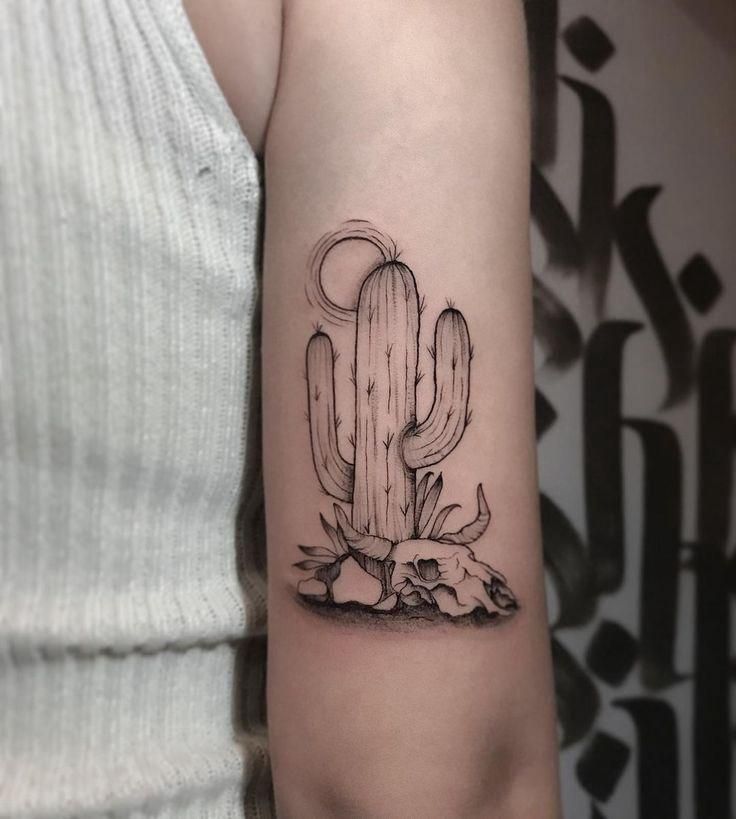
This upper-arm design has the atmosphere of a miniature Western story. A tall Saguaro dominates the composition, but the cattle skull resting among stones at its base changes the mood completely. Instead of reading as a simple botanical tattoo, the piece suggests an isolated desert where beauty and mortality naturally coexist.
The execution is particularly well suited to fine line tattooing. Thin vertical marks give the cactus its ribbed texture, while tiny irregular strokes create thorns without making the plant look overly dark. The skull receives slightly stronger shading, which gives the lower portion of the tattoo visual weight. That contrast is useful: without it, such a tall cactus could easily feel as though it were floating on the skin.
A loosely drawn circular sun or moon behind the upper section adds another layer without crowding the composition. I like this kind of imperfect circle in a tattoo because it keeps the work from becoming too polished. It feels more like an artist’s desert drawing transferred directly to skin.
For anyone exploring Western cactus tattoo ideas, this is a smart reference. The concept could also work as a stencil for a slightly larger forearm piece, with additional desert grass, flowers, or distant mountains added later. It has enough character to stand alone but could equally become the beginning of a botanical or Western sleeve.
Black and Grey Arizona Desert Landscape
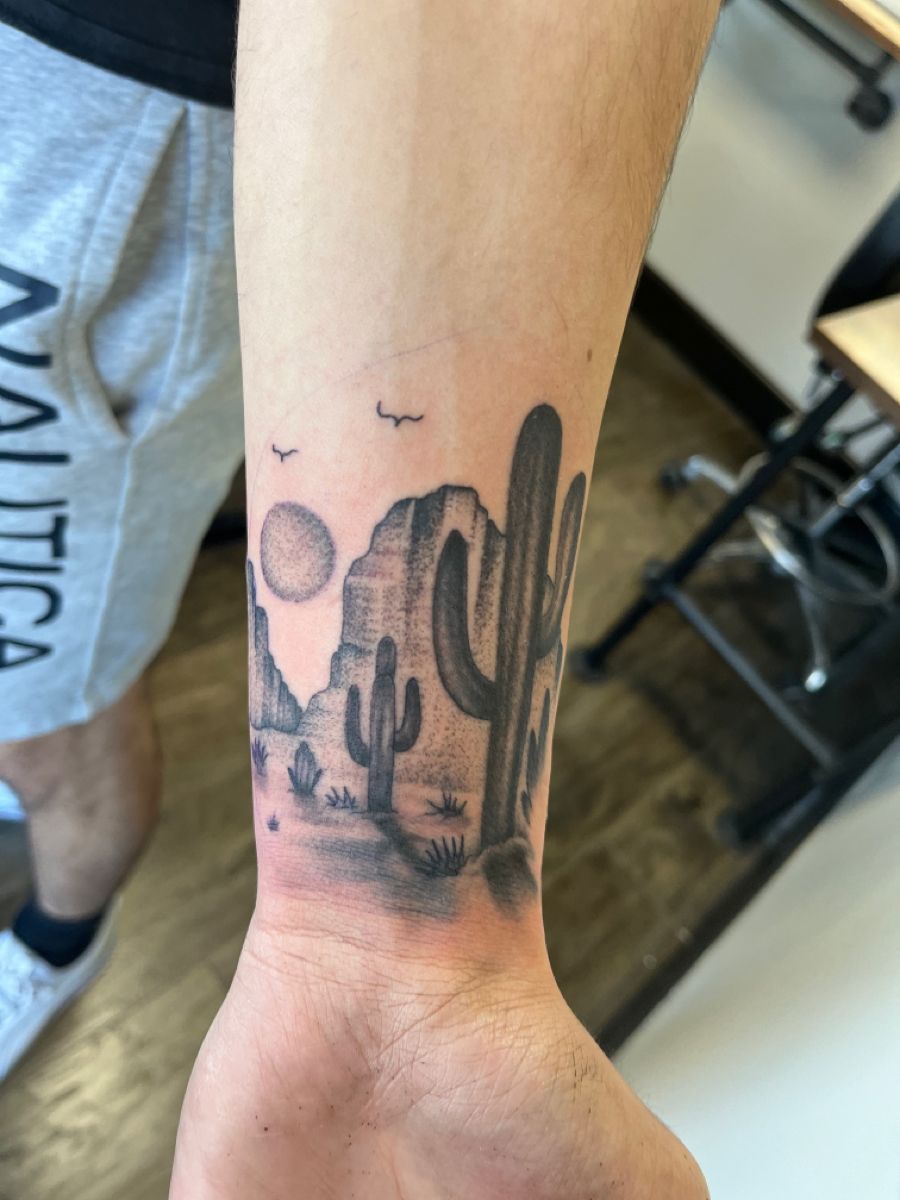
There is something cinematic about a desert landscape wrapped around the lower forearm. Here, several cacti rise in front of monumental rock formations, while a shaded sun hangs low in the sky and two tiny birds create a sense of distance. Rather than treating the cactus as an isolated symbol, the artist builds an entire environment around it.
The tall Saguaro on the right provides the strongest silhouette. Smaller cacti further back create depth, and the mountains are rendered with soft stippling rather than heavy outlines. This combination gives the piece the dusty, slightly hazy quality associated with Arizona and the American Southwest.
Black-and-grey shading is an excellent choice for this type of design. Full color might make every element compete for attention, whereas restrained grey tones allow the eye to move naturally from the foreground cactus toward the cliffs and sun. The gradual fade toward the wrist also prevents the tattoo from ending with an abrupt border.
This is a particularly good direction for men or women who want a landscape rather than a conventional plant tattoo. Enlarged, the same idea could form part of a Western sleeve, perhaps incorporating desert roads, horses, snakes, stars, or additional rock formations. Kept at this scale, however, it already feels like a complete little world.
Cute Flowering Cactus Tattoo in Bright Color
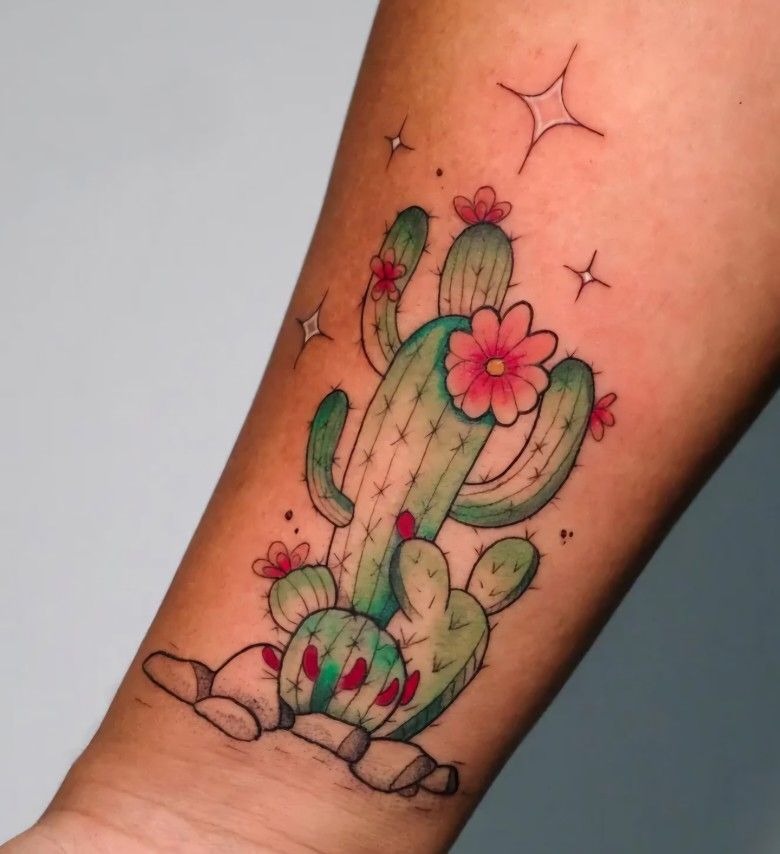
Not every cactus tattoo needs the dusty seriousness of a Western landscape. This colorful composition goes in the opposite direction, using several green cactus forms, pink flowers, tiny stones, and sparkling star details to create something cheerful and distinctly cute.
The central cactus has an almost animated quality because of its curved arms and exaggerated proportions. Pink blossoms interrupt the green throughout the composition, while deeper red accents provide small bursts of contrast. The coloring is deliberately soft rather than heavily saturated, allowing some of the skin tone to remain visible through the greens.
There is also a playful mix of cactus species. Taller forms sit alongside rounded prickly pear pads, giving the tattoo more visual variety than a single plant could provide. Small rocks create a foundation at the bottom, which makes the arrangement feel like a miniature desert garden.
This style is especially appealing for women who like botanical tattoos but do not want something overly delicate or serious. It could also inspire colorful flash designs, since individual elements—the flowers, prickly pear pads, stars, or small cactus—could easily be separated into tiny tattoos of their own.
One practical lesson here is that color does not need to fill every millimeter. The open areas keep the composition light, and that breathing room is what prevents a busy arrangement from looking cluttered.
Minimalist Desert Scene with Saguaro and Prickly Pear
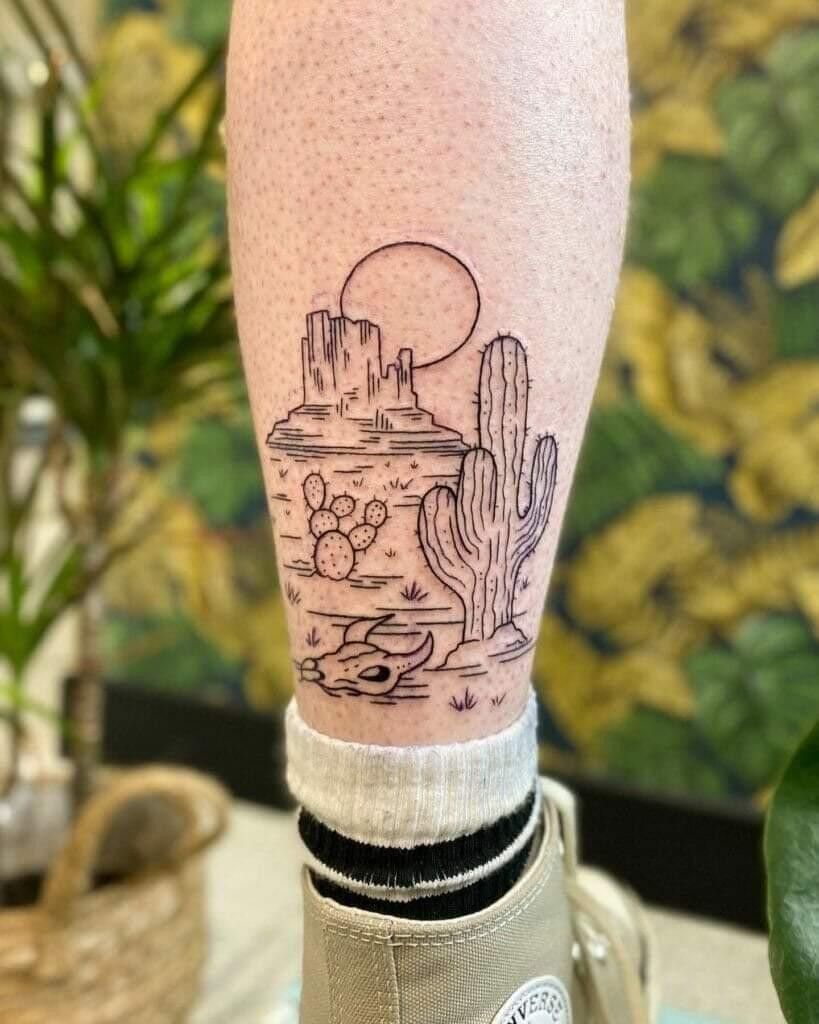
This lower-leg tattoo strips the desert landscape down to its most recognizable ingredients: a large Saguaro, a patch of prickly pear, distant mesas, a circular sun, sparse vegetation, and an animal skull in the foreground. The result feels like a page from a vintage travel sketchbook.
The linework is intentionally straightforward. Instead of smooth digital-looking curves, many of the marks have a slightly hand-drawn quality. Short parallel lines define the rock formations, tiny dots suggest cactus texture, and sparse strokes across the ground indicate vegetation without filling every empty space.
That restraint is what makes the tattoo work. A more detailed interpretation of the same scene could become visually dense very quickly. Here, each object has enough space around it to remain readable.
The large circular sun is especially effective because it balances the vertical cactus. Meanwhile, the skull near the bottom provides a darker narrative note associated with traditional Western imagery. It is not a fully traditional or American traditional tattoo—the outlines and shading are far lighter—but the subject matter shares the same affection for strong, instantly recognizable symbols.
For someone who wants a simple desert tattoo without reducing the concept to one tiny cactus, this approach offers a useful middle ground.
Tiny Potted Cactus with a Playful Message
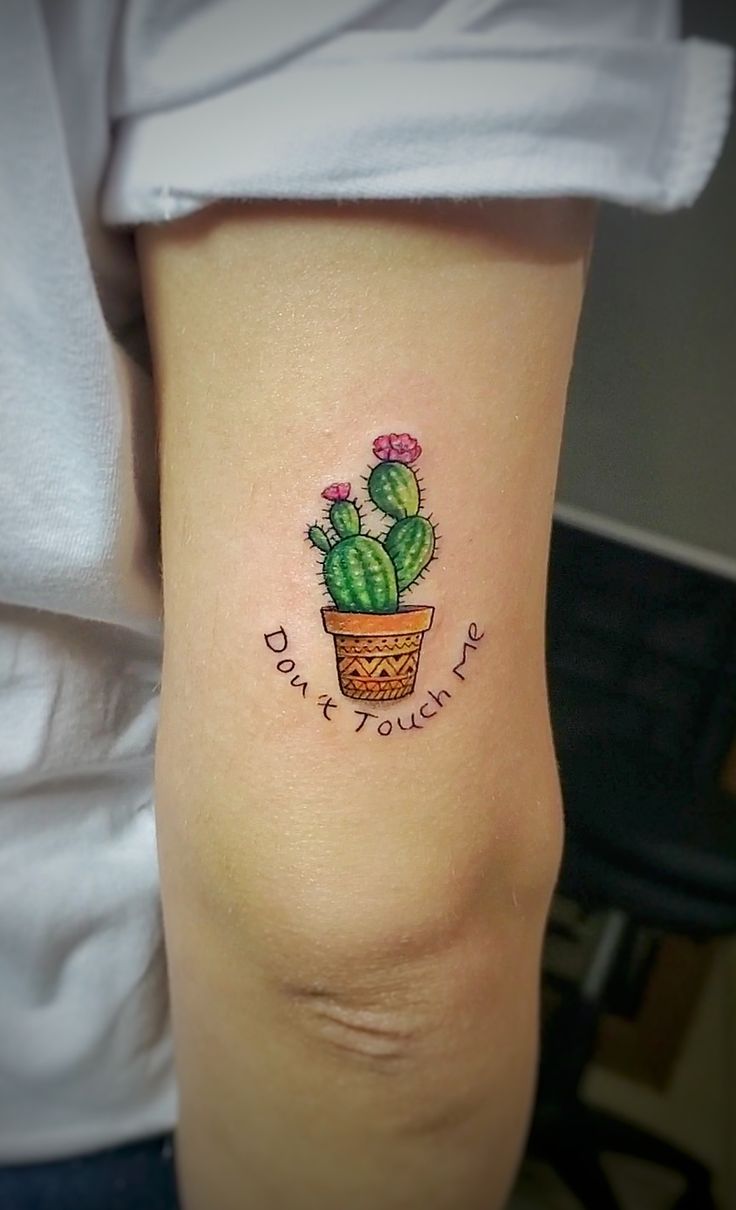
Small tattoos often work best when they commit to one clear idea, and this tiny potted cactus does exactly that. Three rounded green cactus stems emerge from a patterned terracotta-colored pot, with small pink flowers bringing a bright accent to the upper portion of the design.
The handwritten phrase curving underneath adds humor and personality. Instead of turning the cactus into a grand symbol of survival or the desert, the tattoo embraces the obvious joke surrounding a prickly plant. That makes it feel personal and casual—the kind of tattoo that can make its owner smile years after the novelty of getting it has passed.
Despite its size, the artist includes a surprising amount of detail. White and lighter green highlights create dimension inside the cactus pads, individual spines remain visible, and the geometric decoration on the pot gives the base its own character.
This is one of those minimalist ideas that could be adapted in dozens of ways. The pot could reference Mexican pottery, the flowers could be changed to a favorite color, or the handwritten text could be replaced with a personal phrase. It would also work without lettering for anyone who prefers a cleaner simple design.
And while cactus tattoos are sometimes associated with rugged Western imagery, this example proves the motif can be genuinely sweet.
Detailed Saguaro Botanical Study
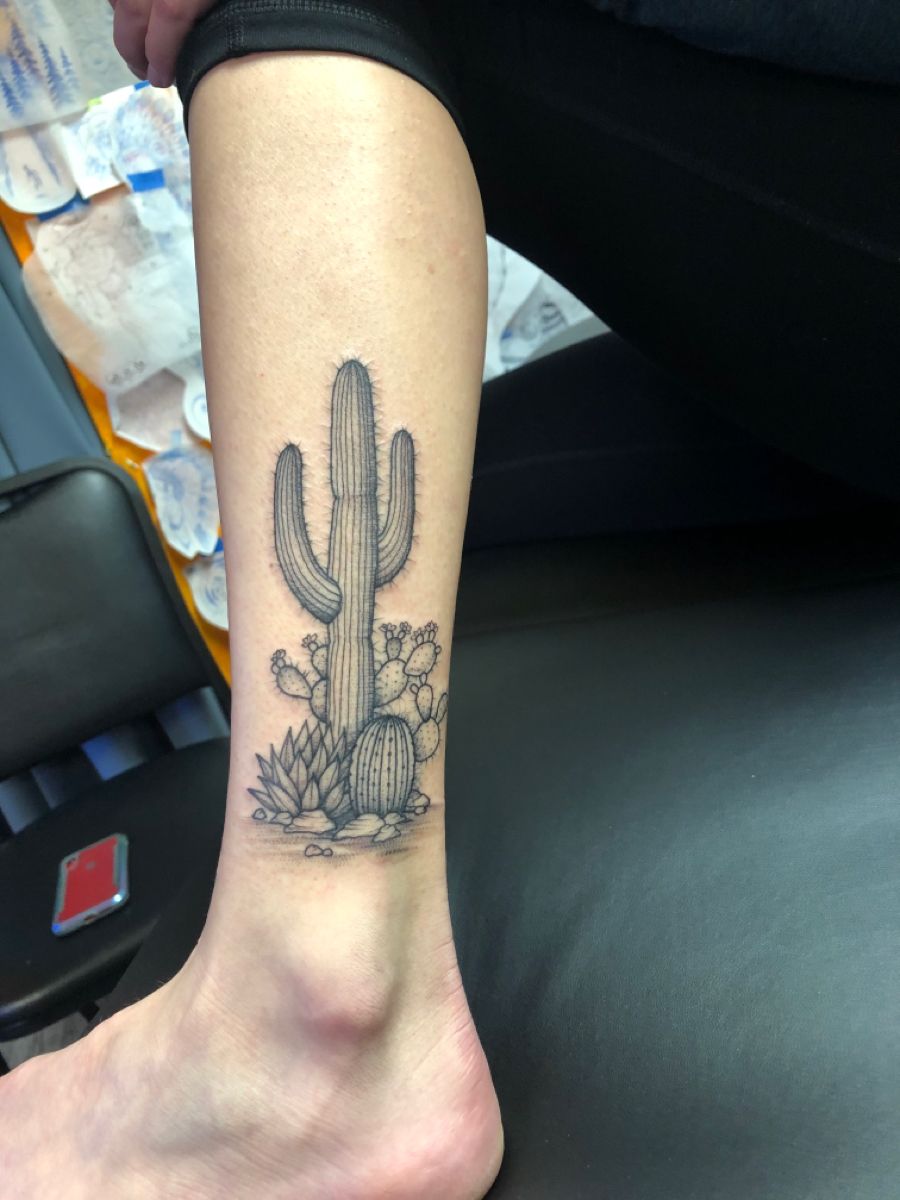
A tall cactus naturally suits elongated placements, and this lower-leg composition makes excellent use of that geometry. The central Saguaro rises vertically while smaller desert plants gather around its base, including rounded cactus forms, prickly pear pads, and a pointed succulent.
The style sits somewhere between scientific botanical illustration and fine line tattooing. Numerous narrow vertical strokes define the ribs of the Saguaro, while extremely small marks along the edges suggest its spines. The surrounding plants are handled with the same patience, giving the entire arrangement a cohesive texture.
What makes this design particularly successful is its hierarchy. The eye immediately recognizes the tall central cactus, then discovers the smaller plants around it. Nothing competes with the main silhouette.
There is no need for color here. Black ink emphasizes the structural beauty of the plants, making the tattoo feel more like an old botanical drawing than a decorative desert postcard. For people who save tattoo stencil references before an appointment, this is a useful example of how multiple plant species can be combined without losing clarity.
It is also a concept that could grow naturally. Additional desert plants could extend upward or around the leg, eventually developing into a botanical sleeve-style composition without making the original tattoo feel incomplete.
Bold Cactus Pair with a Southwestern Feel
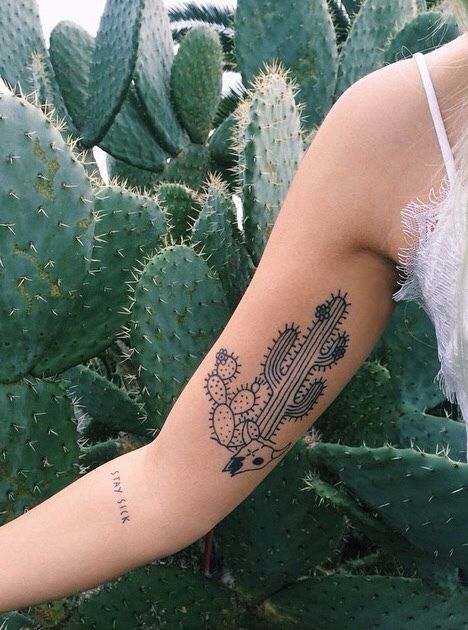
The final idea uses stronger outlines and a more graphic approach. A tall branching cactus is paired with a cluster of prickly pear pads, creating two contrasting silhouettes within the same compact composition. Small decorative marks and a pointed accent near the base give the tattoo an almost illustrative flash quality.
Compared with the more delicate fine line pieces, this one relies on bold contour work. That makes sense for the placement: the design remains readable from a distance, while the individual spines provide enough texture when viewed closely.
There is an unmistakable Mexican and Southwestern character to the combination of cactus varieties. The imagery also connects naturally with Arizona and broader Western aesthetics without needing mountains, sunsets, or cowboy imagery to explain the theme.
This could be an interesting starting point for an American traditional interpretation as well. An artist could increase the line weight further, add saturated green, yellow, and red, and introduce flowers or a banner to push the piece toward classic traditional tattoo language. Alternatively, keeping it entirely black preserves the contemporary illustrative quality seen here.
I have always found that the most memorable plant tattoos are not necessarily the most complicated ones. They are the ones whose silhouette you can recognize immediately. This piece understands that principle particularly well: even from several feet away, there is no mistaking the desert subject.
Celestial Saguaro Tattoo with Flowers and a Crescent Moon
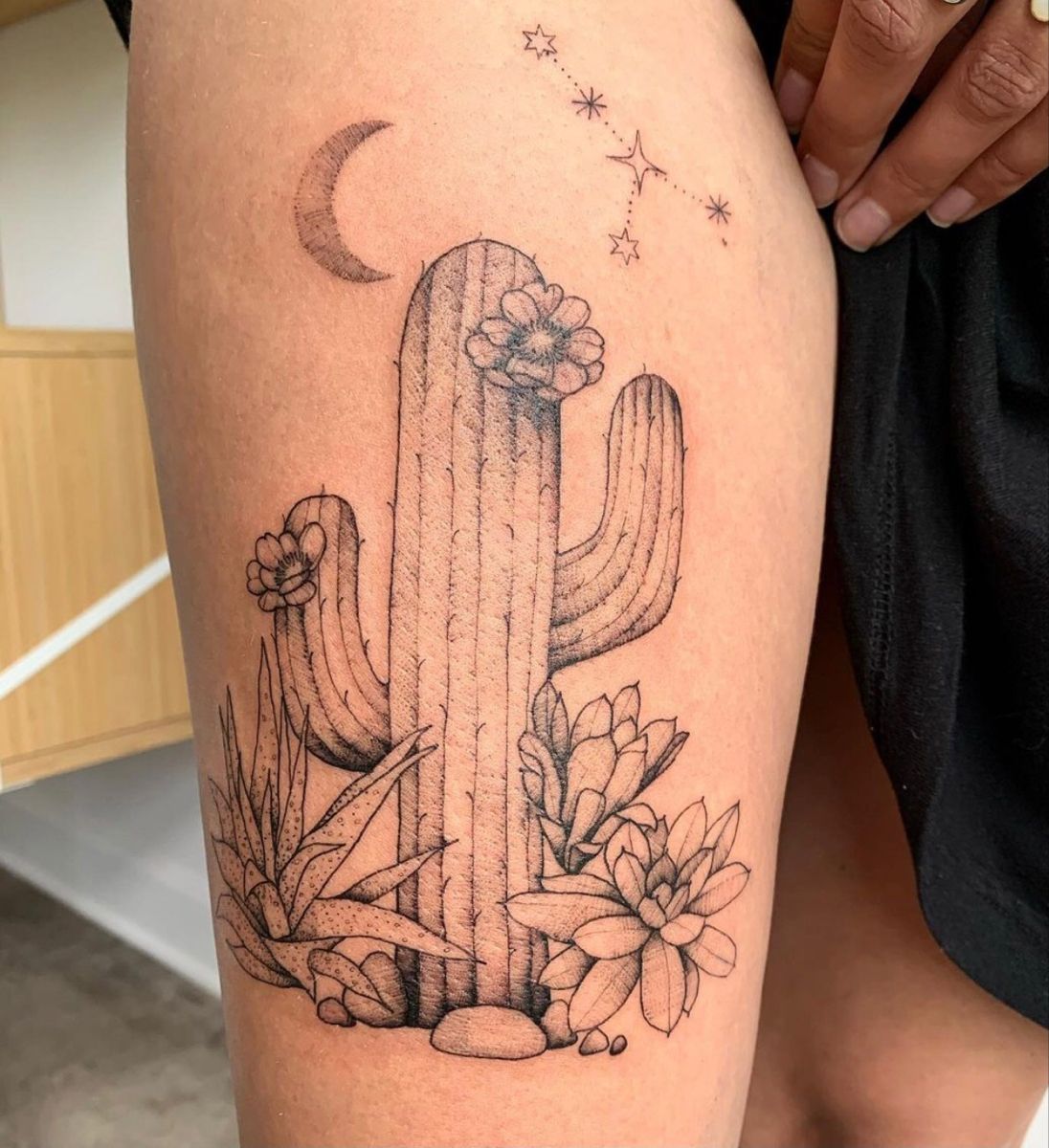
This large thigh piece takes the familiar Saguaro silhouette and gives it a softer, almost celestial personality. The tall central cactus is surrounded by succulents and desert plants at its base, while blooming flowers interrupt the vertical lines of the cactus itself. Above, a crescent moon and a loose trail of tiny stars create an airy counterpoint to the heavier botanical composition.
The fine line approach is particularly effective here. Vertical ribs are drawn with long, controlled strokes, while stippled shading creates dimension without turning the cactus into a solid black form. Around the base, pointed leaves, layered succulents, stones, and smaller botanical details make the tattoo feel like a carefully assembled desert garden.
There is also a nice balance between Western imagery and a more feminine botanical aesthetic. A conventional Arizona tattoo might pair a Saguaro with mountains and a sunset; adding flowers, moon imagery, and delicate stars makes this version feel more personal and contemporary. It is an especially strong direction for women looking for a substantial cactus tattoo that remains elegant rather than visually aggressive.
Placement matters here as much as subject. The thigh provides enough uninterrupted space for the cactus to stay tall and for the surrounding plants to retain their individual shapes. Reduced too far, those fine details would begin to compete with one another.
Tiny Minimalist Potted Cactus
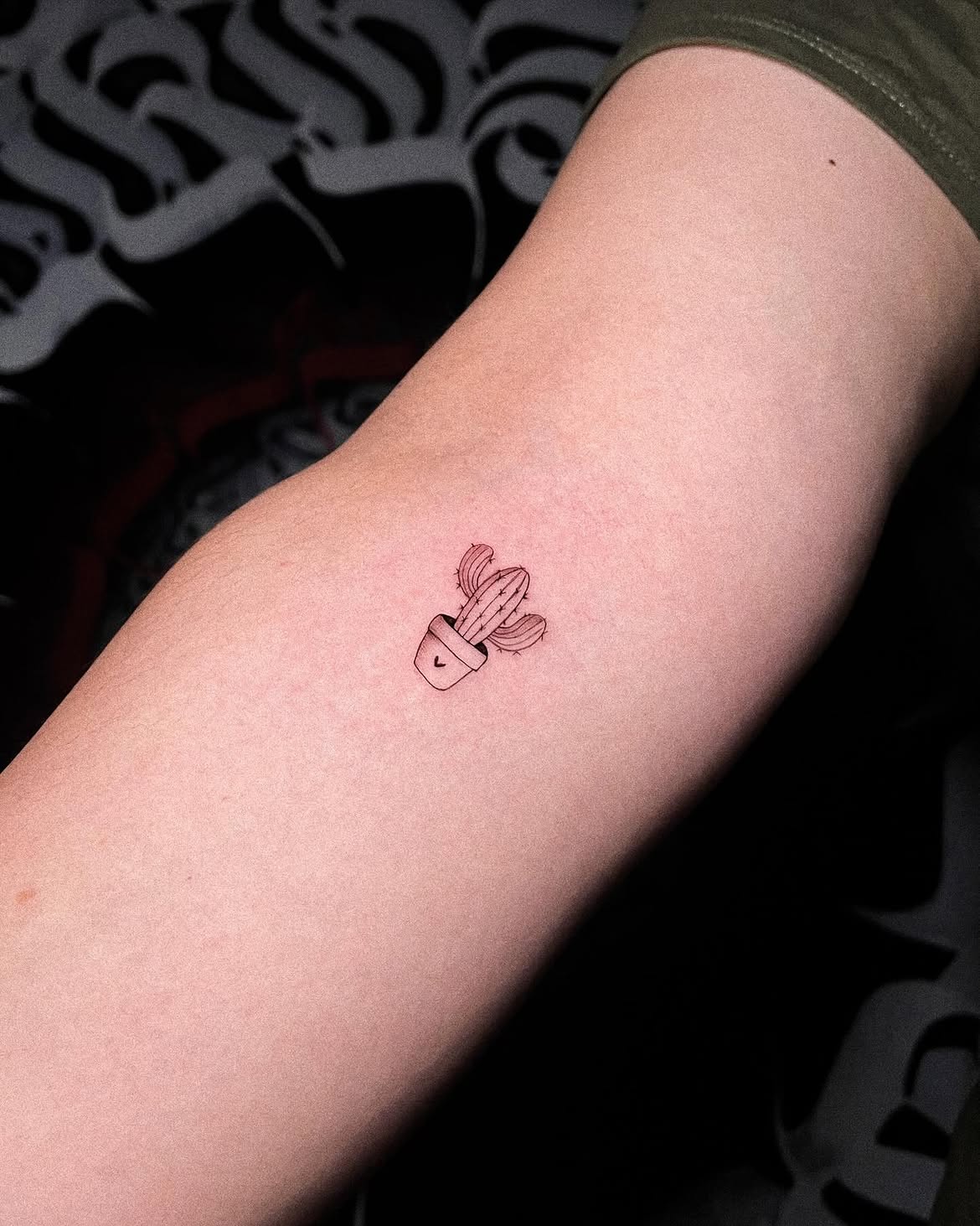
At the opposite end of the scale is this wonderfully tiny cactus, placed with plenty of open skin around it. The miniature plant sits inside a simple pot decorated with a small heart, giving the entire tattoo an understated and affectionate character.
This is minimalist tattooing in its most straightforward form. There is no landscape, color, or elaborate shading—just very thin black outlines, a few internal lines defining the cactus ribs, tiny spines, and enough detail to make the plant immediately recognizable.
What makes a tattoo this small successful is restraint. It is tempting to pack miniature designs with texture, but details that look impressive on a stencil can eventually become difficult to distinguish once placed at a tiny scale. Here, the artist keeps the drawing open and readable.
It is also an easy placement idea for someone getting a first tattoo. The design feels discreet without being anonymous, and the little heart gives it more personality than a generic cactus icon. Among Cactus tattoo ideas 2026, this is a good reminder that a memorable tattoo does not need to occupy much skin.
Mexican Stamp Cactus Tattoo
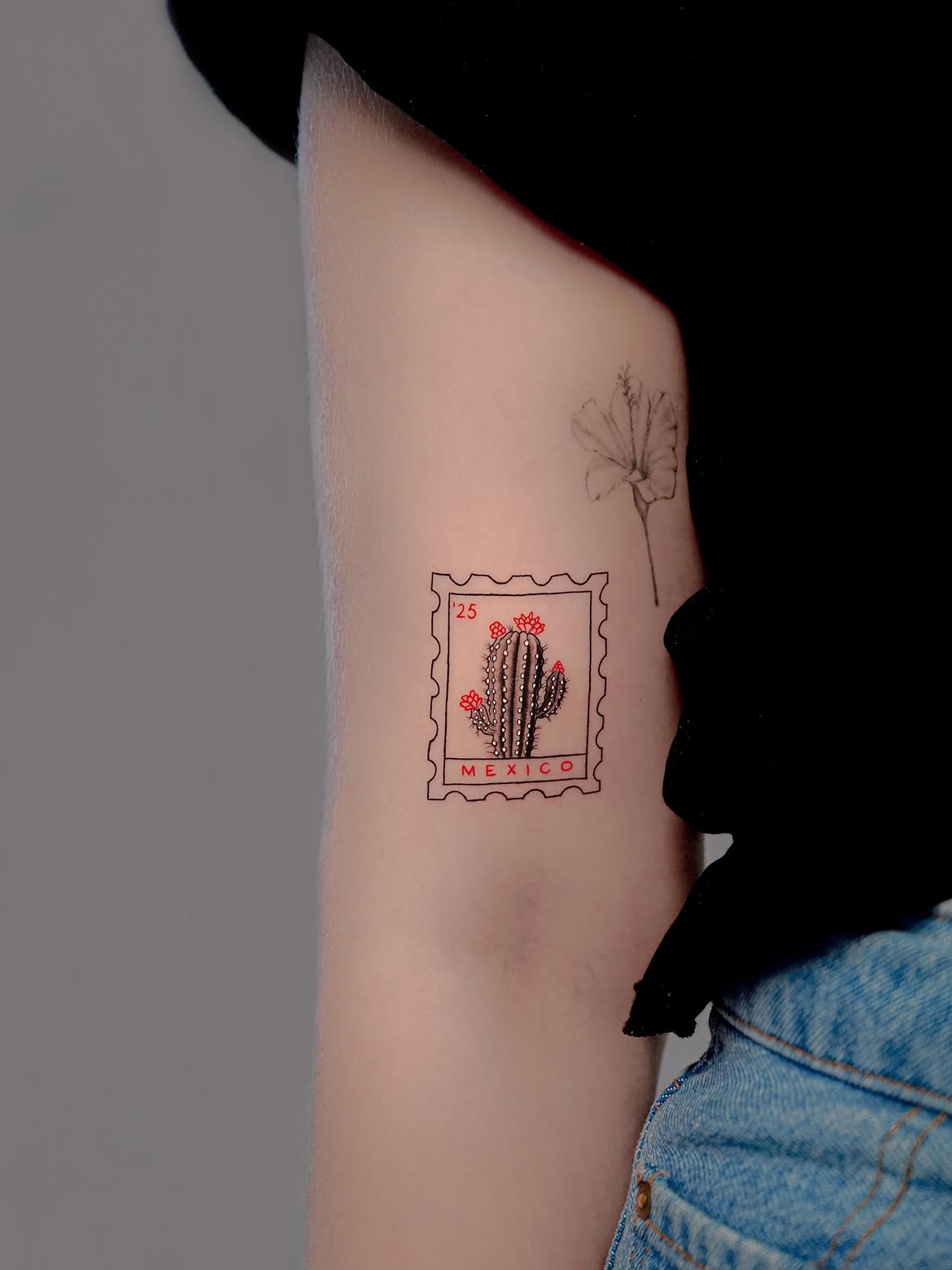
One of the most distinctive concepts in this collection turns the cactus into a miniature postage stamp. A flowering cactus occupies the center, framed by the perforated edge associated with vintage stamps, while red details include the number 25 and the word MEXICO along the bottom.
The Mexican reference is direct, but the execution keeps it stylish rather than souvenir-like. Black remains the dominant ink, while selective red creates a sharp accent in the lettering and flowers. That limited palette gives the design the graphic quality of vintage printed ephemera.
This is also an excellent example of how tattoo artists can move beyond straightforward botanical drawing. The cactus remains the subject, yet the stamp format adds ideas of travel, memory, origin, and place. Someone could adapt the same structure around a meaningful destination, year, denomination, or personal symbol.
I can imagine this working particularly well as part of a travel-themed flash collection. The defined rectangular silhouette also makes it easy to combine with other small tattoos without the elements visually merging together.
Fine Line Prickly Pear with Desert Blossoms
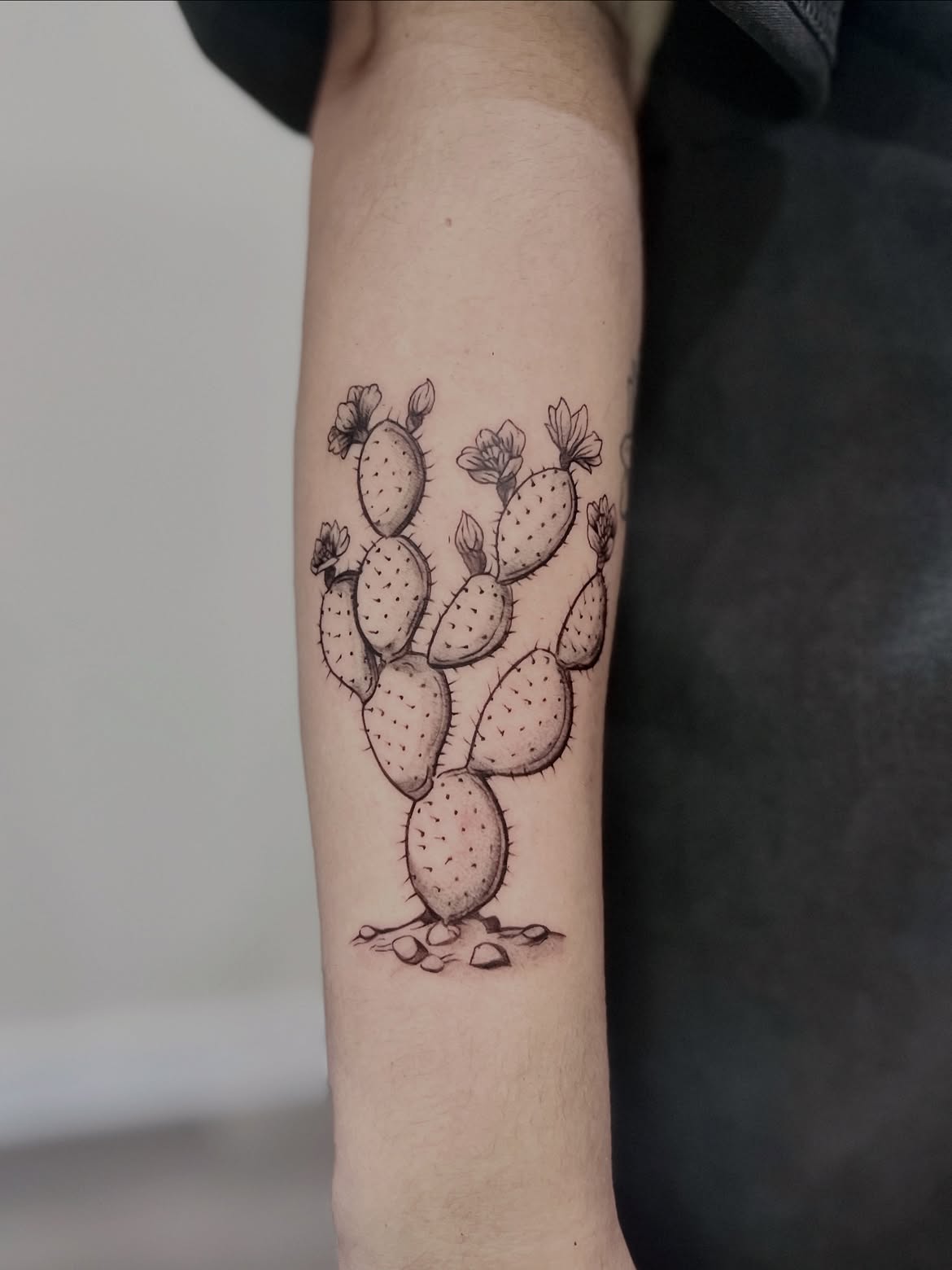
The prickly pear deserves more attention in cactus tattooing. Its stacked oval pads create a completely different rhythm from the upright Saguaro, and this forearm piece shows how beautifully that structure translates into black ink.
Several pads branch naturally from a central base, gradually spreading outward as the composition rises. Small blossoms and buds sit at the ends, adding delicate shapes to an otherwise thorny plant. Rather than using dense shading, the artist relies on thin contours, tiny dots, short spine marks, and restrained grey work inside the flowers.
The result falls comfortably between realistic botanical illustration and fine line tattooing. It feels detailed without becoming fussy.
The forearm is an especially sensible placement because the plant’s irregular vertical shape follows the available space while leaving a clean margin around the design. This could easily be expanded later with additional Mexican or Arizona flora, although I would personally leave this one alone—the empty skin around those branching pads is part of what makes it so attractive.
For anyone searching for a cactus tattoo stencil that is more organic than a symmetrical Saguaro, prickly pear is worth considering.
Small Color Saguaro in a Rustic Pot
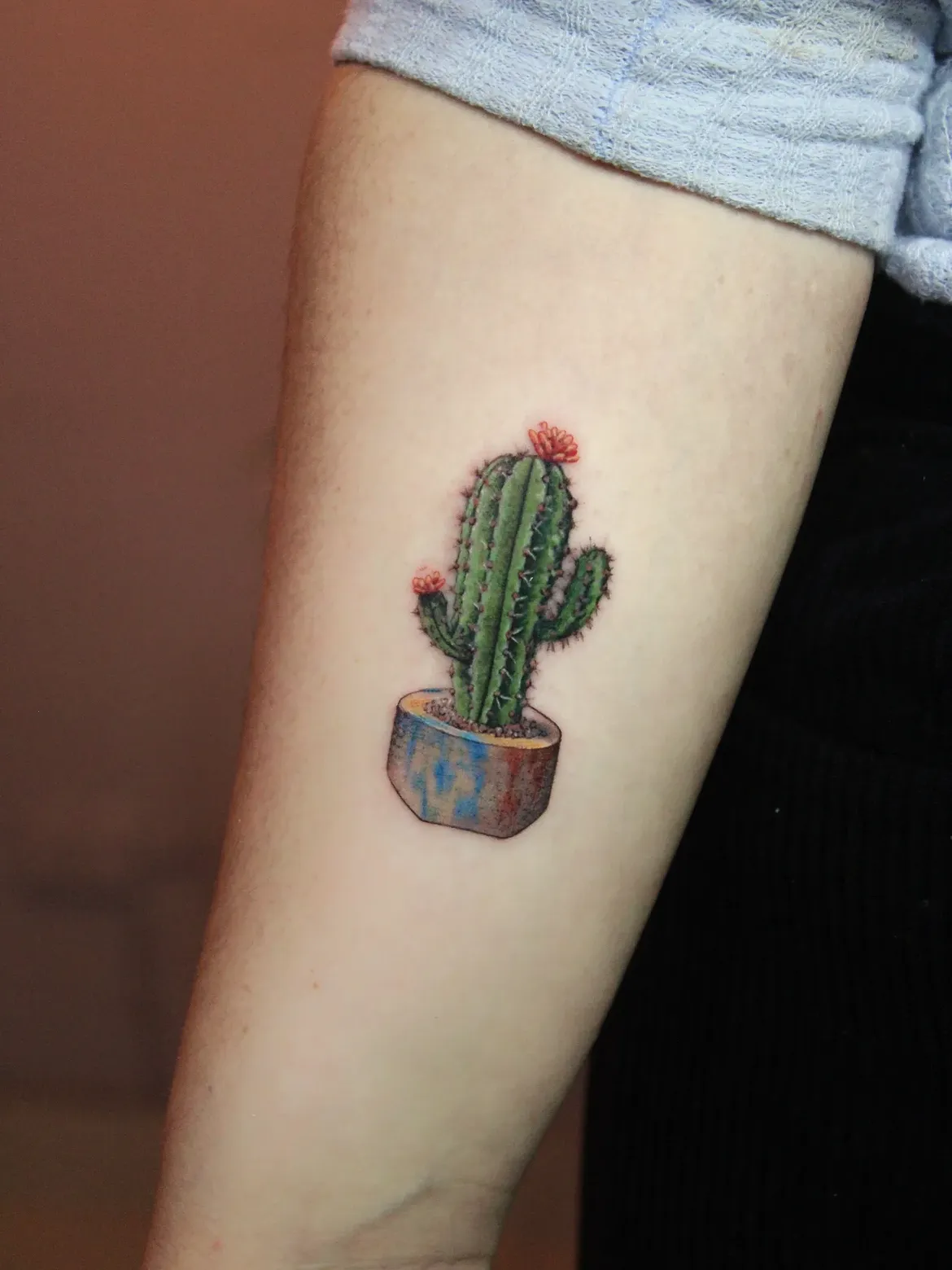
This compact color tattoo feels closer to a tiny botanical portrait than a cartoon cactus. The central plant uses several shades of green to describe its ribs, with dark edges and individual pale spines creating surprisingly convincing texture. Small reddish-orange flowers at the top and on the arms provide warm accents.
The pot deserves attention too. Instead of a perfectly clean geometric container, it has uneven blue, rust, ochre, and earthy tones that suggest weathered ceramic. That imperfect finish gives the tattoo a handcrafted character and keeps the cactus from looking like a generic digital illustration.
Color is used thoughtfully. The green remains natural rather than neon, and the flowers are bright enough to draw attention without overwhelming the plant.
A potted Saguaro is also an appealing compromise for anyone who likes Arizona and Western cactus imagery but does not necessarily want a complete desert landscape. The container makes the motif feel domestic and personal—as though a small piece of the desert has been brought home.
It is a cute design, certainly, but the botanical texture prevents it from becoming overly whimsical.
Cute Cactus Family in a Pot
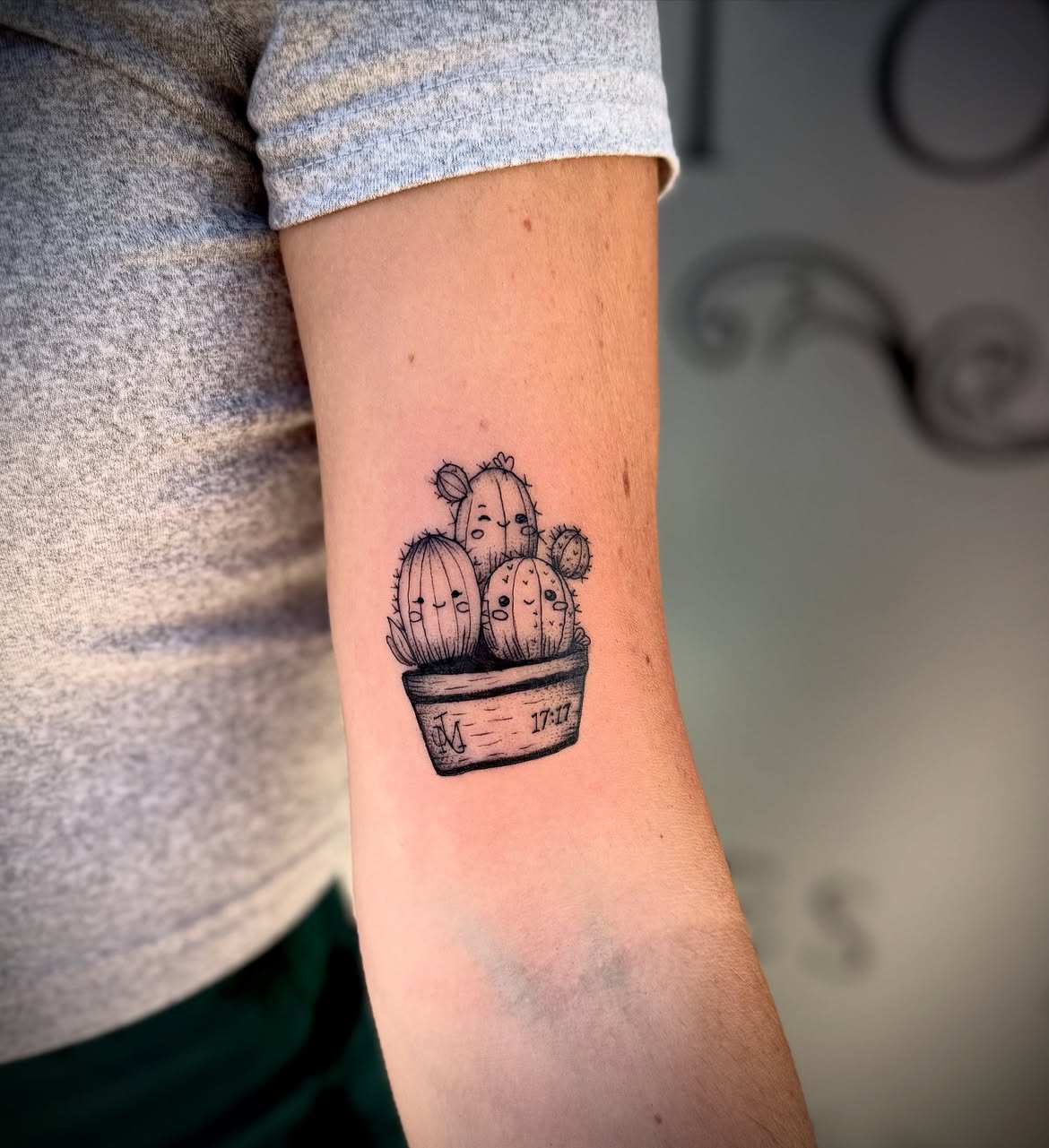
Three little cacti squeezed together in one pot give this tattoo an unexpectedly expressive personality. Each plant has its own face, markings, and shape, turning a straightforward botanical subject into a tiny cast of characters.
This kind of cute cactus tattoo works because the humor is understated. The faces are made from only a handful of tiny lines and dots, while the rest of the design retains recognizable cactus textures—ribs, spines, buds, and small surrounding growth. Fine black shading beneath the plants and around the pot provides enough depth to stop the piece from feeling like a flat doodle.
There is potential symbolism here too. Three cacti could represent siblings, children, close friends, or members of a family. Personal numbers or initials can be incorporated into the pot, making an already playful tattoo more specific to its wearer.
It is easy to imagine this concept becoming Christmas cactus flash as well: tiny lights, stars, ornaments, or a miniature Santa hat could transform the group into a seasonal design without losing its basic charm.
The placement on the inner arm keeps it visible enough to enjoy regularly, which feels appropriate for a tattoo built around personality rather than dramatic symbolism.
Simple Fine Line Cactus and Succulent Pot
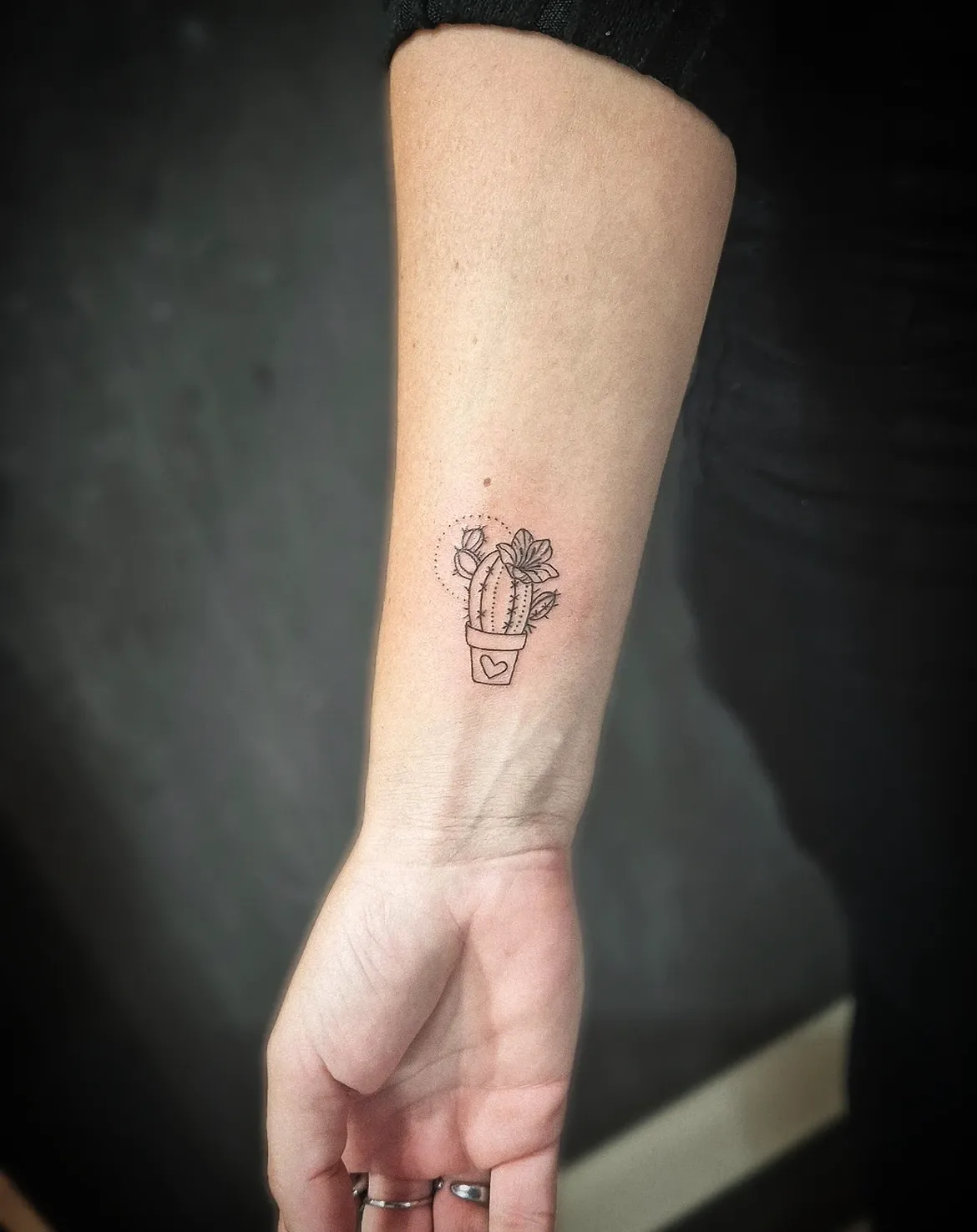
This small inner-forearm tattoo finds a pleasant middle ground between the ultra-minimalist cactus and a detailed botanical arrangement. A ribbed cactus sits in a tiny flowerpot alongside succulent-like leaves and buds, while a heart outlined on the front of the pot provides the only decorative symbol.
Everything is rendered in delicate black linework. The cactus uses repeated vertical lines and tiny spine marks, while the leaves are drawn with enough internal detail to separate them from the central plant. A dotted circular accent behind the upper portion subtly frames the arrangement without creating a hard border.
The scale makes the design easy to wear, but it does not feel generic. That is largely because the composition includes several botanical shapes instead of relying on a single cactus icon.
For someone who brings a simple reference drawing to a tattoo appointment, this is a good example of how an artist can add just enough detail to make the final piece feel custom. It could suit both men and women, although its delicate proportions and compact inner-arm placement are especially popular in contemporary fine line work.
Mexican Saguaro with a Sombrero
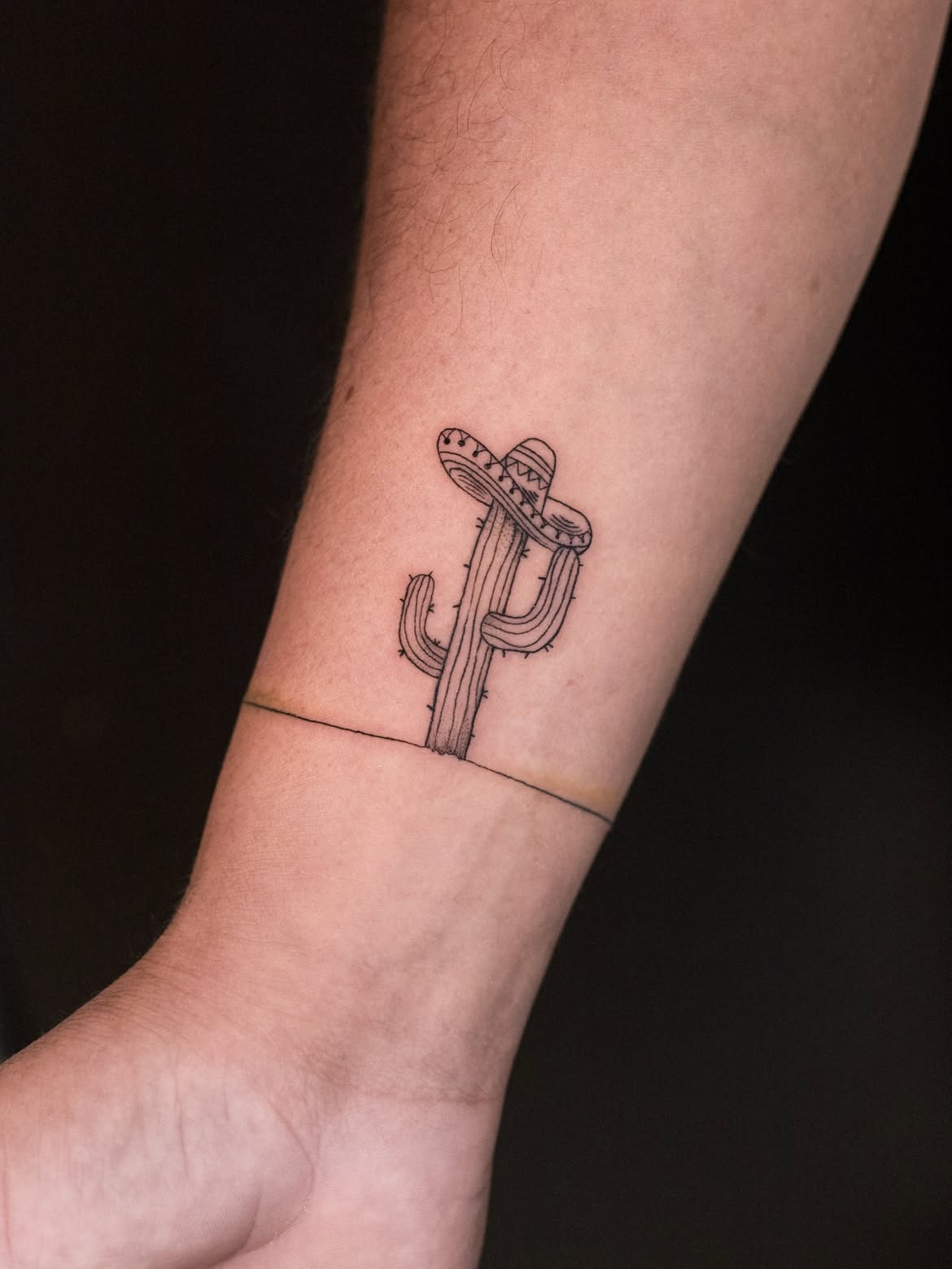
A simple Saguaro becomes instantly more playful when it is topped with a patterned sombrero. The tattoo uses extremely restrained black linework: long parallel strokes create the cactus ribs, tiny marks indicate thorns, and geometric decoration gives the hat enough personality to become the focal point.
What I particularly like is the horizontal line crossing behind the cactus near the wrist. It works almost like a horizon and anchors an otherwise floating figure. The artist has avoided unnecessary shading, so despite the decorative hat, the tattoo still reads as a clean fine line design.
The Mexican influence is unmistakable, but the execution remains minimal rather than turning into a complicated themed scene. This would also translate nicely into a tattoo flash sheet alongside chili peppers, agave, desert suns, cowboy boots, or smaller prickly pear motifs.
For a more colorful variation, muted red, green, turquoise, or ochre could be introduced into the sombrero while leaving the cactus itself black. As it stands, though, the monochrome approach gives the piece a charming hand-drawn character.
Colorful Flowering Cactus with a Personalized Pot
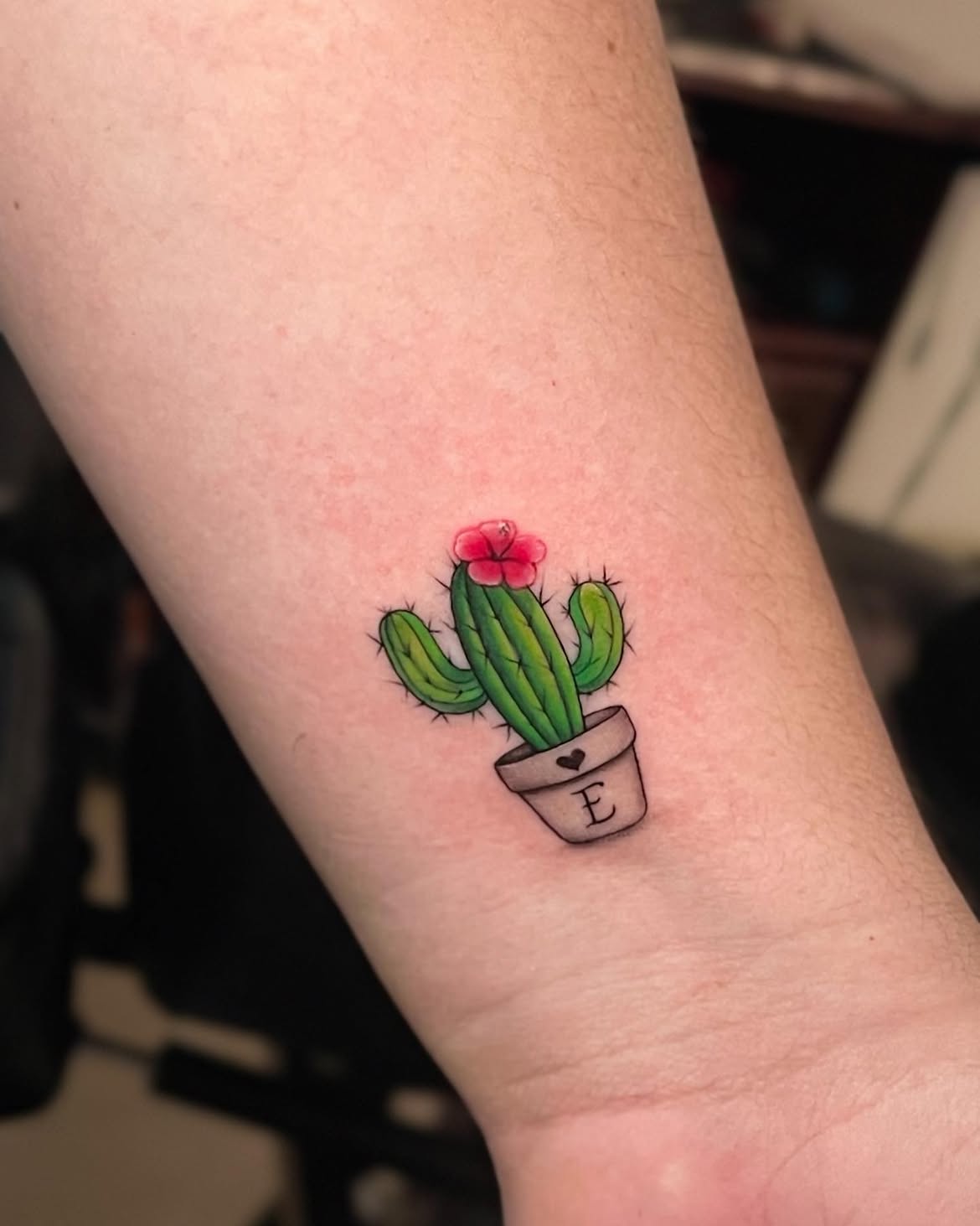
This compact forearm tattoo proves how effective a little color can be. The cactus is filled with several shades of fresh green, while a bright pink-red flower sits at its crown. A small heart and letter on the pot turn an otherwise familiar botanical motif into something more personal.
Strong black contours keep the image crisp. Rather than applying one flat green, the artist uses alternating tones along the cactus ribs, giving the plant dimension without requiring realistic shading. The black thorns provide sharp contrast against those bright areas.
This is a genuinely cute cactus tattoo, yet it still feels polished enough to avoid looking childish. The personalization is especially useful as inspiration: an initial, date, tiny word, or symbol can make a common cactus design specific to its wearer.
It would work well for women who want a small colorful piece, but the underlying idea is completely adaptable. Changing the pot, flower, lettering, or palette could transform the same basic composition into dozens of individual designs.
Minimalist Saguaro, Prickly Pear and Desert Sun
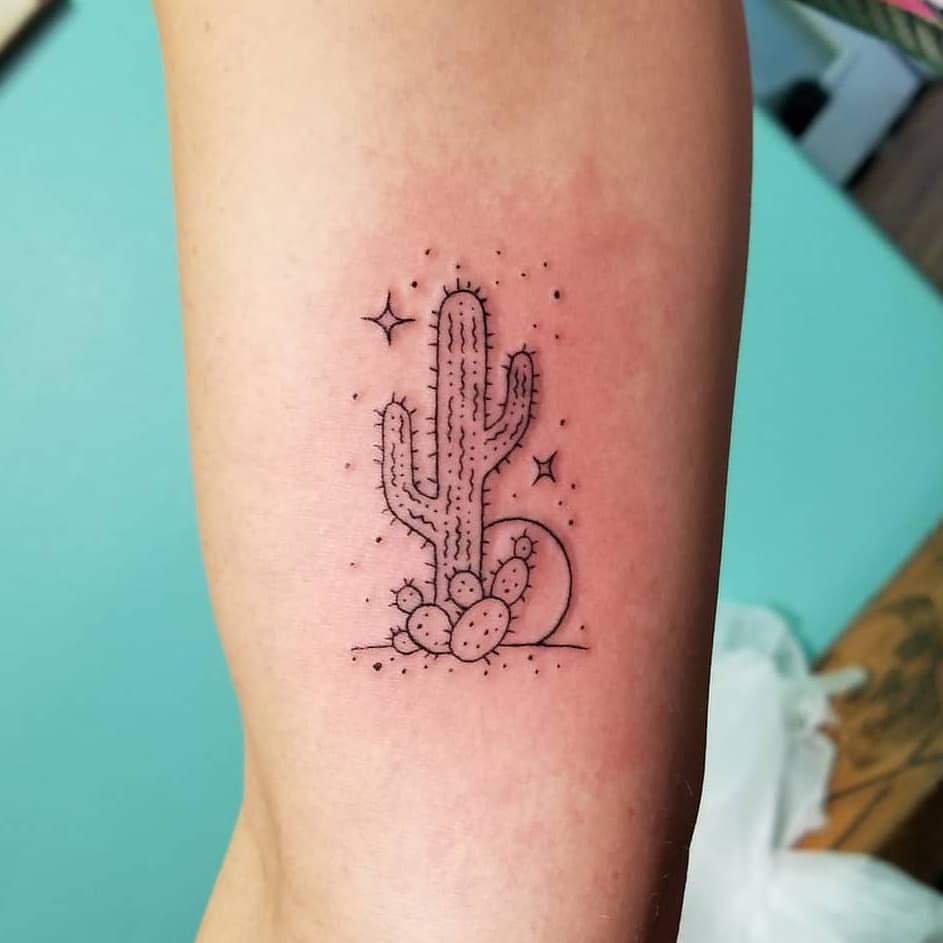
This design compresses an entire desert scene into a surprisingly small area. A tall Saguaro forms the center, several prickly pear pads cluster around its base, and a simple outlined sun emerges from behind them. Small dots and four-point stars fill the surrounding negative space.
The tattoo has a very clean illustrative rhythm. Nothing is heavily shaded, so the eye immediately picks up the silhouettes rather than texture. Fine internal lines give the Saguaro enough structure, while dots and tiny spine marks distinguish the smaller cacti.
It is a particularly approachable version of an Arizona tattoo. Instead of mountains, animal skulls, or a large sunset, the artist reduces Southwestern imagery to a handful of essential forms.
This type of minimalist composition also makes a useful stencil reference because its elements can be resized or rearranged easily. The sun could become orange or red, the stars could be removed, or the prickly pear could be enlarged without changing the central concept.
Cowboy Cactus with Boots, Hat and Lasso
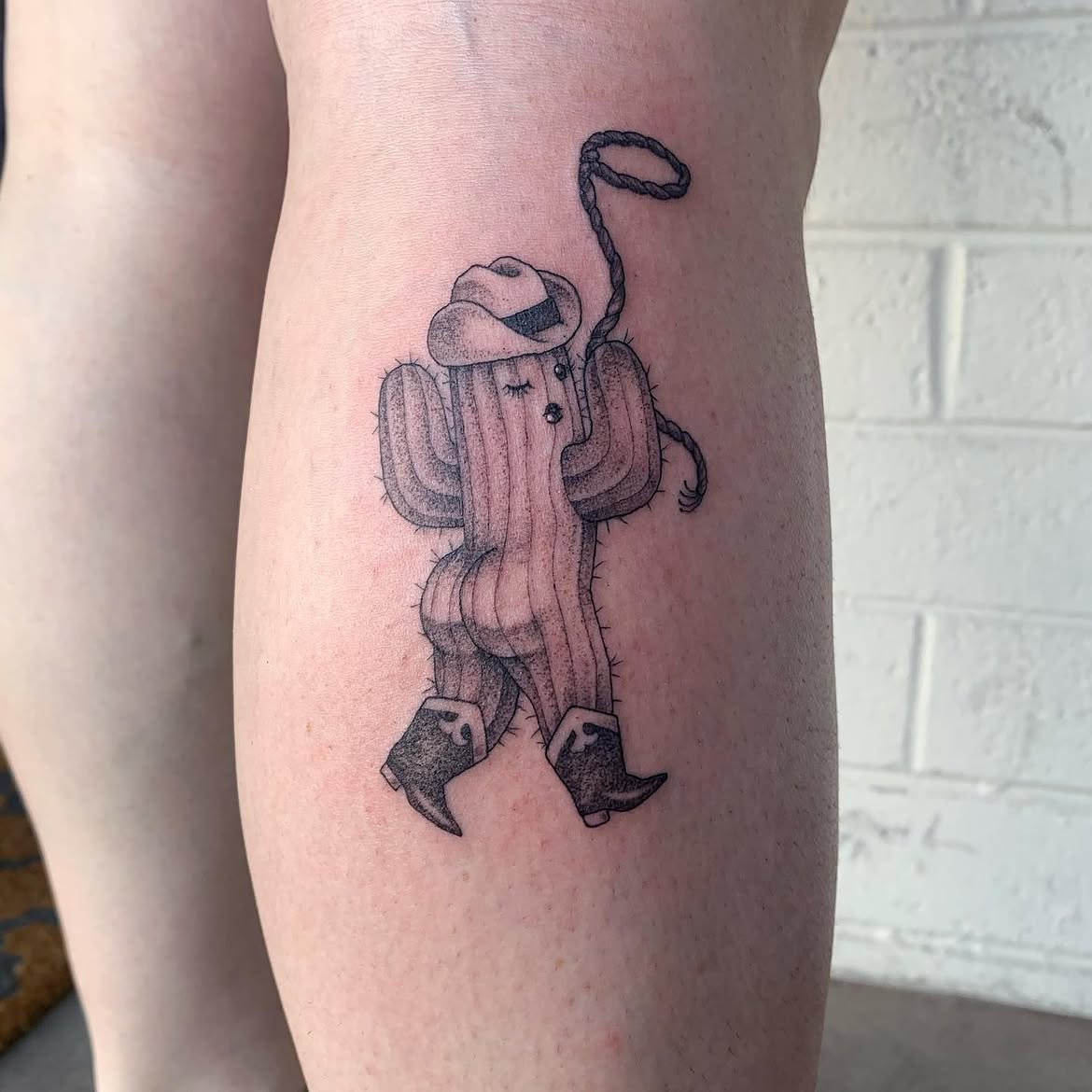
Some cactus tattoos symbolize endurance. This one appears more interested in having a good time.
The cactus has been transformed into a full Western character, complete with cowboy hat, boots, facial features, and a raised lasso. Its curved arms naturally become part of the pose, making the familiar Saguaro shape surprisingly well suited to anthropomorphic tattoo art.
Black-and-grey shading gives the piece a vintage illustrated quality. The hat and boots receive the darkest values, while vertical lines preserve the cactus texture through the center. Small thorns are still visible, so the plant identity never disappears beneath the costume.
This is one of the more humorous ideas in the collection, but it could also inspire a fantastic American traditional version. Bold black outlines, deep green cactus skin, brown boots, a tan hat, and red or yellow highlights would push the character firmly into traditional flash territory.
For anyone building a Western sleeve, a character like this could sit alongside horseshoes, dice, snakes, cowboy skulls, desert flowers, revolvers, or traditional roses. As a standalone piece, however, its unusual personality is already enough.
Tiny Cosmic Saguaro with Stars
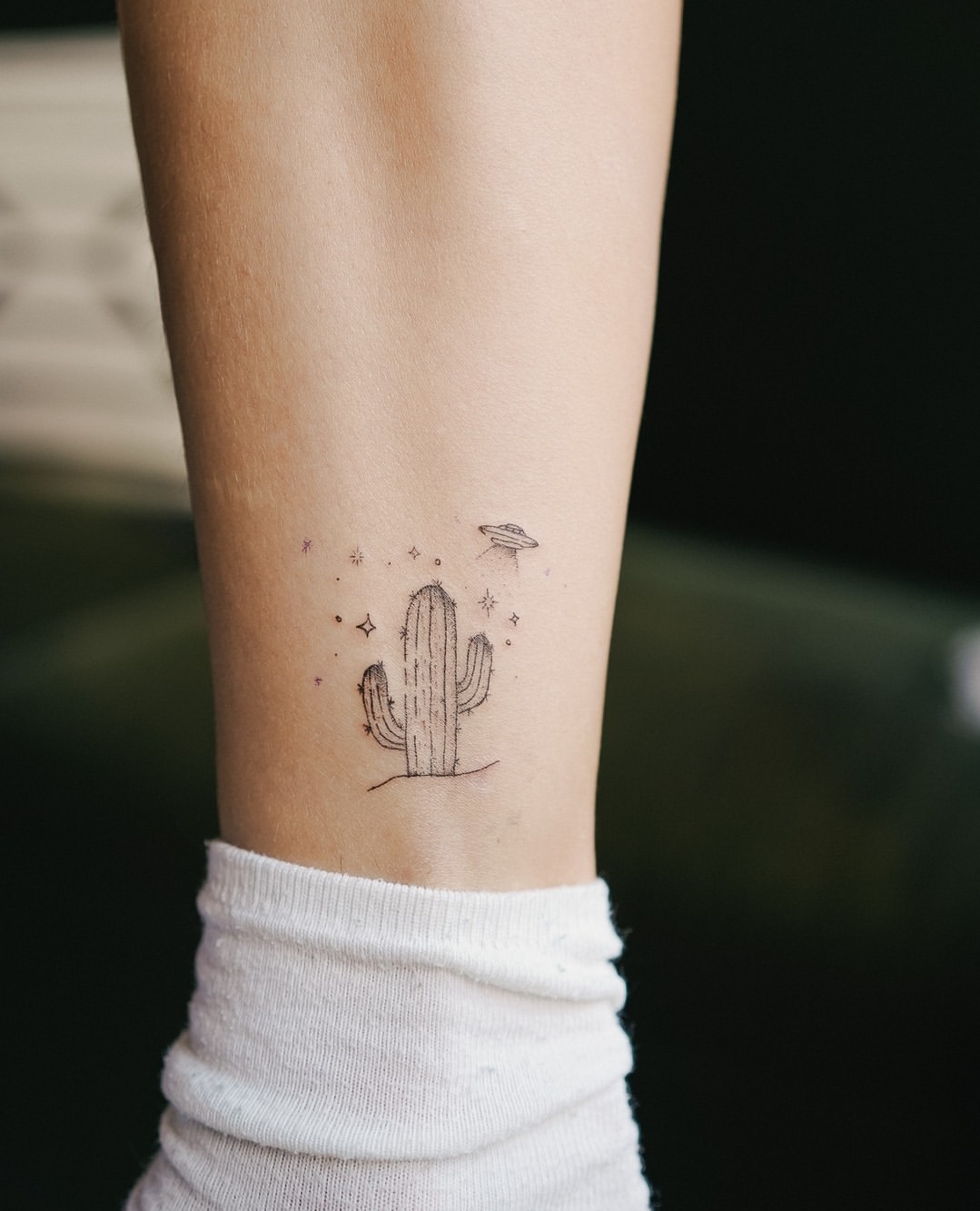
Here the Saguaro is reduced to a delicate little desert symbol surrounded by stars, dots, and what appears to be a tiny flying saucer above it. The result feels somewhere between Western minimalism and a playful extraterrestrial postcard from the desert.
The cactus itself is almost sketch-like. Very thin vertical strokes form the ribs, with slightly irregular edges that keep the tattoo from looking mechanically perfect. Around it, miniature stars and scattered dots provide atmosphere without creating a defined frame.
This is exactly the sort of tiny fine line tattoo that benefits from negative space. The surrounding skin becomes part of the composition, giving every little cosmic detail room to register.
The UFO is a clever addition because desert landscapes and extraterrestrial folklore have been connected in popular culture for decades. Yet the reference is so subtle that the tattoo remains primarily botanical.
For someone who wants a simple cactus design with one unexpected detail, this is much more memorable than adding extra decorative foliage simply to fill space.
Graphic Black Saguaro Tattoo for Men
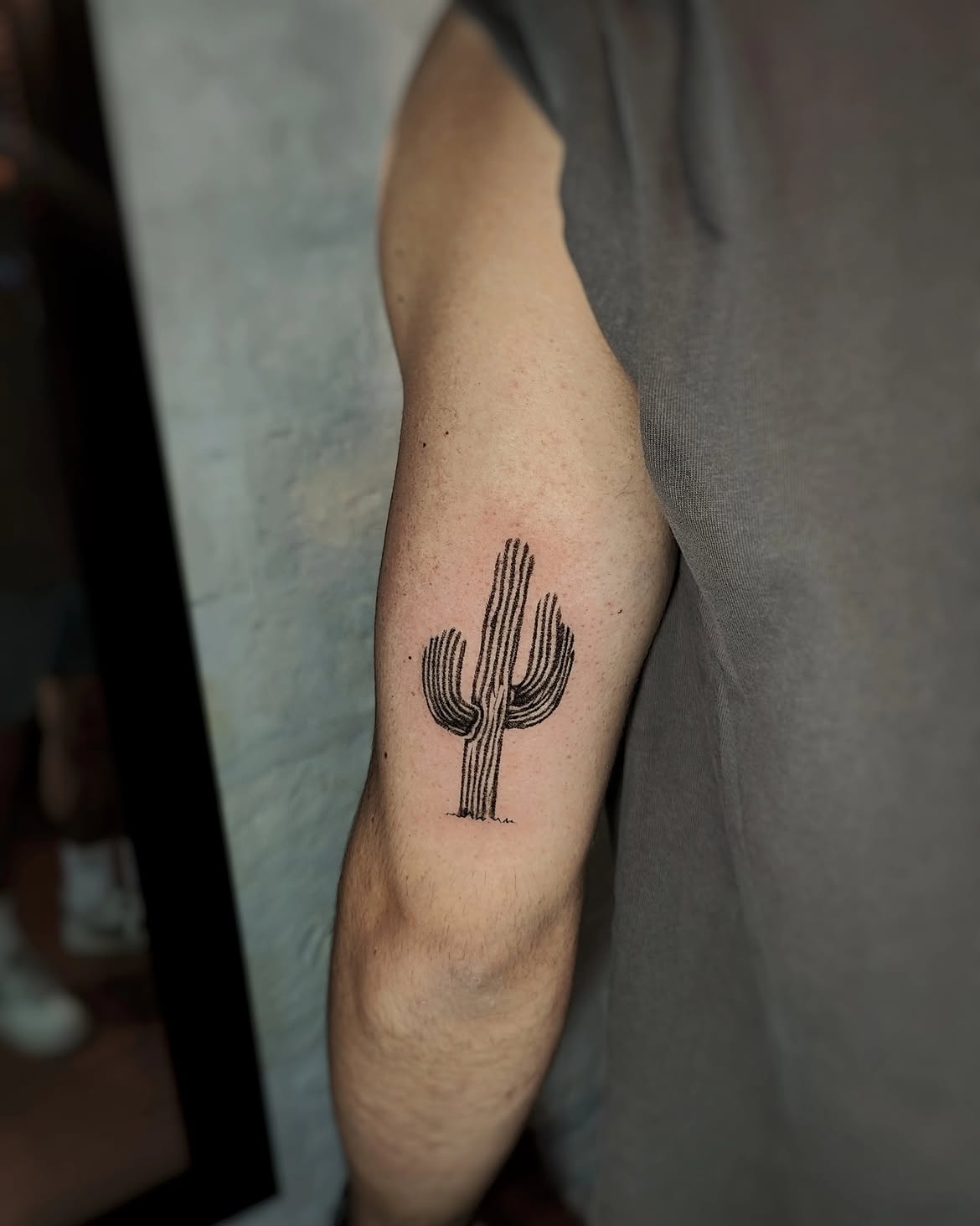
This Saguaro takes a completely different approach to the delicate tattoos elsewhere in the collection. Instead of fine botanical details, the artist builds the entire cactus from repeated heavy black lines, creating a bold graphic silhouette.
The parallel strokes bend smoothly around both arms before returning to the central trunk. There are no flowers, stars, pots, landscapes, or obvious Western accessories. Even thorns are absent. The identity of the cactus comes almost entirely from shape.
That reduction makes the piece particularly strong. It is minimalist, but not fragile; simple, but not anonymous. The thicker application of black also gives it enough visual presence to suit someone who finds conventional fine line tattoos too delicate.
This style is an especially useful reference for men looking for a compact cactus tattoo with a stronger graphic feel. The upper arm placement works well because the vertical design follows the limb and remains readable from a distance.
There is something almost logo-like about it, and in this case that is a compliment. The artist has stripped the Saguaro down until only its most recognizable visual information remains.
Arizona Saguaro with an Orange Desert Sun
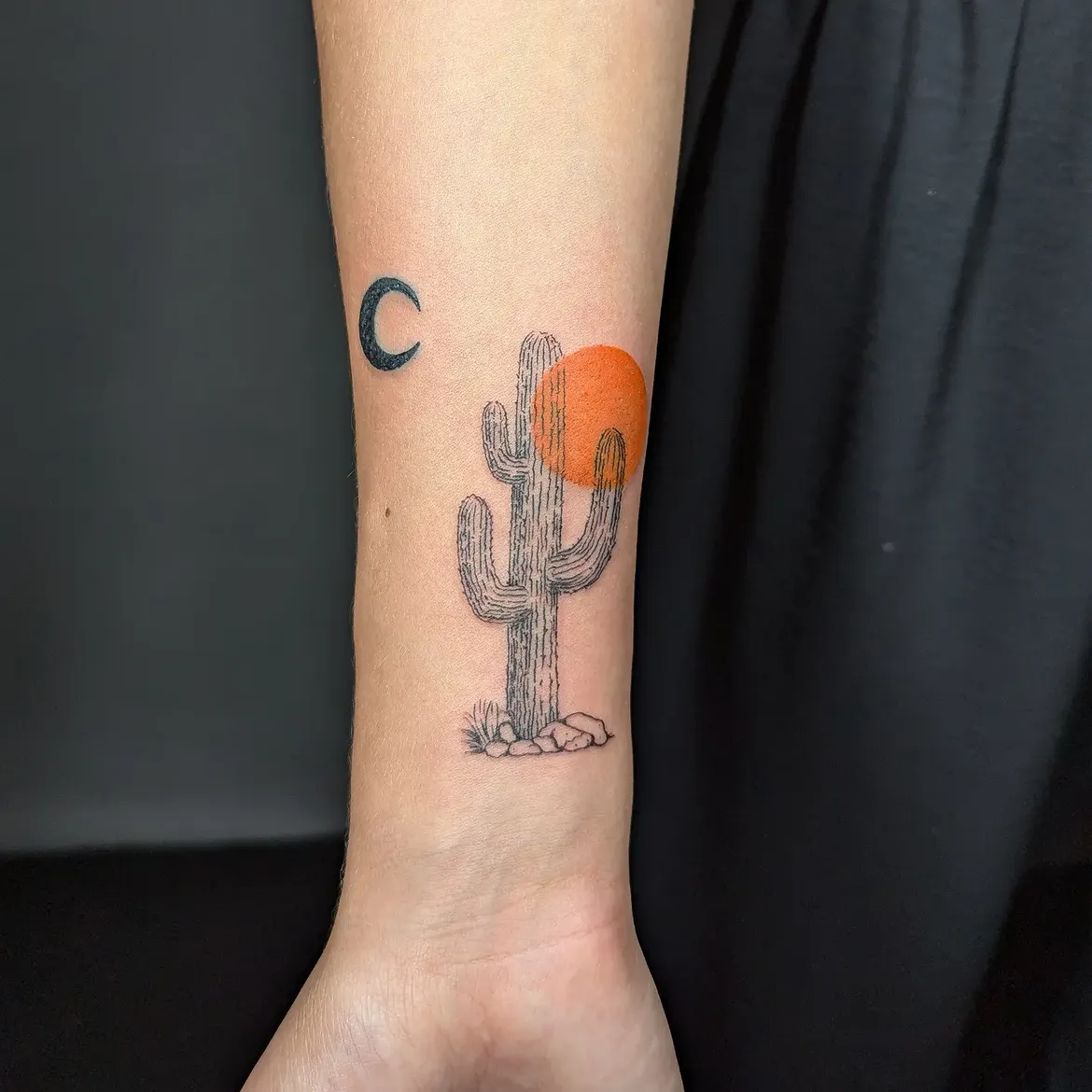
Few combinations communicate the American Southwest as quickly as a tall Saguaro against a glowing orange sun. This forearm tattoo uses that familiar image but gives it a contemporary finish through thin black-and-grey linework and a single saturated circle of color.
The cactus is rendered with numerous vertical strokes rather than a heavy exterior contour. Stones and a tiny desert plant at the base establish the ground, while the large orange disc sits behind the upper arms. Because virtually everything else is neutral, that one field of color becomes enormously effective.
The composition feels unmistakably Arizona and Western without relying on cowboy imagery. It captures the atmosphere of desert heat through shape and color alone.
This is also a useful lesson for anyone considering color but hesitating over a fully saturated tattoo. You do not have to color the cactus green. One bold accent can completely change the character of a blackwork design.
The existing crescent nearby also demonstrates how easily cactus tattoos can coexist with other small pieces. Instead of demanding an isolated canvas, the tall plant can become part of an evolving arm collection or eventually connect with a larger desert sleeve.
Fine Line Desert Garden with Saguaro and Prickly Pear
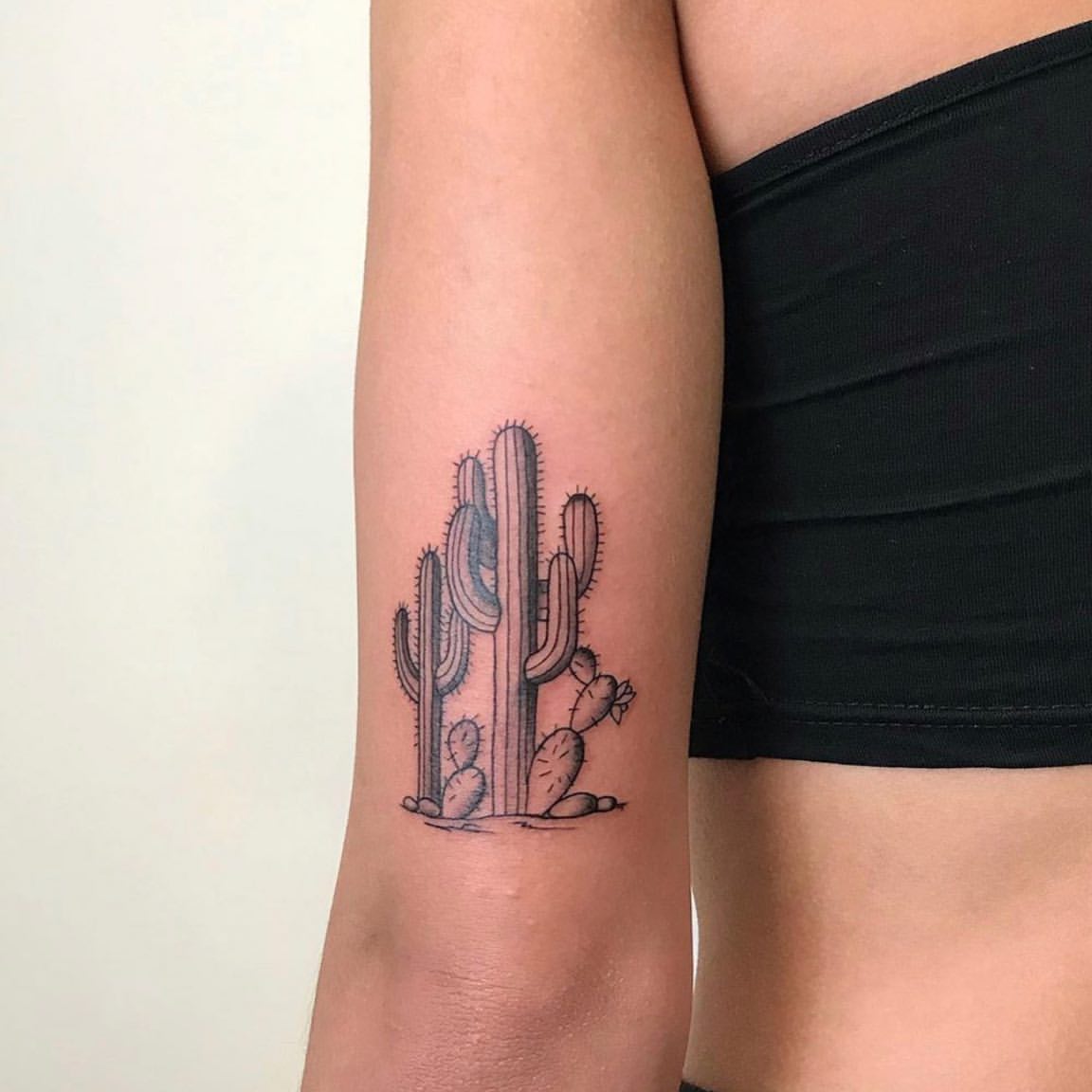
This compact upper-arm tattoo feels like a miniature desert garden assembled from several cactus varieties rather than a single botanical specimen. Tall Saguaro forms create the vertical backbone of the composition, while smaller prickly pear pads, stones, and a flowering cactus soften the base.
The fine line technique keeps what could have been a crowded design surprisingly airy. Long parallel strokes define the ribs of the taller cacti, and tiny individual thorns form crisp silhouettes along their edges. There is very little heavy shading, aside from a few darker areas that help separate overlapping plants.
The placement just above the elbow is clever. The vertical composition follows the upper arm naturally, while the lower horizontal ground line gives the cluster a clear stopping point before the joint. It is substantial enough to be noticed but still leaves plenty of negative space.
This is a particularly useful design for anyone who cannot decide between one Saguaro and a prickly pear tattoo. Combining several species gives the piece more of an Arizona landscape character without requiring mountains, sunsets, or other obvious Western imagery.
Botanical Cactus and Succulent Forearm Arrangement
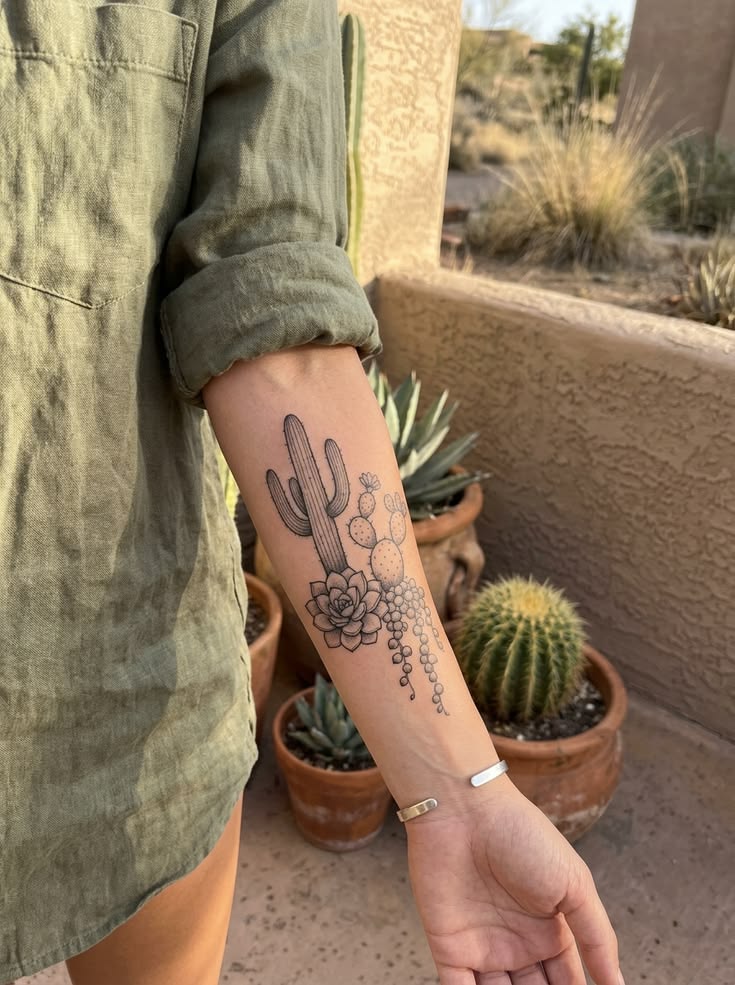
A cactus does not have to be isolated to remain the star of a tattoo. Here, a tall Saguaro rises behind prickly pear pads, a large rosette succulent, and trailing strands of small rounded leaves. Together they form an elongated botanical arrangement perfectly suited to the forearm.
The contrast between plant structures makes this piece particularly appealing. The Saguaro contributes strong vertical lines, the prickly pear introduces rounded forms, and the succulent creates a dense floral shape near the center. The trailing plant then pulls the eye downward and prevents the composition from ending too abruptly.
Everything is executed in black fine line work, giving the tattoo the character of a botanical drawing. There is enough detail to distinguish every plant, but the artist resists filling the leaves with unnecessary dark shading.
This is a beautiful option for women who want cactus imagery to feel more botanical than traditionally Western. It could also serve as the foundation of a larger plant sleeve, with additional succulents and desert flowers gradually extending around the forearm.
Cute Heart-Shaped Cactus in Color
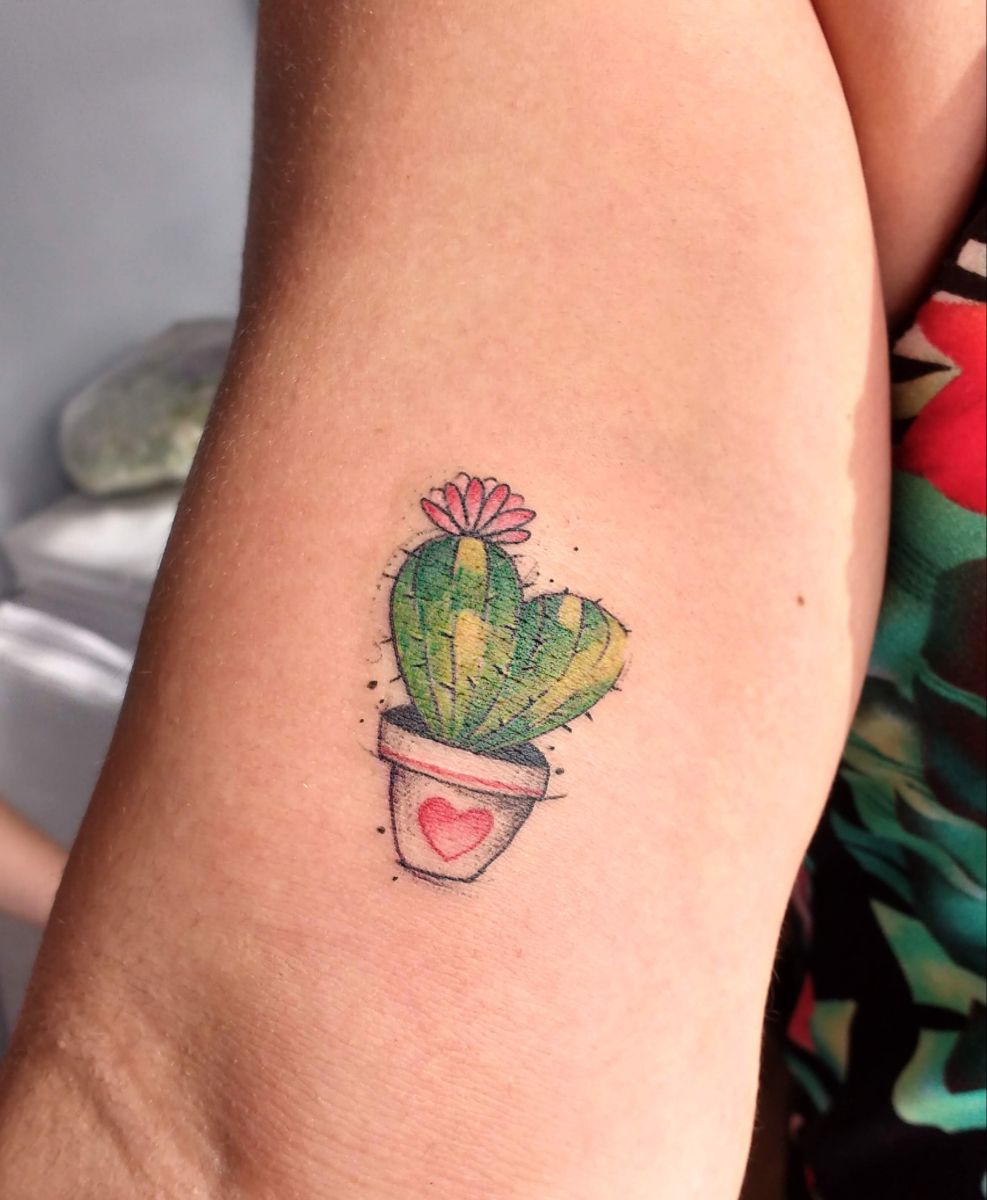
Few designs in this collection communicate affection as directly as this little heart-shaped cactus. Two green lobes form a recognizable heart silhouette inside a small pot, while a pink flower blooms at the top and another heart decorates the container.
The color palette is deliberately cheerful. Several shades of green create the cactus surface, pale yellow highlights add dimension, and pink-red accents connect the flower to the heart on the pot. Thin black spines around the perimeter preserve the cactus identity despite the playful shape.
This is unquestionably a cute tattoo, but it also demonstrates how easily cactus imagery can be personalized. A heart-shaped plant can represent a relationship, self-love, family, or simply affection for gardening and succulents.
Its compact scale makes it suitable for the arm without demanding much space. A tiny version could be simplified further, while a larger interpretation could introduce more realistic shading or even American traditional outlines and saturated color.
Floral Prickly Pear Botanical Sleeve
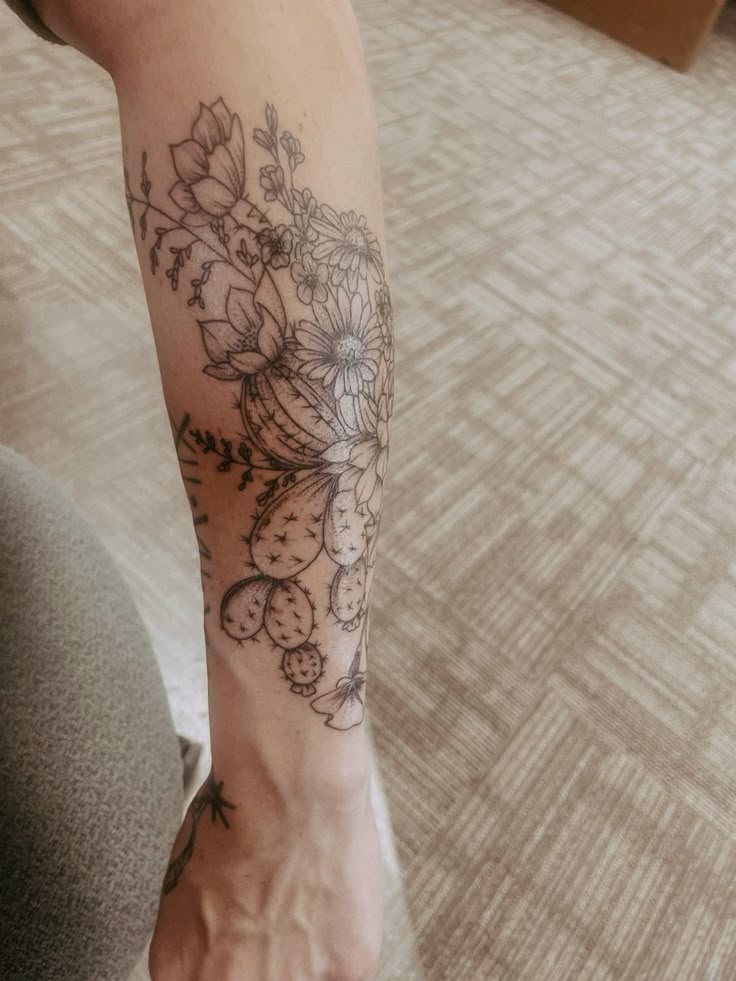
This expansive botanical tattoo takes the cactus theme into genuine sleeve territory. Instead of presenting the prickly pear as a solitary desert plant, the artist weaves its oval pads through a dense arrangement of large flowers, leaves, buds, and delicate stems.
The cactus appears toward the lower portion of the composition, where its thorn-covered pads provide a wonderful textural contrast to soft petals. That contrast is important. Botanical sleeves can sometimes become a continuous mass of similar floral shapes, but the prickly pear introduces something rougher and more architectural.
The linework remains delicate throughout. Individual spines are clearly articulated, while flowers rely on layered contours and restrained shading. The absence of strong color allows the composition to feel cohesive despite the number of different botanical elements.
For anyone considering cactus tattoos for women, this offers a sophisticated alternative to stereotypical desert scenes. It treats the cactus as part of a broader botanical vocabulary rather than limiting it to Mexican, Arizona, or cowboy symbolism.
It is also the sort of tattoo that rewards a little patience. From a distance it reads as a flowing floral composition; up close, the eye begins discovering thorns, buds, individual leaves, and tiny structural details.
Realistic Color Cactus and Succulent Tattoo
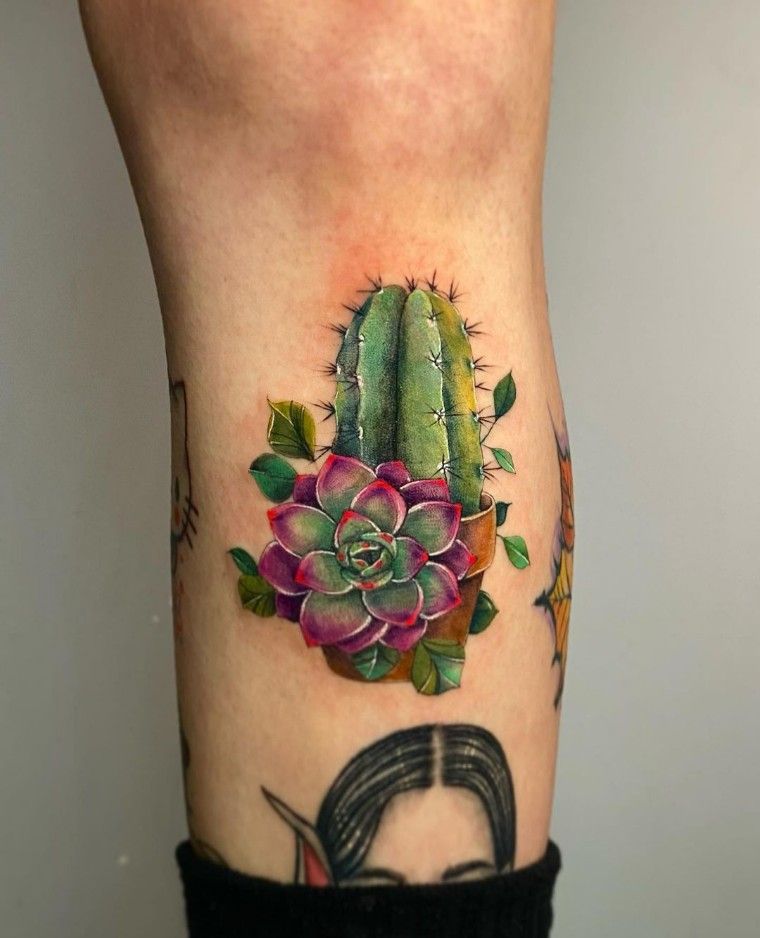
Color realism transforms this cactus-and-succulent combination into something that almost feels three-dimensional. A tall green cactus rises behind a large purple-green succulent, with smaller leaves surrounding both plants and tying the composition together.
The cactus itself uses gradients of olive, yellow-green, and deeper forest tones to create a rounded surface. Sharp black thorns extend from pale points along the ribs, producing convincing depth. The succulent is even more dramatic: rich purple and magenta edges surround green inner petals, while tiny highlights make the leaves appear thick and waxy.
This is far removed from a minimalist cactus tattoo. It is about texture, saturation, and botanical realism. Yet the composition remains compact enough to function as one self-contained piece rather than an entire garden scene.
The juxtaposition is what makes it memorable. A cactus is rigid and vertical; the succulent is broad and symmetrical. Together, those opposite shapes create balance.
Anyone bringing this type of reference to an artist should look specifically for someone experienced in color botanical work. Fine transitions and small highlights are doing much of the visual work here, so technique matters considerably more than it would with a simple outline stencil.
Small Realistic Flowering Cactus in a Pot
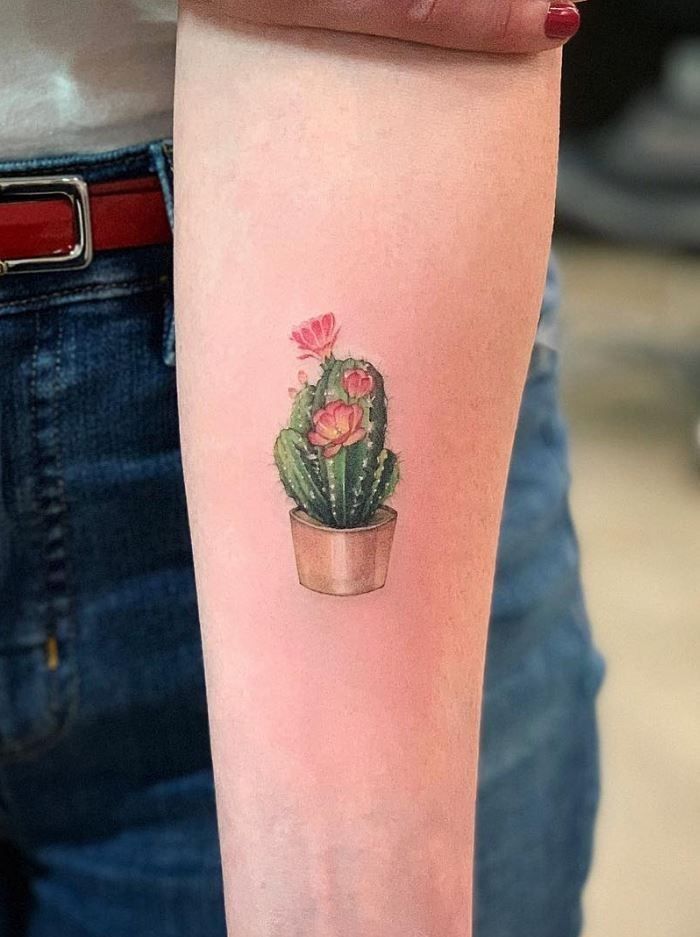
This small forearm tattoo has the charm of a miniature botanical painting. A compact cactus sits inside a warm brown pot, while several pink and coral flowers bloom from its upper surface.
Despite the modest scale, the artist uses multiple green tones, pale vertical highlights, tiny spines, and soft shadow to create a convincing sense of volume. The flowers provide just enough contrast to pull attention upward without overpowering the cactus itself.
It is a useful example for anyone who wants a simple subject but does not necessarily want minimalist execution. The concept—a cactus in a pot—is extremely straightforward, yet realistic color makes it feel considerably richer.
The understated proportions also make this an appealing alternative to larger Western pieces. There is no need for an Arizona sunset, desert skull, or elaborate scenery; the plant carries the tattoo on its own.
A flowering cactus has a nice symbolic quality too. Cacti are usually associated with endurance because they thrive in demanding environments, while flowers suggest that survival can eventually produce something beautiful. Whether or not the wearer assigns that meaning, it gives this small design a little more emotional depth.
Cactus tattoos in 2026 can be delicate, funny, colorful, rugged, or quietly symbolic. A tiny potted plant can carry as much personality as a full Arizona landscape, while Saguaro and prickly pear designs give artists shapes that adapt naturally to arms and legs. Even seasonal concepts such as a playful Christmas cactus can work when the imagery has a personal reason behind it. If one of these ideas has inspired your next tattoo—or you already have a cactus design with a story behind it—leave a comment and share which style you would choose.