
Dotwork has a way of making black ink feel surprisingly light. Instead of relying only on solid fills and conventional shading, the technique builds form from hundreds—or sometimes thousands—of individual marks. Viewed closely, you notice every dot; from a little farther away, those dots merge into gradients, shadows, petals, and geometric shapes.
That versatility is what makes dotwork tattoo ideas so interesting. A design can be barely there, with fine line branches softened by scattered stippling, or it can become a commanding ornamental piece covering an entire forearm or knee. Mandala work is an obvious favorite, but floral motifs, geometric symbols, abstract pattern work, and small hand tattoos all respond beautifully to the technique.
Artists working in blackwork and geometric tattooing have pushed stippling far beyond its old role as simple shading. Publications regularly show how contemporary tattooers combine traditional imagery with newer graphic approaches. What matters most, though, is how a design works on an actual body. The 27 examples here demonstrate just how different dotwork can look depending on scale, placement, density, and the amount of open skin left inside the composition.
Dotted Star Hand Tattoo With a Pixel-Like Finish
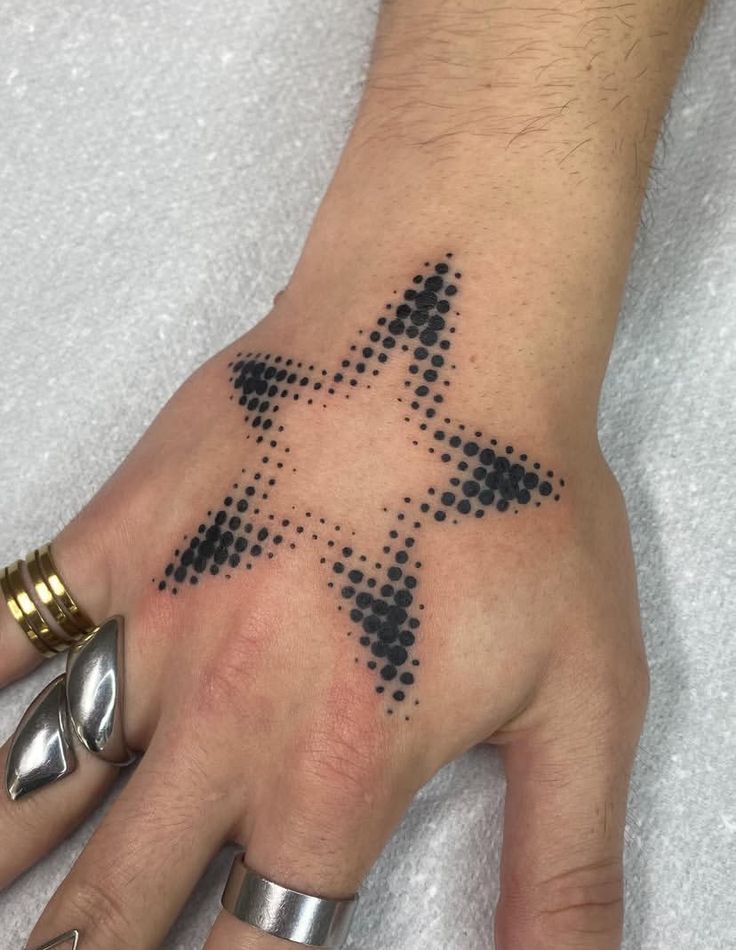
This star is a clever example of how a familiar symbol can feel completely different when the outline disappears. Rather than drawing a continuous border, the artist constructs the entire design from black dots that change gradually in size. Larger circles gather around the five points and important structural areas, while much smaller marks establish the edges.
That shift in scale creates a pixelated, almost digital texture. There is enough empty skin between the dots to prevent the star from becoming a heavy black shape, yet its silhouette remains immediately readable.
The hand is particularly effective for an idea like this because the motif is compact and graphic. It spreads across the available space without needing ornamental extensions toward the fingers or wrist. I also like that the pattern isn’t obsessively uniform. Slight changes in spacing give it more personality than a mechanically perfect stencil might have.
For anyone collecting smaller dotwork tattoo ideas, this shows that the technique doesn’t have to mean a huge mandala or sleeve. One recognizable shape and a thoughtful progression of dot sizes can be enough.
Geometric Dotwork Flower Built From Negative Space
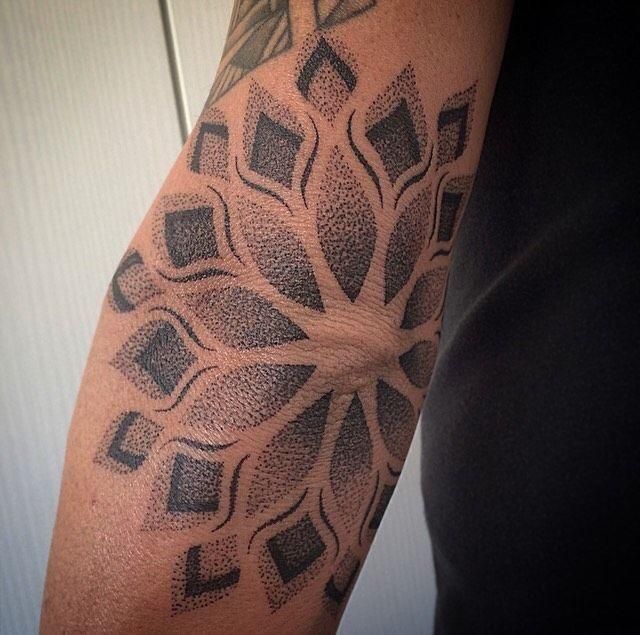
This elbow-area piece takes the opposite approach. It is larger, more abstract, and built around repetition. The composition resembles a geometric flower, with elongated petal forms radiating outward from the center and smaller diamond-like shapes filling the spaces around them.
What makes it especially effective is the relationship between stippling and untouched skin. The petals aren’t simply colored black. Dense fields of tiny dots create smoky surfaces, while narrow areas of bare skin divide one section from another. As a result, the design stays legible even though there is very little conventional outlining.
The geometry also responds naturally to the joint. Rather than fighting the elbow’s shape, the motif uses its central point as part of the composition. When the arm bends, the pattern changes slightly; when extended, the symmetry becomes clearer.
This is useful inspiration for both men and women who want geometric work without the harder appearance of completely saturated blackwork. A similar Vorlage could also be adapted into a shoulder, knee, or upper-arm placement because the radial construction works well on rounded areas.
Large Ornamental Mandala Forearm Tattoo
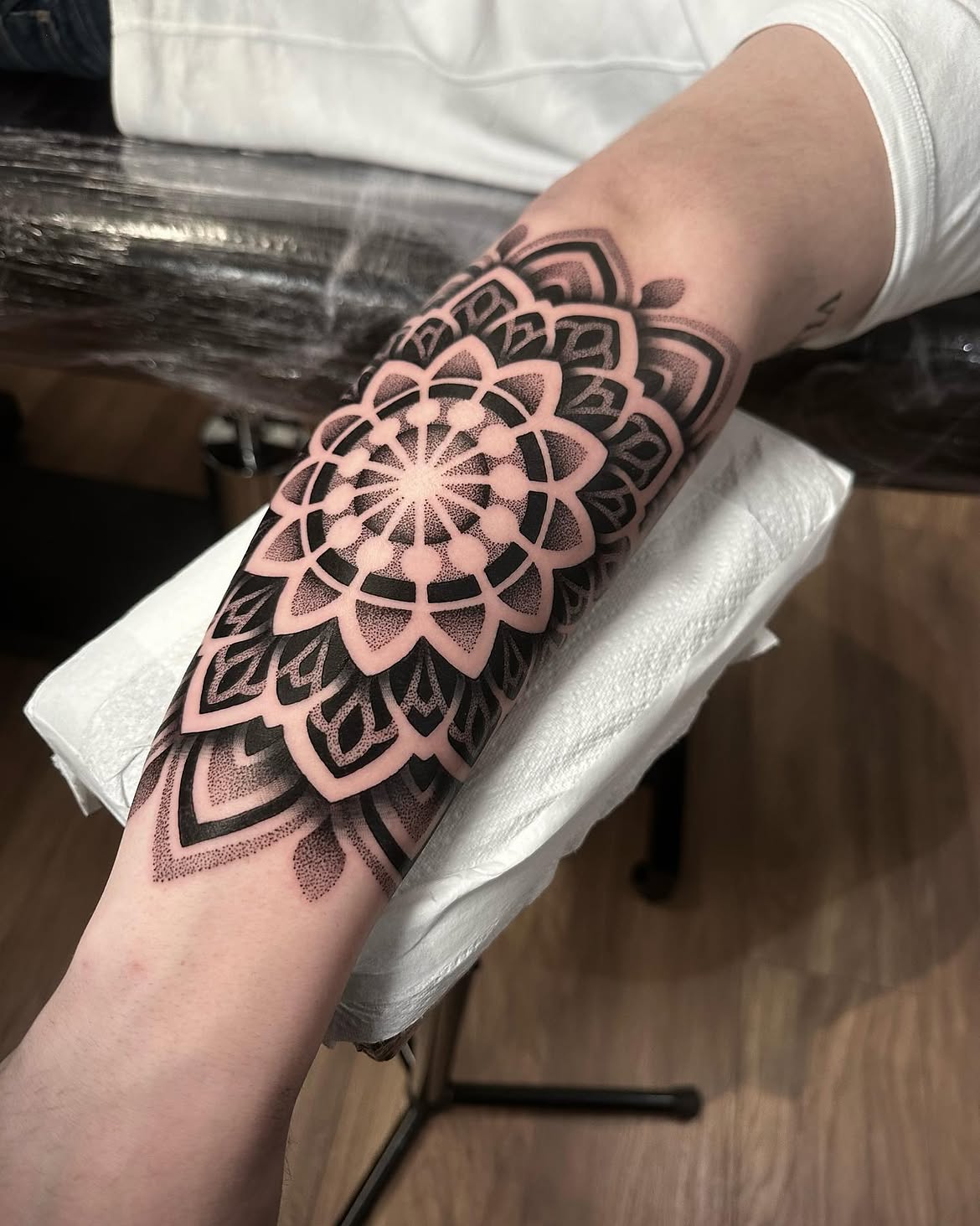
Few motifs show off dotwork quite as convincingly as a mandala, and this forearm piece demonstrates why. The tattoo unfolds in concentric layers, beginning with a detailed circular center and expanding through petals, arches, pointed forms, and repeating decorative sections.
There are several techniques working together here. Bold black areas provide structure, crisp negative-space channels separate the layers, and stippled gradients soften selected sections. That mixture keeps the tattoo from becoming visually flat. Your eye moves between solid black, bare skin, and thousands of tiny dots.
The central flower-like formation is particularly strong. Fine radial lines and rounded details establish a precise focal point before the design grows outward into heavier ornamental forms. Farther from the center, the petals become larger and more architectural.
This kind of mandala dots composition requires careful planning. Symmetry errors that might disappear inside a loose floral tattoo become obvious in geometric work, so a well-prepared mandala stencil is essential. Placement matters too: the long forearm gives the artist enough room to preserve small details rather than compressing them.
For someone considering a future sleeve, a piece like this can also serve as a powerful anchor. Additional geometric or ornamental sections could eventually extend toward the wrist or upper arm without making the original tattoo feel incomplete on its own.
Fine Line Botanical Branch With Soft Dotwork Shading
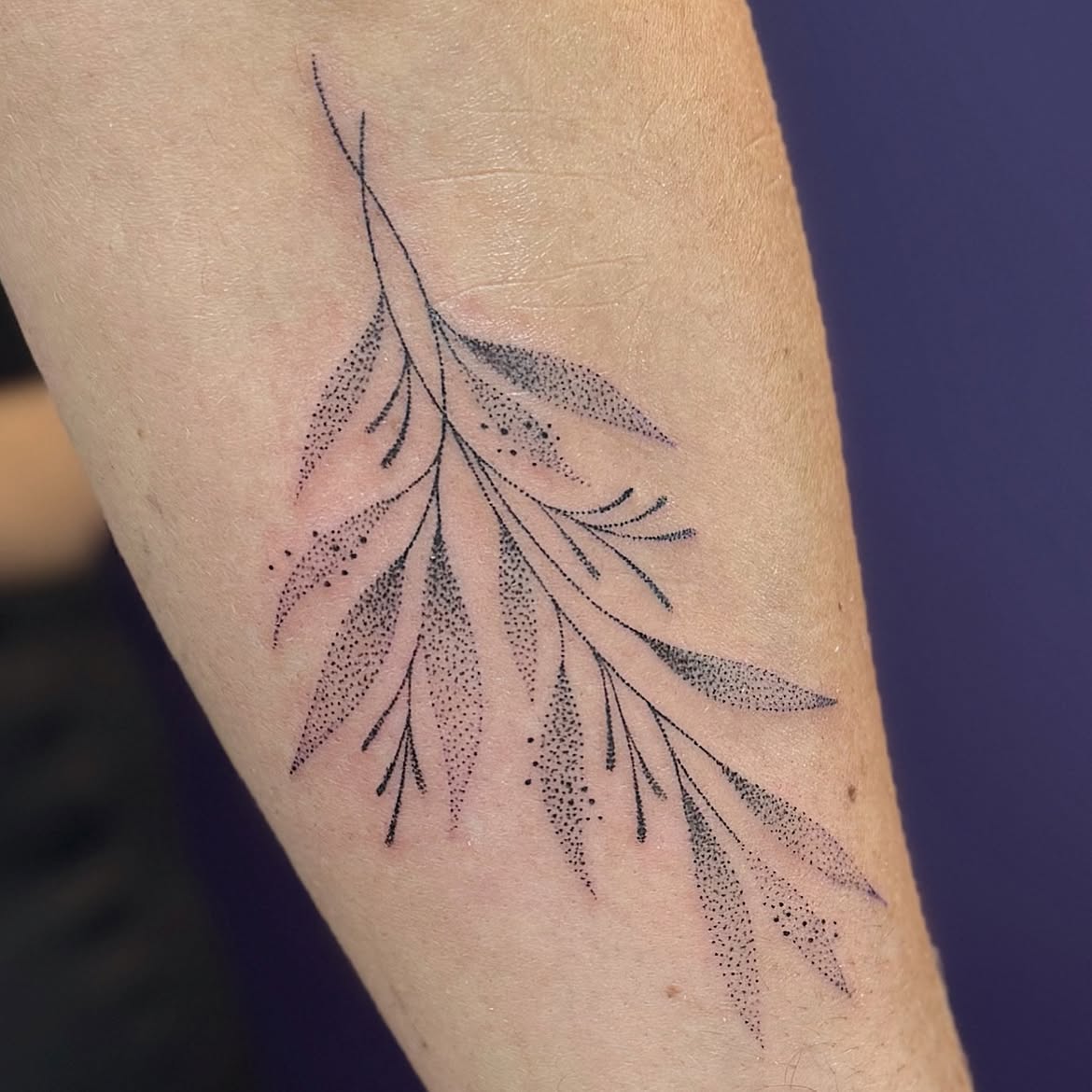
This botanical tattoo proves how gentle dotwork can become when the artist dramatically reduces the density of the marks. A thin branch forms the backbone of the composition, while narrow leaves extend naturally to either side.
Instead of filling those leaves with solid black, the artist uses exceptionally fine stippling. Some areas contain concentrated dots near the base or edge, then dissolve gradually into bare skin. The result has an airy, almost pencil-drawn character.
The asymmetry is important. The branches do not mirror one another, and their different lengths keep the piece closer to a botanical sketch than a formal ornamental pattern. Long, delicate stems add movement without making the tattoo noticeably heavier.
This is one of those designs that rewards a second look. At first it reads simply as a graceful floral or botanical element; only closer inspection reveals how much of the shading is composed of individual points.
For people drawn to fine line tattoos but worried that pure linework may look too sparse, subtle stippling offers a useful middle ground. It introduces depth while preserving the lightness that makes minimalist botanical work so appealing.
Knee Mandala With Geometric Petals and Dot Shading
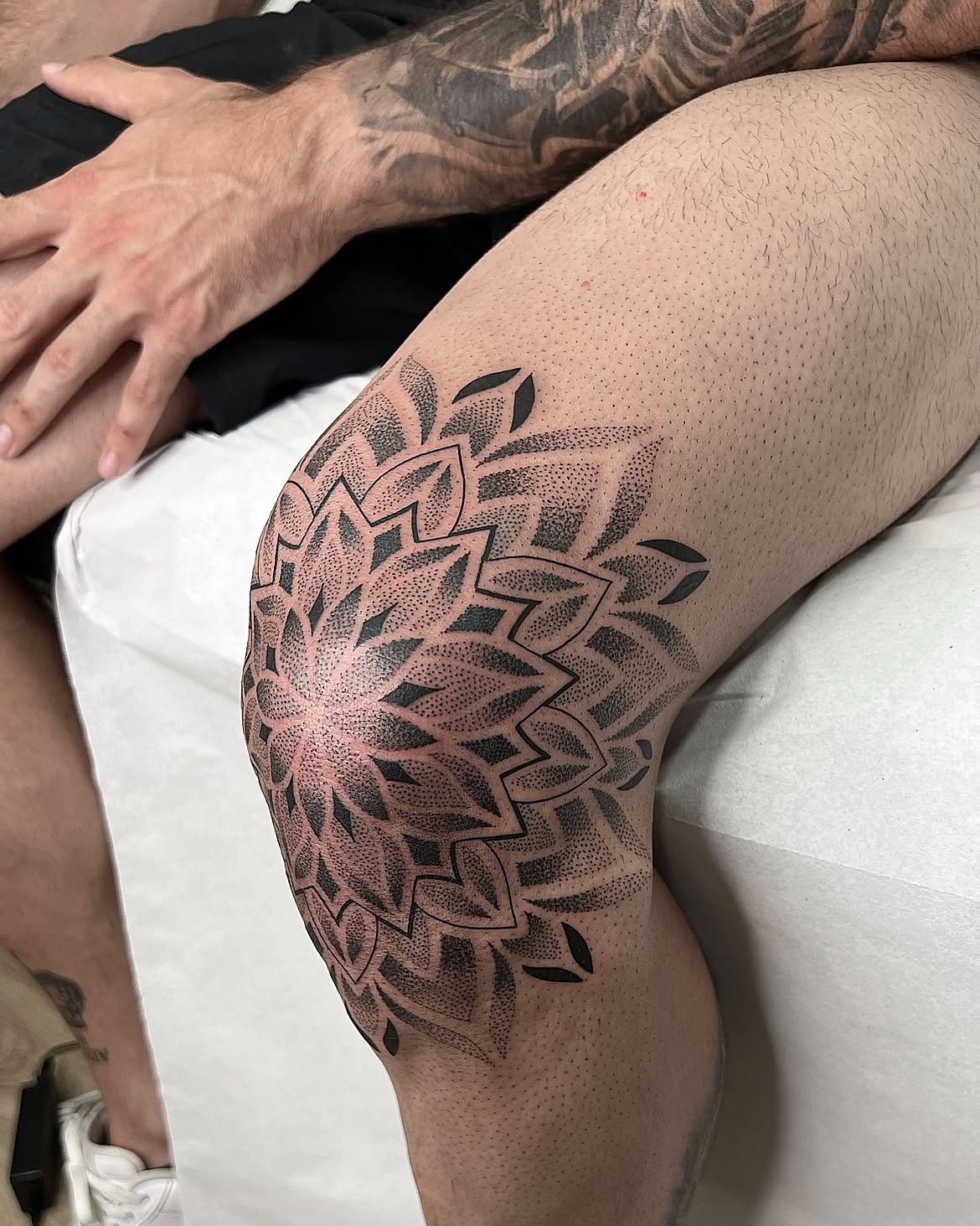
The knee can be a difficult canvas, but radial imagery turns that challenge into an advantage. Here, a large geometric mandala wraps around the kneecap, allowing the joint to become the natural center of the design.
Layer after layer of pointed petals expands outward. Some sections are framed by clean black outlines, others contain compact fields of dots, and small solid-black accents interrupt the softer textures. That variation gives the tattoo a strong rhythm without depending on color.
I particularly like how the outer elements begin to loosen as they move away from the center. Rather than ending in one rigid circular border, isolated leaf-like shapes and partial ornamental forms create a softer transition back into bare skin. It prevents the tattoo from looking as though a decorative sticker has simply been placed over the knee.
A geometric knee piece like this needs to be considered both with the leg straight and bent. The pattern inevitably shifts with movement, which is part of the appeal. For anyone researching a muster or pattern for this placement, it makes sense to look beyond a flat drawing and consider how every layer will travel around the anatomy.
It is a bold idea, but the dot shading stops it from becoming overwhelmingly dark.
Vertical Floral Mandala Dotwork on the Lower Leg
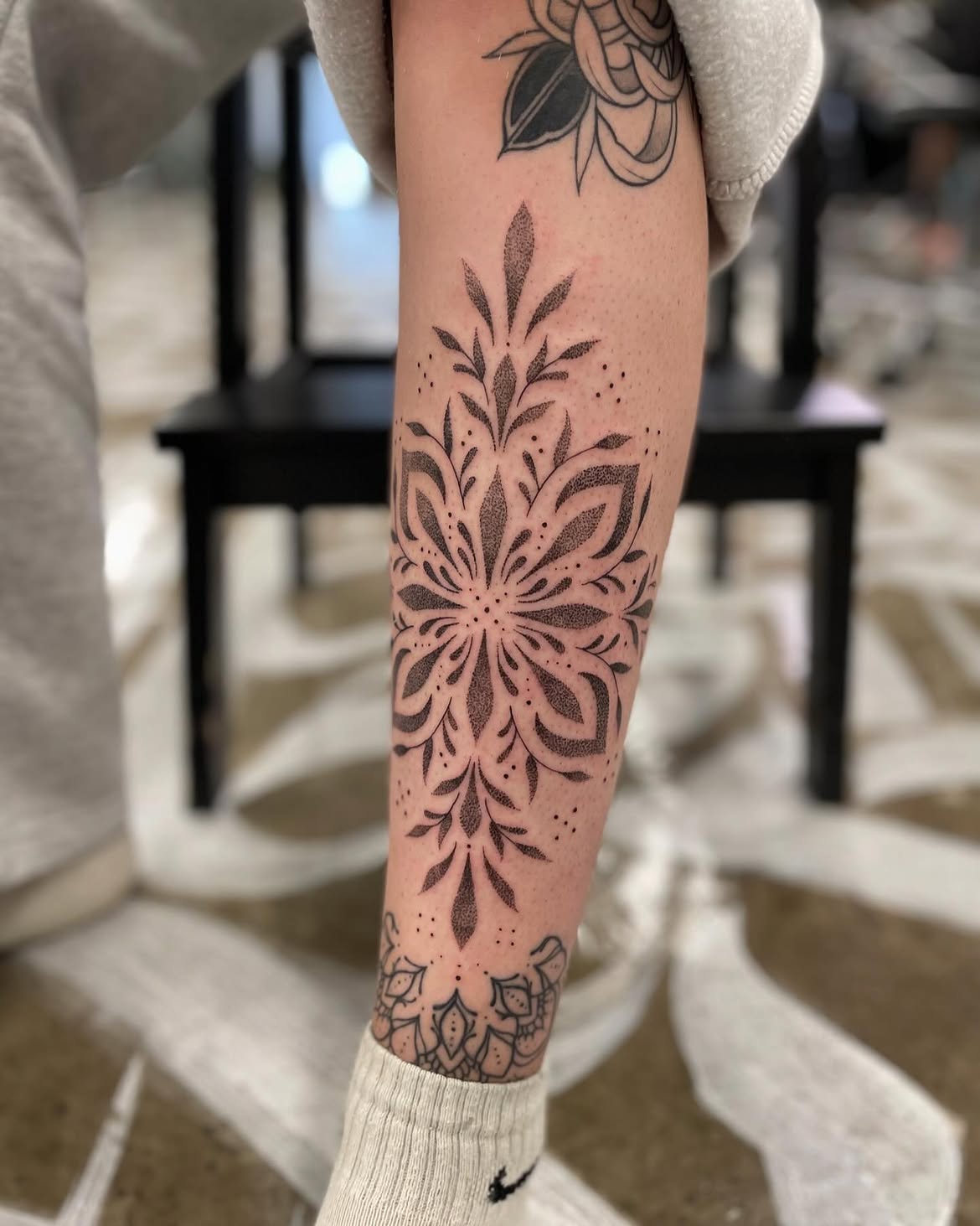
This lower-leg tattoo takes the symmetry associated with mandala work and stretches it vertically. The central flower provides the widest part of the composition, while tapered ornamental elements extend above and below it.
That elongated construction is beautifully suited to the leg. Instead of forcing a perfectly circular mandala into a narrow area, the artist lets the design follow the body’s proportions. Leaf and petal forms become progressively smaller toward the ends, producing a natural visual taper.
Dotwork is used as both fill and decoration. Dense stippling darkens selected petals, tiny isolated dots accent the negative spaces, and fine dotted textures give the larger shapes a soft finish. The balance between open and shaded sections means the tattoo remains detailed without turning into a dark block from a distance.
This would be a particularly useful reference for someone searching for mandala women ideas that feel decorative but not excessively heavy. There is also plenty of inspiration here for a custom mandala stencil: the central floral structure could be retained while the upper and lower extensions are modified to fit a different calf, forearm, or thigh.
One practical lesson from this design is that symmetry doesn’t always require a circle. Sometimes changing the proportions of the pattern makes it work far better with the chosen placement.
Soft Dotwork Mandala Wrapped Around the Elbow
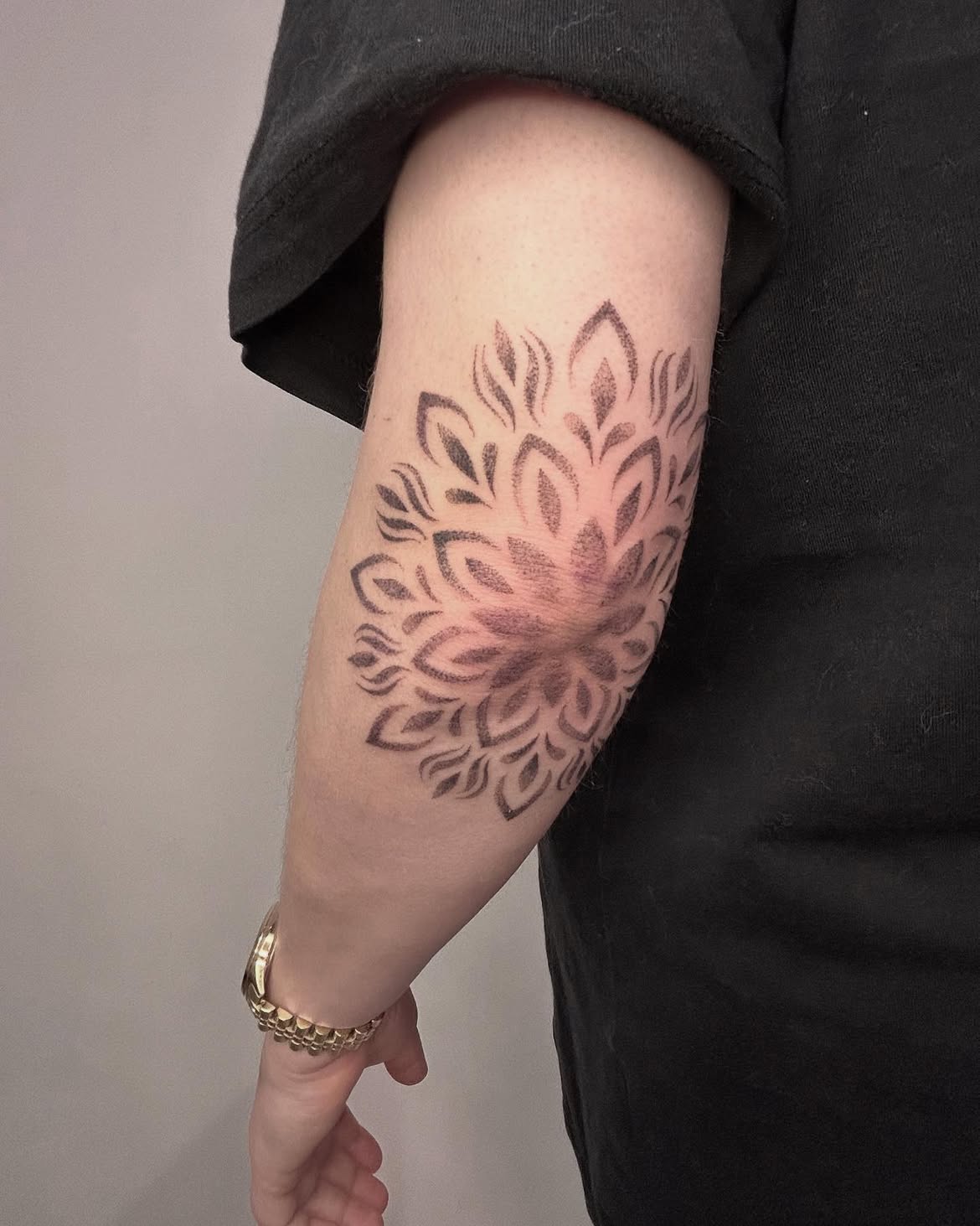
The final design has an unusually soft quality for a fairly large mandala. Its petal shapes radiate around the elbow, but there are few hard, dark boundaries. Instead, the forms appear to have been dusted onto the skin through closely controlled stippling.
This gives the tattoo a faded, almost textile-like appearance. Larger pointed petals establish the main structure, while smaller curved motifs fill the spaces between them. The density changes gently across the composition, so some portions appear darker without losing the characteristic grain of dotwork.
Using the elbow as the center is a smart decision. Like the knee, it naturally suits radial geometry, but this tattoo is considerably lighter than many traditional elbow mandalas. That makes it an interesting option for someone who loves ornamental tattoos yet doesn’t want large areas of saturated black.
The edges are also deliberately understated. Instead of drawing a strong outer circle, individual shapes gradually complete the mandala. That softer finish allows the piece to sit comfortably on its own, though its repeating forms could eventually connect with additional geometric work and develop into a broader sleeve.
It is also a reminder that dotwork doesn’t always need dramatic contrast. Sometimes the most distinctive result comes from keeping the dots relatively consistent and allowing texture itself to define the image.
Delicate Forearm Mandala With Airy Dotwork Details
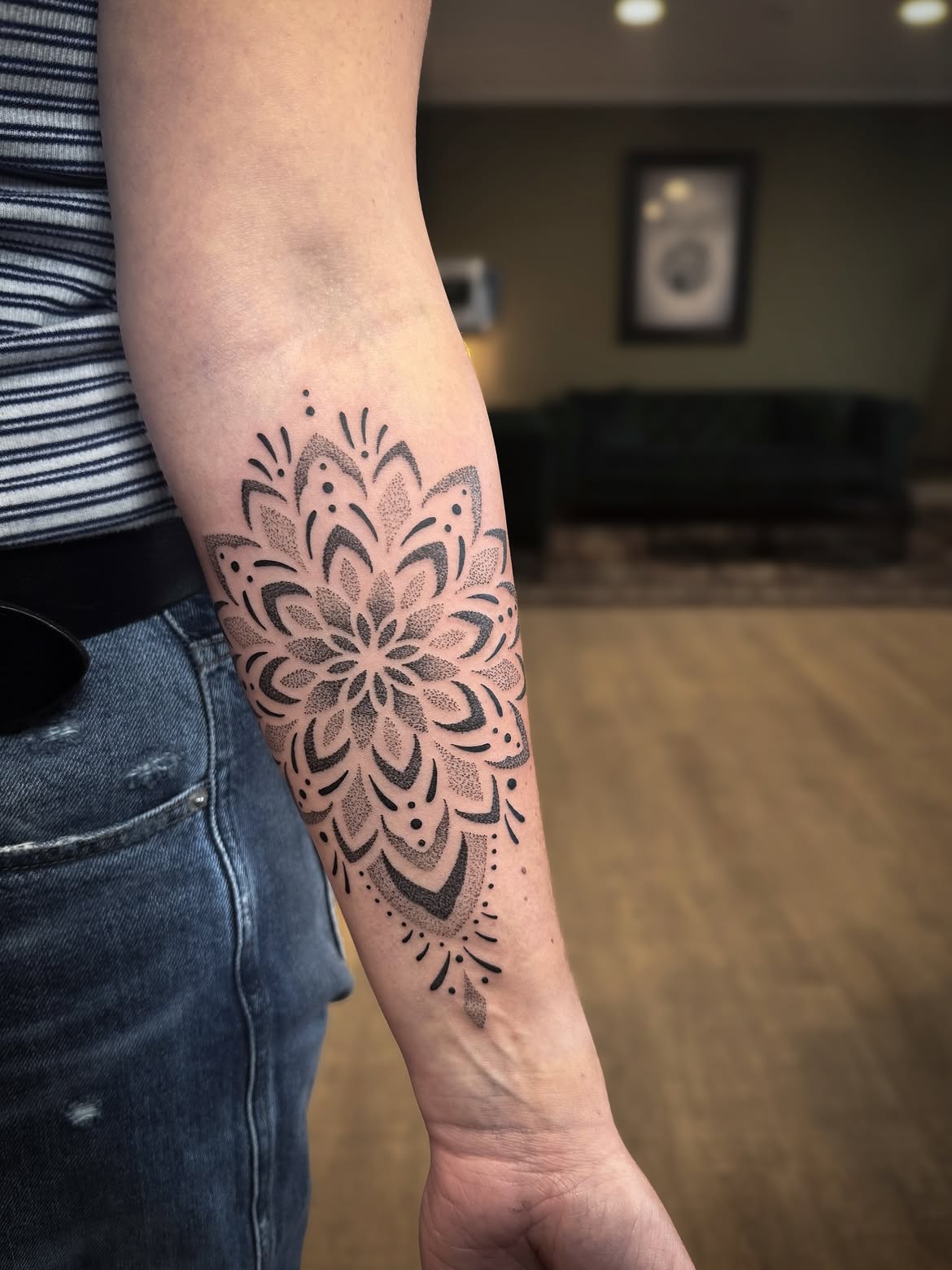
This forearm piece takes the familiar mandala format and makes it feel noticeably lighter. Rather than filling every petal with dense black ink, the artist alternates soft stippling with clean negative space. The central flower is compact and symmetrical, then gradually opens into larger pointed petals as the composition approaches the elbow and wrist.
Small standalone dots are an important part of the design. They sit between the larger ornamental shapes almost like tiny pieces of jewelry, breaking up the symmetry just enough to keep the tattoo from feeling rigid. Short curved strokes add another texture alongside the finer mandala dots.
The placement is especially successful. Its widest section occupies the fuller part of the forearm, while the pattern narrows toward the wrist. That natural taper makes the tattoo look designed for this particular piece of anatomy rather than transferred from a generic Vorlage.
For anyone who likes mandala women designs but wants something softer than heavy blackwork, this is a strong direction. A tattoo artist could also simplify the underlying mandala stencil, reduce the number of petals, or increase the stippling to create a darker version without changing the basic structure.
Architectural Mandala Leg Tattoo With Bold Negative Space
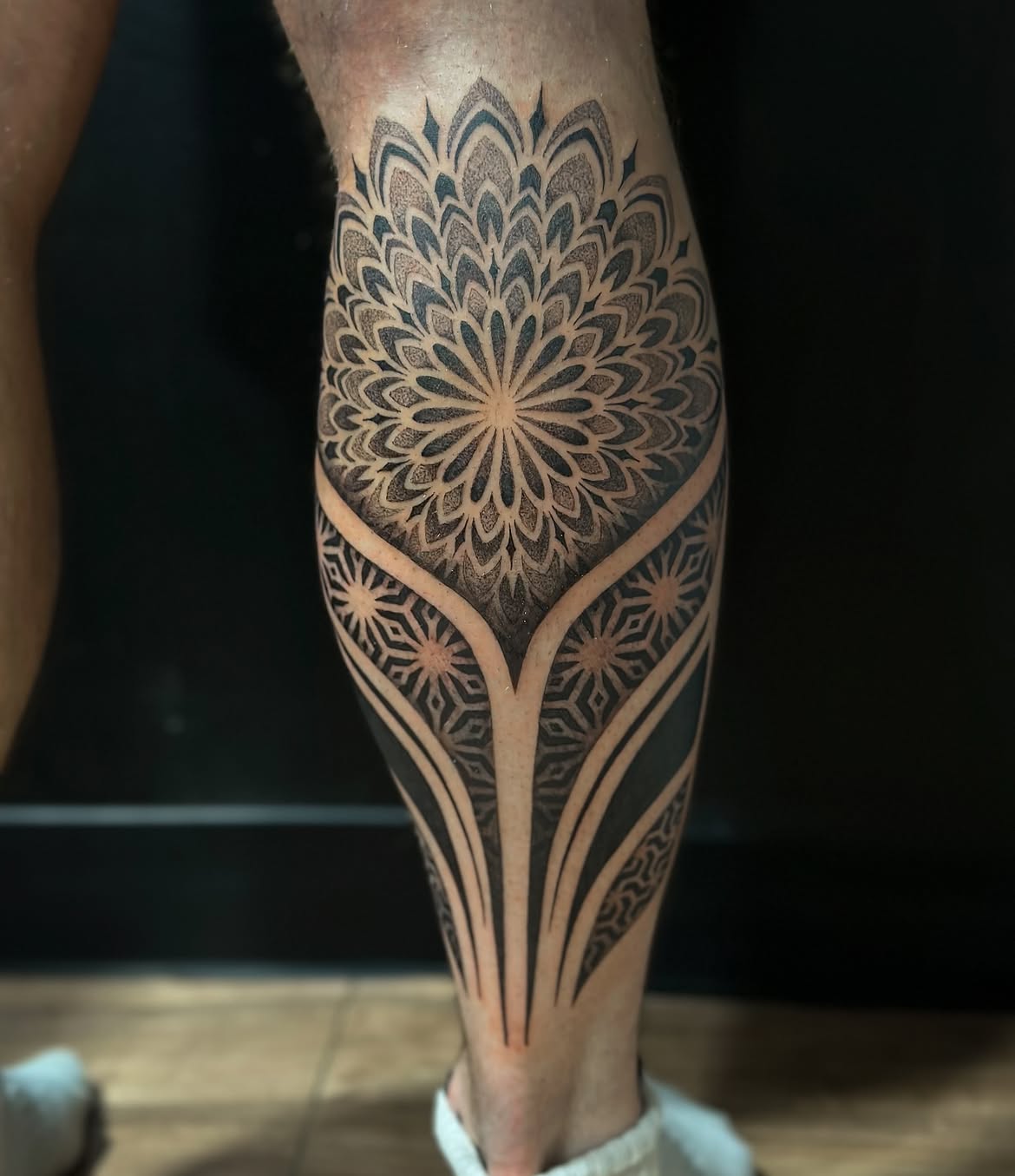
Here dotwork meets something closer to ornamental architecture. A large radial mandala dominates the upper part of the lower leg, with dozens of pointed petals emerging from a bright center. Each successive layer grows wider, producing the impression of a flower opening outward.
Below it, however, the design changes character. Long strips of untouched skin sweep downward between dark black sections, transforming the circular motif into an elongated geometric composition. Smaller rosette patterns occupy the lower sections and create a bridge between the enormous mandala and the narrow ending near the ankle.
The contrast is excellent. Dense stippling provides a smoky gray texture inside many petals, while solid black sections create the structural framework. Broad negative-space lines then cut through all that darkness and make the tattoo readable from a distance.
This is the sort of geometric work I would save as inspiration rather than copy literally. The proportions are closely connected to the leg, so a good artist would redraw the pattern around another person’s anatomy. For men looking for a large dotwork tattoo that has the presence of a sleeve without covering every inch in black, this balance is particularly effective.
Bold Dotwork Mandala Wrapped Around the Elbow
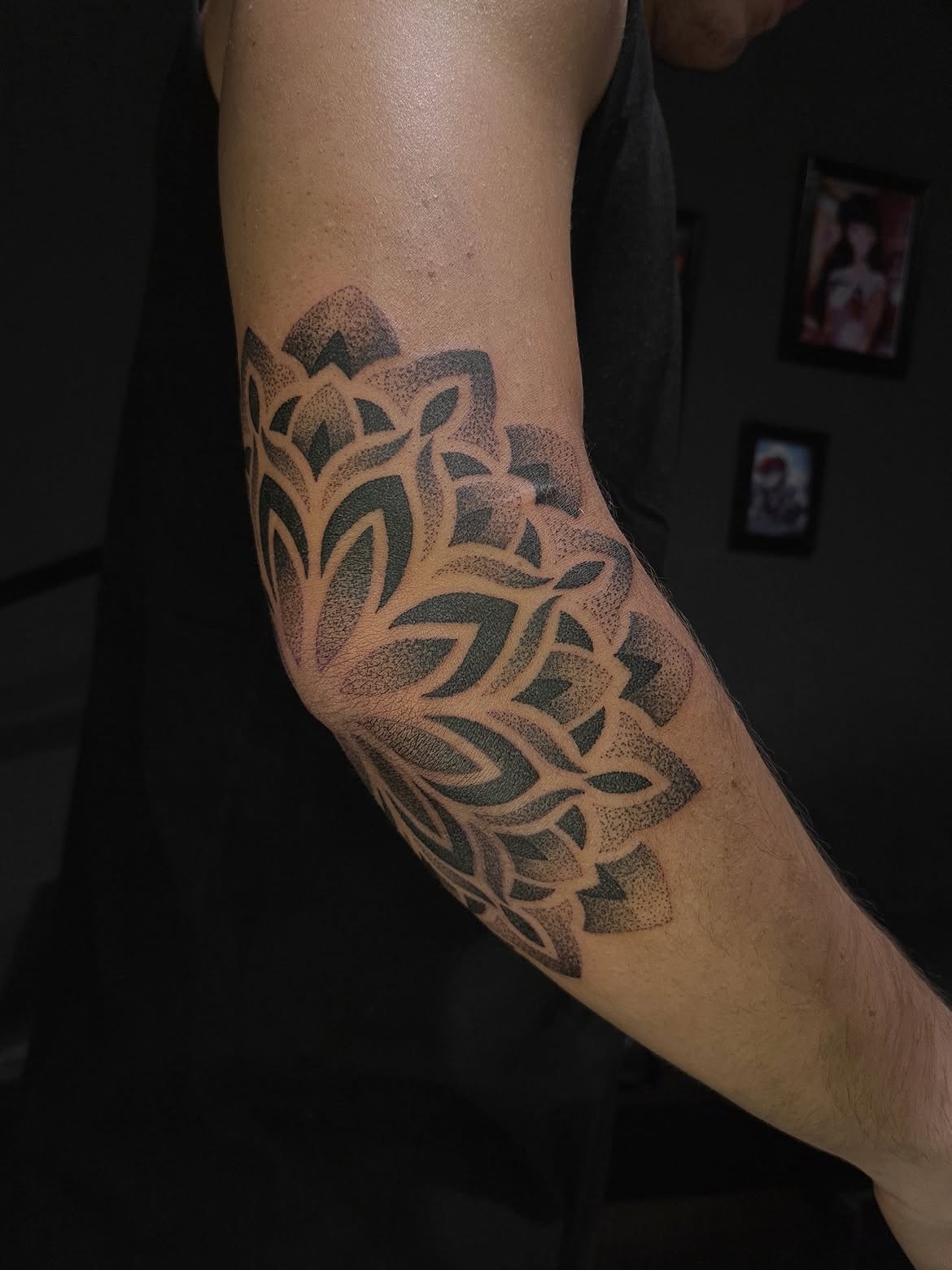
The elbow becomes the center of a large ornamental flower in this design. Broad petal shapes overlap visually around the joint, while alternating fields of solid ink and stippled shading establish the depth.
Compared with some of the more delicate ideas in this collection, this tattoo has considerably more visual weight. Large black sections immediately establish the geometry, and the dots function primarily as softer transitional shading. The combination is useful because pure solid black could make such a substantial elbow tattoo feel extremely dense.
There is also a nice contrast between curved petal forms and sharper geometric shapes. Some sections resemble leaves, while others end in squared or angular points. Together they create an ornamental pattern that feels organic without becoming conventionally floral.
The joint itself should always be part of the planning process for a design like this. A flat stencil may look perfectly symmetrical on paper but inevitably changes once wrapped around the elbow. Here the slight distortion created by the anatomy actually adds energy to the composition.
Hand Mandala With Dense Stippled Petals
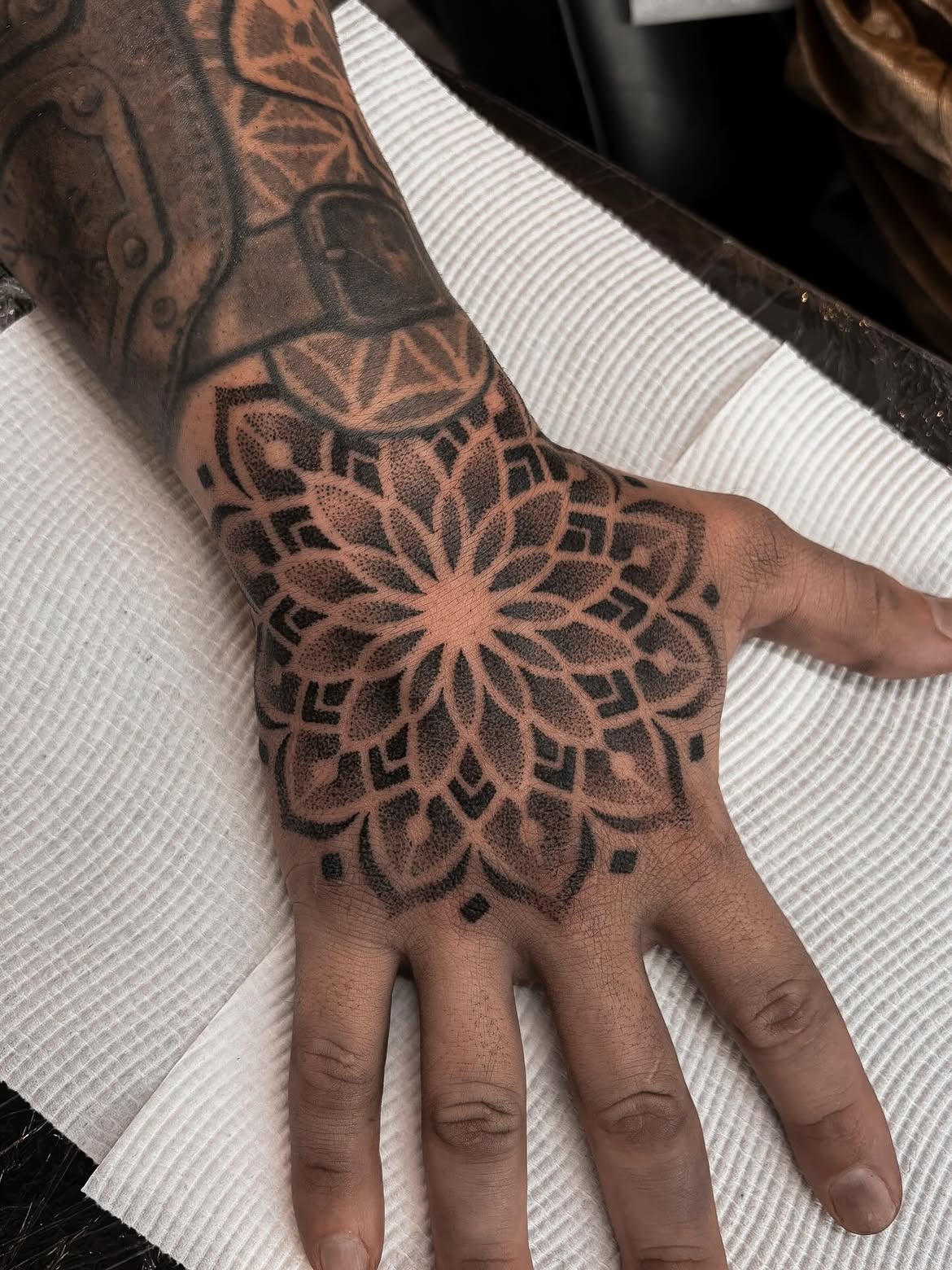
A hand tattoo has very little room for unnecessary detail, which makes the clarity of this mandala especially important. The central flower sits across the back of the hand, with long petals radiating outward toward the knuckles, thumb, and wrist.
The tattoo relies heavily on negative space. Bare skin creates the outlines separating one petal from another, while dotwork fills the interiors with different levels of darkness. Small solid-black geometric accents are placed around the outer layers, giving the design enough contrast to remain recognizable at a glance.
What stands out is the way the mandala stencil appears to have been adjusted for the hand rather than kept as a perfect circle. The edges respond to the available space, allowing the motif to approach the wrist and knuckles without looking abruptly cropped.
It’s a bold placement, and that deserves consideration beyond aesthetics. Hand tattoos are constantly visible and receive considerable exposure and friction, so discussing long-term appearance and touch-ups with an experienced artist is worthwhile. Visually, though, this is an excellent demonstration of how mandala dots can produce shading without sacrificing the clean geometry of the underlying design.
Blackwork and Dotwork Mandala Extending From Wrist to Hand
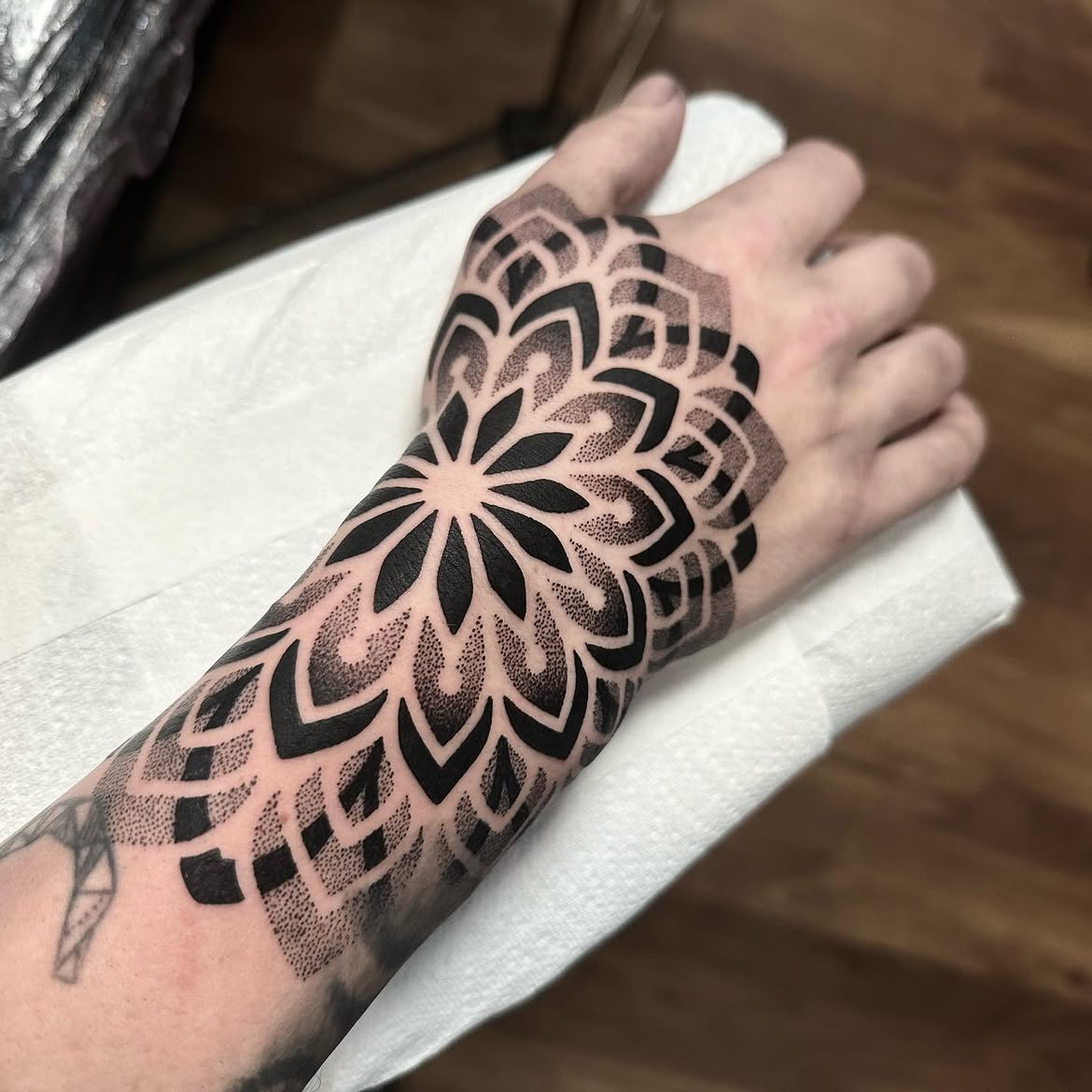
This design pushes the hand-mandala concept farther by extending well onto the wrist and lower forearm. The center is formed from elongated solid-black petals, creating a dramatic focal point before the tattoo expands into alternating bands of stippling, black outlines, negative space, and geometric blocks.
The changing textures are what keep such a large composition interesting. One ring may be almost completely black, while the next is built from thousands of tiny dots. Farther out, diamond shapes and curved petals interrupt the circular rhythm.
There is a useful lesson here for anyone planning a sleeve: repeating geometry doesn’t have to mean repeating exactly the same element. Consistent spacing and symmetry can hold the design together while individual layers use entirely different marks.
I also like how the wrist acts as a transitional zone rather than a stopping point. The pattern flows across it and onto the hand, which makes the tattoo feel like one continuous ornamental piece. It is visually assertive, but the stippled sections prevent the blackwork from swallowing all the smaller details.
Lotus Dotwork Tattoo With Ornamental Om Symbol
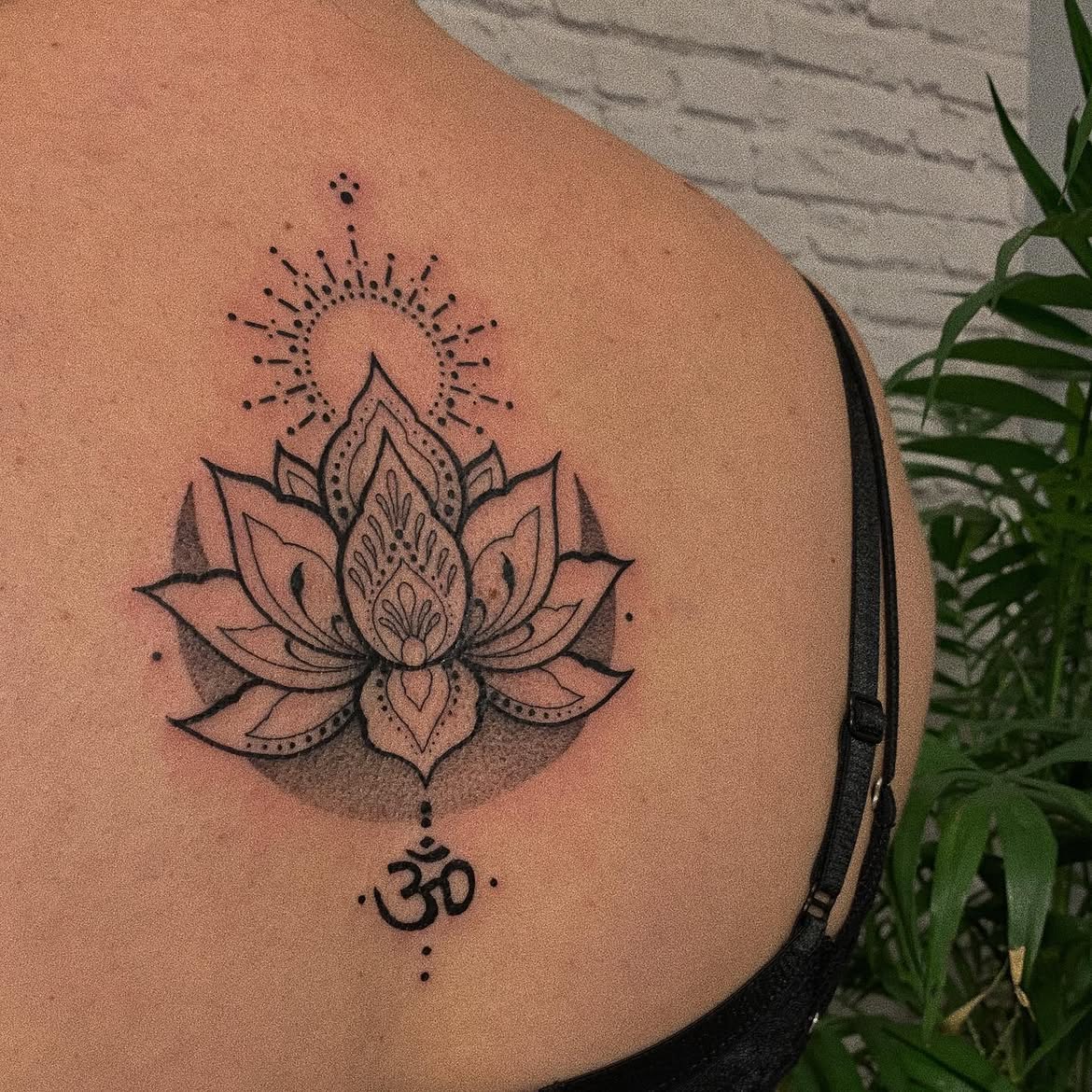
This lotus takes dotwork away from pure geometric abstraction and into a more symbolic direction. Layered petals form the central flower, while delicate internal linework gives several petals an ornamental, almost engraved appearance.
Behind the lotus sits a broad field of stippled shading. It creates a soft shadow that pushes the fine outlines forward without requiring a heavy conventional background. Above the flower, a semicircular arrangement of dots and short rays forms a halo-like crown. The marks gradually become more pronounced toward the top, giving the otherwise horizontal tattoo a subtle vertical axis.
An Om symbol sits beneath the lotus and completes that axis. Because both lotus and Om carry established spiritual associations in Indian religious traditions, I would treat them as meaningful imagery rather than simply decorative additions. Anyone considering a similar design should understand the symbols they choose and discuss their intended arrangement with the artist.
Technically, this piece also shows how well fine line and dotwork can coexist. The lines provide precision, while stippling introduces atmosphere and depth. Neither technique has to dominate the other.
Realistic Eagle Portrait Shaded With Fine Dotwork
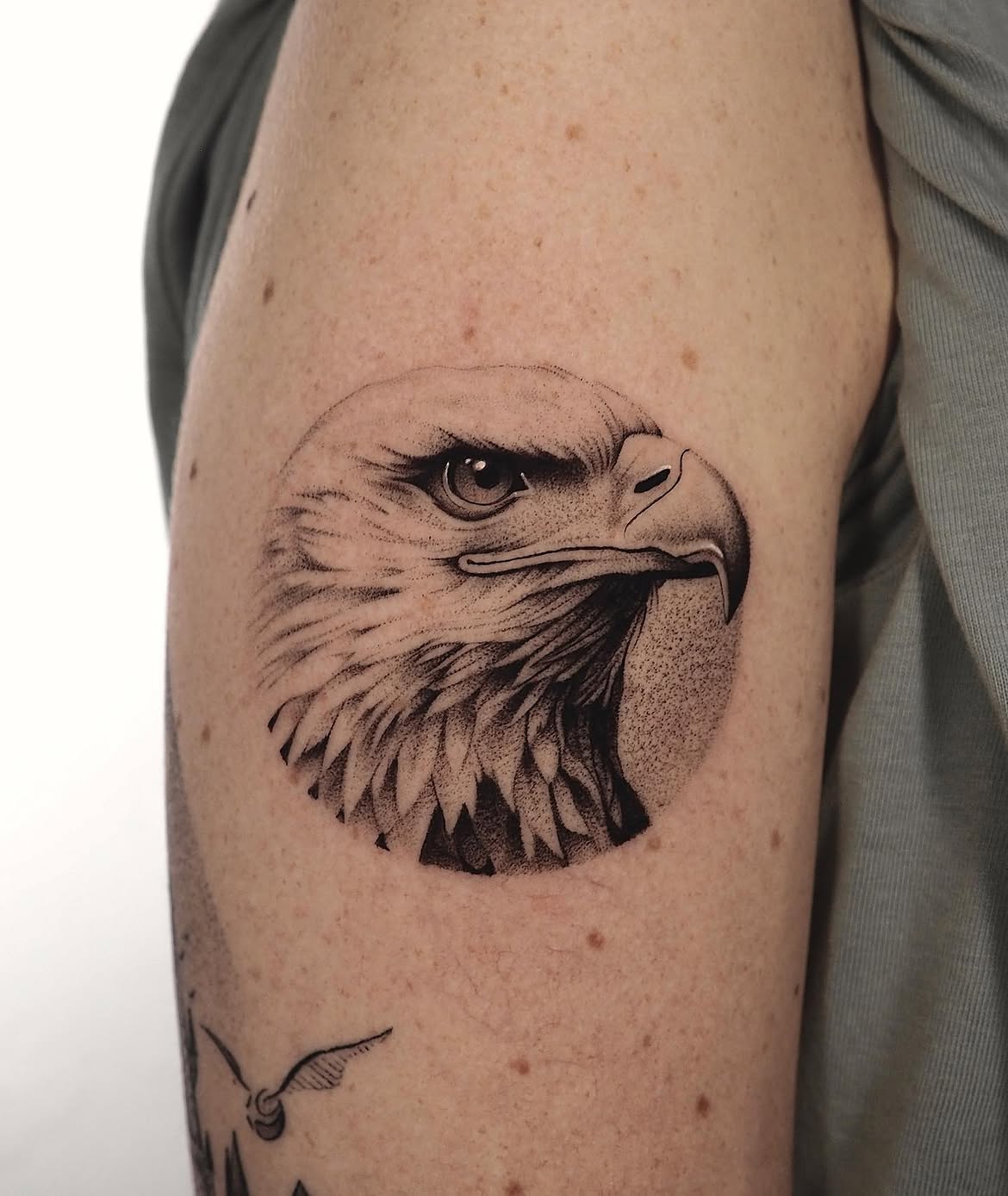
Not every dotwork tattoo needs a mandala, and this eagle is an excellent change of pace. Instead of geometric repetition, stippling is used to model a realistic animal portrait. The head is shown in profile, with the hooked beak, layered feathers, and intensely rendered eye forming the main points of attention.
The eye is particularly effective because it carries the darkest concentration of ink. Fine lines define the surrounding folds and feather direction, while progressively scattered dots create subtle shadows around the face and beak. The transition from dense marks to untouched skin is so gradual that parts of the eagle seem to fade naturally into the arm.
Feathers beneath the head combine thin strokes with darker shadows, providing enough structure to keep the portrait from looking overly soft. The rounded lower edge is only partly implied; much of the form is created by tonal changes rather than a conventional outline.
For men or women who admire dotwork but don’t connect with geometric, mandala, moon, or ornamental imagery, realism opens an entirely different direction. This piece demonstrates the fundamental strength of the technique: dots are not merely decorative. In experienced hands, they can behave like graphite on paper, producing volume, texture, and remarkably subtle changes in light.
Ornamental Foot Tattoo With Flowing Dotwork Petals
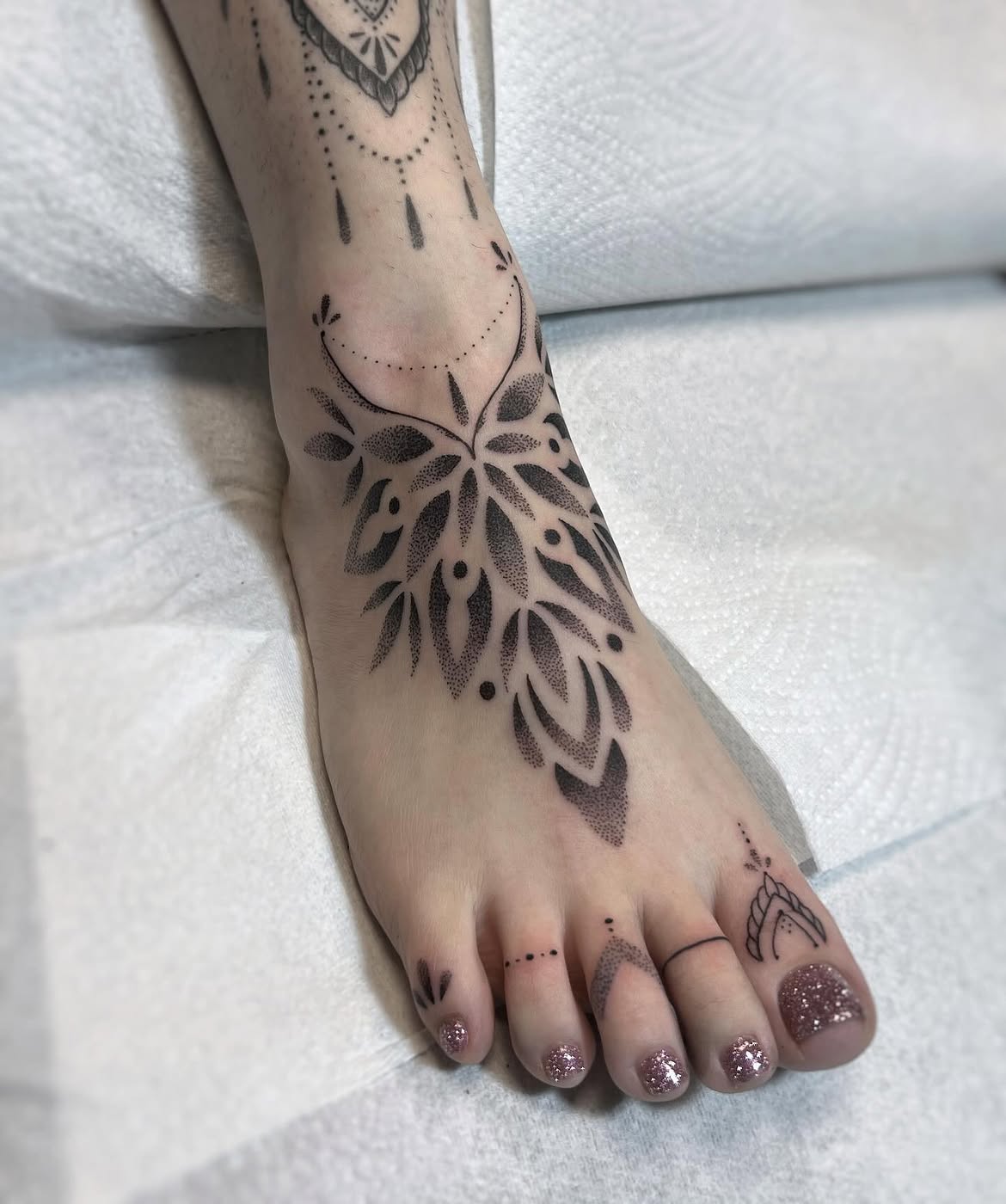
This foot tattoo shows how effectively dotwork can soften an otherwise bold ornamental design. The main motif begins around the ankle and spreads downward across the top of the foot in a loose arrangement of pointed petals, leaf-like forms, and sweeping curves. Instead of following the strict circular symmetry of a classic mandala, the composition has been stretched to follow the natural length of the foot.
The stippling is particularly attractive inside the larger petals. Dense clusters of tiny dots sit beside areas of untouched skin, producing a gradient without making the tattoo look overly heavy. Small solid circles and dotted chains add decorative rhythm, while the fine curved lines around the ankle create a jewelry-like effect.
What I like most is the irregular balance. The design feels coordinated without being perfectly mirrored. That makes it closer to a free-flowing floral pattern than a traditional mandala stencil. Smaller decorative elements on the toes also echo the larger tattoo without competing with it.
For this placement, restraint matters. Extending every element onto the toes could easily make the composition too busy. Here, the large motif remains the focal point while the smaller marks function almost like punctuation.
Geometric Dotwork Elbow Sleeve With a Negative-Space Band
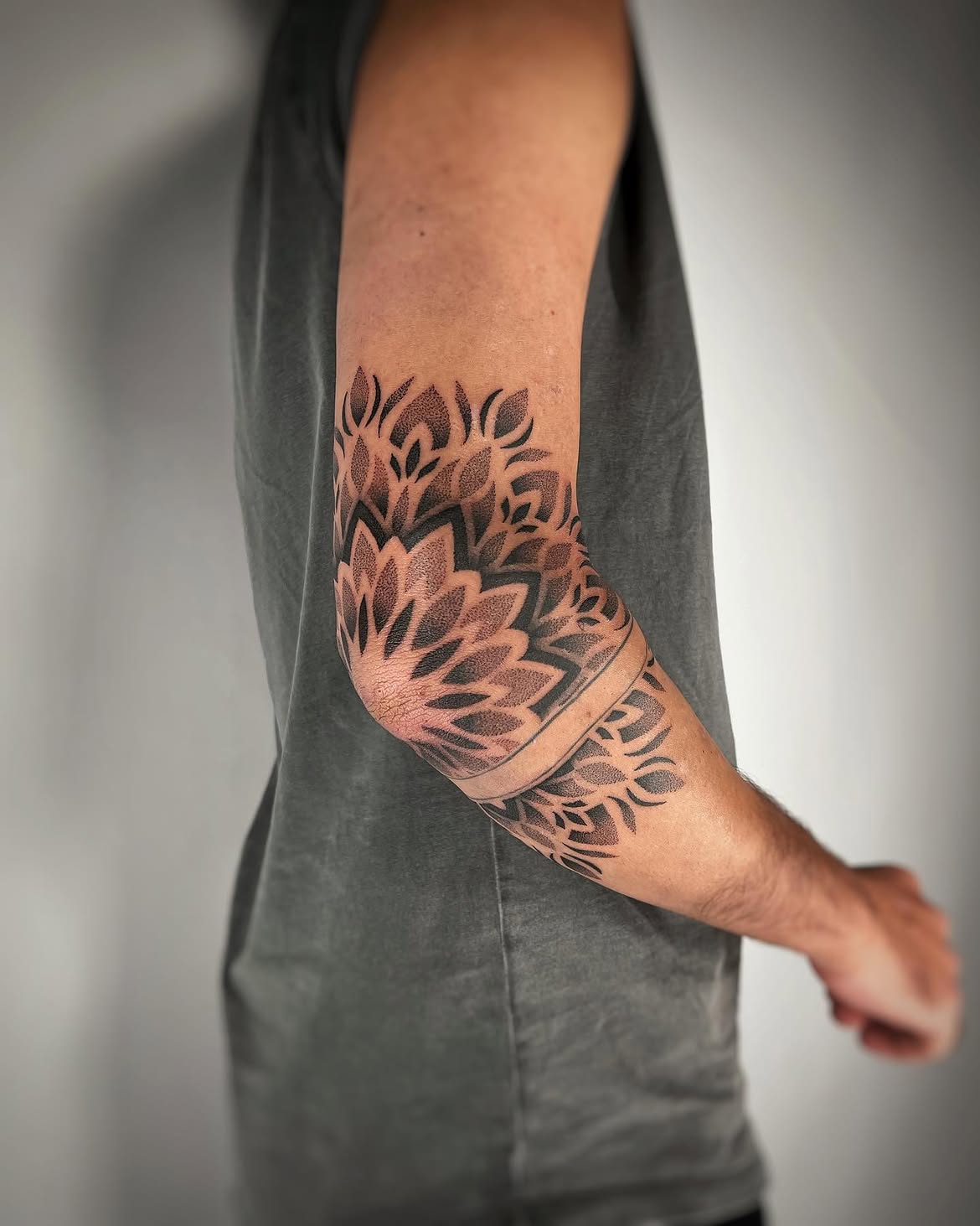
This elbow tattoo is built for movement. Large pointed petals radiate around the joint, creating a bold geometric flower that changes slightly every time the arm bends. The design then continues both above and below the elbow, giving it the presence of a developing sleeve rather than an isolated mandala.
One detail immediately separates this piece from many similar designs: the broad band of bare skin crossing the lower section. That negative-space stripe creates a visual pause between two dense areas of ornament. Without it, the combination of black shapes and stippled petals could become difficult to read.
The artist also alternates different levels of dot density. Some petals have almost velvety dark centers, while others retain enough open skin to feel noticeably lighter. Solid black wedges provide contrast and strengthen the underlying geometric structure.
For men who prefer large-scale ornamental tattoos, this is a useful example of how a mandala can become part of a broader arm composition. A custom Vorlage or stencil should be planned with the elbow bent and straight, because the success of the tattoo depends heavily on how those petals wrap around the joint.
Layered Floral Mandala Forearm Tattoo
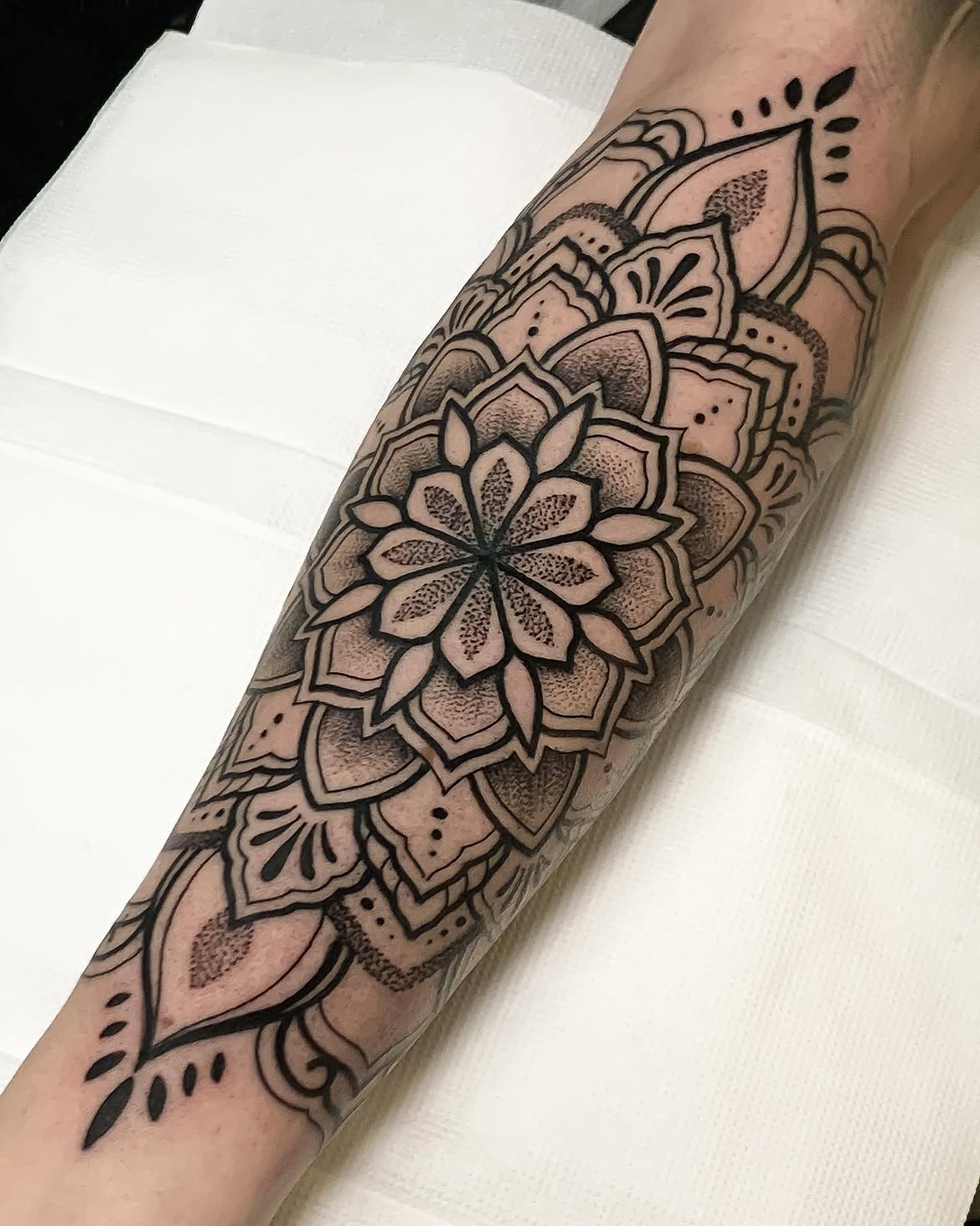
This forearm mandala has the intricacy of carved ornament. A relatively small central flower expands through multiple tiers of petals, each layer introducing a different shape, border, or texture. The repetition gives the tattoo strong symmetry, but the changing internal details stop that symmetry from becoming monotonous.
Dotwork appears primarily as shading within the petals. Some areas are densely stippled around their edges and gradually lighten toward the center, giving otherwise flat geometric forms a subtle sense of depth. Fine outlines sit alongside heavier black borders, while occasional solid teardrop shapes provide darker accents.
The elongated outer petals are especially well suited to the forearm. They allow a fundamentally circular mandala design to stretch vertically and use more of the available space. Rather than looking like a round emblem placed in the middle of the arm, the tattoo follows its proportions.
Anyone researching a mandala stencil can take an important idea from this piece: symmetry doesn’t require every layer to use the same visual language. Dots, lines, solid black shapes, and negative space can all coexist as long as the repetition remains controlled.
Matching Ornamental Dotwork Leg Tattoos
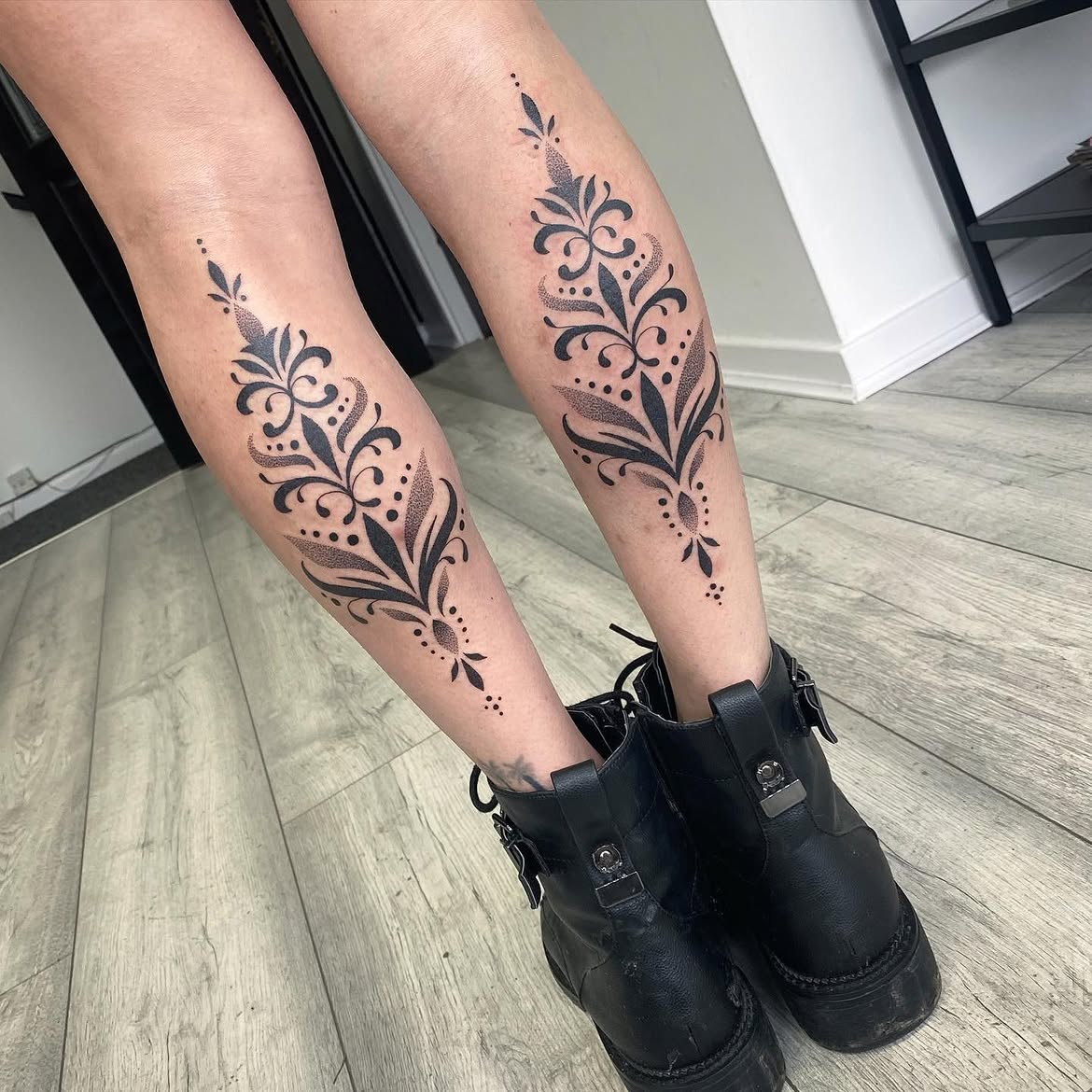
Matching tattoos become especially interesting when the design is substantial enough to work independently on each leg. These two pieces use the same elongated floral arrangement, creating a mirrored visual effect when the legs are placed together.
The design mixes sweeping black curves, pointed leaves, tiny circular accents, and softly stippled sections. Rather than forming one conventional flower, the elements travel vertically up the calf in a decorative vine-like rhythm. That direction makes the legs appear visually longer and gives the tattoo plenty of movement.
There is a slightly folk-inspired quality to the curved motifs as well. They resemble ornamental flourishes found in decorative illustration and textile muster, but the stippled gradients keep the result firmly within contemporary dotwork.
For matching tattoo ideas, exact duplication isn’t always necessary, but it works particularly well here because the placement creates the variation. Each tattoo follows a different leg, so natural anatomy prevents the pair from looking artificially copied even though their core pattern is essentially the same.
Fine Dotwork Mandala Across the Shoulder
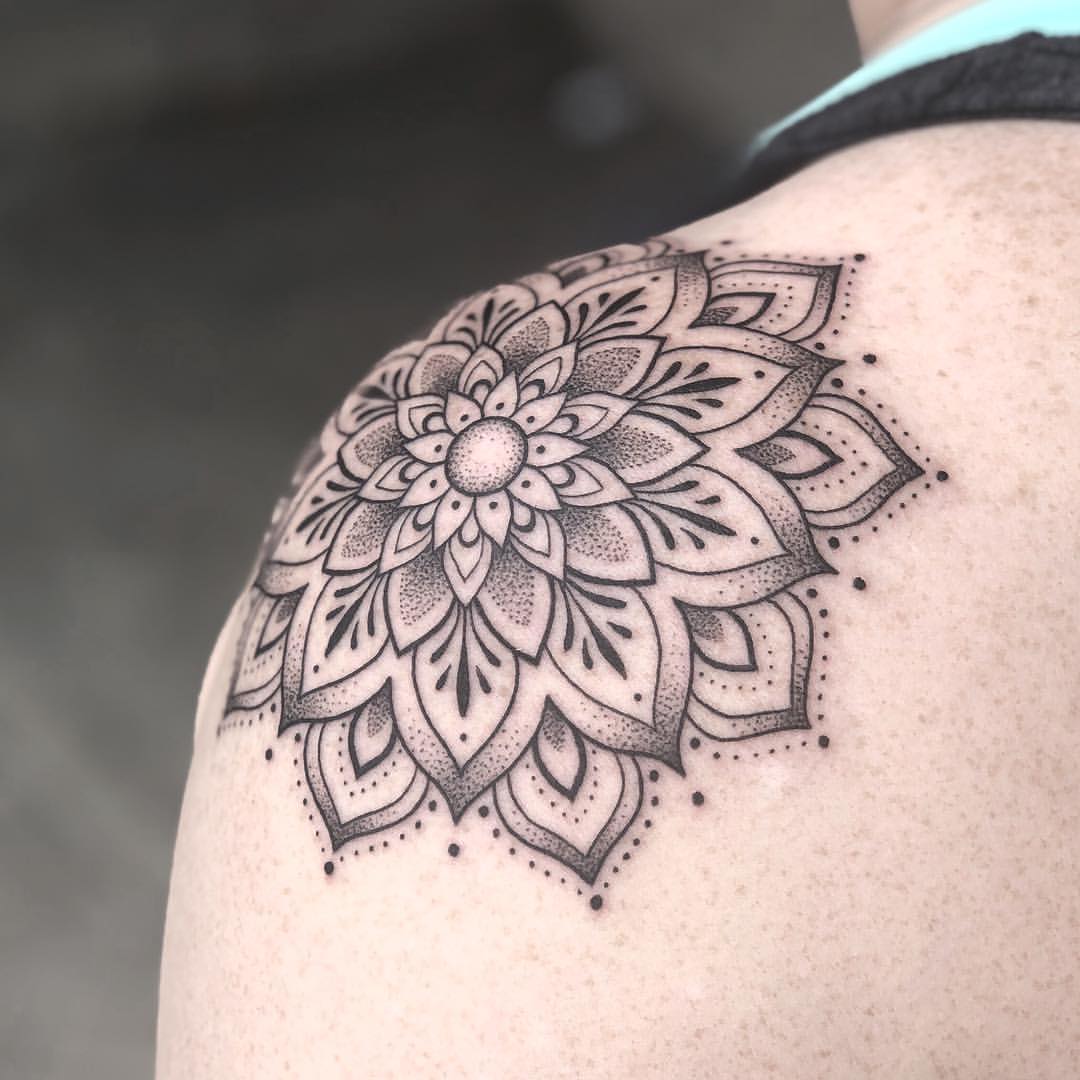
The rounded shoulder is one of the most natural placements for a mandala because the anatomy already provides a curved surface for the design to follow. Here, the central flower sits near the highest point of the shoulder and gradually expands outward through several rings of petals.
This piece leans toward the delicate side of dotwork. The outlines are comparatively fine, and stippling is concentrated inside selected petals rather than spread across the entire tattoo. Small dots around the perimeter form loose decorative trails, allowing the outer edge to fade gently instead of ending with a hard circular border.
The internal details deserve attention too. Some petals contain short organic marks reminiscent of leaves or seeds, while others rely almost entirely on fine line outlines and dotted shading. This variety gives the tattoo a handmade quality despite its careful symmetry.
Among mandala women ideas, this placement is particularly versatile. The motif can remain contained on the shoulder as it does here, or its outer petals can later provide natural connection points for a larger floral or ornamental sleeve.
Large Mandala Flowing From the Forearm Onto the Hand
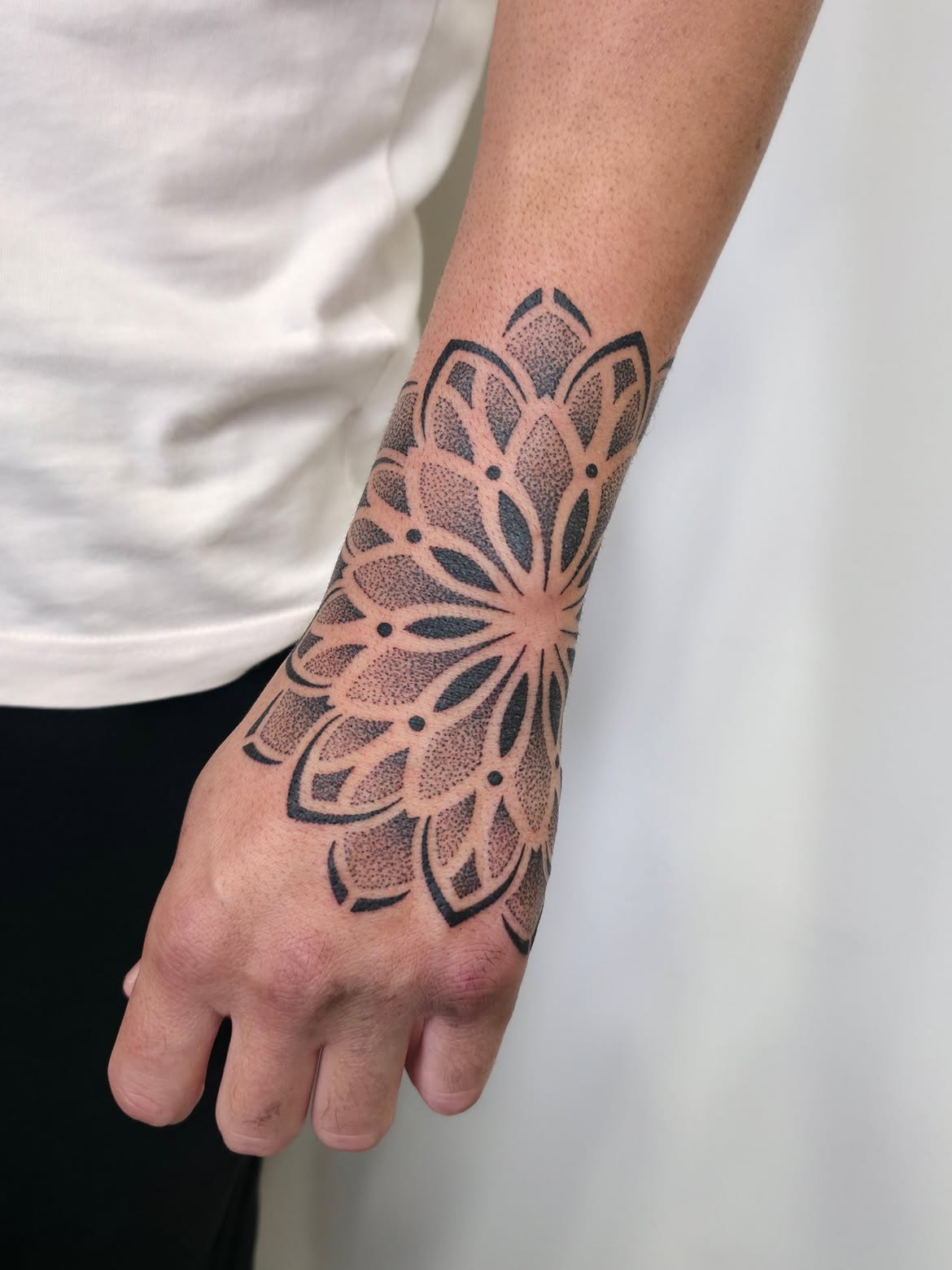
This design uses the wrist as part of the artwork rather than treating it as a boundary. A large mandala spreads from the forearm across the joint and toward the back of the hand, giving the pattern a continuous, wrapping quality.
Long pointed petals form the primary structure. Inside them, extremely dense fields of dots create dark gray surfaces that contrast against narrow channels of bare skin. Several solid-black shapes appear closer to the center, adding enough weight to keep the tattoo visually strong from a distance.
The result sits somewhere between a traditional mandala, geometric blackwork, and contemporary dotwork. It feels substantial without depending on one enormous field of black ink.
This approach could also form the lower section of a full sleeve. Because the outer petals terminate at different heights, an artist would have several opportunities to connect future pattern work farther up the arm. Even as a standalone piece, however, it feels complete because the radial structure remains easy to recognize.
Surreal Eye and Sun Dotwork Tattoo
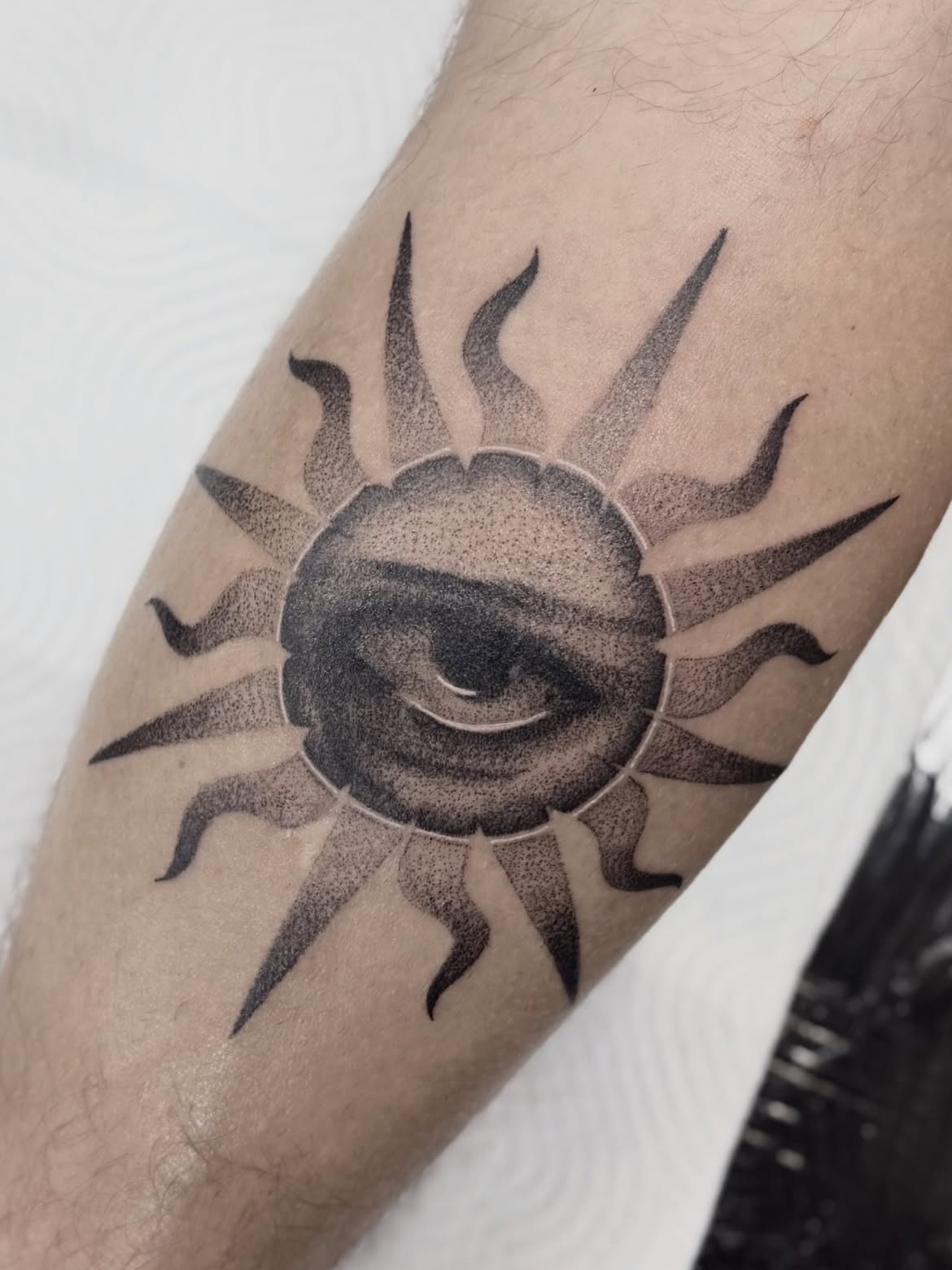
One of the most unusual designs in the collection replaces floral geometry with a surreal eye framed by sun-like rays. The circular center contains a realistically shaded eye, while alternating straight and wavy points radiate around it.
Dotwork is doing much of the tonal work. Around the eyelids, iris, and surrounding skin, tightly packed stippling produces soft shadows and gives the eye a surprisingly three-dimensional appearance. The surrounding rays use lighter gradients, so they remain visually separate from the darker center.
There is also a compelling contrast between realism and symbolism. The eye is anatomical enough to feel alive, while the surrounding form belongs to an entirely different visual language. The combination can suggest perception, intuition, illumination, or vigilance depending on the meaning the wearer assigns to it.
For people who enjoy the symbolism of a moon or sun tattoo but want something less predictable, this kind of hybrid design offers a strong alternative. It also demonstrates why dotwork should never be reduced to mandalas alone: the same tiny marks that build perfectly ordered geometric patterns can create remarkably convincing realistic shading.
Large Dotwork Mandala Flowing Across the Calf
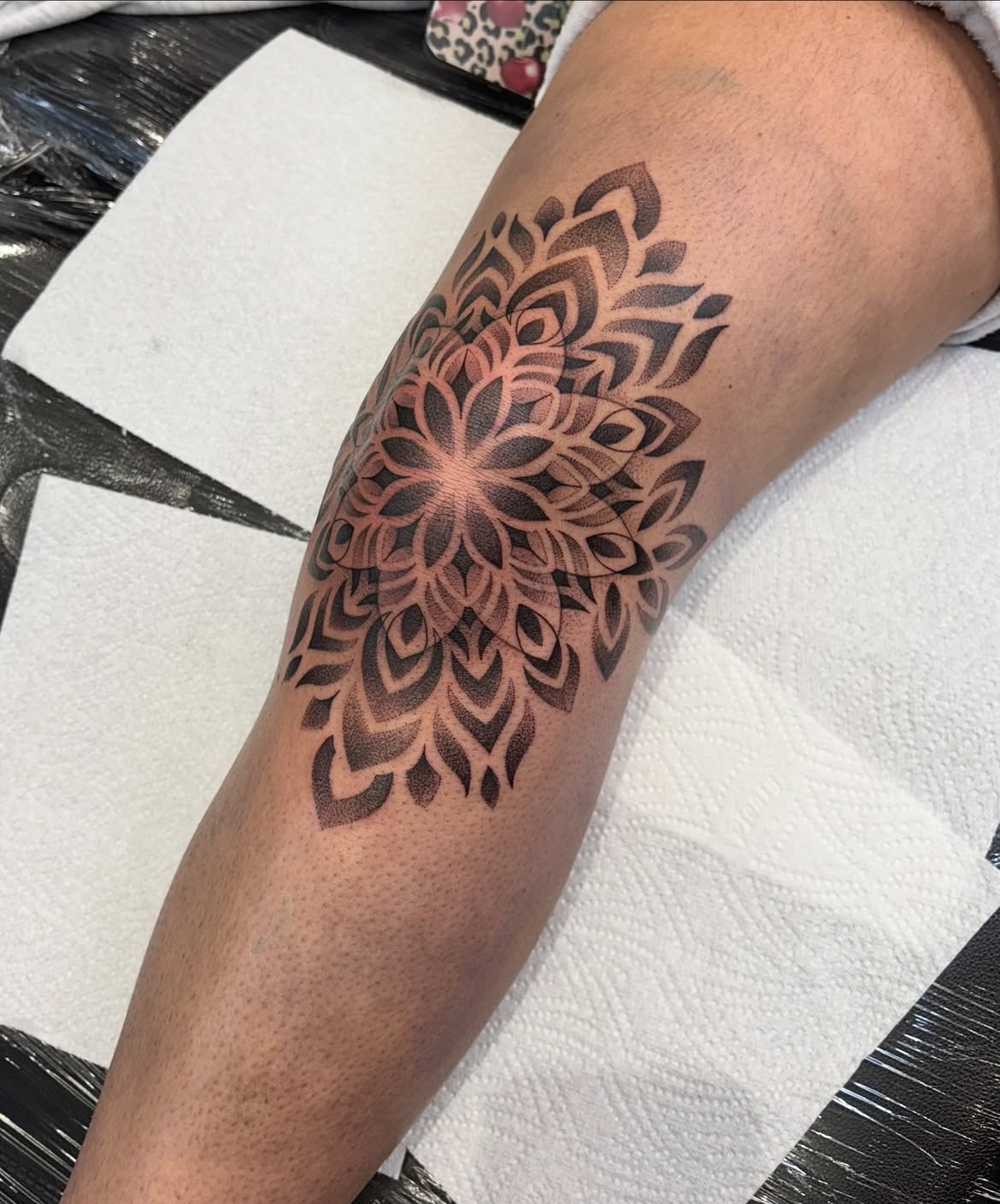
This calf tattoo uses one of dotwork’s greatest strengths: it creates a large, dramatic mandala without turning the entire area into a flat mass of black ink. The central flower begins with elongated petals arranged around a compact focal point, then expands through increasingly complex layers of pointed and curved forms.
There is a satisfying rhythm to the way the darker sections alternate with bare skin. Some petals are densely stippled until they almost resemble solid black, while neighboring shapes use lighter mandala dots. Narrow negative-space channels separate those layers and keep the geometry readable.
The calf gives this design enough vertical room to stretch beyond a perfectly circular format. The upper and lower sections taper into smaller ornamental shapes, making the tattoo feel naturally fitted to the leg.
For anyone collecting large geometric ideas, this is a useful reminder that a mandala does not need a heavy outline around its perimeter. Letting individual petals establish the edge gives the composition a softer finish and leaves room for a future leg sleeve if desired.
Airy Floral Dotwork Design With Leaf-Shaped Shading
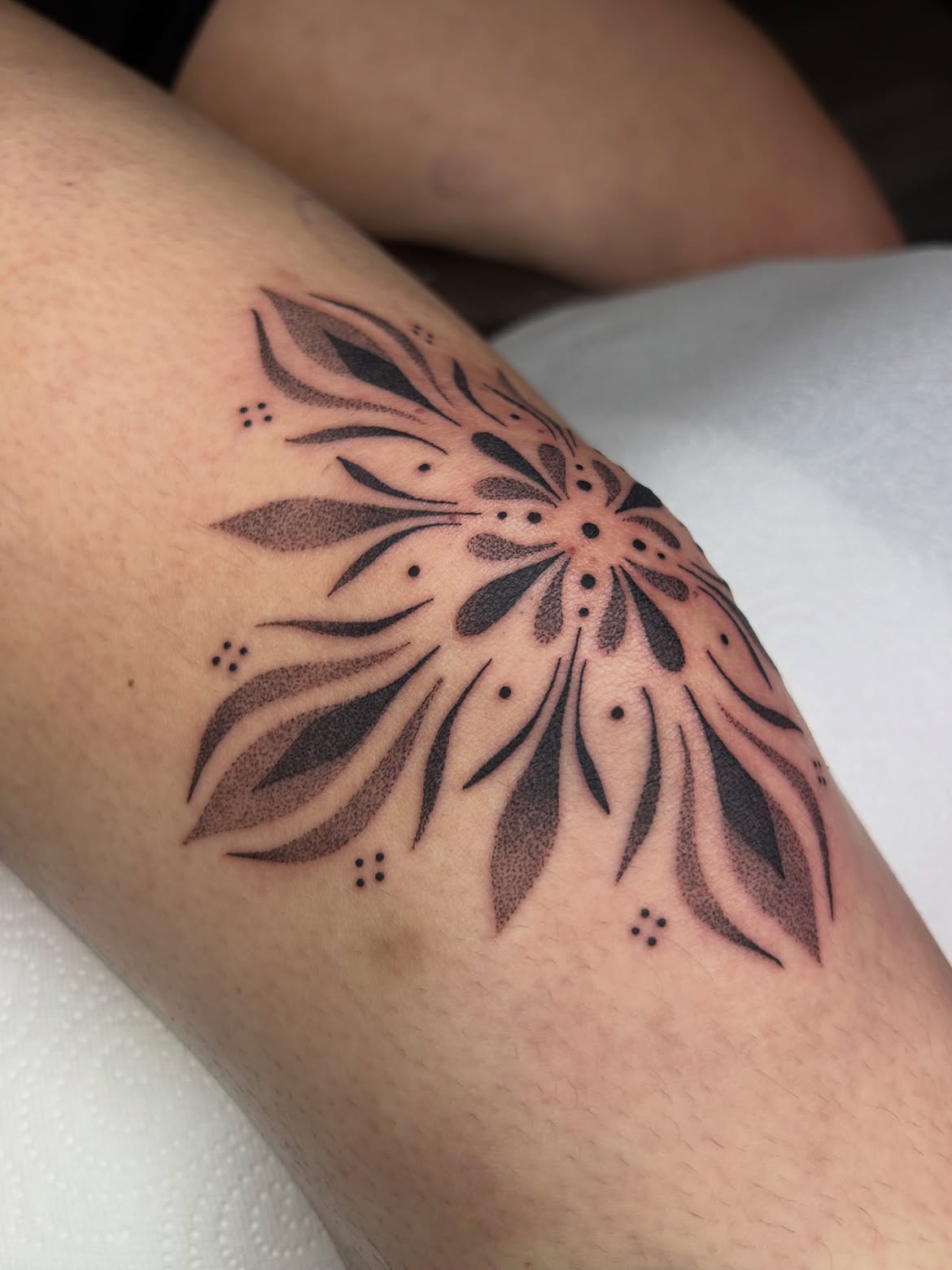
This piece feels noticeably freer than the highly symmetrical mandalas in the collection. The central formation still has a radial structure, but the outer shapes stretch into long, sweeping leaves and narrow tapered lines.
Dotwork shading gives those elements their depth. Some leaf forms contain a dark central section surrounded by a lighter stippled border, while others are composed almost entirely of tiny dots. Small groups of solid circles appear around the composition, adding just enough decorative detail to fill the open spaces.
The result sits somewhere between a flower, an ornamental burst, and an abstract botanical pattern. I especially like the amount of skin allowed to remain visible between the elements. That negative space makes the design breathe and prevents the wider placement from appearing unnecessarily heavy.
This approach could be particularly appealing to someone who likes floral dotwork but doesn’t want the strict mathematical repetition of a traditional mandala stencil. It still has balance and structure, just with a more spontaneous personality.
Elongated Mandala Forearm Tattoo With Botanical Extensions
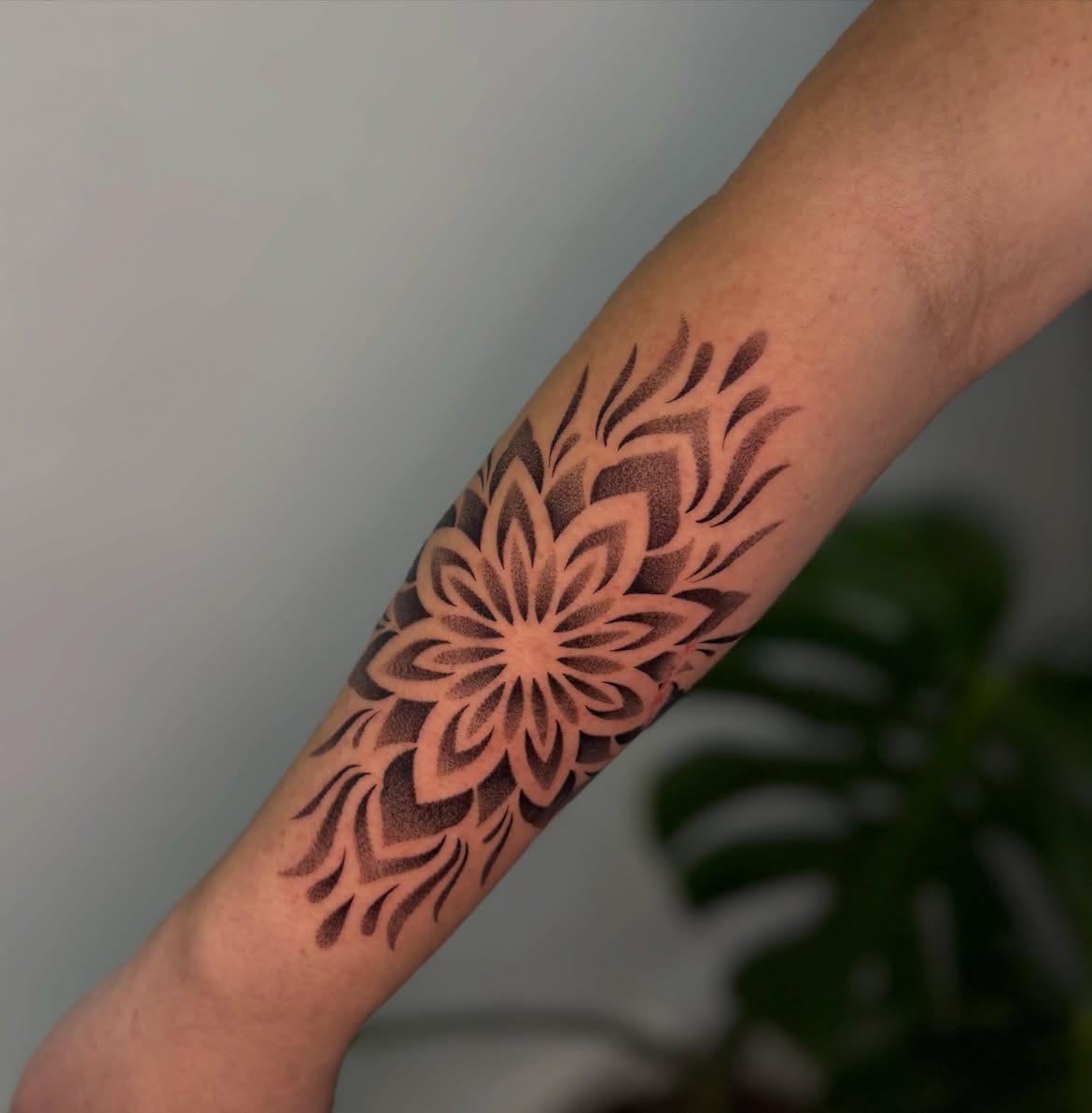
This forearm mandala is built around a crisp radial flower, but the outer decoration is what gives the tattoo its personality. Instead of stopping at a circular border, narrow leaves and tapered strokes continue outward along the length of the arm.
The construction is deceptively simple. Petals near the center are narrow and closely spaced, while the next layers become progressively broader. Dot shading fills many of those outer forms, producing a soft charcoal-like tone against the clean negative-space borders.
The extensions at either end are particularly effective. They transform what could have been a conventional circular geometric tattoo into an elongated composition that fits the forearm much more naturally.
This is also a good example of how a custom Vorlage should respond to placement. A perfectly round pattern may look impressive on paper, but stretching selected elements along the anatomy often makes the finished tattoo feel more intentional. The combination of botanical details, symmetry, and stippling works equally well as a standalone piece or as the foundation for a future ornamental sleeve.
Minimal Dotwork Eye Made Entirely From a Grid of Dots
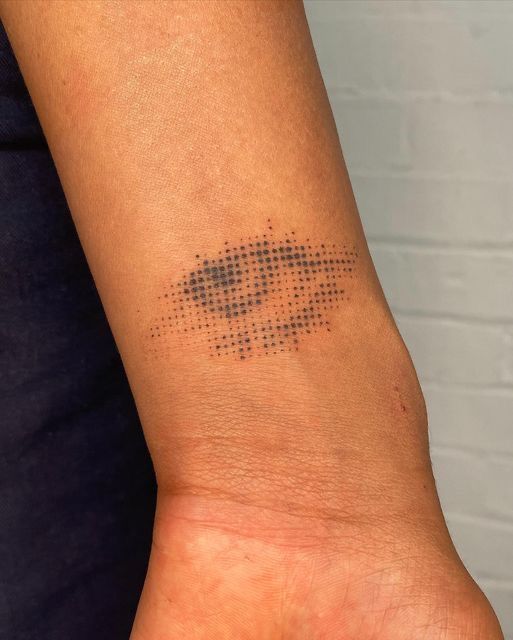
This tiny eye takes dotwork back to its most literal form. There is no conventional outline and virtually no continuous linework. Instead, carefully positioned dots form the eyelids, iris, pupil, and surrounding shadow.
The grid-like arrangement creates an almost halftone or digital-print effect. Larger and darker dots establish the important features, while smaller, more widely spaced marks allow the image to fade gradually into bare skin.
From a distance, the eye becomes surprisingly clear. Up close, however, the viewer can see how little ink is actually required to construct it. That tension between recognizable imagery and abstract pattern is exactly what makes minimalist dotwork interesting.
For people who associate the style only with large mandala designs, this is an excellent alternative. A small tattoo can still demonstrate the technique without needing elaborate geometry, floral ornament, or a large placement. It also has a contemporary graphic quality that feels very different from traditional stipple shading.
Abstract Spiral Dotwork Symbol on the Upper Arm
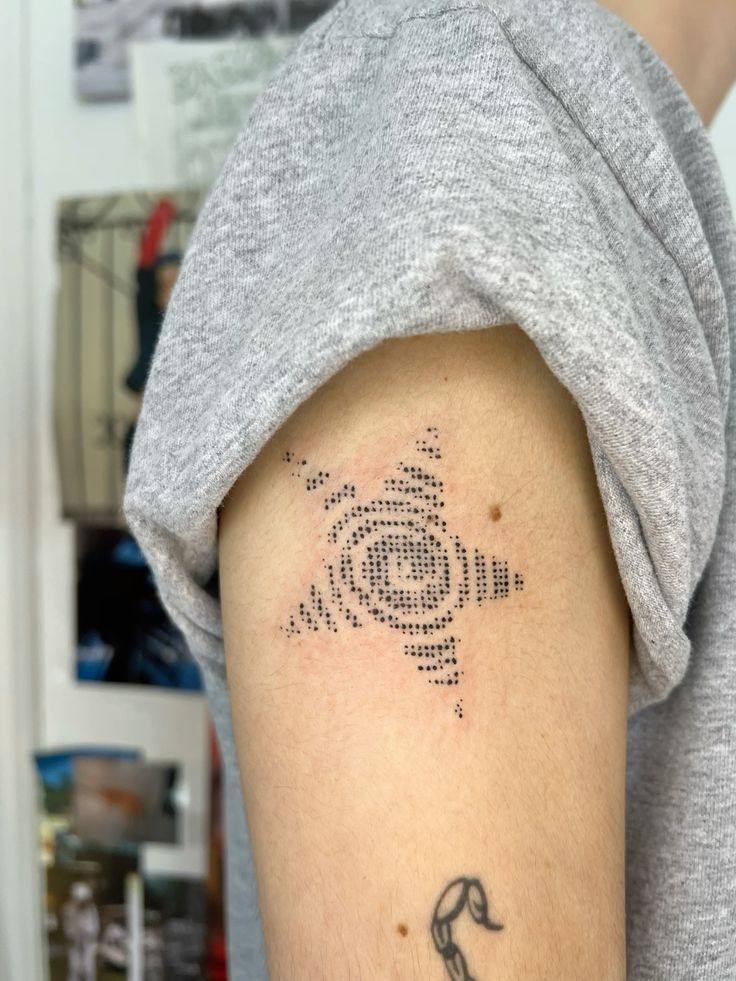
This small upper-arm piece is another example of dots functioning as the entire visual language of a tattoo. Concentric formations create a central spiral, while four loosely triangular extensions project outward to produce a compact geometric symbol.
There are no hard borders. Instead, the artist controls shape through spacing. Dense rows of black dots establish the strongest portions of the design, while scattered marks soften its outer edges.
The effect feels somewhere between an optical symbol, a diagram, and a contemporary tribal-inspired muster. Because the construction is intentionally open, the skin becomes part of the artwork rather than merely a background for it.
I find pieces like this particularly interesting because they expose the logic of dotwork. In a large mandala, individual marks can disappear inside the overall ornament. Here, every dot remains visible and important. Removing even a small row could noticeably change the balance.
It’s a compact idea for anyone who wants geometric tattooing without conventional black outlines or an intricate stencil.
Surreal Broken Heart With Eye and Safety Pins
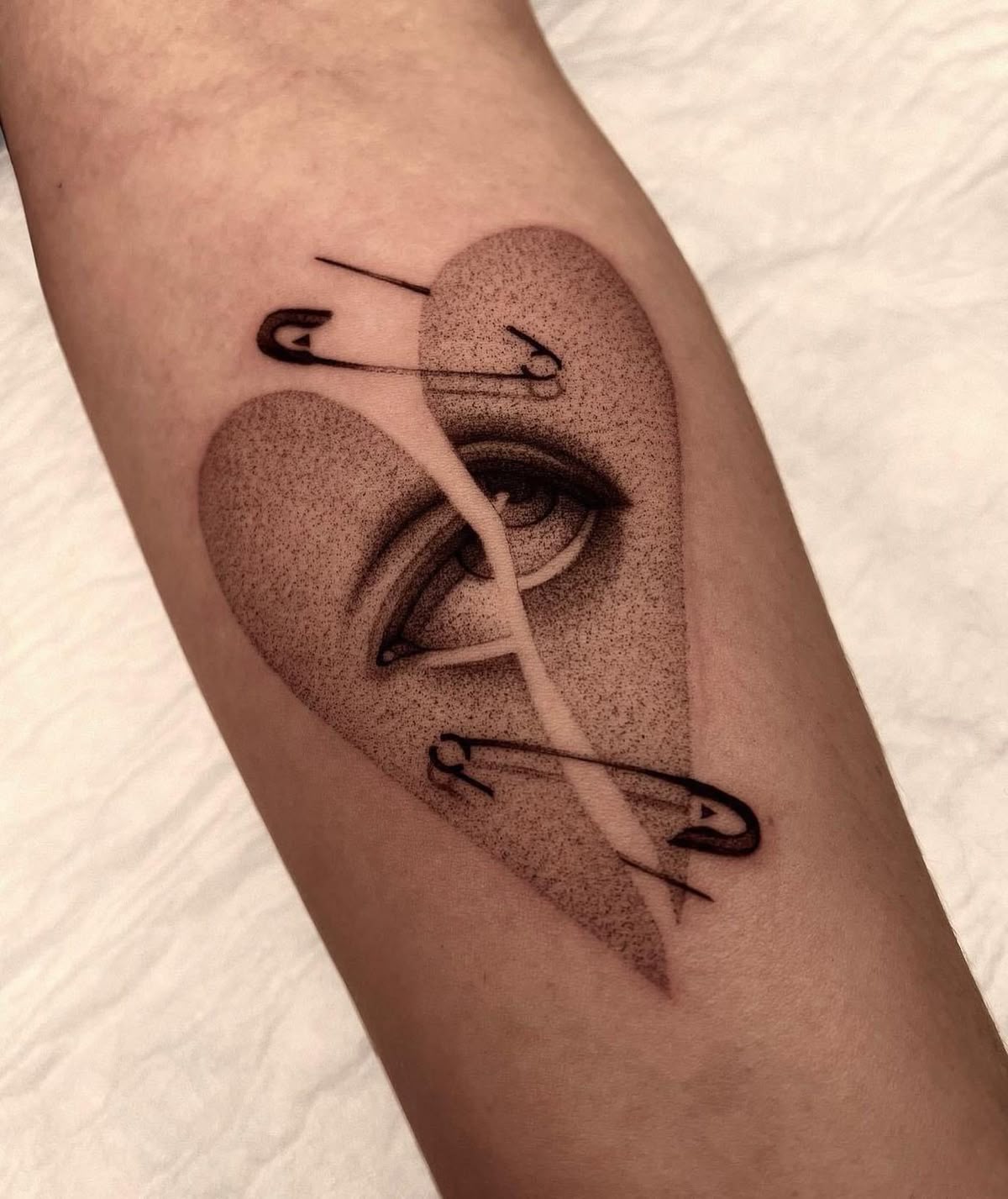
This surreal heart takes the article in a completely different direction. A large heart-shaped field is rendered with extremely fine stippling, creating a smooth gray texture rather than a solid black silhouette. A pale irregular split runs vertically through the center, making the heart appear torn into two pieces.
Inside that break sits a realistic eye. Dense dotwork around the eyelids creates deep shadows, while finer marks soften the surrounding areas. The contrast between the anatomical eye and the graphic heart makes the design feel intentionally strange and emotionally charged.
Three safety pins cross the composition as though they are attempting to hold the broken form together. Their clean fine line construction contrasts sharply with the grainy stippled background. It is a simple visual metaphor, but an effective one: damage, repair, vulnerability, and resilience can all be read into the same image.
Technically, the piece is also a strong example of combining styles. Realistic stippling, minimalist linework, negative space, and graphic symbolism all occupy one relatively compact tattoo without competing for attention.
Among these dotwork tattoo ideas, this one makes perhaps the clearest case for looking beyond mandala, geometric, and ornamental work. Dotwork is a technique rather than a subject. Once that distinction becomes clear, almost anything—from an abstract symbol to a surreal portrait—can be built from dots.
Dotwork is less a single tattoo style than a way of building an image. The same technique can produce a tiny graphic star, a delicate botanical branch, or an intricate mandala large enough to dominate an entire joint. The strongest designs tend to respect both distance and detail: they form a clear silhouette from across the room, then reveal their tiny marks and gradients when viewed closely.
If one of these ideas caught your attention—or you have a completely different dotwork concept in mind—leave a comment and share which placement, pattern, or style you would choose.