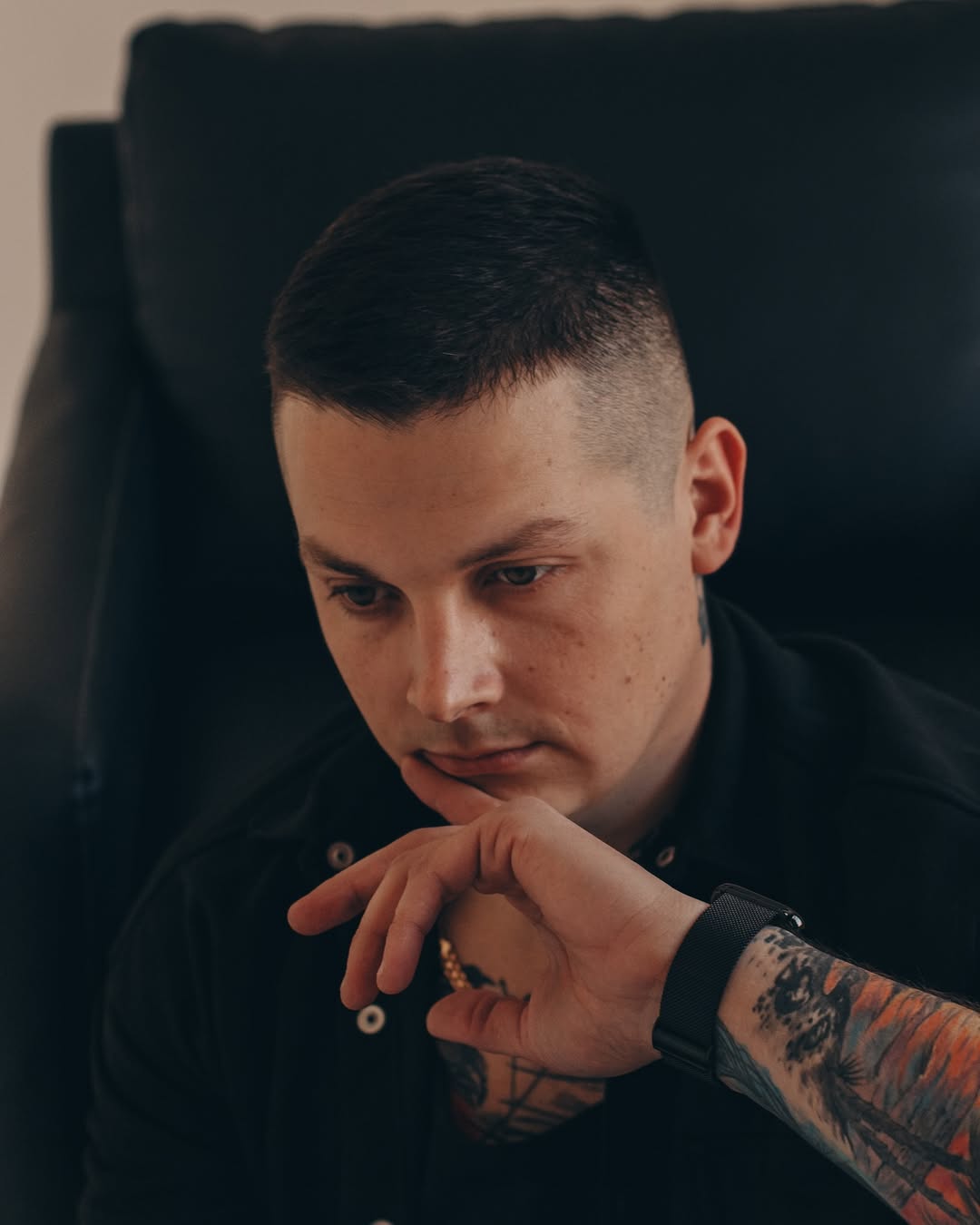
Saint Christopher tattoos have a particular weight to them. They are religious images, certainly, but their appeal reaches beyond straightforward devotional art. For generations, Saint Christopher has been associated with travelers, difficult journeys, protection, endurance, and the idea of carrying someone safely through danger. That symbolism translates naturally into tattooing, where a permanent image can become a personal reminder rather than simply decoration.
What makes Saint Christopher tattoo ideas especially interesting is how differently artists interpret the same familiar figure. A large forearm or sleeve can turn the saint into the center of an elaborate biblical narrative, while a fine line or minimalist design can reduce the composition to a few carefully chosen details: the Child, the staff, a halo, or a protective inscription.
Tattoo publications and artist-focused platforms are useful places to observe how contemporary artists reinterpret religious imagery. The strongest work rarely feels like a copied illustration. Instead, scale, placement, contrast, line weight, and surrounding symbolism are adjusted to make an old subject feel personal.
Here are 27 approaches that show just how broad that visual language can be.
Saint Christopher and Saint Michael Religious Forearm Sleeve
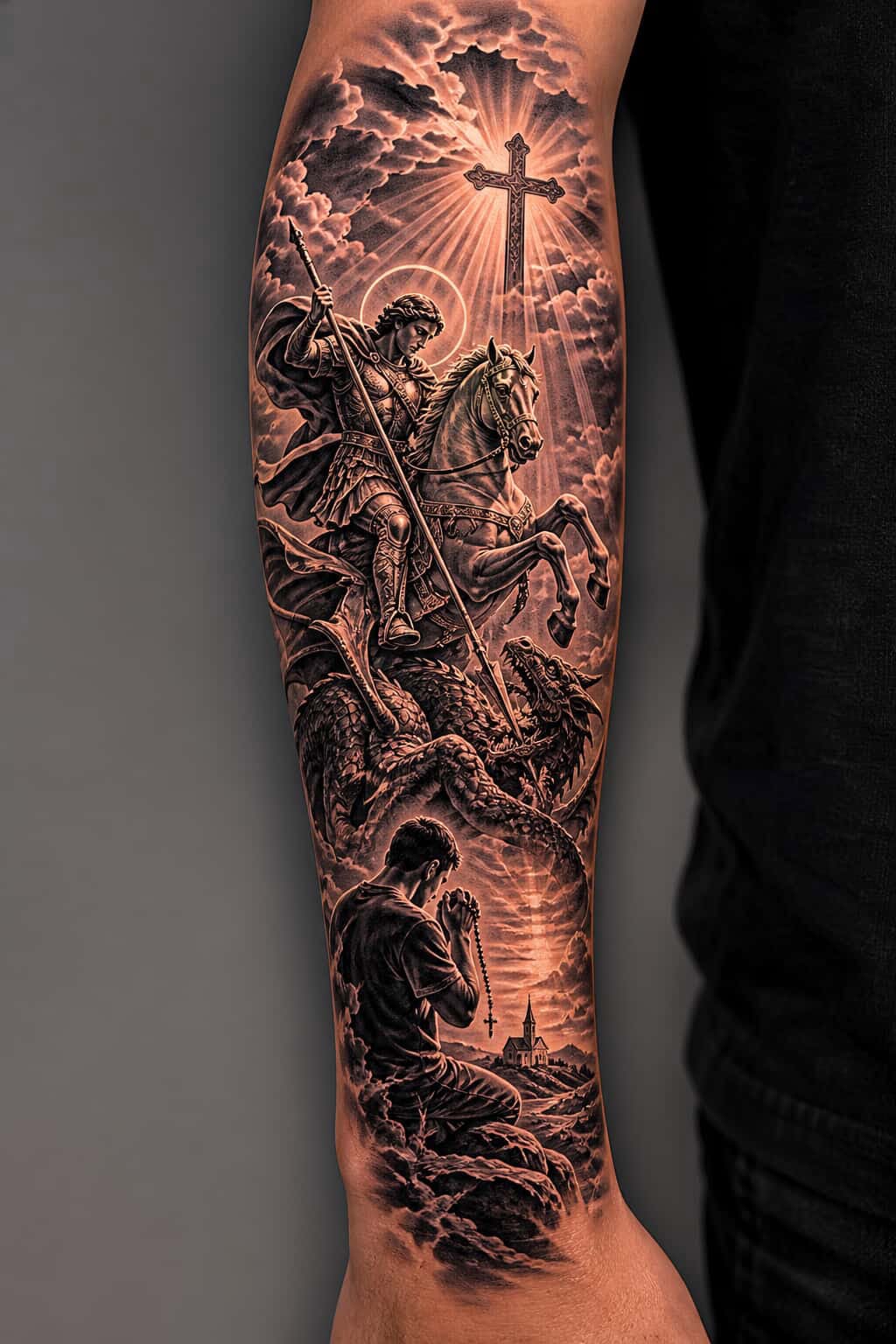
This is the most cinematic design of the group, built almost like a religious mural fitted to the shape of the forearm. Rather than presenting Saint Christopher alone, the composition expands into a larger story of faith, struggle, and protection. A mounted Saint Michael dominates the upper portion, driving his spear toward the dragon beneath him, while a large cross appears overhead among dramatic clouds and radiant beams.
The lower portion changes the emotional rhythm completely. A kneeling man holds a rosary in prayer, with a distant church appearing beyond him. That transition—from heavenly battle above to private devotion below—gives the tattoo a narrative quality that works particularly well for a large forearm piece or full sleeve.
The black-and-gray realism relies heavily on contrast. Deep blacks define the dragon and storm clouds, while lighter areas around the cross create the illusion of illumination. The result has the density needed for a substantial men’s arm tattoo without turning into one flat mass of shading.
For anyone developing a custom Saint Christopher composition, this is also a reminder that religious imagery does not have to exist in isolation. A saint, rosary, church, cross, clouds, and another protective figure can be connected into one coherent story. On a larger chest or back piece, the same concept could become even more expansive.
Archangel-Inspired Saint Protection Leg Tattoo
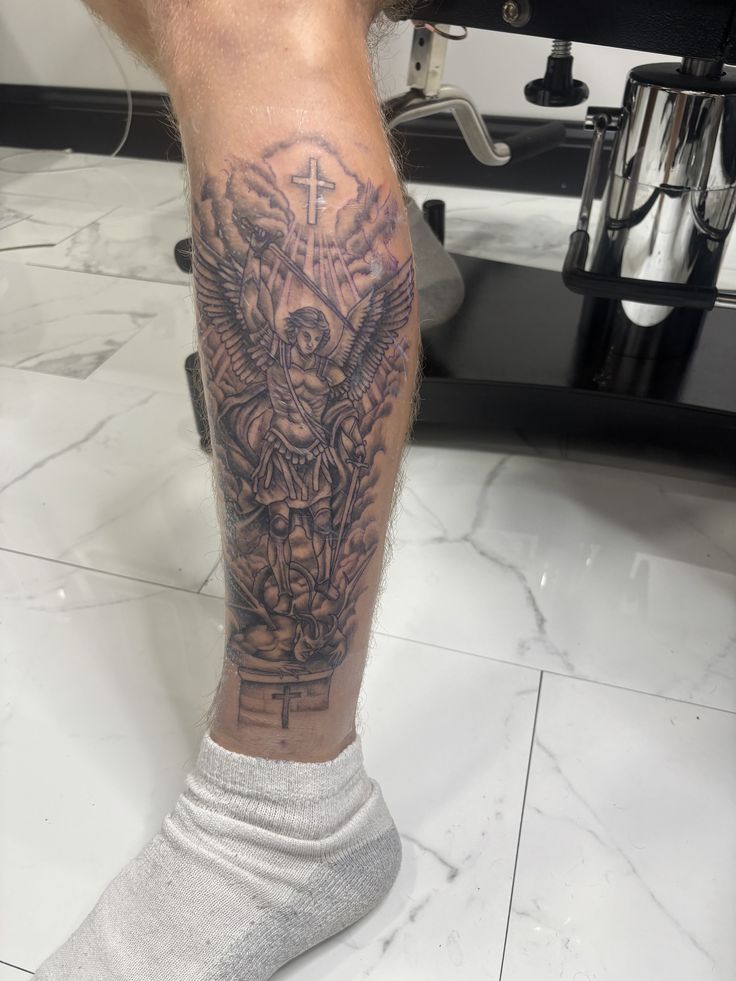
Here the emphasis moves from elaborate realism toward an engraved, almost classical religious aesthetic. The central winged warrior fills the vertical space of the leg, surrounded by clouds and crowned by a cross illuminated from above.
The elongated format is particularly successful. Wings stretch outward without making the composition excessively wide, while the figure, sword, and lower ornamental details pull the eye downward. It is exactly the sort of arrangement that benefits from being planned as a complete design stencil rather than assembled from unrelated elements afterward.
There is considerable detail, yet the tattoo remains readable because the major shapes are clearly separated. The wings establish the outer silhouette, the body creates the central axis, and the bright cross provides a natural focal point at the top.
Someone wanting a more traditional religious tattoo could simplify the cloud textures and increase the strength of the outline. Conversely, a realism artist could deepen the shadows and introduce stronger light rays. Either approach would preserve the essential protective character of the piece.
Black and Gray Saint Christopher Forearm Portrait
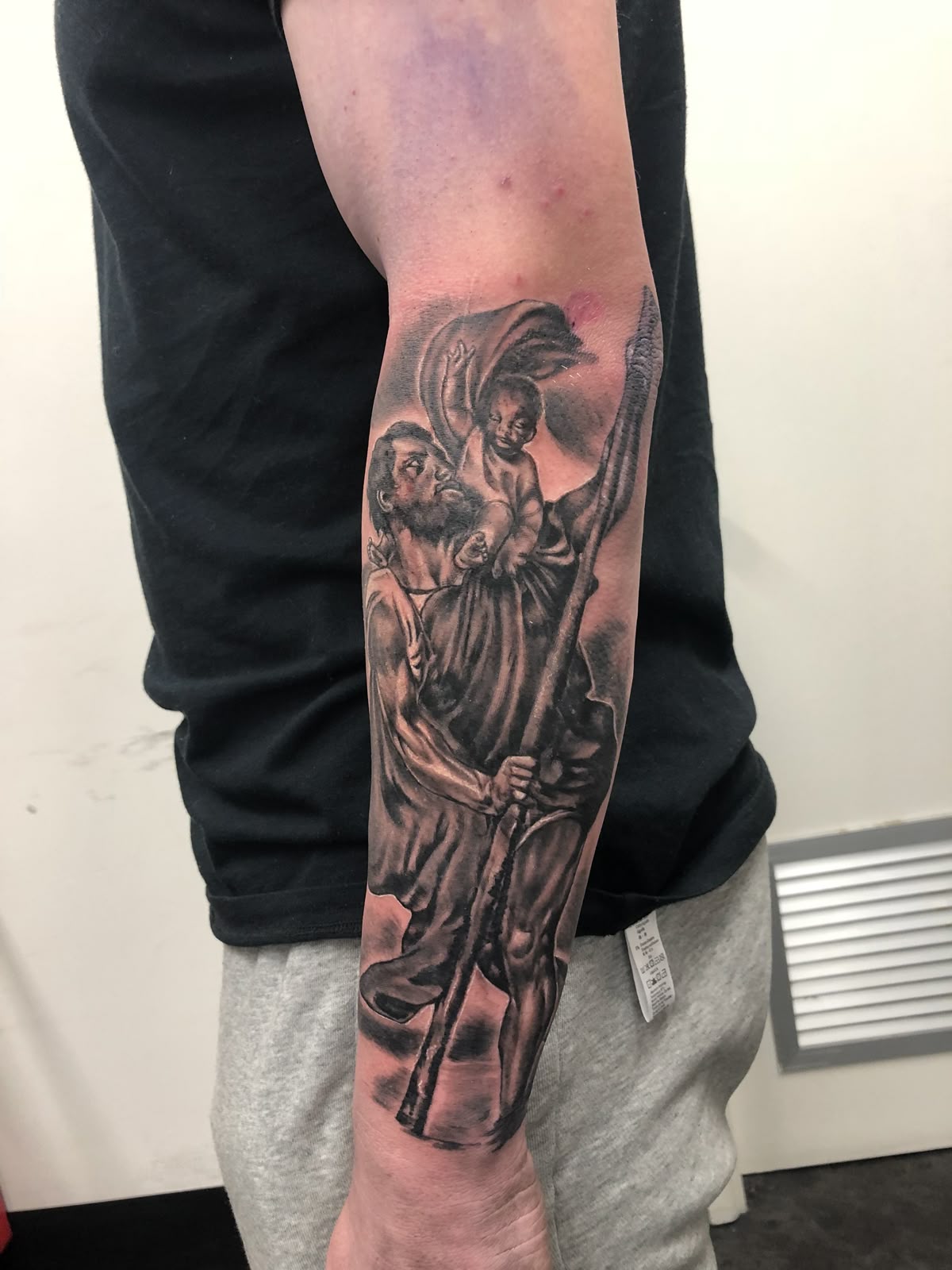
This Saint Christopher tattoo concentrates on the most recognizable part of his legend: the saint carrying the Christ Child while gripping his staff.
The narrow forearm placement suits the subject beautifully. Christopher’s body follows the length of the arm, and the tall staff reinforces that vertical movement. The Child sits high near his shoulder, establishing an immediate visual relationship between the two figures without requiring additional scenery.
What I like about this version is its restraint. It has the dimensional shading associated with realism, but it does not depend on an elaborate background. Draped fabric creates most of the movement, while darker folds help separate the body from the skin.
That makes the piece a useful reference for someone who wants substantial religious imagery but does not necessarily want a complete sleeve. It could also work on the upper arm or shoulder, although the proportions would need to be redrawn rather than simply resized.
For longevity, facial features deserve particular attention in a tattoo like this. Saint Christopher and the Child both depend on relatively small expressions, so allowing enough space between important lines is often more valuable than squeezing in another layer of micro-detail.
Fine Line Saint Christopher With Geometric Celestial Details
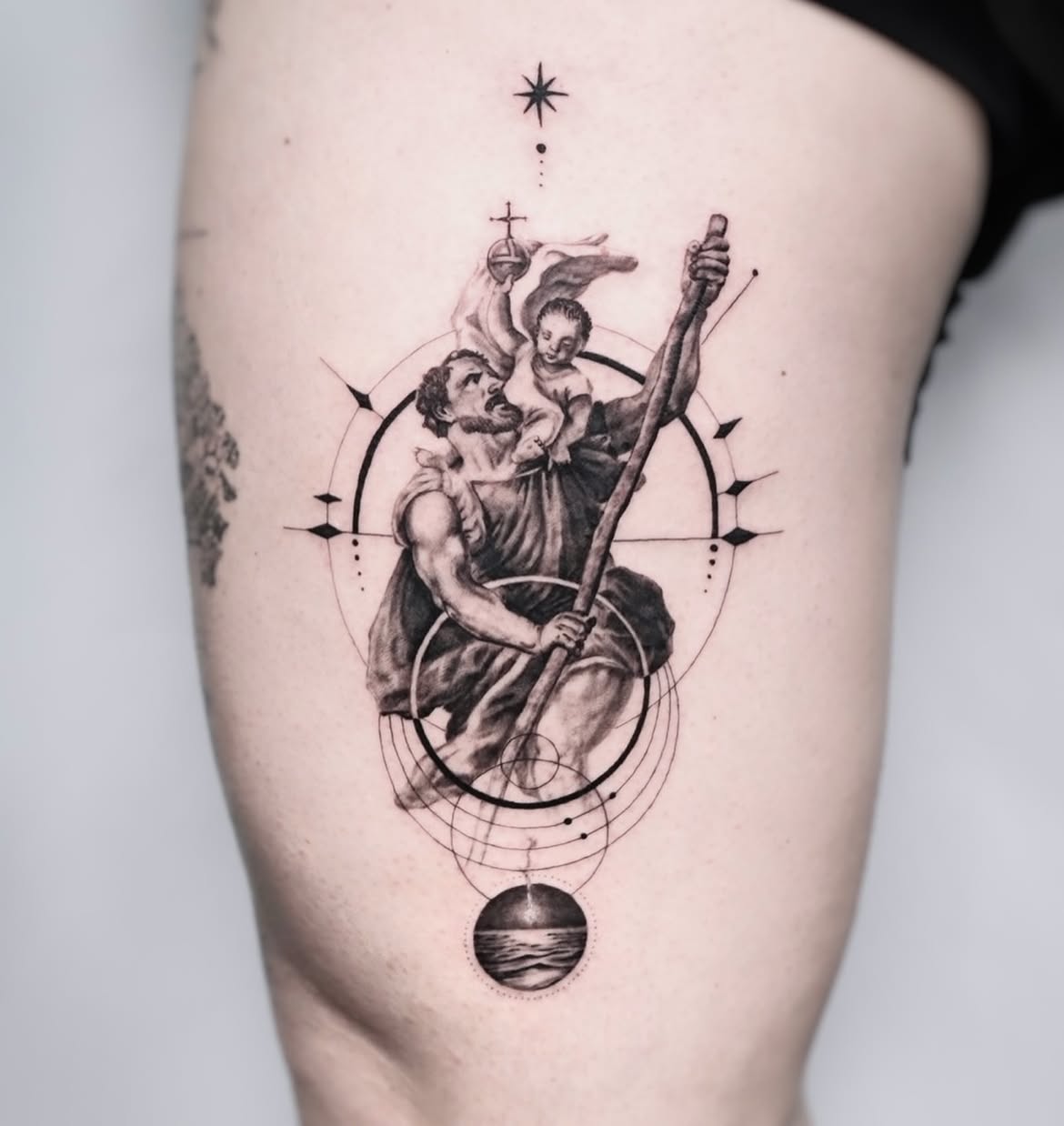
This interpretation takes the same historic subject in a distinctly contemporary direction. Saint Christopher and the Child remain rendered with recognizable figurative detail, but the surrounding geometry changes the entire personality of the tattoo.
Circular lines frame the saint, delicate orbital forms cross the lower section, and small stars and dots extend the composition vertically. A tiny circular landscape beneath the figure introduces another unexpected detail, almost suggesting a world or distant horizon.
It is a sophisticated example of fine line religious tattooing because the decorative elements do not compete with the saint. Instead, they create breathing room around him.
This approach can be particularly appealing to women and men who appreciate sacred imagery but do not want the visual density of a conventional black-and-gray sleeve. The style could translate effectively to the thigh, shoulder, upper arm, or back.
A minimalist variation could go further by keeping only Christopher, the Child, one circular halo, and a star. That would produce a much more simple tattoo while retaining the central meaning.
Minimal Fine Line Saint Christopher Thigh Design
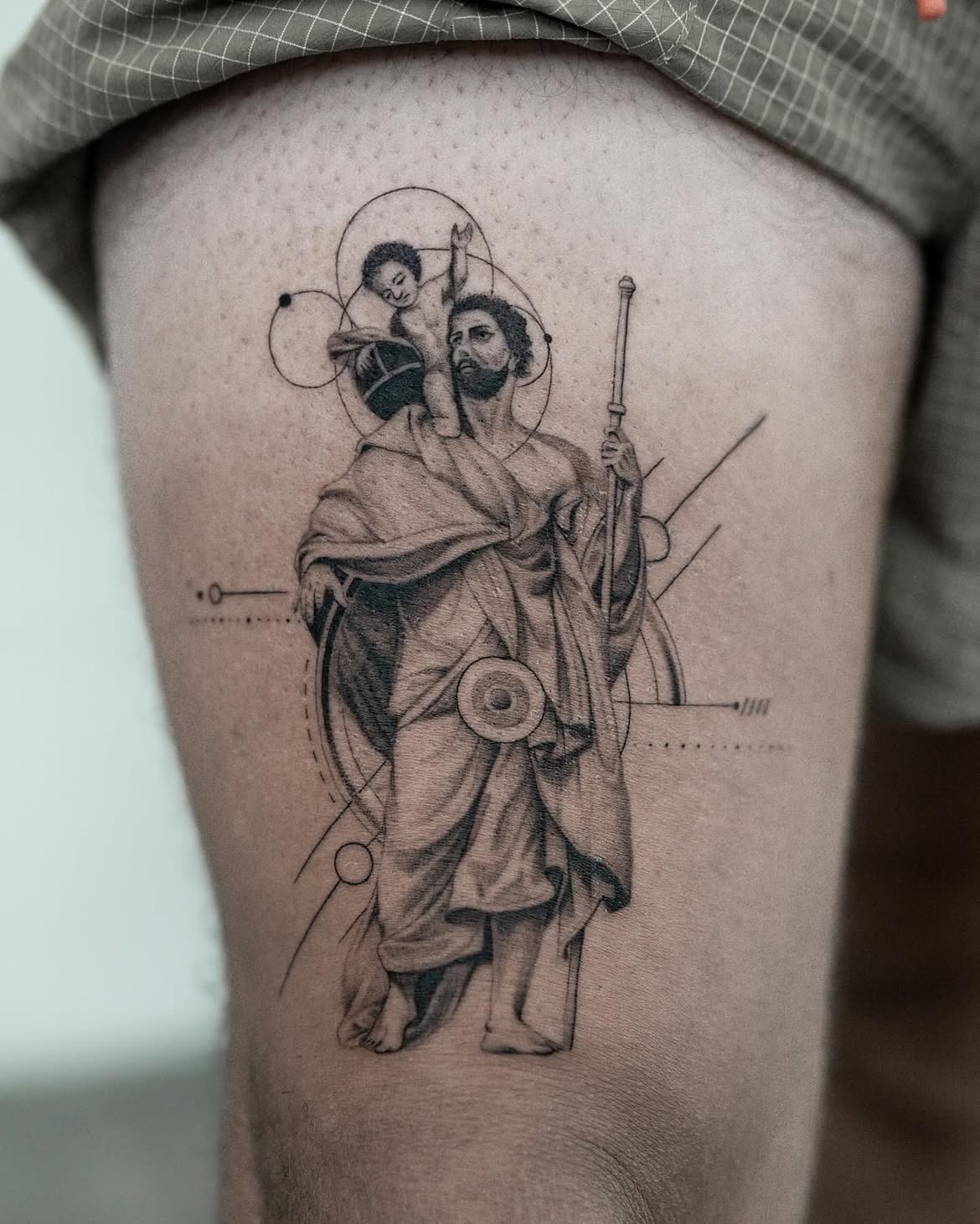
This piece strips away even more background detail and lets Saint Christopher stand almost independently on the skin. He carries the Child on one shoulder and holds his staff upright, while extremely thin geometric lines and circles pass around the figures.
The effect is quiet rather than monumental.
Fine stippling provides texture inside the robe, face, and limbs, but large portions of untouched skin remain visible. That negative space is important: without it, all those delicate lines could easily merge into an overly busy composition.
The thigh gives the artist enough room to preserve small facial and clothing details. A similar design simple approach could work on the upper arm, although shrinking it dramatically for the hand or behind the ear would sacrifice much of what makes the illustration effective.
For a genuine small stencil, I would simplify the concept instead of merely reducing its dimensions. Keep the staff, silhouette, Child, and perhaps one halo. In tattoo design, simplicity often comes from removing information intelligently rather than making complicated information tiny.
American Traditional Saint Christopher Tattoo With Gothic Lettering
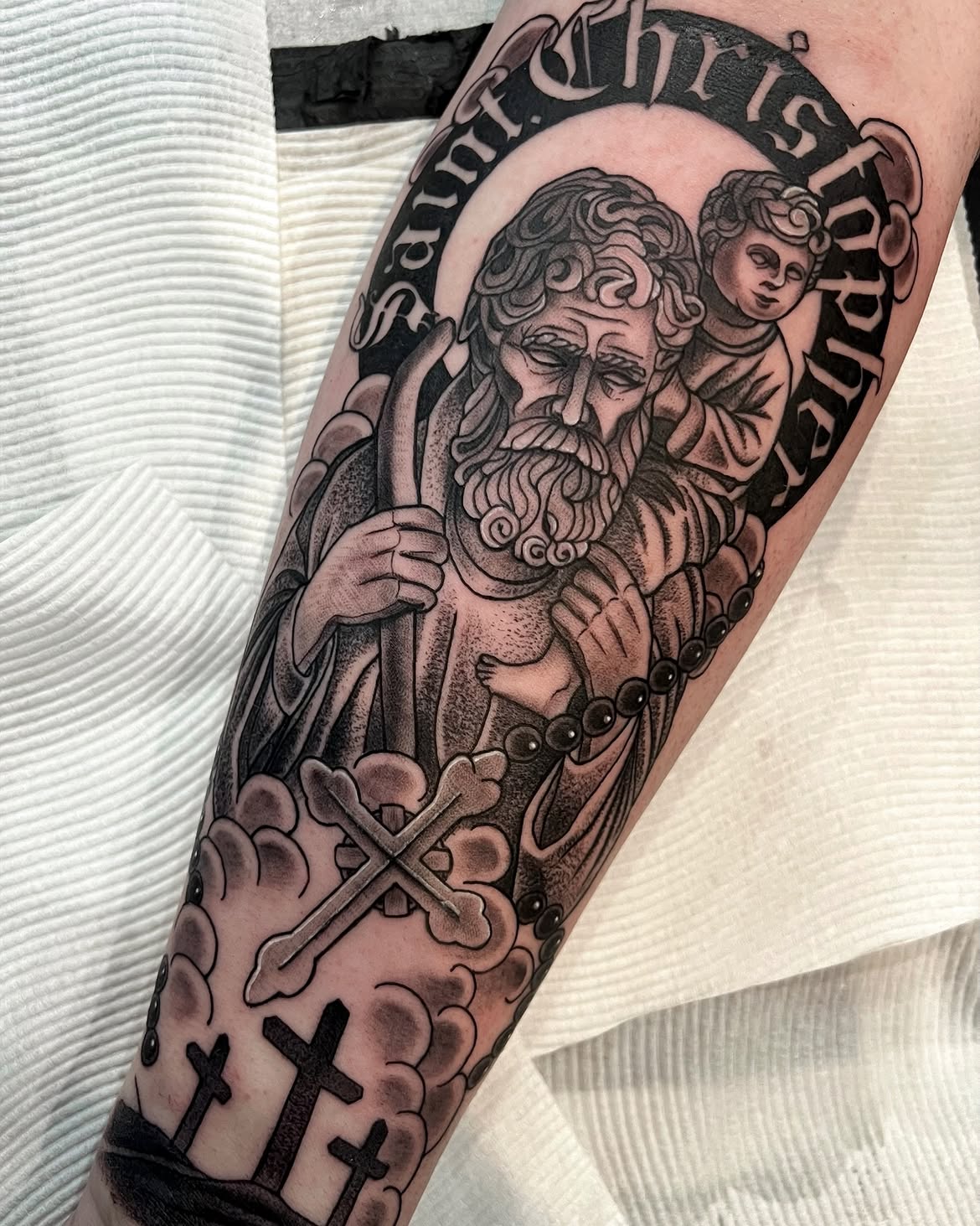
This is where the collection takes a sharp stylistic turn. Instead of delicate contemporary lines or smooth realism, Saint Christopher is treated with the visual confidence of American traditional tattooing.
Heavy black areas form the background and frame the central figures. Christopher’s beard, robe, staff, and the Child are constructed with decisive outlines and textured shading. Gothic lettering curves around the upper section, immediately giving the tattoo the character of an emblem or devotional badge.
The lower imagery strengthens that feeling. Crossed forms, clouds, and three black crosses create a dense foundation, while the rosary-like beads moving across the composition add another layer of religious symbolism.
This style is particularly effective when someone wants a tattoo that looks intentionally bold from several feet away. Unlike a delicate outline or fine line design, it relies on strong boundaries and large dark shapes.
It could easily inspire a broader traditional sleeve. Roses, rays, crosses, banners, ships, or other travel-related symbols could surround Saint Christopher while maintaining the same old-school vocabulary. That connection feels especially appropriate given his longstanding association with travelers.
Simple Saint Christopher Protect Us Upper Arm Tattoo
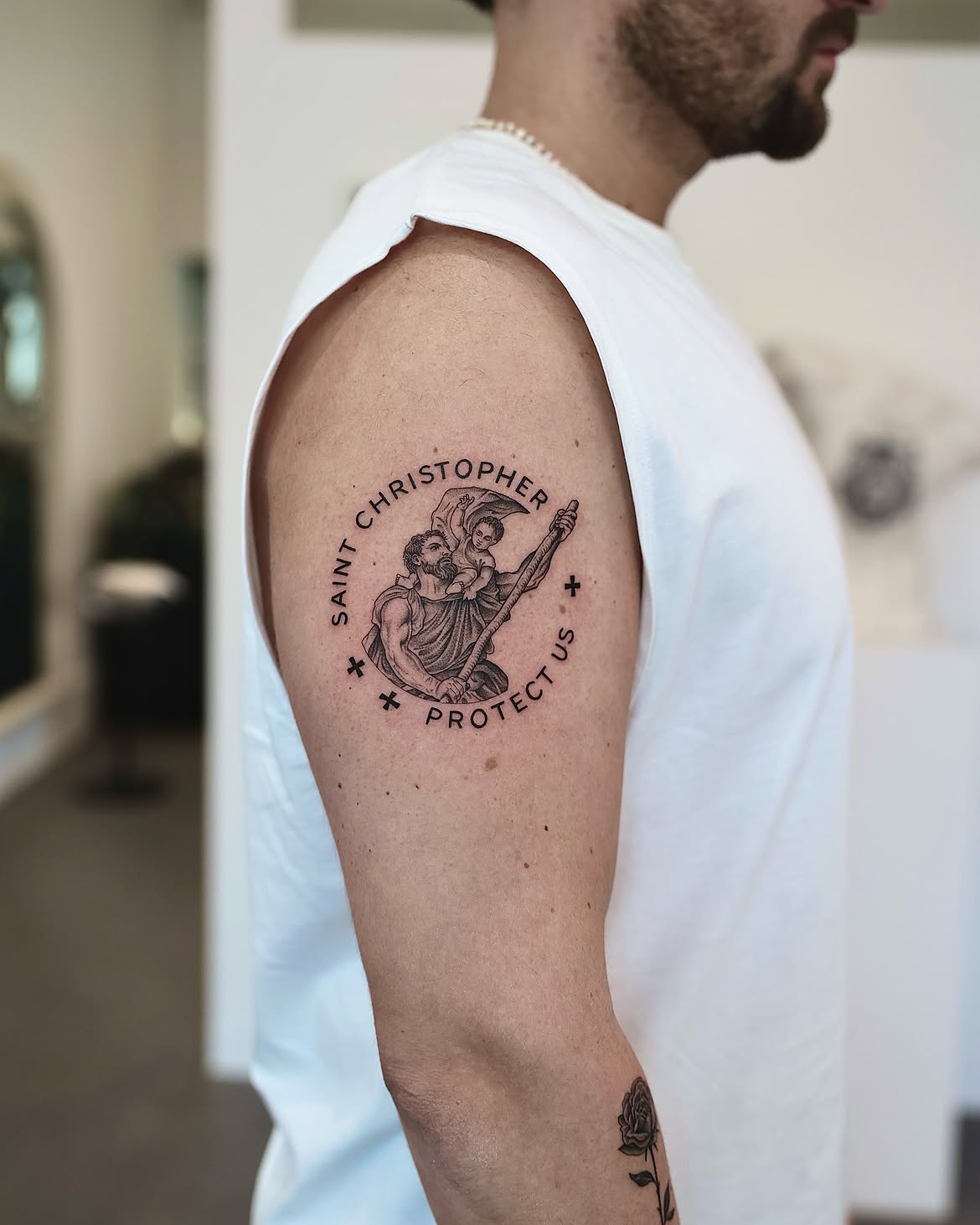
The final idea demonstrates that a meaningful Saint Christopher tattoo does not need sleeve-level complexity.
The saint and Child sit inside a clean circular arrangement on the upper arm, surrounded by the words SAINT CHRISTOPHER PROTECT US. Several small crosses balance the lettering and reinforce the devotional character without overcrowding the design.
This is arguably one of the most wearable concepts in the group. The scale leaves plenty of open skin around the tattoo, the message can be understood quickly, and the placement works naturally with the curve of the arm.
It is also an excellent starting point for a custom simple Saint Christopher tattoo. Someone could remove the inscription for a more minimalist version, keep only a single cross, or convert the central illustration into a cleaner outline. Another possibility would be adapting the circular format into a medallion-style tattoo, referencing the Saint Christopher medals traditionally associated with travelers.
Placement changes the personality considerably. On the shoulder, it could be enlarged into a more substantial emblem; on the forearm, the text could become part of a vertical composition. A small version might even work as the beginning of a patchwork sleeve, provided the central figures are not reduced beyond legibility.
Neo-Traditional Saint Christopher Shoulder Tattoo
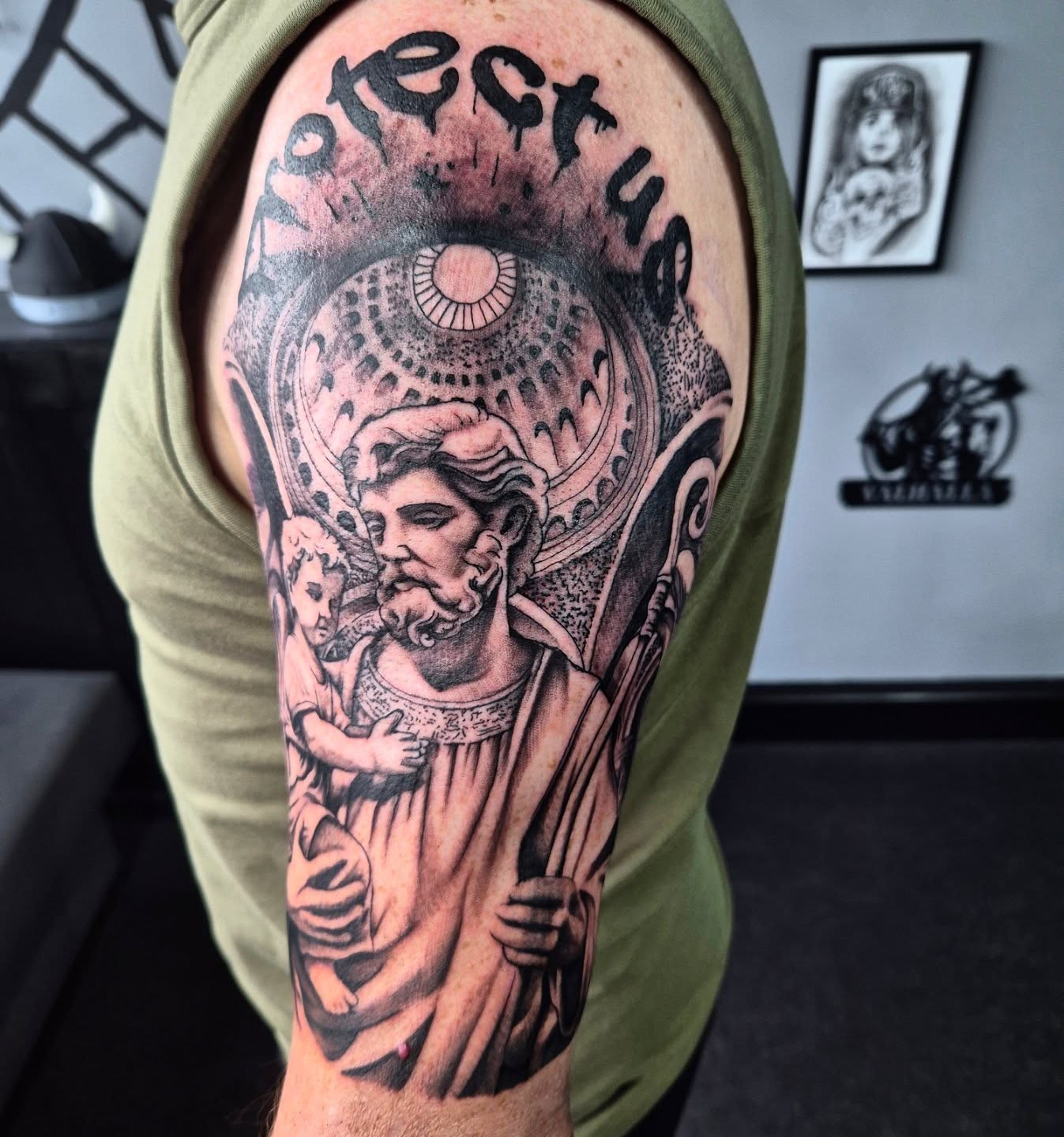
This large shoulder and upper-arm piece gives Saint Christopher a much heavier, almost illustrated character. The saint and Child occupy most of the available space, while the staff creates a strong vertical line along one side. Behind them, a circular ornamental field resembles the decorative architecture or patterned halo found in old religious art.
What makes the tattoo memorable is the combination of classical subject matter and rough contemporary execution. The facial features are carefully modeled, but the surrounding blacks, stippling, irregular textures, and lettering feel deliberately raw. The words above the figure become part of the silhouette rather than behaving like a neat caption.
The shoulder is a smart placement for a design this broad. Its rounded surface accommodates the large halo-like background while leaving enough length on the upper arm for Christopher’s robe and staff. This could also become the upper section of a religious sleeve, with water, crosses, or travel symbolism continuing toward the forearm.
For someone developing a custom stencil, I would preserve the large head-and-shoulders silhouette and circular backdrop. Those are the elements that make the tattoo readable before any of its smaller details are noticed.
Traditional Saint Christopher Protect Us Medallion
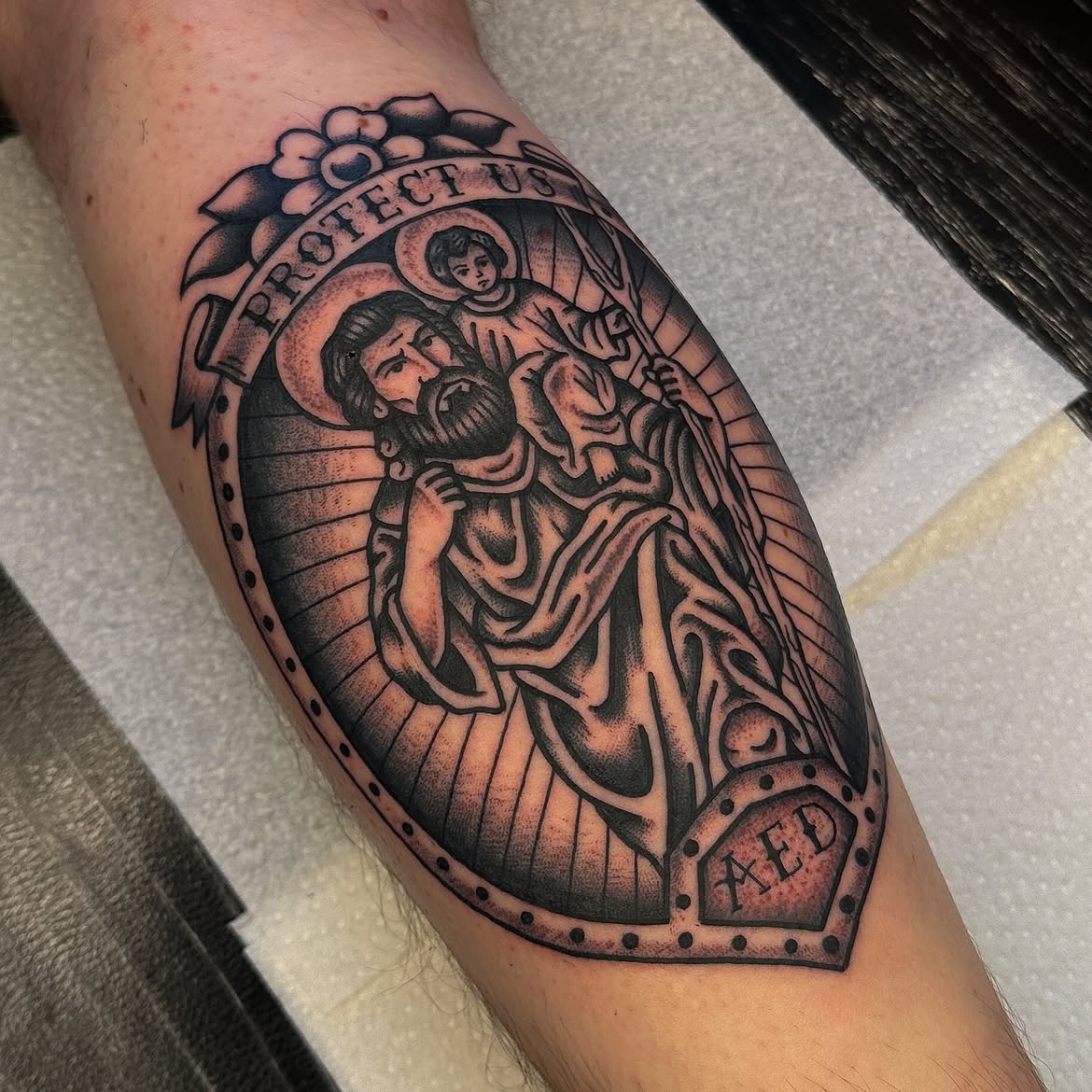
Few Saint Christopher tattoo ideas connect as naturally with the saint’s traditional protective medal as this one. The entire composition has been treated like a wearable religious emblem, complete with an arched border, radiant lines, halos, flowers, and a banner reading PROTECT US.
Christopher carries the Child high against his shoulder while his large robe sweeps through the center. Heavy black outlines immediately push the piece toward a traditional tattoo vocabulary. Dot shading softens the interior without weakening those outlines, while the dark radial background gives the lighter figures separation.
There is something appealingly old-fashioned about this approach. It resembles an object that might have been carried for decades before its imagery was translated into tattoo form.
The oval construction also makes an excellent design stencil for the forearm or leg because there are no awkward loose edges. For an American traditional adaptation, an artist could simplify the faces further, strengthen the black areas, and introduce a limited palette. Flowers, a banner, or a small cross could remain as framing devices without obscuring the principal figures.
Small Black and Gray Saint Christopher Upper Arm Tattoo
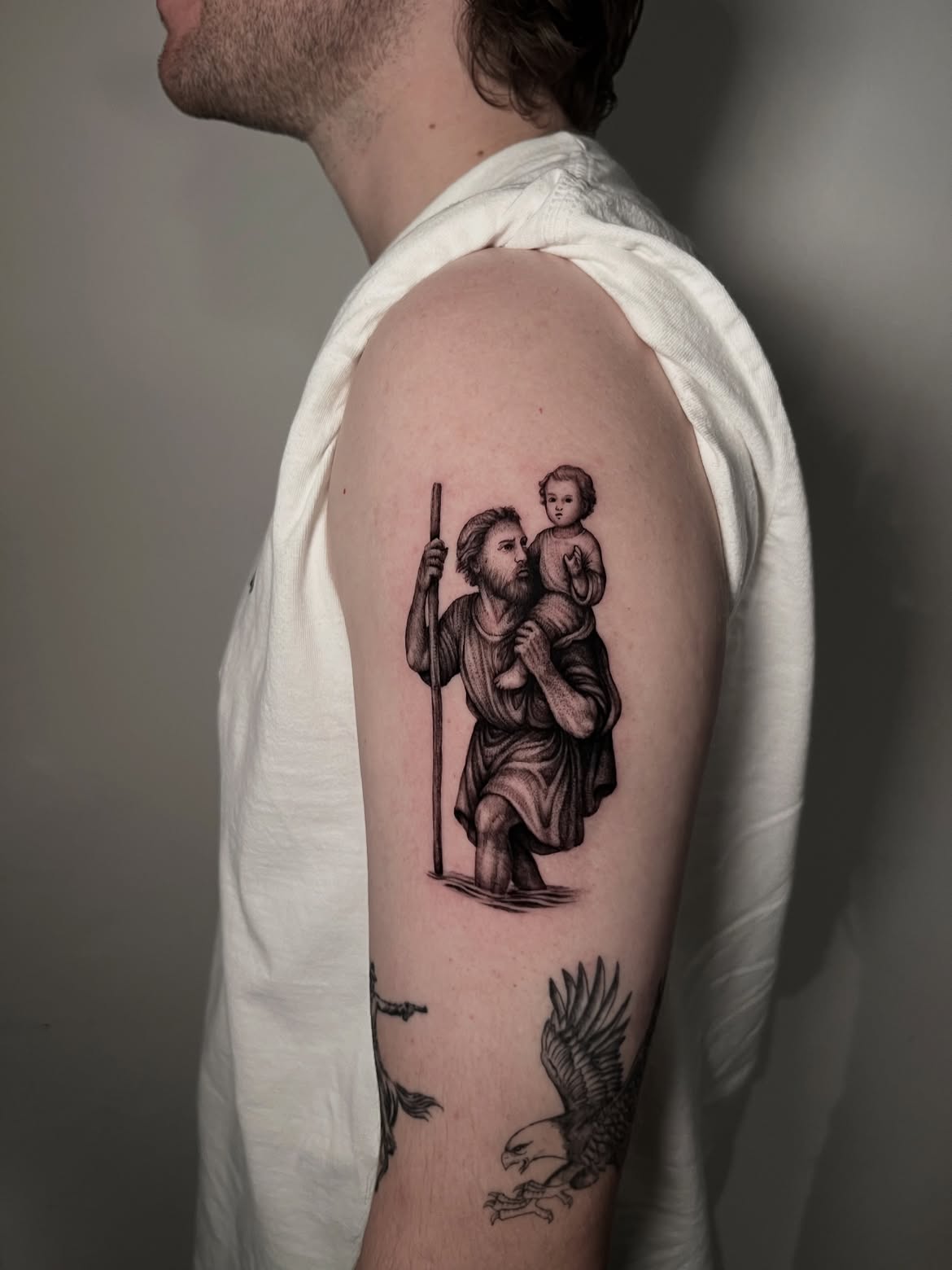
This is a good counterpoint to the larger religious pieces because it proves that Saint Christopher does not require a huge canvas. The saint is shown walking with the Child seated on his shoulder, one hand supporting the Child and the other gripping a long staff.
There is no elaborate halo, lettering, architectural border, or dramatic sky. That restraint gives the design a surprisingly intimate quality. It feels more like a personal devotional image than a public statement.
The black-and-gray shading is concentrated mainly in the robe, hair, faces, and staff, leaving plenty of untouched skin around the figure. This negative space is one reason the tattoo reads so clearly on the upper arm.
It is also a useful reference for a design simple enough to coexist with other tattoos. Rather than forcing it into a complete sleeve, the wearer can allow it to stand alone or gradually build a patchwork arm collection around it.
For an even more minimalist treatment, some garment texture could be removed and the figure reduced to clean outline work. I would not make the faces substantially smaller, though; the interaction between Christopher and the Child is where much of the personality lives.
Fine Line Saint Christopher Protect Us Medal Tattoo
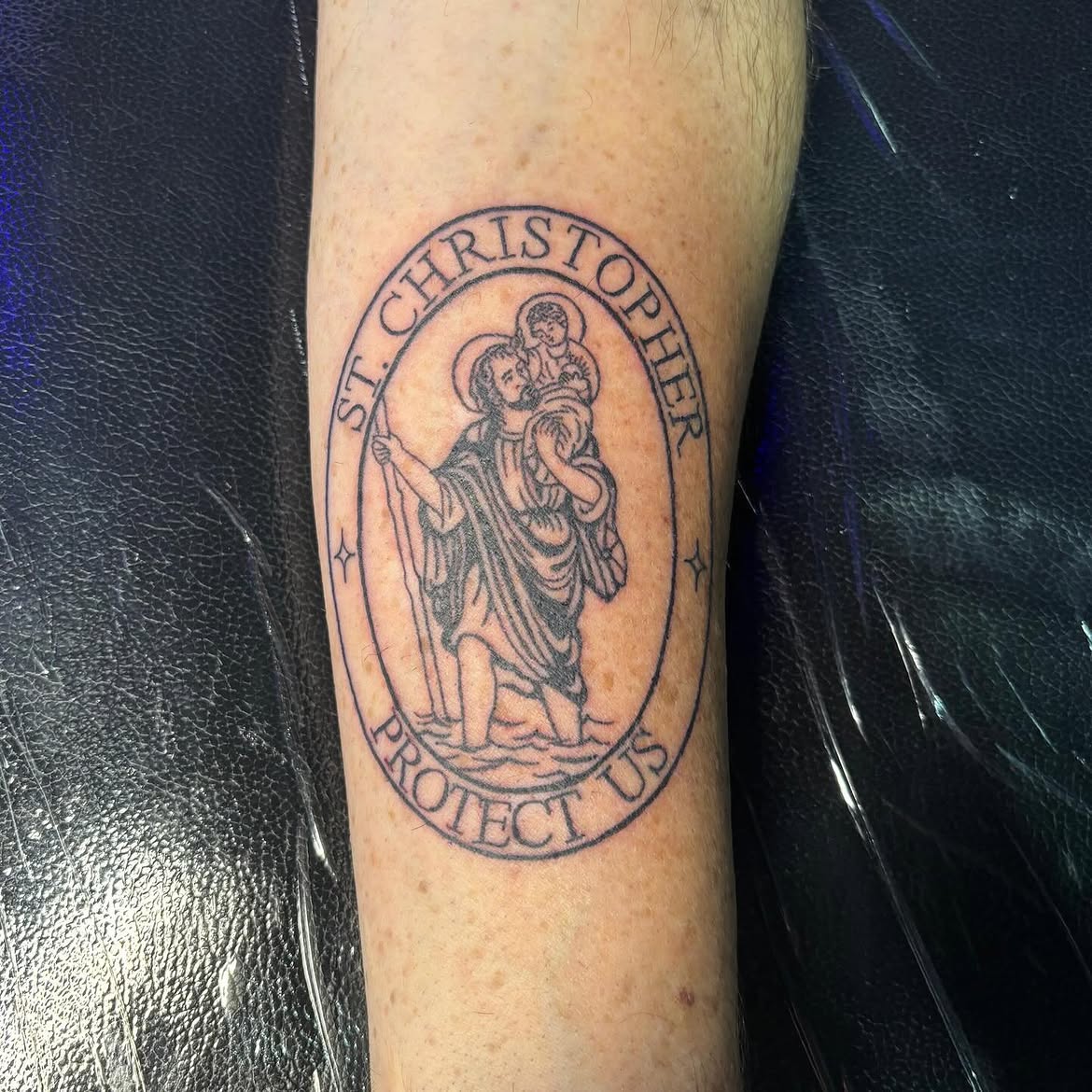
Here the familiar Saint Christopher medal is interpreted with exceptionally light linework. The oval border carries ST. CHRISTOPHER across the top and PROTECT US beneath, while the saint and Child occupy the center.
Instead of relying on solid black fields, the artist builds the design through narrow outlines and restrained gray shading. Even the water at Christopher’s feet is indicated economically. Two tiny star-like ornaments on either side are enough to prevent the border from feeling empty.
This is the sort of fine line religious tattoo that can appeal to someone who wants the symbolism without the visual weight of a conventional sleeve. It would work equally well among tattoo ideas for men or women, since the defining quality is not gender but scale and delicacy.
The medallion structure is also practical. A tattoo artist can adapt the same concept to the forearm, upper arm, leg, or even a larger chest composition. For a smaller version, however, simplifying the Child’s clothing and Christopher’s robe would be wiser than simply shrinking every existing line.
Saint Christopher Crossing the Water Forearm Tattoo
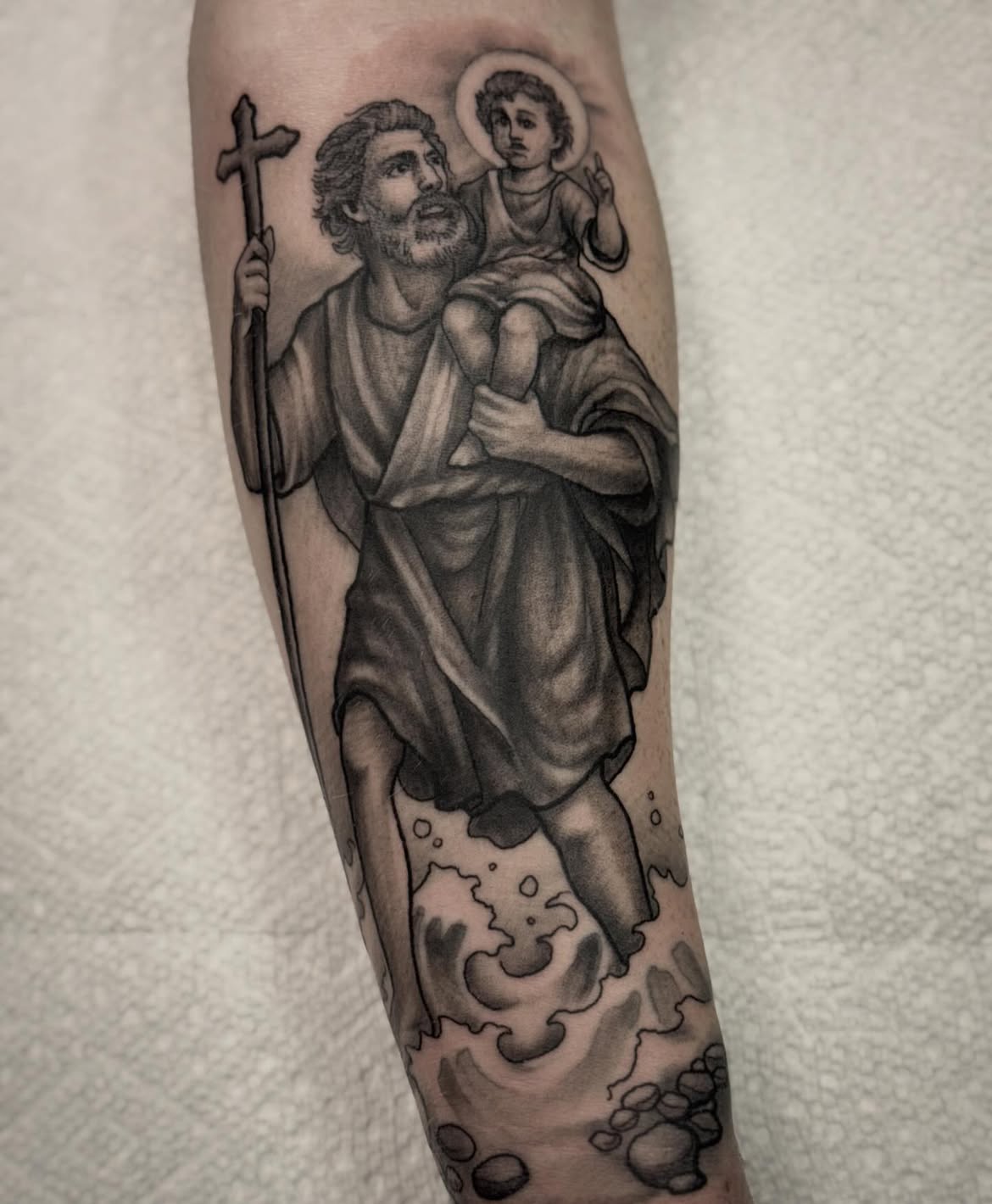
This design pays closer attention to the journey itself. Christopher moves through turbulent water with the Christ Child on his shoulder, while his tall staff rises beside him and terminates in a cross-shaped top.
The waves are essential here. They turn what could have been a static portrait into a scene of movement and difficulty. Christopher’s forward stride, exposed leg, flowing robe, and swirling water all reinforce the feeling that he is pushing against resistance.
That visual narrative matters because Saint Christopher’s symbolism is so closely tied to passage and protection. A traveler may connect with the design differently from someone who sees it as a religious image, yet both readings can coexist.
The elongated arrangement is almost made for the forearm. Christopher fills the wider upper portion while waves and stones anchor the narrower area below. On the leg, the same composition could be enlarged and given more water, clouds, or distant landscape.
I would resist adding too many secondary symbols. The cross, Child, staff, and water already tell the story. Sometimes a successful tattoo needs fewer symbols, not more.
Dark Religious Knight and Saint Benedict Sleeve Idea
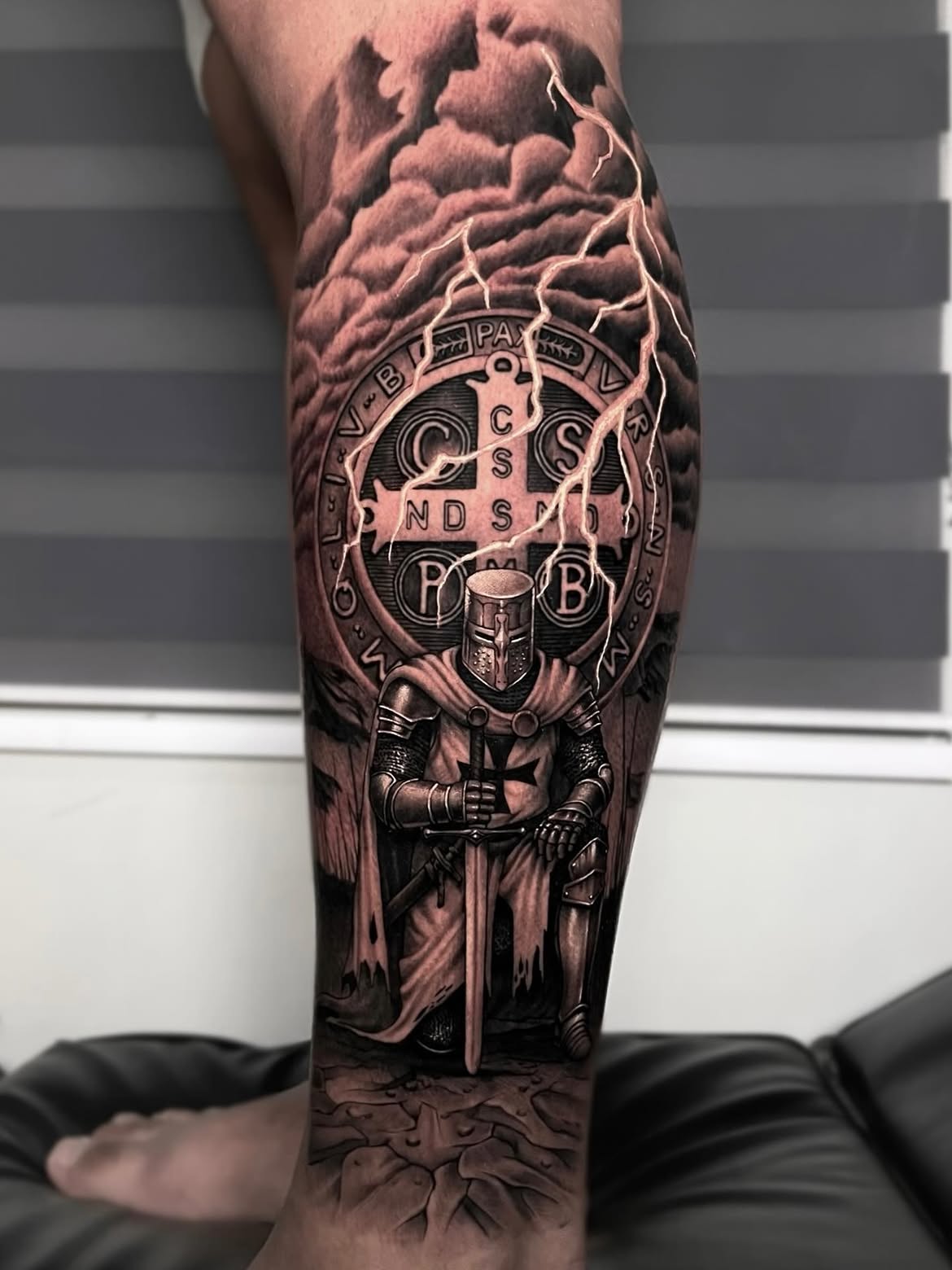
This piece moves away from a literal Saint Christopher portrait, but it offers an interesting direction for anyone building a broader protection-themed religious sleeve. A kneeling armored knight occupies the lower section, gripping a sword while a monumental Saint Benedict medal rises behind him. Storm clouds and branching lightning fill the upper background.
The mood is dramatically different from the quieter Christopher designs. Deep blacks surround polished sections of armor, and the lightning cuts through the darkness with narrow highlights. The oversized medal functions almost like a sacred shield behind the knight.
As a sleeve concept, it demonstrates how devotional symbols can be combined with narrative figures rather than simply placed side by side. Someone planning a Saint Christopher design could borrow the same strategy: Christopher could occupy the foreground while a medal, cross, compass, or other protective emblem forms the background.
The key is hierarchy. One image should remain dominant. When every religious symbol is given equal contrast and detail, a sleeve can quickly become difficult to read.
Realistic Saint Christopher With Child and Clouds
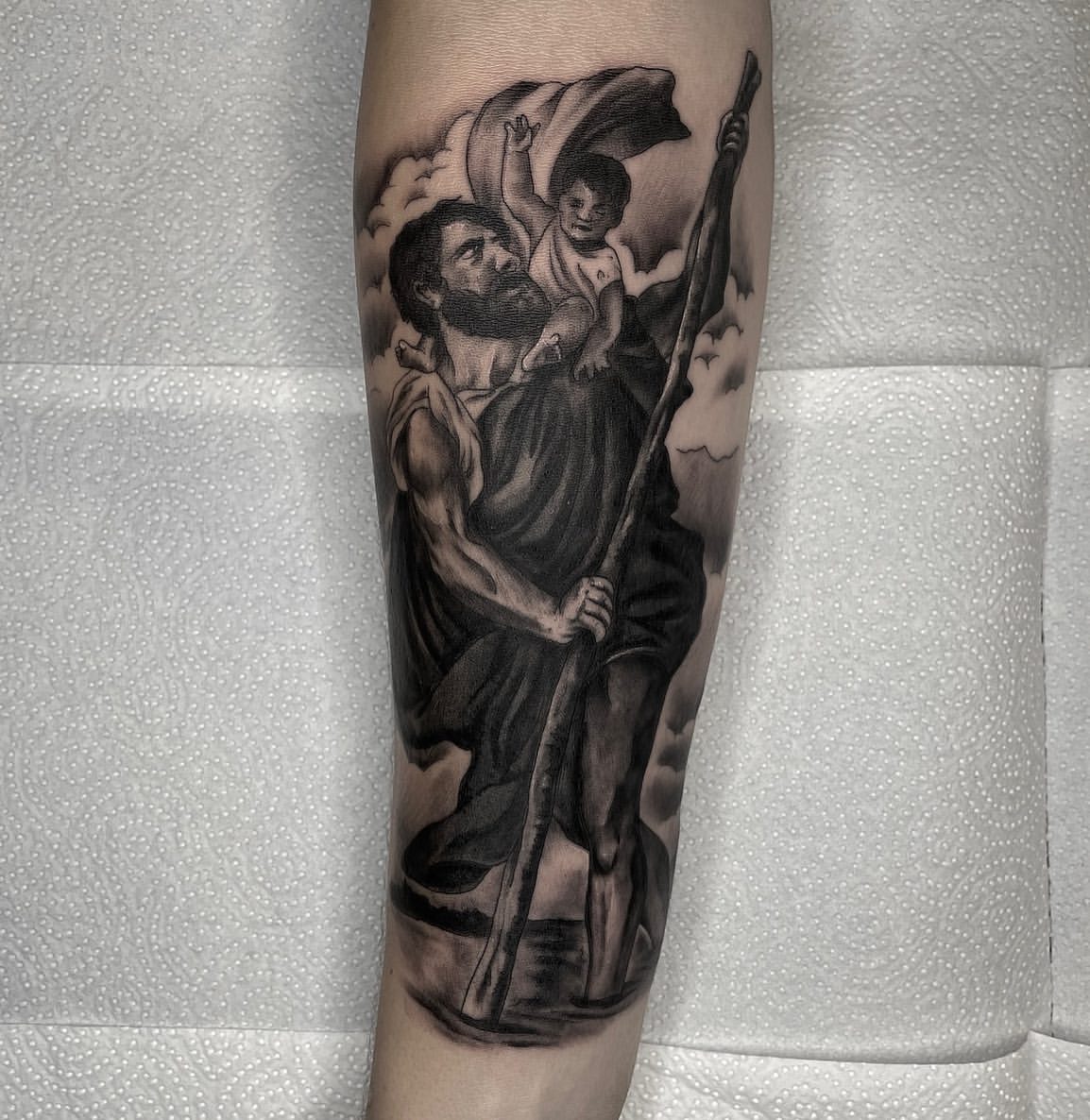
This black-and-gray piece returns to a more classical portrayal but gives it greater atmospheric depth. Christopher holds the Child against his shoulder and grips his staff with the opposite hand. Clouds curl around the upper body, helping the two figures emerge from the surrounding skin.
The Child’s raised hand creates a small but important focal point. Christopher looks upward toward him, establishing a relationship between the figures rather than presenting them as two disconnected portraits. The staff then carries the eye downward through the entire composition.
Soft gray transitions dominate the tattoo. Darker passages appear in Christopher’s hair, beard, robe, and the fabric behind the Child, while the surrounding clouds remain much lighter. This creates depth without requiring an enclosed border.
It would make a strong standalone forearm tattoo, but the open cloud edges also make expansion easy. More clouds could lead into a full arm sleeve, while water could be introduced below to complete the river-crossing narrative. For a larger back or chest design, there would be enough space to explore the landscape and scale of the legend in much greater detail.
Engraving-Style Saint Christopher Medal Tattoo
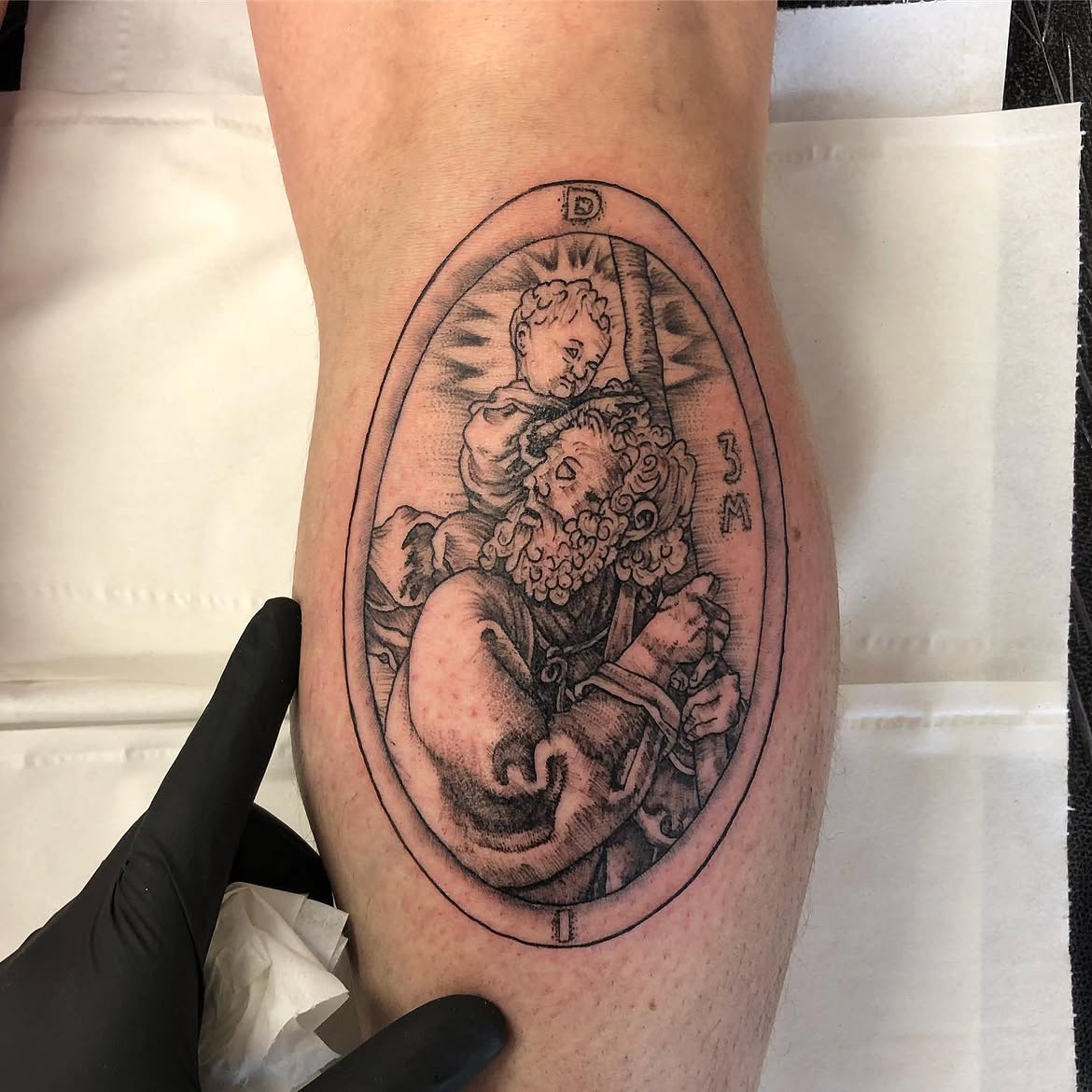
This Saint Christopher tattoo borrows directly from the language of an antique devotional medal. An oval outline encloses Christopher and the Child, turning the entire piece into something that feels less like a conventional illustration and more like a religious object transferred onto skin.
The Child sits above Christopher and leans gently over his head, while Christopher grips his staff with both hands. His broad shoulders and muscular arm create a strong base for the composition. Fine hatching and dotwork supply most of the shadows, giving the piece an engraved quality reminiscent of old prayer cards and medallions.
That restrained technique makes it an interesting middle ground between fine line and traditional black-and-gray work. There is plenty of detail, yet very little heavy black. The surrounding border keeps everything organized and makes the design particularly suitable for the forearm or leg.
For a custom stencil, the oval could be retained while some of the smallest textures are removed. The result would be a simpler tattoo that preserves the beautiful vintage character of the original.
Large Black and Gray Saint Christopher Portrait
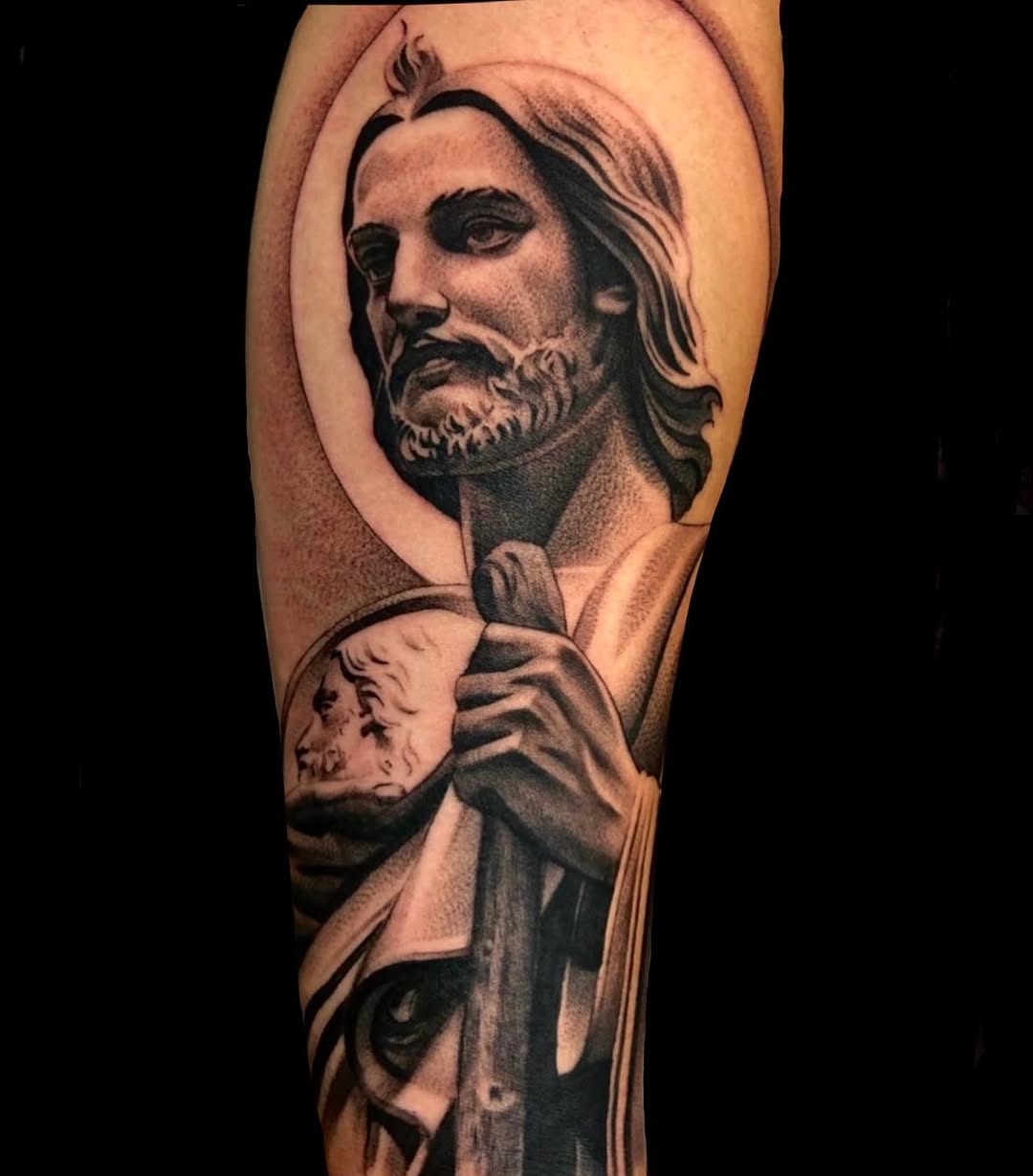
Instead of showing Christopher walking through a river, this design moves close to the saint and treats him almost like a monumental religious portrait. His face dominates the upper section, framed by a broad halo, while the Child appears lower beside his hands and staff.
The enlarged scale makes facial expression the center of the tattoo. Christopher appears calm and solemn rather than heroic in an exaggerated sense. Smooth gradients around the eyes, cheeks, beard, and neck give his face sculptural depth, while the robe beneath uses broader black-and-gray passages.
This is the sort of design that benefits enormously from size. Reducing it to a tiny tattoo would sacrifice the subtle transitions that make the face convincing. The upper arm, shoulder, thigh, chest, or back would all provide enough room for a similar portrait.
It could also become the foundation of a sleeve. Clouds, water, a cross, or rays could extend around the existing portrait while allowing Christopher’s face to remain the undisputed focal point.
Fine Line Archangel Forearm Protection Tattoo
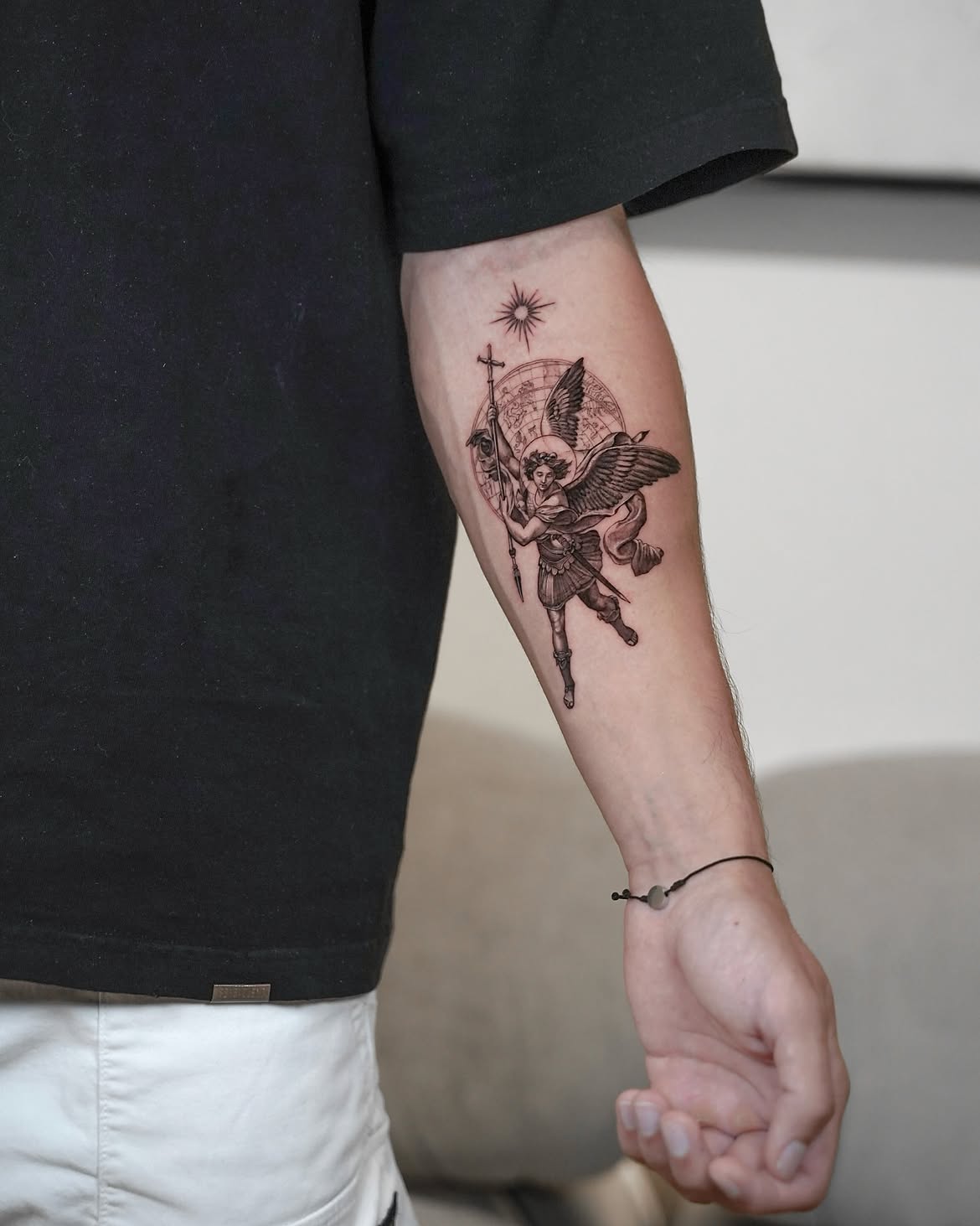
This delicate forearm piece explores protection through angelic imagery rather than a literal Saint Christopher portrait. A winged warrior occupies the center, carrying a long cross-topped staff or spear. Behind the figure sits a finely drawn circular ornamental field, and a radiant star completes the vertical composition above.
The execution is remarkably light. Feathers, armor, clothing, and facial features are rendered with narrow lines and subtle shading rather than large areas of solid black. Even with its complexity, the tattoo leaves plenty of open skin around the figure.
For anyone attracted to minimalist Saint Christopher tattoo ideas, this provides a useful stylistic reference. The same airy treatment could be applied to Christopher carrying the Child: thin contours, restrained shading, a small halo, and perhaps one celestial symbol above.
The proportions are particularly well suited to the inner forearm. A similar piece could also work on the calf or upper arm. Going substantially smaller, however, would require a much more simple stencil with fewer feather and clothing details.
Realistic Saint Christopher Mountain Journey Tattoo
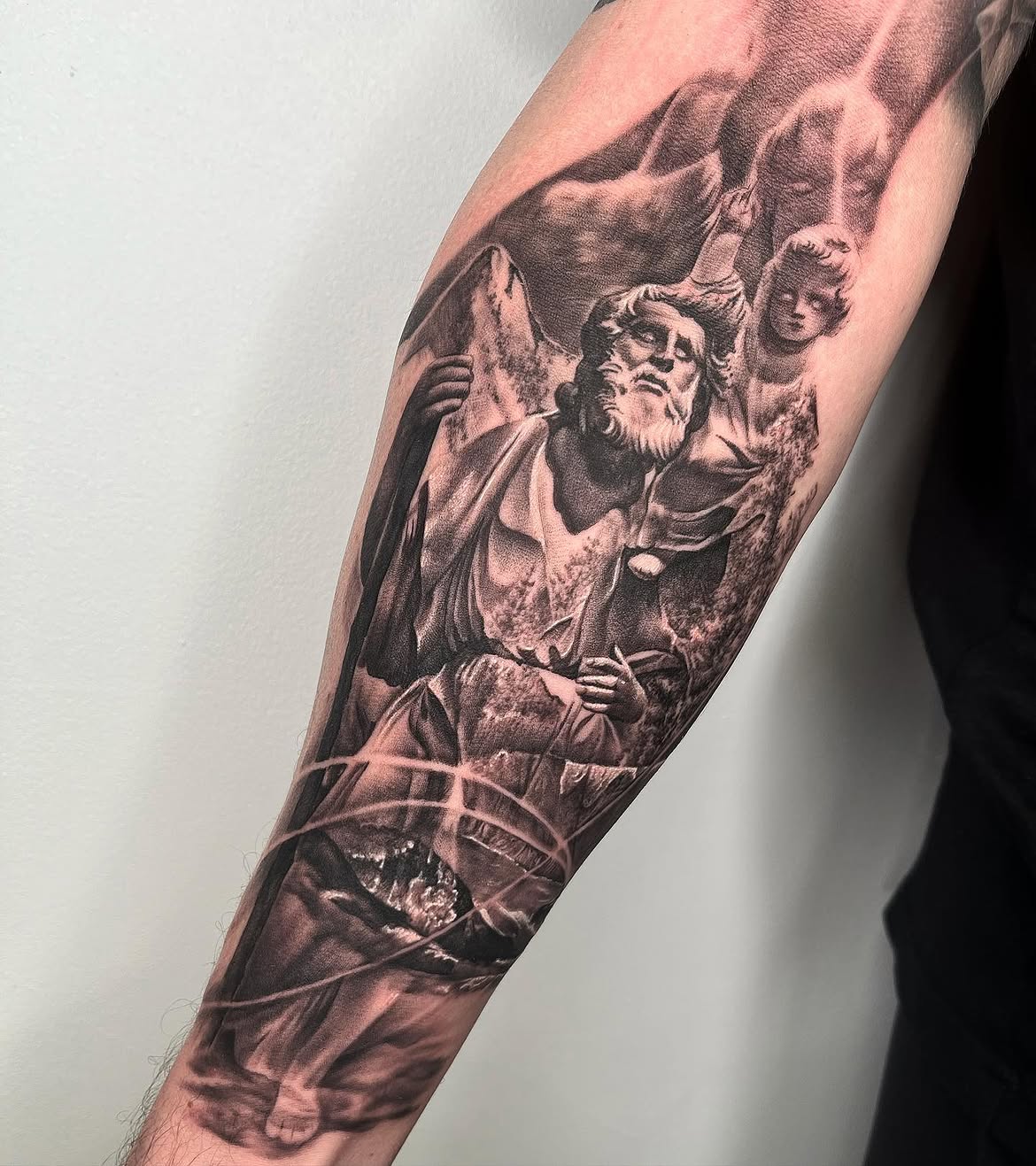
This is one of the more narrative designs in the collection. Saint Christopher carries the Child while moving through a rugged landscape, with large mountain forms rising behind them and rays of light breaking through the upper background.
Christopher’s expression gives the scene much of its emotional strength. He looks upward while the Child rests securely beside him, turning the familiar religious subject into a story about responsibility and endurance. Dark shadows beneath Christopher’s face and robe contrast with the lighter landscape and beams overhead.
The lower portion introduces water and sweeping curved lines that reinforce the sense of a difficult crossing. Rather than presenting the saint as a stationary icon, the artist makes him part of an environment.
This type of realism works especially well as a large forearm piece because the mountains can taper toward the elbow while the water naturally closes the design near the wrist. Expanded onto the arm or leg, the landscape could become even more dramatic.
There is a lesson here for anyone planning a custom religious tattoo: scenery should contribute to the story. Mountains, water, and light feel appropriate because they reinforce ideas of travel, obstacles, and safe passage rather than simply filling empty skin.
Minimalist Saint Christopher Chest Tattoo
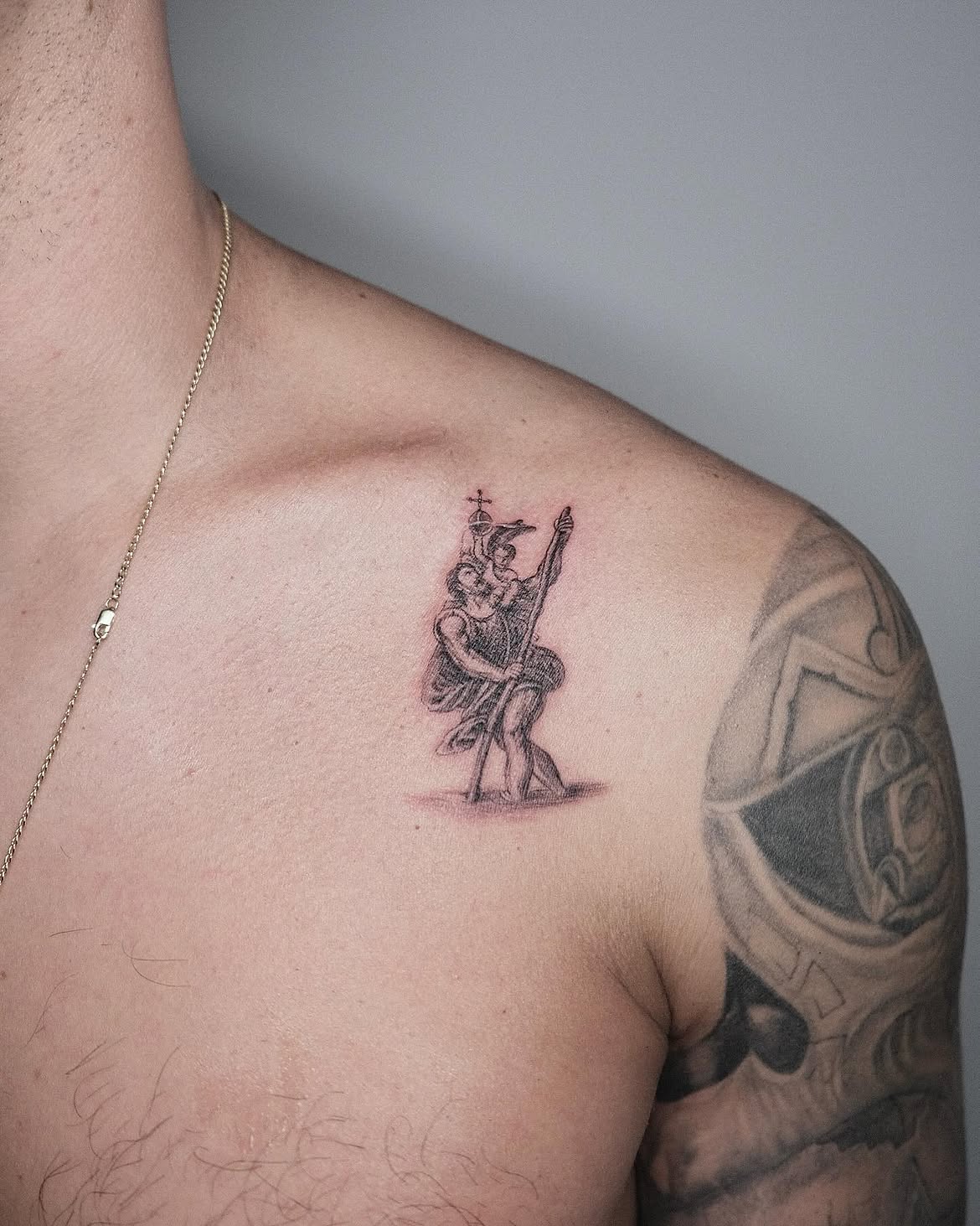
At the opposite end of the scale is this tiny chest tattoo. Saint Christopher and the Child have been reduced to the essential components of the traditional image: a walking figure, a Child carried above, a long staff, and just enough linework to establish clothing and movement.
The placement near the collarbone gives the piece a personal quality. It can remain concealed beneath most shirts and appear only when the wearer chooses, which suits a symbol that may have private spiritual significance.
This is a strong example of what design simple should actually mean. The artist has not attempted to squeeze a realistic portrait into a miniature space. Instead, detail has been deliberately reduced so the silhouette remains recognizable.
A similarly minimalist version could work for men or women, particularly on the chest, shoulder, ankle, or upper arm. A pure outline variation could simplify it even further. At this size, adding text, elaborate waves, or multiple background symbols would probably weaken rather than improve the composition.
Contemporary Saint Christopher Forearm With Sacred Geometry
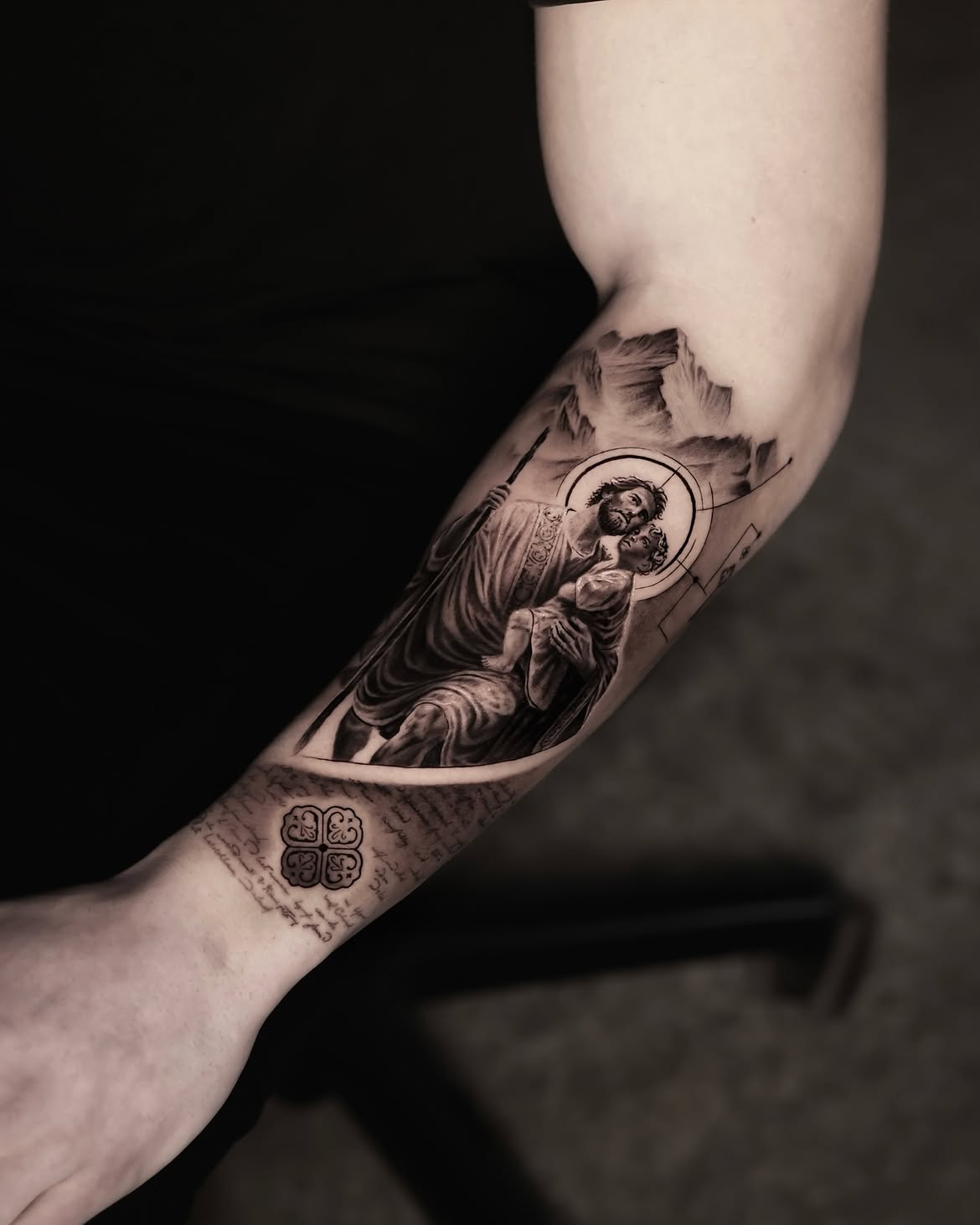
This forearm tattoo combines classical religious portraiture with a distinctly contemporary graphic structure. Christopher holds the Child close while a crisp circular halo frames both heads. Above them, loose gray clouds dissolve into the skin; below, handwritten script and a small ornamental symbol create an entirely different texture.
That contrast is what makes the piece interesting. Christopher and the Child are rendered with careful black-and-gray shading, particularly in the faces and folds of the robes. The halo, by comparison, is almost architectural in its precision. The handwritten area near the wrist feels personal and intimate rather than decorative.
The composition also makes clever use of the forearm. Instead of filling every centimeter with dark shading, the artist allows portions of bare skin to separate the major visual zones. That prevents the tattoo from becoming a solid rectangle.
Someone planning a complete sleeve could use the same principle: alternate highly rendered subjects with quieter transitions. Religious tattoos often become visually exhausting when every inch receives identical contrast.
Dramatic Black and Gray Saint Christopher Forearm Sleeve
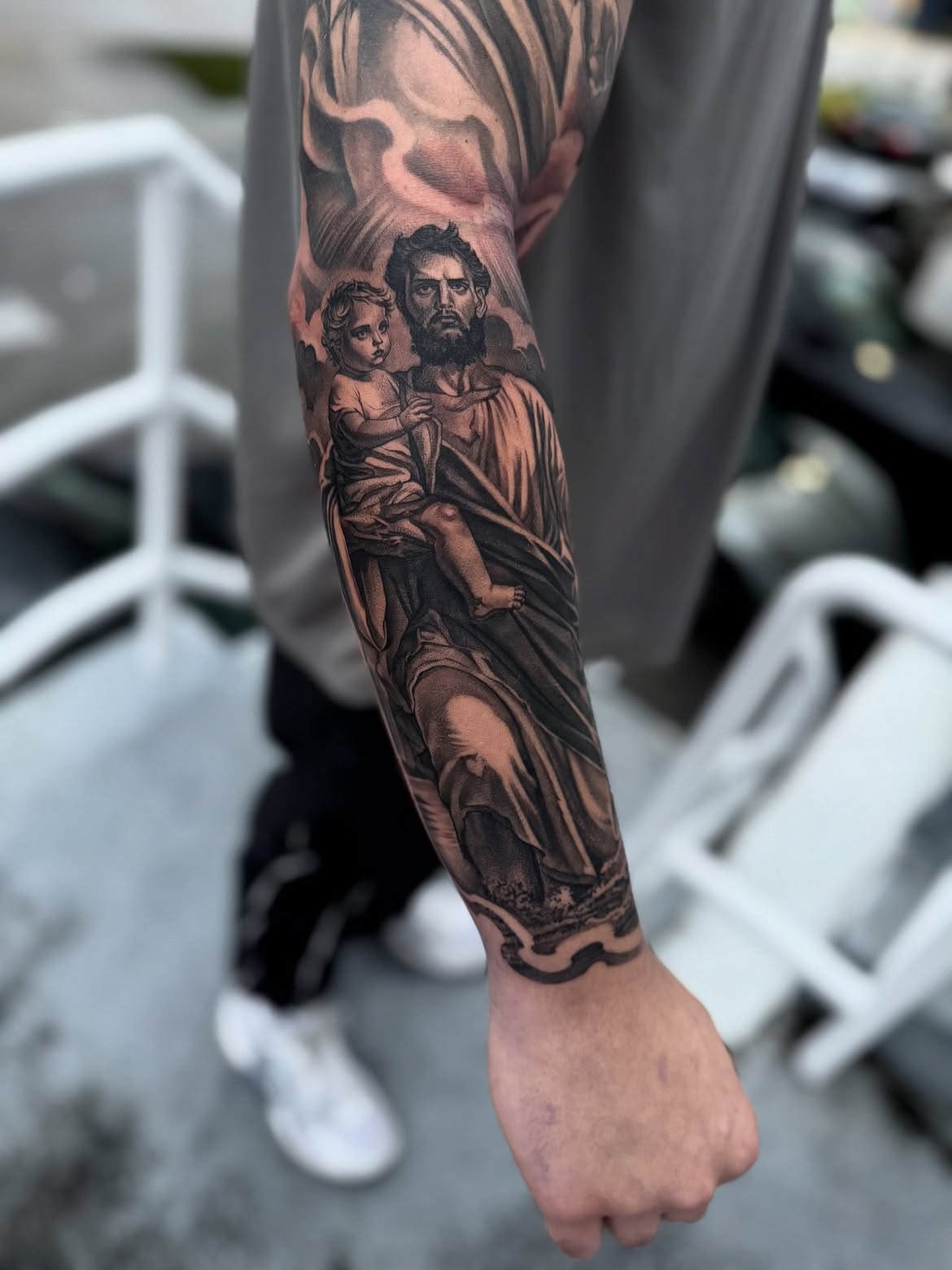
This final design takes Saint Christopher back into large-scale realism. The saint stands almost at full length with the Child supported beside him, surrounded by deep shadows and sweeping atmospheric forms.
The faces receive the sharpest attention. Christopher’s beard, eyes, and strong features establish him immediately, while the Child is rendered with softer contours. The robes then descend through a series of long folds that naturally follow the shape of the forearm.
What distinguishes this tattoo from a simple religious portrait is its tonal structure. Heavy blacks around the upper background push the lighter faces forward, while darker fabric creates weight through the center. Near the wrist, curved elements close the composition instead of allowing it to end abruptly.
This approach would suit someone who wants Saint Christopher to be the principal subject of an arm sleeve rather than one small symbol among many. It has enough visual authority to stand alone, but the atmospheric edges could also connect to additional religious imagery higher on the arm.
Dramatic Archangel Defeating Evil Sleeve Tattoo
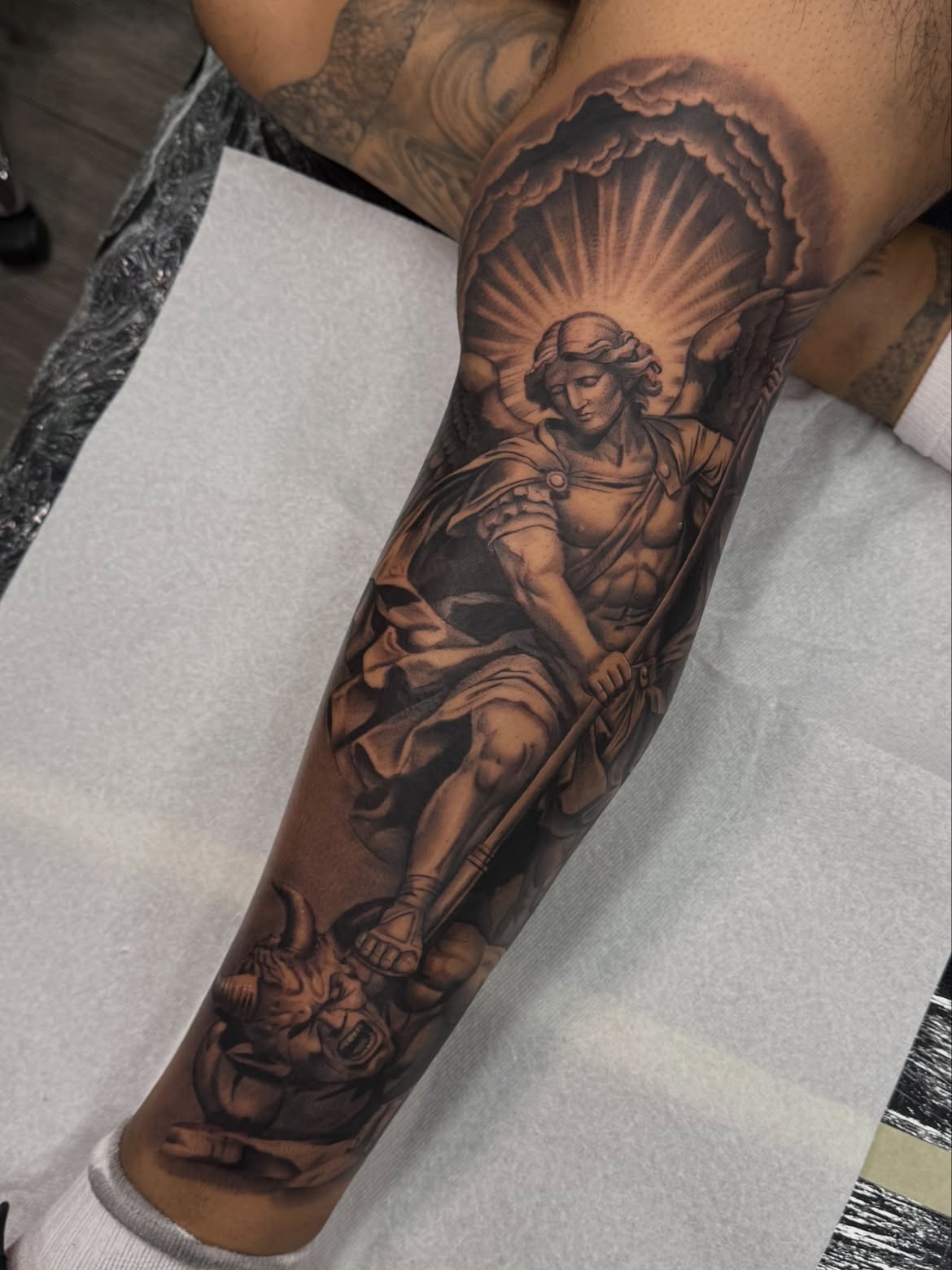
This large black-and-gray piece turns the lower leg into a dramatic religious scene. A powerful winged archangel dominates the composition, dressed in classical armor and flowing fabric while standing over a defeated demonic figure. Above the angel, layers of dark clouds open into an intense burst of radiant light.
The strongest feature is the contrast. Deep blacks around the wings, clouds, and lower figure make the illuminated body of the angel appear almost sculptural. Rays spreading behind the head create a natural halo effect without relying on a conventional circular outline. Fine gradients across the muscles, armor, and robes add realism and depth.
Although this is not a literal Saint Christopher scene, it offers excellent inspiration for anyone building a larger religious sleeve around themes of protection. Saint Christopher could be combined with angels, crosses, clouds, or celestial light to create a complete spiritual narrative.
The long vertical composition is especially effective for the leg, but a similar arrangement could be adapted to the arm or full sleeve.
Ornamental Fine Line Saint Christopher Forearm Tattoo
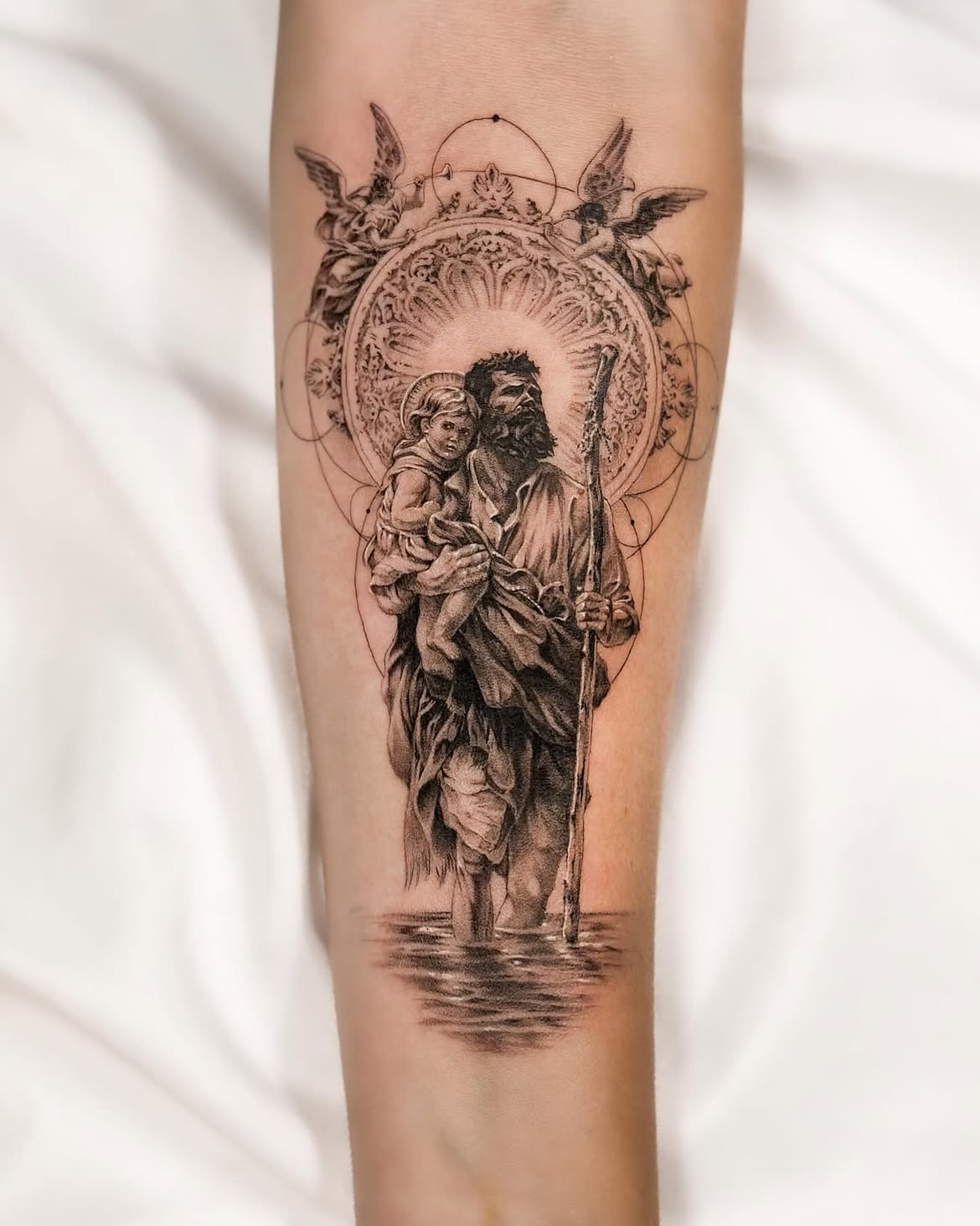
This elaborate forearm tattoo presents Saint Christopher carrying the Child through water, but surrounds the familiar image with unusually delicate ornamental details. A large circular pattern behind the figures resembles an antique rose window or sacred architectural motif, while two small winged figures appear above it.
Christopher himself is rendered with noticeably darker shading than the surrounding decoration. His beard, robe, legs, and staff form a strong central silhouette, while the Child rests securely against his shoulder. Thin horizontal strokes beneath Christopher’s feet suggest the river without making the lower portion visually heavy.
The contrast between realistic figures and intricate fine line ornamentation gives the design a sophisticated character. Additional circular lines around the central medallion introduce a subtle geometric quality, making the piece feel contemporary despite its traditional religious subject.
This is a particularly useful reference for someone who wants Saint Christopher tattoo ideas that feel elegant rather than massive. The decorative background can be simplified for a smaller stencil, or expanded for a larger forearm or arm design.
Saint Christopher Medal With Snake Tattoo
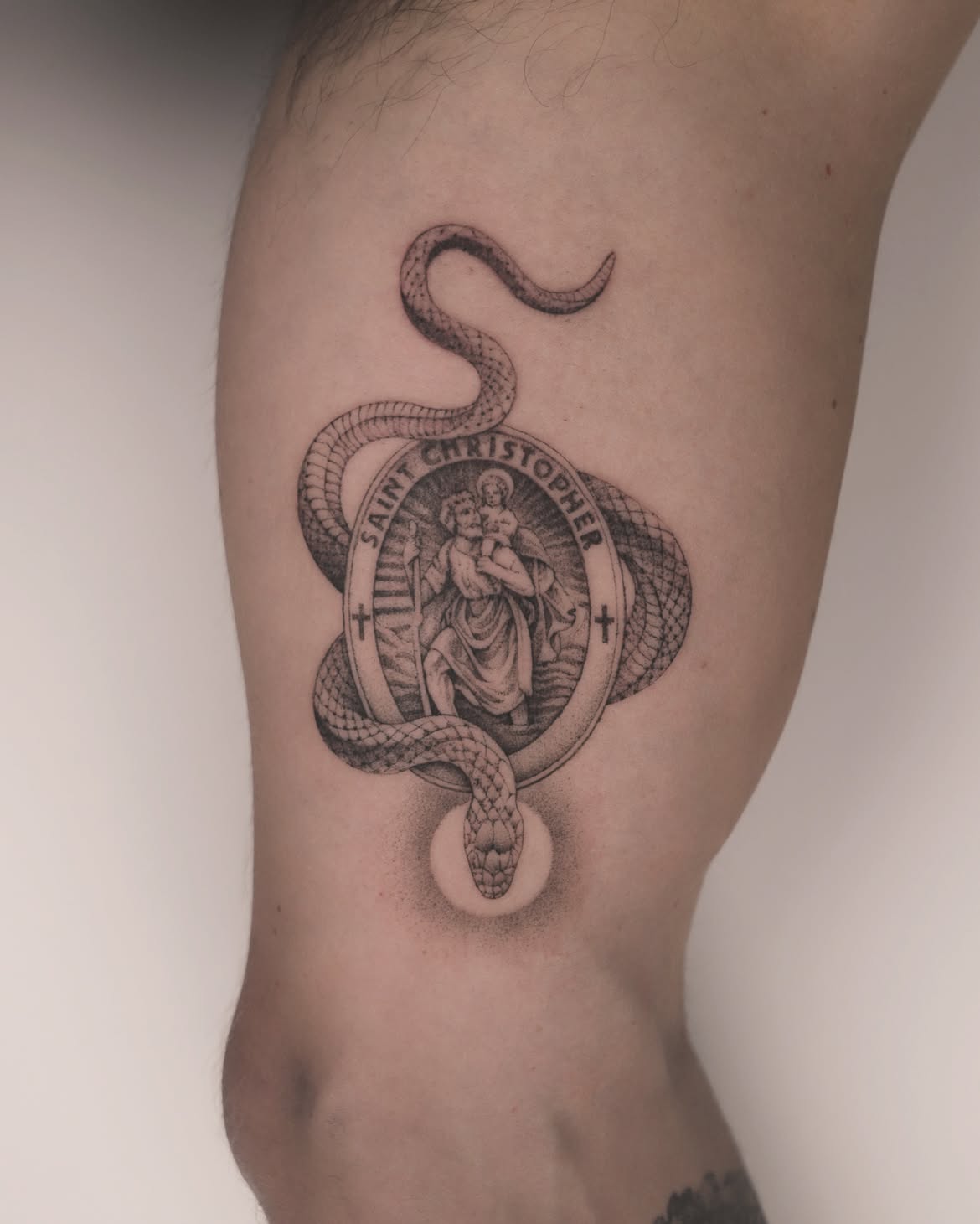
Here, the traditional Saint Christopher medal becomes the center of a much more unusual composition. The oval medallion contains a tiny image of the saint carrying the Child, complete with the inscription SAINT CHRISTOPHER around its upper border. A long snake wraps around the medal, crossing in front of and behind it before extending upward.
The combination creates a striking contrast between Christian devotional imagery and the organic movement of the serpent. The medal is rigid, symmetrical, and carefully framed; the snake introduces curves and motion. Fine scales cover the body, while subtle dotwork shadows beneath the lower section help separate the design from the skin.
This approach is ideal for someone who likes a classic medallion but wants a less predictable tattoo. Other objects could be substituted for the snake while preserving the same central structure—flowers, rosary beads, rope, thorns, or ornamental leaves could all wrap naturally around the medal.
Because of its compact arrangement, the concept can work on the upper arm, thigh, calf, or forearm without needing the space required by a realistic full-body portrait.
Saint Joseph and Child Religious Leg Tattoo
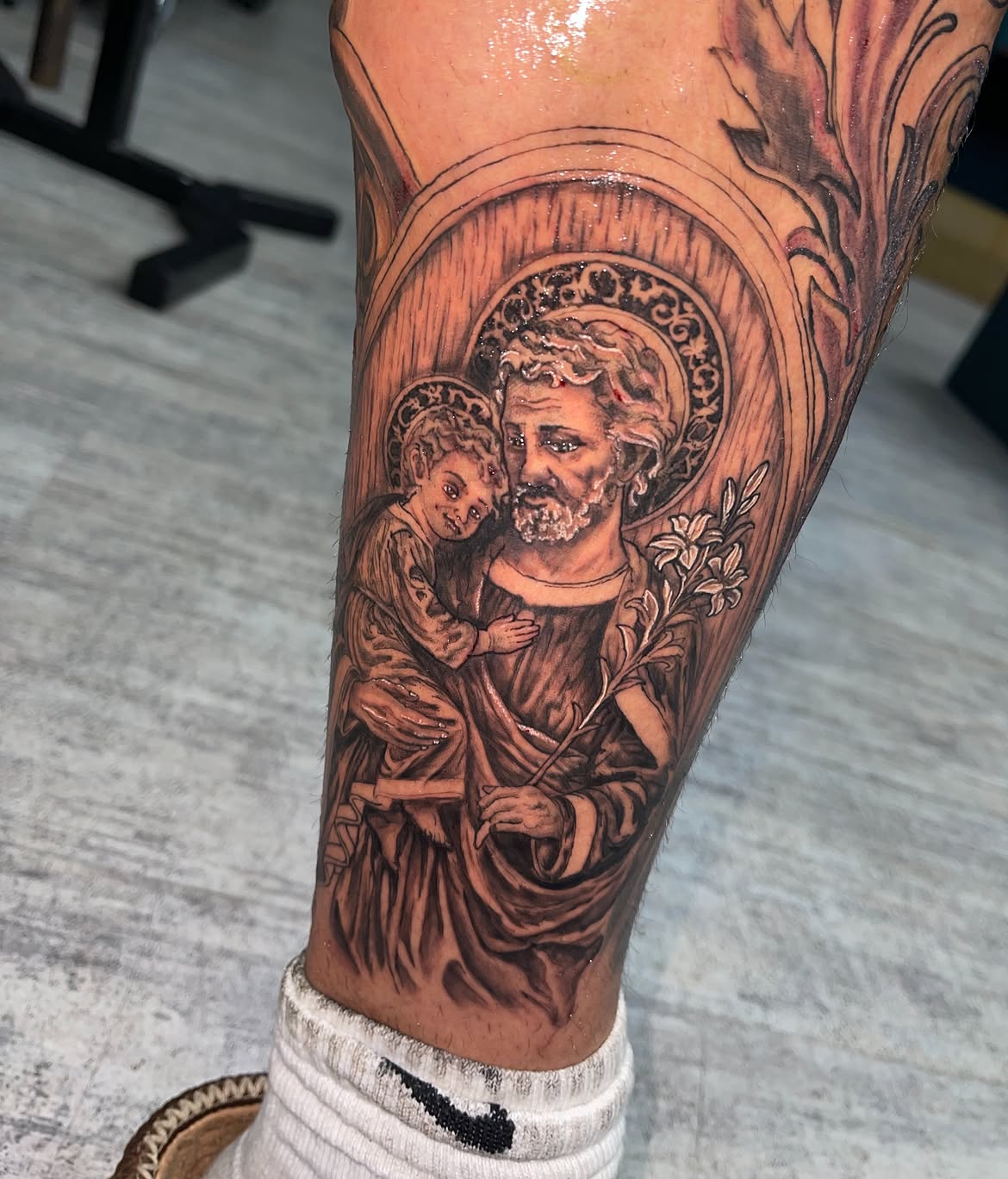
This detailed religious tattoo portrays a bearded saint holding the Child close while carrying a flowering lily. Large decorative halos surround both heads, immediately giving the image the visual character of traditional sacred art.
The relationship between the two figures is intimate and calm. Rather than emphasizing movement or danger, the composition focuses on protection, closeness, and tenderness. The Child rests against the larger figure while the saint’s hands support both the Child and the flowering stem.
Architectural framing around the upper portion makes the tattoo resemble a painted church icon. Fine black lines establish the halos and facial details, while softer gray shading fills the robes. The white lily creates an elegant vertical accent against the darker fabric.
Although the imagery differs from Saint Christopher, the composition provides strong inspiration for a more peaceful Christopher design. A similar arrangement could show Christopher holding the Child rather than crossing the river, creating a religious portrait suitable for the leg, forearm, or upper arm.
Memorial Saint Christopher Medal and Wing Tattoo
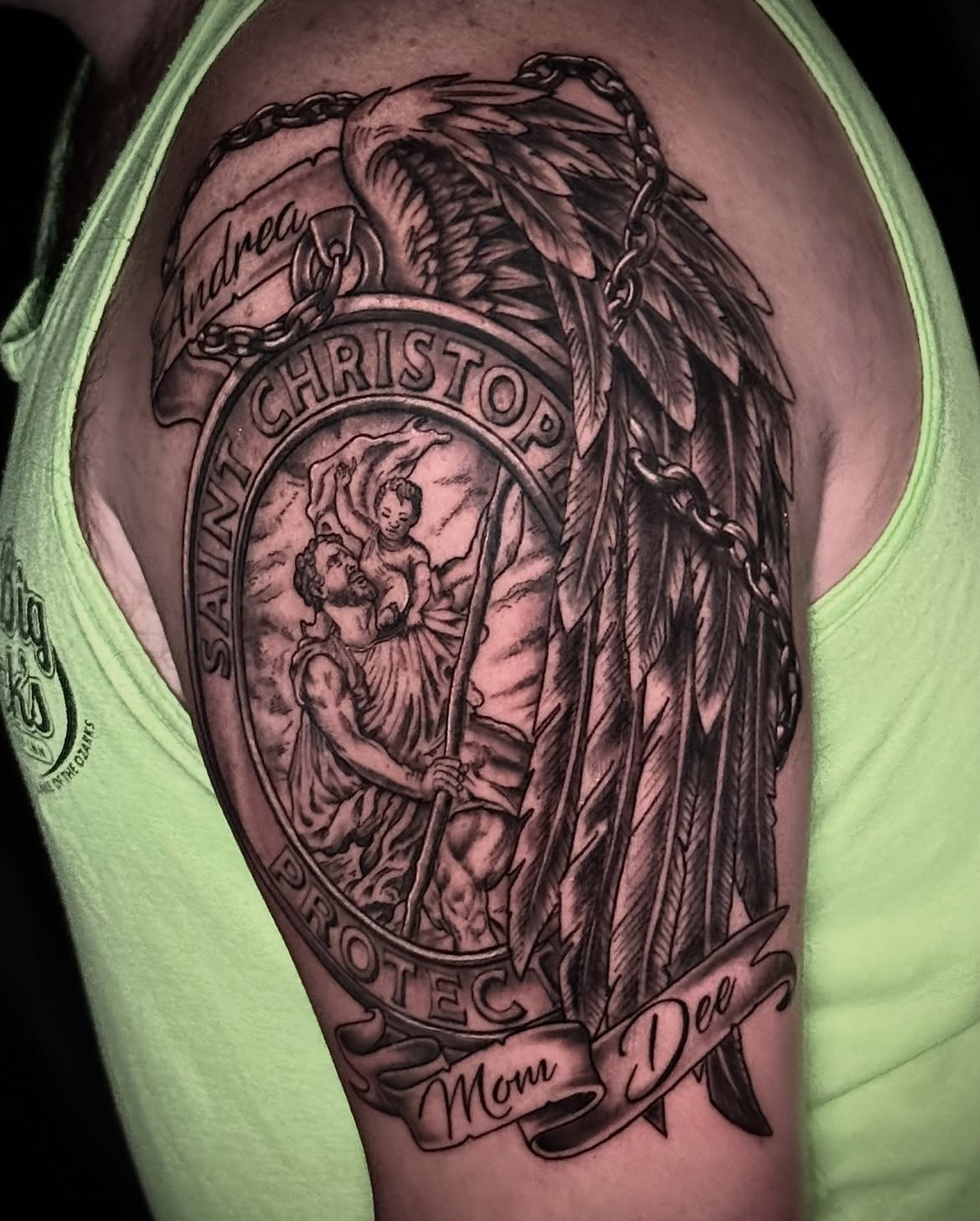
This large upper-arm tattoo transforms the Saint Christopher medal into a deeply personal memorial piece. The central medallion shows Christopher carrying the Child with his staff, while the familiar words SAINT CHRISTOPHER PROTECT frame the scene.
Behind the medal stretches a large feathered wing. Each feather is individually outlined and shaded, creating a dark sweeping shape that fills the shoulder naturally. A chain appears to pass around and behind the composition, reinforcing the idea that the central image is a physical pendant.
Two flowing banners introduce handwritten names, making the tattoo clearly personal rather than purely decorative. This combination of religious symbolism, protection, remembrance, and lettering demonstrates how easily a traditional Saint Christopher design can be customized.
The shoulder and upper arm are excellent placements for this style because they provide enough width for the medal while allowing feathers to follow the body’s natural curve. Expanded farther downward, the concept could become a full sleeve incorporating clouds, dates, additional script, or a cross.
Color Saint Christopher Carrying the Child Tattoo
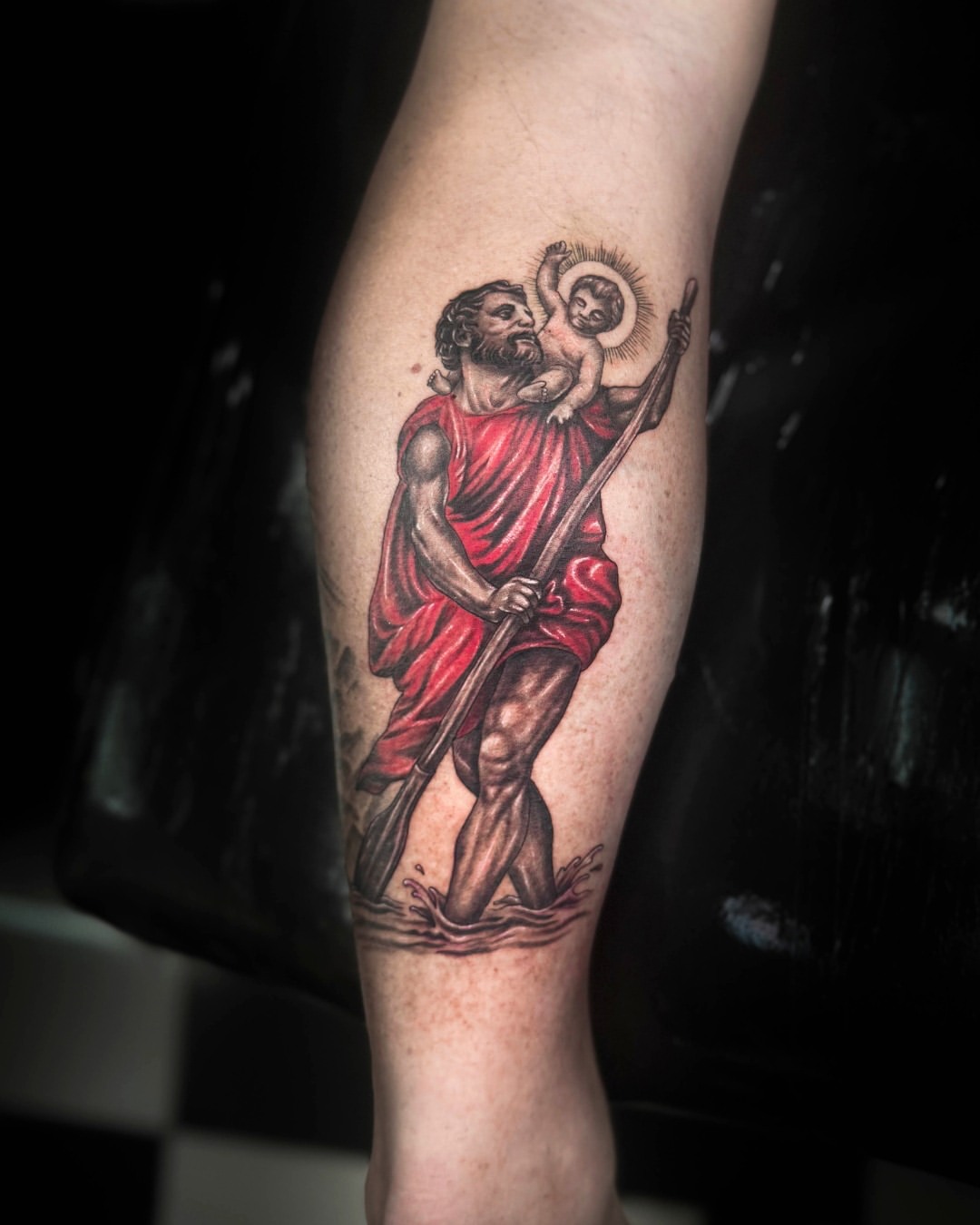
Color completely changes the mood of this traditional Saint Christopher scene. The saint is shown walking through water with the Child resting on his shoulder, but instead of relying entirely on black and gray, the artist gives Christopher a vivid red robe.
That red fabric immediately becomes the visual center of the tattoo. Bright highlights follow its folds while darker crimson shadows create volume. Christopher’s exposed arms and legs are rendered in earthy, realistic tones, emphasizing his physical strength and the effort involved in the journey.
The Child provides a softer focal point above Christopher’s shoulder. A radiant halo surrounds the head, while the raised hand introduces a recognizable devotional gesture. The long wooden staff cuts diagonally through the composition and helps guide the eye from the water toward the figures.
Small splashes around Christopher’s legs complete the river-crossing narrative without requiring an elaborate landscape. This makes the tattoo detailed but still visually clean.
For anyone comparing color and black-and-gray Saint Christopher tattoo ideas, this example shows how effectively one dominant hue can work. There is no need to make every element colorful. A red, blue, or deep green robe against restrained skin tones and black shading can provide enough contrast to make the entire design memorable.
Saint Christopher imagery has survived for centuries because its central idea remains remarkably human: carrying a burden, crossing difficult ground, and hoping to reach the other side safely. That is why these tattoos can feel equally convincing as elaborate religious sleeves, traditional designs, restrained fine line pieces, or simple personal symbols. If you have a Saint Christopher tattoo—or an idea you would approach differently—share it in the comments and tell us what the symbol means to you.