Chicano tattooing combines multiple artistic aspects into one, telling a visual story about the inner cities, family, and spirituality. It originated from a mix of Mexican-American culture and black-and-grey prison art from California, which combines Catholic art, lowrider aesthetics, and portraits, along with bold lettering to create a style that is now known and loved around the globe.
What began as improvised black and grey pieces done with guitar strings and homemade ink has evolved into one of the most refined forms of realism in tattooing, known for soft shading, fine lines, and dramatic light–shadow contrast. Saints and sinners, angels with guns, clowns with tears, and scripts across the stomach or chest—all of this falls under the umbrella of Chicano design ideas.
The style has its heroes. Artists like Freddy Negrete helped pioneer black-and-grey in the California prison system before bringing it to professional studios, while Mister Cartoon turned Chicano lettering, portraits, and lowrider imagery into a global brand that has tattooed everyone from hip-hop icons to athletes. Their work is constantly analyzed on platforms like Tattoodo and in museum shows, and it’s thanks to them that a once-underground style now appears on magazine covers.
Below are real-world examples that show how powerful Chicano tattoo design can be. Each piece has its own story, symbolism, and technical tricks—and each one offers ideas for anyone planning their own sleeve, chest piece, or stomach script.
Angel kid and “Predestinado” stomach piece
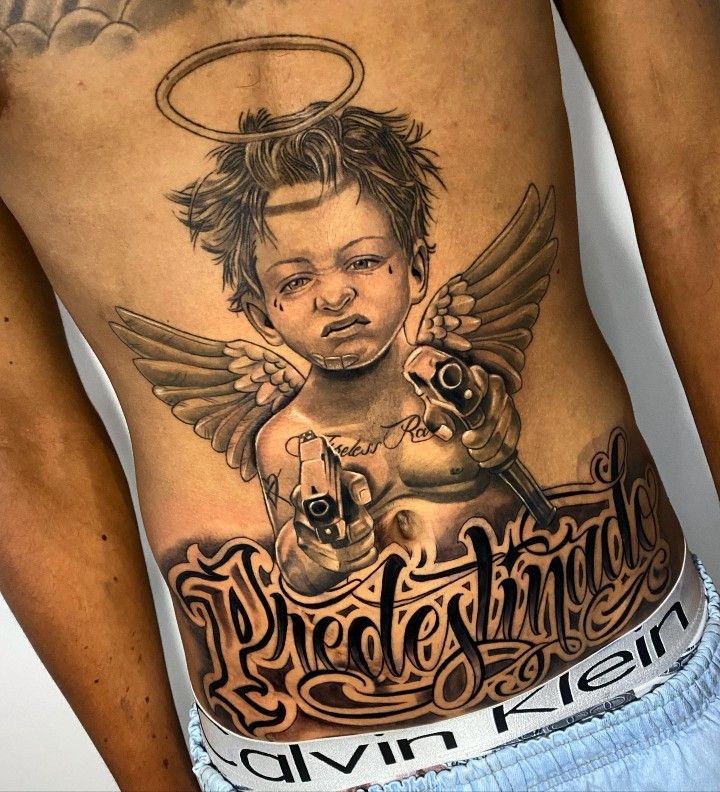
This large stomach and torso piece captures one of the most striking Chicano contradictions: innocence wrapped in danger. A cherub-like angel with messy hair and tiny wings stares straight ahead with a hard, almost grown-up expression. Under the eyes, a subtle teardrop hints at street stories that never make it into family albums.
In both hands, the child holds two detailed pistols, carefully rendered with smooth grey washes and bright highlights. The guns are pointed outward, so the viewer becomes part of the scene, which gives the tattoo its confrontational energy. The halo floating above the head keeps the piece anchored in Catholic symbolism—a reminder that even in the roughest neighborhoods, families still light candles to saints and pray for protection.
Beneath the figure, huge flowing script spells out “Predestinado.” The word is drawn in the classic Chicano font alphabet—sweeping lines, thick downstrokes, and razor-thin hairlines. This type of lettering is a whole art form on its own; many artists keep pages of sketches and design drawings just to get these curves right. On a stomach, the script moves with every breath, almost like a banner waving over the angel in motion.
For someone planning a similar design, it works beautifully as the center of a larger torso project. The angel could be surrounded later by roses, clouds, or more scripts to build a full sleeve running up the ribs and onto the chest. Keeping the palette strictly black and grey helps the story feel timeless rather than cartoonish.
Street-photography realism on the calf
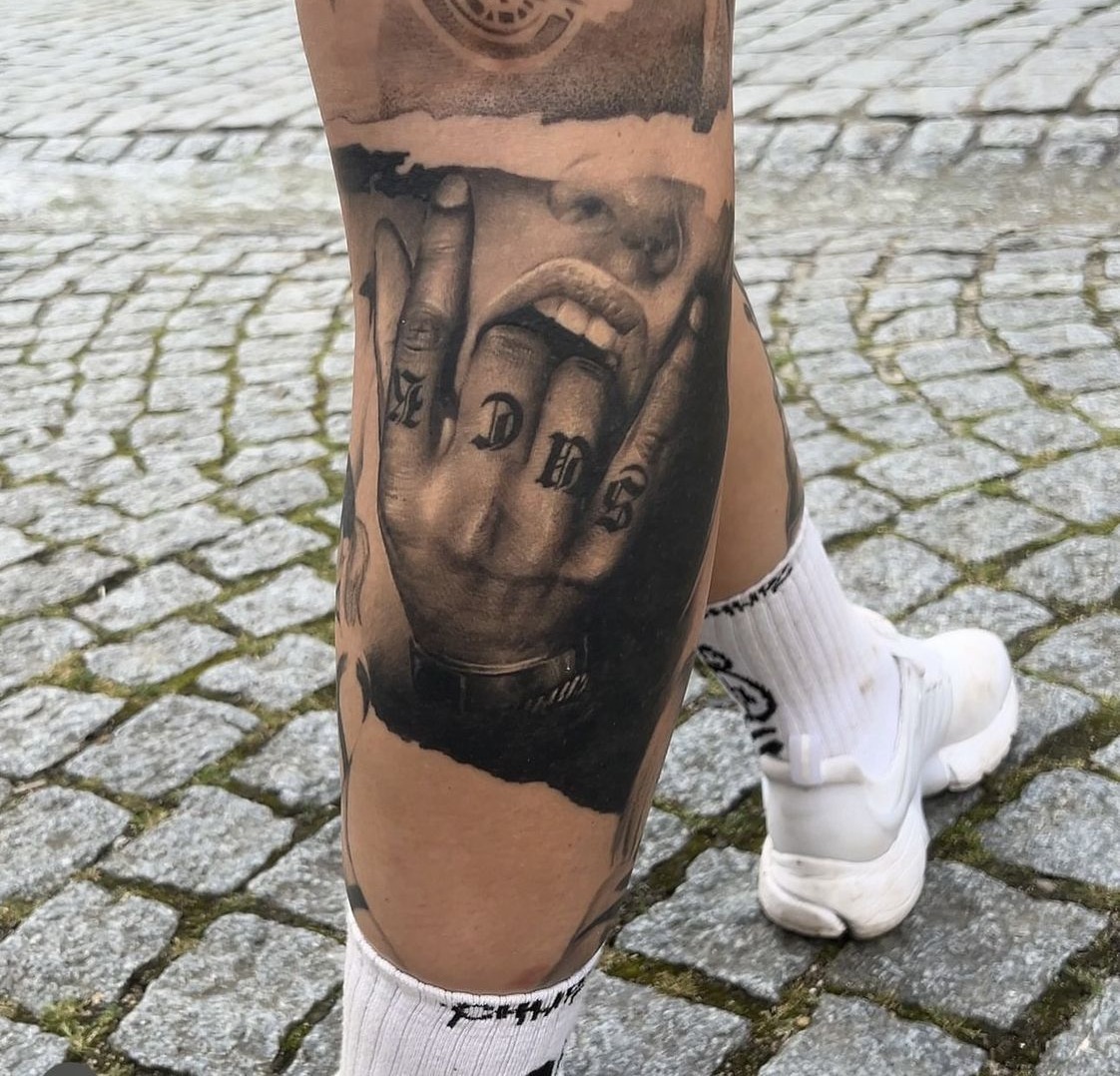
The design wraps around the calf like an untamed snapshot from an evening stroll. The scene is captured by a dominating hand with fingers bent to form a gesture that is a cross between a welcoming gesture and a warning. Black lettering spanning across the fingers captures the essence of knuckle scripts that characterize the Chicano culture.
The space behind the hand is filled with a depth that is created from the gentle blurring of a mouth and teeth and gives the impression the hand is emerging from the skin. Super clean and smooth shades of darkness were used to create the mouth and the nose area, with the lips being touched with a white hue to simulate a hint of moisture. It is a masterclass in using a clean stencil and then building volume with patient layers of grey wash.
This type of leg piece is a good starting point for a full lower leg sleeve. Above, you could add a clock, a Virgin Mary, or classic clown faces; below, script wrapping the ankle would balance the composition. Because the tattoo is highly realistic, it suits people who love that “photo printed on skin” look rather than a traditional flash style. For women who want something similar, the same idea can be softened with longer nails, delicate jewelry, or a lipstick tube instead of a cigarette.
Crime saga backpiece with bold lettering
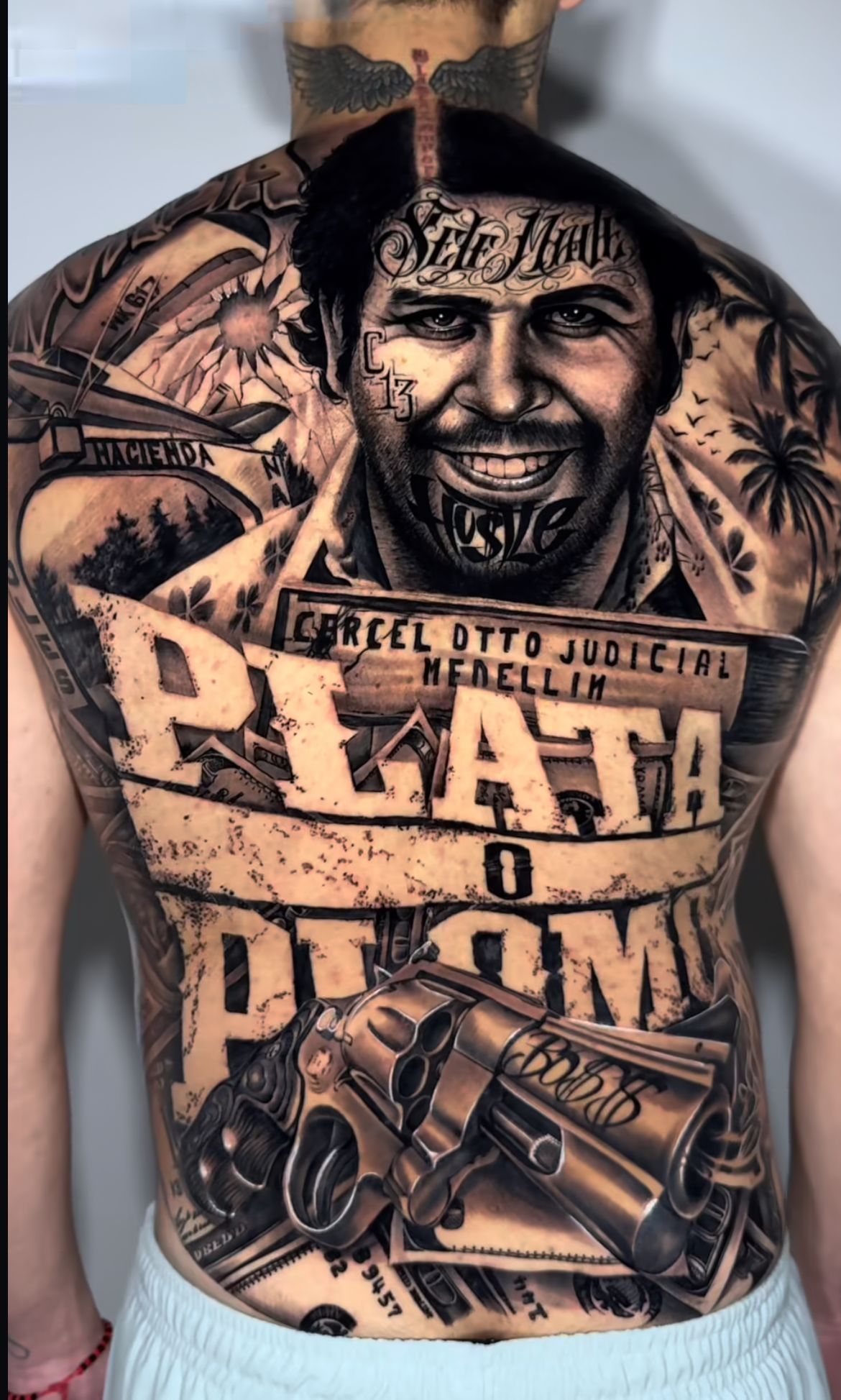
Here the entire back becomes a movie poster. At the top sits a grinning portrait of a notorious cartel figure from popular culture, framed by maps, palm trees, and references to Latin American streets and neighborhoods. The face itself is deeply shaded, with pores, wrinkles, and hair texture rendered in microscopic detail—it’s the kind of realism admired on specialist sites that analyze Chicano and black-and-grey work frame by frame.
Across the mid-back, giant block letters scream “PLATA O PLOMO,” a phrase loaded with underworld mythology. The letters feel like ripped paper posters pasted over the portrait, giving the design a layered collage effect. This is where lettering alphabet skills really matter: the artist has balanced cracks, shadows, and texture so the words look distressed without losing readability.
A large black revolver rests atop stacks of cash with the barrel turned slightly to the side. The cylinder is in a black satin finish, while the other metallic pieces of the gun are in solid silver. The design is highly detailed with lots of screws. Each groove is polished, and the reflections of the barrel are perfectly bright. The attention to detail makes the design photorealistic.
Chicano tattoos are often seen as controversial due to the themes, but they are not just pieces designed to glorify violence. More often than not, they are worn by men who watched action-packed films as kids and view the pieces as cautionary illustrations of power and consequence. When choosing a tattoo of this nature, you’re going to want to find a tattoo artist who specializes in Chicano design. Goodies are places that display tattoos by Mister Cartoon and Freddy Negrete. Portfolios of these artists become modern Vorlagen, where you can thoroughly analyze and study their work.
“Baby” portrait with lollipop and gun
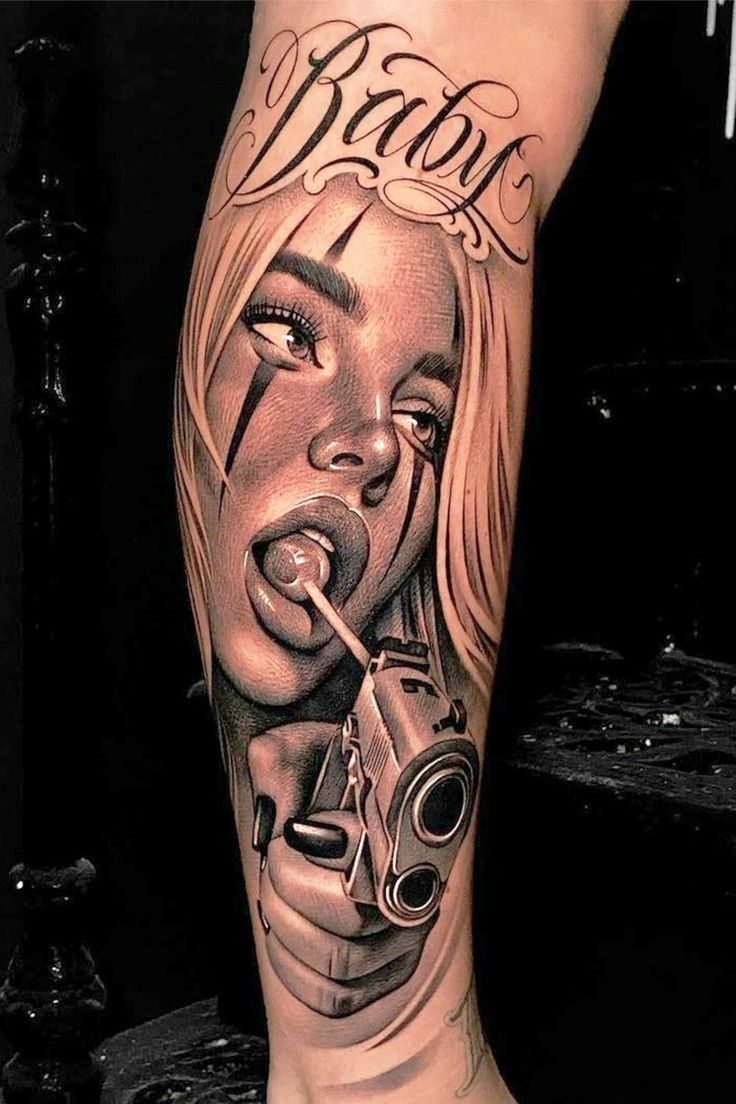
A vertical leg piece like this has the feel and energy of a fantastic cinema close-up. A young girl with long hair looks up from under heavy lashes, a lollipop tucked between slightly parted lips. Dark tear-shaped streaks fall from her lower eyelids, a nod to the clown-esque “sad beauty” that runs through so many Chicano portraits.
Floating above her is an elegant script reading “Baby.” The word is written in flowing letras de style, with long loops that stretch almost from knee to ankle. It’s a perfect example of how a single word can act as both title and nickname, something many Chicano artists learn early when they copy Old English and cursive alphabets out of notebooks.
In the lower part of the tattoo, a hand pushes a pistol towards the viewer, the barrel foreshortened so it feels almost three-dimensional. The contrast between the softness of the face and the hardness of the weapon is where the tension lives. This is classic Chicano storytelling: affection wrapped inside threat.
For women who want to explore Chicano style, this sort of piece shows how strong a single portrait can be. Swapping the gun for a rose, microphone, or spray can keeps the attitude while changing the message. On a full leg sleeve, women often pair a portrait like this with script on the back of the calf and smaller icons—dice, cards, tiny angels—around the ankle.
Chest composition with skull and silent nun

On this chest, two worlds collide: a skull framed by hands and blindfolds, and below it, a serene woman in a veil raising a finger to her lips. The upper section uses the “see no evil, hear no evil, speak no evil” motif, but the Chicano twist lies in the atmospheric shading. Hands cover eyes, ears, and mouth, yet the skull still grins through the gaps, as if saying that death sees and hears everything.
The lower figure looks like a modern take on a nun or saint. Her features are soft and slightly stylized, with long lashes and a direct gaze. The veil forms sharp gothic arches around her, echoing the stained glass windows of old churches often found in Chicano design drawings. With one finger over her lips, she demands silence—a powerful symbol in communities that survived by keeping secrets.
Technically, the artist has balanced strong black fields behind the skull with velvety greys on the nun’s face, giving the whole torso a strong centerline. This kind of chest piece is ideal if you want to build a symmetrical sleeve system later, extending patterns out along the shoulders and into the arms.
For anyone planning something similar, I always suggest spending time with your artist over rough sketch ideas. Decide whether you want a more realistic saint, a stylized scritta banner underneath, or extra elements like doves and roses. A well-planned stencil here makes all the difference, because misaligned eyes or hands are impossible to unsee once healed.
Full upper-body suit with cityscape and bold script
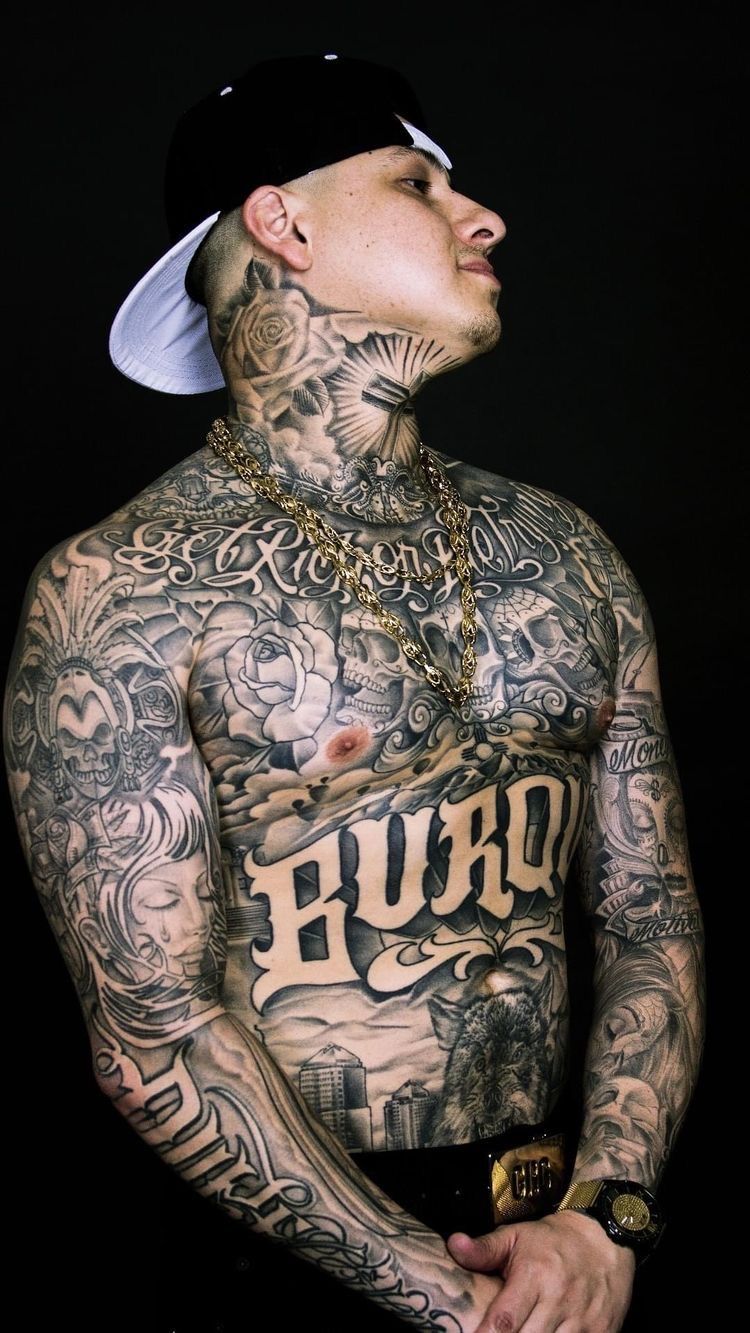
This image could be straight out of a Chicano documentary: a man turned almost entirely into a canvas. From the neck down, every patch of skin carries ink, from roses on the throat to murals on the stomach and sleeve work on both arms. Across the midsection, giant letters spell out a word in heavy Old English blocks, the kind of font you see referenced again and again in Chicano lettering tutorials.
Around that central script, the artist has woven a city skyline, a wolf, skulls, clown faces, and more religious design ideas. Each element has its own shading style, but everything is tied together with soft grey backgrounds that let the larger shapes breathe. On the neck, roses and chains frame the jawline, giving the wearer a permanent collar of petals and metal.
This is where Chicano tattooing becomes full-body storytelling. Some collectors spend years building a suit like this, starting with one sleeve, adding a chest piece, then eventually connecting everything until only hands and face are left blank. For them, flash sheets and old “font alphabet” pages are like family photo albums—sources of memory and identity.
From a practical standpoint, anyone dreaming of this level of coverage should think carefully about composition. Pick one or two keywords for the stomach and upper chest, then work with your artist to design sleeve patterns that flow into them. Don’t be afraid to use European references either—many German and Italian studios publish Chicano “Vorlagen” and “scritta” alphabets online, proving how global the style has become.
“Savage” stomach piece with smoky clown-style portrait
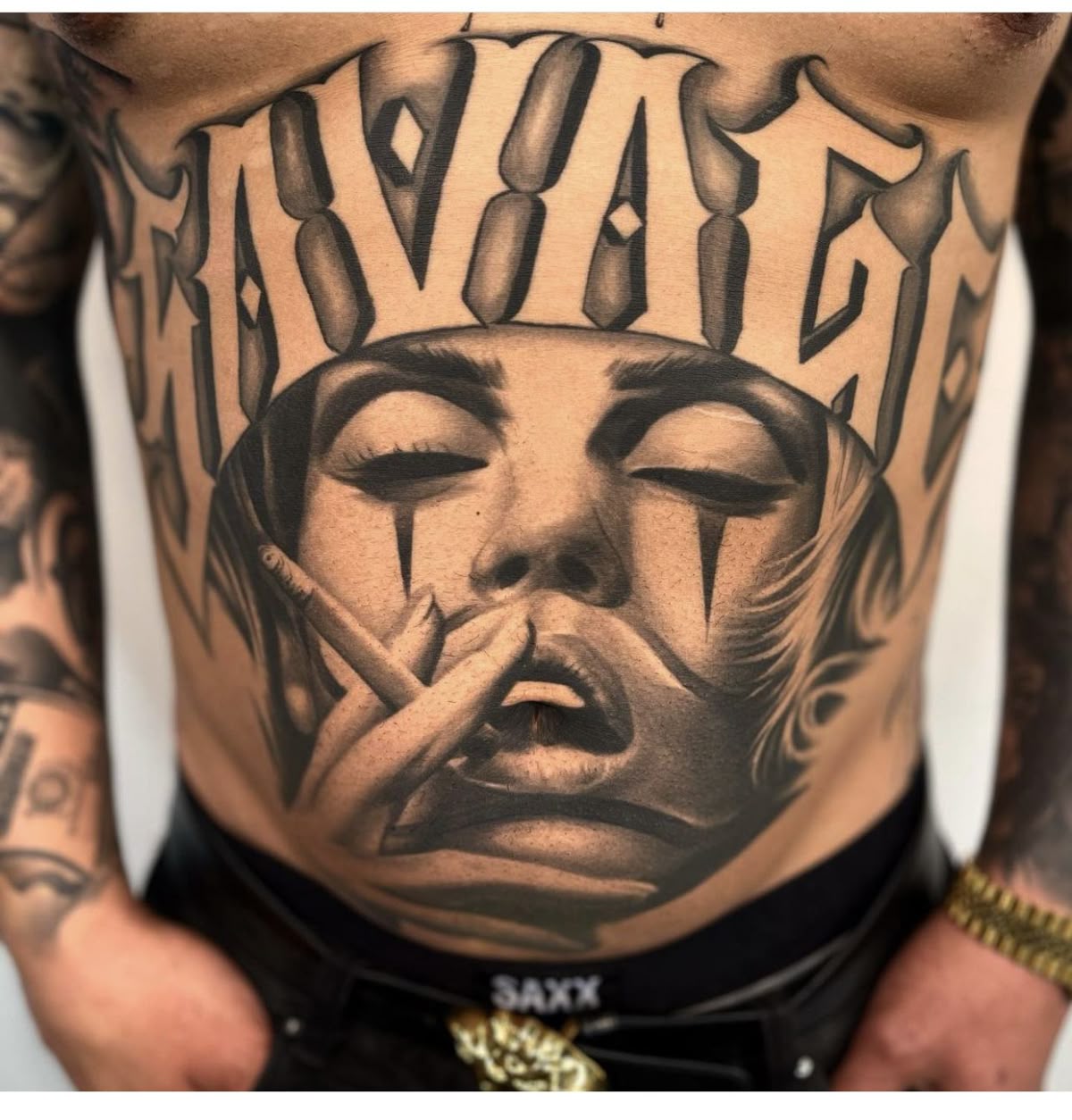
The last example is pure attitude. Across the upper stomach, massive letters announce “SAVAGE,” each one shaped with inner diamonds and razor-sharp edges. The spacing is tight but clean; this is the kind of lettering that looks simple until you watch an artist map it out with rulers and fine markers.
Below the word, a woman’s face dominates the lower belly. Her eyes are half-closed, framed by bold triangular streaks running down the cheeks—a nod to the classic payasa (clown girl) motif that’s iconic in Chicano tattoo history. A cigarette droops from her lips, smoke rising in delicate wisps that soften the harshness of the word above.
The shading here is almost airbrushed. The artist has used a wide range of greys to model the cheekbones, lips, and eyelids, with tiny dots of white ink to catch the light on the nose and lower lip. The result feels cinematic, like a still frame from a black-and-white film.
As a design for the stomach, this works equally well for men and for women. Swapping the word “Savage” for a family name, barrio, or short phrase in Spanish turns the piece into a personal banner. Many clients bring their handwriting or favorite lettering alphabet as reference; others ask their artist to develop a custom script, which is where Chicano tattooing overlaps with calligraphy and graphic design.
Neon “Vice City” pin-up on the calf
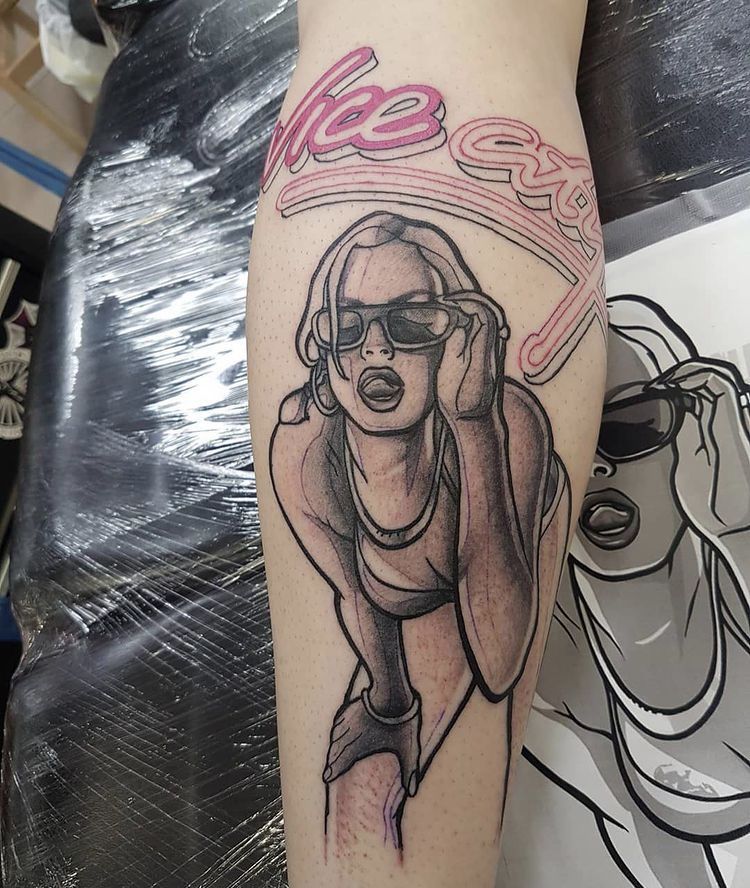
This calf piece steps away from strict black and grey and taps into early-2000s gaming nostalgia. A stylized girl bends forward in oversized sunglasses, lips parted as if she’s about to shout over a nightclub soundtrack. The body is constructed with clean outlines and simplified shading, almost like a blown-up panel from a comic book rather than a photorealistic portrait.
Above her, bubble lettering spells out “Vice City” in a hot-pink script with a white highlight framing every stroke. The curved underline pulls the eye back down toward the figure and gives the whole design a sense of motion, like neon buzzing above a Miami boulevard. It’s a clever example of how Chicano-inspired artists sometimes borrow from pop culture: the pose, colors, and font all echo the era of lowriders, chrome rims, and PlayStation covers.
For anyone collecting Chicano design ideas, this shows how far the style can stretch. You can keep the attitude and bold script, but swap religious imagery for pure nightlife style. It works beautifully as the starting panel of a color-accent leg sleeve, with future additions kept black and grey so the pink script always remains the loudest voice.
Baroque Leg Sleeve With Gangland Cinema Touches
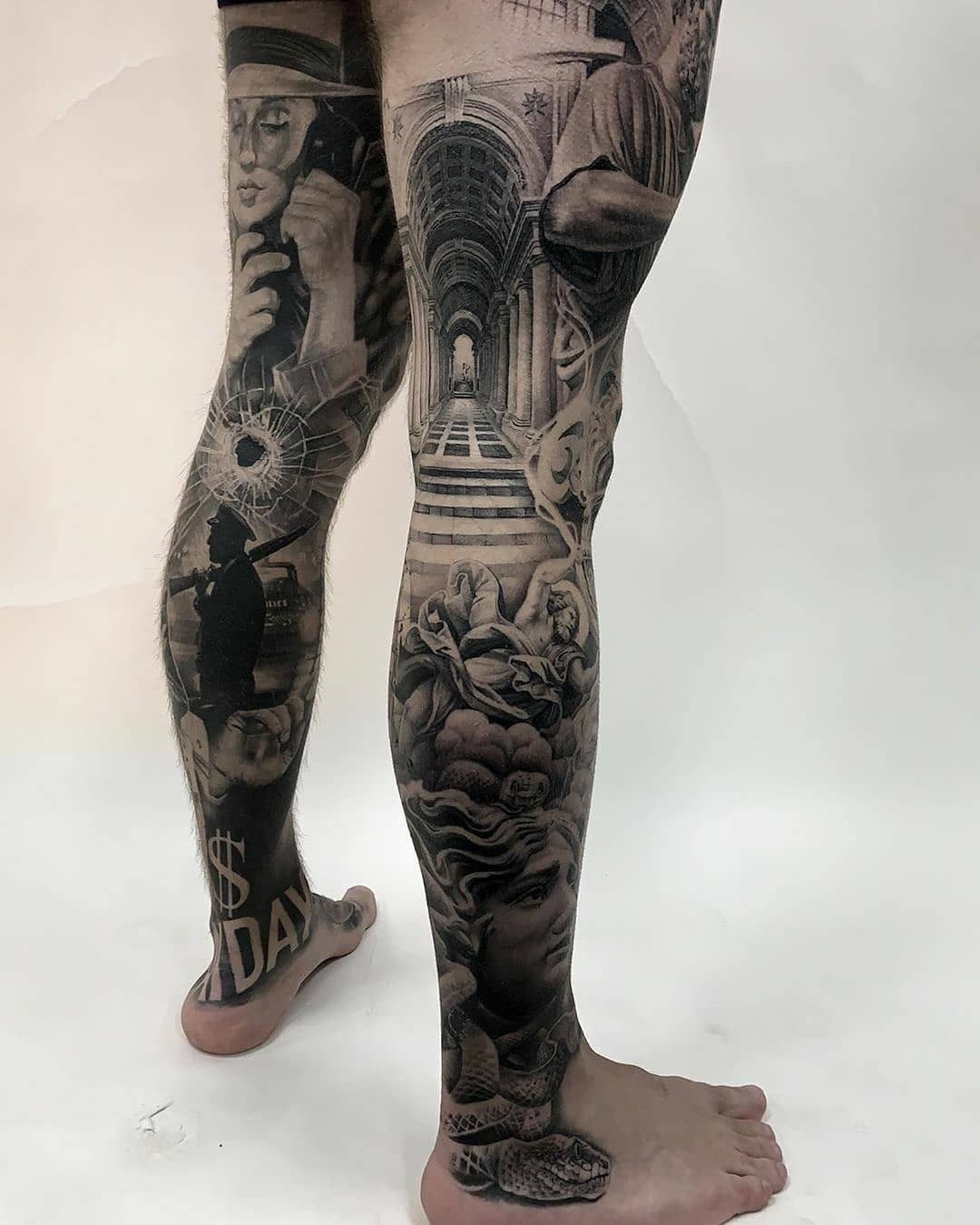
In this design, the legs transform into a vertical screen. One side of the leg displays a long, double-arched corridor with intricate perspective lines drawn toward a bright vanishing point. With shadowy, swirling, engraved stonework, the arch is adorned with statues. The arch feels like a catholicon or dreamy government building that holds more secrets than it will ever share.
Incorporated around this leg architecture are ‘gang’ cinema scenes. The first is an outline of a woman talking on the phone, then a silhouetted man holding a shotgun, and finally a broken frame of glass that appears to be from an entrance of an animated bullet. The calf is anchored with a classical face from a coiled cloud on a classical face, and out of the cloud, snakes are choking the calf.
This gives the whole piece a heavy mythological reference and pulls the composition together. In design style, this is a master class in building a complete sleeve on the leg. Different textures—stone, fabric, skin, glass—are handled with tiny design drawings and a meticulously transferred stencil. For men who want a narrative leg, this approach lets you weave crime, history, and faith into one continuous story without feeling cluttered. Add a small script panel or lettering alphabet near the knee, and the drama is complete.
Religious thigh and shin composition with Last Supper
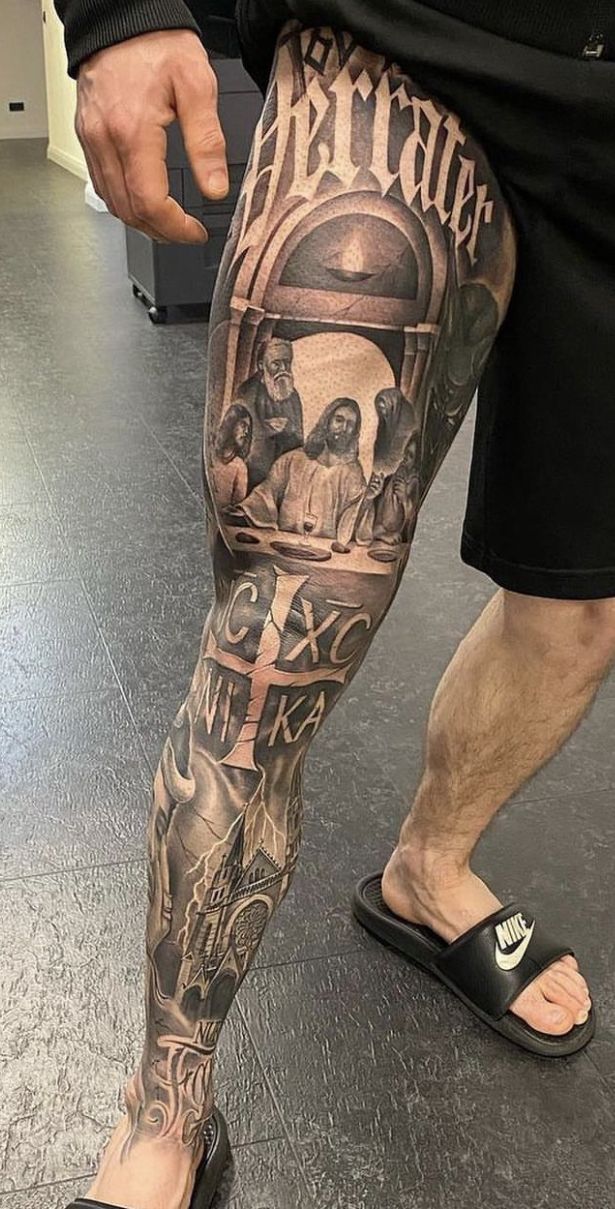
This piece wraps from mid-thigh to ankle and is anchored by a powerful religious scene: Christ and the apostles seated at a long table, rendered with soft sfumato shading. The figures sit beneath a grand archway that fades into darkness, giving the impression of a sacred, hidden chamber. Above that arch, towering Gothic lettering announces a word in sharp, angular strokes, the shapes reminiscent of old church banners and Chicano scritta styles.
Moving down the leg, a large cross intersects Greek letters—the classic “IC XC NIKA” motif associated with Orthodox iconography. Lightning forks through dark clouds around a tall cathedral, tying sky and stone together in one stormy vertical flow. Every element—fabric folds, brickwork, clouds—has been carefully mapped during the sketch phase so that the leg’s natural curves act like a frame rather than fighting the composition.
This is the kind of design that appeals to collectors who see their tattoos as walking altars. It could easily be adapted for women who want a similar statement sleeve women’s piece: soften the shadows on the faces, add doves or roses, or introduce a delicate script panel with a personal prayer. The underlying idea is the same: faith carried visibly, step by step.
Provocative nun and Bible stomach piece
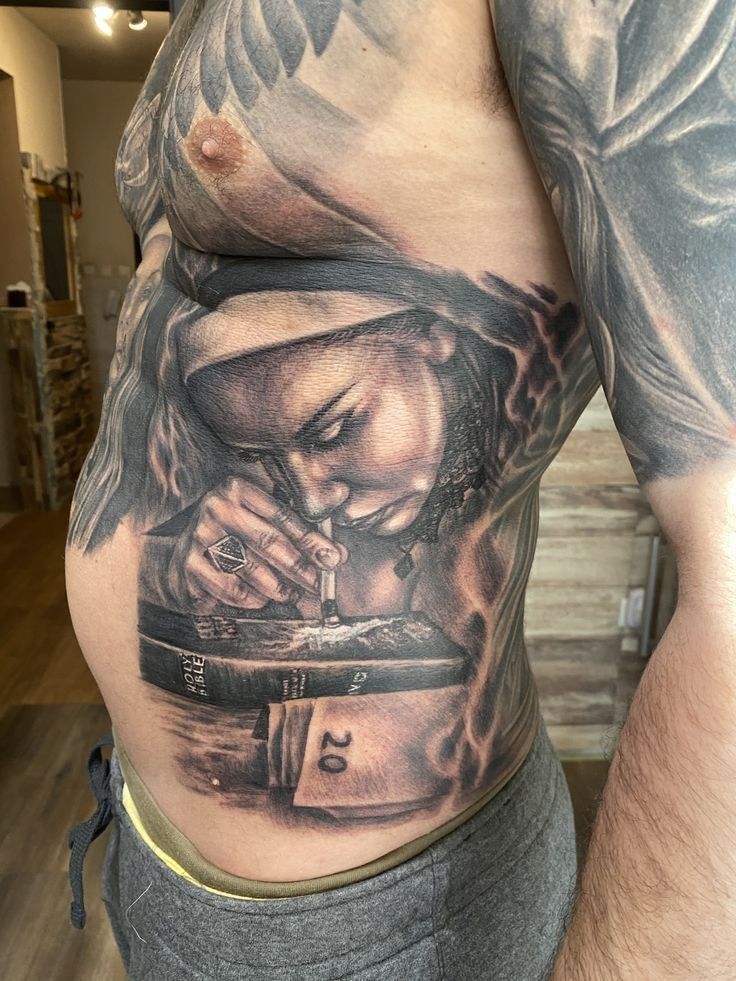
On the torso, a hyper-real portrait shows a woman in a veil leaning over a thick book—the title on the spine clearly reading “Holy Bible.” In her hand, she holds a rolled bill pressed against the pages, as if dragging a line across sacred text. It’s an image that deliberately shocks, but it also captures a tension that has pulsed through Chicano art for decades: devotion and rebellion locked in the same frame.
The shading is dense, with warm greys used to model the folds of the veil and the soft texture of skin. Tiny details—the shine on a ring, the grain of the book cover, creases around the eyes—suggest hours of machine time and a perfectly placed stencil. Flames or smoky shadows roll around the background, framing the figure without stealing focus.
As a design, this stomach piece won’t be for everyone, but that’s exactly the point. It speaks to people whose histories mix strict religious upbringing with street temptations. If someone wanted a less confrontational version, the same pose could be reimagined with the nun reading or tracing a passage with her finger, turning an act of desecration into an act of contemplation. That’s the beauty of custom Chicano work: one powerful idea can be redrawn dozens of ways.
Travel-journal leg sleeve: New York, London, Paris
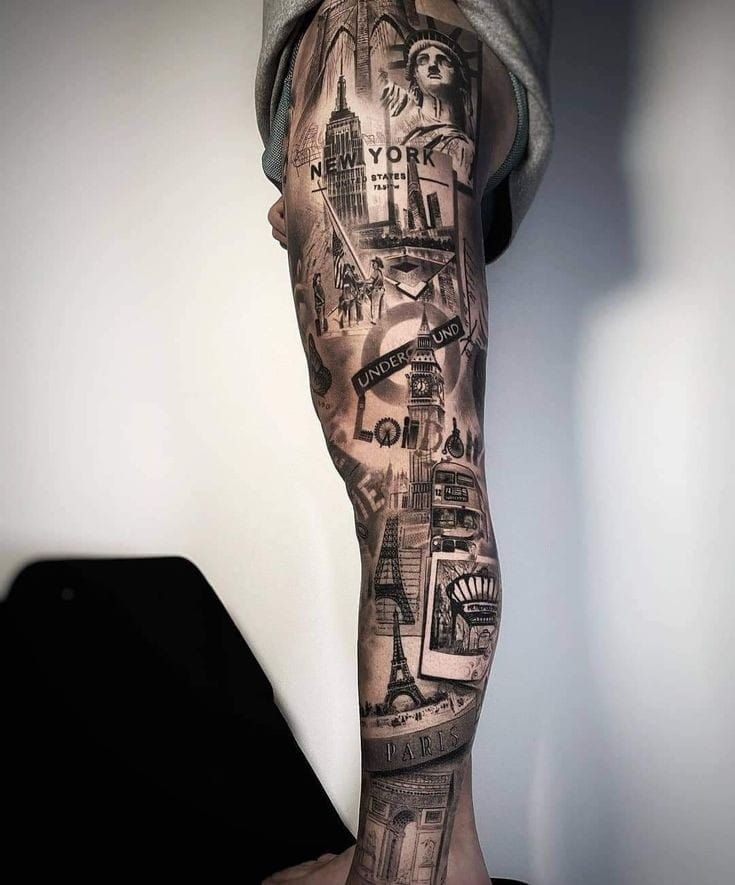
This leg is essentially a passport stamped onto skin. From hip to ankle, iconic skylines and landmarks from around the world stack and overlap: the Statue of Liberty, the Empire State Building, Big Ben, double-decker buses, the Eiffel Tower, and the arches of Parisian boulevards. Each motif is treated like a tiny black-and-grey postcard, complete with small lettering labels—“NEW YORK,” “LONDON,” “PARIS”—in a simple block font that sits nicely among the more detailed images.
The artist has used light grey mist to blend each scene into the next, so nothing feels like a sticker. Instead, it reads as one continuous travel montage, the way memories blur together after a long trip. This approach borrows from Chicano collage-style design ideas but swaps saints and lowriders for city bridges and monuments.
For anyone who lives out of a suitcase or dreams of working their way through global capitals, this is a perfect blueprint. It can be adapted for women with softer skyline lines or extra elements like flowers and tickets; for men, bold block lettering, the alphabet, or coordinates could be added around the knee or ankle to anchor the story. Think of it as a permanent scrapbook, drawn not on paper but directly on the leg.
West Coast icon and lowrider rib piece
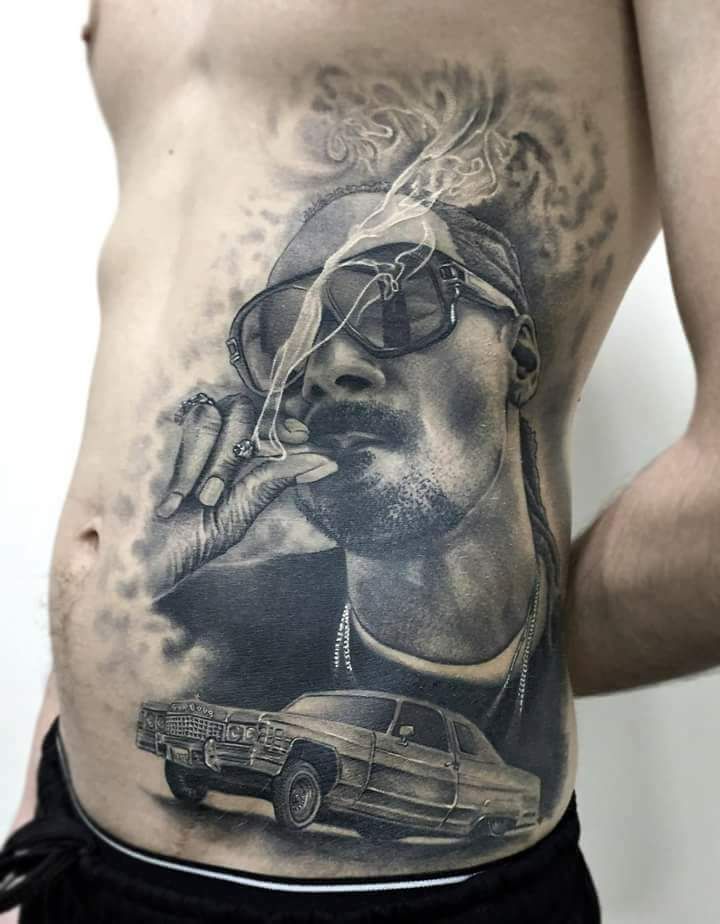
This side-torso tattoo pays tribute to a West Coast rap legend. The portrait captures him mid-smoke, head slightly tilted back, eyes hidden behind reflective sunglasses. Smoke curls upward in lazy spirals, blending into cloudy shading that fills the negative space across the ribs. Beneath the face, a classic lowrider glides along, nose lifted, headlights shining as if caught in the flicker of a streetlamp.
Technically, the piece is a showcase of fine black-and-grey: crisp hair texture, subtle skin pores, and glassy reflections in the lenses. The car below is drawn with clean, straight lines and smooth gradients, the chrome accents singing without needing a single drop of color. Every part of the design screams West Coast Chicano style—music, cars, smoke, and confidence.
This kind of tattoo is a favorite among hip-hop fans and Chicano culture lovers who grew up on lowrider magazines and mixtapes. It translates beautifully into a larger rib sleeve by adding lettering above the portrait—maybe a favorite lyric in elegant letras de script—or by extending the scene with palm trees and neighborhood streets sweeping toward the back.
“Peaky Blinders” newspaper collage on the leg
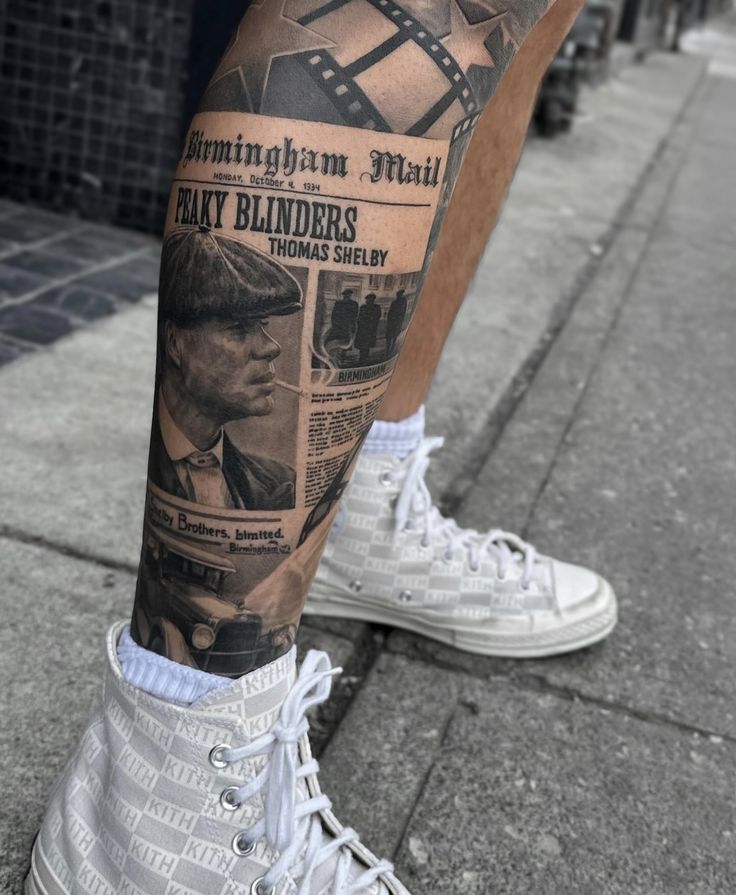
The final piece turns the calf into a sepia-toned newspaper page. Headlines from “Birmingham Mail” frame a large central portrait of Thomas Shelby from Peaky Blinders, his flat cap casting a deep shadow over sharp cheekbones. Beneath, smaller images echo the show’s world: silhouettes of men in long coats, glimpses of vintage cars, and blocks of text that mimic old printing presses.
At the top, strips of film reel wind around the leg, reminding the viewer that this story began as television before it became a tattoo. The shading is careful and dry, using dotwork and grain to imitate the texture of aged newsprint. This is where Chicano realism meets pop-culture collage: instead of saints and cholos, the design drawings borrow from British crime drama, but the execution—tight line work, disciplined greys, clever use of stencil—feels right at home in the barrio tradition.
For fans of movies and series, this approach opens a whole new lane of design ideas. Imagine a calf covered in classic film posters or a full leg sleeve built from comic covers and title cards. The key lesson here is composition: anchor everything around a strong central portrait and let the typography and smaller panels support it, like a well-designed magazine cover running down the shin.
Forbidden fruit sleeve with Adam and Eve
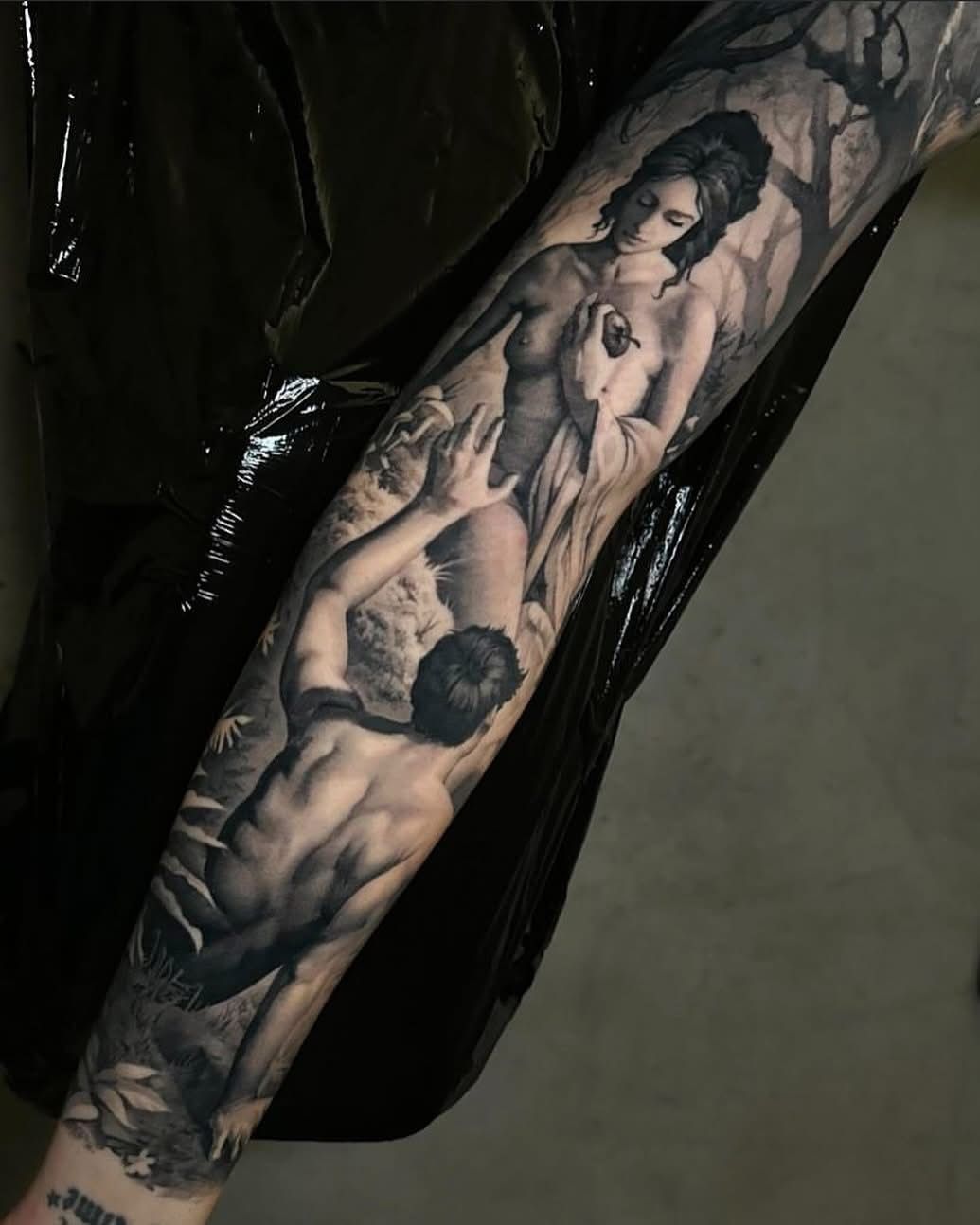
This forearm sleeve turns the creation story into a slow, cinematic moment. At the top, a woman stands among twisted tree trunks, body turned slightly away but head bowed with a soft, almost guilty expression. One hand covers her chest with a draped cloth while the other cradles the fruit—the tiny detail that changes the whole world. The anatomy is carefully rendered: subtle collarbones, soft stomach, and gentle curves lit by a warm grey glow.
Lower on the arm, a muscular man climbs toward her, back and shoulders picked out with dramatic highlights. His hands reach up, caught between desire and hesitation. Shadows from leaves and branches frame the two bodies, hinting at a dense Garden of Eden without overcrowding the design.
It’s a powerful style choice for anyone drawn to biblical narratives but bored of traditional church illustrations. The composition flows naturally with the arm’s movement; when the wrist bends, the man seems to move closer to the fruit. For a future extension, small lettering in a delicate font—maybe a phrase about temptation or free will—could be added along the inner arm without disturbing the main scene.
Gangster cinema collage backpiece
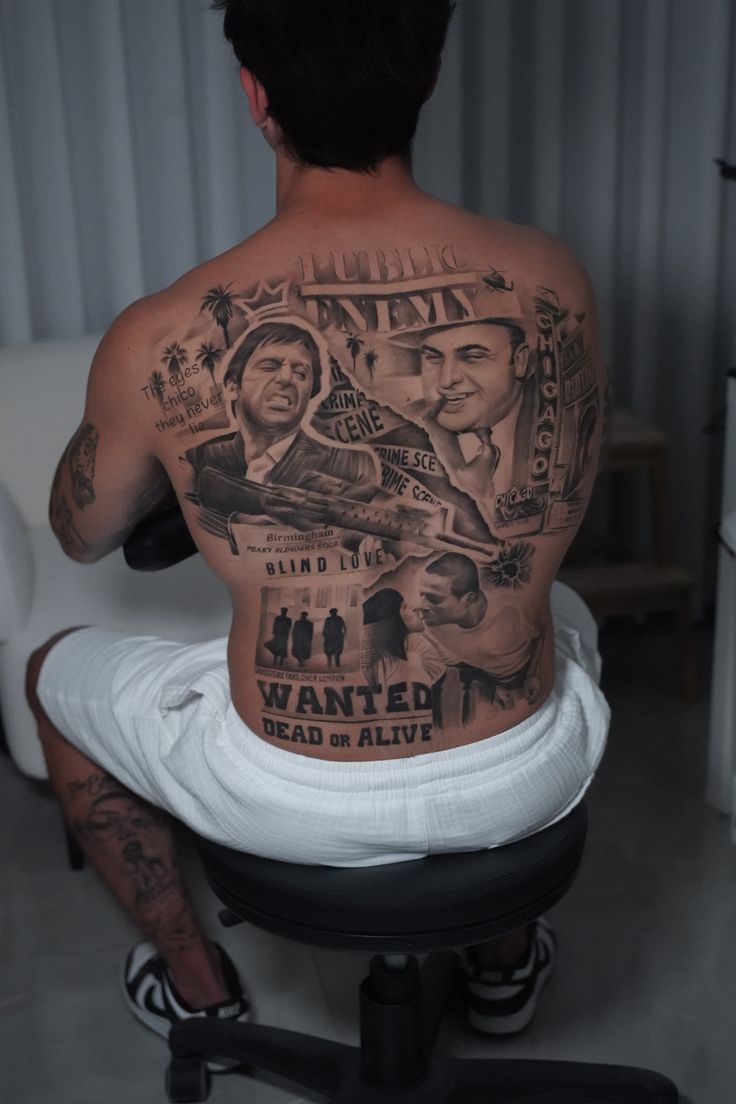
Across the whole back, crime legends from movies and history meet in one sprawling collage. The upper section features bold block lettering spelling out titles and locations—“PUBLIC ENEMY,” “CHICAGO,” “WANTED DEAD OR ALIVE”—using a classic font alphabet that echoes old posters and newspaper mastheads.
Beneath those headlines, iconic gangster faces stare out: slick hair, sharp suits, hard stares. Around them, smaller scenes unfold: silhouettes in long coats, crime-scene tape, palm trees, and city skylines. The artist treats every element like a separate frame of film but blends them together with soft grey backgrounds so the back doesn’t feel chopped up.
This kind of backpiece suits men who grew up on gangster cinema and noir stories. It’s a love letter to that universe without copying a single still frame. Someone planning a similar project could bring favorite movies as Vorlagen—visual references—and work with the artist on a loose sketch before committing to the final stencil. Add a small quote in cursive script near the spine, and the story becomes personal rather than just fan art.
“Censored” portrait with playful shock value

On the calf, a banner with the word “CENSORED” slices diagonally across the leg in heavy black lettering, like a stamp from an old magazine. Behind it, a realist portrait of a young girl with big lashes and glossy lips looks upward, tongue out in an exaggerated expression that’s half punk, half pin-up. Small Old English numbers “69” sit under one eye, a nod to street culture and provocative humor.
The shading is rich and velvety; light glints off the eyes and the tip of the tongue, while deep blacks carve out the jawline and hair. Up top, hints of chrome and mechanical shapes suggest a lowrider or engine, adding another layer of Chicano design ideas without stealing focus.
This piece walks a tightrope between explicit and playful, which is exactly why that “CENSORED” banner works so well. For someone who wants similar energy but a different message, the same structure could be reworked with alternative words—”LIMITED,” “PRIVATE,” even a name—drawn in a custom lettering alphabet. It’s a reminder that a single word, if designed well, can steer the whole meaning of a sleeve.
“Hustle” clown girl money sleeve
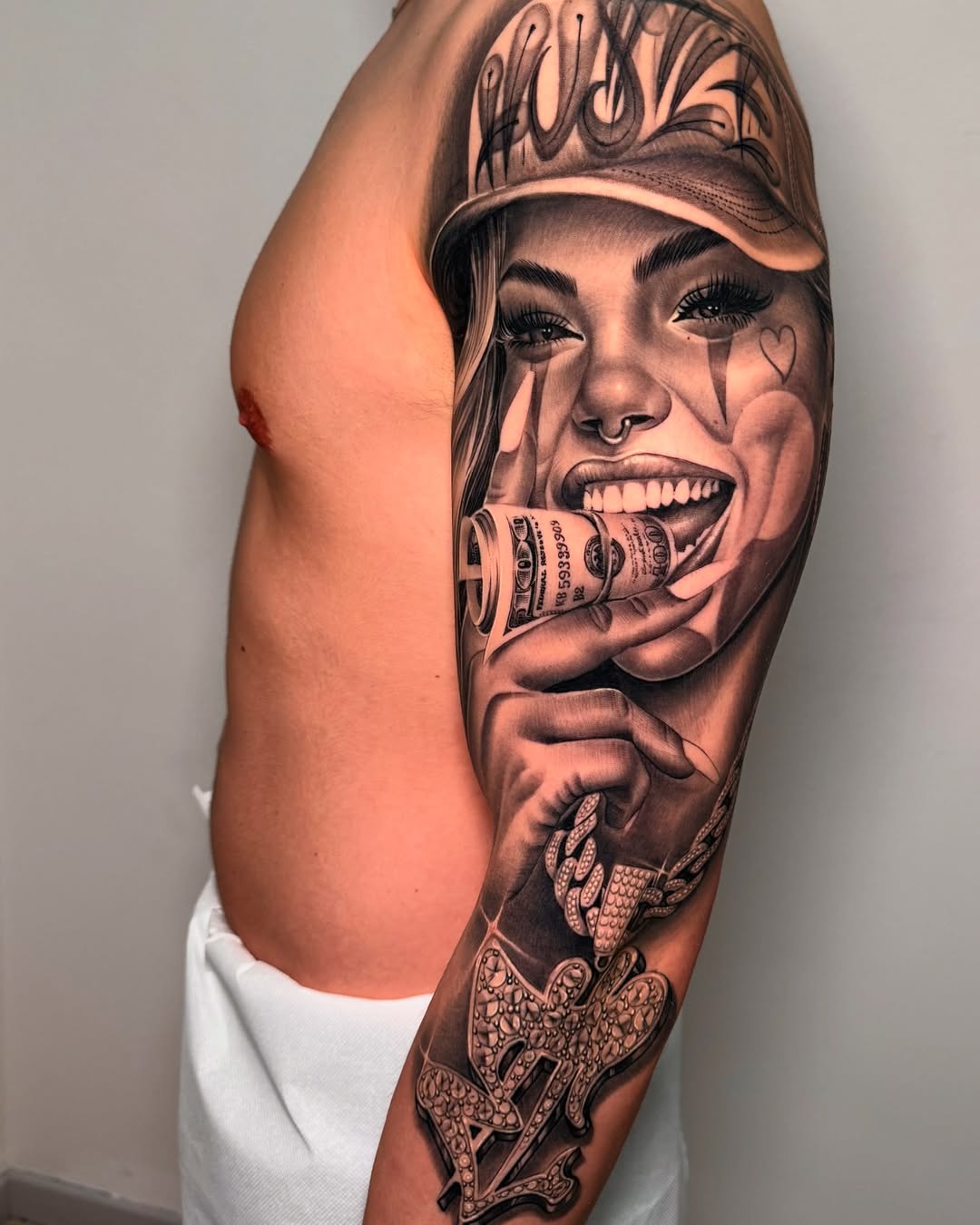
Here the entire upper arm is dedicated to a single concept: making it by any means necessary. At the top, a large script reading “HUSTLE” stretches across a cap, drawn in bold, sweeping letras de style. The loops and arrows of the font give the word movement, as if it’s vibrating with ambition.
Below, a smiling woman with clown-like tear streaks and a tiny heart near the eye bites down on a roll of dollar bills. Her nose ring, sharp eyeliner, and manicured nails all scream confidence. The artist has nailed micro-details—pores, reflections in the eyes, tiny fibers on the notes—turning the arm into a high-definition billboard.
Further down the sleeve, a hand clutches an iced-out pendant and chunky chain, each stone individually shaded to catch imaginary light. The jewelry curves perfectly with the bicep, proving how much planning went into the design drawings and stencil placement. This kind of piece is ideal for those who see themselves as grinders and go-getters. For women, a similar sleeve design featuring softer elements or different props—such as lipstick, a spray can, or a microphone—can convey the same message but with a slightly different flavor.
“Loyalty” cherub with money fan
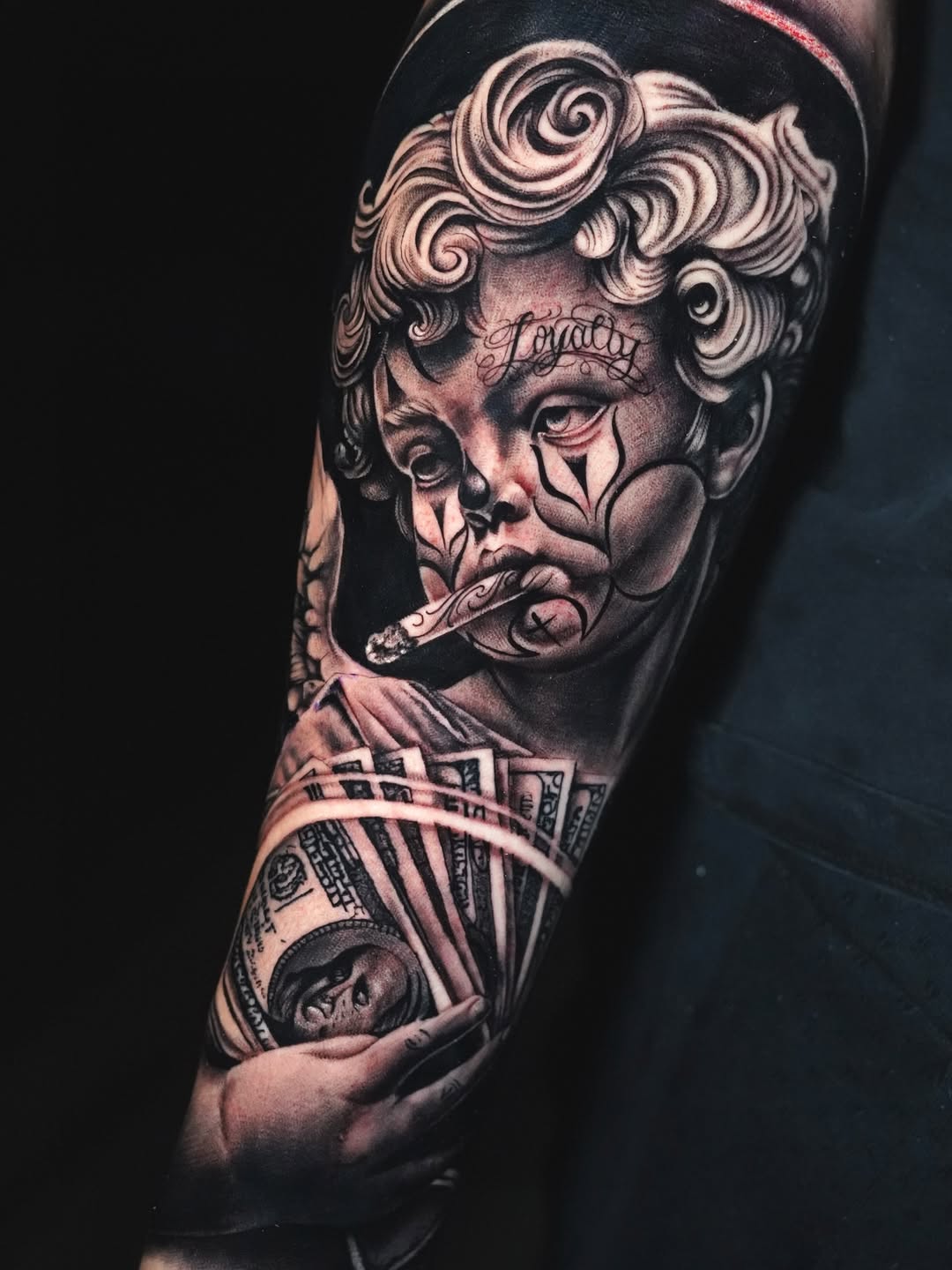
On the forearm, a baroque angel becomes a streetwise character. The cherub-style child has heavy curls and pudgy cheeks, but under one eye run thin clown lines, and above the brow sits elegant script reading “Loyalty” in delicate lettering. Between the lips rests a small cigarillo, smoke blending into the dark background.
Cradled in the hands is a thick fan of hundred-dollar bills, each note shaded carefully enough that the faces and numbers remain readable. The contrast between soft baby skin and crisp cash creates the kind of tension Chicano artists love: innocence tangled with vice. Deep blacks around the figure push it forward, while subtle highlights on the curls make them almost marble-like.
This tattoo works beautifully as the top half of a money-themed sleeve. Future additions could include a rosary, dice, or a city skyline to ground the story. It also offers a strong design idea for anyone exploring family themes; swapping the cigar for a pacifier and changing “Loyalty” to a child’s name turns the same structure into a heartfelt tribute.
Barrio chest suit with monumental script
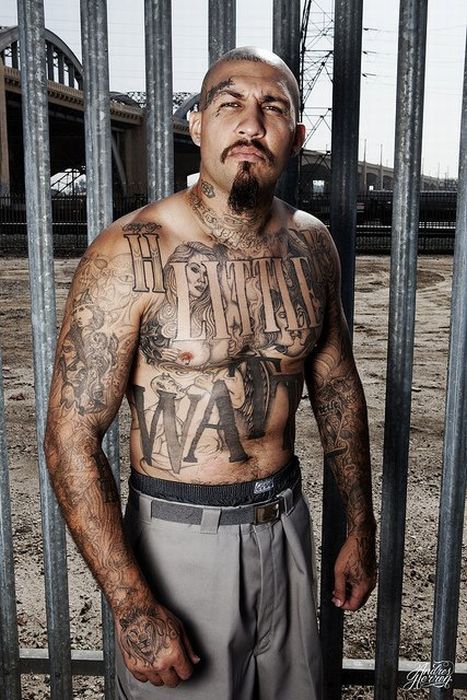
The final human canvas shows a classic Chicano torso covered almost edge to edge. Across the chest and stomach, towering block lettering spells out a barrio name in a style that feels carved from stone. Each letter has sharp serifs, subtle shadows, and just enough spacing to remain readable even as the body moves.
Within and around the letters, smaller scenes unfold: a saintly woman, perhaps the Virgin Mary, in a flowing robe; skulls and flames; and ornamental patterns filling the gaps. The arms and neck are also packed with black-and-grey work, turning the wearer into a walking mural. This is where calligraphy and fine-line realism meet, and where years of small appointments finally link into one cohesive design.
For anyone dreaming of this level of coverage, the lesson is clear: start with a strong central word and let everything radiate from it. Bring reference Vorlagen—old cholo scripts, gang handstyles, and classic Chicano flash—to your artist, and be ready for multiple sketch rounds. Once such a piece is finished, it becomes impossible to separate the person from the artwork; the tattoos tell you as much about the wearer as their clothes or accent.
Full religious leg suits with saints and crosses
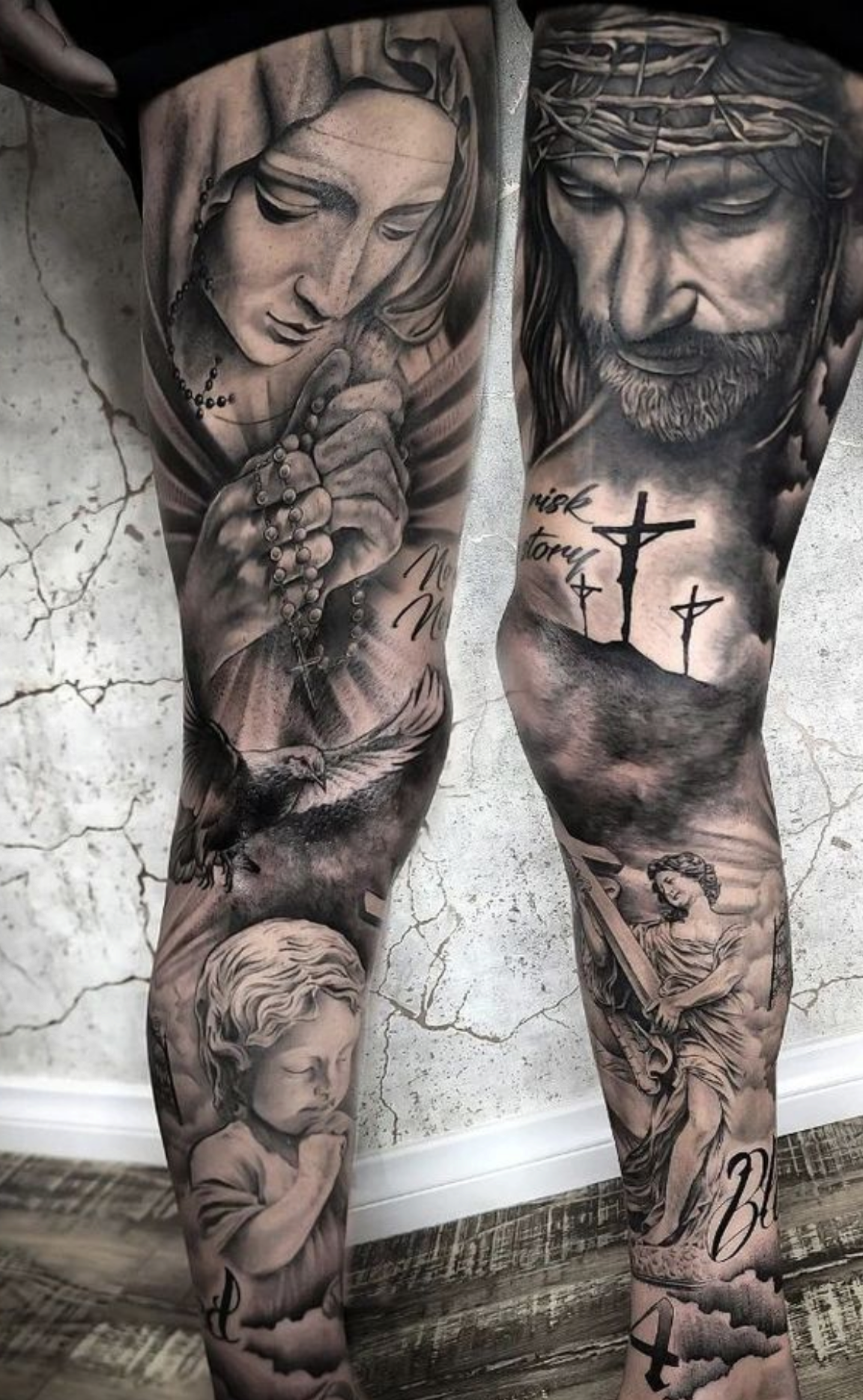
The last set of legs shows devotional Chicano style at its most elaborate. On one side, a veiled Mary bows her head over a rosary, fingers interlaced with prayer beads that glint in tiny white highlights. Light rays burst behind her, while a dove dives through clouds below, wings open in a soft grey blur. Further down, a sleeping child-angel with folded hands reinforces the theme of protection.
The opposite leg carries a sorrowful Christ with a crown of thorns, eyes downcast. Below him, three crosses stand on a hill against a stormy sky, lightning slicing through the darkness. At the calf, a marble-like statue of another saint grips a cross, robes flowing in sculptural folds. Discreet script lettering—personal names, fragments of prayers—winds around the scenes in a graceful cursive font.
Together, both legs read like a mobile cathedral. It’s a perfect reference for clients collecting religious design ideas: how to balance portraits, symbols, and text without losing clarity. For someone planning a similar project for women, softening the shadows on facial features and adding floral borders could make the visuals gentler while keeping the faith message strong.
West Coast backpiece about ambition and loyalty
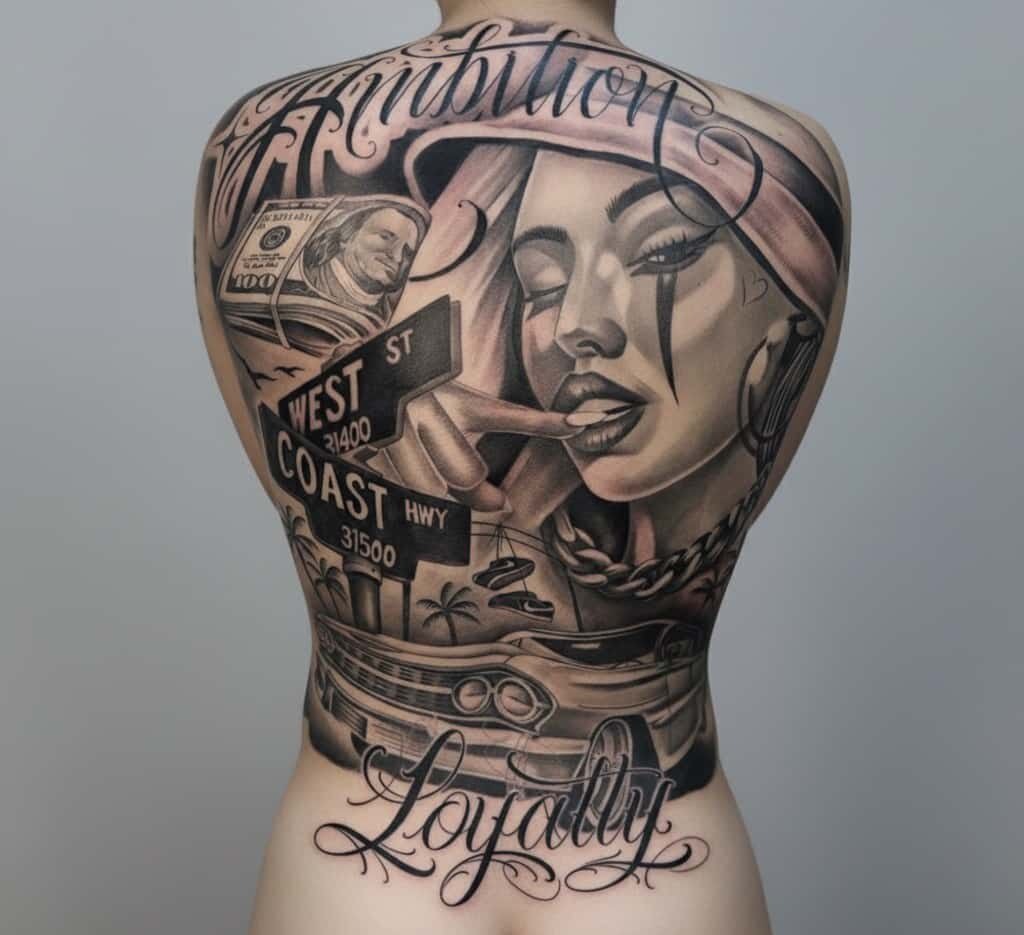
Across the whole back, two words run the show: “ambition” and “loyalty.” They’re written in sweeping cursive lettering, the kind of font you see in classic Chicano flash sheets—long loops, razor-sharp terminals, and a rhythm that feels almost like hand-painted lowrider panels. Between those words, a chola-style girl in a bandana stares out with clown tears and half-closed eyes, a cigarette resting at her lips.
To the left, a roll of hundred-dollar bills and a “West Coast Hwy” street sign anchor the story, while palm trees and a lowrider slide along the lower spine. Everything is shaded in buttery greys, from the gleam in her hoop earrings to the chrome bumper. It’s a masterclass in backpiece design drawings: the big script frames the portrait, the street signs and car support the narrative, and the negative space keeps the whole design readable from a distance. For anyone collecting Chicano sleeve or back ideas for women, this shows how you can balance soft femininity with hard hustle energy.
Wall Street leg sleeve with money and pressure
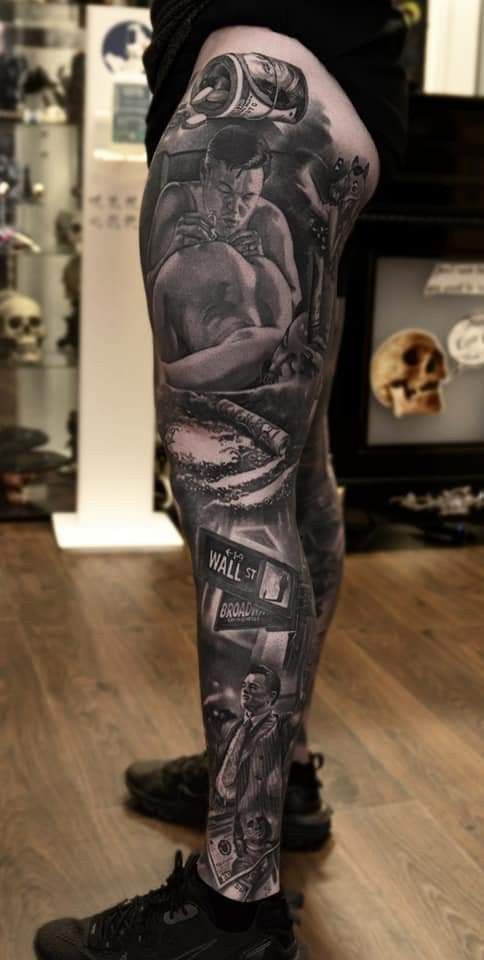
This full leg sleeve swaps barrios for business districts but keeps the same Chicano drama. At the top, a crumpled can and stormy clouds set the mood. Below, a man clutches his knees in the shower, head down, water pouring over his shoulders—a raw image of burnout that feels ripped from a movie still.
Further down, chains and crashing waves circle the calf before the scene sharpens into the iconic “Wall St./Broadway” sign and a suited figure standing in a blizzard of banknotes. The font alphabet on the street signs stays faithful to New York’s real signage, while the suit and tie are rendered with the same care usually given to bandanas and lowriders in traditional Chicano work. It’s a brilliant twist on the style: instead of gang life, the villain here is financial pressure. For artists looking for fresh design ideas, this painting proves that with a strong stencil and solid sketch, even stock-market stories can live comfortably in a Chicano visual language.
Hollywood foreground with smoke and skyline
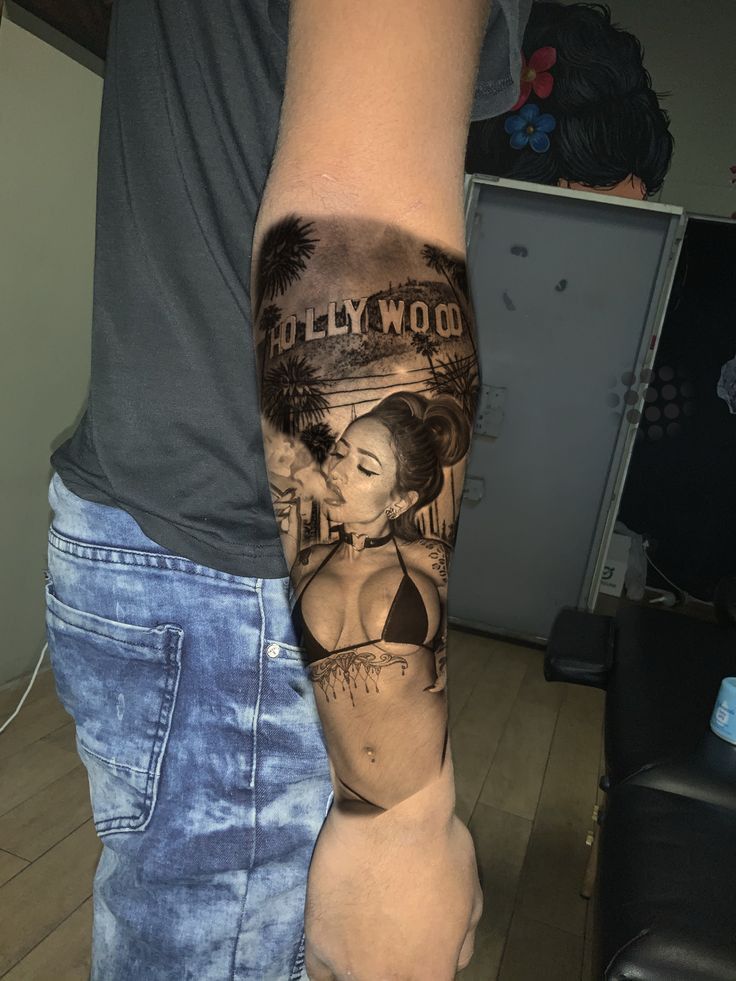
On the forearm, the famous HOLLYWOOD sign sits high on the arm like a headline. Tall palms rise in front of it, their trunks fading into a hazy night sky peppered with grainy texture. Just below, a woman in a bikini exhales smoke, eyes closed and shoulders relaxed, framed by a soft city skyline.
The composition feels like an LA postcard gone noir. Deep blacks around the shoulders and hair push the figure forward, while the soft mid-tones on the skin add warmth. Tiny white highlights on jewelry and lip gloss provide the whole piece a cinematic sheen. This outfit is pure boulevard style: glamour, nightlife, and just enough danger. For a future extension, a small script scritta could wrap around the wrist—a quote about dreams or fame—turning the ensemble into a compact yet powerful lower-arm sleeve.
Chest of cherubs, favelas and motorbike stunts

Here, three chubby cherubs float across the chest, halos glowing over their curls. One covers the eyes, one sleeps, and another presses a finger to the lips—a playful nod to “see no evil, hear no evil, speak no evil” with a heavenly twist. Their soft shading and marble-like texture recall Renaissance paintings and classic Angel imagery seen in old Chicano flashes.
Below the ribs, the atmosphere shifts: densely packed houses of a hillside favela cluster together at steep angles, and a masked rider performs a wheelie on a motorcycle at the core of the abdomen. A little speech bubble of graffiti-style lettering adds a street-art accent. The contrast between innocent cherubs and chaotic city blocks creates a narrative about growing up under watchful eyes yet living fast at ground level. It’s the kind of layered story many Brazilian and West Coast artists—from Mister Cartoon to the new São Paulo school—love to tell, and a strong Vorlagen reference for anyone planning a large story-driven torso piece.
Script-heavy chest suit with barrio attitude
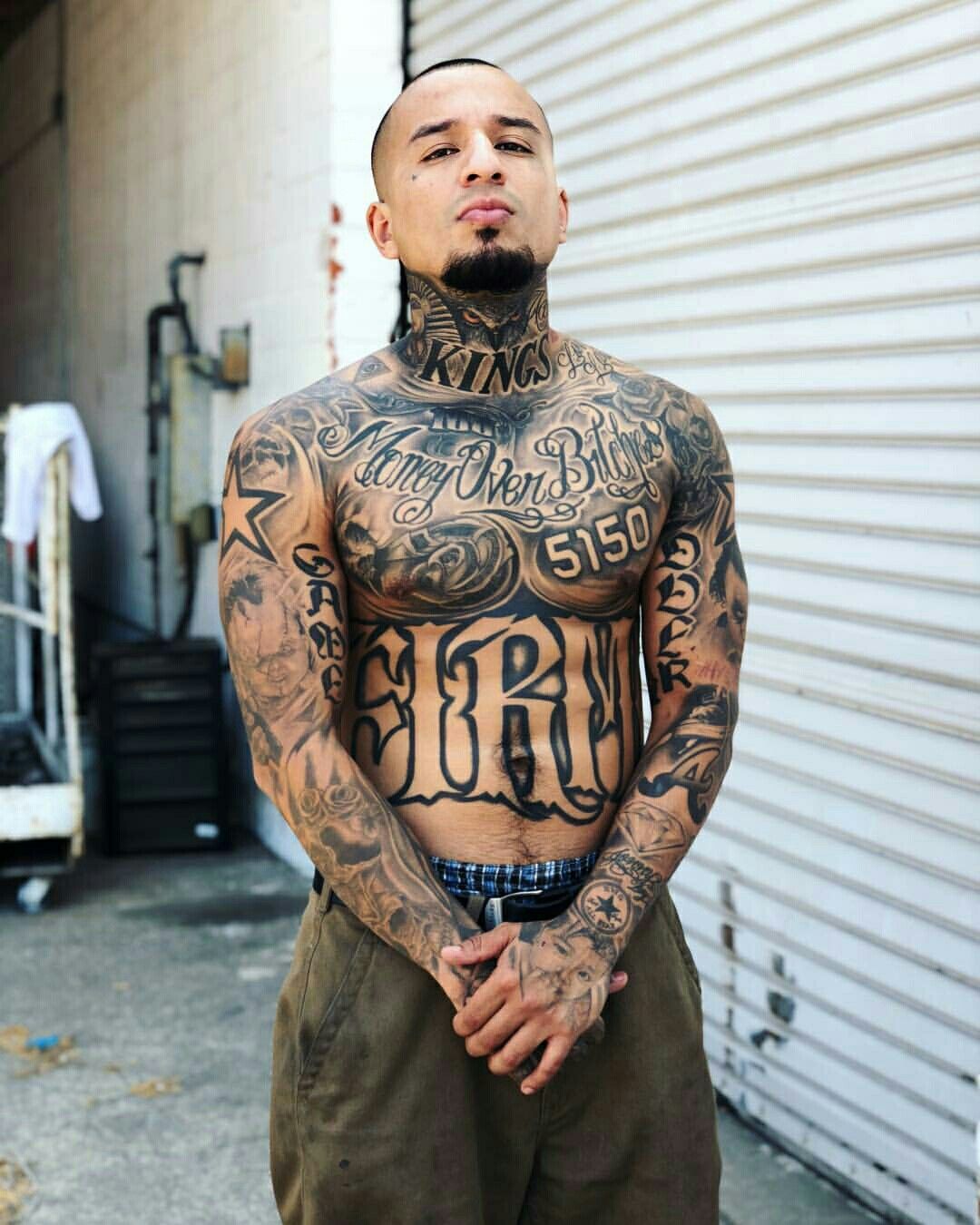
This body is almost entirely wrapped in script and symbols. Across the chest, ornate lettering in the alphabet spells out phrases about money, loyalty, and crew, each word drawn in a different Chicano font: some wild and curly, some blocky and aggressive. The neck shouts “KINGS” in bold capitals, while the stomach carries monumental straight-edge letters that rise and fall with every breath.
Between the words, smaller images—stars, faces, numbers—fill gaps like pieces from a custom flash sheet. The overall effect is that of a walking text mural, the kind of look pioneered by LA legends and still referenced by younger men in the scene. For tattooers, this artwork is a reminder of how essential clean lettering skills are in Chicano work; a good chest suit starts long before the needle touches skin, with pages of sketch practice and testing how words flow with muscle and bone.
Cartoon “Bad Bunny” cheek piece with attitude
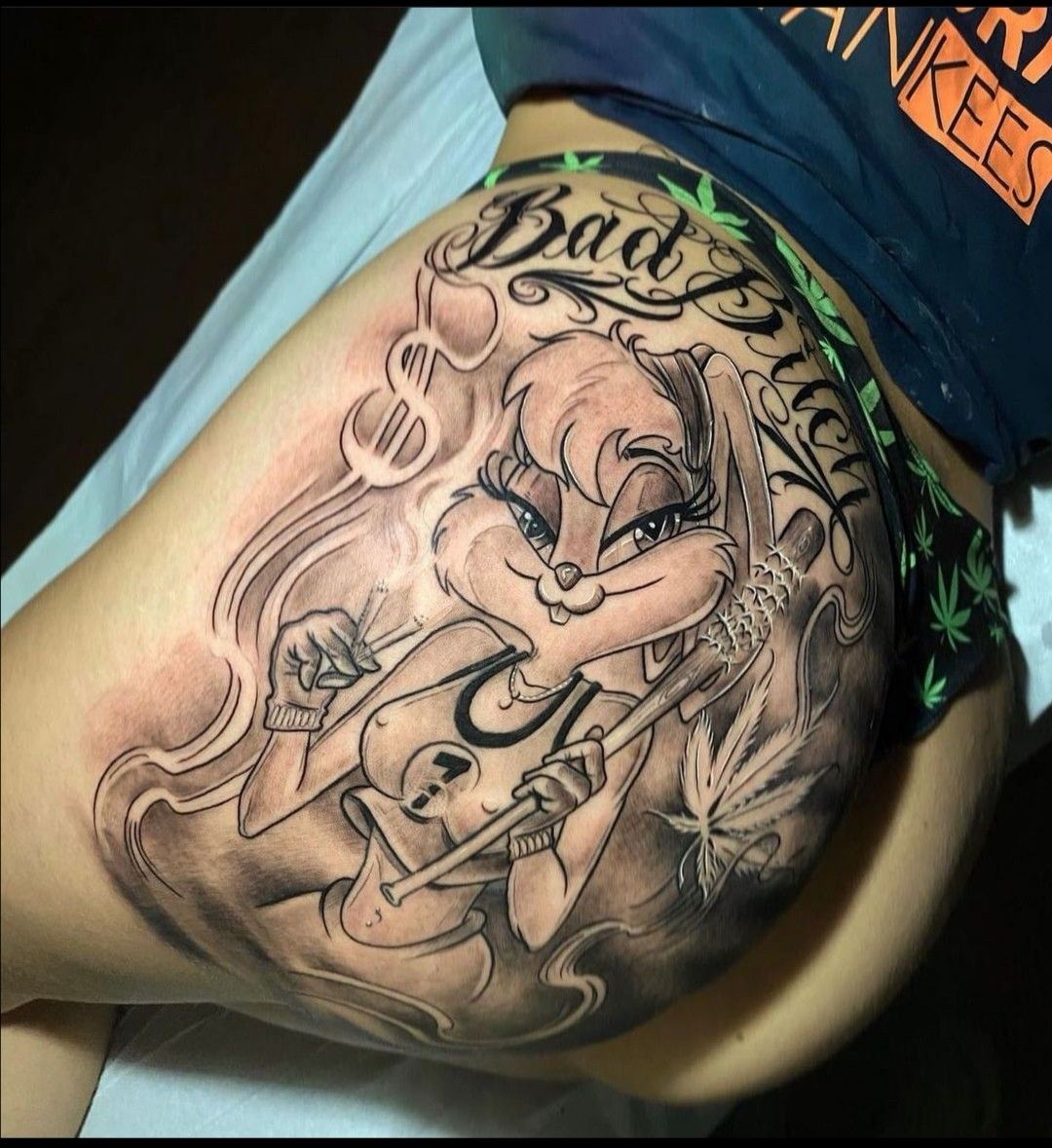
On the hip and upper thigh, a familiar cartoon rabbit gets a barrio makeover. The character leans back with a sly grin, holding a spiked bat in one hand and a tiny joint in the other, surrounded by wisps of smoke that coil like musical notes. Above, the phrase “Bad Bunny” (or “Bad Baby,” depending on how you read the loops) is written in playful script lettering, with little dollar signs hidden in the swirls.
The shading is soft and almost airbrushed, keeping the character friendly despite the cheeky details. This is a perfect example of how Chicano artists remix pop culture: they keep the cartoon proportions but apply black-and-grey techniques, turning a childhood figure into a grown-up joke. It’s a fun reference for women who want a big piece with humor rather than heavy symbolism and a reminder that not every Chicano design has to be deadly serious to feel authentic.
Full-torso Joker with Portuguese scripture
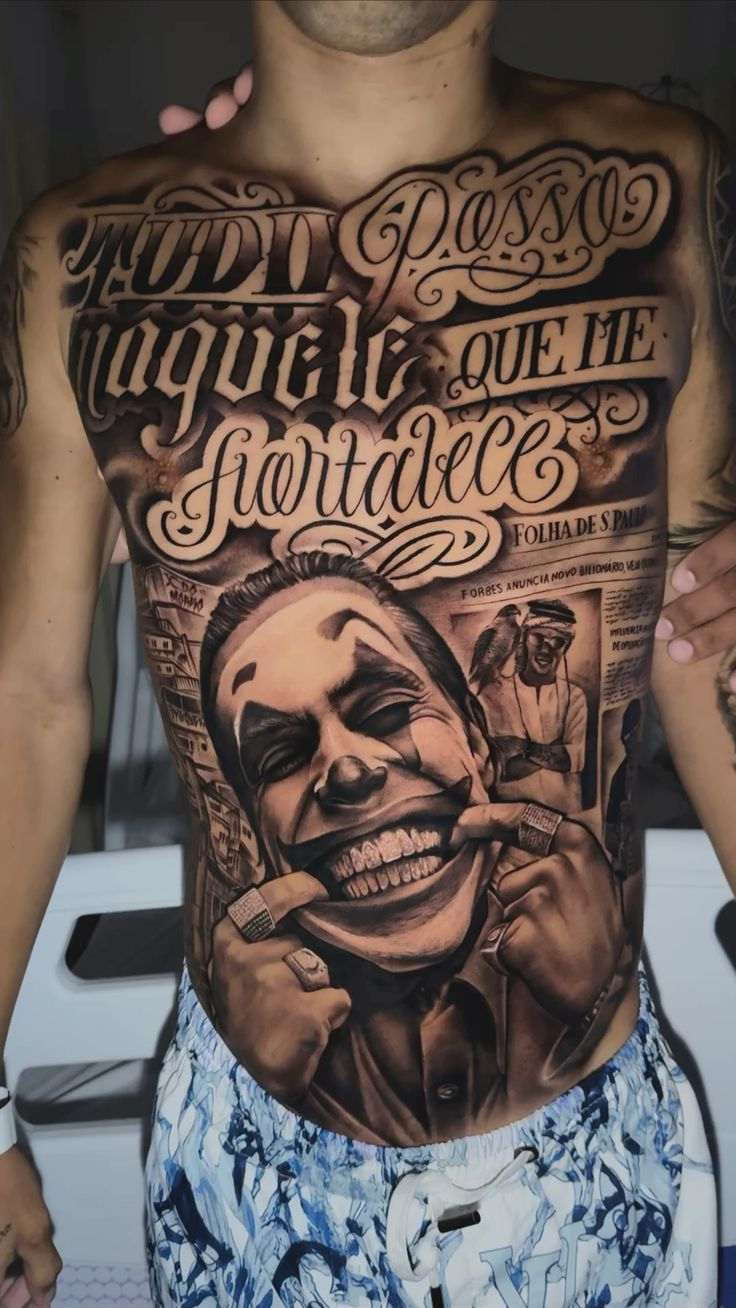
The last torso blends faith, media, and madness in one dense composition. Across the chest, Portuguese script rolls in giant curls: “Tudo posso naquele que me fortalece”—a biblical line about drawing strength from God. The lettering is classic letras de style, with thick and thin strokes dancing together like a calligrapher’s warm-up page.
Below the script, a grinning Joker-style figure pulls his mouth wider with both hands, showing too many teeth. Newspaper clippings, cityscapes, and businessmen in suits fill the remaining space around him, echoing the way modern films often frame the character. The blend of holy verse and chaotic clown feels intentionally contradictory, a meditation on how people juggle faith with frustration.
From a technical angle, this piece showcases clean design drawings and confident stencil placement: the script follows the chest curve, the portrait sits squarely on the stomach, and the background panels fill negative space without losing legibility. For anyone chasing large-scale Chicano design ideas, it’s proof that you can stack text, portraits, and story elements and still keep the composition breathable—as long as you respect flow and let each section own its space.
Chicano tattoos started as quiet acts of resistance and identity, scratched into skin with homemade machines. Today they’re studied on websites, in galleries, and on platforms that showcase the work of artists like Freddy Negrete and Mister Cartoon alongside new generations pushing the style forward.
Whether it’s an angel with guns, a sad clown beauty, or a full-body suit of script and cityscapes, each piece carries more than ink: it carries a story about faith, struggle, pride, and belonging. If you’re planning your own Chicano tattoo—a small design for the forearm, a chest sleeve, or a full back—take your time, study reputable artists, and talk through your ideas until the stencil feels like your biography.
And when that story finally heals into your skin, come back and tell us how it feels. Drop a comment, share your experience, and help keep this living art form evolving with every new line and shadow.