Demon tattoos occupy a fascinating corner of tattoo culture because they can be beautiful, disturbing, mythological, rebellious, or deeply personal—sometimes all at once. While the imagery often leans into horns, skulls, wings, supernatural faces, and heavy shadows, the meaning does not have to be purely sinister. A demon can represent temptation, suppressed emotions, confrontation with fear, personal transformation, or the darker half of a deliberately balanced angel and demon concept.
The most memorable demon tattoo ideas tend to have a clear personality. Some borrow the drama of gothic illustration, others use the smooth dimensional shading of contemporary black-and-grey realism, while traditional and Japanese-inspired approaches create entirely different moods. Placement matters just as much: the forearm and calf give an artist enough vertical space for faces and elongated figures, while a full sleeve can turn the theme into a much larger narrative.
Artists and tattoo publications have helped make dark illustrative and realism work increasingly visible, but the strongest pieces still feel individual rather than copied from a trend. These designs show just how many directions the subject can take.
Horned Female Demon With an Elegant Dark-Fantasy Look
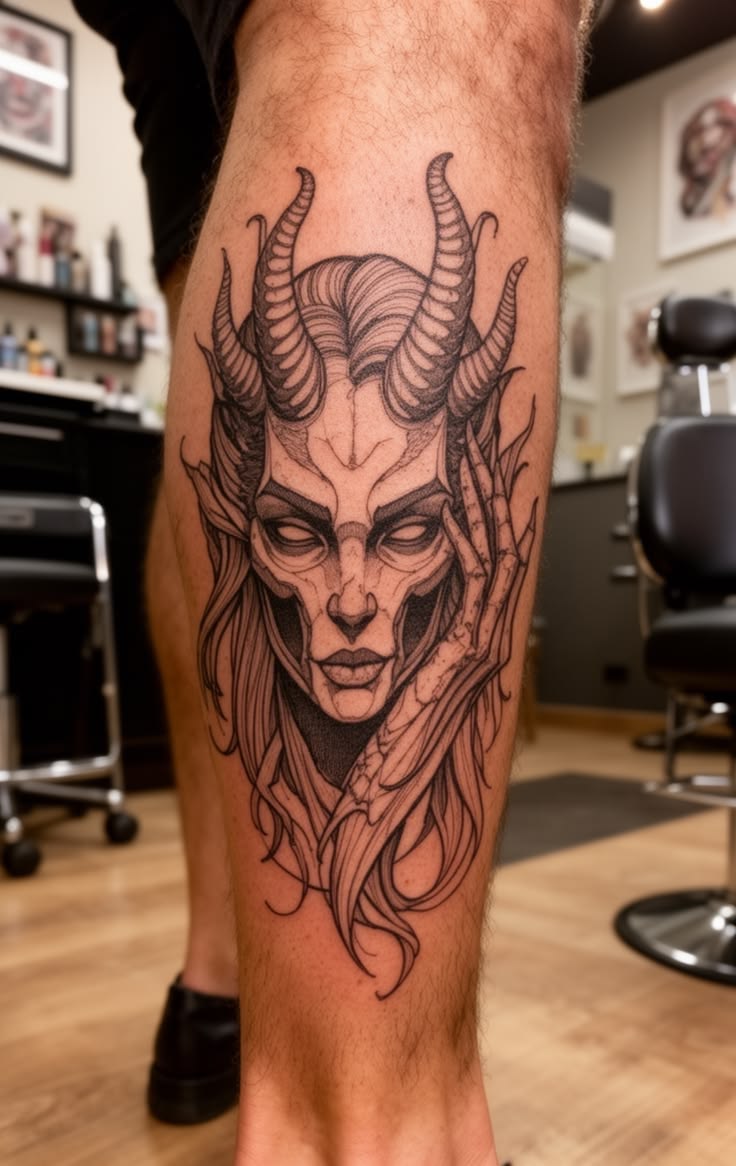
This design takes the classic horned female demon and gives her an unusually refined, almost regal appearance. Four prominent curved horns rise above the head, immediately establishing the supernatural theme, but the face itself remains elegant and carefully proportioned. That contrast between beauty and menace is what makes the composition so effective.
Fine black lines define the facial structure, while darker sections around the eyes, cheeks, and lower face create a mask-like quality. The artist has kept much of the skin open rather than filling every area with black. As a result, the tattoo remains detailed without becoming visually muddy. Long flowing hair frames the portrait and gives the lower section movement, while the claw-like hand beside the face introduces a sharper, more threatening detail.
I particularly like this kind of design on the calf because the vertical anatomy naturally accommodates the horns, face, hair, and hand. It is also a useful idea for someone who wants dark imagery without committing to an extremely dense realism piece. With some simplification, the composition could even be adapted into a clean stencil for a smaller placement.
Winged Demon Looming Over a Seated Woman
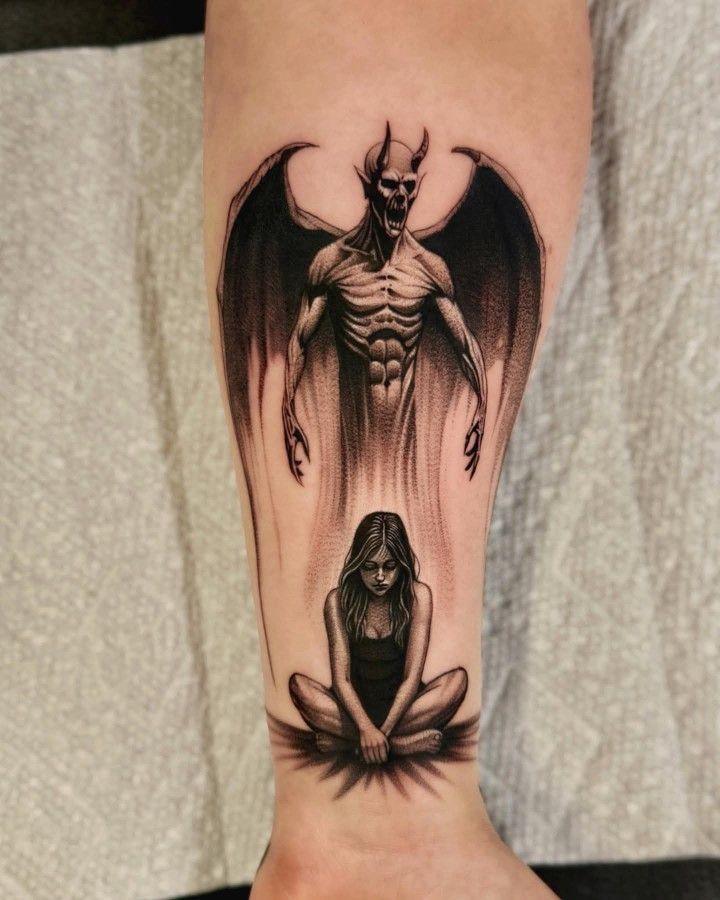
This piece feels more like a scene from a supernatural story than a conventional demon portrait. A large horned creature spreads its black wings across the upper half of the composition while a seated woman occupies the lower section. The dramatic difference in scale immediately creates tension: the demon appears enormous and threatening, while the human figure looks isolated and vulnerable.
The creature has a skeletal torso, elongated arms, pointed horns, and broad wings filled with nearly solid black shading. Fine stippling and soft gradients beneath its body make it appear to emerge from darkness rather than simply float above the woman. The seated figure is treated more delicately, creating a useful contrast in texture and visual weight.
There is plenty of room for interpretation here. The demon could symbolize fear, anxiety, temptation, grief, or something that continually follows a person. That narrative quality makes this a compelling approach for men or women who want their tattoo to suggest an internal struggle rather than simply depict a monster.
It could also inspire an angel vs demon variation. Replacing one side of the composition with an angel, for example, would transform the scene into a more explicit representation of opposing forces.
Gothic Demon Woman With Skull Headdress and Wings
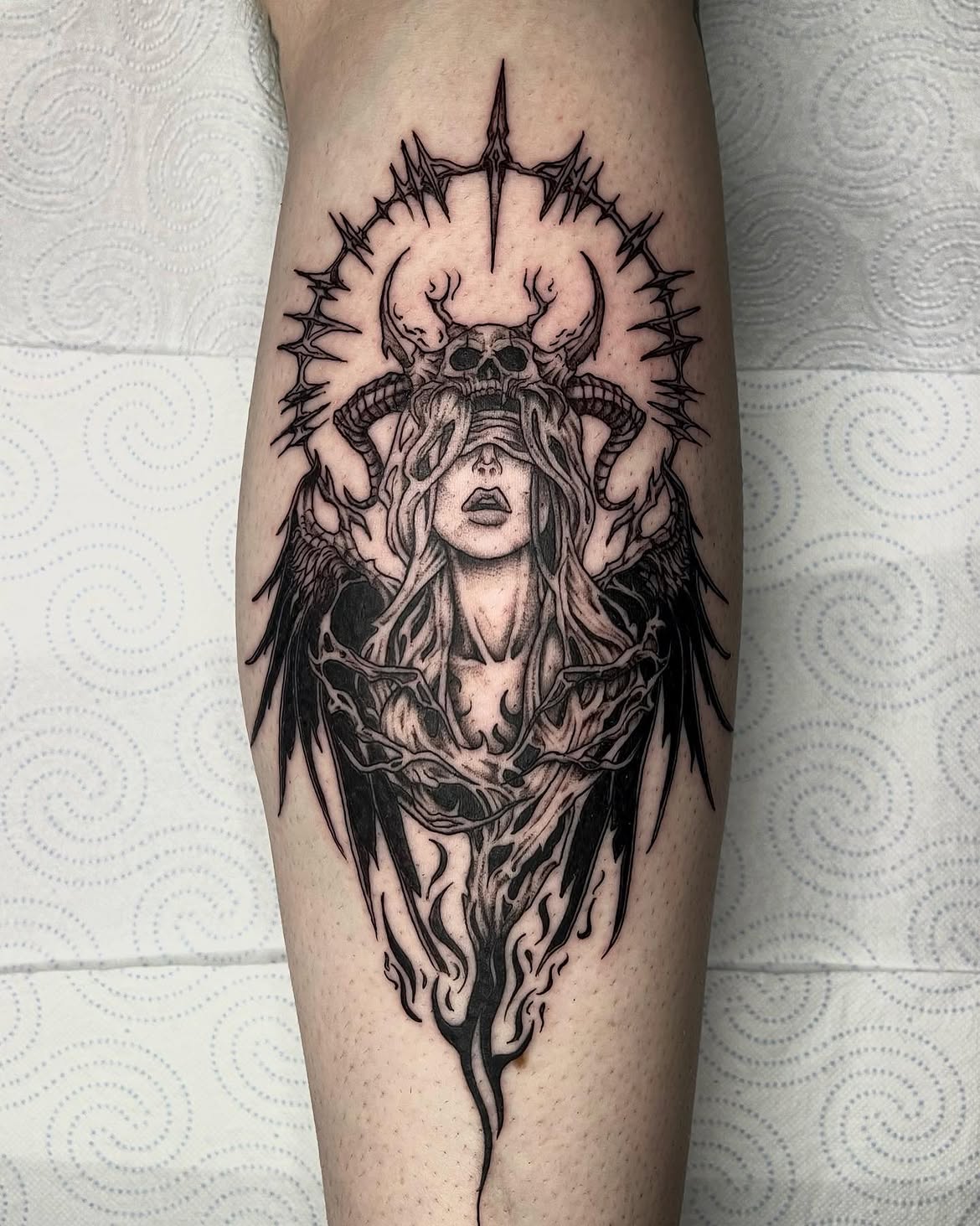
There is an almost ceremonial quality to this elaborate blackwork tattoo. At its center is a female figure wearing a dramatic horned skull headdress. Her eyes are obscured, immediately shifting attention toward the skull, horns, flowing hair, wings, and organic armor surrounding her body.
The upper portion is enclosed by a jagged circular structure reminiscent of thorns or an occult halo. It acts as a frame and helps contain what might otherwise become an overwhelmingly complicated composition. Dark wings extend down both sides, providing large black areas that contrast with the lighter face and chest.
One of the strongest details is the gradual transformation toward the bottom. Instead of ending abruptly, the figure narrows into flame-like and organic shapes. That tapered finish works especially well on the calf or forearm.
For anyone collecting demon tattoo ideas with a gothic rather than purely realistic character, this approach offers considerable inspiration. There is enough detail for the eye to keep discovering new forms, yet the central silhouette remains immediately readable. Elements of fire could also be incorporated around the lower edges without disturbing the structure.
Grotesque Demon Face in Black-and-Grey Realism
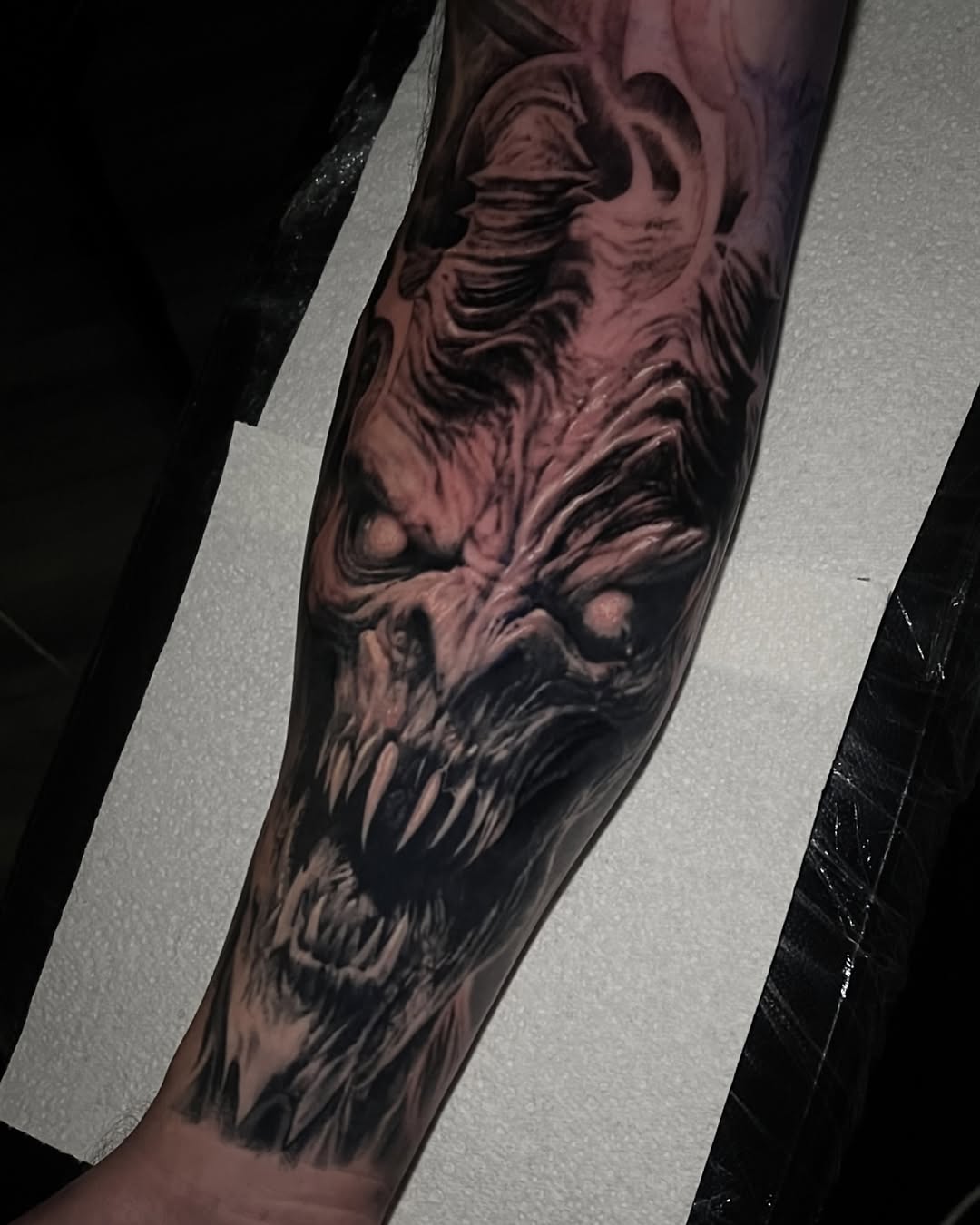
This is where demon imagery becomes deliberately uncomfortable. Rather than romanticizing the creature, the artist emphasizes an almost decaying anatomy: deep wrinkles, distorted skin, pale eyes, sharp teeth, heavy brow structures, and horn-like growths.
The tattoo relies strongly on black-and-grey realism. Deep blacks disappear into the contours of the limb, while narrow highlights reveal ridges and folds in the creature’s face. The glowing-looking eyes stand out because they are surrounded by so much darkness. Below them, the mouth becomes the most aggressive element, packed with irregular pointed teeth.
A piece like this works particularly well for men who prefer horror-oriented body art, although there is obviously nothing inherently gender-specific about the imagery. More important is scale. Trying to make this simple or excessively small would sacrifice much of what makes it successful. The folds, teeth, eye sockets, and layered shadows need sufficient room.
This could become the centerpiece of a horror sleeve, particularly if the surrounding space were continued with smoke, ruined architecture, flames, or additional creatures.
Split Female Face With Horned Demon Imagery
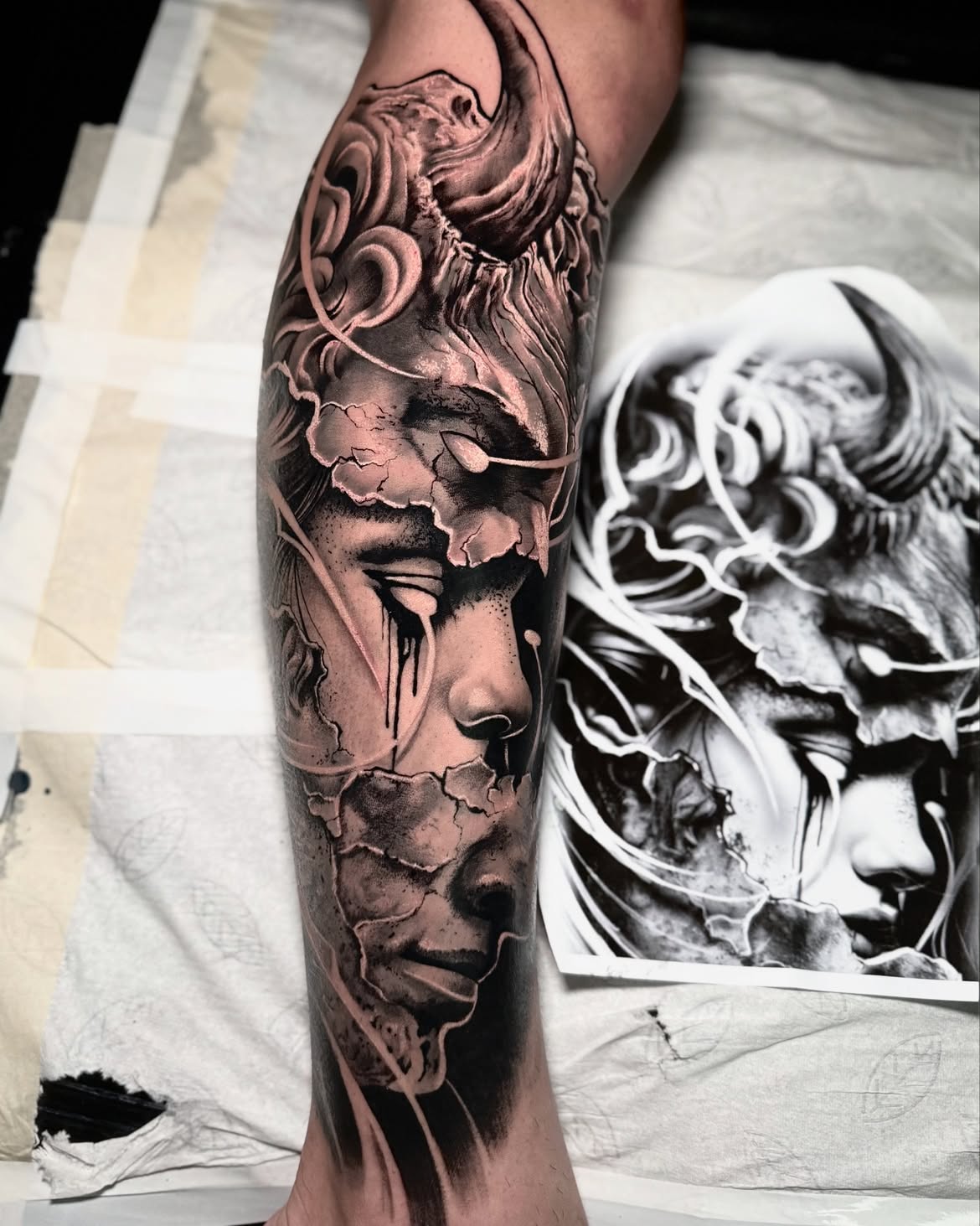
Instead of showing a demon as an entirely separate creature, this tattoo merges human beauty with supernatural imagery. The central female face is divided and partially concealed by cracked, fragmented forms. Large horn structures emerge above, while black shading and abstract lines weave through the portrait.
The most interesting feature is the sense that the human identity is breaking apart. Sections of the face seem to disappear behind damaged surfaces, and dark streaks fall from one eye. This gives the piece an emotional quality that straightforward monster portraits often lack.
It is easy to imagine the concept representing duality—the composed self on the surface and something darker underneath. That same principle explains the enduring popularity of half angel half demon compositions. A half Buddha half demon or Buddha and demon concept could explore a similar visual contrast, although the symbolism and cultural context deserve careful consideration rather than being used simply as decoration.
From a technical standpoint, the smooth grey transitions are crucial. The darkest areas create depth around the fragmented face, while untouched skin supplies highlights. It is a strong example of how negative space can be just as important as black ink.
Realistic Female Demon With Horns and Skull
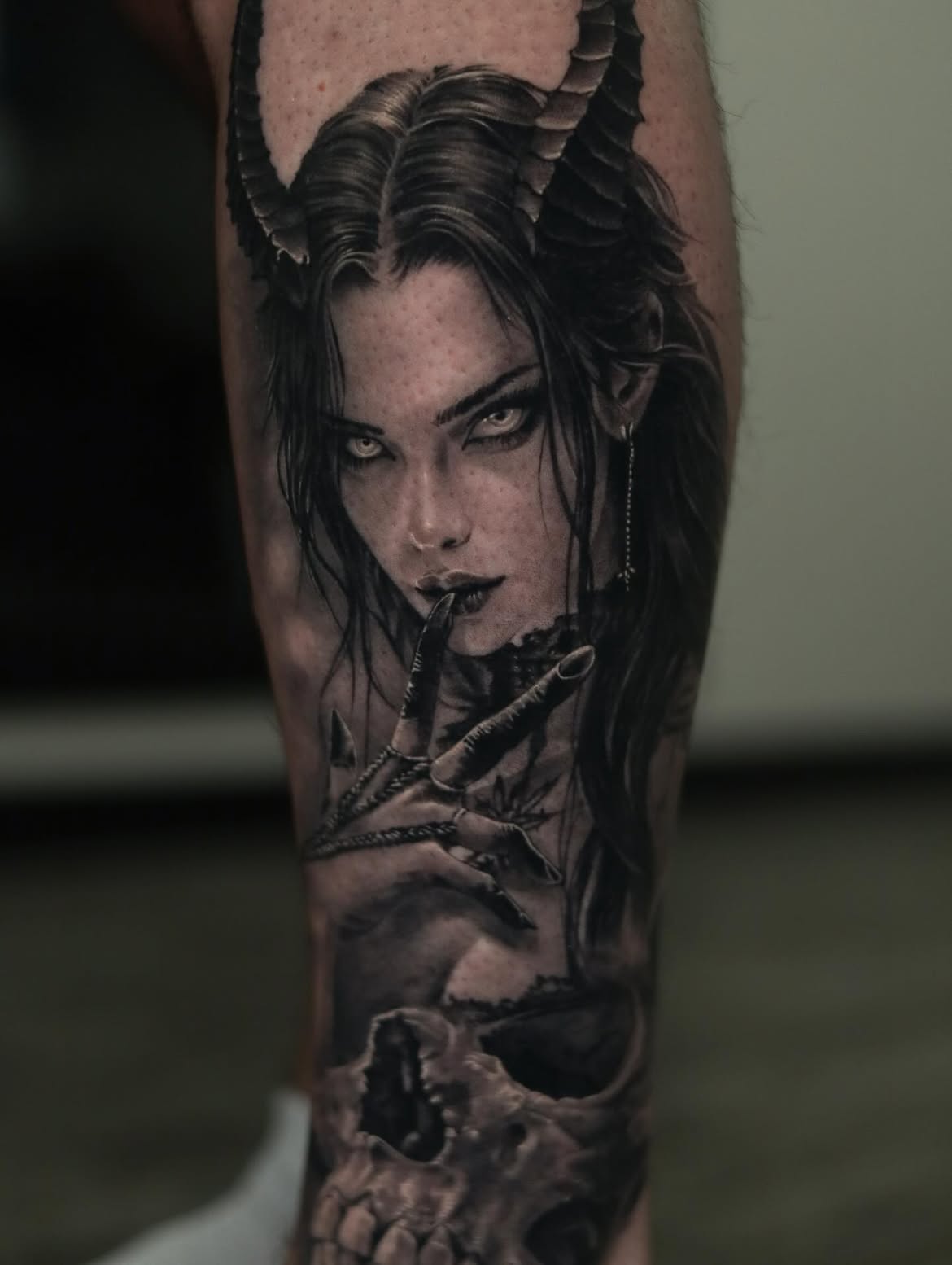
This portrait takes a seductive dark-fantasy direction. The female demon has long dark hair, pointed ears, large segmented horns, intense eyes, and carefully rendered facial features. A hand rises toward her lips, adding personality and making the character feel less like a static portrait.
The realism is particularly effective around the eyes, hair, and fingers. Small jewelry details and dark fingernails reinforce the gothic styling without competing with the face. Lower in the composition, a skull introduces a familiar symbol of mortality and visually anchors the portrait.
The placement allows the long composition to follow the shape of the limb beautifully. Horns fill the upper space, the face becomes the focal point, and the skull occupies the narrower lower section. This hierarchy is worth considering when planning any detailed demon tattoo design: the largest visual element should remain readable from a distance, while secondary details reward a closer look.
A blue accent in the eyes or subtle colored highlights could completely change the atmosphere while preserving the predominantly black-and-grey treatment. Conversely, keeping everything monochrome gives the piece a more timeless quality.
Screaming Demon Woman and Anatomical Heart
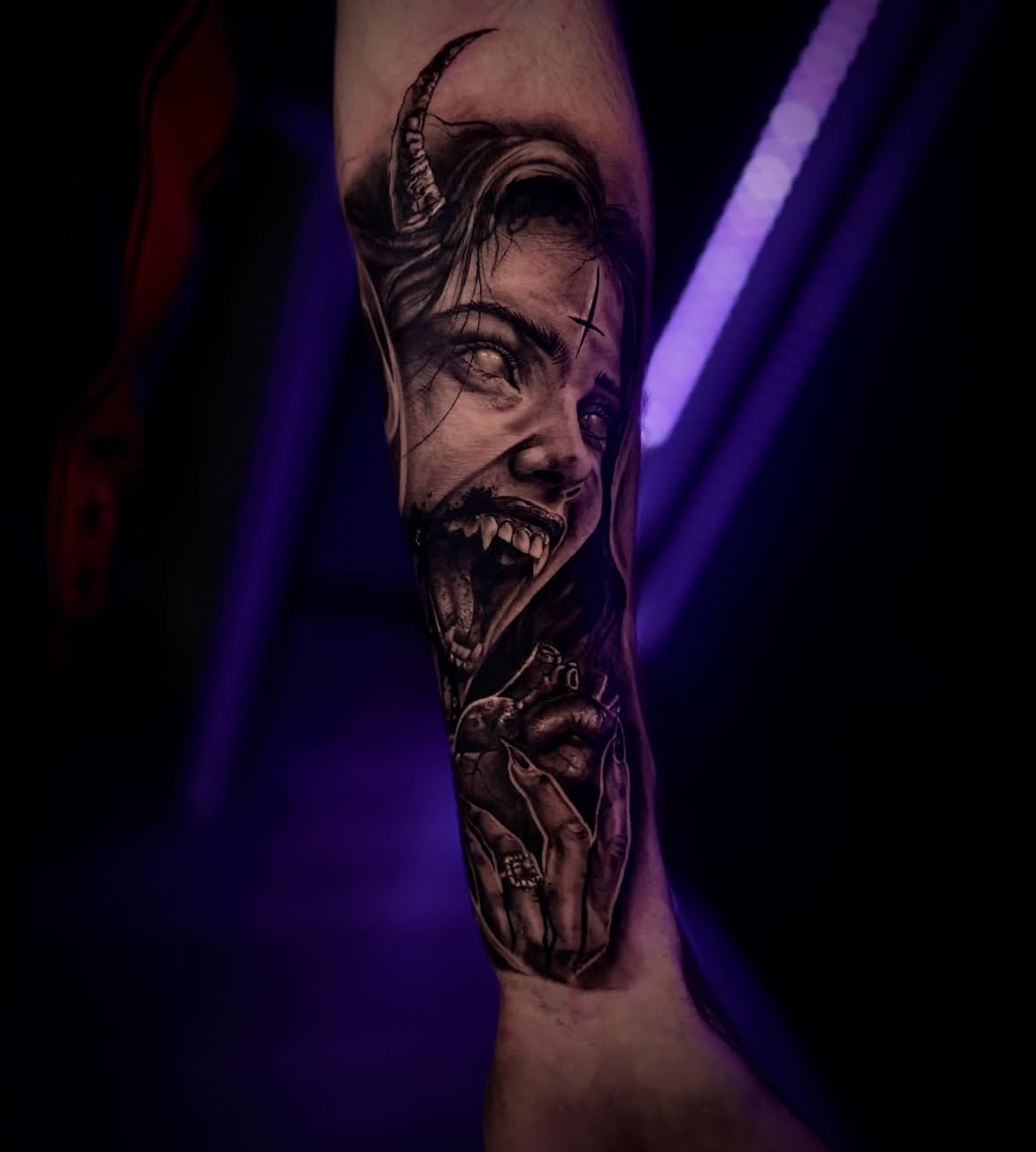
The final design in this group is intensely expressive. A distorted female face dominates the upper section, with one horn curving from the head and a small cross-like mark placed on the forehead. The open mouth, exposed teeth, pale eyes, and strong facial shadows create an almost cinematic horror effect.
Below the face sits an anatomical heart, introducing a second symbolic layer. It can be interpreted as emotion, mortality, pain, desire, or vulnerability beneath the frightening exterior. Rather than relying on decorative filler, the artist connects the two subjects through darkness and organic transitions.
The black-and-grey rendering is especially effective because the face emerges from large areas of shadow. This gives the tattoo considerable depth and allows the lighter eyes and teeth to become natural focal points. It would translate well into part of a larger sleeve, where additional imagery could continue around the arm.
For people researching a demon tattoo drawing before meeting an artist, this piece also illustrates an important lesson: expression matters as much as anatomy. Changing the mouth, eyes, eyebrows, or head angle can transform the same basic demon concept from mysterious to furious, sorrowful, or terrifying.
Demon tattoos do not have to communicate one fixed meaning. A horned woman can represent temptation or independence; a monstrous face can embody fear that has been confronted; an angel defeating a demon can suggest triumph over destructive impulses; and an angel vs demon composition can explore moral conflict without presenting either side as visually simple. Other traditions take the theme in completely different directions, from bold Trad interpretations to elaborate Japanese demon imagery.
Yellow-Eyed Demon With Skulls and Shadow Hands
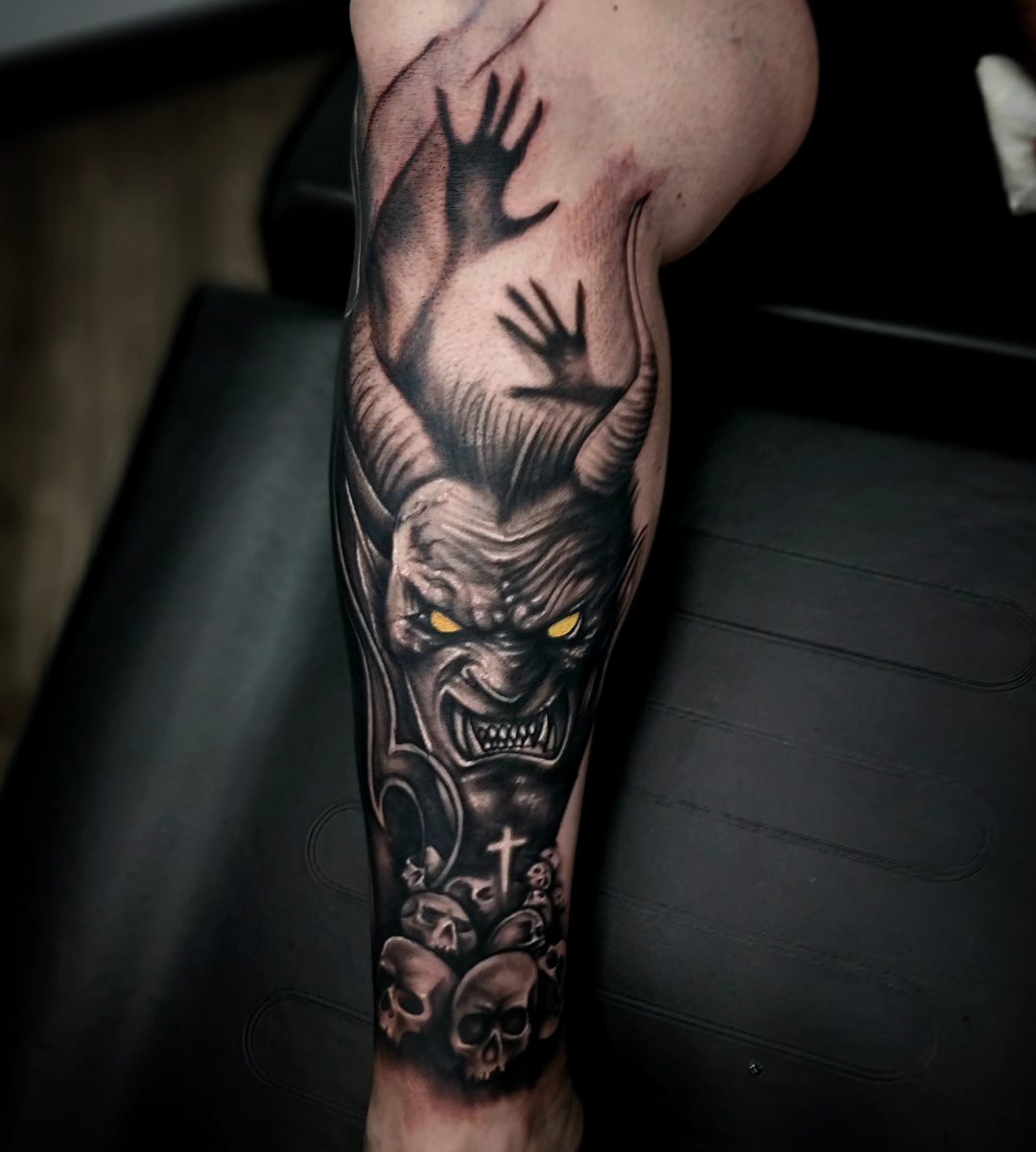
This demon tattoo builds its impact around a single point of color. The creature’s face is rendered almost entirely in black and grey, but the yellow eyes immediately cut through the darkness. It is a small detail, yet it changes the whole mood of the design, making the demon seem alert and unnervingly alive.
Long horns follow the vertical shape of the leg, while the deeply furrowed forehead, sharp teeth, and exaggerated expression give the face an aggressive character. Above the horns, several shadowy hands seem to reach through a smoky background. Below, a collection of skulls fills the narrower area near the ankle. A small cross appears among them, adding another symbolic element without dominating the composition.
What works especially well here is the transition between separate elements. The artist has not simply stacked a demon, hands, and skulls on top of one another. Dark shading connects everything into what feels like one continuous scene. For anyone considering a large demon tattoo sleeve, the same technique could be used to connect multiple subjects around the arm or leg.
The restrained color also offers an alternative to a fully blue, red, or multicolored demon. Sometimes one bright accent is enough.
Screaming Female Demon With Horns and Claws
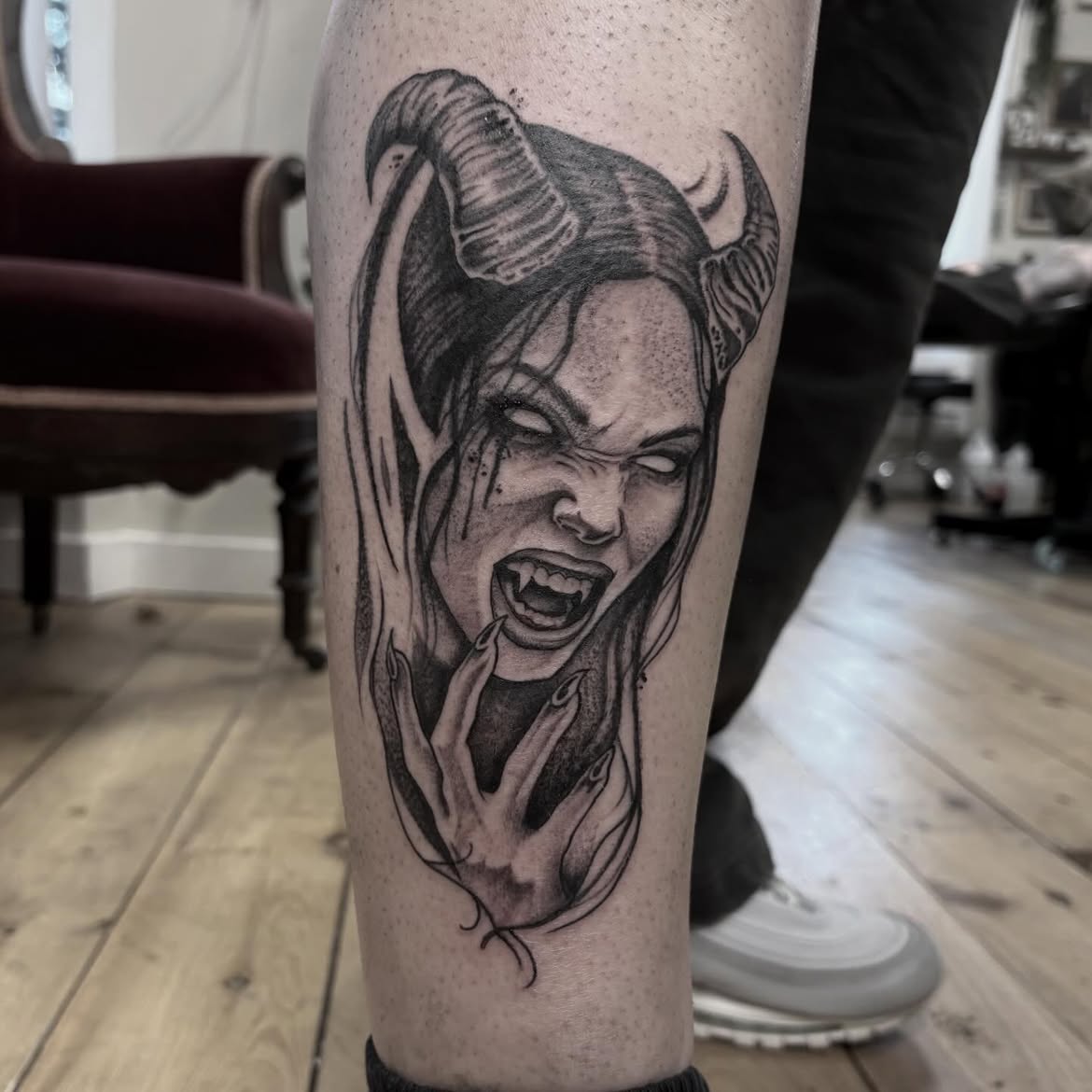
This female demon has a completely different personality from the polished dark-fantasy portraits in the earlier designs. Her mouth is open in a scream, small fangs are exposed, blank eyes create an eerie supernatural expression, and two heavily textured horns curve from the top of her head.
The long fingers are particularly important to the composition. Instead of stopping at a portrait, the artist brings one clawed hand upward across the lower part of the design. Those pointed nails echo the sharp horns and teeth, so the entire tattoo shares the same visual language.
The technique sits somewhere between illustrative blackwork and a highly developed drawing. Fine stippling softens the cheeks and forehead, while heavier blacks around the hair provide contrast. It is detailed without attempting photographic realism.
This is also a good example of why a relatively simple palette does not necessarily produce a simple tattoo. With only black ink and skin tone, the artist creates depth through line weight, dotwork, negative space, and carefully controlled shading. The result feels raw and energetic—almost like a page from a dark graphic novel transferred directly onto skin.
Grinning Horned Demon in a Japanese-Inspired Style
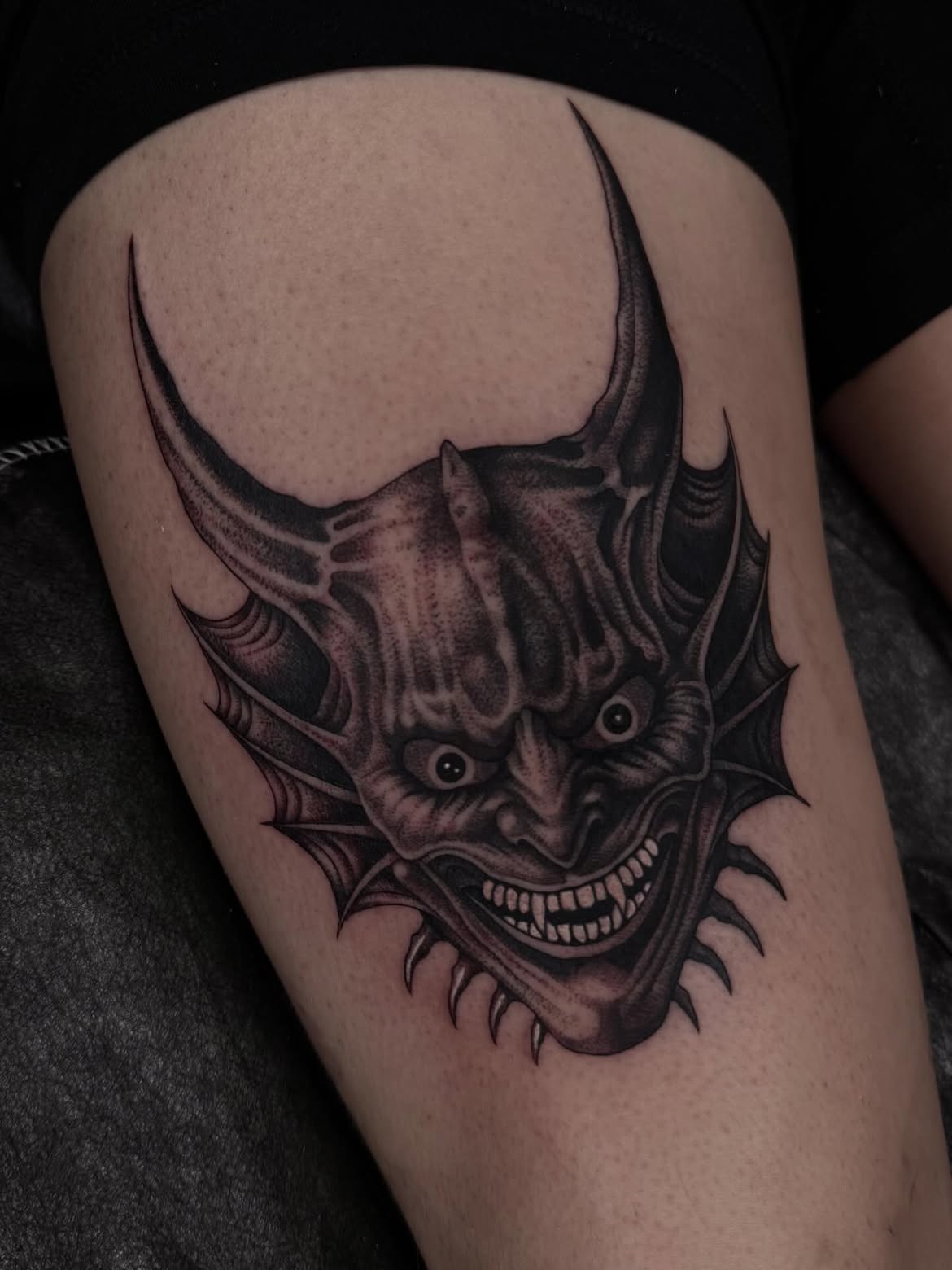
The enormous horns are the first thing that gives this tattoo its personality. They extend upward in a dramatic V shape, making the head appear wider and more imposing, while the exaggerated grin gives the creature an unsettling theatrical expression.
Compared with photorealistic demon portraits, this piece relies more heavily on deliberate outlines, patterned surfaces, and graphic shading. Dotwork covers large portions of the forehead, while darker sections around the eyes, cheeks, and horns establish dimension. Smaller horn-like structures and pointed shapes around the face create an ornate silhouette.
There is a noticeable Japanese influence in the mask-like construction, although the design should not automatically be treated as a traditional Japanese demon mask without knowing the artist’s intended reference. That distinction matters: contemporary tattooing often mixes visual languages rather than following one historical tradition exactly.
For placement, the thigh gives this idea room to breathe. The wide upper area accommodates the horns while the chin naturally tapers downward. If adapted to a forearm, I would reduce some of the lateral elements rather than simply shrinking the entire stencil.
Realistic Horned Woman With an Aggressive Expression
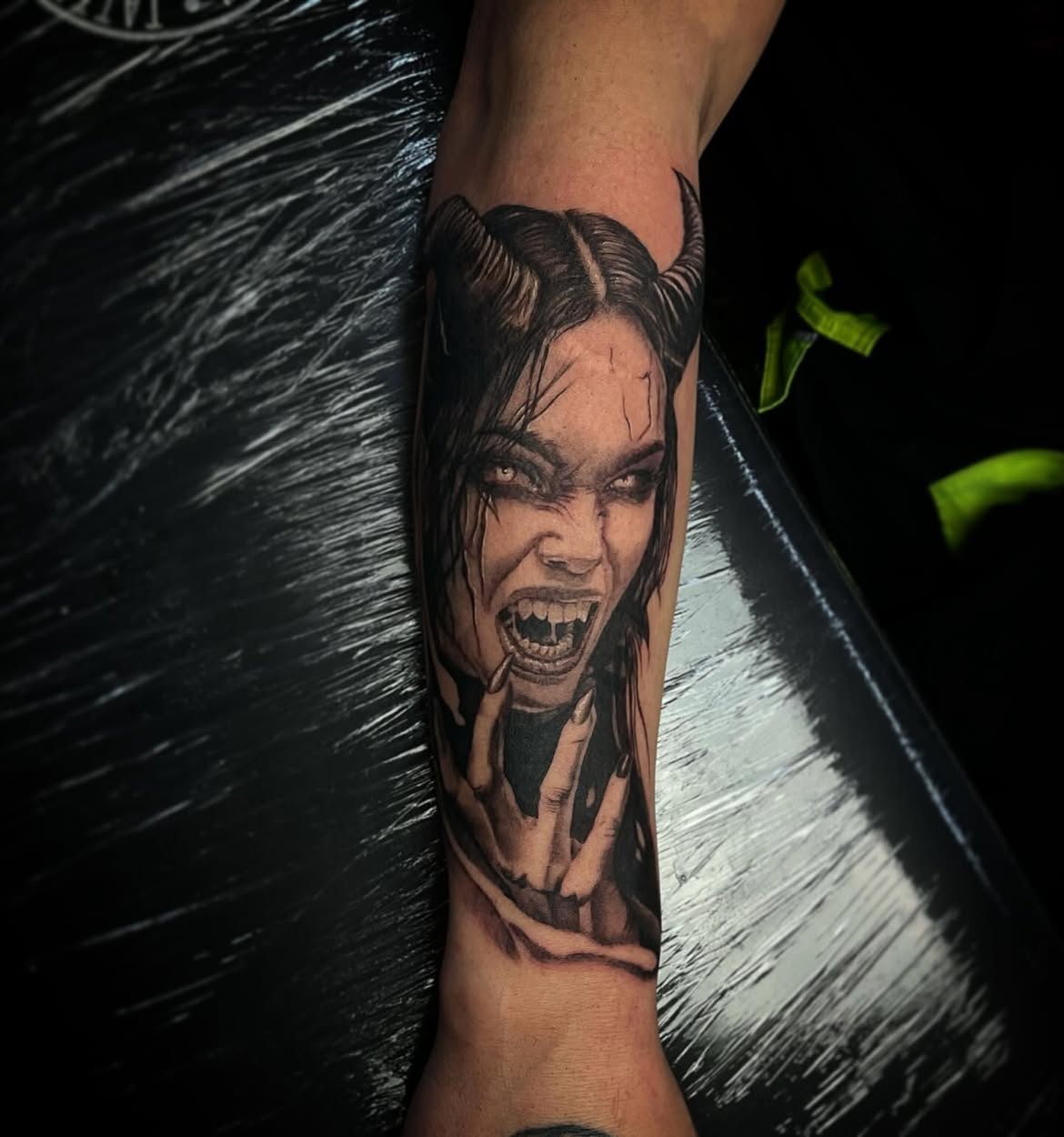
Here the demon theme returns to realism, but the mood is much more confrontational. The central woman bares pointed teeth while staring directly outward. Dark hair surrounds her face, and two horns rise from either side of the head. One hand reaches toward the mouth, its long pointed nails reinforcing the predatory character.
The artist uses relatively natural facial proportions, which makes the supernatural modifications more convincing. Instead of constructing an entirely alien monster, the piece begins with a recognizable human portrait and introduces demonic features gradually: unusual eyes, horns, fangs, cracked markings, and darkened areas around the face.
That approach is especially effective for a female demon tattoo because beauty and aggression are allowed to coexist rather than cancel one another out. The contrast can symbolize temptation, confidence, danger, duality, or simply an attraction to gothic character design.
For a larger sleeve, this portrait could be paired with an opposing figure. An angel and demon arrangement, for example, could use similar portrait proportions while changing the expression, lighting, wings, and surrounding symbolism to distinguish the two sides.
Winged Demon Holding a Screaming Skull
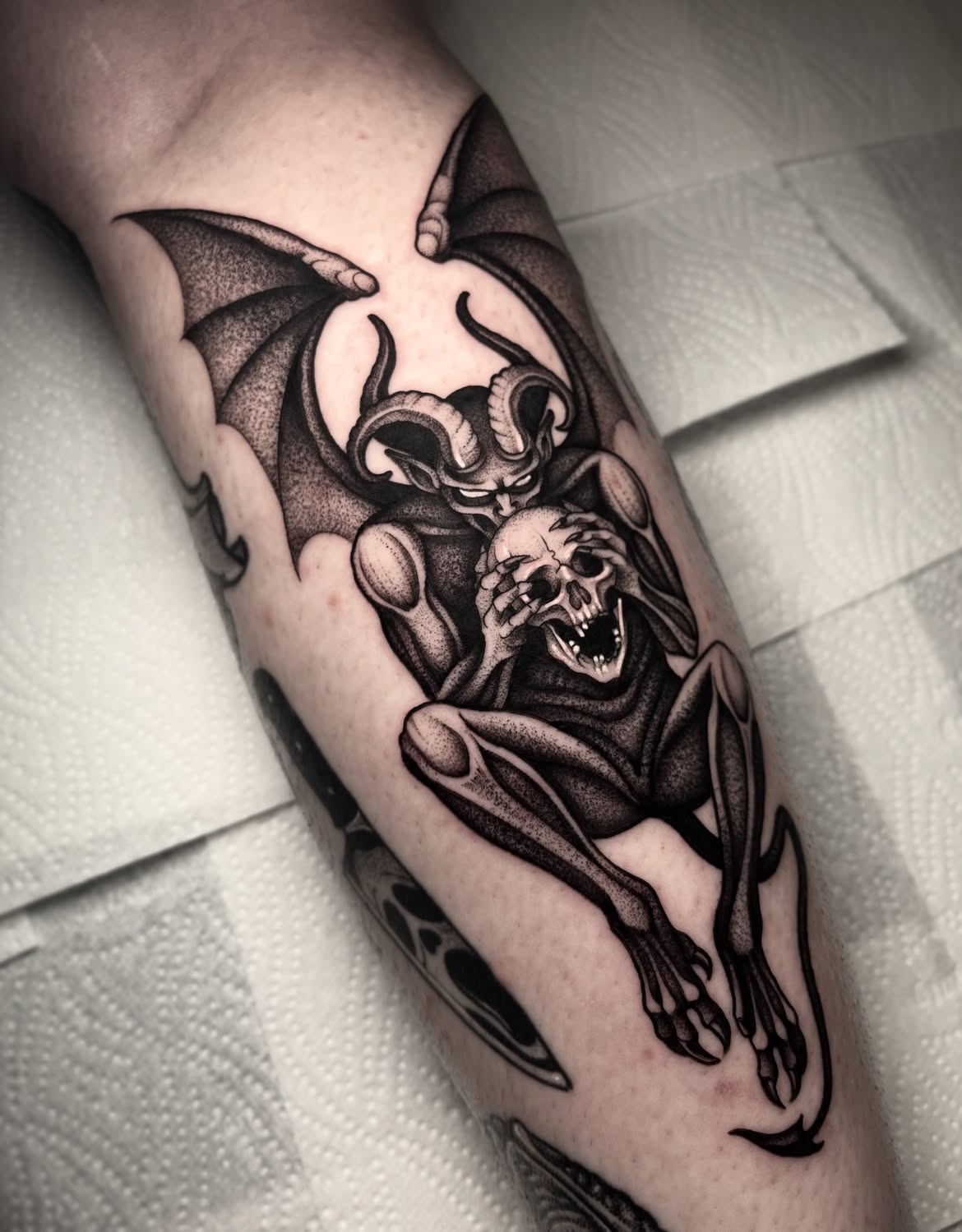
This piece moves away from portrait realism and into dark illustrative blackwork. A compact winged demon crouches around a skull, gripping it with long fingers while its own horned head bends toward the center. The skull’s open mouth becomes the brightest and most recognizable part of the composition.
The creature’s anatomy is intentionally unnatural. Long limbs fold into sharp angles, the wings create a dark frame behind the body, and curved horns direct the viewer’s eye back toward the skull. Rather than filling the surrounding skin, the artist leaves generous negative space around the silhouette. That makes the black sections feel even stronger.
The stippled shading deserves attention as well. Thousands of tiny marks create gradual transitions inside the wings and body without sacrificing the crisp outline. It has some of the clarity associated with Trad tattooing, but its anatomy, dotwork, and gothic subject matter push it toward a contemporary illustrative style.
I can imagine this concept working particularly well for men and women who like demon imagery but do not want a realistic human face. It has a strong silhouette, reads clearly from a distance, and could be expanded with fire, additional skulls, or architectural elements later.
Skeletal Demon Face Emerging From Darkness
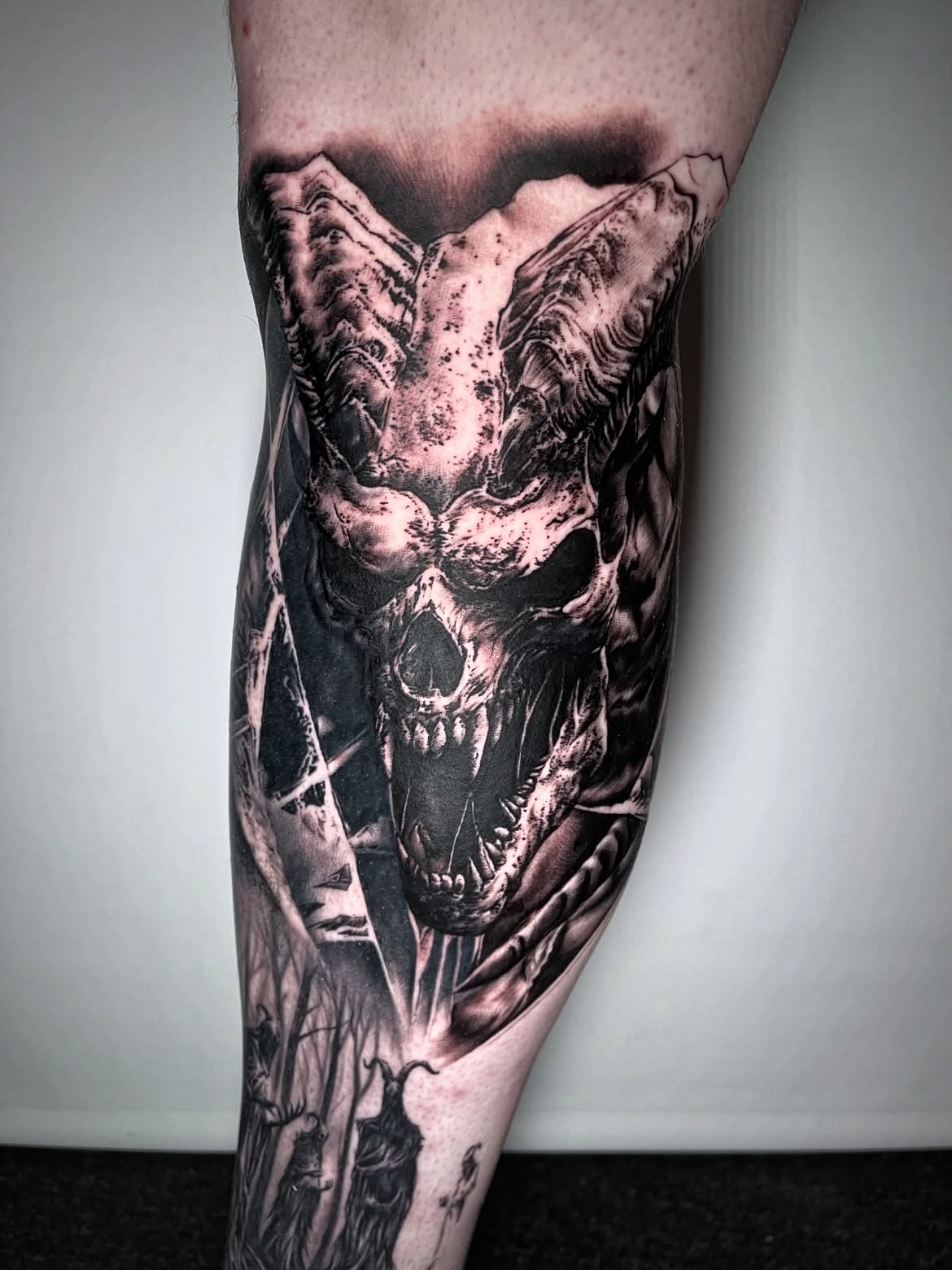
This creature looks less like a conventional horned devil and more like something excavated from a nightmare. The face combines skeletal anatomy with animalistic structures: huge pointed forms rise from the skull, the eye sockets disappear into blackness, and a long open jaw exposes rows of narrow teeth.
The artist uses extremely dark shading around the central head, allowing pale sections of bone to emerge sharply from the background. This high contrast gives the tattoo an almost three-dimensional effect. Some areas are meticulously textured, while others dissolve into black, so the viewer never receives a perfectly clean boundary between creature and darkness.
There is also something effective about the asymmetry. The design does not feel like a polished decorative mask; it looks damaged, ancient, and organic. That roughness gives it much of its character.
For a horror-focused demon tattoo design, this is an excellent reminder that horns and red skin are not required. Altering familiar anatomy can be much more disturbing. A goat skull, for example, could be developed using a comparable skeletal approach while creating an entirely different silhouette.
Ornamental Japanese Demon Mask With Long Tongue
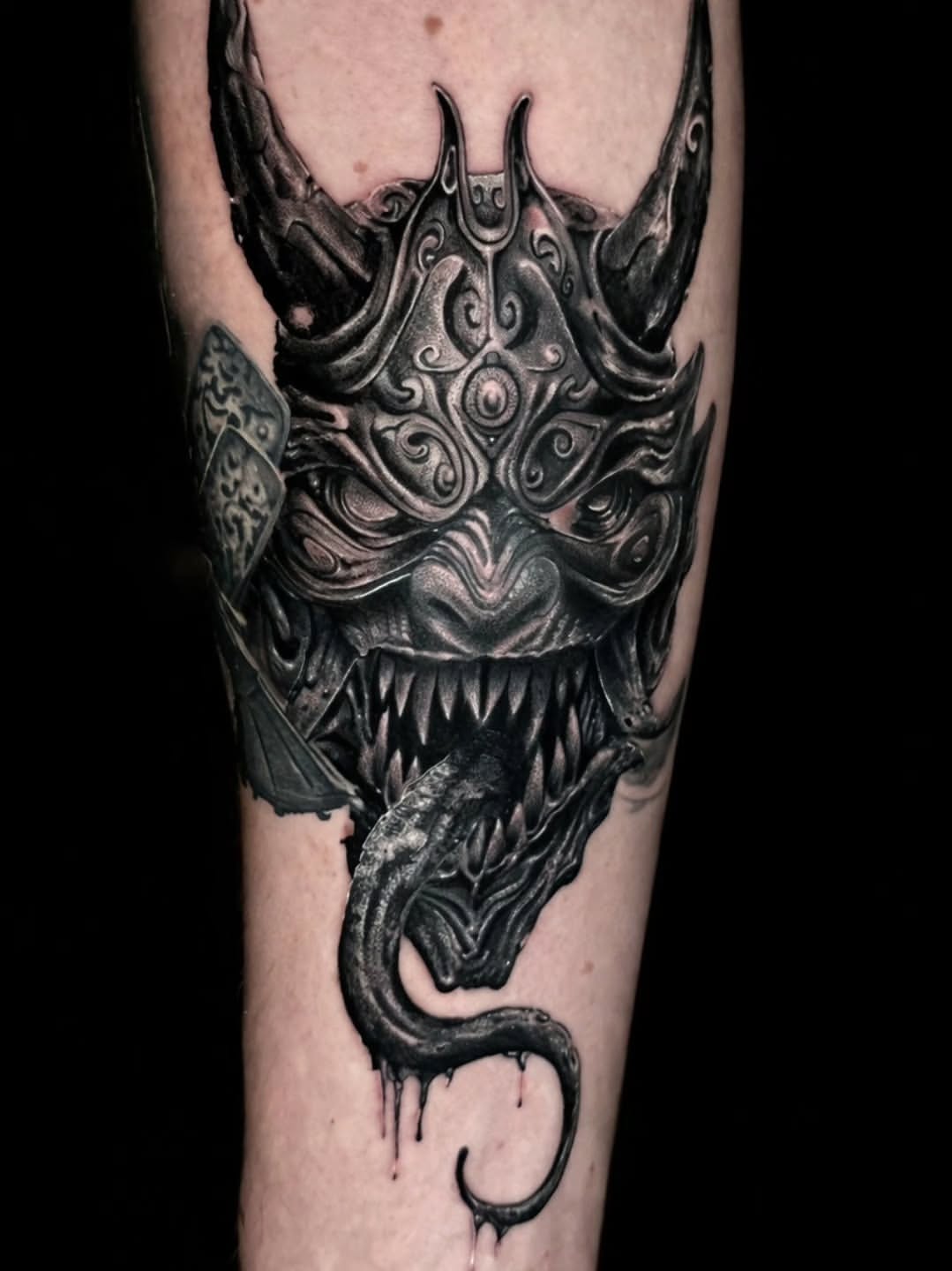
This elaborate Japanese-inspired demon tattoo is built around an ornate mask rather than a realistic face. The forehead is covered with symmetrical decorative structures and swirling motifs, almost resembling supernatural armor. Narrow eyes sit beneath the elaborate crown-like shapes, while a mouth filled with long pointed teeth dominates the lower half.
The extended tongue provides the tattoo’s most dramatic detail. It curls downward beyond the jaw and gives the otherwise symmetrical composition a sense of movement. Small drip-like details at its end make the creature appear even more grotesque.
The mixture of ornament and horror is particularly successful. Remove the teeth and tongue and much of the upper section could almost resemble ceremonial metalwork; add those aggressive features back and the design becomes unmistakably monstrous. Deep black recesses around the mouth and eyes also prevent the decorative patterns from making the piece look too busy.
Anyone exploring demon tattoo ideas through Japanese imagery should look beyond generic internet labels and discuss the specific source material with an artist experienced in Japanese tattoo traditions. Oni, hannya, supernatural beings, and modern fantasy masks can carry different visual conventions and associations, even though online inspiration boards frequently group them together.
Realistic Shoulder Demon With a Predatory Grin
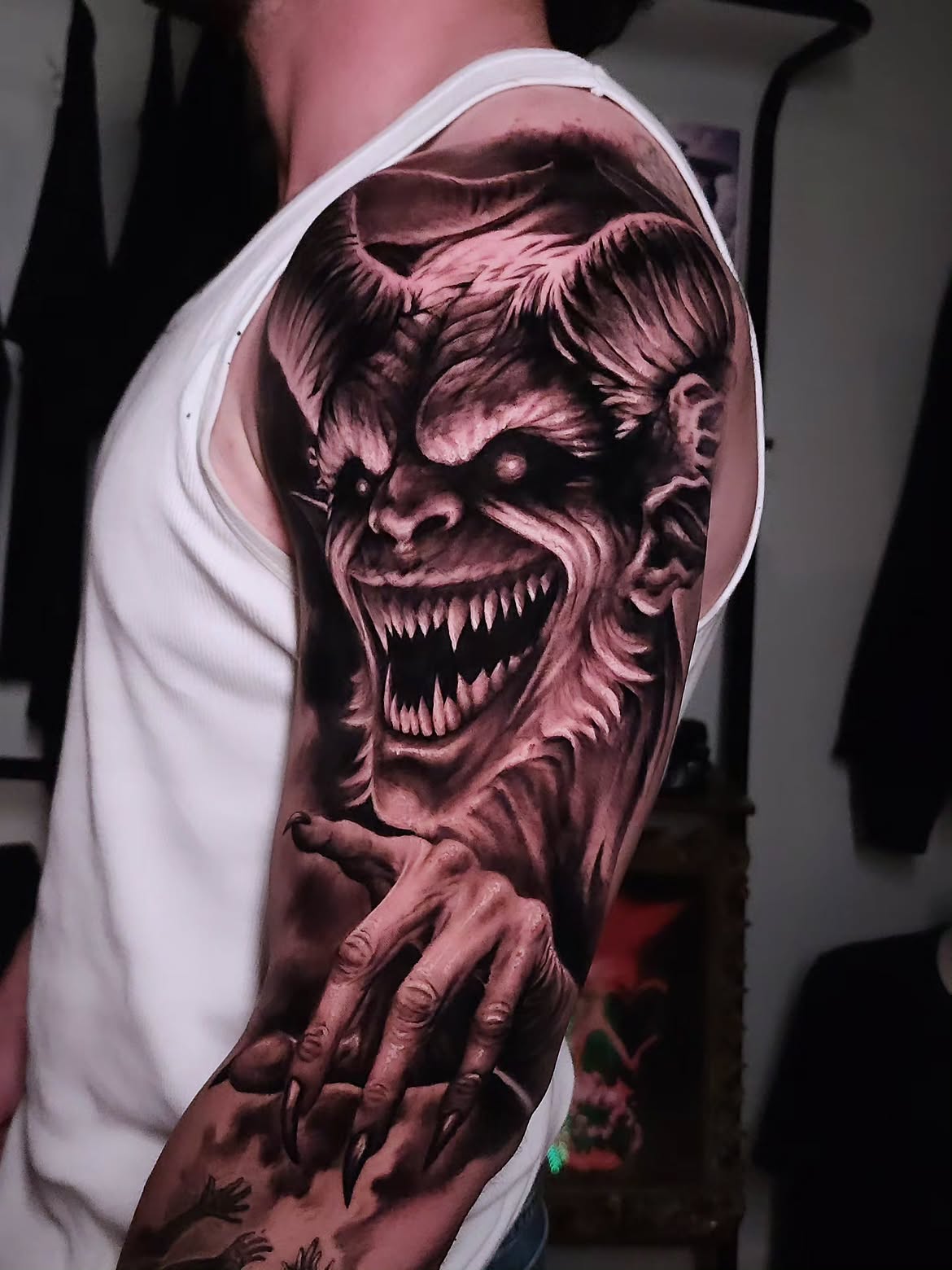
This large shoulder piece uses the rounded anatomy of the upper arm almost perfectly. The demon’s oversized head dominates the composition, with broad horns extending toward the edges of the shoulder and a huge open grin packed with narrow, pointed teeth. Pale eyes surrounded by nearly solid black sockets make the expression even more unsettling.
The realism comes from the texture rather than from perfectly smooth shading. Deep wrinkles run across the forehead and cheeks, while ridges around the horns and jaw give the creature an aged, almost leathery appearance. Below the face, a long clawed hand stretches toward the elbow, creating a natural continuation instead of ending the tattoo abruptly beneath the chin.
This is an especially effective design for men or anyone looking for a large horror piece that can eventually grow into a complete sleeve. The shoulder provides enough width for the exaggerated face, while the arm gives the artist room to extend fingers, smoke, fire, or additional supernatural imagery downward.
Winged Demon With an Inverted Sword and Flames
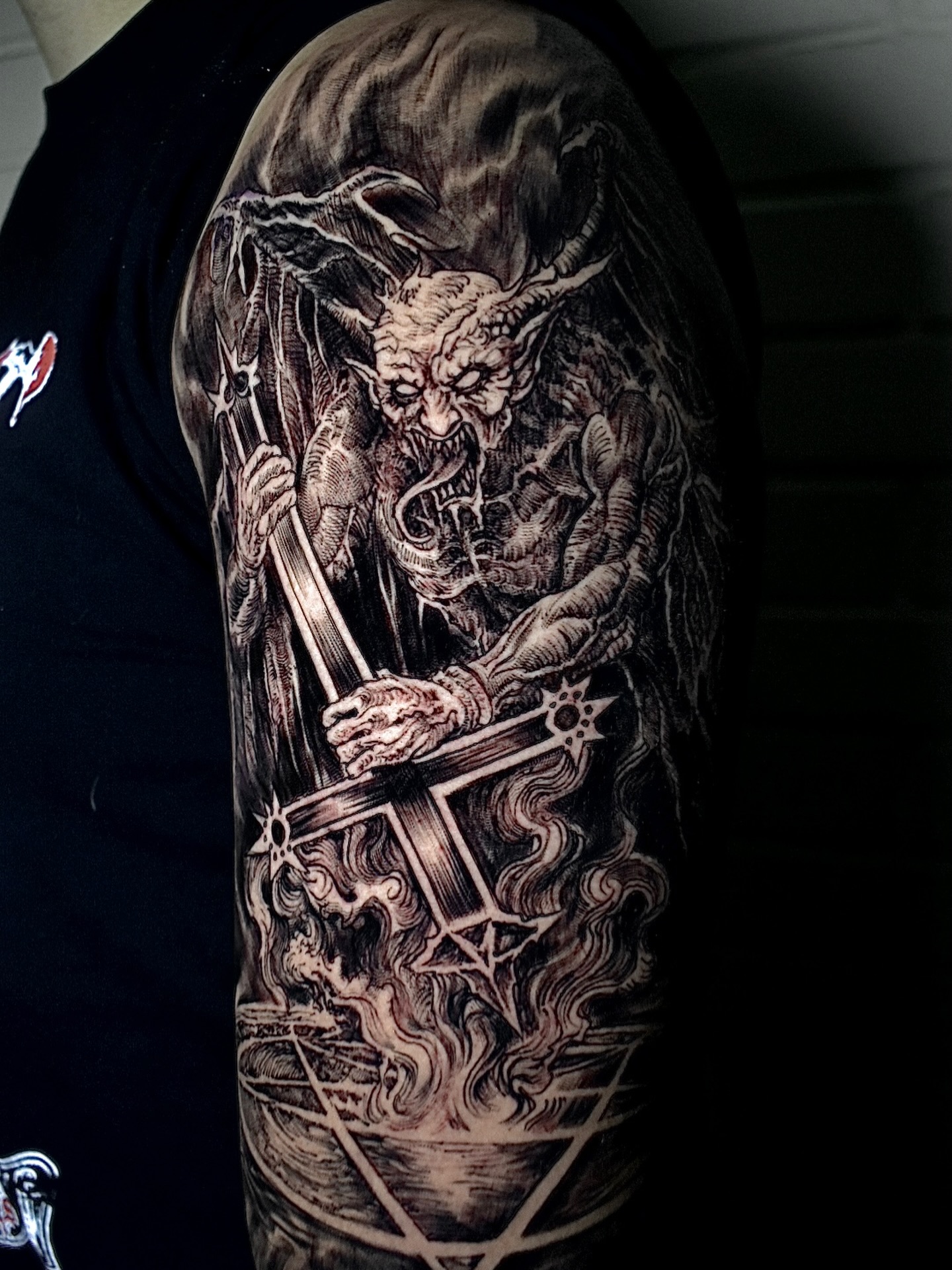
There is a strong old-illustration quality to this demon tattoo. Rather than relying on polished realism, the artist uses dense linework and cross-hatching to construct a horned, winged creature leaning over an enormous inverted sword.
The demon has an almost engraved appearance. Its muscular limbs, stretched wings, long tongue, claws, and angular face are defined through countless thin lines. Beneath the sword, stylized fire curls upward in flowing shapes, while geometric and occult-inspired elements complete the lower section.
The sword acts as the visual spine of the entire composition. This is clever placement for the upper arm because its straight vertical structure organizes all the more chaotic details surrounding it. The creature wraps around that central line rather than floating independently.
Among these demon tattoo ideas, this one feels particularly narrative. It resembles an illustration from an old forbidden manuscript or dark fantasy book, which makes it an interesting alternative to modern black-and-grey realism.
Horned Demon King Surrounded by Screaming Souls
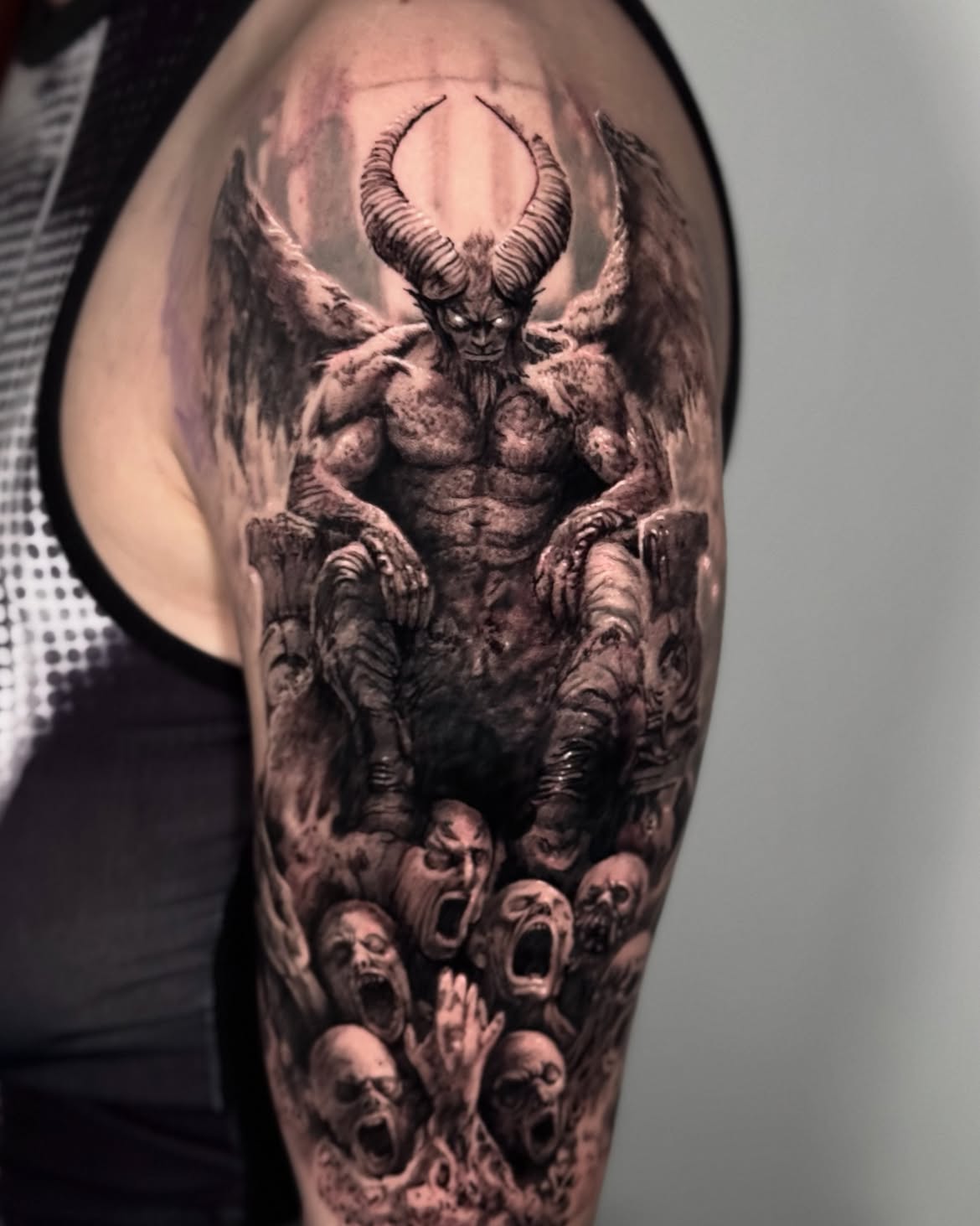
This large upper-arm tattoo creates an entire infernal scene rather than concentrating on a single face. A muscular winged demon sits above a crowd of screaming figures, its enormous curved horns forming an almost symmetrical crown around its head.
The demon’s seated posture gives it an imposing, throne-like presence. Heavy shoulders, defined abdominal muscles, clawed hands, wings, and thick horns establish the main silhouette, while the collection of faces underneath introduces frantic movement. Some mouths are open in screams, hands reach upward, and skull-like forms disappear into shadow.
I find the contrast in body language particularly effective. The central creature appears almost motionless, while everything beneath it looks chaotic. That makes the demon feel powerful without requiring an exaggerated action pose.
For a full sleeve, a composition like this provides plenty of possibilities. The lower figures could continue toward the elbow and forearm, while wings, smoke, or architectural elements could wrap around the arm. An angel vs demon narrative could also be developed on the opposite arm, creating a much larger story about opposing forces.
Gothic Female Demon With Crescent Moon and Rose
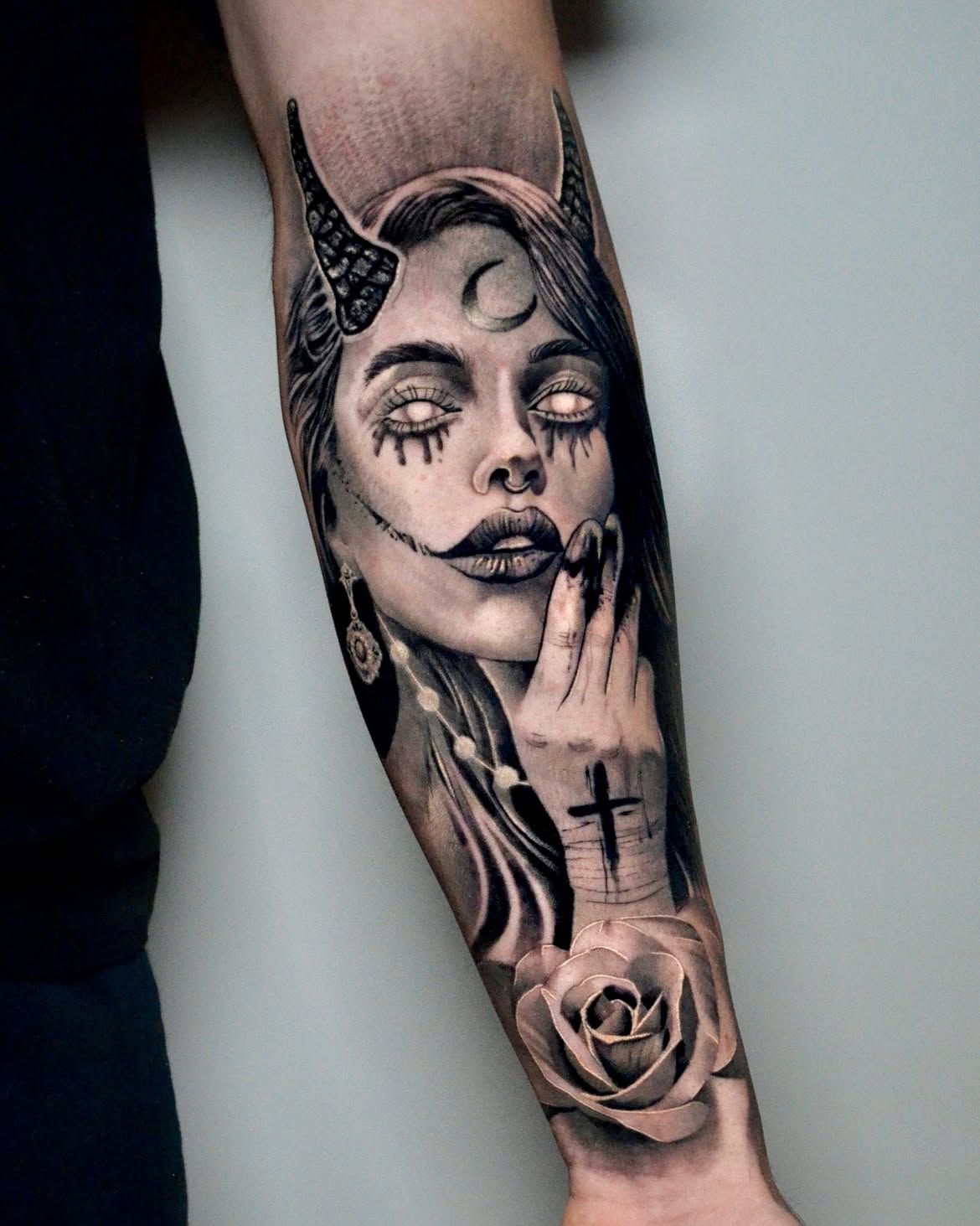
Not every demon needs exposed teeth and monstrous anatomy. This elegant female portrait takes a softer gothic approach, combining subtle supernatural details with beauty-focused black-and-grey realism.
Two dark horns rise through the hair, while a crescent moon sits prominently on the forehead. The blank eyes are framed by long lashes and dripping black marks. A dark line extends from the corner of the mouth across the cheek, adding a slightly macabre edge without distorting the facial proportions.
The hand beside the face is another important element. Dark fingertips and a cross-like mark on the wrist strengthen the occult aesthetic, while the rose at the bottom gives the composition a softer ending. The flower also helps fill the wider lower portion without competing with the portrait.
This is one of the more adaptable demon tattoo ideas for women, though the concept is obviously not restricted by gender. Someone wanting a less aggressive idea could retain the horns, moon, portrait, and floral elements while reducing the darker markings around the eyes and mouth.
Demon Head, Serpent, and Ornamental Dagger
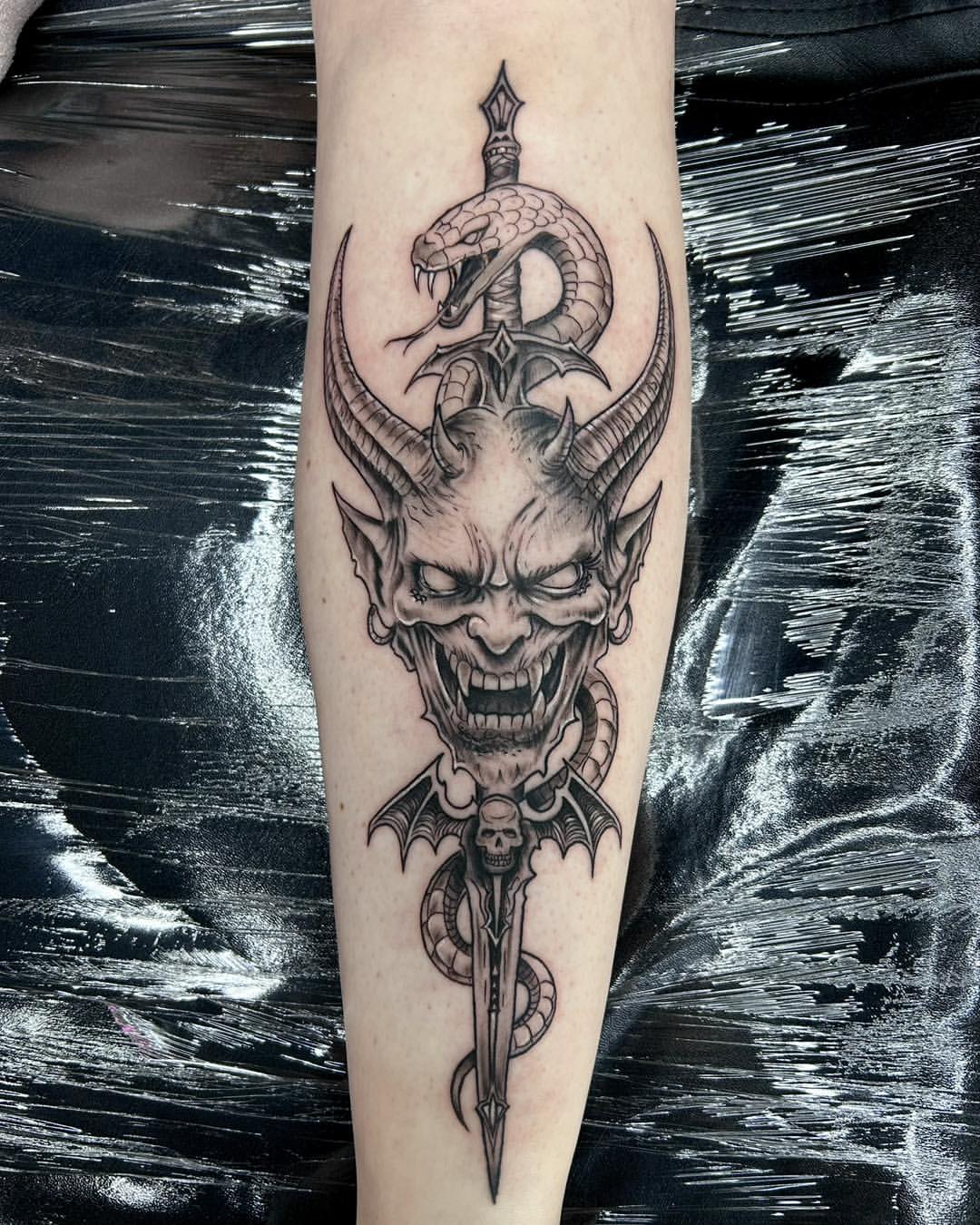
This vertical composition combines three classic tattoo subjects—a demon, a snake, and a dagger—into one compact design. The demon’s head occupies the center, with long horns rising diagonally and pointed ears extending outward. Instead of heavy realism, the face is constructed with crisp outlines and controlled grey shading.
A snake wraps around the upper part of the dagger, its scaled body curving above the demon’s horns. The blade then passes visually through the composition and continues beneath the face, where a small skull with bat-like wings decorates the handle area.
This arrangement is particularly successful as a stencil concept because every component has a clear silhouette. Even from a distance, the viewer can identify the horns, snake, face, wings, and dagger. The relatively open use of skin also prevents the piece from becoming too dense.
There is a slight Trad sensibility in the way recognizable symbols are combined, although the linework and shading give the finished tattoo a more contemporary illustrative character. It could also be adapted into color with red, green, or blue accents while preserving the basic structure.
Screaming Creature With Oversized Fangs
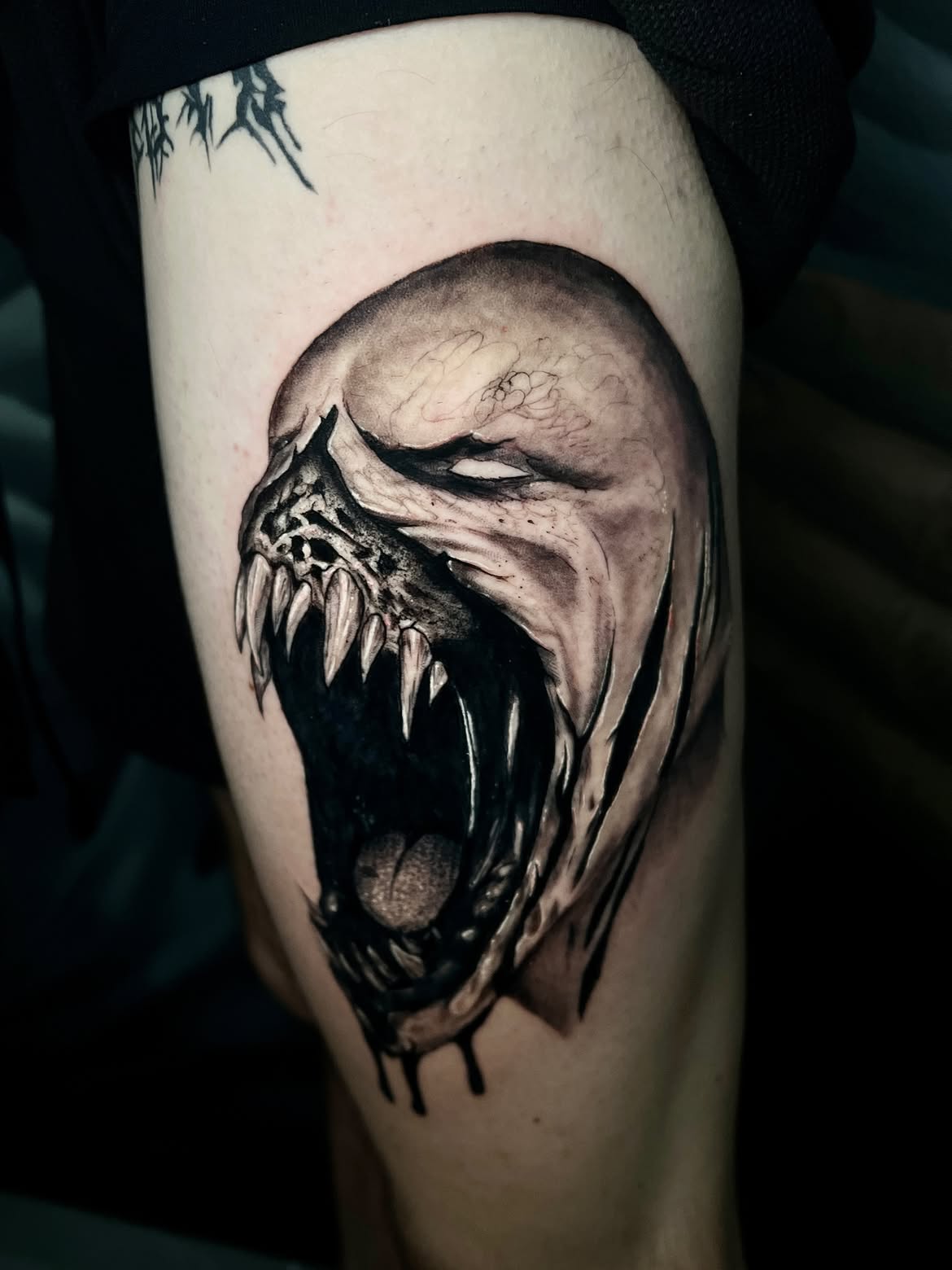
This tattoo strips the demon concept down to pure expression. There are no elaborate wings, weapons, or surrounding symbols; almost everything revolves around an enormous open mouth.
The creature’s skull-like face stretches around the jaw, with one pale eye visible beneath a heavy brow. Long teeth project from both sides of the mouth, while the interior is packed with saturated black. That darkness is essential because it makes the lighter fangs look almost three-dimensional.
Rather than defining every section with a hard outline, the artist lets parts of the head dissolve into soft grey shading. The result feels less like a decorative mask and more like something emerging from shadow. Small black drips beneath the jaw reinforce the raw horror aesthetic.
This could be a useful reference for someone wanting a relatively simple demon concept in terms of composition while still demanding sophisticated tattooing technique. There is only one main subject, but the success of the piece depends heavily on smooth shading, believable teeth, and strong contrast.
Demon Face Across the Hand With Tormented Figures
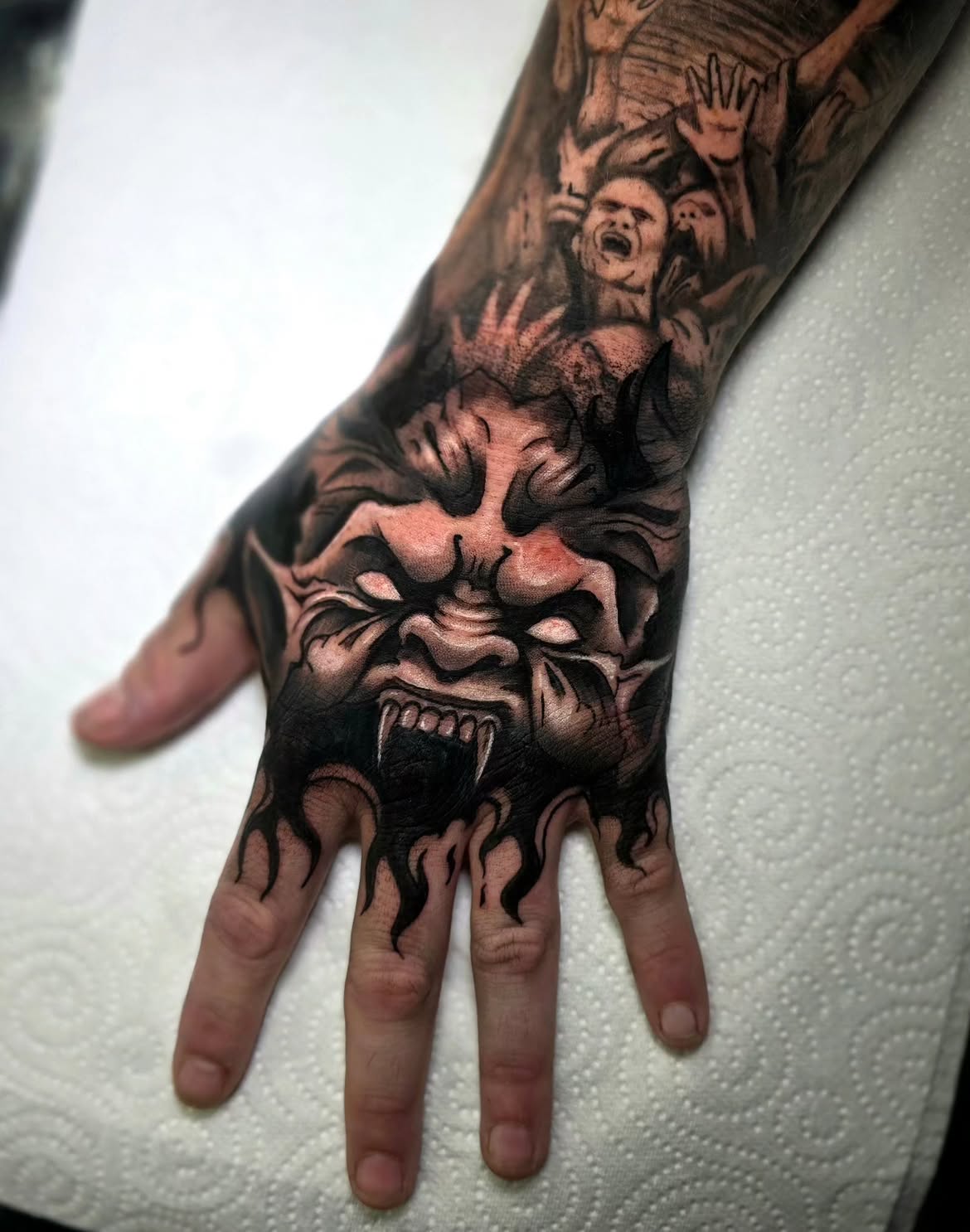
Hand tattoos have very little room for unnecessary detail, so this piece makes the demon’s face enormous. The eyes sit across the upper hand, the nose follows the central anatomy, and the mouth stretches toward the knuckles. Black flame-like shapes continue onto several fingers, making the tattoo feel connected to the movement of the hand rather than simply placed on top of it.
The expression is fierce but highly graphic. Pale eyes contrast with thick black markings around the brows and cheeks, while two fangs descend from the mouth. Instead of using realistic horns, the artist emphasizes sweeping black shapes that give the face a fiery, supernatural silhouette.
The story continues above the wrist. Several distressed human figures appear among dark shadows, with raised hands and anguished expressions. This transition turns the hand tattoo into the endpoint of a larger forearm scene rather than an isolated demon tattoo design.
It is a bold placement and one that deserves careful planning. Hands receive substantial exposure and movement, so anyone considering this location should discuss aging, touch-ups, workplace considerations, and how the design will connect to existing forearm tattoos with an experienced artist.
Chained Horned Demon Surrounded by Ravens
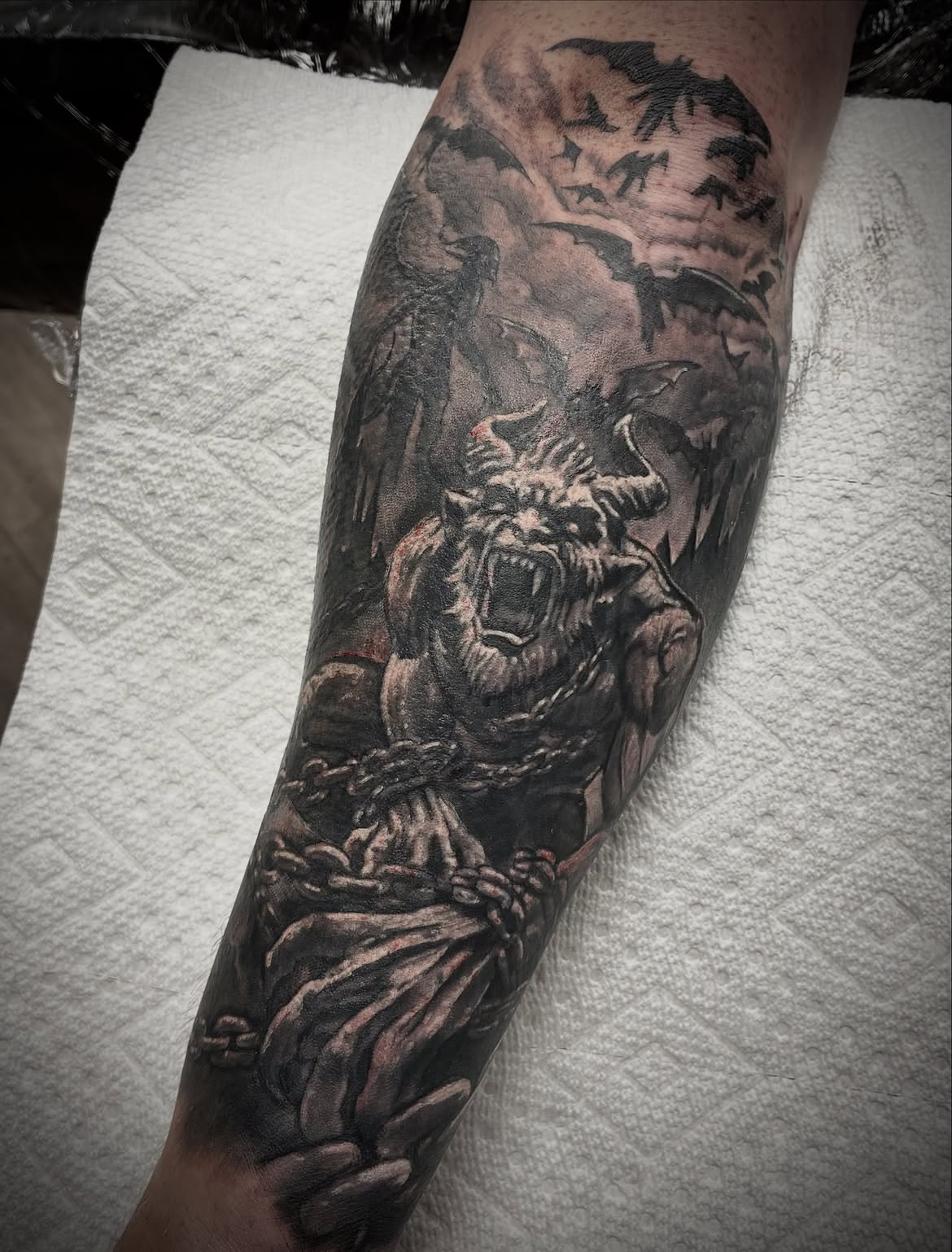
This dark black-and-grey forearm tattoo builds a complete horror scene around a chained horned demon. The creature occupies the center of the composition, roaring upward with its mouth wide open while heavy chains cross its body and wrists. Large curved horns frame the face, and the muscular shoulders make the figure feel physically powerful despite its restrained position.
Ravens and smaller flying birds fill the upper background, disappearing into smoky grey shading. Their silhouettes create depth without competing with the central character. The combination of chains, birds, shadows, and the struggling figure gives the piece a strong narrative quality. Symbolically, the imagery could suggest confinement, rebellion, inner conflict, or an attempt to control destructive impulses, depending on the wearer’s interpretation.
The elongated composition is particularly well suited to a forearm sleeve, where additional smoke, skulls, fire, or gothic scenery could continue around the arm.
Realistic Horned Demon Portrait With Pale Eyes
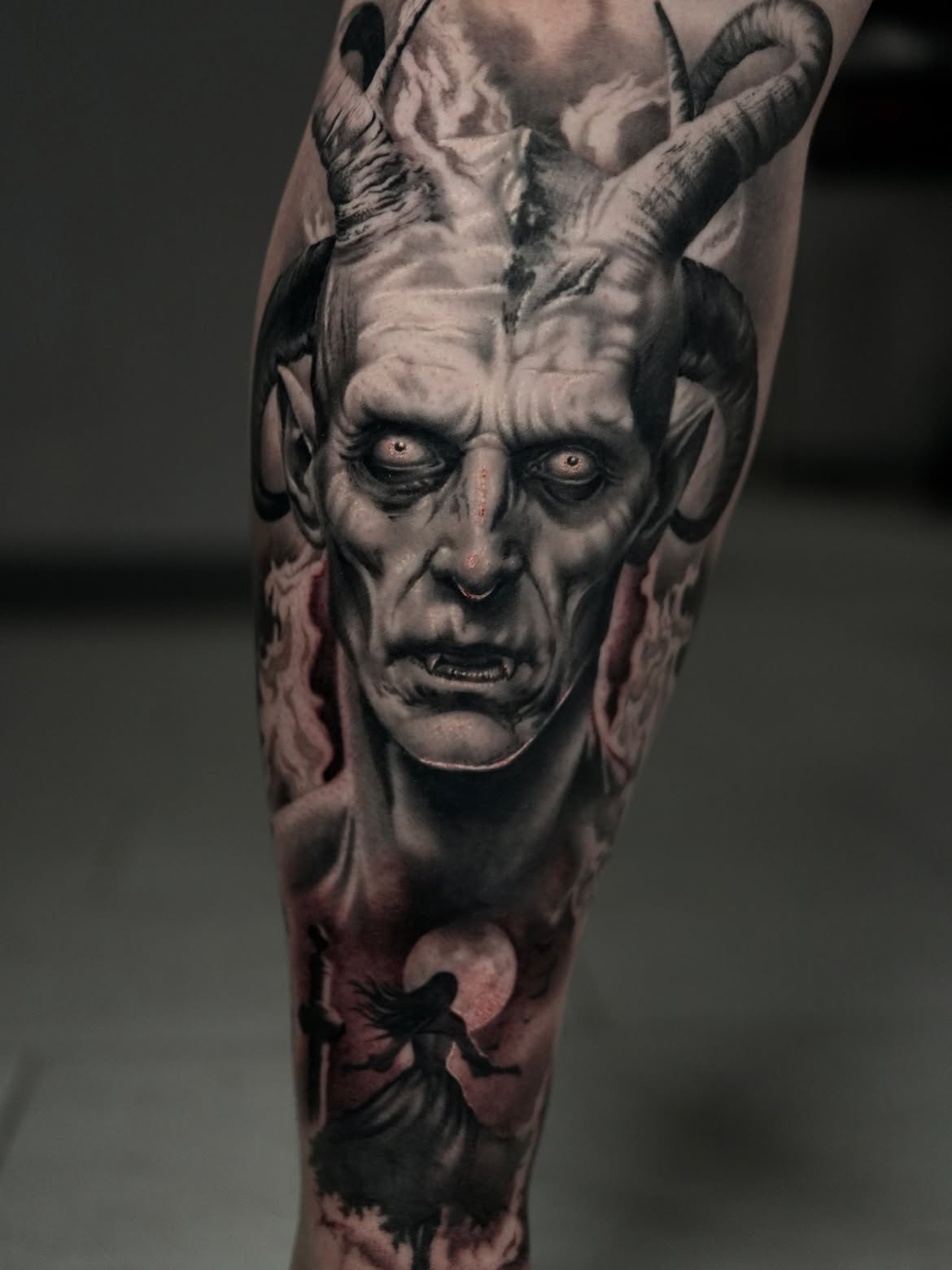
This portrait takes a more restrained approach to demonic imagery. Instead of an exaggerated monster, the tattoo presents an almost human face transformed by enormous horns, pointed ears, hollow-looking eyes, and subtly sharpened teeth.
The realism is impressive because of the facial structure. Wrinkles across the forehead, shadows beneath the eyes, pronounced cheekbones, and carefully modeled lips make the creature appear tangible. The enormous horns extend upward and backward, naturally following the long shape of the placement.
Muted reddish accents appear around parts of the face and background, adding warmth to an otherwise monochromatic design. Beneath the portrait, a silhouetted figure appears against a pale circular form, giving the composition another narrative layer.
This style works well for anyone searching for realistic demon tattoo ideas for men without relying on an extremely busy composition. The portrait itself provides enough visual impact to stand alone.
Dark Grinning Demon With Curved Horns
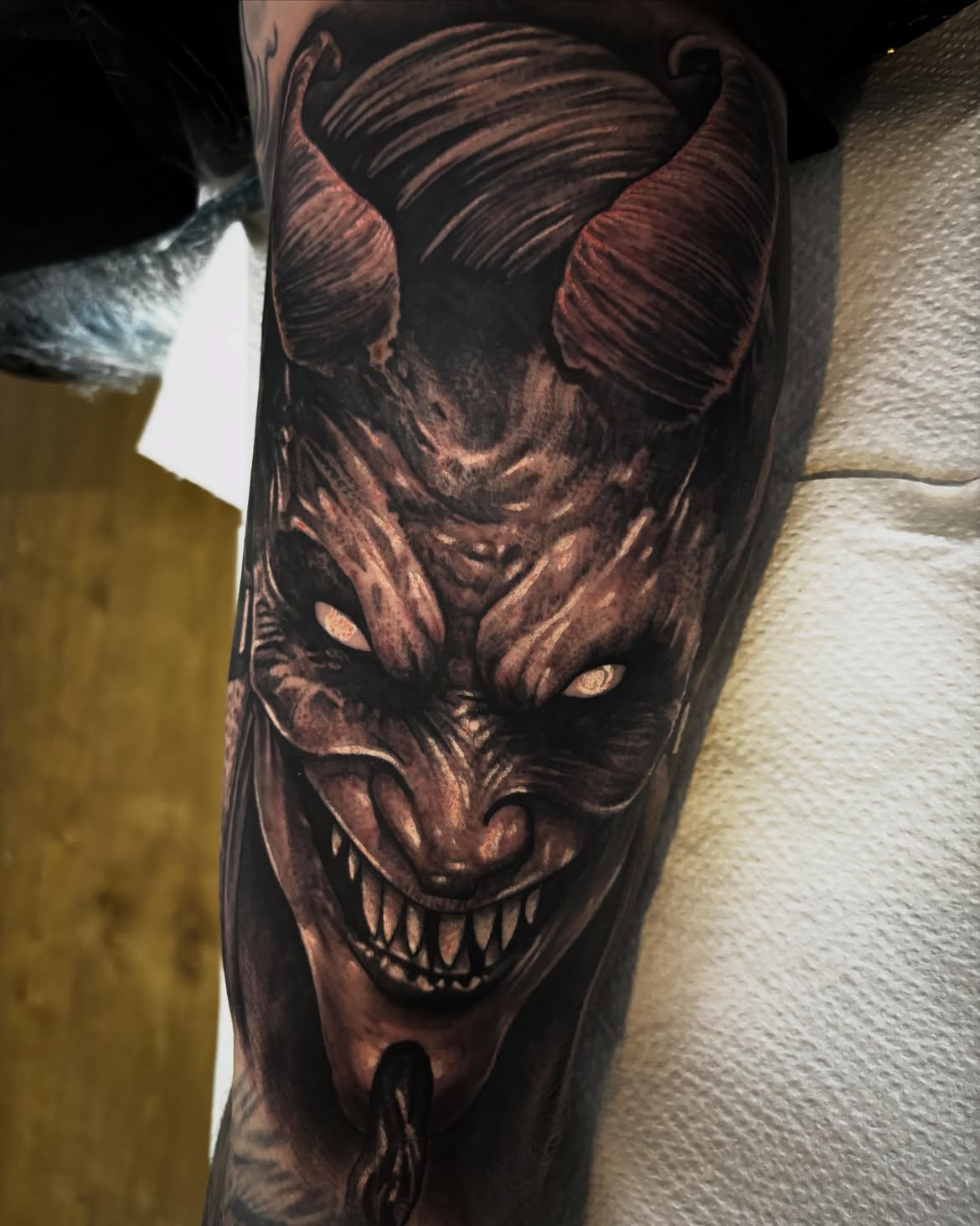
Here the entire tattoo is constructed around the expression. Two enormous ridged horns curve upward from a shadow-heavy forehead, while pale eyes stare directly outward. The exaggerated grin exposes rows of narrow pointed teeth, immediately turning the face into the focal point.
Black saturation surrounds much of the head, allowing lighter highlights across the nose, brows, cheeks, and horns to emerge dramatically from the darkness. This high-contrast technique creates the impression that the demon is appearing from a completely black background.
There are relatively few secondary elements, which gives this piece a surprisingly simple structure despite the sophisticated rendering. That makes it an excellent example of how a single demon face can carry an entire forearm composition when the expression, lighting, and anatomy are strong enough.
Woman, Demon Mask, and Coiling Snake
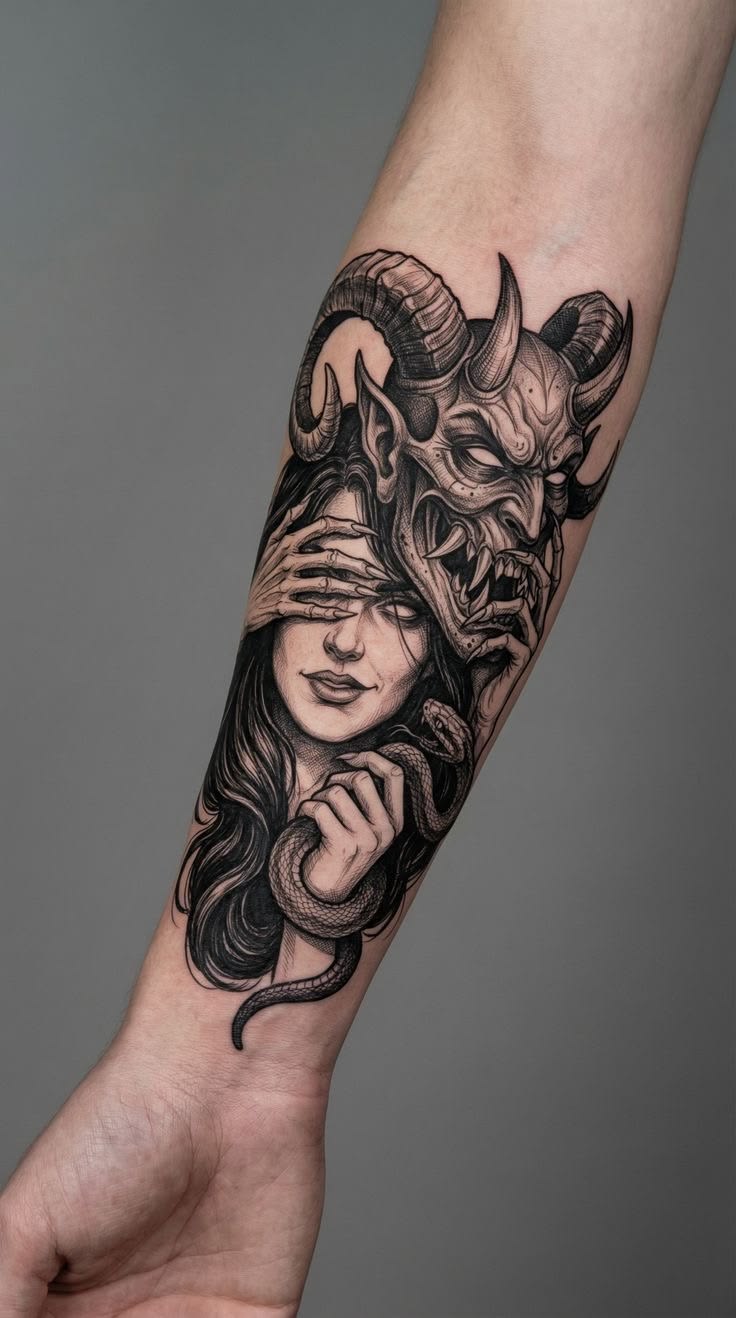
This elegant illustrative tattoo combines three distinct subjects into one flowing composition. A woman’s portrait fills the lower half, while a large horned demon mask rises behind her head. A snake coils around her hand and continues downward, creating a natural visual connection between the upper and lower sections.
The contrast between the two faces is especially effective. The woman has soft features, closed eyes, flowing hair, and a peaceful expression. Directly above her, the demon has enormous horns, pointed ears, hollow eyes, and an open mouth filled with fangs. One skeletal-looking hand reaches across the woman’s eyes, strengthening the relationship between the characters.
The snake adds another symbolic possibility, often associated with transformation, danger, temptation, or renewal. Combined with the opposing faces, the piece could be interpreted as a visual exploration of beauty and darkness, innocence and temptation, or competing sides of one personality.
For those exploring demon tattoo ideas for women, this composition shows how demonic imagery can be integrated into an elegant portrait rather than becoming the only subject.
Gothic Demon Girl With Horns and Occult Details
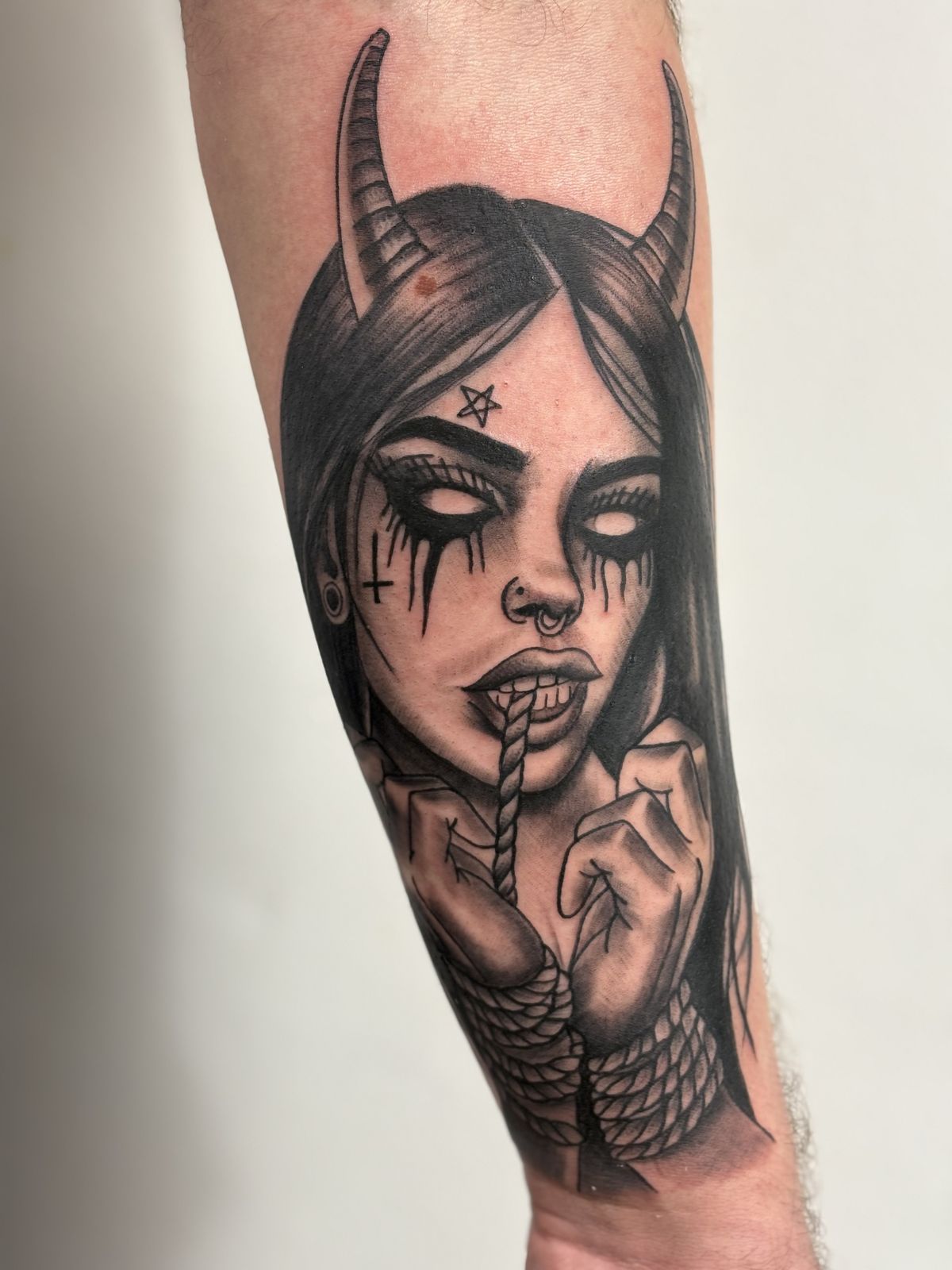
This female demon portrait uses bold blackwork and illustrative shading instead of photorealism. Two long horns rise above straight dark hair, while blank eyes surrounded by dripping black makeup create the strongest visual feature of the face.
Several smaller details reinforce the gothic aesthetic. A small pentagram appears on the forehead, an inverted cross sits beside the eye, and facial piercings give the character a contemporary alternative appearance. A rope passes through the mouth and wraps around the hands below, creating an unusual narrative detail.
The artist keeps the face relatively clean while concentrating heavy blacks around the hair and eyes. This balance preserves readability and makes the pale areas of skin function almost like highlights.
It is a strong design for women or men who prefer modern gothic portraiture to traditional monster imagery. The concept could also be adapted into a smaller stencil by simplifying the hands and rope while retaining the horns, eyes, and facial symbols.
Red-Eyed Demon With Ornamental Blackwork
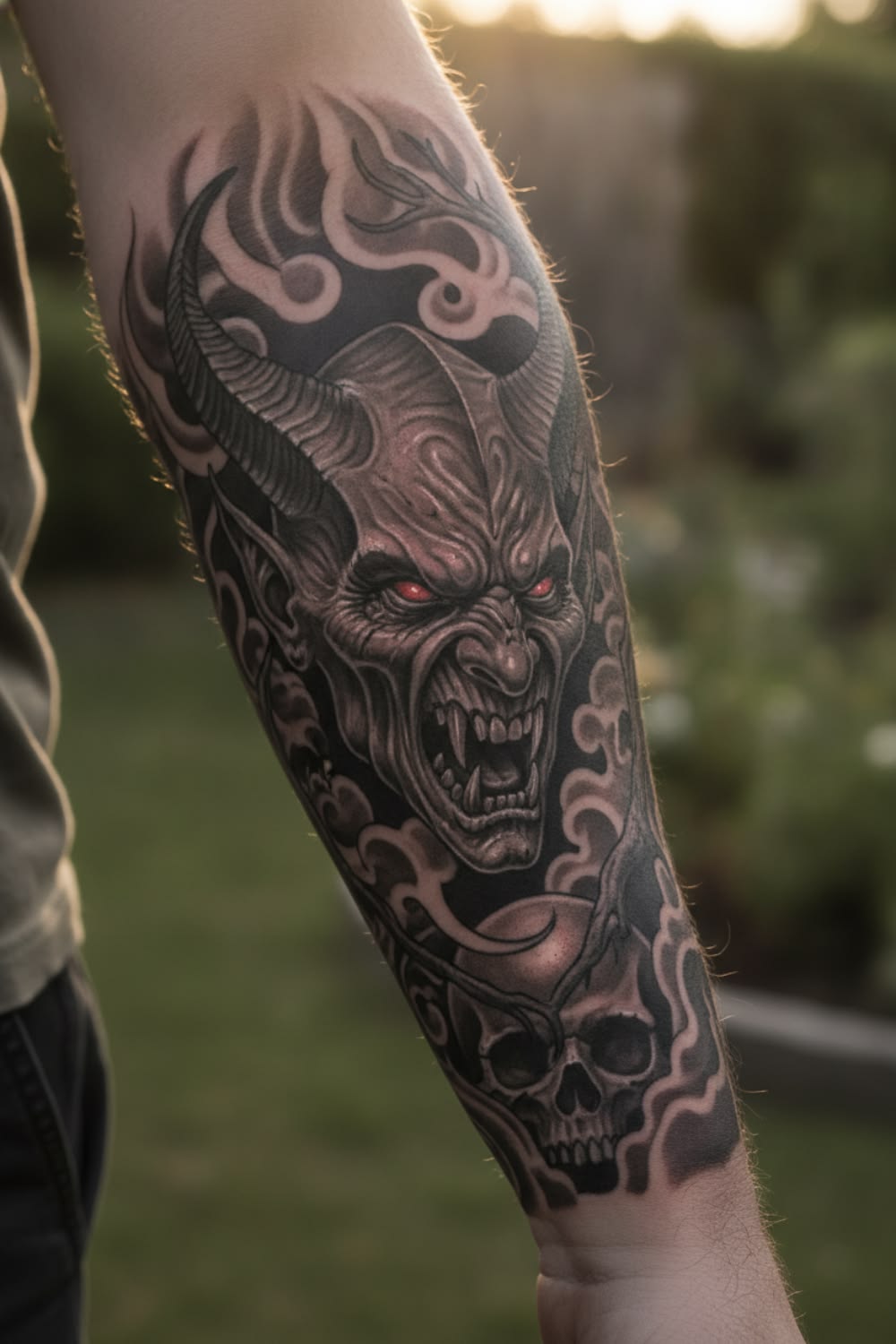
This forearm piece demonstrates how a tiny amount of color can transform an otherwise black-and-grey tattoo. The demon’s face is surrounded by dense ornamental blackwork, but its bright red eyes immediately command attention.
Large ridged horns frame the upper section, while deeply carved-looking wrinkles run down the forehead and around the nose. The mouth is open in a snarl, revealing prominent fangs. Beneath it sits a skull, extending the darker theme toward the wrist.
Decorative flame-like curves move around both subjects, creating a more stylized alternative to realistic smoke or fire. These patterns also help fill irregular spaces around the central portrait and make the tattoo feel closer to a cohesive half sleeve.
The combination of realistic facial modeling and graphic background shapes is particularly useful for a demon tattoo design because it preserves clarity from a distance while still offering plenty of detail up close.
Minimal Blackwork Dancing Demon
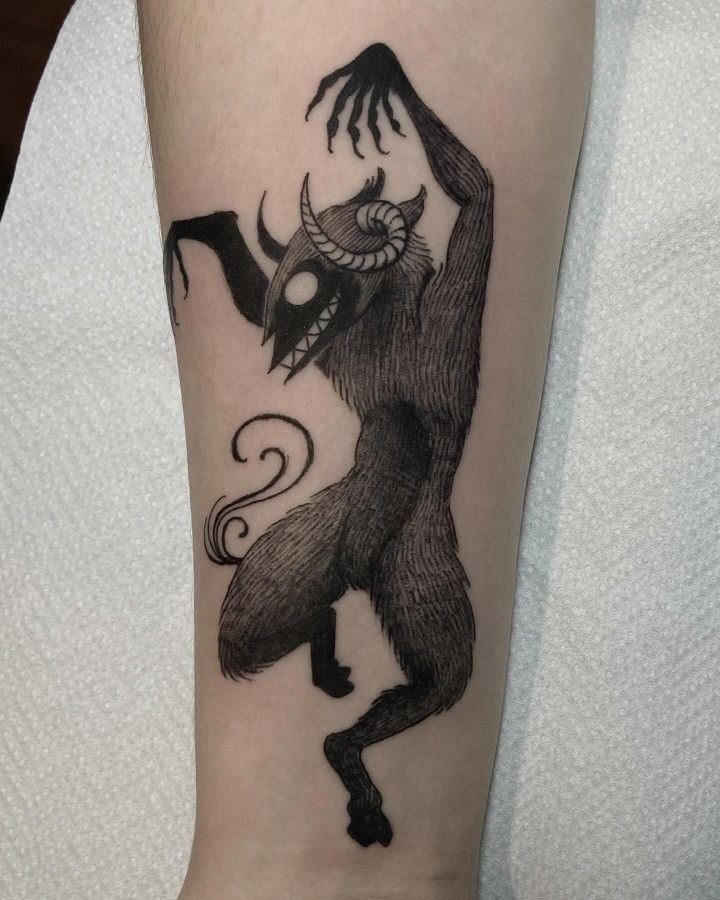
This unusual piece moves in a completely different direction from the heavily shaded demons above. The creature has a long furry body, thin bent legs, oversized arms, spiral horns, a pointed face, and one large pale eye. Its raised hands and twisted posture make it appear as though it is dancing or performing some strange ritual.
Fine repeated strokes create the texture of the body rather than smooth grey shading. The limbs remain angular and deliberately unnatural, while a curling tail adds movement near the center of the composition. Because there is no detailed background, plenty of untouched skin remains around the figure.
This is a great reference for someone seeking small, simple, or unconventional demon imagery. It feels closer to a strange folklore illustration than a realistic horror tattoo. The concept could easily work on the forearm, calf, upper arm, or even as part of a patchwork sleeve.
The best approach is to treat these references as starting points rather than templates. Change the expression, horns, placement, shading, surrounding symbols, or narrative until the tattoo feels personal. If one of these demon tattoo ideas caught your attention—or you would interpret its symbolism differently—leave a comment and share which design you would choose.