
Dice have always carried a little tension with them. They represent the moment before an outcome is known—the roll when luck, chance, risk, and personal choice seem to collide. That symbolism translates naturally into tattooing, which is why dice tattoo ideas can feel playful in one design and surprisingly personal in another.
There is also far more visual variety here than the classic casino motif suggests. Dice can become part of a bold American traditional design, a tiny fine-line tattoo, a romantic heart concept, a flaming old-school piece, or even a subtle nod to Dnd and D&d culture. Placement changes the character just as much as style does: a miniature pair can disappear neatly into a patchwork arm, while larger shaded dice have enough presence to anchor part of a sleeve.
The designs below show just how differently the same familiar object can be interpreted.
Fine-Line Dice with Sparkle Details
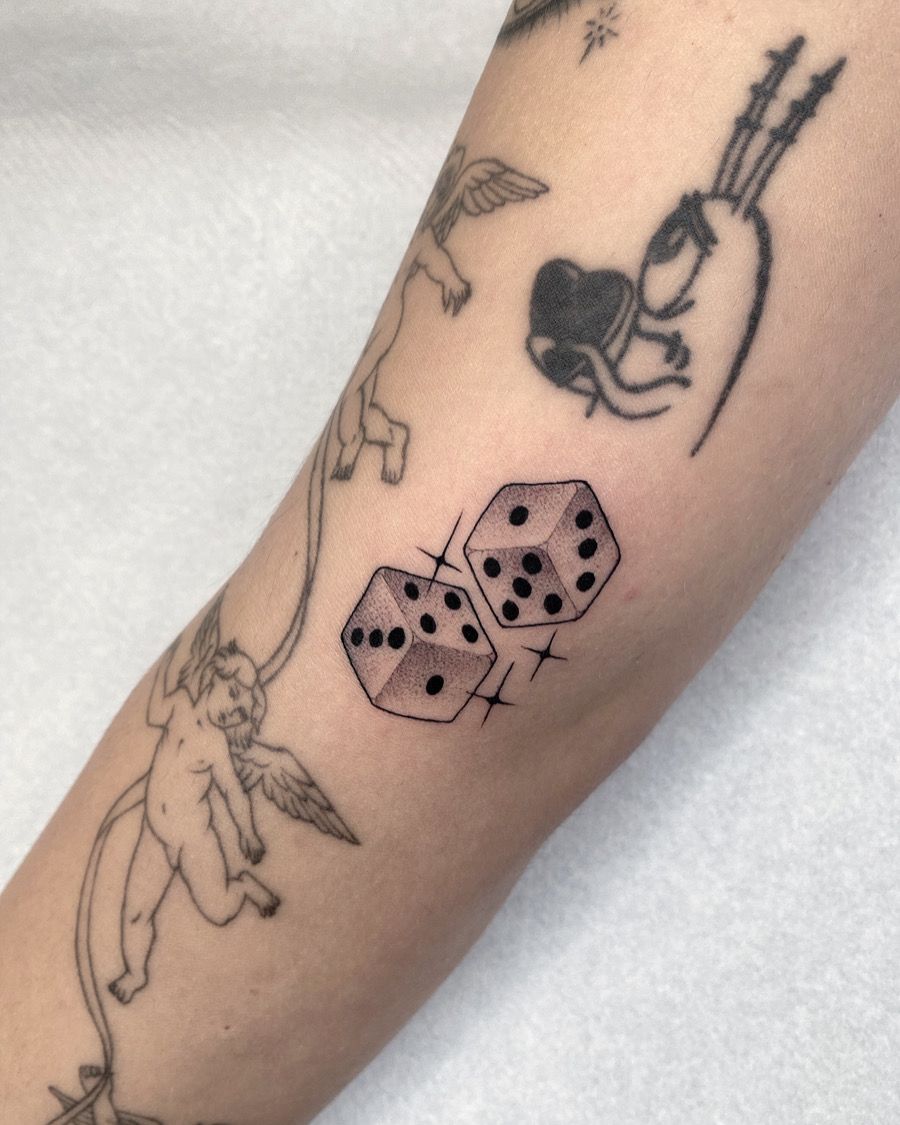
This pair of dice is a great example of how a simple subject can work beautifully within a patchwork tattoo collection. The cubes are drawn with crisp black outlines and slightly irregular perspective, which keeps the design from feeling overly geometric or mechanical. Small sparkle marks surrounding the dice add movement without making the composition busy.
The stippled shading is particularly effective. Instead of filling the sides with heavy black, the artist uses tiny dots to create dimension, leaving plenty of skin visible. The dark circular pips then become the strongest graphic elements. That contrast makes the tattoo readable even though the overall Design remains relatively delicate.
For anyone collecting small tattoos over time, this approach is easy to integrate into a sleeve. It can sit between larger pieces without competing with them, while the lucky symbolism of rolling dice gives the design enough personality to stand independently.
Flaming Dice in a Traditional Tattoo Style
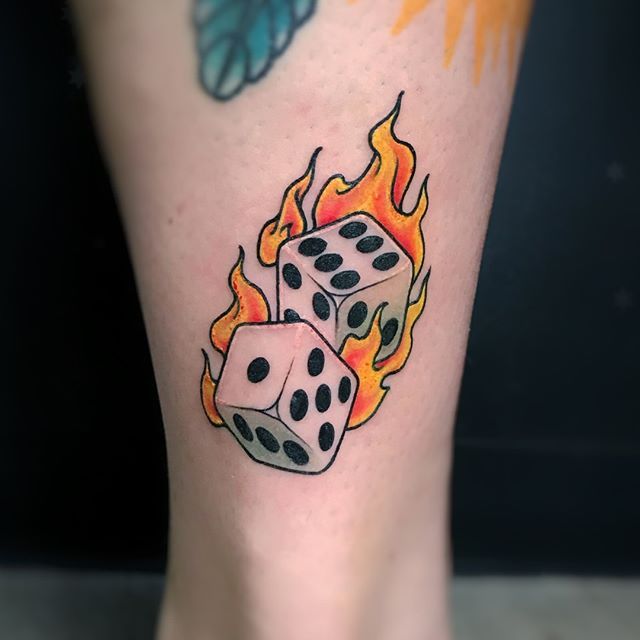
Few combinations feel as naturally suited to tattooing as dice and fire. Here, two substantial dice are surrounded by sweeping orange and yellow flames, producing the kind of immediate visual impact associated with Traditional tattoo imagery.
Black outlines hold everything together. The dice have pale faces and oversized dark pips, while the Flaming background introduces the Red-orange warmth that gives the piece its energy. Rather than looking like two static cubes, the dice appear to be flying through heat—as though they have just been thrown and their result is still undecided.
This concept would translate particularly well into American traditional flash. It also has the visual strength needed for a larger arm composition for men or women. A tattoo artist could push the old-school character further with a banner, Cards and dice combination, a 777 reference, cherries, or other classic gambling symbols.
The appeal is less about literal gambling than attitude. Fire turns an ordinary lucky symbol into something faster, louder, and considerably more rebellious.
Separated Black-and-Gray Dice for a Patchwork Arm
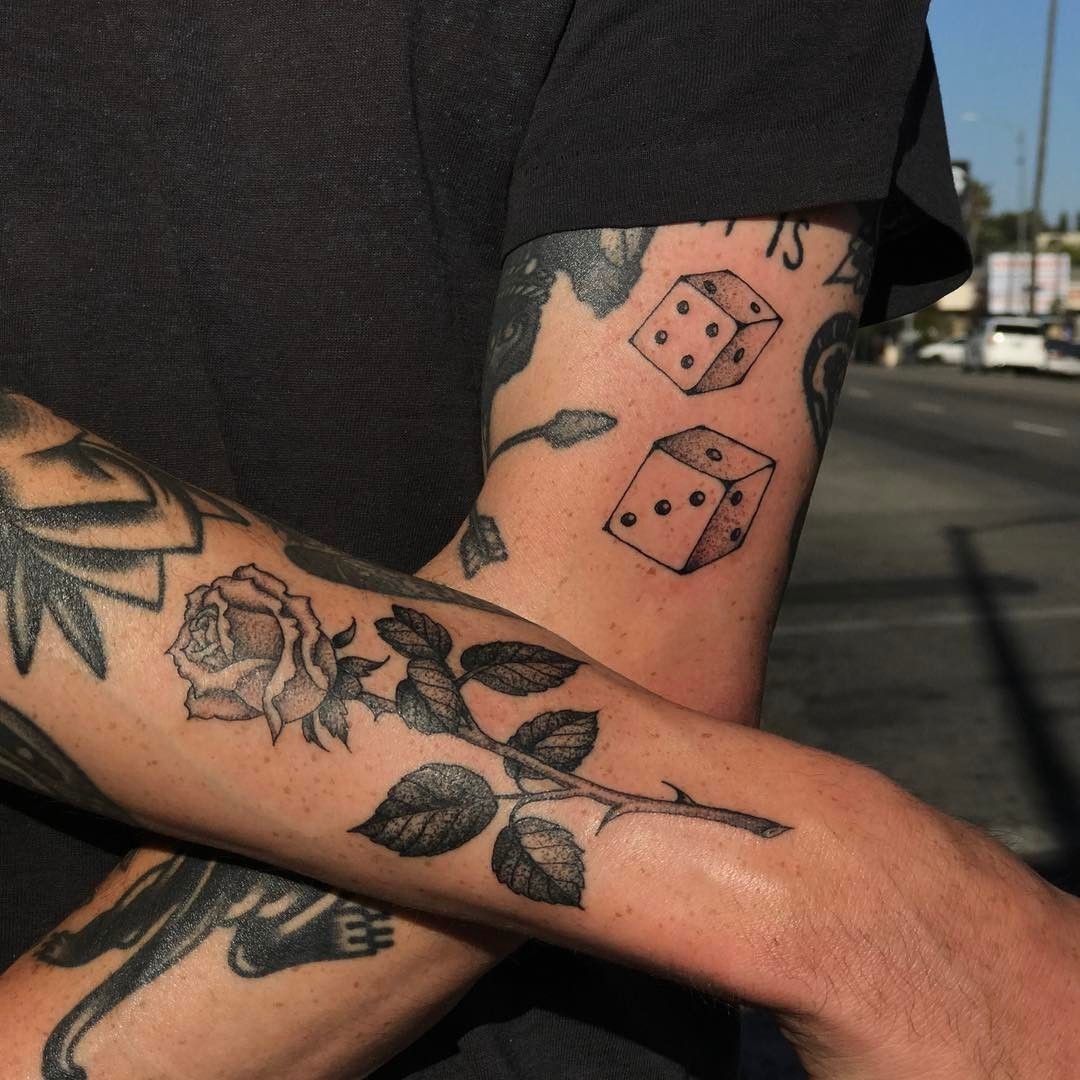
Instead of placing two dice together as a single compact motif, this Design separates them vertically. That small compositional decision makes the tattoo particularly useful when filling an open section of an existing arm collection.
Each die is outlined simply, with restrained gray shading creating depth along selected faces. There is no decorative frame, flame, banner, or background. The result feels straightforward and slightly rough around the edges in a way that suits an established patchwork sleeve.
I particularly like dice tattoos when the artist resists the temptation to overdecorate them. A cube already has strong perspective lines, contrasting faces, and a recognizable arrangement of dots. Sometimes those ingredients are enough.
For design men references especially, this is a practical direction: it is noticeable without becoming the dominant tattoo on the arm. It could also work alongside Traditional roses, cards, lettering, snakes, or other black-and-gray Ideas while maintaining enough negative space between individual pieces.
Tiny Dice with Heart-Shaped Pips
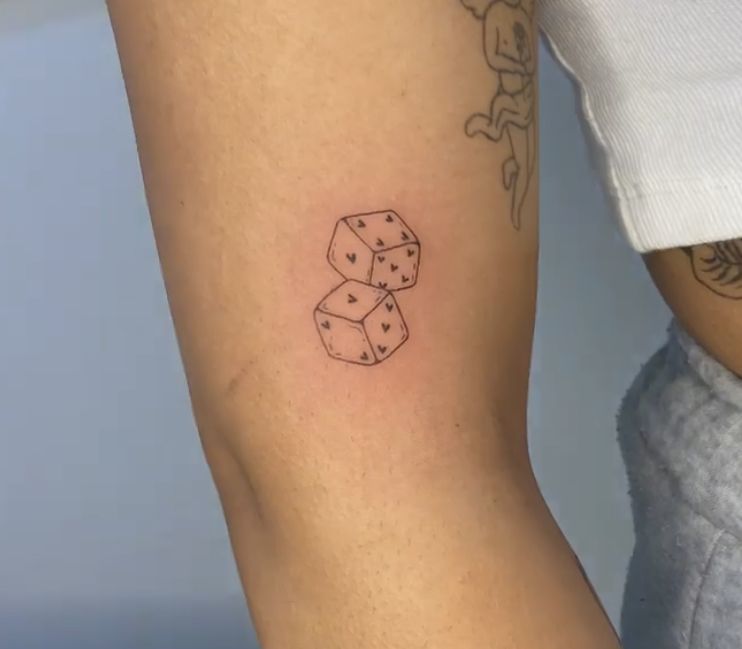
This is where the familiar dice motif becomes unexpectedly sweet. Two tiny cubes are rendered with extremely fine outlines, but ordinary circular pips have been replaced by miniature Heart shapes.
That one alteration completely changes the emotional tone. Instead of immediately suggesting casinos, gambling, or risk, the dice can represent taking a chance on love, trusting someone, or simply approaching uncertainty with optimism.
The small scale keeps the idea subtle. There is no heavy shading, and the thin lines make the cubes feel almost like a miniature illustration. It is an especially adaptable option for women looking for something delicate, although the concept is by no means limited by gender.
A good Stencil matters with work this small. The spaces between the hearts, corners, and perspective lines need to remain clear so the dice continue to read properly as the tattoo ages. Increasing the design by even a few millimeters can sometimes give those tiny details considerably more breathing room.
Red Heart Dice with a Minimal Outline
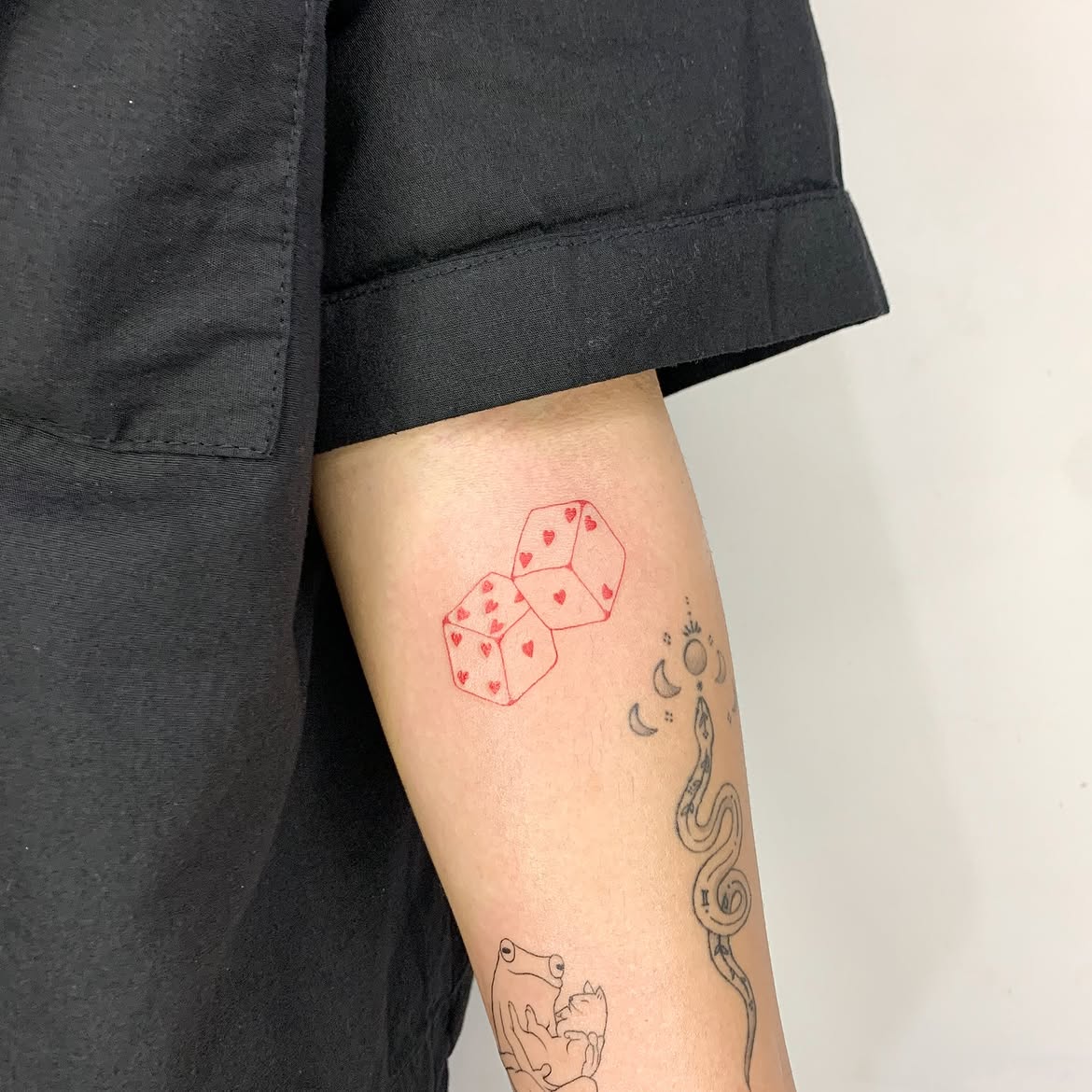
Red ink gives this pair an entirely different personality. The outlines are light and uncomplicated, while tiny Red hearts replace traditional dots across the visible faces. Against the surrounding black linework, the color immediately attracts attention.
It is a clever example of how color can connect a new tattoo to an existing collection without requiring a large piece. The two dice are close enough to read as a pair but angled differently, creating a casual rolling effect rather than a rigid arrangement.
Among romantic dice tattoo ideas, this is one of the easiest concepts to personalize. Heart pips could represent a relationship, friendship, anniversary, or the broader idea of taking emotional chances. Two people could even use the same basic flash as a matching tattoo while changing the numbers displayed on the individual faces.
The design also demonstrates why a tattoo does not need complex rendering to stand out. One distinctive decision—in this case red linework and hearts—is enough to give a familiar symbol a recognizable identity.
Contrasting Red and Black Heart Dice
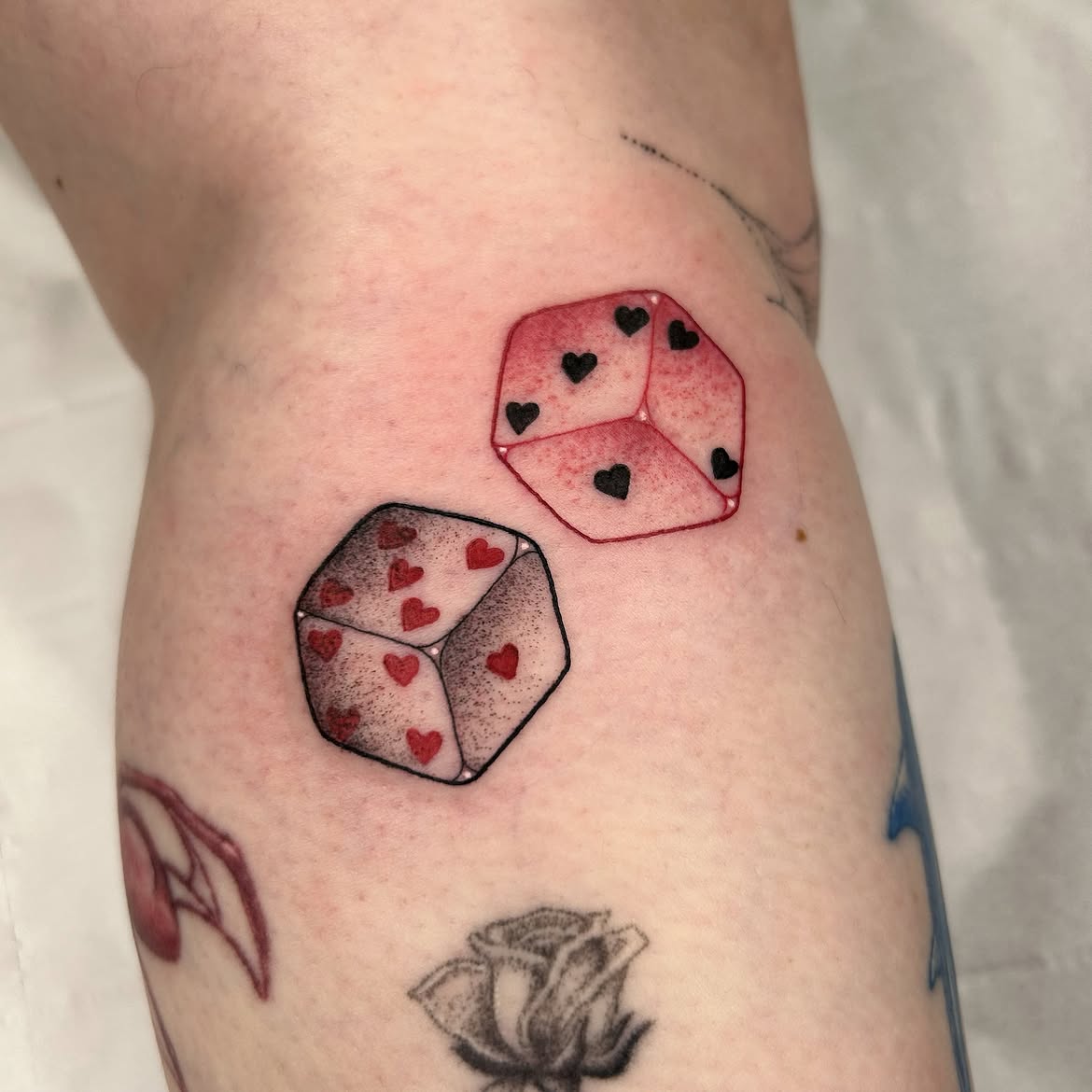
This variation develops the heart concept further by giving each die its own color treatment. One uses a dark outline with Red hearts, while the second is dominated by translucent red shading and bold black hearts.
The opposing palette makes the pair feel connected without making them identical. Soft stippling across the faces gives the cubes a slightly worn, tactile quality, almost like vintage game pieces. The heart-shaped pips remain unmistakable, but the stronger shading makes this version much more substantial than the fine-line alternatives.
There are several ways to read the symbolism: luck and love, two personalities in a relationship, complementary opposites, or simply an affection for playful tattoo flash. That ambiguity is useful. Tattoos often become more interesting when they can carry a private meaning without requiring everyone else to understand it immediately.
As design ideas go, this would also be easy to expand. A Cherry motif, small flames, cards, stars, or a traditional banner could surround the dice if a larger composition were wanted later.
Micro Realistic Dice Tattoo
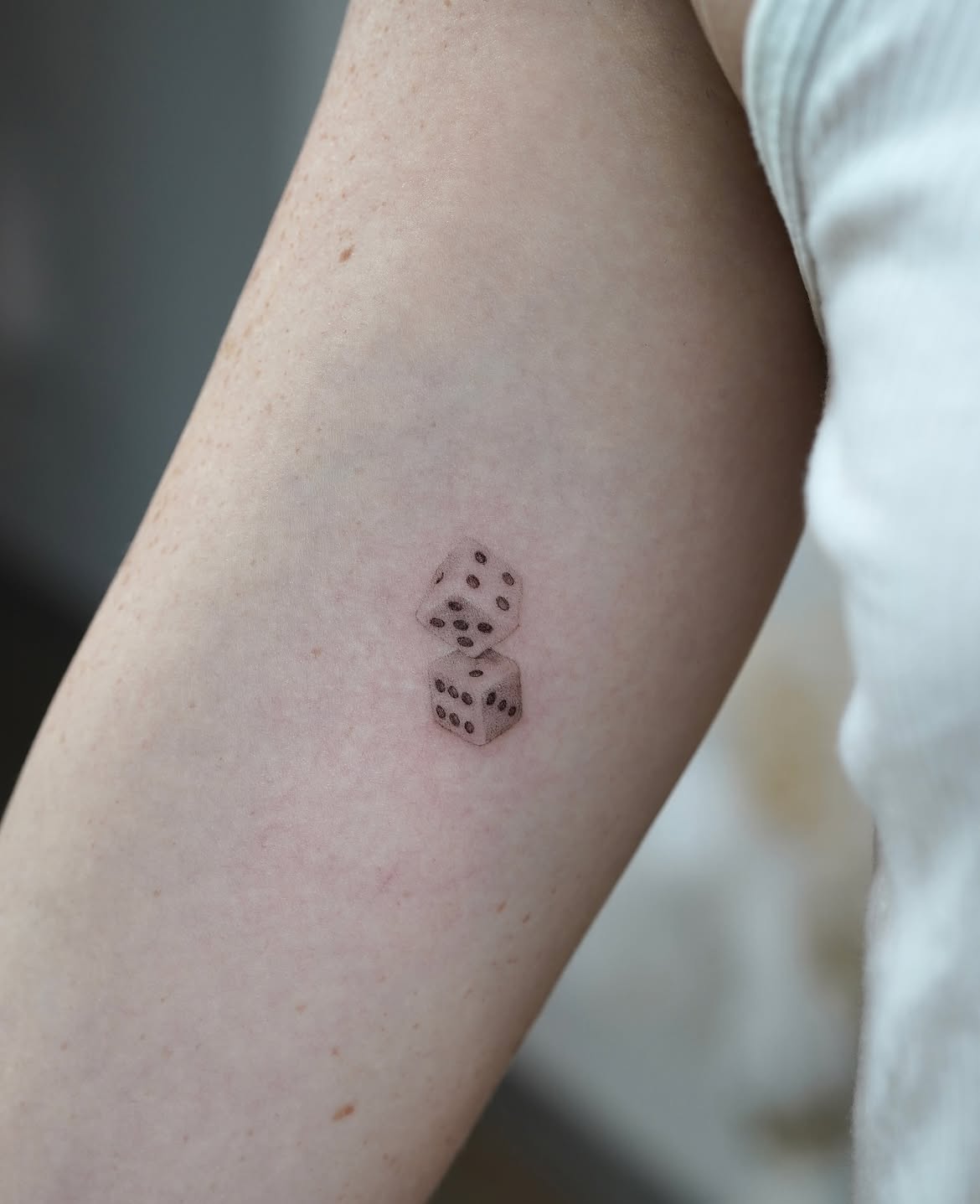
At the opposite end of the scale is this remarkably restrained micro tattoo. Two tiny dice appear stacked in motion, rendered with delicate gray shading rather than a strong black contour.
Despite its size, the perspective is surprisingly convincing. The individual faces remain recognizable, while the tiny pips provide just enough contrast to define each cube. The absence of a decorative background allows the design to sit quietly on the arm.
This kind of tattoo works especially well for someone who likes the meaning of dice but does not want the visual language of classic gambling flash. It feels closer to a miniature pencil sketch than an American traditional tattoo.
Scale deserves serious consideration with a piece like this. Fine details naturally soften over time, so discussing line spacing and long-term readability with an experienced artist is worthwhile. Tattoo publications and educational resources such as Inked Magazine and Tattooing 101 regularly emphasize the importance of matching detail to size and placement rather than simply shrinking a larger design.
For a first tattoo, or for someone building a very understated collection, the concept offers a clean starting point.
Soft Micro Dice with Realistic Shading
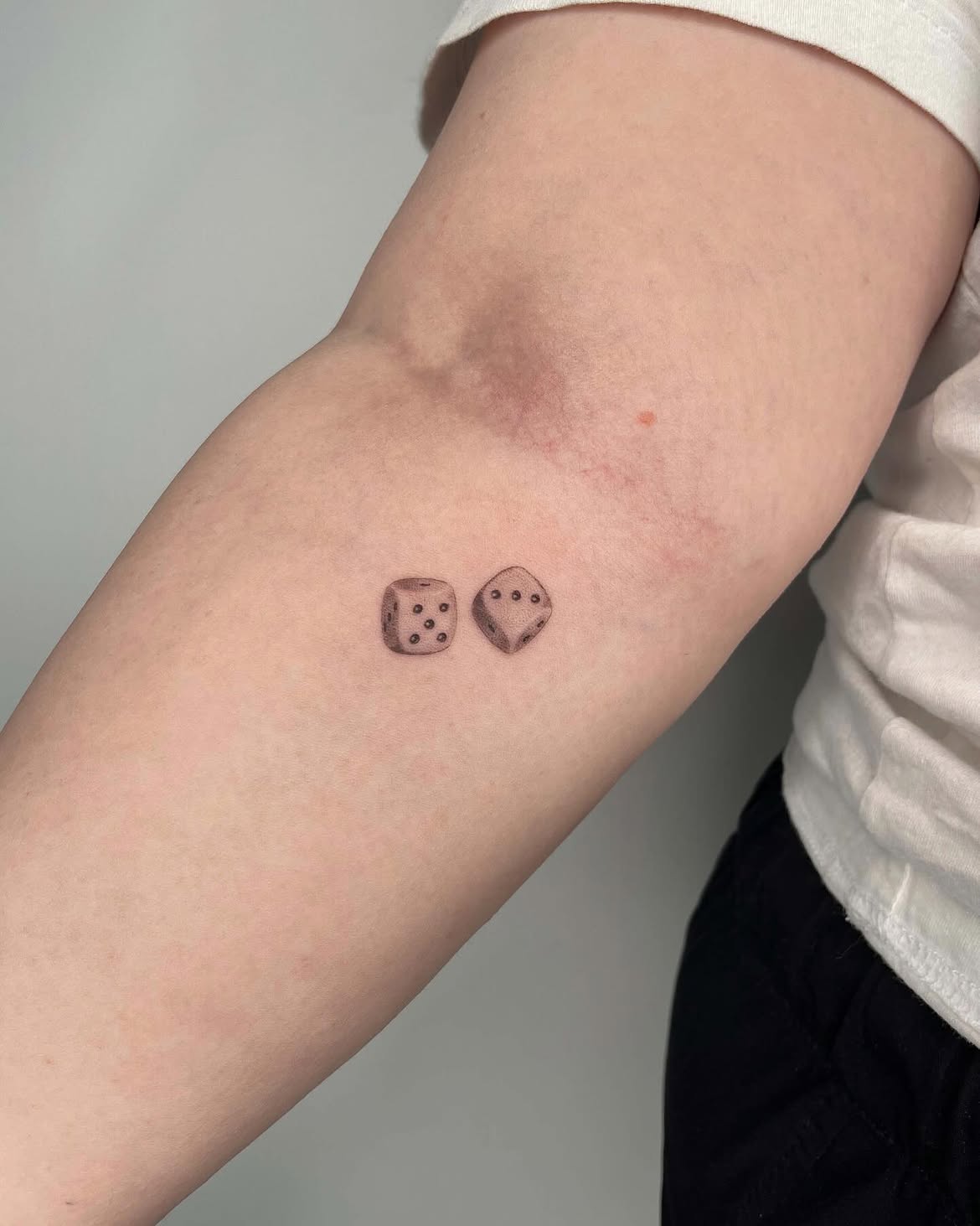
This small pair takes the minimalist route but avoids looking flat. Both dice are rendered with soft gray shading, rounded edges, and tiny dark pips, giving them the character of well-used game pieces rather than perfectly manufactured cubes. The slightly different angles are important: they suggest two dice that have just landed instead of a static geometric symbol.
The compact placement makes this an appealing option for anyone who wants a Lucky motif without committing to a large Traditional composition. There is enough tonal work to establish dimension, yet the Design remains quiet and understated. It could work equally naturally for men or for women, particularly for someone drawn to micro realism and subtle black-and-gray tattoos.
One detail worth borrowing from this idea is the breathing room around the dice. Nothing competes with the forms, so even at this modest scale they remain immediately recognizable.
Floating Dice with a Realistic Drop Shadow
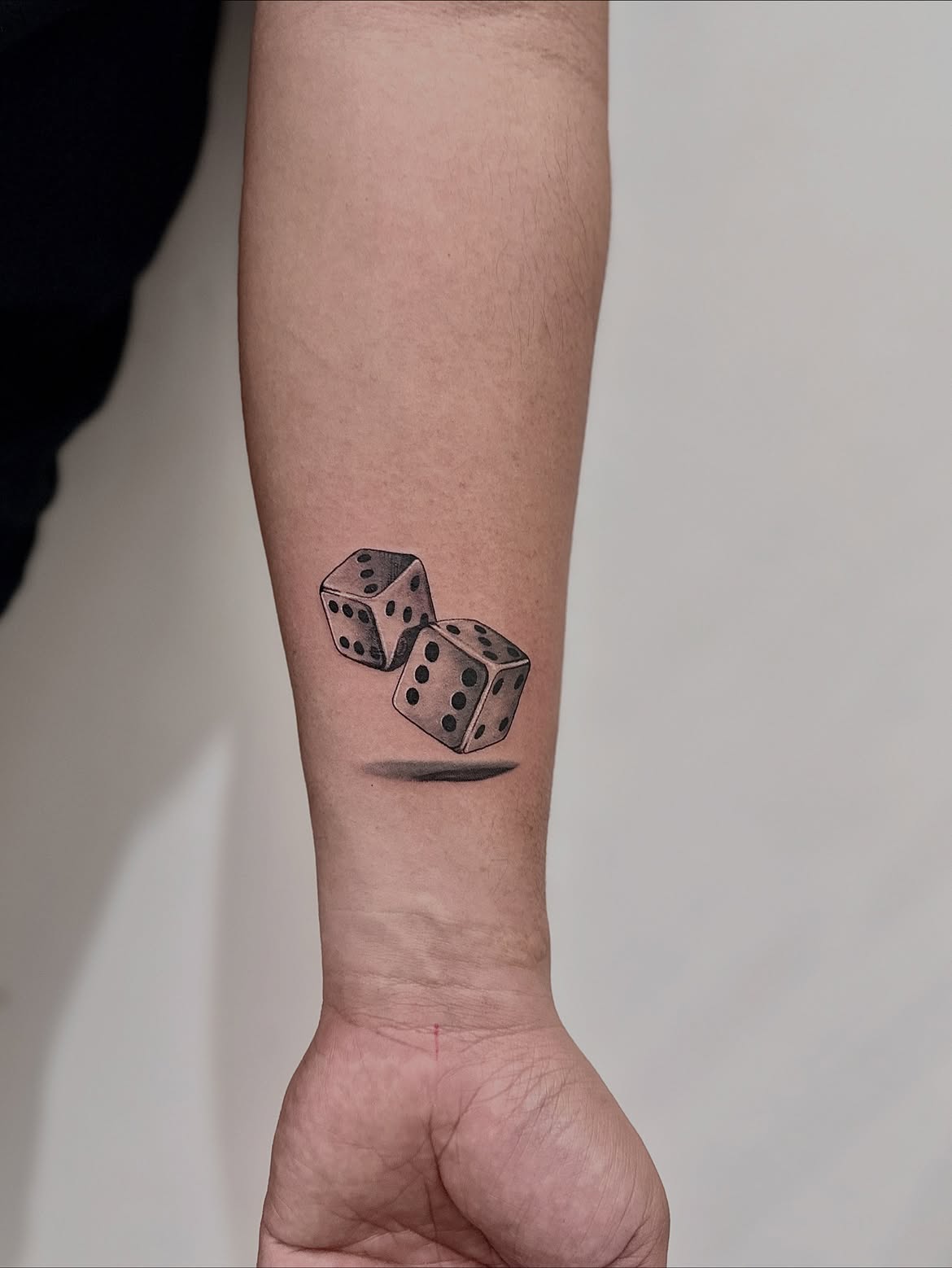
This design captures a moment rather than simply depicting an object. Two dice appear suspended above a narrow shadow, as though they are still bouncing after a roll. That little illusion of movement gives an otherwise classic subject a surprisingly contemporary feel.
The artist uses stronger black outlines around the cubes, deep stippling on selected faces, and large circular pips. Beneath them, the blurred horizontal shadow provides the visual trick that makes the dice seem airborne. It is an effective example of how one small additional element can transform familiar dice tattoo ideas.
The symbolism fits the composition beautifully. Dice already represent uncertainty, and showing them before they have fully settled emphasizes that feeling of an outcome still being decided. Someone interested in a design for men could scale this concept up, while a smaller version would retain much of the same impact.
It is also a useful alternative for people who like gambling imagery but do not necessarily want cards, 777, flames, or other overt casino references.
Cards and Dice Gambling Sleeve Design
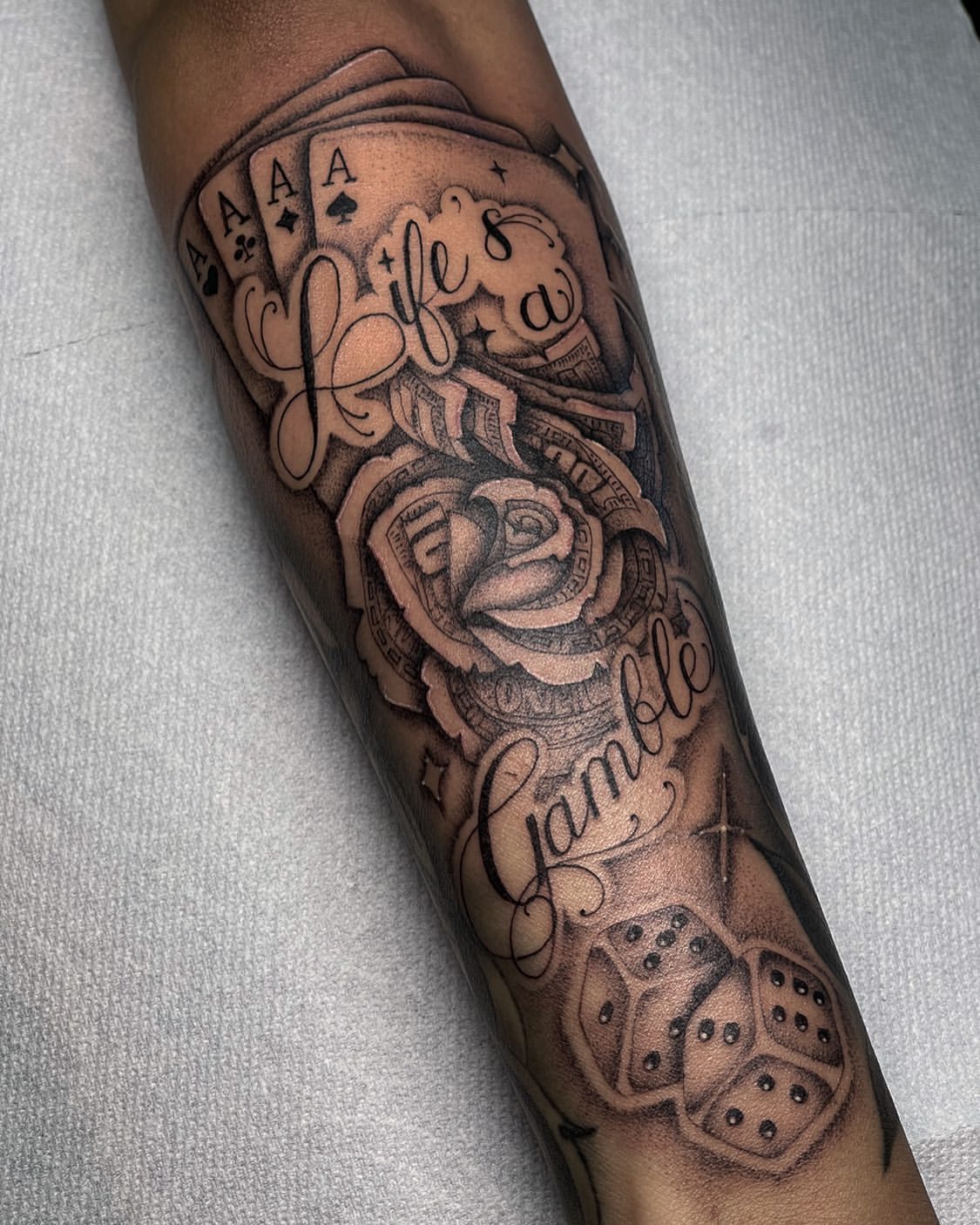
This is the most elaborate gambling-themed composition in the collection. Instead of treating dice as an isolated symbol, the artist builds an entire black-and-gray sleeve-style narrative around risk and chance. Playing cards, money, lettering, a rose, decorative highlights, and multiple dice are layered together into a dense vertical arrangement.
The Cards and dice combination feels particularly natural because the imagery shares the same visual language. A row of aces establishes the casino theme at the top, while the dice near the lower portion provide a heavier geometric counterpoint. Between them, the rose softens the composition and prevents the design from becoming a simple collection of gambling objects.
The script lettering is equally important. Its sweeping curves contrast with the hard edges of the cards and dice, creating movement through the arm. Dark shading fills the spaces between major elements so the whole tattoo reads as one connected piece rather than separate flash designs.
For anyone researching a substantial sleeve or design men inspiration, this demonstrates the value of planning the entire composition before tattooing individual motifs. Large pieces need rhythm: detailed areas, dark passages, recognizable focal points, and enough variation to keep the eye moving.
Blackwork Dice with Tiny Stars
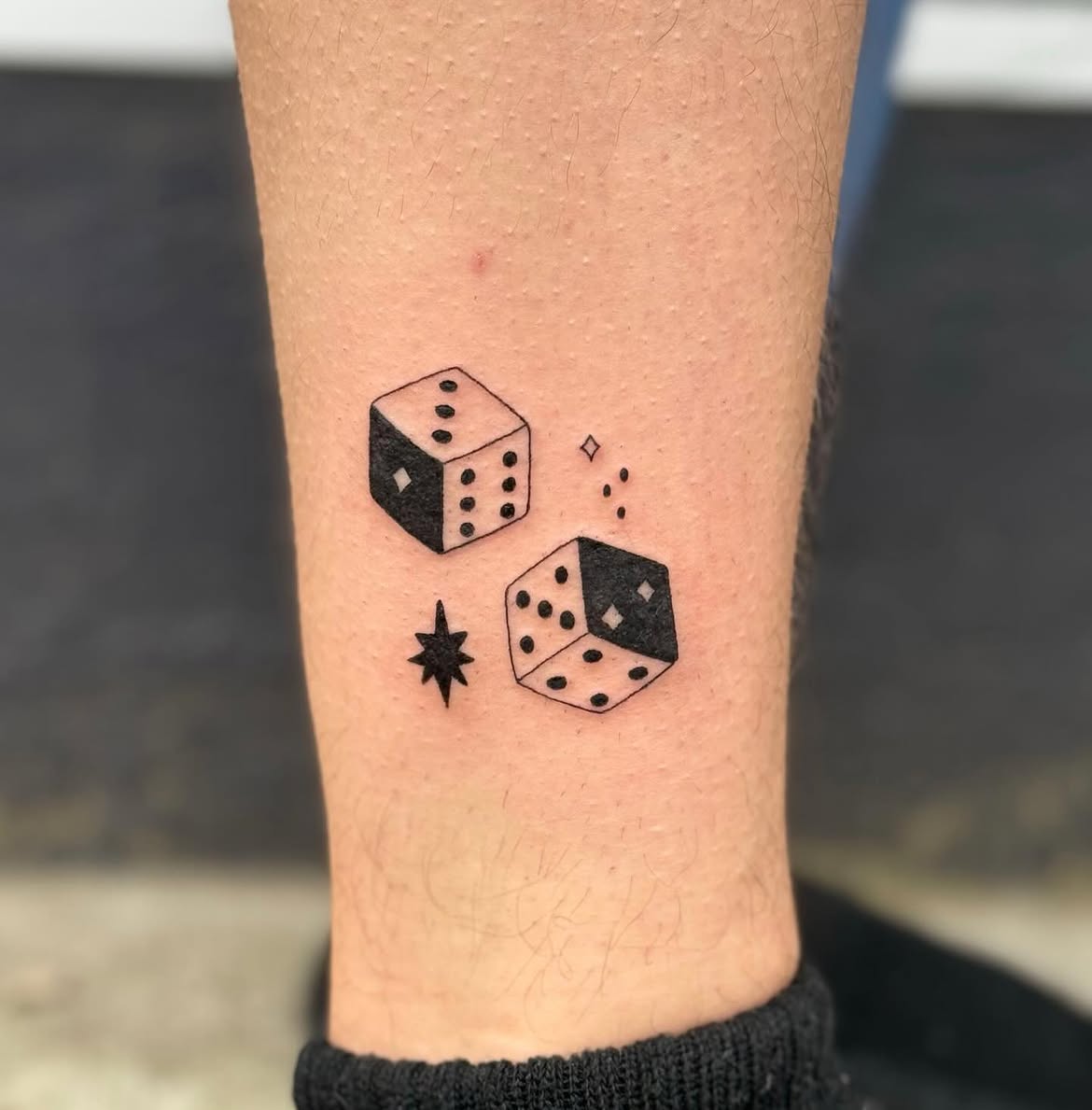
Here the artist takes a graphic approach, combining two dice with small celestial accents. Selected faces are filled completely with black, while tiny diamond-shaped openings interrupt the solid ink. The remaining faces stay largely unshaded and use traditional black pips.
That alternating treatment creates a strong positive-and-negative-space effect. It feels cleaner than realism and more modern than American traditional flash, while still keeping the dice instantly recognizable.
The little star and diamond accents are especially effective. They suggest luck and sparkle without resorting to literal casino imagery. I have always found that small decorative marks can make simple tattoo designs feel more intentional; the trick is knowing when to stop. Here, only a few are needed.
This Design would be easy to adapt into a larger patchwork sleeve because the strong black areas can visually connect with other blackwork tattoos. It is equally convincing as a standalone piece because the asymmetrical arrangement already forms a complete composition.
Flaming Die with Bold Black-and-Gray Shading
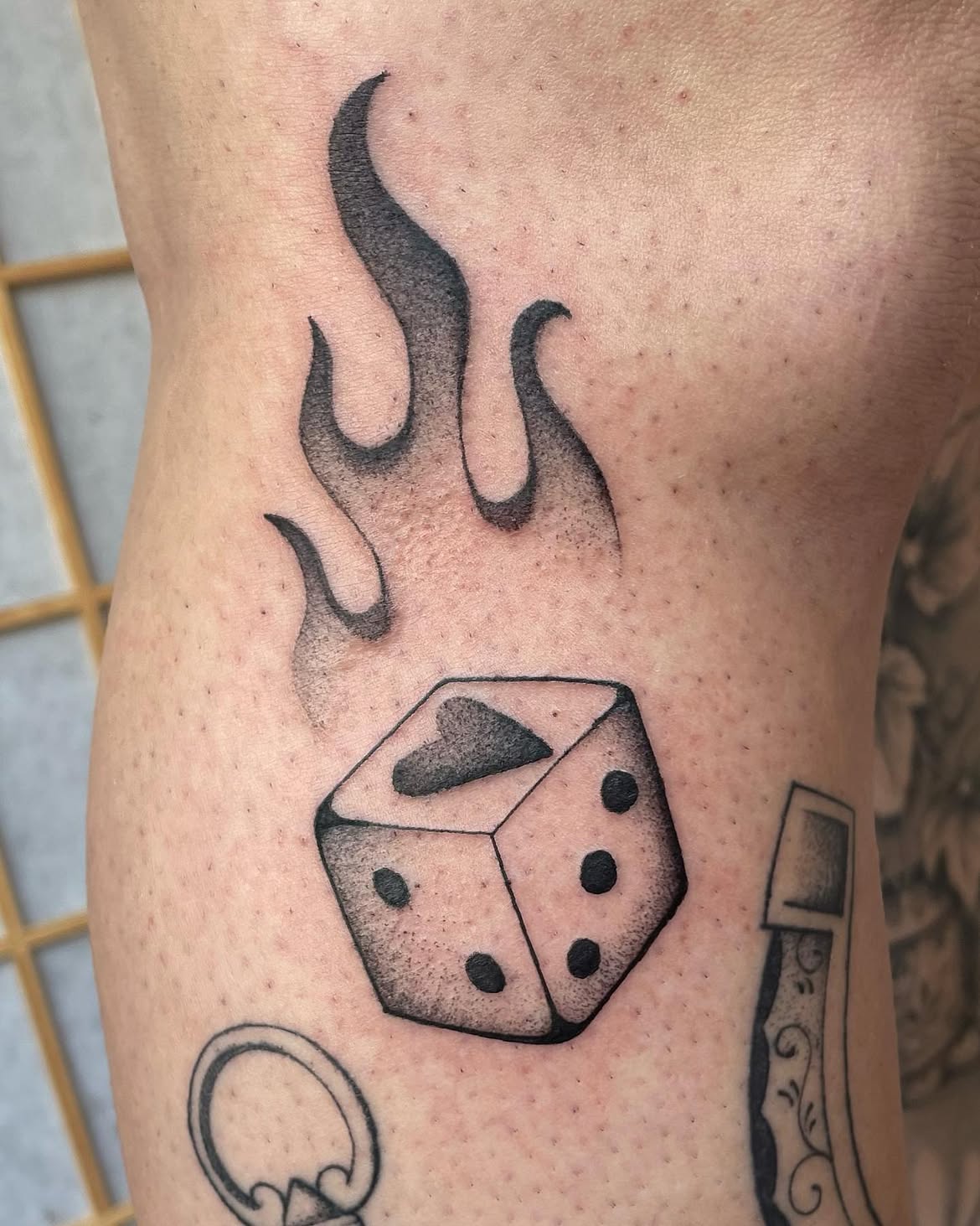
A single die becomes considerably more aggressive when paired with stylized flames. Rather than using the bright Red, orange, and yellow palette often associated with Flaming American traditional tattoos, this version stays entirely in black and gray.
The die itself is large enough for each face to receive individual tonal treatment. Dotwork and soft gradients give the cube weight, while the pips remain solid and graphic. Above it, long flame shapes taper into curved points. Their darker borders gradually dissolve into stippled shading toward the center.
The combination has an appealing contrast: the cube is solid and angular, while the flames are fluid and vertical. That difference creates movement without requiring additional symbols.
This could be an excellent starting point for a custom Stencil. A tattoo artist could keep the monochrome approach or push it toward a classic Traditional direction with Red flames. It could also become part of a broader lucky sleeve alongside cards, Cherry imagery, Snake eyes, or 777 symbolism.
Dramatic Dice with Sparkles and Smoky Dotwork
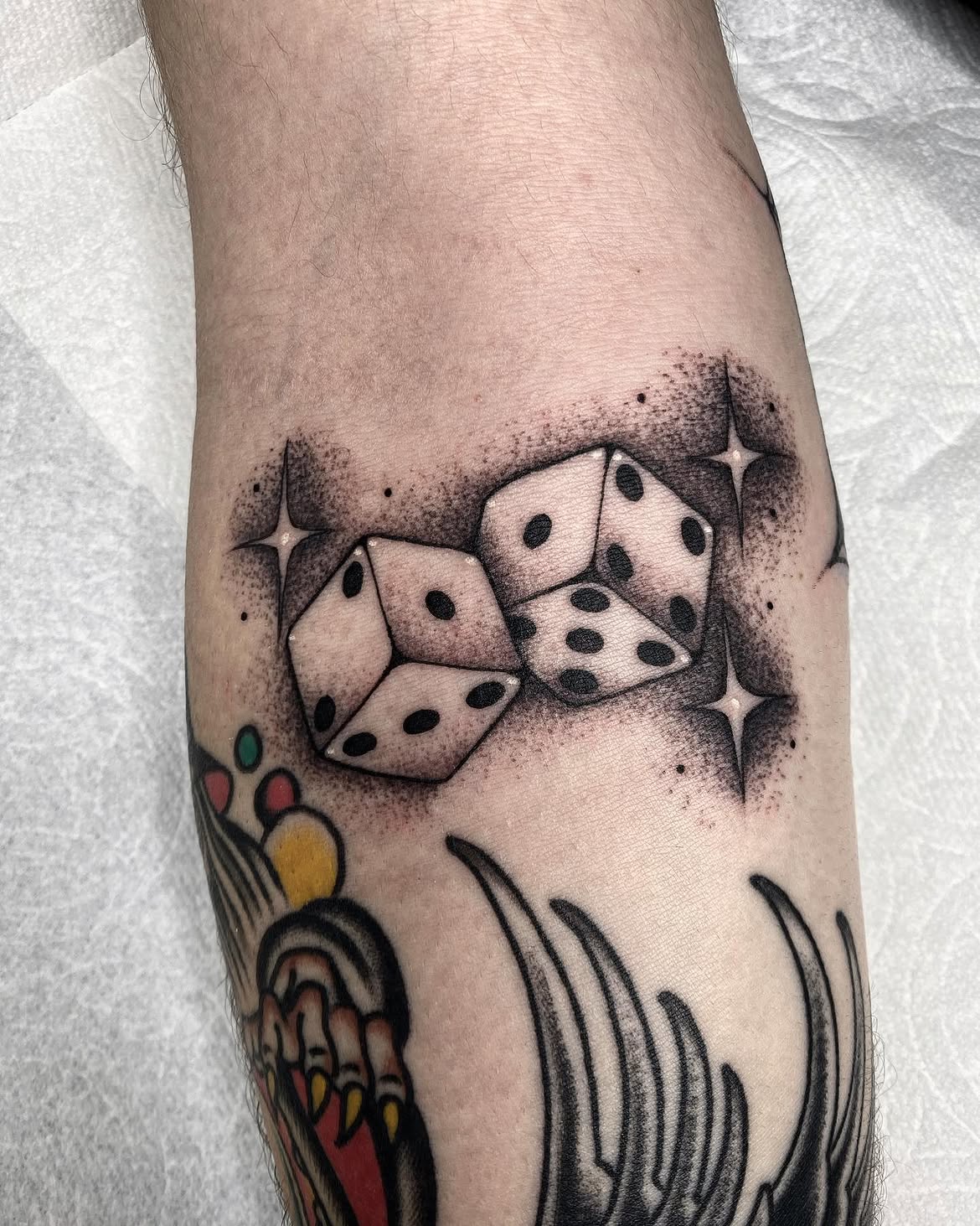
These two dice feel almost cinematic. Strong perspective makes them appear to tumble toward the viewer, while the surrounding dark stippling produces a smoky halo. Four-point starbursts punctuate that background and introduce bright pockets of negative space.
What makes the Design memorable is its depth. The front faces remain relatively light, the sides transition through soft gray shading, and the background becomes considerably darker. This layered contrast visually pulls the dice forward.
It is a smart technique for integrating a new tattoo into an existing collection as well. The irregular stippled border does not create a hard frame, so the composition can gradually merge into neighboring work if the wearer develops the area into a sleeve.
The overall mood sits somewhere between realistic and illustrative. It lacks the thick color blocks of American traditional work, but it is more dramatic than minimalist fine line. For men or women who want recognizable dice without a conventional casino aesthetic, this middle ground offers plenty of possibilities.
Heart Dice with a Hidden Number 13
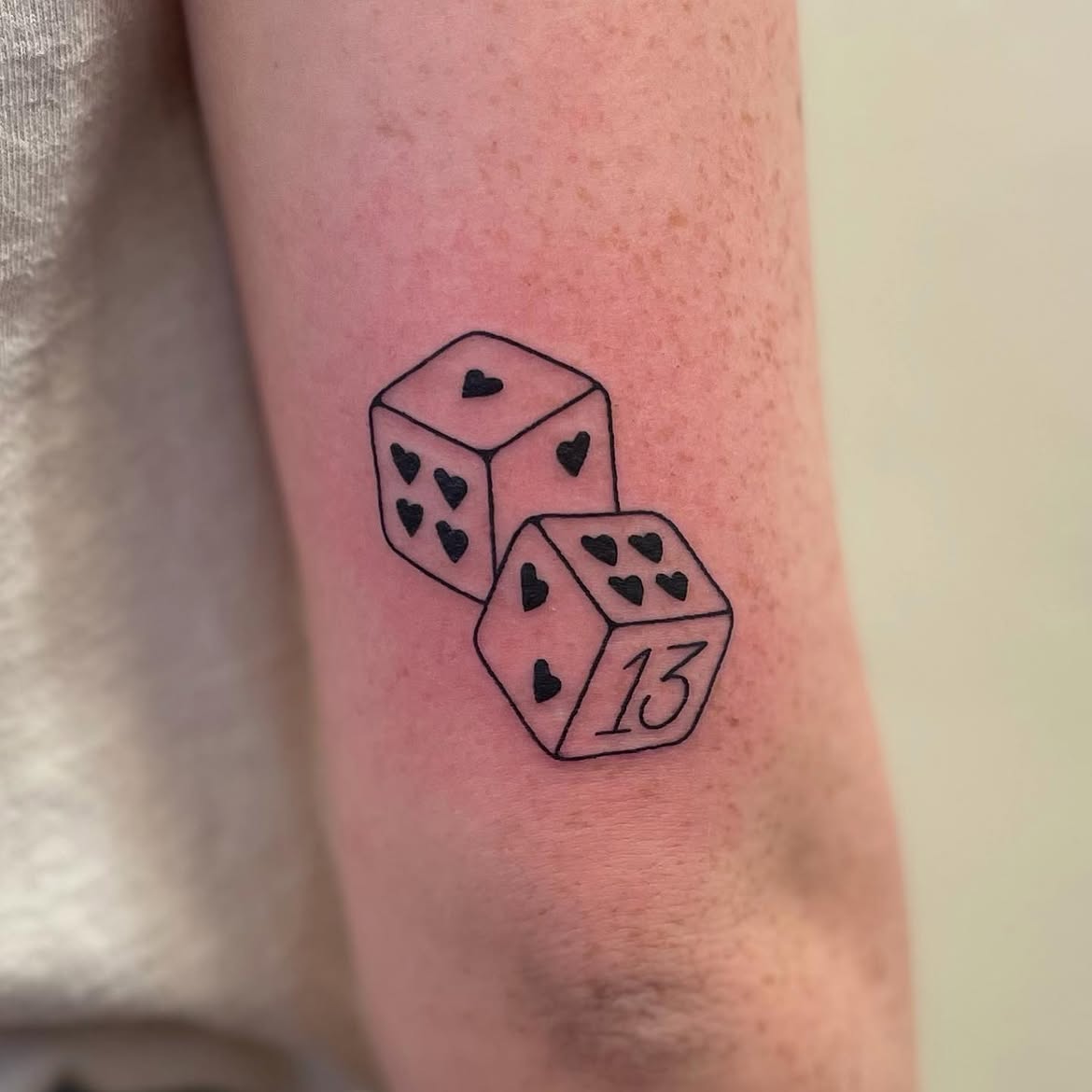
This pair turns the usual concept of Lucky numbers on its head. Heart-shaped pips decorate both dice, while one visible face replaces the expected dots with the number 13. The result plays with two ideas that are often treated as opposites: love and bad luck.
That contradiction gives the tattoo personality. Thirteen has long carried associations with superstition, while dice naturally belong to the visual world of chance. Putting the number directly onto a die makes the symbolism deliberate, but the Heart details keep the piece playful rather than ominous.
The execution is refreshingly straightforward. Clean black outlines define the cubes, solid black hearts provide contrast, and there is virtually no shading. Because the design relies on linework rather than texture, every symbolic detail is easy to read.
Four Dice with Fine Shading and Sparkle Details
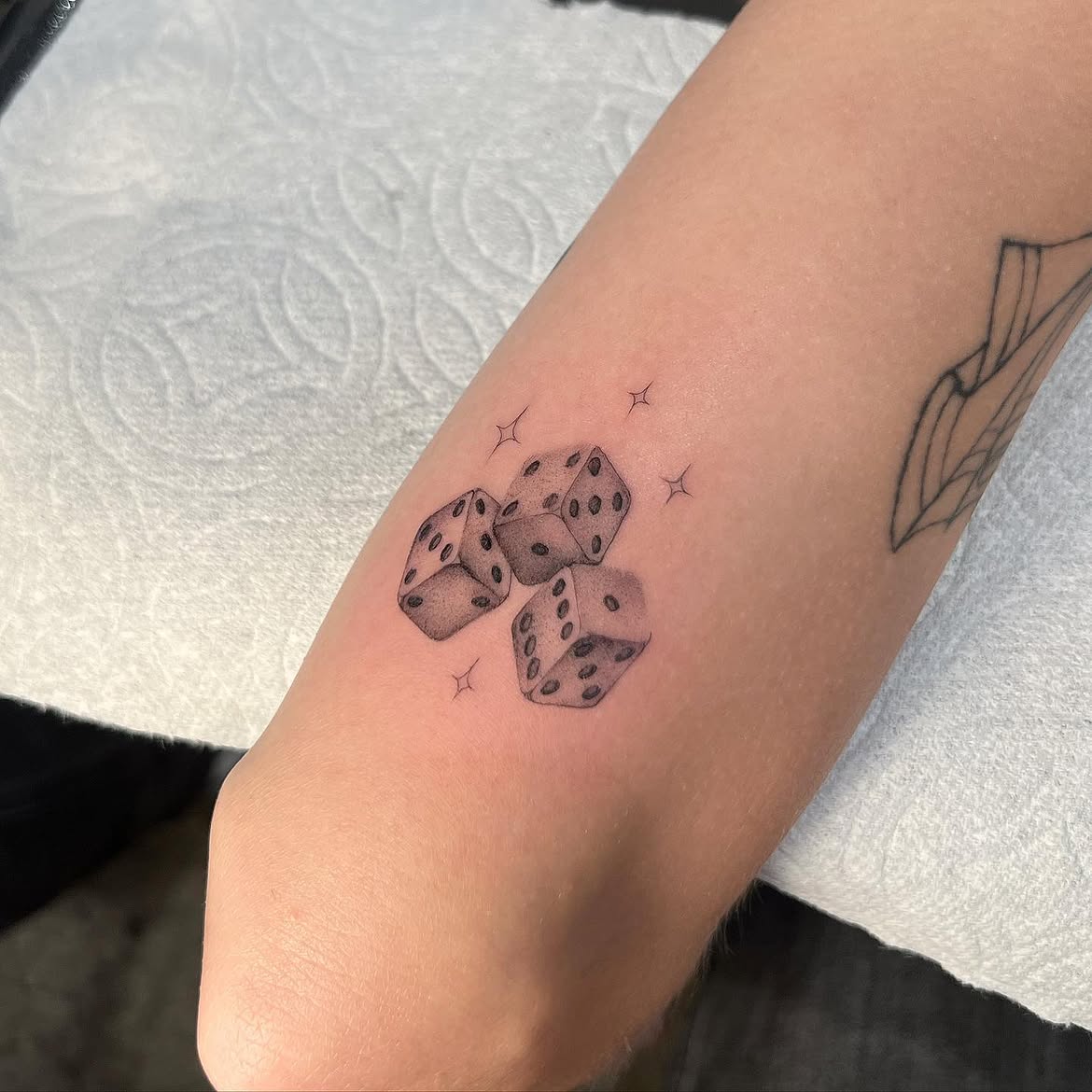
Four dice create a busier composition than the paired designs we have seen so far, but the artist keeps the result surprisingly light. Each cube sits at a slightly different angle, giving the group the scattered quality of dice that have just finished rolling. Instead of arranging everything into a rigid square, the overlapping forms produce natural movement.
Fine black outlines establish the geometry, while soft stippling and gray shading separate the individual faces. The pips are dark enough to remain readable without overpowering the delicate treatment. Several tiny four-point sparkles surround the group, reinforcing the Lucky theme and filling otherwise awkward negative spaces.
I like this approach for a patchwork collection because four dice create a substantial focal point without requiring a heavy frame. It could also be customized through meaningful numbers: 3, a birthday combination, Snake eyes, or another personal sequence could make an otherwise decorative Design much more individual.
Flaming Heart Dice in Red and Black
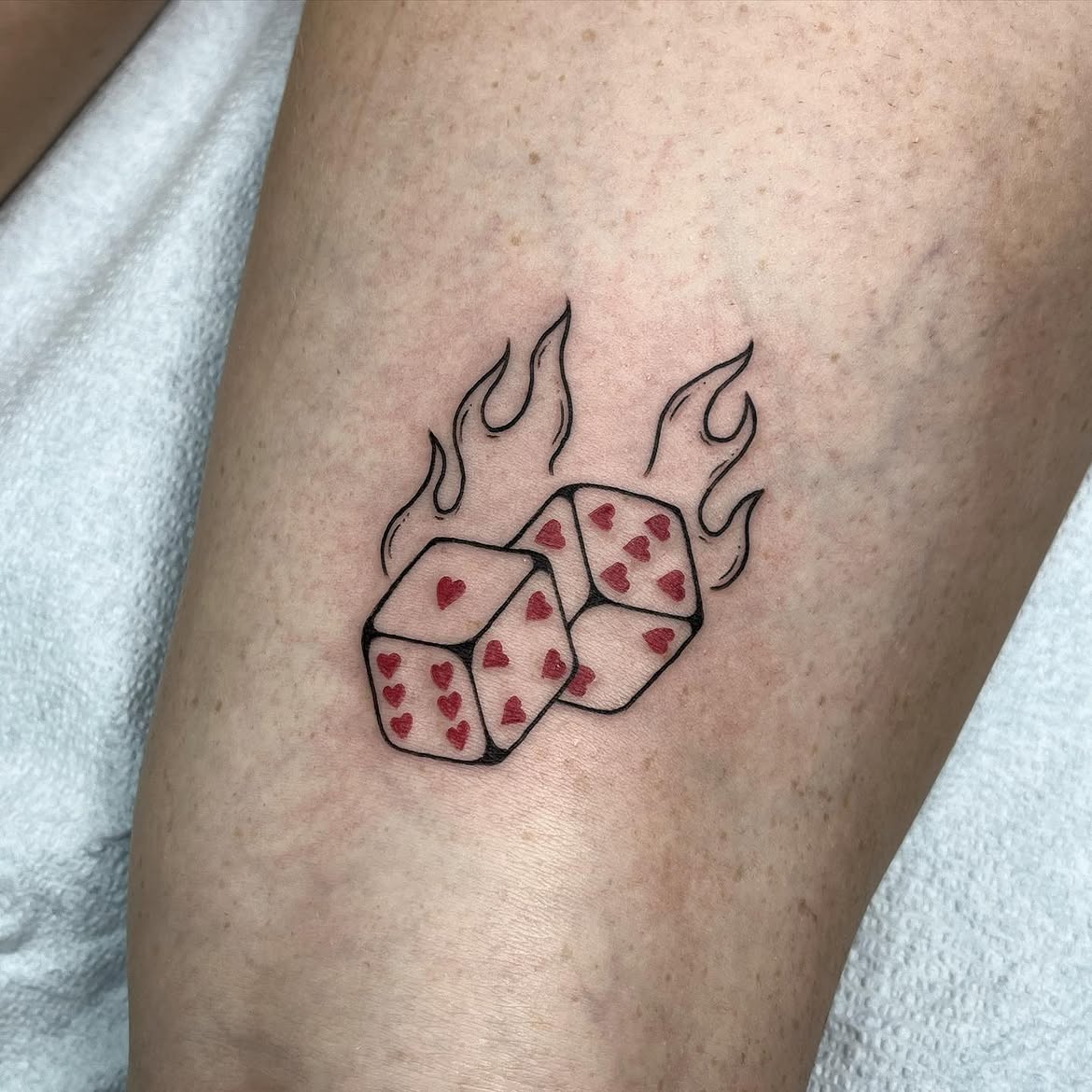
This design combines three recurring tattoo motifs—dice, Heart symbols, and flames—without making the composition excessively complicated. Two cubes overlap at the center, their conventional circular pips replaced entirely by small Red hearts. Behind them, clean black flames rise upward and frame the pair.
The restrained color palette is what makes the tattoo work. Red appears only inside the hearts, while black defines the dice and Flaming outline. Because the flames remain unfilled, they create energy without stealing attention from the central objects.
There is also an appealing tension in the symbolism. Dice traditionally suggest chance, while hearts immediately introduce love and emotion. Together, they can read as taking a chance on someone, falling recklessly in love, or simply accepting that relationships never come with guaranteed outcomes.
For women or men looking for romantic dice tattoo ideas that do not feel overly delicate, this is a strong direction. Filling the flames with Red or orange would move it closer to American traditional flash, while leaving them open preserves the lighter illustrative character.
Polished Realistic Dice with Metallic Depth
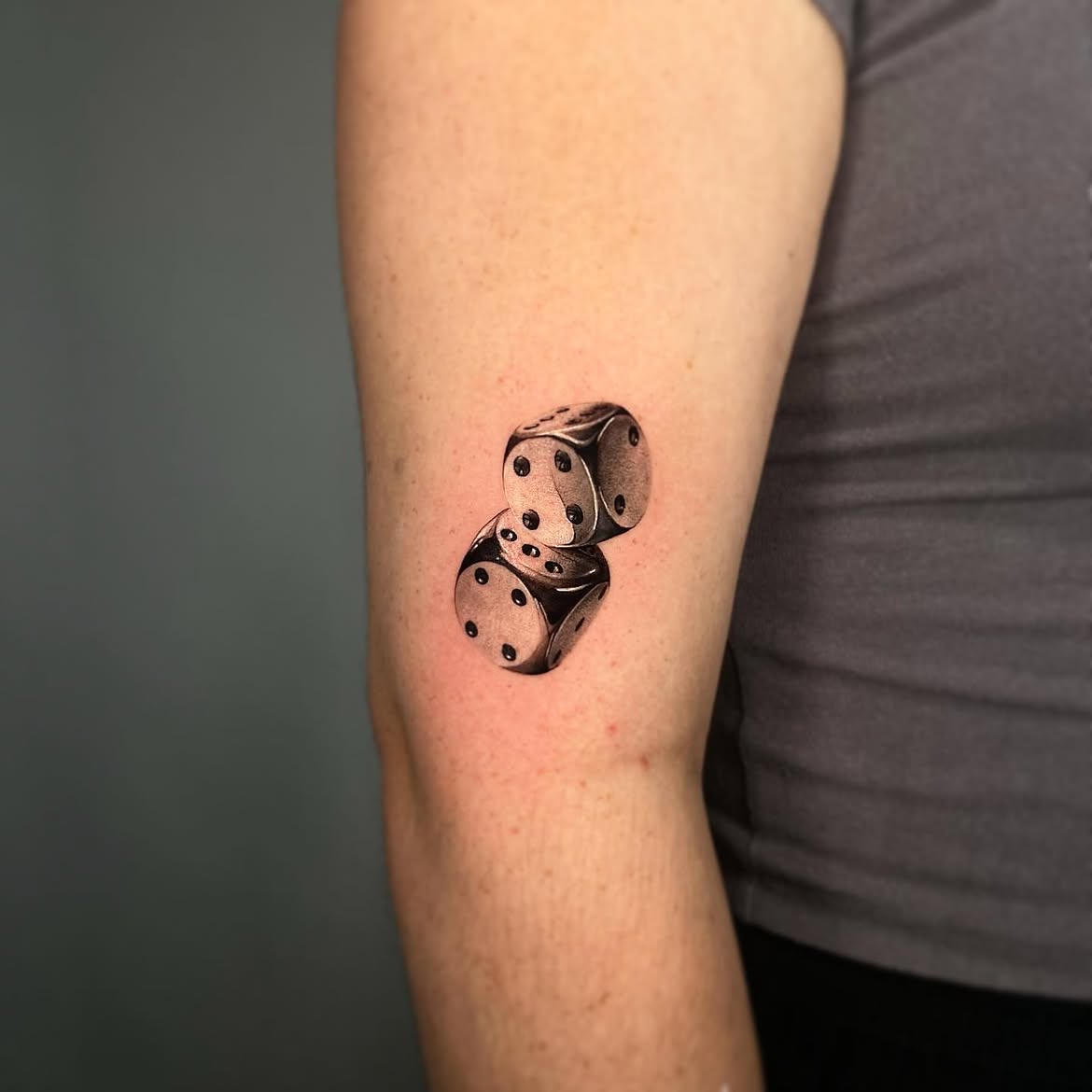
These two dice take realism much further. Rounded corners, glossy highlights, deep shadows, and smooth tonal transitions make them resemble polished physical objects rather than drawn symbols. The darker sides create convincing depth, while small highlights around the edges suggest a reflective surface.
The cubes overlap vertically, producing a compact silhouette that works particularly well on the arm. There is no flame, lettering, cards, or decorative background; virtually all the visual interest comes from the rendering itself.
That restraint is useful when considering design ideas for men who prefer realism over Traditional tattoo language. The motif can remain relatively small while still carrying enough tonal contrast to command attention. It could also become the starting point of a larger gambling sleeve later, with cards and money, a 777 symbol, or other lucky imagery added around it.
This is the kind of tattoo where scale matters. Realistic highlights and gradients need enough room to remain distinct, so preserving the artist’s tonal detail is more important than making the design as tiny as possible.
Dice in a Black-and-Gray Patchwork Collection
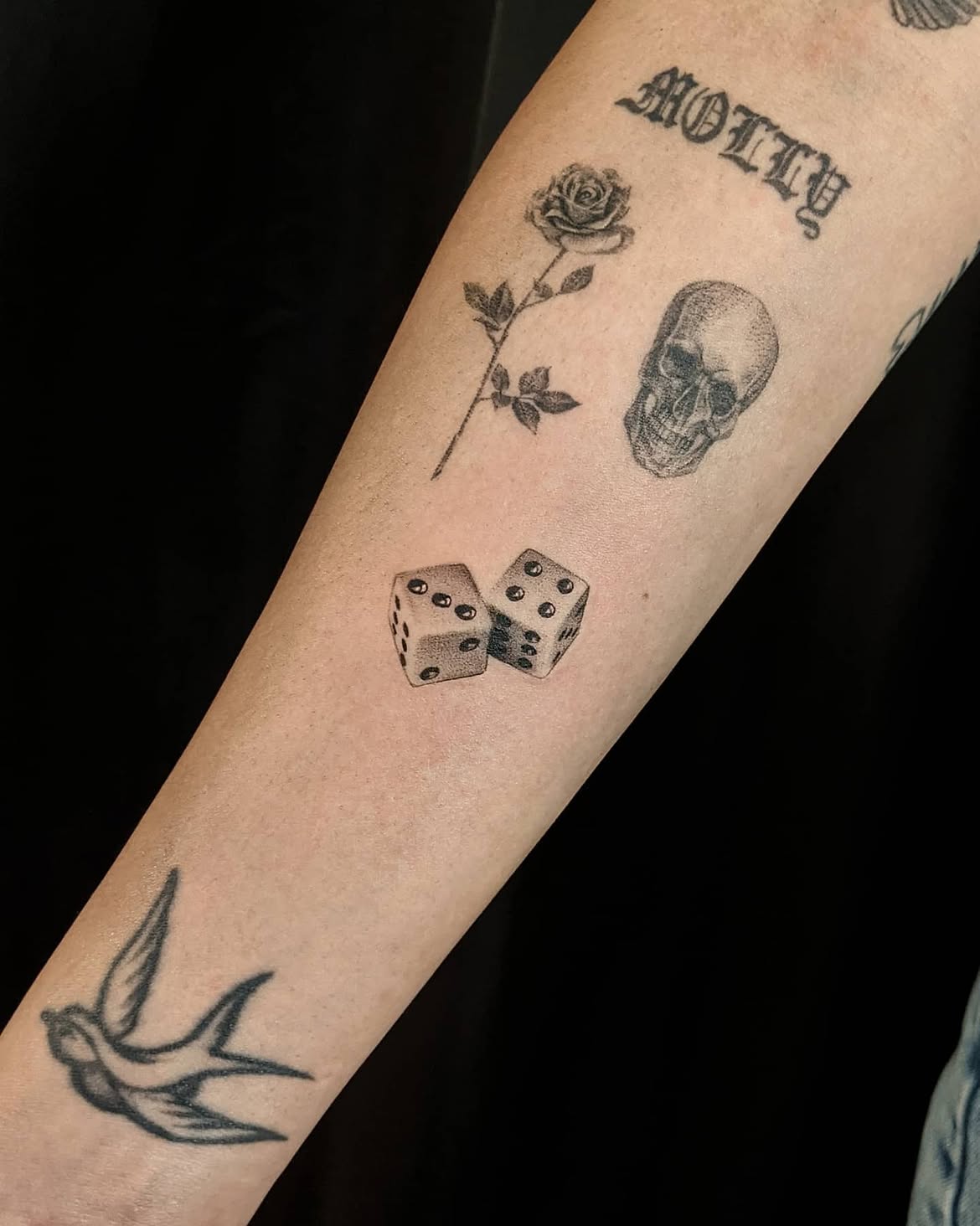
Here, the dice are part of a broader patchwork vocabulary rather than the dominant element. A pair of softly shaded cubes sits among other independent black-and-gray tattoos, demonstrating how naturally dice can function as filler between established pieces.
The design itself is understated. Thin outlines define the cubes, stippled shading gives the sides dimension, and dark oval pips supply contrast. The dice are positioned close together but not perfectly aligned, which makes them look casually thrown rather than carefully stacked.
For anyone gradually building a sleeve, this is a useful lesson in scale. Not every addition needs to become the main attraction. Small dice can occupy an irregular gap and still introduce their own symbolism of luck, uncertainty, and risk.
Their neutral black-and-gray treatment also makes them easy to combine with many styles. A rose, skull, swallow, lettering, Cherry motif, or small Traditional flash piece can sit nearby without creating a color conflict. That adaptability is one reason dice continue to work so well in patchwork tattooing.
Colorful Heart Dice with a Retro Flash Feel
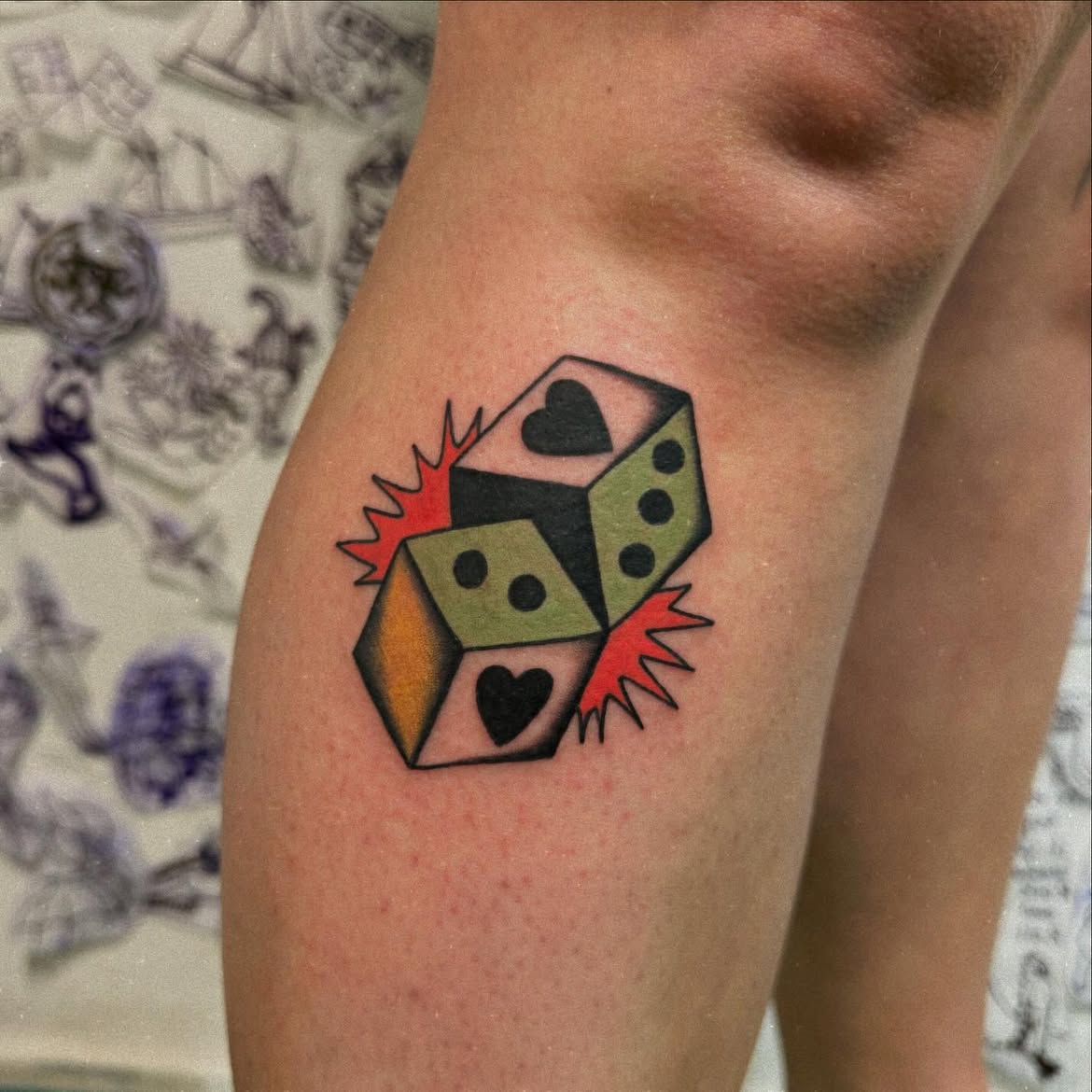
This pair has an entirely different personality from the realistic black-and-gray examples. Thick black outlines, blocks of muted green and warm orange, pink surfaces, Red burst shapes, and black Heart symbols create a playful retro aesthetic.
The dice overlap tightly, but each visible face uses a different color or graphic treatment. That prevents the cubes from visually blending together. Black areas provide weight, while the bright red accents behind the dice give the composition an energetic flash-like outline.
There is something intentionally unconventional about the palette. Rather than reproducing standard white casino dice, the artist treats the cubes almost like pieces of pop-art illustration. It is an excellent reminder that a recognizable subject does not need realistic coloring.
This could inspire an American traditional-adjacent Design for someone who enjoys bold color but wants something less predictable than classic Red Flaming dice. The hearts keep the concept playful and romantic, making it equally adaptable for women, men, or matching tattoos.
Tiny Black-and-Gray Dice with Clean Linework
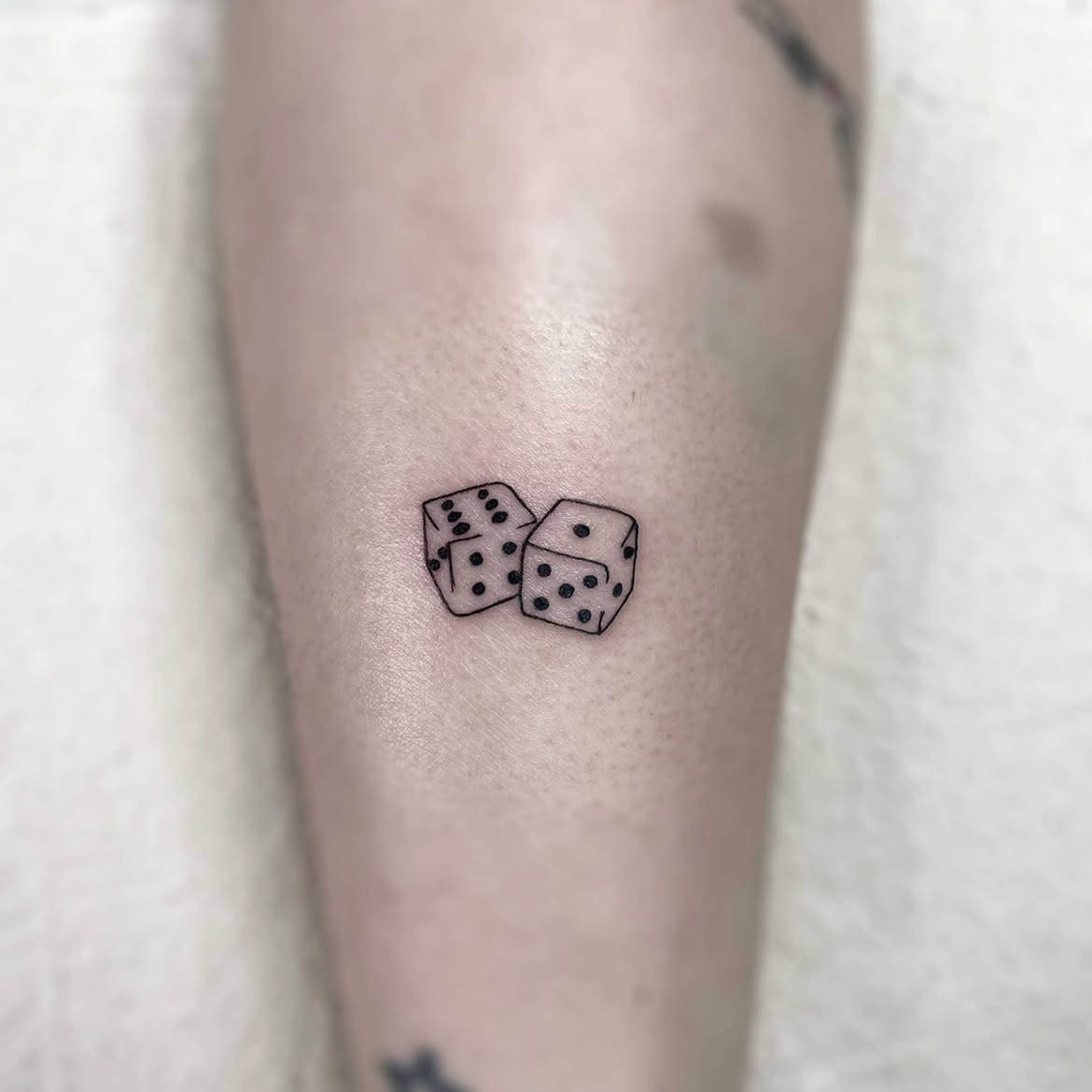
Two small dice sit side by side in a particularly clean minimalist composition. Their outlines are fine but clearly defined, while restrained gray shading creates just enough separation between the visible faces.
Unlike highly realistic micro tattoos, this Design does not attempt to reproduce every reflection or surface texture. Instead, it relies on simple perspective, dark pips, and a few carefully placed shadows. That makes the result feel more like a miniature ink drawing.
The size is especially appealing for someone seeking subtle dice tattoo ideas. It could fit naturally on an arm, ankle, or other relatively compact placement without requiring additional decorative elements. For women who prefer understated designs, this approach offers the symbolism of luck without the visual weight of a classic gambling tattoo.
It is also an easy concept to personalize through the visible numbers. Choosing a specific combination rather than leaving the faces random can quietly introduce a date, favorite number, or private reference without changing the overall minimalist appearance.
Contrasting Black and White Dice
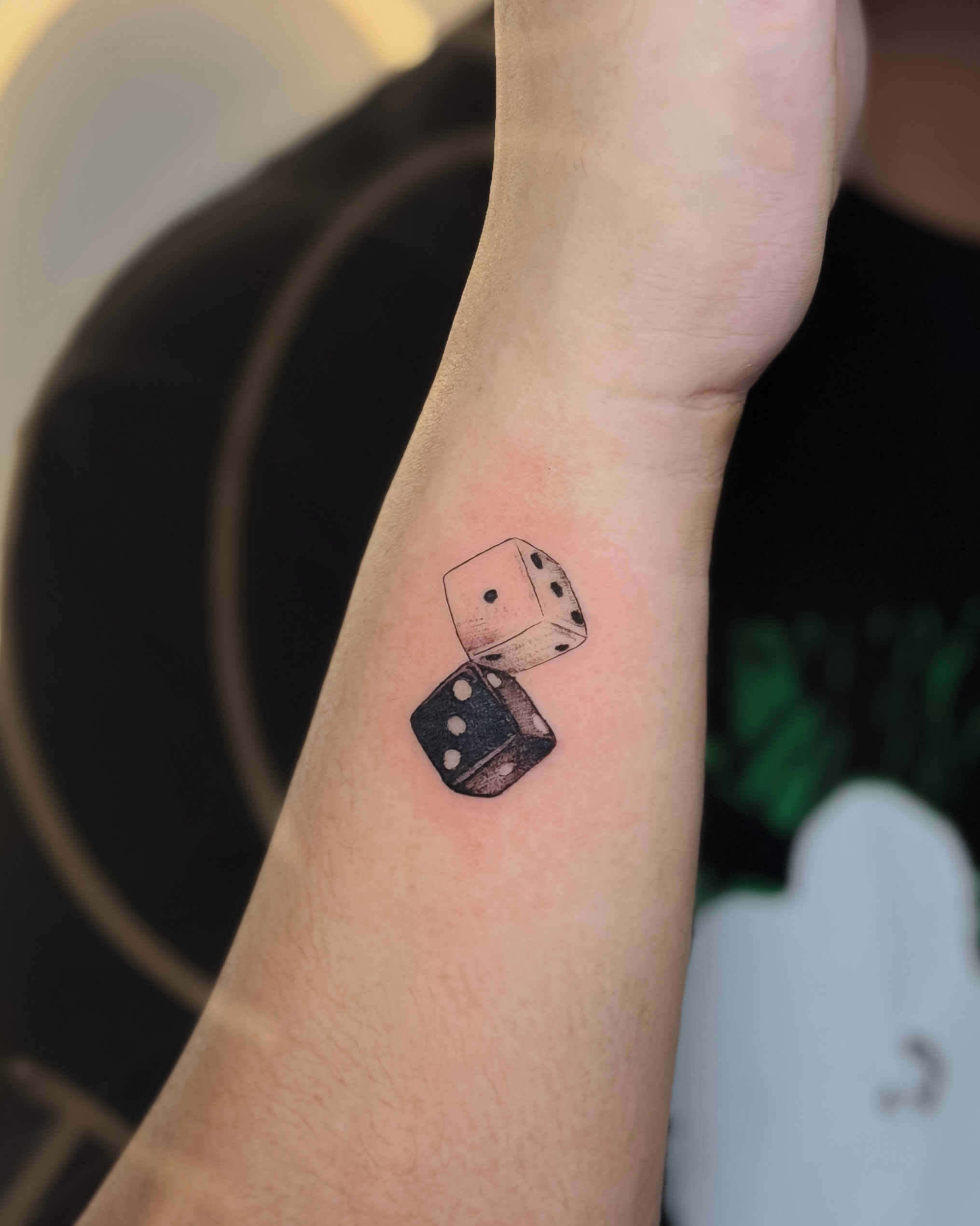
The final pair uses contrast as its main idea. One die remains mostly light with conventional dark pips, while the second is heavily filled with black and uses areas of untouched skin to create its markings. Placed together, they read almost like opposite versions of the same object.
That light-versus-dark relationship gives a very simple tattoo more conceptual depth. It can suggest chance taking two directions, good and bad luck, opposing personalities, or simply the graphic appeal of inversion. The slightly offset vertical arrangement keeps the cubes connected without making them appear mechanically stacked.
The black die also gives the composition a strong visual anchor. Because the second cube is much lighter, the pair remains balanced rather than becoming one dense block of ink. Fine texture and imperfect shading add a hand-drawn character that suits the modest scale.
As a Stencil idea, this could be customized easily. Snake eyes could reinforce a classic gambling reference, meaningful numbers could make the dice personal, or Heart-shaped pips could shift the symbolism toward relationships. It is simple, readable, and distinctive without relying on extra decoration.
Three Realistic Dice with Sparkling Accents
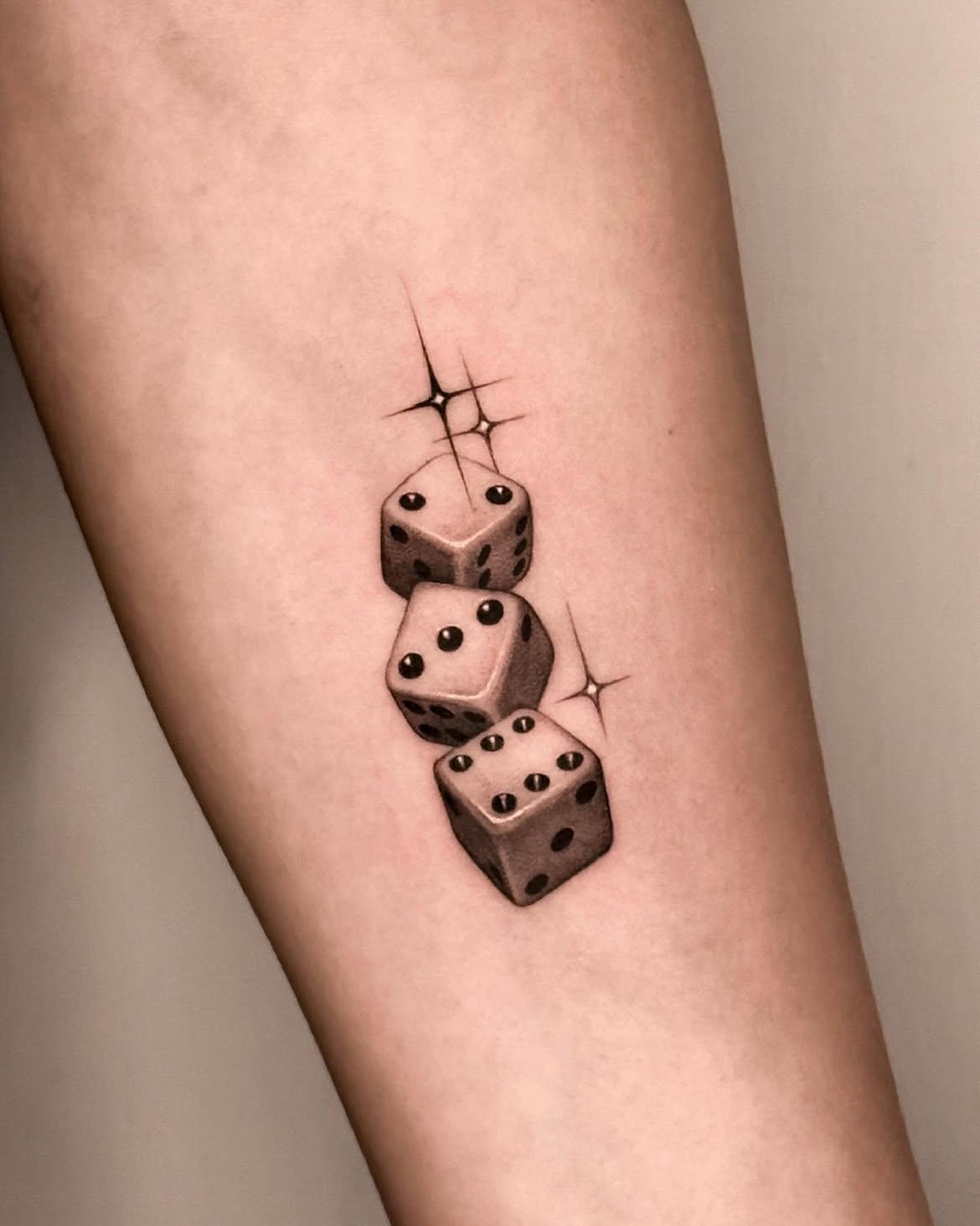
This tattoo features three dice arranged vertically along the arm, creating a compact composition with a clear sense of movement. Instead of looking perfectly geometric, the cubes have gently rounded corners and soft black-and-gray shading that gives them a slightly vintage, realistic character. Each die is positioned at a different angle, making the group resemble dice caught in the middle of a roll.
Small star-like sparkles appear above and beside the dice. Their sharp, elongated points contrast beautifully with the rounded cubes and add a subtle Lucky aesthetic. Dark glossy pips stand out against the lighter surfaces, while delicate gradients along the sides establish convincing depth.
This is a versatile option for someone who wants dice tattoo ideas with more detail than a minimalist Stencil but without the heaviness of a full gambling sleeve. The vertical arrangement is particularly suitable for the forearm or upper arm, where the design can follow the natural length of the body.
Heart Dice with Soft Black-and-Gray Shading
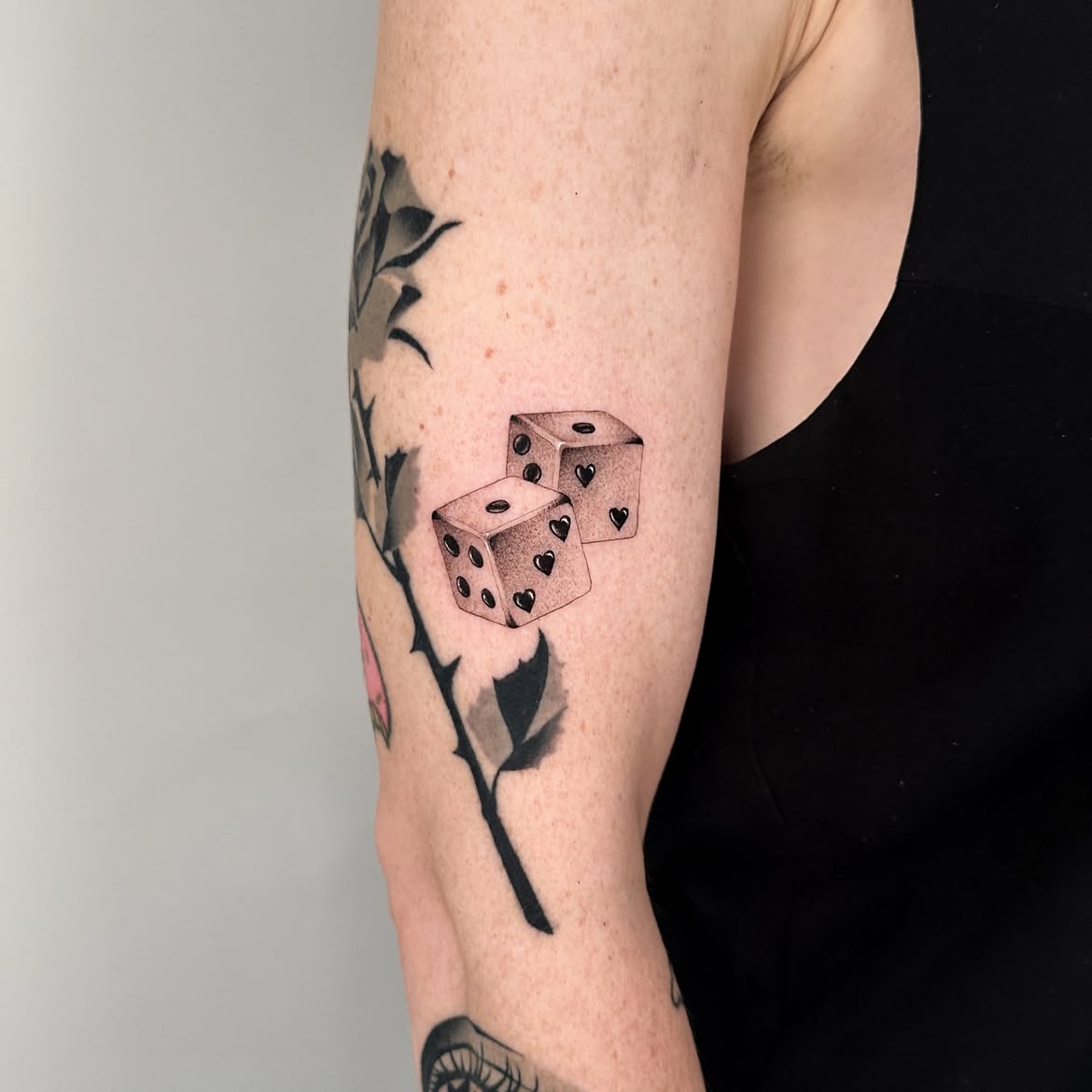
Two dice overlap on the upper arm in this romantic variation of the traditional gambling motif. Ordinary pips are mixed with small black Heart symbols, immediately giving the familiar cubes a softer and more personal identity.
The tattoo uses thin outlines and delicate stippled shading rather than heavy black fills. Subtle gradients around the edges make each cube dimensional while maintaining an airy appearance. The hearts themselves are small but dark, so they remain visible even from a distance.
Placement is especially effective here. The relatively small Design sits naturally among existing botanical tattoos without competing with them, showing how dice can become part of a larger patchwork arm collection.
The combination of love and chance gives the imagery an obvious symbolic possibility: relationships can involve risk, uncertainty, and trusting where life takes you. For women or anyone looking for less conventional Lucky dice imagery, replacing standard dots with hearts offers an easy way to personalize a classic subject.
Dramatic Dice with a Clover and Banner Symbol
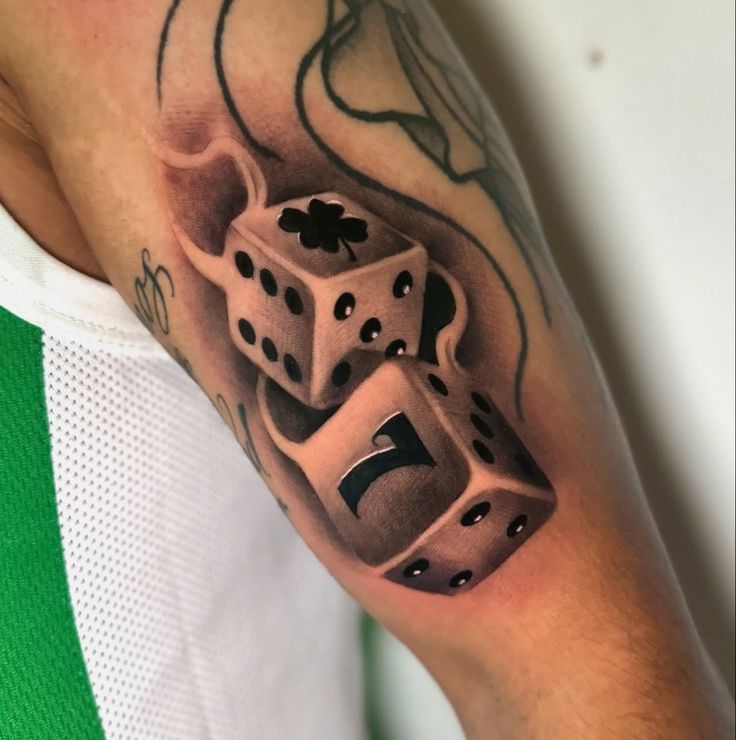
This black-and-gray piece moves in a much bolder direction. Two large dice overlap within a smoky, heavily shaded background, producing the depth and intensity associated with realistic gambling tattoos. Rounded edges, highlights, and deep shadows give the cubes substantial volume.
The upper die includes a black four-leaf clover, strengthening the Lucky symbolism. The lower cube replaces a conventional pip arrangement with a bold banner-like graphic, making the composition feel customized rather than based on standard casino dice.
The surrounding shading is particularly important. Soft black forms sweep around the dice and connect them visually with the larger arm tattoo, preventing the cubes from looking like isolated stickers. This technique would work especially well in a sleeve containing Cards, money, a Clock, rose, or other gambling imagery.
For men who prefer darker Design ideas, this demonstrates how simple dice can become the foundation of a much more dramatic composition.
Fine-Line Heart Dice with Tiny Sparkles
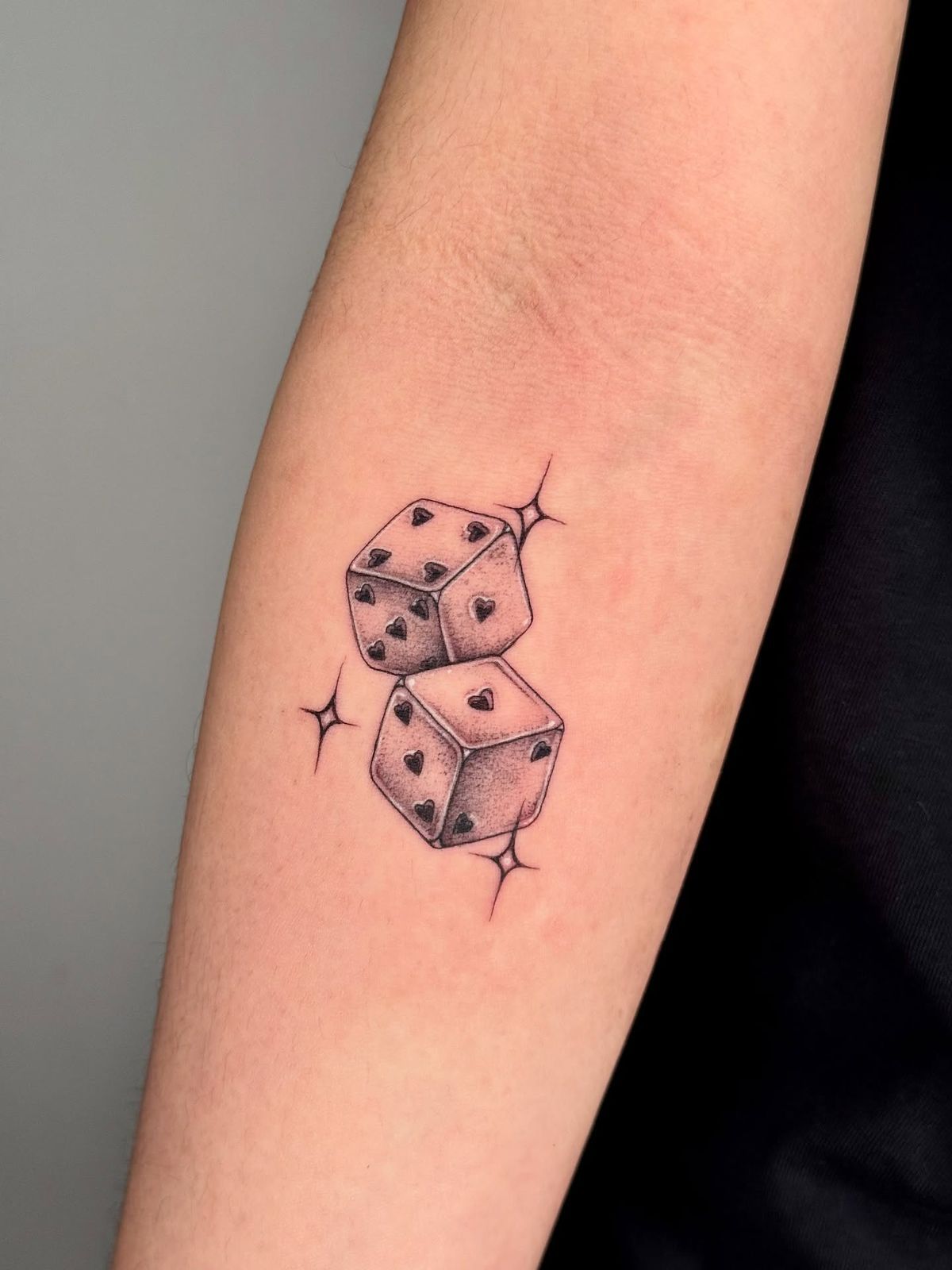
This design combines the delicacy of fine-line tattooing with the playful symbolism of Heart dice. Two cubes are arranged diagonally, with the upper die slightly overlapping the lower one. Rather than circular pips, every visible marking is shaped like a miniature black heart.
Fine stippling creates gentle gray texture across the surfaces, while narrow outlines preserve the lightweight appearance. Three small sparkles are positioned around the cubes, adding visual balance and giving the tattoo a charming, almost magical quality.
The design works particularly well as a small forearm tattoo because it remains detailed without requiring a large area. There is enough negative space around the individual elements for every heart and edge to remain readable.
Among dice tattoo ideas for women, this approach offers an interesting compromise between Cute and classic. The underlying subject still represents luck and risk, but the hearts transform it into something more romantic and personal.
Simple Upper Arm Dice Tattoo
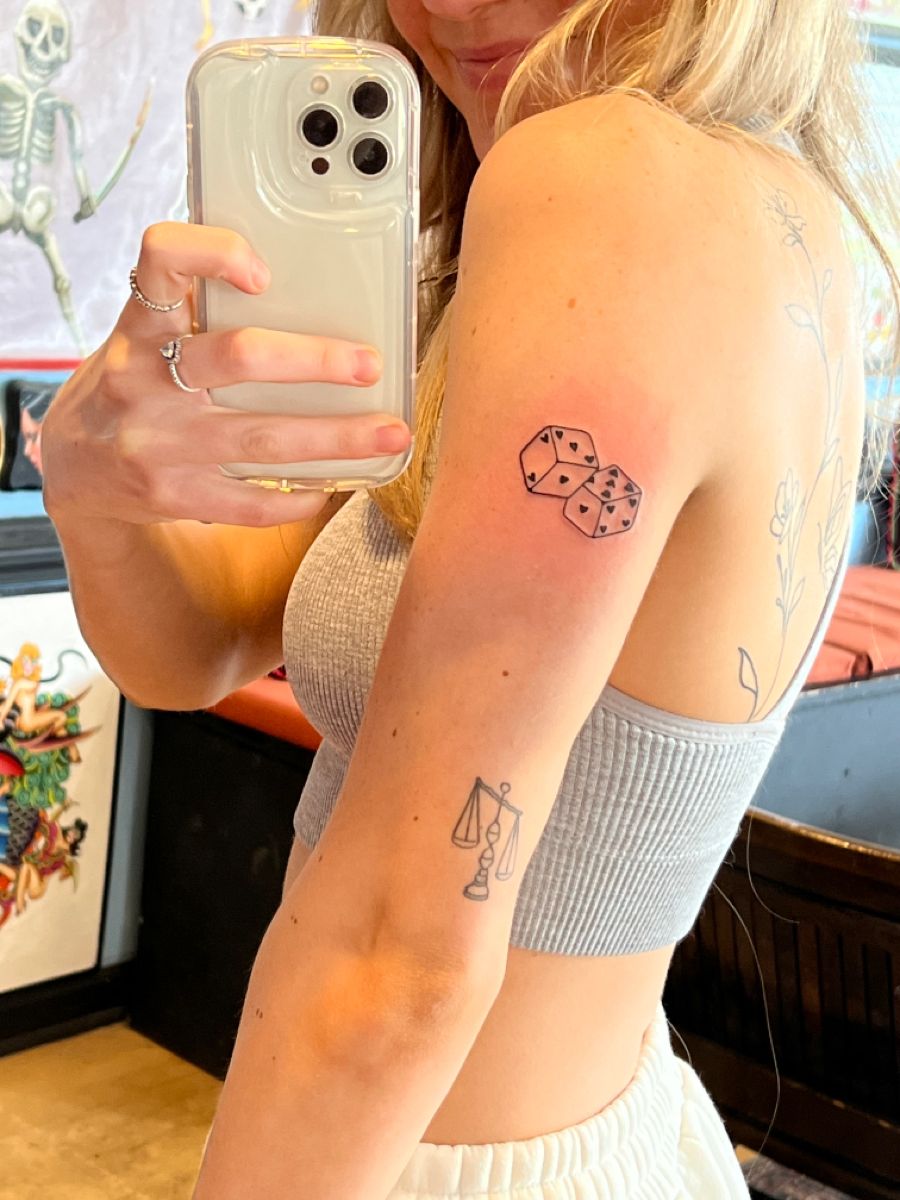
Two tiny dice form a straightforward upper-arm tattoo with an intentionally handmade appearance. The cubes overlap slightly and are drawn with uncomplicated black outlines, while small pips and minimal internal shading establish their three-dimensional shape.
What makes this example appealing is its restraint. There are no flames, Cards, roses, lettering, or dramatic shadows. The artist allows the recognizable silhouette of the dice to carry the entire Design. Because of that simplicity, the tattoo fits comfortably alongside other small fine-line pieces.
The upper arm also provides enough open space for the design to remain visible without becoming dominant. This can be particularly useful for anyone building a patchwork collection gradually.
A similar Stencil could easily be customized by changing the numbers on the visible faces. A birthday, Lucky 7 reference, Snake eyes combination, or numbers shared between two people could turn this understated design into a more personal tattoo.
Softly Shaded Dice Near the Wrist
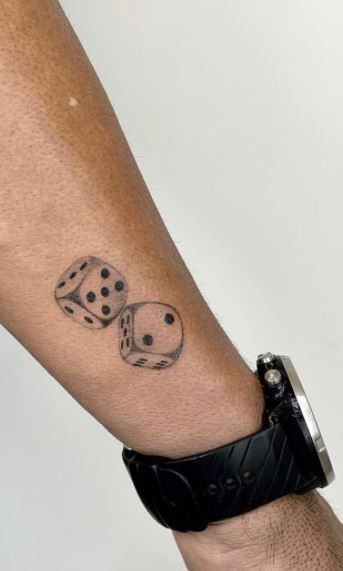
This pair of dice sits just above the wrist, using soft gray shading to create depth against the skin. The cubes are positioned close together but face different directions, making them look naturally scattered rather than carefully aligned.
The artist keeps the outlines relatively subtle. Instead of strong black borders, the dimensional effect comes primarily from gradual shading around the edges and beneath the visible faces. Dark pips provide the necessary contrast and keep the imagery readable at its small scale.
Placement near the watch line makes this an especially discreet option. The tattoo can remain visible when desired while still occupying a relatively compact area of the arm. Its black-and-gray palette also makes it easy to combine with future tattoos.
For someone exploring Small dice tattoo ideas, this example shows that realism does not necessarily require a large piece. Careful shading and perspective can give even a modest Design convincing dimension.
Minimal Fine-Line Dice with Plenty of Negative Space
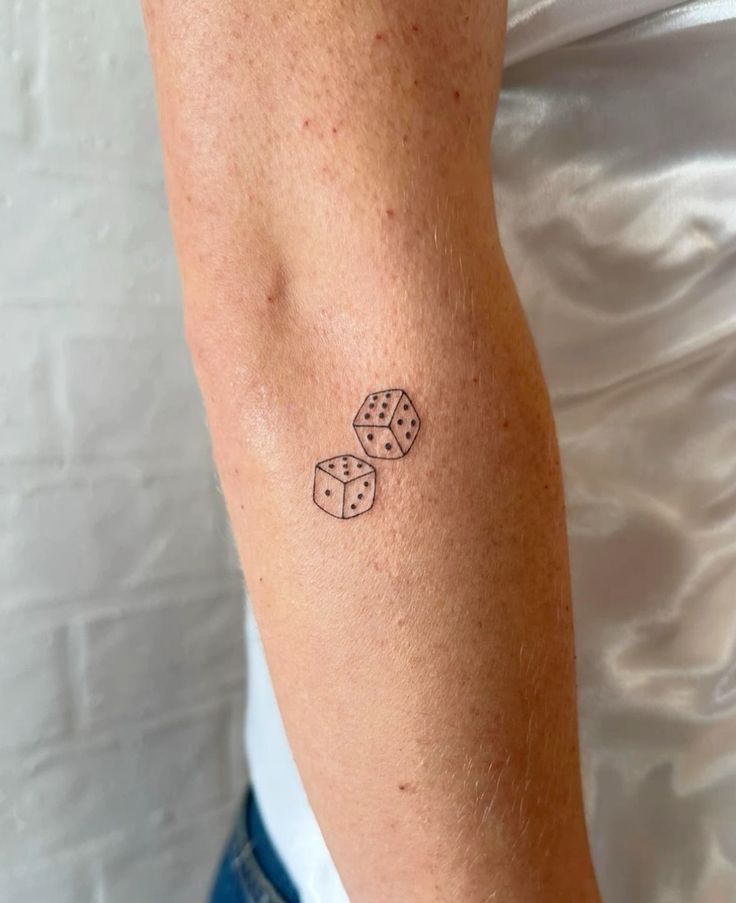
The final design strips the dice motif back to its essentials. Two tiny cubes float independently on the arm with generous negative space between and around them. Fine black outlines define each shape, while miniature dots indicate the numbers on the visible faces.
There is virtually no heavy shading, which makes this one of the most Minimalist examples in the collection. The slightly imperfect line quality gives the cubes a hand-drawn character rather than the precision of a realistic casino illustration.
Because the tattoo is so small, placement becomes an important part of the aesthetic. The open skin surrounding the dice makes them feel intentional rather than unfinished and allows their geometric shapes to stand out.
This kind of simple Stencil can work for women or men and is particularly adaptable for Matching tattoos. Two people could use identical dice while choosing different meaningful numbers, creating a subtle connection without needing names, dates, or additional lettering.
Dice are unusually flexible tattoo subjects because their meaning changes with the details around them. Black dots can create a classic lucky motif; Heart pips turn chance into romance; Flaming dice introduce old-school attitude; and miniature shading can make the same symbol feel almost understated. Fans of tabletop gaming can move beyond six-sided dice altogether with a D20, Dnd, or D&d-inspired interpretation, while traditional collectors can explore Snake eyes, 777, Cherry, cards and dice, or vintage flash compositions.
The strongest design is usually the one that connects the symbolism with a style you would genuinely enjoy wearing years from now. If one of these ideas sparked a variation of your own, leave a comment and share what numbers, colors, or symbols you would put on your dice.