
The Sacred Heart has the rare quality of feeling instantly recognizable while still leaving plenty of room for personal interpretation. Rooted in Christian iconography, the heart is traditionally associated with divine love, sacrifice, suffering, compassion, and devotion. Yet in contemporary tattoo culture, artists have pushed the symbol far beyond one fixed visual formula. A Sacred Heart can be tiny and almost whispered onto the skin, rendered as a dramatic blackwork centerpiece, or transformed into a saturated American traditional design.
That flexibility is what makes sacred heart tattoo ideas so interesting. The essential ingredients—heart, flame, rays, flowers, thorns, a cross, or pierced elements—can be rearranged to produce completely different moods. Some designs feel devotional and solemn; others lean Gothic, romantic, ornamental, or unmistakably Trad.
Tattoo publications and artist-focused resources are useful places to explore how traditional religious imagery continues to be reinterpreted by contemporary tattooers. The 28 designs here show just how broad that visual vocabulary can be.
Sacred Heart Hand Tattoo with Piercing Swords and Radiating Lines
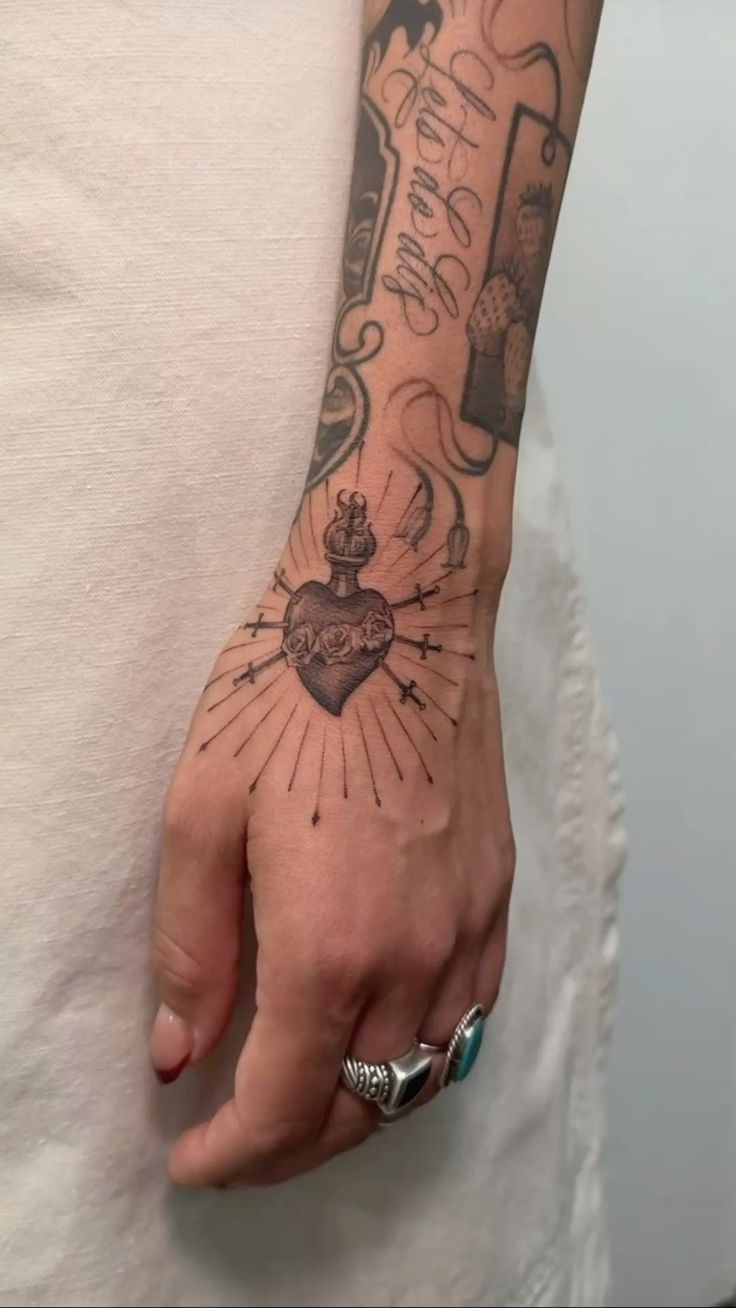
This hand tattoo takes the Sacred Heart into darker, almost medieval territory. The heart sits directly over the back of the hand, where its compact shape works naturally with the anatomy. Instead of relying on heavy decorative framing, the artist builds intensity through multiple narrow blades piercing or surrounding the heart and a halo of long, fine rays extending outward.
The heart itself has substantial black-and-gray shading. Its lower point is dark and sharply defined, while ornamental roses across the center introduce a softer counterweight to the weapons. A small architectural flame-like element crowns the composition, giving the design the familiar upward movement found in traditional Sacred Heart imagery.
The placement deserves attention. A hand tattoo is impossible to treat as background decoration, so even a relatively small design becomes visually assertive. The radiating lines are especially effective here because they spread over the available surface without requiring a large block of dark ink.
This could be an excellent starting point for anyone attracted to Gothic or blackwork interpretations rather than bright religious imagery. A custom design stencil could simplify the number of swords or enlarge the central heart depending on hand size. For long-term clarity, I would personally resist making the smallest details any tighter—the existing negative space is part of what allows the composition to breathe.
Tiny Fine Line Sacred Heart with a Cross
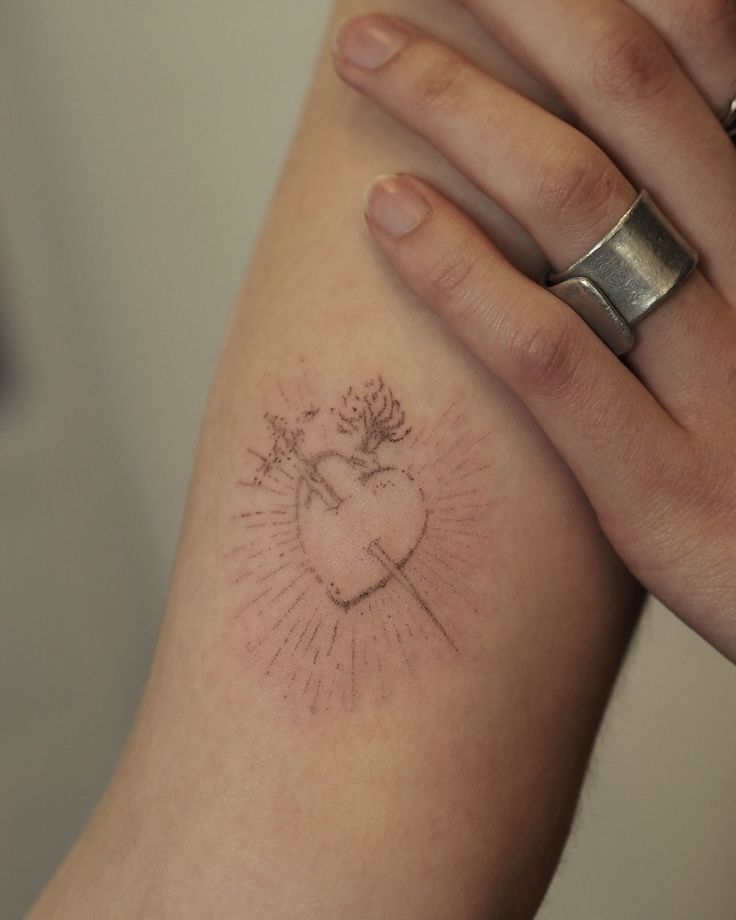
At the opposite end of the spectrum is an extremely delicate fine line Sacred Heart. The design reduces the motif to its essentials: a softly outlined heart, a small cross, flame-like ornamentation above it, and a restrained burst of rays.
What makes this version compelling is how little ink it needs to communicate the symbol. There is no heavy black border, dense shadow, or elaborate ornamental frame. Instead, faint stippling and hair-thin marks give it an almost antique quality, as though the motif had been lifted from an old devotional illustration.
For women or men looking for a discreet religious tattoo, this approach offers considerable placement flexibility. It could translate beautifully to the upper arm, inner forearm, ankle, shoulder, or another relatively quiet area. The simple treatment also makes it easy to personalize without fundamentally changing the character of the tattoo.
There is an important practical consideration with very delicate tattoos, however. Ultra-fine marks can soften as they age, so a good artist may recommend slightly more separation between the smallest details than appears in a digital stencil. In this particular style, restraint matters more than packing in additional symbolism.
Black and Gray Sacred Heart Wrapped in a Crown of Thorns
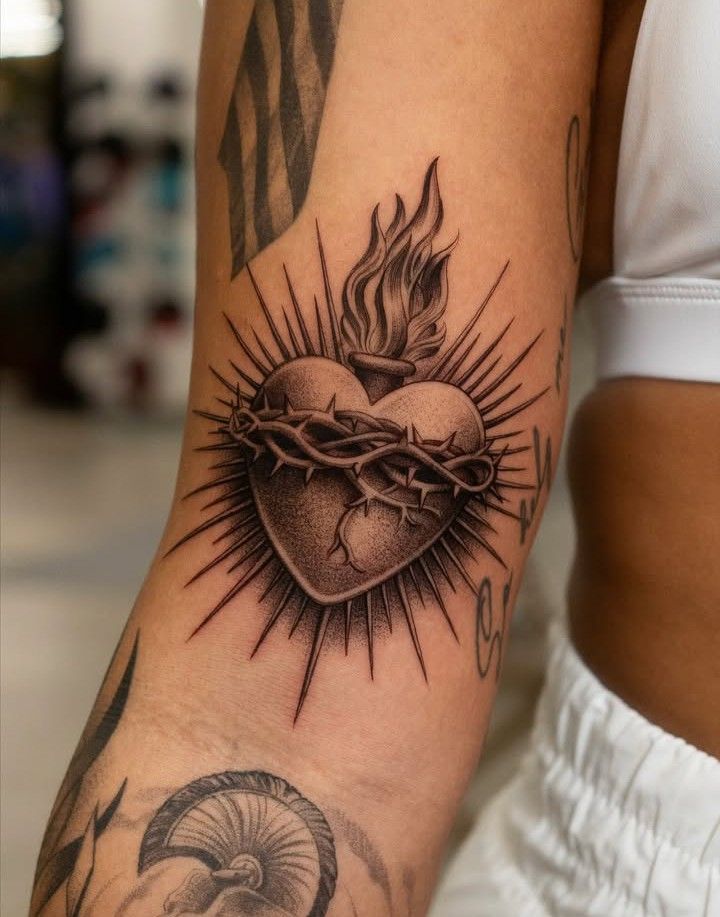
This is the most immediately dramatic design of the group. A substantial anatomical-looking heart is encircled by a heavy crown of thorns, while a tall flame rises from its upper edge. Long black rays explode outward, creating a pointed halo that makes the entire piece appear larger than the heart itself.
The crown of thorns changes the emotional temperature of the design. Rather than presenting love as something purely romantic, it connects the heart to endurance, pain, sacrifice, and faith. That relationship is central to the historical meaning of Sacred Heart imagery and explains why thorns, flames, wounds, and crosses appear so frequently in both religious art and tattooing.
Technically, the piece combines crisp outlines with dotwork and gradual black-and-gray shading. The heart has genuine volume: darker edges push backward while lighter central areas come forward. The thorns then cross over that volume, giving the tattoo an effective sense of depth.
This approach works particularly well for men and women who want the symbol to function as a strong standalone piece rather than a miniature accent. It also has enough visual weight to become part of a larger sleeve. Fans of black-and-gray traditional work could use this as a reference while changing the flame, rays, or thorn arrangement to create a more individual composition.
Small Sacred Heart with Roses and a Soft Flame
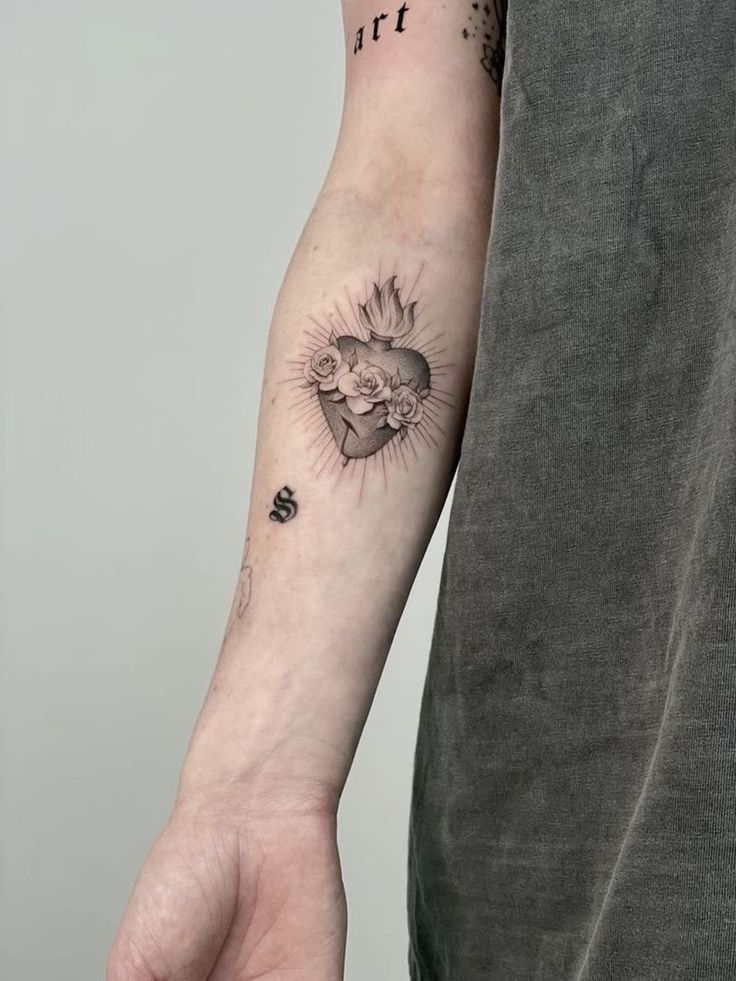
This compact forearm design feels quieter and more romantic. The heart is darkened with soft gray shading, but three roses crossing its front immediately soften the silhouette. A modest flame rises from the top while short, fine rays surround the motif.
The scale is especially successful. Rather than forcing every conventional Sacred Heart detail into a small area, the artist gives the flowers enough room to remain readable. Their petals are individually shaped, while the darker heart provides contrast behind them. The result feels decorative without becoming overly ornate.
Roses are a natural partner for this imagery because they can add layers of personal meaning—love, remembrance, beauty, grief, devotion—without requiring words. They also provide an easy way to customize the composition. A client could choose a birth flower, alter the number of blossoms, or introduce a restrained touch of red while keeping the rest in black and gray.
For someone collecting smaller tattoos, this format is particularly adaptable. It has enough identity to stand alone but does not dominate the surrounding skin. I also like that the flame is relatively restrained; it keeps the flowers and heart in visual balance instead of turning the top of the tattoo into the only focal point.
Mexican Traditional Sacred Heart in Red, Green, and Gold
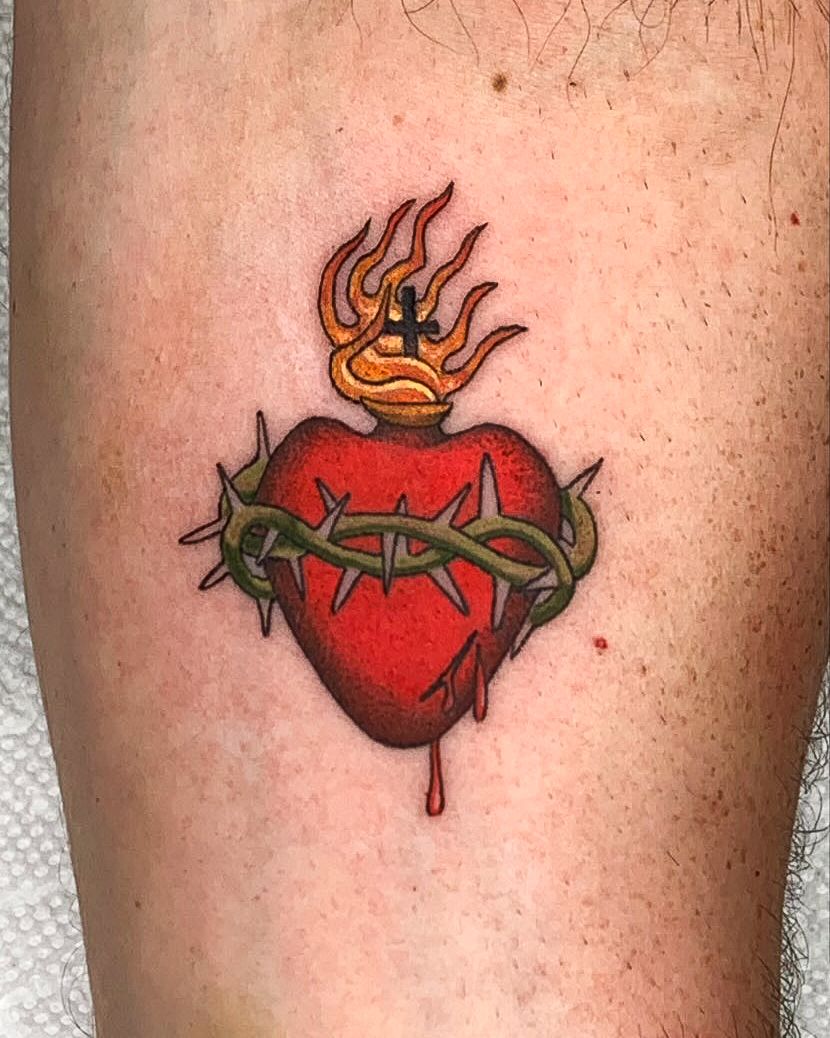
Color completely changes the personality of the Sacred Heart. Here, a saturated red heart is wrapped tightly in a green crown of thorns, pierced by prominent spikes, and topped by a golden-orange flame containing a black cross. A small drop of blood extends below the heart, emphasizing the theme of sacrifice.
The strong black outline and compact blocks of color immediately recall American traditional tattooing, while the religious iconography also connects naturally with Mexican traditional visual culture. Sacred Heart imagery has a deep presence in Mexican devotional art, where brilliant reds, flames, flowers, rays, and religious symbols often appear with unapologetic visual intensity.
What I find effective here is the limited palette. Red, olive green, orange-gold, and black are enough. Adding several more colors could easily weaken the clarity of the design. The thick outline also makes the individual elements readable from a distance, which is one reason this kind of Trad approach remains so enduring.
For anyone searching through classic tattoo flash, this is a useful reminder that an old symbol does not need excessive complexity. Strong silhouette, controlled color, and immediately readable iconography can carry the entire piece.
Ornamental Sacred Heart with Flowers and Rising Flame
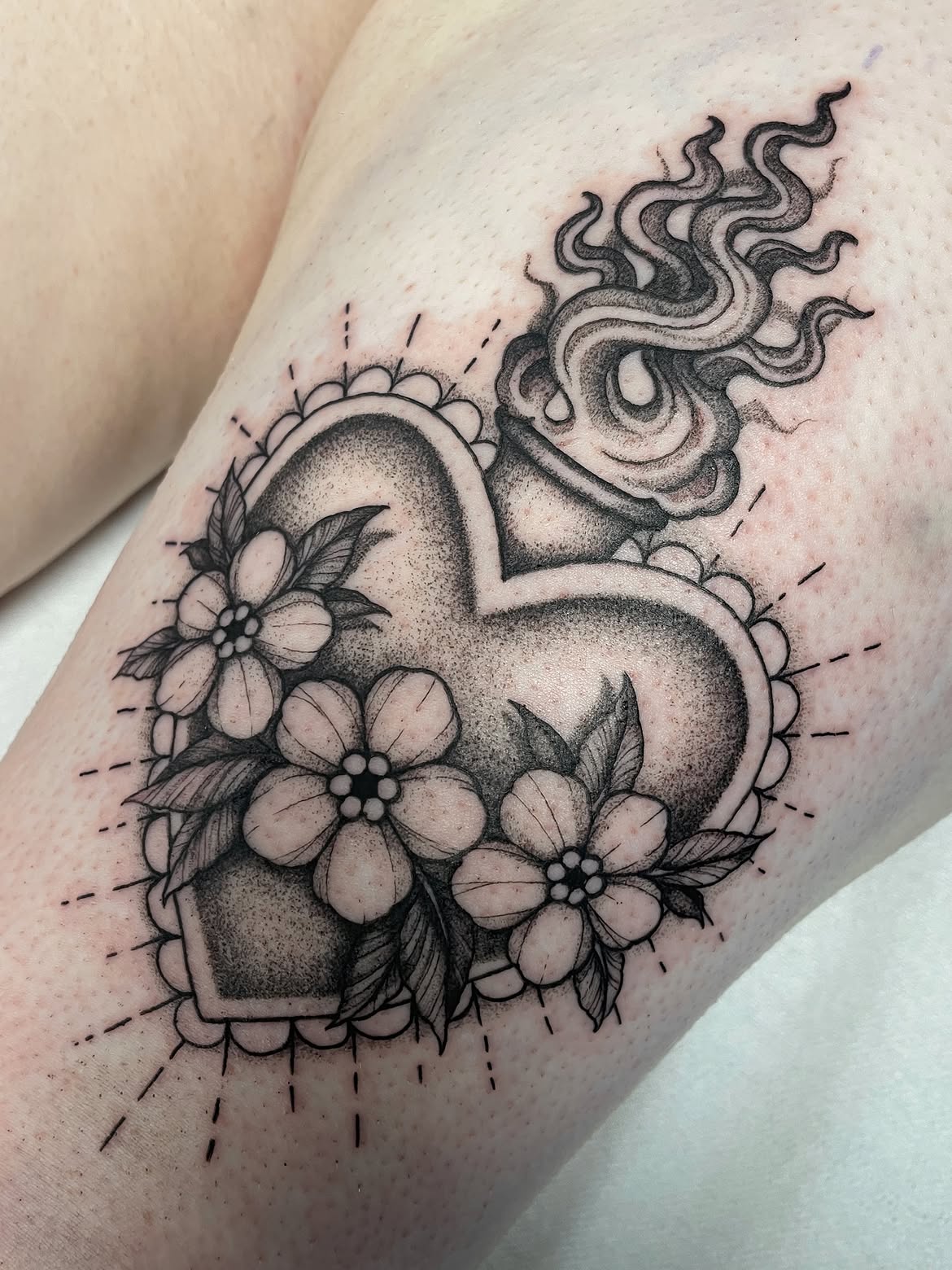
This interpretation feels halfway between devotional imagery and botanical illustration. The heart is broad and softly shaded, with a thick pale border that creates separation from the surrounding elements. A large flame rises from its upper edge, while flowers and leaves sweep across the lower half.
The dotwork shading is particularly important. Instead of filling the heart with flat black, the artist uses thousands of tiny marks to create a smoky gradient. That texture continues into the flame and produces an almost printed quality reminiscent of vintage engraving.
Small rounded forms following portions of the outline create an ornamental border, while broken rays surrounding the composition establish the familiar halo. Those rays are deliberately irregular in length, which keeps the design from becoming mechanically symmetrical.
Botanical versions like this can be highly personal. Different flowers can commemorate family members, relationships, dates, or places without introducing literal text. The basic design could also be adapted into a larger thigh or upper-arm piece, where the leaves and flowers would have more space to spread.
It is a good example of how contemporary Sacred Heart tattoos can retain recognizable symbolism while stepping away from strictly religious-looking flash.
Blackwork Sacred Heart Framed with Roses and Beaded Ornament
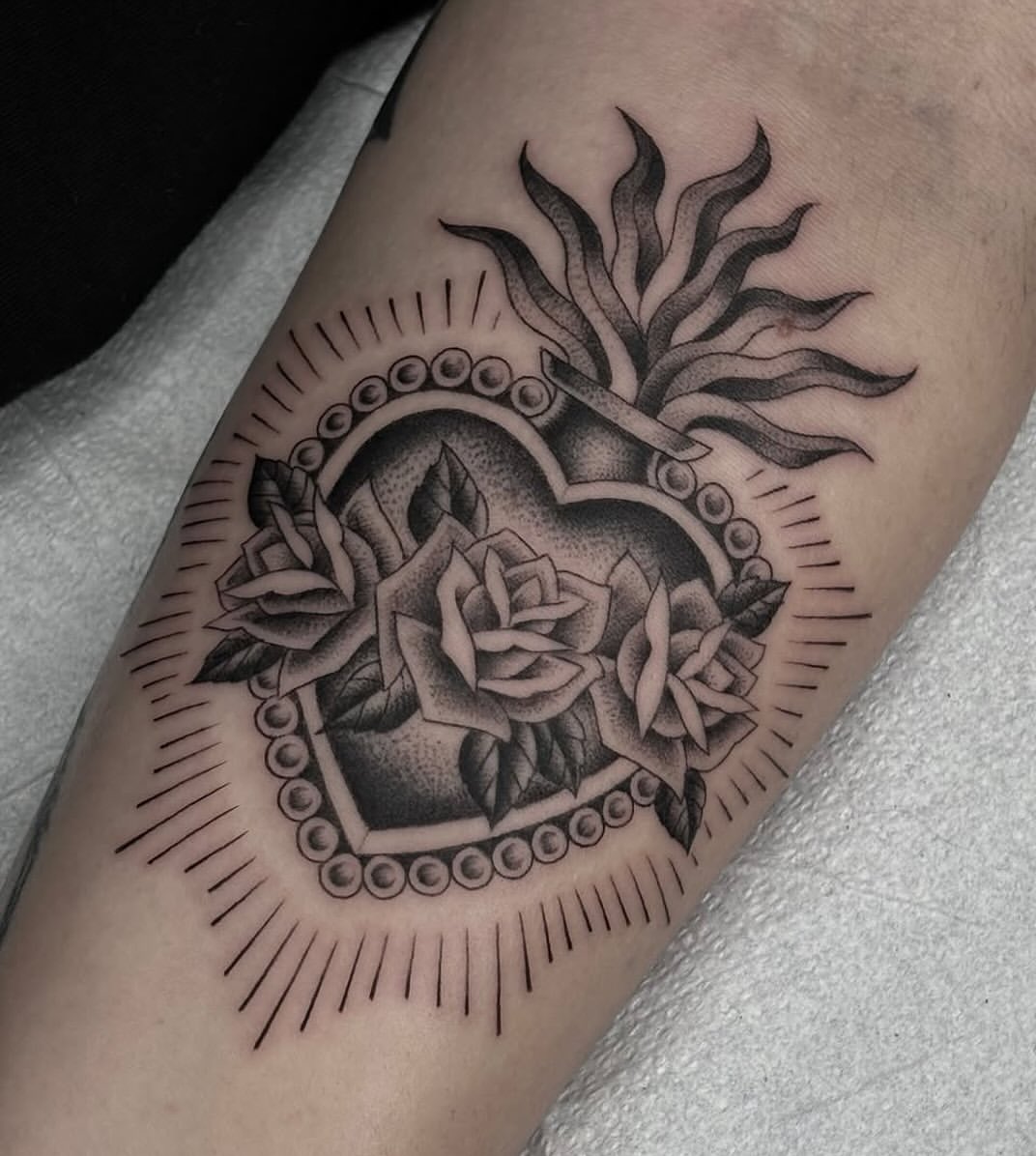
The final design takes a more decorative approach, framing a dark Sacred Heart with roses, bead-like circles, radiating lines, and a large stylized flame. There is a satisfying tension between the bold overall silhouette and the finely textured interior.
Three roses occupy the center and sides of the heart, breaking up the darker shading behind them. Their lighter petals become the visual foreground, while leaves fill the gaps and help connect the floral arrangement. Around the heart, the repeated circular border behaves almost like jewelry or a devotional ornament.
The flame is unusually graphic. Instead of naturalistic fire, it consists of long, curved tongues that spread upward and outward. This gives the upper section a slightly Gothic character and prevents the tattoo from feeling too delicate despite the floral centerpiece.
This would be an interesting reference for someone who likes an ornamental tattoo but still wants the recognizability of a classic Sacred Heart. It could remain entirely black and gray, as shown here, or incorporate selective color—for example, deep red roses while leaving the heart and flame monochrome.
More importantly, it demonstrates why a custom stencil matters. There are several competing elements—flowers, border, heart, flame, rays—and their spacing has to be resolved before tattooing. Remove that structure and the design could quickly become visually crowded.
Colorful Traditional Sacred Heart with a Floral Center
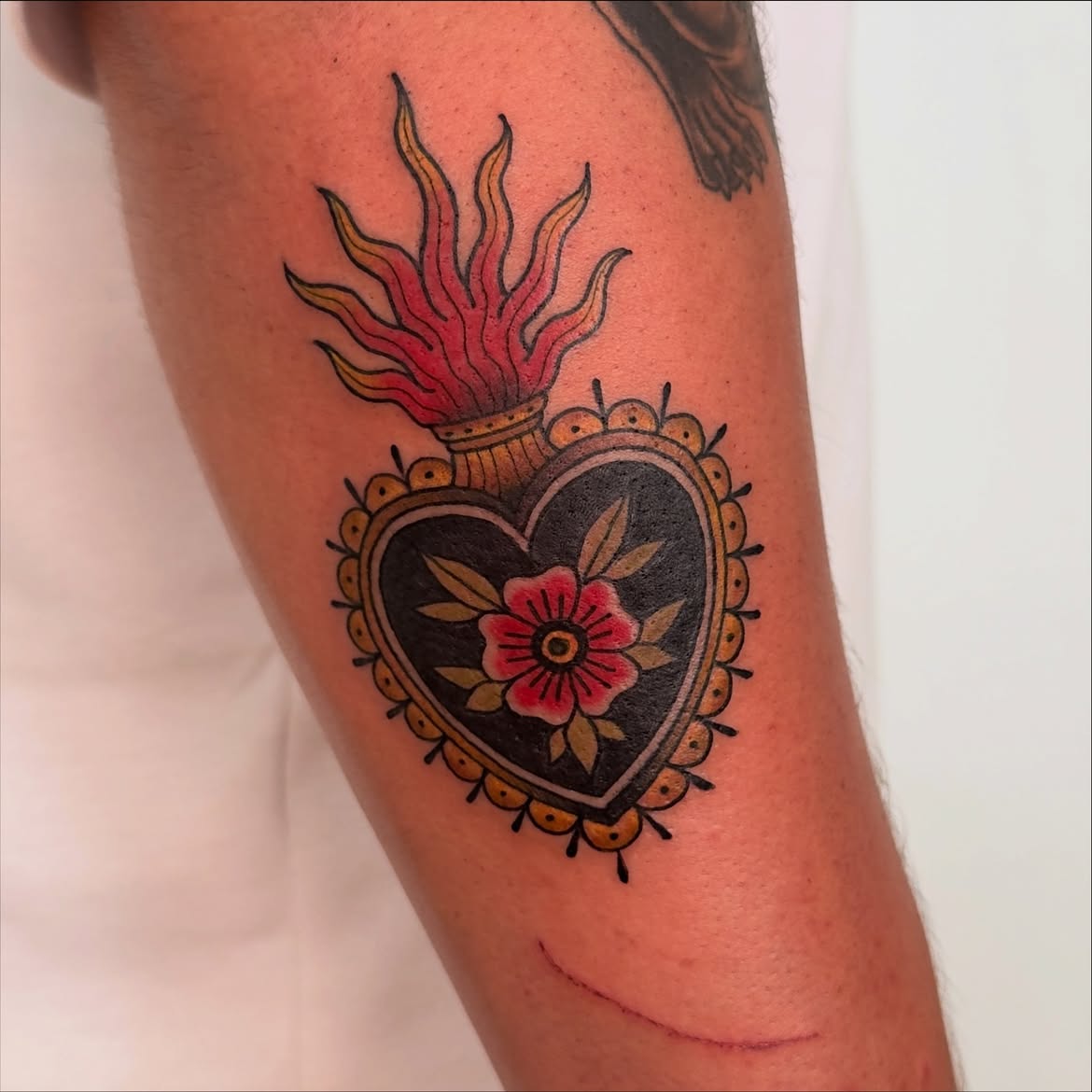
This design brings a warmer, folk-inspired personality to the Sacred Heart. The central heart is almost entirely filled with black, immediately giving the composition a strong graphic foundation. Against that dark field sits a bright red flower with ochre leaves, a small detail that completely changes the mood of the piece. Rather than looking severe, the heart feels celebratory and handcrafted.
The surrounding golden scalloped border is particularly effective. Tiny black accents repeat around its perimeter, creating the decorative rhythm often associated with Mexican traditional religious art. Above it, an elongated flame moves from deep red toward warm yellow at its tips. That restricted color palette—black, red, gold, and muted brown—keeps the tattoo cohesive.
There are obvious connections here with both Mexican imagery and American traditional tattooing: thick outlines, strong contrast, uncomplicated shapes, and colors designed to remain readable. For anyone drawn to classic Trad work but wanting something more decorative than a standard flash heart, this is a strong direction. The central flower could also be customized, giving the familiar symbol a more personal identity without disturbing its traditional silhouette.
Black and Gray Sacred Heart with a Jeweled Ornamental Border
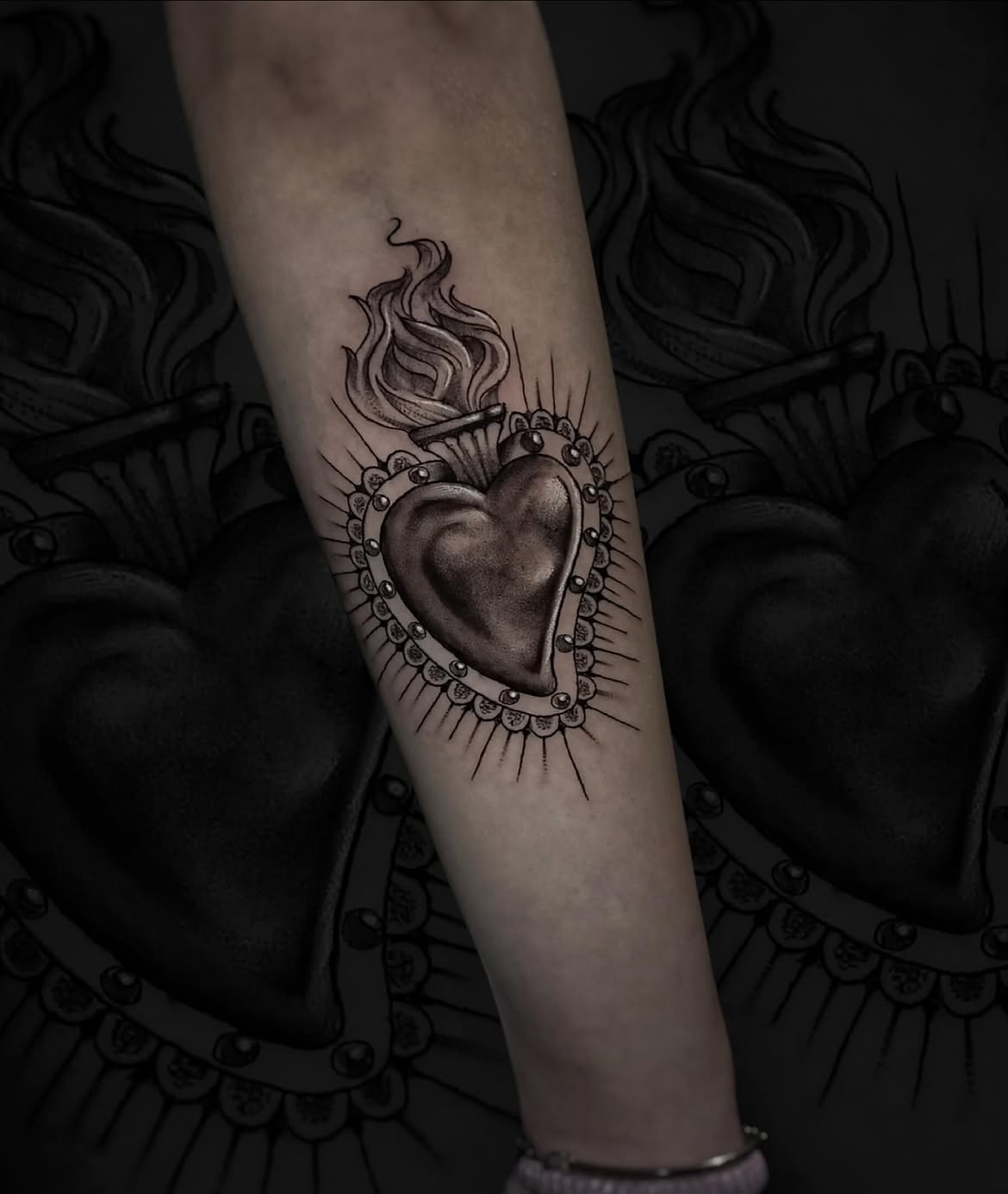
Without color, the Sacred Heart can become surprisingly sculptural. This version uses smooth black-and-gray gradients to give the central heart a rounded, almost metallic surface. A narrow highlight curves across it while deeper shadows collect around the lower and side edges, producing convincing dimension without an overly realistic treatment.
The frame is where the tattoo becomes distinctly ornamental. Small circular details and repeating scalloped forms surround the heart like a piece of antique jewelry. Fine rays then extend beyond that border, creating another layer without making the forearm design unnecessarily heavy.
The flame follows the same restrained philosophy. Its individual sections are separated with delicate lines and subtle gray shading rather than solid black. Because the central heart is comparatively dark, this lighter flame prevents the upper portion from becoming visually top-heavy.
I could see this working especially well for someone who likes religious symbolism but does not necessarily want an obvious traditional tattoo. It is elegant enough for a standalone forearm piece and structured enough to integrate into a larger black-and-gray collection. A good design stencil would be particularly important here because the repeated border needs consistent spacing to preserve that jewelry-like finish.
Sacred Heart with Crown of Thorns, Two Swords, and Graphic Flame
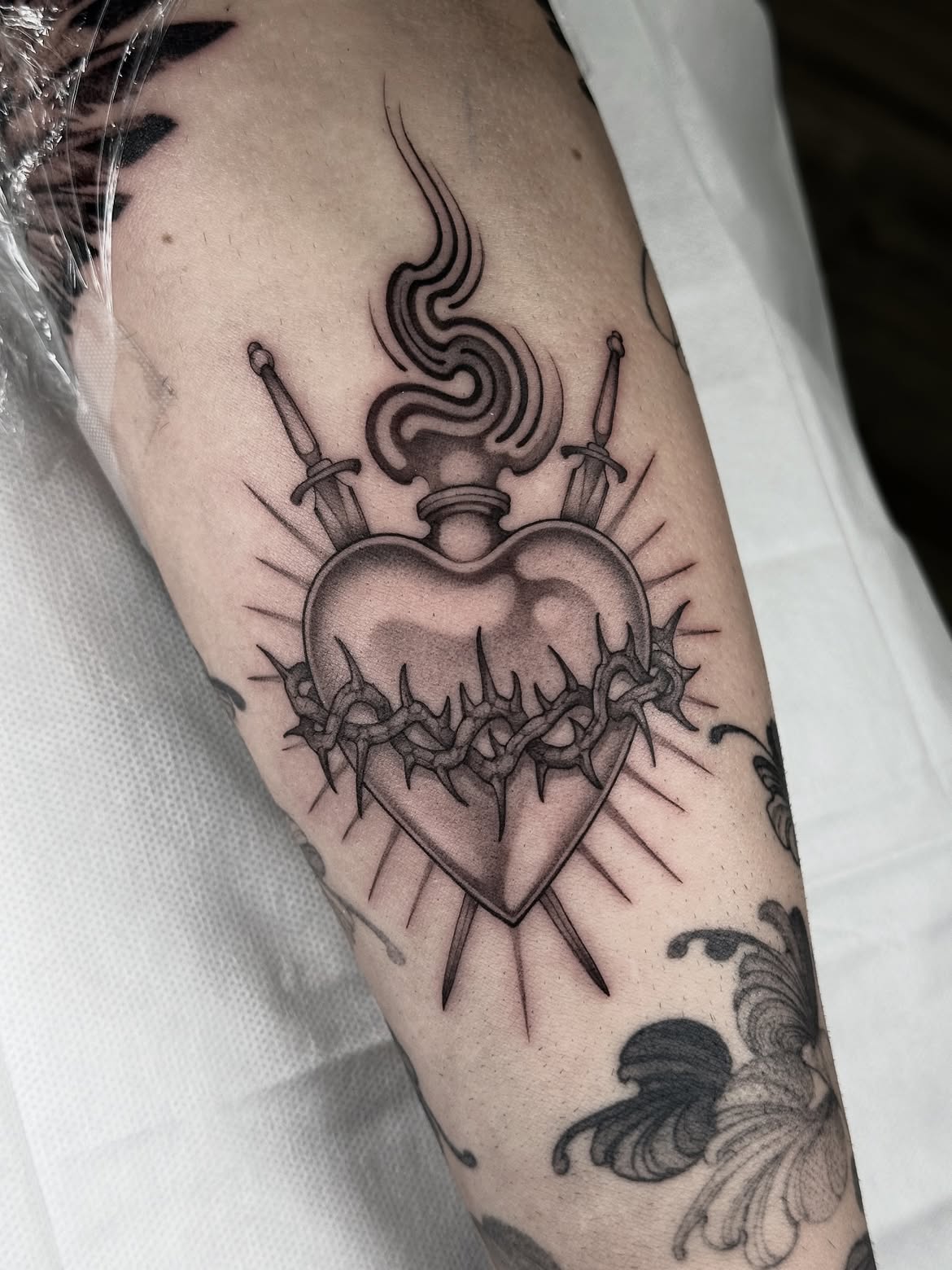
This design strips away flowers and decorative framing in favor of some of the Sacred Heart’s most forceful symbols. Two swords rise behind the heart, a crown of thorns cuts directly across its center, and a stylized flame emerges from the top. Long rays complete the composition, turning the heart into an unmistakable focal point.
The most interesting element is the flame. Rather than copying natural fire, the artist builds it from thick, flowing bands that curl into one another. That graphic treatment gives an otherwise traditional subject a contemporary edge. It is a clever reminder that a recognizable symbol does not have to be drawn literally.
The thorn crown is deliberately dense and aggressive. Individual spikes point in different directions and cast darker visual accents across the smoother surface of the heart. The swords add another layer to the theme of pain and endurance without obscuring the main silhouette.
For men or women interested in darker Sacred Heart tattoo ideas, this approach offers plenty of impact without depending on saturated ink. It could also move toward a more Gothic direction by sharpening the flame and swords, or toward classic black-and-gray Trad by simplifying the shading. The essential composition is strong enough to support either interpretation.
Fine Line Sacred Heart with Crown of Thorns and Cross
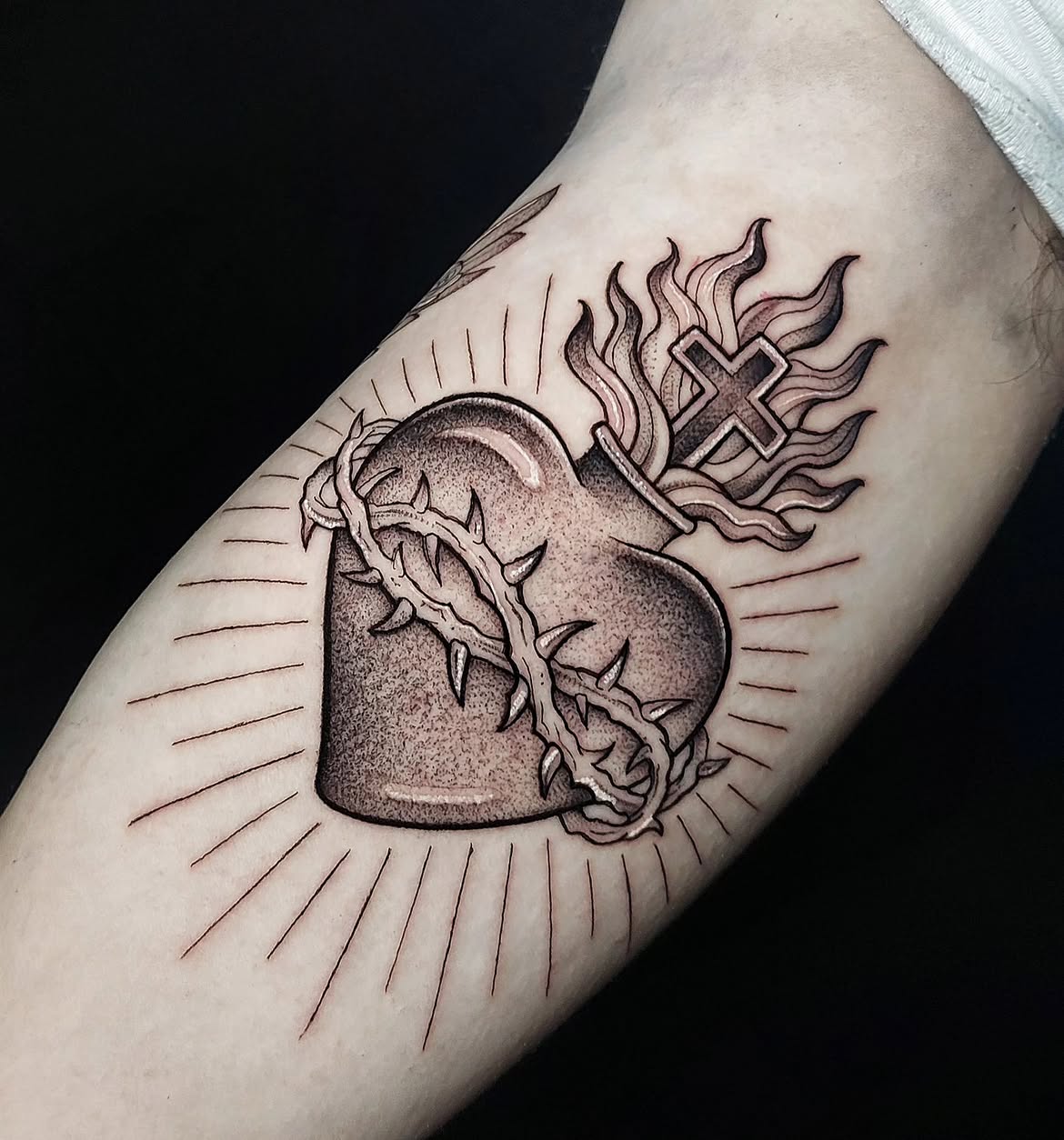
Here the Sacred Heart takes on the appearance of an old religious engraving. The large heart is softly modeled through fine stippling, leaving tiny highlights untouched so that the surface appears rounded. A crown of thorns crosses diagonally over the front, introducing an intentionally rough organic line against the smooth geometry of the heart.
The upper portion is especially beautiful. A cross sits inside a spreading flame, creating a clear vertical axis, while narrow rays surround the entire composition. Nothing feels excessively dark. Even the crown uses negative space between its thorns, helping the individual elements remain readable.
This is an excellent example of how fine line tattooing can handle a relatively substantial religious design. Fine line does not necessarily mean tiny or minimalist; it can also mean controlling texture through thin outlines, dot shading, and carefully preserved skin.
There is a seriousness to this version that I like. It avoids decorative flowers and bright color, allowing the symbolism to carry the piece. Anyone interested in the traditional meaning of the Sacred Heart—love intertwined with suffering, faith, and sacrifice—could take this direction without choosing a heavily old-school aesthetic.
Ornamental Sacred Heart Built from Floral Motifs and Dotwork
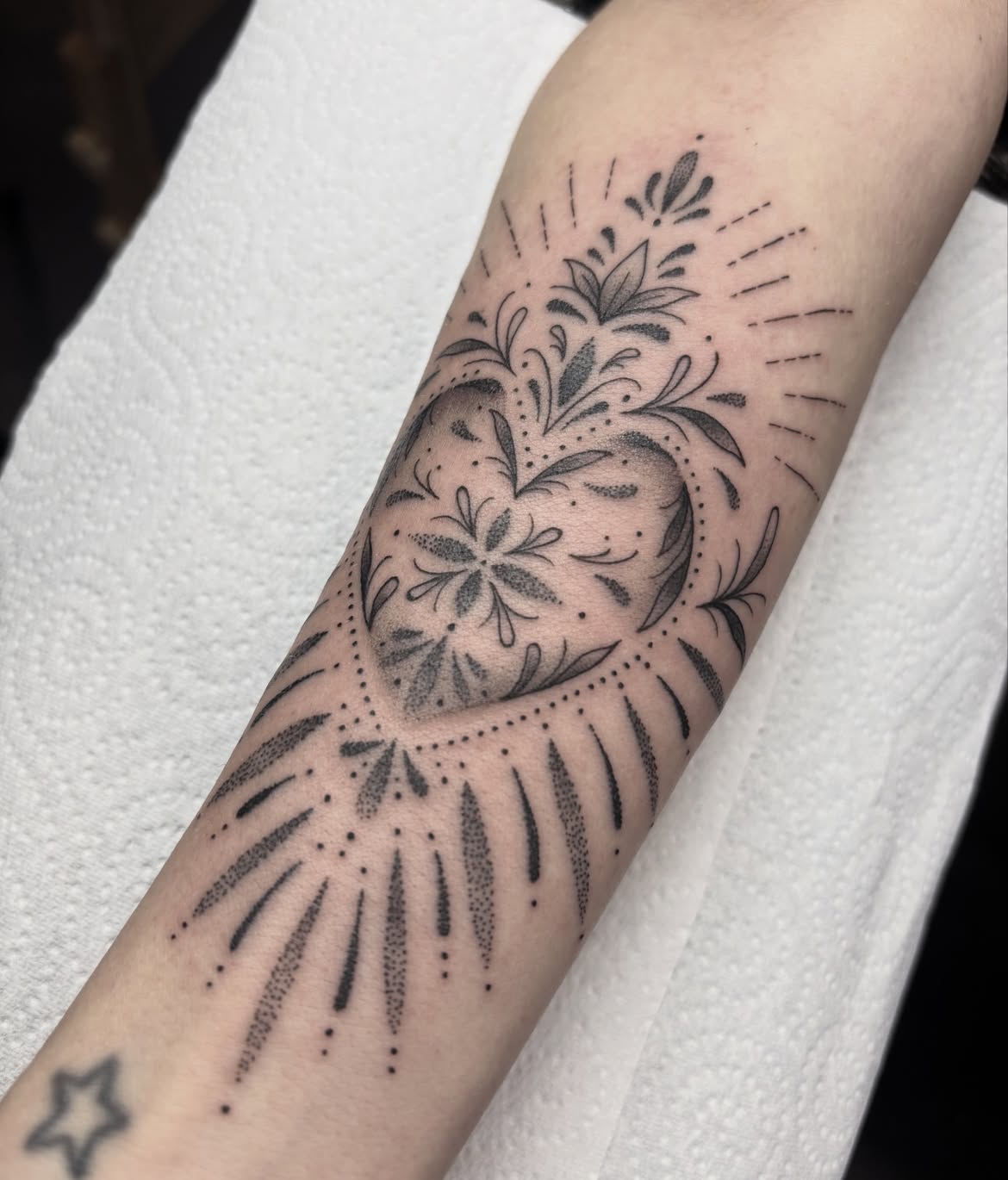
This may be the most unconventional heart in the collection because the decorative language becomes almost as important as the religious symbol itself. Instead of placing flowers around a clearly outlined heart, the artist uses leaves, petals, curved botanical marks, and stippled shadows to suggest the heart’s shape from within.
A dotted outline loosely traces the form, while the surrounding rays alternate between solid fine marks and areas constructed from tiny dots. That combination gives the design movement without introducing heavy black borders.
The result sits somewhere between an ornamental tattoo and contemporary folk illustration. From a distance, the heart is immediately apparent. Closer inspection reveals an entire vocabulary of smaller botanical shapes. That second layer is what makes the piece memorable.
This approach could be particularly appealing to women and men who want Sacred Heart symbolism without the usual crown of thorns, cross, or dramatic flame. The floral details could also be customized extensively. Changing the leaves or introducing meaningful flowers would make the tattoo more personal while preserving the original simple heart structure.
For placement, the forearm is ideal because the elongated rays naturally follow the length of the arm. On a smaller area, I would reduce some of the internal marks rather than compress them; the negative space is essential to the charm of this design.
Symmetrical Sacred Heart with Radiant Ornamental Frame
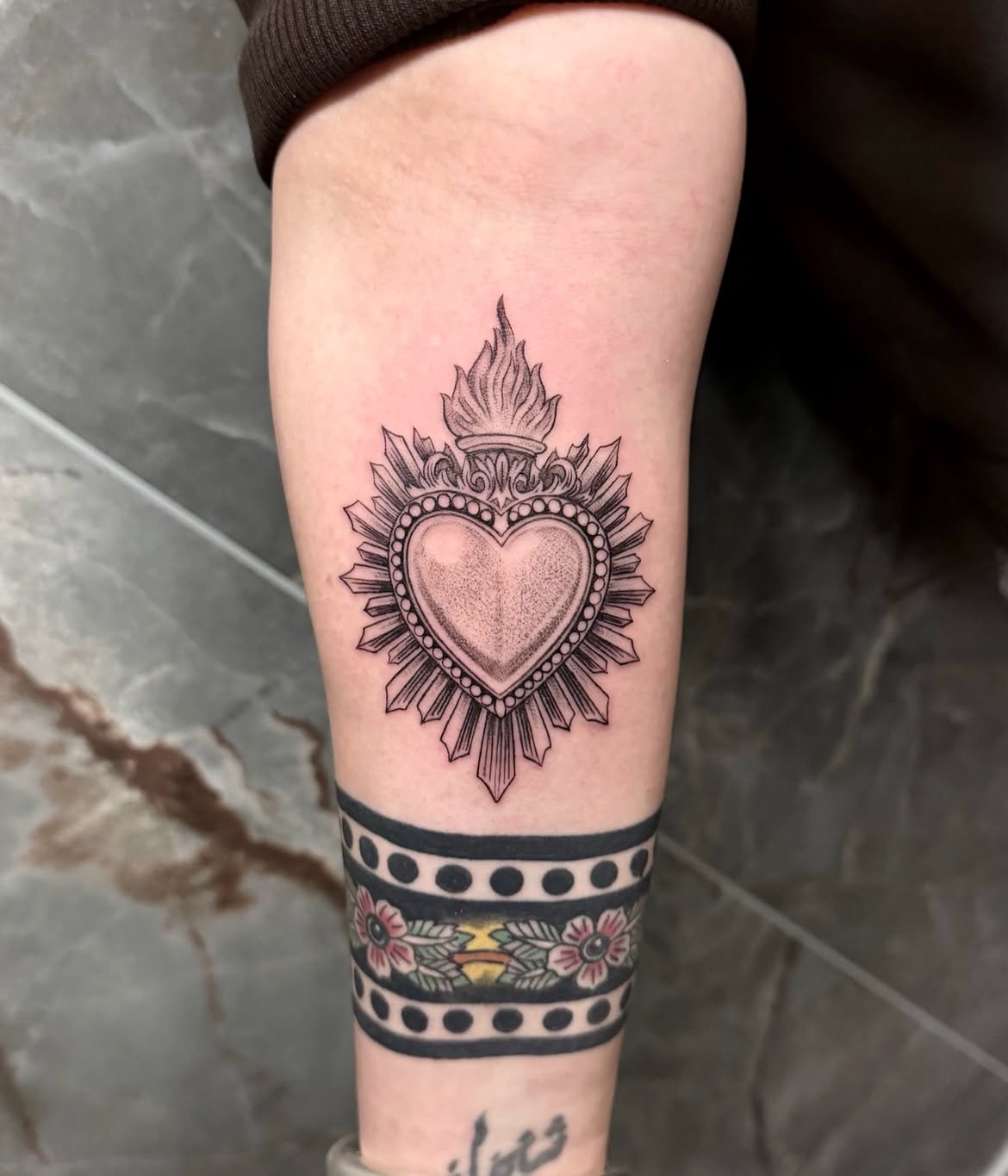
Symmetry drives this Sacred Heart design. A softly stippled heart occupies the center, surrounded first by a neat beaded border and then by a dramatic ring of pointed rays. Above it sits an elaborate decorative crown supporting a flame.
Compared with more organic versions, this one feels architectural. The rays are carefully repeated, the circular border follows the heart with precision, and the top ornament is centered directly over the cleft. There is something almost jewelry-like about it, as though a religious pendant had been enlarged and translated into tattoo form.
The fine black linework prevents the considerable amount of detail from feeling too heavy. Dot shading creates depth inside the heart, while most of the surrounding structure remains open. This balance would be worth preserving when preparing the stencil; making the outer rays too dark could easily overpower the soft center.
For someone collecting ornamental or blackwork tattoos, this is an easy Sacred Heart design to integrate stylistically. It also shows that religious imagery can feel refined rather than rustic or aggressively traditional. The geometry provides visual discipline, while the flame keeps the piece connected to its devotional origins.
Sacred Heart with Dagger, Thorns, Cross, and Long Rays
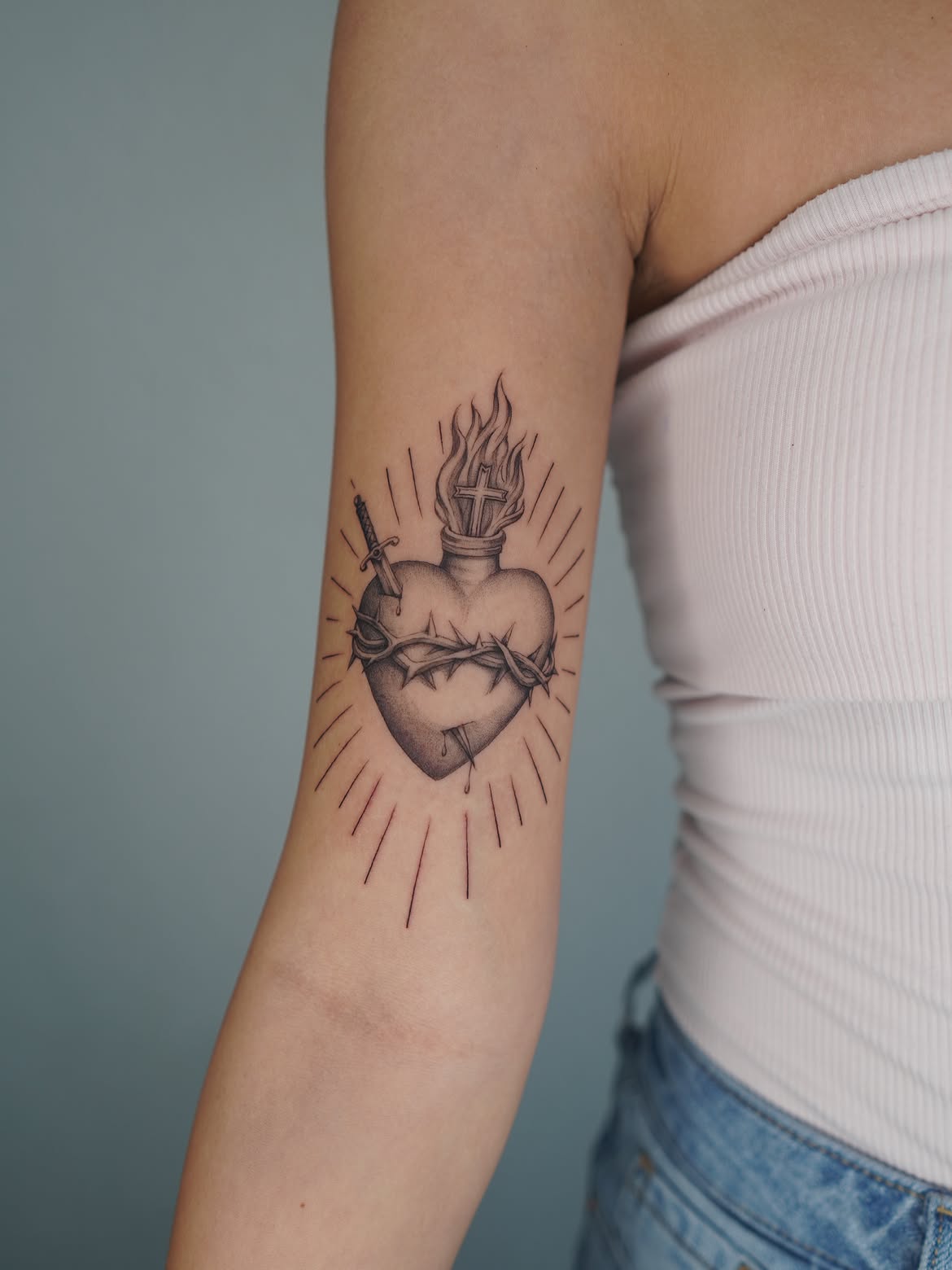
This final piece combines several familiar Sacred Heart elements but gives them enough breathing room to remain individually readable. A softly shaded heart forms the center. A thick crown of thorns wraps horizontally around it, a small dagger enters from the upper side, and a cross stands within the flame above.
Long rays spread outward in an irregular halo. Their simplicity is important: with the dagger, thorns, flame, and cross already providing multiple focal details, a more complicated background would compete with the heart.
The shading is beautifully restrained. Darker tones sit primarily along the lower portion and edges, creating dimension while leaving a broad highlight across the center. The crown of thorns is darker and more sharply outlined, so it visually sits in front of the heart instead of blending into it.
I particularly like this approach for the upper arm because the design occupies the available vertical space without becoming oversized. It has enough detail to reward a closer look, but its silhouette remains obvious from several steps away.
As a source for a custom design, it also offers numerous opportunities for adjustment. The dagger could become a sword, the cross could be simplified, additional wounds could be introduced, or a small amount of red could highlight the heart while everything else remained black and gray. What should stay intact is the hierarchy: heart first, symbolic details second, rays last. That order is what keeps a complex Sacred Heart tattoo clear rather than crowded.
Sacred Heart Hand Tattoo with Roses and Starburst Details
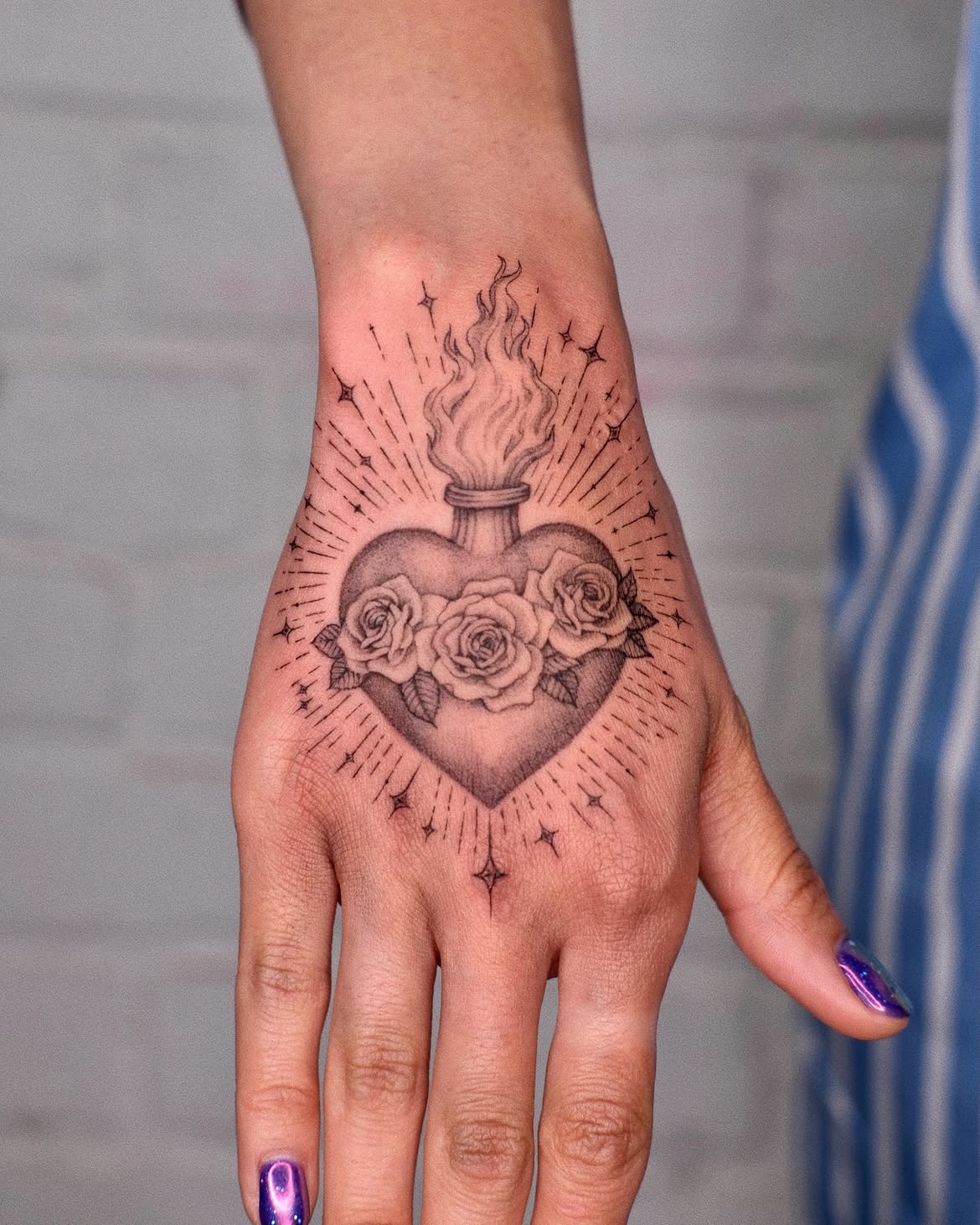
A hand placement gives even delicate Sacred Heart imagery an immediate presence, and this design uses the available space especially well. The softly shaded heart stretches from the wrist toward the knuckles, while three detailed roses form a horizontal band across its center. Leaves tuck naturally behind the petals, giving the floral section enough density to stand apart from the lighter heart.
Above, a tall flame continues the composition toward the wrist. Instead of relying on heavy blackwork, the artist builds it from thin flowing lines and subtle shading. Fine rays and tiny four-point stars spread around the heart, creating a luminous halo without crowding the hand.
The contrast between romantic roses and devotional imagery makes this an appealing option for women or men who want a Sacred Heart tattoo that feels graceful rather than severe. I especially like how the roses replace the expected crown of thorns. The underlying meaning remains connected to love and devotion, but the visual language becomes softer and more personal.
For a custom version, the flowers offer an obvious point of personalization. Birth flowers, a single red rose, or smaller botanical details could all be introduced while preserving the original structure.
Bold Black Sacred Heart with Rose and Geometric Rays
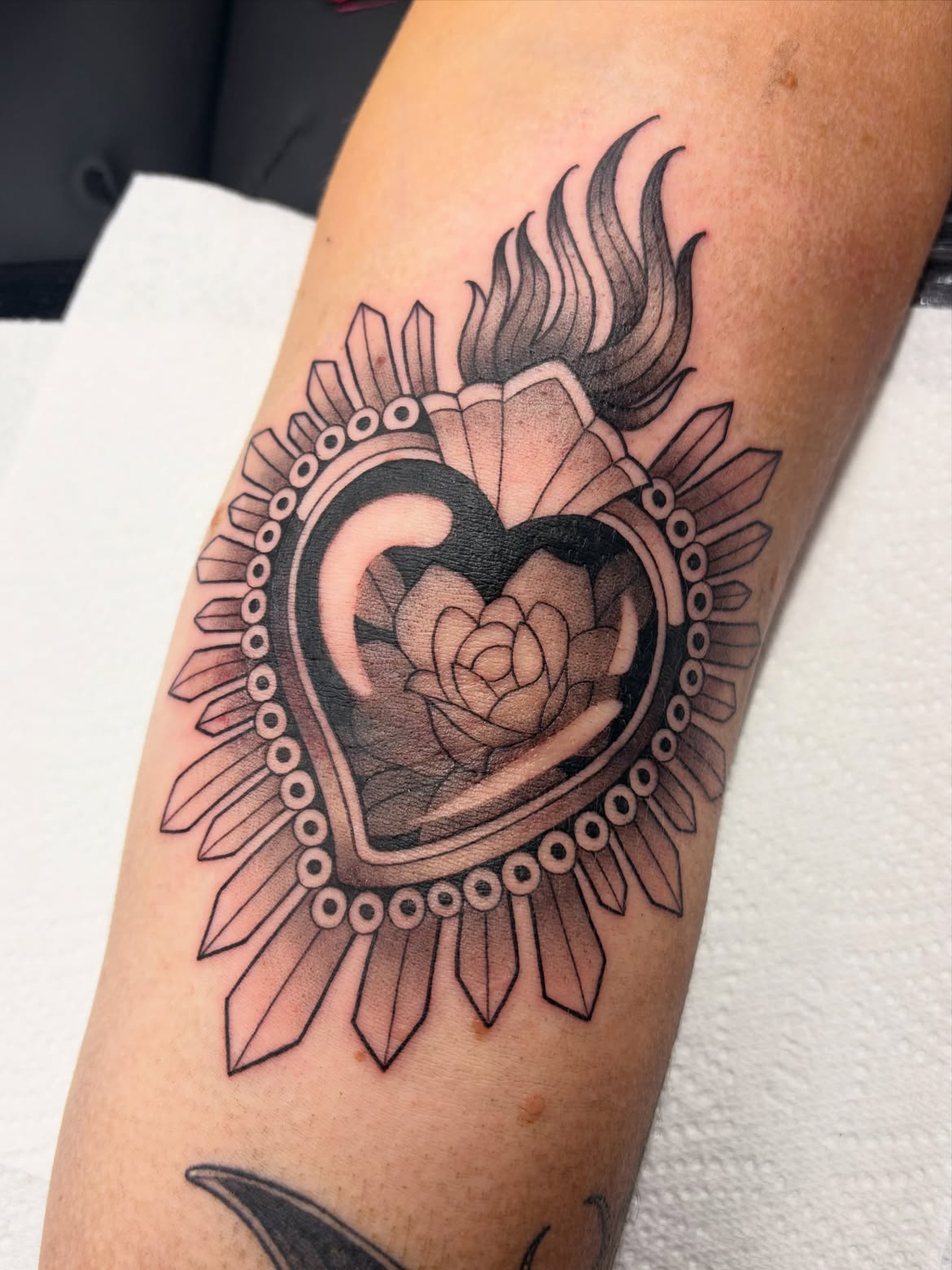
This piece treats the Sacred Heart almost like a piece of jewelry. A heavy black interior creates the dominant heart silhouette, while a large rose appears within it through areas of lighter shading and negative space. Around the heart runs a circular beaded frame, followed by a second layer of long geometric rays.
Those pointed rays are one of the strongest features of the design. Instead of the simple straight lines found in many Sacred Heart tattoos, they resemble cut gemstones or architectural ornament. The result has an unmistakably ornamental character.
The flame is equally graphic, sweeping upward in long black tongues rather than naturalistic curls. Because the heart already contains a considerable amount of dark ink, leaving sections of the rays and border relatively open is a smart choice. It keeps the piece from becoming one dense black shape.
This could provide excellent inspiration for someone who likes Gothic tattooing but wants to avoid skulls or overtly macabre imagery. It also demonstrates how a familiar religious symbol can be pushed toward modern blackwork simply through proportion, negative space, and a carefully constructed stencil.
Minimal Black and Gray Sacred Heart with Crown of Thorns
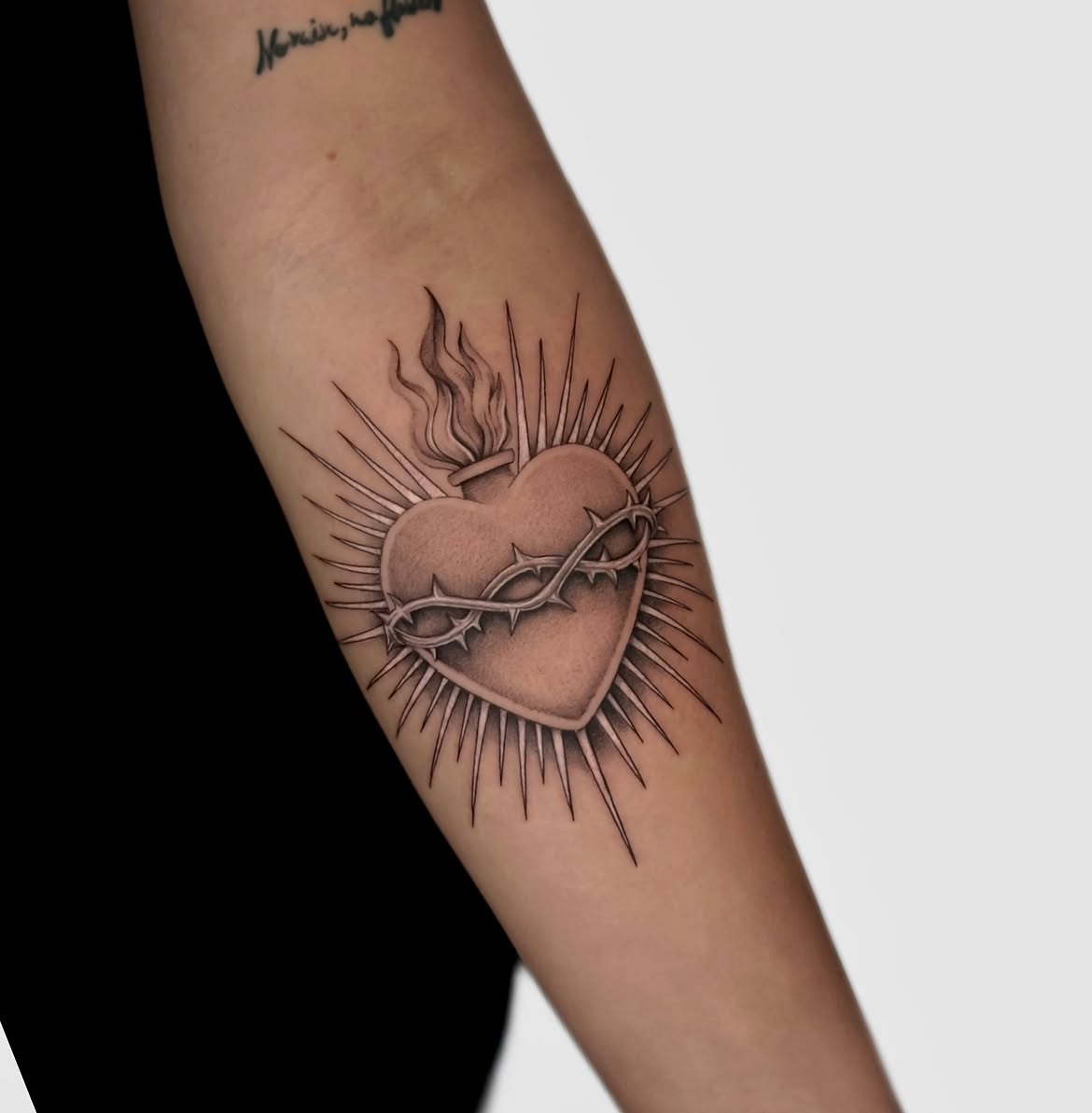
There is something especially strong about a design that knows when to stop. This Sacred Heart contains the expected flame, crown of thorns, and radiant halo, but almost every secondary decorative element has been removed.
The heart itself is smooth and softly shaded, with a narrow lighter border defining its silhouette. A thorny branch winds across the center in a loose diagonal, introducing movement to an otherwise symmetrical composition. Behind it, extremely long, needle-like rays create a sharp halo.
The flame is relatively small and understated. Its fine interior lines echo the thin rays, so the top of the tattoo remains visually connected to the rest of the piece. That consistency makes the tattoo feel more refined than a version built from several unrelated styles.
This is a useful simple alternative for anyone who wants recognizable Sacred Heart symbolism without flowers, swords, elaborate borders, or color. The restraint also makes the piece easier to incorporate beside existing tattoos. For me, the long uneven rays are what save it from becoming overly polished; they add just enough rawness to the otherwise clean composition.
Small Sacred Heart with Cross, Flames, and Crown of Thorns
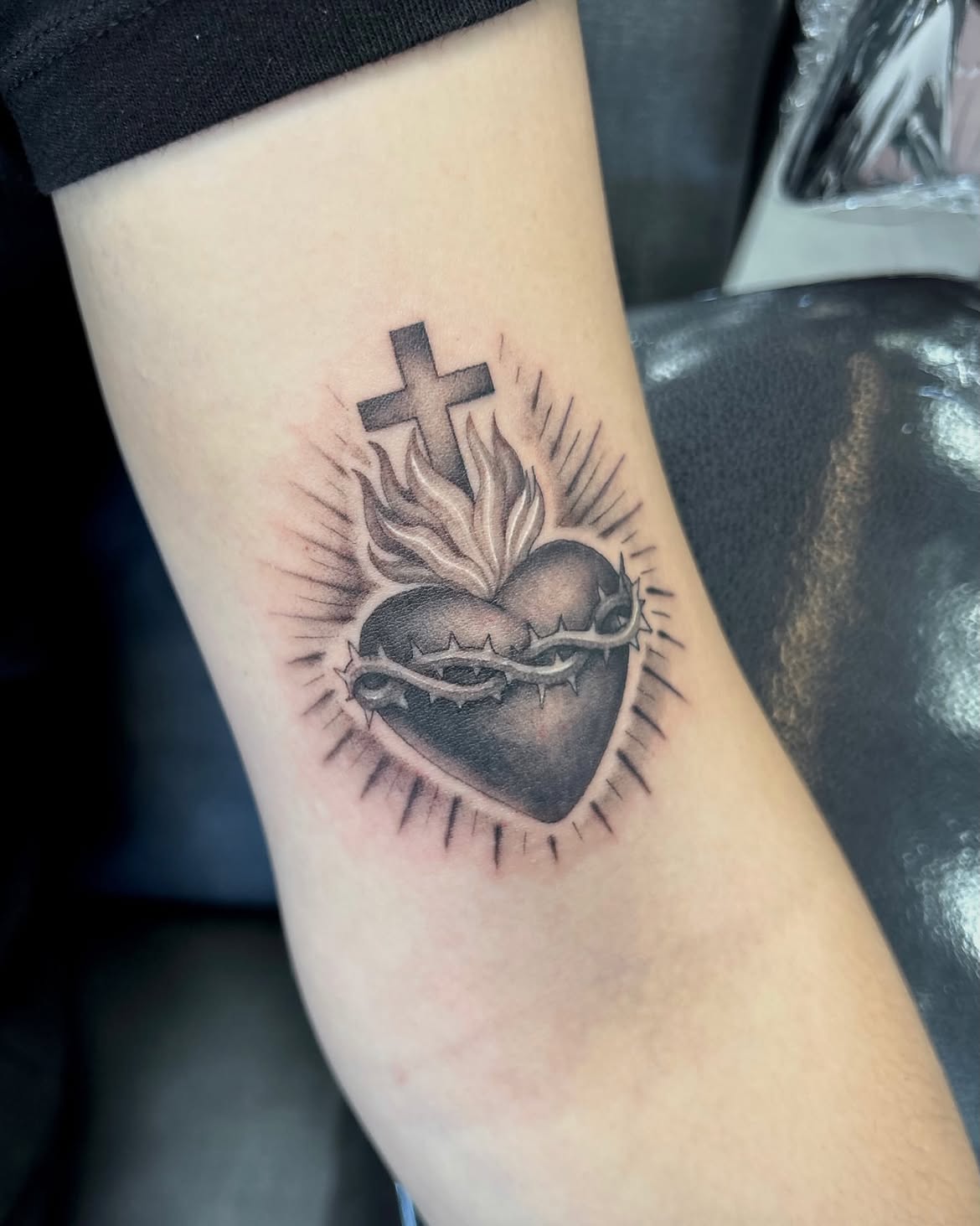
This smaller black-and-gray interpretation keeps the iconography compact while still including three major elements: the heart, the crown of thorns, and the cross rising behind the flame.
The heart carries noticeably deeper shading than many of the fine line examples in this collection. Black concentrates around the lower point and one side, while a softer highlight gives the upper portion dimension. The thorn crown cuts across the center with enough contrast to remain clearly separate from the heart beneath it.
Above, the flames are left comparatively light. A solid cross provides the darkest vertical element and immediately draws the eye upward. Short rays surround the whole motif rather than extending far into the surrounding skin.
For someone wanting a modestly sized religious tattoo, this balance makes sense. Reducing a detailed traditional design too aggressively can turn thorns, flames, and shading into an unreadable cluster as the tattoo ages. Here, each element is given enough room to maintain its identity.
It would suit an arm placement particularly well and could work for both men and women who prefer classic symbolism in a cleaner contemporary format.
Red Sacred Heart with Thorns, Cross, and Golden Flame
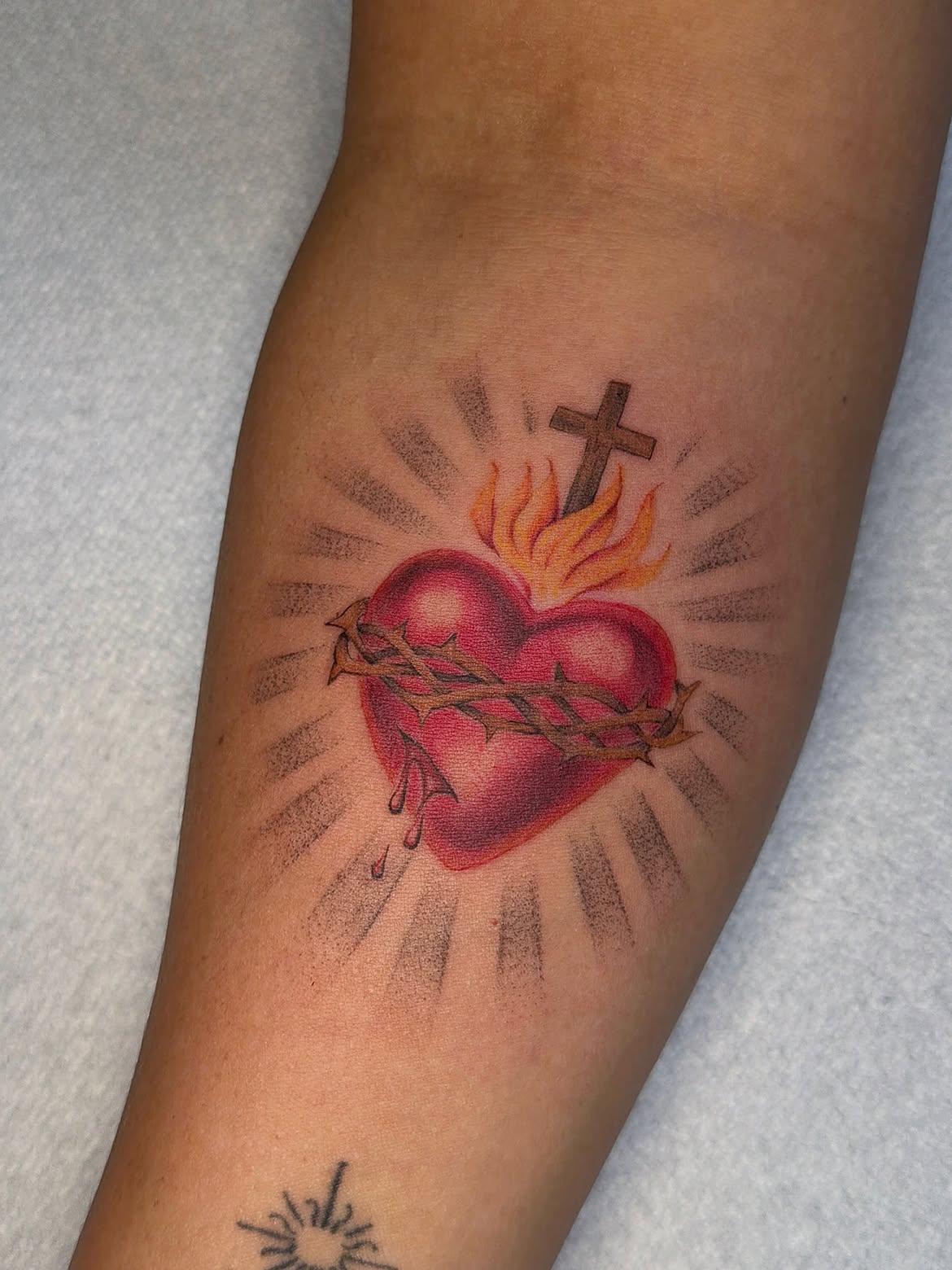
Few versions of this symbol are as immediately recognizable as a red Sacred Heart. Here, saturated crimson gives the heart a warm, almost glowing appearance, while lighter highlights across its upper lobes create volume. A brown crown of thorns cuts across the center, and several small drops extend below it.
Golden-orange flames rise behind the heart toward a dark cross. The contrast is excellent: warm yellow makes the flame visually distinct from the red body of the heart, while the cross provides a firm dark endpoint above everything else.
Soft gray rays spread into the surrounding skin, allowing the central color to remain dominant. This is a clever choice. Had those rays been rendered as heavy black lines, the tattoo would have lost some of its luminous character.
The piece sits comfortably between contemporary illustrative tattooing and Mexican traditional Sacred Heart imagery. For anyone drawn to classic devotional art, this palette is difficult to beat. Red communicates intensity immediately, while the thorns and drops give the design its familiar themes of sacrifice, suffering, and enduring love.
Tiny Fine Line Floral Sacred Heart on the Upper Arm
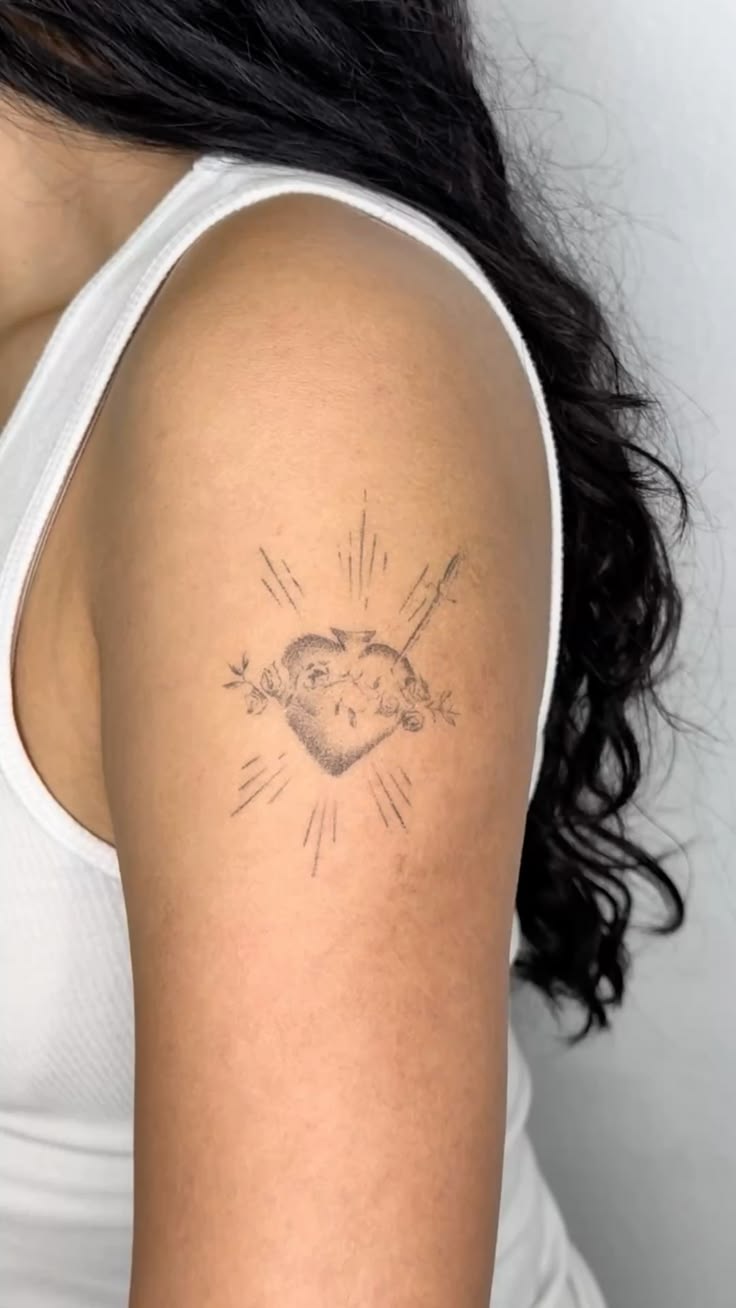
This tiny upper-arm design proves that Sacred Heart imagery does not always require flames, heavy outlines, or dramatic thorns. The heart is suggested through extremely delicate shading and surrounded by tiny flowers and leaves, with sparse rays extending above and below.
The overall effect is intentionally subtle. From a distance it reads as a small decorative emblem; only closer inspection reveals the floral detail within and around the heart. That makes it particularly appealing for someone looking for fine line Sacred Heart tattoo ideas rather than a conspicuous religious statement.
Placement contributes greatly to that feeling. The upper arm offers enough open skin for the miniature motif to remain isolated, almost like a small piece of jewelry. It can be covered easily or allowed to stand alone without needing surrounding tattoos.
A design this delicate requires thoughtful execution. If I were adapting the stencil, I would prioritize the heart silhouette and major floral shapes rather than trying to add more micro-detail. The charm comes from its lightness. Increasing the number of petals, leaves, or rays would work against the reason this version feels special in the first place.
Vivid Sacred Heart Pierced by Three Ornamental Swords
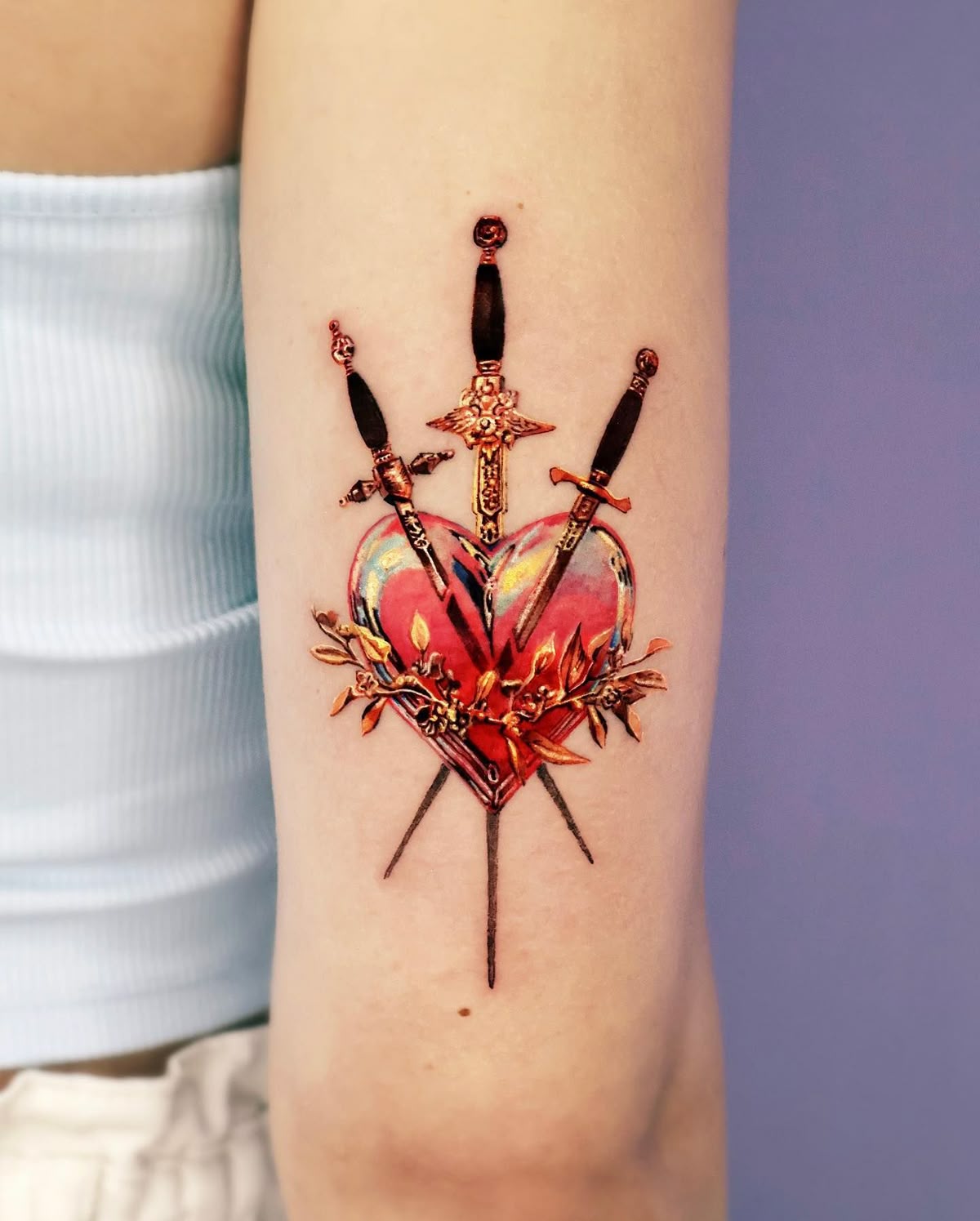
The final design abandons restraint and turns the heart into a richly colored statement piece. Three swords pierce the upper portion of a brilliant red heart, their ornate hilts rendered with gold, black, and warm metallic tones. Decorative branches cross the lower section, adding another layer of detail without hiding the heart’s sharp silhouette.
The color treatment is unusual and memorable. Alongside intense red are flashes of pale blue, yellow, orange, and almost reflective white highlights. Those cool accents make the heart appear glossy, while the warm gold of the weapons creates a luxurious contrast.
Although the composition borrows from religious and traditional tattoo symbolism, the rendering feels much more illustrative than conventional American traditional flash. The outlines are controlled, but the internal color shifts and tiny sword details push the piece toward a contemporary, almost jewel-like aesthetic.
Three blades naturally introduce associations with pain, sacrifice, grief, or emotional trials, although personal meaning does not have to follow a single prescribed interpretation. That is one of the reasons Sacred Heart imagery remains so adaptable: its historical symbolism provides a foundation, but individual elements can change the story.
For anyone considering a similarly detailed piece, I would keep the tattoo at a reasonable scale. Ornate sword handles, tiny botanical forms, highlights, and multiple color transitions need physical space. Enlarging the design stencil slightly is preferable to sacrificing the details that give this version its distinctive character.
Anatomical Sacred Heart with Three Swords and Crown of Thorns
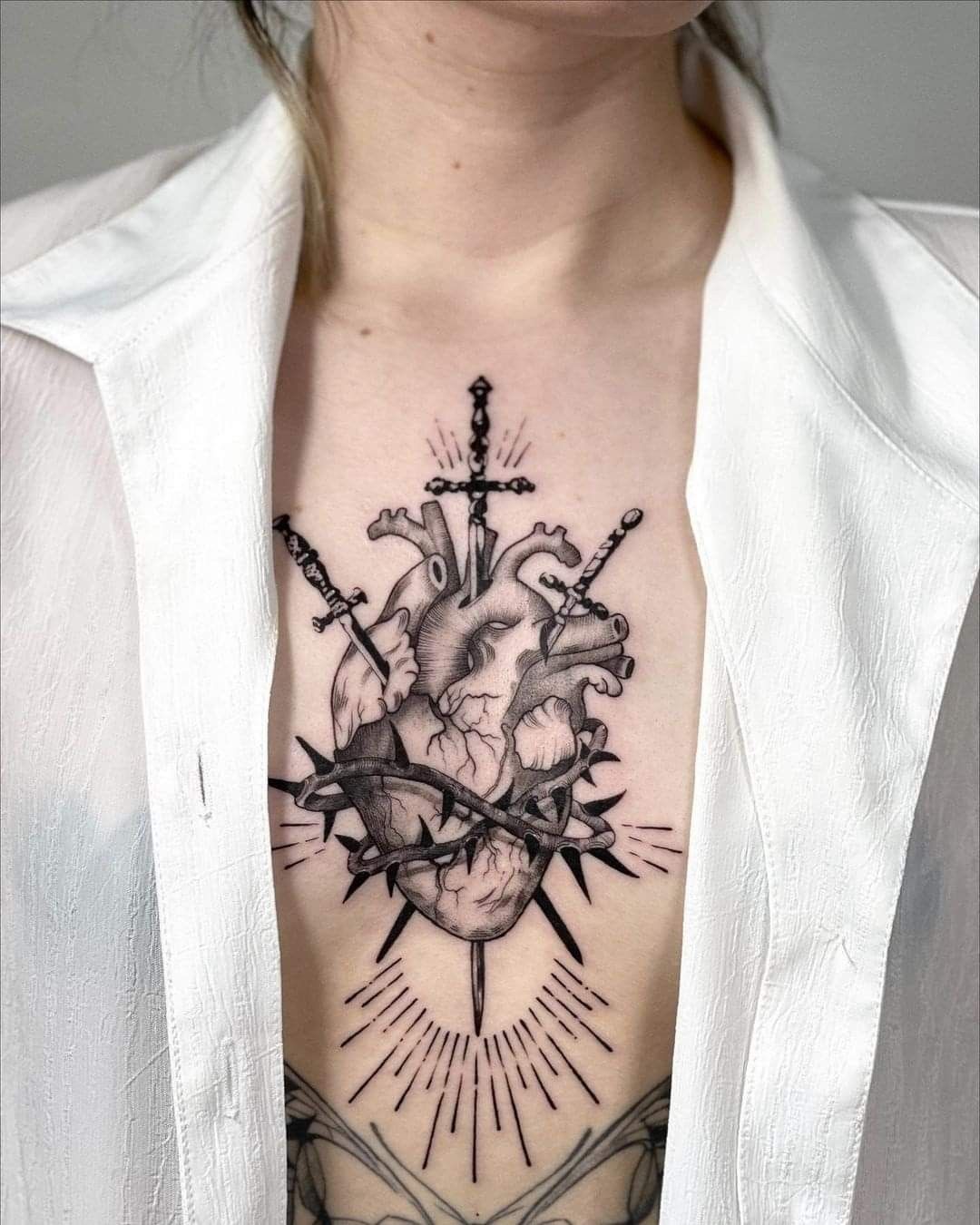
This design takes the Sacred Heart away from the familiar symmetrical icon and replaces it with an anatomically inspired human heart. That decision immediately gives the tattoo a darker, more visceral personality. Fine black-and-gray shading defines the chambers, vessels, folds, and organic contours, while three swords pass through the composition at different angles.
A thick crown of thorns wraps around the lower half. Its oversized spikes create an intentionally harsh contrast with the detailed anatomy underneath. Below the heart, long radiating lines open into a broad fan, giving the composition the devotional halo expected from Sacred Heart imagery without forcing the heart itself into a conventional shape.
The placement makes the design especially dramatic. Centered on the chest, the anatomical heart acquires another layer of visual meaning because it sits close to the body’s actual heart. This is not a quiet or decorative interpretation; it has the scale and complexity of a centerpiece.
For anyone drawn to Gothic Sacred Heart tattoo ideas, this offers a strong direction. A custom design stencil could reduce the number of swords or simplify the anatomical details, but I would preserve the contrast between realistic organic forms and sharp religious symbolism—that tension is the most memorable part of the piece.
Small Ornamental Sacred Heart with a Radiant Halo
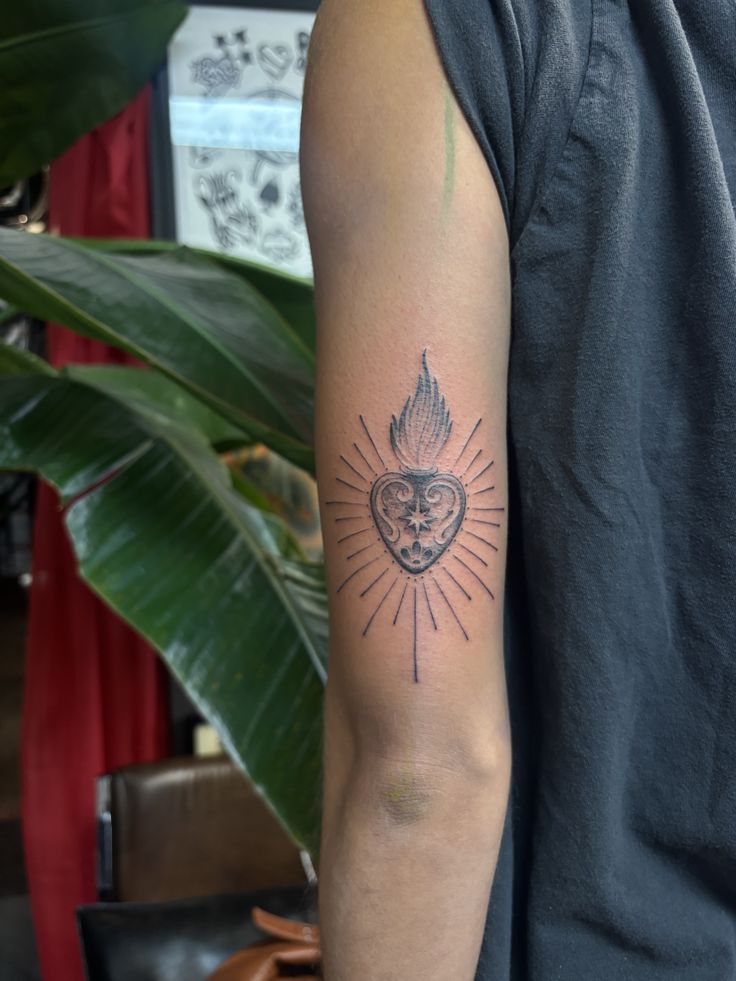
This smaller upper-arm tattoo has an entirely different character. The heart is compact, symmetrical, and filled with curling decorative motifs rather than realistic shading. A tiny star-like detail sits near its center, while a tall flame extends from the top.
Straight rays radiate evenly around the heart, giving the relatively small tattoo a much larger visual footprint. I often find this technique especially effective with simple designs: instead of enlarging the central motif, the artist uses empty space and thin lines to create presence.
There is a vintage quality to the internal ornamentation. The curved shapes resemble engraving, folk decoration, or details found on antique religious objects. That makes this an appealing option for someone who wants an ornamental Sacred Heart without roses, thorns, swords, or heavy black shading.
The scale also makes it adaptable for both men and women. It could sit on the upper arm as shown, move to the forearm, or become part of a collection of smaller traditional and religious tattoos. Keeping the linework uncomplicated is key; adding too many miniature details would undermine its charm.
Tiny Simple Sacred Heart with Thorns and Flame
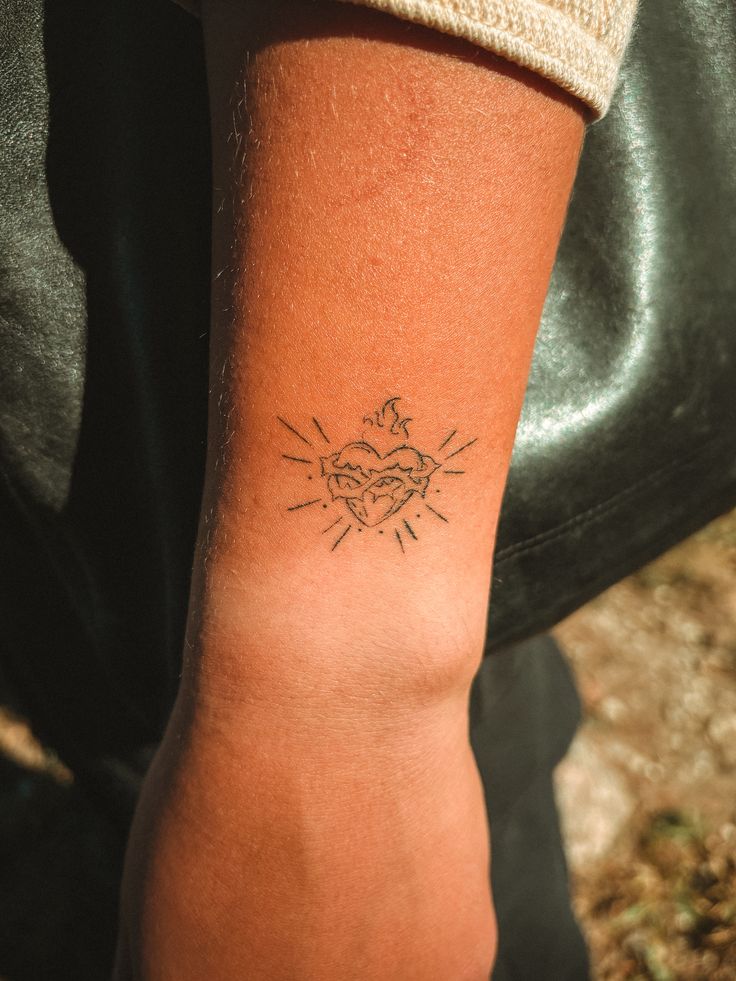
This is one of the most pared-back interpretations in the entire collection. A miniature heart, a loose crown of thorns, a tiny flame, and a handful of short rays are enough to establish the Sacred Heart immediately.
There is almost no shading. Instead, the artist relies on thin outlines and small irregular marks, giving the tattoo a hand-drawn quality. It feels less formal than traditional religious flash, and that informality is precisely what makes it attractive.
For anyone considering a first tattoo or simply wanting something discreet, this is an excellent example of a simple approach. It retains recognizable symbolism without demanding much skin. The small size also makes the placement easy to integrate beside future tattoos.
The main consideration with miniature work is longevity. A good fine line artist may simplify the thorns or leave slightly more space between individual marks so they remain distinguishable as the tattoo settles. At this scale, clarity is more valuable than squeezing every possible Sacred Heart detail into the design.
Dark Sacred Heart Hand Tattoo with Cross and Blood Drops
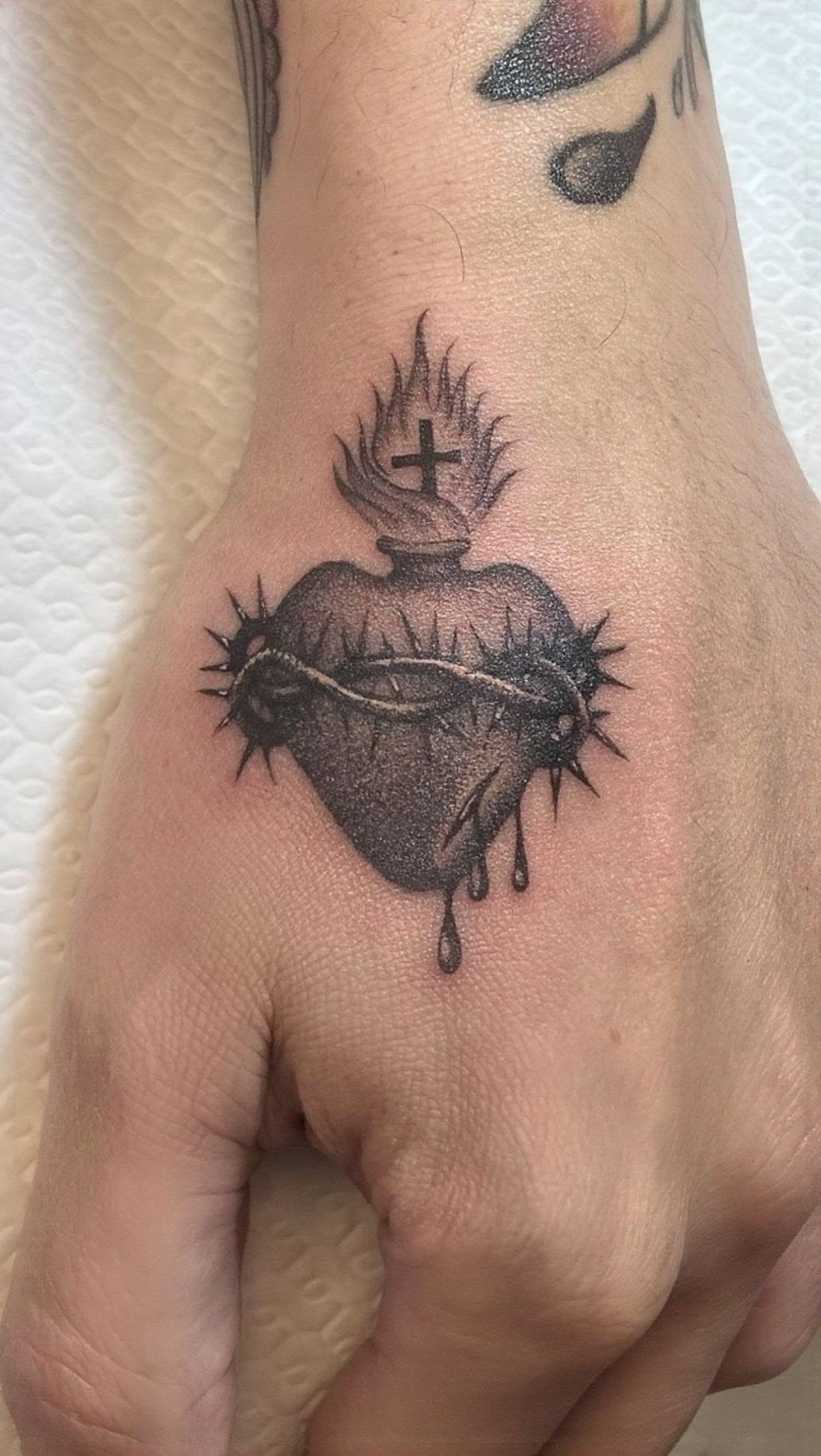
This hand tattoo takes the opposite approach, using deep black shading to make a compact Sacred Heart feel heavy and intense. The heart is almost completely dark, with just enough variation in the shading to preserve its rounded form.
A thorny branch crosses the middle, while a small wound below it releases three drops. Above, a black cross sits within narrow flames. The whole arrangement is compact and vertical, which works particularly well on the back of the hand.
The Gothic character comes from the concentration of black rather than excessive decoration. Even the flame is subdued, allowing the thorns and dark heart to carry most of the emotional weight. In terms of traditional meaning, those elements strongly emphasize suffering, sacrifice, and devotion.
Hand placement naturally makes a tattoo more conspicuous and also subjects it to considerable wear, so the relatively bold lines here are practical as well as stylistic. Someone adapting this piece could introduce a little red into the drops or flame, but the monochrome version arguably feels more severe and cohesive.
Red Ornamental Sacred Heart Back Tattoo
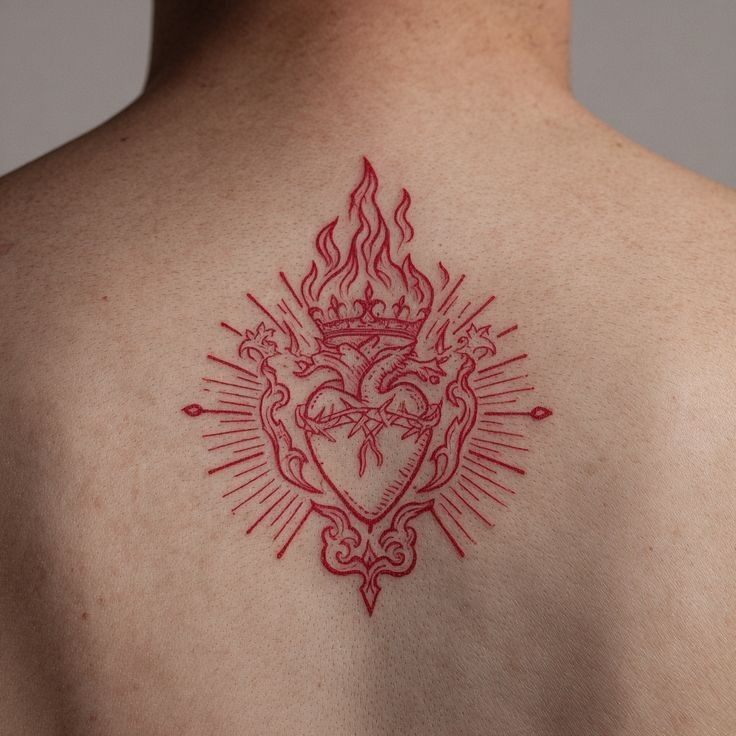
Using only red ink transforms this Sacred Heart into something that feels halfway between a tattoo and an antique devotional print. The central heart is wrapped in thorns and surrounded by elaborate scrollwork, while a crown and tall flames rise above it.
The ornamental framework is particularly beautiful. Curving forms follow the sides of the heart and meet beneath it in a pointed flourish, giving the design a formal, almost heraldic silhouette. Numerous fine rays spread outward, increasing the scale without filling the back with heavy ink.
Because everything is drawn in a single color, the eye pays more attention to line quality and structure. The red also connects naturally with the heart itself, giving the piece warmth even though very little solid color is actually used.
There are strong echoes of Mexican devotional imagery here, particularly in the combination of flames, crown, rays, and elaborate decoration. Someone interested in Mexican traditional tattooing could push that connection further with bolder outlines or saturated color, but I actually prefer the restraint of this version. It feels ceremonial rather than flashy.
The upper back is an excellent placement for this kind of symmetrical stencil, since the central axis of the body reinforces the design’s carefully balanced construction.
Black and Gray Sacred Heart with Dramatic Thorn Halo
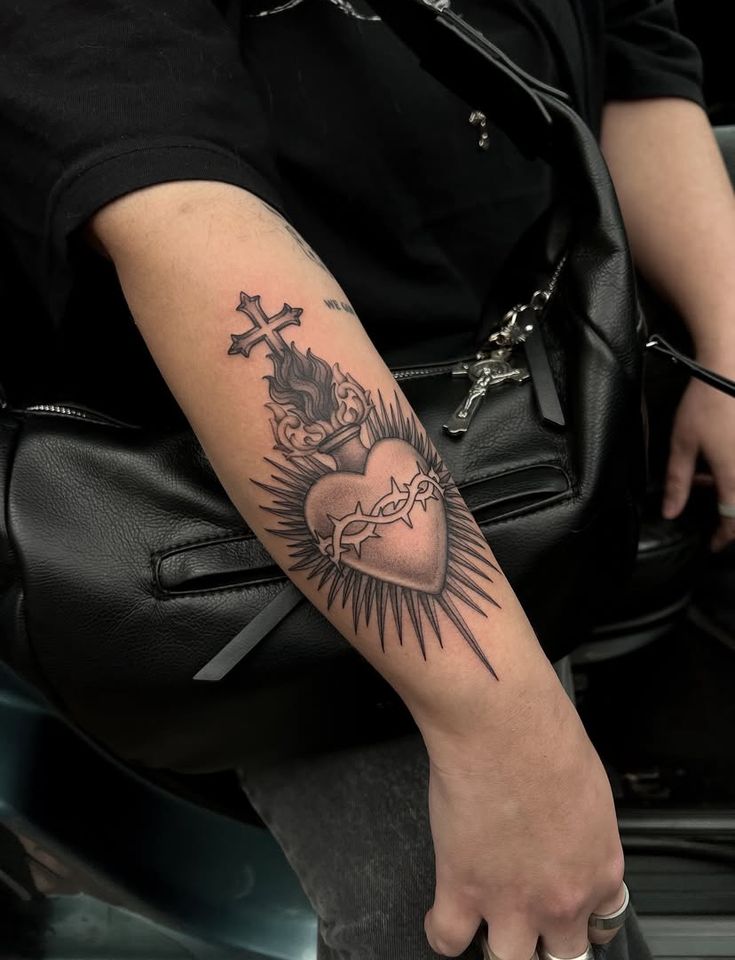
This forearm piece is built around contrast. The heart itself is relatively smooth and softly shaded, while the surrounding halo consists of long, sharp black rays. A crown of thorns winds across the center in a lighter tone, allowing it to remain readable against the heart beneath.
The flame above is unusually elaborate, curling around itself in several layered sections. A cross floats just beyond it, visually extending the tattoo farther up the arm. Together, the cross and flame establish a strong vertical movement, while the rays spread horizontally and downward.
I like the way the artist has resisted filling every element with the same degree of black. The rays are assertive; the heart is softer; the thorns are mostly outlined; the flame combines both approaches. That hierarchy gives the tattoo depth.
This style could appeal equally to women and men who want a traditional Sacred Heart concept but prefer contemporary black-and-gray execution. It would also sit naturally beside blackwork, Gothic, or illustrative tattoos without looking like an isolated piece of classic American traditional flash.
Sacred Heart with Anatomical Details and Crown of Thorns
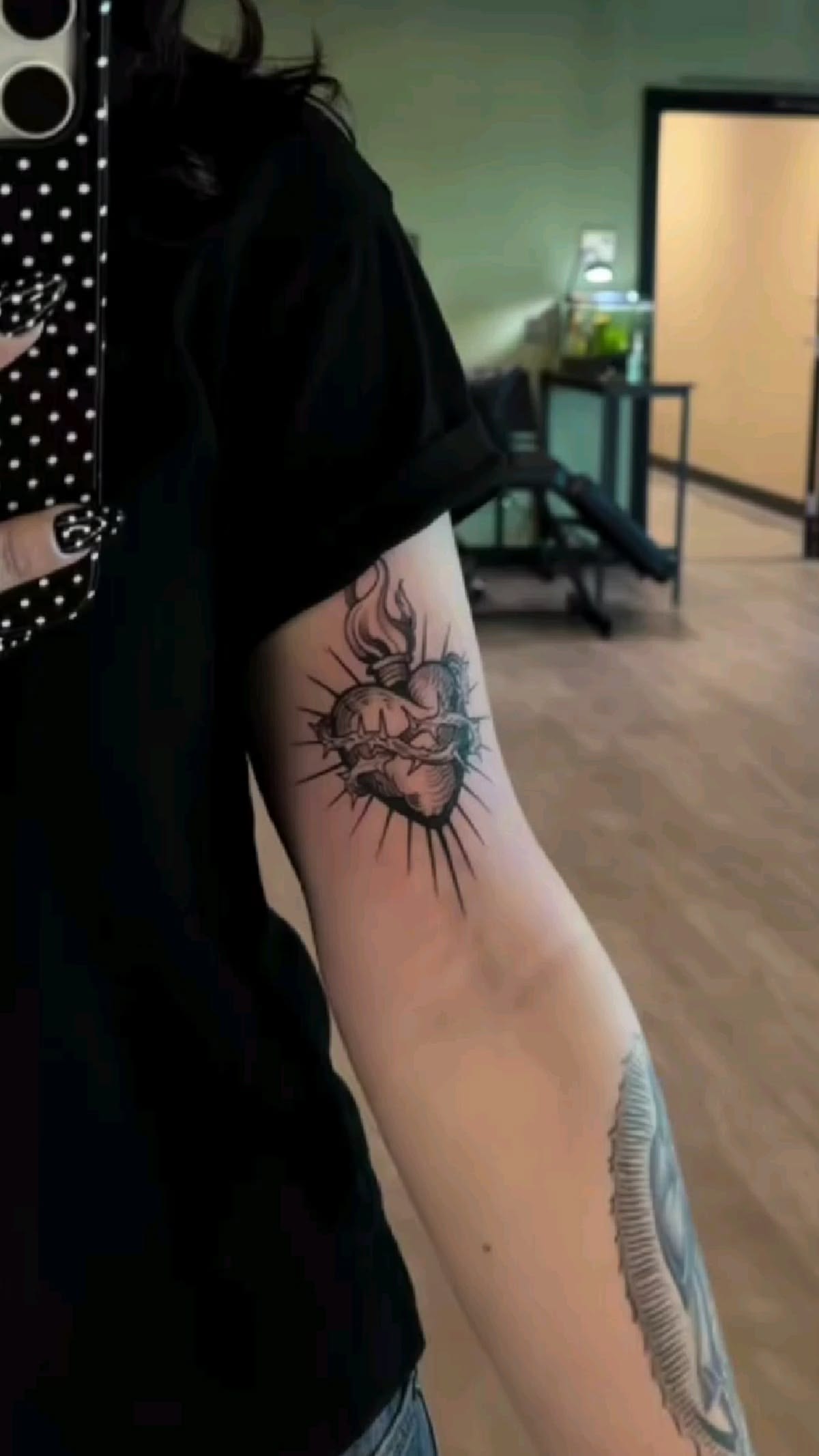
The final tattoo merges two versions of the heart—the religious emblem and the anatomical organ. Rather than drawing a perfectly symmetrical Valentine’s-style shape, the artist introduces organic chambers, folds, and vascular details while still retaining the flame, thorns, and radiating halo associated with the Sacred Heart.
The crown of thorns forms the visual dividing line through the center. Its sharp points overlap the softer anatomical structures, making the heart appear bound rather than simply decorated. A flame rises from the upper portion, while long rays surround the composition and reinforce its devotional identity.
The black-and-gray treatment is restrained enough that the anatomical details remain legible. That matters on the upper arm, where the surface curves and an overly complicated stencil could quickly lose clarity when viewed from different angles.
For me, this is one of the most interesting approaches because it makes the traditional meaning feel unusually physical. Love, suffering, vulnerability, and endurance are represented not by an idealized symbol but by something closer to a living organ. It is an effective direction for anyone who appreciates Sacred Heart iconography but wants a design that feels less conventional.
Sacred Heart tattoos have survived generations of changing tattoo trends because the symbol itself is remarkably adaptable. A tiny fine-line heart can feel intimate and private; a thorn-covered black-and-gray version can communicate sacrifice and resilience; a bold Mexican or American traditional interpretation can turn the same idea into vivid, unmistakable iconography. The best choice is rarely about following one established formula—it is about deciding which parts of the symbol actually matter to you, then giving those elements enough space to speak. If one of these Sacred Heart tattoo ideas inspired your own variation, leave a comment and tell us which style you would choose.