Scars already create lines, textures, and shapes on the body, which is why some of the most interesting scar tattoo ideas 2026 don’t try to make them disappear. Instead, the tattoo artist treats the scar as part of the composition. A surgical line can become a zipper, a row of stitches, the backbone of a playful character, or an unexpectedly delicate ornamental detail.
There is an important practical side to these designs, too. Tattooing scar tissue is different from working on unaffected skin. Texture, sensitivity, pigmentation, and the age of the scar can all influence how ink settles. Experienced artists generally prefer working with fully healed, stable scars, and surgical scars may require clearance from the appropriate medical professional before tattooing. Resources such as Tattooing 101 and established professional tattoo artists are useful starting points when researching artists, but an in-person consultation is particularly important for scar work.
28 ideas below show several approaches—from tiny, humorous additions to larger designs that completely reinterpret a surgical line.
Industrial Stitch Tattoo Along a Long Leg Scar
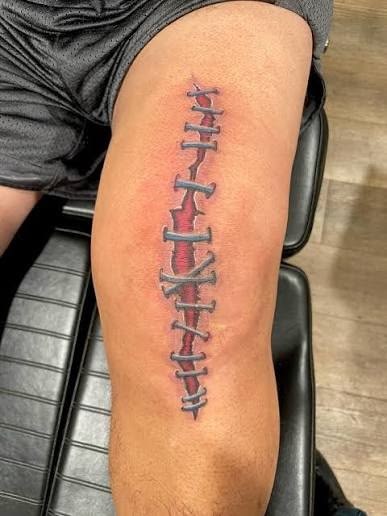
A long vertical scar on the upper leg becomes the centerline of an intentionally rugged stitch design. Rather than placing dense pigment directly over the entire scar, the composition works around it: short dark bars cross the line at irregular intervals, creating the illusion that the skin has been mechanically stitched together.
The uneven spacing is what makes this idea convincing. Perfectly identical marks could feel decorative, whereas these slightly varied bars have an industrial, almost improvised character. Muted gray-black shading and small highlights add enough dimension to suggest metal without turning the design into heavy realism.
This is a clever alternative to a conventional cover up. The original line remains readable, but its meaning changes because the eye begins interpreting it as part of the tattoo. Similar concepts can work particularly well for men or women who prefer bold scar tattoos without adding a large block of ink.
There is also room to personalize the concept. Cleaner black lines would push it toward minimalism, while metallic gray, subtle red accents, or more dimensional hardware could make it considerably more dramatic.
Open Zipper Ankle Scar Tattoo
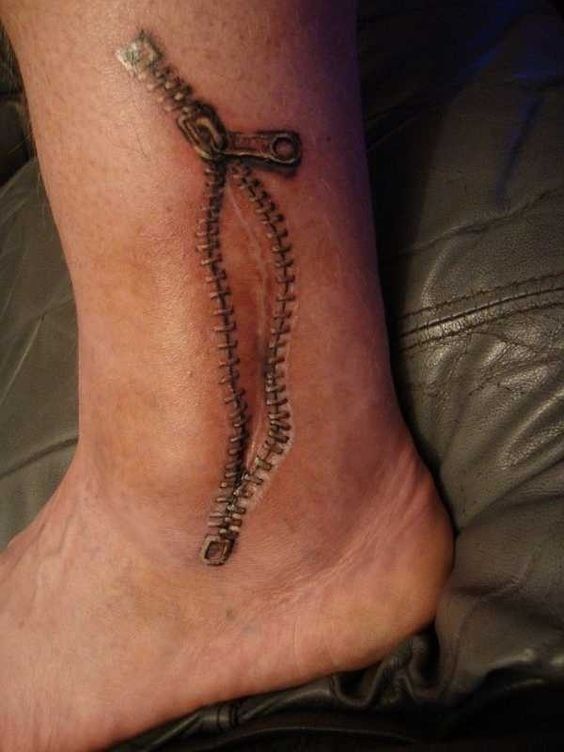
This ankle design takes one of the classic scar-tattoo concepts and gives it surprisingly convincing detail. A zipper follows the vertical scar, with two rows of tiny teeth separating around the upper portion and a small pull positioned near the opening.
What makes the concept effective is the relationship between the natural mark and the illustrated object. The scar provides texture that a conventional zipper tattoo would otherwise have to imitate with shading. Dark brown and black tones keep the hardware dimensional, while the relatively narrow shape follows the anatomy of the ankle rather than fighting against it.
For anyone researching scar tattoo ideas, this demonstrates why placement matters as much as subject matter. A long zipper makes visual sense over a linear surgical scar because both share essentially the same geometry.
It is playful without becoming cartoonish, and it doesn’t need to be oversized to make the joke immediately understandable. For older ankle or lower-leg scars, this type of composition can be adapted into a much cleaner fine-line version or pushed toward realistic metalwork.
Tiny Bandage Tattoo for a Small Scar
Not every scar needs an elaborate tattoo. Sometimes the smartest response is only a few centimeters of ink.
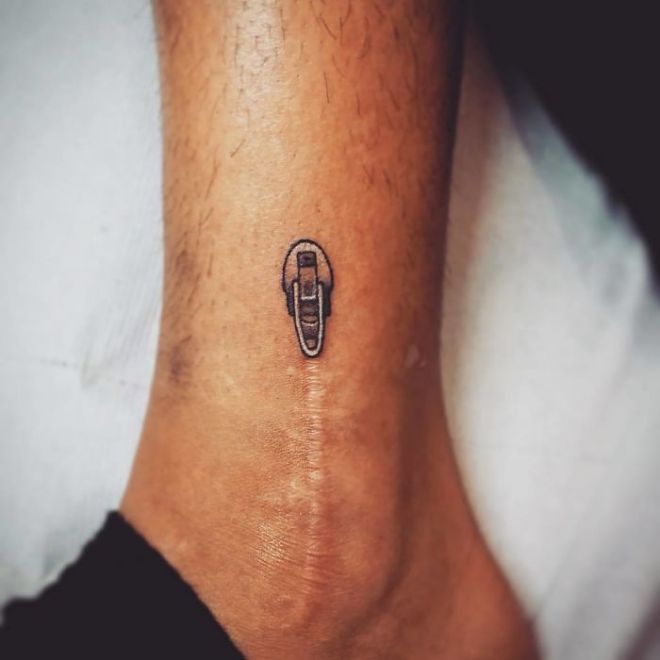
Here, a tiny adhesive bandage is positioned directly over a small mark. A thin black outline defines the oval silhouette, while compact interior rectangles and restrained gray-brown shading provide just enough information for the object to read instantly.
There is something charmingly self-aware about this approach. Instead of pretending the mark was never there, the tattoo essentially says, yes, this happened—and then turns it into a visual joke.
Small designs like this are especially useful when a traditional cover would require making the tattoo disproportionately large. They can work around minor surgical marks on the arm, knee, ankle, or leg, depending on the scar’s shape and condition.
The restraint is also what makes it feel contemporary. Tiny tattoos remain easy to combine with future work, so the wearer isn’t committing an entire section of skin to disguising one small scar.
Fishing Hook and Fish Skeleton Scar Tattoo
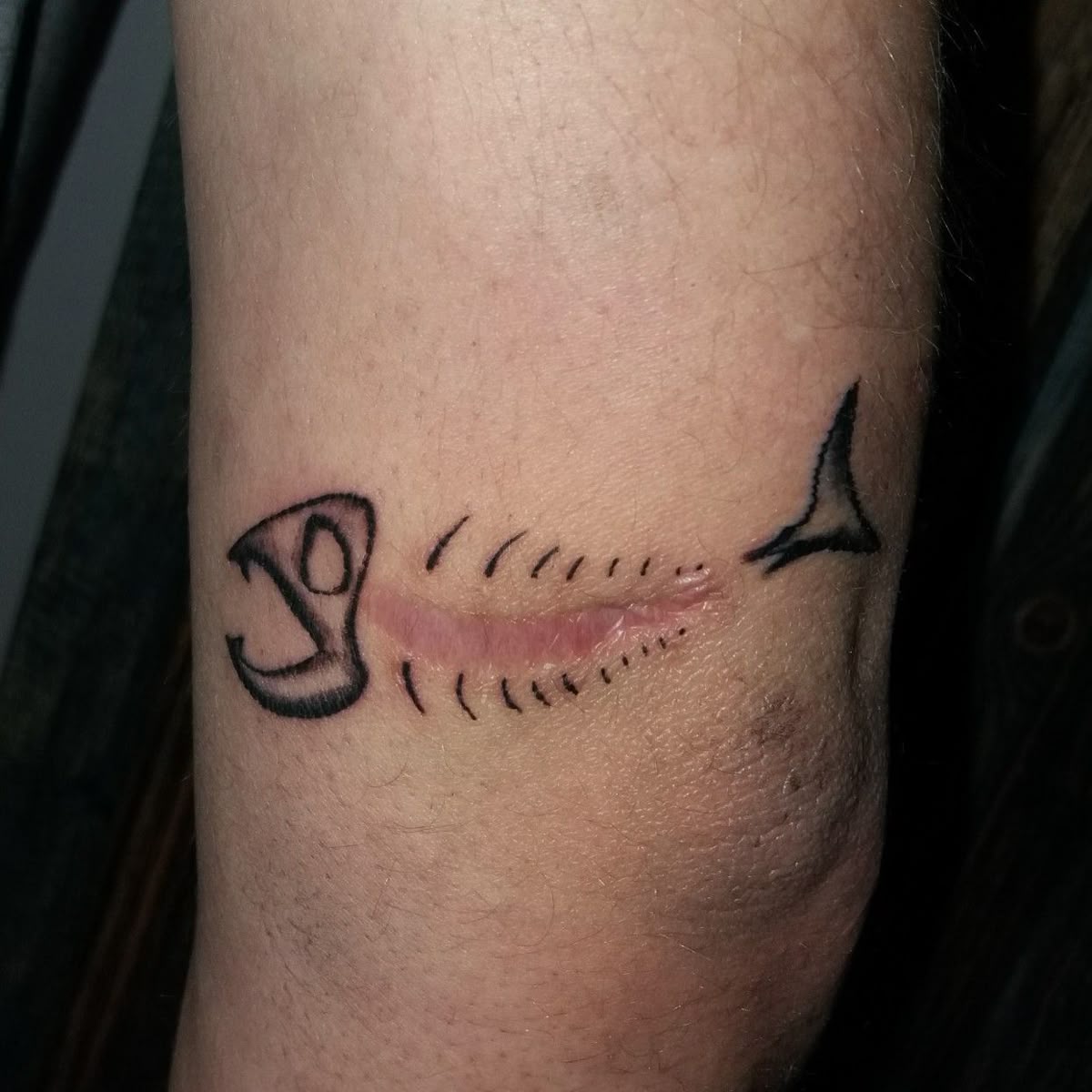
Humor takes over completely in this scar design. A curved scar becomes the body of a fish skeleton, with a stylized fish head added at one end and a pointed tail at the other. Small curved black strokes running above and below the scar suggest ribs.
The result is deliberately simple. There is no attempt at photorealism, elaborate color, or heavy coverups. The artist needs only a handful of strategically placed lines because the scar itself supplies the most important element—the fish’s spine.
This is precisely the kind of design that can feel more personal than simply hiding a mark. The irregularity of the scar is no longer a problem that needs correcting; it is what gives the fish its shape.
The idea could also be developed in several directions. A fisherman might add a hook or tiny line, while someone who likes traditional tattooing could transform the head and tail into bolder American traditional forms. Keeping it black, however, preserves the wonderfully dry humor of the original concept.
Fine-Line Claw Marks Across Stomach Scars
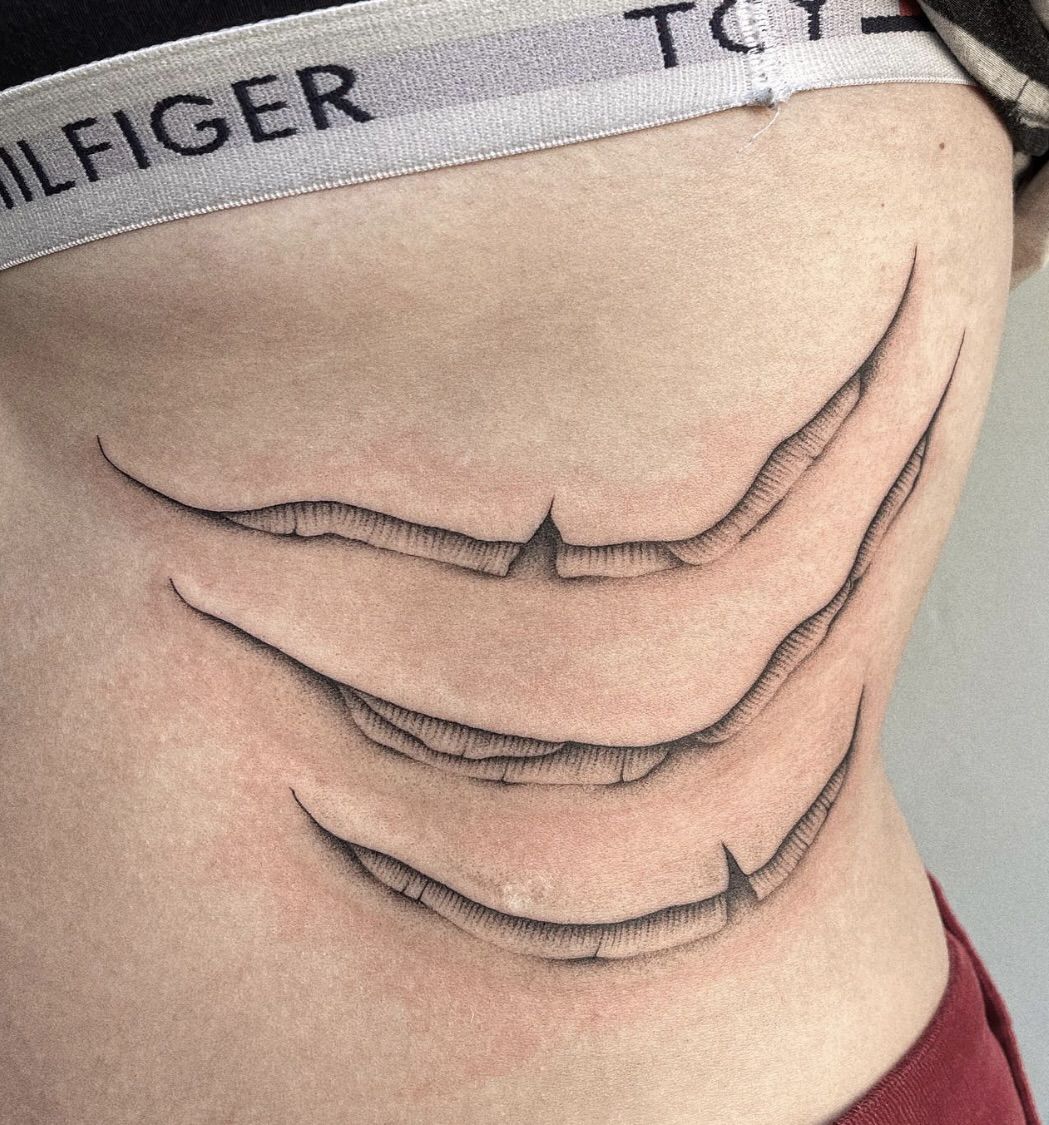
Three sweeping scars across the side of the stomach are transformed into long claw marks through exceptionally restrained fine-line work. Instead of filling or masking the scar tissue, dark tapered points are added around the natural lines, making each mark appear as though it was created by a giant claw.
This is one of the strongest examples of designing with scar texture rather than against it. Fine hatching placed alongside portions of the lines creates shallow depth, while the sharp black tips establish the direction of each slash. The untouched skin keeps the composition airy despite its considerable size.
A concept like this could easily be adapted into a wing, fantasy creature, dragon, or even a subtle pop-culture reference. The existing scar determines the movement, while the added tattoo provides the story.
For larger scars on the torso, this can be an appealing alternative to dense coverage. It leaves plenty of negative space and allows the natural texture to remain part of the finished aesthetic.
Large Zipper Tattoo Following a Surgical Leg Scar
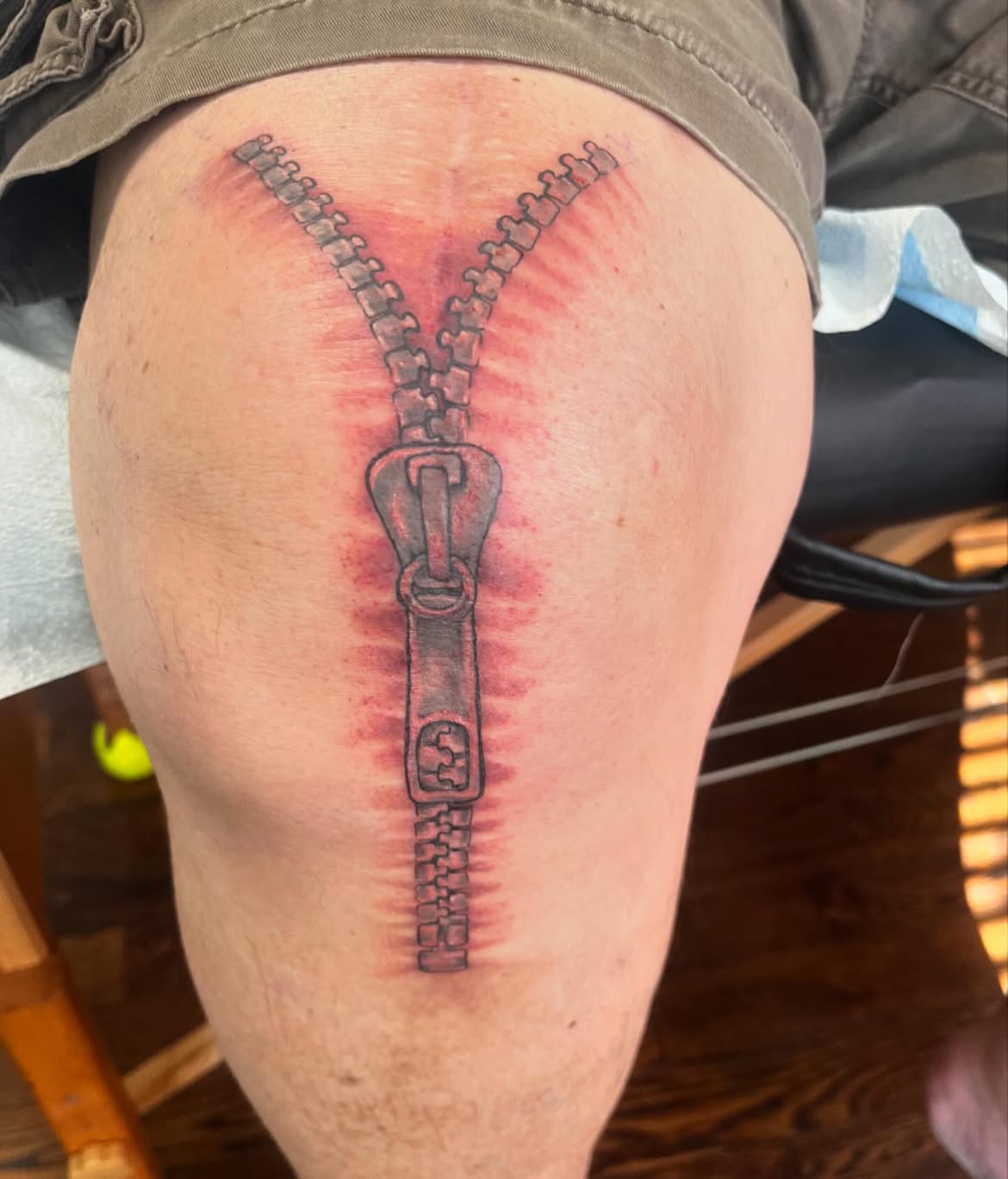
A much larger interpretation of the zipper concept turns a long surgical line into a bold mechanical feature. The zipper runs vertically along the upper leg, with the teeth opening into a wide V toward the top. An oversized slider dominates the center and creates a strong focal point.
Unlike the smaller ankle version, this design isn’t trying to be discreet. Heavy outlines, repeated rectangular teeth, and gray shading make the zipper deliberately graphic. Areas of visible redness emphasize how closely the tattoo follows the existing scar line, although the appearance of fresh tattooed skin will naturally change as it heals.
This scale could suit certain long scars following orthopedic procedures, including some ACL or other leg surgeries, depending on their location. It is also a useful reference for people searching for tattoo ideas for men or women who would rather make a surgical scar visually prominent than camouflage it.
The main lesson here is proportion. A substantial scar can support a substantial motif. Trying to place a tiny decorative object in the same area might make the scar more noticeable by contrast, whereas the oversized zipper gives the entire section of the leg a new visual identity.
Funny Chainsaw Character Using the Scar as Part of the Scene
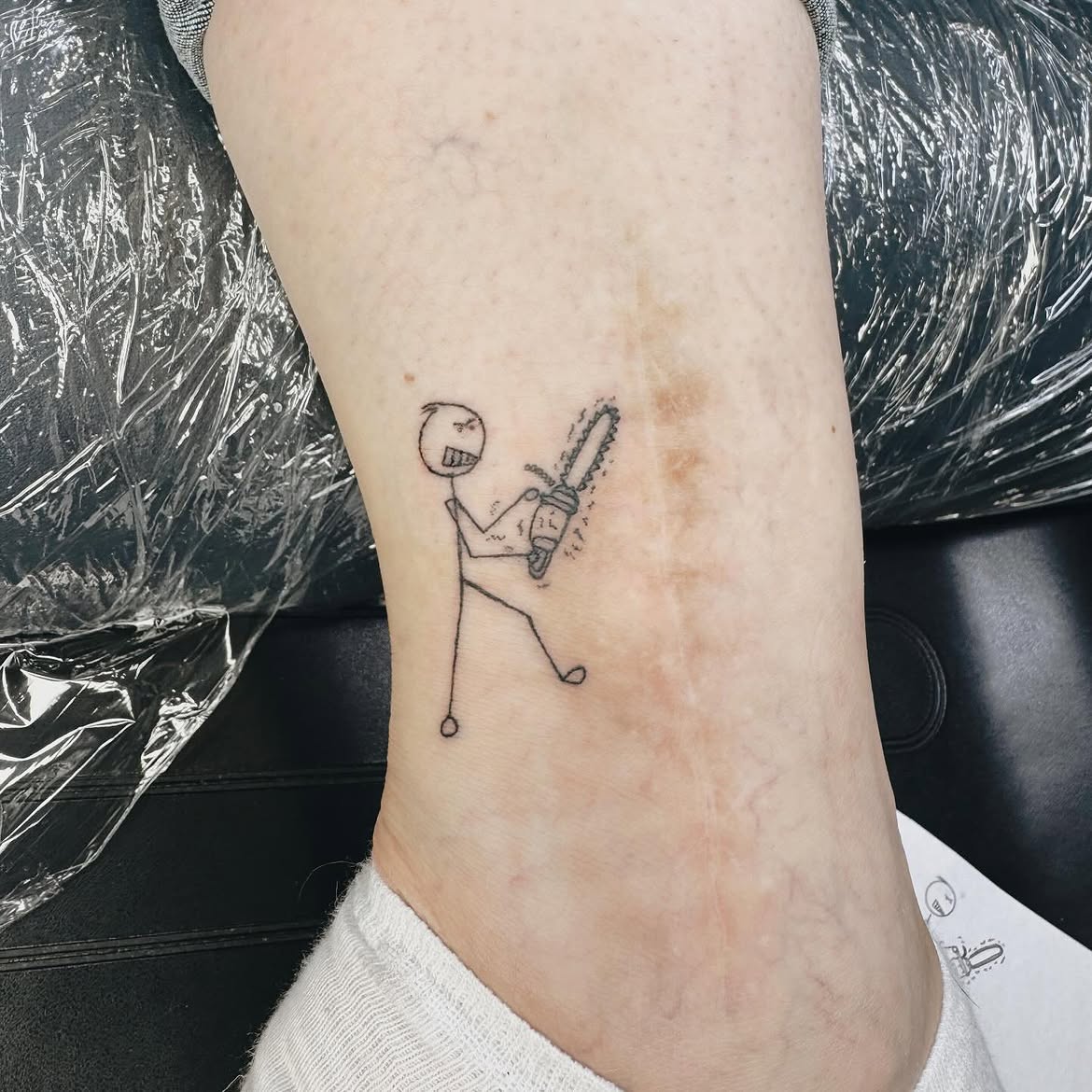
Scar tattoos don’t have to carry solemn symbolism. This tiny stick-figure scene proves that comedy can be just as personal.
A simple character appears to be operating a miniature chainsaw beside the scar, turning the mark into the implied result of the character’s chaotic handiwork. Thin black linework keeps everything intentionally sketchy: circular hands and feet, an expressive face, a small chainsaw body, and jagged teeth are enough to tell the entire story.
The intentionally rough drawing style is a particularly good choice. A highly realistic character could overwhelm the relatively subtle scar, while this almost notebook-doodle aesthetic keeps the natural mark visually important.
It’s also a useful reminder that a scar tattoo doesn’t automatically mean cover up work. Sometimes adding a tiny narrative around a scar creates a more distinctive result than covering it with flowers or solid shading.
For someone who associates a scar with a difficult period, humor can offer a very different way of reclaiming the area. The finished tattoo becomes less about concealing what happened and more about deciding how the story is presented.
Red Thread and Needle Scar Tattoo
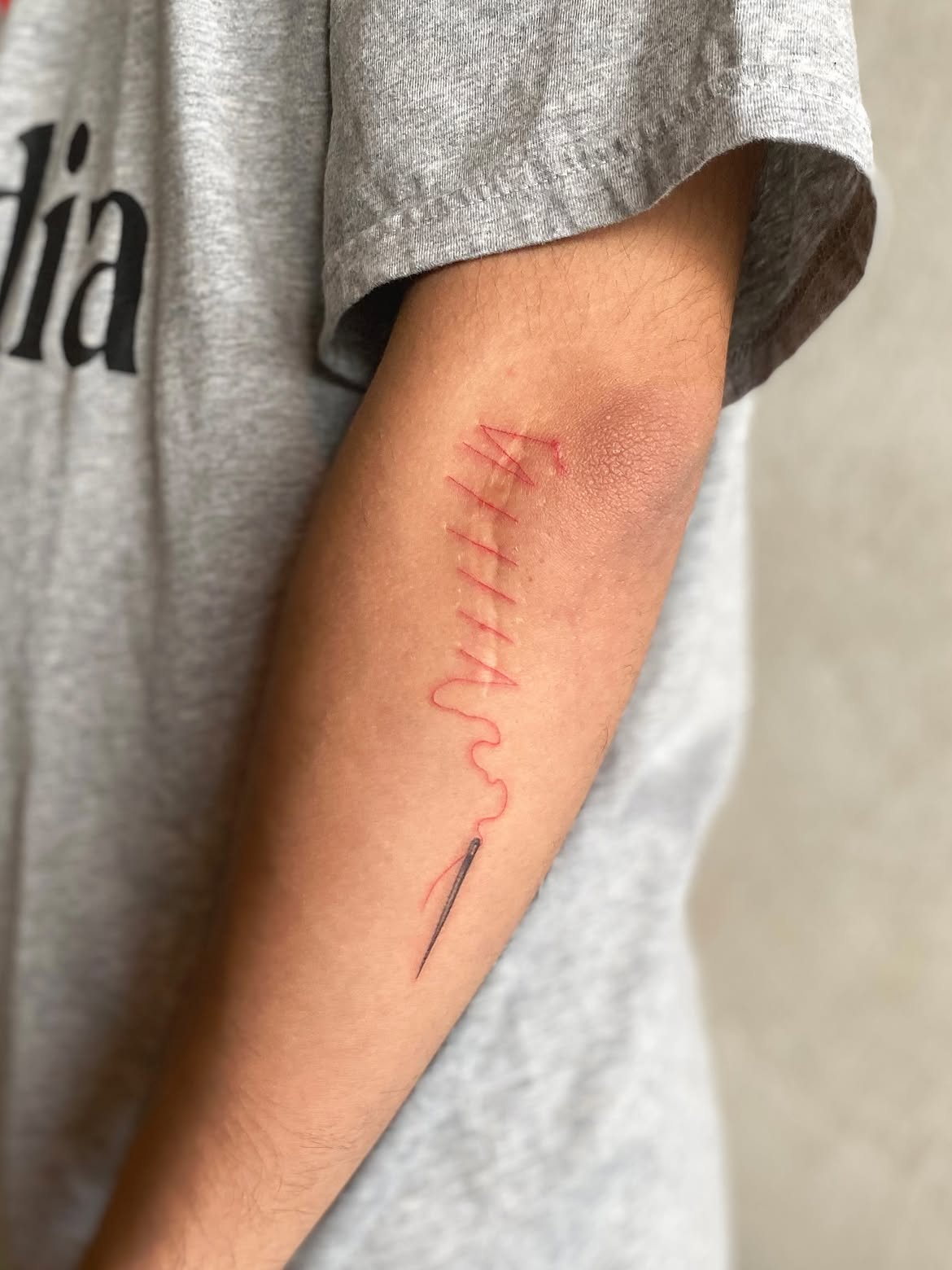
This design takes the familiar idea of surgical stitches and translates it into something much more delicate. A slim needle sits at the lower end of the composition, while a winding red thread travels upward toward a series of fine diagonal stitches. The existing scar becomes the seam being repaired rather than something the tattoo is attempting to erase.
The restrained color palette is especially effective. Nearly everything is carried by the red line, with the dark needle providing a small point of contrast. Because the thread is intentionally loose and irregular, the tattoo feels hand-drawn rather than mechanically perfect.
For a long arm or leg scar, the same concept could be expanded with additional stitches, while a shorter scar would suit an even more minimal version. It is an appealing idea for women or men who want to acknowledge healing without committing to a conventional, heavily shaded cover up.
UFO Abduction Knee Scar Tattoo
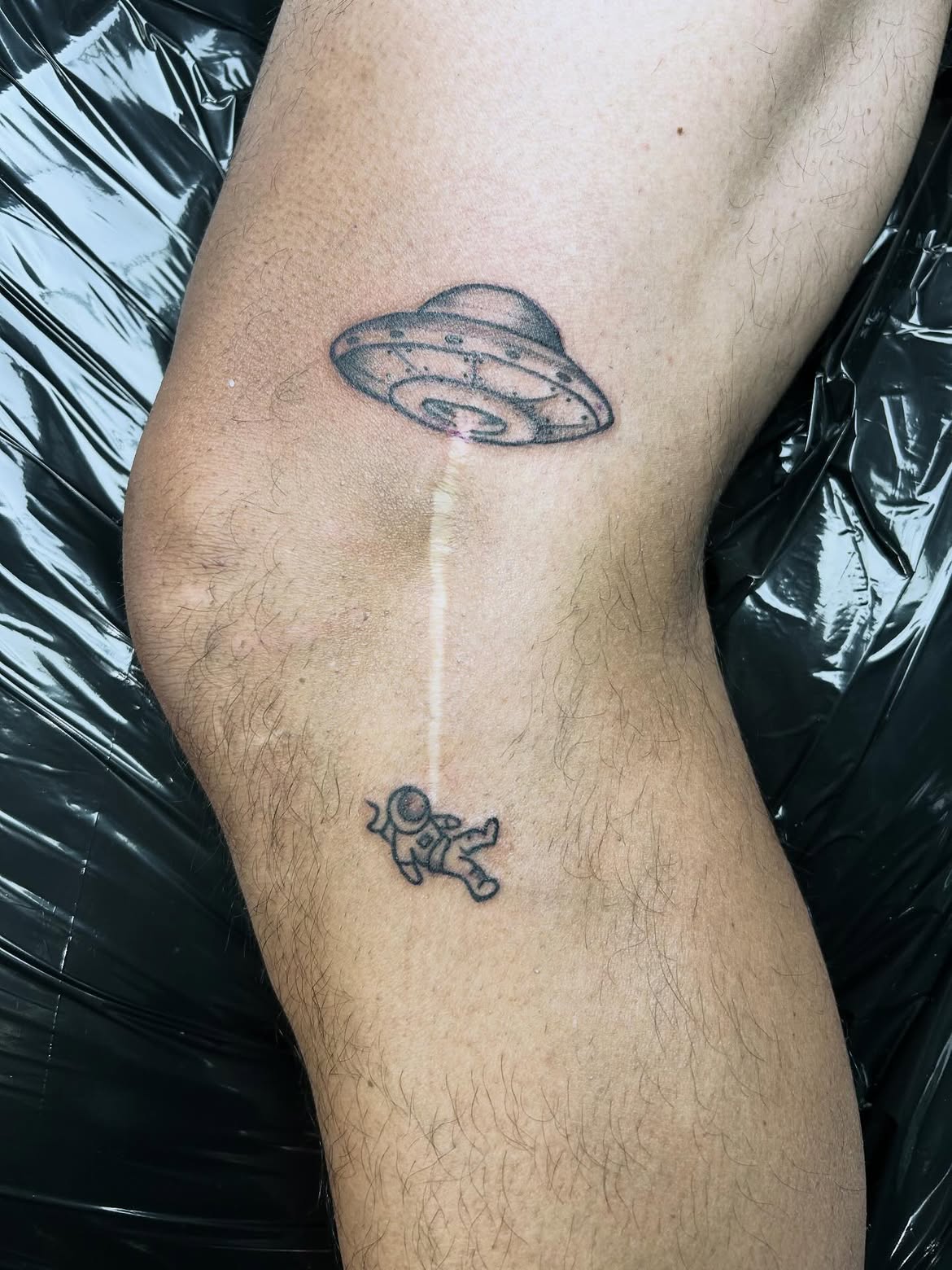
A pale vertical scar near the knee becomes a beam of light connecting two tiny illustrations: a flying saucer above and an astronaut floating underneath it. It is exactly the kind of visual joke that makes scar tattoos memorable because the natural line does most of the storytelling.
The UFO has enough black-and-gray shading to suggest a rounded metallic form, while the astronaut is kept deliberately tiny and graphic. Between them, the light scar remains almost completely untouched. From a distance, it reads as a glowing tractor beam.
For anyone considering tattooing after an ACL or another knee procedure, this illustrates an important creative principle: a scar does not necessarily have to sit underneath the tattoo. It can occupy the negative space between tattooed elements instead.
The result feels imaginative without requiring a large cover, and the sci-fi theme could easily be personalized with stars, planets, a rocket, or a different character.
White Lightning Scar Tattoo Across the Neck and Shoulder
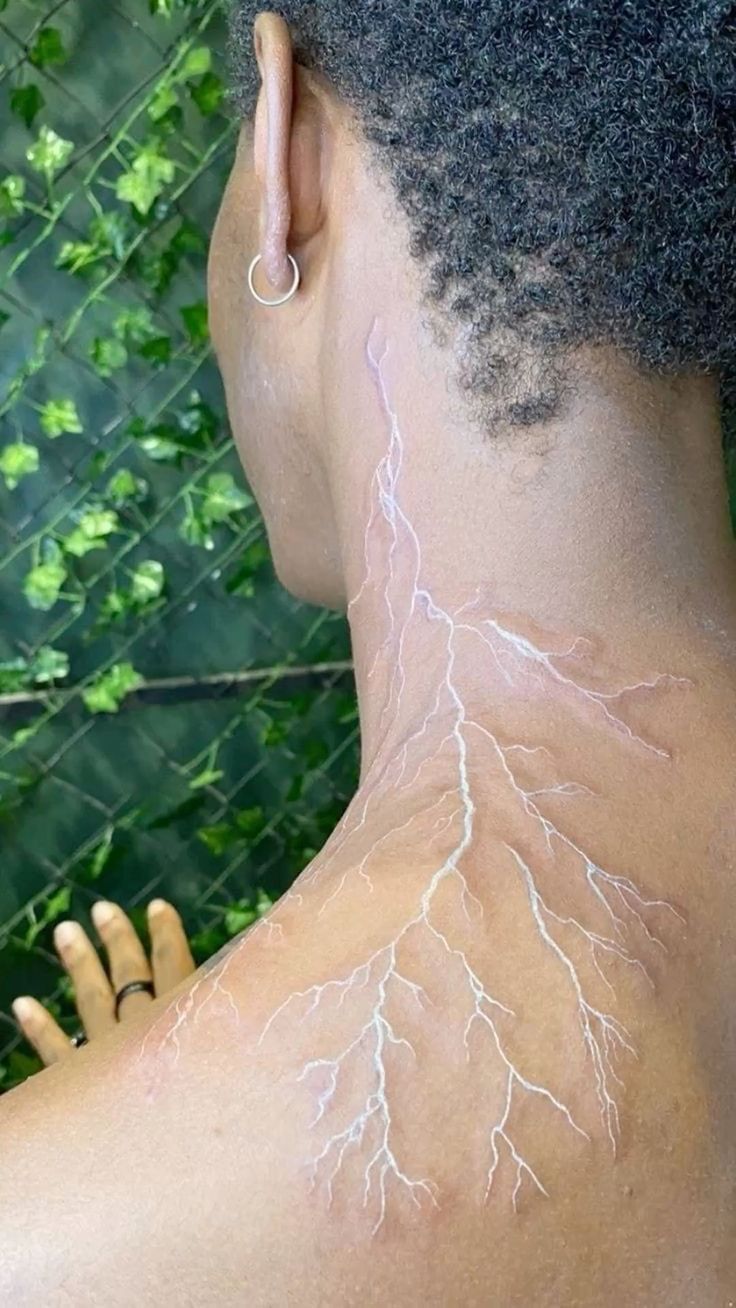
Instead of dark ink, branching white lightning travels from behind the ear down the neck and across the shoulder. The fine irregular lines resemble both electrical currents and the organic branching pattern of veins or tree roots.
White ink makes this idea particularly subtle. Against the skin, the network appears almost luminous, especially where several narrow branches meet at the main central bolt. The design also demonstrates how a scar-inspired tattoo does not always have to follow one perfectly straight line. It can spread outward and use the body’s contours to create movement.
The transition from neck to shoulder is beautifully handled. Smaller branches become finer toward their ends, preventing the tattoo from turning into one large white mass.
Anyone considering white pigment over or around scar tissue should discuss expectations carefully with an experienced artist, since healed appearance can vary considerably with skin tone, scar texture, placement, and the way white ink settles over time.
Blue and Red Floral Scar Cover Up
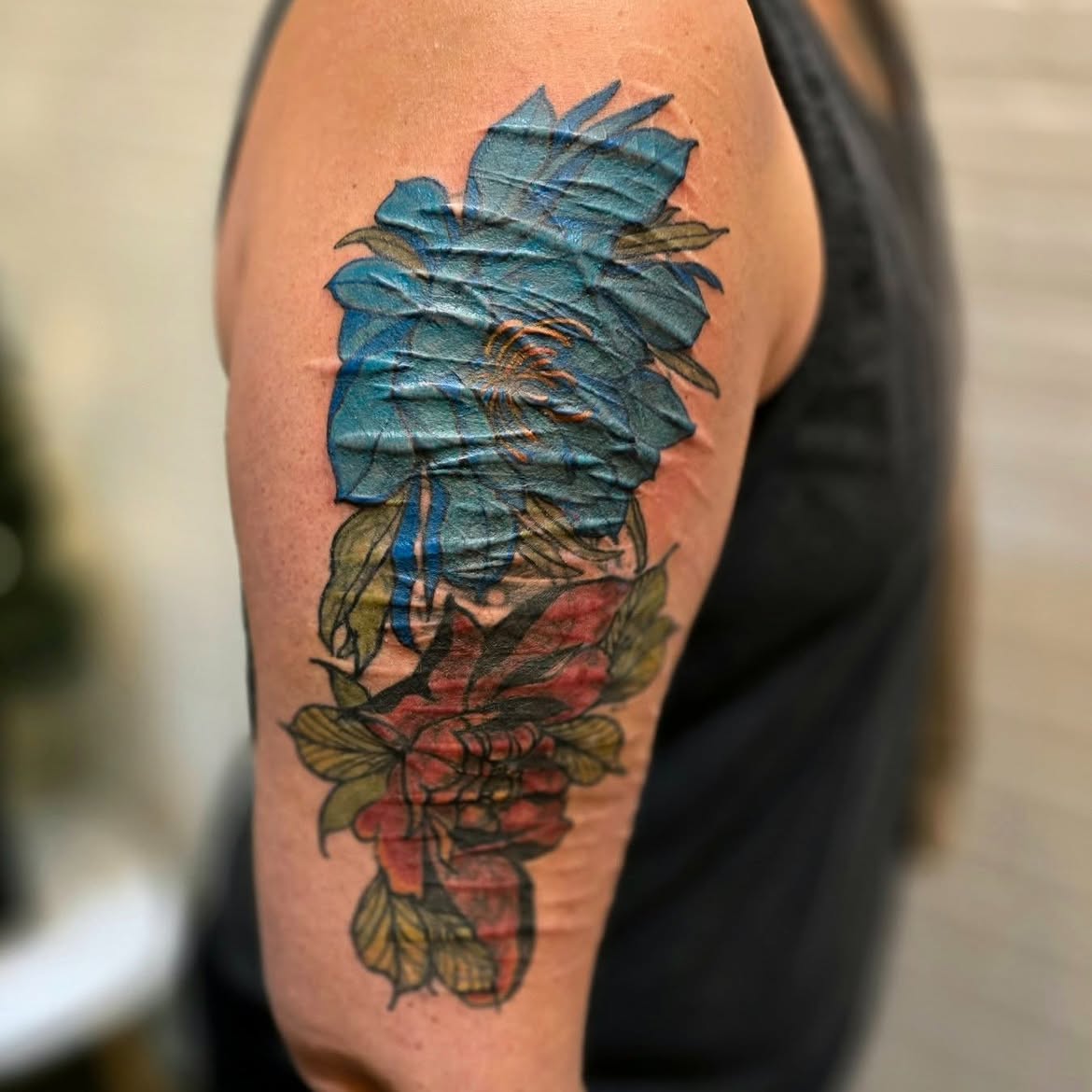
This is the most traditional cover up approach in this group. Rather than converting individual scar lines into objects, a substantial floral composition stretches vertically along the upper arm and incorporates the textured area into layers of petals, leaves, outlines, and color.
Large blue flowers dominate the upper section, while deeper red blossoms create weight below. Olive and muted green leaves bridge the two color zones. Strong outlines give the flowers enough definition to remain readable even where the surface of the skin changes underneath them.
For larger scars, this illustrates why botanical coverups remain popular. Flowers contain natural folds, overlapping petals, shadows, veins, and irregular edges. An artist can use those details strategically instead of relying on a flat block of pigment.
The design is equally adaptable for women and men. Darker flowers could make the treatment moodier, while softer botanical colors would produce a lighter result. The essential advantage is the layered composition: the eye follows the flowers before it notices differences in skin texture.
Black Cat Ankle Scar Tattoo
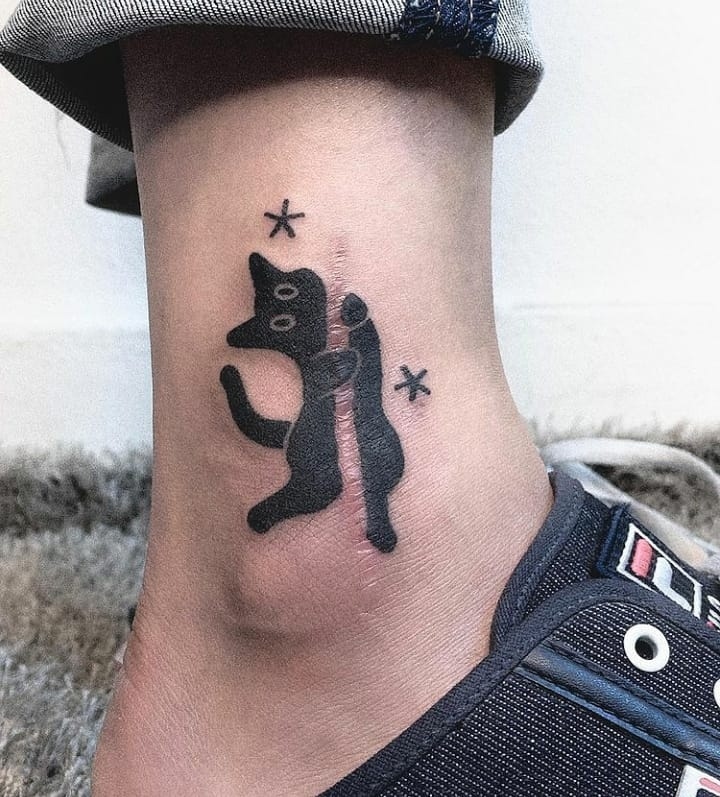
A small black cat turns a vertical ankle scar into the funniest part of the design. The animal appears to be leaning against—or interacting with—the natural line, so the scar becomes an intentional prop rather than an interruption.
The cat is rendered almost entirely in solid black. Two negative-space eyes keep its face expressive, while a curved tail and loosely positioned limbs give the silhouette a quirky, animated personality. Two tiny star-like marks complete the composition without crowding the ankle.
This is a useful approach for people who like tiny tattoos but don’t necessarily want a literal scar cover. Solid black elements placed beside the mark provide strong contrast, while leaving the scar itself visible.
The idea could be personalized endlessly: a cat climbing the line, hanging from it, scratching it, or peeking around it would all use the same basic principle. The placement also works nicely with low shoes because the complete design remains visible just above the footwear.
Three Tiny Color Stitches for a Minimal Scar
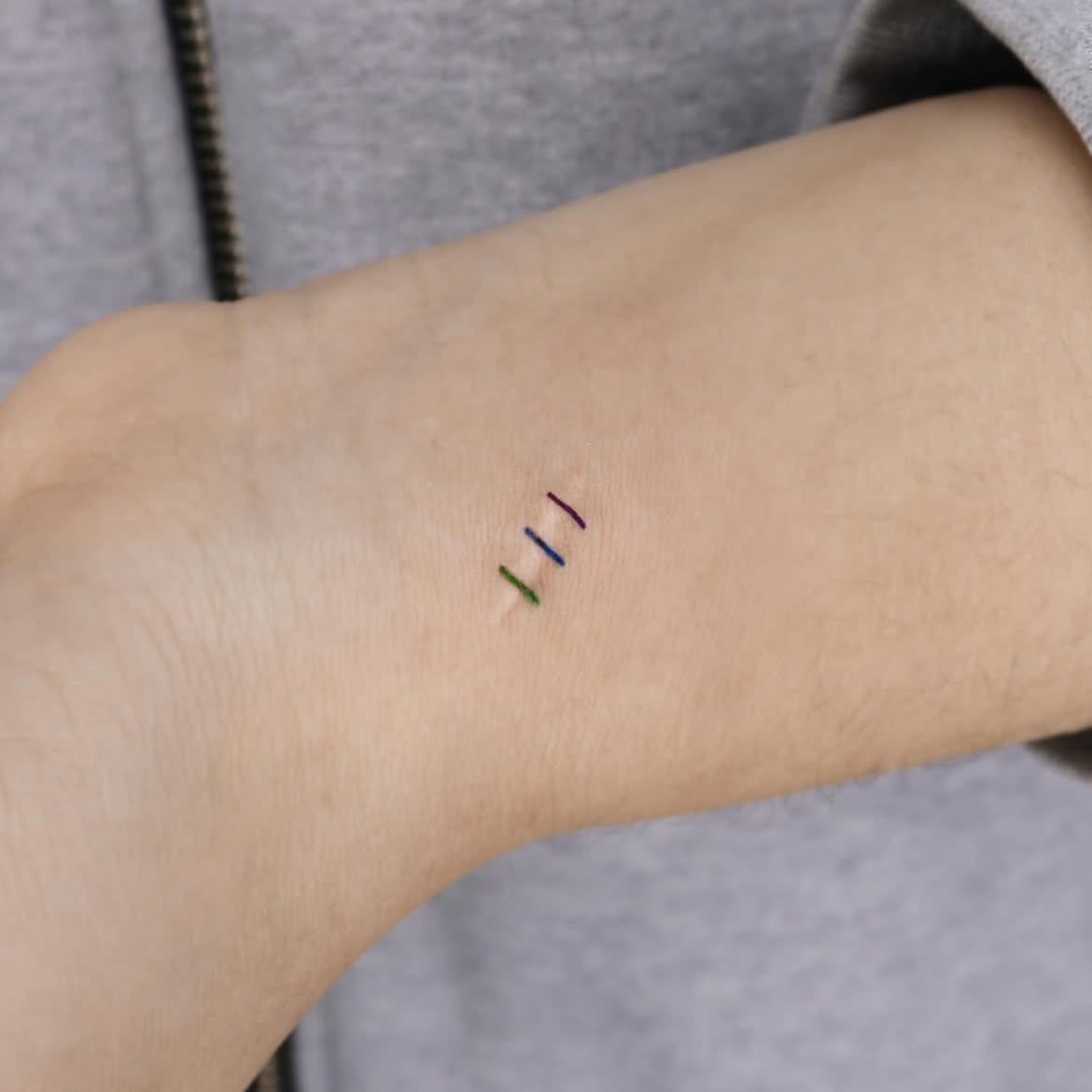
Three tiny strokes of color prove just how little ink a scar tattoo may actually need. Green, blue, and purple marks cross a short pale line, creating the impression of miniature stitches.
There is no shading, outline, decorative background, or attempt to conceal the surrounding skin. That simplicity makes the natural scar an equal partner in the finished design. Without it, the three colored bars would be almost abstract; with it, their purpose becomes immediately understandable.
This is one of the most understated scar tattoo ideas 2026 for someone who wants an intervention rather than a full transformation. The palette could also carry personal meaning. Rainbow colors could create a brighter version, while three black stitches would feel more graphic and neutral.
Tiny concepts like this are especially dependent on precision. With so few elements, placement and spacing become the entire design, so choosing an artist comfortable with fine-line work matters more than adding complexity.
Safety Pin Tattoos Around a Textured Leg Scar
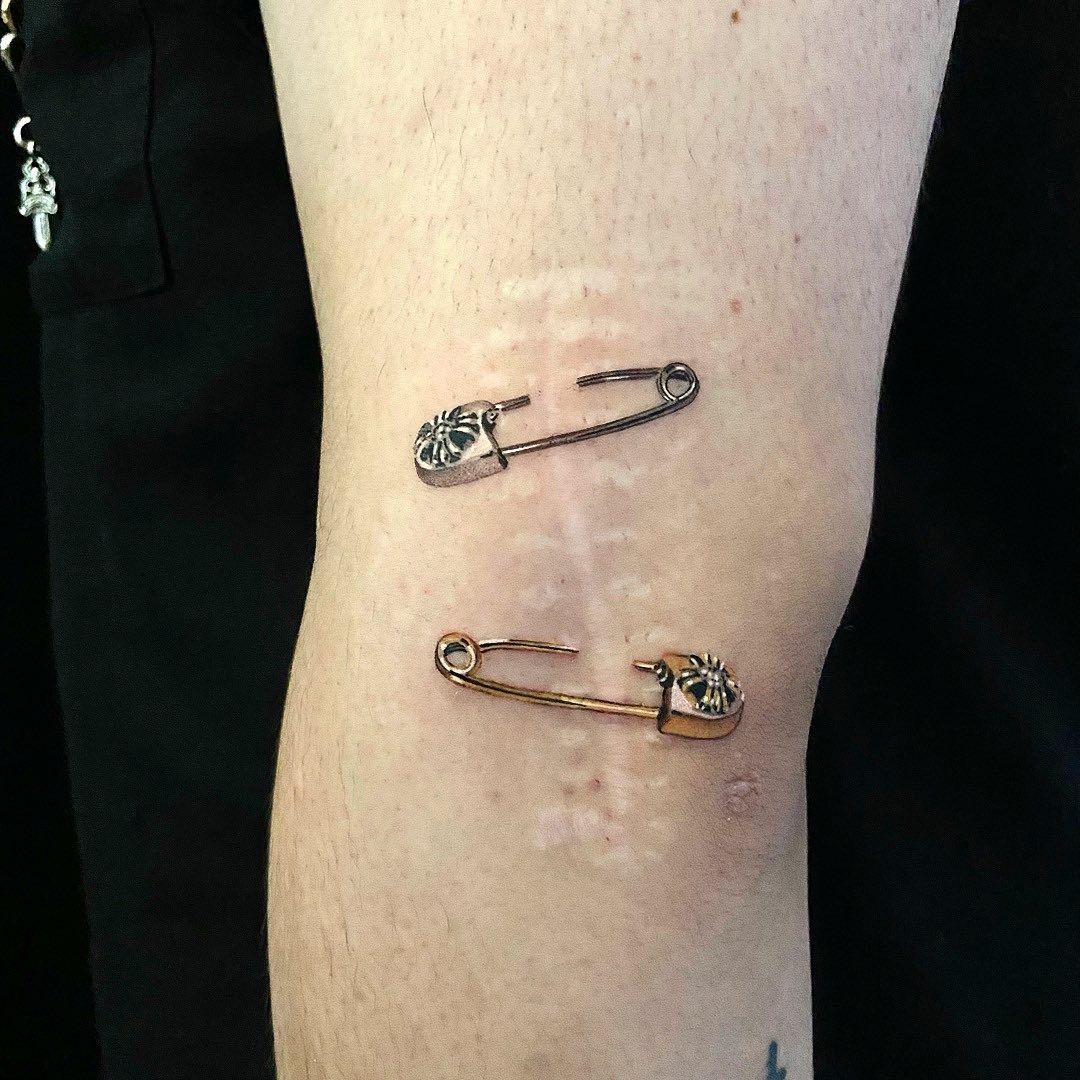
Two realistic safety pins create an industrial frame around a broad area of textured skin on the leg. One sits above and another below, producing the illusion that the area has been fastened or held together.
The metallic effect comes from surprisingly small details: dark outlines, fine highlights, curved wire, dimensional clasps, and warm versus cool metallic tones. One pin reads as silvery gray while the other has a warmer gold appearance, preventing the repeated motif from looking copied and pasted.
Unlike a dense cover up, the tattoo leaves much of the scarred area visible. That choice gives the design its character. The safety pins don’t pretend the texture isn’t there; visually, they suggest that it belongs between them.
This concept sits somewhere between body-horror imagery and jewelry-inspired tattooing, yet it remains relatively minimal. For a more dramatic interpretation, an artist could add thread, fabric effects, staples, or additional hardware. Keeping only the two pins, however, allows the natural skin texture to remain the focal point.
Zipper Tattoo Following an Ankle Scar
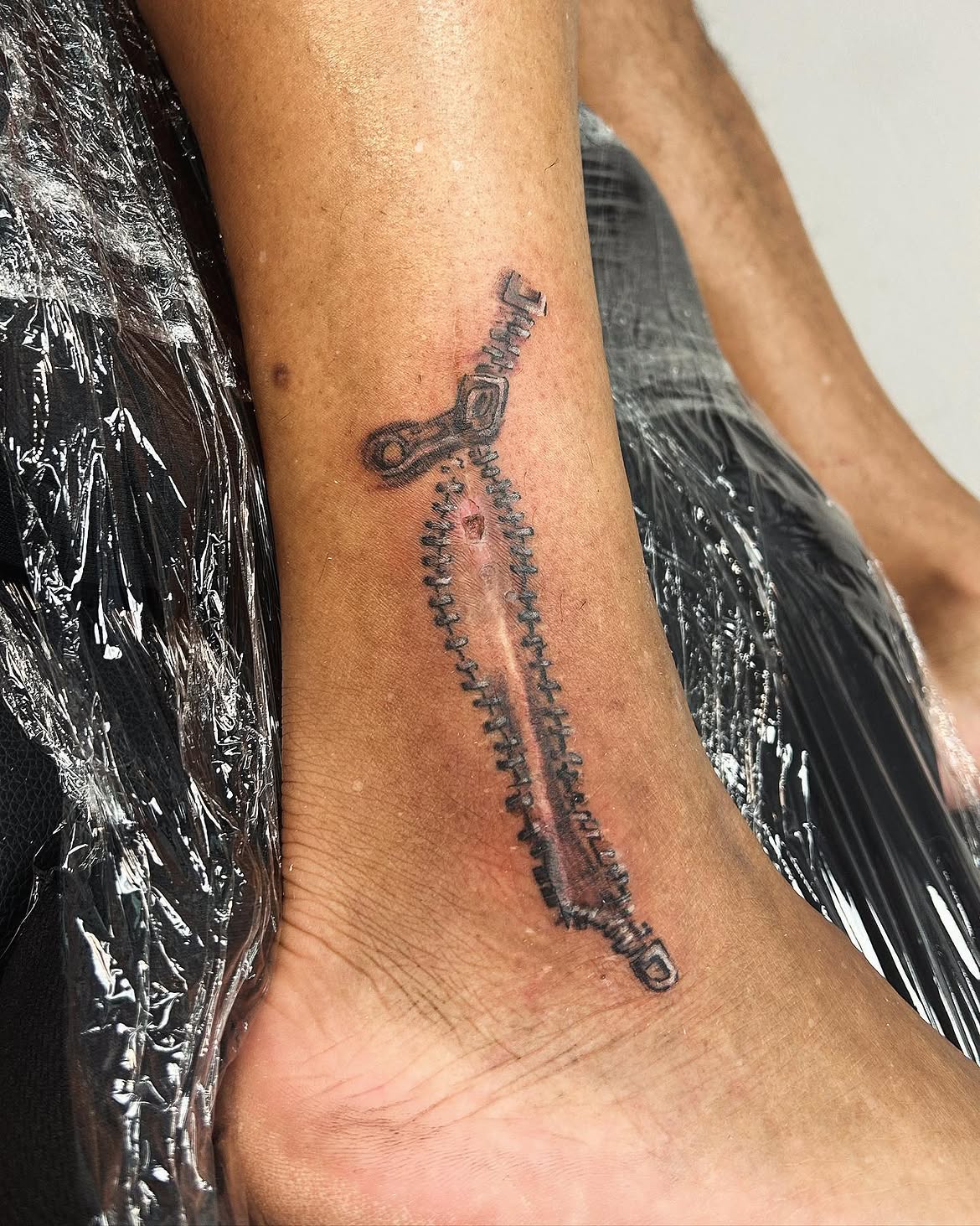
A long scar running toward the ankle is transformed into the opening of a partially unzipped zipper. Instead of covering the pale central line, the artist builds two rows of dark zipper teeth around it, allowing the natural skin texture to form the space between them. A substantial pull tab at the top completes the illusion.
The black-and-gray treatment gives the hardware a convincingly metallic quality without making the tattoo unnecessarily heavy. Slight variations in the zipper teeth are useful here: they work with the uneven character of scar tissue rather than demanding perfect symmetry.
As a scar cover concept, this sits somewhere between camouflage and celebration. The scar remains clearly visible, yet it suddenly appears indispensable to the composition. This approach can be especially effective on long surgical scars on the leg, where the narrow proportions naturally accommodate mechanical motifs.
Delicate White Star Tattoo Over a Scar
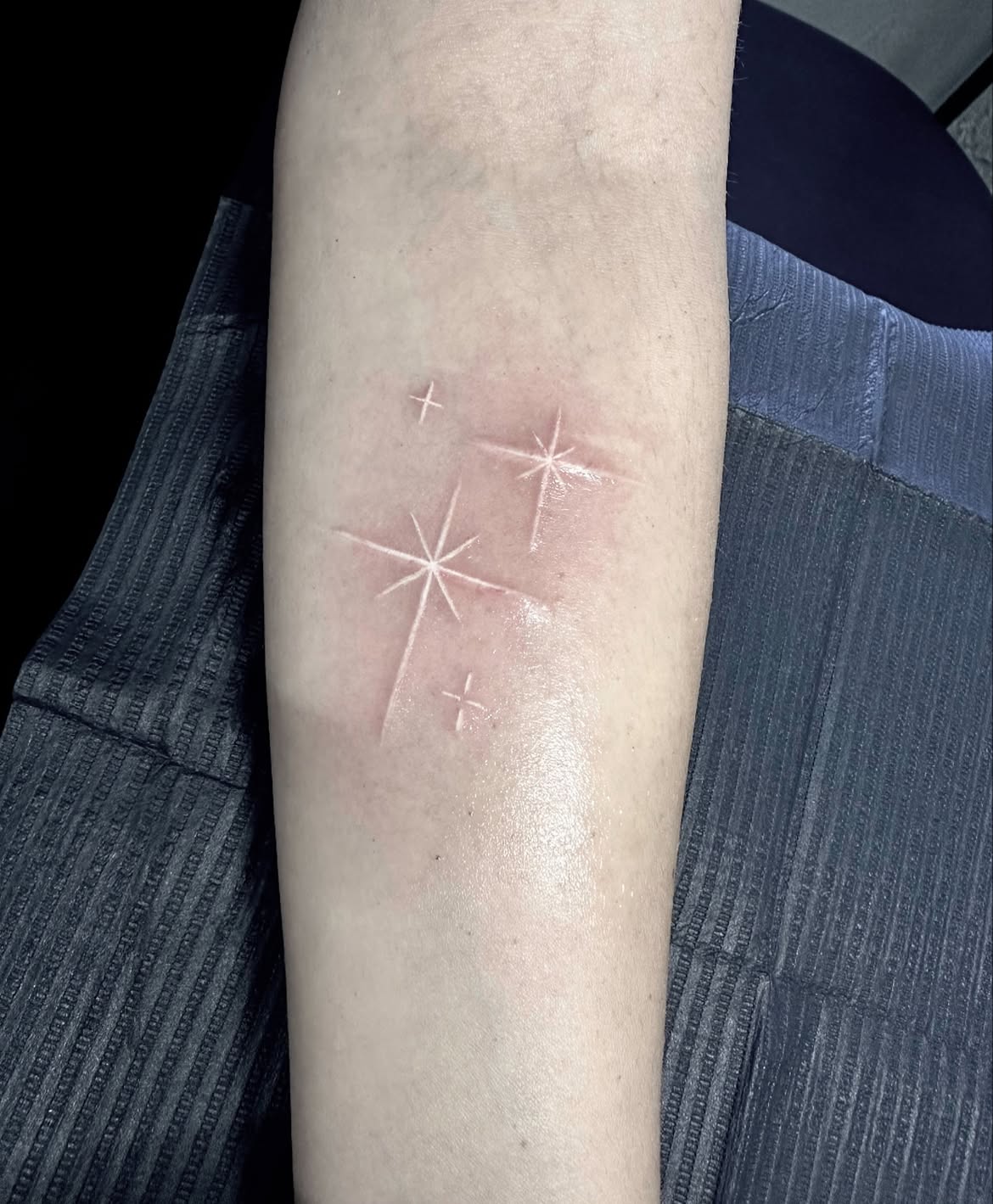
Four fine starbursts turn a pale area of skin into an almost ethereal composition. The largest stars feature elongated rays, while two tiny crosses provide balance around them. Everything is executed in white, making the design intentionally quiet rather than creating the contrast associated with conventional black scar coverups.
The effect is closer to light catching the skin than a traditional tattoo. That makes it particularly interesting for anyone who wants to decorate a scar without visually replacing it.
There is also a lovely conceptual relationship between scars and stars: both can be irregular, linear forms, so the natural texture doesn’t interfere with the motif. Instead, it becomes part of the glow.
White tattoos can change noticeably as they heal, and their visibility differs across skin tones. For that reason, anyone drawn to this style should look specifically at an artist’s portfolio of fully healed white-ink work rather than judging the technique only from fresh tattoos.
Fish Skeleton Tattoo Built Around Linear Scars
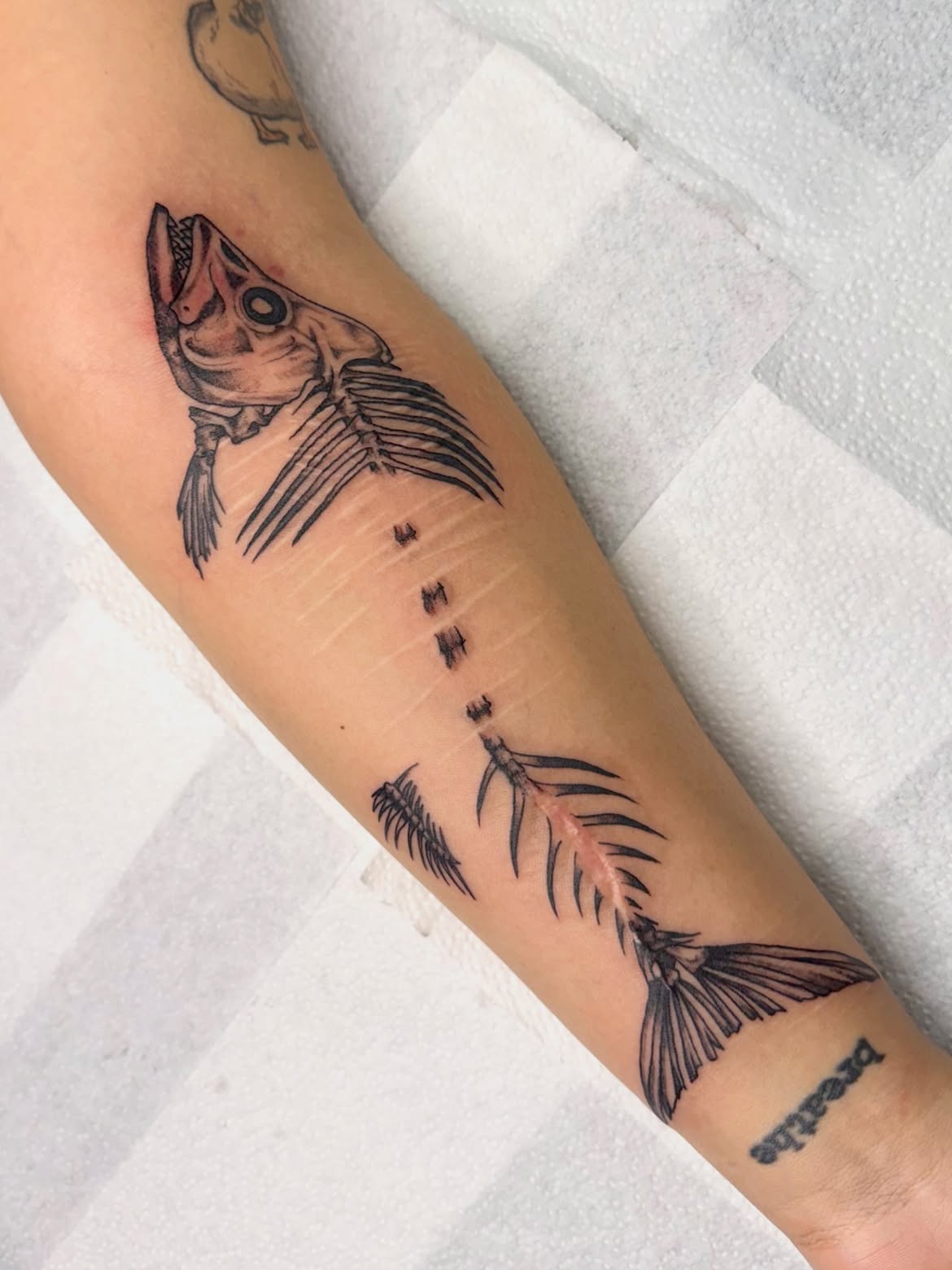
This larger composition uses several parallel scars as open space within a fragmented fish skeleton. A detailed head anchors one end, while ribs, vertebral fragments, and a finely lined tail extend along the limb.
The contrast between biological illustration and natural scar tissue is what makes the idea so effective. Rather than coloring directly across every line, the artist allows sections of skin to interrupt the skeleton. It looks almost as though portions of the fish have disappeared, leaving its anatomy suspended around the scars.
Black linework carries most of the design, with subtle gray shading concentrated around the skull. Fine ribs and fin rays prevent the tattoo from becoming visually dense.
This is a good example of how larger scar tattoo ideas can move beyond literal zippers and stitches. The scar still determines the composition, but the finished piece functions as a complete illustrative tattoo in its own right.
Needle and Thread Spine Scar Tattoo
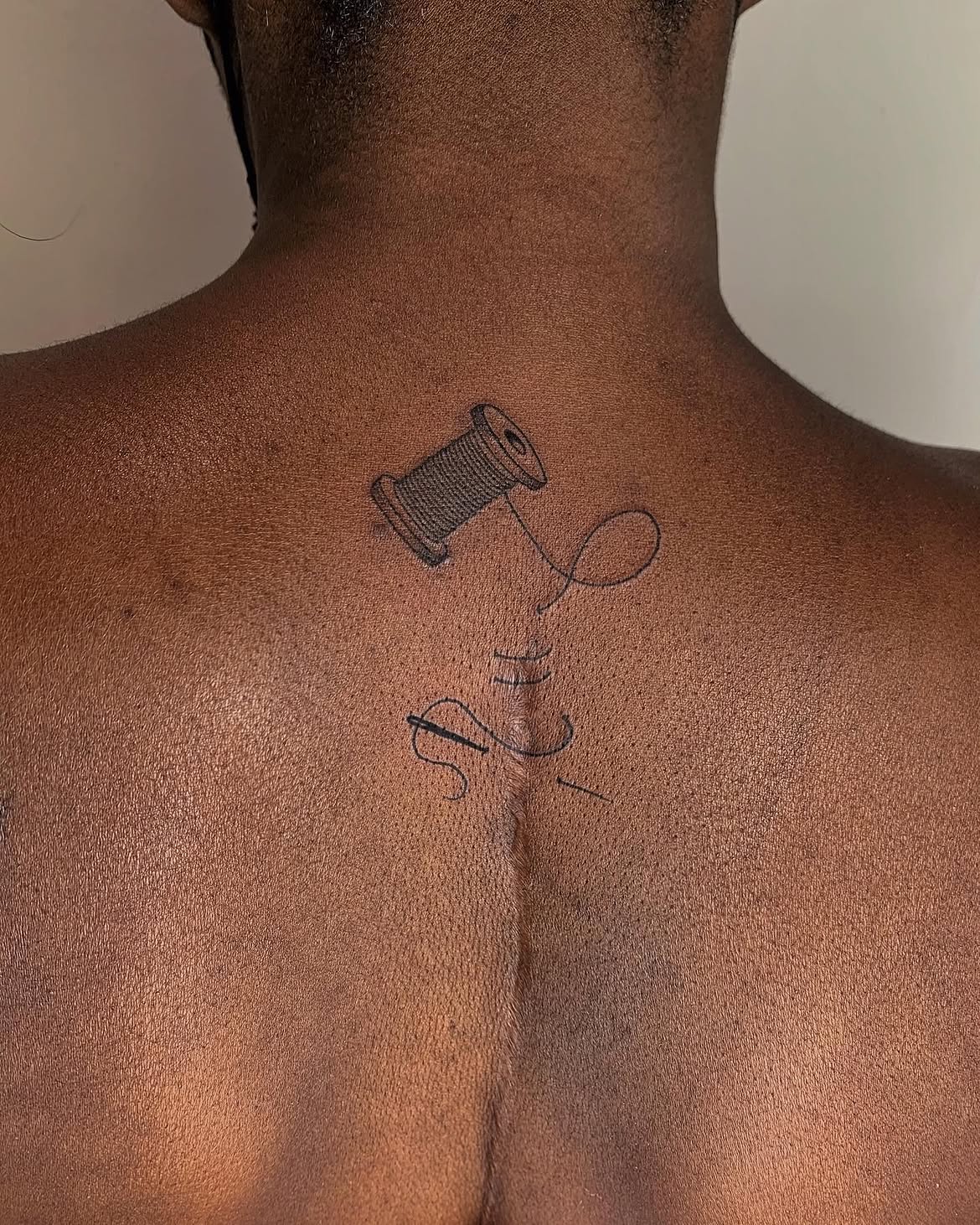
A vertical spine scar becomes the seam in an elegant needle-and-thread composition. A spool sits above the scar, with a loose thread curving downward before meeting the central line. Below, the needle and several small stitch marks suggest that the scar is still being sewn together.
The restrained fine-line technique suits the placement beautifully. Heavy shading across the upper back could easily overpower the natural vertical anatomy, whereas the narrow spool, thread, and needle keep attention centered along the spine.
There is something particularly meaningful about this approach because the tattoo doesn’t deny the scar’s history. The imagery of sewing suggests repair, continuation, and putting something back together.
It could also be adapted for other long surgical scars, including certain top surgery or abdominal scars, although every placement would require a composition specifically drawn around the individual’s anatomy and fully healed tissue.
Raised Moth Scarification-Style Design
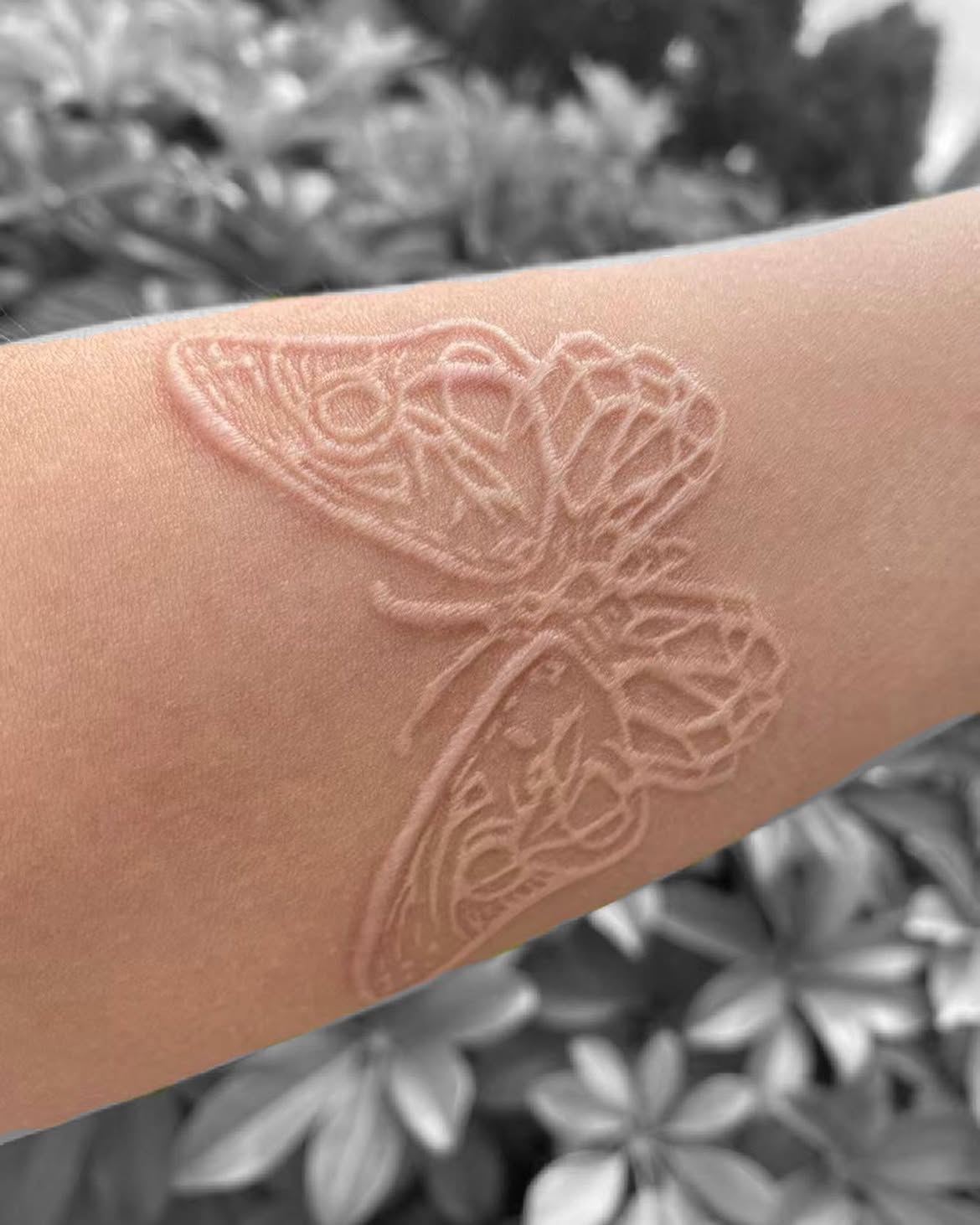
This moth stands apart from the ink-heavy designs in the collection. Its entire silhouette appears through raised, skin-toned lines, creating an intricate monochromatic pattern with virtually no conventional color contrast.
The wings contain repeating geometric sections, loops, and vein-like divisions. Because the design relies on texture, light and shadow become responsible for revealing the moth. From one angle it can appear subtle; from another, every raised line becomes sharply defined.
Visually, the concept shows why a scar does not need dark pigment to become decorative. Natural-looking, tonal designs can create an entirely different aesthetic from traditional cover up tattoos.
It is important, however, to distinguish decorative tattooing over an existing healed scar from intentional scarification or other body-modification techniques. Anyone interested in a raised design should research the specific method involved, its healing implications, and an appropriately qualified professional rather than assuming it behaves like ordinary tattooing.
White Scar-Style Face Tattoo
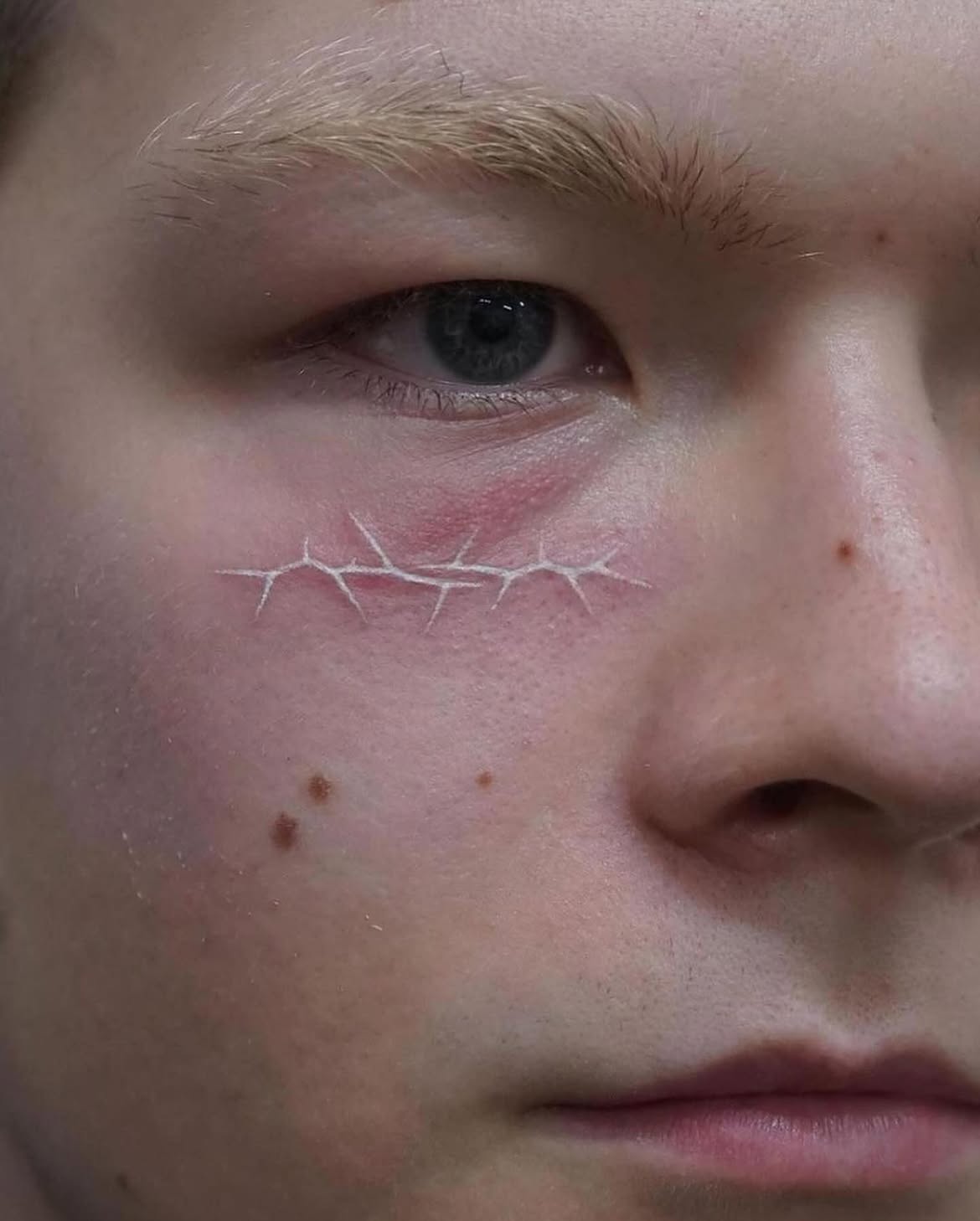
A thin jagged white line runs beneath the eye, crossed by several short branches that create the appearance of a stylized healed injury. The design is narrow enough to follow the natural horizontal space of the cheek without dominating the rest of the face.
This is one of the more striking for men face concepts because it reverses the usual scar-covering logic. Instead of hiding a scar, the tattoo deliberately creates a scar-like visual language.
The asymmetry is crucial. Each branch changes angle and length, keeping the line organic rather than looking like a repeated decorative stitch. White pigment also softens the result compared with a black facial tattoo.
The placement demands particular precision. Facial tattoos remain highly visible, and the delicate skin around the eye makes professional placement especially important. Anyone considering this direction should also think about how subtle white pigment may change in appearance after full healing.
White Lightning Hand Tattoo
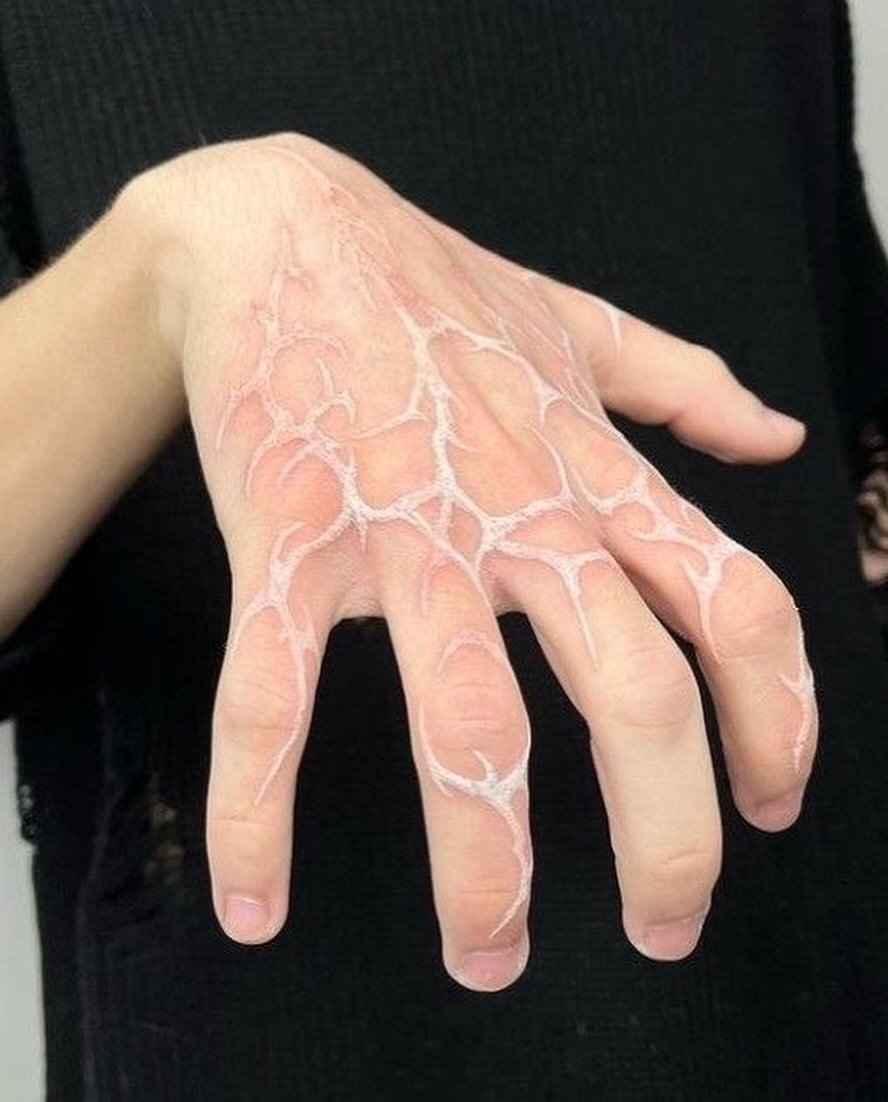
A sprawling network of white lightning covers the back of the hand and continues across several fingers. The pattern branches repeatedly, beginning with thicker central paths and breaking into progressively finer lines toward the edges.
The design has an organic quality somewhere between electricity, cracked porcelain, veins, and fantasy-style scarring. Because the pigment stays close to the skin’s natural value, the tattoo gains much of its impact from texture rather than darkness.
The hand is particularly suited to this branching composition. Every finger provides another route for the lightning to travel, allowing the design to respond naturally to anatomy instead of stopping abruptly at the knuckles.
Pop-culture fans could also reinterpret this aesthetic through Deku hand, Harry Potter, anime, or fantasy-inspired scar motifs without reproducing a character design literally. For someone interested in a less referential approach, the same branching structure works simply as abstract white linework.
Hand tattoos are exposed to considerable movement, washing, friction, and sunlight, so healed examples are especially useful when deciding how fine the branches should be. The strongest version is not necessarily the one with the most lines, but the one that preserves enough open skin for the branching pattern to remain readable.
Tiny Surgeon Stitching a Knee Scar
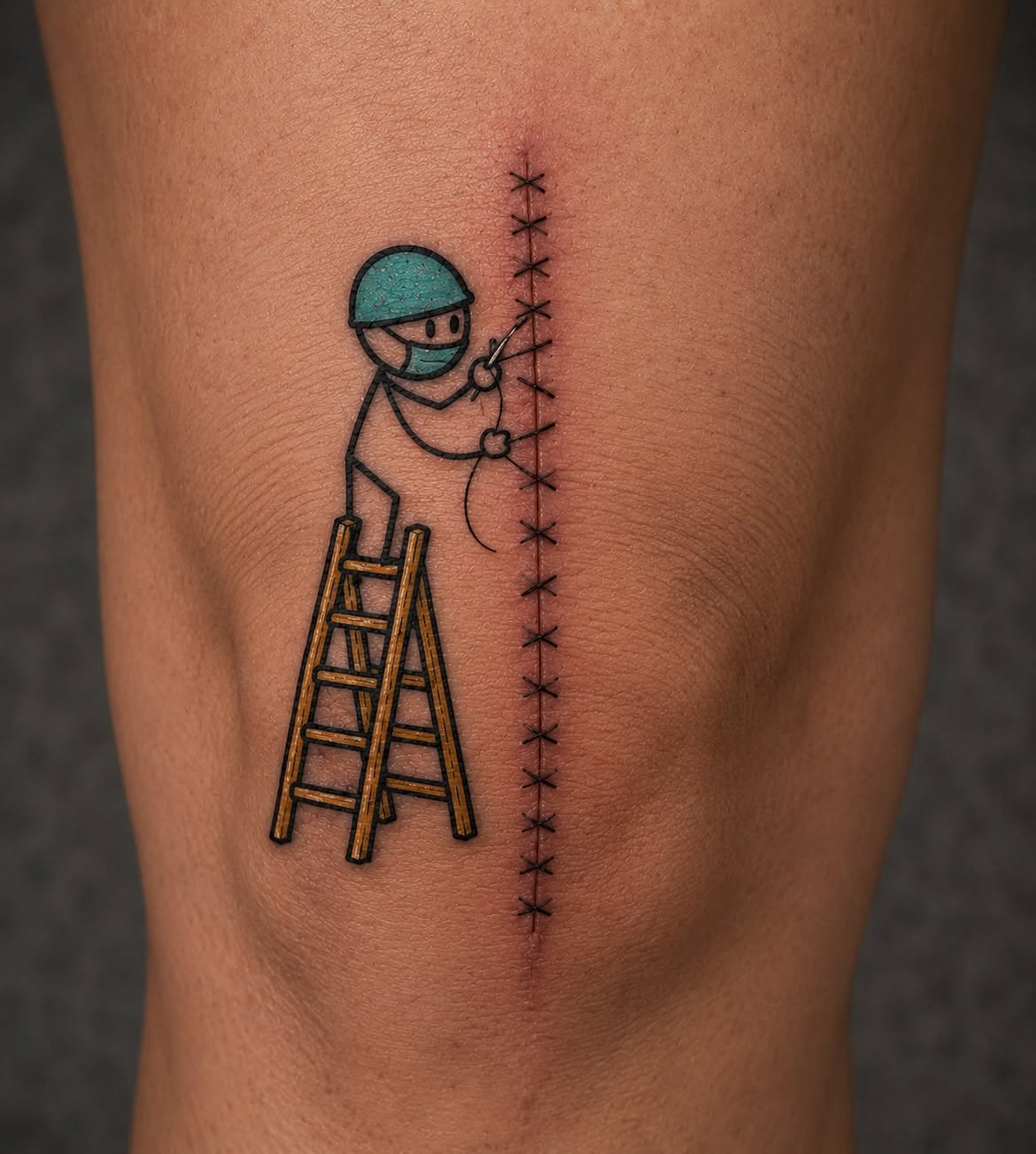
A long vertical knee scar becomes the seam in one of the most playful designs in this collection. A tiny masked figure stands on a wooden ladder beside the line, apparently sewing the scar closed one stitch at a time. Repeated black X-shaped sutures follow the scar from top to bottom, while a loose thread curves from the character’s hands.
Small touches of color make the concept especially charming. The turquoise surgical cap and mask contrast with the warm brown ladder, while thin black outlines preserve the illustrated, almost comic-book quality of the scene.
Instead of functioning as a traditional cover up, the tattoo makes the scar the most important part of the story. Without the existing line, the joke would not work. It is a great example of how scars from knee procedures, including some ACL surgeries, can inspire a composition rather than simply determine what needs to be hidden.
Red Rose Tattoo Growing Along a Knee Scar
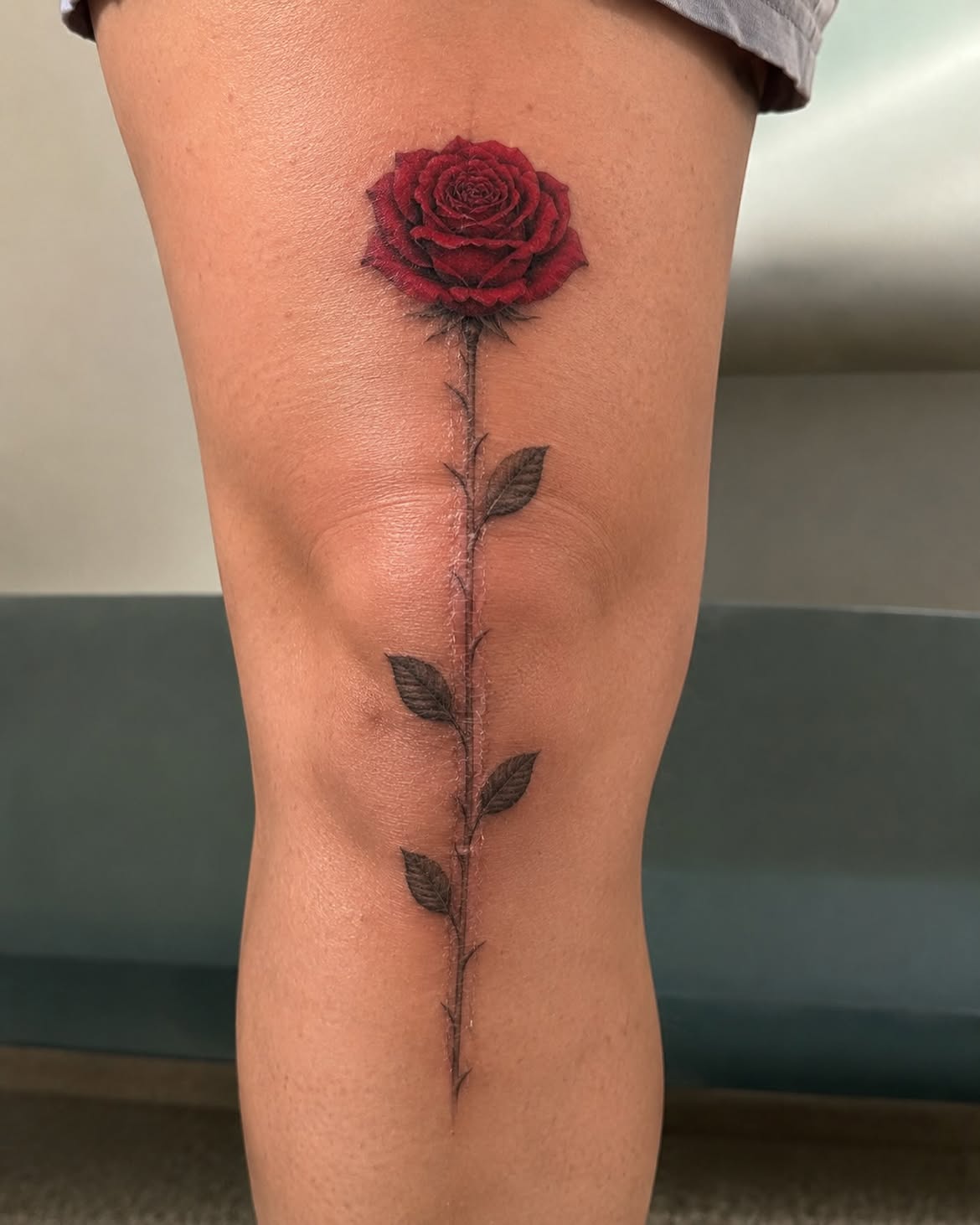
A dramatic red rose transforms a long vertical leg scar into the stem of a flower. The bloom sits above the knee, while the stem travels directly through the scar and continues below it, accompanied by small dark leaves and thorns.
The placement feels unusually natural because the scar already provides the exact vertical structure a botanical design needs. Instead of drawing an artificial stem over every millimeter, the tattoo allows portions of the skin texture to remain visible. Dark brown-black shading around the leaves and stem creates contrast against the saturated crimson petals.
For women leg scar tattoos, floral designs remain particularly versatile because stems, vines, leaves, and petals can be adjusted around almost any irregularity. This version is less about complete camouflage and more about transforming the scar’s silhouette.
There is also an appealing symbolism here without needing to overstate it: something visibly delicate grows directly from a line associated with healing.
Realistic Sword Tattoo Built Around a Long Leg Scar
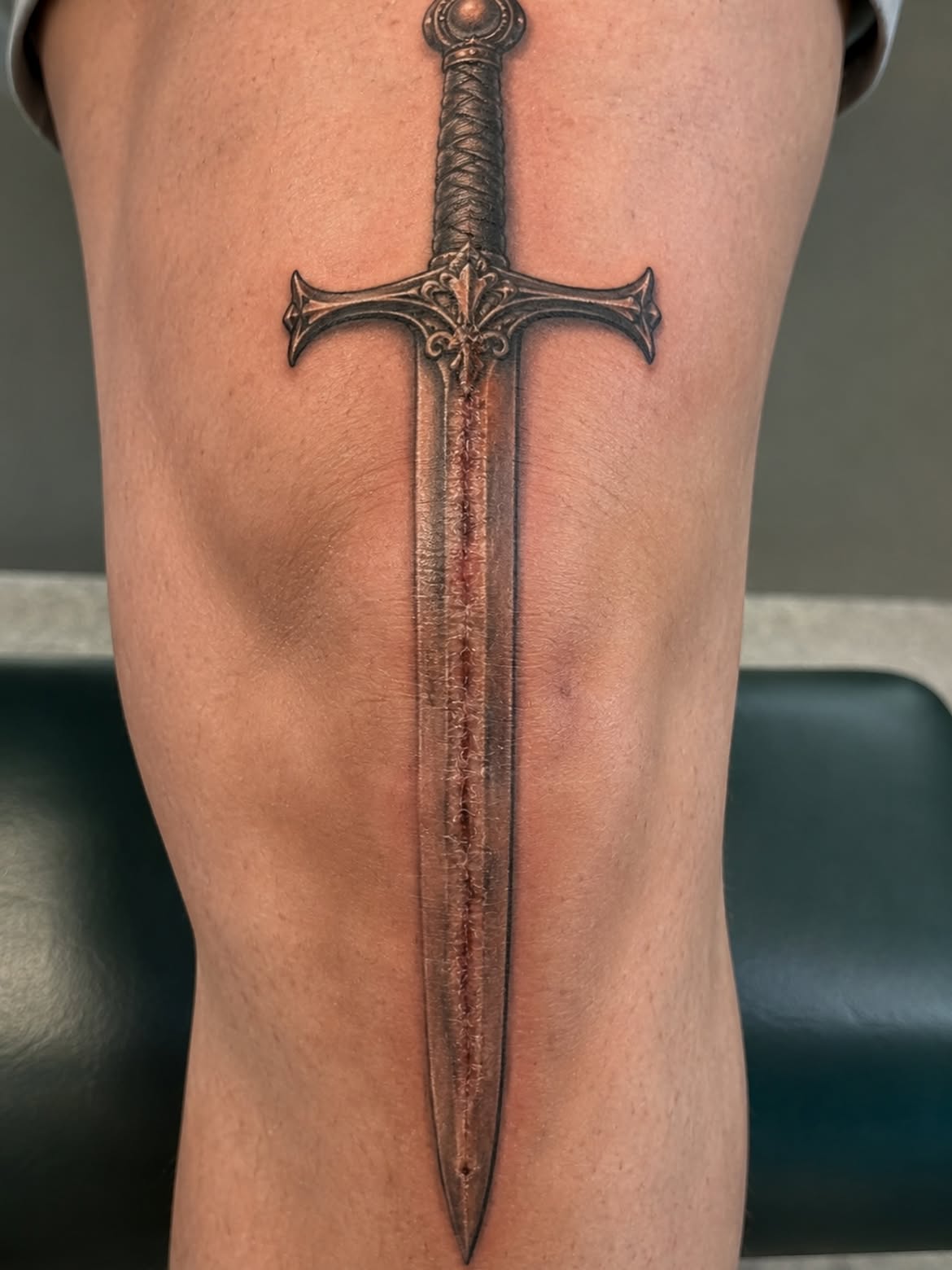
Few objects suit a straight surgical scar as naturally as a sword. Here, a long scar runs through the center of an ornate blade, effectively becoming its central ridge.
The hilt receives the most decorative treatment, with a wrapped grip, rounded pommel, sweeping guard, and intricate ornamental details. Black-and-gray shading gives the metal convincing depth, while narrow highlights running along the blade create a polished effect.
What makes the design work is restraint around the scar itself. Rather than burying the central texture under solid pigment, the artist uses it as a structural feature. The slightly irregular surface even makes the blade appear weathered.
This is a particularly strong option among scar tattoo ideas for men, although the motif is obviously not gender-specific. A medieval sword, fantasy dagger, katana, or even a Harry Potter-inspired magical object could follow the same basic principle: choose a long symmetrical object whose shape makes sense with the existing scar.
Funny Chainsaw Scar Tattoo
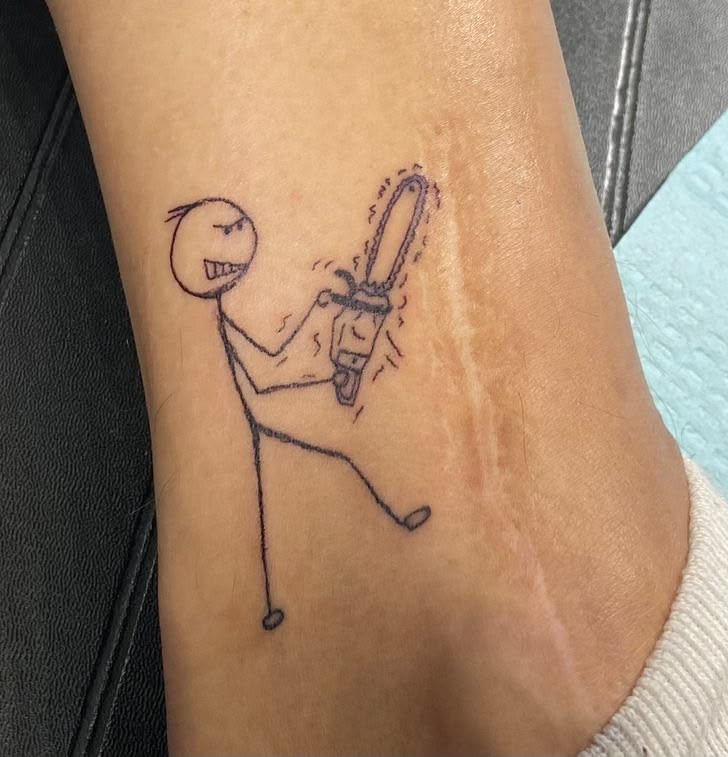
A mischievous stick figure operating a chainsaw turns a pale scar into the aftermath of an absurd miniature accident. The character is intentionally crude, with a circular head, simple limbs, exaggerated teeth, and a tiny chainsaw vibrating in its hands.
That roughness is exactly why the tattoo succeeds. A realistic illustration would compete with the subtle scar, whereas the doodle-like linework makes the natural mark feel like another stroke in the drawing.
This concept is also proof that meaningful scar tattoos don’t have to be solemn. Humor can be a perfectly valid way to change the relationship someone has with a visible mark. Rather than covering the scar, the wearer effectively gives it a punchline.
It works especially well on the ankle, arm, or leg, where an elongated scar can become the imaginary path of the chainsaw.
Realistic Claw-Mark Scar Tattoo Across the Chest
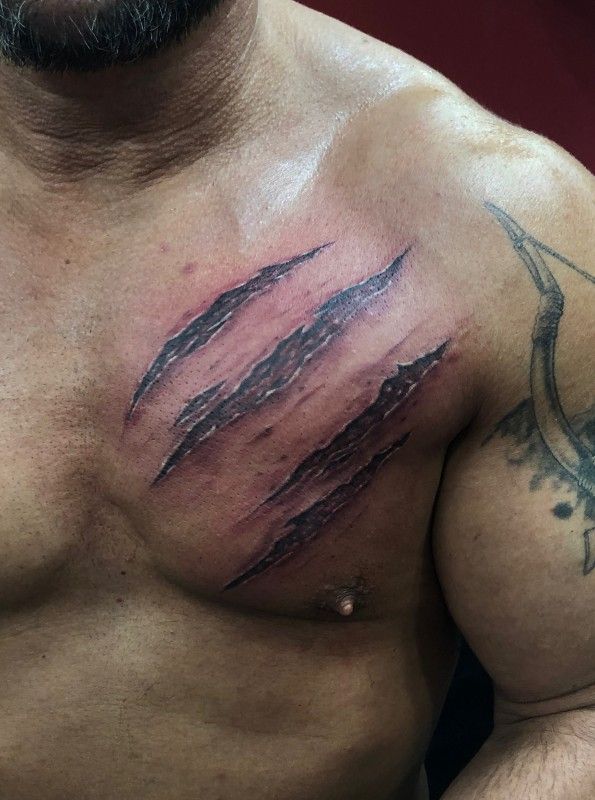
Four diagonal slashes create a dramatic scar-like effect across the upper chest. Dark interiors, irregular black edges, and muted red shading give each mark considerable depth, creating the illusion that the skin has been torn by claws.
This is much bolder than the minimalist scar tattoos elsewhere in the collection. Instead of hiding texture, the design exaggerates the visual language of scars and turns it into an intentional feature. The different lengths and slightly changing angles prevent the slashes from feeling mechanically repeated.
For men who prefer dark realism, this approach can work particularly well across broad areas such as the chest, shoulder, or upper leg. It could also be adapted into fantasy imagery—a dragon attack, monster claws, or a stylized Luffy-inspired scar concept, depending on the wearer’s interests.
The important artistic detail is irregularity. Realistic slash tattoos tend to look more convincing when their edges, widths, and shadows vary instead of forming four perfectly parallel lines.
Tiny Stick Figure Climbing a Vertical Scar
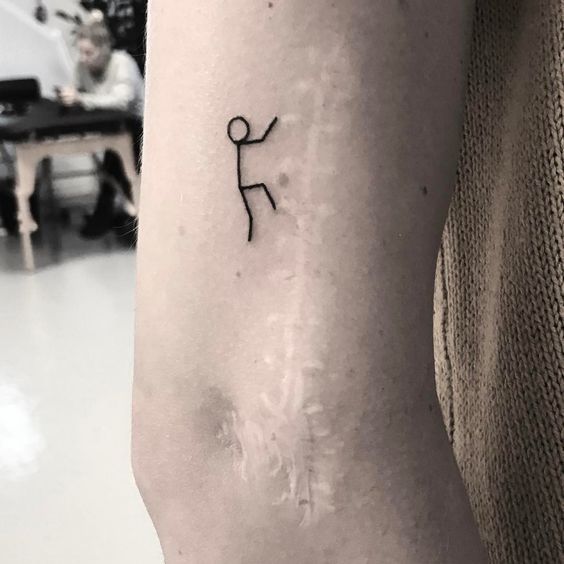
Sometimes one tiny addition is enough to completely change how a scar reads. A miniature black stick figure appears alongside a long pale vertical line, positioned as though it were climbing the scar like a rope or narrow cliff.
There is virtually no shading and no attempt to create a conventional cover. A circular head and a handful of thin strokes form the entire character. That extreme simplicity leaves the natural scar as the dominant visual element.
I particularly like this type of idea because it doesn’t require the tattoo to compete with the body’s history. The scar remains recognizable, but the little character gives the eye something new to associate with it.
The same concept could be customized endlessly: a climber with a rope, a tiny astronaut, a gardener climbing a vine, or even a small anime-inspired figure could interact with the line while keeping the amount of ink minimal.
White Tree and Roots Scar-Style Tattoo
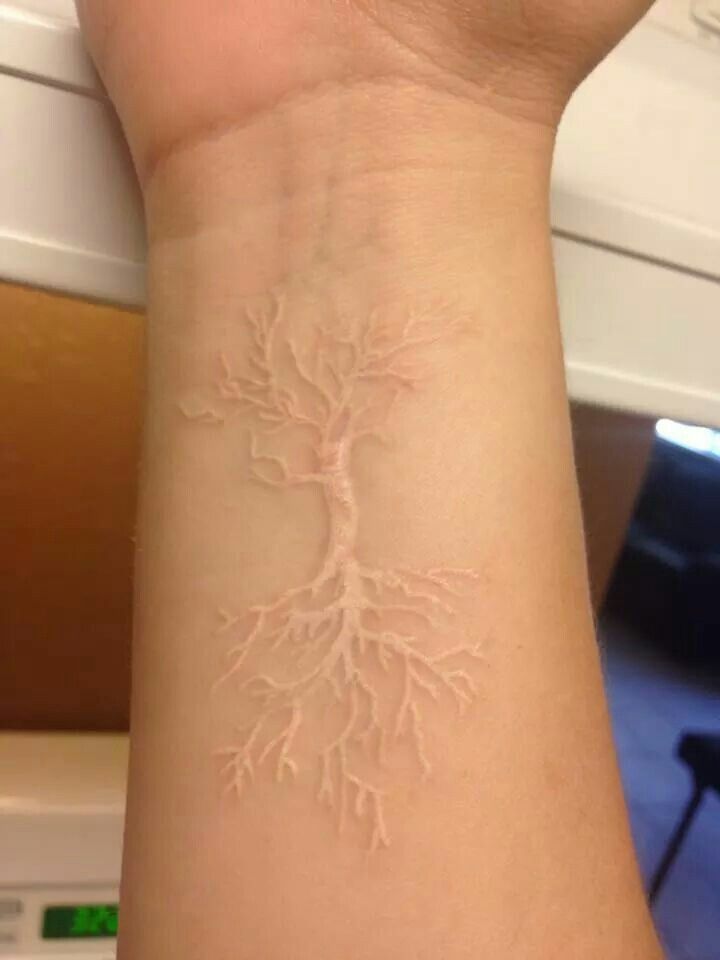
A delicate tree rendered in white stretches vertically along the inner arm, with branches spreading upward and an equally elaborate root system expanding below. The trunk forms the narrow center of the composition, creating an almost symmetrical relationship between what grows above the ground and what remains beneath it.
The pale treatment makes the tree look remarkably similar to natural scar tissue. Instead of relying on black outlines, the design is defined through subtle changes in texture and tone. The branching roots are particularly effective because they become progressively thinner as they move away from the trunk.
As symbolism, the tree is an intuitive match for scar-inspired work: growth and roots occupy the same composition, while the central trunk suggests continuity between them. Yet the design is visually strong even without assigning it a specific meaning.
This technique could also inspire lightning, branching veins, botanical forms, or fantasy patterns. Because pale and white work can heal very differently from conventional black ink, looking at an artist’s healed portfolio is essential before choosing this unusually subtle aesthetic.
Scar tattoos in 2026 are becoming interesting precisely because there is no single rule for what they should accomplish. Some people want near-complete coverups, while others deliberately preserve every visible millimeter and simply add a new context around it. From a tiny bandage to oversized zipper teeth, the best approach is usually the one designed specifically around the scar’s actual shape rather than copied unchanged from someone else’s body. If one of these ideas gave you inspiration—or you have transformed a scar in a completely different way—leave a comment and share the story behind your design.