
Stained glass has a visual language that translates unusually well into tattooing. Heavy outlines divide a design into small fragments, color becomes part of the structure rather than simple decoration, and even familiar subjects—flowers, birds, insects—can suddenly feel architectural. Some stained glass tattoo ideas borrow directly from church and cathedral windows, while others use the technique more loosely, turning nature into a mosaic of jewel-like shapes.
What I like most about this style is its range. It can be Gothic and solemn, bright and almost playful, or stripped back into an elegant black and grey design. The 28 tattoos here show just how differently an artist can interpret the same basic idea, from compact floral panels to a nearly full sleeve.
Gothic Lily Stained Glass Window Tattoo
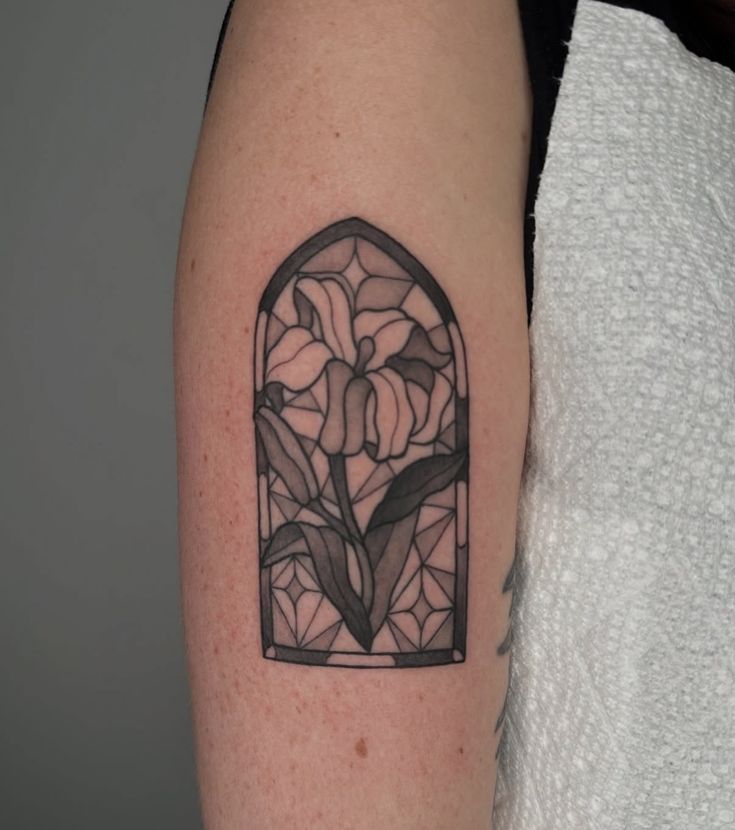
This is one of those designs where the silhouette does half the work. The tall, pointed arch immediately suggests a Gothic church window, giving the relatively small tattoo an architectural presence. Inside it, a lily rises vertically through a network of irregular panes. The flower is recognizable without being rendered realistically; its petals have been simplified so they belong naturally to the stained-glass structure.
The restrained black and grey treatment is especially effective. Rather than filling every compartment with heavy shading, the artist allows skin to act as the lightest value. Dark leaves anchor the lower portion, while softer grey sections around the flower keep the composition from becoming flat. Thick outer lines mimic the leading used between pieces of real glass, while thinner internal lines preserve detail.
For anyone collecting ideas black and white rather than vivid color work, this is a useful reference. A lily or rose could work equally well in this format, and the pointed cathedral frame makes the concept feel complete without requiring a large placement. It is also a good example of how a Christian architectural influence can be present without turning the tattoo into an explicitly religious image.
Color Floral Mosaic Sleeve Tattoo
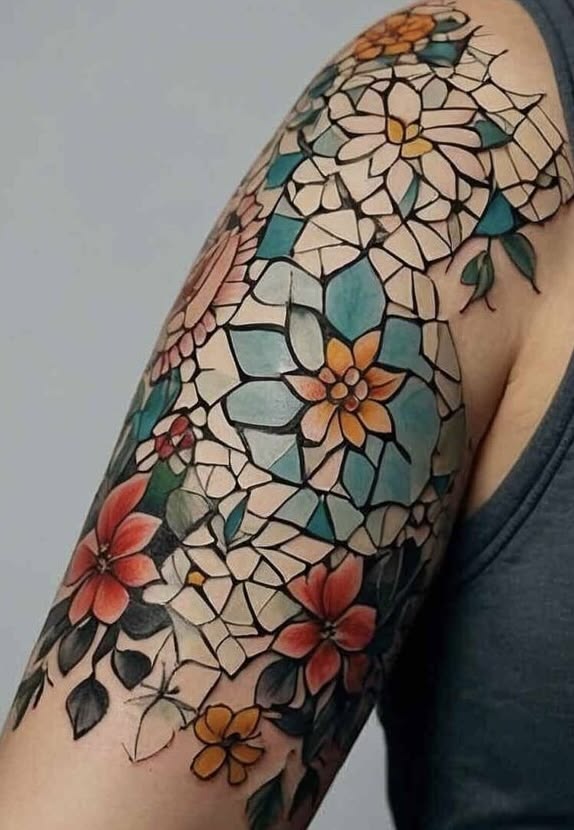
At the opposite end of the spectrum is this exuberant floral design, which uses much of the upper arm as a continuous stained-glass surface. Instead of placing the subject inside a rigid church-window frame, the artist lets the mosaic itself wrap naturally around the body.
Large flowers in red, orange, pale pink and blue-green establish the main focal points. Between them, smaller fragments of turquoise, cream, grey and green behave like broken pieces of glass. Black outlines keep all that color under control. Without those boundaries, such a varied palette could easily become visually chaotic; here, every section has a clear place.
This approach is particularly convincing as a sleeve or half-sleeve because stained glass already depends on connected fragments. The arm’s curved surface makes those fragments appear to continue beyond what can be seen from one angle, which gives the tattoo an immersive quality.
There is also a nice balance between floral design and abstraction. From a distance, you first register a colorful garden. Move closer and the individual panes become much more noticeable. That double reading is something worth discussing with an artist if you want a larger stained glass tattoo: the strongest compositions tend to remain readable both across a room and at close range.
Blue and Pink Iris Panel Tattoo
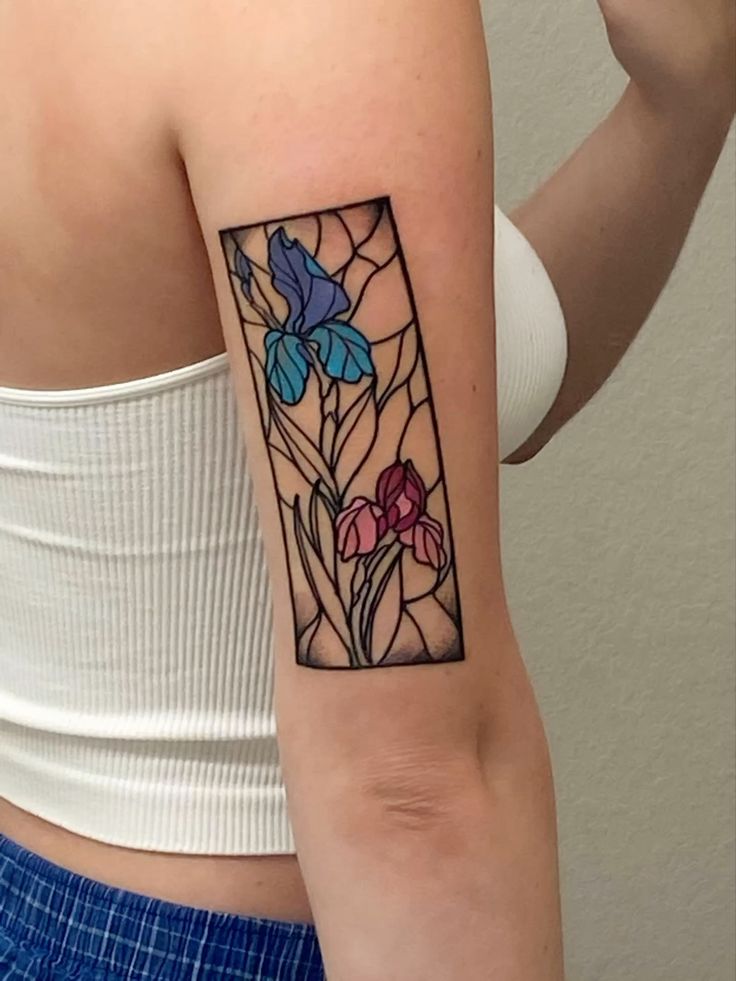
This rectangular panel has a lighter, more contemporary personality. Two iris-like flowers occupy opposite portions of the composition: cool blue and turquoise dominate the upper bloom, while deep pink and burgundy distinguish the lower one. Long stems and leaves connect the flowers vertically, creating movement through what could otherwise have been a very static rectangle.
The clever detail is the amount of untouched skin. Rather than filling every stained-glass segment with color, the design leaves much of the background open. Black lines still divide it into panes, so the stained-glass reference remains obvious, but the overall tattoo feels airy.
That makes this type of design especially appealing for women or anyone who likes color tattoos without wanting a dense block of pigment. It also demonstrates that a stained glass tattoo does not need elaborate cathedral ornamentation. A simple geometric boundary, botanical subject and carefully chosen palette are enough to establish the style.
I would be reluctant to add more color to a composition like this. The limited blue-and-pink contrast is precisely what gives it personality. Sometimes the temptation with stained glass is to use every color available; restraint can be far more memorable.
Ornamental Black and Grey Stained Glass Sleeve
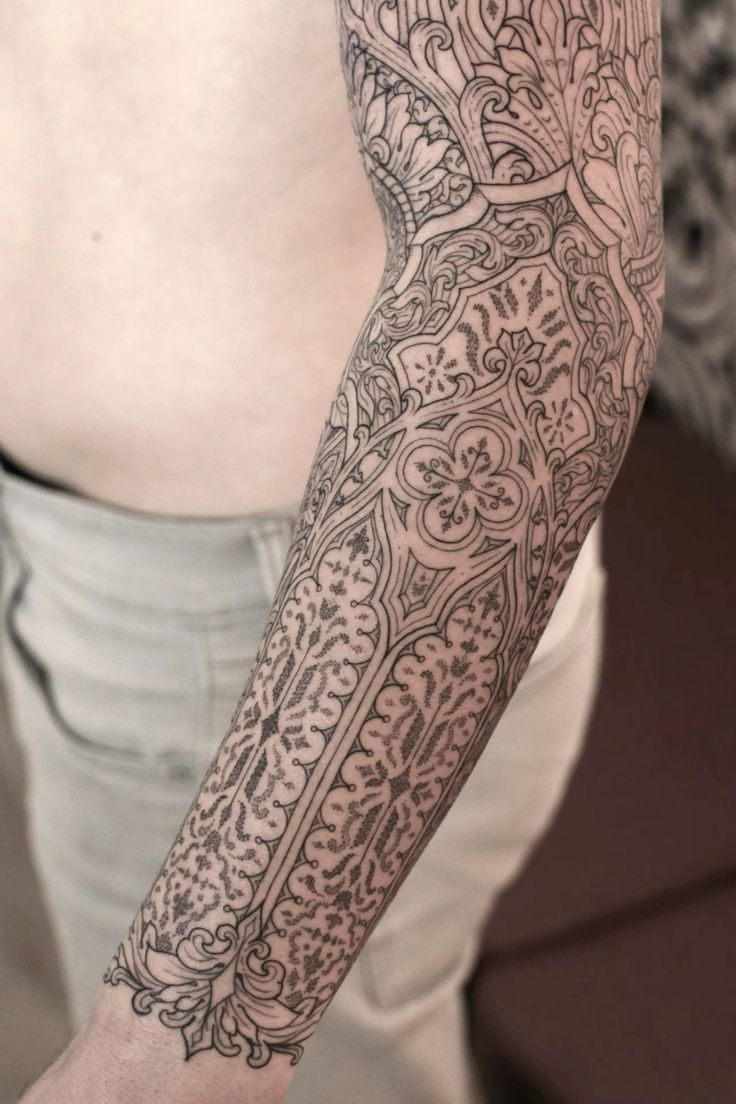
This forearm piece takes the concept in a completely different direction. Instead of reproducing colored glass, it concentrates on the elaborate ornament surrounding historic windows. The result sits somewhere between Gothic architecture, decorative engraving and an extremely detailed black and grey sleeve.
The design follows the long shape of the forearm beautifully. Repeating arches, pointed forms, floral motifs and curling ornamental lines lead the eye from one section into another. A four-petal flower forms one of the central anchors, while surrounding panels are filled with tiny dotwork marks and patterned textures.
That density is balanced by the absence of solid black fields. Most of the tattoo is built from linework, stippling and negative space, so the skin continues to show through even in complicated areas. This prevents the ornament from becoming one indistinguishable grey mass.
For men and women considering a larger Gothic design, this is an interesting alternative to the familiar colorful cathedral window. It captures the craftsmanship and symmetry associated with stained glass while remaining essentially black and white. It also has an aged, almost manuscript-like quality that should become even more interesting as the tattoo settles into the skin.
A design this intricate does require discipline. Very tiny decorative marks can change visually over time, so spacing matters just as much as the initial drawing. This is one of those cases where choosing an artist with a strong portfolio of healed ornamental work is more useful than simply judging fresh tattoos online.
Rainbow Hummingbird Stained Glass Tattoo
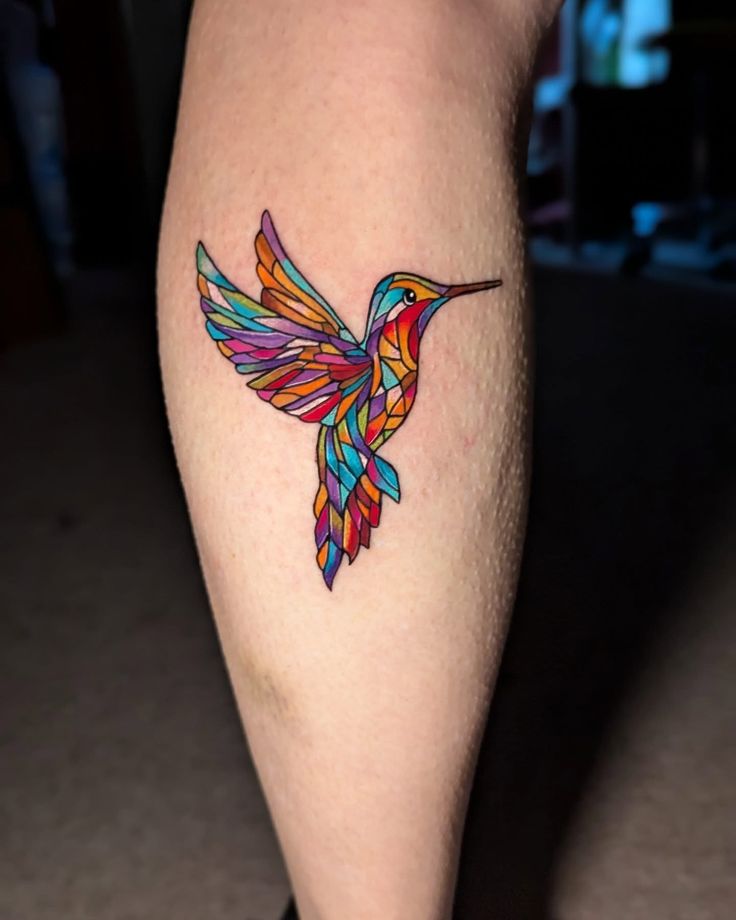
The hummingbird proves that stained glass does not always need a literal window around it. Here, the bird itself has become the window.
Its body and wings are divided into angular pieces outlined in black, with each compartment carrying a different burst of color. Turquoise, violet, orange, yellow, red, pink and blue appear side by side like tiny pieces of cut glass. Because the black linework is consistent throughout, the palette stays coherent despite containing so many hues.
The spread wing is particularly effective. Its feathers naturally lend themselves to segmented construction, and the pointed shapes reinforce the sense of movement. The long beak provides a clean horizontal counterpoint to all those angled pieces.
This is one of the more modern stained glass tattoo ideas in the collection. There is no church, Gothic arch or traditional ornamental border, yet the technique is instantly recognizable. It is also a useful direction for anyone who wants a smaller color tattoo. Butterflies, moths, birds and even fish can be divided into convincing glass-like sections without needing a surrounding frame.
There is a slightly joyful quality to this one that separates it from the darker cathedral-inspired examples. The jewel palette feels energetic, while the hovering hummingbird adds lightness. It is proof that stained-glass influence can be playful rather than solemn.
Dragonfly and Floral Black Stained Glass Tattoo
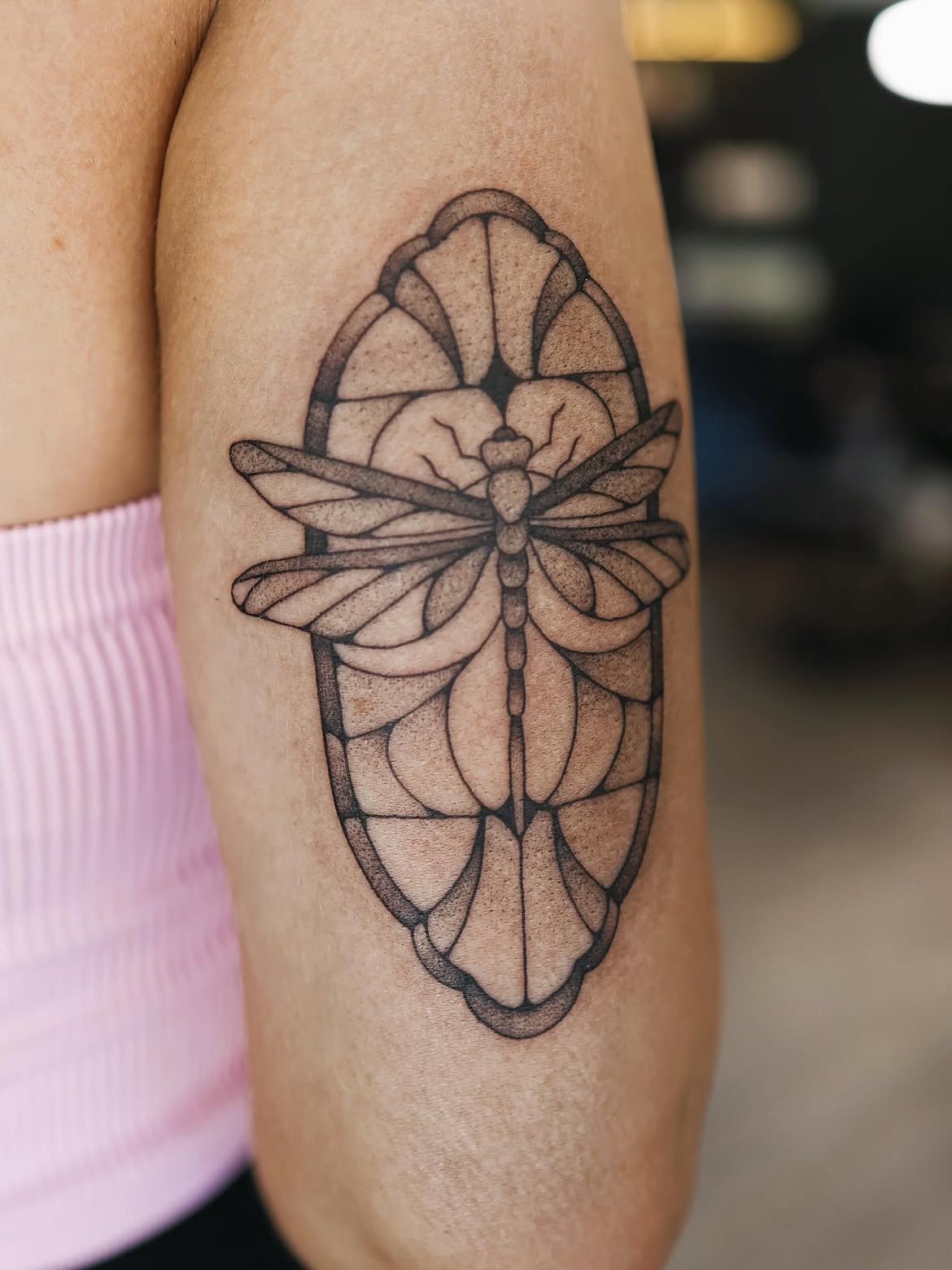
This dragonfly design is beautifully restrained. An elongated ornamental frame surrounds a large flower, while the insect stretches horizontally across the center. That crossing of vertical and horizontal shapes gives the composition its strength: the window provides height, while the wings break beyond its sides.
The artist relies almost entirely on black, grey and soft stippled shading. The dragonfly’s transparent wings are suggested through thin internal divisions rather than heavy fill, which suits the subject particularly well. Behind it, broad floral petals are divided into window-like compartments, connecting the insect to the stained-glass theme without making the construction feel forced.
I particularly like the decision to let the wings escape the frame. A perfectly enclosed composition would have looked formal; allowing the insect to overlap the border introduces movement and depth. It feels as though the dragonfly belongs to the window but is also emerging from it.
For a black and grey design, this offers plenty of visual interest without relying on elaborate Gothic decoration. It could also translate well into a larger back piece or become one component of a nature-inspired sleeve. A moth, bee or butterfly could use the same structural idea.
Pink Iris Cathedral Window Tattoo
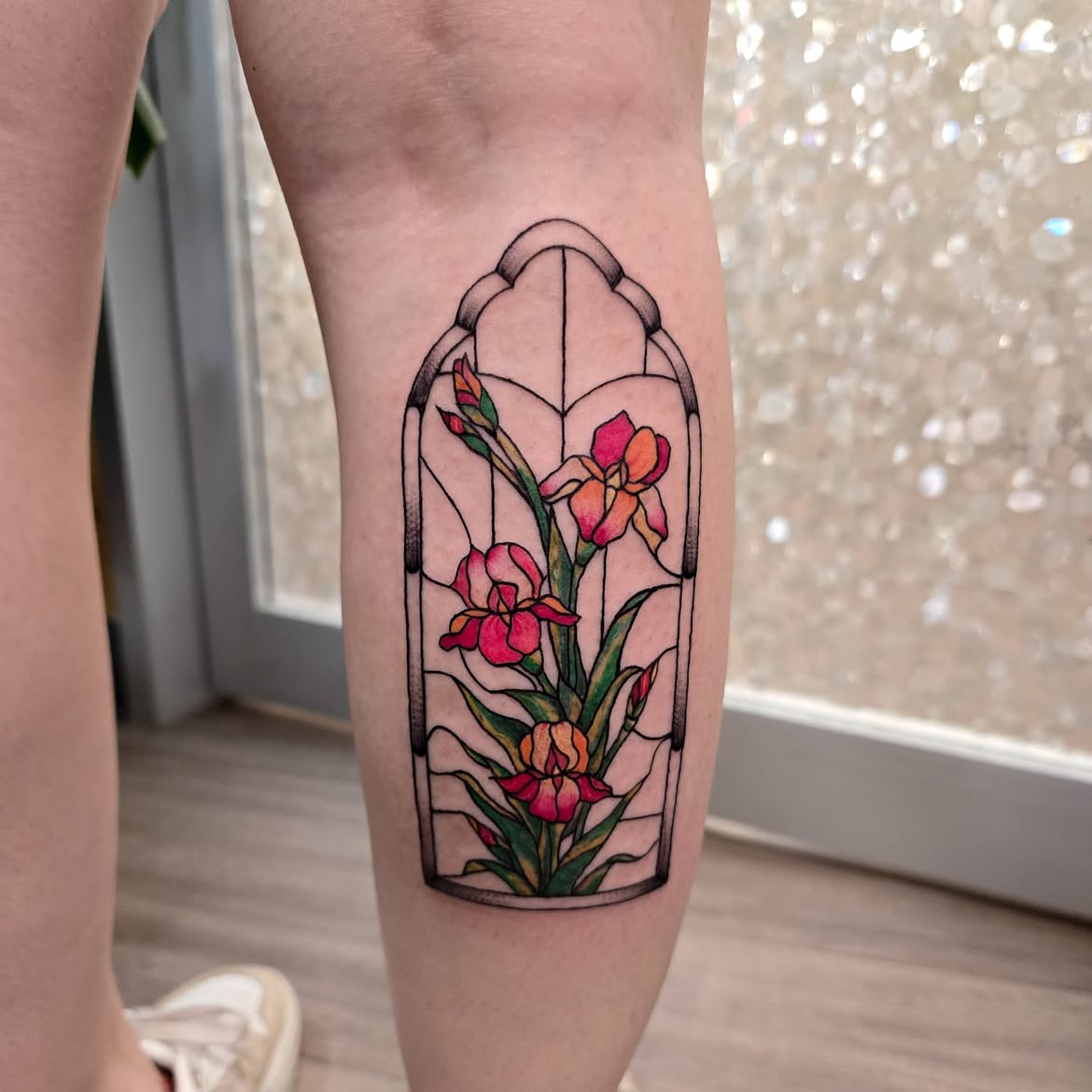
This final floral piece returns to the recognizable cathedral-window silhouette, but its bright irises give the architecture a softer character. The tall rounded frame contains several blooms at different stages, from narrow buds to fully opened flowers, allowing the arrangement to feel like a small garden growing inside a window.
Pink, magenta, coral and orange dominate the petals, while dark and olive greens give the leaves enough visual weight to anchor the lower half. The palette is warm without becoming overly sweet. Black outlines separate individual panes and provide the contrast necessary for those colors to remain crisp.
The structure deserves attention too. Rather than creating an overly busy background, the artist uses broad, mostly open panes around the flowers. These areas behave almost like clear glass, giving the botanical elements room to breathe. The darker border then functions as a frame, making the entire tattoo read as a single object.
For anyone considering a tulip, rose or iris stained glass tattoo, this is an excellent demonstration of how botanical forms can be adapted to architectural geometry without losing their natural character. The flower stems remain organic, while the surrounding window supplies order.
The design also shows why stained glass works so well on longer placements such as the calf, forearm or upper arm. Historic church windows were designed vertically, and that proportion happens to complement many areas of the body. Instead of fighting the anatomy, the narrow cathedral format naturally follows it.
Harry Potter-Inspired Gothic Stained Glass Tattoo
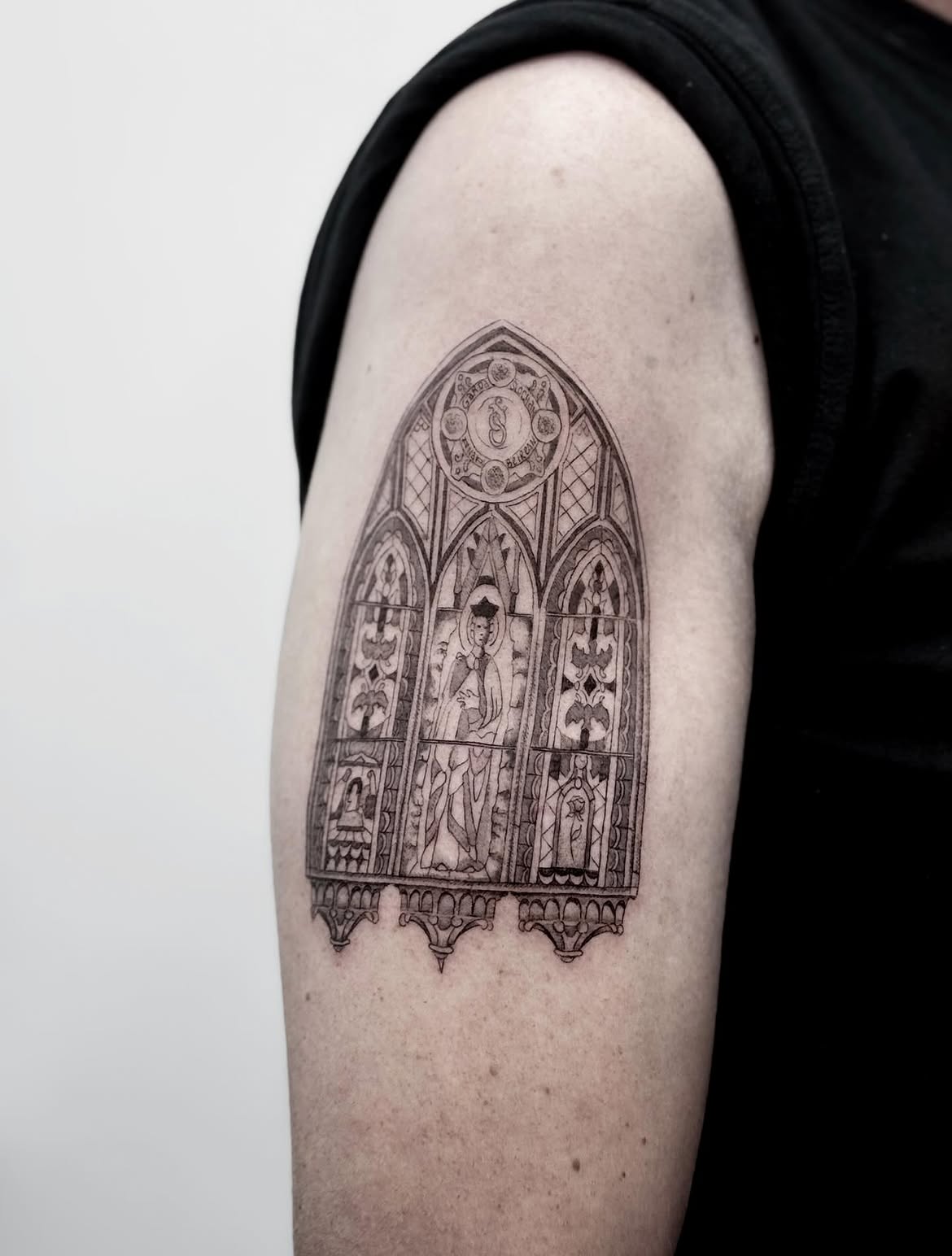
This design takes the stained glass concept in a distinctly Gothic direction, using the architecture of an old cathedral window as the framework for a highly detailed Harry Potter-inspired composition. The pointed arch immediately establishes the church-window silhouette, while three narrow vertical panels and the circular ornament at the top make the piece feel surprisingly architectural for its relatively compact size.
What makes this tattoo interesting is its refusal to depend on color. Fine black and grey linework creates the impression of aged glass, stone tracery, and tiny illustrated panes. The central figure provides the main focal point, while smaller decorative scenes occupy the side sections. Even the lower edge is finished with miniature architectural details, so the window feels like a complete object rather than simply an outline filled with imagery.
For fans who want a pop-culture tattoo without an obvious logo or large character portrait, this approach has real charm. The references are filtered through Gothic design, giving the piece the feeling of an artifact from an imaginary cathedral. It also shows how naturally fantasy subjects can fit stained glass tattoo ideas, especially when the artist treats the surrounding architecture with as much attention as the central imagery.
Celestial Sun and Moon Stained Glass Tattoo
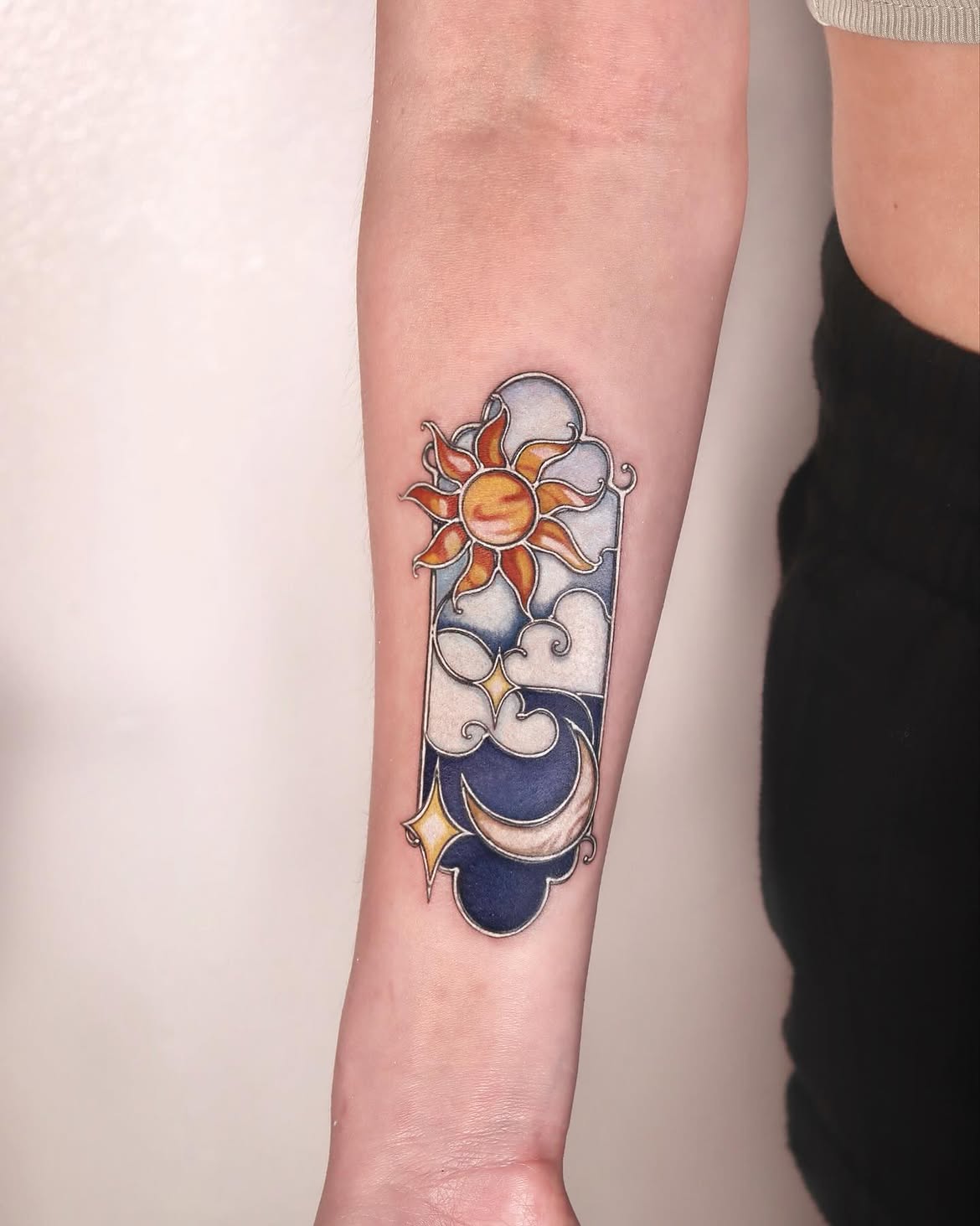
This narrow forearm design trades traditional religious imagery for a dreamy celestial theme. A warm orange sun dominates the top, pale swirling clouds occupy the center, and a crescent moon rests against a deep blue night sky near the bottom. Small golden stars complete the transition from daylight to night.
The color palette is beautifully controlled. Orange and gold feel warm and luminous, while navy and powder blue introduce a cooler contrast. Thin dark outlines and pale highlights imitate the metallic seams of actual stained glass without making the tattoo look excessively heavy.
I especially like the vertical storytelling here. Your eye naturally travels from sun to clouds to moon, so the narrow format feels intentional rather than dictated by the placement. It is an excellent design for women or men looking for color without committing to a large sleeve.
This is also a reminder that stained glass does not have to mean church or Christian symbolism. Once the visual grammar of outlined panes is established, almost any subject can inhabit the window.
Black and Grey Iris Window Tattoo
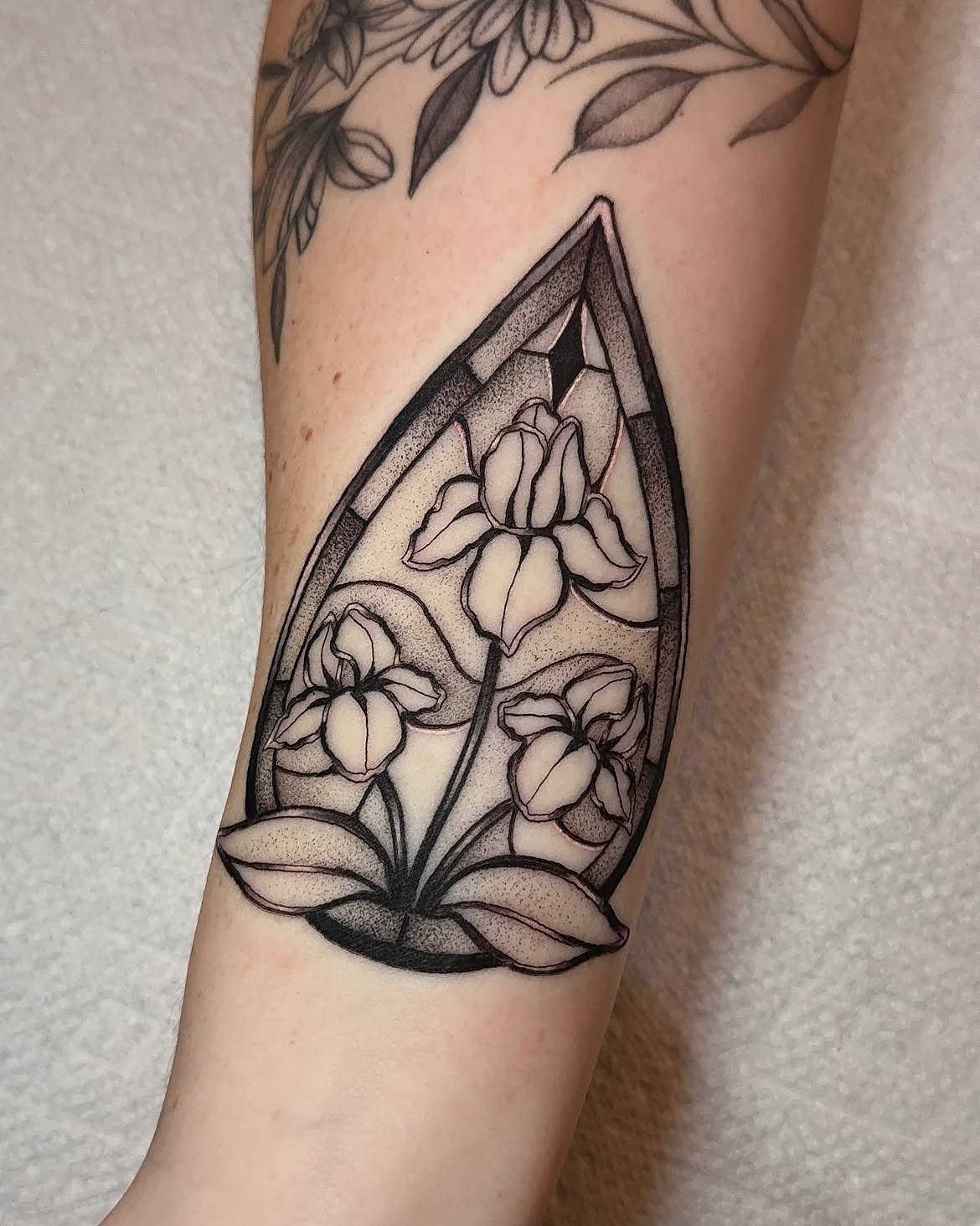
A pointed Gothic frame surrounds three iris flowers in this restrained black and grey piece. The central bloom rises above two smaller flowers, establishing a subtle triangular composition that echoes the pointed top of the surrounding window.
Instead of using saturated color, the artist creates separation with dotwork, soft grey shading and areas of untouched skin. Individual background panes shift gently between lighter and darker values, while solid black accents around the perimeter provide enough contrast to keep the silhouette sharp.
The floral elements extend slightly into the lower border, which is a small but important detail. It prevents the flowers from feeling trapped behind a rigid frame and gives the design a more organic character.
Anyone searching for ideas black and white could easily adapt this format to a rose, tulip, lily or another personally meaningful flower. The Gothic outline supplies structure while the botanical subject softens its severity. It is understated enough to sit alongside existing floral work yet distinctive enough to work as a standalone tattoo.
Traditional Stained Glass Table Lamp Tattoo
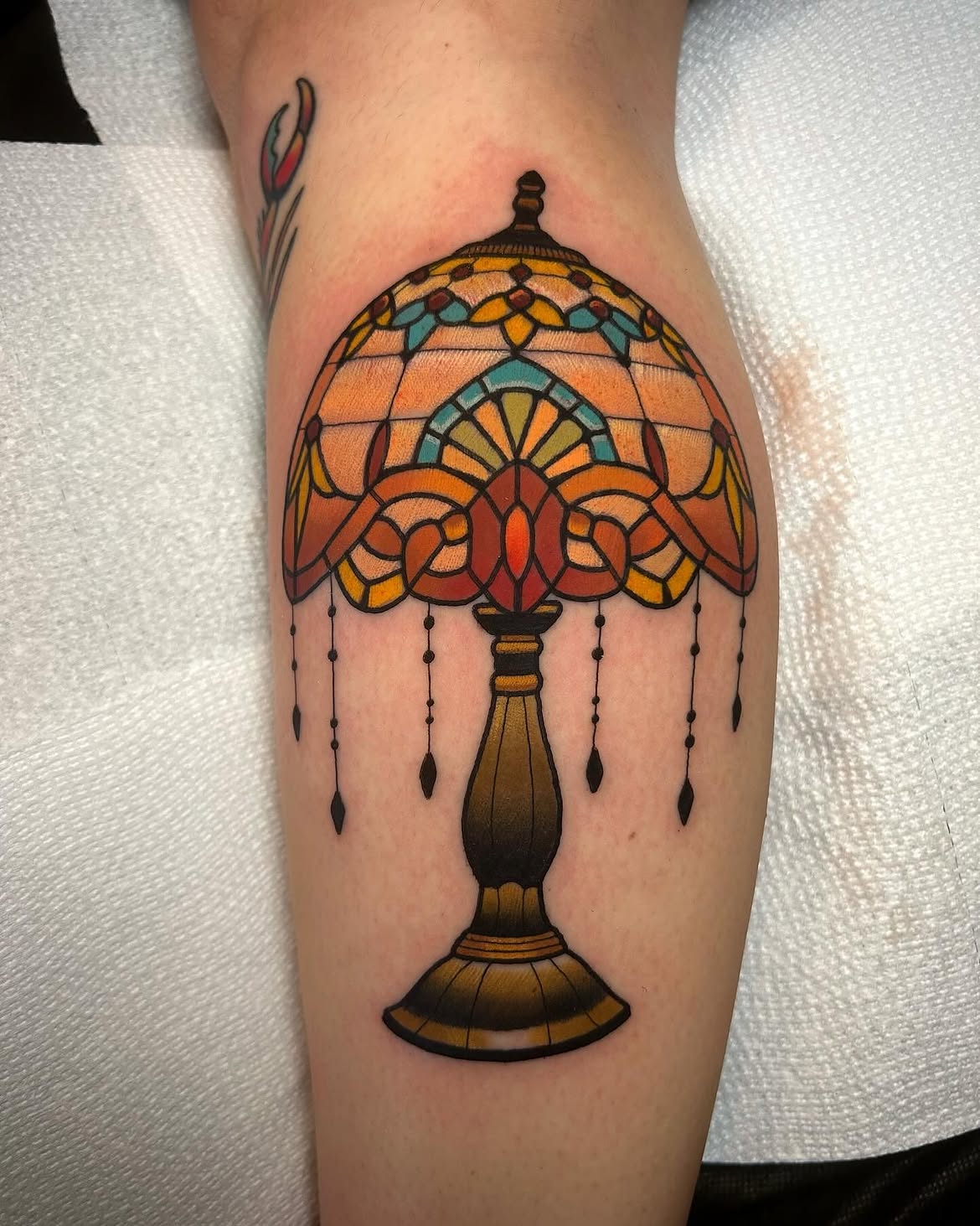
This tattoo approaches the theme from a clever angle: rather than depicting a stained glass window, it celebrates another object inseparable from decorative glass—the classic table lamp.
The broad shade is constructed from tightly fitted sections of amber, orange, red, turquoise and yellow. Strong black outlines separate the panes, producing the visual rhythm associated with traditional leaded glass. Decorative curves along the lower edge keep the shade from becoming too geometrically rigid, while a series of hanging dark ornaments adds movement.
Below it, the lamp base is rendered in muted bronze and brown tones. Its relative simplicity is important because it allows the colorful shade to remain dominant. The overall result has an Art Nouveau flavor and feels almost like an heirloom translated directly into tattoo form.
There is also a slight American traditional quality in the strong outlines and confident blocks of color, although the ornamental construction is more intricate than a conventional traditional tattoo. For someone who loves vintage interiors, antique objects, or warm retro palettes, this is a wonderfully unexpected alternative to cathedral imagery.
Gothic Rose Window Black Tattoo
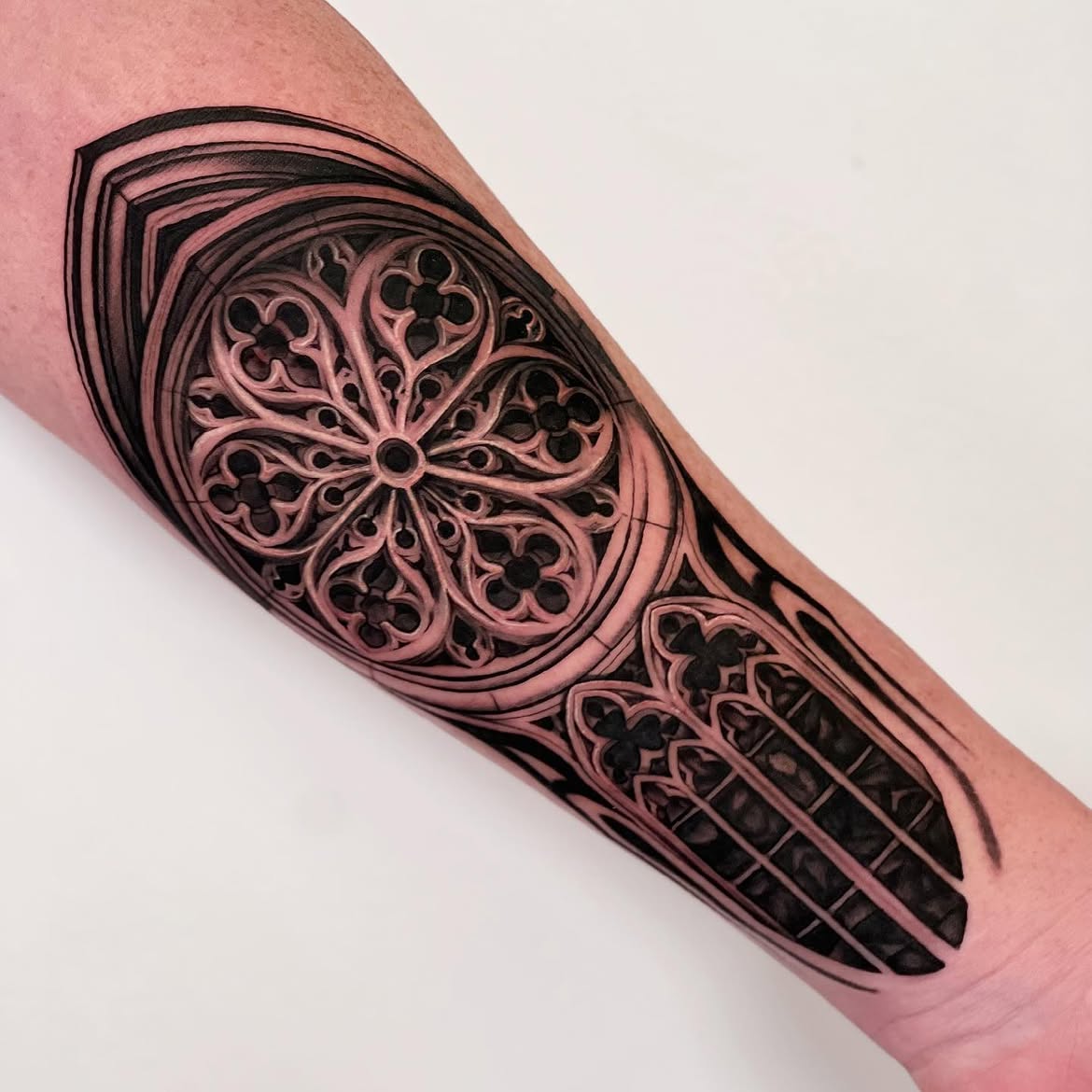
Few architectural elements communicate Gothic style as immediately as a cathedral rose window, and this forearm design makes that structure the star. The upper section is dominated by a circular radial motif, with petal-like stone forms spreading from a dark center. Smaller quatrefoil shapes repeat around it, producing the complex symmetry associated with medieval tracery.
A narrower pointed window continues beneath the circular section, allowing the composition to follow the length of the arm. Heavy black areas sit behind lighter architectural lines, creating the impression that we are looking through carved stone into darkness.
This is considerably bolder than the previous black and grey designs. Black is not simply used for outlines; it becomes an important part of the architecture. That high contrast gives the tattoo weight and makes even tiny ornamental forms visible.
A design like this could also become the foundation of a larger Gothic sleeve. Architectural arches, additional church windows, statues, gargoyles or ornamental stonework could continue naturally around it. Even by itself, however, it feels complete. There is no need for color because light and darkness provide the drama.
Delicate Butterfly Stained Glass Linework Tattoo
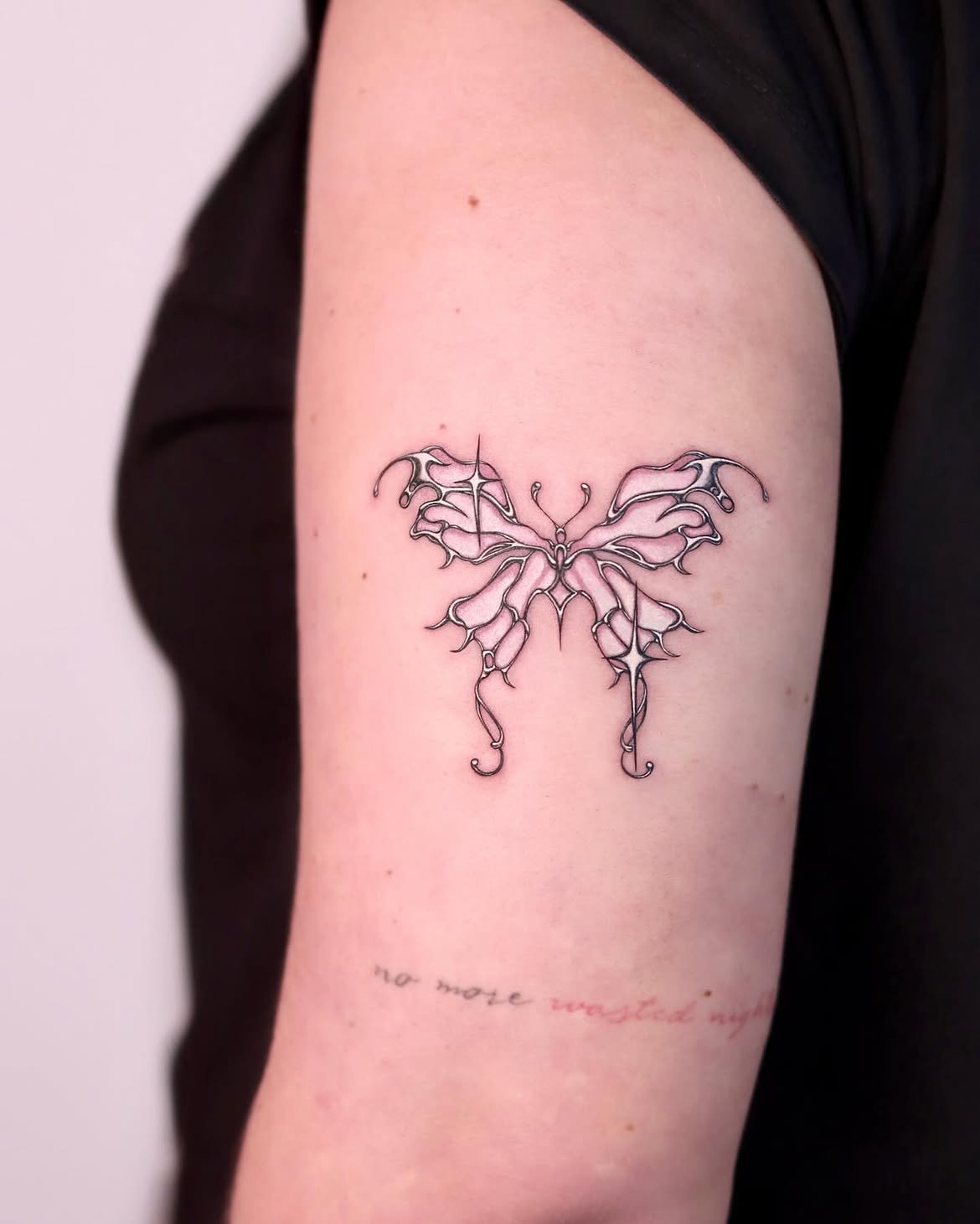
This butterfly offers perhaps the most minimalist interpretation in the collection. There is no external window at all. Instead, the wings themselves are treated like delicate pieces of ornamental glass, divided by fine curving lines and tiny pointed sections.
The symmetry is intentionally imperfect in the details. Both wings share the same overall structure, but the flowing internal shapes keep the tattoo from feeling mechanically mirrored. Star-like accents appear at several intersections, bringing a slightly magical quality to the design.
The absence of filled color and large black areas makes this tattoo exceptionally light on the skin. Fine grey shading appears around selected lines, giving them a subtle dimensional quality while preserving the airy character of the butterfly.
This kind of design would appeal to someone who likes the concept of stained glass but finds literal cathedral windows too architectural. It could remain black and white as shown or receive tiny transparent-looking areas of pastel color. I would personally keep it restrained—the open skin is what makes the elaborate linework feel so elegant.
Birds in an Oval Stained Glass Window Tattoo
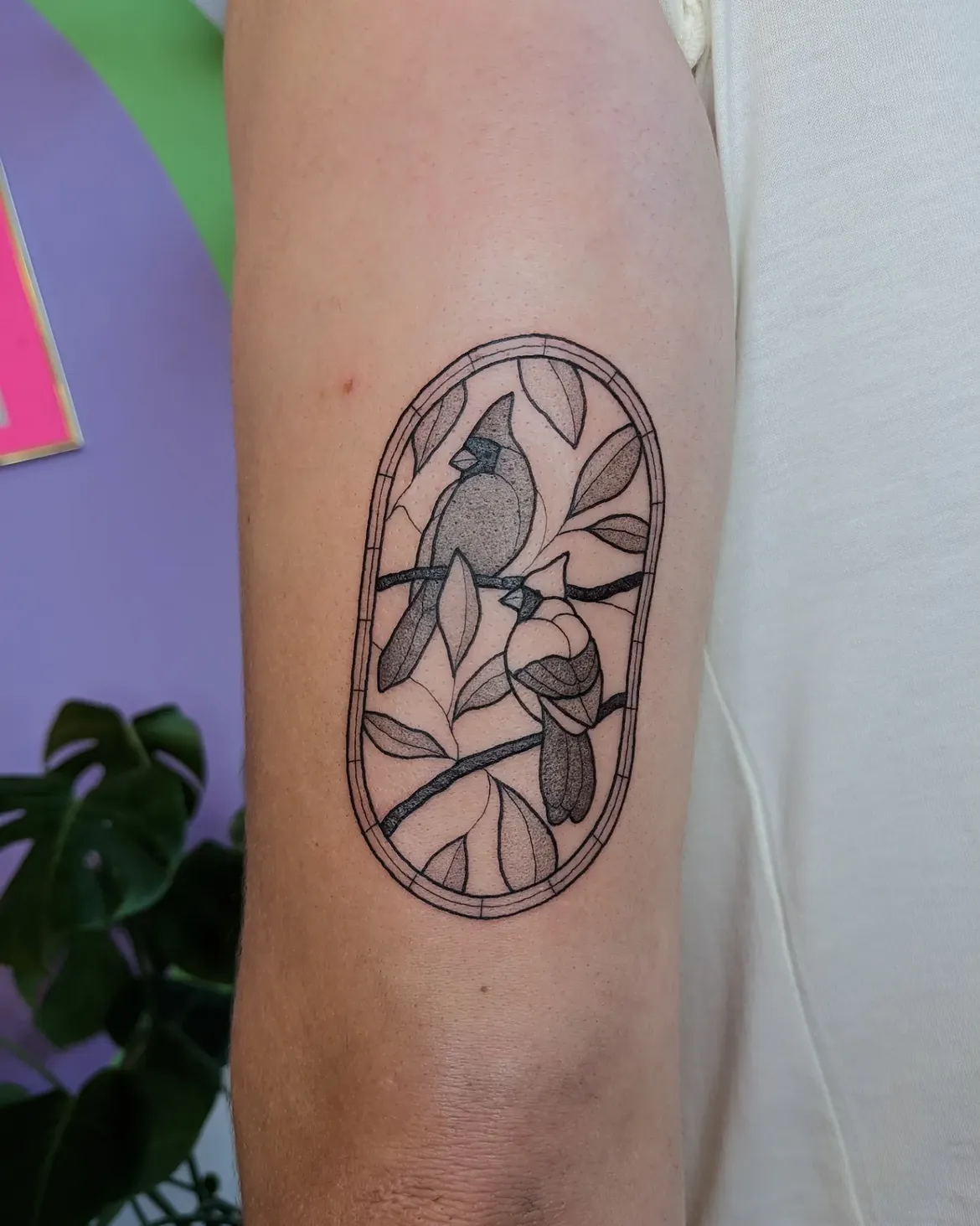
Two birds perched among leafy branches turn this oval panel into a quiet nature scene. Rather than using the pointed arch of a church window, the artist chooses a softly rounded frame, which immediately makes the design feel less Gothic and more botanical.
The birds occupy different heights, creating a natural visual dialogue between them. Dark branches cross the composition diagonally, while leaves fill the spaces around the animals without overcrowding the center. Fine divisions across the background subtly suggest individual glass panes.
The black and grey palette is particularly well suited to the subject. Stippled shading creates texture in the birds’ bodies and feathers, while the leaves remain simple enough not to compete with them. The narrow double border finishes the composition almost like a small framed illustration.
This is a good example of adapting stained glass tattoo ideas to personal symbolism. Birds might represent family, partnership, memory, freedom, or simply an appreciation for nature, but the design does not force a single interpretation. It would also translate beautifully into color if someone wanted the birds and foliage to resemble jewel-toned glass.
Black and Grey Rose Stained Glass Tattoo
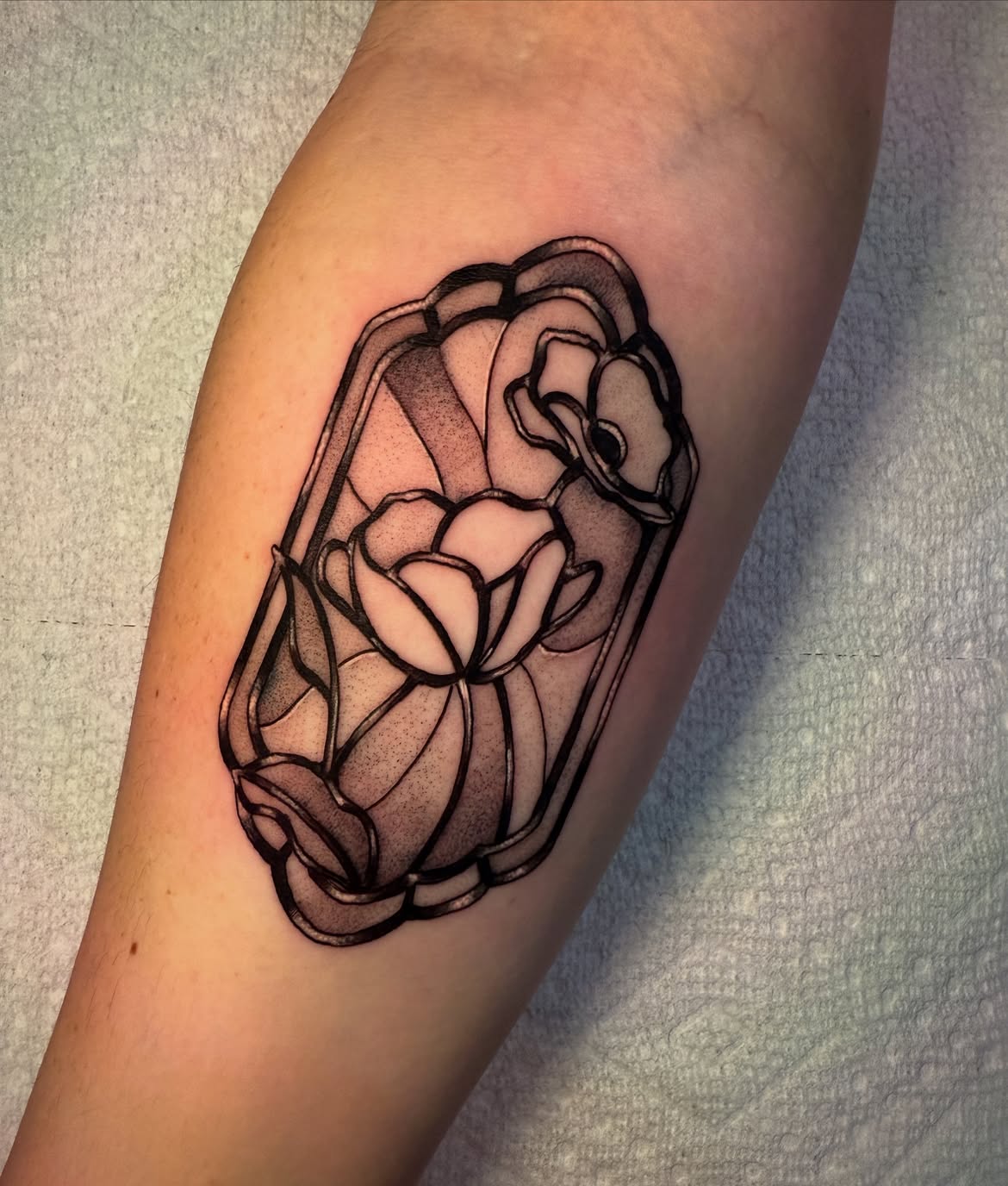
This floral panel has the weight and structure of traditional stained glass without relying on a single bright color. Several roses are fitted tightly inside an elongated ornamental frame, their overlapping petals divided into broad sections that resemble individual pieces of glass. The result feels substantial and decorative rather than delicate.
The black and grey palette works especially well because the artist varies the density of the shading from pane to pane. Some areas remain almost completely open, others carry soft stippling, and several sections become considerably darker. Those tonal shifts replace the different colors that would normally distinguish pieces of glass.
The roses also interact with the border rather than sitting passively inside it. Petals push toward the edges and occasionally interrupt the geometry, creating the impression that the floral design was constructed together with the frame.
For someone considering rose stained glass tattoo ideas black and white, this is a strong reference. It retains the recognizable visual language of leaded glass but has a quieter, slightly Gothic character that should pair naturally with existing blackwork.
Botanical Cathedral Window Forearm Tattoo
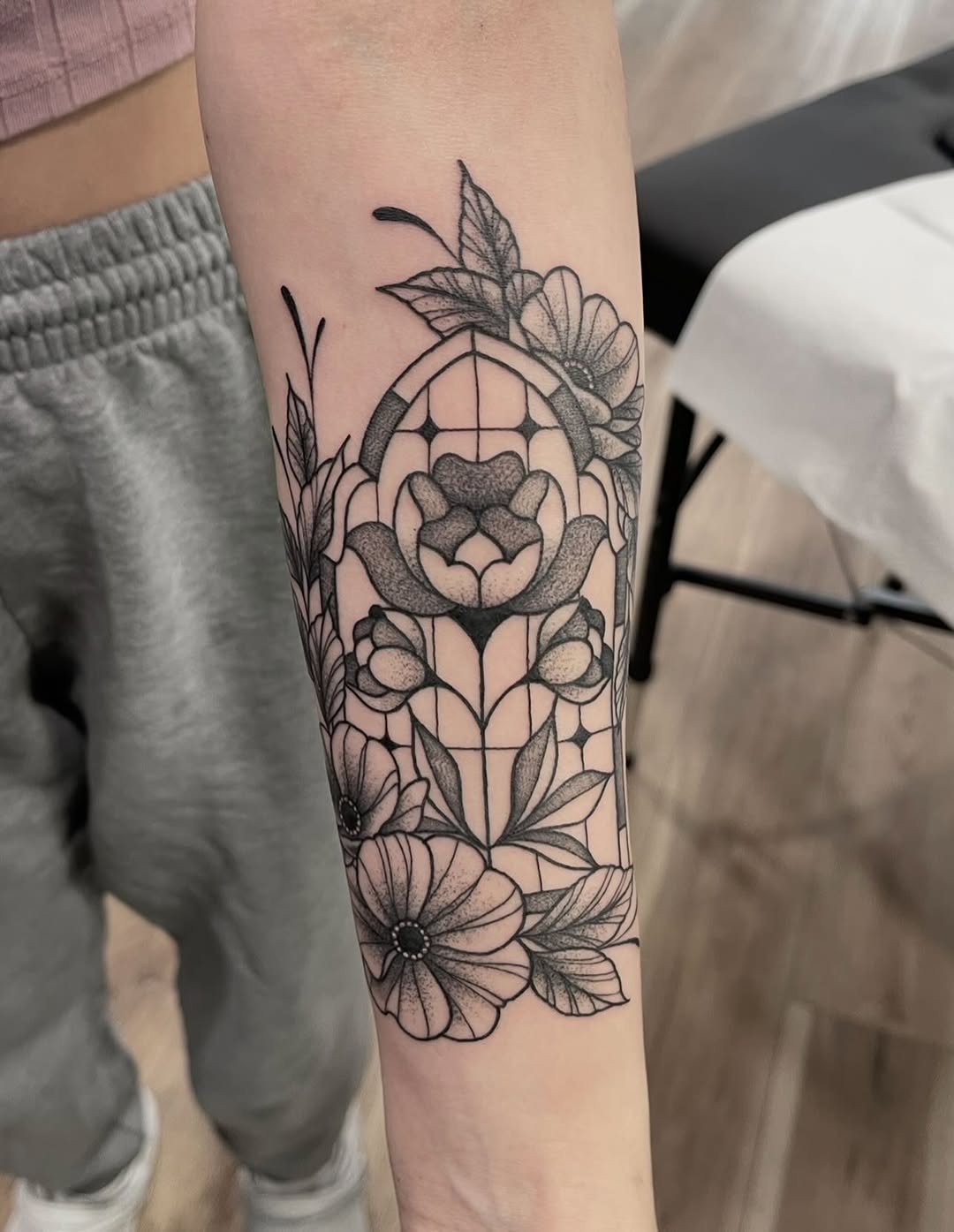
Here, the architectural element acts almost like a background for a garden. A tall pointed window rises through the center of the forearm, while flowers and leaves grow across its boundaries. The largest bloom occupies the middle, two smaller buds balance it below, and looser botanical elements extend around the frame.
That overlap is what gives the design personality. If every flower had been contained inside the window, the composition could have felt formal and static. Allowing petals and leaves to move beyond the architectural boundary makes it feel as though nature is gradually taking over the structure.
Fine linework and stippled black and grey shading keep the piece relatively light despite its size. The panes behind the central flower are mostly open, with small dark intersections creating the illusion of joined glass.
This is an attractive option for women and men who like cathedral imagery but do not necessarily want overtly Christian iconography. The pointed church-window shape supplies a Gothic undertone, while the flowers soften it enough to work alongside other botanical tattoos.
Jewel-Toned Floral Stained Glass Lamp Tattoo
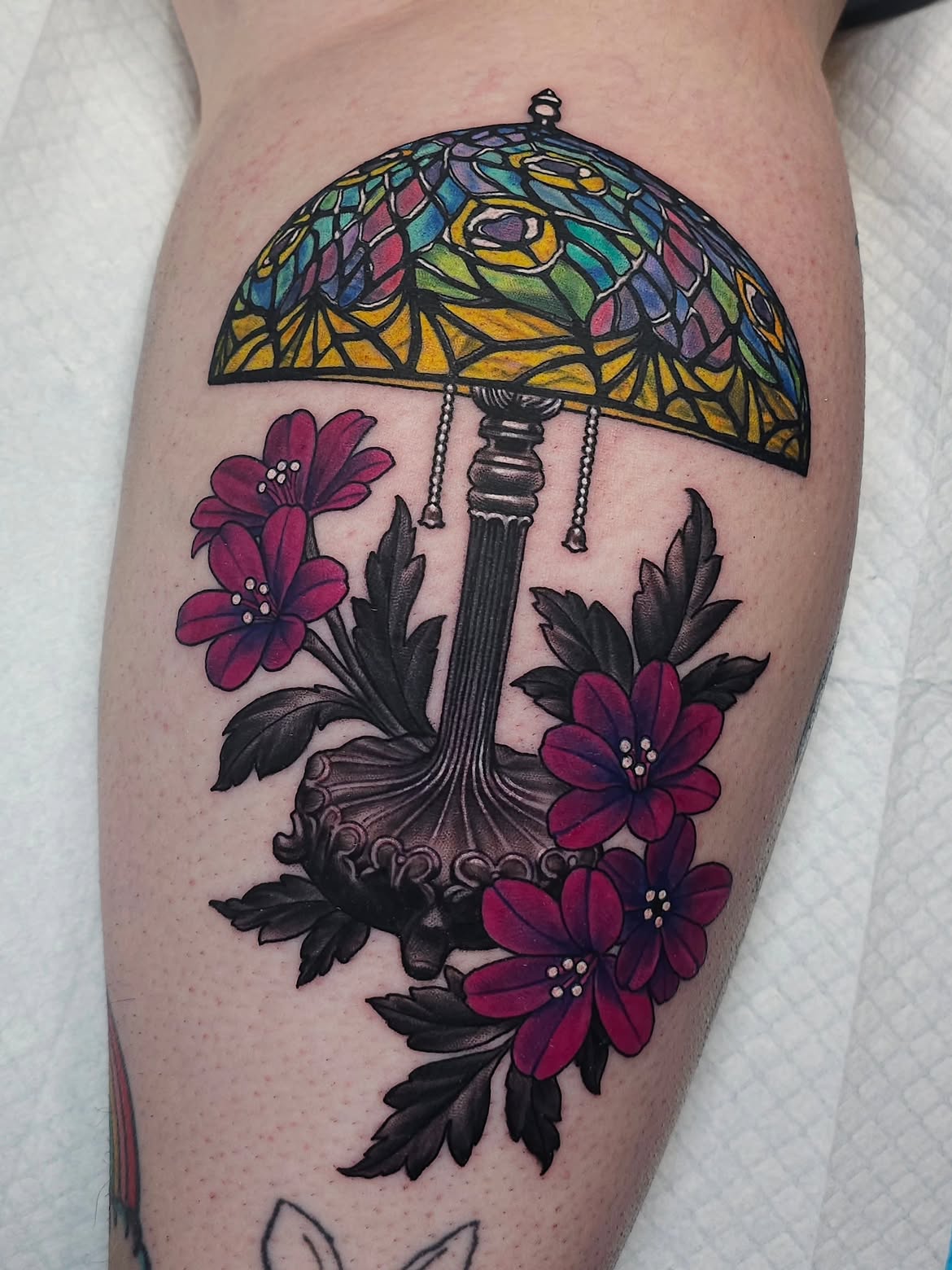
Few objects make better tattoo references for this style than a vintage stained glass lamp. The broad domed shade provides a natural canvas for dozens of small colored sections, and this design takes full advantage of that opportunity.
Turquoise, emerald, violet, yellow, blue and raspberry tones are distributed across a dense floral pattern. Dark outlines divide each piece, allowing even neighboring colors to remain distinct. Along the bottom edge, golden fan-shaped sections create a warm visual foundation for the cooler greens and blues above.
The base is intentionally different. Rendered primarily in black and grey, its fluted column and metallic shading give the lamp weight without competing with the shade. Two pull chains hanging from beneath the dome add a small realistic detail and reinforce the vintage character.
I particularly like the decision to surround the lamp with deep magenta flowers and nearly black foliage. They create a bridge between decorative object and botanical tattoo, so the composition does not feel like an isolated household item. For a larger color design, this combination has considerably more personality than simply reproducing a lamp by itself.
Fine Line Botanical Stained Glass Panel
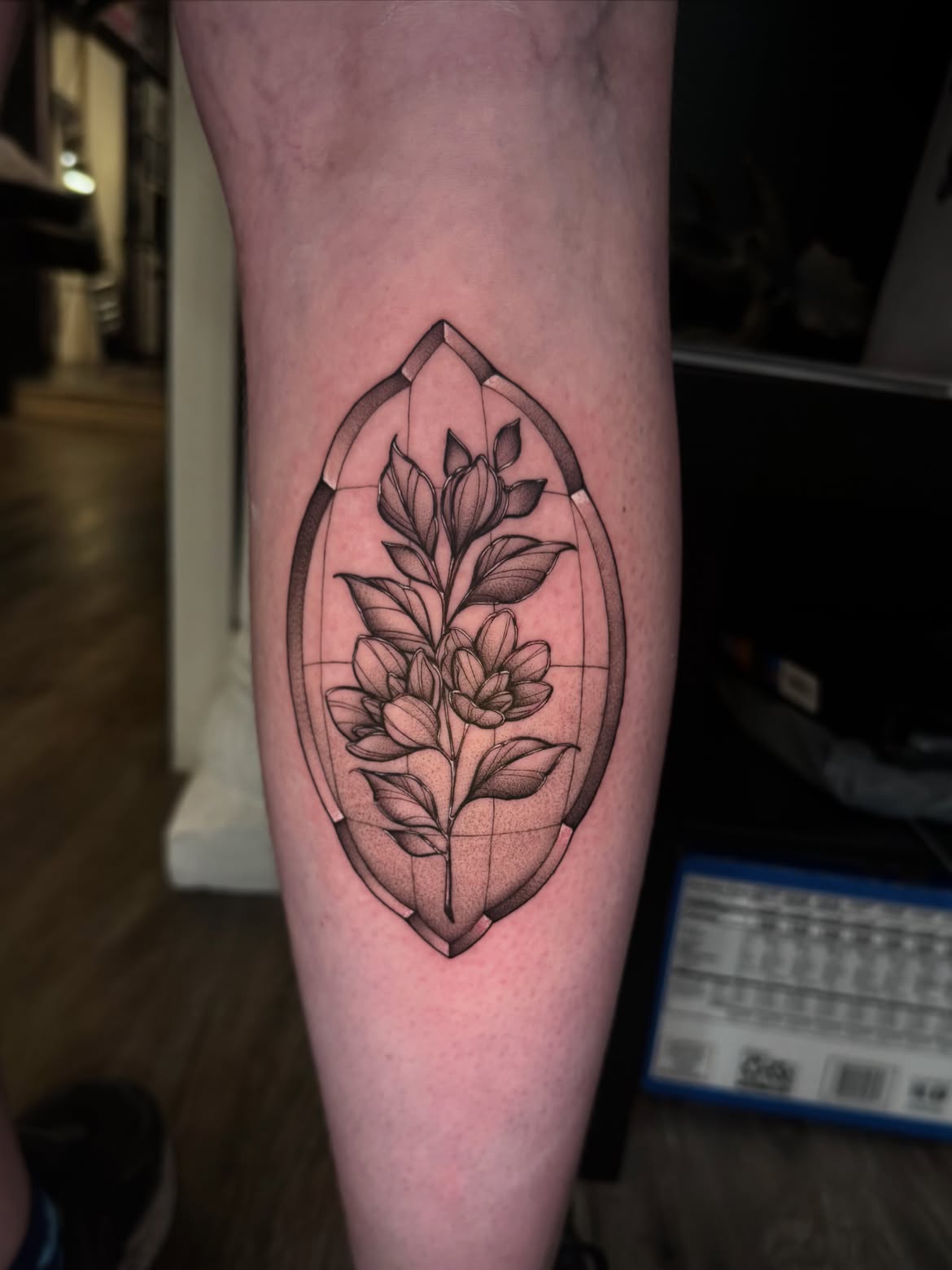
This design is much quieter. A flowering branch sits inside a long pointed oval that resembles a simplified Gothic window, but there is almost no heavy black and no saturated color. Instead, fine outlines and subtle stippling create the impression of translucent glass.
The botanical arrangement grows vertically through the frame. Several blossoms gather around the middle while leaves and unopened buds extend toward the pointed top. The surrounding panes are deliberately broad and understated, allowing the plant to remain the obvious focal point.
This is a good example of how negative space can substitute for literal transparency. The skin becomes the palest glass, while small changes in dotwork establish depth. Even the border alternates between darker and lighter sections, suggesting separate pieces assembled around the perimeter.
For a minimalist black and grey tattoo, the concept is particularly adaptable. A favorite flower, birth flower, rose or tulip could replace the existing botanical subject without changing the underlying structure.
Minimal Rose Window Tattoo
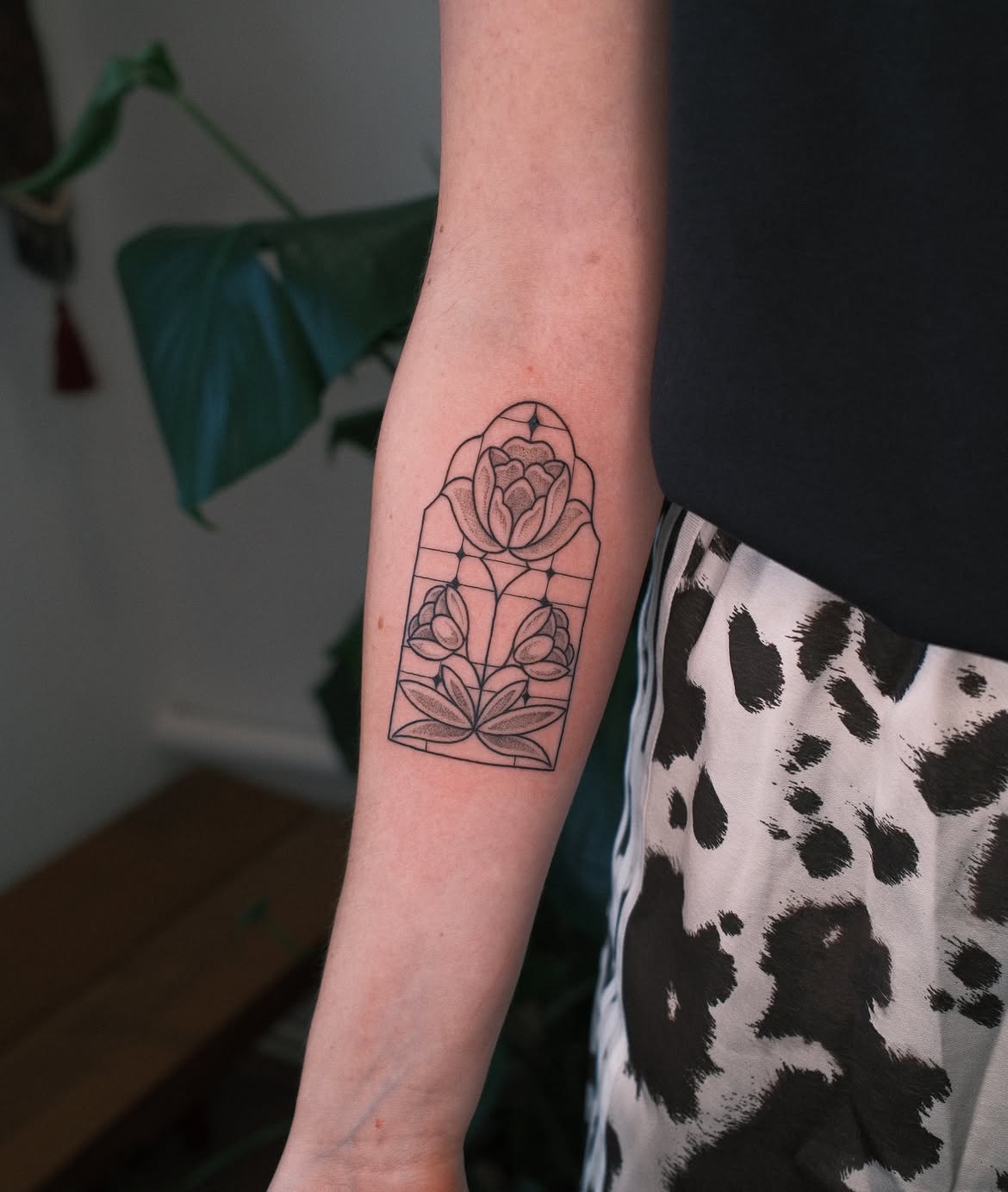
This compact forearm piece strips the stained-glass concept down to its essentials: a narrow arched window, three flowers, a few leaves and a network of geometric divisions.
The largest rose sits at the crown of the design and almost becomes part of the architecture itself. Two smaller blossoms occupy the lower half, while elongated leaves spread across the base. Thin straight lines connect the empty areas between them, creating simple panes without overwhelming the flowers.
There is very little heavy shading. Fine stippling adds texture inside the petals and leaves, while most of the background remains untouched. As a result, the tattoo feels clean and contemporary rather than historically Gothic.
This restrained approach is especially useful when placement space is limited. A stained glass design can become extremely detailed very quickly; simplifying the number of panes gives the flowers enough room to remain readable. It is also an appealing alternative for anyone who wants a rose motif without the stronger visual weight of American traditional color work.
Swan Stained Glass Window Tattoo
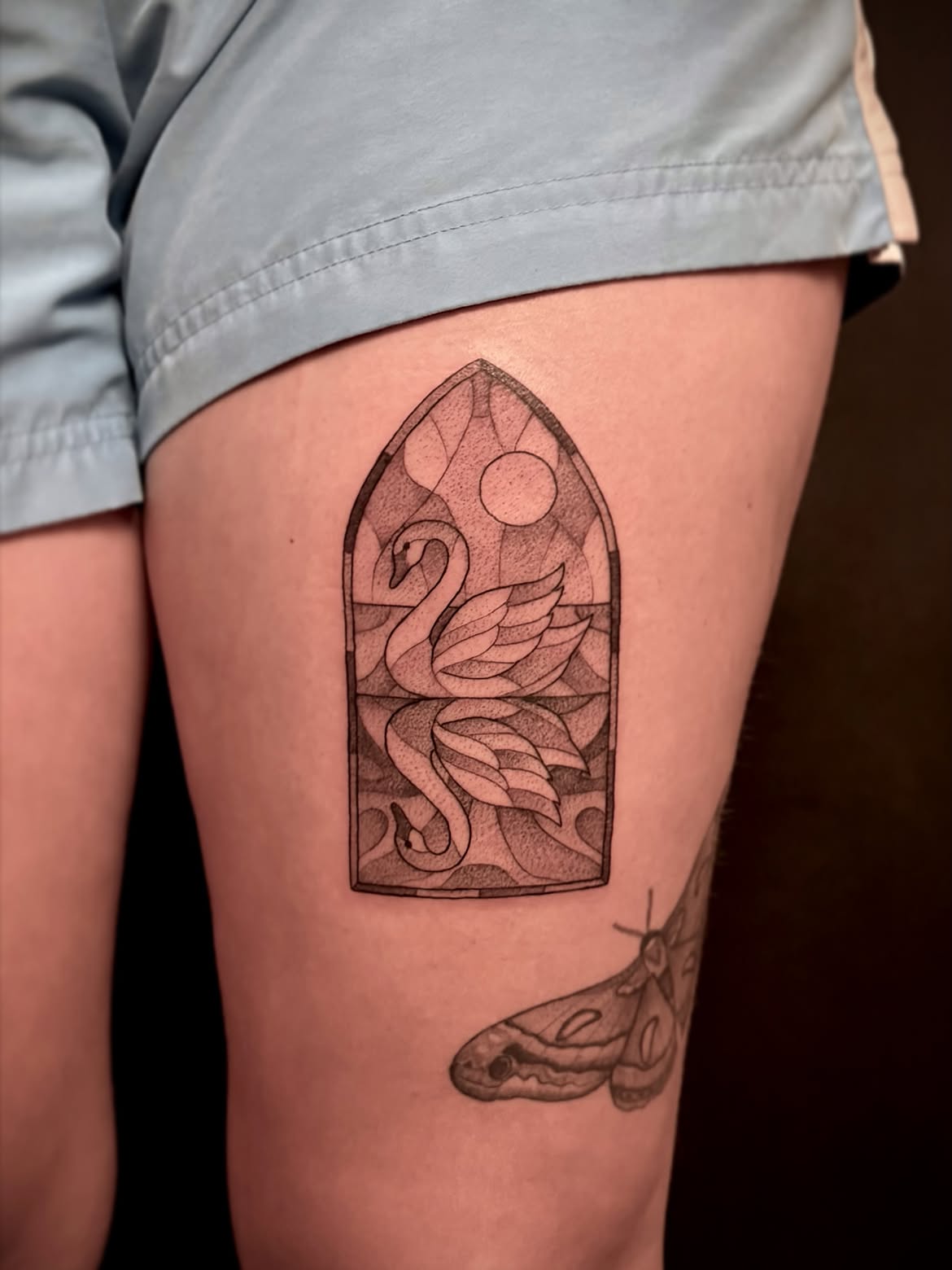
This swan composition has the atmosphere of an illustrated storybook window. A pointed arch encloses two swans arranged one above the other, surrounded by broad sections that suggest water, sky and landscape. A simple circular sun or moon appears in the upper portion.
The birds are constructed from overlapping feather shapes, which translate naturally into the stained-glass technique. Each wing is divided into separate curved sections, while soft stippled shading gives neighboring panes slightly different tonal values. The lower swan creates a reflection-like repetition of the upper figure, giving the design an appealing symmetry without making it perfectly mirrored.
The absence of color changes the mood completely. Rather than resembling a brilliant cathedral window, it feels muted, nostalgic and almost antique. This could work particularly well for someone drawn to black and grey tattoos with romantic symbolism.
It is also an excellent example of choosing a subject whose natural anatomy already lends itself to segmentation. Wings, feathers, waves and leaves can become individual glass panes without looking artificially divided.
Small Rose Cathedral Window Tattoo
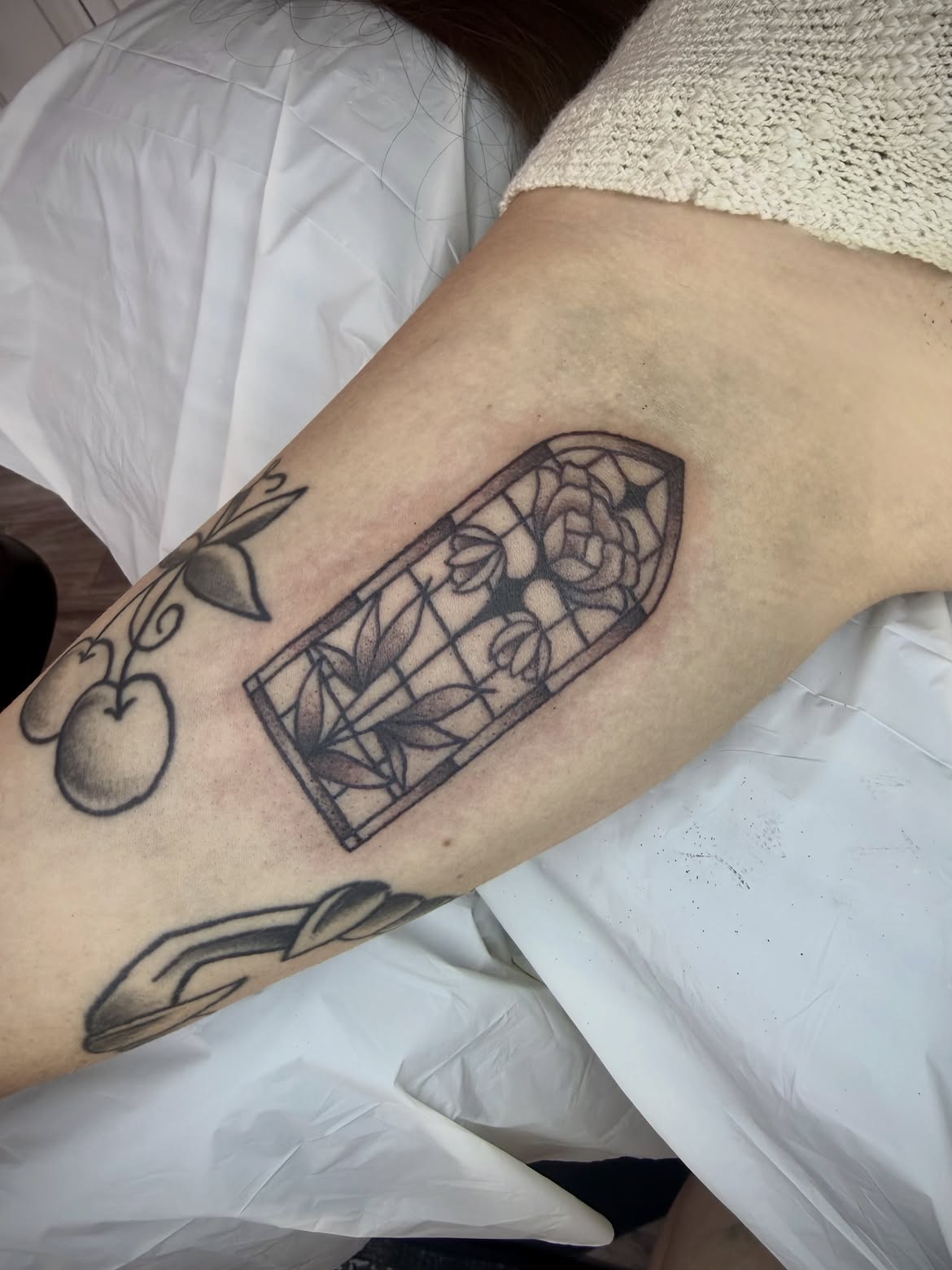
This small floral window uses classic stained-glass construction on a very manageable scale. A narrow pointed arch contains a rose and two smaller buds, surrounded by leaves and angular panes. Stronger black sections at several intersections give the illusion of the dark leading found in traditional glasswork.
The rose occupies the upper end of the panel, which helps draw attention toward the Gothic point of the frame. Below it, the stems and leaves provide a natural vertical path through the composition. Instead of filling every compartment with dense shading, the artist alternates soft grey textures with open skin.
That restraint matters at this size. Trying to reproduce the complexity of a full cathedral window in a small area could quickly make the tattoo difficult to read. Here, the simplified geometry gives every element enough space.
This is an especially versatile design for someone who wants stained glass influence without making it the dominant theme of an entire arm. It can sit comfortably among other black tattoos, while the recognizable church-window silhouette still gives it an identity of its own.
Vibrant Butterfly Stained Glass Tattoo
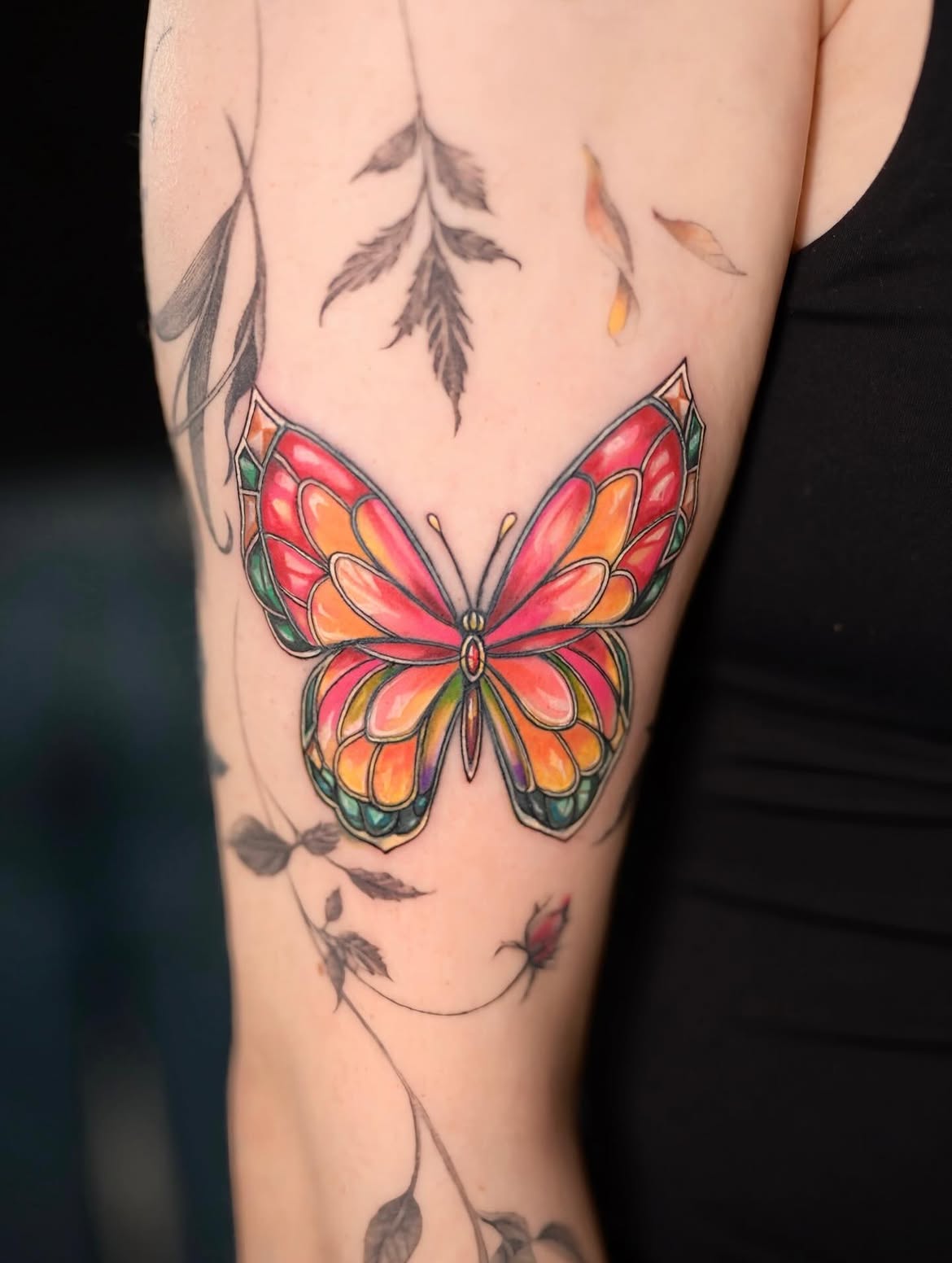
This butterfly takes the luminous quality of stained glass and translates it into a bold, immediately readable color tattoo. Rather than placing the insect inside a church or cathedral window, the wings themselves become the glasswork. Each section is outlined with dark, lead-like lines, creating individual panes filled with saturated red, coral, orange, yellow, green and subtle touches of violet.
The warm center of the palette is especially effective. Coral and orange spread outward from the body before deeper reds take over the upper wings, while green sections along the outer edges provide just enough contrast. Small white highlights create the suggestion of light reflecting from polished glass.
For anyone who loves stained glass tattoo ideas but wants to avoid explicitly Gothic architecture, this is a strong direction. Butterflies naturally provide symmetry and plenty of internal divisions, so the technique feels organic rather than imposed. The design also shows how well vivid color can coexist with other softer botanical tattoos without needing an additional frame around it.
Oval Rose Stained Glass Tattoo
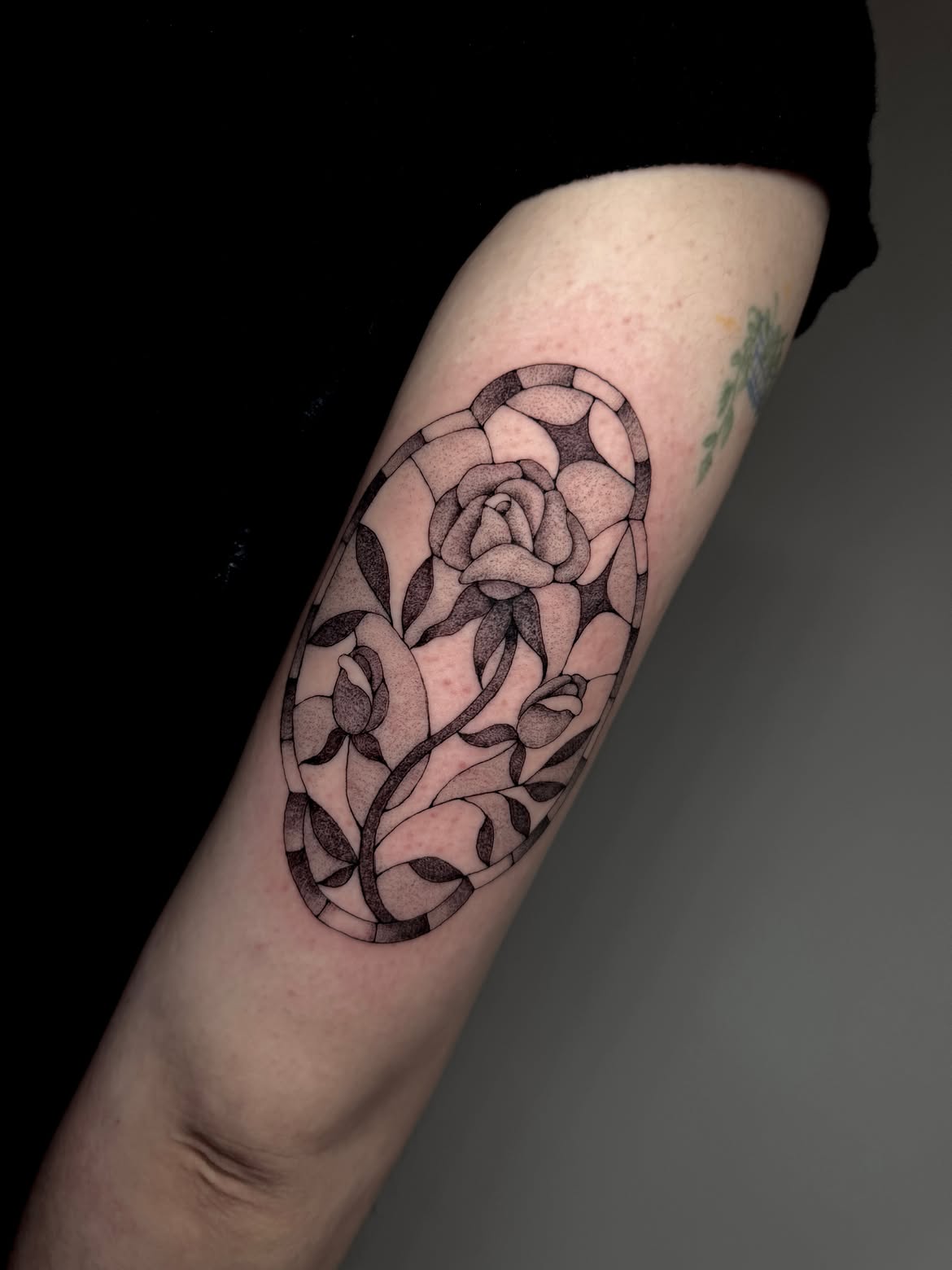
A large rose and two smaller buds fill this elongated oval panel, producing a design that feels halfway between a vintage window and a botanical illustration. The main flower occupies the upper half, while a curved stem travels downward through the composition and connects the smaller blooms.
The black and grey treatment is subtle but far from flat. Fine stippling distinguishes individual petals and background panes, while darker leaves and small geometric intersections give the tattoo necessary contrast. The segmented outer border reinforces the stained-glass construction without becoming visually heavy.
One of the smartest details is the curved stem. Much of stained glass design depends on straight architectural lines, but this organic sweep keeps the composition moving. It guides the eye from the large rose through the buds and prevents the oval format from becoming too rigid.
For rose ideas black and white, this is an elegant alternative to a conventional floral tattoo. The glass structure adds another layer of design while still allowing the flower to remain the obvious subject.
Mermaid Mosaic Stained Glass Tattoo
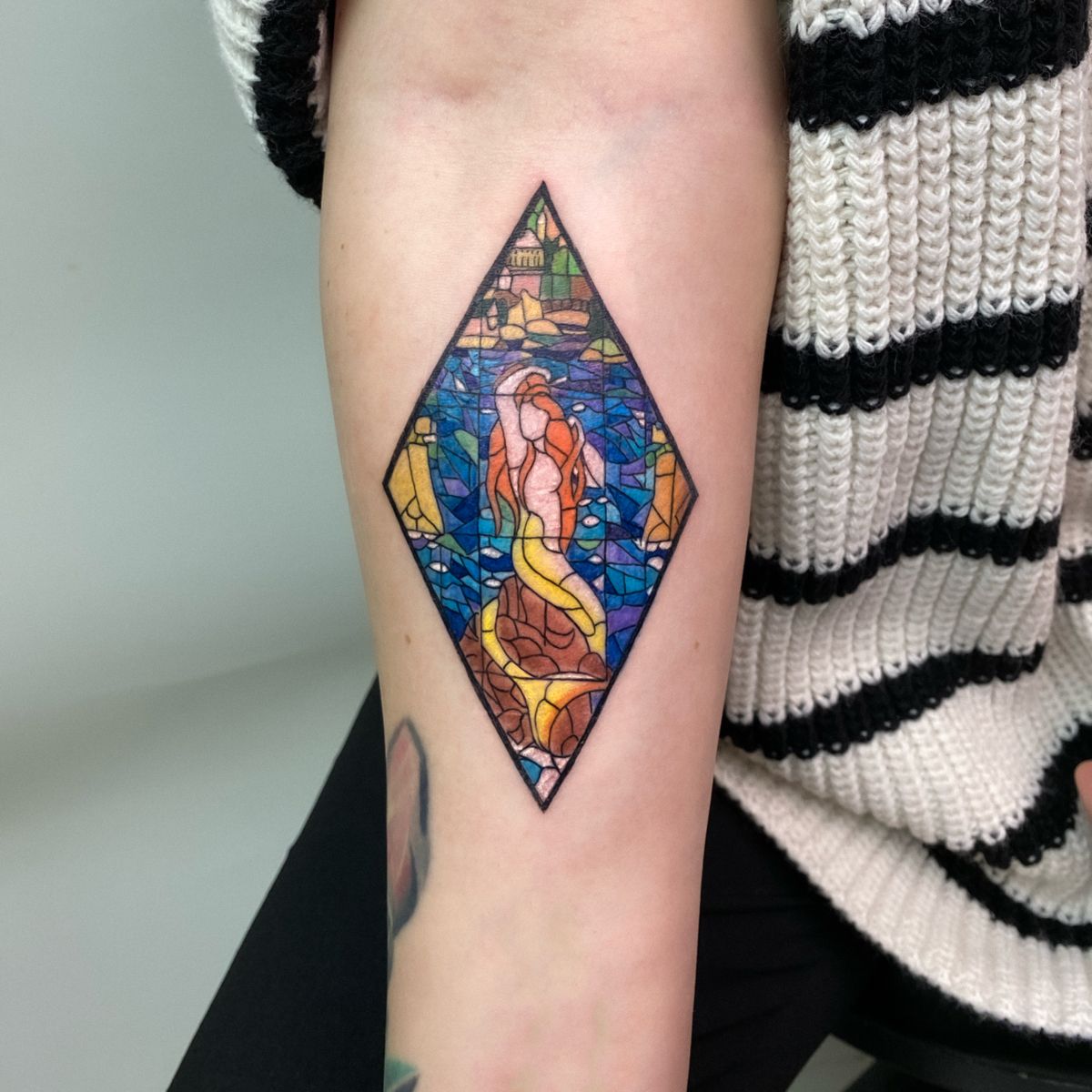
This design embraces the mosaic side of stained glass more fully than most examples in the collection. A mermaid occupies the center of a long diamond-shaped frame, surrounded by water rendered as dozens of irregular blue, turquoise and violet pieces. Her warm orange-red hair and yellow tail immediately separate her from the cooler background.
The tiny fragments are what make the tattoo convincing. Instead of simply outlining a mermaid and filling the background blue, the artist breaks almost every surface into individual panes. From a distance the scene reads clearly; closer inspection reveals the complicated patchwork underneath.
There is even a small landscape near the top of the composition, giving the scene a sense of depth and making the diamond feel like a miniature narrative window. The strong black perimeter keeps all those tiny color sections visually contained.
This is a good reminder that stained glass tattoo ideas can move beyond flowers and religious imagery. Fantasy subjects work particularly well because the jewel-like color enhances their storybook quality. For someone who wants a highly detailed color tattoo, this approach offers almost endless possibilities.
Fine Line Gothic Cathedral Architecture Tattoo
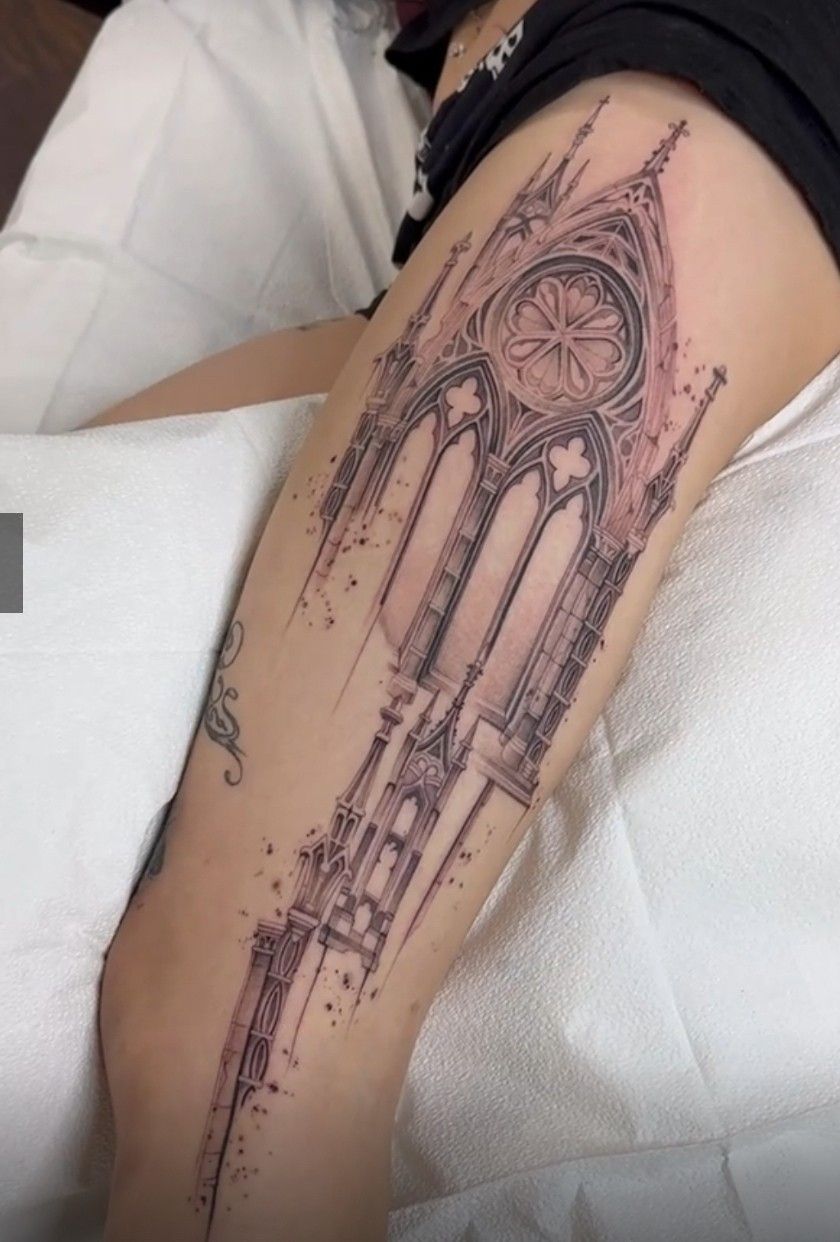
Here the focus shifts from stained glass itself to the architecture that traditionally surrounds it. The design recreates a towering Gothic cathedral façade with an elaborate rose window, pointed arches, narrow columns, tracery and tall spires.
The rose window immediately commands attention. Its circular flower-like geometry sits above a series of long lancet openings, creating the familiar vertical rhythm of Gothic church architecture. Instead of heavy black fill, the artist relies on exceptionally fine black and grey lines, subtle shading and tiny ornamental marks.
The elongated placement makes sense for this subject. Gothic architecture was designed to emphasize height, and the tattoo follows the same principle as it travels down the limb. Small fragments and fading architectural details around the edges make the structure feel almost like an old technical drawing rather than a perfectly polished illustration.
For someone drawn to Christian, church or cathedral references but not necessarily interested in bright stained-glass color, this is a sophisticated alternative. It also demonstrates that the frame surrounding a historic window can be every bit as visually compelling as the glass itself.
Red Gothic Castle Stained Glass Tattoo
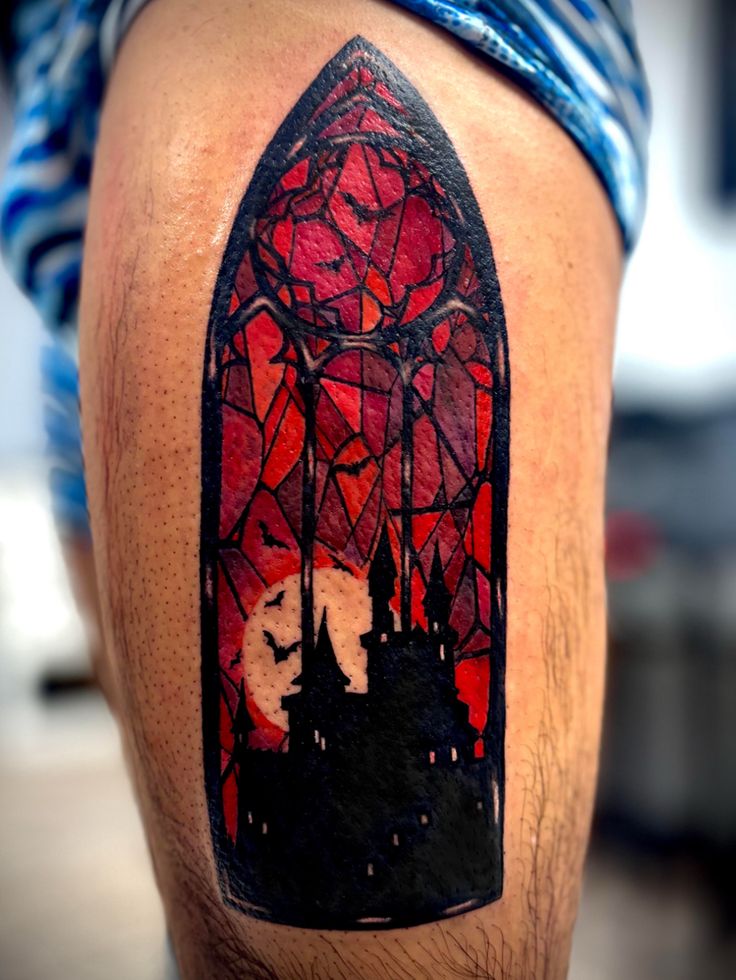
This piece pushes the Gothic mood much further. A tall pointed window is flooded with shades of crimson, scarlet and dark red, while the black silhouette of a castle rises across the lower portion. Above it, a pale moon creates a dramatic break in the otherwise fiery palette.
The background is divided into irregular glass fragments, with thick black lines running between red panes. Several sections shift from bright red to burgundy, creating the impression that different pieces of glass are catching different amounts of light. Dark silhouettes within some upper panes add an ominous, almost cinematic quality.
What makes this design memorable is the extreme contrast. The castle is almost completely black, so its towers and spires cut sharply into the glowing background. It has the atmosphere of a Gothic story rendered as a church window.
For men or women looking for darker stained glass tattoo ideas, this is an effective alternative to floral work. It could also inspire a TWD-related or horror-themed design by replacing the architecture with a personally meaningful silhouette while retaining the dramatic red glass.
Ornamental Gothic Forearm Window Tattoo
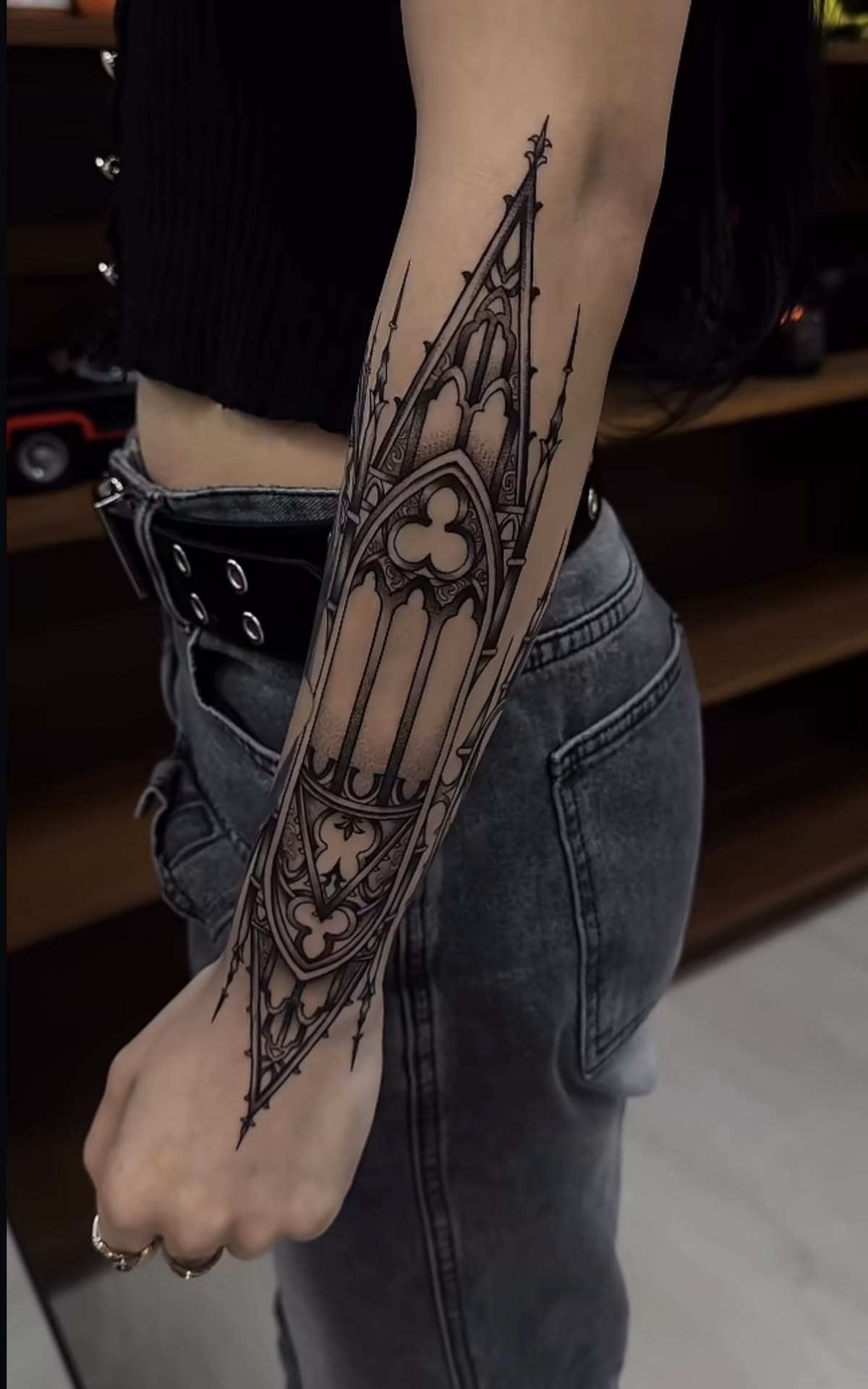
This long forearm design is all about Gothic geometry. Rather than filling a window with flowers or figures, the tattoo magnifies the architectural framework itself. Pointed arches, trefoil forms, narrow vertical openings and ornamental flourishes combine into something that looks part cathedral window and part decorative armor.
The placement is particularly successful. The narrow upper point follows the forearm toward the elbow, while the lower ornament tapers toward the wrist and hand. Those extended spires make the tattoo appear even longer than its actual central structure.
Black and grey shading adds depth between the architectural layers. Some sections remain nearly untouched, while recessed areas are darkened to suggest carved stone or shadow behind tracery. The contrast remains controlled enough that the finer details are still readable.
This is a strong concept for a Gothic sleeve as well. Additional cathedral motifs could continue around the arm without requiring a sudden stylistic change. Even alone, however, it has enough scale and architectural complexity to function as a statement piece.
Orange Floral Stained Glass Panel Tattoo
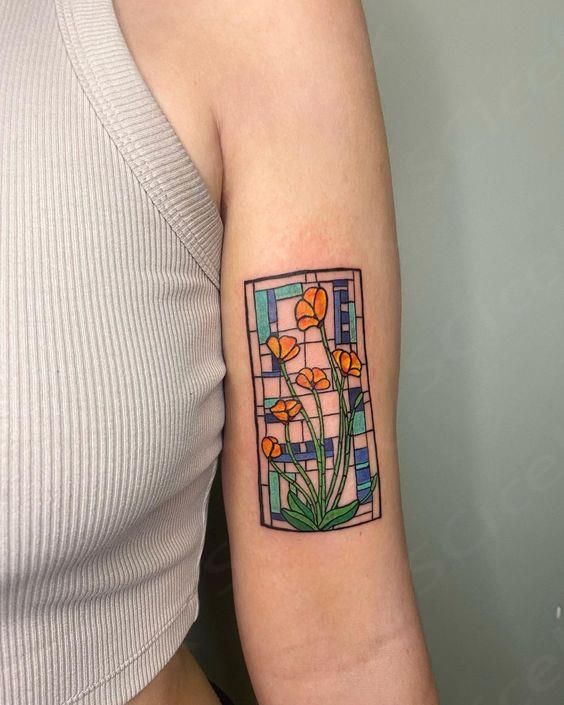
This final design takes a much brighter and more approachable direction. Several slender orange flowers grow upward inside a simple rectangular stained-glass panel, surrounded by green leaves and blocks of muted turquoise, lavender, blue and soft pink.
Unlike the ornate cathedral pieces, the frame is deliberately straightforward. Horizontal and vertical lines create rectangular panes, while a few irregular divisions stop the background from looking too mechanical. The flowers break through this grid with curved stems and asymmetrical petals.
The orange blooms are an excellent color choice because they stand clearly against the cooler background. Green foliage gathers toward the base and visually anchors the stems, while the surrounding pastel glass keeps the overall effect light.
This design has a slightly modernist quality and would work particularly well for someone who wants color without the darker symbolism often associated with Gothic stained glass. A tulip or another favorite flower could easily replace the existing blooms. The format is also compact enough for the upper arm or forearm while still giving the individual panes enough room to remain legible.
Stained glass tattoos can move from American traditional-inspired blocks of strong color to delicate black and grey ornament, Gothic church imagery, floral panels and contemporary animal designs. The most successful ones do more than imitate glass: they use the body’s shape, negative space and tattoo linework to reinterpret the medium.
Which of these stained glass tattoo ideas would you actually wear—the colorful floral work, the black ornamental approach, or one of the smaller window designs? Leave a comment and share the style you would choose.