
Tokyo Ghoul has always had the kind of visual language that translates naturally into tattooing. Manga panels rendered in heavy black ink, Kaneki’s transformation, red spider lilies, centipedes, stitches, fragmented typography, and unsettling contrasts between beauty and violence can all become striking body art without requiring a literal recreation of an anime scene.
The strongest Tokyo ghoul tattoo ideas tend to borrow recognizable elements from the series while allowing the tattoo artist to reinterpret them for the body. A detailed forearm can carry a manga collage, while a shoulder or upper arm gives flowers room to move. Smaller, more subtle concepts can focus on a single red lily, a line of stitches, or symbolic lettering.
Tattoo publications and communities are useful references when studying how contemporary artists adapt illustration, manga, fine-line work, and blackwork to the shape of the body. The 28 designs here show just how broad the Tokyo Ghoul aesthetic can become.
Kaneki Manga Panel Forearm Tattoo
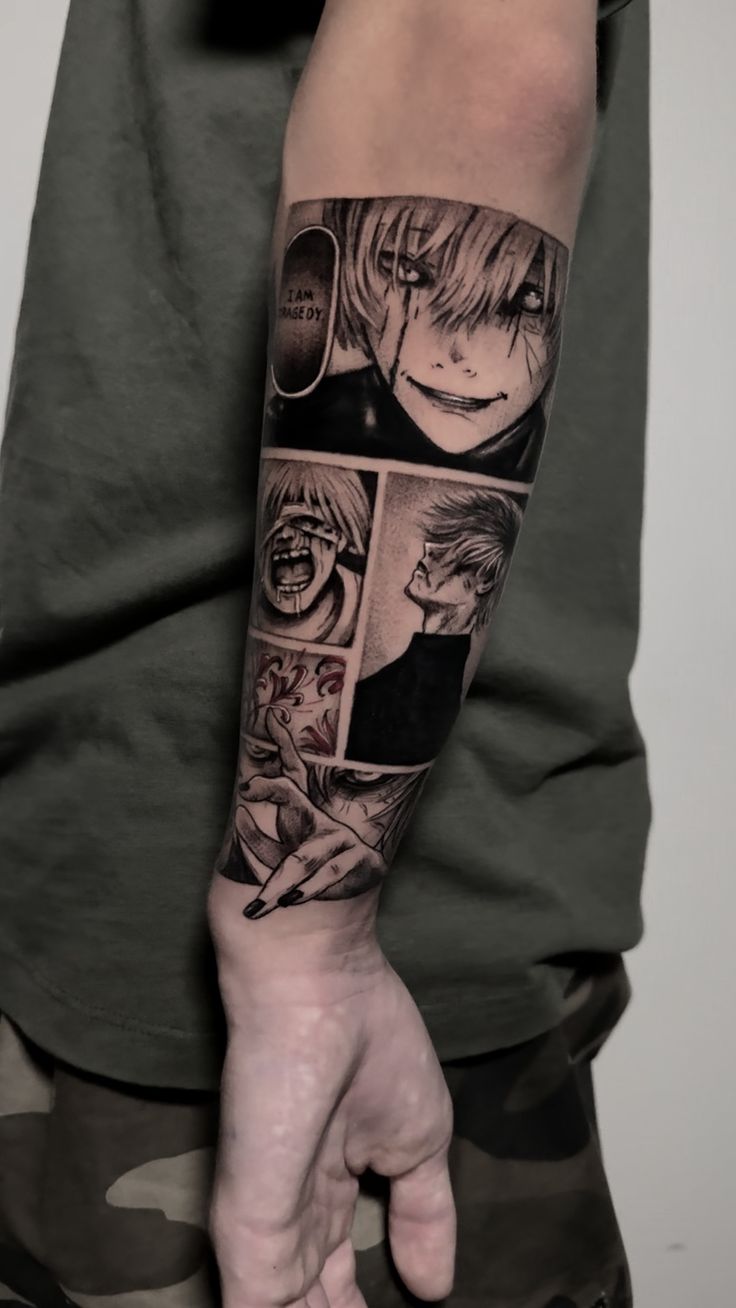
This forearm piece treats the skin almost like a printed manga page. Instead of choosing one isolated portrait, the design builds a vertical collage from several panels featuring Kaneki in dramatically different emotional states. The largest face dominates the upper portion, while smaller scenes continue toward the wrist, giving the tattoo a narrative rhythm rather than the static feeling of a conventional character portrait.
The black-and-gray treatment is particularly appropriate for a Kaneki design. Dense black areas establish the darkest parts of the composition, while delicate gray shading recreates the grainy, hand-drawn quality associated with manga illustration. Fine lines around the eyes, hair, hands, and facial expressions keep the imagery recognizable even when the arm is viewed from a distance.
It is also a clever example of Tokyo Ghoul tattoo forearm placement. The long rectangular proportions naturally resemble a manga page, allowing several frames to be stacked without forcing them into an awkward shape. Extending the concept farther around the arm could turn it into a full sleeve, with additional panels gradually disappearing into blackwork or abstract kagune-inspired forms.
For anyone developing a custom stencil, I would keep the panel borders slightly irregular rather than making everything geometrically perfect. That small imperfection helps preserve the raw printed-comic character of the piece.
Red Spider Lily Timeline Forearm Design
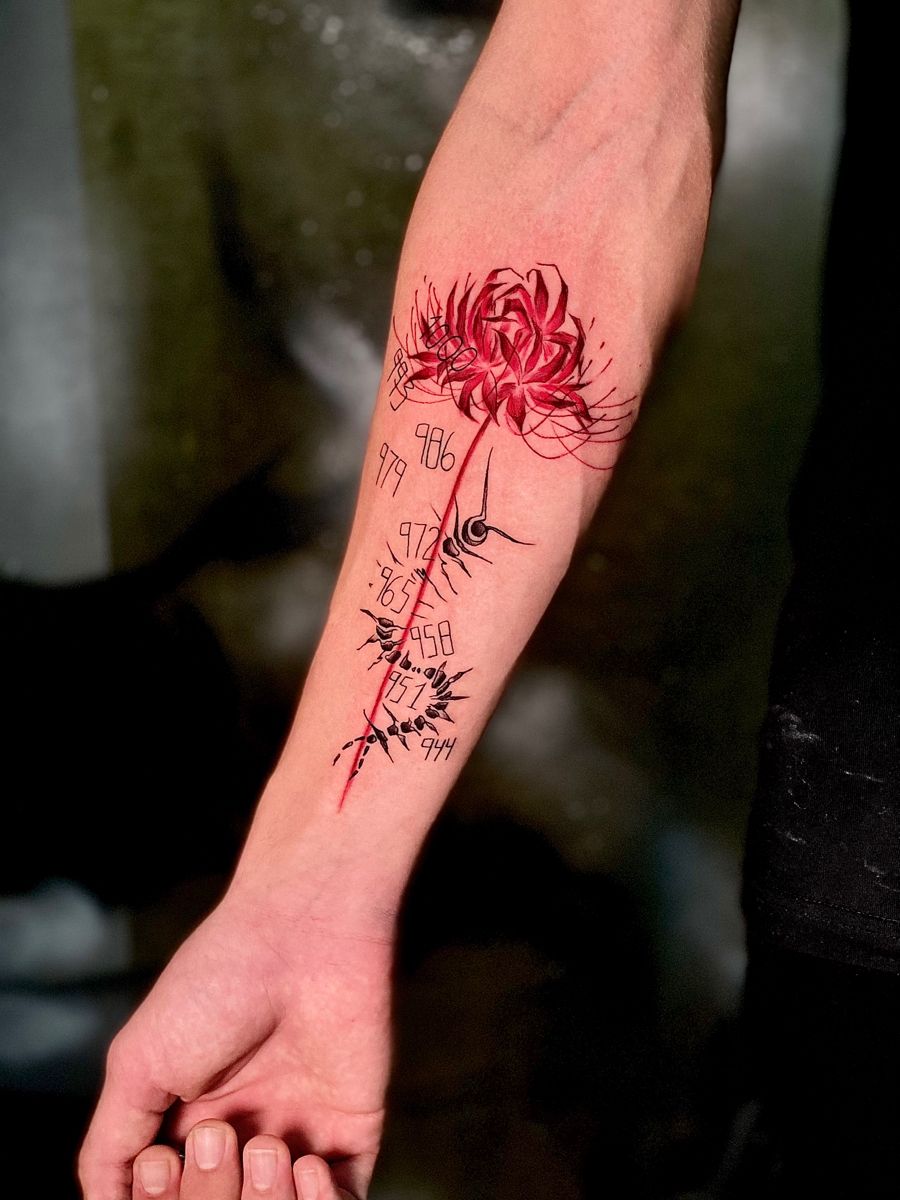
Here the mood changes completely. A delicate red lily flower sits near the upper part of the forearm, followed by a descending arrangement of numbers, fragmented black marks, fine botanical details, and red accents. There is a lot of negative space, which makes every individual element feel intentional.
The spider lily has become one of the most visually effective motifs for anime-inspired tattoos because its long, curling petals already possess an almost supernatural silhouette. Within a Tokyo Ghoul context, spider lilies work especially well with themes of death, change, memory, and the boundary between different states of existence.
What I like most is the restraint. Many designs flower concepts become decorative first and narrative second, whereas this one allows the botanical element to establish the emotional tone without overwhelming the symbolic details beneath it. The contrast between saturated red and very thin black linework creates a slightly clinical, almost diagrammatic appearance.
This is a strong direction for someone collecting ideas arm references but wanting something less obvious than a character portrait. A tattoo artist could personalize the numerical sequence, adjust the flower, or remove secondary details for an even more subtle result.
Flowing Red and Black Spider Lilies on the Upper Arm
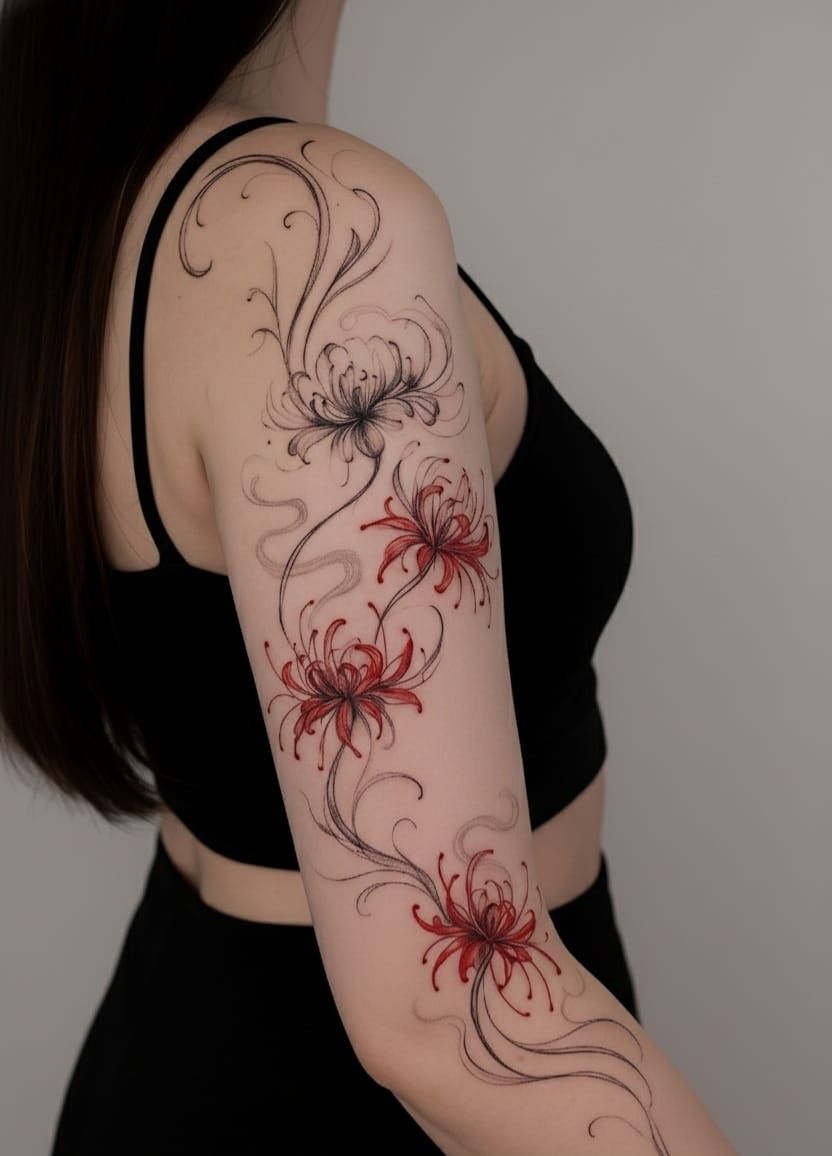
This upper arm tattoo approaches the same flower motif in a much softer way. Several spider lilies travel from the shoulder toward the elbow, connected visually by extremely thin, curling lines. Black and muted red alternate throughout the composition, creating movement without requiring heavy shading.
The placement is one of its greatest strengths. Instead of forcing the artwork into a rectangle, the stems and ornamental lines follow the natural length of the arm. The largest bloom sits high near the shoulder, where there is more space, while progressively separated flowers guide the eye downward.
For ideas flower references, this demonstrates how Tokyo Ghoul inspiration does not have to look like conventional anime merchandise translated onto skin. Someone unfamiliar with the series could simply read it as elegant botanical work. A fan, however, can connect the red lily imagery with the darker atmosphere surrounding the story.
This approach would also adapt beautifully to the thigh, shoulder, side of the torso, or even ideas spine placement. On the spine, the artist could make the flowers narrower and allow their stems to descend vertically. On black skin, brighter red pigments and stronger black outlines may need to be planned differently according to skin tone and the artist’s experience, rather than simply copying the exact tonal balance seen here.
Centipede and Spider Lily Upper Arm Tattoo
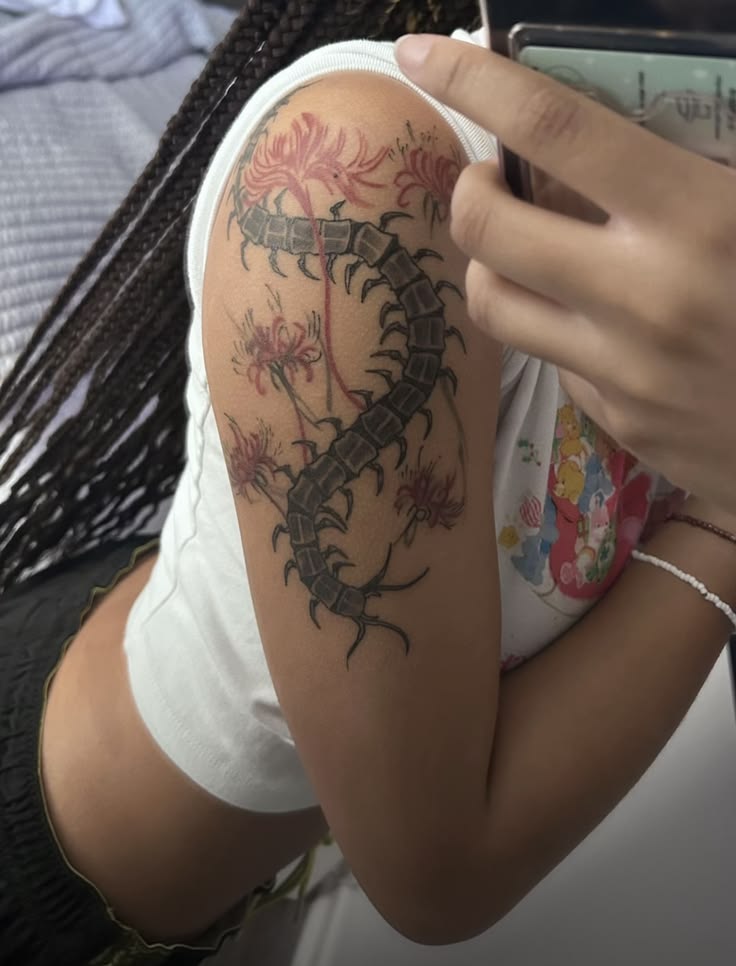
Few symbols communicate Tokyo Ghoul’s disturbing side as effectively as the centipede. This version places a long segmented creature across the upper arm, surrounded by loosely rendered reddish spider lilies. The combination is deliberately uncomfortable: graceful flowers provide the background while the dark insect becomes the dominant focal point.
The centipede bends rather than running in a straight line. That matters enormously on an arm because the curved body prevents the tattoo from appearing pasted onto the skin. Individual legs break away from the central silhouette and create a jagged outline that remains readable against the softer flower forms.
Fans looking for Scolopendre imagery—the French term that sometimes appears in searches for centipede-inspired tattoo references—could use this as a starting point without copying it literally. The creature could be made realistic, simplified into black linework, or incorporated around Kaneki imagery.
There is also an interesting contrast of visual textures. The insect is architectural and segmented; the flowers are loose and almost sketch-like. That tension makes the tattoo feel much closer to Tokyo Ghoul’s unsettling visual world than a perfectly polished botanical composition would.
Detailed Centipede Forearm Tattoo With Red Flowers and Digital Elements
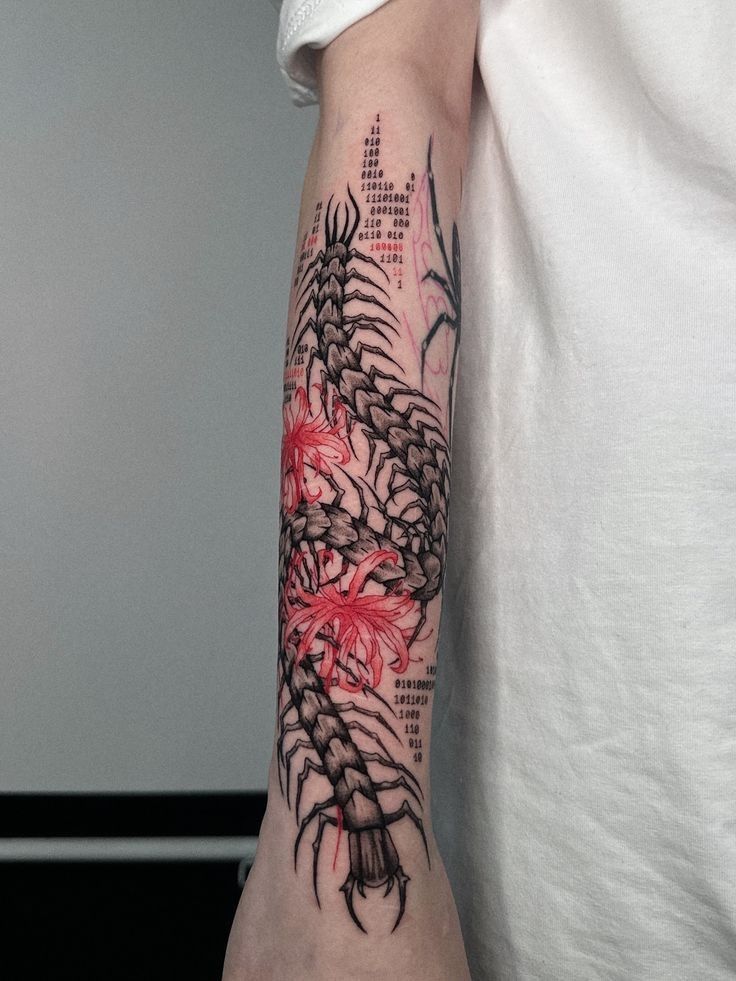
This is one of the most complex Tokyo Ghoul tattoo designs in the group. A large centipede twists vertically along the forearm, its overlapping body segments rendered with dark shading and sharp outlines. Red spider lilies interrupt the creature at several points, while columns of tiny numbers and digital-looking symbols occupy the negative spaces around it.
The result feels somewhere between manga illustration, cyber-inspired graphic design, and blackwork. Rather than separating those styles, the tattoo deliberately lets them collide.
The centipede itself deserves attention. Each segment has enough tonal variation to create depth, while the numerous legs generate controlled visual chaos around the body. Because the creature changes direction as it travels down the arm, the viewer has to follow the tattoo rather than absorbing it in a single glance.
Red provides the essential counterweight. Without it, the dense black centipede could become visually heavy. The red lily flower shapes introduce lighter, more organic forms and connect the piece to the recurring spider-lily language seen in many Tokyo Ghoul-inspired ideas.
For a larger arm project, this could easily become the foundation of a sleeve. Black manga panels, an eye detail, Kaneki portraiture, lettering, or additional flowers could occupy the remaining surfaces while preserving the centipede as the central vertical element.
Red Stitches Wrapping Around the Arm and Hand
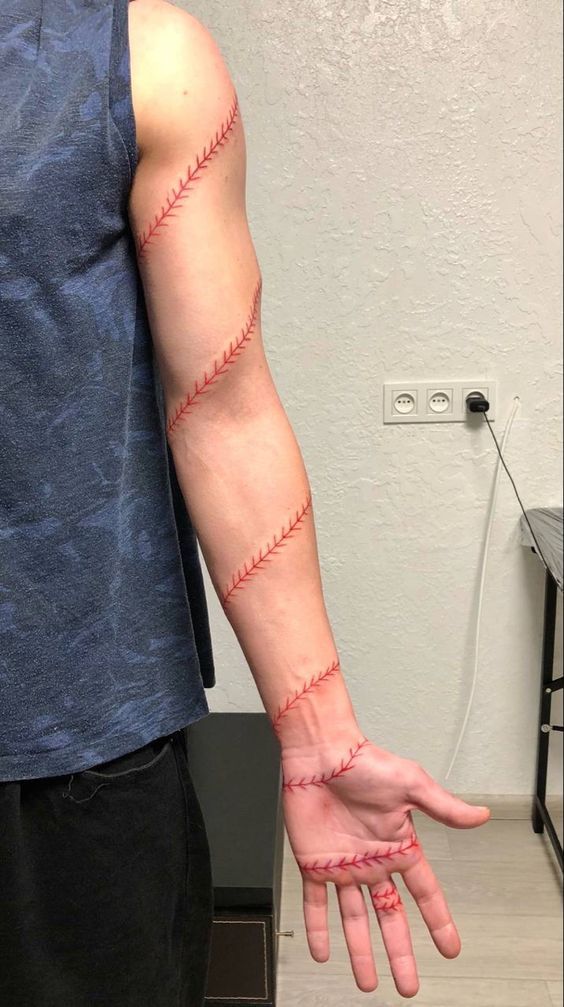
Sometimes the simplest concept is the one people remember. These red stitches travel continuously around the arm, crossing the upper arm, elbow area, forearm, wrist, palm, and fingers. Instead of imitating a realistic surgical wound, the tattoo relies on a clean central red line with short diagonal marks that create the illusion of crudely sewn skin.
The uninterrupted path is what makes the design work. The arm seems visually reconstructed from separate pieces, giving an otherwise minimal tattoo a slightly disturbing quality. Red ink reinforces the effect while remaining far lighter than a dense blackwork sleeve.
This is useful inspiration for anyone who wants Tokyo Ghoul references without using Kaneki’s face or a recognizable manga scene. It can function almost like a hidden fandom tattoo: visually unusual on its own, yet connected to the broader language of scars, bodily transformation, damage, and reconstruction.
Placement requires careful planning. A line crossing joints can change dramatically as the elbow, wrist, and fingers move, so an experienced artist should map the stencil while checking the arm in several positions. The concept could also stop at the wrist for a cleaner forearm version rather than continuing onto the hand.
Subtle Red Spider Lily Back Tattoo With Japanese Lettering
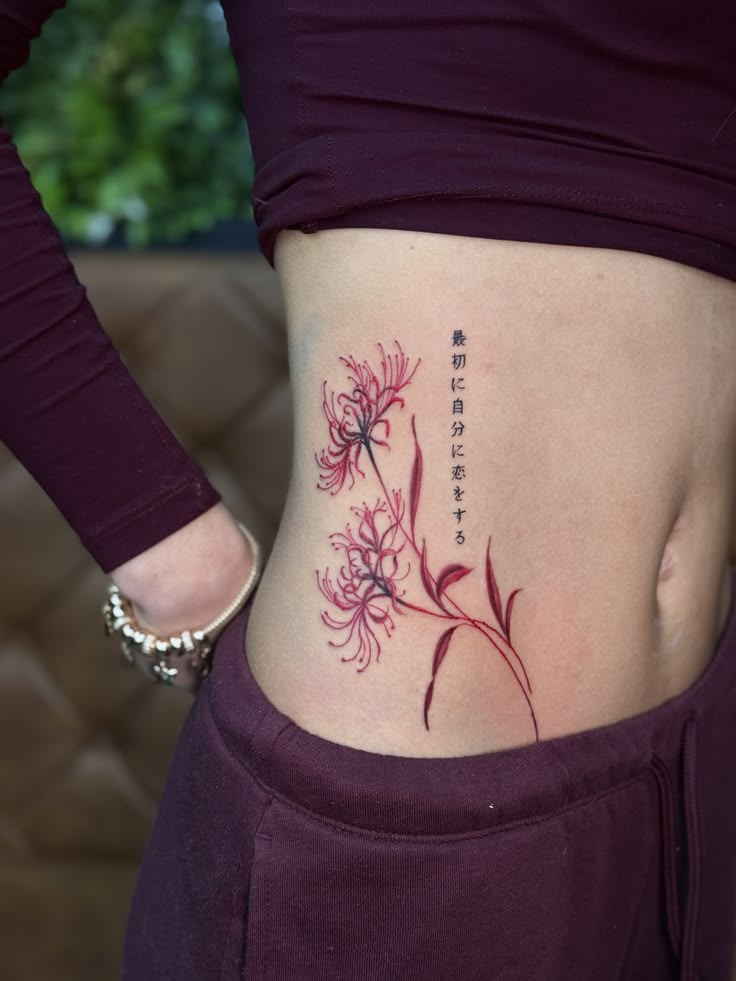
This small back composition shows how restrained Tokyo Ghoul-inspired body art can be. Fine red spider lilies sit along the lower side of the back, accompanied by slender stems and a vertical column of black Japanese characters. The red-and-black palette creates enough contrast to make the design immediately noticeable without requiring a large surface area.
Unlike the heavier centipede and manga concepts, the focus here is elegance. The petals are built from narrow curved strokes rather than blocks of color, and the stems leave generous areas of untouched skin around them. That negative space gives the entire piece a light, almost calligraphic quality.
It is a particularly useful reference for ideas back and Rücken searches because the composition could be repositioned in several ways. Moving it toward the center would create a strong vertical ideas spine design; placing it higher could produce a delicate shoulder-blade tattoo; reducing it to one bloom could make the concept suitable behind the ear.
Anyone considering Japanese lettering should have the exact phrase independently verified by a fluent speaker before it becomes permanent. Decorative plantillas found online can help establish composition, but they should not be trusted automatically for language accuracy.
Kaneki Portrait With Bold Red Spider Lilies
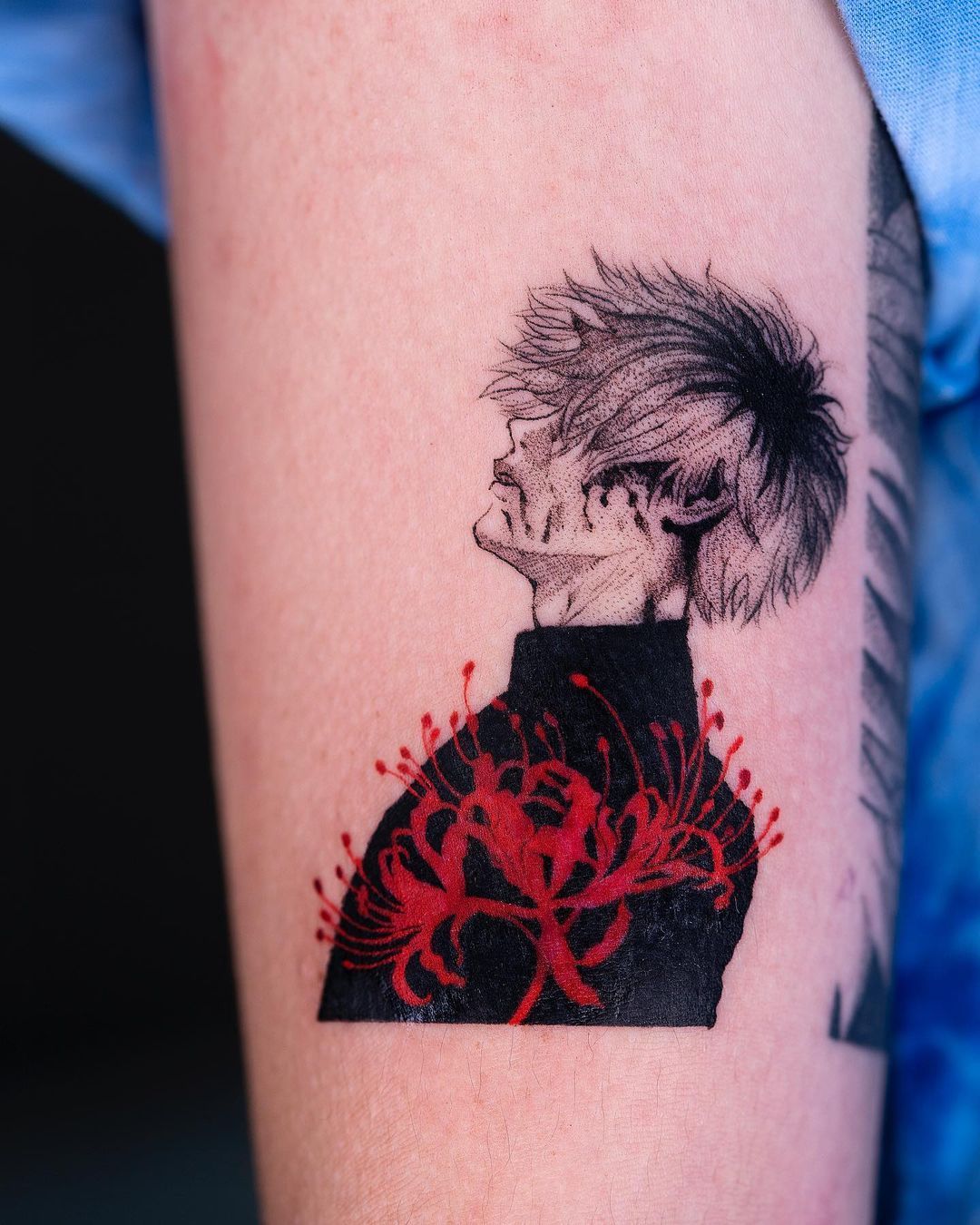
This design combines two of the most recognizable directions in Tokyo Ghoul tattoo art: a manga-style Kaneki portrait and intensely colored spider lilies. The character is shown in profile with his head tilted upward, creating a vulnerable, almost exhausted expression. Fine black lines and dotwork reproduce the texture of manga printing, especially through the hair, facial marks, jaw, and neck.
The lower half changes dramatically. Kaneki’s clothing becomes an almost completely solid black field, allowing the brilliant red lily flower to spread across it. That contrast is excellent tattoo composition—the flower does not merely sit beside the portrait but seems to emerge from the darkness.
As an upper arm design, it has enough vertical space for the portrait to remain detailed without becoming oversized. The idea could also work on the thigh, where an artist would have even more room to preserve small facial textures. Fans looking for designs flower references can use this approach to combine recognizable manga imagery with botanical symbolism instead of treating them as separate tattoos.
Fine-Line Kaneki and Single Red Lily Design
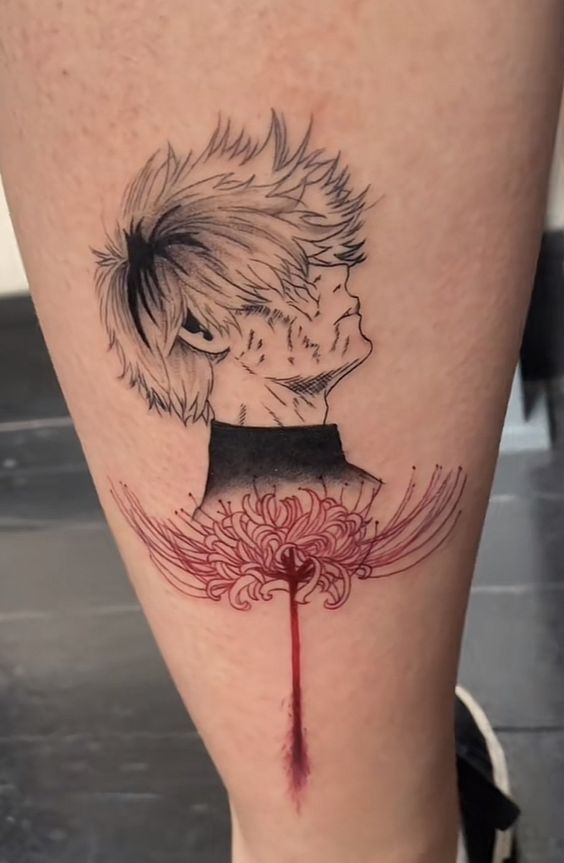
This interpretation feels lighter and more intimate. Kaneki appears above a single red spider lily, with his face tilted upward and his hair rendered through loose, energetic black lines. Rather than relying on extensive black-and-gray realism, the artist leaves considerable untouched skin inside the portrait.
The flower beneath the character creates a natural visual boundary. Its thin red petals stretch horizontally while a single stem drops downward, extending the composition without adding unnecessary weight. That makes this one of the more subtle character-based ideas in the collection.
There is also an appealing tension between the two drawing styles. Kaneki looks like a sketch lifted from a manga page, while the red lily is more decorative and symmetrical. If I were adapting this concept, I would resist adding a complicated background—the open skin is precisely what gives the design its emotional quality.
This format works especially well for people searching for ideas arm that clearly reference Tokyo Ghoul without committing to a full sleeve.
Minimal Spider Lily Side Tattoo
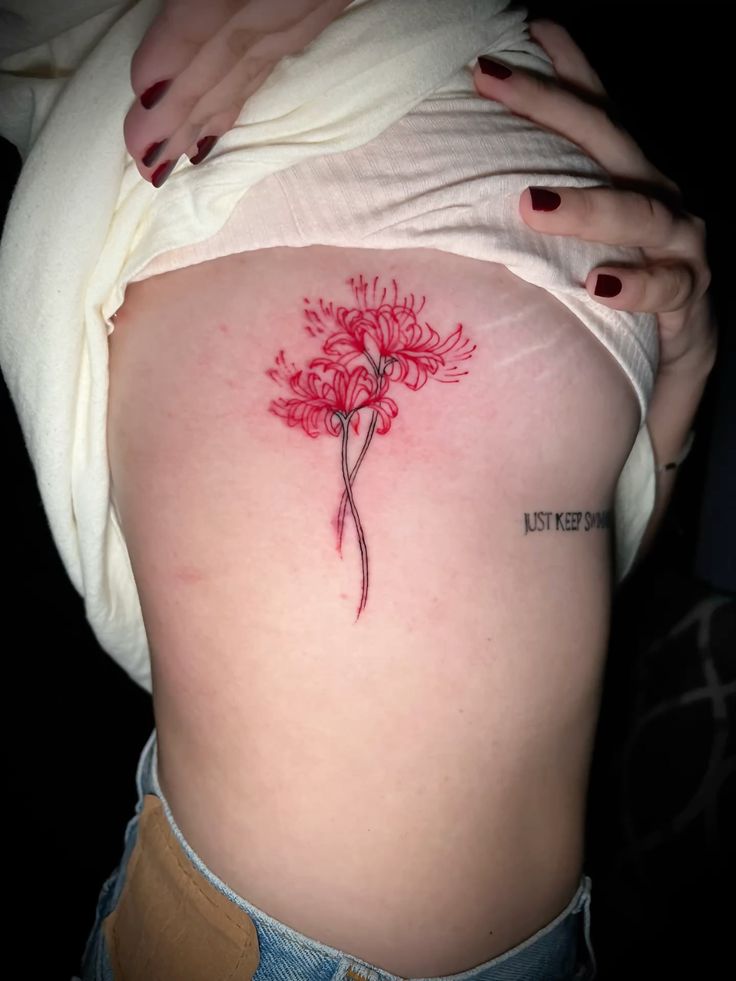
Two delicate red spider lilies create one of the cleanest ideas flower concepts in this set. Instead of including a character, mask, centipede, or large block of manga imagery, the design relies entirely on the flowers associated with Tokyo Ghoul’s dark visual atmosphere.
The petals are drawn with fine red strokes that become increasingly delicate toward their tips. Two extremely thin stems descend beneath the blossoms, one incorporating darker linework that gives the otherwise bright composition a little more definition.
Placement along the side of the torso suits the vertical shape beautifully. The design feels personal and relatively discreet, disappearing beneath clothing while still having enough room to breathe when visible. A similar arrangement could be adapted into ideas back or ideas spine placement by lengthening the stems and arranging several blossoms vertically.
It is a good reminder that fandom tattoos do not always need an obvious character. Sometimes one carefully selected flower from a story’s visual vocabulary communicates the connection more elegantly than a literal scene.
Centipede Forearm Tattoo With Red Spider Lily
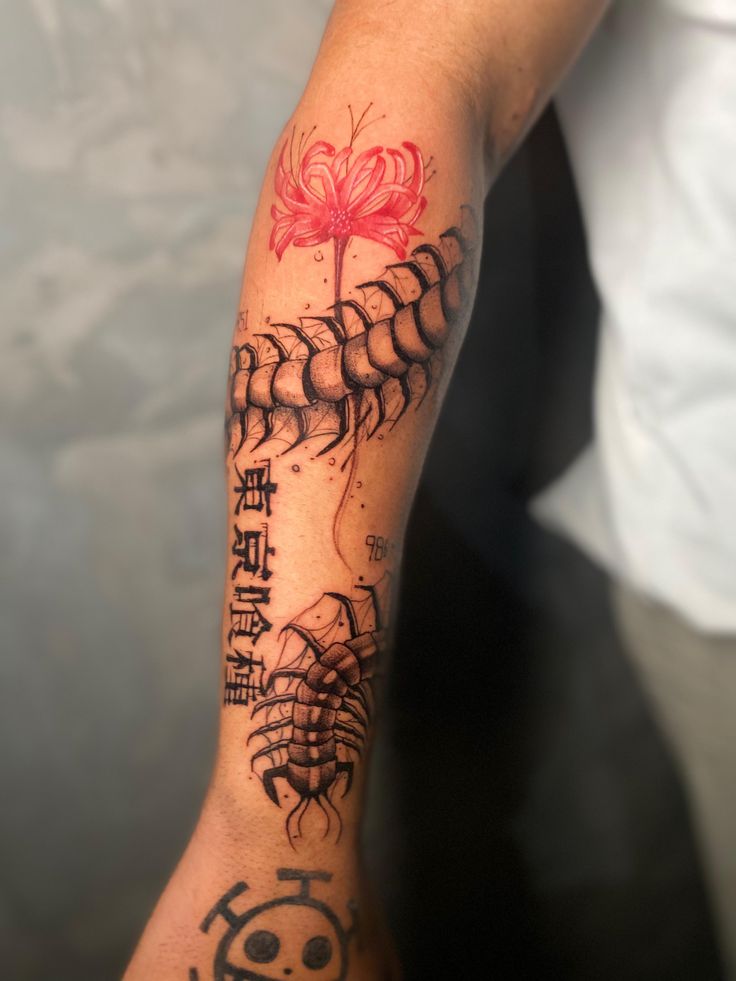
A segmented centipede curves across the forearm beneath a bright red spider lily, creating a design that immediately feels darker and more aggressive. Black outlines define each armored section of the creature, while restrained shading prevents the insect from becoming one solid mass.
The curving anatomy is particularly effective for forearm placement. Instead of running straight from elbow to wrist, the centipede changes direction, giving the design movement and helping it conform to the cylindrical shape of the arm. A smaller centipede appears farther down, reinforcing the theme without simply repeating the first element at the same scale.
The red flower provides a striking visual counterpoint. Its softer botanical form sits above the angular legs and segmented body, establishing the beauty-versus-horror contrast that makes this imagery so suitable for Tokyo Ghoul.
Vertical lettering adds another graphic layer and pushes the tattoo closer to a manga-inspired composition. Anyone creating a custom stencil should have Japanese text checked carefully before tattooing rather than relying on random online plantillas.
Red Lily and Detailed Centipede Forearm Piece
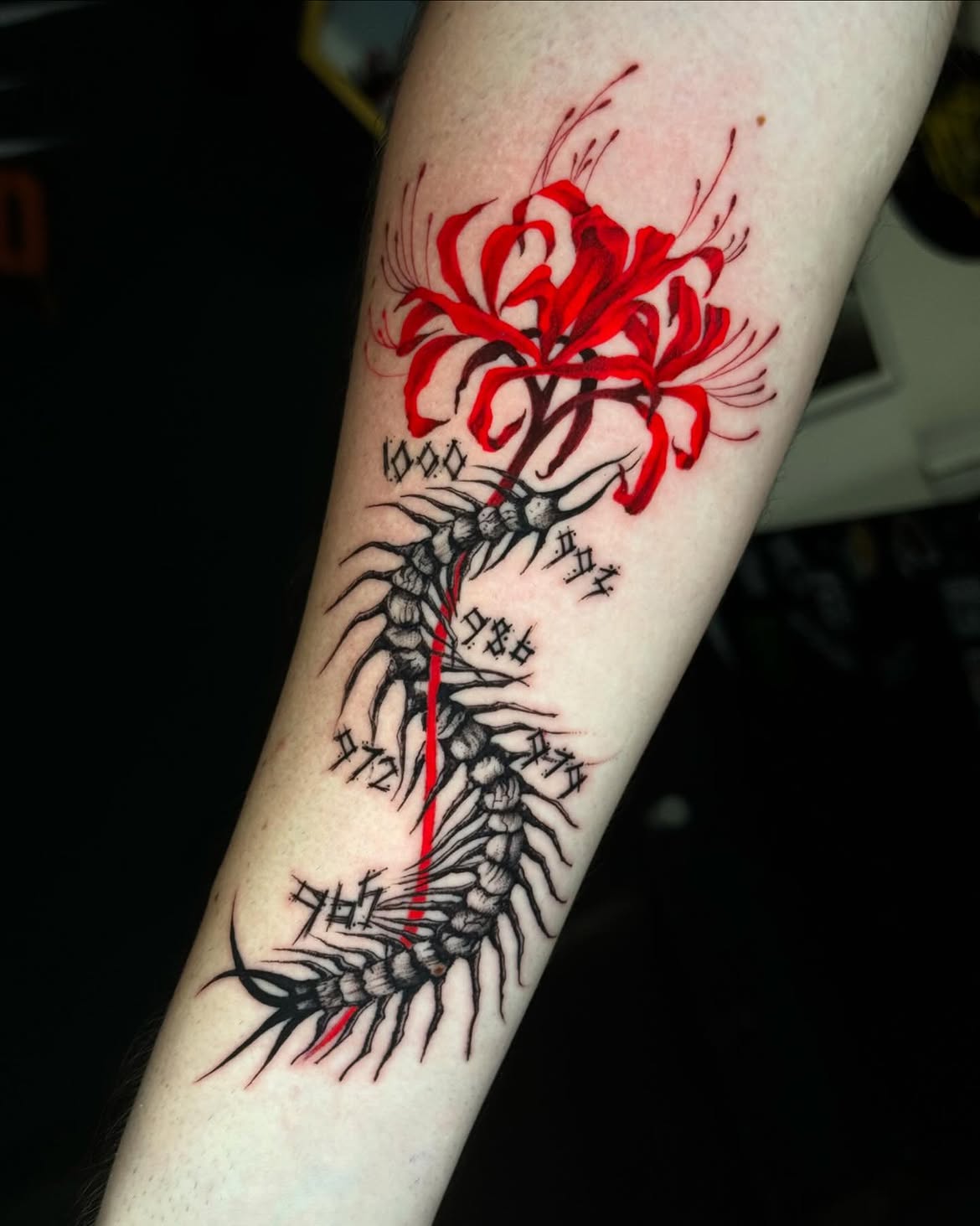
This forearm design makes the Scolopendre, or centipede, the structural backbone of the entire tattoo. Its body travels diagonally down the arm in a dramatic curve, with numerous pointed legs extending outward from shaded segments. The anatomy is detailed enough to feel unsettling without moving into photorealism.
Above it sits a large, saturated red lily flower. Thick red petals dominate the upper section, while extremely fine stamens reach beyond the main silhouette. A thin red line continues downward through the centipede, visually connecting the flower and creature.
Small graphic symbols scattered around the insect add to the fragmented manga aesthetic. They keep the surrounding negative space from feeling empty while remaining secondary to the two major motifs.
This is an excellent example of why red and black are such an effective palette for Tokyo Ghoul-inspired work. Black creates weight and menace; red supplies emotion and an immediate focal point. Extending similar elements around the sides of the forearm could eventually transform the concept into a cohesive sleeve.
Large Centipede and Spider Lily Shoulder Tattoo
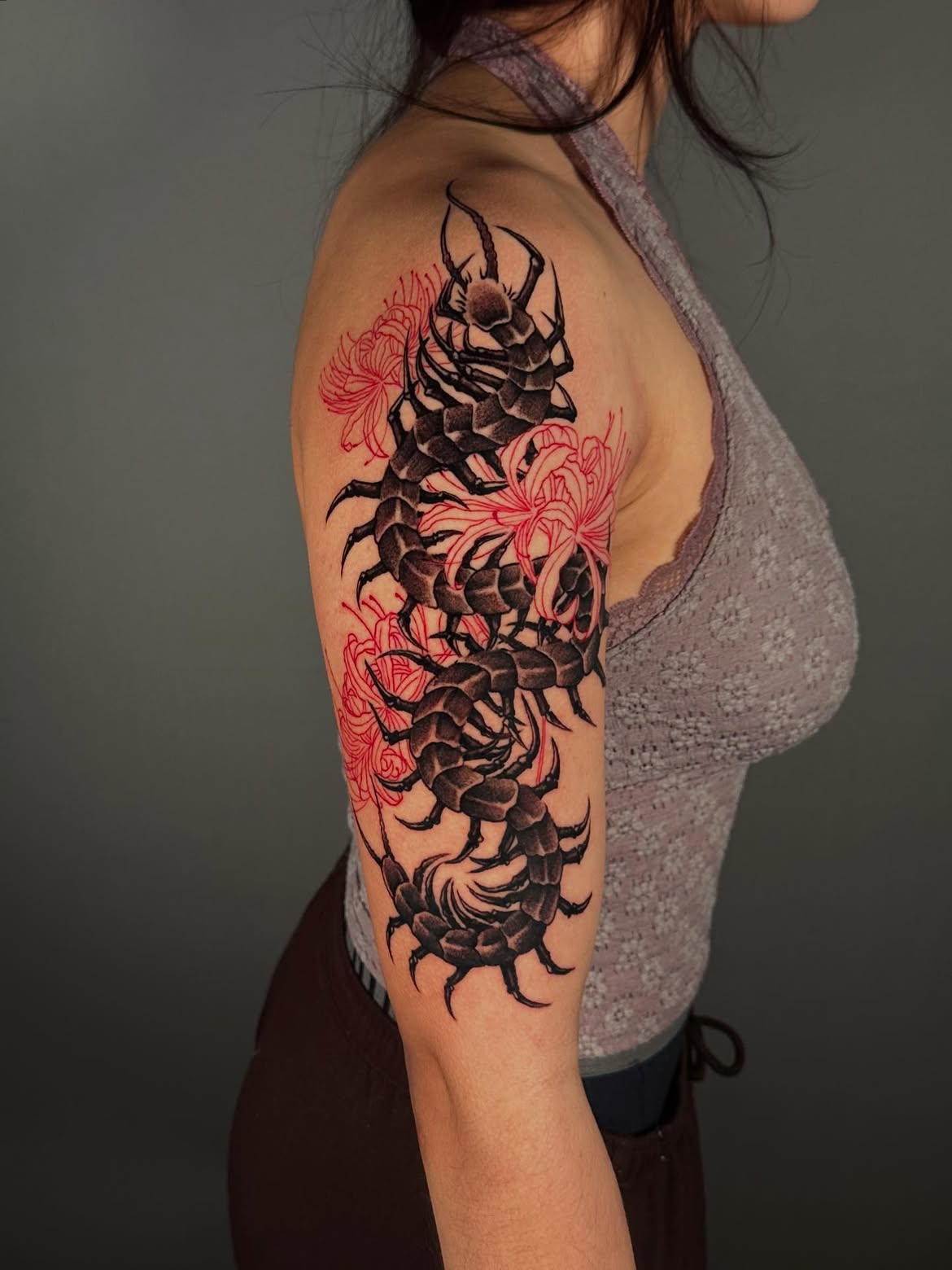
This is a much more ambitious approach to the centipede motif. A massive black-and-gray creature coils from the shoulder down the upper arm, weaving through several red spider lilies. Instead of treating the centipede as a straight vertical symbol, the artist uses its flexible body to create an S-shaped composition.
That decision works beautifully with the anatomy of the arm. The upper section occupies the rounded shoulder, the middle turns inward, and the lower portion sweeps toward the outside of the arm. The numerous legs reinforce this movement and prevent the tattoo from feeling flat.
The flowers are deliberately lighter. Their red outlines remain largely unfilled, so they sit behind and between the heavily shaded segments without competing for dominance. This difference in visual weight gives the tattoo convincing depth.
For anyone planning Tokyo Ghoul tattoo ideas arm or a future sleeve, this is a useful compositional reference. Additional manga panels or abstract black elements could eventually extend onto the forearm, while the centipede remains the principal connecting form. The same basic idea could also become a dramatic thigh tattoo because that placement provides enough space for the creature’s many anatomical details.
Kaneki Manga Collage With Red Eye and Spider Lilies
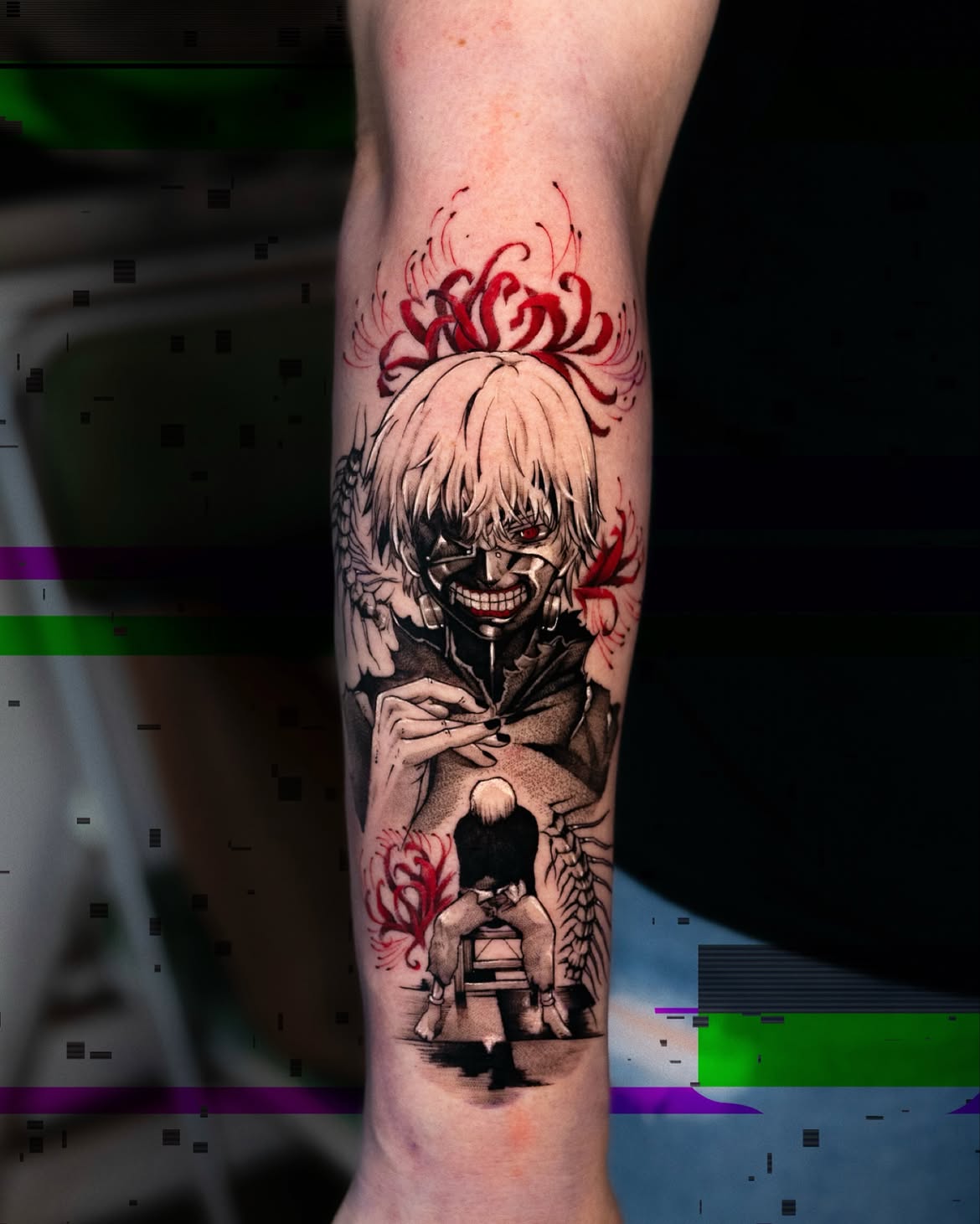
This elaborate forearm tattoo reads like several pages of Tokyo Ghoul compressed into one vertical composition. Kaneki dominates the upper section, wearing his iconic mask and looking directly outward. Most of the portrait remains black and gray, making the single red eye immediately command attention.
The artist continues the narrative downward instead of ending with the portrait. Hands, clothing, another smaller figure, floral elements, and red spider lilies form a sequence of interconnected scenes. It has the storytelling quality of a manga panel tattoo but without rigid rectangular borders separating every moment.
The controlled use of red is particularly successful. Rather than coloring large portions of the character, the artist reserves it for the eye and flowers. Those repeated accents guide the viewer from the top of the composition toward the wrist.
For a serious Kaneki fan, this style offers far more storytelling potential than a standalone portrait. It can incorporate transformation, identity, suffering, and recurring symbolism within one cohesive forearm design. Expanded around the arm, it could become an impressive Tokyo Ghoul sleeve, especially if the artist maintained the same balance of detailed blackwork, open skin, and carefully placed red accents.
Centipede and Red Spider Lilies Leg Tattoo
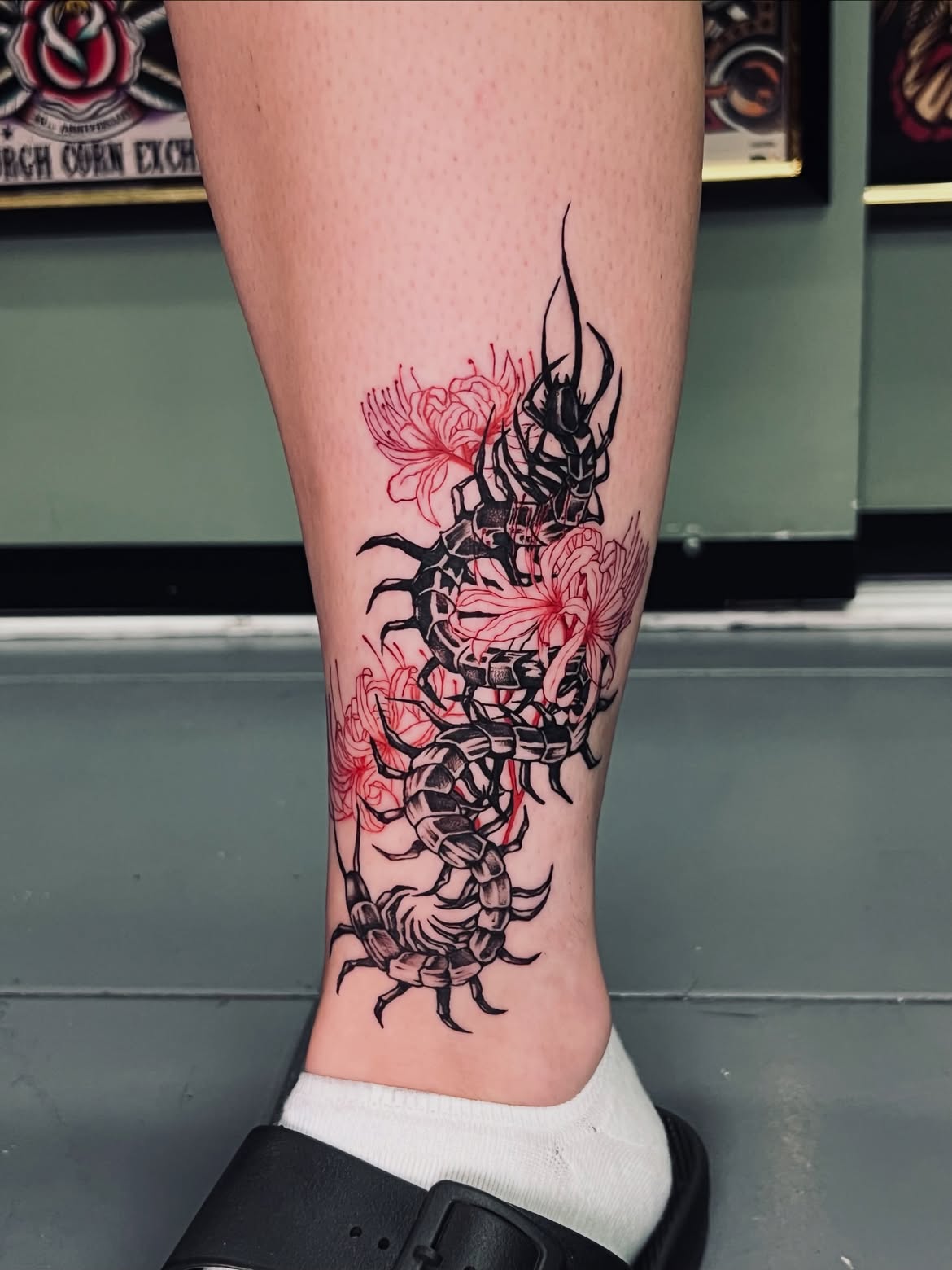
This leg design pushes the centipede motif into a sharper, almost armored direction. The creature travels vertically down the lower leg in a loose S-curve, giving the composition enough movement to follow the natural shape of the calf rather than reading as a straight strip of imagery. Its segmented body is built from heavy black outlines, angular plates, pointed legs, and selective dark shading.
Red spider lilies are threaded through the centipede rather than placed neatly around its edges. That overlap is important: it makes the flowers and creature feel like parts of the same scene. The petals remain mostly linear and airy, providing a delicate contrast to the dense black anatomy.
For Tokyo Ghoul fans, the combination immediately evokes the series’ recurring collision of beauty and psychological horror. It is also a useful alternative to the typical forearm or arm placement. The lower leg offers a similarly long canvas but allows the centipede to become larger and more aggressive without requiring a full sleeve.
Black and Gray Centipede Arm Tattoo
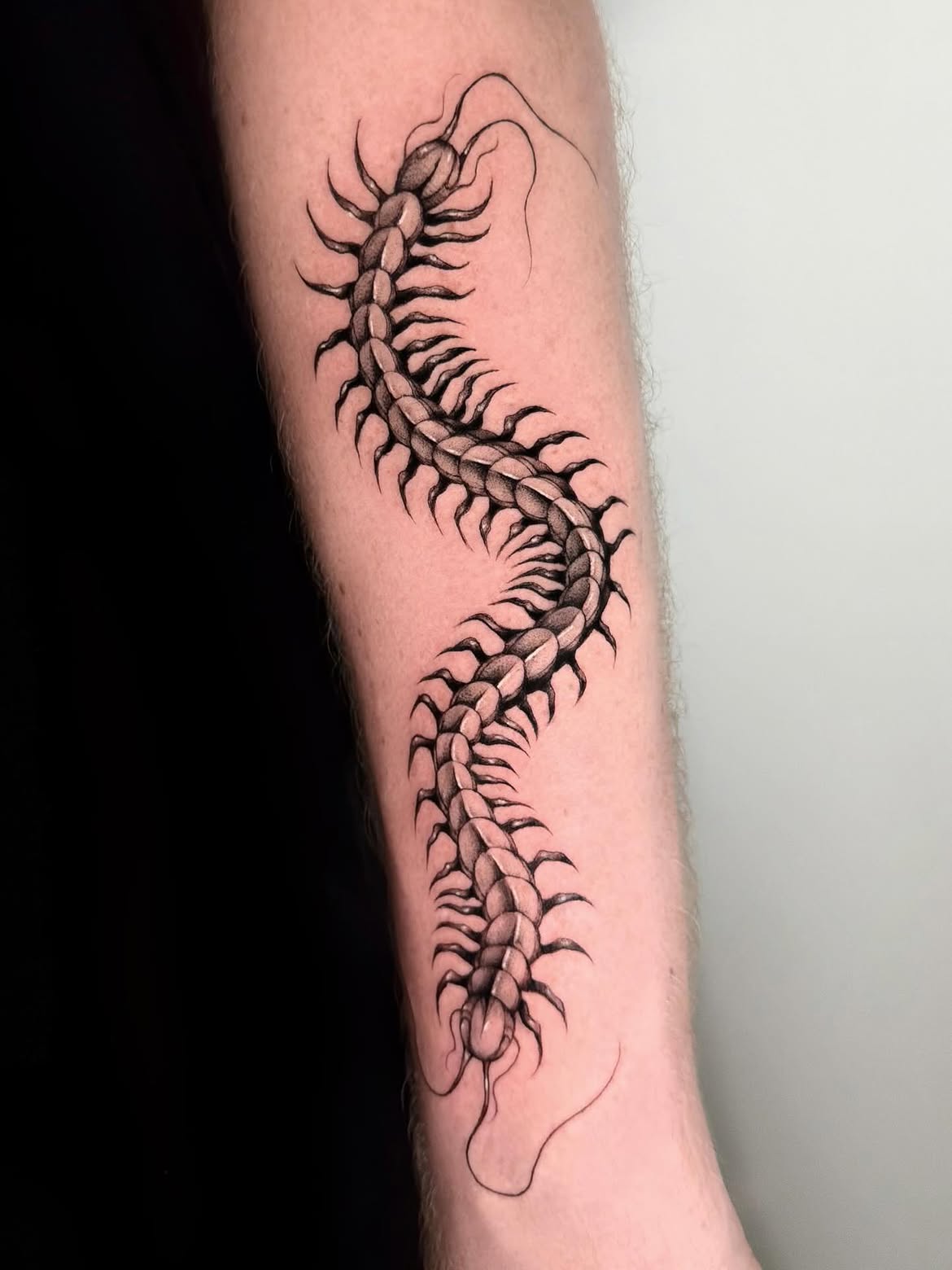
This piece strips the concept back to one symbol: a long black-and-gray centipede. There are no flowers, portraits, manga panels, or lettering to explain the reference. That restraint gives the design a darker and surprisingly sophisticated character.
The body curves repeatedly as it travels along the arm. Individual segments are softly shaded in gray, while their edges and the numerous legs are defined with stronger black. Because the legs alternate along both sides, the silhouette stays visually active even where the central body is relatively simple.
Among Tokyo Ghoul tattoo ideas, this is a strong choice for someone who wants a reference that other fans may recognize but that does not immediately announce itself as an anime tattoo. The Scolopendre symbolism can stand on its own as an unsettling insect design.
Scale matters here. Making the creature too small would force the legs and segments together as the tattoo ages. At this size, the artist has enough breathing room to preserve the anatomy and subtle shading.
Minimal Black Stitches Wrapping Around the Arm
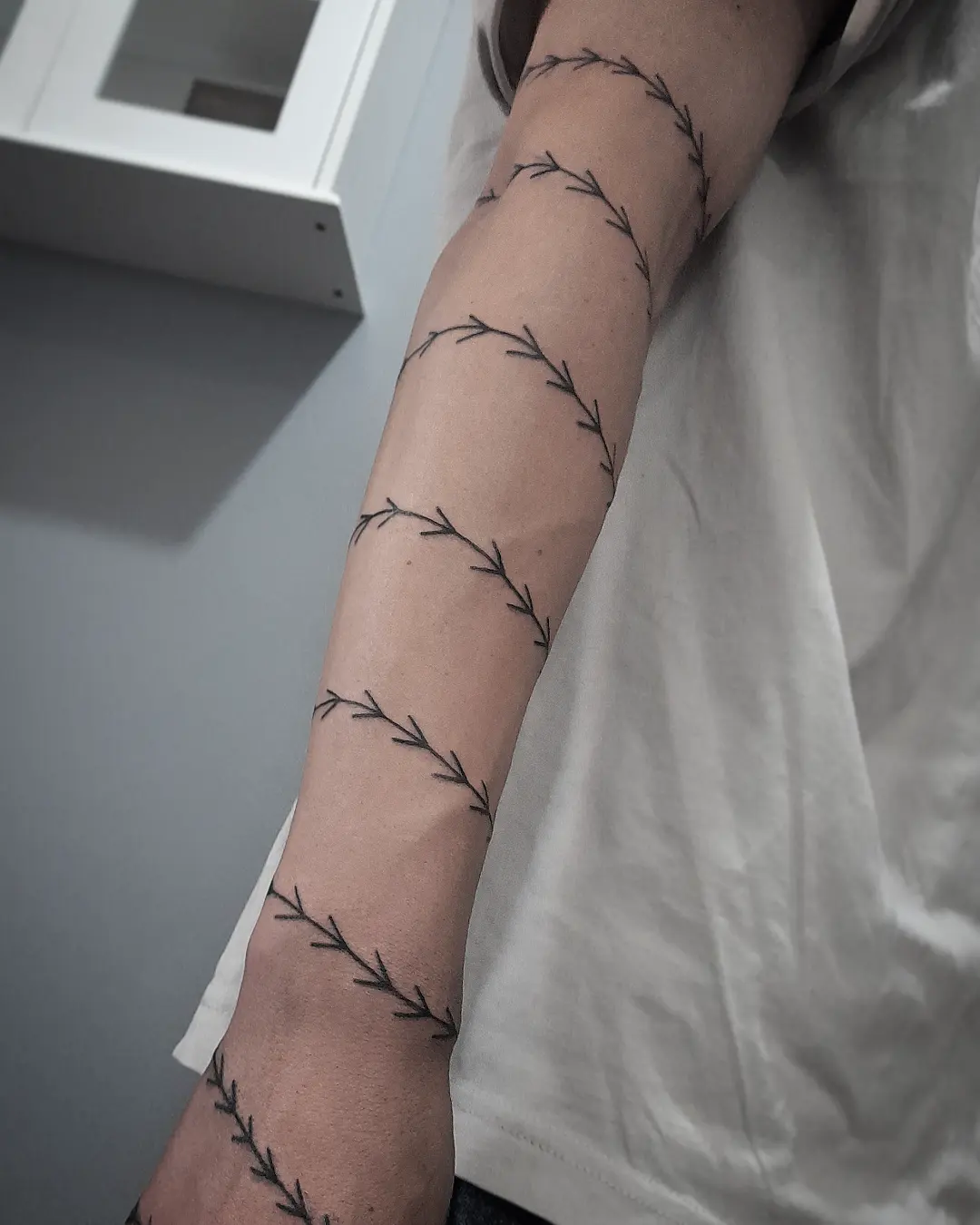
This is one of the most subtle interpretations in the collection. Thin black stitches spiral around the arm from the upper section toward the forearm, creating the impression that the limb has been sewn together along a continuous seam.
Unlike the earlier red version, the black ink makes this concept feel less like a fresh wound and more like a graphic illustration. Each section consists of a slender central line accompanied by short diagonal marks. The tattoo therefore remains minimal despite covering a surprisingly large area.
The spacing is particularly effective. Instead of packing the spirals closely together, generous areas of untouched skin separate them. From certain angles, only a few fragments of the line are visible, while rotating the arm reveals the complete wrapping composition.
This kind of Tokyo Ghoul tattoo arm idea proves that coverage and visual heaviness are not the same thing. A design can extend over most of an arm without behaving like a conventional sleeve.
Graphic Black Stitch Tattoo Extending Onto the Hand
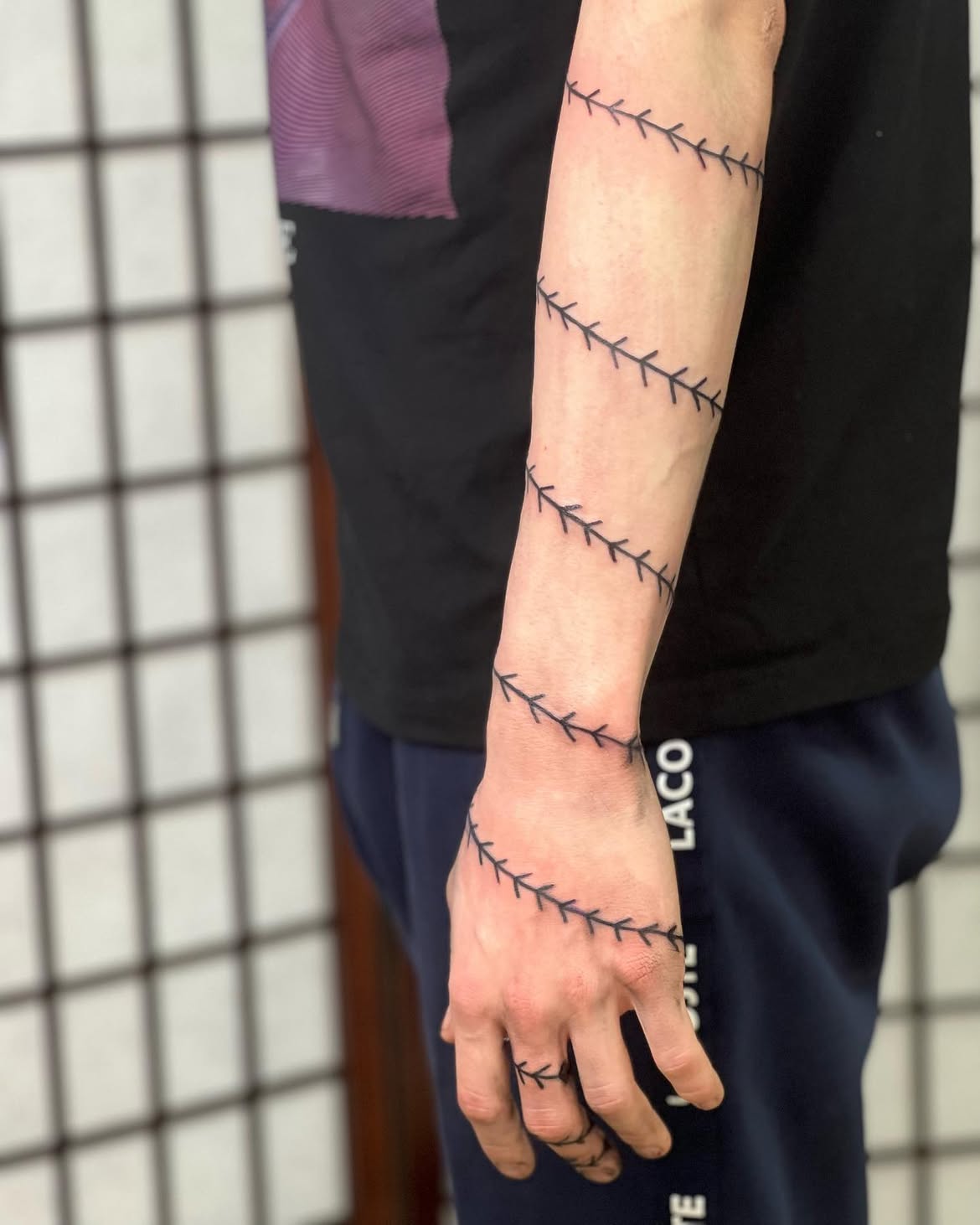
Here the stitched concept becomes bolder. Stronger black lines wrap around the forearm at wide intervals before continuing across the wrist, back of the hand, and fingers. Short perpendicular marks create the familiar sewn-skin effect, but the clean execution keeps the result graphic rather than realistic.
Extending the stitches onto the hand makes a significant difference. There is no obvious endpoint at the wrist, so the design seems to continue naturally across the entire limb. The lines also change visually whenever the hand bends or rotates, making body movement part of the composition.
This would be an interesting direction for someone who likes Tokyo Ghoul symbolism but does not want a Kaneki portrait, centipede, or red lily. It is instantly readable as a scar or reconstruction motif while remaining open enough to personal interpretation.
Because hand tattoos experience substantial wear, anyone adapting this idea should discuss line thickness, placement, and future touch-ups with an artist rather than simply transferring an online stencil unchanged.
Centipede and Red Spider Lily Thigh Tattoo
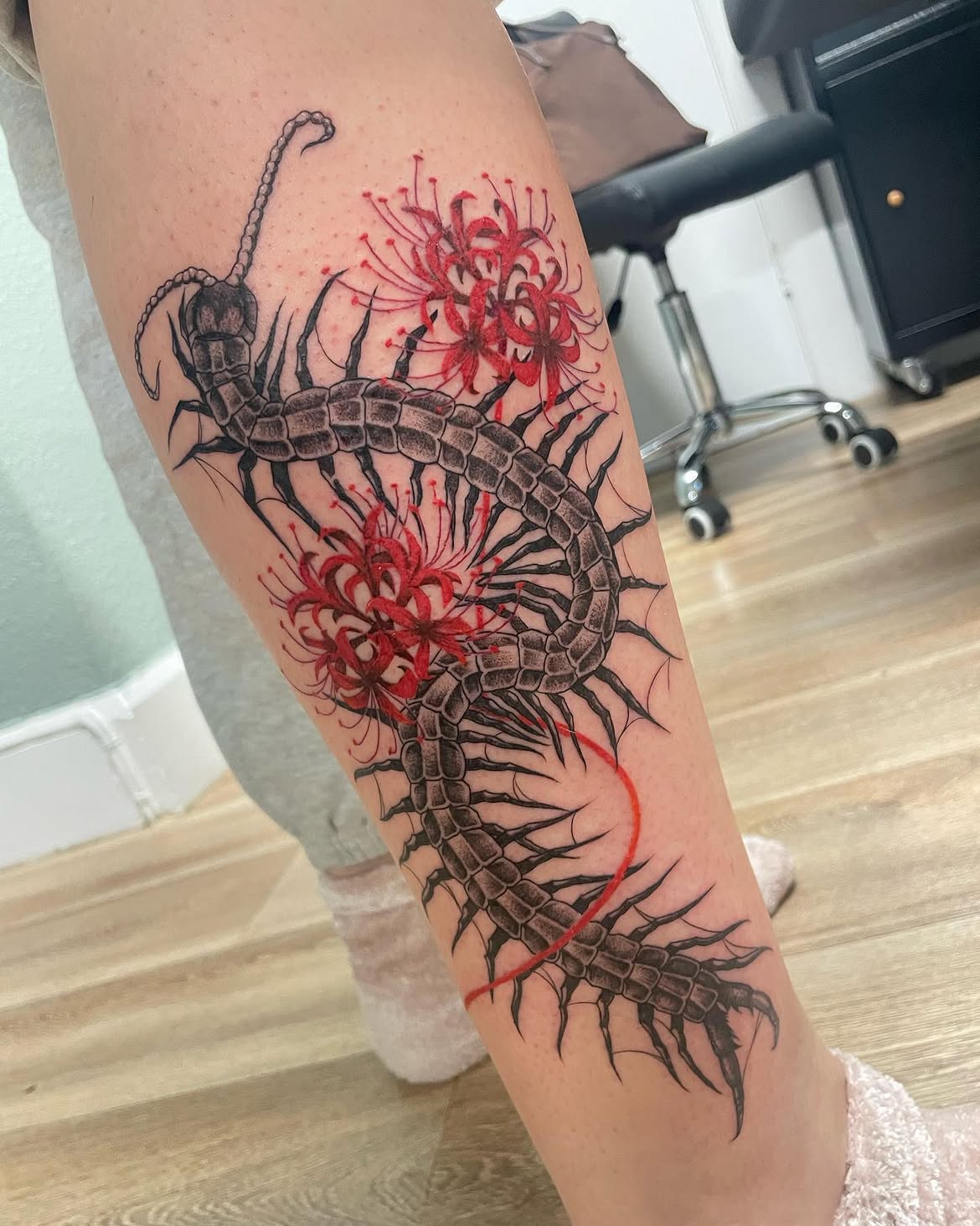
The thigh provides enough space to let a centipede become genuinely imposing. Here the creature curves through the composition with broad armored segments, pointed legs, long antennae, and textured black-and-gray shading. Several vivid red spider lilies occupy the surrounding negative space.
What makes this version particularly effective is the relationship between scale and detail. Each section of the centipede is large enough to carry internal texture, while the legs can extend outward without merging into neighboring elements. The flowers remain considerably lighter and more delicate.
The red stamens overlap portions of the creature, preventing the composition from feeling like a centipede with decorative flowers merely added afterward. A sweeping red stem also introduces another curve through the design and helps connect its upper and lower sections.
For anyone collecting ideas flower or designs flower references within the Tokyo Ghoul theme, this is an excellent example of how botanical imagery can soften an intentionally disturbing central motif without taking away its menace.
Kaneki Manga Collage Tattoo With Mask and Typography
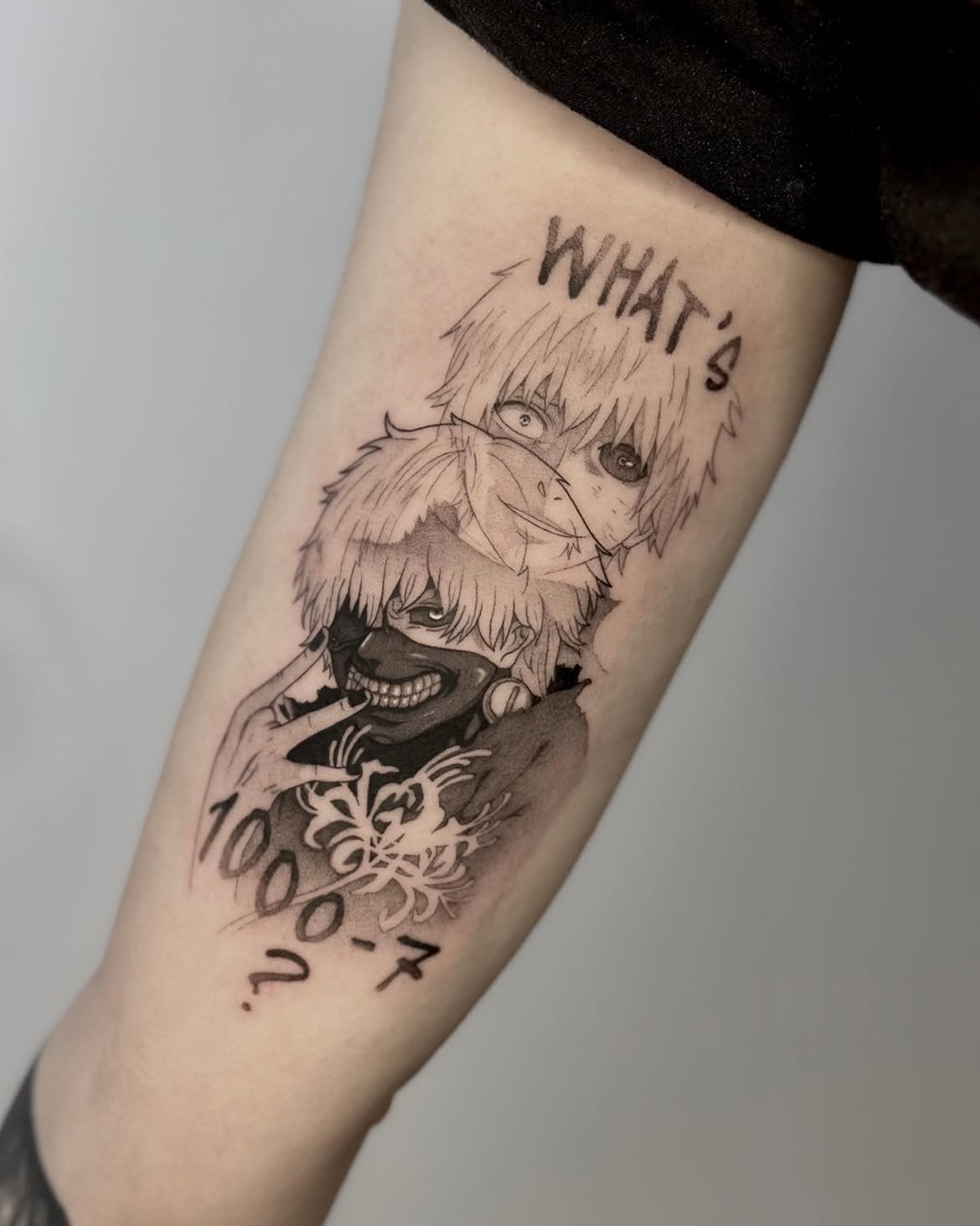
This compact collage takes a very different route. Multiple representations of Kaneki are layered vertically, showing contrasting expressions and identities. The upper portrait is lighter and psychologically exposed, while the masked version below introduces dense black areas, the familiar toothy grin, and a far more threatening mood.
Loose typography surrounds the portraits, including large handwritten characters and numerals. Rather than looking like polished caption text, these marks resemble fragments scribbled across a manga sketchbook. That roughness gives the tattoo personality.
A pale spider lily is integrated near the bottom instead of becoming the usual bright red focal point. It almost disappears into the surrounding negative space, allowing Kaneki’s mask and facial expressions to remain dominant.
This approach is especially useful for people who cannot choose one favorite version of the character. Rather than reproducing a single panel, the artist can combine several emotional states into one personalized design. It also leaves plenty of possibilities for expansion into a larger sleeve later.
Large Centipede Forearm Tattoo With Layered Red Lilies
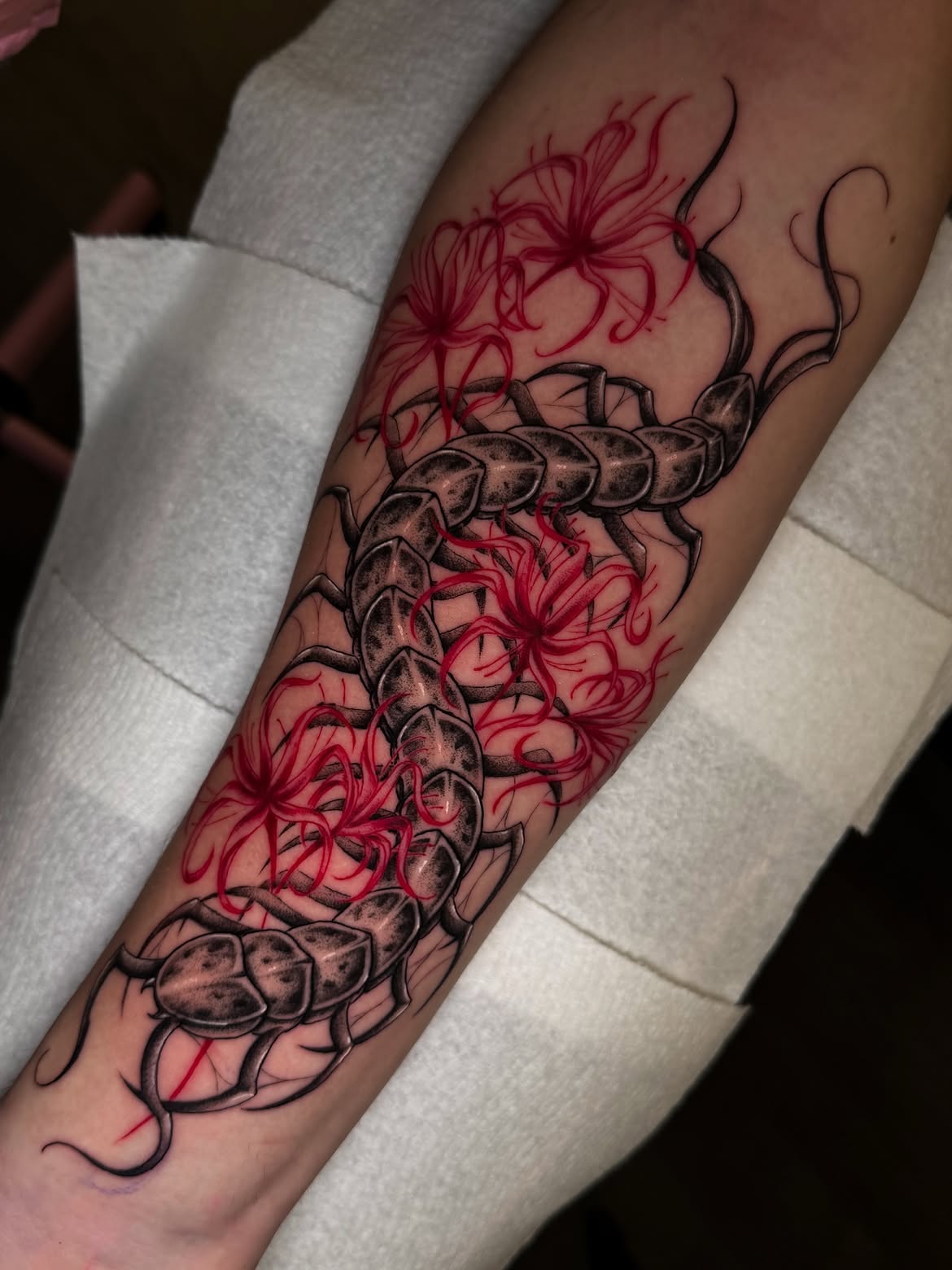
This final design makes full use of the elongated forearm canvas. A thick centipede bends dramatically through the center, its large overlapping plates rendered with dark stippled shading and confident outlines. The body feels substantial and almost three-dimensional compared with the finer centipede designs elsewhere in the collection.
Several red lily flower forms surround and overlap the insect. Instead of filling the flowers with solid blocks of red, the artist relies largely on flowing outlines, narrow petals, and curling stamens. This prevents the floral sections from becoming too visually heavy beside the broad black-and-gray creature.
The color hierarchy is simple but extremely effective: black defines structure and danger, red creates movement and emotional intensity, and untouched skin keeps both readable. The lilies also appear at different heights, so the eye naturally follows the tattoo along the length of the arm.
For a future sleeve, this would make an excellent central foundation. Additional flowers, manga fragments, Kaneki imagery, or black abstract elements could wrap around the remaining arm while the centipede continues to serve as the visual spine of the composition.
Kaneki Thigh Tattoo With Red Spider Lily
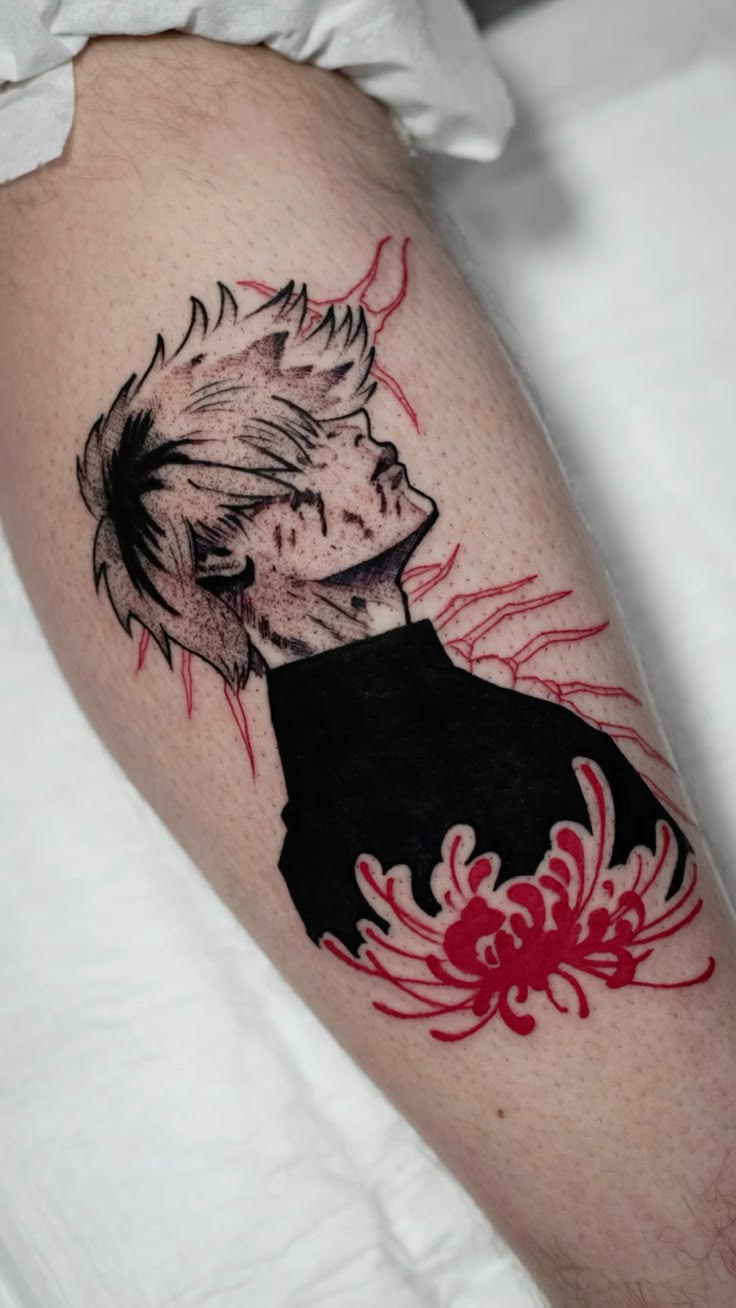
This thigh tattoo builds its impact around a large manga-style portrait of Kaneki. His head is tilted upward, while scratches, shadows, and distressed marks across the face suggest the darker, more tortured side of the character. Instead of smooth realism, the artist uses stippling, sketch-like textures, and decisive black contours, preserving the raw quality of manga artwork.
The solid-black clothing creates a powerful base beneath the comparatively delicate portrait. A vivid red lily flower overlaps that dark area near the bottom, while additional thin red forms appear behind the character. Because the red is used selectively, it immediately becomes the second focal point after Kaneki’s face.
The thigh is particularly well suited to this kind of composition. There is enough width to retain facial details and enough vertical room to separate the portrait from the flower. If someone wanted to develop the tattoo further, additional spider lilies could extend around the side without interfering with the central character.
Minimal Kaneki Eyes Manga Panel Tattoo
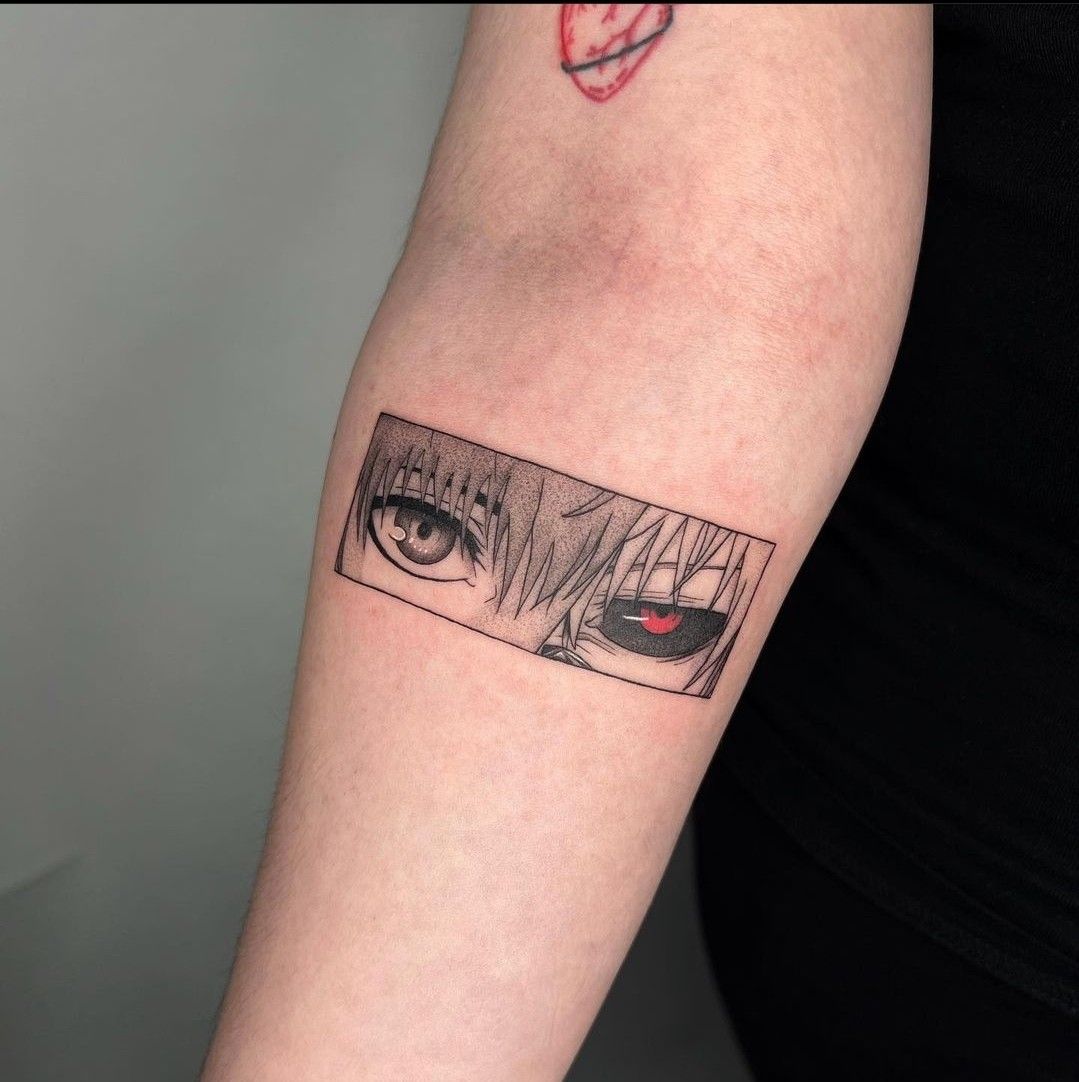
Sometimes one detail says more than a complete portrait. This compact rectangular design isolates Kaneki’s eyes as though a narrow manga panel had been transferred directly onto the skin. Hair crosses the upper portion, while fine dotwork establishes soft gray shadows around both eyes.
The defining accent is the small red iris against a heavily blackened eye. Everything else stays within black and gray, so this tiny amount of red becomes impossible to overlook.
The rectangular border is also a smart compositional choice. Rather than disguising the tattoo as an organic image, it openly embraces its manga origin. The result feels like a selected frame from a printed page.
For anyone searching for subtle Tokyo Ghoul tattoo ideas, this is one of the easiest concepts to adapt. It can remain small on the arm, sit above the elbow, or become one panel within a larger manga sleeve. A tattoo artist could also create an original stencil from a personally meaningful scene rather than reproducing a popular panel exactly.
Emotional Kaneki Manga Scene Tattoo
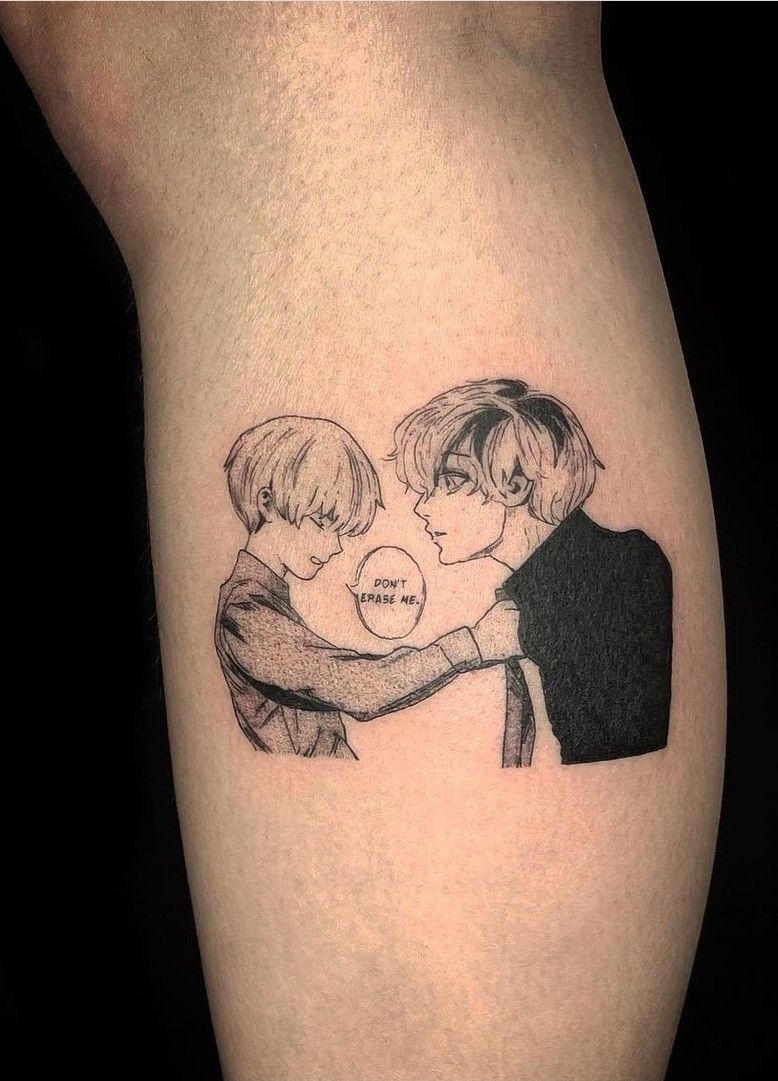
This tattoo takes a narrative approach rather than relying on a familiar symbol. Two characters face one another in a quiet manga-style scene, with one reaching toward the other’s collar. Between them sits the speech bubble Don’t erase me, turning the tattoo into a preserved emotional moment rather than simply character artwork.
The linework is deliberately restrained. Fine outlines establish the faces and clothing, while light stippling creates texture without burying the scene beneath heavy shading. One character’s black clothing provides the darkest area and helps balance the otherwise airy drawing.
Designs like this work because they depend on context and memory. A fan may connect more strongly with a specific conversation or relationship from a story than with its most recognizable iconography. Choosing a personal manga panel can therefore produce a tattoo that feels far more individual than another standard character portrait.
It is also a good example of why the original panel should be adapted rather than simply enlarged. A skilled artist can simplify tiny manga details so expressions and lettering remain legible as the tattoo ages.
Small Kaneki Forearm Tattoo With Red Spider Lilies
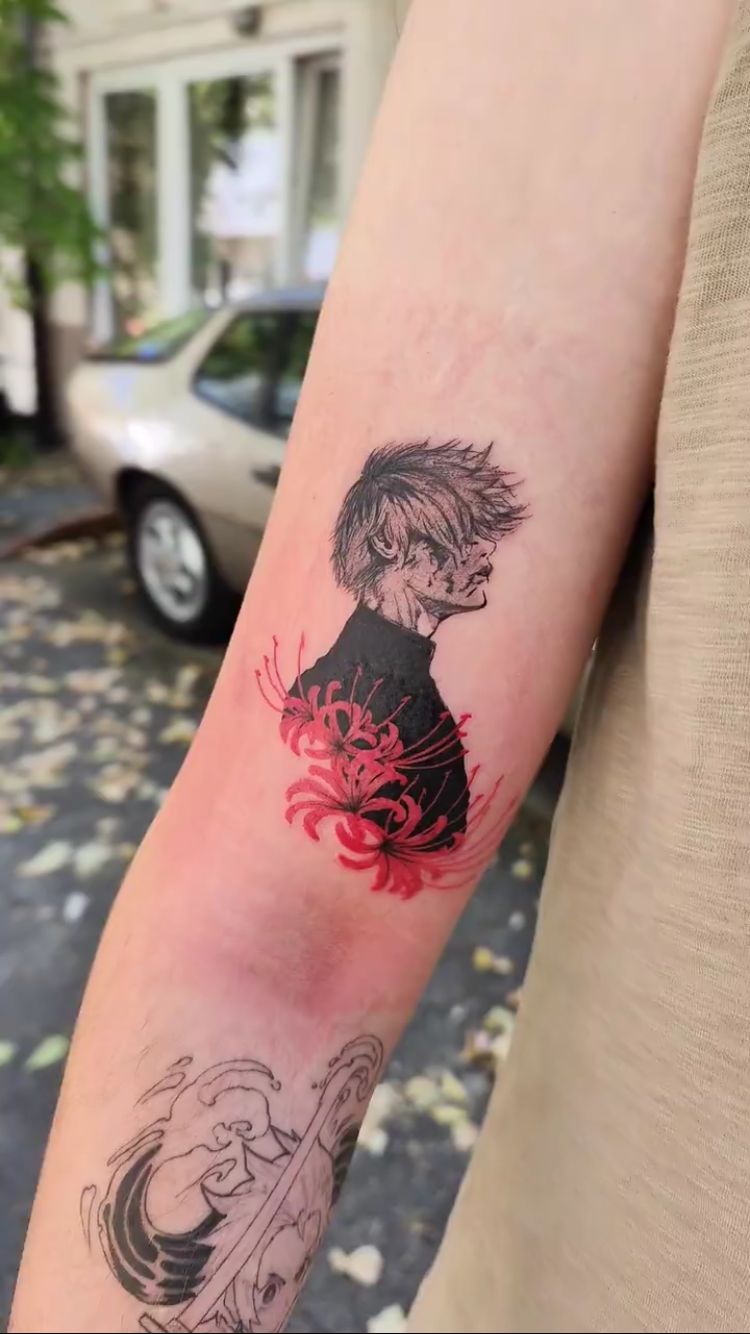
This smaller forearm piece proves that a character-and-flower combination does not need a large canvas. Kaneki is shown in profile with tousled hair, facial marks, and a heavily blacked-out high collar. Beneath him, several red spider lilies spread outward and overlap the dark silhouette.
The balance between red and black is especially successful. Rather than placing the flower beside the portrait, the artist lets the lilies emerge directly across the clothing. Their curling petals break up the solid black and create a transition between dense character work and open skin.
Because the design occupies only part of the forearm, it leaves plenty of room for future additions. More manga imagery, a centipede, lettering, or additional flowers could eventually transform the area into a larger Tokyo Ghoul sleeve.
As a standalone piece, however, it already feels complete. The compact proportions make it a strong reference for people seeking ideas arm that are clearly recognizable without dominating the entire limb.
Black and Red Spider Lily Side Tattoo
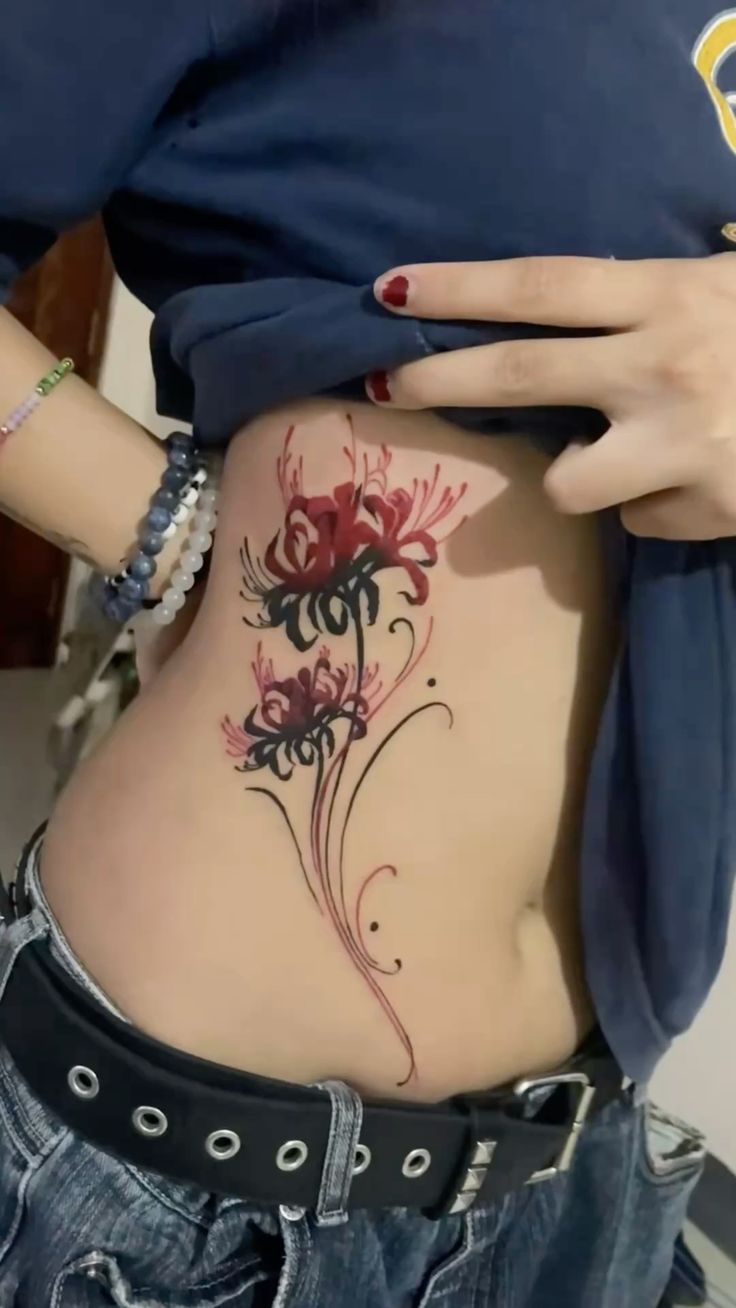
This botanical design moves away from literal character imagery and concentrates entirely on two stylized spider lilies. Red and black overlap within the petals, producing a darker interpretation of the familiar red lily motif.
Long, thin stems descend along the side of the torso, accompanied by elegant curls and small dot details. The arrangement follows the body’s vertical line instead of spreading outward, which keeps a relatively large tattoo feeling graceful.
What makes this especially interesting among designs flower references is the two-tone treatment. Pure red spider lilies can appear delicate or romantic; introducing black gives them a more ominous edge and ties them more naturally to Tokyo Ghoul’s visual atmosphere.
The same composition could translate well to ideas spine placement. The stems could follow the center of the back while the blooms sit higher between the shoulder blades. A reduced single-flower variation could also work as a more subtle design.
Spider Lily and Centipede Symbolic Forearm Design
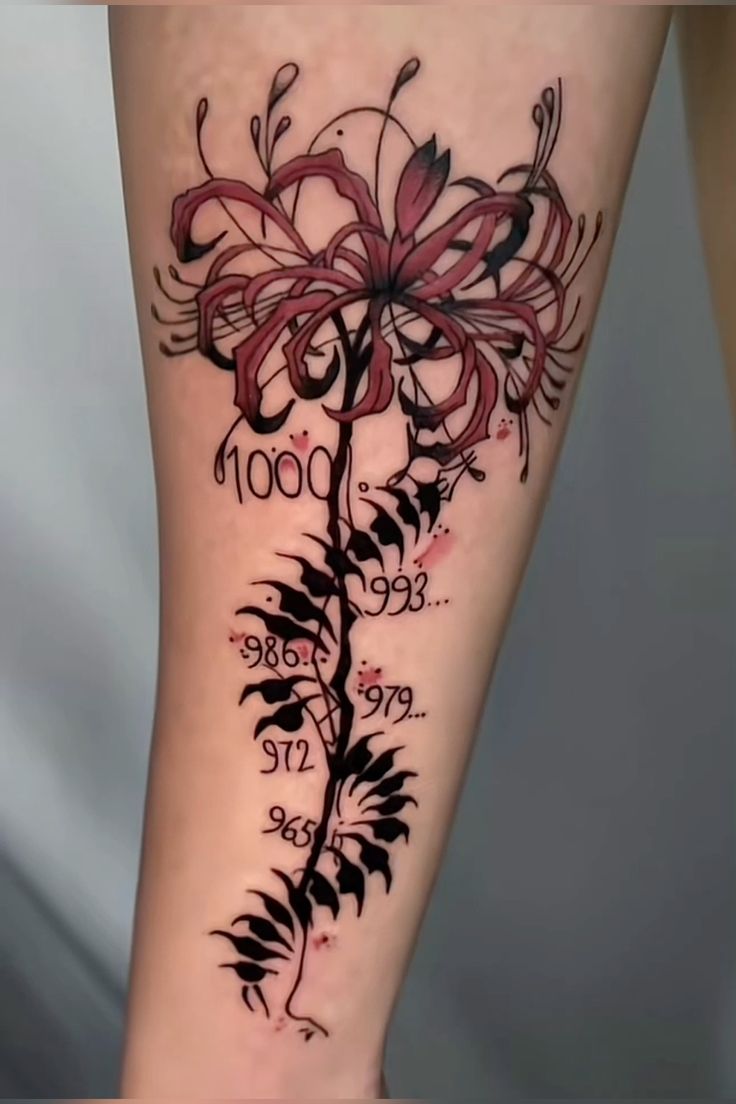
This piece combines a large spider lily with a vertical centipede-like form and a descending sequence of numbers. The flower occupies the top of the composition, where its broad burgundy petals establish a soft organic focal point. Beneath it, black pointed shapes gradually create a much harsher silhouette.
The numbers positioned along the stem introduce an unusual graphic rhythm. Instead of filling the background with shading, the tattoo uses typography and isolated marks to break up the negative space. This gives the work the appearance of an illustrated diagram or fragmented timeline.
For Tokyo Ghoul tattoo designs, that mixture of botanical imagery, unsettling anatomy, and numbers feels particularly appropriate. It hints at the source material without depending on a recognizable face.
This would also make a strong basis for custom plantillas or stencil development. The numerical elements could be personalized, the lily could become brighter red, and the lower black structure could be simplified depending on the available space.
Subtle Spider Lily Back Tattoo
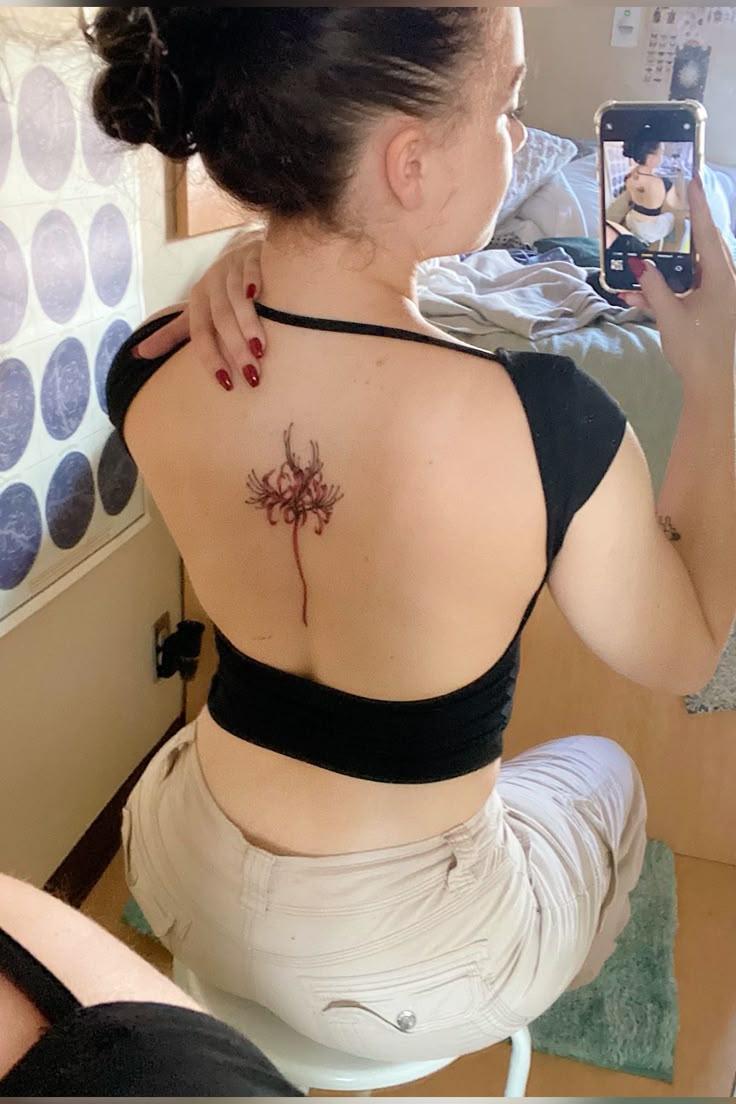
A single spider lily placed high on the back creates one of the quietest designs in the entire collection. The bloom sits close to the center line between the shoulder blades, with a slender stem dropping vertically beneath it. Its muted reddish-brown palette makes the tattoo softer than the highly saturated scarlet flowers used in many Tokyo Ghoul pieces.
Placement is doing much of the work here. Because the design sits close to the spine and is surrounded by generous negative space, the flower feels almost suspended on the skin. There is no need for additional lettering or character imagery.
For anyone considering ideas back, Rücken, or ideas spine, this demonstrates how effective a small symbolic tattoo can be when positioned carefully. Moving the flower slightly lower would emphasize the spine, while adding a second bloom could extend the composition without changing its minimalist character.
It is also one of the easiest Tokyo Ghoul-inspired ideas to keep personal. To most viewers, it can simply appear to be an elegant botanical tattoo; to someone familiar with the visual symbolism surrounding the series, the spider lily carries another layer of meaning.
Tokyo Ghoul gives tattoo artists unusually rich material to work with because its visual identity stretches far beyond character portraits. Kaneki manga panels can become an intricate forearm centerpiece, while a centipede, red spider lilies, stitches, or a single flower can communicate the darker atmosphere in a far more understated way. The best design is ultimately the one that borrows from the series without feeling like a copy of someone else’s tattoo. If one of these ideas inspired your own concept—or you already have a Tokyo Ghoul piece—leave a comment and share which symbol or character you chose.