Art Nouveau has always felt unusually compatible with tattooing. The movement was built around lines that seem to grow rather than simply connect: stems bend into borders, hair becomes ornament, flowers stretch into architectural shapes, and the human figure often appears surrounded by botanical curves. Translated to skin, those qualities can create a tattoo that feels decorative without becoming rigid.
The obvious historical reference is Alphonse Mucha, whose posters helped define the graceful woman, elaborate floral halo, and ornamental framing that many people now immediately associate with the style. Yet modern Art Nouveau tattoo ideas go well beyond direct Mucha reproductions. Contemporary artists borrow the movement’s visual vocabulary and mix it with fine line work, blackwork, bold Color, botanical illustration, and even elements of traditional tattooing.
What I particularly like about this style is how much placement can change the design. A sweeping Flower can follow a Shoulder naturally, while a tall ornamental Piece can make excellent use of the Leg or forearm. The following 29 tattoos show just how flexible that approach can be.
Delicate Art Nouveau Flowers Flowing Across the Shoulder
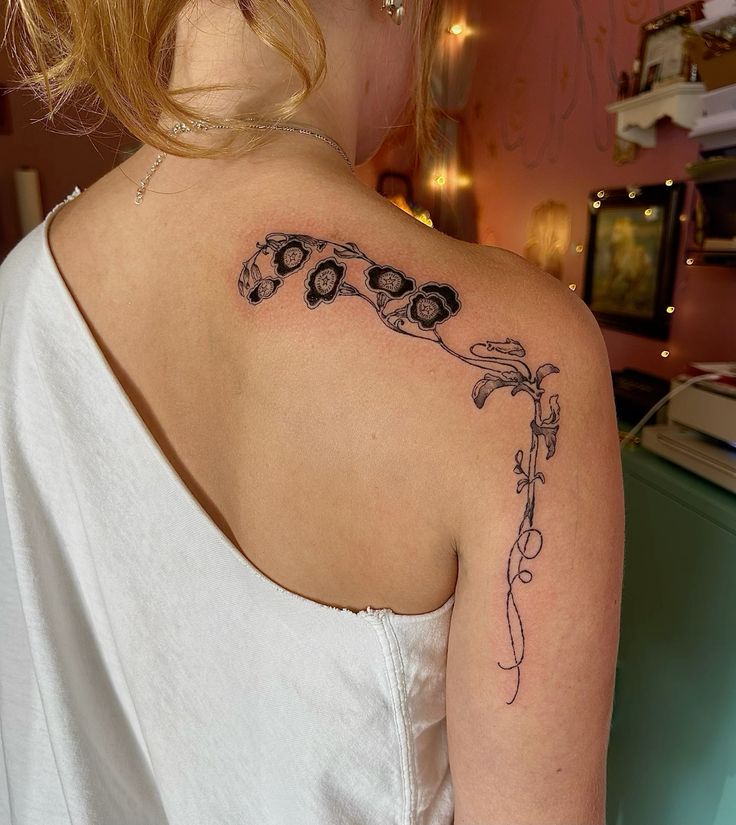
This is a lovely example of Art Nouveau reduced to its most delicate ingredients. Instead of enclosing the composition in a heavy decorative frame, the artist lets a thin botanical branch travel from the upper Back across the Shoulder and down toward the Arm. That movement is important: the tattoo seems to have grown into its placement rather than having been stamped onto it.
A cluster of dark flowers provides the visual weight. Their layered interiors are considerably denser than the surrounding stems, leaves, and small ornamental details, creating a beautiful contrast between solid black areas and almost weightless linework. The long, wandering stem then becomes part of the composition itself. Its curls and irregular bends recall the famous whiplash curves associated with Art Nouveau Design.
The placement is especially successful. Shoulder tattoos can become visually heavy when every inch is filled, but here negative space is treated almost like another material. The exposed skin separates individual Flower forms and keeps the entire Piece elegant.
This is useful Design inspiration for anyone who loves Floral tattoos but doesn’t want the density of a traditional bouquet. It could also be adapted with an Iris, poppy, lily, or another personally meaningful flower. Extending the line farther down the Arm could eventually transform it into the beginning of an airy botanical Sleeve without sacrificing its graceful character.
Blackwork Flowers and Butterfly with Sweeping Art Nouveau Curves
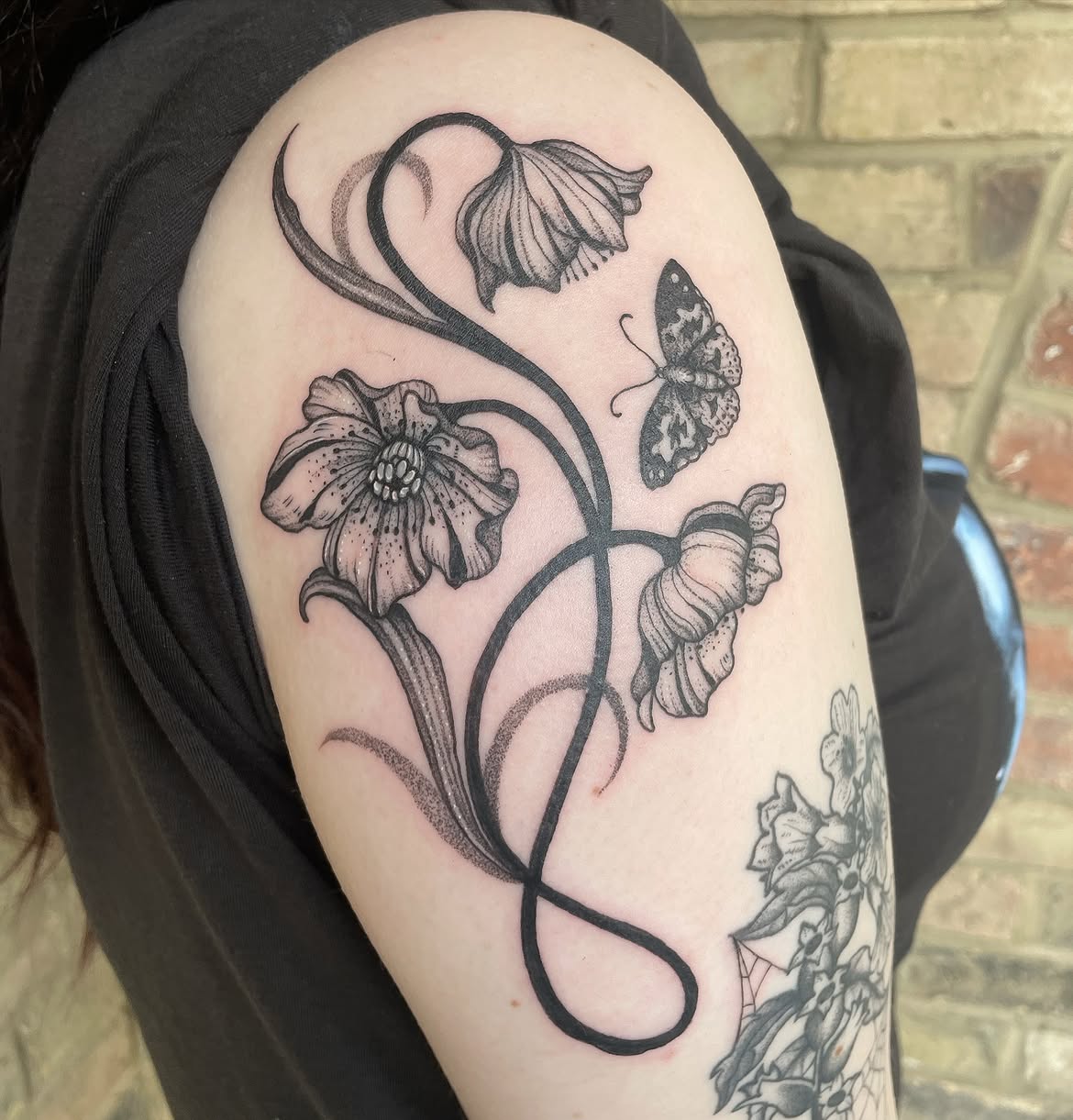
Here the Art Nouveau influence is much bolder. Thick, almost ribbon-like stems sweep across the upper Arm in exaggerated curves, while flowers and a butterfly occupy the spaces created between them. The Design has that characteristic sense of controlled movement: every curve seems to lead into another.
The flowers are beautifully textured. Fine shading, stippling, and closely drawn petal lines give them depth without introducing Color. The butterfly provides a second organic motif but also serves an important compositional purpose, occupying the open area between the larger floral forms.
What makes this Piece memorable is the difference in line weight. The stems are dark and assertive, while the flower details remain soft and intricate. That contrast gives the tattoo the appearance of an antique botanical illustration crossed with decorative turn-of-the-century graphics.
For an Arm placement, this approach works particularly well because the long curves can respond to the body’s contours. A similar Design flowers concept could become a half Sleeve by introducing additional blooms, insects, leaves, or small ornamental sections around the existing framework.
It is also proof that Art Nouveau does not have to mean ultra-fine lines. The movement’s defining curves remain recognizable even when interpreted through substantial blackwork.
Mucha-Inspired Woman in an Ornamental Blackwork Sleeve
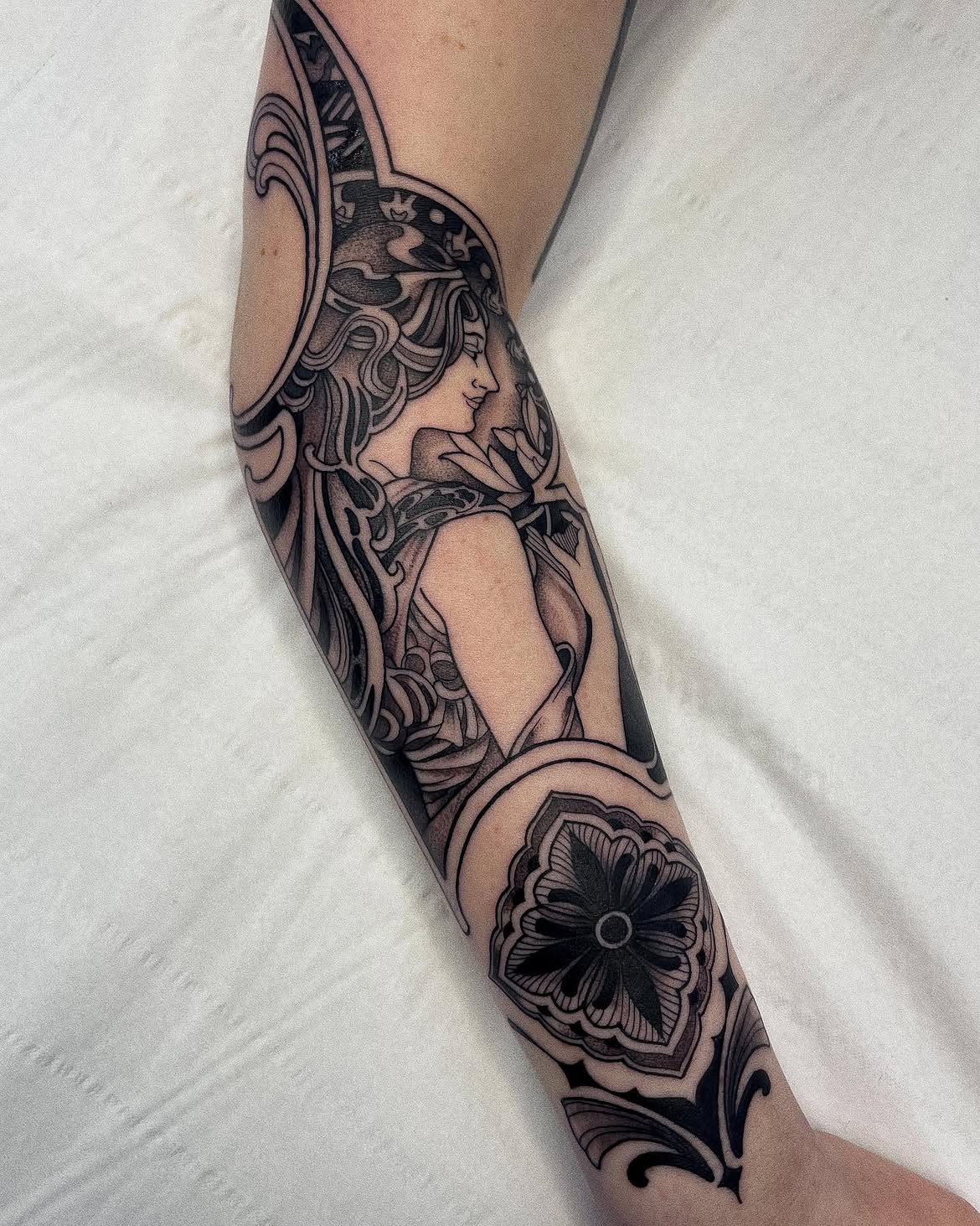
If there is one image that immediately brings the golden age of Art Nouveau to mind, it is the elegantly profiled woman surrounded by extravagant ornament. This tattoo takes that familiar visual language and turns it into an ambitious black-and-gray Arm composition.
The female figure occupies the center, shown in profile with flowing hair and a calm, almost statuesque expression. Around her, ornamental shapes expand outward in layered curves. Rather than functioning as random decoration, those shapes create a framework that directs the eye through the entire Piece.
This is where the Mucha influence feels strongest. Alphonse Mucha frequently integrated women, flowers, patterned clothing, halos, and decorative borders into unified compositions. The tattoo does something similar, but the artist has translated those ideas into a stronger blackwork vocabulary suited to skin.
I especially like the large ornamental Flower toward the lower section. Its geometry balances the softer profile above it, while repeated curved forms visually connect the different sections. Areas of untouched skin prevent the Sleeve from becoming a solid block of black.
Anyone considering a Mucha-inspired tattoo should notice this balance. Copying an old poster literally is not the only option. A tattoo artist can borrow its silhouette, rhythm, Flower deco details, and framing principles while creating an original woman portrait designed specifically around the Arm.
Jewel-Toned Floral Panel with Art Nouveau Architecture
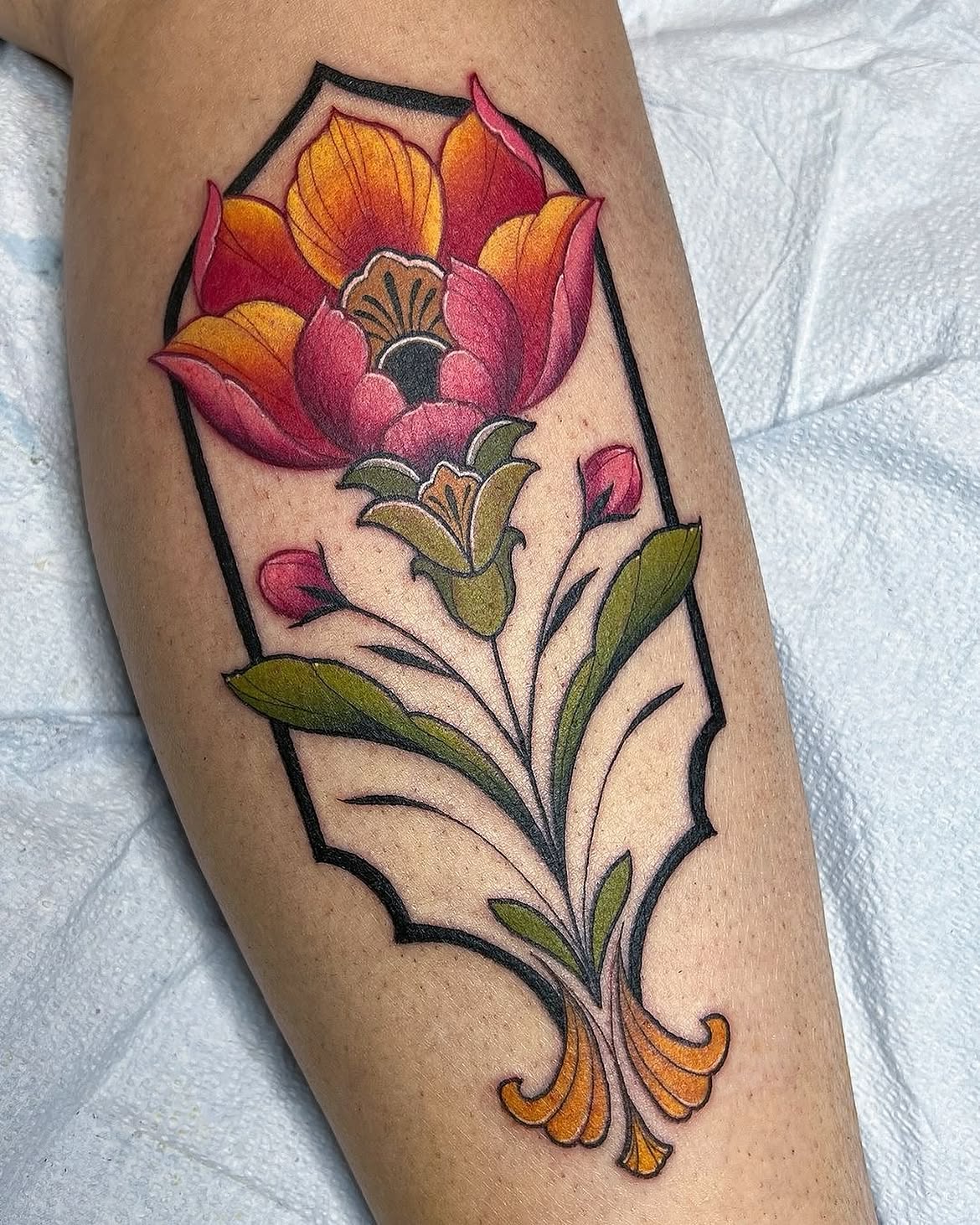
Color changes the personality of Art Nouveau dramatically, and this floral Piece demonstrates why. Warm pink, crimson, orange, mustard, and muted olive immediately give the composition the richness of vintage decorative glass or an illustrated botanical panel.
A large stylized Flower dominates the upper section. Rather than pursuing botanical realism, the petals are simplified into clearly separated shapes, which suits the decorative character of the movement. Smaller buds and foliage rise from an elegant central stem beneath it.
The surrounding black frame is equally important. Its irregular architectural outline turns a straightforward Floral tattoo into something resembling a fragment of an antique decorative panel. Near the bottom, curled orange elements finish the composition with a flourish instead of allowing the stems to end abruptly.
There is a useful lesson here for anyone collecting Art Nouveau Design inspiration: the border can matter almost as much as the subject inside it. Decorative framing gives flowers context and can instantly push an otherwise contemporary tattoo toward a period aesthetic.
This type of vertical Piece would translate beautifully to the forearm, upper Arm, or Leg. Different Flores could also alter its symbolism while preserving the same underlying structure. An Iris, for example, would be particularly appropriate because its naturally sweeping petals already echo Art Nouveau curves.
Floral Vase Tattoo with Crane and Vintage Color
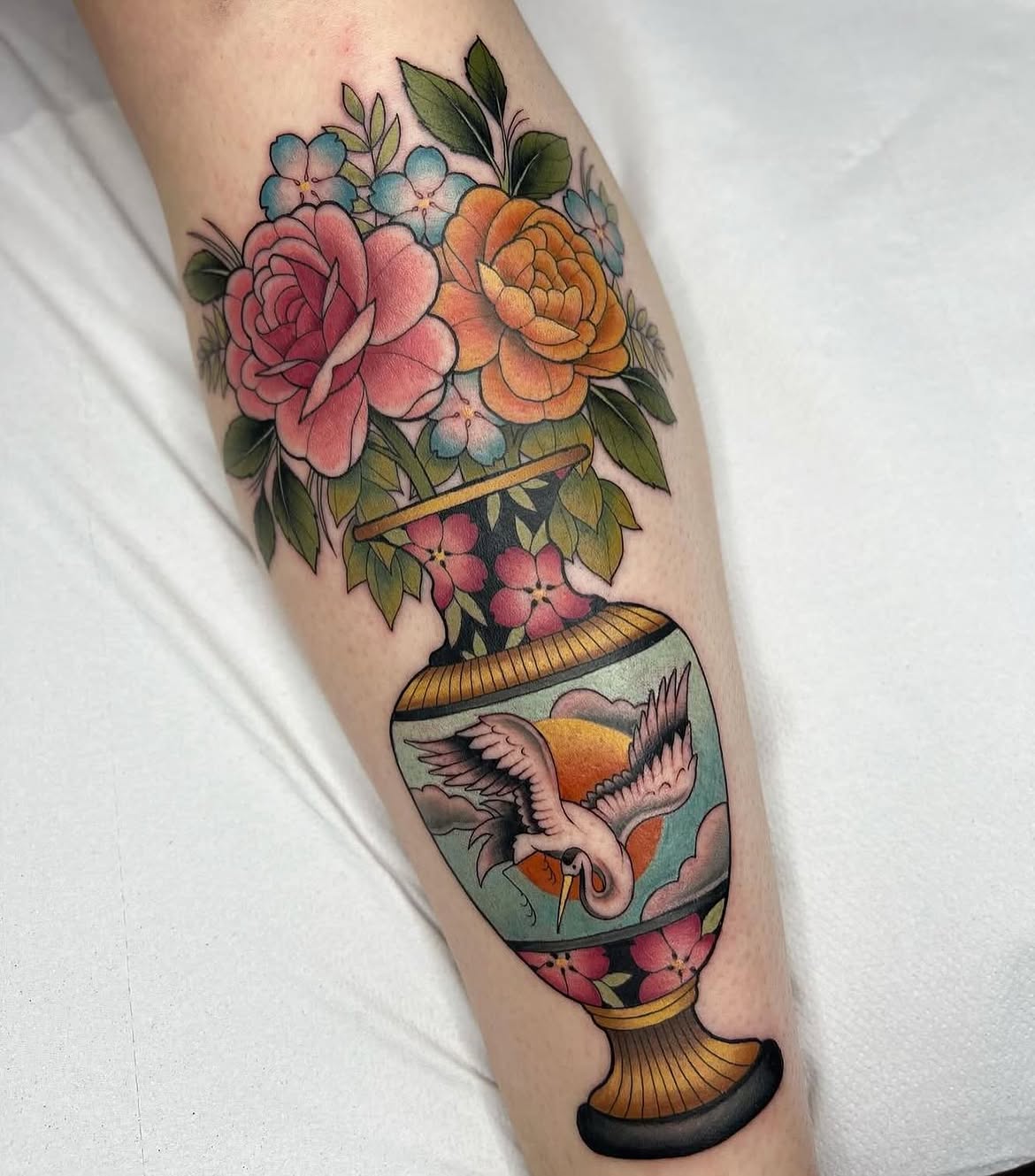
This is the most narrative Color tattoo in the group. A decorative vase forms the foundation, while a generous bouquet rises above it, creating a tall composition that uses the available Arm space beautifully.
The bouquet combines large pink and orange flowers with smaller blue blossoms and dark green foliage. Instead of pushing toward photographic realism, the artist keeps the colors slightly muted and the outlines clearly visible. That choice gives the Piece the atmosphere of an old illustration or decorative print.
Then there is the vase itself. A crane flies across its central panel against a stylized landscape, turning an ordinary container into a miniature scene. Floral decoration continues around the vessel, while warm gold details at the rim and base help connect it to the orange flowers above.
One reason this Design works so well is its hierarchy. The eye first encounters the large Flower forms, then travels down through smaller blossoms toward the detailed vase. There is plenty to discover, yet the overall silhouette remains easy to read.
For someone planning a substantial Art Nouveau Arm tattoo, this approach offers an alternative to the familiar woman-and-frame composition. Decorative objects, ceramics, birds, botanical elements, and vintage motifs can carry the same spirit. It would also make a striking Leg Piece, where the extra vertical room could accommodate an even taller vase and more elaborate foliage.
Fine-Line Poppies with Long Art Nouveau Stems
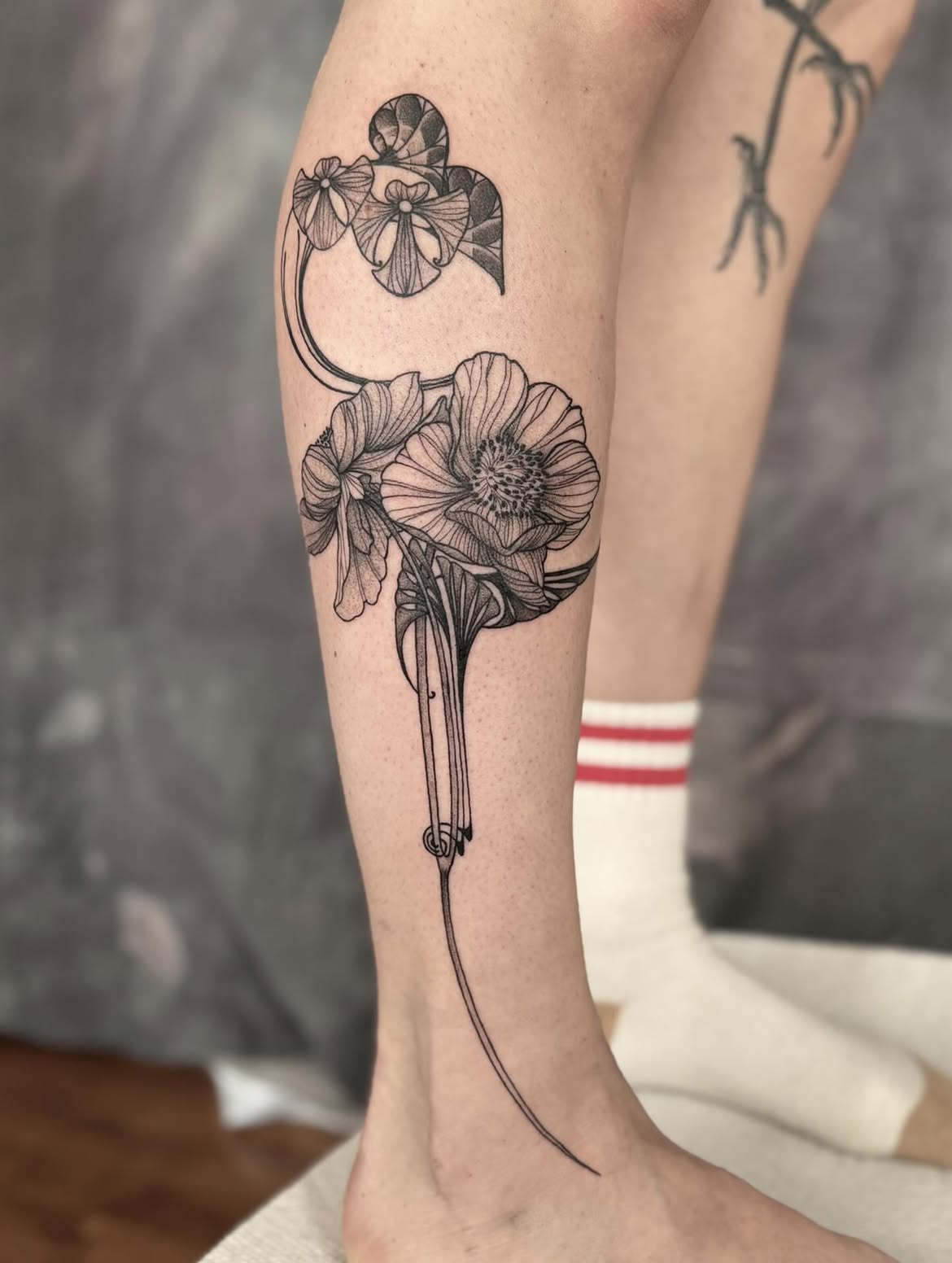
At first glance, this tattoo appears almost purely botanical. Look longer, however, and the Art Nouveau logic becomes obvious. Long stems curve upward and outward, flowers overlap in an intentionally decorative arrangement, and several lines extend well beyond the main cluster simply because their movement contributes to the composition.
The poppy-like blooms are rendered with exceptionally fine internal lines. Each petal contains delicate striations that describe its folds, while darker centers provide just enough contrast to anchor the flowers. Above them, smaller blooms and rounded leaves complete an asymmetrical crown.
The most interesting detail for me is the elongated stem descending toward the ankle. A more conventional Floral tattoo might have stopped beneath the main bouquet. Keeping that line creates a dramatic vertical rhythm and makes the design feel unmistakably intentional.
This is an excellent example of how ornamental thinking can coexist with botanical accuracy. Nothing needs to be excessively decorated. The natural architecture of a Flower can supply most of the Art Nouveau character when its stems and petals are arranged carefully.
The Leg is particularly suitable for this strategy. Its length allows a tattoo artist to exaggerate sweeping lines without compressing the flowers. Similar work could incorporate an Iris or lily for even stronger curves, while a small amount of muted Color could be introduced without losing the sophisticated fine-line quality.
Matching Minimalist Art Nouveau Floral Ornaments
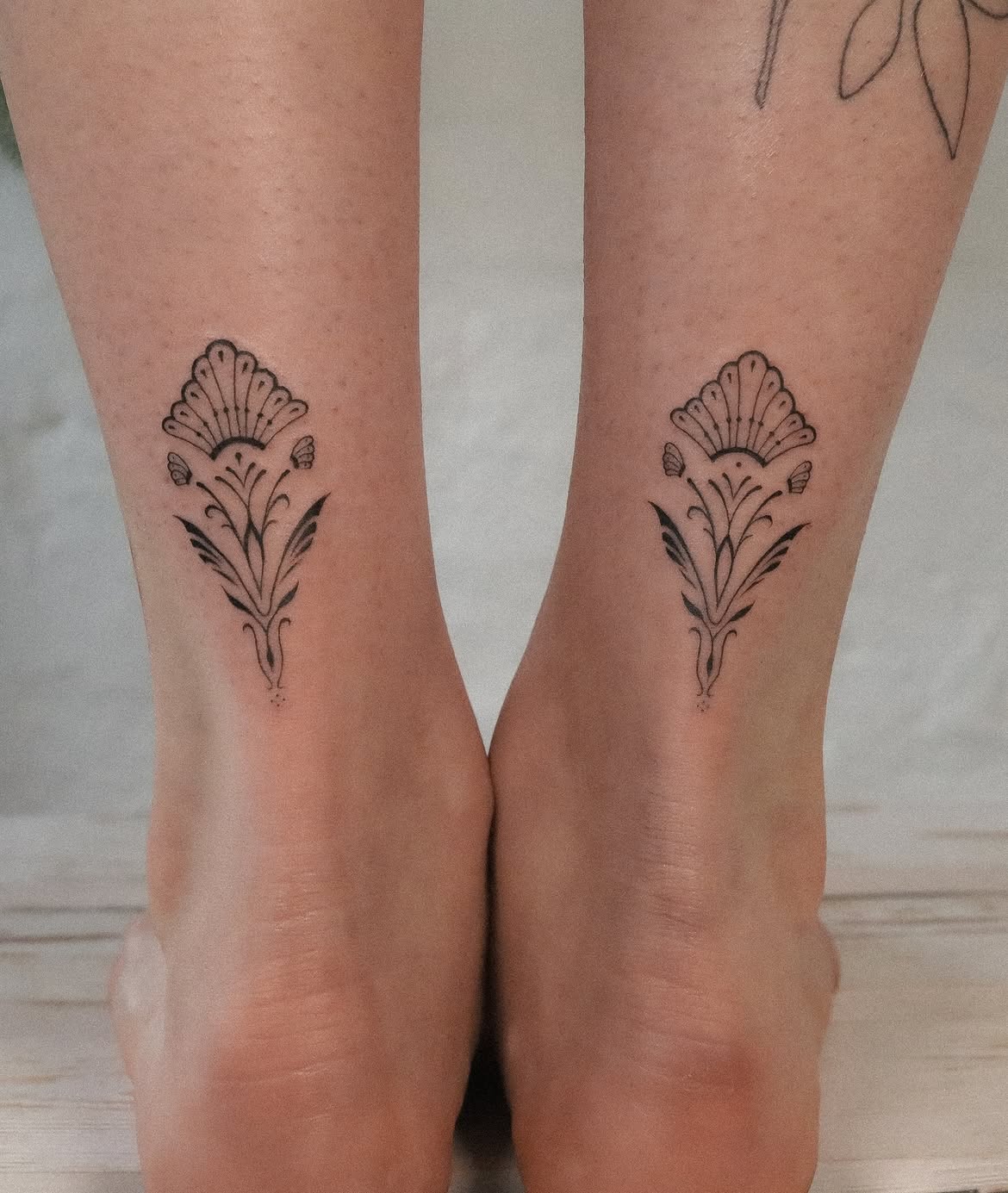
These matching ankle tattoos show the opposite end of the Art Nouveau spectrum. There is no elaborate portrait, large bouquet, or dramatic frame. Instead, the entire idea has been compressed into a tiny symmetrical ornamental Flower.
A fan-shaped bloom sits at the top, its petals arranged like a decorative shell. Beneath it, narrow stems divide into curling botanical lines and pointed dark leaves. Two miniature wing-like details sit on either side, adding just enough complexity to keep the Design from feeling overly simple.
Symmetry gives these tattoos a formal, almost jewelry-like quality. Placed just above the ankles, they resemble small ornaments attached to the body rather than conventional floral illustrations. That makes the concept particularly effective as a matching Piece.
Small Art Nouveau tattoos can be surprisingly difficult to design. The style naturally invites elaborate details, but reducing too many of them can produce a muddy result once the tattoo ages. Here, the artist avoids that problem by relying on a strong silhouette, open skin, limited shading, and clearly separated lines.
For both women and Men looking for understated Art Nouveau tattoo ideas, this type of ornamental flash is worth considering. The same structure could work on the wrist, inner Arm, ankle, or behind the upper Arm, with different flowers substituted to personalize the motif.
Framed Daffodils with Fine Art Nouveau Scrollwork
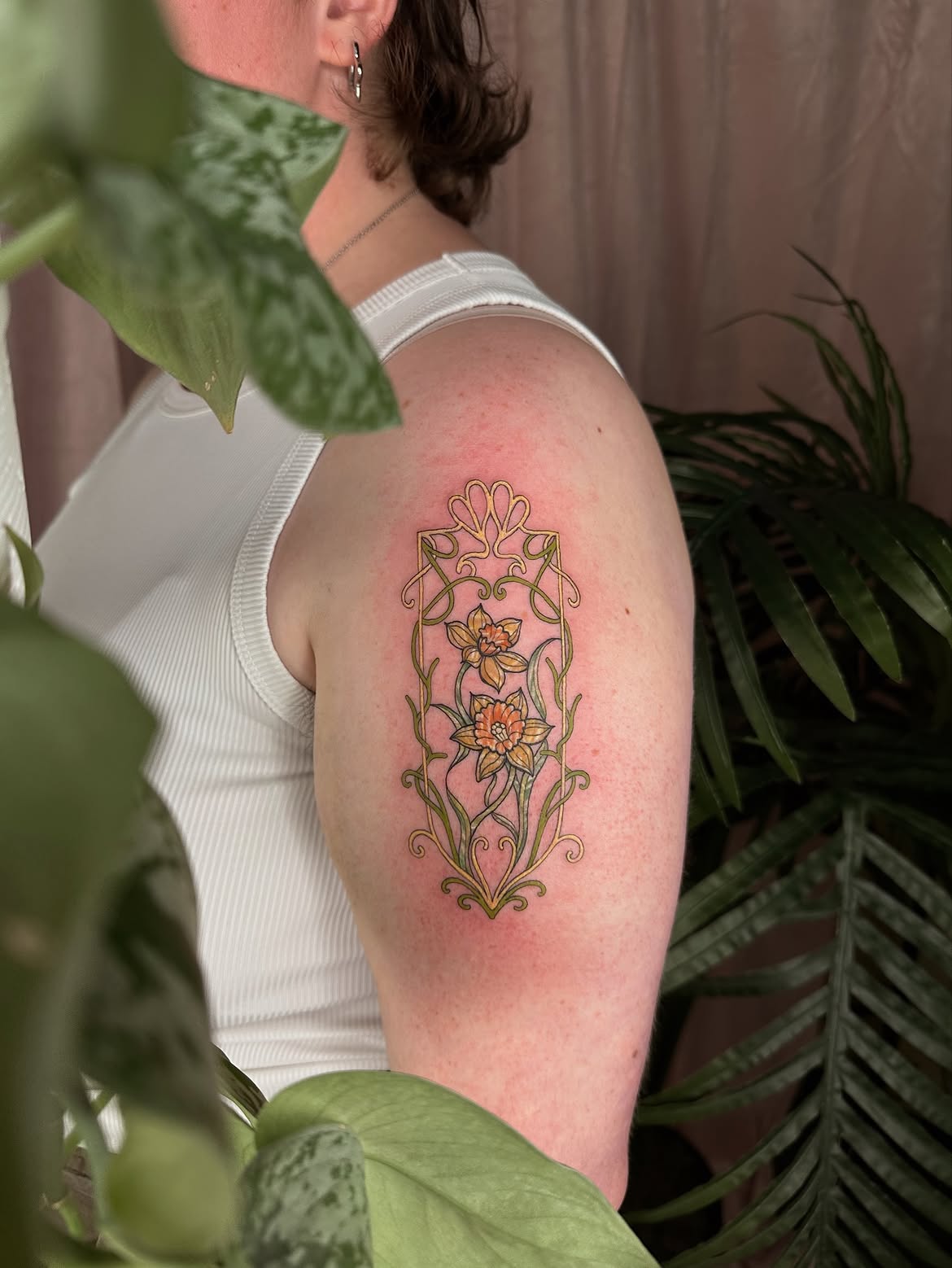
This compact upper Arm Piece captures one of the most recognizable qualities of Art Nouveau: nature contained within architecture. Two golden-orange flowers sit inside a tall ornamental frame constructed from curling green stems. Instead of drawing a hard rectangle around the Floral subject, the artist allows leaves, tendrils, and symmetrical scrolls to become the border themselves.
The upper crest is particularly effective. Three elongated loops rise above the frame like a decorative element from an antique doorway or stained-glass panel. Below, narrow vines repeatedly turn inward before meeting in a pointed flourish at the base. The result is highly structured without looking geometric or severe.
Muted Color also works beautifully here. Olive green and warm orange have a slightly aged character that suits the period influence better than extremely bright contemporary tones might. The flowers remain the focal point, while the green ornamental framework creates contrast without overwhelming them.
For a smaller Art Nouveau tattoo, this is excellent Design inspiration. The basic framework could accommodate an Iris, lily, poppy, or another favorite Flower, and the proportions are naturally suited to the upper Arm, forearm, calf, or Shoulder.
Bold Flower Deco Tattoo Flowing from Wrist to Hand
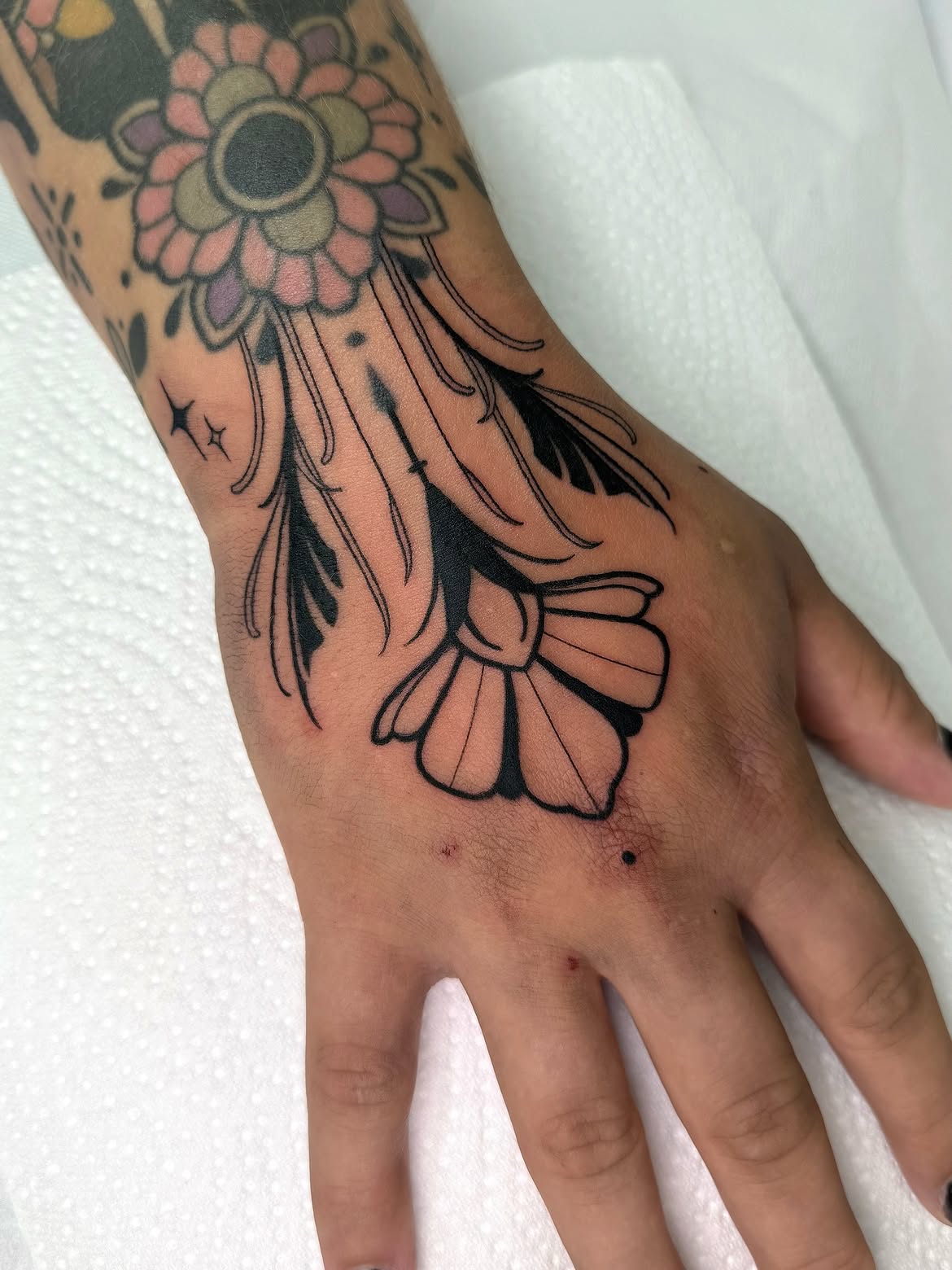
Art Nouveau becomes much more graphic in this hand Design. A large existing flower at the wrist transitions into long descending curves, black leaves, narrow ornamental lines, and a second stylized bloom positioned across the hand. Rather than separating wrist and hand into two independent areas, the composition treats them as one continuous surface.
The long strands are what create the sense of motion. Some resemble stems, others feel almost like decorative ribbons, and the pointed black leaves introduce strong contrast among the open lines. The lower Flower spreads across the hand in broad fan-shaped petals, giving the composition enough visual weight to finish confidently.
There is a slight flash-like quality to the individual elements, but their arrangement feels customized to the placement. That’s especially important with hand tattoos: a Design that ignores joints and natural movement can quickly look awkward. Here, the curves narrow as they travel over the wrist and then open again across the hand.
For anyone attracted to Flower deco rather than delicate botanical realism, this offers a bolder direction. Similar ornament could also be used to connect an established Arm Sleeve with a future hand Piece.
Soft Black-and-Gray Iris Flowers with Whiplash Curves
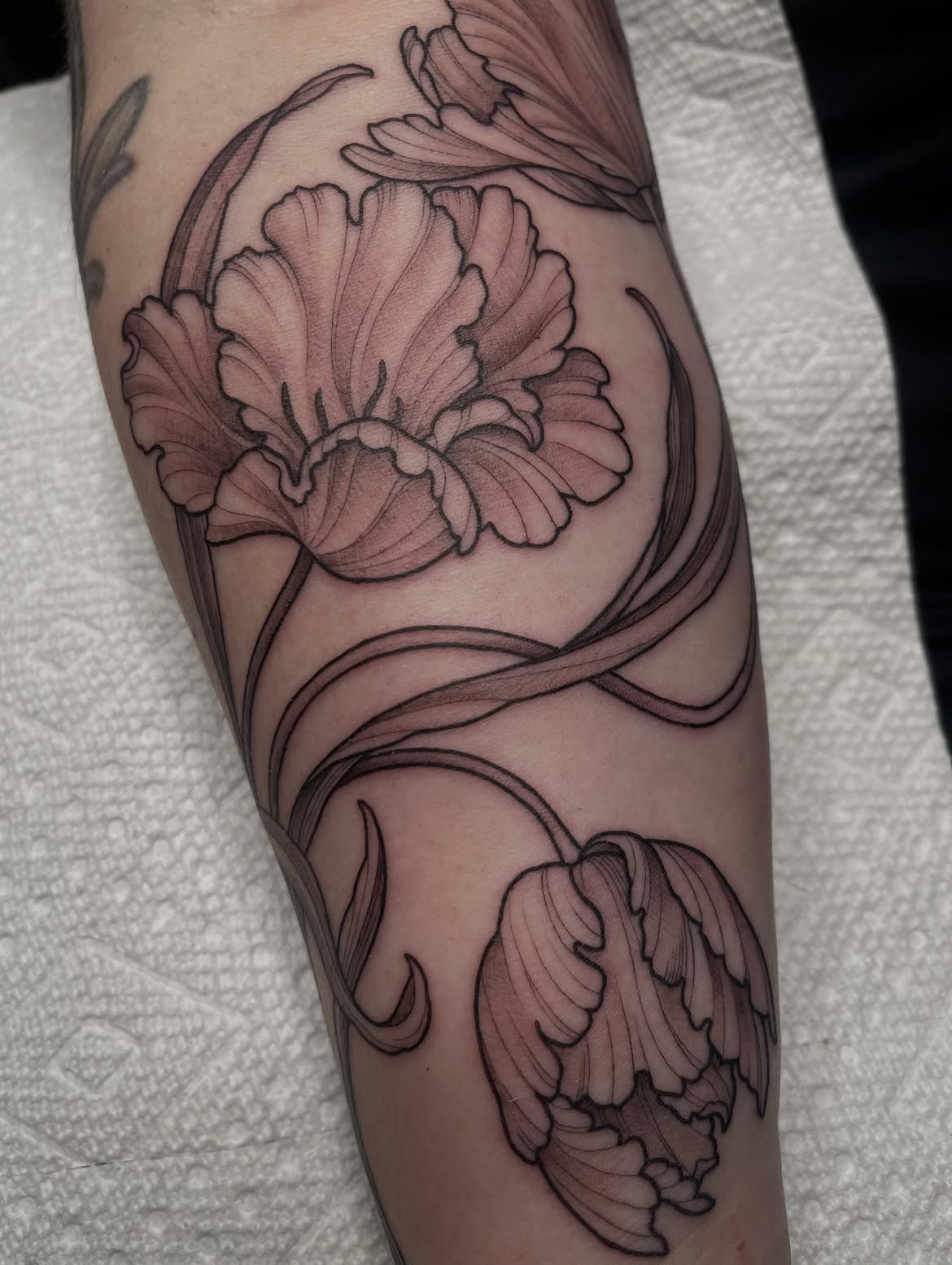
The Iris is almost made for Art Nouveau. Its dramatic petals, long leaves, and naturally curved silhouette already possess many of the characteristics designers of the period tried to emphasize. This tattoo takes advantage of that beautifully.
Several large blooms move through the composition at different stages of opening. The central Flower displays broad, ruffled petals, while another hangs downward in a heavier closed form. Instead of filling those petals with dark shading, the artist uses extremely soft gray gradients and fine directional lines. That restrained technique keeps their texture visible.
The leaves are more stylized. Long blades sweep around the flowers in deep arcs, sometimes crossing one another to create the characteristic whiplash rhythm associated with Art Nouveau Design. I find this combination particularly successful because the flowers themselves remain recognizable while the surrounding foliage is allowed to become more decorative.
It could easily expand into a larger Floral Sleeve. Additional irises could follow the Arm upward while the leaves provide natural connections between sections. Even without Color, the Piece has depth because line direction and subtle shading do most of the work.
Golden Iris Hand Tattoo with Dark Ornamental Leaves
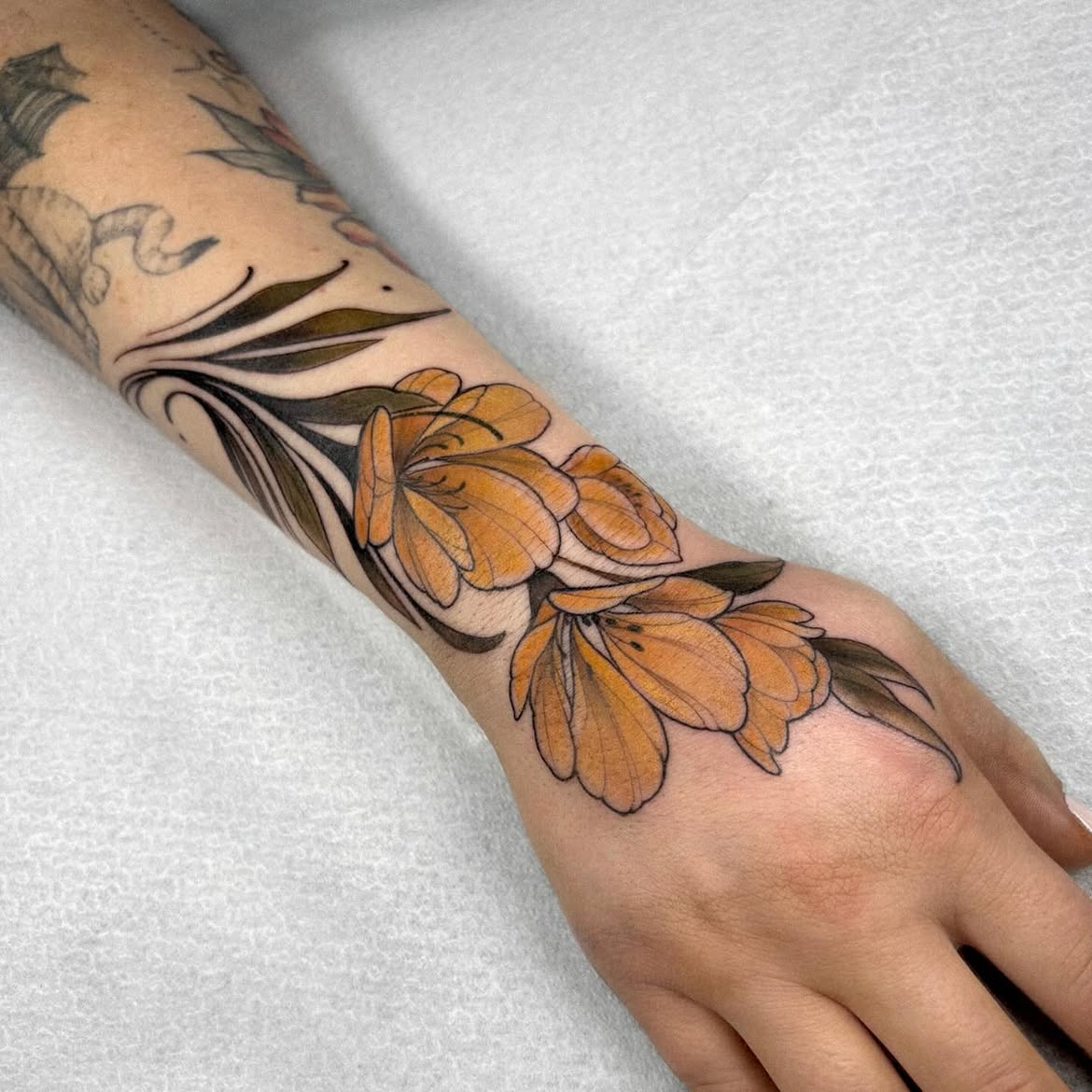
This second Iris interpretation takes almost the opposite approach. Instead of muted black and gray, the artist uses warm golden Color to make the flowers immediately noticeable against dark green-brown foliage.
Two main blooms stretch across the wrist and hand. Their petals are divided by delicate internal lines, producing the ribbed appearance often seen in vintage botanical drawings. Behind them, narrow leaves converge into a dramatic fan of black and olive shapes toward the forearm.
That transition is the clever part. The Design does not simply place flowers on the hand; it creates a directional flow from the Arm toward the fingers. Sharp leaves gradually give way to softer petals, producing a balance between ornamental abstraction and recognizable nature.
Golden ochre also feels particularly appropriate for this aesthetic. Paired with earthy green and black, it recalls old posters, book illustrations, and decorative interiors rather than modern neon Color. For someone building a botanical Sleeve, repeating these tones elsewhere on the Arm could create a remarkably cohesive result.
Small Symmetrical Floral Ornament with Art Nouveau Character
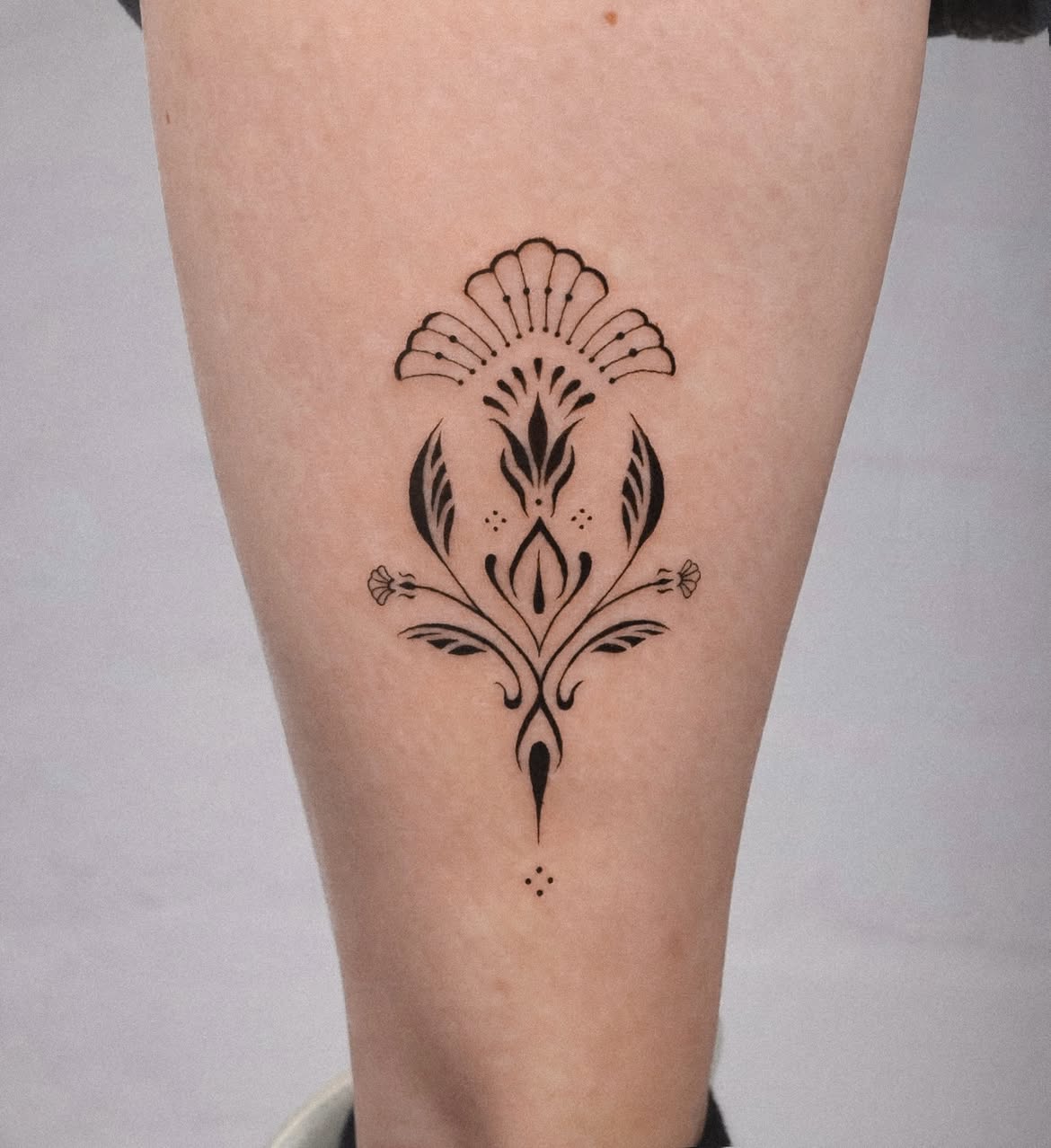
Not every Art Nouveau tattoo needs elaborate Flores or a Mucha-style portrait. This small black ornamental Piece reduces the style to symmetry, botanical curves, and carefully placed negative space.
At the top, three fan-shaped forms suggest an abstract Flower crown. Tiny dots extend into each section, giving the motif a delicate decorative finish. Beneath them, solid black leaves curve around a central bud-like form, while two tiny side flowers stretch outward on fine stems.
The lower portion narrows elegantly into mirrored curls and a pointed drop. That vertical taper is important because it prevents the symmetrical Design from looking like a static emblem. Your eye is guided downward through the ornament.
This is the kind of tattoo that could work especially well as repeatable Art Nouveau flash. Its scale makes it adaptable to the forearm, calf, upper Arm, ankle, or other narrow placements. The mixture of open linework and small solid-black accents should also remain visually clearer than a miniature Design packed with elaborate shading.
Oversized Floral Sleeve with Flowing Black Leaves
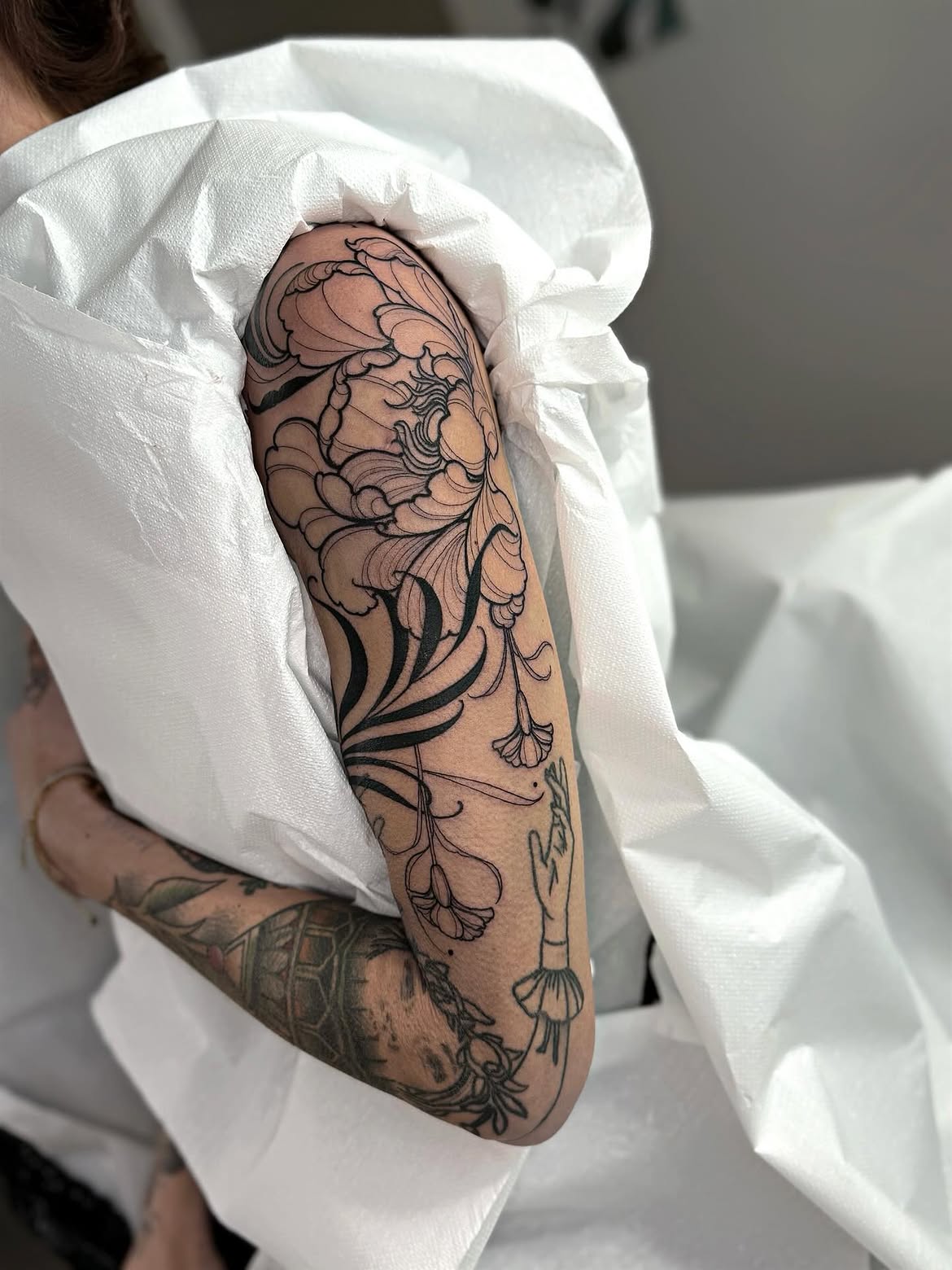
This larger Arm Piece shows how convincingly Art Nouveau principles can be adapted to contemporary Sleeve work. The flowers are oversized, layered, and dramatic, filling much of the available space while still allowing skin to remain visible between petals and stems.
Each bloom is built from repeated contour lines that emphasize its structure. The petals fold over one another in generous waves, and the artist avoids excessive interior shading. Instead, dark leaves and stems provide the strongest black areas. That difference gives the flowers a light, almost translucent quality.
The composition is especially effective around the curvature of the upper Arm. Large petals wrap naturally around the body instead of being confined to a flat frontal view. Long stems then descend through the Piece, ending in smaller hanging flowers that visually connect the larger design to existing tattoos farther down the Arm.
For a Floral Sleeve, this is a useful reminder that Art Nouveau does not require literal historical imagery. No decorative border or woman portrait is necessary. Scale, asymmetry, sweeping stems, stylized leaves, and rhythmic repetition are enough to establish the aesthetic.
Autumn-Colored Botanical Branch Along the Arm
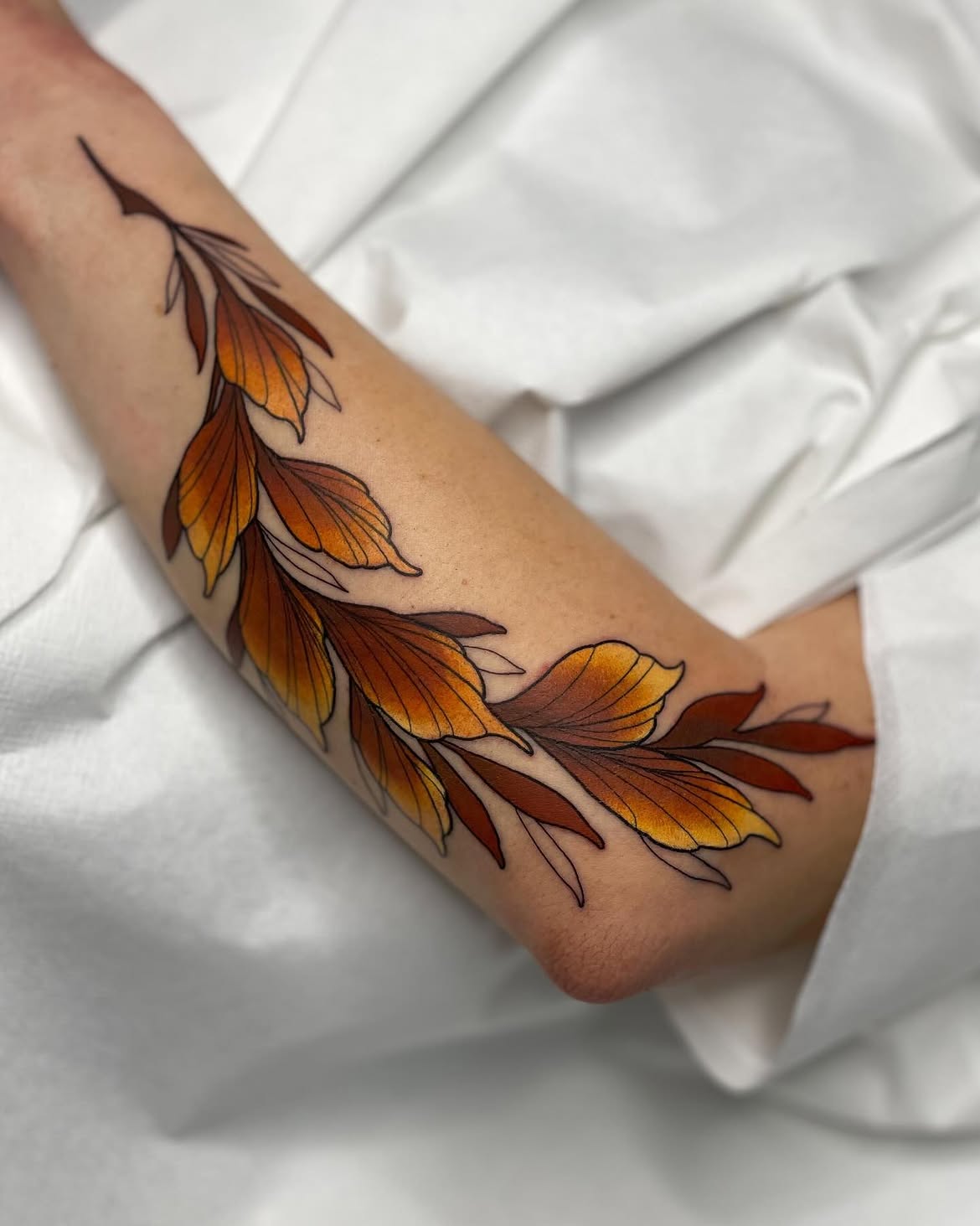
This final Design is wonderfully simple in concept: a branch of elongated leaves follows the Arm in a continuous curve. What gives it Art Nouveau character is the treatment of those leaves and the almost calligraphic rhythm of the composition.
The Color palette is restrained to amber, burnt orange, rust, deep brown, and occasional pale sections. Fine black lines run through the larger leaves like delicate veins, while narrow pointed shapes overlap behind them. The combination creates depth without requiring heavy shading.
Placement does a great deal of the work. The branch bends with the elbow and continues along the forearm, so its silhouette changes subtly as the Arm moves. That relationship between natural form and the human body is one of the reasons botanical Art Nouveau tattoos can feel so effortless when they are designed well.
The autumn palette is also a refreshing alternative to conventional green Floral work. It gives the Piece warmth and a slightly vintage mood while remaining clean and contemporary. The same idea could travel farther toward the Shoulder to form a loose Sleeve, or remain isolated as a long botanical accent.
Flowing Peony Design with Sculpted Art Nouveau Leaves
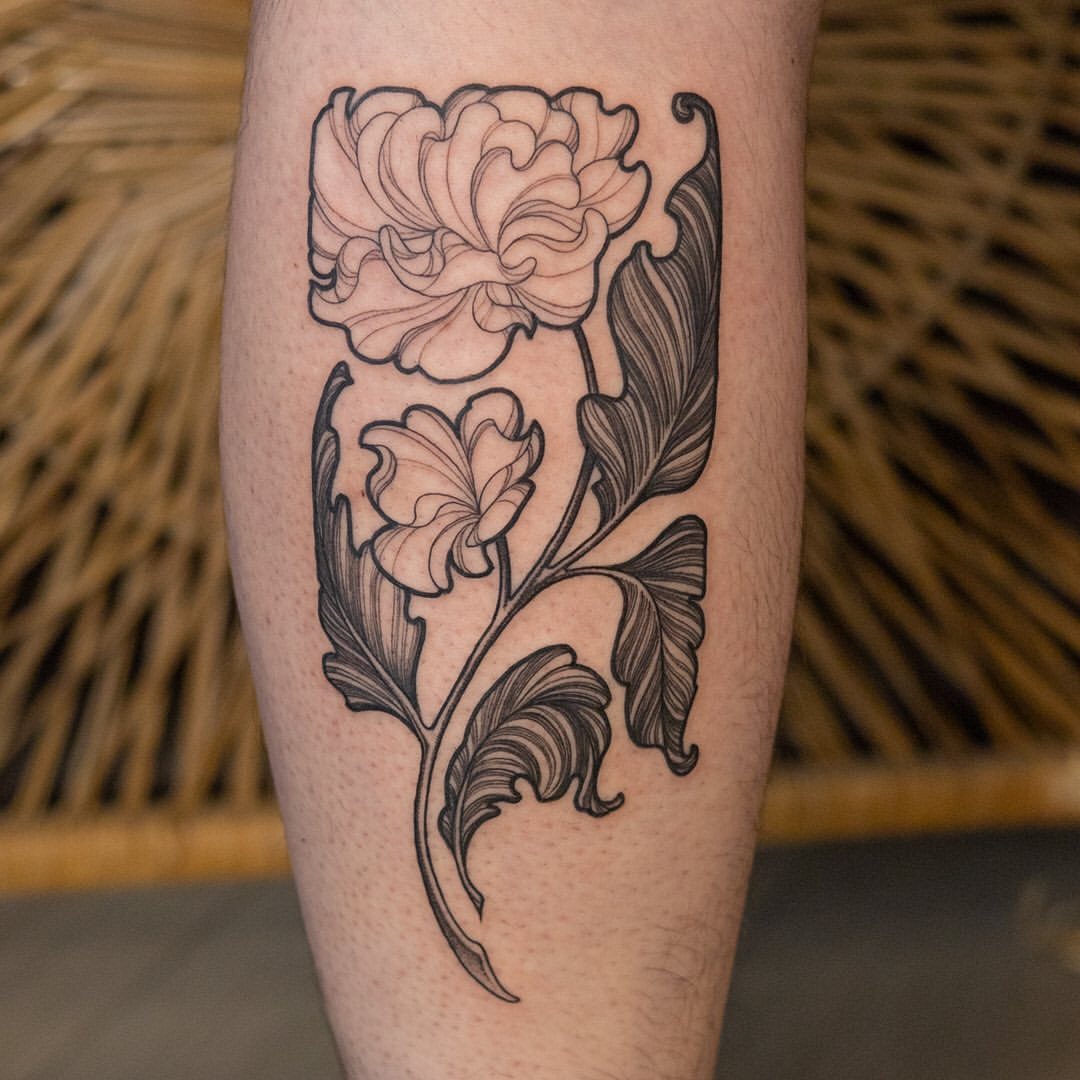
This blackwork Floral Design captures Art Nouveau through movement rather than through elaborate framing. Two flowers rise along a gently curving stem, with the larger bloom opening at the top and a smaller flower sitting beneath it. The petals remain relatively light and spacious, allowing their curled edges to create most of the visual texture.
The leaves provide the real decorative drama. They are long, sharply tapered, and filled with parallel lines that follow every bend. Several tips curl inward almost like carved wood or forged metal ornament. This treatment moves the Piece away from conventional botanical illustration and gives it the unmistakable rhythm of turn-of-the-century decorative art.
I particularly like the contrast between the flowers and foliage. Leaving the blooms largely open prevents the tattoo from becoming visually dense, while the darker leaves create enough weight to define the silhouette from a distance.
The vertical format is well suited to the Leg. It could work equally well on the forearm, where the stem could follow the natural length of the Arm. For anyone looking for Art Nouveau Design inspiration without Color or a formal ornamental border, this is a strong example of how the plants themselves can provide all the decoration.
Fine-Line Floral Ornament with Art Deco Accents
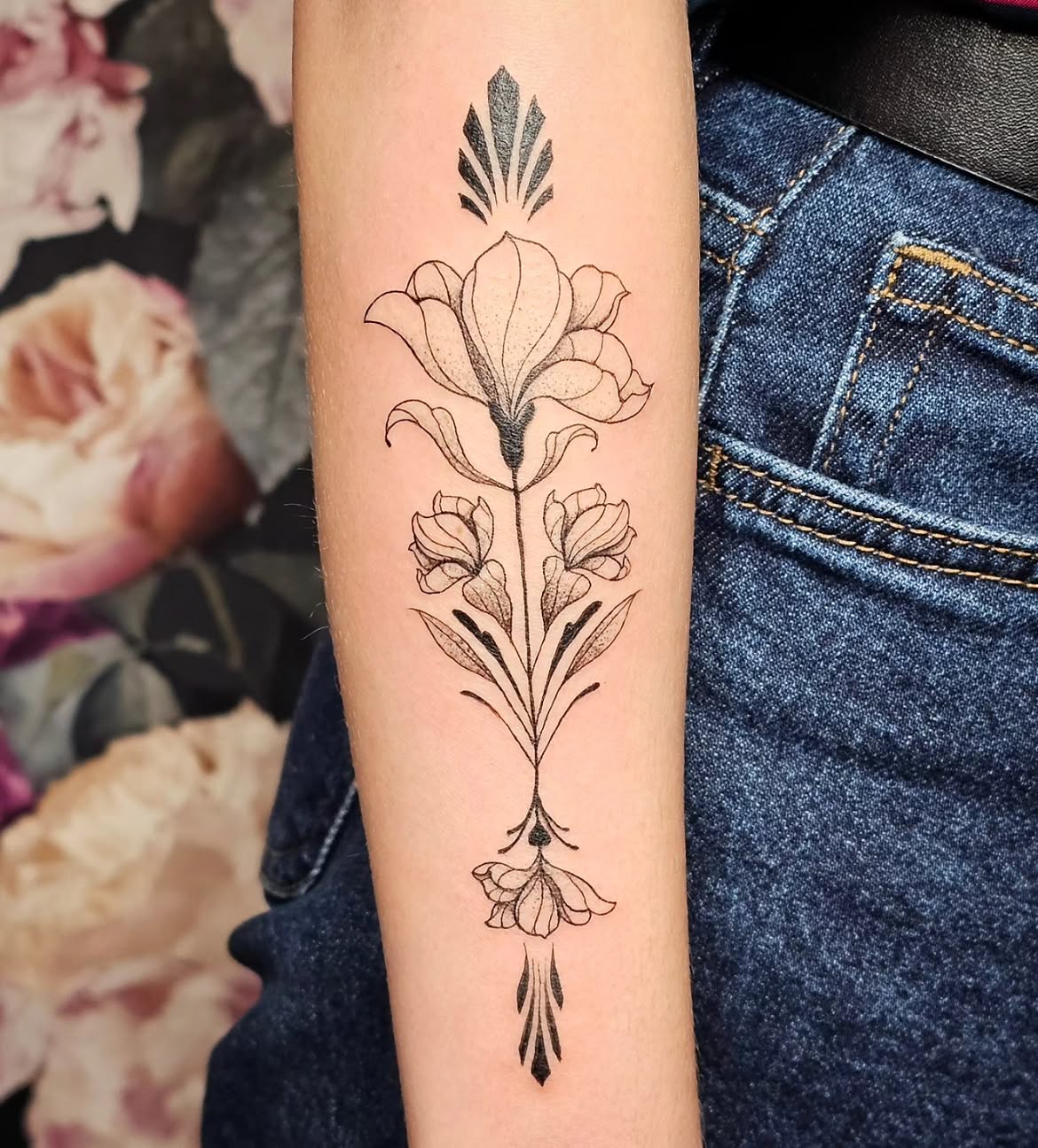
This Piece takes a quieter, more geometric route. A tall central Flower anchors the composition, with two smaller blooms branching symmetrically from the stem. Fine outlines, subtle stippling, and restrained black accents keep the botanical portion exceptionally delicate.
Above and below the flowers sit narrow geometric rays. They introduce a touch of Art Deco geometry into an otherwise organic Art Nouveau Design, and the contrast works surprisingly well. The botanical center is soft and irregular; the pointed ornaments at either end are precise and architectural.
The composition also makes clever use of symmetry without becoming perfectly mirrored. Individual petals retain their natural irregularity, while the overall silhouette stays balanced along a strong vertical axis.
This kind of Piece is ideal for someone who wants Floral ornament rather than a large illustrative tattoo. On the inner Arm it reads almost like a piece of jewelry. The same framework could be adapted with an Iris or another elongated Flower, or expanded with additional leaves while preserving its elegant proportions.
Jewel-Toned Symmetrical Flower Deco Design
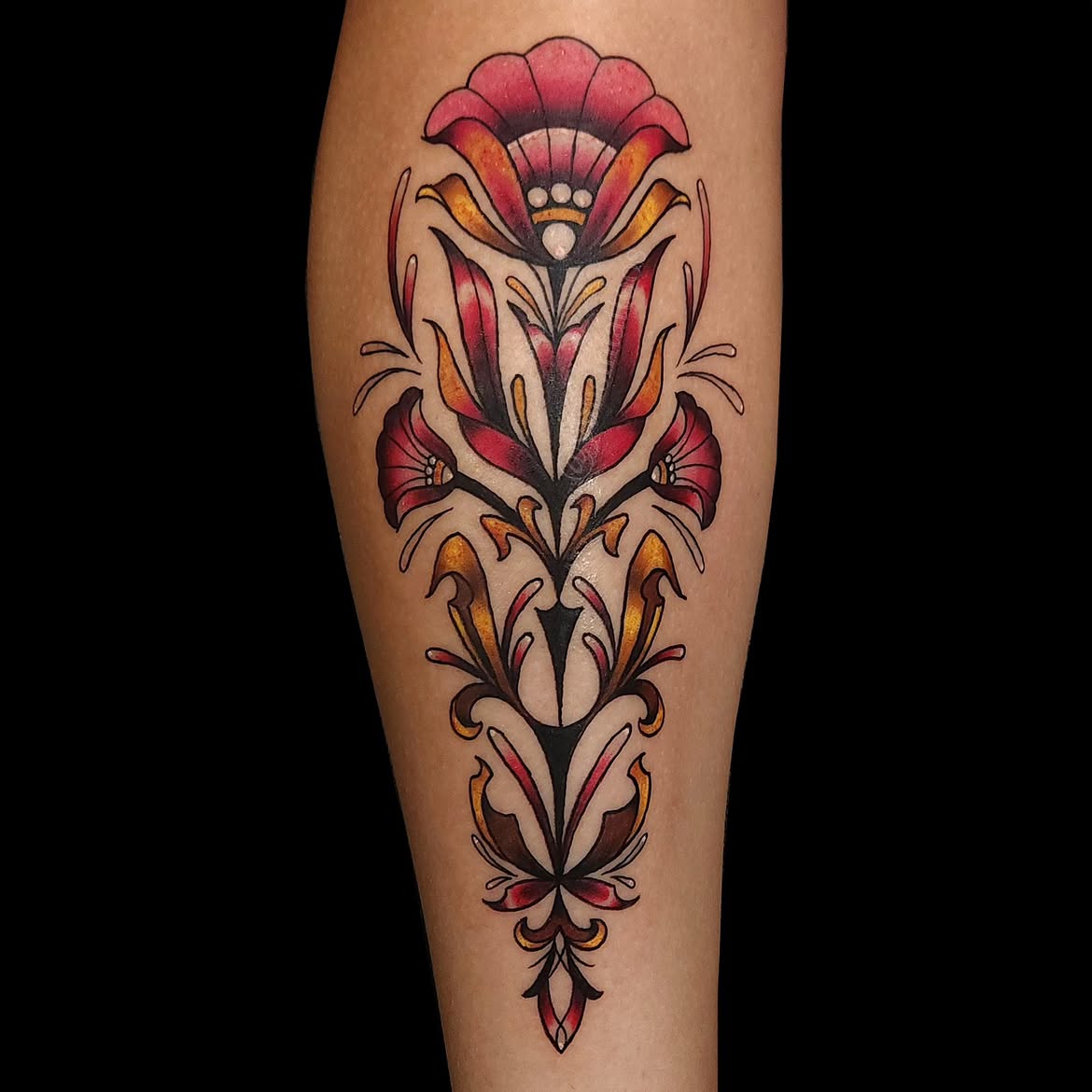
Here Art Nouveau becomes bold, colorful, and almost architectural. The tattoo is built around a strict central axis, but nearly every individual shape comes from stylized botanical forms. A broad red-pink Flower crowns the Design, while pointed petals, curled stems, and smaller blossoms descend through a long ornamental structure.
The Color palette is particularly effective. Raspberry red, burnt orange, deep brown, black, and small pale highlights create the feeling of enamel, stained glass, or vintage decorative tiles. Black outlines separate the colors cleanly, making every element easy to read.
This is Flower deco in a very literal sense: the plant has been transformed into ornament. The petals are not trying to reproduce a particular species realistically. Instead, they become repeated architectural shapes that gradually narrow toward the bottom.
On the forearm or Leg, this elongated format has real presence without requiring the coverage of a full Sleeve. It is also an excellent example of why Art Nouveau tattoo ideas can appeal to both women and Men—the emphasis here is on ornament, symmetry, and graphic construction rather than a conventionally feminine or masculine subject.
Calligraphic Flowers Drawn with Continuous Curves
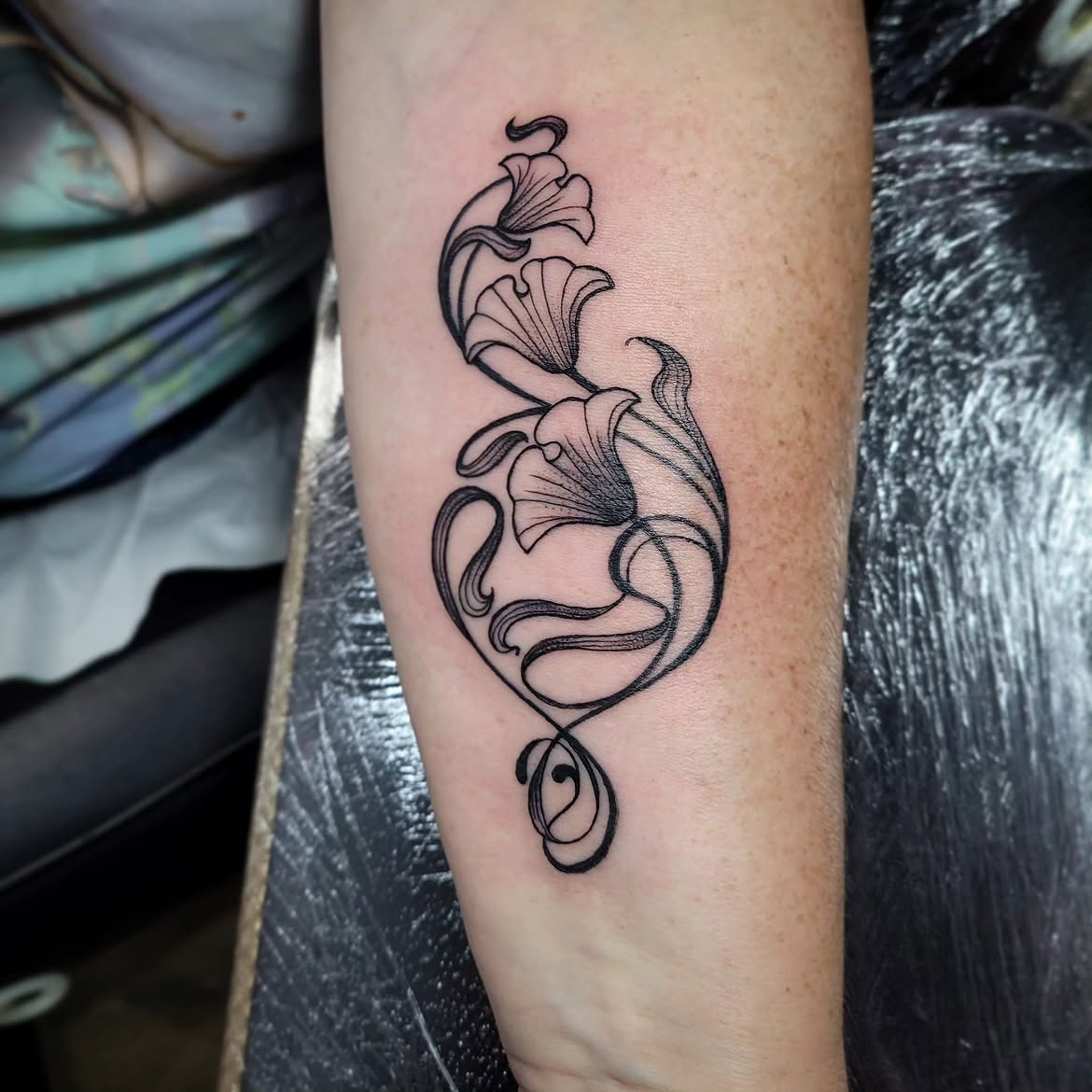
Few tattoos in this collection demonstrate the famous Art Nouveau whiplash curve as clearly as this one. Flowers and leaves appear to emerge from a continuous network of sweeping black lines, giving the entire Design the fluidity of handwriting.
The blossoms are simplified into fan-like petals filled with fine parallel marks. They gradually open as the composition travels upward, while the stems below loop into broad spirals. There is an almost musical rhythm to the arrangement: a curve expands, tightens, crosses another line, and then opens into a Flower.
The absence of Color is a smart decision. Adding several shades might distract from what makes this Piece interesting—the choreography of the line itself. Instead, subtle black shading inside the leaves and petals establishes depth while allowing the negative space to remain dominant.
This would make beautiful Art Nouveau flash for the Arm or Leg, but its proportions could also be adjusted for a Shoulder design. It demonstrates that the style does not always need antique-looking ornament. Sometimes a few beautifully controlled curves are enough.
Cosmic Fairy and Crescent Moon Back Tattoo
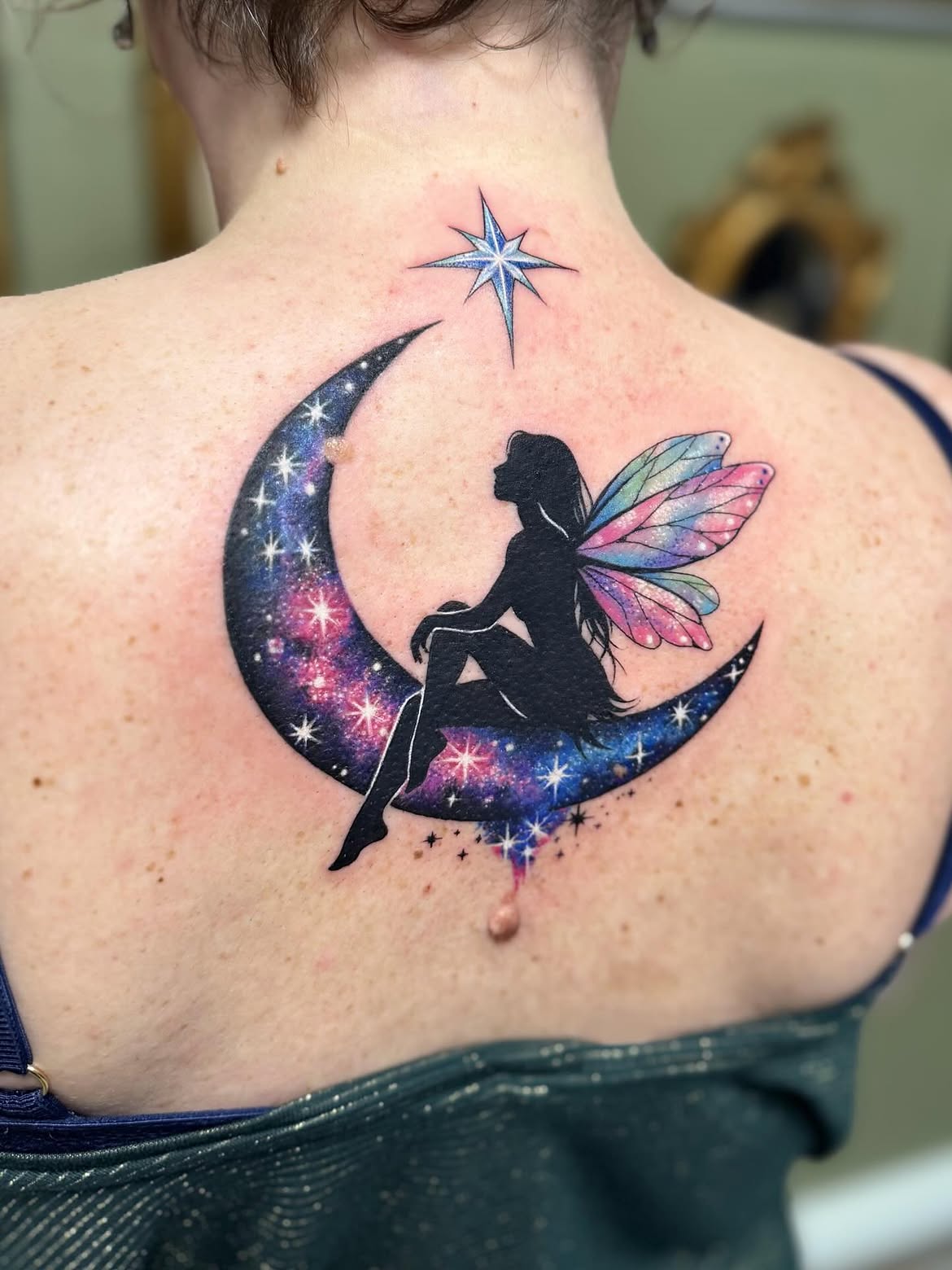
This Back Piece moves away from historical Art Nouveau and into a contemporary fantasy interpretation. A silhouetted fairy sits on a large crescent moon, with colorful wings spreading behind her and an eight-pointed star positioned above.
The moon is filled with a galaxy effect—deep blue, violet, pink, and black punctuated by bright stars. Against that luminous Color, the completely black figure becomes an effective focal point. Her profile and seated pose remain readable even without facial or clothing detail.
The wings introduce another layer of Color, shifting between turquoise, lavender, pink, and pale green. Fine divisions inside them suggest the structure of insect wings and prevent the bright gradient from becoming shapeless.
Although this Piece is less historically faithful than the Floral and Mucha-inspired examples, it shows how the romantic side of Art Nouveau can migrate into modern fantasy tattooing. The movement frequently celebrated graceful figures, celestial motifs, nature, and dreamlike beauty, and those ideas are reinterpreted here through a contemporary fairy aesthetic.
The upper Back is also a logical placement. Its width accommodates the crescent and extended wings, while the star draws the composition upward toward the neck.
Ornamental Orchid with Baroque Art Nouveau Detail
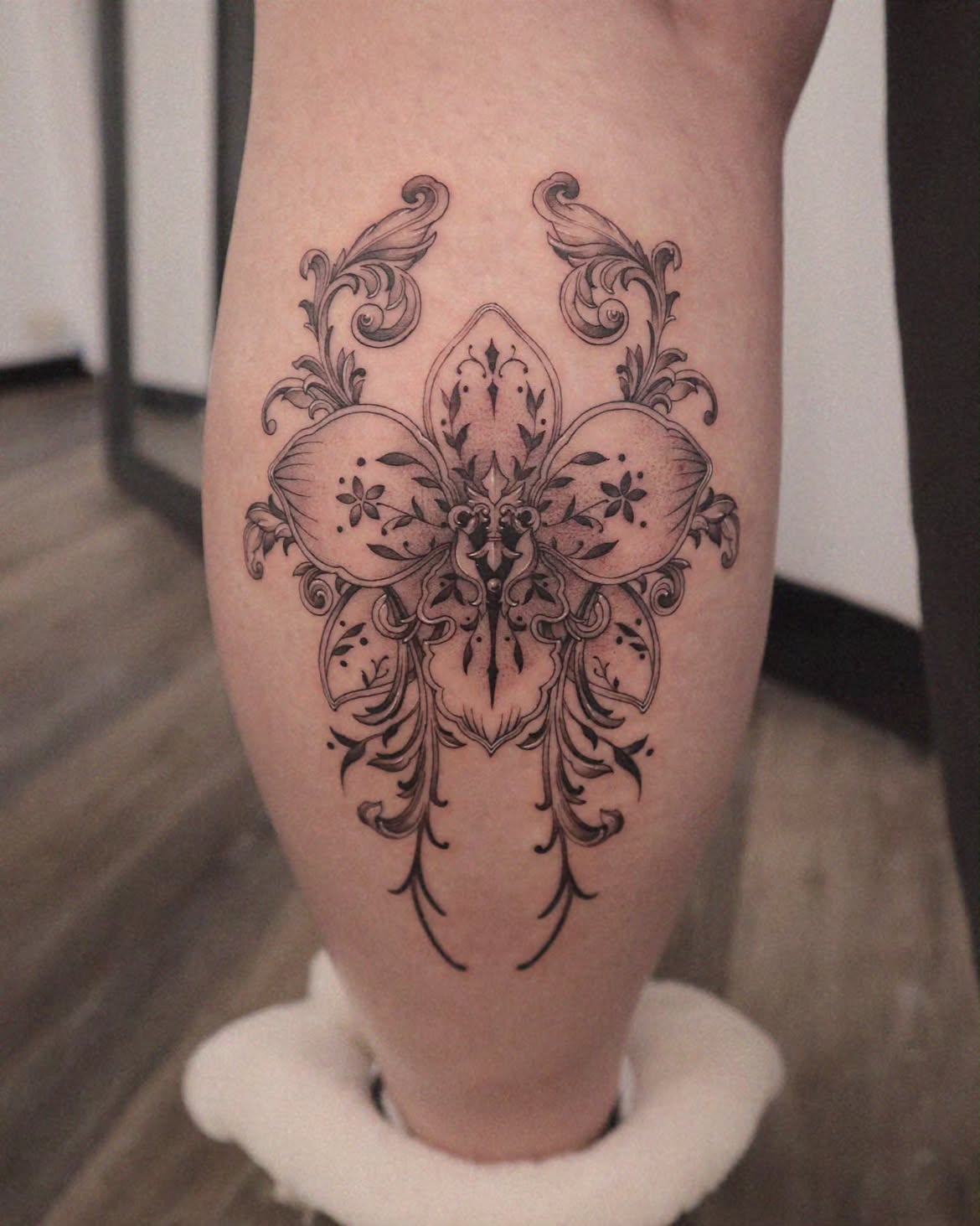
This ornate Floral Piece rewards a closer look. At its core is a large orchid-like Flower, but the artist has surrounded and partially transformed it with scrolls, flourishes, miniature botanical motifs, and decorative extensions.
The central petals remain broad and recognizable. Small leaf shapes and dot clusters decorate their interiors, almost as if the flower had been patterned like fabric. Around them, curling ornaments rise and fall symmetrically, becoming increasingly elaborate near the center.
There is a fascinating tension between nature and decoration here. You can still read the subject as a Flower, yet its anatomy gradually dissolves into ornamental architecture. That transformation is very much in the spirit of Art Nouveau, where vines, petals, wings, hair, and borders often seemed to belong to the same visual language.
Fine black-and-gray shading keeps the details legible without creating a large dark mass. On the Leg, the vertical symmetry feels balanced and substantial. A similar approach could become the central element of an ornamental Sleeve, especially if the surrounding scrollwork were extended to connect with other Floral pieces.
Vintage Woman Portrait in an Ornate Art Nouveau Frame
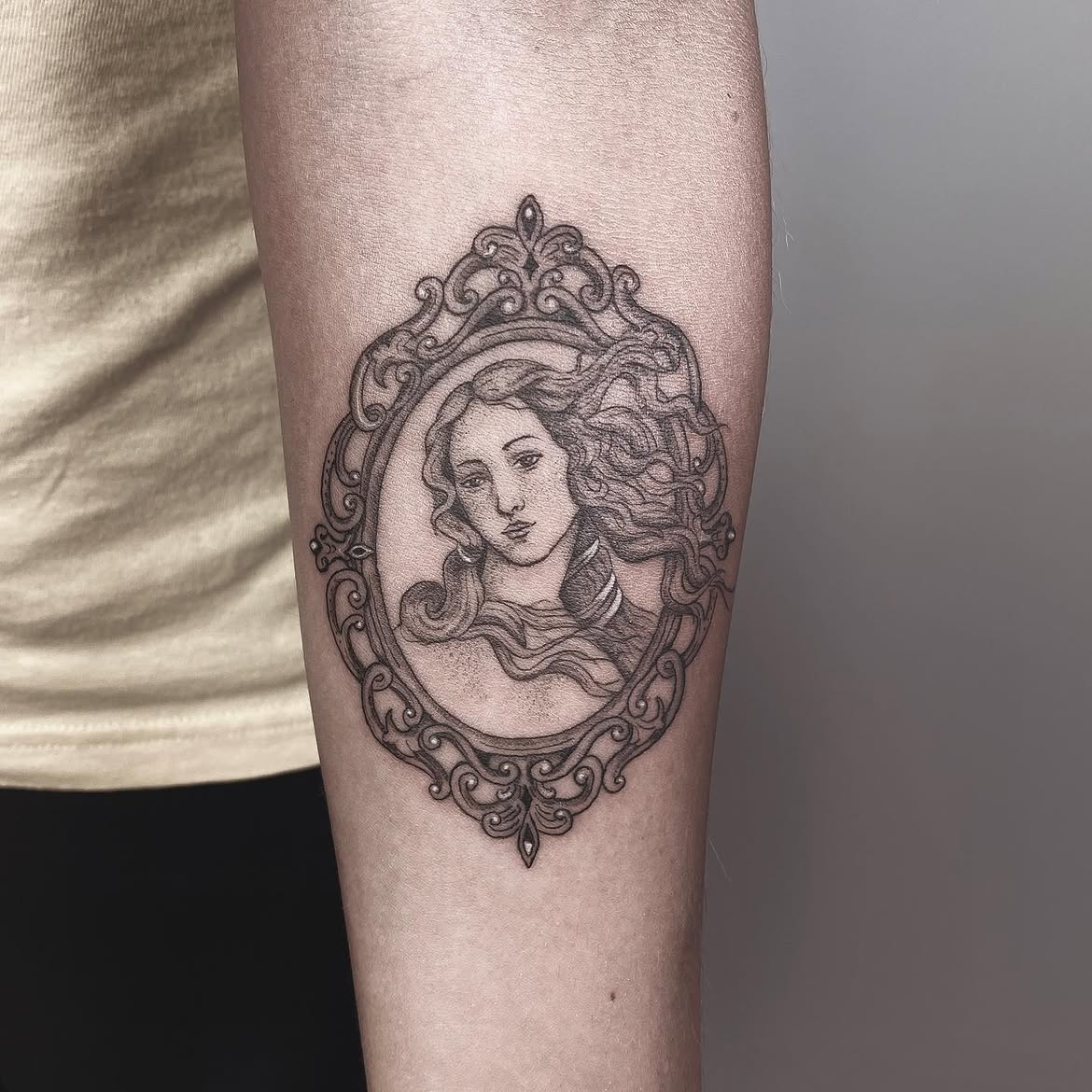
This portrait returns to one of the great recurring subjects of Art Nouveau: the woman as the center of an elaborate decorative composition. Rather than surrounding her with flowers, however, this Design places the portrait inside an oval frame that resembles antique carved furniture, jewelry, or an ornate hand mirror.
The face is rendered softly, with delicate shading and restrained features. Long hair moves outward in waves, helping the portrait transition naturally into the surrounding decoration. The frame is far more elaborate, built from symmetrical curls, leaf-like flourishes, small pointed details, and layered borders.
That contrast is essential. If the portrait and frame were equally busy, the face would disappear. Instead, the woman remains calm and open while the ornament provides visual richness around her.
There is an obvious connection to the decorative portrait tradition associated with Mucha, although this is not simply an imitation of a poster. It takes the broader concept of an idealized woman surrounded by ornamental forms and translates it into a compact tattoo suited to the Arm.
For anyone who loves historical Art Nouveau but does not want a large Mucha Sleeve, this framed portrait offers an appealing middle ground. The border could also be personalized with Flower motifs, initials, symbolic plants, or subtle Color while keeping the same vintage character.
Lily Composition with Bold Whiplash Curves
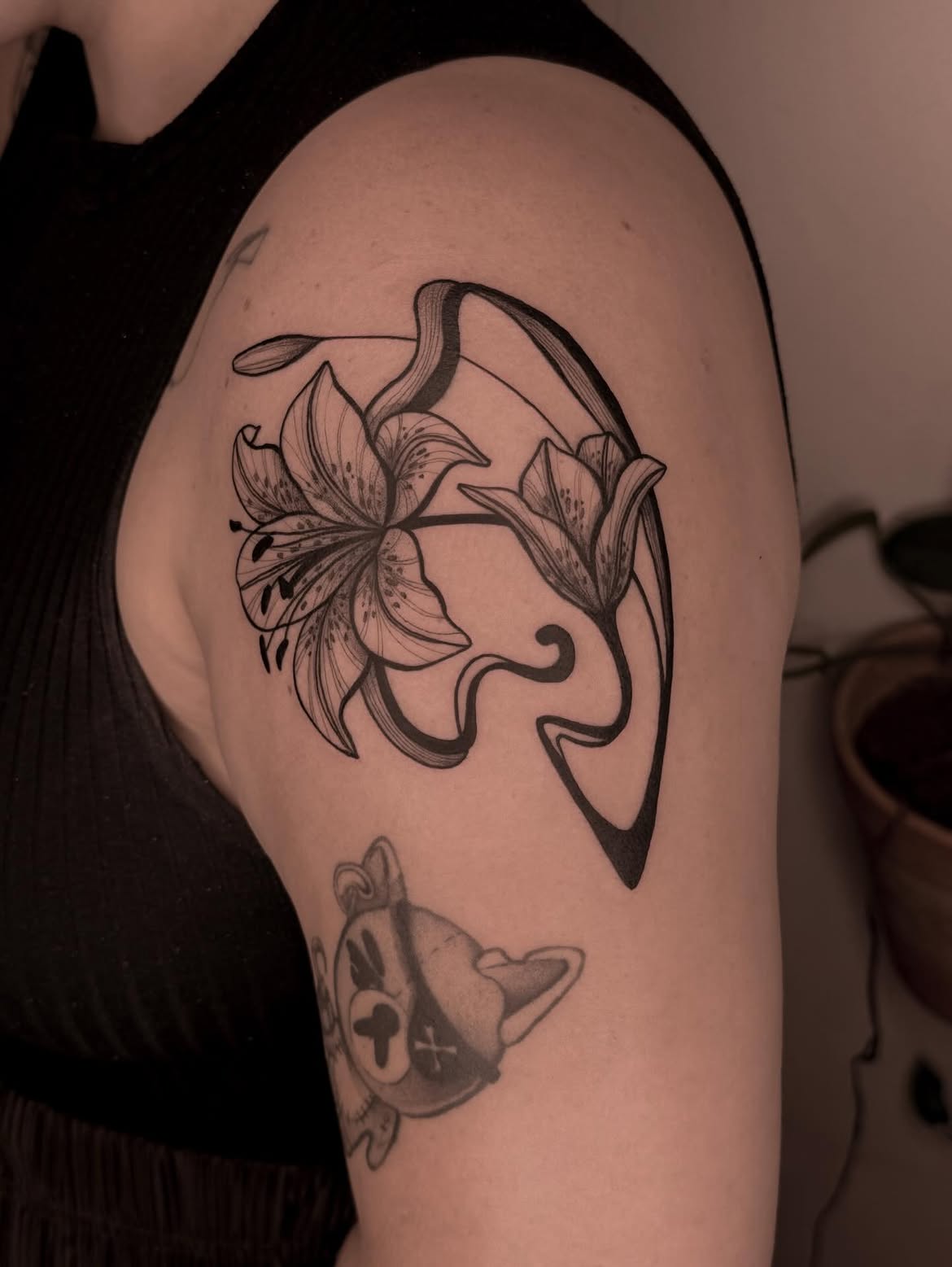
This upper Arm tattoo combines two lilies with the sweeping curves that immediately evoke Art Nouveau ornament. The larger open Flower occupies the left side of the Design, while a smaller bloom rises diagonally toward the right. Their natural petals are surrounded by exaggerated stems and leaf-like bands that stretch into pointed, asymmetrical forms.
The contrast between delicate botanical detail and heavy black lines is especially effective. Fine parallel strokes give the lily petals texture, while the surrounding curves become substantially darker and broader. Some of these lines end in tight hooks, creating the characteristic whiplash movement associated with Art Nouveau.
The Shoulder and upper Arm provide an excellent placement because the composition can follow the rounded surface rather than appearing like a flat rectangular image. It is a strong option for women or Men who prefer blackwork Flower ideas with a dramatic graphic edge.
Abstract Floral Art Nouveau Blackwork
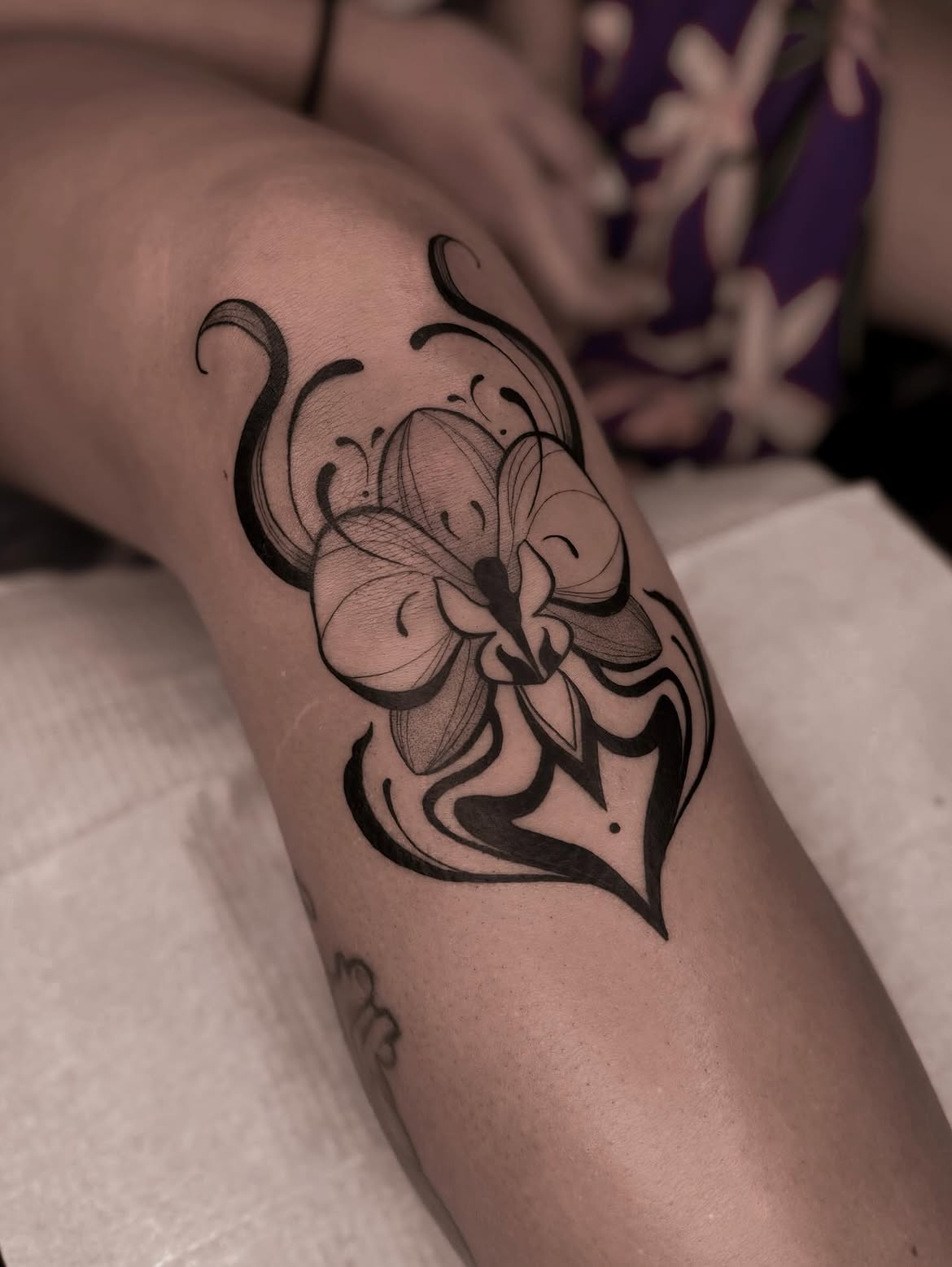
This Design pushes the Floral theme further into abstraction. A large central blossom remains recognizable, but its petals are surrounded by thick waves of black that twist around the Flower like liquid ornament.
The artist creates depth through line weight rather than heavy shading. Some petals contain extremely fine linear textures, while other sections are outlined with dense black curves. Small dots and comma-shaped accents float around the upper portion, adding rhythm without making the composition crowded.
One of the most interesting details is the pointed black form beneath the Flower. It resembles both a stylized leaf and a decorative architectural flourish, making the boundary between plant and ornament intentionally unclear.
The result feels contemporary while retaining the organic principles of classic Art Nouveau Design. This approach would also translate beautifully into a larger Arm or Leg Piece, where additional flowers and flowing black shapes could create a connected Sleeve.
Delicate Hanging Flower Jewelry Design
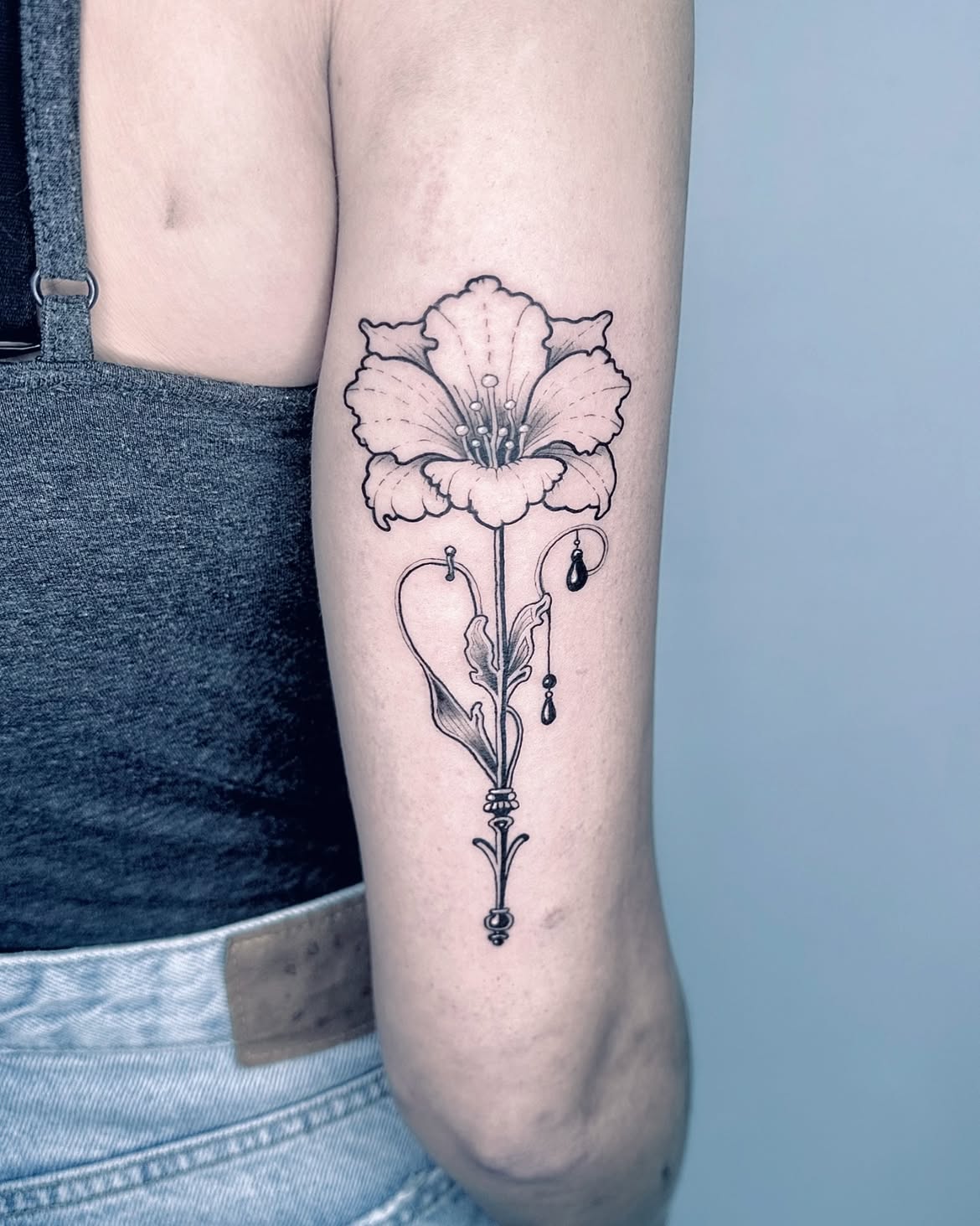
This fine-line Flower tattoo has the elegance of a piece of antique jewelry. A large open blossom sits at the top, supported by an exceptionally slender stem that extends downward into a decorative finial. Two curling side stems carry tiny hanging teardrops that resemble beads or gemstones.
The details are restrained but thoughtfully placed. Fine shading near the center gives the Flower depth, while the stamens rise upward like tiny pins. Beneath the bloom, narrow leaves curve toward one another, forming an almost heart-shaped frame around the central stem.
This is an excellent example of how Art Nouveau tattoo ideas can be minimal without becoming generic. The influence comes through proportion, elongated curves, botanical ornament, and jewelry-like details rather than dense decoration.
The back of the Arm gives the Design enough vertical space to breathe. It would also work well as a forearm Piece or a narrow Leg Design for someone seeking elegant Floral inspiration.
Matching Crescent Moon and Botanical Leg Tattoos
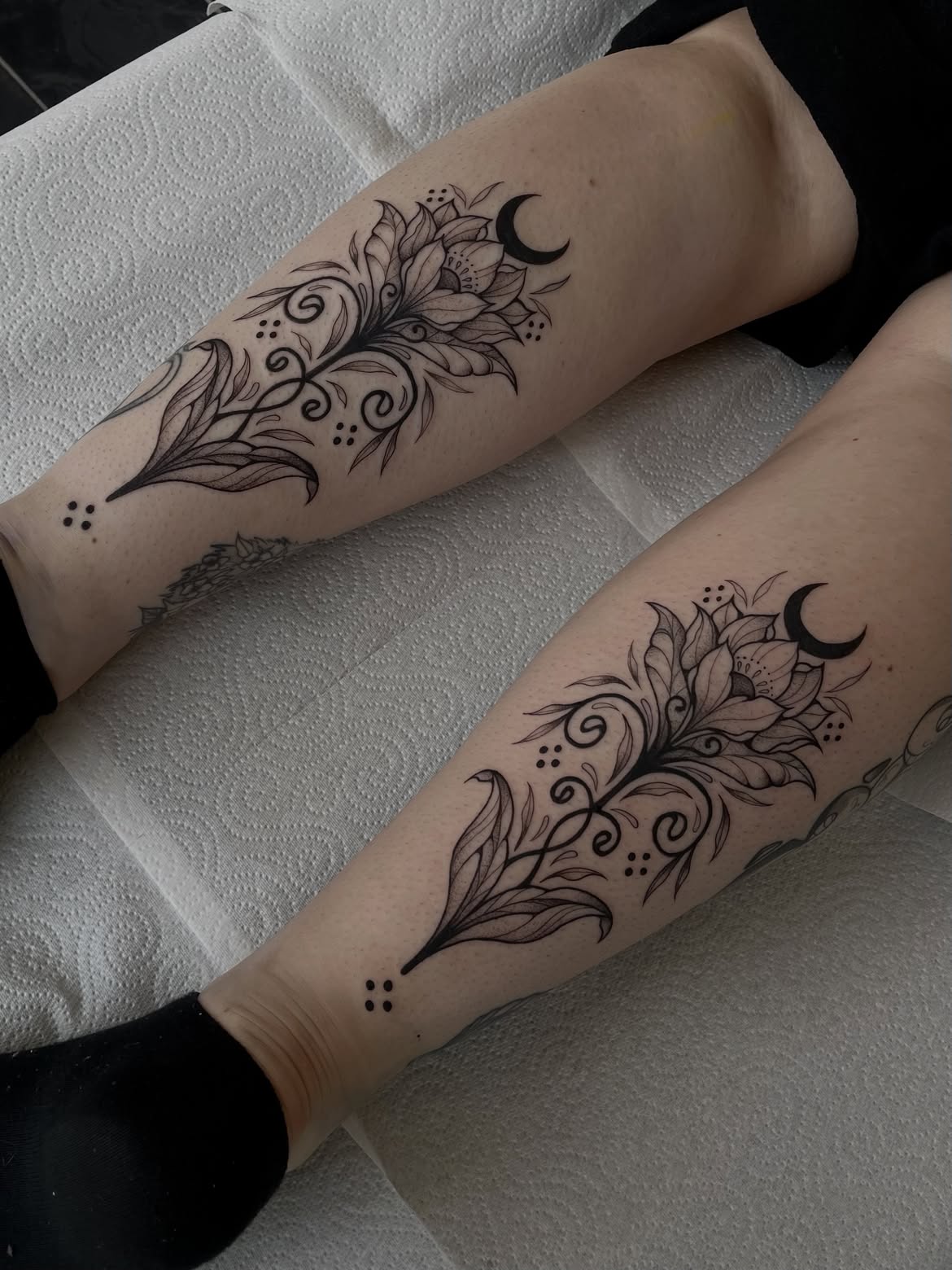
These matching Leg tattoos turn Floral ornament into a flowing celestial composition. Each Piece begins near the ankle with long pointed leaves and develops upward through spiraling vines, layered petals, and a bold black crescent moon.
The repeated curls are particularly important. Instead of using straight botanical stems, the Design allows nearly every branch to turn into a spiral. This gives the flowers a decorative rather than purely naturalistic character and creates continuous movement from the ankle toward the calf.
Fine shading within the leaves contrasts with small groups of solid black dots. The crescent provides the strongest dark accent near the top, balancing the heavier leaf structure below.
As matching tattoos, the designs are especially successful because they repeat the same visual language without depending on tiny symbols or text. The botanical composition could also inspire a single larger Leg Piece or be extended upward into a more elaborate Floral arrangement.
Dramatic Blackwork Flower with Architectural Leaves
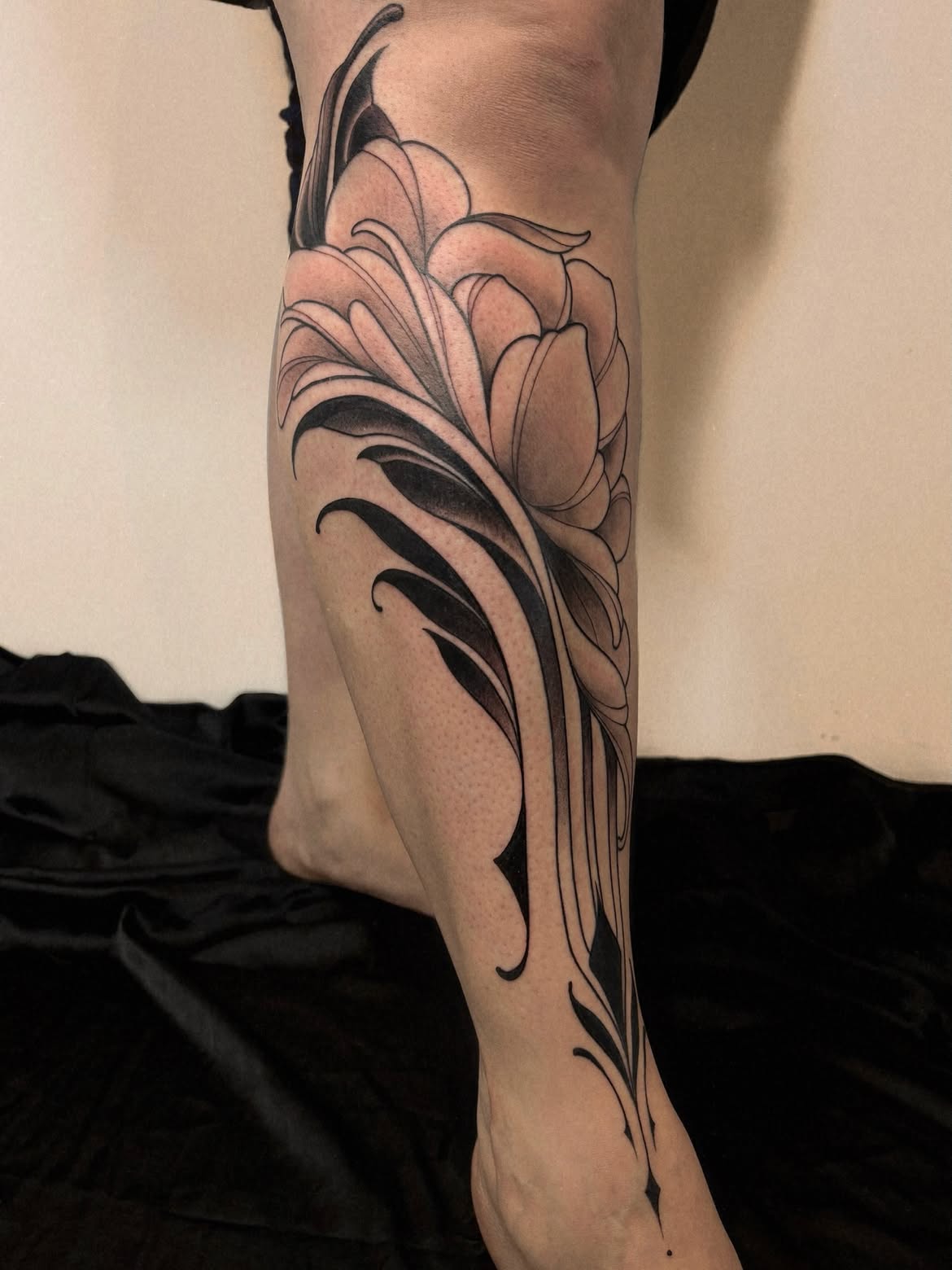
This large Leg tattoo demonstrates how powerful Art Nouveau can become when the familiar Flower motif is simplified into broad, architectural shapes. A large blossom sits near the upper portion of the composition, while dramatically elongated leaves sweep downward toward the ankle.
The petals themselves remain relatively light. Their clean outlines and gentle interior shading preserve a soft botanical quality. Around them, however, are deep black leaf forms with exceptionally long tapered points. These dark sections curve alongside narrow negative-space channels, producing a layered effect similar to carved ornament.
The Design follows the anatomy extremely well. Instead of placing a self-contained image in the center of the Leg, the artist uses the available length to emphasize vertical motion. Lines begin broadly near the upper calf and become increasingly narrow as they descend.
For anyone considering a larger Floral Piece but not a full Sleeve, this approach offers substantial visual impact while still leaving plenty of untouched skin.
Colorful Art Nouveau Floral Panel
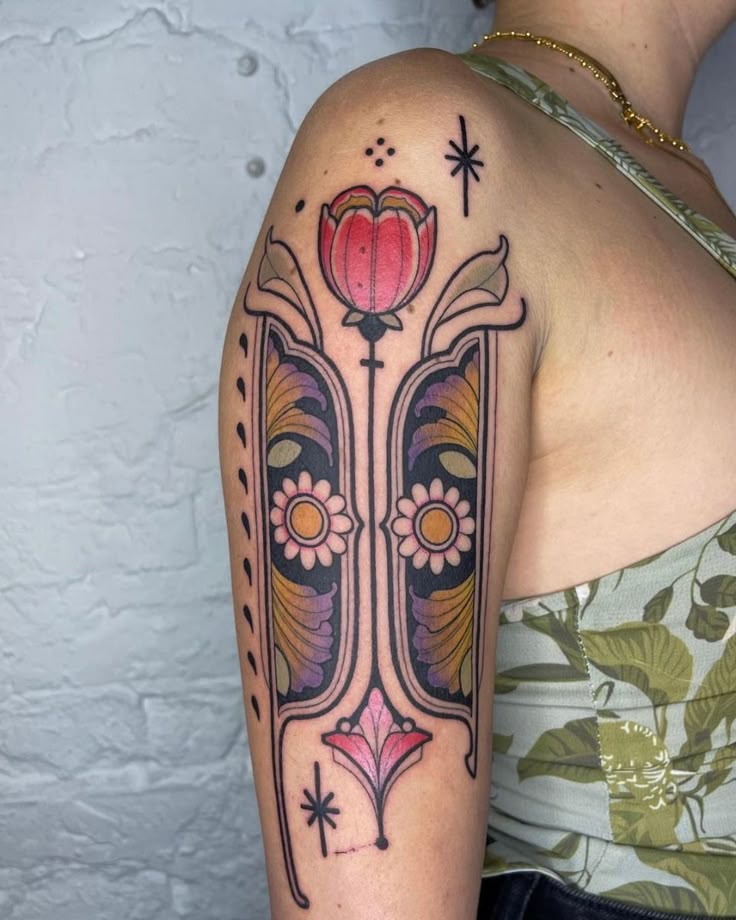
This upper Arm tattoo looks almost like a fragment of a vintage decorative panel. The Design is highly symmetrical, with two dark rectangular sections framing a central vertical axis. Inside them sit small daisy-like flowers surrounded by fan-shaped botanical ornament in muted purple, yellow, pink, and green.
At the top, a red tulip-like Flower becomes the crown of the composition. Its upright form is echoed by long stems and architectural lines extending downward. A smaller pink ornamental Flower anchors the bottom, creating a clear beginning and end to the Piece.
The use of Color makes this tattoo particularly distinctive. Rather than realistic botanical tones, the palette feels deliberately decorative and slightly vintage, recalling printed posters, stained glass, ceramic tiles, and period interiors.
The Design also demonstrates how Art Nouveau and Art Deco influences can overlap. Organic flowers soften the strict symmetry, while long borders and repeated geometric shapes provide structure. On the Arm, the result feels almost like a wearable architectural panel.
Flowing Shoulder and Neck Ornament
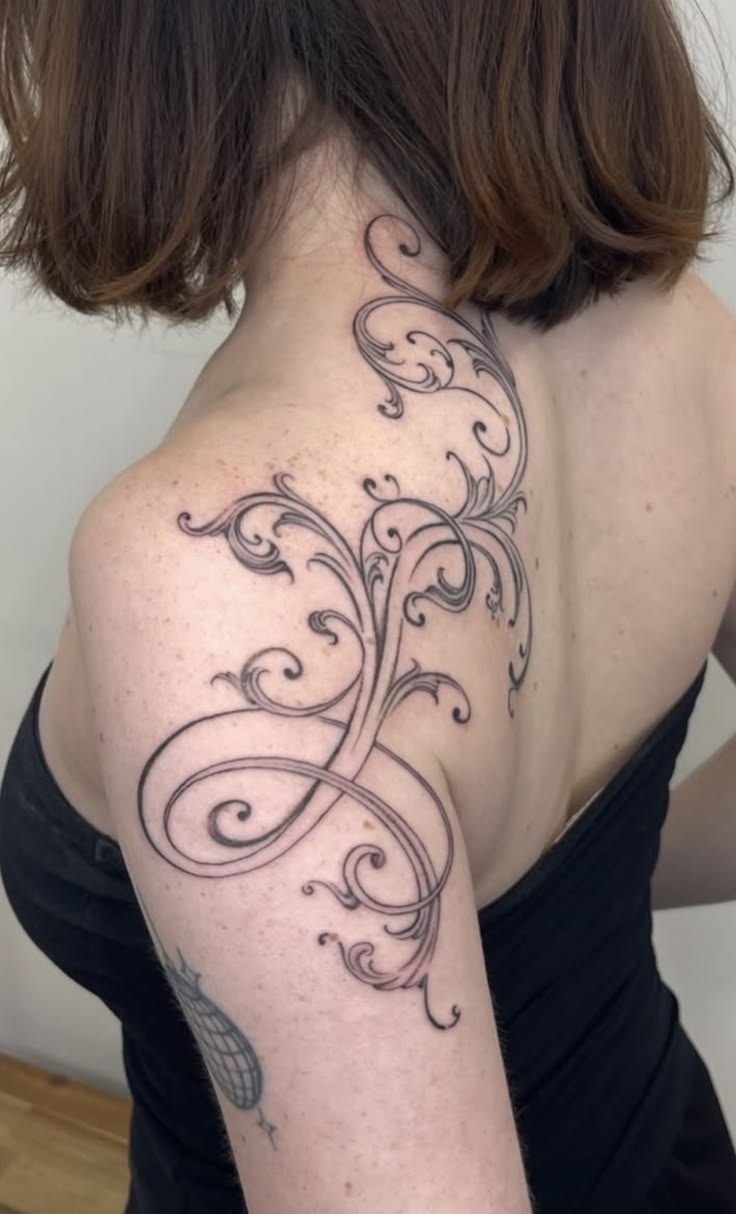
This Shoulder tattoo removes recognizable flowers almost entirely and concentrates on one of Art Nouveau’s most characteristic features: the flowing line. A network of stems, curls, and leaf-like flourishes travels from the upper Arm across the Shoulder and toward the Neck.
The placement is what makes this Design especially effective. Instead of being contained inside a conventional border, the ornament follows the anatomy. A large loop sweeps across the Shoulder, while thinner branches climb toward the Neck and extend across the upper Back.
Every section appears connected to the next. Some lines terminate in small inward curls, while others split into pointed leaf-like shapes. Fine gray shading along selected edges adds just enough dimension without overpowering the airy structure.
This is an excellent Shoulder option for someone who likes Art Nouveau ornament but does not necessarily want an obvious Flower or portrait. It could remain as a standalone Piece or become the foundation of a larger Back or Arm composition.
Colorful Honeysuckle-Inspired Floral Forearm Piece
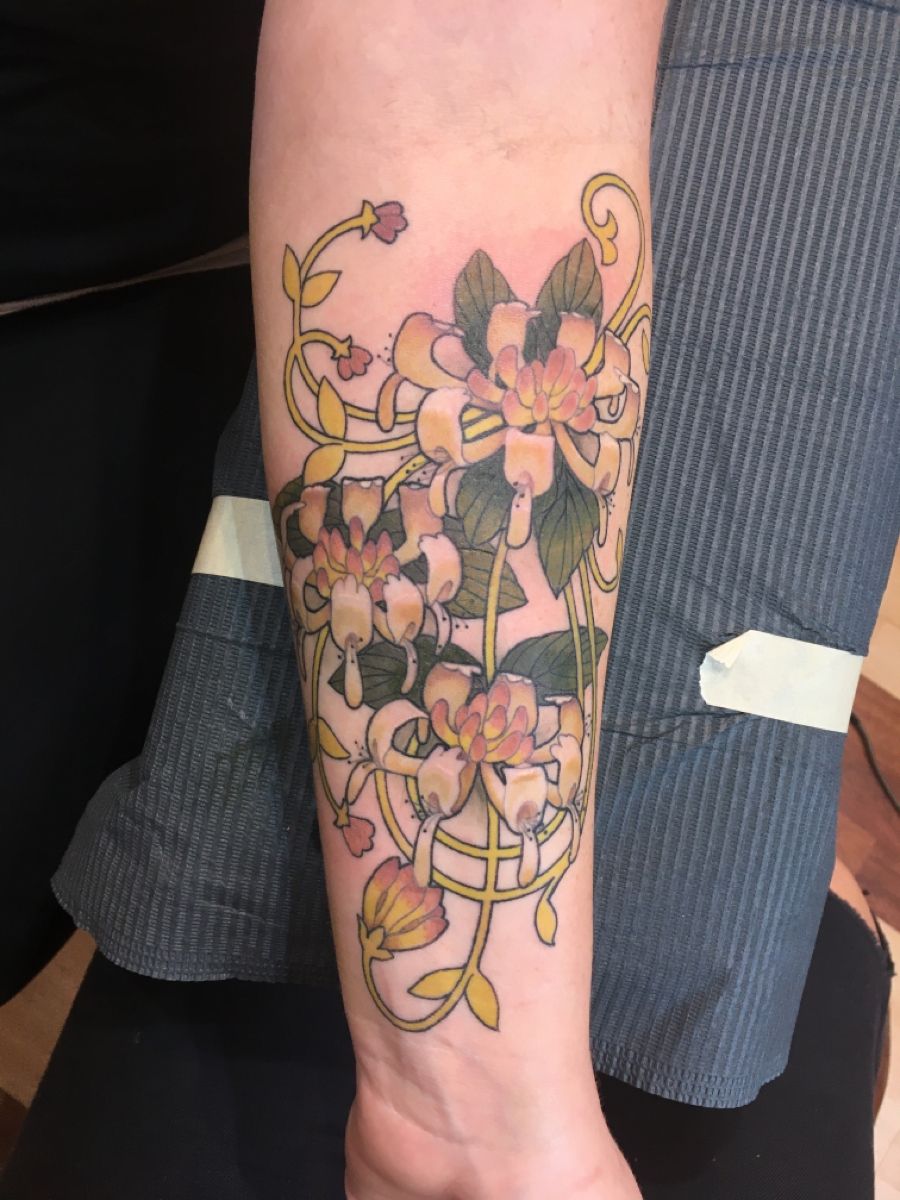
This colorful forearm tattoo takes a more illustrative approach, filling the available space with clustered flowers, dark green leaves, and long yellow-green vines. The flowers appear honeysuckle-inspired, with pale peach and pink petals surrounding warmer orange and yellow centers.
What connects the Design to Art Nouveau is the treatment of the stems. Rather than simply supporting the flowers, they become part of the decoration, creating loops and sweeping curves around the entire composition. Smaller buds extend from these lines and help fill the negative space without making the Piece feel rigid.
The palette has a warm vintage quality. Muted pink, peach, mustard yellow, olive green, and soft orange work together more like colors from an old botanical print than highly saturated modern realism.
Because the flowers overlap and the vines continue beyond the central cluster, the tattoo has the feeling of a growing plant rather than a framed illustration. This makes it especially suitable for the forearm and offers plenty of inspiration for anyone considering a colorful Art Nouveau Floral Sleeve.
Art Nouveau remains such fertile territory for tattoo artists because it sits comfortably between fine art and ornament. It can become a full Mucha-inspired Sleeve, a colorful botanical panel, a flowing Shoulder composition, or a tiny matching Flower without losing its identity. The strongest designs don’t merely add vintage decoration; they use the body’s natural curves as part of the artwork. If one of these approaches has given you an idea for your own Piece, leave a comment and tell us which Art Nouveau style you’d actually wear.