Japanese tattoo designs have a way of wrapping stories around the body. They’re bold and romantic, spiritual and somewhat dangerous all at once. From old-school irezumi Below are several distinct designs that show how traditional and neo-traditional Japanese work can live on real skin today.
Below are several distinct designs that show how traditional and neo-traditional Japanese work can live on real skin today. Each section focuses on one specific tattoo, breaking down the visual details, the symbolism, and even how to style outfits so the art really shines.
Sleeping Cat and Peony Shoulder Sleeve

This design spreads like a storm cloud over the shoulder and upper arm, an almost full arm sleeve built from classic Japanese shapes. Soft grey wind bars curl around clusters of vivid peonies, their petals punched out in hot reds and oranges with deep green leaves. Nestled at the top sits a black-and-white cat, eyes closed, body curled in a way that echoes the rhythm of the clouds.
It’s firmly in the traditional Japanese school of tattooing: big, readable shapes, heavy black, and a limited but saturated color palette. That structure is precisely why these pieces age so well. The background almost acts as a stencil for the eye, framing the central characters and giving the sleeve a sense of movement even when the arm is still.
Symbolically, the cat carries protection and luck in Japanese folklore—think of the maneki-neko beckoning cat—while peonies are often read as courage, wealth, and high status. Put together, it’s a design with meaning: a calm guardian resting inside a storm of blossoms. Many people reach for tiger or snake motifs when they want animal power, but choosing a cat softens the energy without losing attitude.
On the body this print works beautifully for women who like asymmetry. A strapless or one-shoulder top lets the half sleeve breathe, while an oversized shirt slipping off one side hints at the artwork without revealing everything. If the wearer ever decides to extend it into a full sleeve or even a full sleeve that runs to the wrist, the existing clouds and florals are already a perfect base layer.
Neo Traditional Oni Mask Forearm Portrait

Here the focus shifts to a man’s forearm placement, although it would suit anyone who loves drama. A female face, lips slightly parted, looks out from the center. Over her head sits a bright red oni mask, its horns reaching upwards, teeth bared. Stripes of the same red slice across her face and neck, echoed by cherry blossoms and geometric blackwork at the wrist.
This is a textbook neo-traditional take on Japanese themes. Rather than following strict old irezumi rules, the artist pushes contrast: almost monochrome skin tones against screaming red, ultra-clean linework, and a modern graphic flow. You can see echoes of contemporary tattooers featured on platforms like Inked and Tattoodo who specialize in Neo Japanese—an evolution of the style that’s more poster art than scroll painting.
The Oni mask itself has layers of symbolism. Traditionally it represents a demon or vengeful spirit, but in tattooing it’s often worn as a kind of talisman—acknowledging darker emotions without letting them win. Paired with the serene woman, you get a duality piece with meaning: beauty and rage in the same frame.
As a sleeve idea, this motif could easily be the anchor for a full sleeve later, with more masks, flowers, or waves building around it. For now, it’s a perfect statement for streetwear: rolled-up hoodies, cropped bomber jackets, or loose T-shirts that end just above the elbow. The strong red and black scheme also pairs well with monochrome outfits; think black denim and white sneakers that let the tattoo do the talking.
Lucky Lantern Charm for the Forearm

This design looks like a charm picked straight from a festival stall. A bold red lantern hangs vertically, wrapped in a mint-green decorative knot and finished with tassels. Cherry blossoms and petals drift around it, softening the strong central column ofcolor..
Lanterns in Japanese culture are symbols of illumination and guidance, often used to celebrate festivals or honor ancestors. Combined with the knot—which resembles traditional mizuhiki cords used on ceremonial gifts—this tattoo reads as a wish for good fortune and safe passage through life. It’s the kind of tattoo that feels instantly personal, full of quiet optimism.
Stylistically, it balances between traditional and modern new school. The outlines and shading are clean and simple like classic irezumi, but the color gradients and slightly cartoonish charm of the lantern nod to more modern tattoo ideas you’d find scrolling through social feeds of younger artists just out of tattoo school.
Placed on the forearm, it works beautifully for women or for girl clients who want something bright but not aggressive. It could be built into a half sleeve with more festival motifs—paper cranes, masks, and fireworks—or left as a stand-alone talisman. Clothing-wise, it pairs well with cropped cardigans, three-quarter sleeves, or a denim jacket pushed up the arm so the lantern peeks out whenever the wrist bends.
Fierce Oni Mask Thigh Piece
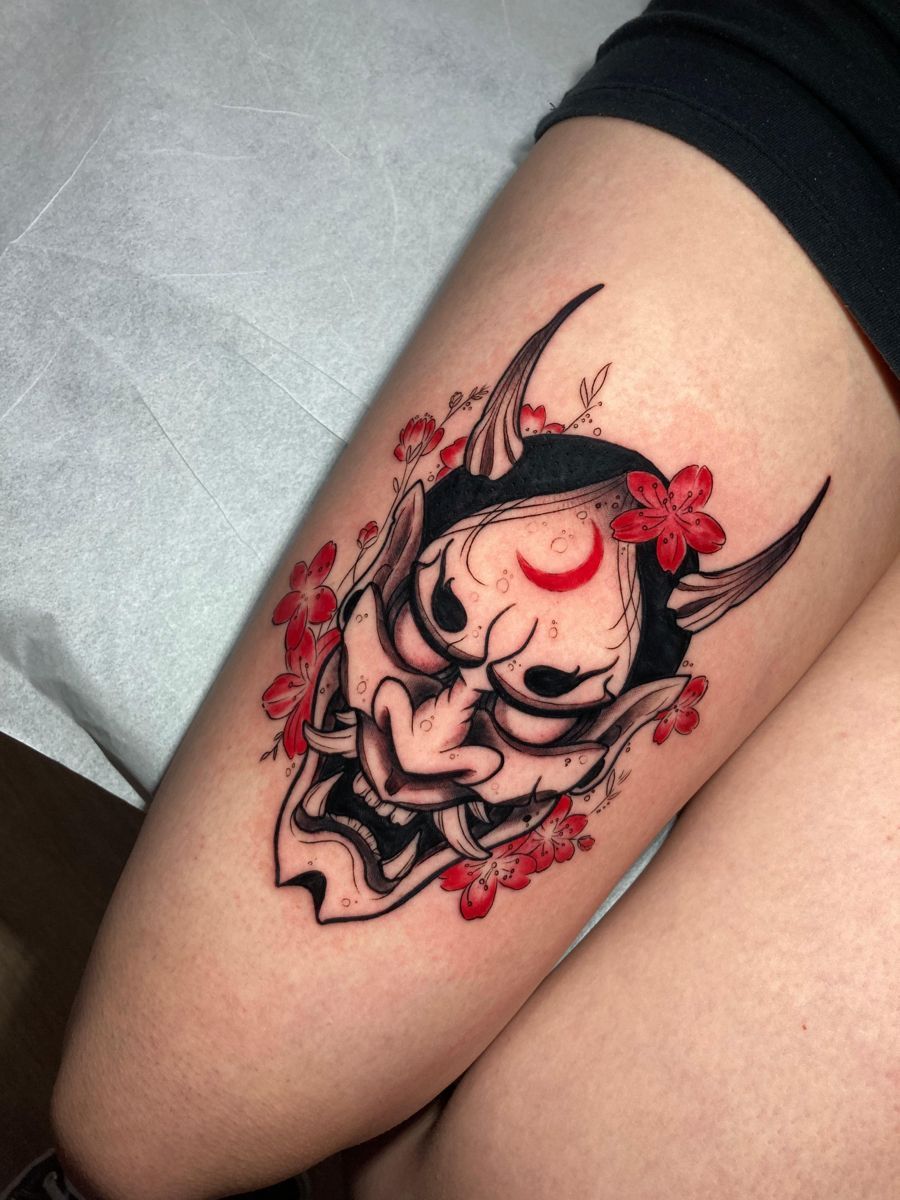
Another Oni appears here, but the mood is entirely different. The mask dominates the thigh, stretching vertically with exaggerated brows, flaring nostrils, and an open mouth frozen between a growl and a scream. Dark, almost velvety black fills the eye sockets and horns, while delicate red blossoms and petals scatter around, adding a strange tenderness.
This style is atypical of Decorative/Neo-Chronicle Japanese design. The mask takes inspiration from styles in classic woodblock prints, with black and red modern colors and sharp outlines. This minimalist design, with one or two primary colors, is favored by many in the field, including Horitaka and Gakkin, and is arguably the most effective.
The meaning of the Oni mask design for women is of female empowerment—it does not signify ‘evil’ in this case but rather emotional authenticity and the honest, sometimes unpleasant, refusal to be sweet. The juxtaposed flowers suggest the idea and reality of the body holding vulnerability and rage simultaneously.
Thigh placements are versatile style-wise. This piece shines with high-waisted shorts, split skirts, or summer dresses with a side slit where the mask flashes as you move. For colder seasons, sheer tights let the red blossoms show through without fully revealing the design. If the wearer ever wants to extend it into a full sleeve down the leg, there’s plenty of space to add waves, clouds, or even a dragon coiling around the mask.
Dragon and Peony Shoulder Crest
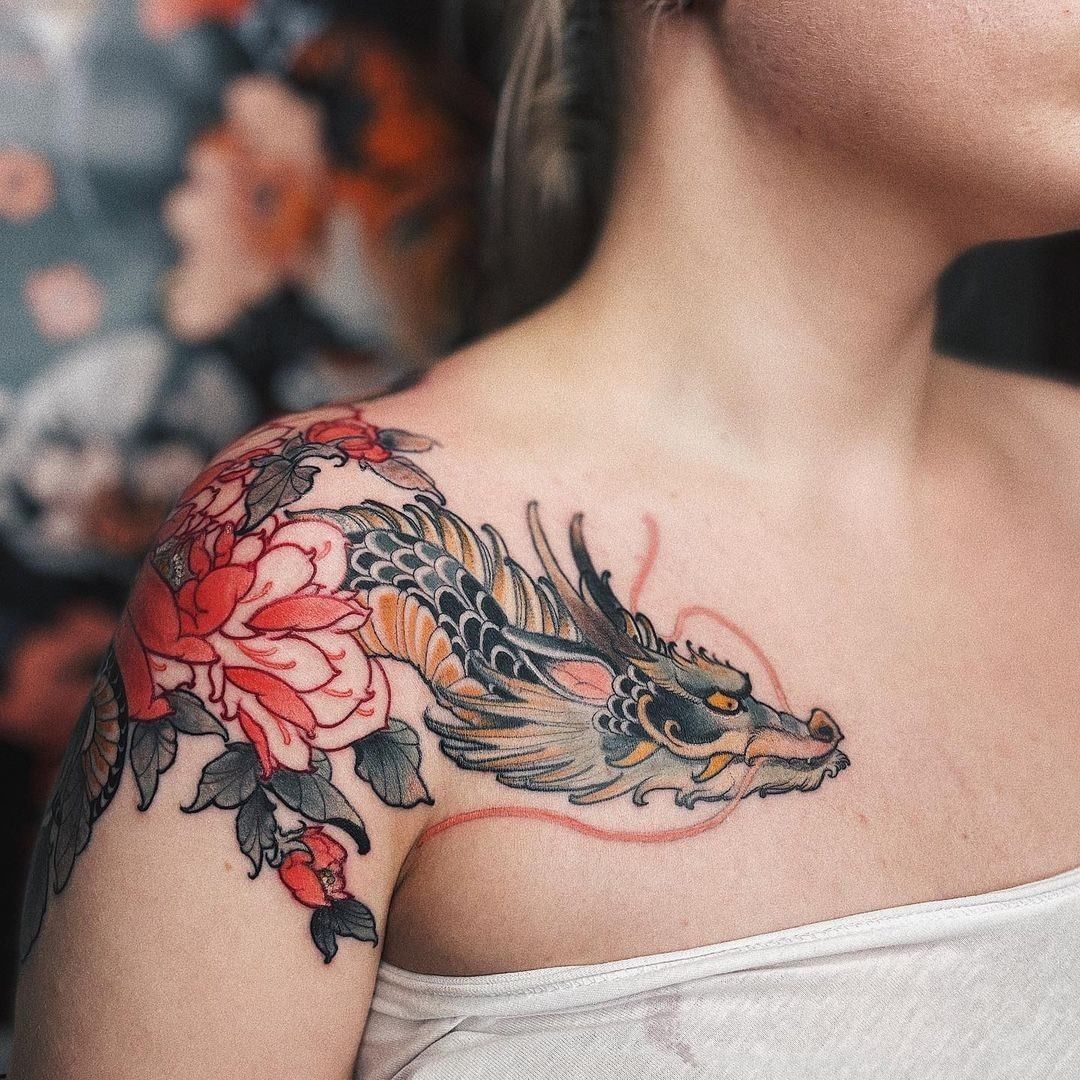
Here a dragon’s head snakes across the shoulder, jaw slightly open, whiskers flaring back with the curve of the collarbone. Scales in muted black and grey provide the creature weight, while rich red peonies spill across the shoulder cap and upper chest, their petals overlapping the dragon in places.
Dragons are perhaps the most iconic Japanese tattoo designs, symbolizing wisdom, protection, and natural forces like storms or oceans. This one doesn’t roar; instead, it glides forward with focused intent. The composition makes clever use of the body: the dragon’s snout leads toward the wearer’s throat, while the blooms emphasize the roundness of the shoulder.
From a technical perspective, it’s very much in the traditional camp—bold black, tight scales, and those flowing lines you see in classic irezumi by masters like Horiyoshi III. Yet the decision to keep the dragon mostly monochrome and let the flowers carry the color gives it a subtle, modern twist.
As a half-sleeve idea, this is perfect. It can stay as a shoulder crest that disappears under a tank top strap or grow into a full sleeve or full arm sleeve by extending the body of the dragon down the arm with more florals and wind bars. Styling is easy: off-the-shoulder knits, camisoles, or even structured blazers with nothing underneath create that frame of fabric around the art, drawing attention exactly where the wearer wants it.
Ornamental Fullback Floral Armor

This is the most ambitious piece in the set: a sweeping Fullback design that climbs from the lower spine to the shoulder blade and spills onto one arm. Dense black shapes curve like armor plates, filled with stylized florals and leaves in dusty oranges and blues. Vertical columns of script break up the flow, echoing the pillars of old temple inscriptions.
Full back tattoos in the Japanese tradition are all about commitment. Historically, they were worn under clothing like a secret second skin, only revealed in bathhouses or during festivals. This design honors that history while speeding confidently into the present—an almost abstract, negative-space take on classic bodysuits.
The solid black makes it read as a sleeve and back combination. On the arm, the motifs sweep forward, suggesting a future full sleeve or even full sleeve that could embrace the chest and opposite shoulder. For women, this style offers a powerful counterpoint to the delicate, minimal tattoos that dominate social media; it says, “I’m not here for a small accent—this is my exoskeleton.”
In terms of style advice, this kind of back piece changes how you perceive clothes. Low-back dresses, halter tops, or loose kimono-style jackets become part of the story, offering glimpses of floral armor as you move. Even a simple racer-back tank transforms into a frame for the artwork. It’s the sort of tattoo you could imagine on stage performers or fashion editors—people who think of their body as a moving gallery wall.
Fine-Line Fan and Dragon Tattoo for Girl
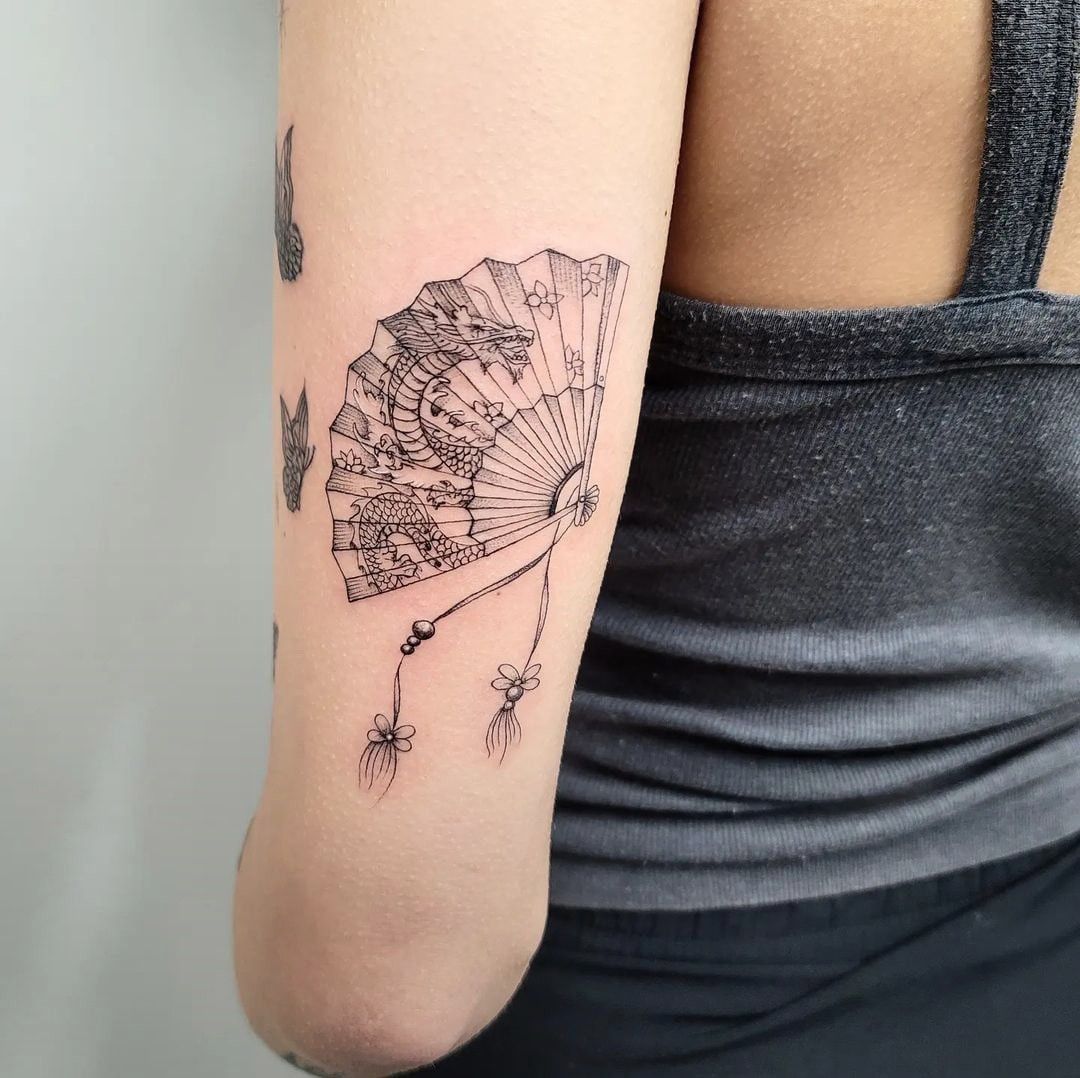
The final design is the most subtle, yet it conveys a powerful message. A dragon is curled in lazy S shapes throughout the sky and is surrounded by a stiff, curled folding fan, which opens slightly to the left at the back of the arm. The design is entirely in tiny, intricate black work, with the mountains and florals also depicted in fine line art, which makes for a very fine and delicate design and pulls the whole sleeve and back piece together beautifully.
For a fine jewelry shop vibe, tassels and beads hang from the handle. Earlier designs were all about being bold, but this one takes a different approach. It is a strong example of the modern fine-line wave of Japanese-inspired work that has gained a following among younger clients. Dragons, fans, and clouds (traditional iconography) remain core elements, just petite and simply stylized.
In Japan, fans symbolize elegance, celebration, and life’s unfolding. In the same culture, dragons symbolize power and protection. Thus, the tattoo invokes and represents the paradox of strength and grace, the former contained and the latter hidden behind a sophisticated design. It is a good tattoo option for a first (especially for girls) due to its subtle nature and narrative.
Because the lines are so clean, it’s easy to imagine the original stencil: a light sketch transferred carefully to skin, every tiny mountain and cloud in place before the needles ever touched down. Styling around this design is fun. Sleeveless tops, racer-back sportswear, or little black dresses with open sides let the fan flash whenever the wearer reaches for something. It pairs nicely with other small pieces too, acting almost like a centerpiece in a collage of fine-line tattoos along the arm.
Ghostly Geisha and Skeleton Thigh Piece
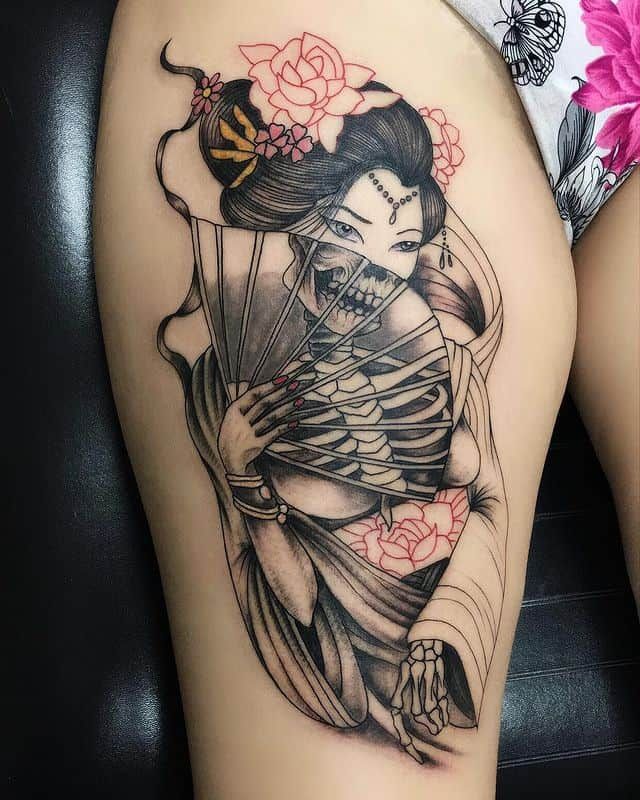
This piece straddles the border between elegance and horror in a way only Japanese neo-traditional work really can. A poised geisha holds an open fan, but as the eye follows the lines downward, her body dissolves into exposed ribs and skeletal fingers. The upper half of her face is flawless—coiffed hair pinned with a chrysanthemum, soft brows, delicate eyeliner—while the lower jaw is stripped back to teeth and bone. Pale pink peonies bloom around the head and hip, softening the shock.
It’s a tattoo with meaning about duality: beauty and decay, allure and danger in the same body. You’ll see similar narratives in prints of ghosts like Oiwa or Okiku, and modern opinion leaders in Neo Japanese tattooing often revisit these stories to explore themes of betrayal, resilience, and transformation. The fine black linework and selective use of muted color push this firmly into Neo-traditional territory rather than strict Traditional irezumi.
As a large thigh piece, it’s perfect for those who want something powerful yet easy to cover. Paired with a high-slit skirt or swimsuit, the geisha floats with the wearer, like a ghost moving in and out of the screen. This design also works well as the first chapter of a bigger leg sleeve; more spirits, snakes, or an Oni mask could intertwine with the thigh and calf later, completing a narrative.
Geisha Leg Design
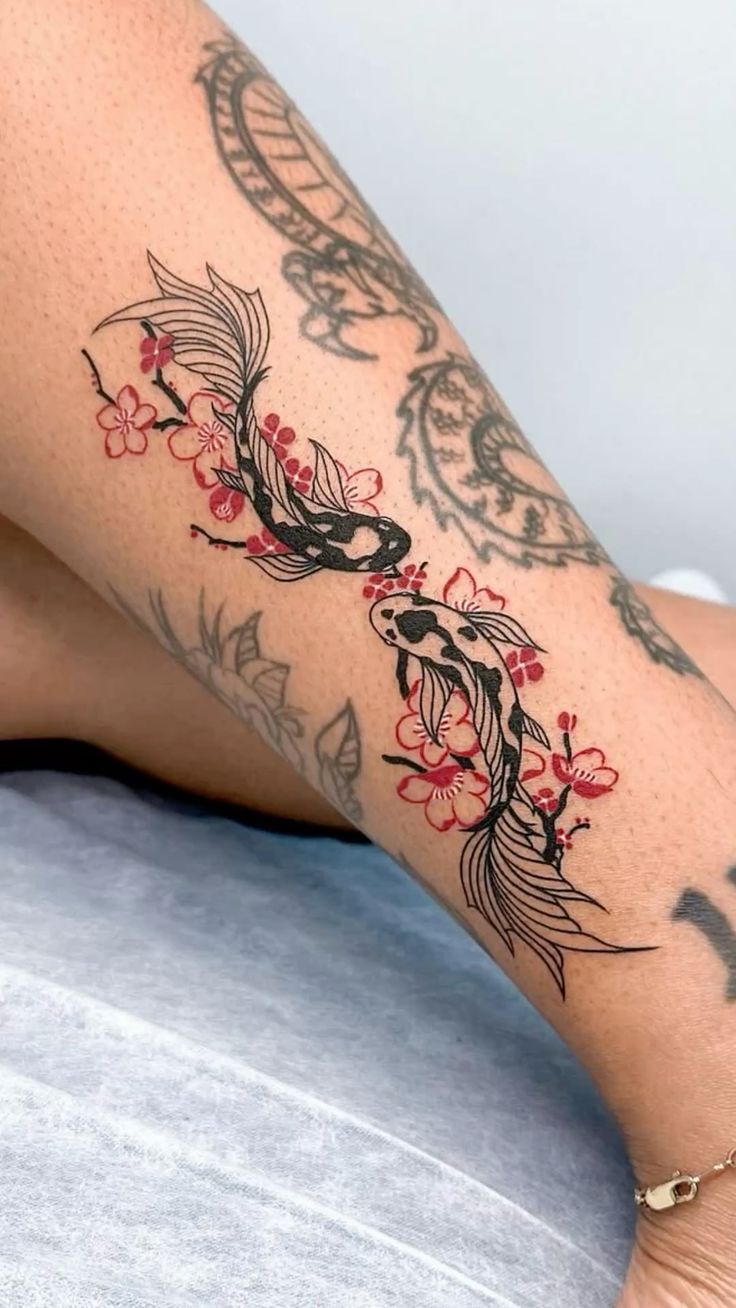
Now the energy shifts to something lighter and more fluid. Two koi fish spiral around each other along the shin, drawn in black ink with just enough detail to suggest scales and flowing fins. They’re separated by flowing red cherry blossoms and petals, which perfectly turn the negative skin tone into part of the composition. Koi are among the most traditional Japanese tattoo motifs, standing for perseverance, luck, and the courage to swim upstream. When paired like this—one facing up, one down—they often echo the idea of balance, like a subtle yin-yang.
It’s a design with meaning that suits both men and women, but there’s an especially graceful quality here that makes it a perfect option for girl clients looking for something romantic without being saccharine. The style sits between modern minimalism and classic irezumi: fewer background elements than a full sleeve, but still rooted in the same symbolic language. If someone is torn between a koi, a snake, or a tiger motif, this kind of airy composition shows how you can lean into softness without losing power.
On the styling side, this shines with cropped trousers, culottes, or midi skirts that stop mid-calf. Sandals, delicate ankle chains, and neutral tones let the black and red work stand out. As the wearer walks, the koi appear to swim with each step, which is really the whole point of putting such a flowing design on the leg.
Fine-Line Fan Landscape on Upper Arm
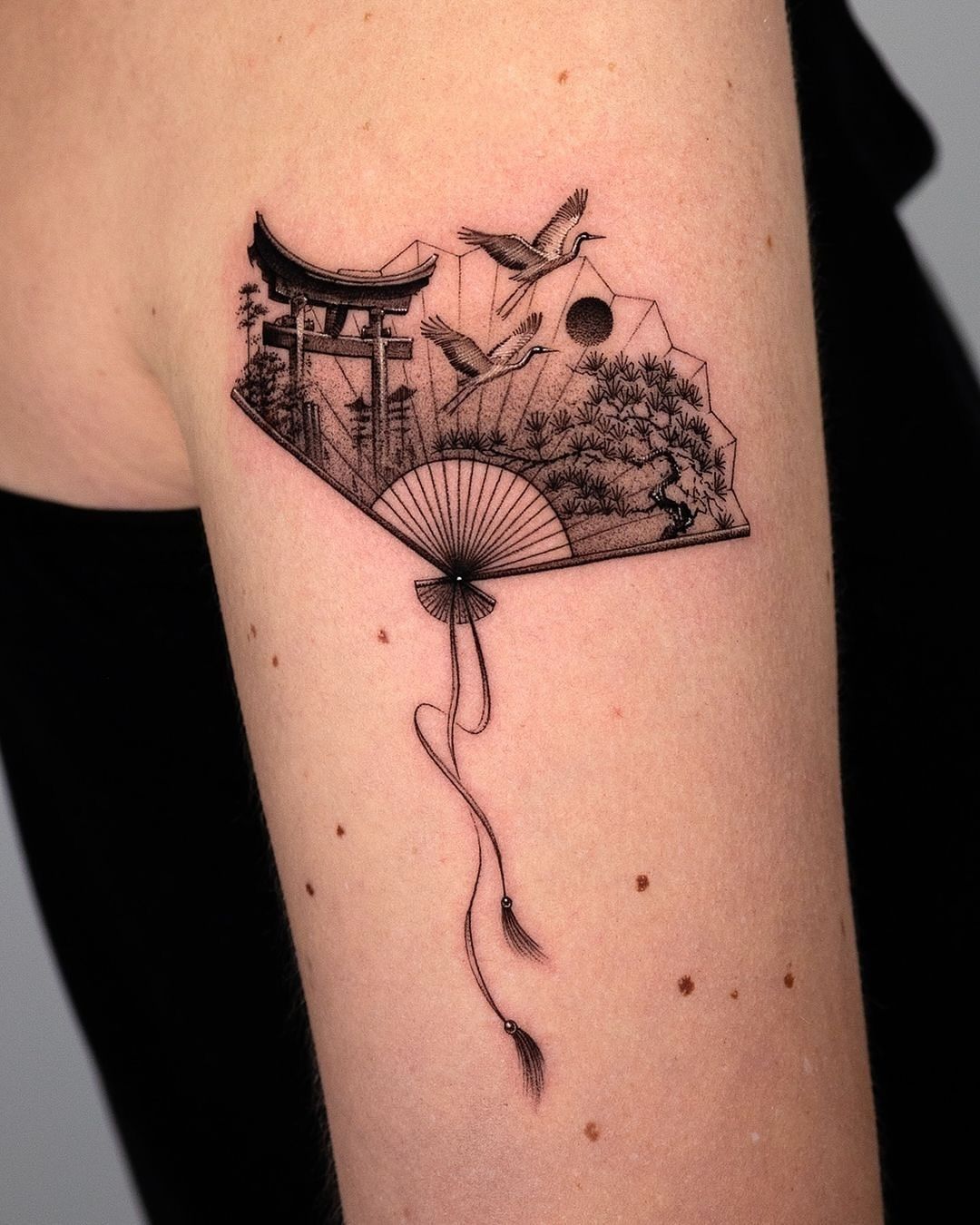
This design is a masterclass in restraint. A folding fan spreads across the upper arm, every rib and pleat rendered in fine stippled lines. Within its panels, a full landscape unfolds: a torii gate, distant mountains, pine trees, and a couple of cranes flying toward a rising sun. Long tassels trail below, as delicate as strands of silk.
You can almost imagine the original stencil pinned up in a studio: a precise, architectural drawing that demands a steady hand. It’s very much part of the modern wave of Japanese-inspired tattoos—minimal, almost illustrative—yet the content is deeply traditional. Cranes symbolize longevity and devotion, torii gates mark the boundary between the everyday world and the sacred, and the rising sun feels like a quiet nod to the country itself.
This kind of piece is ideal for women who want Japanese tattoo designs with meaning but aren’t ready to commit to a full sleeve or back piece project. It reads like jewelry, a charm worn high on the arm. Style-wise, it works brilliantly with sleeveless tops, fine-knit tanks, or tailored blazers rolled at the cuff. It’s subtle enough for a gallery opening or office meeting, yet rich enough that other tattoo lovers will recognize the references instantly.
Classic Floral Sleeve for Men
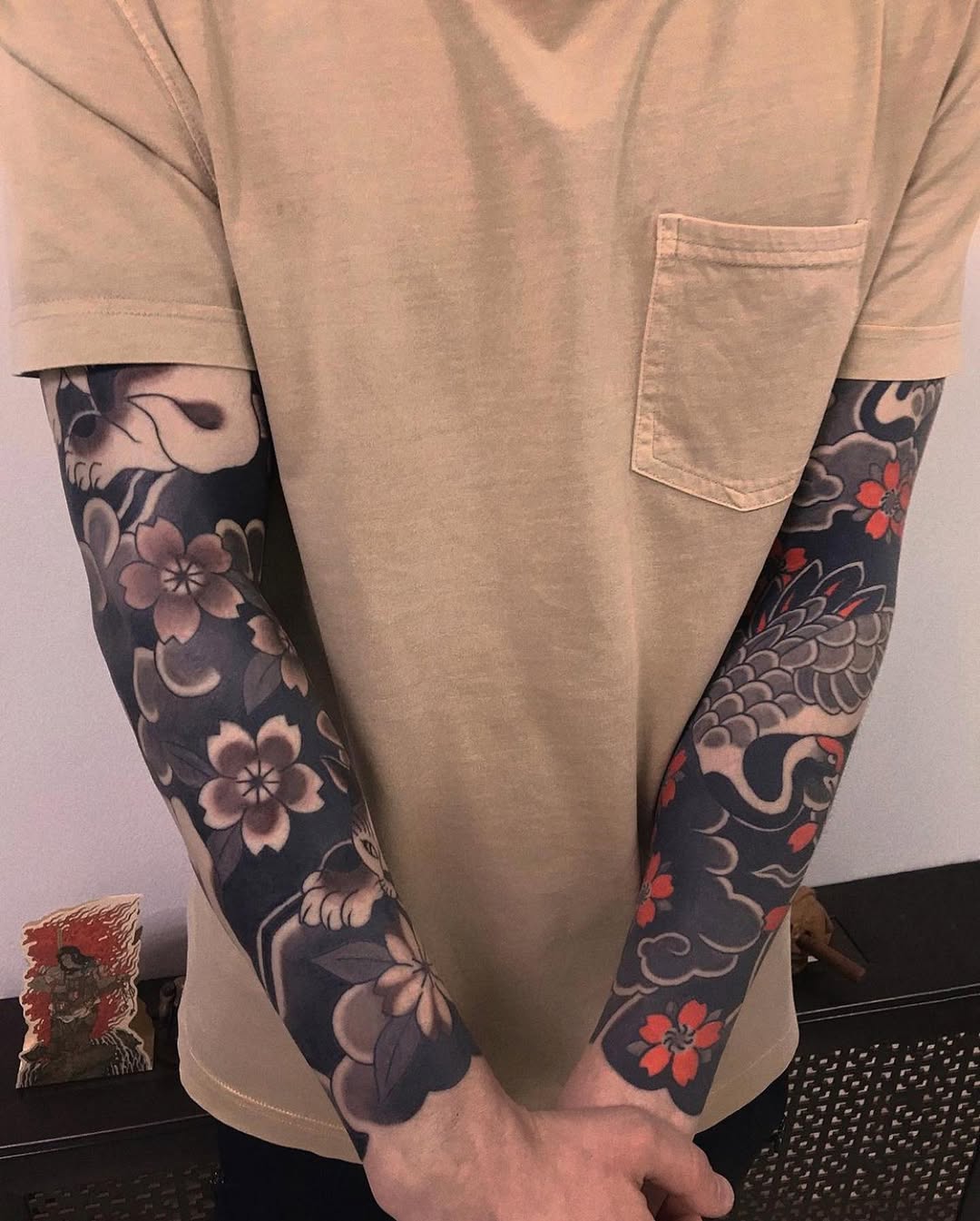
In this instance, the full sleeve tattoo is both arms, going into full sleeve territory (a level of commitment that is characteristic of Japanese tattoo.) Recently created, this illustration portrays dense sakura blossoms and leaves flowing from wrist to bicep, while the other arm is mostly floral with background nuances, what appear to be mythic creature (dragon) counterparts, and deep wind barring and negative space clouds scattered across the upper arm as it goes from bicep to shoulder.
This is a pure traditional Japanese school. Classic, heavy, deep black background as it goes to the arms side, leaving and floral forms into the muted red and cream wrist barring. These sleeve tattoos are of the caliber that you would expect of handcrafting from seasoned artists, the kind that would eventually be featured in top-profile sites such as Tattoo Life or documentations on iconic irezumi. The composition wraps the forearms in a way that makes them feel like fabric sleeves rather than discrete patches.
For men who like understated clothes, this kind of full arm sleeve is a dream. A soft beige T-shirt, an Oxford shirt with rolled cuffs, or a simple denim jacket are all you need; the tattoos become the statement piece. The design also makes sense for anyone thinking ahead to a full bodysuit—there’s room to connect the arms to chest panels, a fullback, or even a tiger or snake motif later without stylistic clashes.
Black and Grey Waterfall Full Arm Sleeve
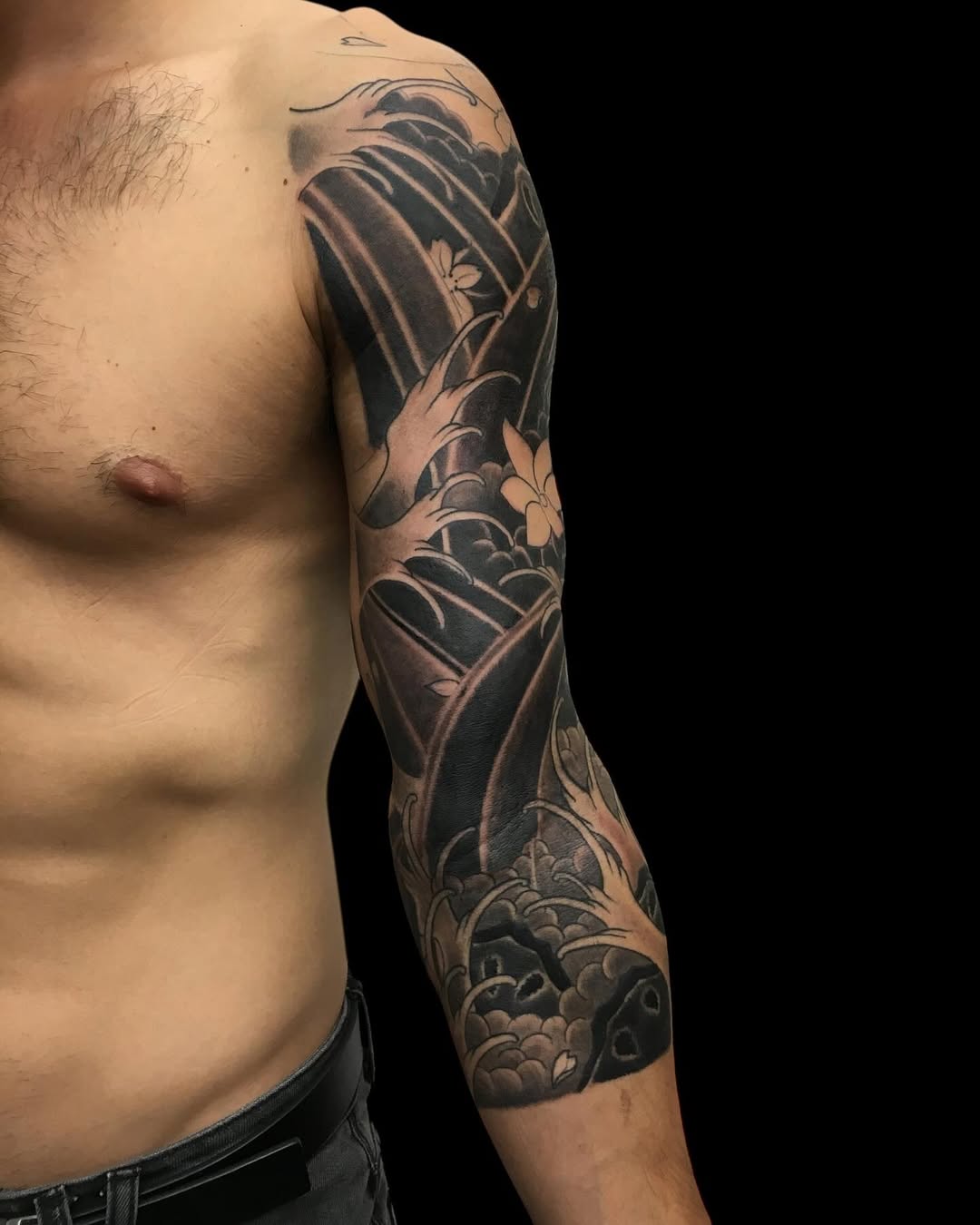
This piece shows how powerful a monochrome Japanese tattoo can be. Heavy black panels carve out a dramatic landscape of cliffs, falling water, and swirling waves that cascade from shoulder to wrist. Soft grey shading picks out rocks and sprays, while occasional blossoms act like pauses in the roaring movement.
Although it’s purely black and grey, the composition is completely traditional: flowy, body-hugging, and engineered so every angle of the arm offers a new vignette. It reads as a full arm sleeve already but could easily have started as a half sleeve around the bicep and grown downwards—exactly the progression a lot of men choose when they realize how addictive this style can be.
This is a great idea for anyone who loves Japanese imagery but prefers an almost armor-like look rather than colorful florals. It pairs cleanly with tailored shirts, leather jackets, and dark denim. Roll up the cuffs, and the waves echo the folds of the fabric; throw on a tank, and the waterfall becomes the focus. For athletes or musicians, the bold shapes are visible even from a distance, which is crucial when you’re on stage or under bright lights.
Dragon Fullback for Women on the Beach
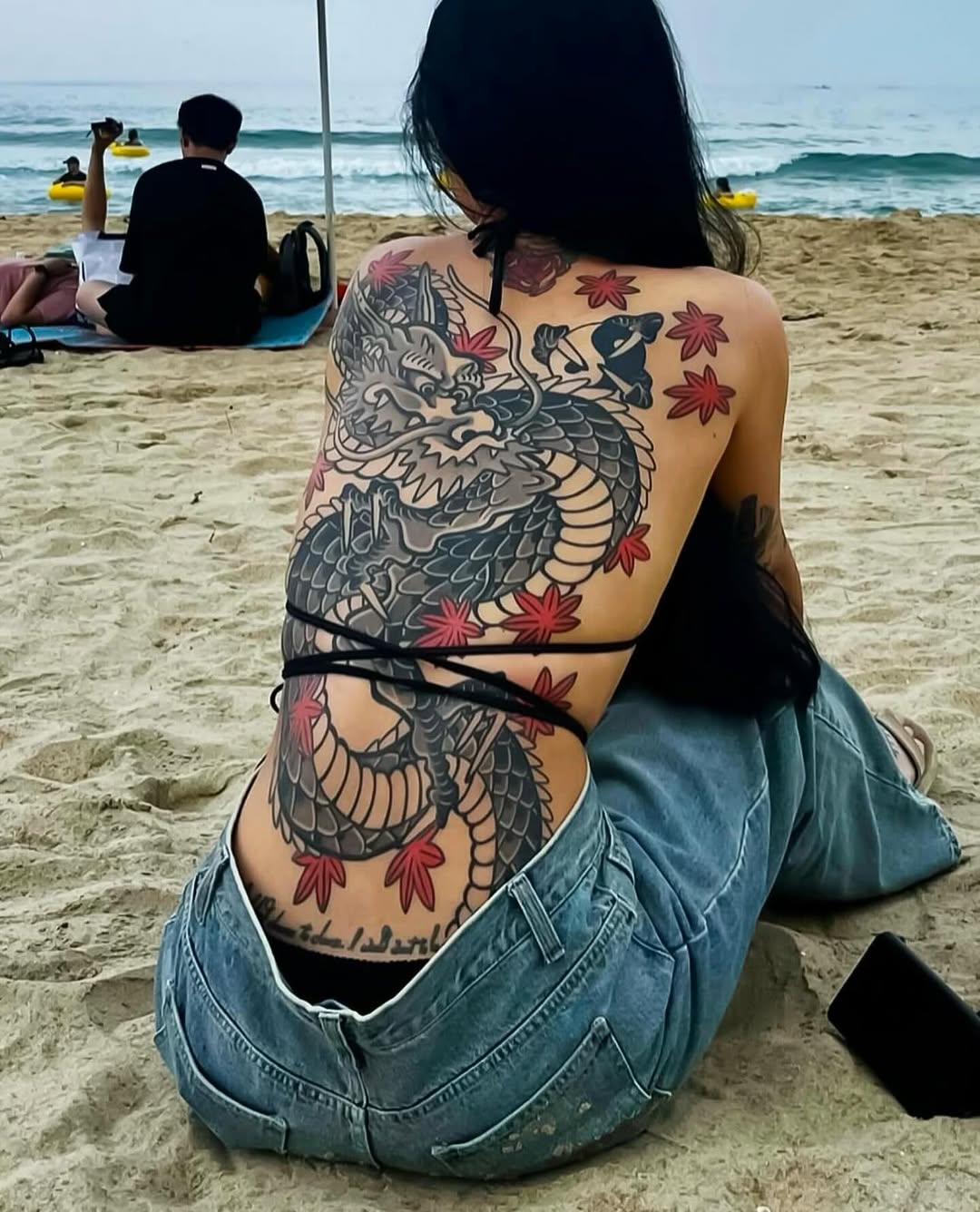
Few things look as effortlessly cool as a Japanese fullback dragon revealed at the beach. Here, a sinuous dragon coils from the lower spine up to the shoulder blades, its body tiled with grey scales and edged with sharp fins. Red maple leaves scatter around it, tumbling down the back and sides like autumn caught in a gust.
Dragons are the marquee characters of Japanese tattoo designs, and this one hits all the right notes: a fierce expression, flowing whiskers, and a body that twists to match the natural curves of the back. Against the sand and sea, it almost feels like armor, a living creature wrapped protectively around the spine. For women who choose such a large back piece, there’s usually a strong personal story—maybe about surviving something hard, stepping into power, or claiming space in a world that often tries to make them small.
Clothing choices become part of the ritual. Strappy bikinis, backless tops, or low-slung jeans let the Dragon breathe and show off the full-back composition. For city days, a loose open-back blouse or a blazer worn over a bralette offers a more subtle reveal. If anyone is torn between a dragon or a tiger for their major back project, seeing how beautifully this design frames the waist and shoulders often tips the balance in favor of the dragon.
Colour-Packed Neo-Traditional Dragon and Koi Full Sleeve
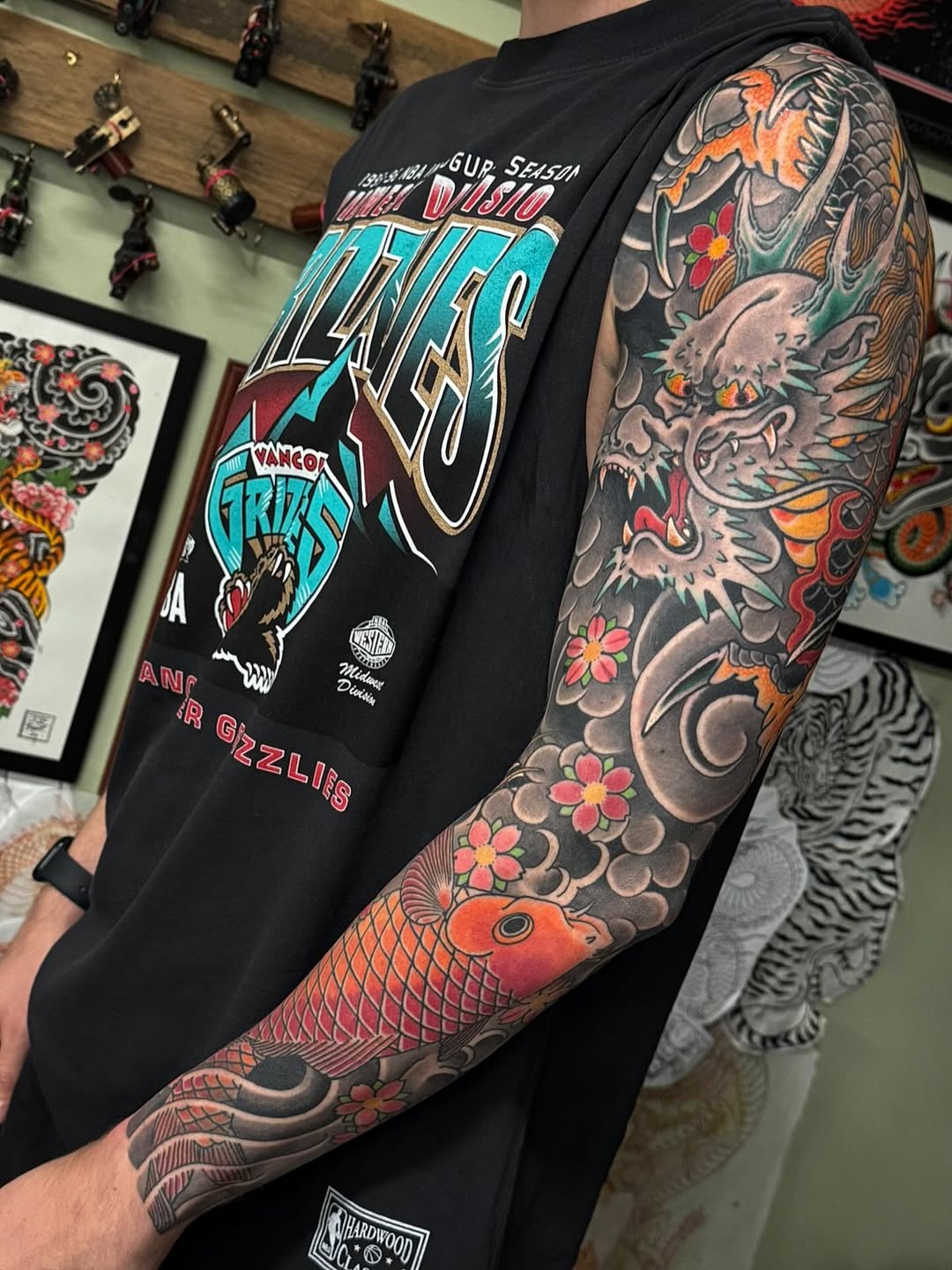
The last design is an explosion of color and movement. A full sleeve runs from shoulder to wrist with a snarl of mythic creatures: a raging dragon near the shoulder, jaws open, and a vivid orange koi swimming along the forearm. Gray clouds and wind bars weave everything together, while cherry blossoms and petals pop in pinks and reds.
This is Neo-traditional Japanese at its most confident. The artist keeps the composition and motifs faithful to classic irezumi but pushes the saturation, sharpens the contrasts, and leans into almost comic-book energy. It’s the kind of work you often see celebrated on contemporary platforms like Tattoodo or by artists who bridge American traditional and Japanese influences—taking cues from old masters while adding a bit of new-school swagger.
For men who want a full sleeve with meaning, the dragon-and-koi pairing is rich territory. Traditionally, a koi that swims upstream and transforms into a dragon stands for ambition and overcoming obstacles. Wearing both on one arm is like wearing the “before and after” of your own transformation story. If someone ever wants to add a tiger or snake on the opposite arm, the symbolism of strength and cunning across both sleeves can be very intentional.
Styling is straightforward: sleeveless band tees, cut-off hoodies, or even a clean white oxford with the sleeves rolled right to the elbow. The colors hold their own next to bold streetwear graphics, but they also look striking against neutral outfits. When the wearer crosses their arms, the koi and dragon almost meet, turning the whole chest-and-arm area into one big moving mural.
Storm Dragon Full Arm Sleeve for Men
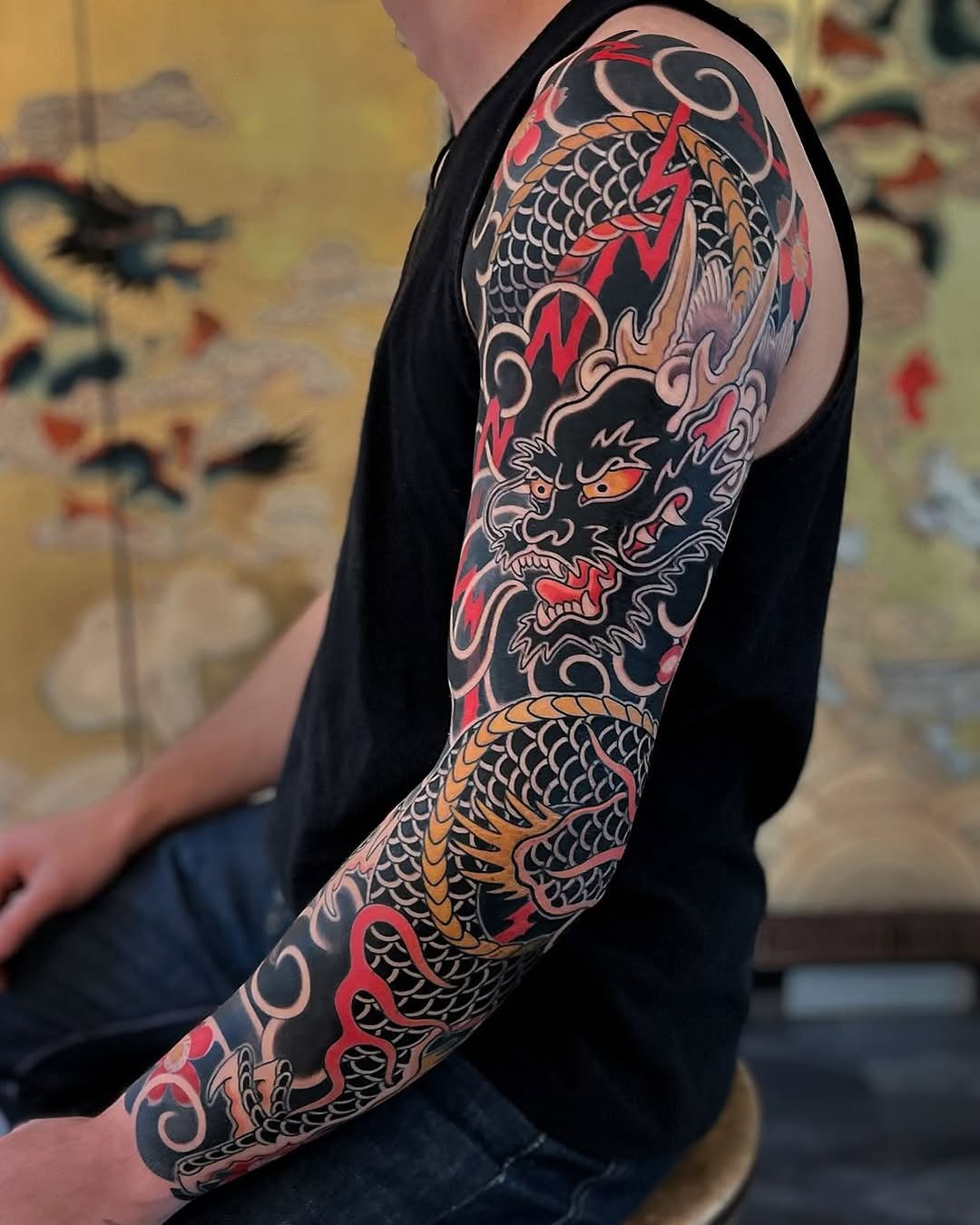
This is the kind of full sleeve that turns an arm into a weather system. A black dragon coils from shoulder to wrist, its scales tiled in tight, uniform rows, wrapped in swirls of wind and jagged red lightning bolts. The head explodes across the upper arm: yellow eyes locked forward, whiskers flaring, and jaws open as if it’s about to roar right out of the skin.
It’s classic traditional Japanese school in structure—heavy black background, bold color, and massive readability from across the room—but the high-contrast palette and lightning give it a neo-traditional punch. Think of the way artists like Shige or Gakkin build depth with almost poster-like color blocking; this sleeve lives in that same universe.
Symbolically, the dragon is the ultimate protector, a figure of wisdom and raw power. Wrapped around a man’s arm like this, it feels like armor, especially with the storm motifs suggesting that the wearer is comfortable walking straight into chaos. It’s a design with meaning for anyone who’s fought through their own “bad weather” and come out stronger.
Outfit-wise, a simple black tank or a rolled-sleeve hoodie is all it needs. The full arm sleeve becomes the main accessory, so keep prints on clothing minimal. Dark denim or straight-cut trousers keep the focus on the swirling reds and golds running from shoulder to wrist.
Soft Birds and Koi Sleeve for Women
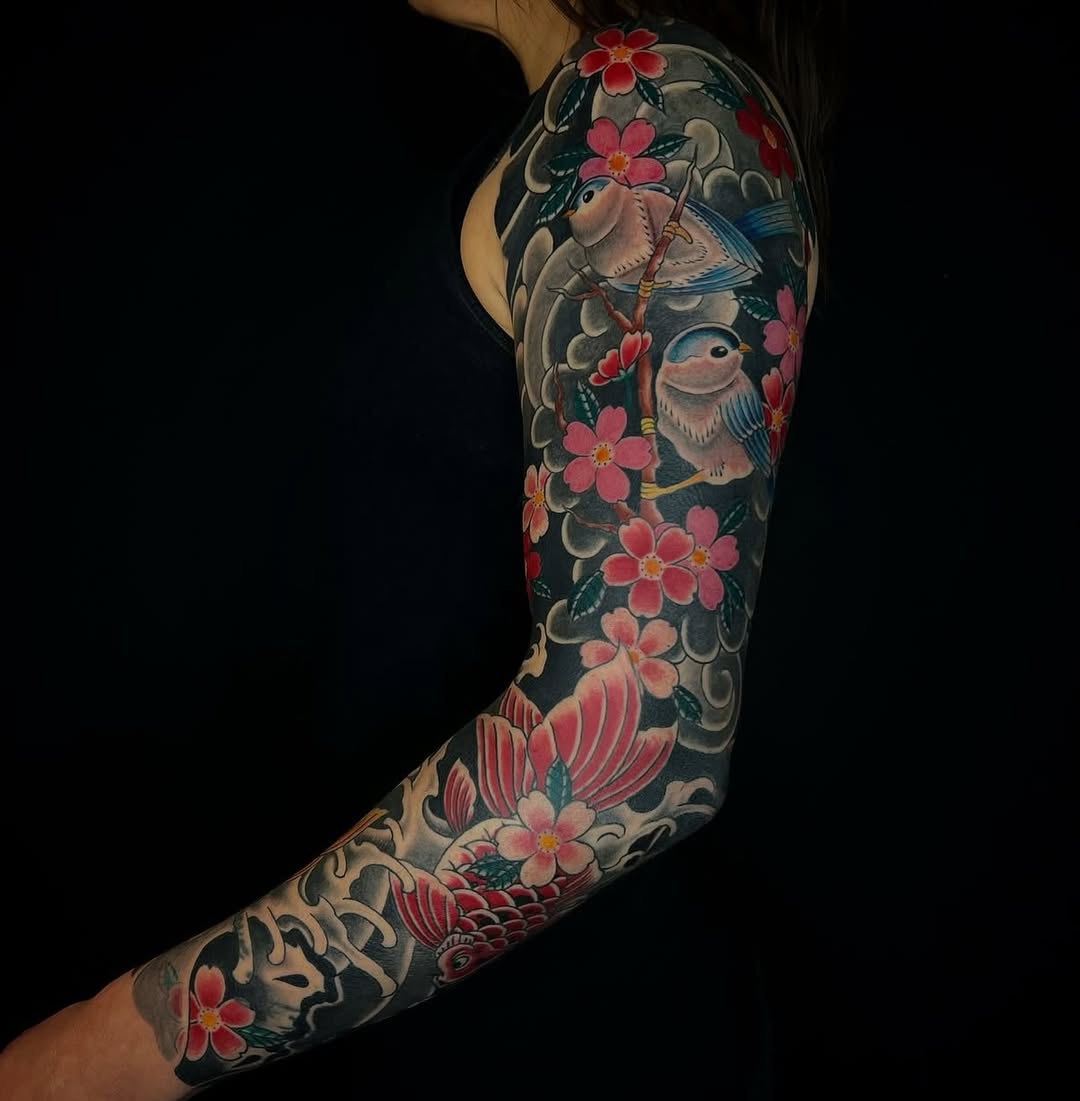
Not every Japanese sleeve has to be about demons and dragons. Here, the entire arm is wrapped in a night garden of cherry blossoms, soft grey clouds, and gentle birds perched on branches. Near the forearm, a koi fish glides upward through the same water and wind currents, its fins echoing the petals above.
This shirt is a beautiful example of a full sleeve for women that keeps all the traditional structure—background clouds, layered motifs, flowing composition—but softens the mood with pastel pinks and tender blues. The mix of birds and koi gives the piece a layered symbolism: freedom and grace meeting perseverance and luck. It’s almost like a visual diary of someone who has learned to move gently through a tough world.
From a style point of view, the design is the kind of sleeve you see on fashion-forward creatives in Tokyo: powerful, but not aggressive. It works with dark camisoles, ribbed tank tops, or even oversized knit jumpers pushed to the elbows. Pair it with delicate jewelry rather than heavy metal; the tattoo already does the talking.
Dragon and Koi Full Leg Sleeve
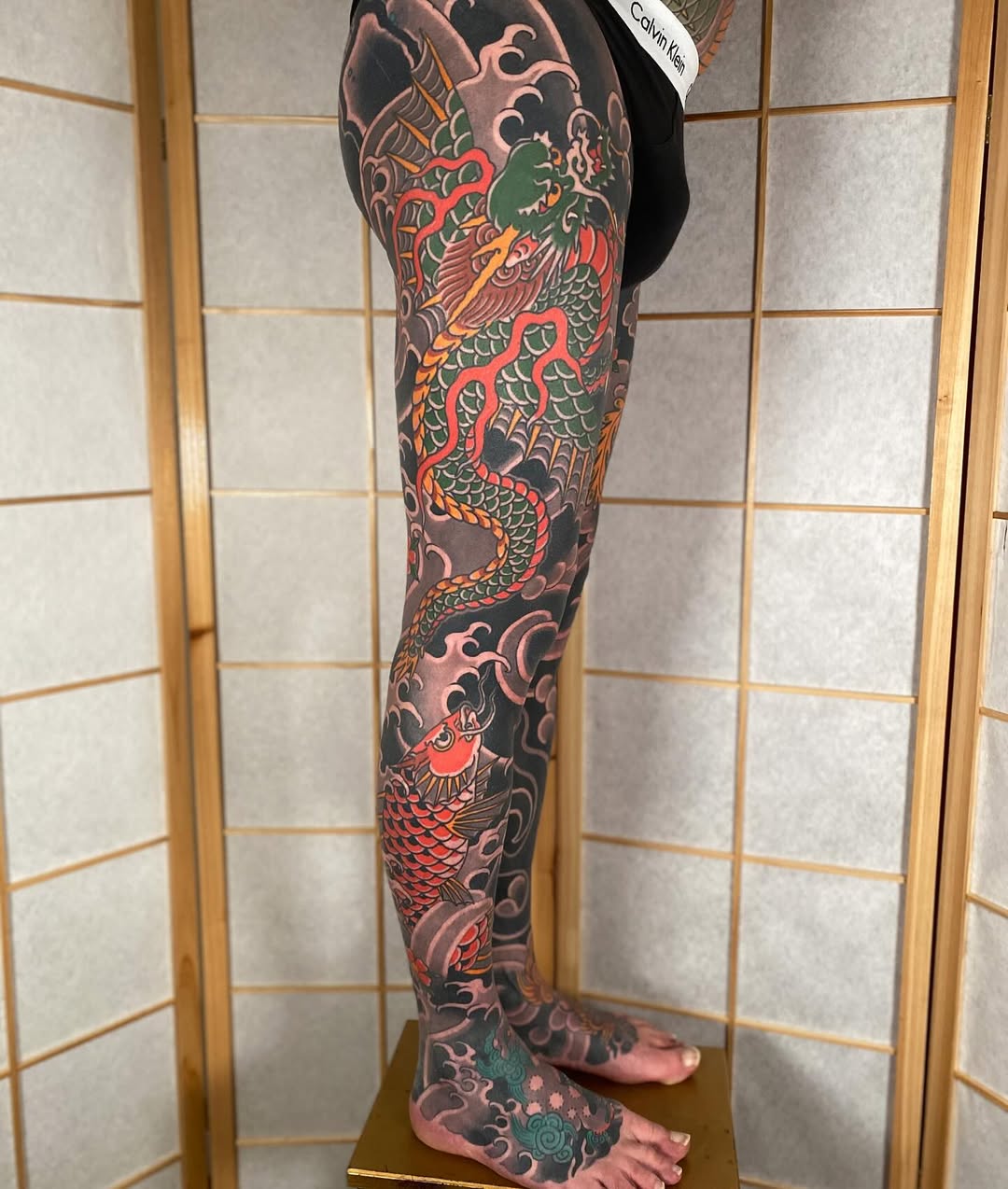
Here the Japanese obsession with balance spills over an entire leg. A long green dragon runs from hip to ankle, spine twisting so that its head guards the thigh while the tail snakes down toward the foot. Around the shin, a bright red koi swims through the same current of waves and wind bars, tying the story together.
This garment is essentially a full sleeve, just on the leg instead of the arm. The coverage is near-total—thigh, knee, calf, and foot wrapped in black and grey backgrounds with bursts of orange, red, and green. Traditional rules are followed closely: big shapes, clear negative space, and a clear hierarchy of characters. The dragon commands the narrative, the koi plays the role of the striver, and the swirling water fills every gap without ever feeling crowded.
For outfits, this kind of legwork changes everything. Shorter hemlines suddenly make sense: tailored shorts, yukata-style summer robes, loose gym shorts, or swimwear that lets the entire composition breathe. It’s equally striking under ripped jeans, where flashes of color at the knee or ankle hint at the story underneath.
Samurai Story Half Sleeve on Men’s Arm
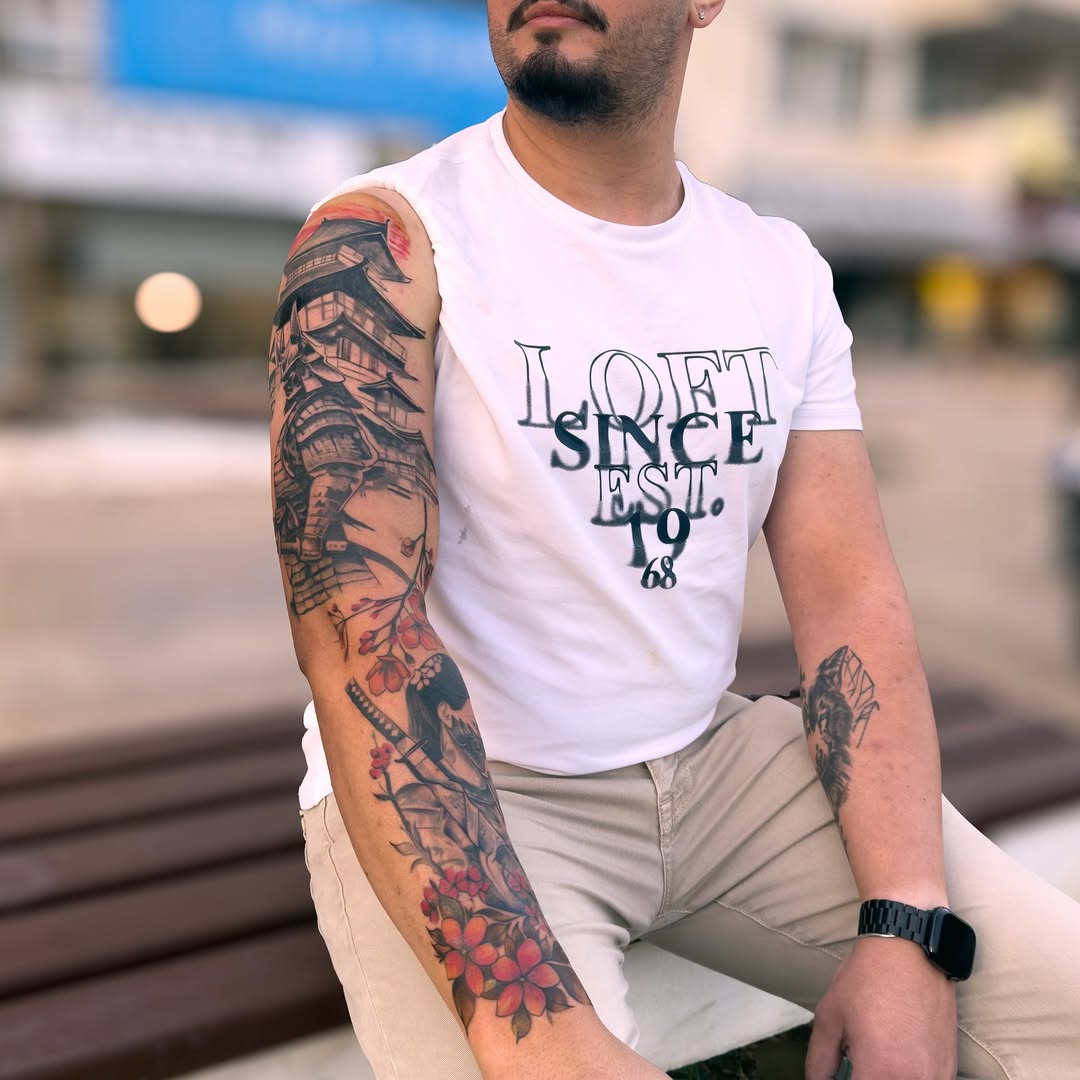
This arm shows how a half sleeve can still feel like a complete story. From the shoulder to mid-forearm, there’s a vertical narrative: a tiered Japanese temple rising on the upper arm, a katana and samurai elements along the mid-section, and blossoms drifting downward to the wrist. The color palette stays controlled—muted reds, browns, and soft blacks—giving the piece a slightly weathered, cinematic look.
It sits somewhere between modern illustrative work and neo-traditional Japanese. The linework is crisp and sketch-like, but the clouds and blossoms still nod to the old masters. For men who want Japanese tattoo ideas with meaning but aren’t ready for a full sleeve, this sort of composition is ideal. It can later be extended into a full arm sleeve by deepening the background and adding more narrative elements around the elbow and inner arm.
Styling is easy: sleeveless or rolled-sleeve T-shirts, casual chinos, and white sneakers. The design plays well with graphic tees because it reads like another panel of illustration instead of fighting the print on the shirt.
Script and Clouds Men’s Forearm Piece
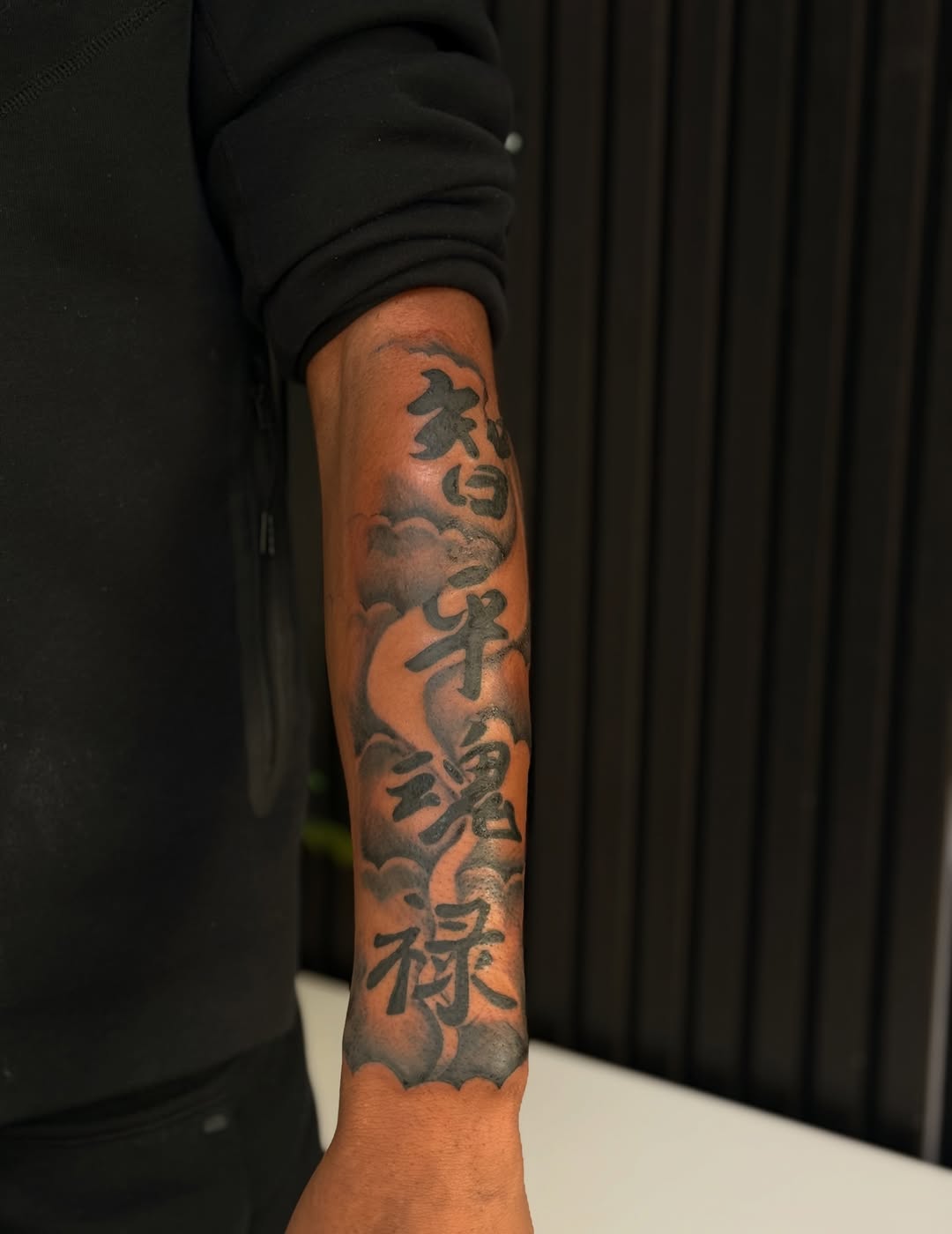
Occasionally the most powerful statement is a single column of words. This man’s forearm tattoo runs vertically from wrist to elbow, with bold black kanji characters framed by swirling grey clouds. While the letters stand alone, the cloud background anchors them in traditional Japanese visual language, akin to the integration of lettering in classic fullback suits.
Because the script likely carries a personal motto or blessing, the result is a design with meaning that doesn’t rely on mythic beasts or weapons. It’s contemplative, almost meditative—a reminder that Japanese tattoo culture isn’t only about spectacle.
For styling, this forearm piece loves simple, fitted long-sleeve tops that can be pushed up when the wearer wants to reveal the text. A black hoodie or bomber jacket keeps the focus on the contrast between skin, ink, and fabric. It also layers nicely with a watch or bracelet, framing the characters rather than competing with them.
Tiger and Oni Mask Shoulder Half Sleeve
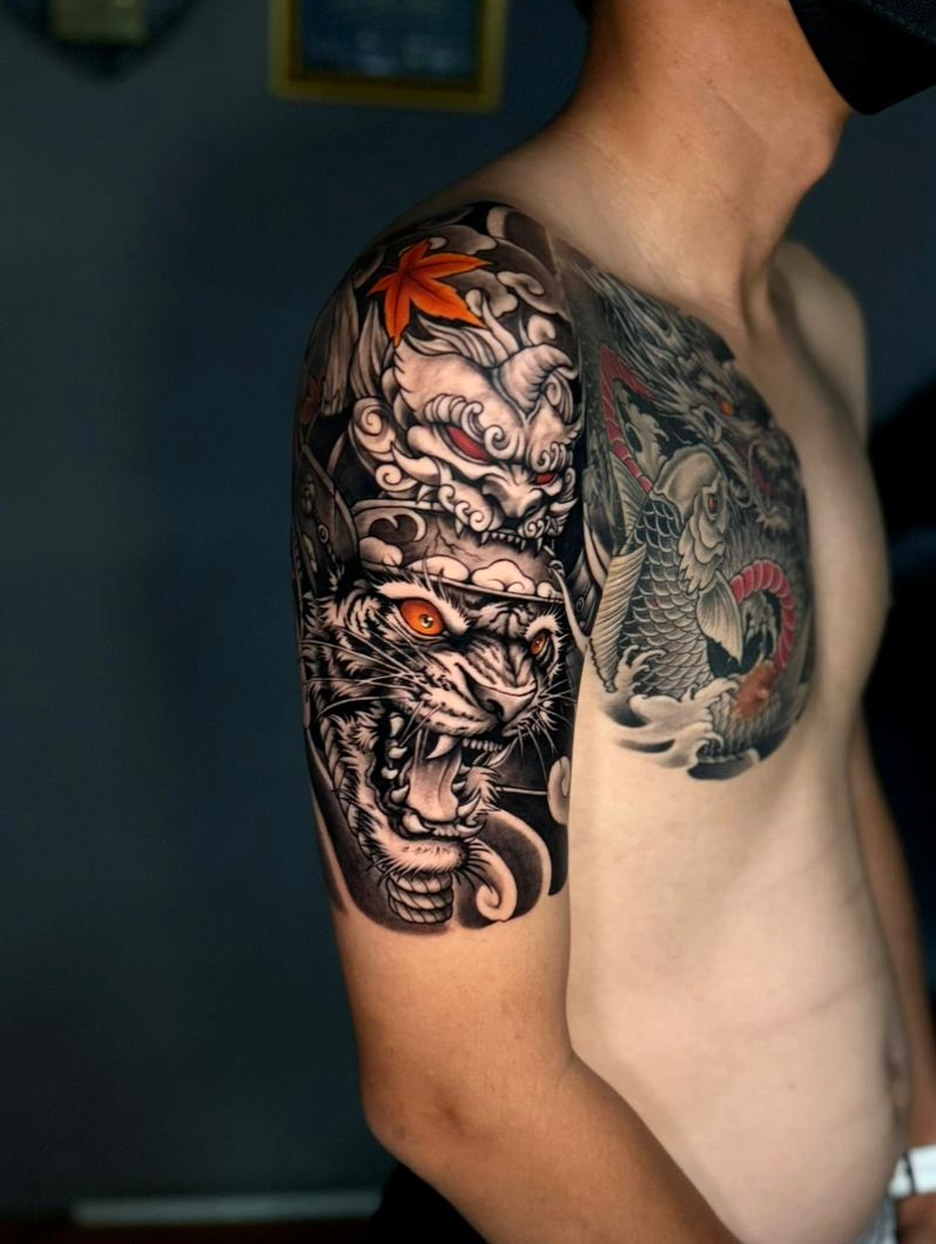
Here, a snarling tiger bursts from the upper arm, jaws open, eyes burning orange. Above it, an Oni mask peers out from a storm of clouds, one maple leaf resting nearby like a paused moment of autumn. The whole piece occupies the shoulder and upper bicep—technically a half sleeve—but it has the density and drama of a much larger tattoo.
In Japanese tattoo mythology, the tiger stands for strength, courage, and instinct, while the Oni mask can represent both danger and protection. Put together, they form a kind of spiritual bodyguard: brute force and supernatural watchfulness sharing the same patch of skin. This is a perfect neo-traditional mash-up—crisp modern shading, but faithful to traditional forms.
Outfit-wise, it’s made for sleeveless gym tops, singlets, and open-sided tanks. The artwork sits exactly where a tailored T-shirt sleeve would end, so choosing tops that skim just above the bicep lets the eyes catch that flash of teeth and horn as the arm moves. For anyone planning a larger chest or back project, this design is a strong anchor on the corner of the torso.
Full-Body Japanese Bodysuit for Women
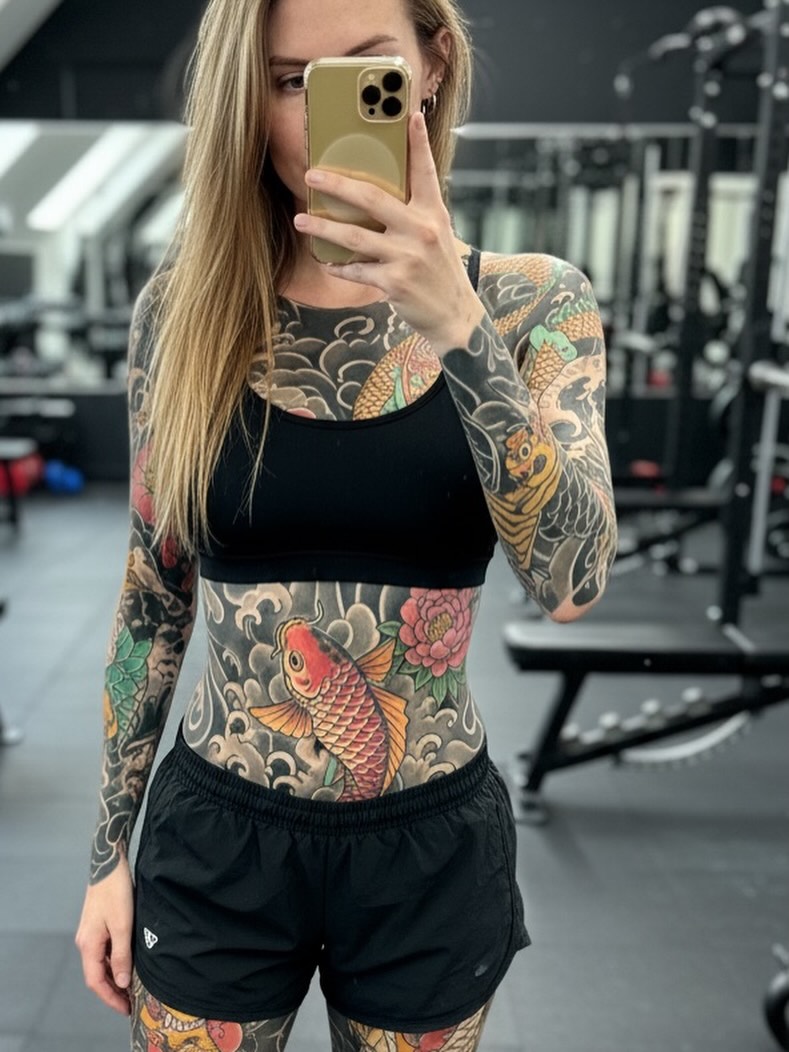
The final look is a commitment in capital letters: a near-total bodysuit of Japanese motifs wrapping the torso, arms, and legs. Across the stomach swims a large golden koi framed by grey waves and soft pink peonies. Dragons and more koi wind around the ribs and sleeves, stitched together with clouds and wind bars in the classic irezumi style.
This is the ultimate expression of traditional Japanese tattooing for women—part full back, part chest panel, and part full sleeve on both arms. This design could easily grace the pages of a Horiyoshi III book or a feature on Tattoo Life. Every element is placed to flatter the body: waves narrowing at the waist, koi curved to elongate the torso, and negative space used cleverly around joints so the design reads clearly even in motion.
In terms of style, the wearer treats athletic gear as a frame. A black sports bra and short running shorts allow the entire bodysuit to breathe while still feeling practical and modern. For everyday life, high-waisted jeans, cropped hoodies, or sheer tops create layers where flashes of scales and petals appear and disappear. It’s a look that rewrites the old idea that Japanese bodysuits are only for men; here, the canon of motifs—dragon, koi, peony, and waves—feels unapologetically for girl power.
Minimal Fan on Thigh with Rising Sun
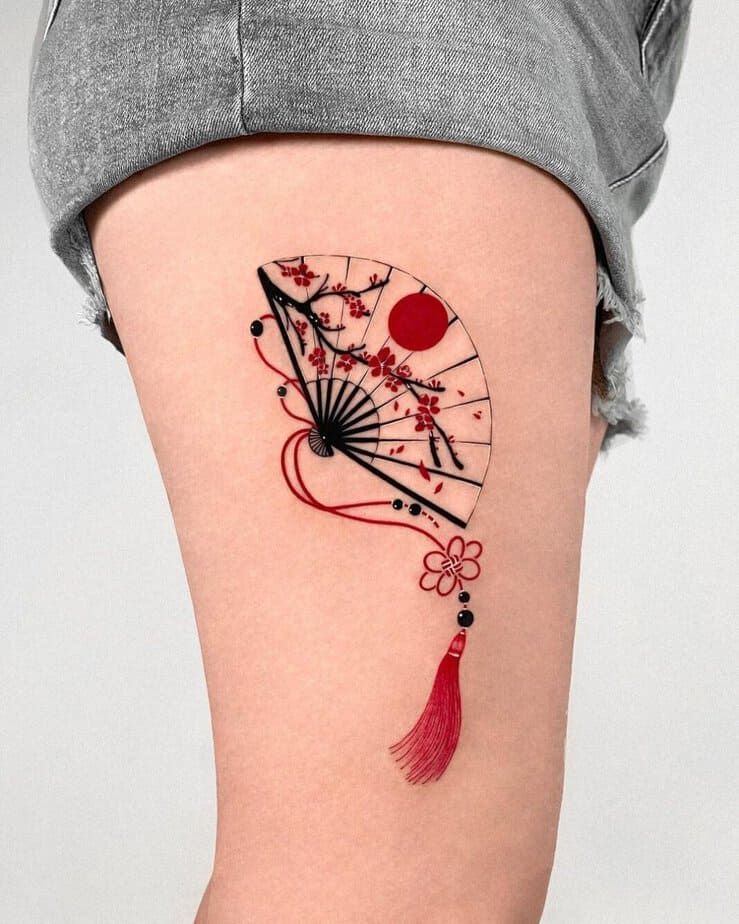
This design shows how Japanese tattoo ideas can be incredibly light and modern without losing their roots. A delicate folding fan opens across the upper thigh, its ribs drawn in clean black lines that look almost like a stencil. Inside, fine branches of sakura reach outward, dotted with bright red blossoms and petals. A solid red sun hangs in the corner of the fan, echoing the flag and quietly grounding the motif in tradition.
Below, a slim string of beads leads to a stylized flower and a long red tassel. The composition is vertical, which flatters the leg and adds a jewelry-like feel—more charm than armor. For women who want something elegant and feminine, this is a perfect tattoo for girl clients testing the waters of Japanese work. It’s a design with meaning about spring, renewal, and optimism, but it still feels playful.
Styling is easy: high-waisted shorts, wrap skirts, or a swimsuit cut a little higher on the leg will let the fan peek out when the wearer moves. The limited palette of red and black pairs beautifully with monochrome outfits or denim, and the motif works equally well as a starting point for a future half sleeve down the thigh.
Ghostly Musician: Neo-Traditional Yokai Scene

Here the mood turns darker and more cinematic. A kneeling figure in an ornate kimono plays a shamisen, but the upper body dissolves into mist and a long, snaking neck that ends in a disembodied head. The eyes are wide, the hair pinned back with old-fashioned combs and sticks; it’s inspired by traditional yokai illustrations where everyday women transform into spirits.
The style leans into Neo-traditional Japanese—bold outlines and black and grey shading, but enough fine detail in the patterns of the kimono to feel hand-drawn rather than rigid. The skull motif tucked into the robe and the coiling smoke make this a great sleeve or thigh piece for anyone fascinated by Japanese ghost stories. Artists like those featured on Tattoo Life often say these are their favorite designs because they allow so much storytelling.
On the body, it’s a strong thigh placement for both men and women. It works under loose shorts or a skirt, and when revealed, it always starts conversation. If the wearer ever wanted a full leg sleeve, more spirits, snakes, or an Oni mask could easily be added around this central character, turning a single haunting image into a full narrative.
Monochrome Chrysanthemum Full Sleeve for Women
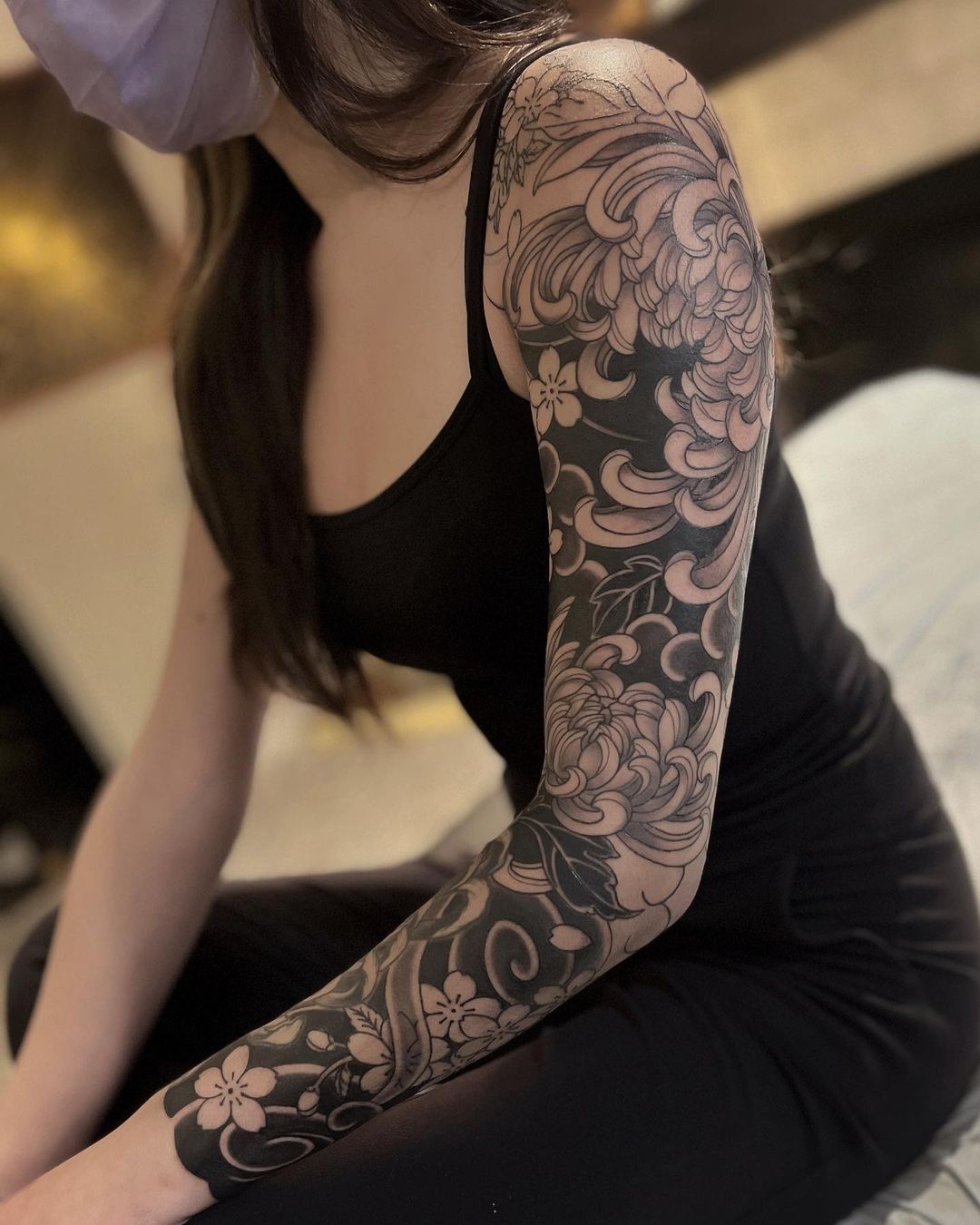
This full sleeve wraps the arm from shoulder to wrist in sweeping petals, leaves, and waves, all rendered in black and soft grey. Large chrysanthemums burst across the upper arm, their layered petals curling around the muscle, while smaller blossoms and scroll-like wind bars fill the gaps. Despite the heavy coverage, there’s a sense of lightness thanks to the careful use of negative space.
It’s textbook Traditional Japanese structure—big shapes, deep background—but the decision to keep everything monochrome gives it a sleek, modern editorial feel. This is the kind of sleeve you could imagine on a fashion stylist or musician, equally at home in a hoodie or a tailored blazer. For women who want a sleeve but prefer subtlety over bright color, it’s a powerful compromise.
Because the entire arm is covered, outfits become part of the composition. A black cami or one-shoulder dress turns the tattoo into an evening accessory; throw on an oversized blazer, and only the wrist florals show, like a secret. This style is also a great base for future additions—a chest panel or back piece can easily connect to the clouds and petals at the shoulder.
Pink Fan, Great Wave and Fuji Calf Piece
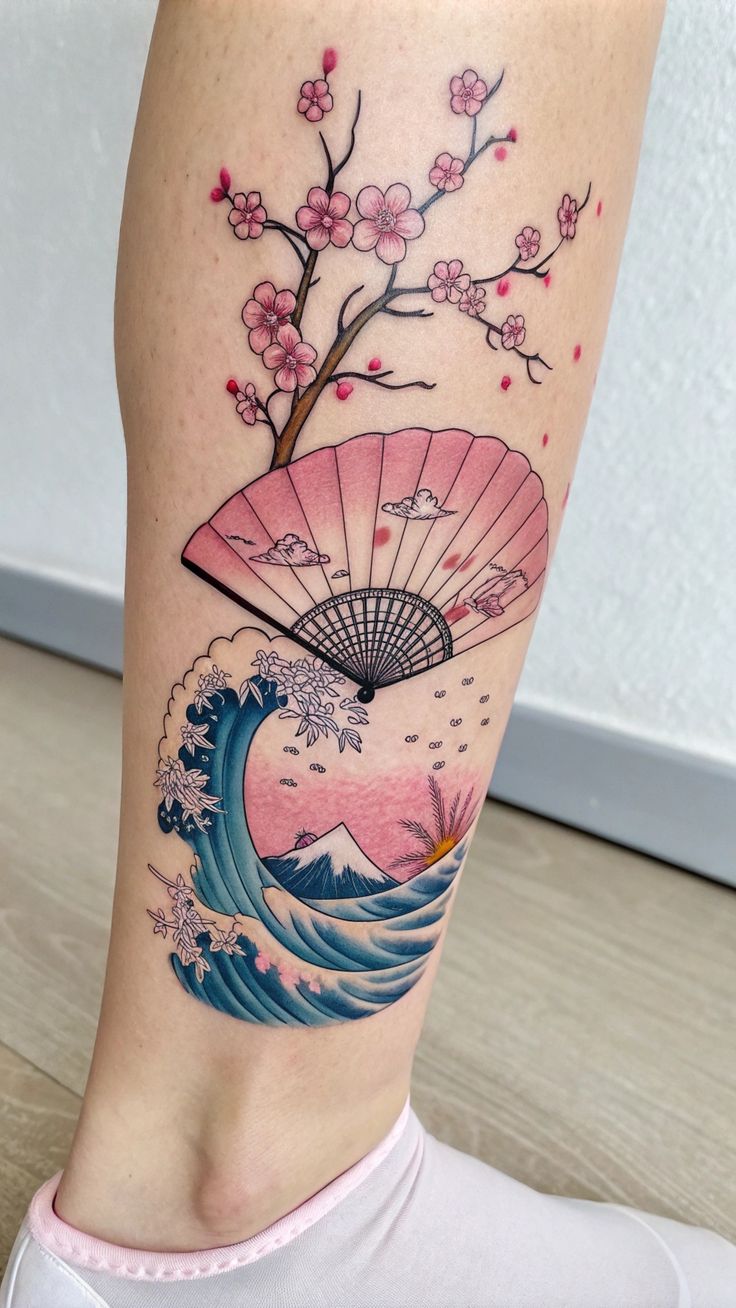
This design feels like a poster for a dream trip to Japan. At the top, a branch of cherry blossoms twists upward, bursting into clusters of soft pink flowers. Beneath it, a pink folding fan opens horizontally, carrying tiny clouds across its panels. From the bottom edge of the fan, a stylized wave crashes outward, its foam tipped with petals. Behind it, Mount Fuji rises above a pink sky, the sun just dipping near the horizon.
It’s a modern, neo-traditional composition that plays with depth: land, sea, and sky are all stacked in one vertical frame. The colors are bright and almost pastel, but the black outlines keep things firmly anchored in the Japanese school of tattooing. It’s the sort of piece you’d see celebrated on contemporary tattoo blogs as a perfect example of how to blend classic motifs into something fresh.
As a calf tattoo, it’s ideal for women who like story-driven pieces but don’t want a full sleeve yet. It pairs beautifully with low socks and sneakers, midi skirts, or culottes. And if the wearer ever dreams of a full leg sleeve, more waves or background clouds could easily grow around this piece like a frame.
Maneki-Neko Dotwork Charm

Few Japanese symbols are as instantly recognizable—or as charming—as the maneki-neko. Here, the lucky cat is rendered in soft dotwork shading, giving it a warm, velvety texture. One paw is raised in the traditional beckoning gesture, while the other rests on a stylized coin. A small bell hangs at the collar, and simple flowers frame the figure at the top and bottom.
This is a traditional motif drawn with a modern technique. The stippling, clean outlines, and restrained palette make it feel contemporary, but the meaning is timeless: prosperity, good fortune, and welcoming energy. It’s especially popular for girl clients who want something playful but not trivial; the symbolism runs deep, particularly for people who’ve lived or travelled in Japan.
Placed on the thigh or outer calf, it’s easy to cover for work yet simple to show off with shorts or a skirt. The rounded shapes and gentle expression pair well with soft knitwear, oversize hoodies, and sneakers—more cozy than aggressive. It also works as a starting point for a larger piece; waves, coins, or even a snake or dragon could one day curl around this smiling guardian.
Geisha Sleeve with Blossoms for Women

This is a lush, full arm sleeve that stretches from the shoulder blade down past the elbow. A poised geisha occupies the upper arm, hair stacked high with combs and pins, framed by rolling clouds. Around her, cherry blossoms explode in reds and pinks against a jet-black background. The flowers spill down the arm, creating a cascade of petals that feels almost like fabric.
It’s a traditional composition with a strong storytelling core. The geisha can symbolize discipline, artistry, and the power of performance; the blossoms add notes of beauty and impermanence. For women, this kind of sleeve often marks a commitment to their own craft—writers, dancers, and tattooers themselves. In the world of Japanese tattoo designs, it’s a classic motif that never really leaves style, championed for years by opinion leaders on platforms like Tattoo Life and Tattoodo.
In terms of outfits, a simple black tank or strappy dress turns the tattoo into a statement accessory. The contrast of color against dark clothing is striking, but it also holds up under denim jackets and oversized sweaters. If the wearer ever wanted to extend into a back piece, the existing clouds and blossoms are ready-made bridges into a full-back design.
Red Dragon Shoulder and Arm for Women
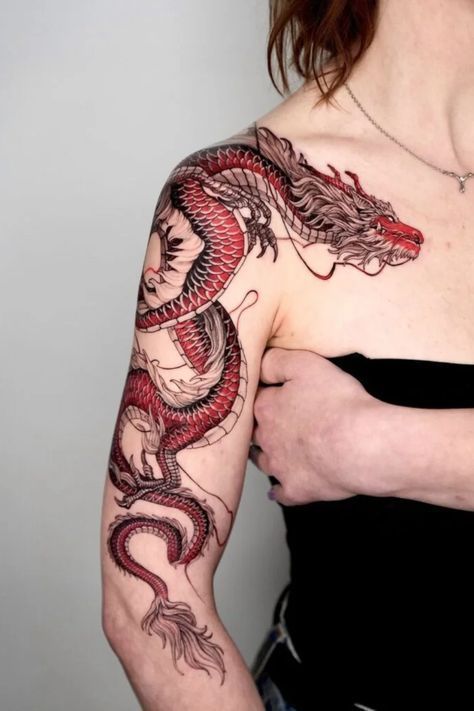
Here a lithe red dragon coils from collarbone to forearm, its body snaking along the outer arm like a living bracelet. The scales are meticulously lined, with darker shading on the underside to give the creature depth. Horns, whiskers, and claws are picked out in softer tones, while the red saturates just enough to feel fiery without overpowering the skin.
This is a perfect modern take on a traditional dragon—lean, almost calligraphic, with just enough negative space around it to breathe. It reads as a half sleeve now, but with a few additional background elements, it could easily become a full arm sleeve in the future. Dragons in Japanese lore symbolize wisdom, protection, and the ability to ride the forces of nature rather than be crushed by them; worn by a woman, it becomes an unapologetic banner of power.
Styling-wise, this is made for bandeau tops, one-shoulder dresses, and gym wear. The line of the dragon follows the natural curve of the deltoid and tricep, so every movement makes it seem to twist and flex. For women who want a strong motif that is clearly Japanese yet not overloaded with clouds and flowers, this piece strikes a perfect balance.
Koi Around the Red Sun Forearm Tattoo

The last design in this batch wraps the forearm in a compact but layered story. Two koi fish—black and white—circle a bold red sun at the center, their long fins flowing outward like calligraphic strokes. Around them, thin branches of blossoms arc in a loose frame, petals scattered as if caught in a gentle current.
This is a beautifully modern composition built from very traditional symbols. Koi stand for perseverance and transformation; the red disc evokes both the national flag and the rising sun; the blossoms add that familiar note of fleeting time. Put together, it’s a tattoo with meaning about pushing through adversity and staying in motion. For a man’s forearm placement, it’s elegant but still strong; for women, it reads as delicate but not overly sweet.
The clean black lines look almost like they were laid down from a crisp stencil, which means this design will hold up well over time. It pairs with anything from rolled-shirt sleeves in an office to casual T-shirts or knitwear on weekends. As a starting point for a larger sleeve, waves or wind bars could expand from the sun, and the koi could one day swim into a full-sleeve or half-sleeve narrative along the arm.
Japanese tattoo designs are endlessly adaptable. The same motifs—Oni mask, dragon, flowers, lanterns, and waves—can live as huge fullback bodysuits or as tiny fine-line charms. Whether you lean toward strict Traditional, bold Neo-traditional, or minimalist Modern interpretations, the key is finding a story that feels like yours and a tattooer whose vision you trust.
If any of these sleeve, back, or forearm ideas sparked something, share your thoughts or questions in the comments. Real conversations about meaning, placement, and style are how great tattoos are born—long before the stencil ever hits the skin.