
Knee tattoos have a personality all their own. The joint creates a natural focal point, but it also forces an artist to think differently about shape, movement, and negative space. A design that looks balanced on a forearm can feel completely different when transferred to a knee, where every bend of the leg changes the composition slightly. That challenge is exactly what makes Knee tattoo ideas 2026 so interesting.
This year, the strongest ideas seem less concerned with simply filling the kneecap and more focused on working with its anatomy. Some designs sit directly on the top of the knee, others frame it with floral or ornamental elements, and more experimental pieces deliberately leave the center open. There is also plenty of room for personality: Gothic spider webs, American traditional imagery, delicate feminine botanicals, moths, skulls, and unusual patchwork compositions can all work beautifully here.
Below are 29 very different approaches that show just how versatile knee tattoos can be for both women and men.
Patchwork Knee Tattoos With an Eclectic Blackwork Look
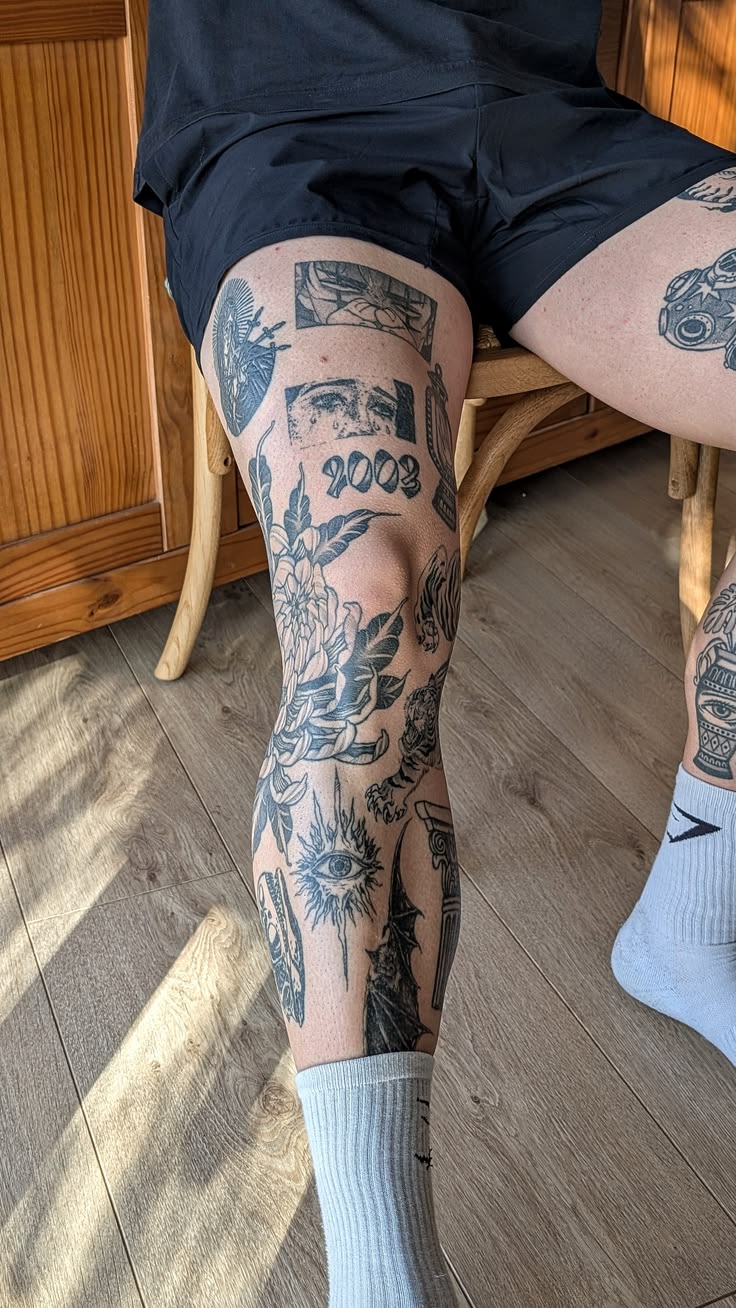
A patchwork leg is one of the most relaxed ways to approach knee tattoo placement, because the knee does not necessarily need one large, perfectly centered statement piece. Here, individual black-and-gray designs travel from the upper thigh toward the shin, creating a collection that feels accumulated rather than planned as a conventional sleeve.
The most interesting part is the interaction between the tattoos around the knee. Large botanical work extends down the leg, while smaller illustrative motifs occupy the available gaps. An eye surrounded by energetic, almost flame-like rays creates a particularly strong focal point below the joint. There are also animal elements, lettering, rectangular illustrative pieces, and darker shaded forms, so the leg reads almost like a personal visual scrapbook.
For men ideas or women who prefer an alternative aesthetic, this type of arrangement gives enormous freedom. You can begin with two or three tattoos and gradually build the leg rather than committing to a complete composition at once. A good artist can also create a stencil plan for future additions, making sure enough breathing room remains between pieces.
I particularly like patchwork around difficult joints because it doesn’t pretend that the knee is a flat canvas. The irregular spacing actually becomes part of the character. Even when the leg bends, there is no single symmetrical design that needs to remain visually perfect.
Shark Jaw Wrap Around Knee Tattoo
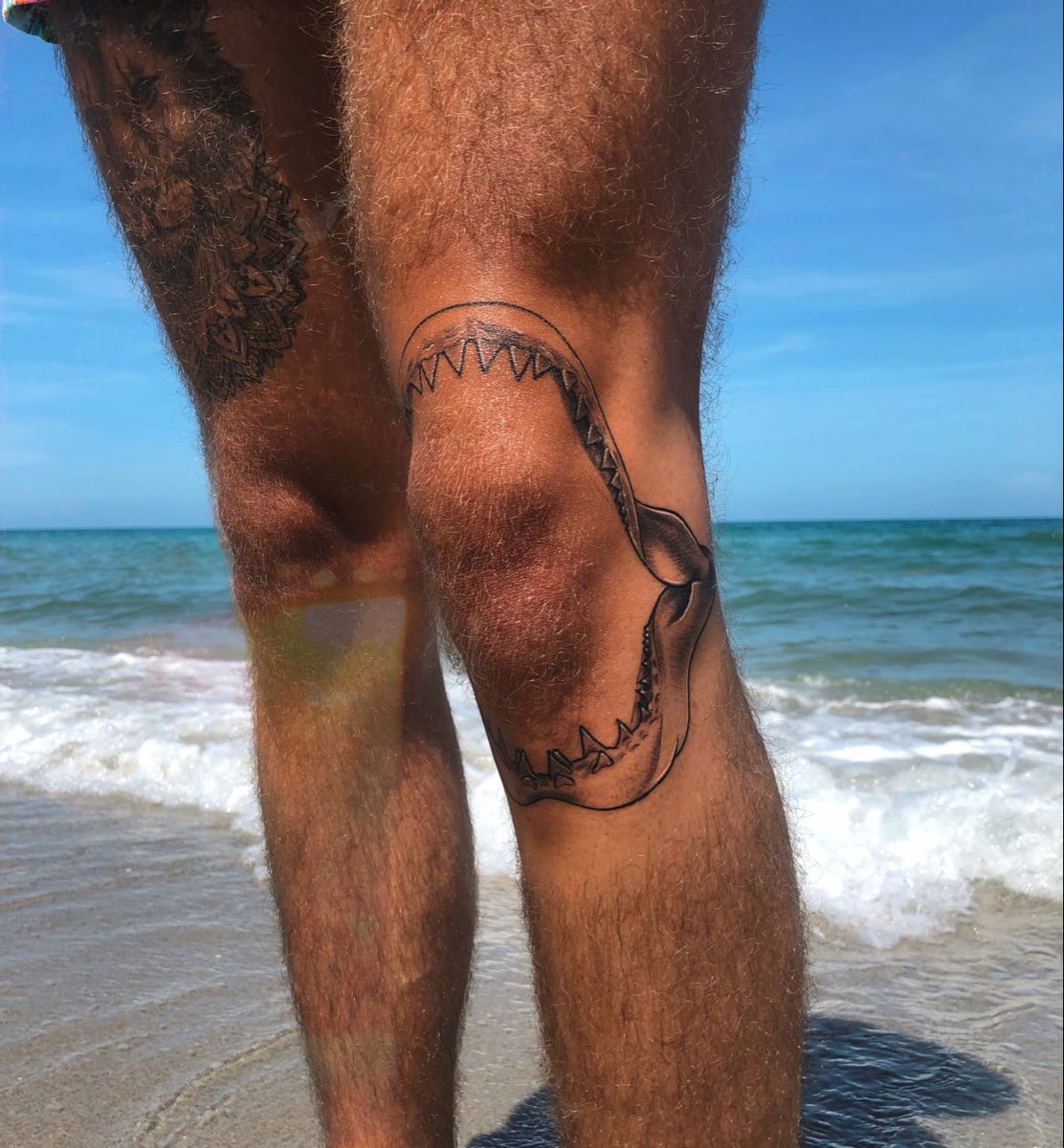
Few knee tattoo ideas use anatomy as cleverly as an open shark jaw. Instead of fighting against the circular shape of the joint, this design turns it into the empty space inside the animal’s mouth.
The upper and lower jaws curve around the kneecap, while sharp triangular teeth point inward. Fine black outlines establish the shape, and restrained gray shading adds dimension without making the tattoo unnecessarily heavy. Because much of the center remains untouched, the tattoo feels surprisingly airy despite its aggressive subject.
This is a smart example of a wrap around concept. Movement is built into the tattoo: as the knee bends, the relationship between the two rows of teeth changes slightly. That makes the joint itself an active component of the artwork.
For someone researching knee tattoos for men, a shark is an obvious strong option, but there is nothing inherently gender-specific about the composition. What matters more is scale. The jaw needs enough room to follow the side of the knee without becoming cramped.
It is also a useful reminder that a powerful knee piece doesn’t always require dense black ink directly over the kneecap. Sometimes the best solution is designing around the most prominent part of the joint.
Gothic Spider Web and Heart Knee Tattoo
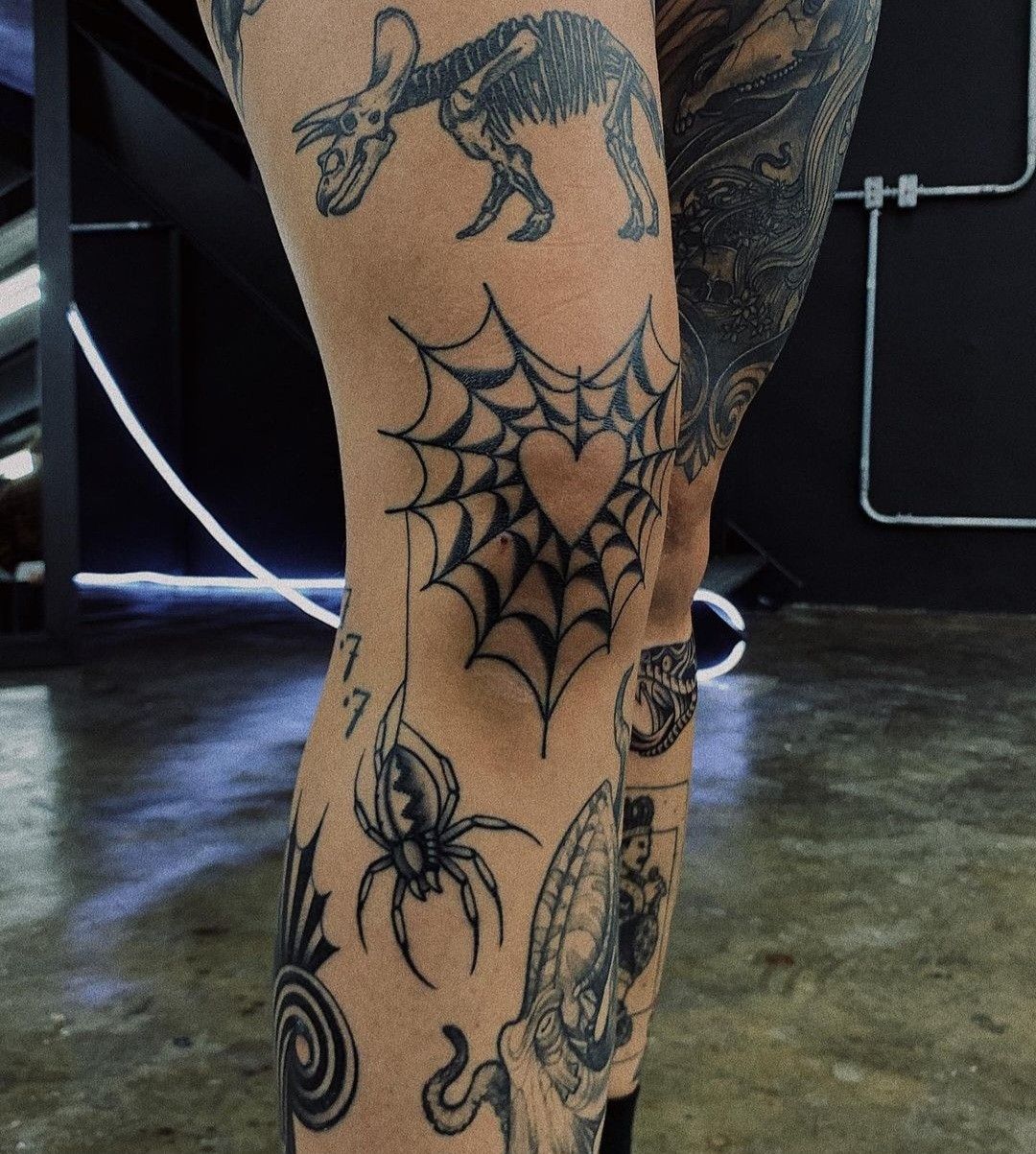
A spider web feels almost tailor-made for the knee. Its radial structure naturally expands outward from a central point, which is why the motif has remained such a recognizable part of traditional tattoo vocabulary.
This variation softens the familiar Gothic spider web idea by placing a clean heart-shaped opening at its center. Strong black lines radiate around it, while selected areas of the web contain solid black shading. The contrast gives the piece enough visual weight to hold its own among the surrounding patchwork tattoos.
A separate spider below the joint continues the theme without making the entire area overly symmetrical. That little break in predictability is important. Rather than looking like a perfectly isolated emblem, the web becomes part of a larger tattoo collection.
This could work particularly well for anyone who likes Trad, Gothic, or American traditional influences but wants something more personal than a standard web. The heart introduces a playful contradiction: something associated with affection sits inside imagery usually connected with darkness, traps, and mystery.
When adapting the concept, the center doesn’t have to be a heart either. A flower, star, small bat, eye, or ornamental symbol could occupy the same position.
Skull and Eye Tattoos Above the Knees
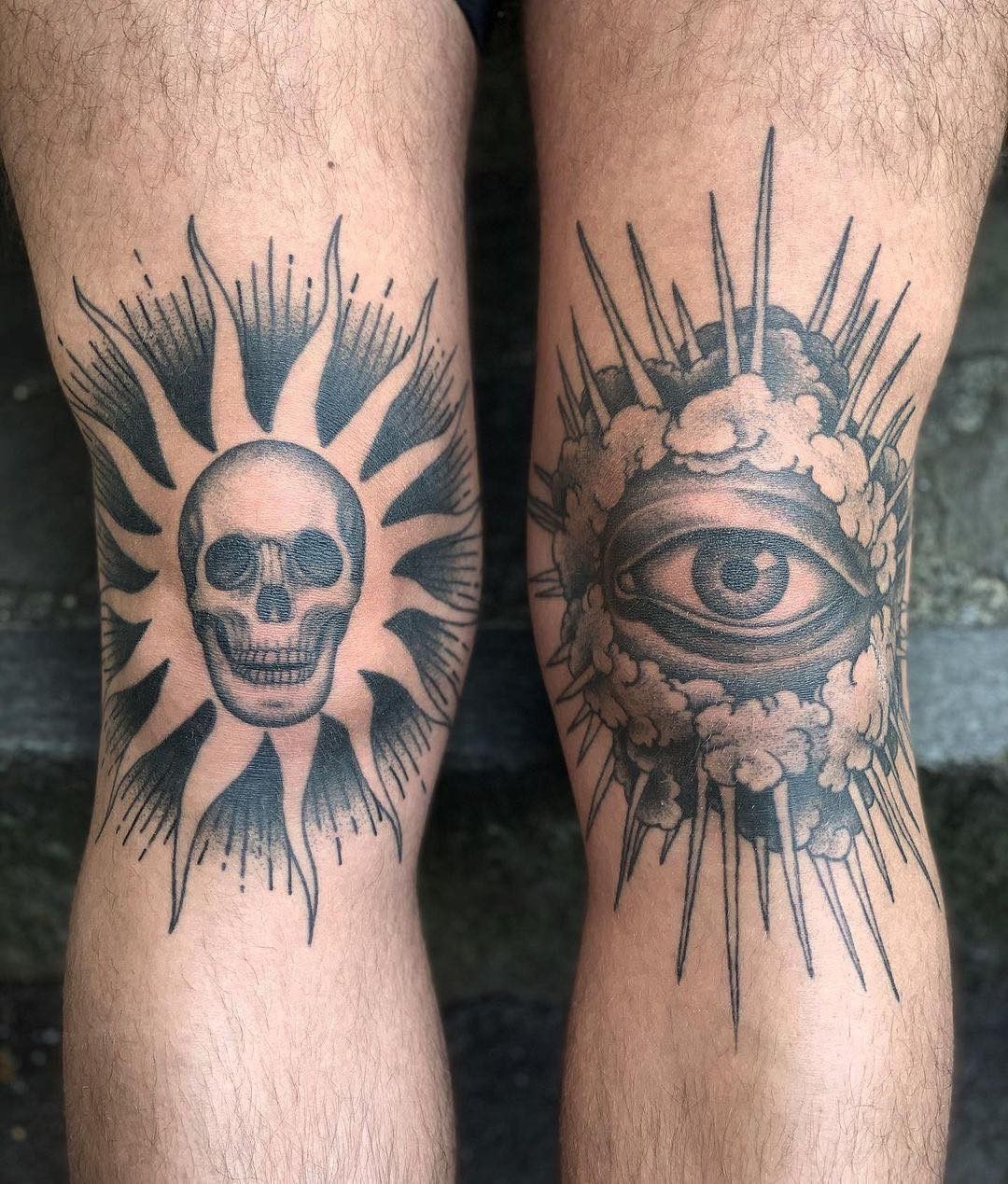
Using both knees as a pair opens up possibilities that a single tattoo simply cannot offer. Here, the compositions are related through scale, black-and-gray shading, and radiating lines, yet the central subjects are deliberately different.
One knee features a skull surrounded by bold rays. Alternating dark areas and untouched skin create a sunburst effect, making the skull appear almost illuminated. On the opposite leg, a large realistic eye emerges from clouds, with long pointed rays extending outward.
The matching placement above and over the knees makes the two designs feel connected without turning them into identical tattoos. That’s a useful strategy for anyone interested in symmetrical leg work but worried that two matching images might feel too formal.
Symbolically, the pairing is also intriguing. A skull inevitably suggests mortality, while an eye can represent awareness, observation, intuition, or protection. Put together, they create a darker visual narrative about seeing, knowing, and the temporary nature of life.
For a men design, this scale has enough presence to anchor larger leg work later. The same principle could also be adapted into ideas female clients might prefer—perhaps a moon and flower, butterfly and moth, or two different ornamental motifs sharing the same outline and scale.
Cracked Glass Blackwork Knee Tattoo
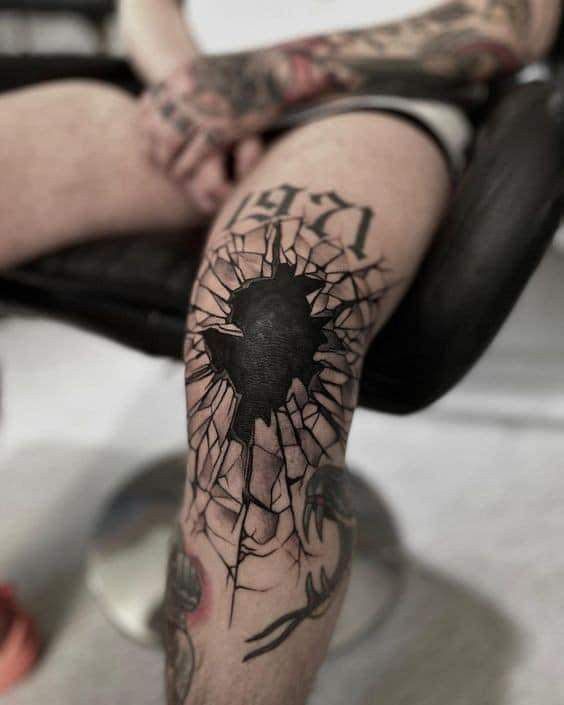
This is one of the most unique concepts in the group because the knee itself appears to become the point of impact.
A dense black center occupies the kneecap, and irregular lines spread outward like shattered glass. Some fragments are outlined with relatively simple strokes, while others are reinforced with heavier black sections. The deliberate irregularity prevents the tattoo from looking like a geometric mandala; instead, it feels chaotic and physical.
That illusion works particularly well on the knee. The natural prominence of the kneecap gives the central black area extra dimension, almost as though something has genuinely broken through the surface.
For people who want a dark tattoo but aren’t interested in familiar Gothic subjects such as a bat, skull, or spider web, abstraction can be a compelling alternative. The piece still carries an aggressive quality, yet its meaning remains open.
The design could also become an effective foundation for future work. Cracks can be extended toward the upper or lower leg, incorporated into surrounding tattoos, or left isolated so that negative skin becomes part of the composition.
Feminine Floral Knee Frame With Delicate Ornament
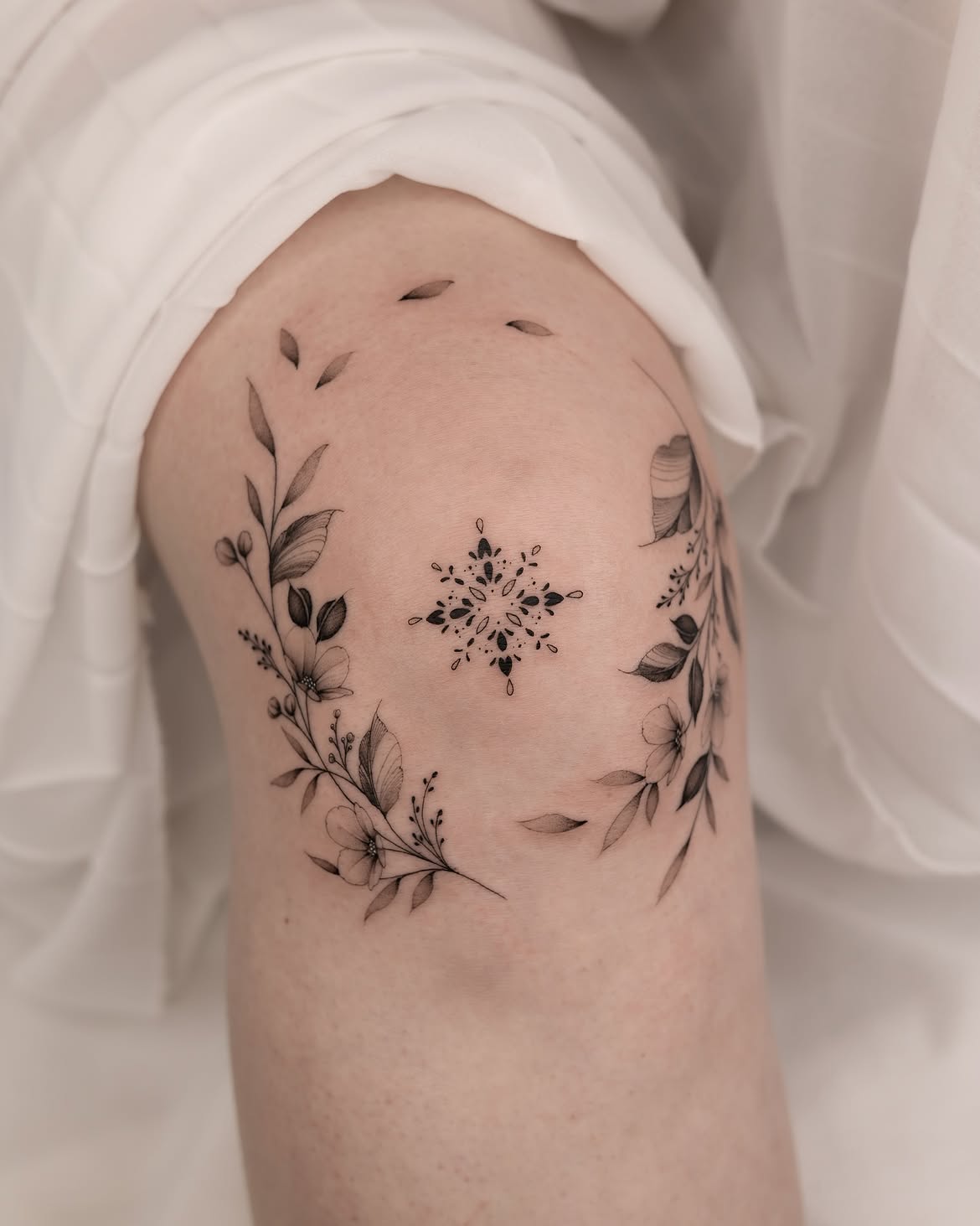
Not every knee tattoo needs heavy outlines or a dark central motif. This delicate floral composition demonstrates almost the opposite philosophy: the kneecap is mostly left open while flowers and leaves form a graceful frame around it.
Fine stems rise along both sides, accompanied by softly shaded leaves, small blossoms, and floating botanical details. The lower branches curve inward beneath the knee, helping define its shape without enclosing it completely. A small symmetrical ornamental motif occupies the center, giving the composition a subtle anchor.
The balance between detail and empty skin is what makes this feminine approach so successful. From a distance, the tattoo feels light; closer inspection reveals careful linework and restrained shading.
This style can be especially appealing to women who love botanical tattoos but don’t want a large solid flower sitting directly on the kneecap. It also leaves plenty of opportunities for personalization. Birth flowers, wildflowers, herbs, or meaningful plants could replace the existing botanical elements.
There is something particularly elegant about allowing the knee to remain visible rather than trying to disguise its anatomy. The branches simply acknowledge its natural shape and frame it.
Skull Moth and Floral Knee Tattoos
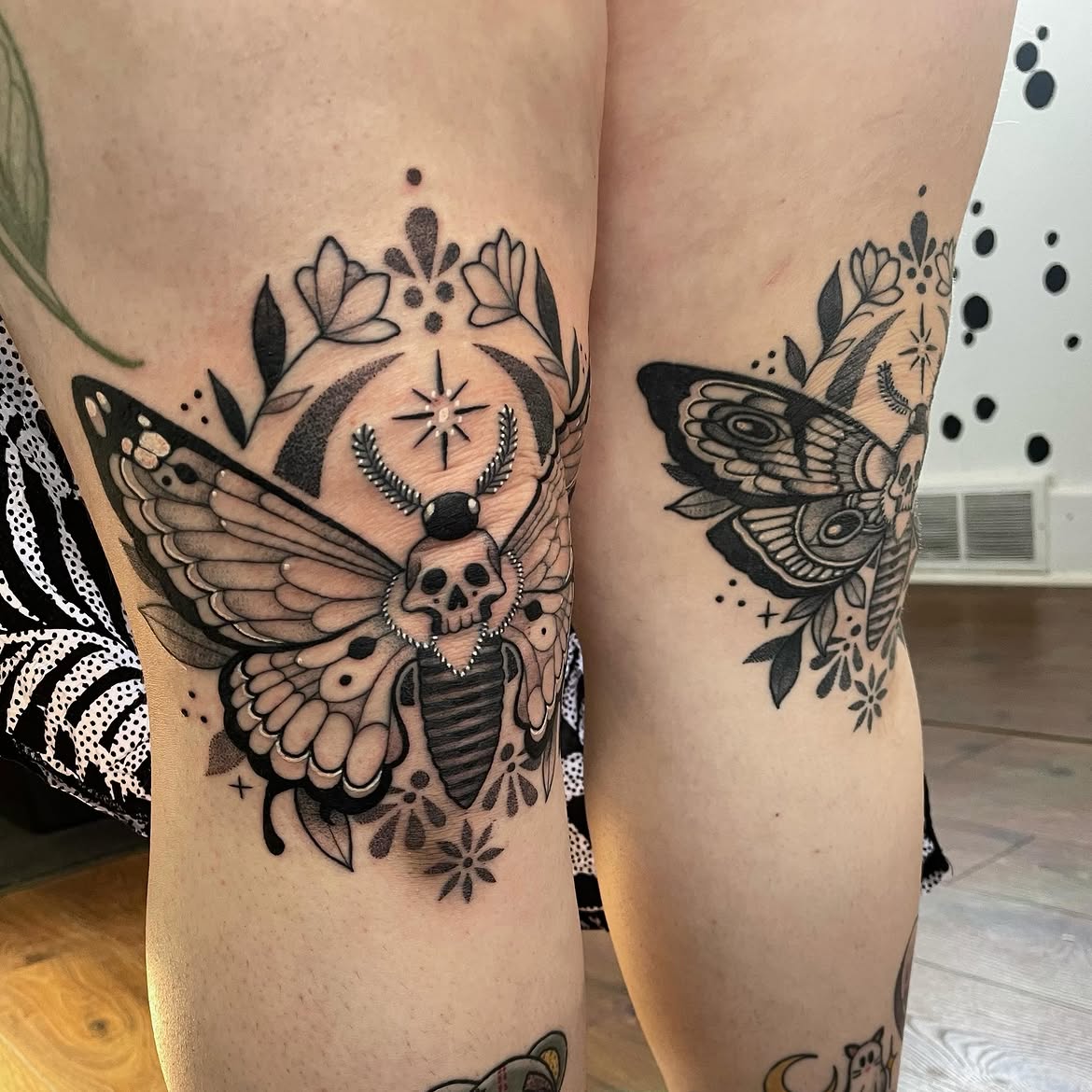
The moth has become a modern tattoo favorite for good reason: its open wings create natural symmetry, while the body provides a strong vertical axis. Around the knee, those qualities become especially useful.
One leg features a large winged insect with a small skull incorporated prominently into its body. Layered wings combine strong outlines, black sections, and softer internal shading. Floral and decorative elements surround the insect, while tiny stars, dots, leaves, and symmetrical marks fill the remaining space without overwhelming the main subject.
The opposite leg offers a related moth composition, creating visual continuity across both knees. The tattoos aren’t simple copies, though, which keeps the pairing interesting.
A skull moth is an especially effective choice for someone drawn to Gothic imagery but wanting more detail than a straightforward skull tattoo. Depending on the styling, a moth can feel dark, mystical, traditional, or surprisingly delicate. It also carries associations with transformation, attraction to light, nighttime, and change.
The botanical additions make the overall arrangement softer. Similar compositions could introduce a butterfly, bees, flower details, or even small ornamental patterns around the wings. If you’re considering a pair of knee pieces, repeating the same visual language rather than exactly the same image often produces a more individual result.
Bold Mandala Knee Tattoo with Geometric Blackwork
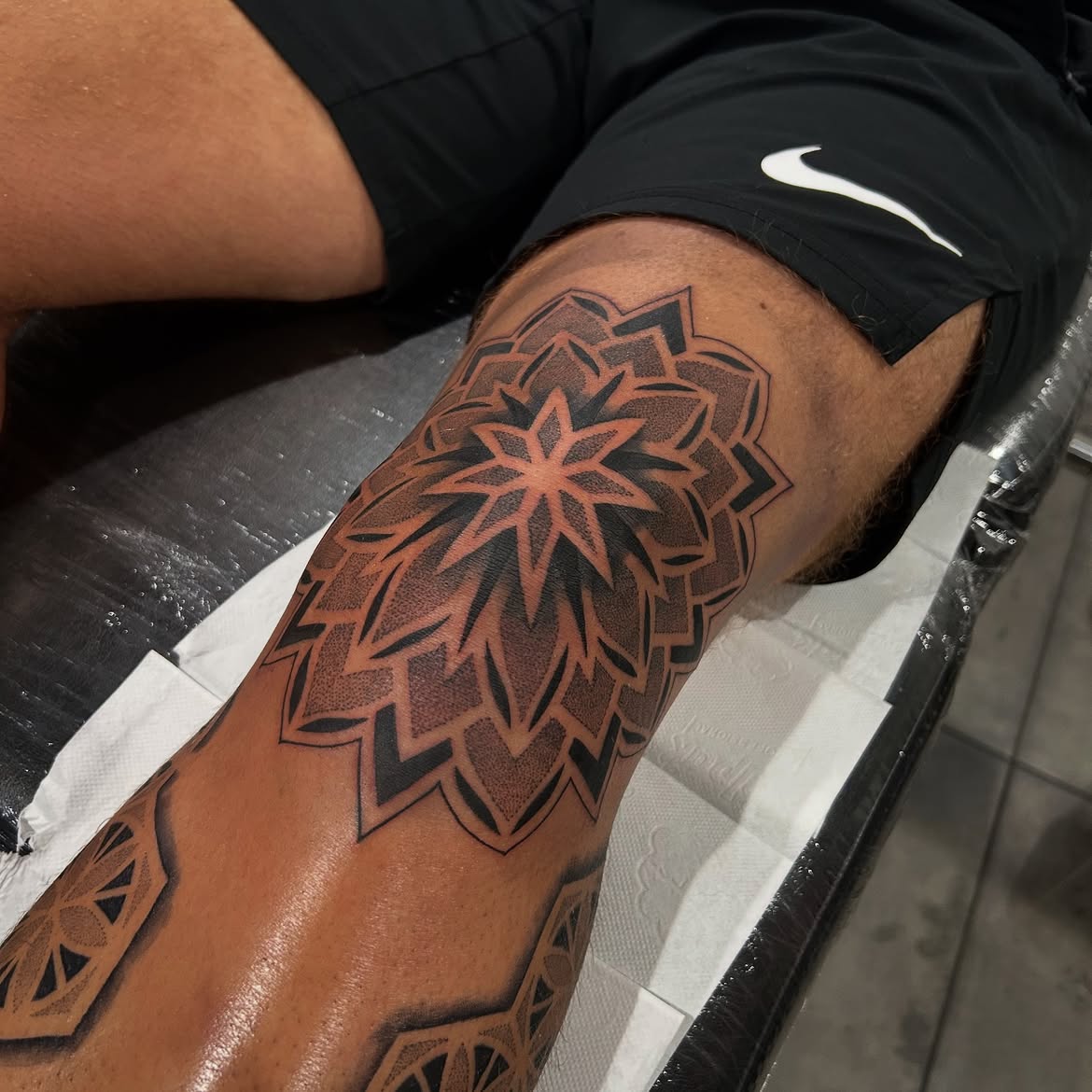
A large mandala is one of those knee tattoo ideas that makes immediate sense anatomically. The circular structure naturally follows the kneecap, while the repeated points and layered geometry expand outward toward the upper and lower leg. Here, the center of the ornamental design is positioned directly over the knee, creating a strong focal point without needing any additional imagery.
The execution relies on a combination of solid black sections, negative space, precise outlines, and stippled shading. That mix keeps such a substantial tattoo from turning into one flat dark mass. Look closely and the individual layers alternate in weight: sharp petals, angular borders, and softer dotwork sections create depth.
This is an especially effective men design for someone who wants a substantial standalone tattoo, although ornamental work is completely adaptable for women as well. The important consideration is scale. Shrinking a stencil like this too aggressively would sacrifice the clean separation between its geometric layers.
There is also a practical visual advantage to placing a mandala on the top of the knee: its symmetry makes the joint look intentionally framed. Even when the leg bends, a little distortion feels appropriate because the pattern was built around a moving circular surface in the first place.
Matching Ornamental Knee Tattoos with Negative-Space Centers
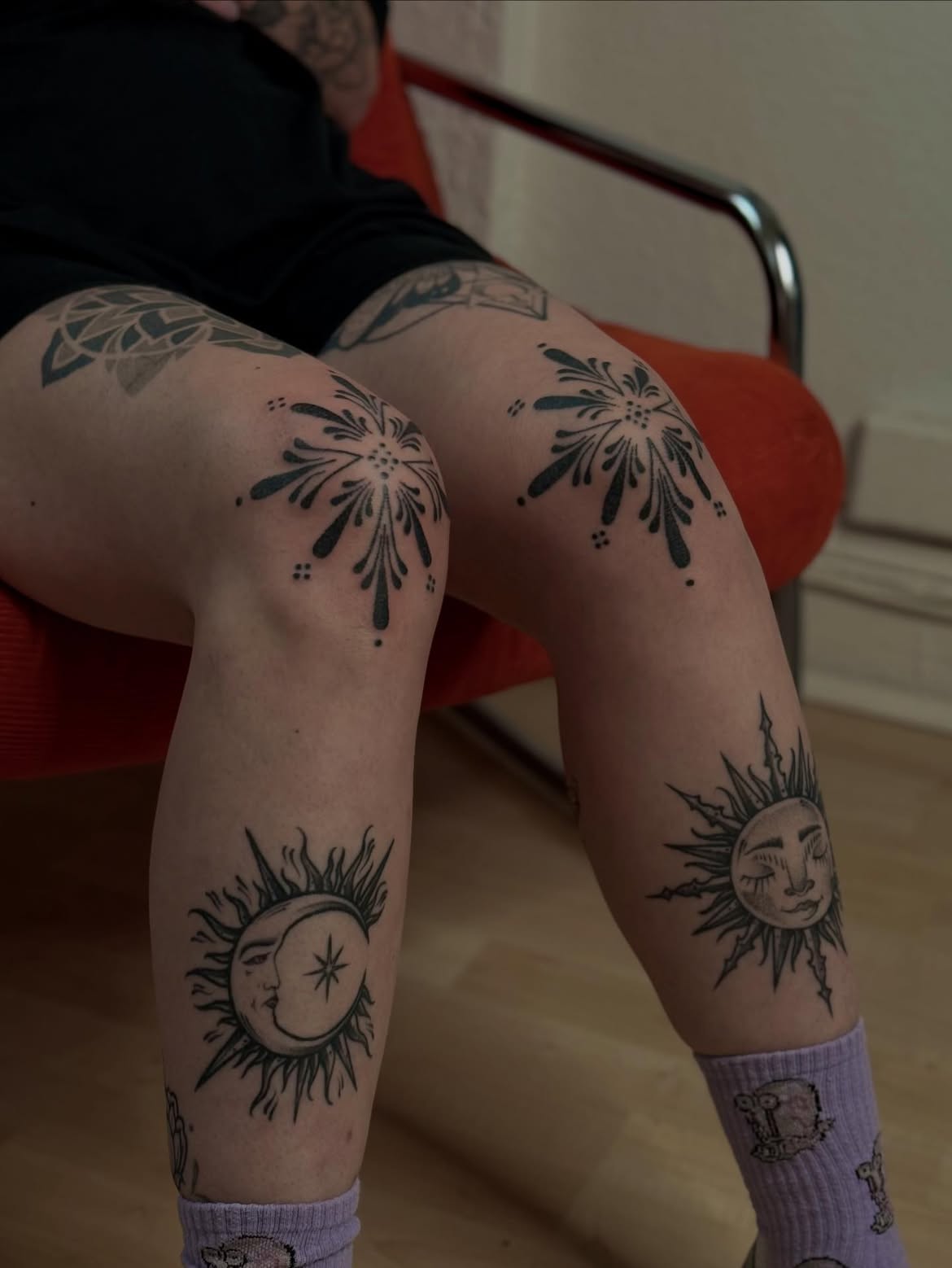
Matching knee pieces don’t necessarily need enormous coverage. These two compact ornamental designs demonstrate how repeating the same motif can create balance while leaving plenty of untouched skin around the joint.
Each tattoo begins with a small open center and radiates outward through elongated black droplets, thin decorative strokes, tiny dots, and miniature grouped marks. The composition feels somewhere between a stylized flower and a decorative starburst. Because the center remains light, the kneecap itself becomes part of the design rather than disappearing beneath ink.
This is a particularly useful direction for ideas female searches because it has a decorative, feminine quality without relying on conventional floral realism. It could also be adapted easily: the outer marks might become tiny leaves, stars, petals, or more elaborate filigree.
The pairing is what gives the idea its real impact. Individually, each knee tattoo is relatively restrained. Seen together, they establish a clear visual rhythm across both legs. For anyone considering two knees at once, repeating the same stencil is one of the easiest ways to create cohesion.
Ornamental Floral Knee Tattoo with Dotwork Shading
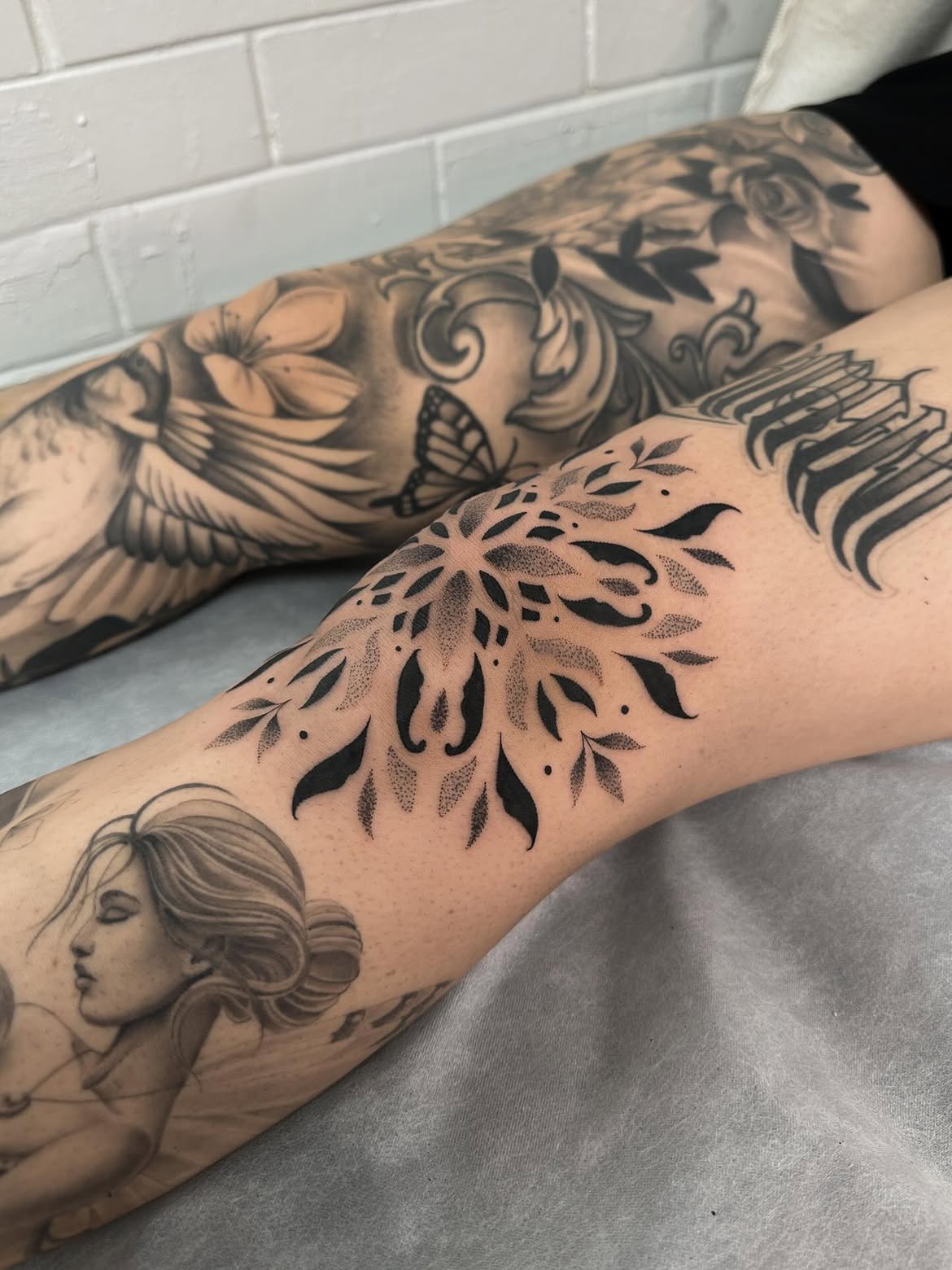
This floral ornamental piece takes advantage of nearly every useful characteristic of knee placement. It has a radial center that suits the kneecap, elongated details that follow the leg vertically, and enough negative space to prevent the tattoo from feeling crowded.
The central flower is built from repeated petal-like shapes rather than realistic botanical drawing. Around it, black ornamental leaves and curved teardrop forms alternate with finely stippled sections. Smaller leafy branches extend toward the side of the knee, giving the design an organic finish and breaking up the otherwise strict symmetry.
Dotwork deserves attention here. Instead of filling every shape with solid black, the artist uses fields of tiny dots to produce soft tonal transitions. Against the dense black leaves, that texture gives the composition a much richer appearance.
For women or men interested in a decorative knee piece, this approach sits nicely between a conventional mandala and a botanical tattoo. It feels structured without becoming rigid and floral without looking overly literal.
It could also grow naturally into a larger leg project. The small branches provide convenient transition points for additional leaves, flowers, ornamental bands, or a wrap around composition later.
Gothic Animal Skull Jaw Framing the Knee
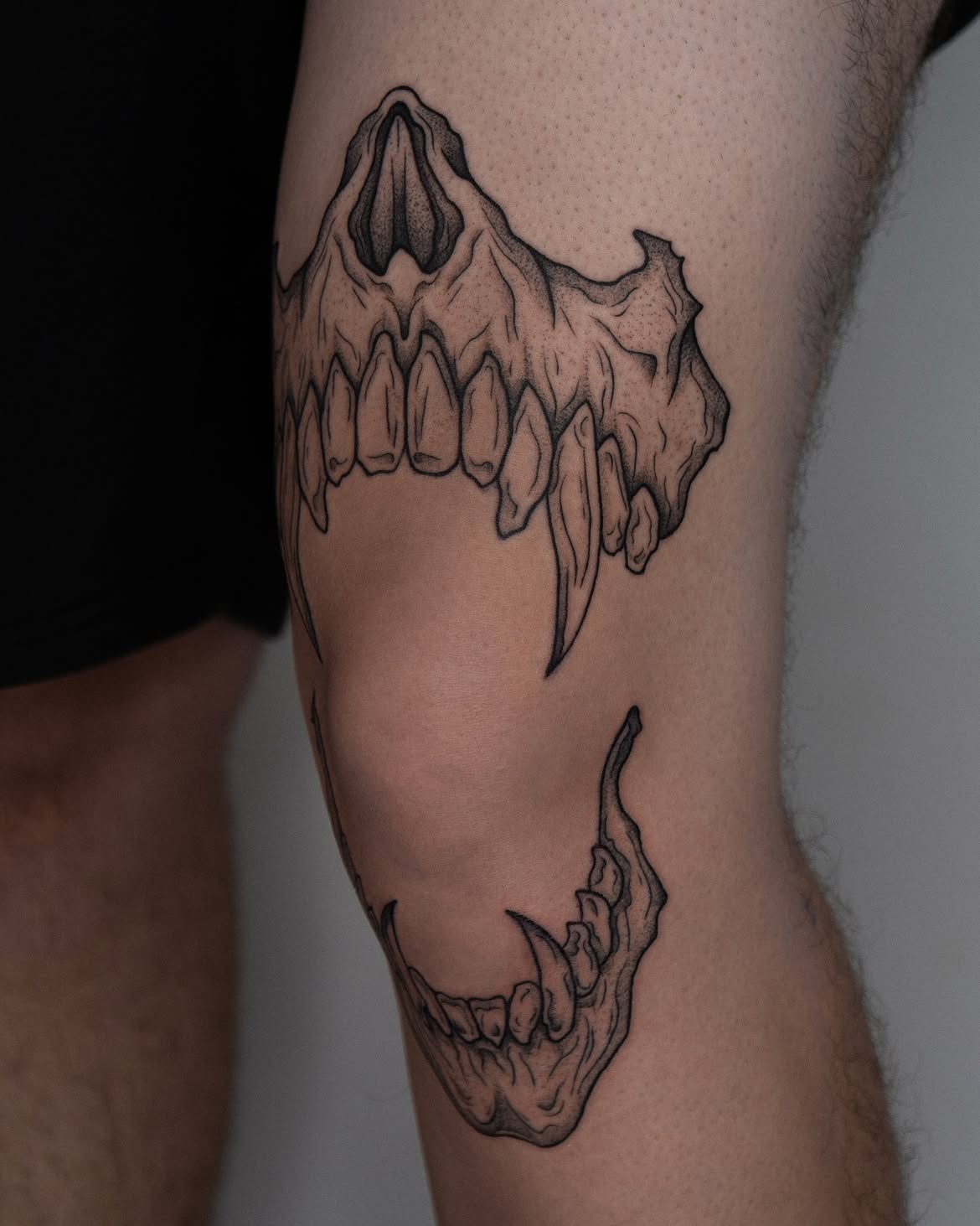
Here’s another design that understands the value of leaving the actual kneecap open. Rather than putting an illustration directly over the joint, the tattoo uses an animal skull’s upper and lower jaws to frame it.
The upper skull sits above the knee, with elongated teeth pointing downward. Below it, the lower jaw curves upward from beneath the kneecap. Together they create the illusion of an enormous open mouth, with bare skin becoming the negative space between the jaws.
Fine black outlines define the bone structure, while subtle dotwork and gray shading emphasize cracks, cavities, teeth, and irregular anatomical surfaces. The restrained shading suits the subject particularly well. A completely solid black treatment would make those small skeletal details harder to distinguish.
For anyone collecting Gothic knee tattoos for men, this is an excellent alternative to the more familiar skull, bat, or spider web. It has the same dark energy but feels far more connected to the anatomy of the leg.
The concept is also flexible. Different animal skulls could radically change its personality—a feline skull would create sharper proportions, while a herbivore skull could introduce longer, stranger bone structures.
Tiny Abstract Butterfly on the Side of the Knee
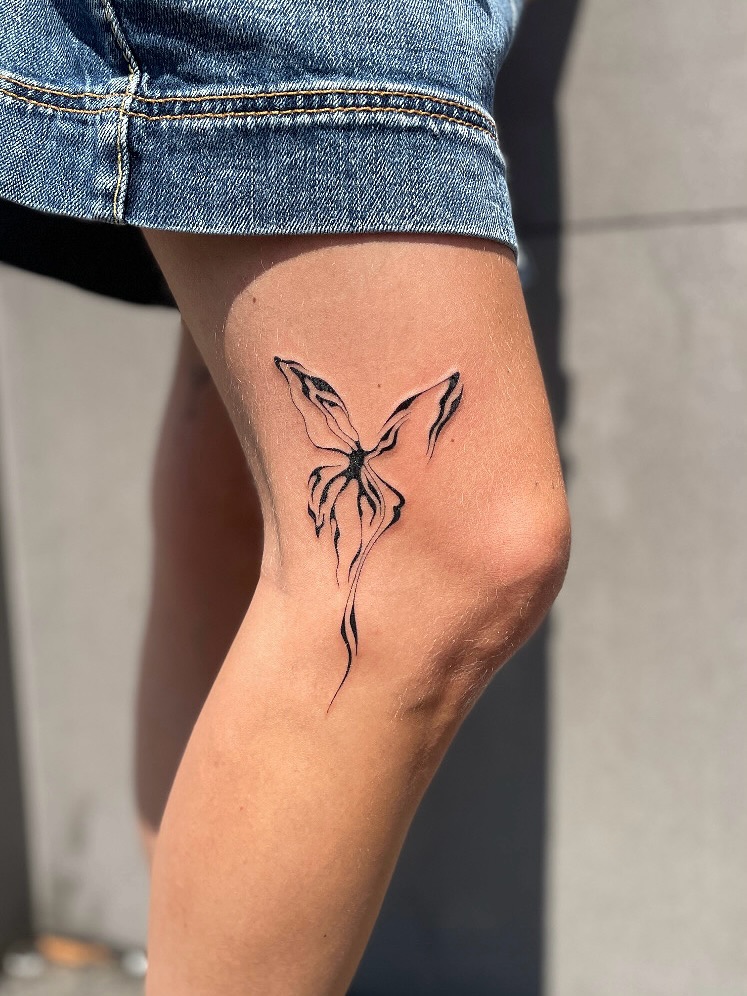
At the opposite end of the scale is this wonderfully minimal butterfly. Instead of covering the kneecap, the design sits on the side of the knee, where its narrow vertical proportions complement the contour of the leg.
The butterfly is reduced to expressive black lines. Its wings are asymmetrical and almost fluid, with sections that look as though they were drawn in a single spontaneous gesture. A thin trailing line extends downward from the body, giving the tattoo additional movement without adding visual weight.
Small tattoos around a knee can sometimes look accidental when their placement isn’t carefully considered. This one avoids that problem by sitting close enough to the joint to interact with its shape while remaining safely outside the center of the kneecap.
For a feminine approach to Knee tattoo ideas 2026, it is a strong reminder that size doesn’t determine impact. The idea would suit someone who prefers fine-line tattoos, discreet placement, or a first knee-area tattoo rather than a large Traditional or ornamental piece.
A butterfly can symbolize transformation and change, but the abstract treatment keeps the imagery from feeling overly sentimental. It looks contemporary, light, and personal.
Flowing Fine-Line Fish Above the Knee
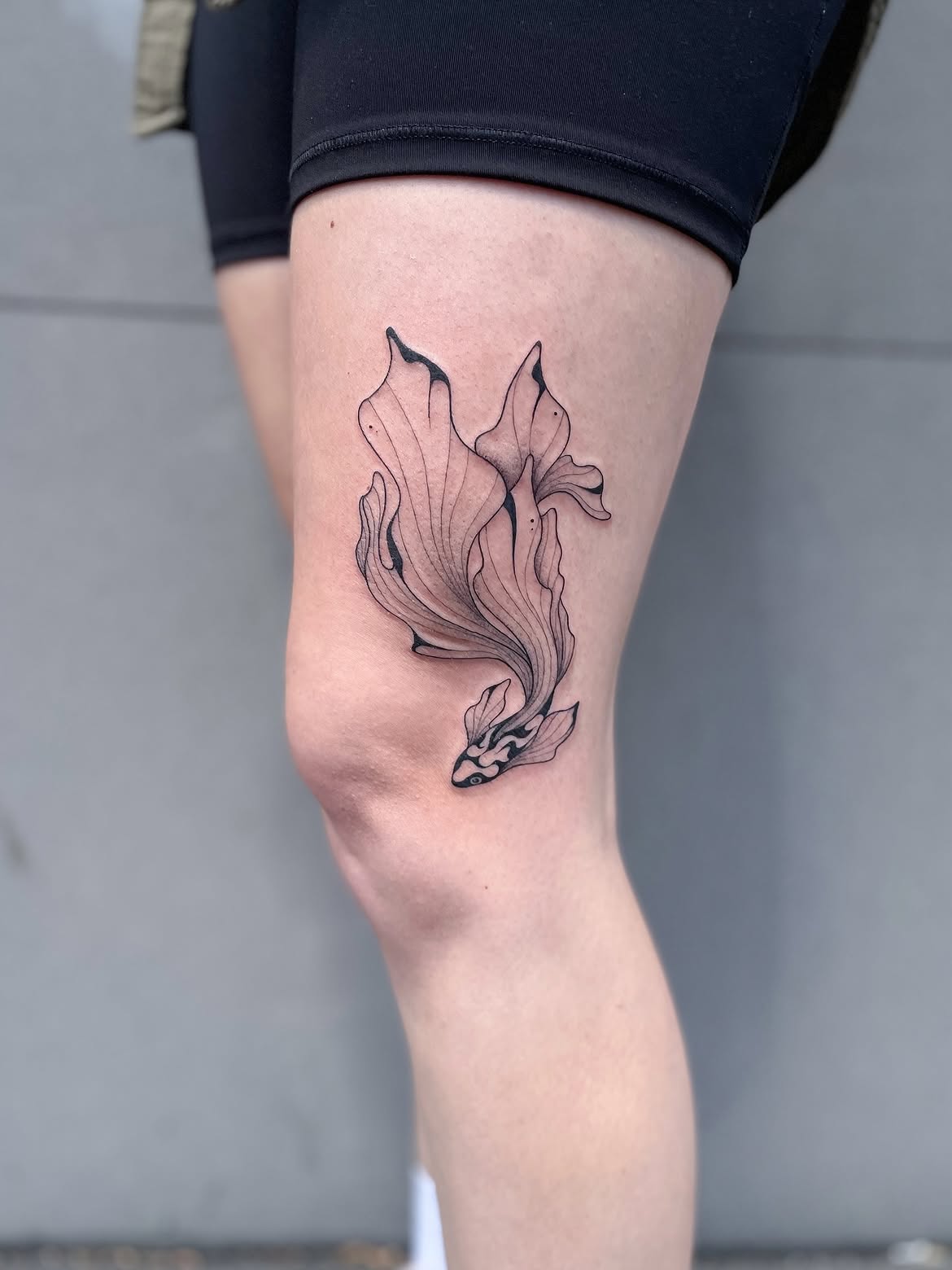
This graceful fish demonstrates how effective an asymmetrical composition can be around the knee. Rather than centering the entire tattoo over the kneecap, the body begins above it and flows diagonally toward the side.
Long, sweeping fins dominate the design. Fine parallel lines follow their direction, giving them a translucent, fabric-like quality, while small areas of darker shading provide definition around the head and selected edges. The restrained black-and-gray palette keeps the piece delicate despite its relatively generous size.
What makes the placement especially successful is the sense of movement. The fish appears to be swimming downward around the knee rather than sitting statically on top of it. The curve of the leg reinforces that impression.
For women looking beyond standard flower and butterfly designs, aquatic subjects offer a beautiful alternative. The same basic composition could accommodate a betta fish, koi, or a more fantastical interpretation while preserving the flowing fins that make this example so elegant.
I also like how much empty skin remains inside and around the fins. Fine-line tattoos often benefit from restraint; giving each line room to breathe is part of what makes the finished piece look sophisticated rather than busy.
Side Knee Fish Tattoo with Long Flowing Fins
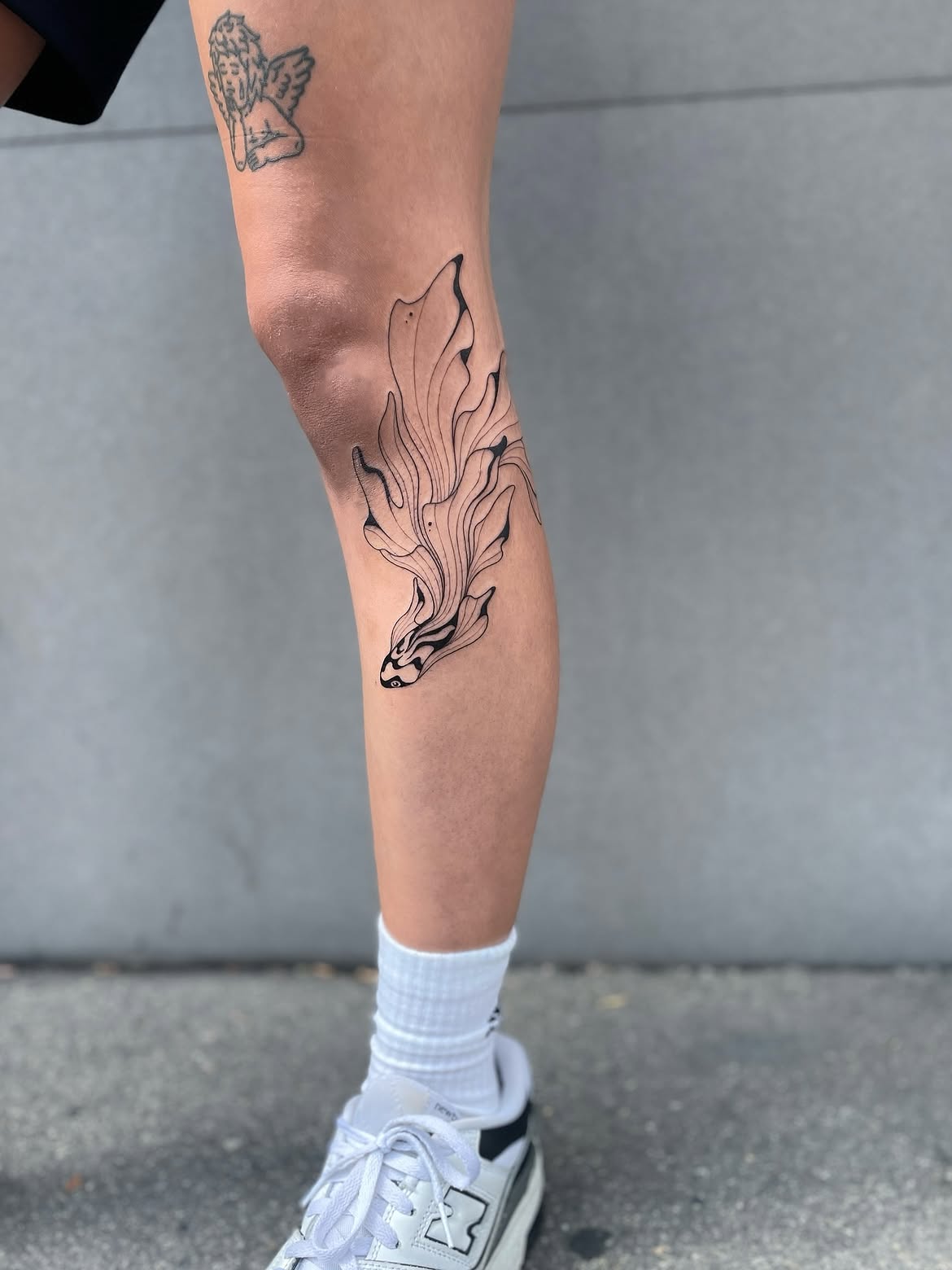
Seen from another angle and placement variation, this fish concept shows why elongated designs work particularly well along the outer knee and upper shin. The head sits lower on the leg while the enormous fins sweep upward toward the joint, following the body’s natural vertical line.
Fine outlines form the majority of the piece. Interior contour lines create the illusion of folds running through the fins, while small black accents at their tips add just enough contrast. The fish’s head contains stronger graphic markings, preventing the delicate body from disappearing visually.
This is a useful lesson when planning unique knee tattoos: the kneecap does not have to be the center of every composition. The areas immediately beside and below it offer excellent placement options, especially for subjects that naturally curve or flow.
It is also an attractive solution for someone building a collection gradually. A piece like this can stand independently, but there remains generous space above, below, and around it for future tattoos.
Flowing Fish Tattoo Along the Side of the Knee
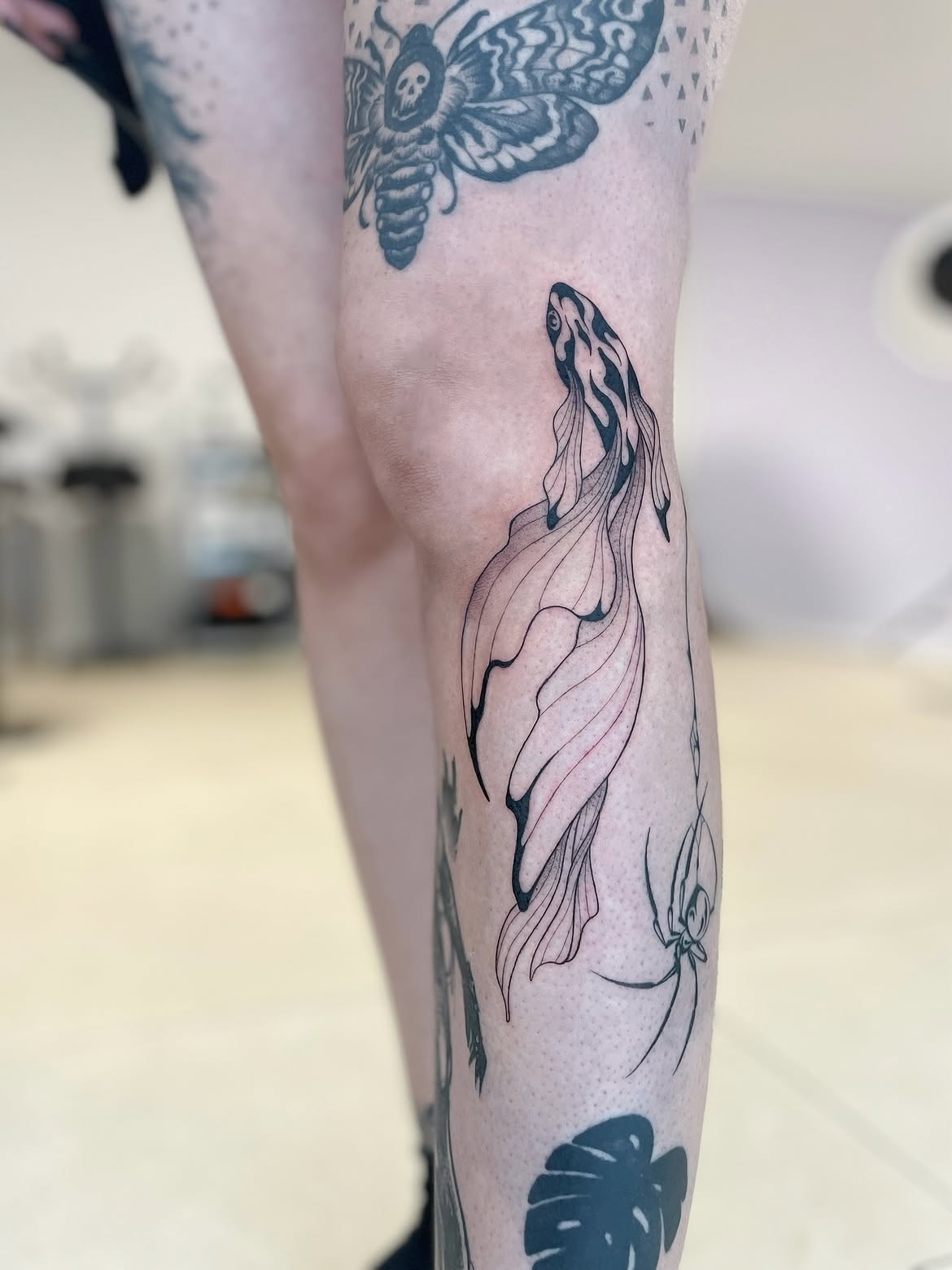
This flowing fish continues one of the most interesting placement trends for 2026: treating the knee as a transition point rather than forcing the entire design onto the kneecap. The fish travels vertically along the side of the joint, its head rising toward the upper knee while long fins cascade downward.
The contrast is beautifully controlled. Dark graphic markings concentrate around the head and edges of the fins, while the larger sections remain mostly open. Fine interior lines give the fins their delicate, almost translucent quality. That combination creates movement without requiring conventional realism or heavy shading.
It also works naturally among existing tattoos. A moth appears above the knee and a spider occupies space farther down the leg, yet the fish retains its identity because of its elongated silhouette.
For both Women and Men who prefer contemporary blackwork, this kind of design offers a clever alternative to a centered mandala. It proves that knee tattoos can belong to a larger patchwork collection while still responding intelligently to the anatomy of the joint.
Delicate Bee and Botanical Knee Ornament
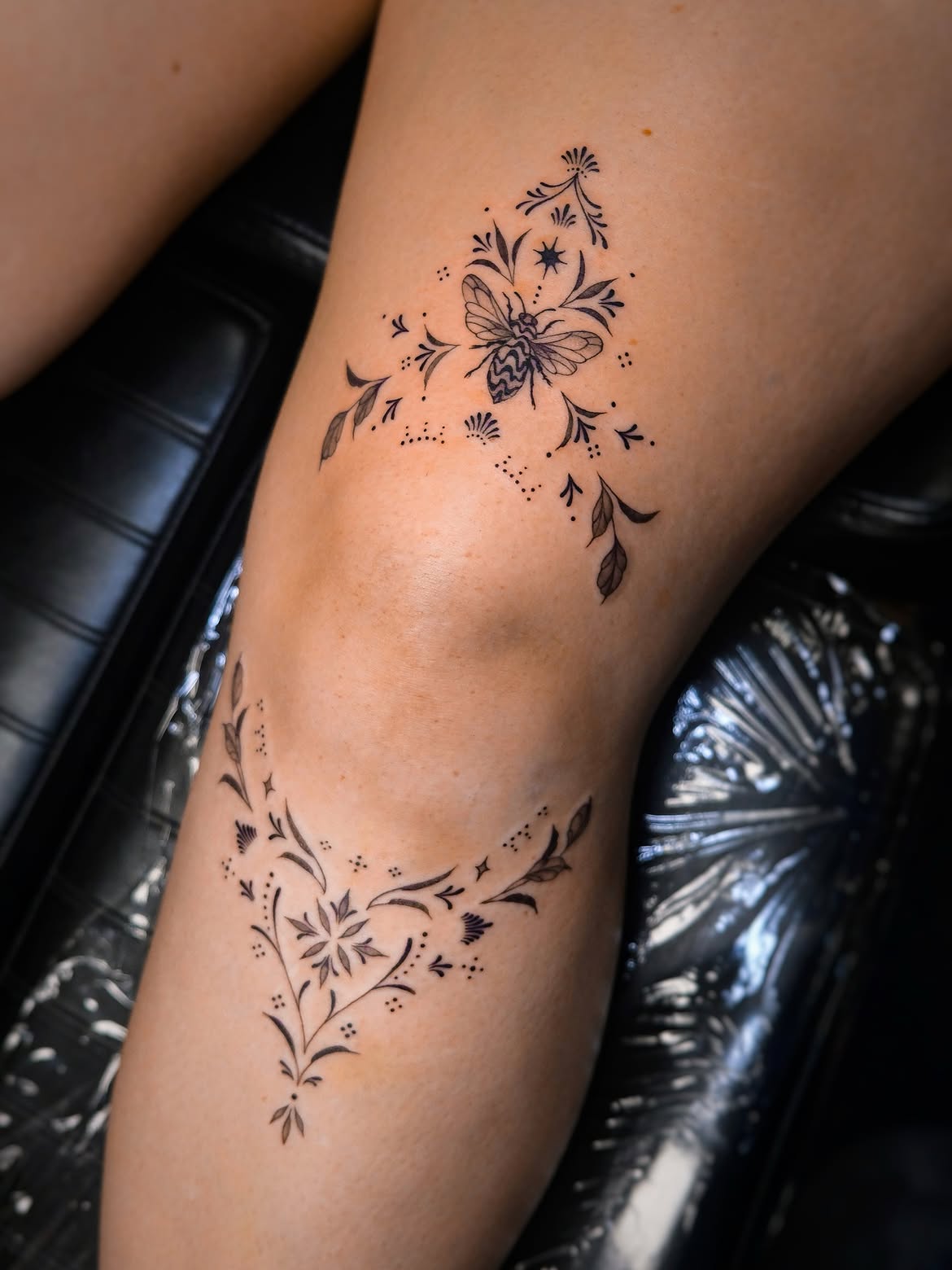
Some of the freshest ideas female tattoo collectors are choosing involve deliberately leaving the kneecap almost completely untouched. This airy botanical composition does exactly that.
A small winged insect—visually closer to a stylized bee—sits above the knee among fine botanical flourishes. Its wings contain delicate linear detail, while patterned black marks decorate the body. Small leaves, curved stems, dots, stars, and fan-like ornamental accents spread outward without forming a rigid border.
A second botanical arrangement develops below the knee, so the empty center becomes an intentional part of the design. It feels almost like an invisible wreath wrapping around the joint.
The lightness is crucial. Rather than one dominant flower, dozens of tiny marks collectively create the decorative effect. It has a feminine quality but avoids becoming overly sweet or conventional.
This is also practical inspiration for someone nervous about covering the center of the kneecap. A custom stencil could position the botanical elements around the joint while maintaining the same airy negative space.
Gothic Bat and Floral Knee Tattoo
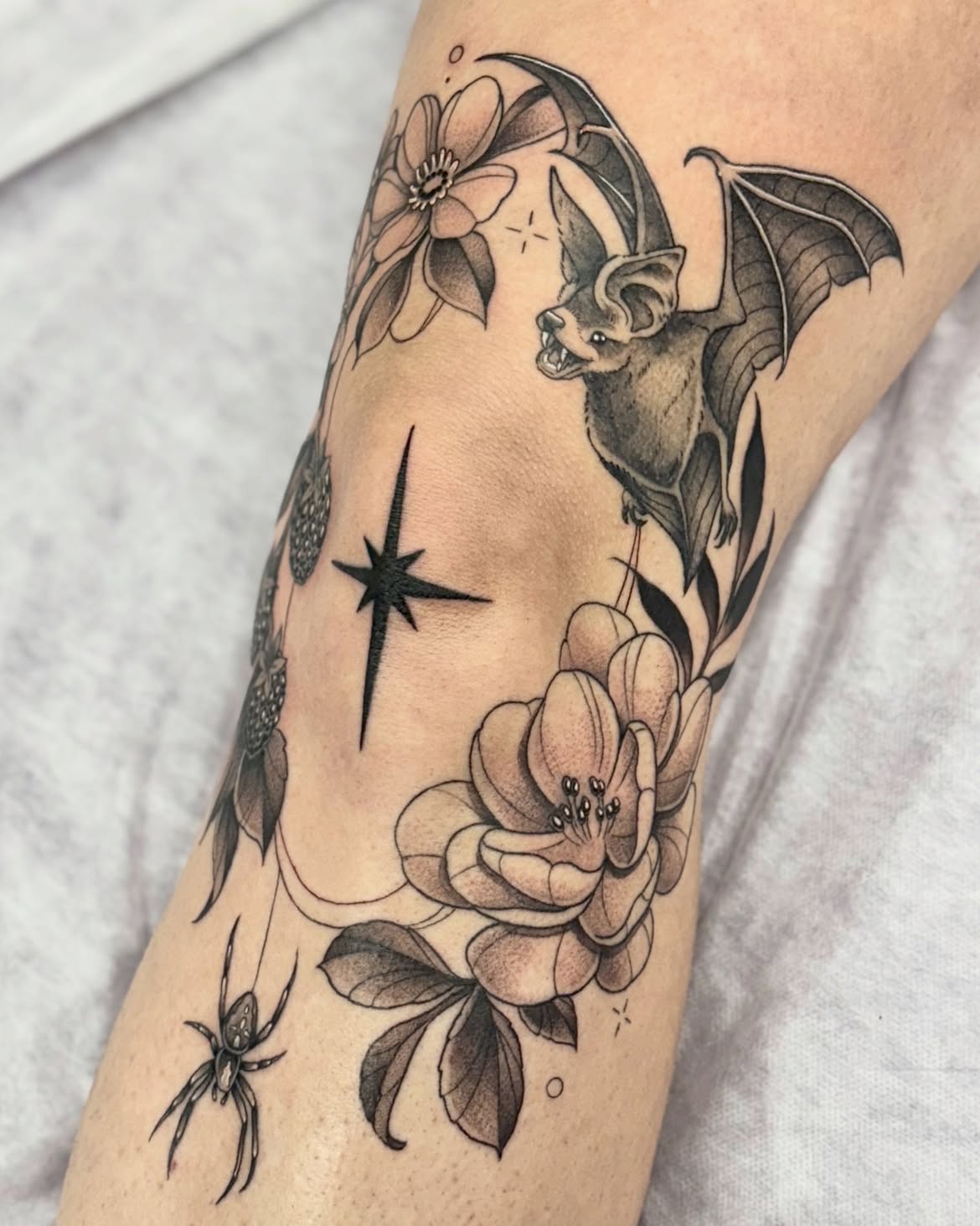
Dark imagery and flowers make an unexpectedly natural pairing. Here, a detailed bat occupies the upper side of the knee, surrounded by large blossoms, leaves, a spider, and small celestial accents.
The bat is rendered with more realism than a classic American traditional version. Fine gray shading gives volume to the body, while the wings show their internal structure through curved lines and darker membranes. Its open mouth adds a slightly aggressive expression that contrasts nicely with the softness of the flowers.
The botanical elements are equally important. Large petals curve around the joint rather than competing with the bat for attention, helping the entire tattoo conform to the knee’s rounded structure. A black star provides a sharp graphic interruption, and the small spider pushes the composition further into Gothic territory.
For someone who likes Gothic imagery but doesn’t want an entirely dark tattoo, combining a bat with floral work is a smart compromise. Flowers soften the subject while the bat prevents the design from becoming too delicate.
Open-Jaw Skull Knee Tattoo
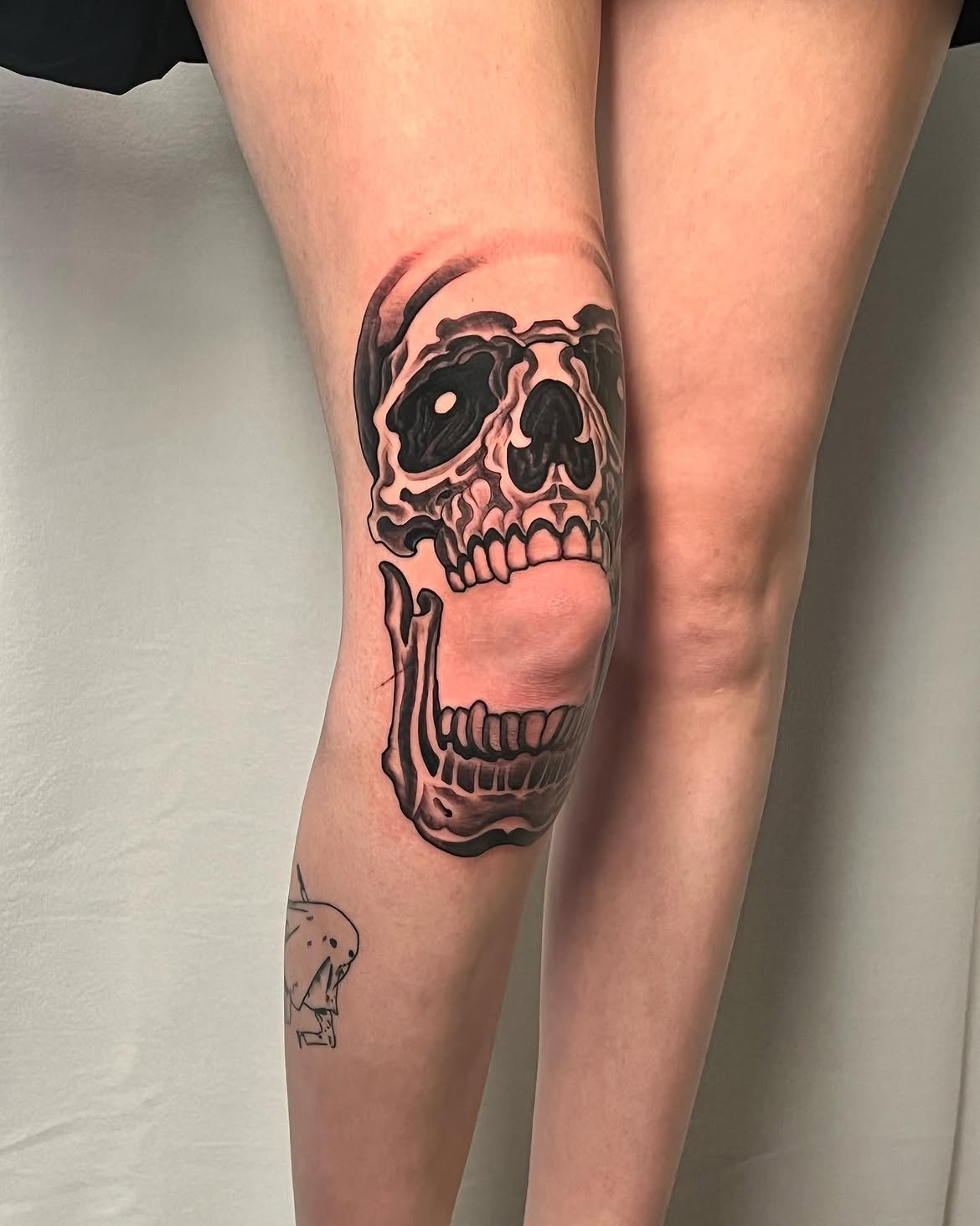
Few concepts exploit knee movement as effectively as an open skull. Here, the upper part of the skull occupies the area above the kneecap while the lower jaw extends beneath it, leaving the center comparatively open.
Heavy black shading fills the eye socket, nasal cavity, and deeper structural areas. Thick outlines make the teeth and jaw immediately readable, while softer gray transitions prevent the piece from looking completely flat. The result sits somewhere between bold blackwork and a modern interpretation of Traditional tattooing.
The anatomy of the knee becomes part of the illusion. When the leg is straight, the skull appears to have an exaggerated open mouth. As the knee bends, the distance between the upper and lower sections changes. That built-in transformation gives the tattoo a quality a similar skull on the thigh simply wouldn’t have.
It’s an especially striking men design, though skulls have long since moved beyond gendered tattoo conventions. Anyone wanting a large statement piece could also combine the skull with spider web details, flames, flowers, or ornamental framing.
Ornamental Mandala Knee Tattoo with Dotwork
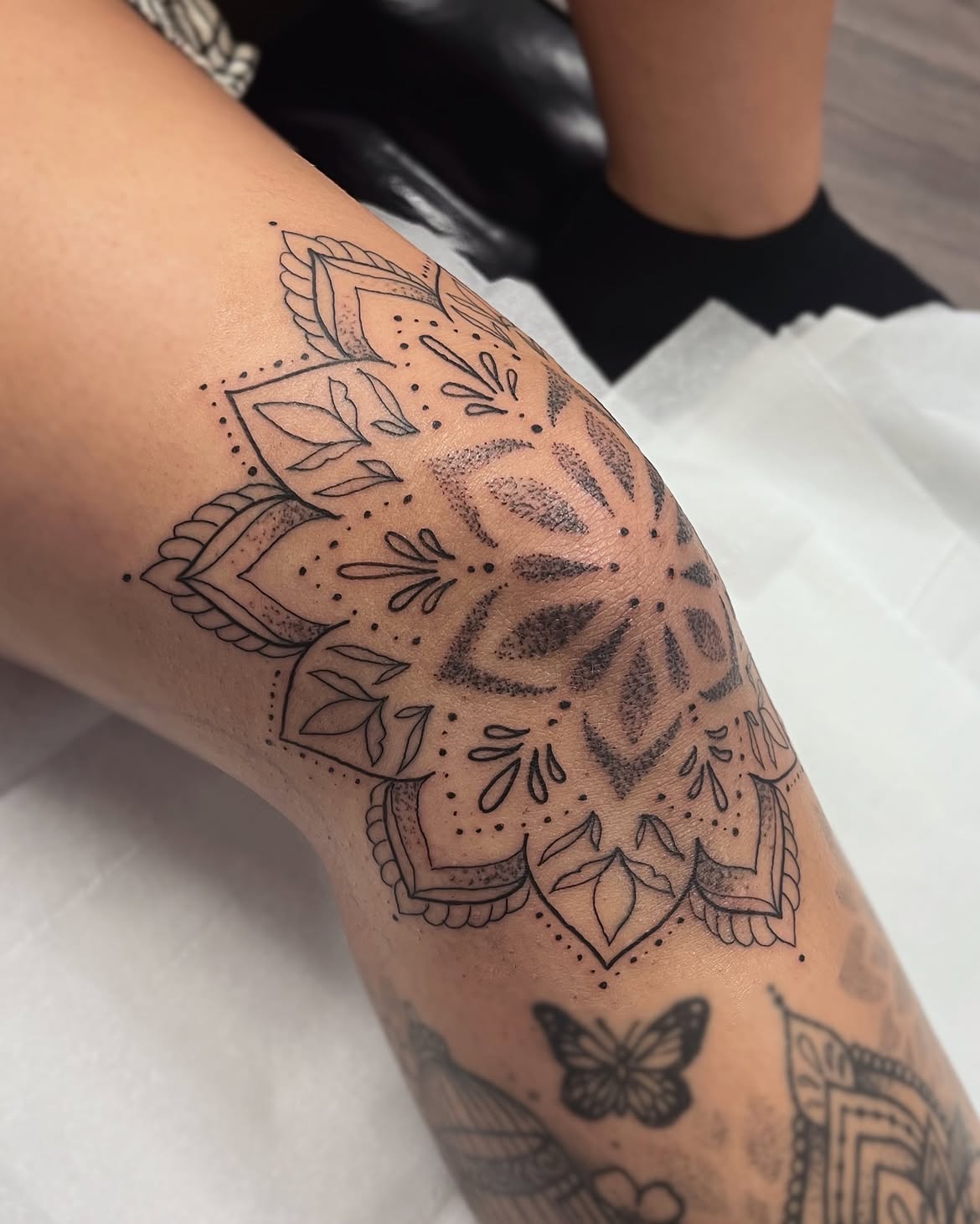
This is a softer interpretation of the classic mandala knee tattoo. Rather than relying on large areas of solid black, the artist builds much of the pattern through fine outlines, dots, botanical forms, and carefully graduated stippling.
The center sits directly over the kneecap and expands through several symmetrical layers. Petal-like forms create the first visual ring, followed by larger pointed shapes containing small leaves and decorative linework. Dot patterns trace the borders and fill otherwise empty areas without making the design visually heavy.
The result feels both ornamental and organic. It isn’t quite a literal flower, yet botanical references are present throughout the composition. This middle ground is one reason mandala-inspired knee tattoos remain so adaptable: the geometry can be made severe and masculine, delicate and feminine, or somewhere between the two.
A tattoo like this depends heavily on accurate stencil placement. Even a small shift in the central axis becomes noticeable when the pattern is this symmetrical, so positioning the design while the leg is in a neutral stance is an important part of the process.
Minimal Botanical Wrap Around Knee Tattoo
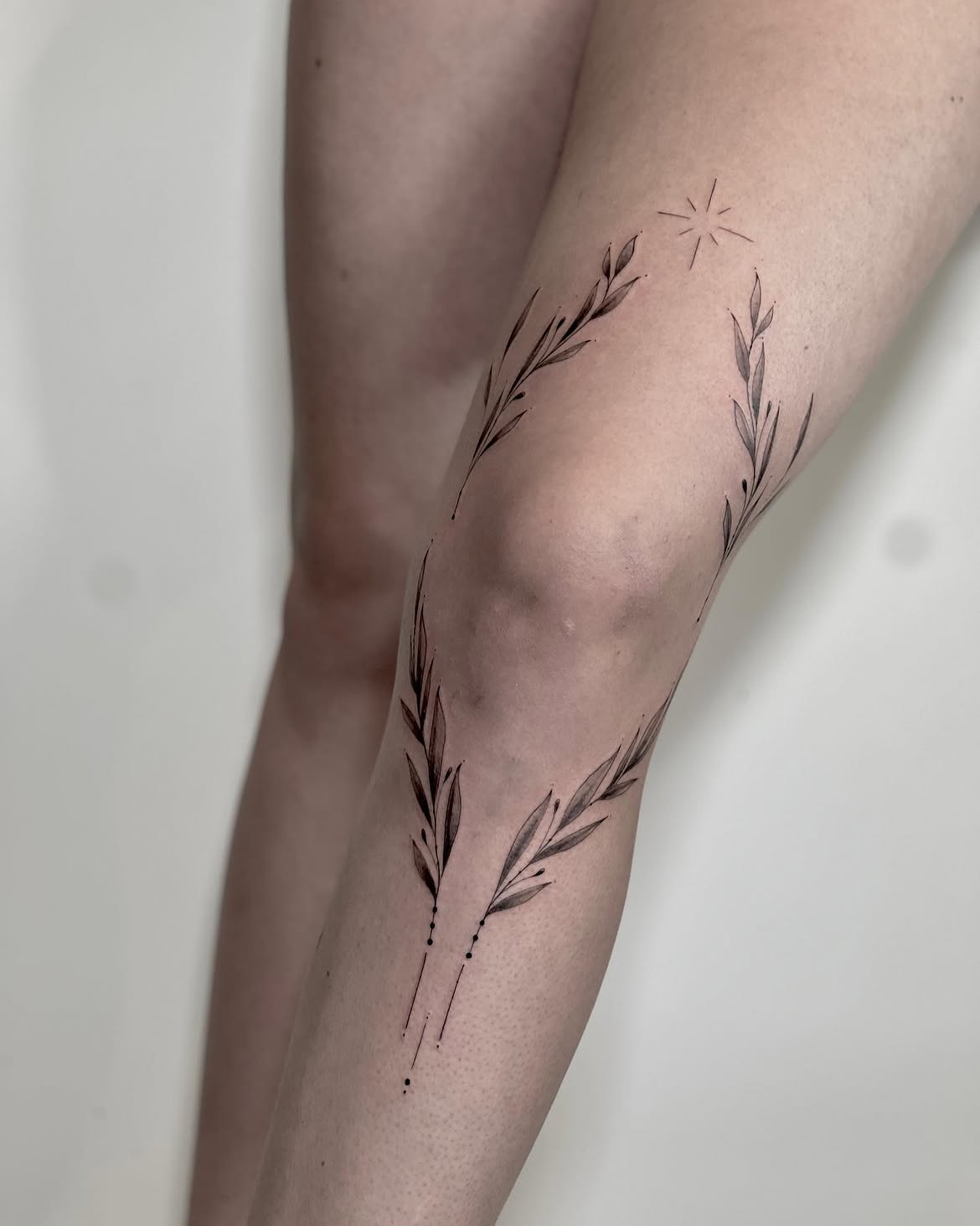
Minimalism around the knee can be remarkably effective when the design follows the joint instead of simply sitting beside it. These slender botanical branches create an incomplete wrap around frame, leaving most of the kneecap completely visible.
Individual stems rise from below the joint and continue toward the upper leg. Narrow leaves are drawn with extremely fine lines and restrained gray-black shading. Tiny dots provide subtle punctuation, while a simple starburst placed above the knee introduces a small celestial detail.
The negative space is arguably the most important part of the composition. Because the branches never form a heavy continuous circle, the tattoo feels light and almost weightless.
For Women looking for feminine knee tattoo ideas, this approach has several advantages. The individual branches can be adapted to meaningful plants, olive leaves, herbs, or birth-flower foliage, and additional elements can always be introduced later.
It is also an excellent example of why placement matters more than size. There is relatively little ink here, yet the design clearly belongs to the knee because every branch responds to the joint’s outline.
Elaborate Botanical Ornamental Knee Design
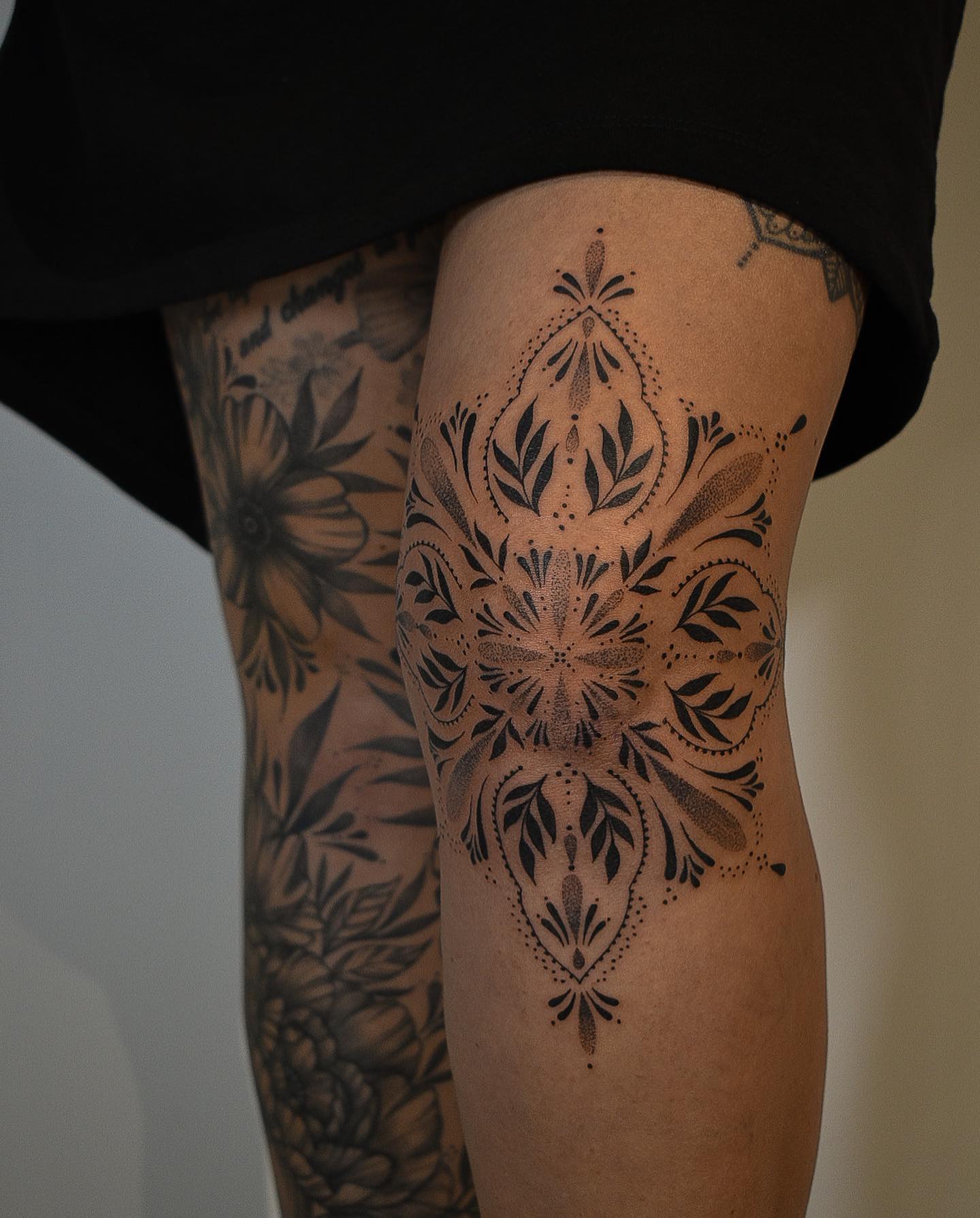
This final piece combines the symmetry of a mandala with the softness of botanical ornament. The composition stretches vertically across the knee, with a central floral burst positioned over the joint and elongated decorative forms extending above and below it.
Black leaf shapes alternate with stippled petals, tiny dots, teardrop accents, and curved botanical details. Instead of constructing the design from hard geometric borders, the artist uses foliage to establish symmetry. That makes the tattoo feel more organic than a conventional mandala while retaining the same satisfying balance.
The vertical extension is particularly successful. Many knee designs become visually wide because artists naturally follow the circular kneecap. Here, the upper and lower ornamental points lengthen the composition and connect it more gracefully with the thigh and shin.
For anyone drawn to floral, feminine, or ornamental knee tattoos, this is a useful reference for creating something substantial without resorting to heavy black coverage. It could also be personalized with recognizable leaves, small flowers, bees, or subtle symbolic details hidden within the pattern.
Traditional Black and Gray Rose Knee Tattoo
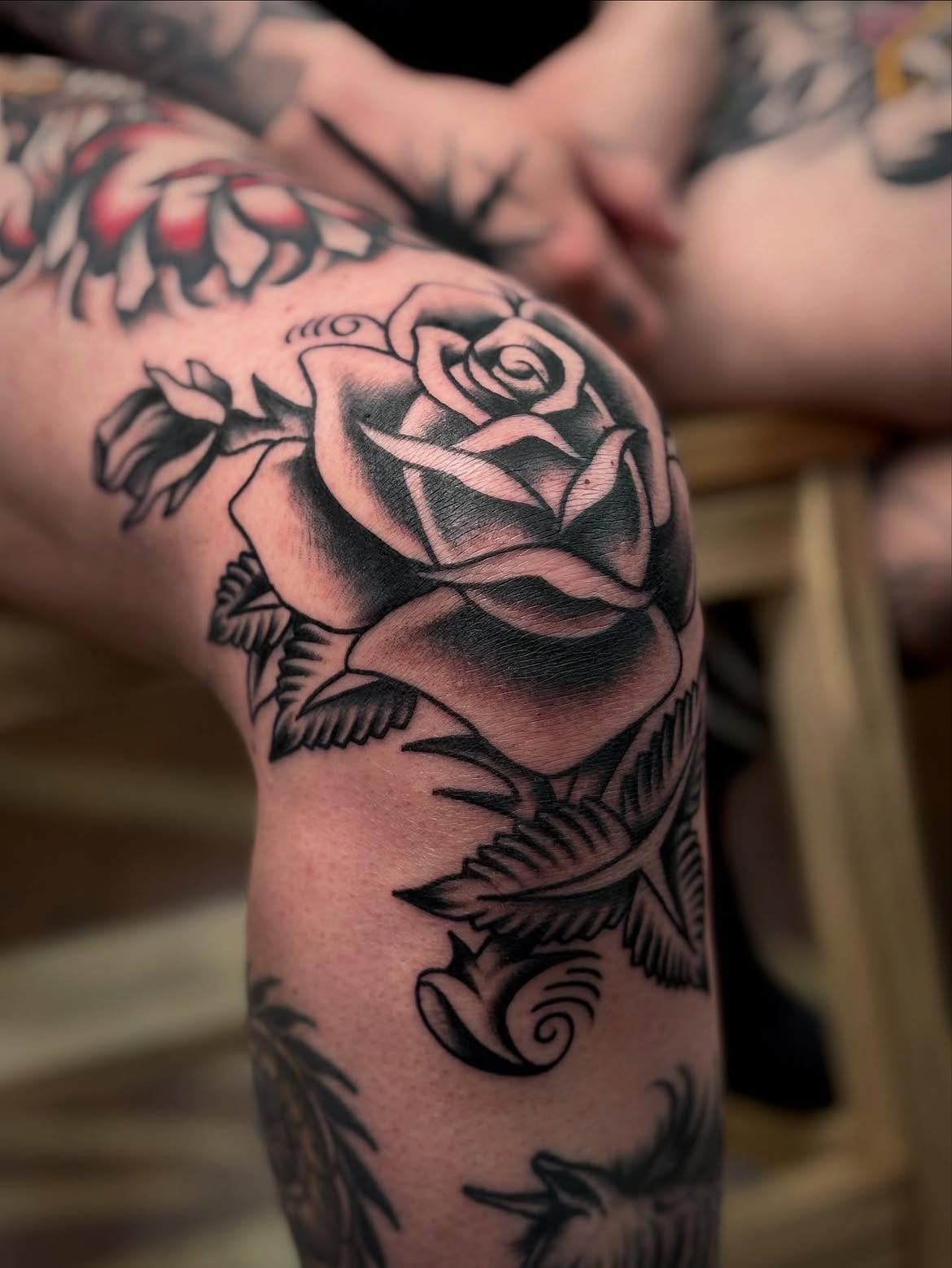
A large rose placed directly over the kneecap is one of those Traditional ideas that works especially well because the natural curve of the joint gives the flower extra dimension. In this design, the rose fills nearly the entire front of the knee, with broad overlapping petals creating a strong circular composition.
Bold black outlines establish the classic tattoo structure, while smooth black-and-gray shading gives each petal depth. The darkest tones appear between overlapping sections, creating the illusion that the petals are folding inward toward the center. Leaves extend toward the lower and side areas of the knee, helping the design blend into the surrounding tattoo collection.
This is an excellent option for anyone who wants a recognizable flower rather than an abstract mandala. It also demonstrates how effective old-school-inspired floral work can be without color. The large shapes remain readable from a distance and are substantial enough to suit both Men and Women looking for a statement knee piece.
Detailed Chrysanthemum Knee Tattoo
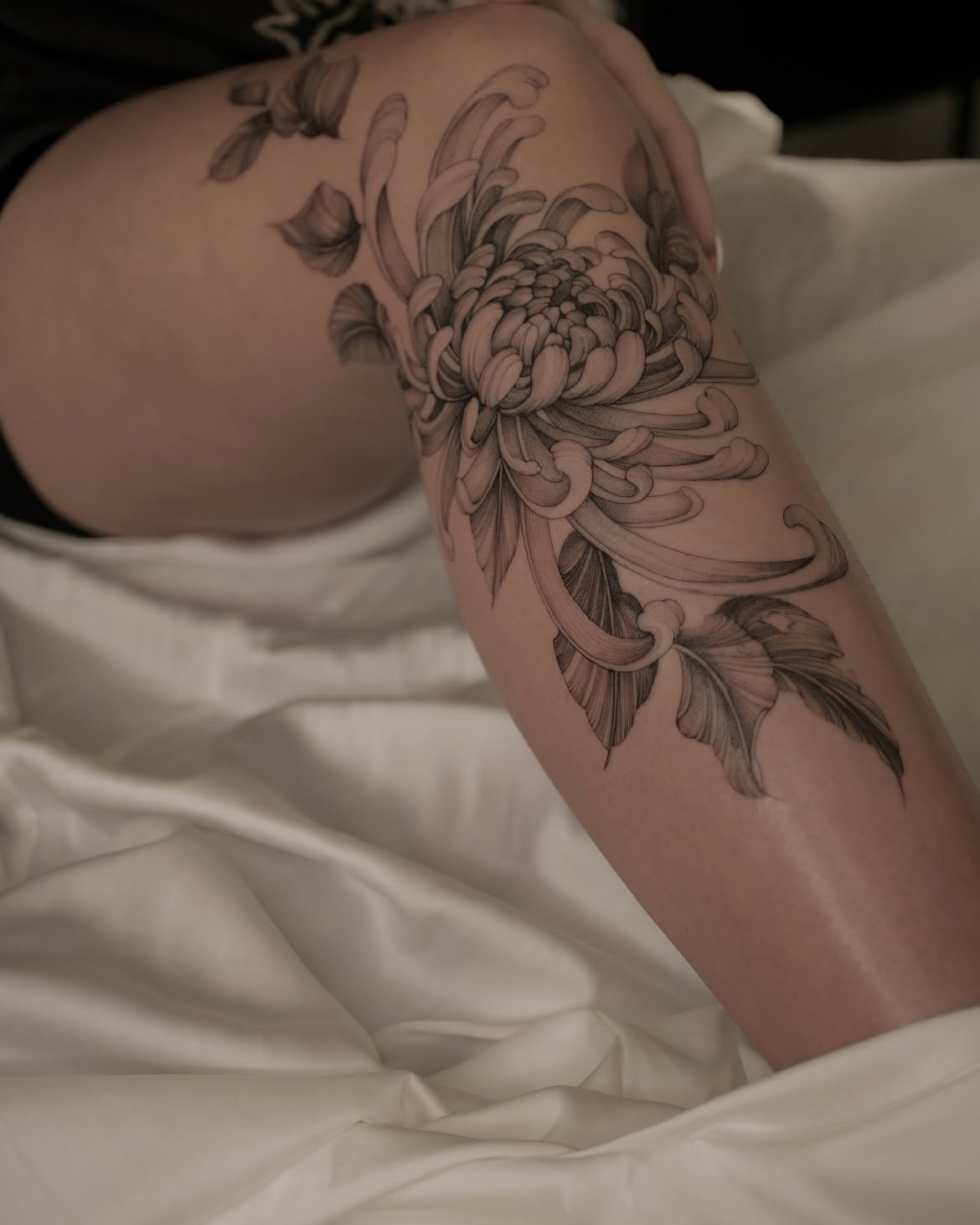
This elegant chrysanthemum transforms the knee into the center of a much larger botanical composition. The densely layered flower sits across the joint, while elongated petals, leaves, and curling decorative forms travel toward the thigh and down the leg.
Unlike a bold American traditional flower, this piece relies on extremely controlled linework and soft shading. Every petal is individually defined, with darker gray concentrated near folds and overlapping sections. That creates impressive depth while preserving the light, sophisticated appearance of the tattoo.
The placement also allows the flower to move naturally with the leg. Instead of creating a rigid circular border around the kneecap, the artist lets individual petals extend in several directions. The result feels almost like a botanical illustration adapted specifically to the body.
For Women interested in larger floral knee tattoos, this is a beautiful example of how a design can remain feminine and refined while still covering considerable space.
Fine Line Botanical Frame Around the Knee
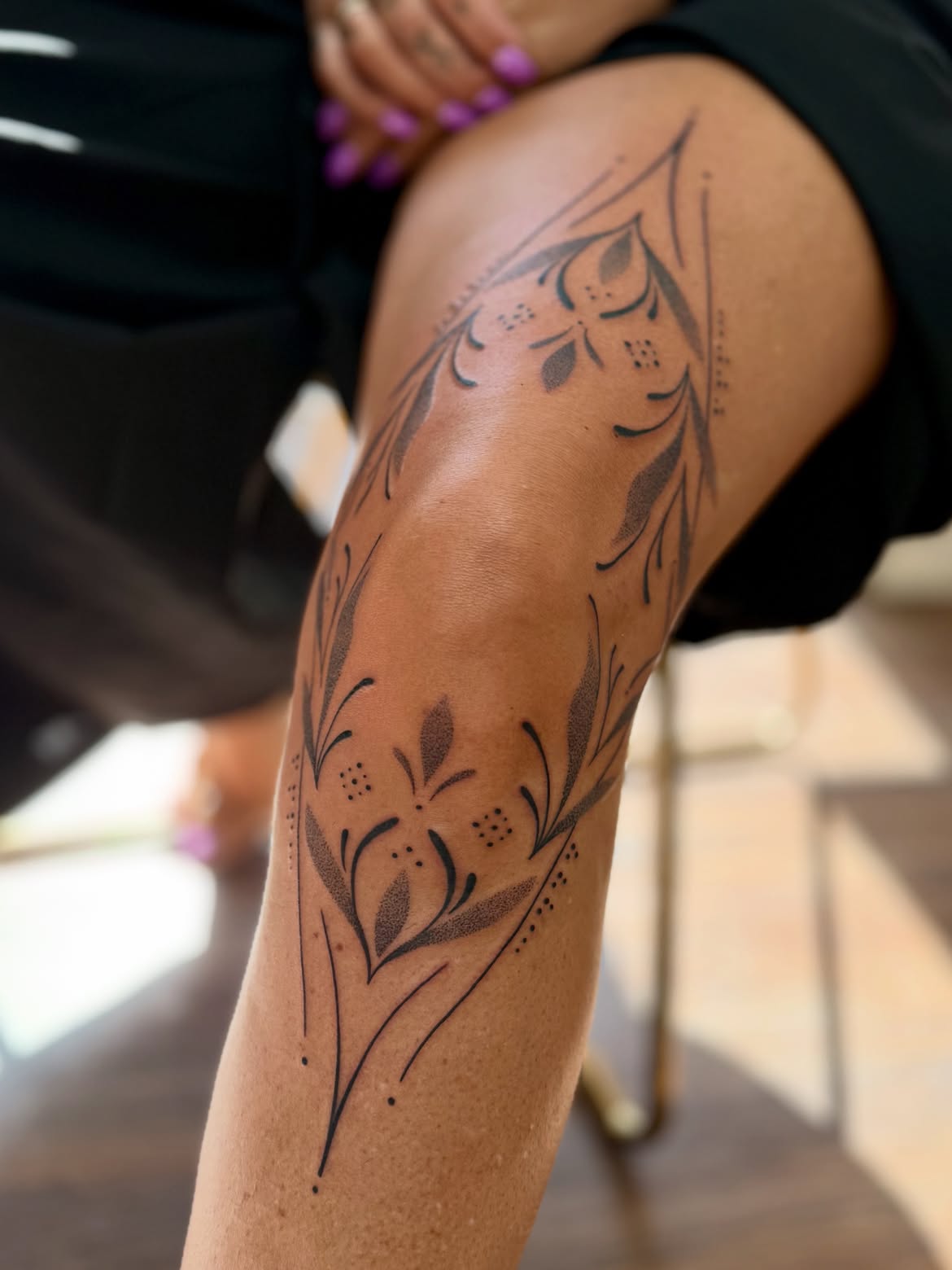
Here the kneecap itself becomes negative space, surrounded by an elongated botanical frame. Thin stems travel around the knee from the upper thigh toward the shin, creating an open oval that follows the natural outline of the joint.
Small leaves, curved strokes, tiny groups of dots, and subtle stippling provide texture without overwhelming the skin. There is no single dominant flower. Instead, the composition relies on repetition and rhythm, making it feel somewhere between fine line botanical work and modern ornamental tattooing.
This style is especially effective for someone who wants noticeable knee decoration without completely filling the joint with ink. The empty center keeps the design visually light and can also become part of a larger leg composition later.
The elongated shape is particularly flattering because it visually follows the leg rather than interrupting it. For feminine ideas female, this is an excellent reference for a custom stencil using leaves, herbs, olive branches, or other personally meaningful plants.
Bold Geometric Mandala Knee Tattoo
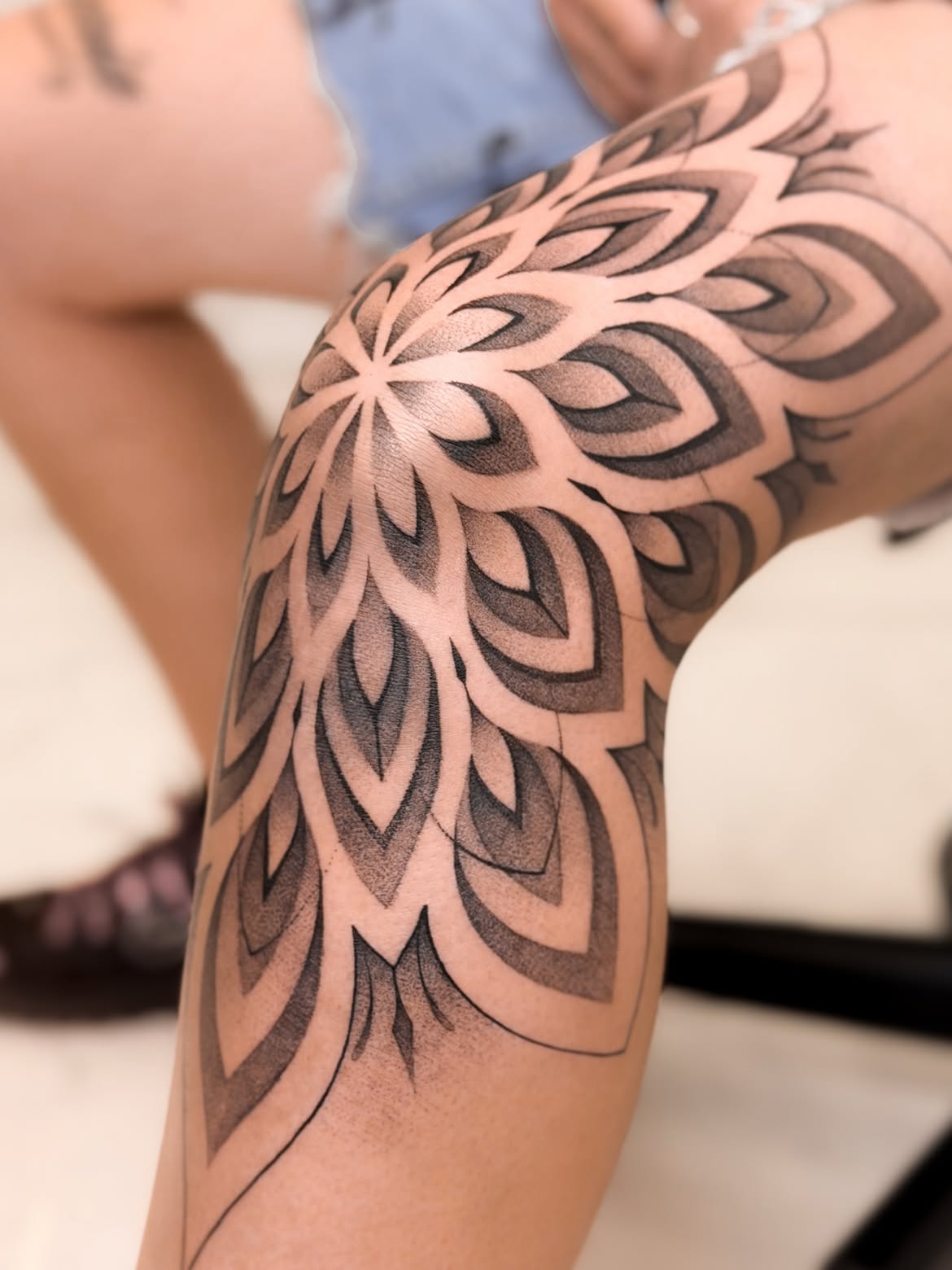
This large black-and-gray mandala turns the kneecap into the precise center of a radiating geometric pattern. Layers of pointed petal shapes expand outward from the middle, wrapping across the curved surface and continuing onto the surrounding leg.
The artist uses strong negative-space channels between darker sections, preventing the design from becoming one solid black mass. Soft dotwork and gray shading appear inside many of the shapes, creating subtle tonal differences between the repeated layers.
What makes this piece particularly successful is its scale. Small mandalas can sometimes appear disconnected from the anatomy, but this version is wide enough to encompass the entire knee. The pattern therefore looks almost integrated into the structure of the joint.
For Men or Women interested in bold ornamental work, this is one of the most versatile concepts. The same basic geometry can be made darker with blackwork, lighter with dotwork, or more decorative by incorporating floral motifs.
Vintage Sun Knee Tattoo
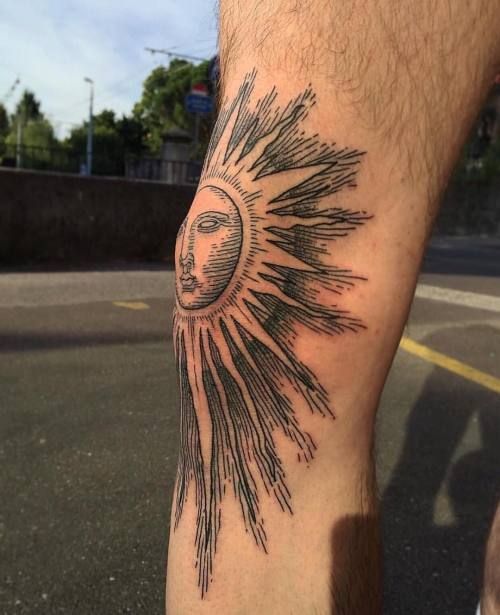
A celestial design offers an imaginative alternative to the flower and mandala styles commonly used on knees. This tattoo places a stylized sun face along the side of the joint, surrounding it with dramatically elongated rays.
The face has a calm, almost antique expression, while the rays are rendered using clusters of thin, sketch-like black lines. Some are short and sharp; others extend vertically down the leg, producing an intentionally irregular silhouette.
The aesthetic recalls vintage engravings and esoteric illustrations rather than modern geometric tattooing. Because the rays are uneven, the tattoo feels organic despite its celestial subject.
This kind of design can carry many personal interpretations—energy, clarity, renewal, optimism, or simply an appreciation for celestial imagery. It would also pair naturally with a moon, stars, botanical details, or other mystical motifs in a larger leg collection.
Open Monster Mouth Knee Tattoo
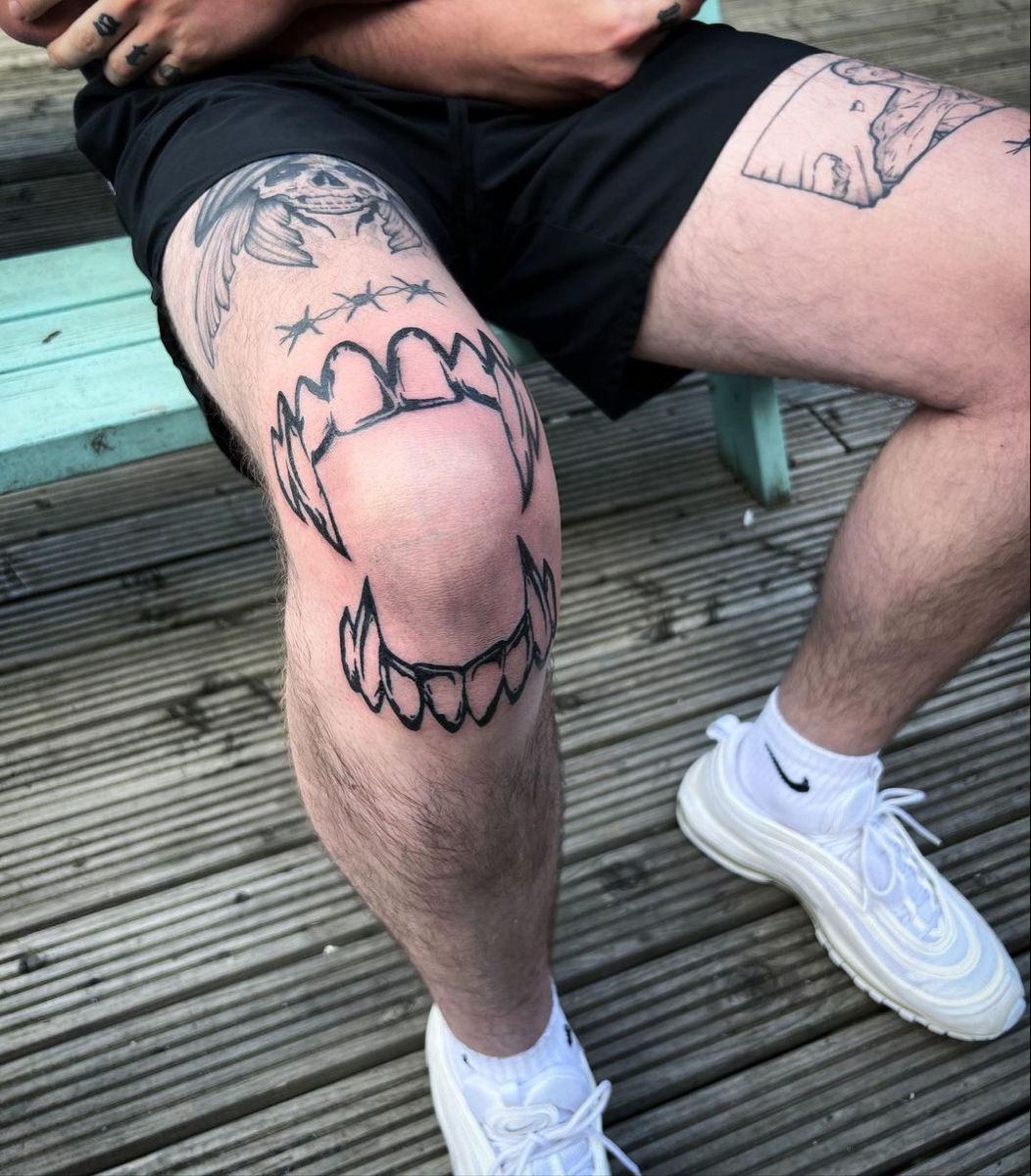
One of the coolest ways to exploit knee movement is to turn the joint into the open space inside a mouth. In this bold design, large jagged teeth sit above and below the kneecap, while pointed side elements create the impression of an enormous creature biting around the joint.
The tattoo is intentionally simple. Rather than using detailed realism, the artist relies on thick black outlines and exaggerated tooth shapes. The exposed skin of the kneecap becomes the interior of the mouth, making the anatomy itself an essential part of the image.
When the leg bends, the relationship between the upper and lower teeth changes, giving the tattoo an animated quality. It is playful, aggressive, and unconventional at the same time.
For Men who prefer graphic, punk-inspired, monster, or dark patchwork tattoos, this concept offers a strong alternative to the usual skull or spider web knee designs.
Compass Star and Laurel Knee Tattoo
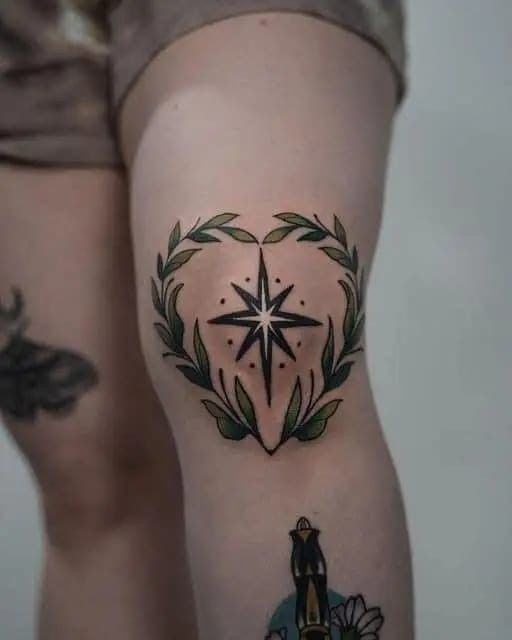
This compact design combines a sharp compass-like star with a delicate wreath of green leaves. The star sits directly over the front of the knee, while two botanical branches curve upward to create a nearly symmetrical frame.
Black gives the central symbol strong visual definition, and the restrained green color in the leaves introduces just enough contrast to separate the botanical frame from the centerpiece. Small dots around the star soften the transition between these elements.
The overall design has a clean symbolic quality. A compass star can suggest direction, guidance, travel, purpose, or finding one’s way, while the surrounding branches may evoke growth and renewal.
It is also an interesting choice for someone who wants color without committing to a highly saturated tattoo. The green is subtle enough that the piece still reads primarily as blackwork, making it easy to combine with other leg tattoos.
Large Snake Wrap Around Knee Tattoo
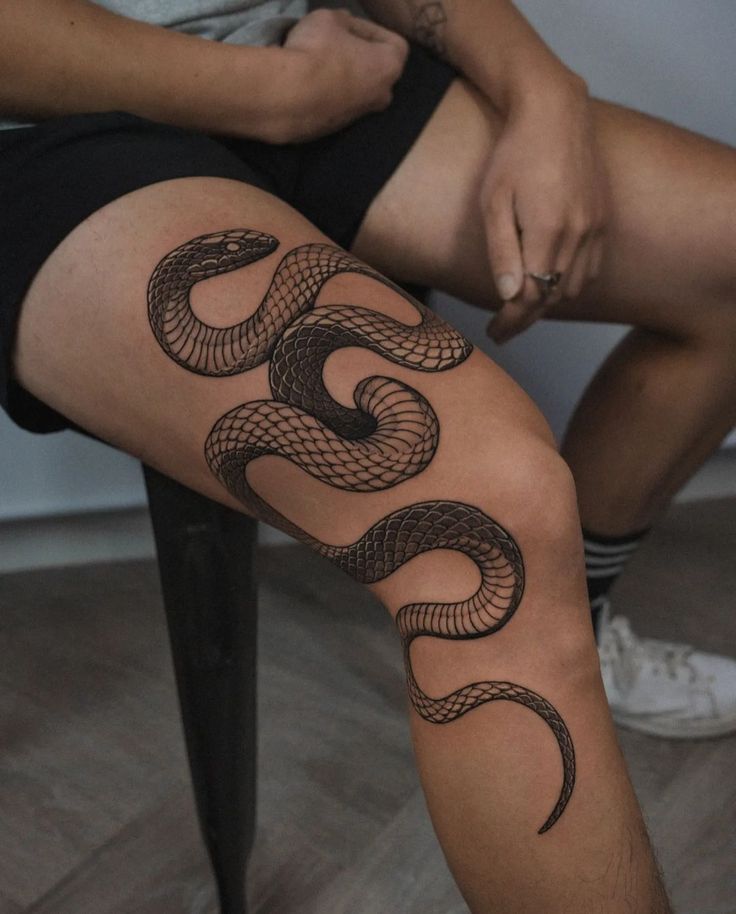
A snake is almost perfectly suited to knee placement because its body can curve naturally around the joint. This large example begins on the thigh, forms several dramatic S-shaped bends, crosses the side of the knee, and continues down toward the shin.
Detailed scales cover the entire body. Alternating dark dorsal areas and lighter underside sections help define each curve, giving the snake dimensionality even though the design uses a limited black-and-gray palette.
Unlike a centered kneecap tattoo, this composition emphasizes movement. The eye naturally follows the snake from one curve to another, making the whole leg part of the artwork rather than treating the knee as an isolated canvas.
This is also an excellent wrap around concept for anyone building a larger leg piece. Flowers, a dagger, skull, spider, or ornamental elements could eventually occupy the remaining negative spaces without interfering with the snake’s strong silhouette.
Knee tattoos in 2026 are becoming less about forcing a conventional motif onto a difficult area and more about treating the joint as part of the artwork. A shark jaw can surround it, a spider web can radiate across it, flowers can frame it, and a moth can use its symmetry to emphasize it. Whether you prefer Traditional, Gothic, ornamental, floral, or experimental blackwork, the best idea is usually the one designed specifically for the movement and proportions of your own leg. Which of these approaches would you actually wear? Leave your favorite in the comments.