Native American tattoo ideas continue to resonate deeply in modern tattoo culture because they represent more than aesthetics — they carry stories of ancestry, spirituality, strength, and respect for nature. Across studios from Los Angeles to Berlin, artists and collectors alike are revisiting traditional Sioux, Navajo, Cherokee, and Crow influences, translating them into bold, realistic pieces for the forearm, sleeve, chest, and leg.
This article explores standout Native American tattoo designs through a curated set of images, breaking down symbolism, artistic execution, and placement ideas. Each section reflects a different visual approach — from ceremonial portraits to animal spirits — offering inspiration for both men and women considering meaningful, long-term ink.
Thunderbird-Inspired Geometric Forearm Outline
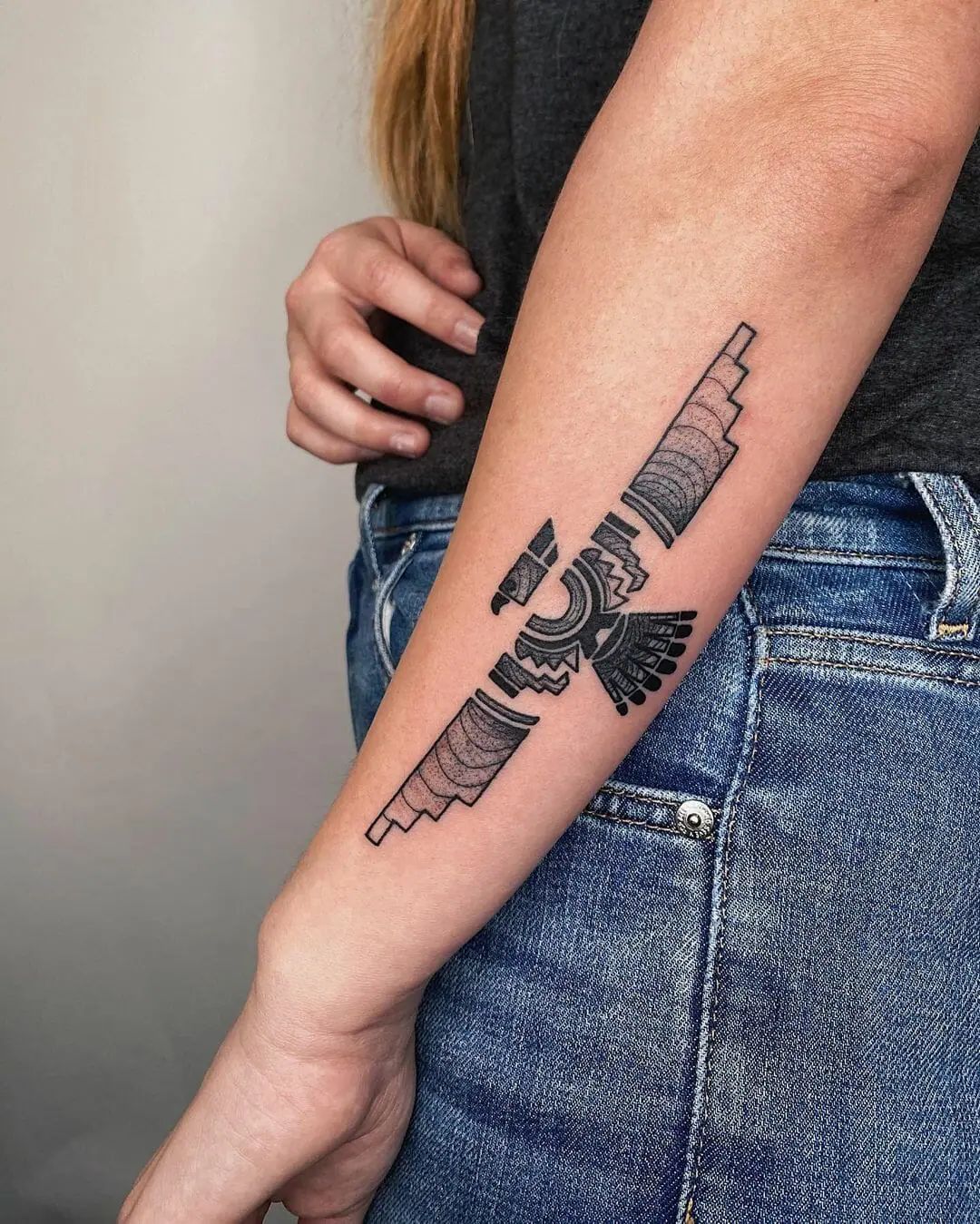
This clean blackwork Forearm design leans into the impact of simplified Drawings—a stylized bird form that reads like a modern thunderbird or Eagle symbol without overloading the arm with tiny details. The center body uses stacked geometric shapes and curved segments, while the wings stretch out in symmetrical blocks with subtle texture lines.
What makes it feel “designed” (not random) is the balance: thick outlines, consistent negative space, and repeating arcs that echo across both sides. If you love crisp, graphic tattoos, this is the kind of piece that ages well because it won’t blur into a gray smudge. Styling-wise, it looks best with short sleeves or a rolled-up denim jacket so the wing span stays visible.
Crow Guardian With Dreamcatcher Realistic Piece
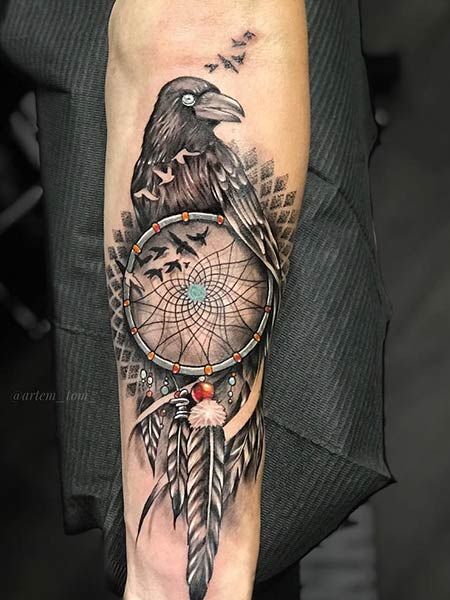
Here’s a Realistic Piece built like a full story: a dark Crow perched above a dreamcatcher, with layered shading that gives the feathers a glossy, almost wet-ink depth. The dreamcatcher web is clean and centered, framed by a ring dotted with warm accent beads, and long feather drops that taper beautifully down the arm—perfect for a half sleeve flow. A few birds in flight add motion and keep the upper area from feeling heavy. If you’re drawn to symbolism, this idea naturally fits themes of protection, guidance, and “watchfulness,” but it still works even if you simply love the drama of black-and-gray realism.
Outfit tip: sleeveless tops and fitted tees make this one look like wearable art; avoid very busy sleeve patterns that fight the feather textures.
Soft Shaded Feather Behind The Ear
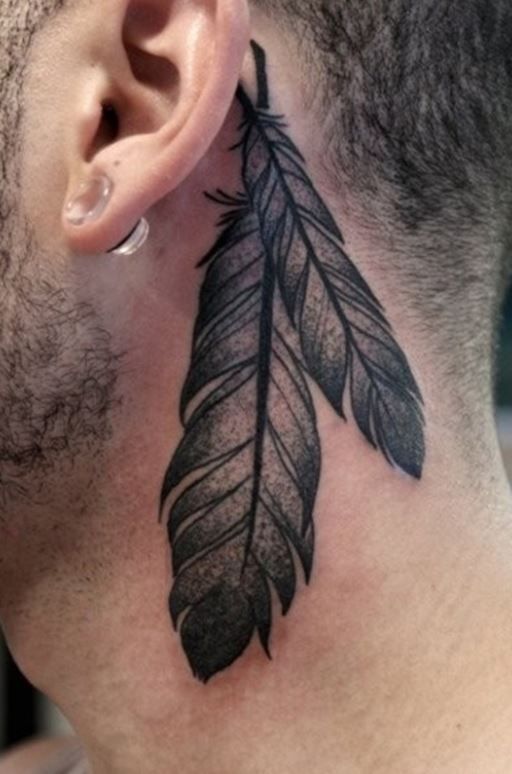
This behind-the-ear placement is a classic for men designs (and anyone who wants something personal but not loud): two layered feathers, shaded from smoky gray to deeper black at the tips. The linework stays sharp along the quill, while the inner barbs fade with dotwork-like softness—giving it a realistic texture without turning into heavy realism. It’s a great “first Indigenous-inspired” tattoo for people who want the feeling of tradition (the feather as a symbol of honor, memory, or spirit) without copying a specific tribal insignia.
Practical note: this area can sting, and it’s visible with short hair—so it’s best for someone who truly wants it seen. Styling tip: it pairs with minimal jewelry; a small hoop or stud is enough.
Skull With Warbonnet Headdress Traditional-Style Statement
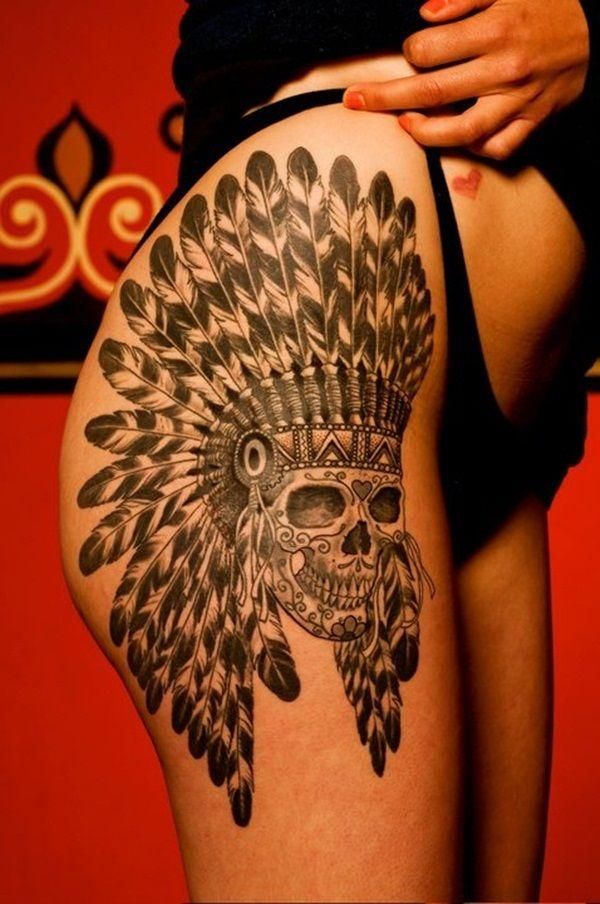
This is the most confrontational concept in the set: a Skull wearing a large feathered warbonnet, scaled big on the upper thigh so the feather fan can spread wide. The tattoo uses strong traditional principles—clean outlines, repeating feather shapes, and clear contrast—so it reads instantly from a distance. The skull’s decorative patterns and the headdress band details add texture without clutter.
One important note, journalist-to-reader: Plains-style warbonnets are often deeply sacred and earned in specific cultural contexts, so many artists (and Indigenous voices) discourage treating them as generic costume imagery. If you love the look but want a more respectful direction, ask for a rework: keep the skull concept, swap the warbonnet for geometric beadwork-inspired patterning, animal symbolism, or abstract feather elements that don’t mimic ceremonial regalia.
Style tip: this placement is made for summer—high-cut shorts or swimsuits let the fan shape peek out dramatically.
Split-Face Warrior Concept With Red Paint And Feather
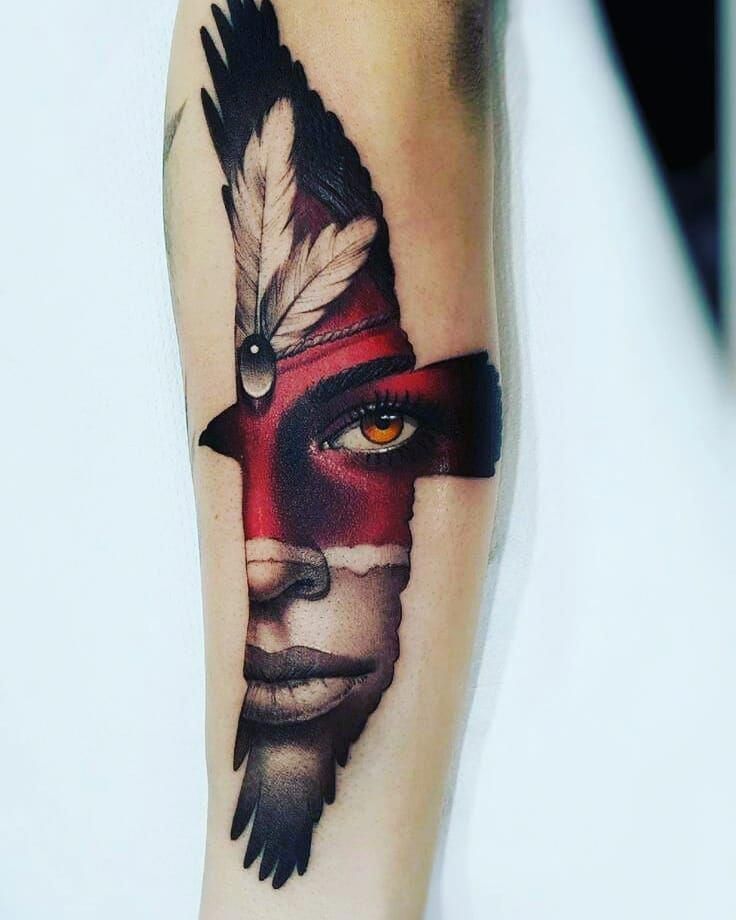
This vertical forearm design uses a clever illusion: one half of a face rendered with smooth shading, then sliced through with bold red paint bands and a dark feather silhouette. The eye becomes the focal point—warm and intense—so the whole tattoo feels alive even though the portrait is partial. It’s a strong example of how modern Native-inspired tattoos often blend portrait realism with graphic elements, almost like editorial artwork.
If you’re aiming for a Realistic Piece that still feels contemporary, this approach delivers: realism for emotion, bold blocks for style. Wardrobe tip: monochrome outfits (black tee, denim, leather) make the red pop; if you wear bright prints, the paint band can visually “compete” with your clothes.
Indigenous Portrait Sleeve Idea With Landscape And Teepee Scene
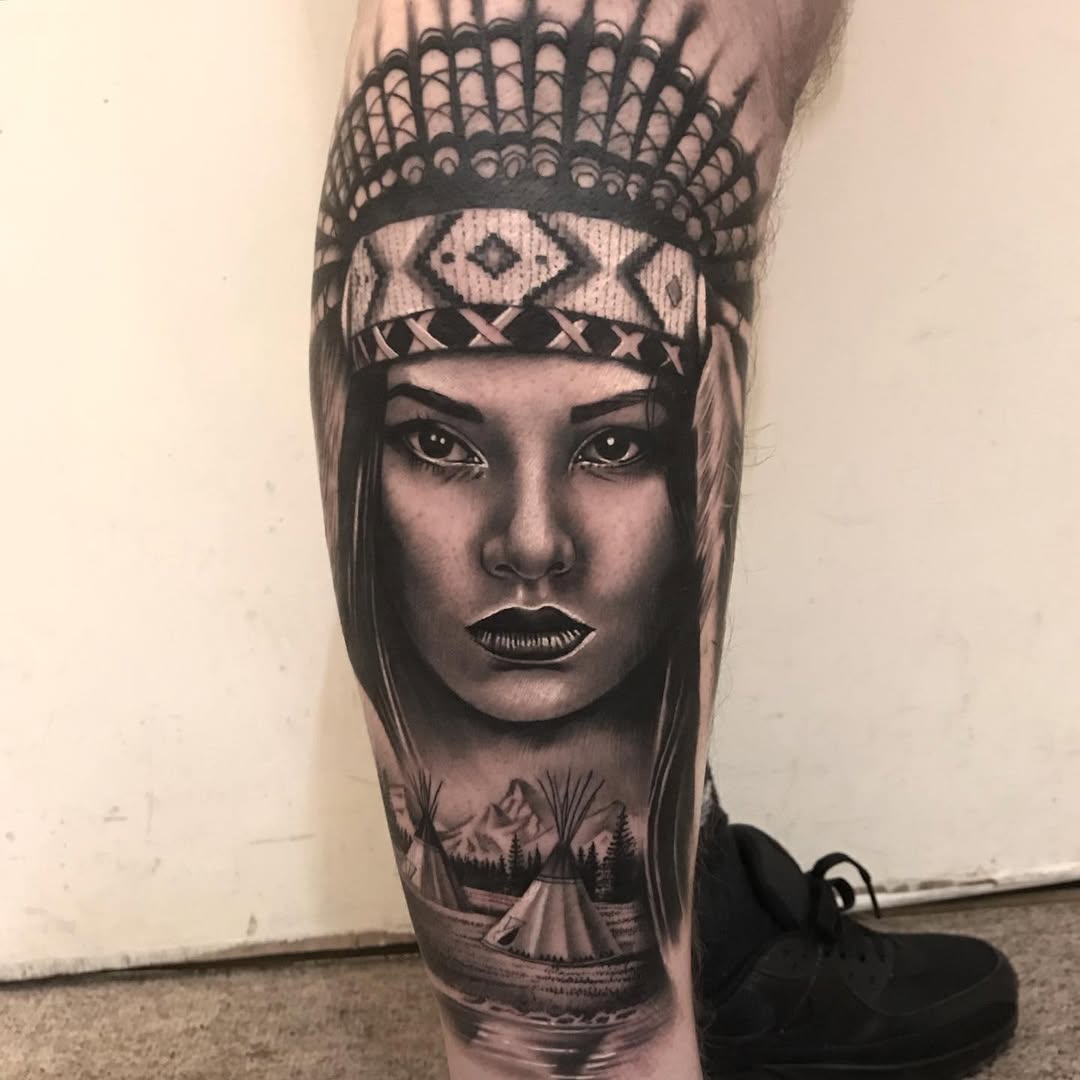
This is a full narrative portrait: a woman’s face with soft, smooth shading and a patterned headdress band, anchored by a scenic lower section—mountains, trees, and a teepee—creating a true Sleeve men / calf-sleeve style layout. The realism is controlled (no muddy blacks), the highlights in the face feel intentional, and the landscape adds grounding so it isn’t “just a portrait floating on skin.” If you’re planning bigger work, this is the kind of composition that can expand: add clouds, additional pattern panels, or animal guardians (a wolf is common, but only if the symbolism feels personal).
Placement tip: this reads best on calf, outer arm, or a full upper arm panel where the face can stay undistorted.
Bold Band Tattoo With Northwest Coast–Inspired Formline Shapes
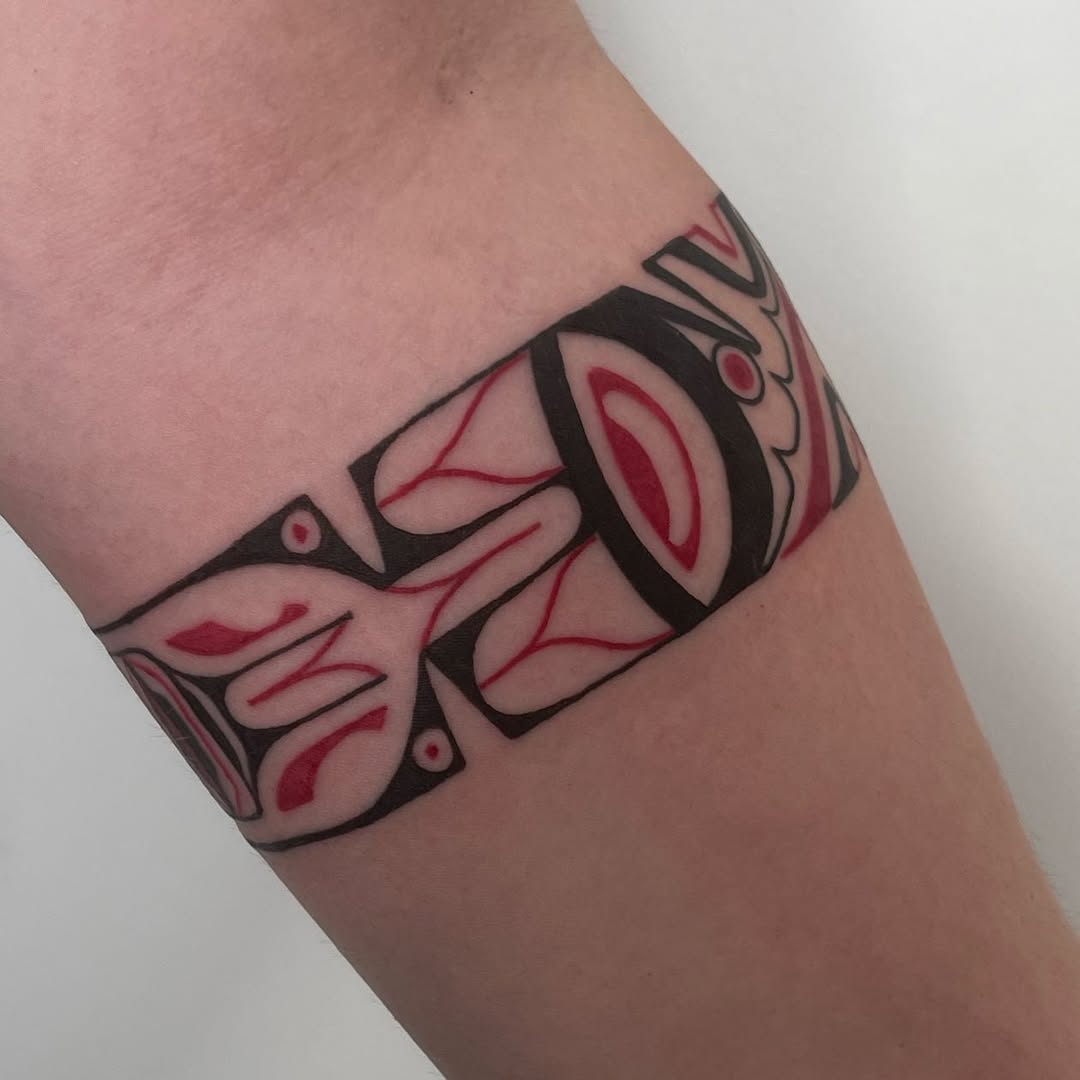
A strong Band tattoo like this is all about rhythm: thick black curves, red accent fills, and negative space that creates the illusion of eyes and flowing forms—very reminiscent of Northwest Coast formline aesthetics. The clean, graphic structure makes it one of the most wearable “everyday” options here, because it looks sharp with anything from streetwear to office basics. If you love armbands but hate when they feel like a generic bracelet, this design style solves it: it has meaning-like structure and visual authority. Technical note: bands need careful placement so they don’t warp when the arm moves—choosing an artist who understands wraparound flow is everything.
Styling tip: short sleeves and tanks show the full loop; long sleeves can hide it completely, which some people prefer for flexibility.
Skull Profile With Feather Headdress In Fine Black-And-Gray
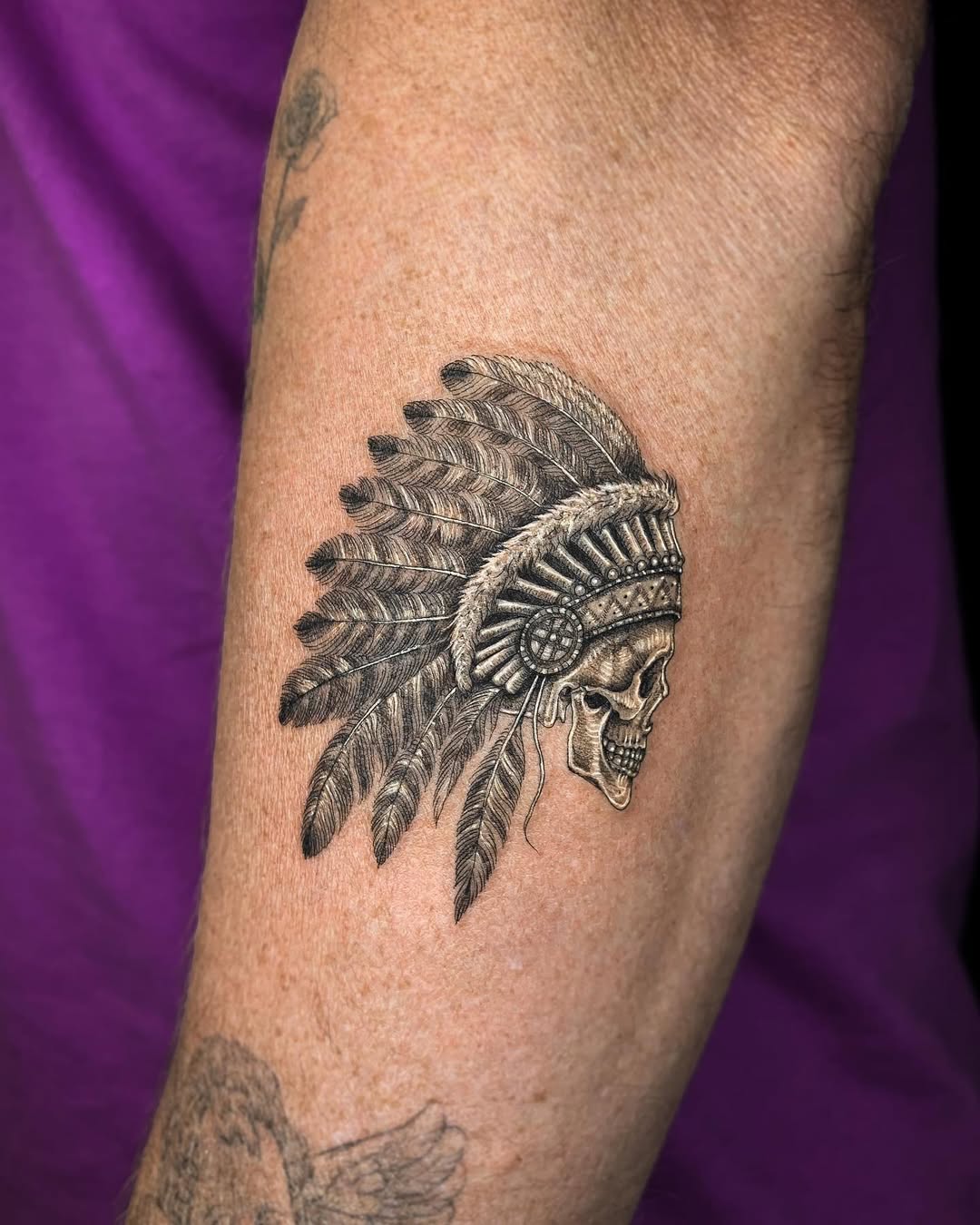
This compact Skull design proves you don’t need a huge canvas to get a “big tattoo” feeling. The skull is turned in profile, shaded with soft gradients that make the cheekbone and jaw look almost carved, while the teeth are kept crisp so they don’t blur together over time. The feather headdress is the real flex: layered plumes with individual barbs, darker tips, and a slightly fuzzy band that reads like fur trim.
The headband has beadwork-like dots and a circular rosette detail near the ear, giving it that ornate, collected look. It’s a strong option for someone who wants a traditional-inspired motif but in a clean, realistic finish—easy to place on the calf, upper arm, or outer forearm without committing to a full sleeve.
Bold Thunderbird Geometry With Turquoise Wings And Sun Discs
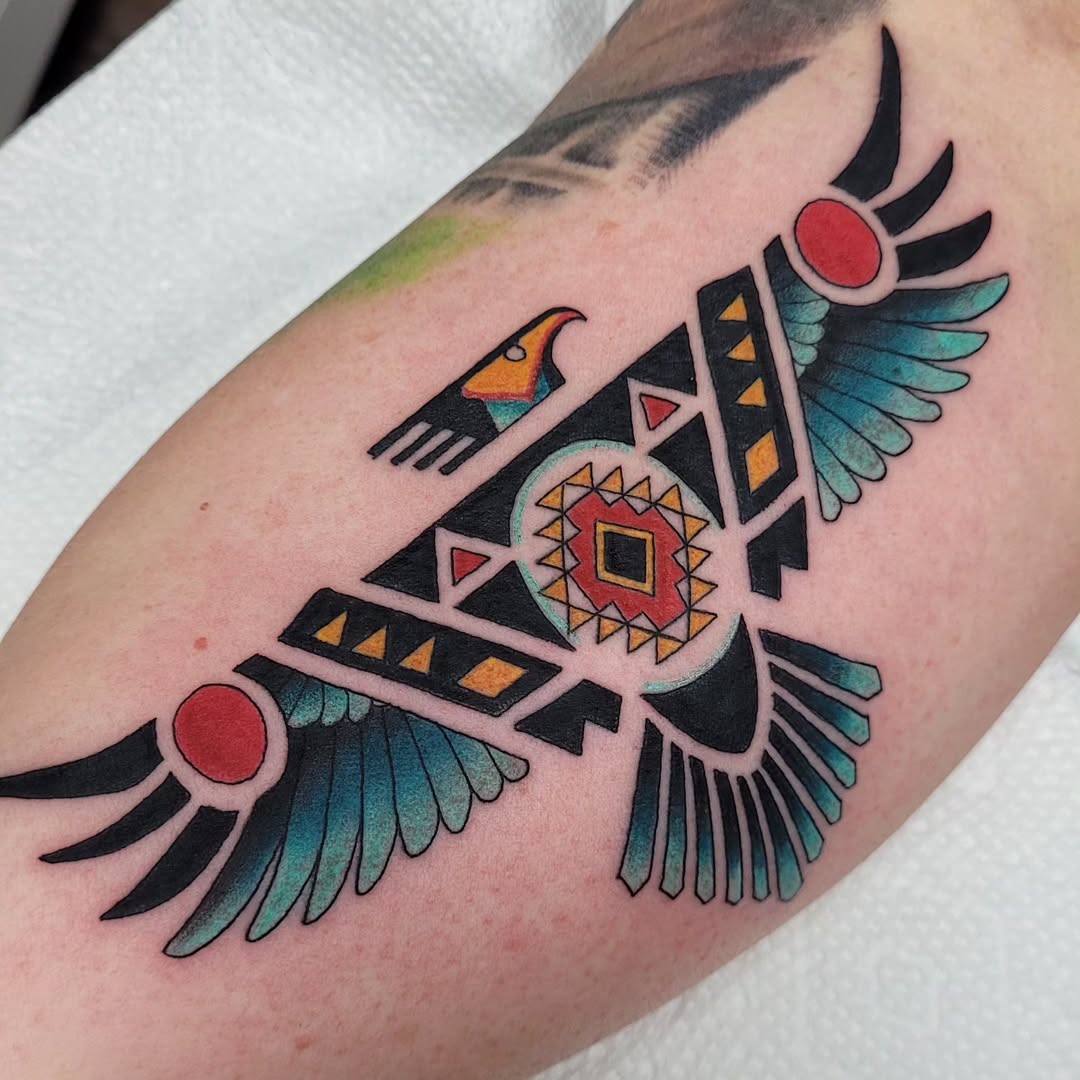
This one is pure graphic confidence—thick black shapes, hard angles, and color that pops from across the room. The bird form reads like a thunderbird / Eagle-inspired emblem, with turquoise wings fanning out in neat segments and deep black “feather” bars that keep the silhouette sharp. Two red sun discs anchor the ends like punctuation marks, while the center medallion uses a diamond-in-diamond motif surrounded by warm yellow and orange triangles.
It’s the kind of piece that works brilliantly on a Forearm because the geometry stays readable when the arm moves. If you like statement tattoos but hate visual clutter, this style is your sweet spot: bold, modern, and built to stay legible for years.
Ultra-Realistic Elder Portrait With Headdress Texture And Weathered Detail
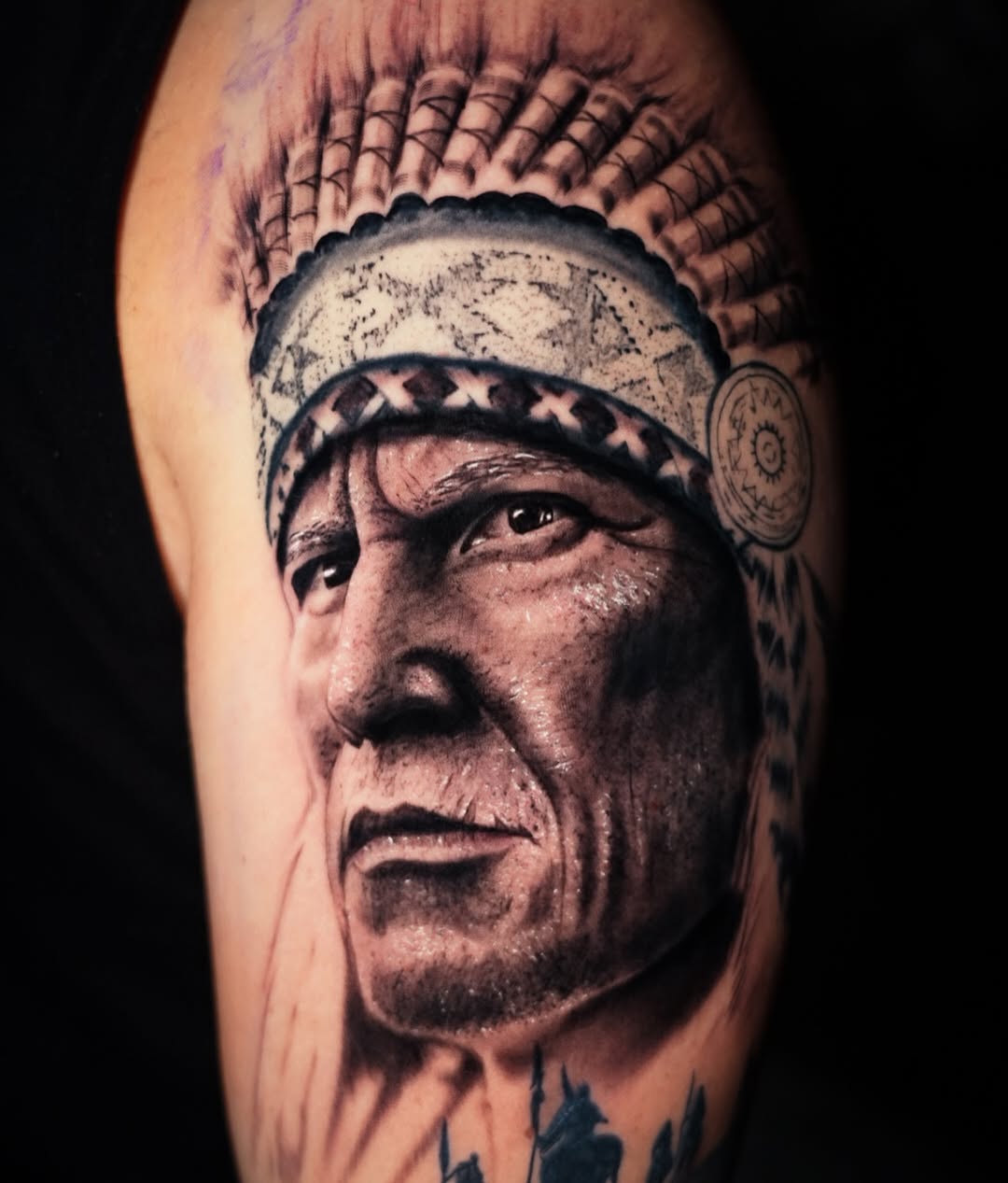
A true Realistic Piece lives or dies by skin texture—and this portrait nails it. The face is rendered with careful contrast: deep-set eyes, creased lids, and natural-looking highlights that make the expression feel present rather than “poster-like.” The headdress band is packed with subtle patterning, and the feathers above it are shaded to suggest volume without turning into a dark cloud. There’s also a circular ornament detail near the side, which adds balance and gives the composition a clear “top frame” for the face.
This is the kind of tattoo that suits men designs on the upper arm or outer bicep—places with enough flat surface to keep the portrait from distorting.
Wolf Guardian Sleeve With Masked Woman And Shadowed Skull Base
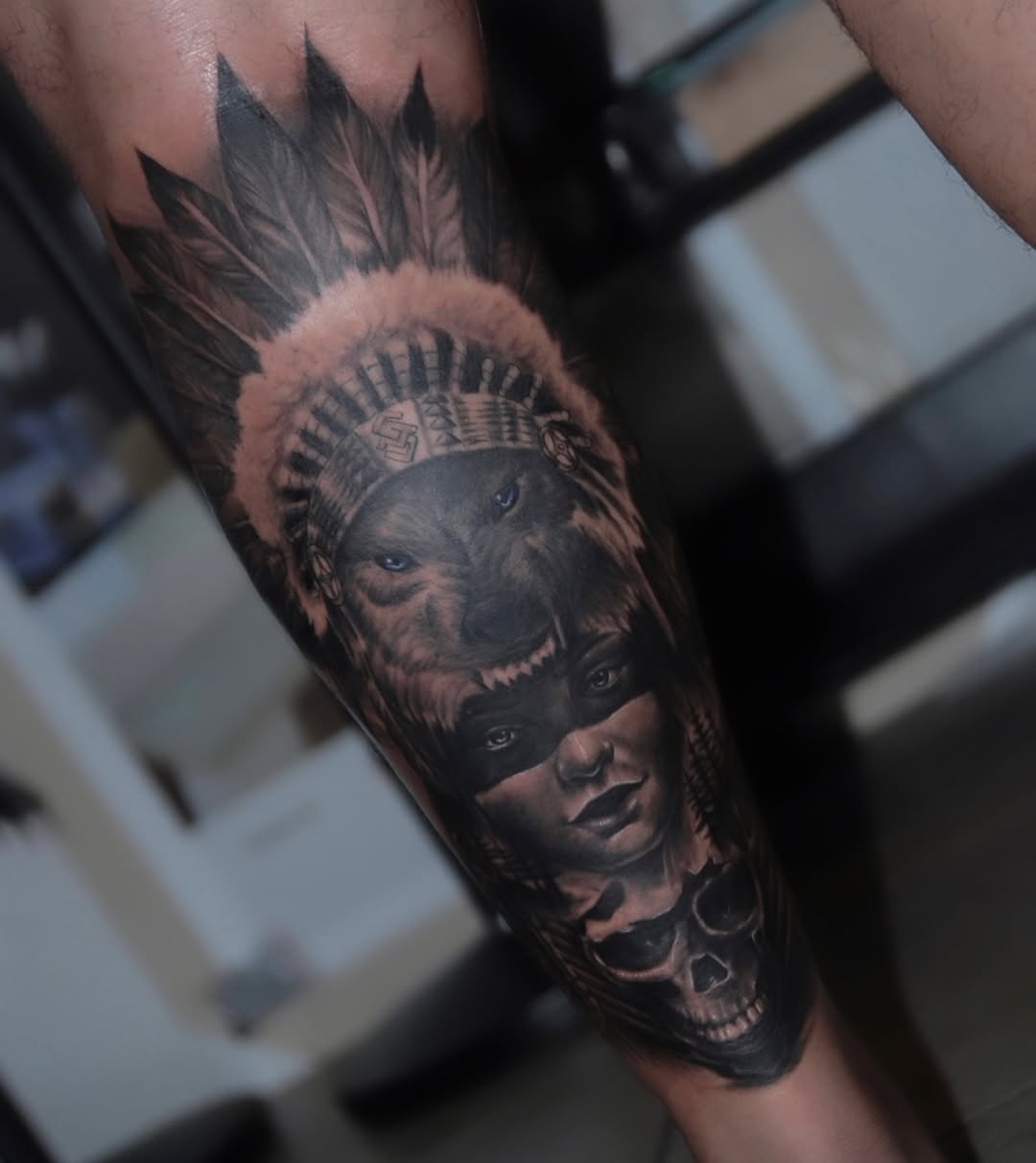
If you want drama and storytelling in one vertical composition, this sleeve idea delivers. A snarling Wolf sits at the top like a guardian figure, wearing a feathered headdress that creates a crown-like silhouette. Below it, a woman’s face appears in smooth black-and-gray realism—eyes calm, lips shaded softly—while the lower section fades into a darker Skull element near the bottom, grounding the whole piece with weight. The transitions are done with smoky gradients, so the three “chapters” feel connected instead of stacked.
This is a smart approach for a calf or full lower-leg sleeve: the wolf takes the widest upper area, the portrait sits in the center, and the skull anchors the narrowest part near the ankle.
Forearm Realism With Elder Portrait And Horseback Scene
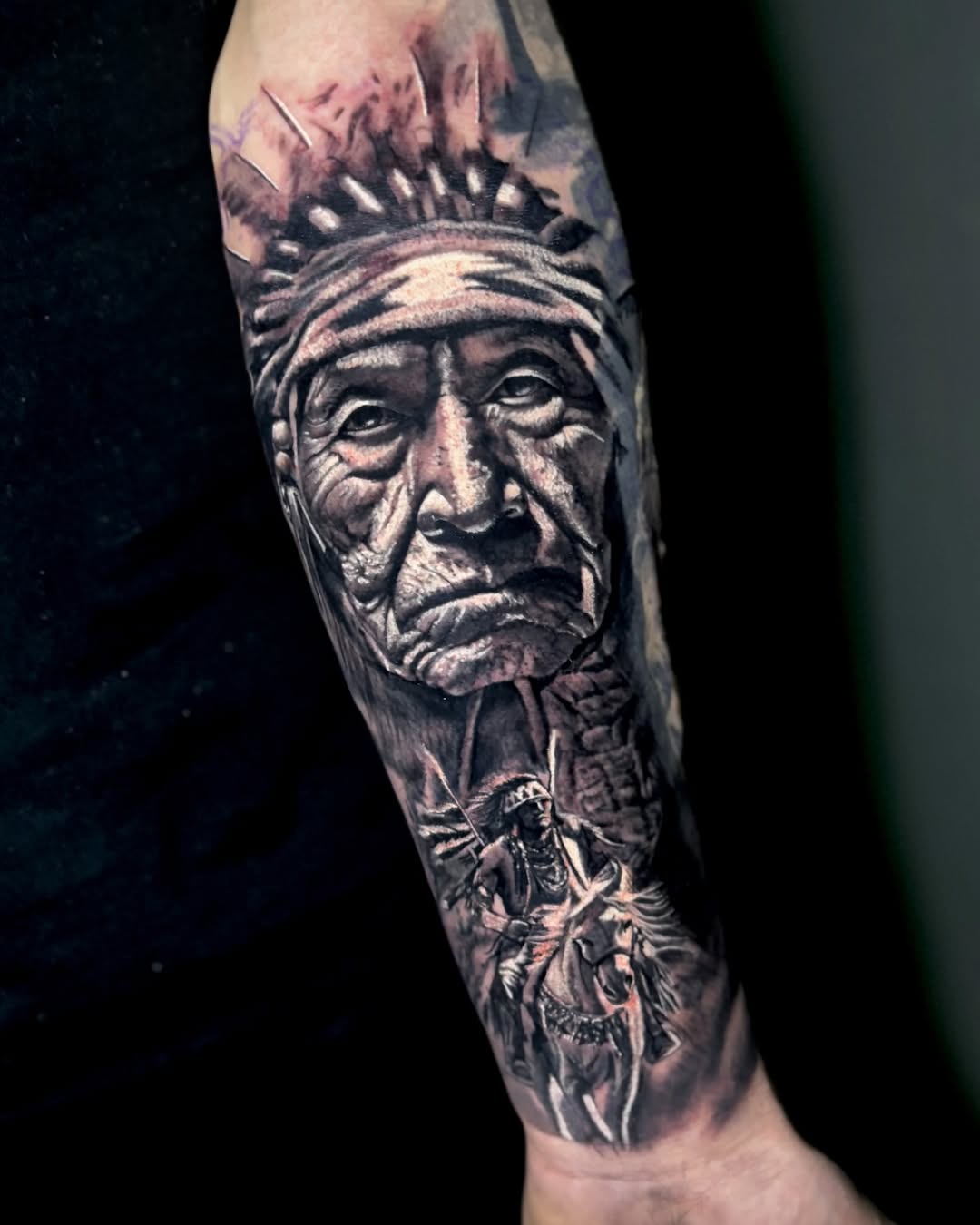
This Forearm tattoo reads like a short film: a strong, weathered elder portrait at the top—heavy shadows under the brow, textured wrinkles, and a tight mouth that gives the expression real gravity—then, below, a detailed Horse rider scene that adds motion and context. The rider is small but crisp, with the horse’s legs and tack shaded just enough to stay readable without turning into mush. The contrast choice is what makes it work: the portrait is high-detail and high-contrast, while the lower scene is slightly softer, so your eye naturally starts at the face and then travels down.
If you’re building a sleeve, this “portrait + narrative vignette” layout is a classic blueprint that artists love because it can expand in either direction.
Thigh Portrait Stencil Style With Braids, Beadwork, And Feather Fan
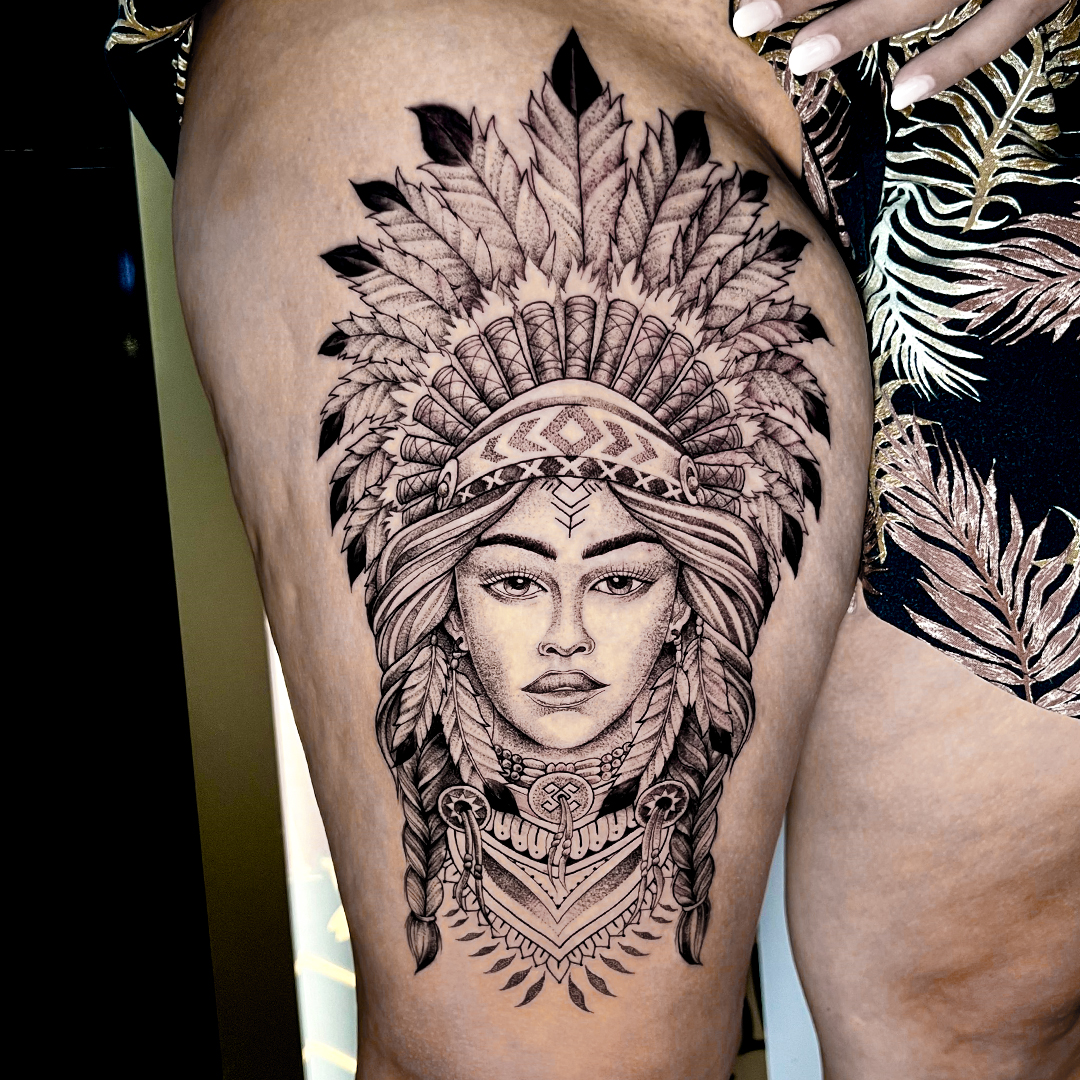
This is a gorgeous example of a for women thigh statement piece that leans more illustrative than photographic. The face is clean and symmetrical, framed by two long braids, while the headdress creates a dramatic halo of feathers—light dot shading inside each plume, darker tips for contrast, and a patterned band across the forehead. Under the chin, layered jewelry and beadwork-style shapes form a neat triangular “bib” that fills the space without feeling heavy.
It has that polished “stencil-to-finished” clarity: strong outlines, tidy shading, and decorative geometry that stays readable from a distance. If you love the portrait concept but prefer something that looks like art printwork (not hyper-real skin texture), this is the direction to save.
Intense Calf Portrait With Feather Crown, Face Markings, And Pendant Detail
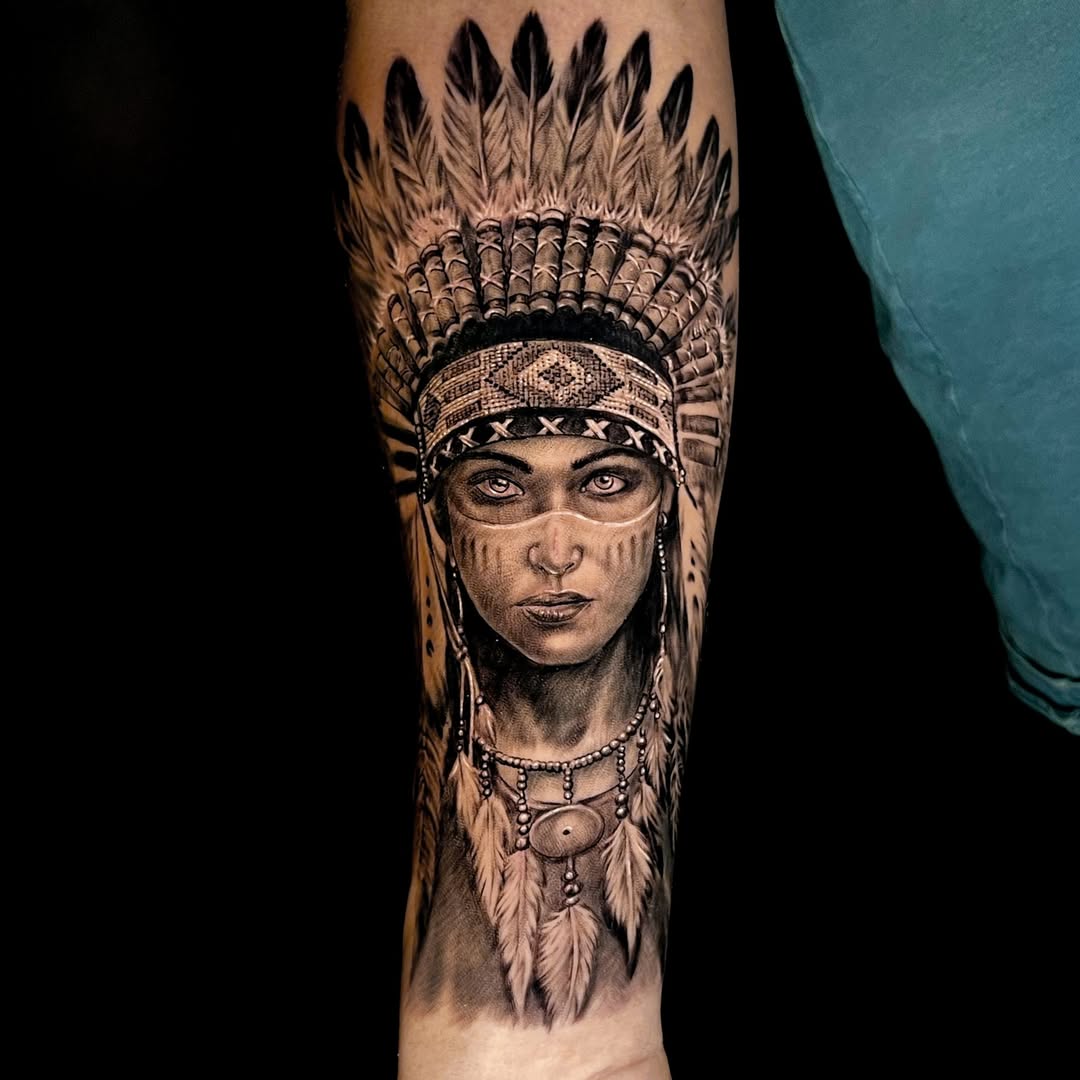
This calf portrait is all about eye contact and contrast. The headdress rises high with layered feathers—dark tips, lighter inner shading—creating a tall silhouette that fits the leg perfectly. Across the face, soft shading and faint markings give a ceremonial, warrior-like mood without relying on heavy lines, while the necklace and round pendant add a strong center point under the chin. The background is kept minimal and dark, which helps the face and feather textures pop.
This is a great example of why realism works best when an artist commits to a clear focal point: you notice the eyes first, then the crown, then the jewelry—exactly the order you’d want for a tattoo meant to be seen in motion.
Ceremonial Woman and Eagle Spirit Composition
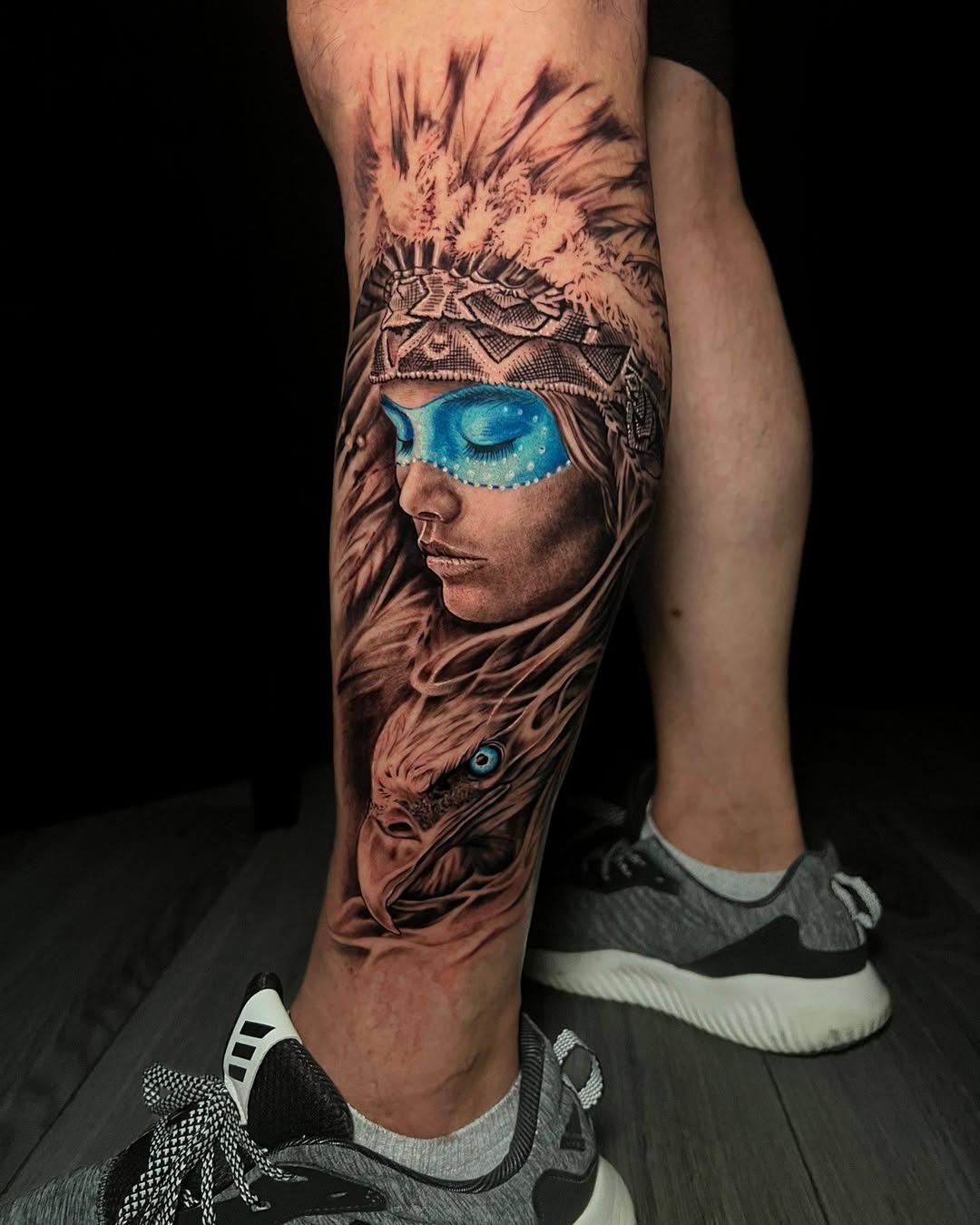
This piece blends two of the most powerful symbols in Native American art: the ceremonial woman and the eagle. The woman’s face is calm, introspective, marked with traditional face paint that signals spiritual protection rather than aggression. The eagle beneath her functions as a guardian spirit — a recurring theme in Navajo and Sioux storytelling — symbolizing vision, freedom, and a direct connection to the sky world.
Executed in a realistic style with subtle color accents, this tattoo works especially well as a men’s lower leg or forearm piece, where vertical flow enhances the narrative. The restrained palette keeps it timeless, while the eagle’s piercing eye anchors the entire composition.
For collectors drawn to traditional sleeve ideas, this design can easily be expanded upward with feathers, cloud motifs, or tribal patterns without losing cohesion.
Warrior Profile and Horse Silhouette
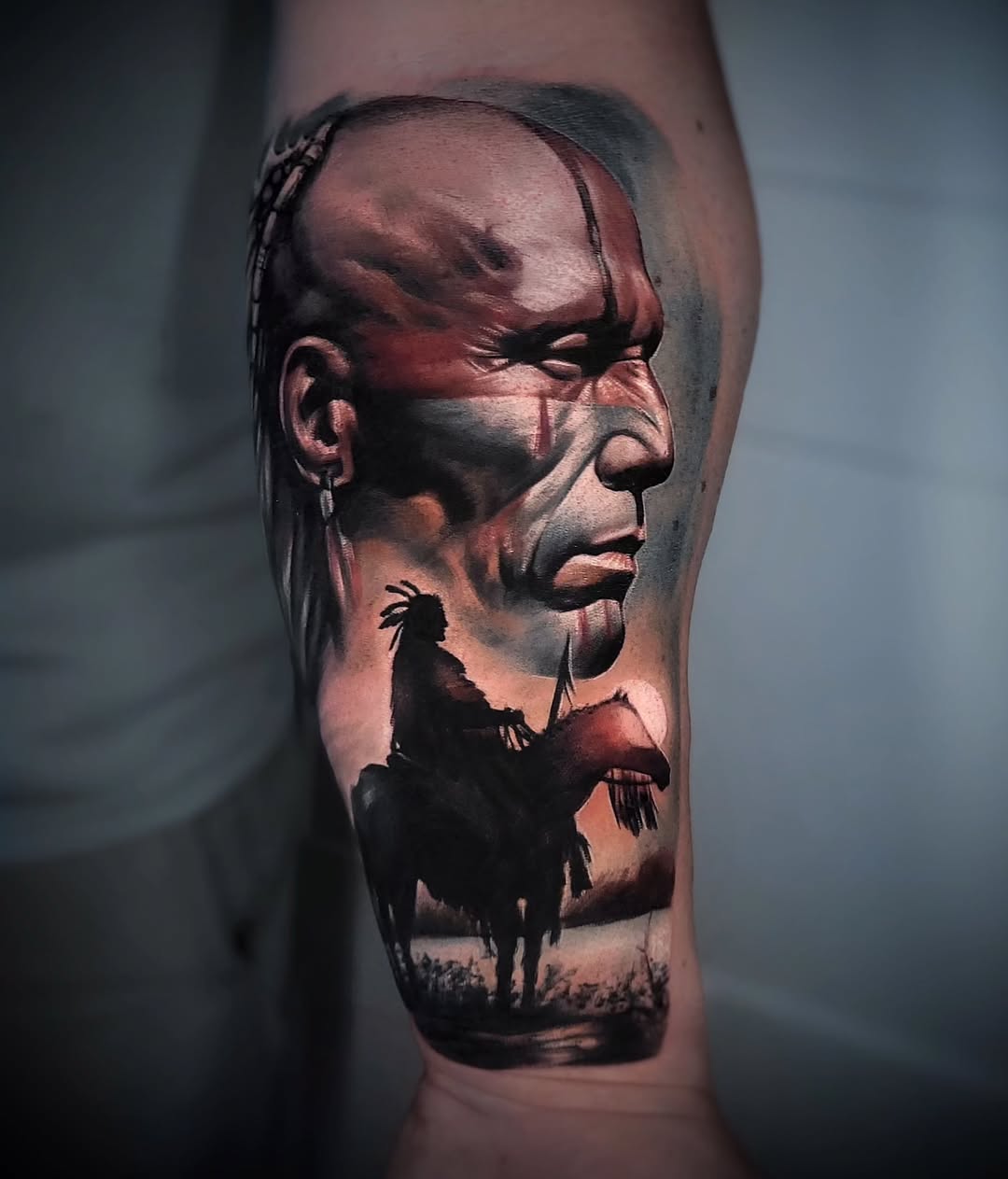
Here, the horse takes center stage — a sacred symbol of power, freedom, and survival in many Plains tribes. The warrior’s profile dominates the upper portion, carved with strong lines and weathered detail that suggest experience rather than youth. Below, the horse and rider appear almost like a memory or vision, reinforcing the idea of legacy and movement through time.
This design aligns closely with Sioux and Crow tattoo traditions, where the horse represents both personal strength and tribal pride. The muted tones and dramatic shading make this an excellent forearm or calf tattoo for men, particularly those drawn to realistic Native American pieces without excessive ornamentation.
Artists often reference similar compositions in publications like Tattoo Life or Inked Magazine when discussing narrative realism in indigenous-inspired tattoos.
Elder Portrait with Traditional Headdress and Pipe
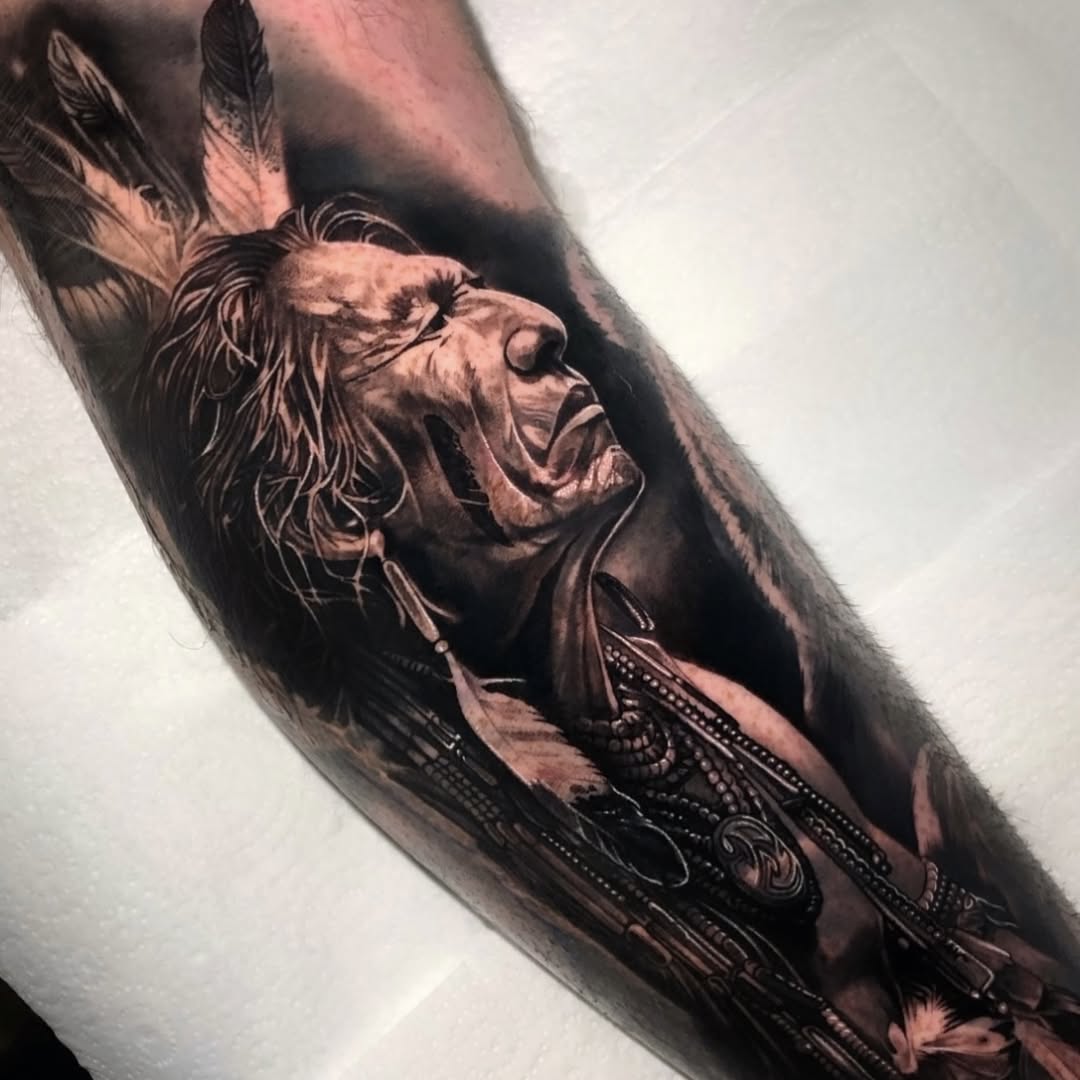
This tattoo centers on the image of an elder, a figure that carries deep weight in Native American tradition. The face is turned slightly upward, eyes closed, suggesting reflection, prayer, or connection to the spiritual world rather than confrontation with the physical one. The lines of the face are deeply etched, emphasizing age, experience, and earned wisdom.
The traditional headdress is rendered with layered feathers that flow naturally with the forearm, creating movement and balance within the composition. Below, the presence of a ceremonial pipe adds further meaning. In many tribes, including Sioux and Cherokee traditions, the pipe represents peace, truth, and dialogue with the spirits. Its inclusion transforms the tattoo from a portrait into a spiritual statement.
Executed in a highly realistic style, this piece works especially well as a forearm tattoo for men or as part of a larger traditional sleeve. The restrained color palette and strong contrast give it longevity, ensuring the design ages with dignity rather than fading into abstraction. This is the kind of Native American tattoo that prioritizes respect and symbolism over visual excess — a hallmark of thoughtful, well-researched body art.
Elder Portrait with Traditional Headdress
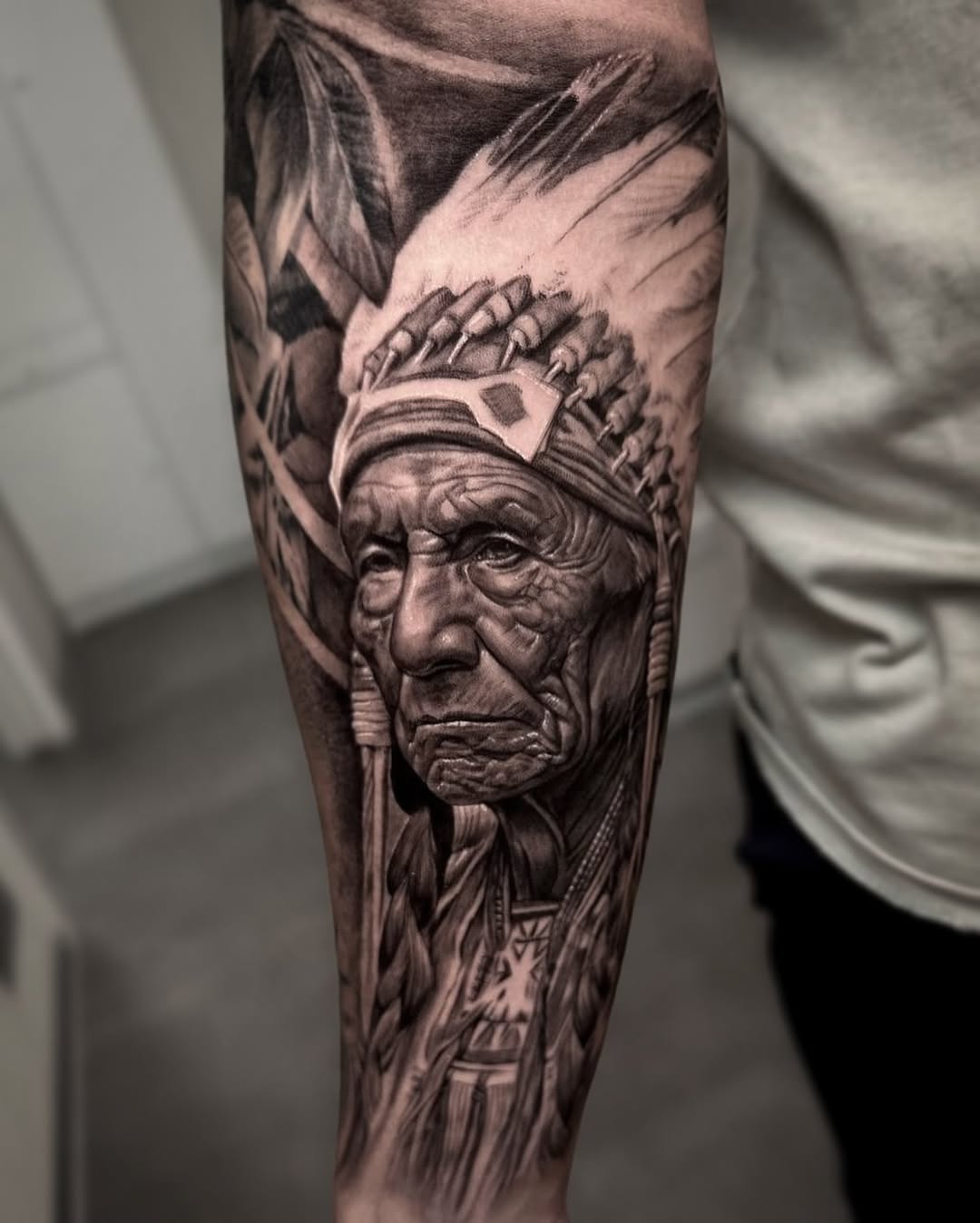
An elder’s face tells a story no symbol ever could. This tattoo leans into that philosophy, presenting a deeply lined portrait that reflects wisdom, resilience, and spiritual authority. The traditional headdress is rendered with extreme attention to texture, each feather layered carefully to maintain realism.
This is a classic Cherokee and Plains-inspired art style, often chosen for full sleeve or upper forearm placements, where the face can remain undistorted. There’s no unnecessary embellishment — just respect for age and experience.
For those researching Native American tattoo stencils or portrait references, this type of work demonstrates why realism remains the gold standard when honoring indigenous elders.
Female Profile with Feathered Headdress
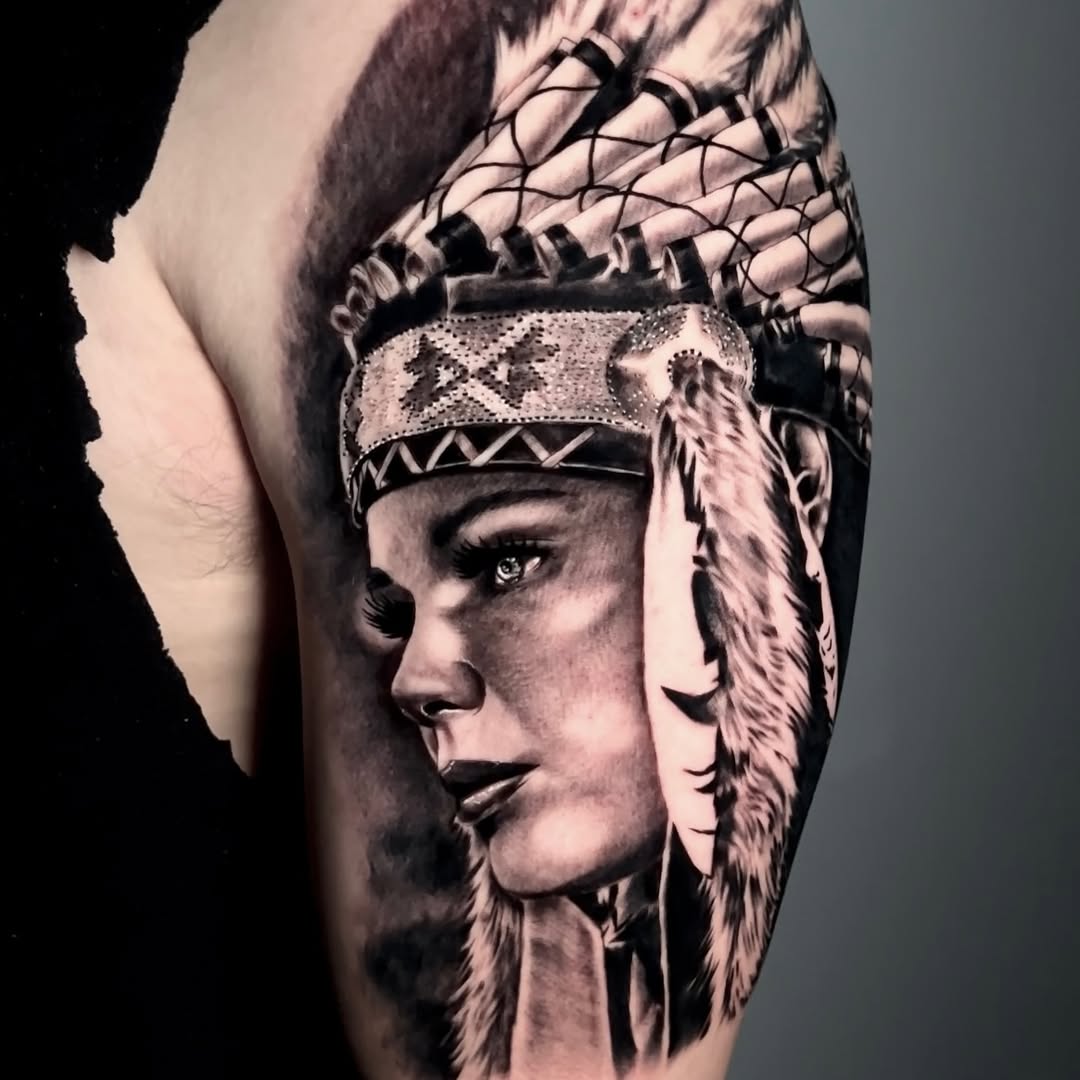
This design softens traditional warrior imagery and reinterprets it through a feminine lens. The woman’s gaze is focused yet serene, framed by a feathered headdress that flows naturally with the arm’s contours. Fine shading around the eyes and cheekbones gives the tattoo emotional depth without overpowering the composition.
This is a strong example of Native American tattoo ideas for women, particularly suited for the upper arm or chest, where curves enhance the elegance of the design. The piece avoids stereotypes by focusing on dignity and presence rather than dramatization.
Artists known for portrait-driven indigenous work often highlight how female Native American designs are evolving — less symbolic overload, more personality and mood.
Contemporary Native American Woman with Bird Symbolism
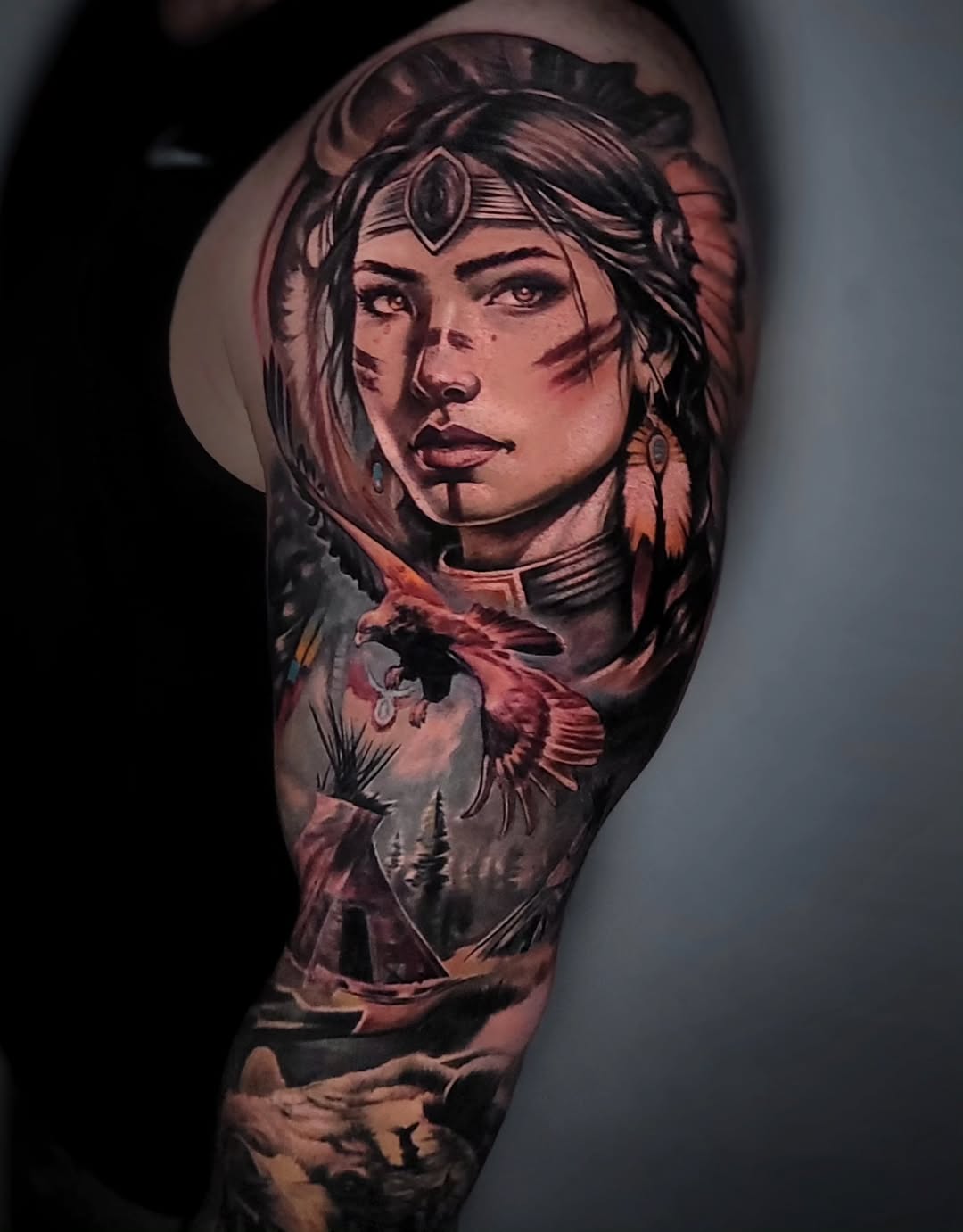
Blending traditional motifs with a modern illustration style, this tattoo stands out through expressive eyes and warm color accents. The bird — often interpreted as an eagle or hawk — adds motion and spiritual balance, reinforcing themes of protection and intuition.
This piece works beautifully as a half sleeve or shoulder tattoo, particularly for collectors looking for a bridge between realism and illustrative art. It reflects current trends seen across major tattoo conventions, where artists merge Native American art with contemporary aesthetics rather than strict historical replication.
Tribal Ceremony Scene with Fire and Feathers
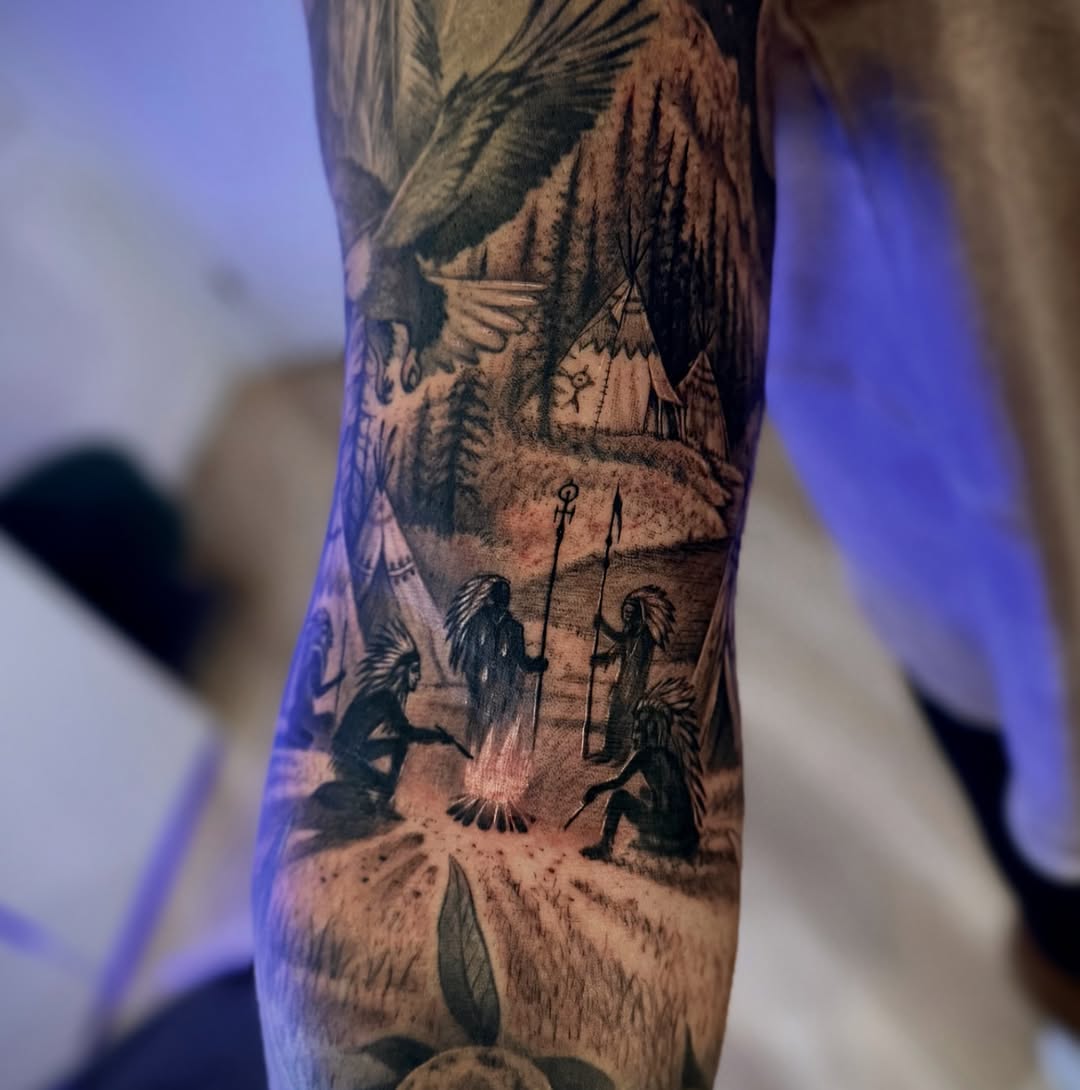
This tattoo shifts from portraiture to storytelling. Multiple figures gather around a central fire, spears raised, feathers catching the light. The scene evokes ceremony, unity, and ancestral ritual — themes deeply rooted in Navajo and Plains traditions.
The composition reads almost like an old drawing brought to life, making it ideal for sleeve tattoos for men who want layered meaning rather than a single focal point. The fire acts as the visual anchor, guiding the eye upward and outward.
Designs like this are often referenced in discussions about traditional Native American sleeve ideas, especially for collectors interested in narrative depth.
Minimalist Elder Portrait Forearm Tattoo
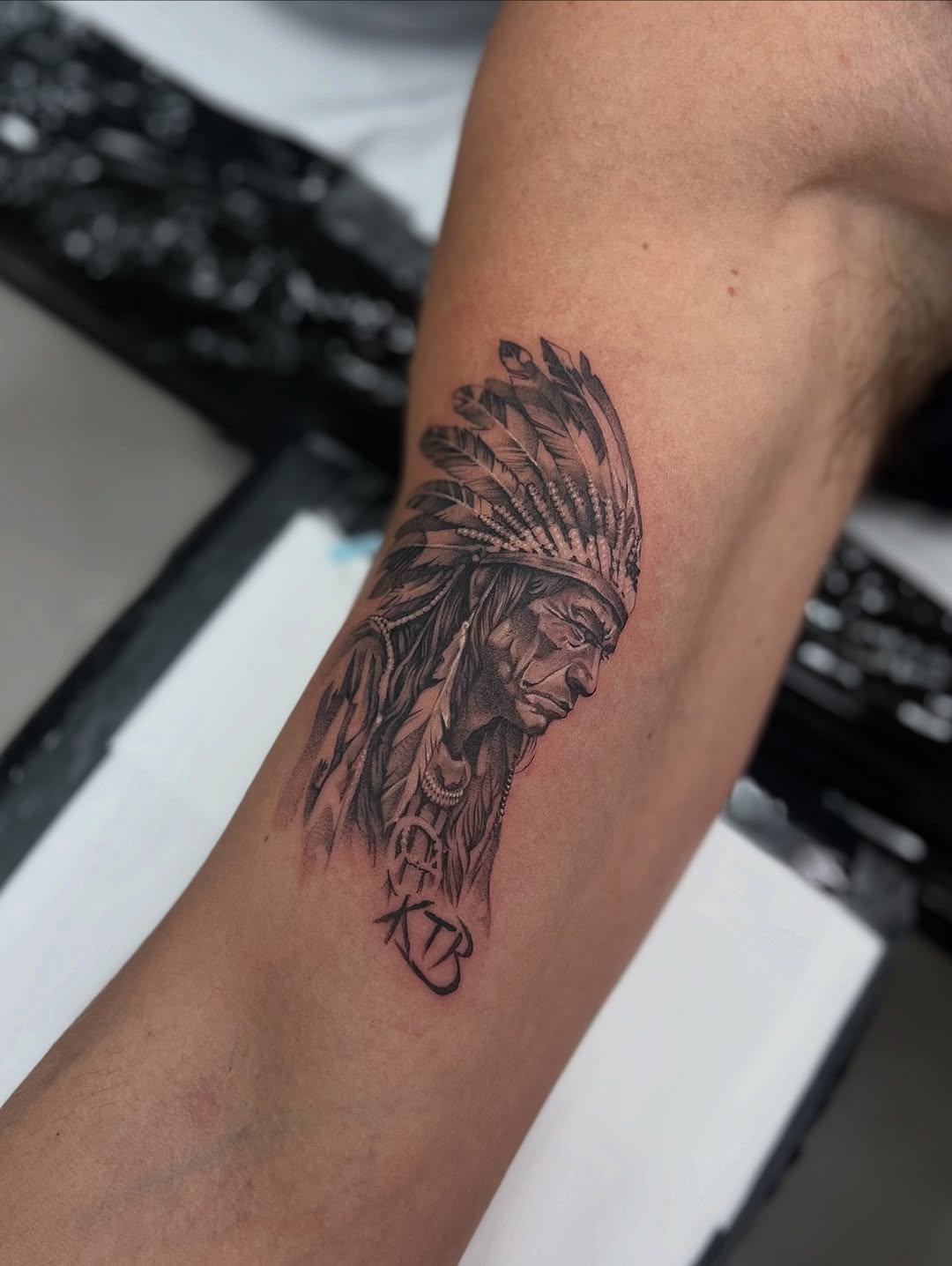
This forearm tattoo strips Native American portraiture down to its essence. The elder’s profile is rendered with restraint — soft shading, clean linework, and just enough contrast to bring out age, wisdom, and quiet authority. The traditional feathered headdress remains the focal point, flowing naturally with the shape of the arm rather than dominating it.
This is a strong forearm idea for men who appreciate subtlety over scale. Unlike full sleeves or hyper-realistic pieces, this design leans closer to traditional art stencils, making it timeless and easy to age well. It’s the kind of tattoo often chosen by collectors who want meaning without spectacle.
Wolf Headdress and Warrior Woman Design
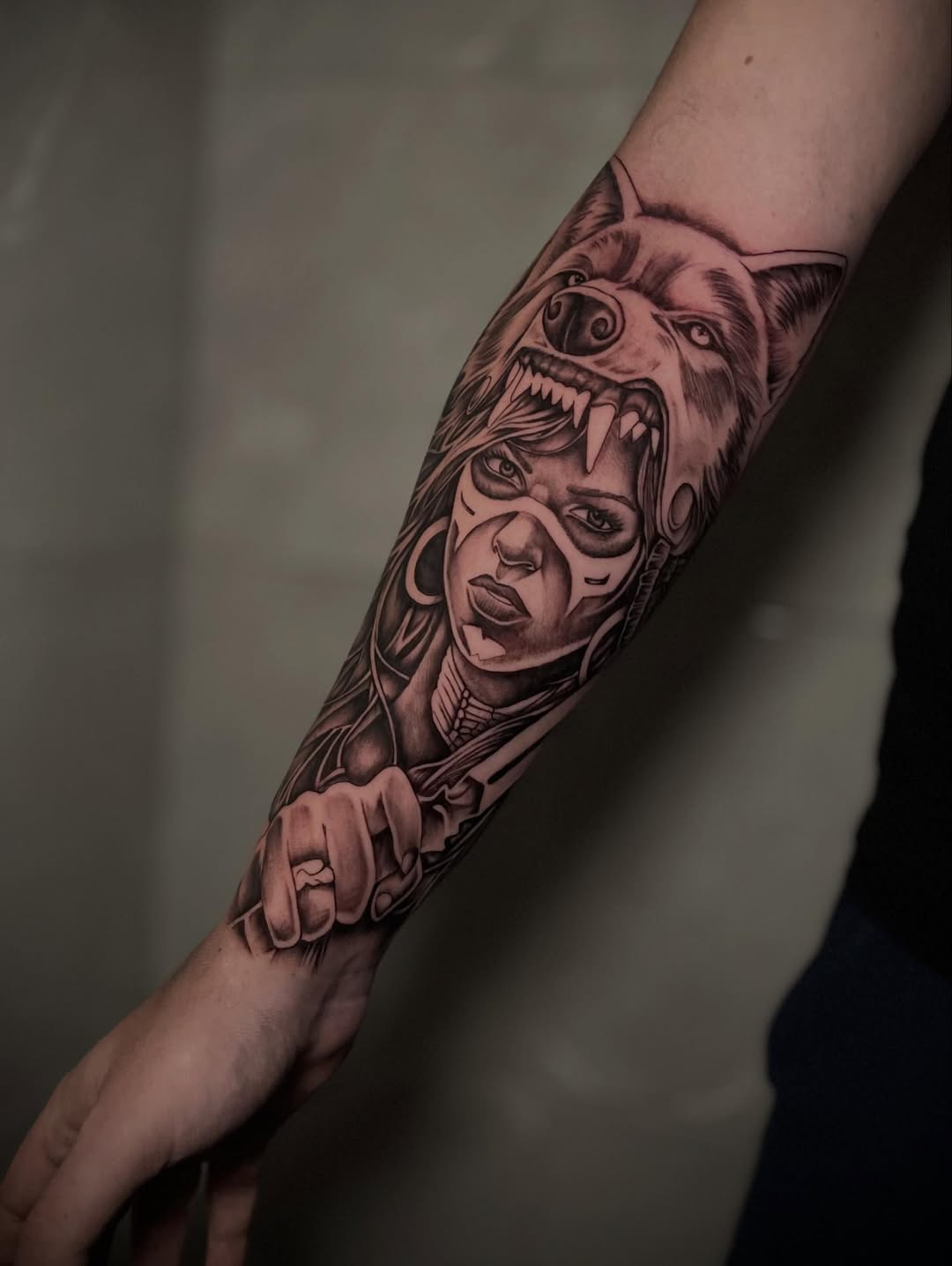
The wolf is one of the most powerful animal symbols in Native American culture, associated with loyalty, instinct, and protection. In this tattoo, the wolf appears as a headdress rather than a separate figure, merging animal spirit and human strength into a single identity.
The female warrior’s face is intense and grounded, accented by ceremonial face markings. This design speaks strongly to Wolf Band symbolism, often referenced in Navajo and Plains storytelling. As a realistic forearm piece, it balances aggression and control — a reminder that strength doesn’t always need to be loud.
For collectors interested in Native American tattoo ideas for women, this style represents empowerment without sacrificing tradition.
Owl and Moon Hand Tattoo Composition
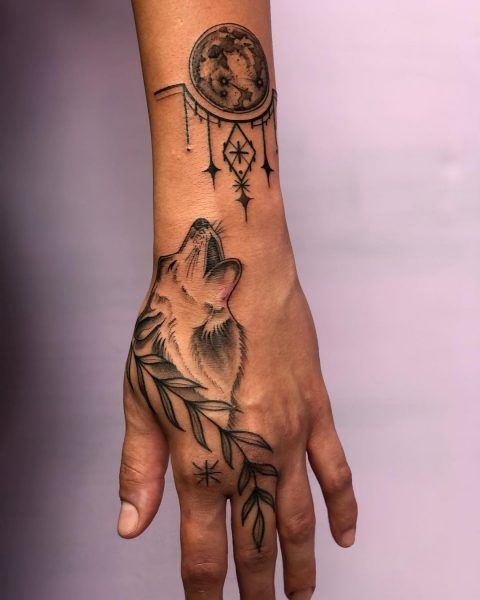
This hand tattoo leans heavily into symbolism. The owl, long considered a guardian of hidden knowledge and the night, pairs naturally with the moon — a symbol of cycles, intuition, and spiritual awareness. The fine-line execution keeps the design elegant rather than overpowering, which is essential for such a visible placement.
Hand tattoos demand intention, and this one delivers. It works particularly well for collectors drawn to Native American animal spirits without resorting to large-scale imagery. The owl here functions as a quiet observer rather than a predator, aligning more closely with traditional spiritual interpretations.
Geometric Tribal Symbol Forearm Tattoo
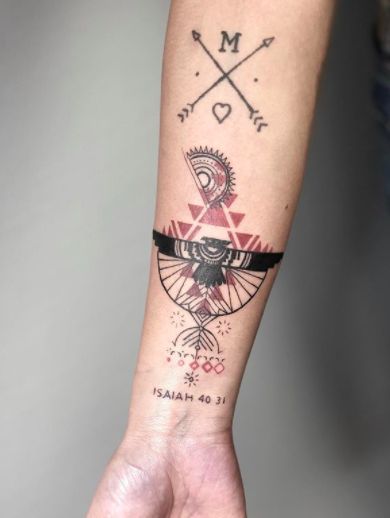
This tattoo bridges ancient symbolism and modern geometry. The symmetrical lines, circular forms, and feather elements echo traditional Native American drawings while introducing a contemporary visual rhythm. The design feels ceremonial rather than decorative — every line appears deliberate.
Placed along the inner forearm, this piece works well as part of a traditional sleeve idea or as a standalone symbol. While less literal than portrait tattoos, geometric designs like this are often inspired by Navajo traditional patterns, adapted for modern tattoo culture.
Feather Band Minimalist Forearm Tattoo
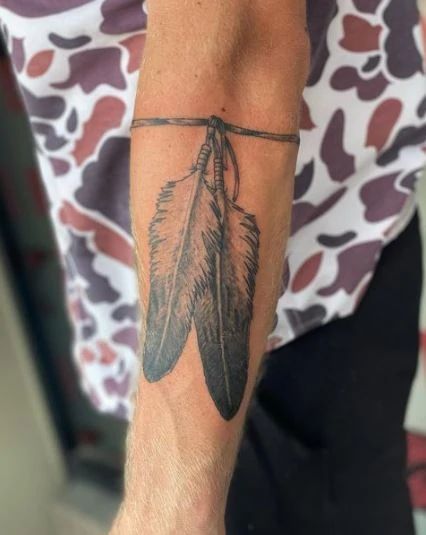
Sometimes the simplest designs carry the most weight. This feather band wraps naturally around the forearm, resembling a bracelet rather than a statement piece. Feathers symbolize honor, connection to the spirit world, and respect — values shared across many tribes.
This tattoo is especially popular among collectors looking for Native American sleeve ideas that can grow over time. It pairs well with future additions like arrows, pipe symbols, or subtle tribal markings. As a minimalist design, it also appeals to those seeking men’s Native American tattoo designs that remain understated.
Ceremonial Dance Scene Upper Arm Tattoo
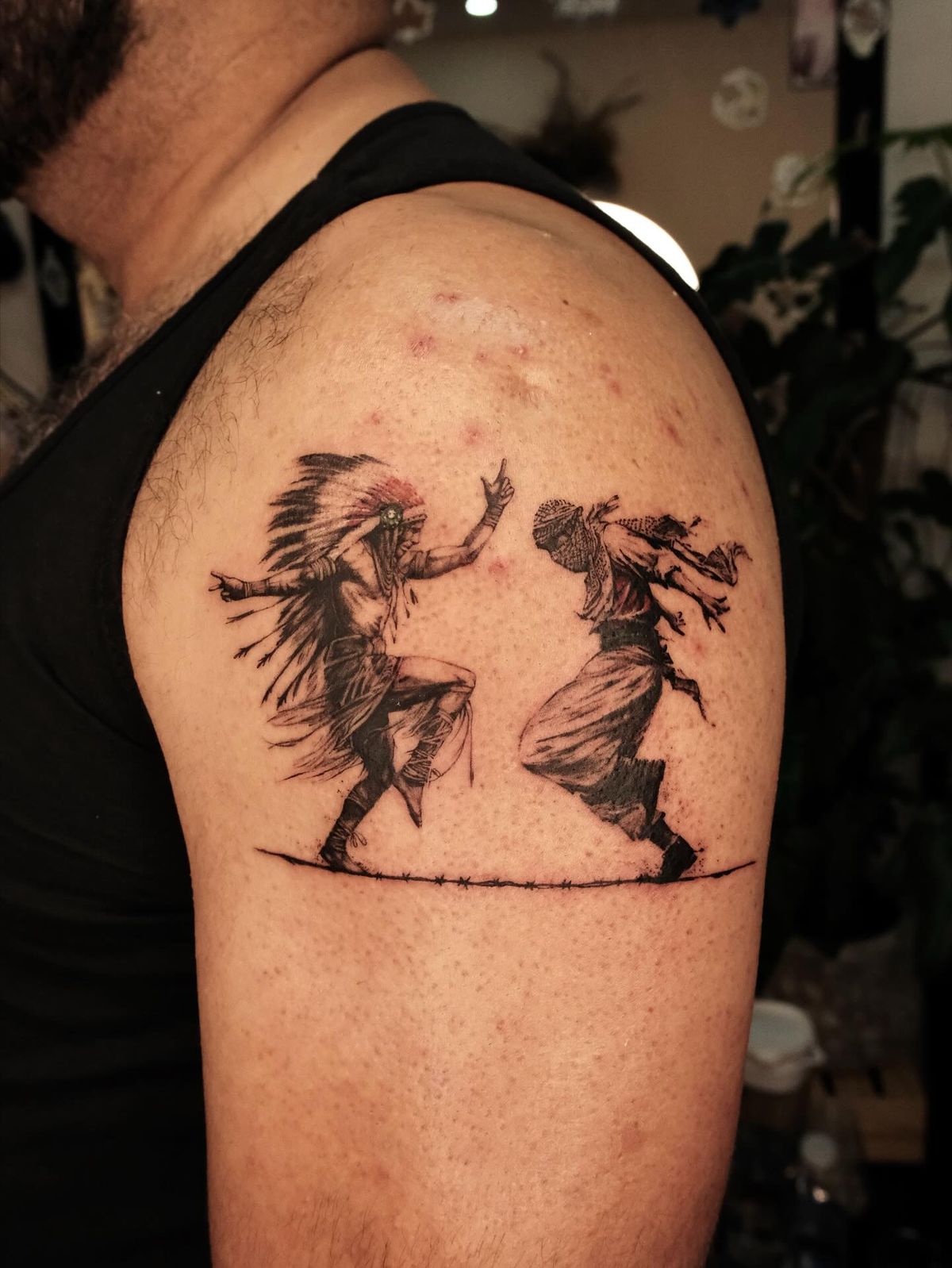
This upper arm tattoo captures motion and ritual. Two figures face one another in what appears to be a ceremonial dance or symbolic confrontation, separated by a thin ground line that anchors the scene. The feathered headdresses and traditional garments emphasize movement rather than detail.
This type of composition reflects storytelling traditions found in Sioux and Plains art, where dance represents communication with the spirit world. As a men’s upper arm tattoo, it works exceptionally well due to the natural curvature of the muscle, allowing the figures to feel alive rather than static.
Contemporary Feather Forearm Tattoo with Lifestyle Styling
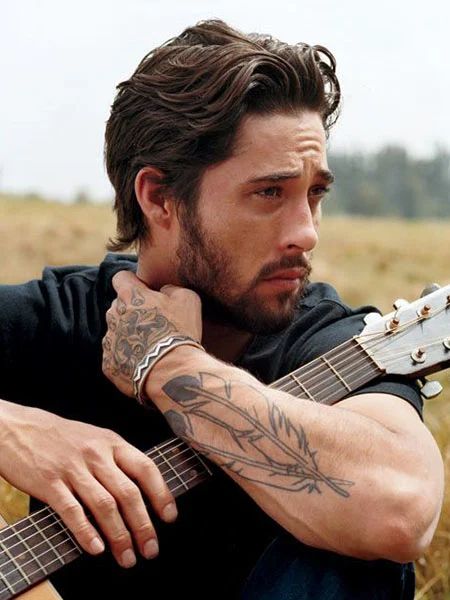
This image stands out because it shows how Native American-inspired tattoos integrate into everyday style. The feather design is clean, linear, and intentionally imperfect, echoing hand-drawn tribal sketches rather than polished realism.
Worn casually, this forearm tattoo complements modern fashion without feeling costume-like. It’s a strong example of how Native American art influences contemporary tattoo culture, especially among musicians, creatives, and travelers who value symbolism over strict tradition.
Traditional Headdress Thigh Tattoo
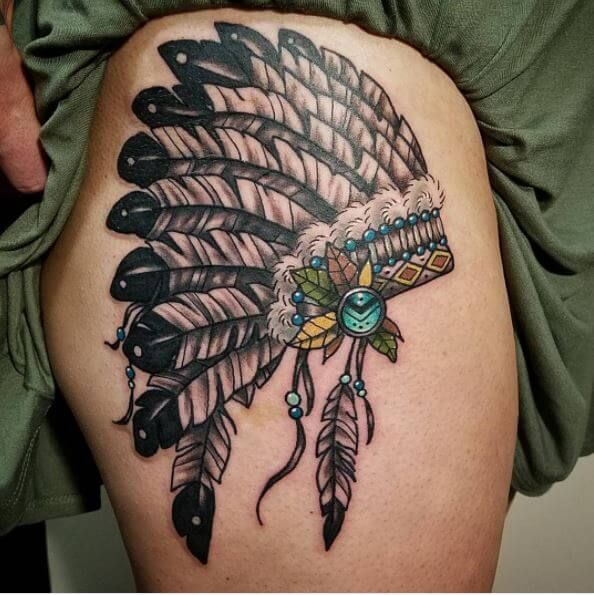
This bold thigh tattoo showcases a classic feathered headdress rendered in a more traditional tattoo style. The solid black outlines and muted color palette give it a timeless quality, reminiscent of early American tattoo flash adapted with indigenous influence.
This placement works well for larger designs that deserve space to breathe. While often chosen by men, thigh tattoos like this are increasingly popular as Native American chest or leg pieces for women, especially when paired with modern clothing that allows the artwork to appear selectively.
Native American tattoo ideas remain powerful because they demand intention. Whether it’s an eagle, a horse, a ceremonial figure, or a full tribal scene, these designs work best when chosen with respect and understanding. The tattoos explored here show how modern artists honor tradition while pushing technical boundaries through realism, composition, and storytelling.
If you’re considering a Native American tattoo — or already wear one — share your thoughts or inspiration in the comments. The conversation around meaning and art is just as important as the ink itself.