Back tattoos have always occupied a special place in tattoo culture. They’re expansive, deliberate, and rarely impulsive. For men, the back functions like a private canvas — large enough to hold complex symbolism, yet revealed only when chosen. From fine line minimalism to full-scale Japanese and religious compositions, back tattoo design has evolved alongside modern masculinity itself.
This article explores a curated set of back tattoo ideas for men, each representing a different artistic direction — from cybersigilism and spine work to angel wings, mandala geometry, and Japanese myth. Every design tells a story, not just through ink, but through placement, scale, and intent.
Cybersigilism Wings and Spine Composition
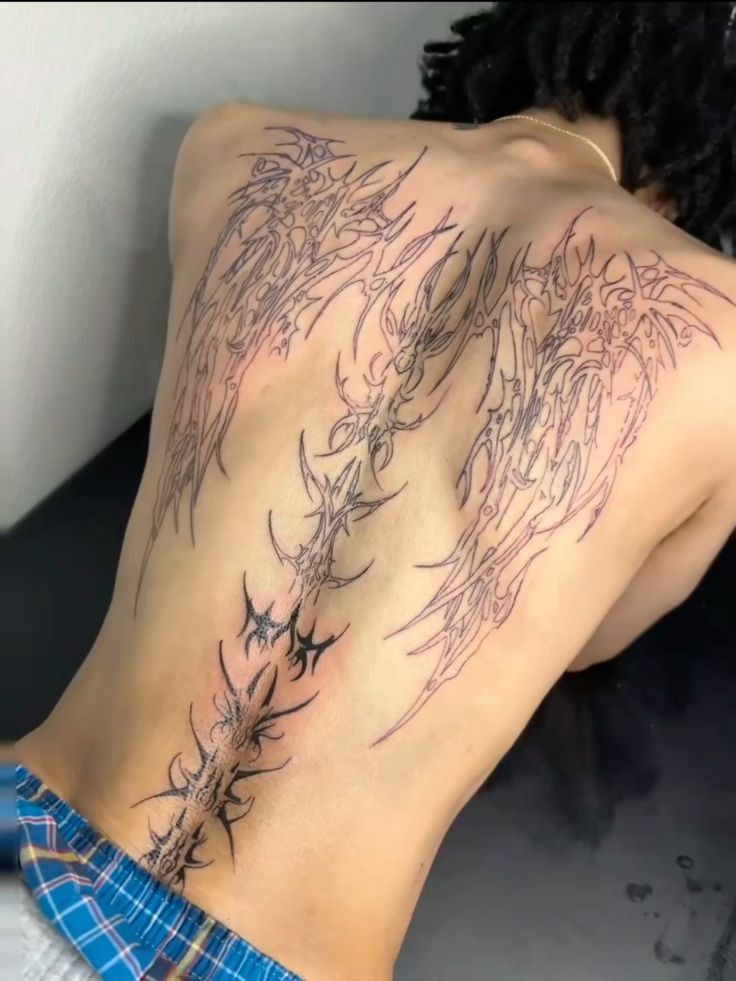
This design leans heavily into cybersigilism, a movement that blends occult symbolism with digital-age abstraction. The wings stretch outward across the upper back in razor-sharp, fragmented strokes, while the spine becomes the structural axis of the piece.
Executed in fine line technique, the tattoo avoids heavy shading, relying instead on tension, spacing, and flow. The wings don’t aim for realism — they feel engineered, almost biomechanical, which gives the piece an aggressive, modern aesthetic.
This kind of back tattoo pairs naturally with minimalist styling: loose trousers, raw denim, or tailored pants worn low on the waist to let the lower spine details breathe. It’s not decorative ink — it’s visual architecture.
Full Angel Wings and Cross Back Piece
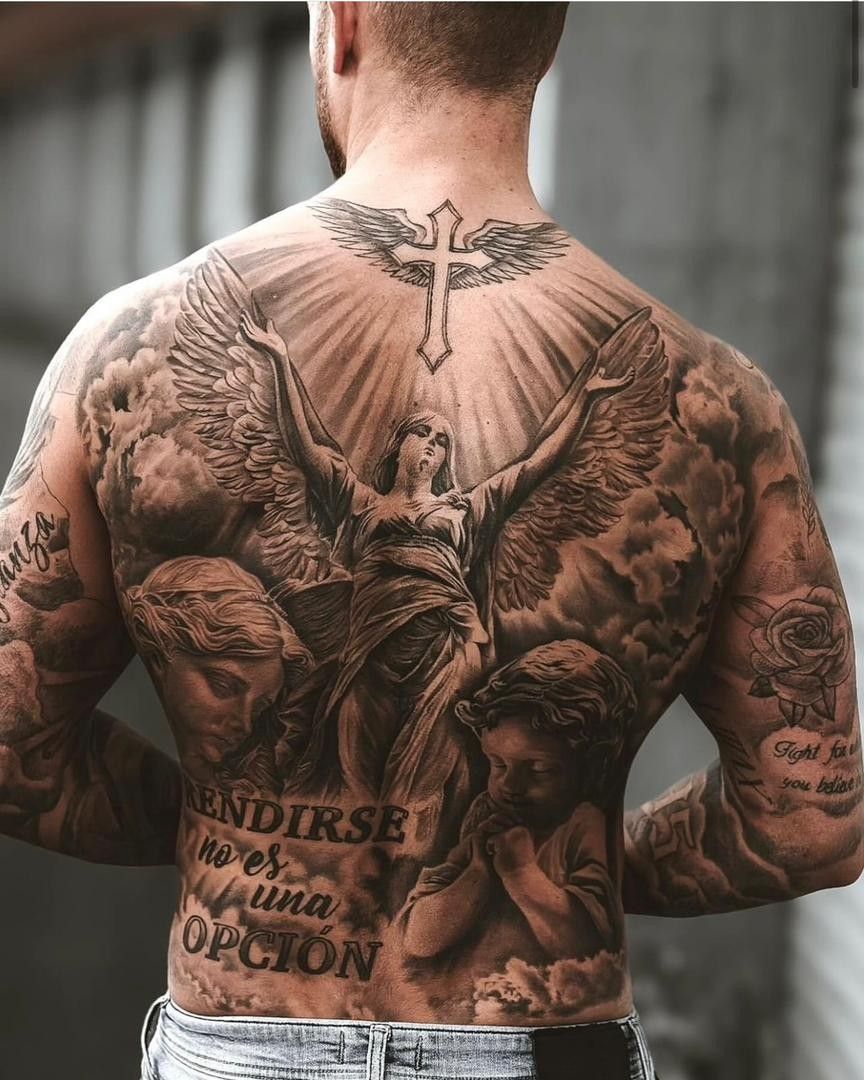
A classic full back tattoo rooted in religious iconography, this piece draws from Renaissance-era sculpture and Catholic symbolism. At the center, an angel ascends with open wings, framed by dramatic cloud work. Above, a cross anchors the composition, radiating authority and faith.
The execution relies on deep contrast, smooth gradients, and controlled realism — a style often associated with veteran black-and-grey artists. The lettering at the lower back adds emotional weight, reinforcing the idea of endurance and sacrifice.
This tattoo suits men who dress with intention: structured jackets, neutral palettes, leather boots. It’s timeless, masculine, and unapologetically symbolic.
Abstract Winged Figure with Minimalist Geometry
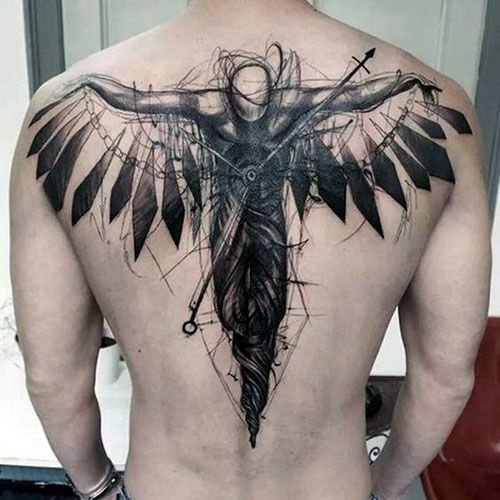
This back tattoo strips the idea of wings down to its conceptual core. The central figure feels almost anatomical, suspended between abstraction and symbolism. Thin lines intersect with sharp geometric elements, creating a design that feels intentionally unfinished — in the best way.
There’s a strong minimal and aesthetic sensibility here. Rather than filling the back, the design allows skin to act as negative space, which enhances the visual tension.
This is the kind of tattoo often seen on creatives — architects, designers, or artists — and pairs effortlessly with oversized shirts, cropped jackets, or monochrome outfits.
Phoenix-Inspired Winged Warrior
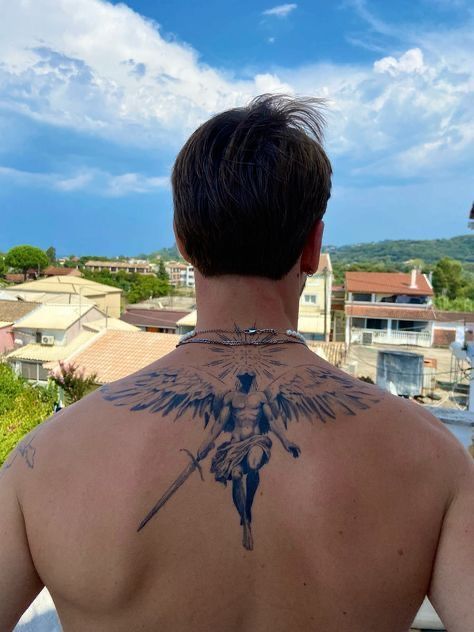
This composition blends myth and motion. The winged figure, sword in hand, echoes Phoenix symbolism — rebirth, endurance, and controlled aggression. The wings are expansive but disciplined, tapering naturally with the shoulder line.
Unlike hyper-realistic angel tattoos, this piece leans toward illustrative realism, making it feel lighter and more wearable. The design thrives on movement, making it especially striking when the back flexes.
Styling-wise, this tattoo works best with athletic silhouettes: fitted tees, open shirts, or sleeveless outerwear that frames the upper back.
Japanese Snake Back Tattoo
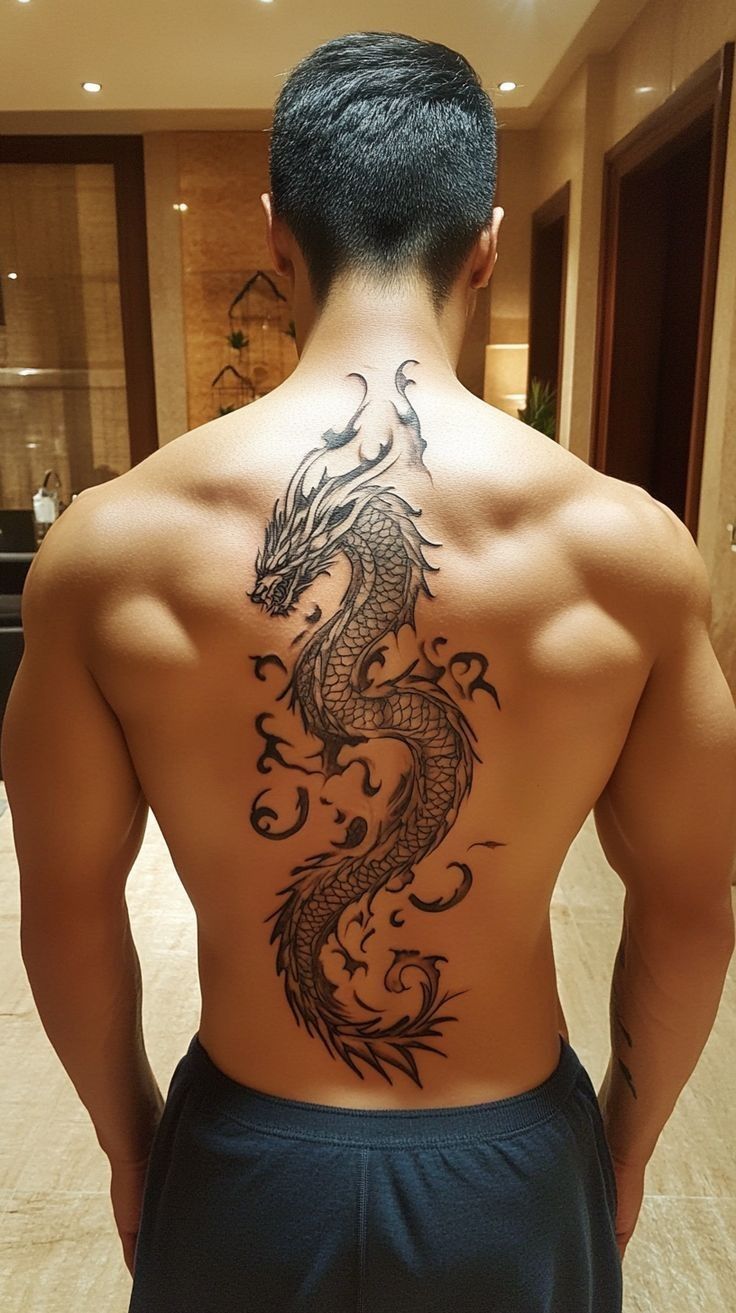
Few motifs carry as much cultural weight as the Japanese snake. Symbolizing wisdom, protection, and transformation, the serpent coils vertically along the spine, commanding attention without overwhelming the back.
The scale placement is precise: large enough to dominate, but narrow enough to maintain elegance. This is a masterclass in Japanese design restraint — no excess, no filler.
This tattoo pairs naturally with clean, modern outfits: tailored trousers, minimalist sneakers, and structured tops. Let the ink speak.
Artists working in traditional Japanese styles, such as those inspired by Horiyoshi III, often emphasize vertical flow — a principle clearly respected here.
Mandala Spine Tattoo with Lunar Symbolism
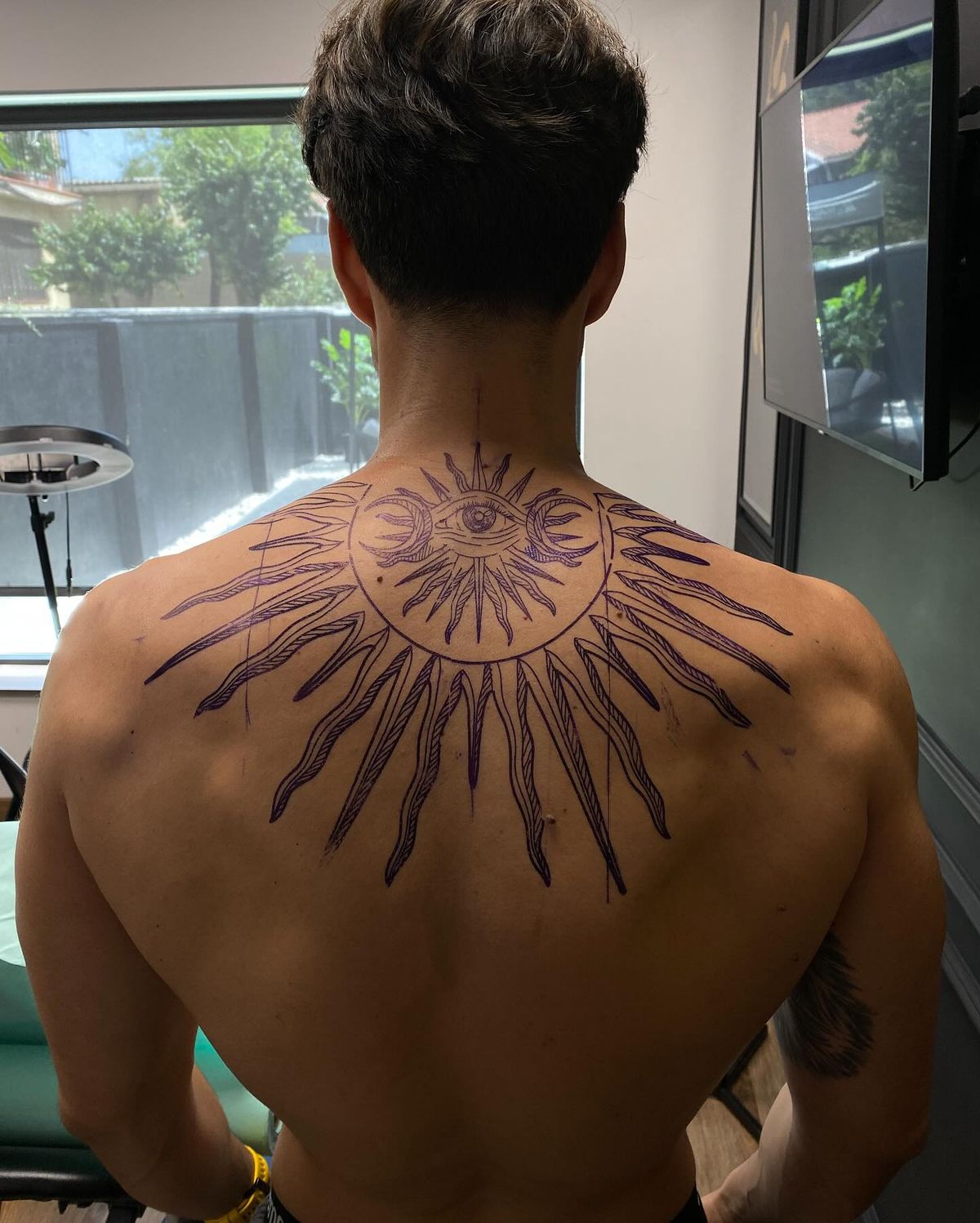
This mandala design uses symmetry to create calm authority. Positioned across the upper back and flowing toward the spine, it incorporates lunar phases and an all-seeing eye, adding layers of meaning without clutter.
Often applied using a stencil, mandala tattoos demand precision. Any imbalance becomes obvious, which makes clean execution essential.
This piece suits men drawn to mindfulness, structure, and quiet confidence. Styling leans toward neutral tones, linen fabrics, and minimal accessories.
Organic Spine Tattoo with Minimal Linework
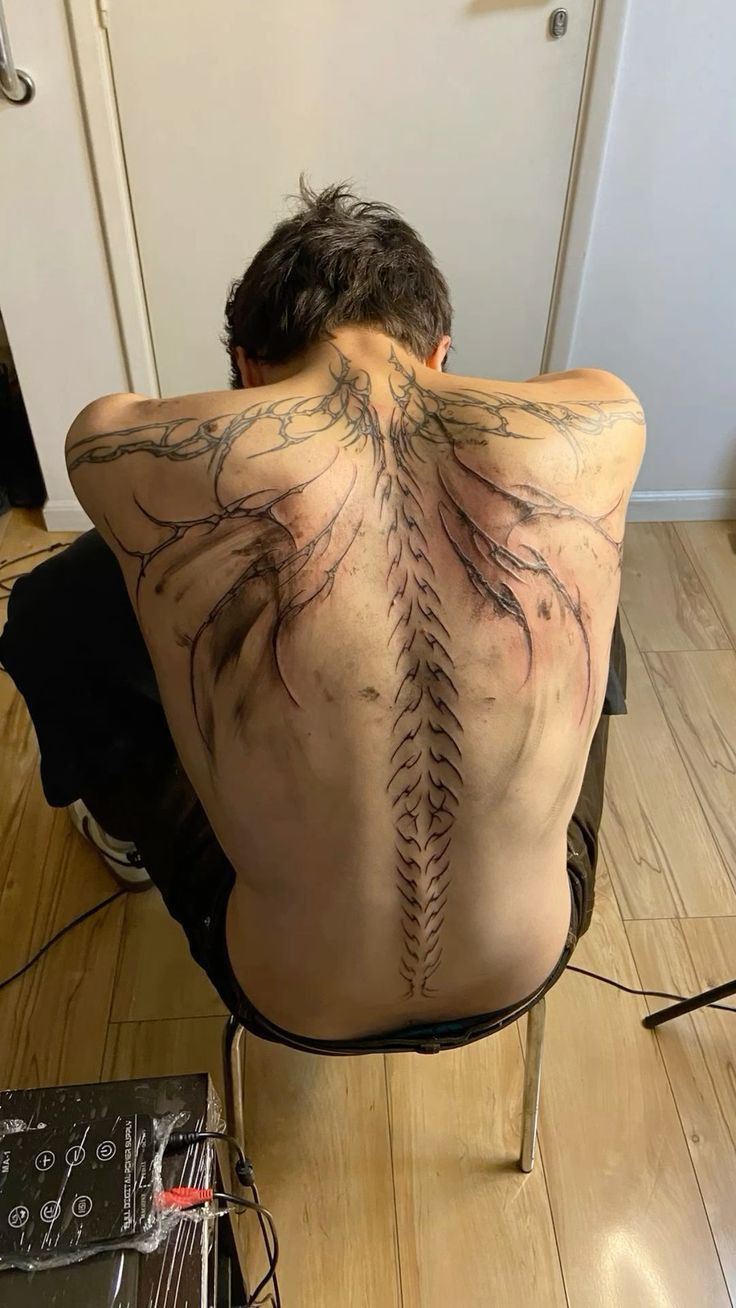
This tattoo feels raw and intentional. Running straight down the lower and mid-back, the design mimics natural growth — almost skeletal or botanical in form.
The appeal lies in its restraint. There’s no heavy shading, no forced symbolism. It’s about flow, anatomy, and subtle rebellion against polished tattoo trends.
This style aligns well with relaxed fashion: vintage denim, worn sneakers, soft knits. It feels lived-in, not curated.
Minimal Angel Wings Spine Tattoo
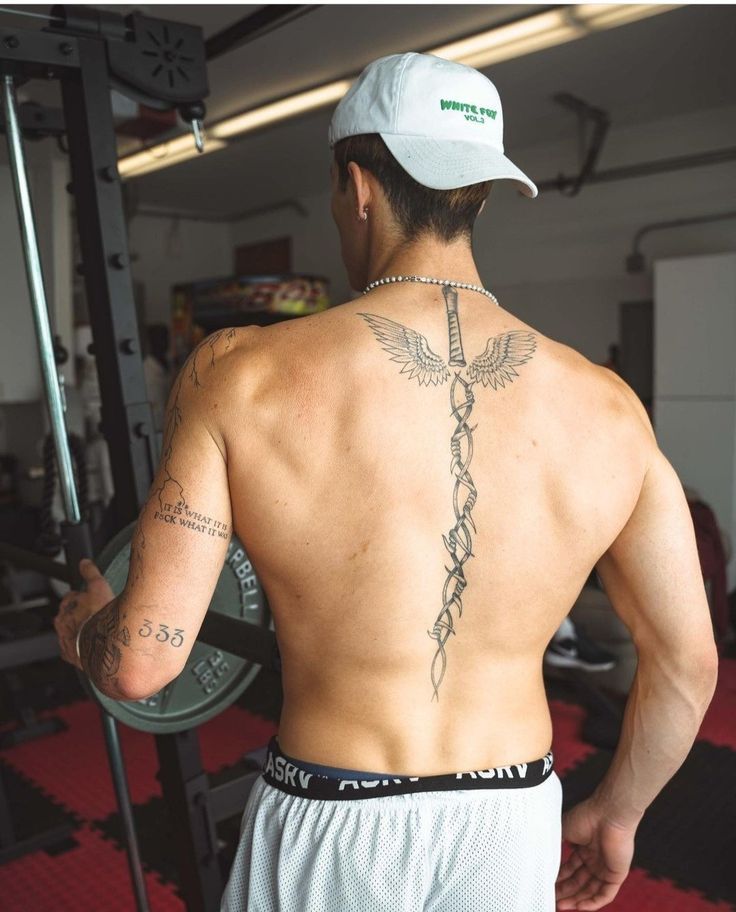
This design proves that angel wings don’t need to dominate the entire back to make an impact. Positioned high across the shoulders and connected by a vertical spine element, the tattoo balances symbolism with restraint.
The wings are rendered in a minimalist style, using clean linework rather than heavy shading. The central vertical motif echoes classical medical or alchemical imagery, giving the piece a quiet intellectual edge rather than overt religiosity.
This is a back tattoo that works effortlessly with modern athletic wear — gym shorts, relaxed tanks, or cropped hoodies. It’s intentional but understated, ideal for men who prefer minimal design over visual overload.
Twin Birds Wing Tattoo with Fine Line Detailing
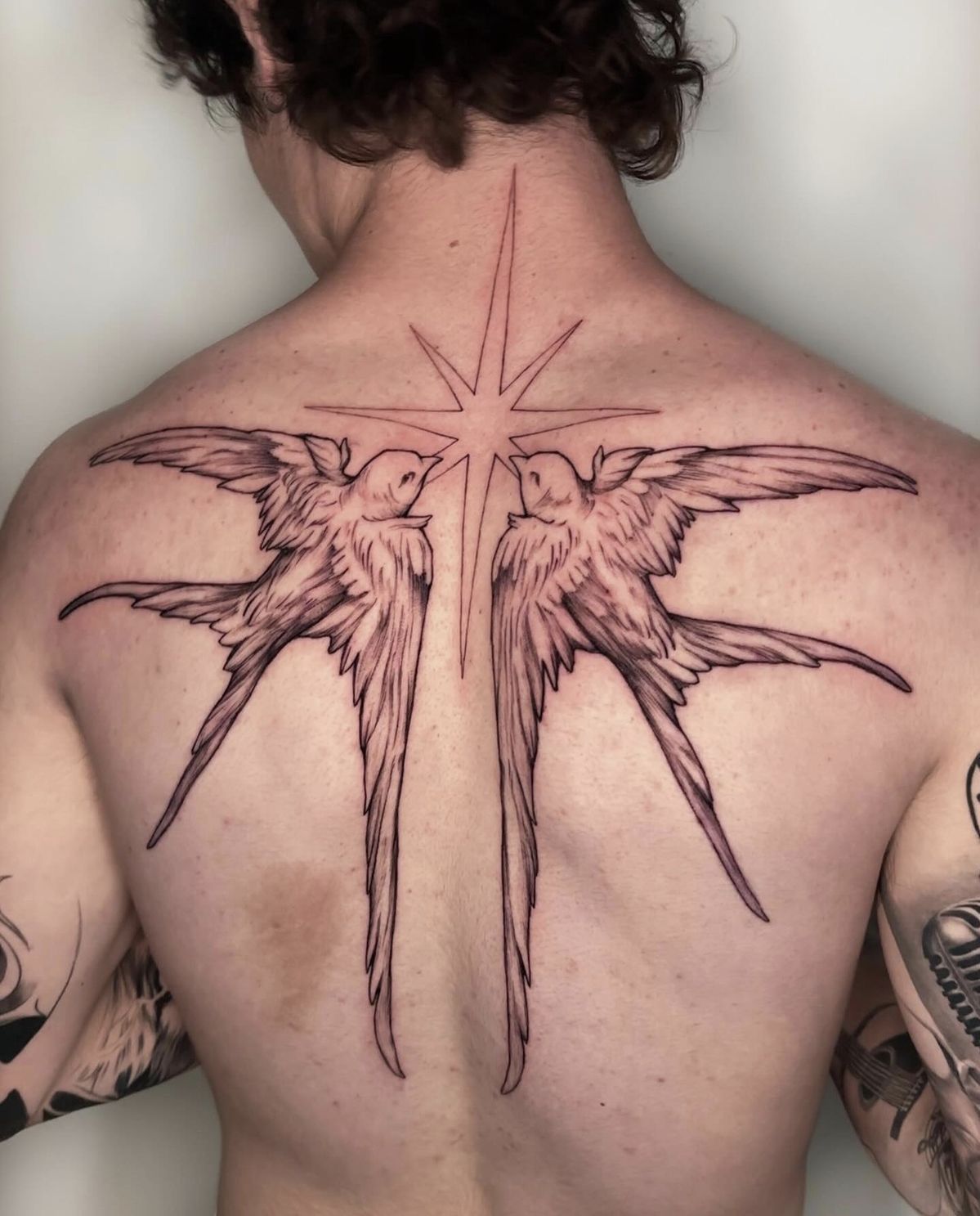
Symmetry takes center stage here. Two birds mirror one another across the upper back, wings fully extended toward a star-like symbol at the center. The execution relies heavily on fine line technique, giving the feathers a light, almost sketchbook quality.
Rather than power or dominance, this tattoo communicates balance and alignment. The vertical flow created by the birds’ tails subtly elongates the back, making it especially flattering on lean builds.
This style pairs well with soft, neutral clothing — linen shirts, open collars, or simple trousers. It’s a tattoo that feels personal, not performative.
Polynesian-Inspired Upper Back Tattoo
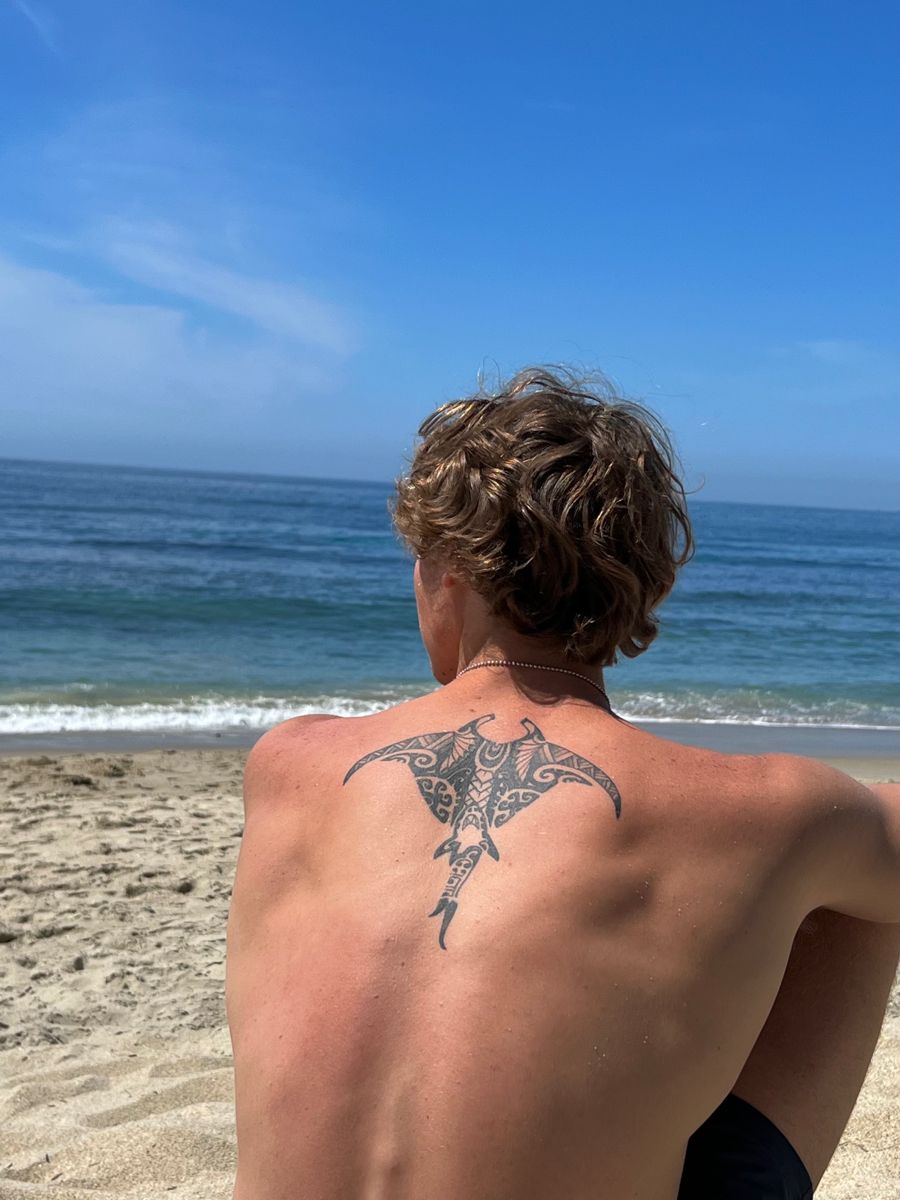
Rooted in Polynesian tradition, this upper-back tattoo draws strength from tribal geometry and cultural symbolism. The central figure resembles a stylized ray or guardian form, with patterns that carry meaning beyond decoration.
Unlike modern minimalism, Polynesian tattoos rely on repetition, rhythm, and ancestral structure. Every line feels deliberate, anchored to heritage rather than trend.
This kind of tattoo complements a natural, outdoors-oriented style — sun-faded shorts, loose tees, or barefoot beach aesthetics. It feels earned, not curated.
Cybersigilism Tribal Wings Back Tattoo
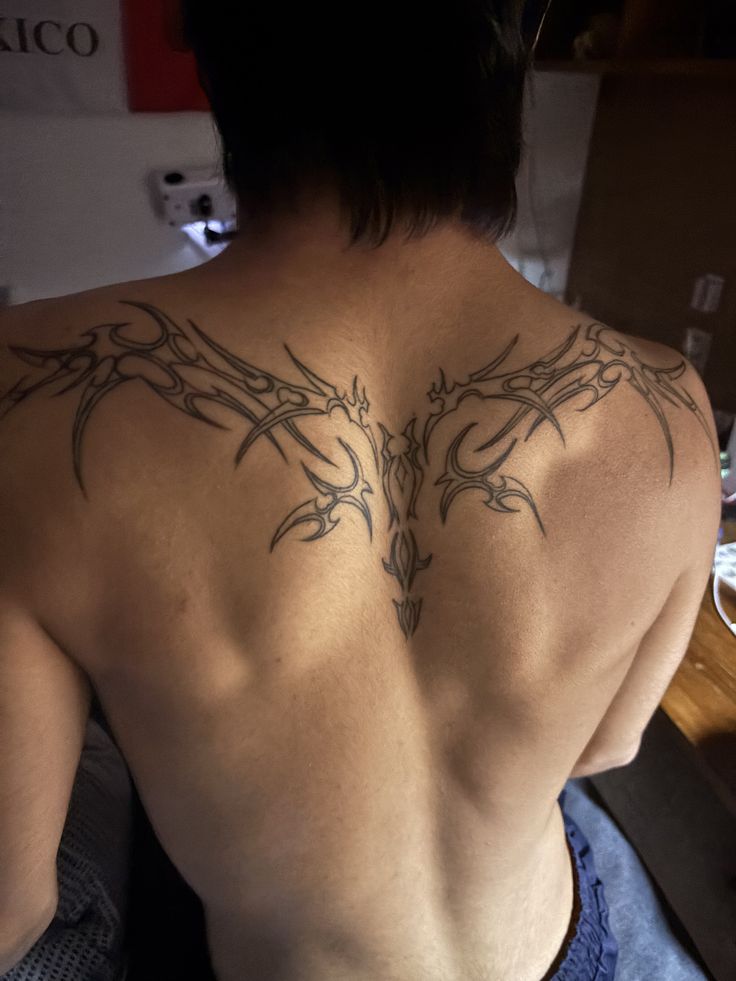
This piece sits at the intersection of tribal influence and cybersigilism. The wings stretch across the shoulders in sharp, flame-like strokes, while the central symbol anchors the composition.
There’s an unmistakable digital-age aggression to the design — angular, fast, and visually disruptive. Unlike traditional tribal tattoos, this version feels experimental, almost coded.
Styling-wise, it thrives alongside streetwear: oversized tees, tactical pants, statement sneakers. It’s less about tradition and more about personal mythology.
Japanese Koi Fish Yin-Yang Back Tattoo
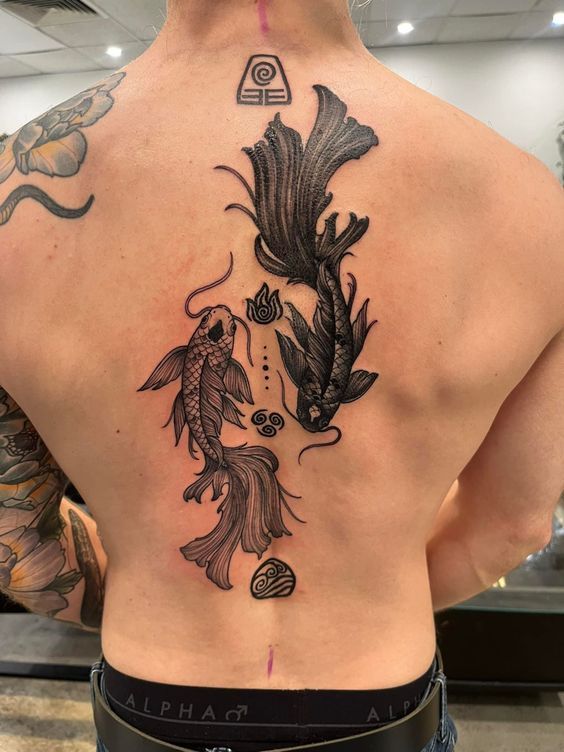
Few symbols are as enduring in Japanese tattoo culture as the koi fish. Here, two koi circle one another in a yin-yang composition, representing balance, perseverance, and transformation.
The contrast between dark and light fish adds visual depth without overwhelming the back. Subtle accent symbols reinforce the spiritual undertone while keeping the design clean and readable.
This tattoo works best with classic, understated fashion — black denim, structured jackets, simple footwear. Let the symbolism carry the weight.
Sak Yant–Inspired Sacred Back Tattoo
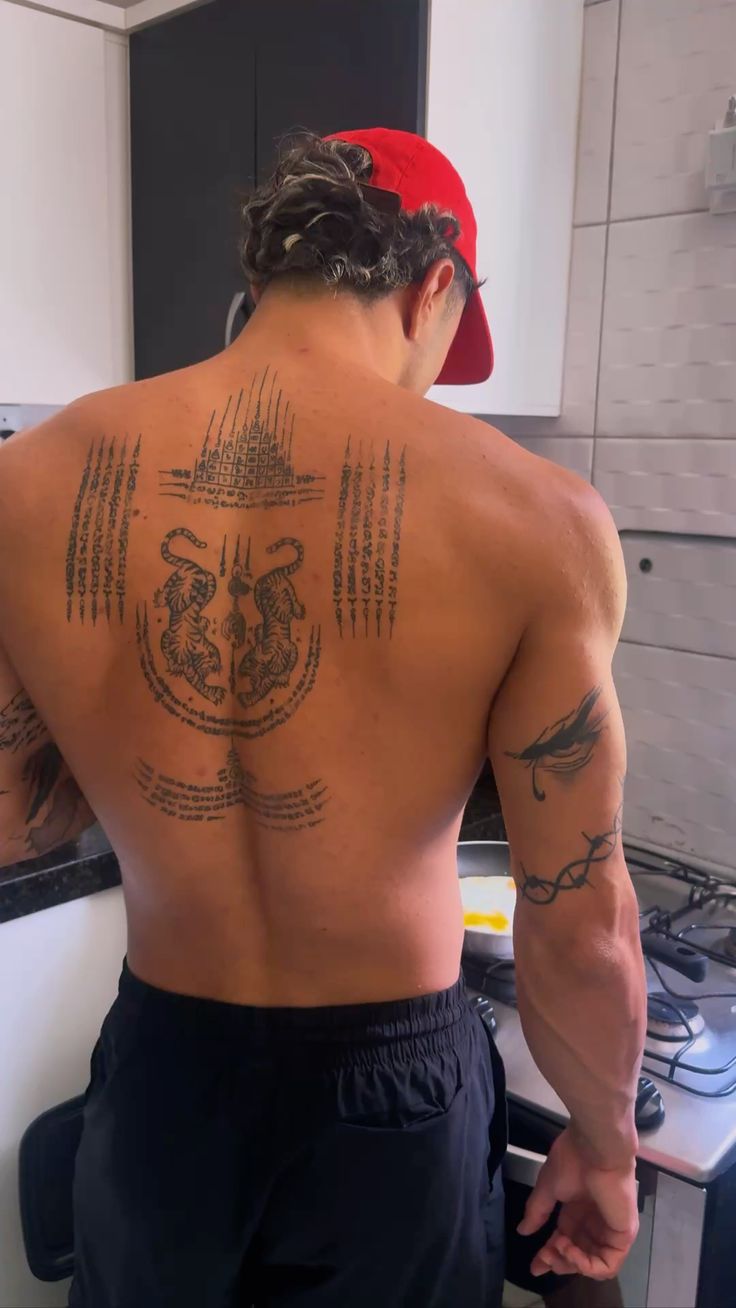
This back tattoo draws inspiration from Sak Yant traditions, blending sacred geometry, ancient script, and symmetrical animal forms. The result feels ceremonial rather than decorative.
The layout covers much of the upper and mid-back without becoming chaotic. Vertical text elements guide the eye downward, reinforcing spiritual hierarchy and protection symbolism.
This tattoo pairs naturally with minimal styling — neutral colors, clean silhouettes — allowing the ink to remain the focal point.
Symbolic World Map Spine Tattoo
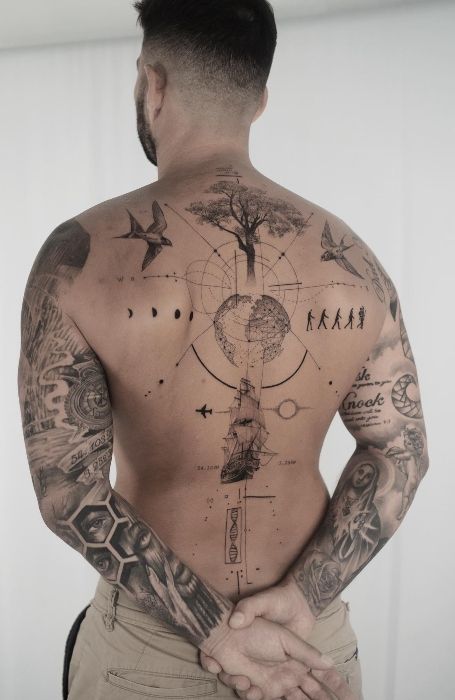
This design reads like a visual journal. A spine-centered composition combines a world map, celestial symbols, birds, and geometric diagrams into a single narrative.
Rather than one dominant image, the tattoo unfolds in layers — evolution, travel, time, and personal growth. It feels almost scientific, reminiscent of old navigation charts or anatomical drawings.
This is a tattoo for thinkers and explorers. It pairs well with utilitarian fashion — cargo pants, neutral shirts, worn boots — understated and functional.
Minimal Upper Back Bird Tattoo
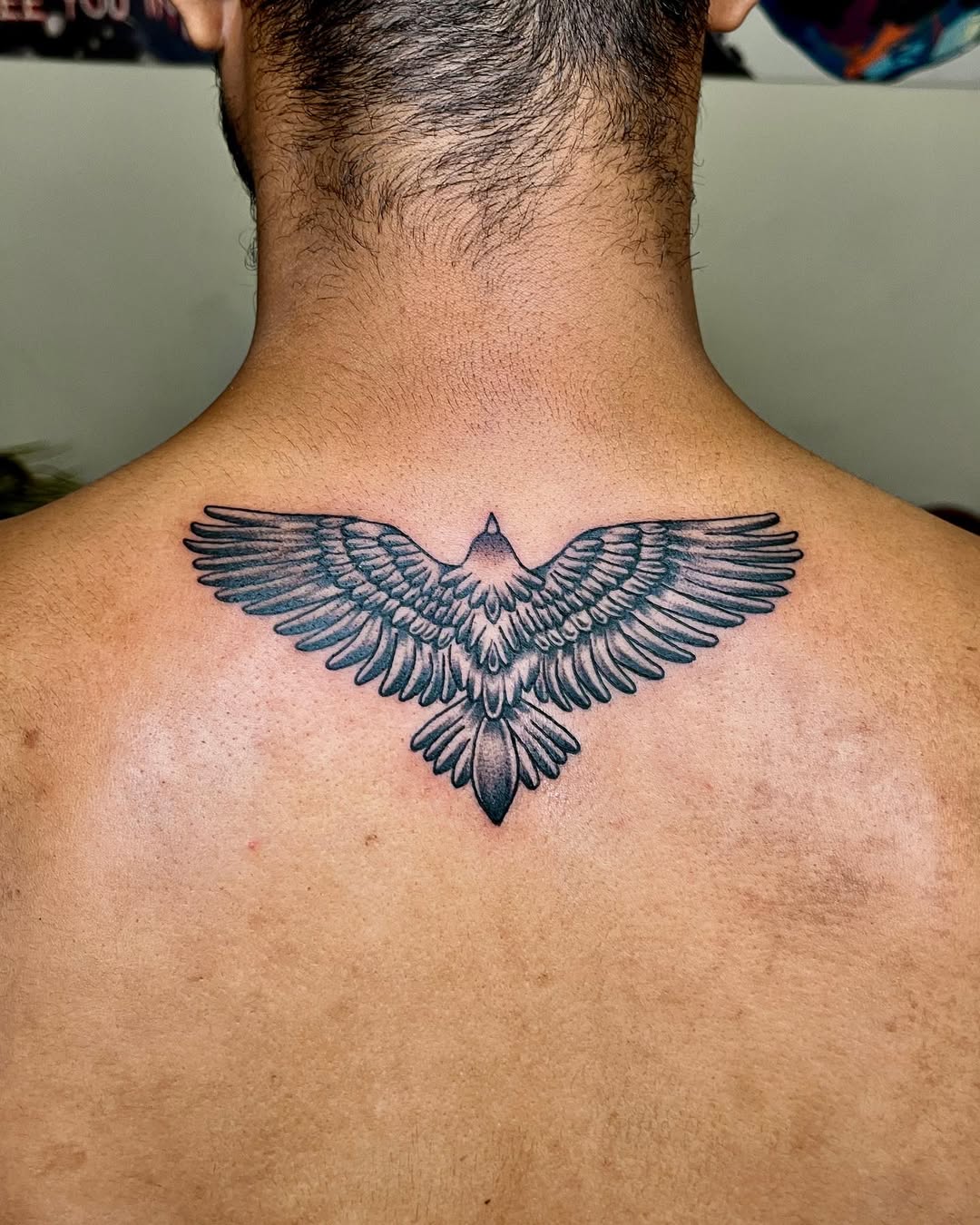
This tattoo demonstrates how a minimal design can still carry emotional weight. A bird with fully extended wings sits high on the upper back, just below the neckline. The placement feels intentional — close enough to the head to suggest freedom of thought, but subtle enough to remain understated.
The feather detailing is soft rather than hyper-realistic, giving the design an almost timeless quality. This kind of tattoo ages well, both visually and conceptually.
Stylistically, it pairs effortlessly with clean, everyday outfits: simple tees, open shirts, or light outerwear. It’s the kind of back tattoo that feels personal, not performative.
Ornamental Spine Tattoo with Lettering
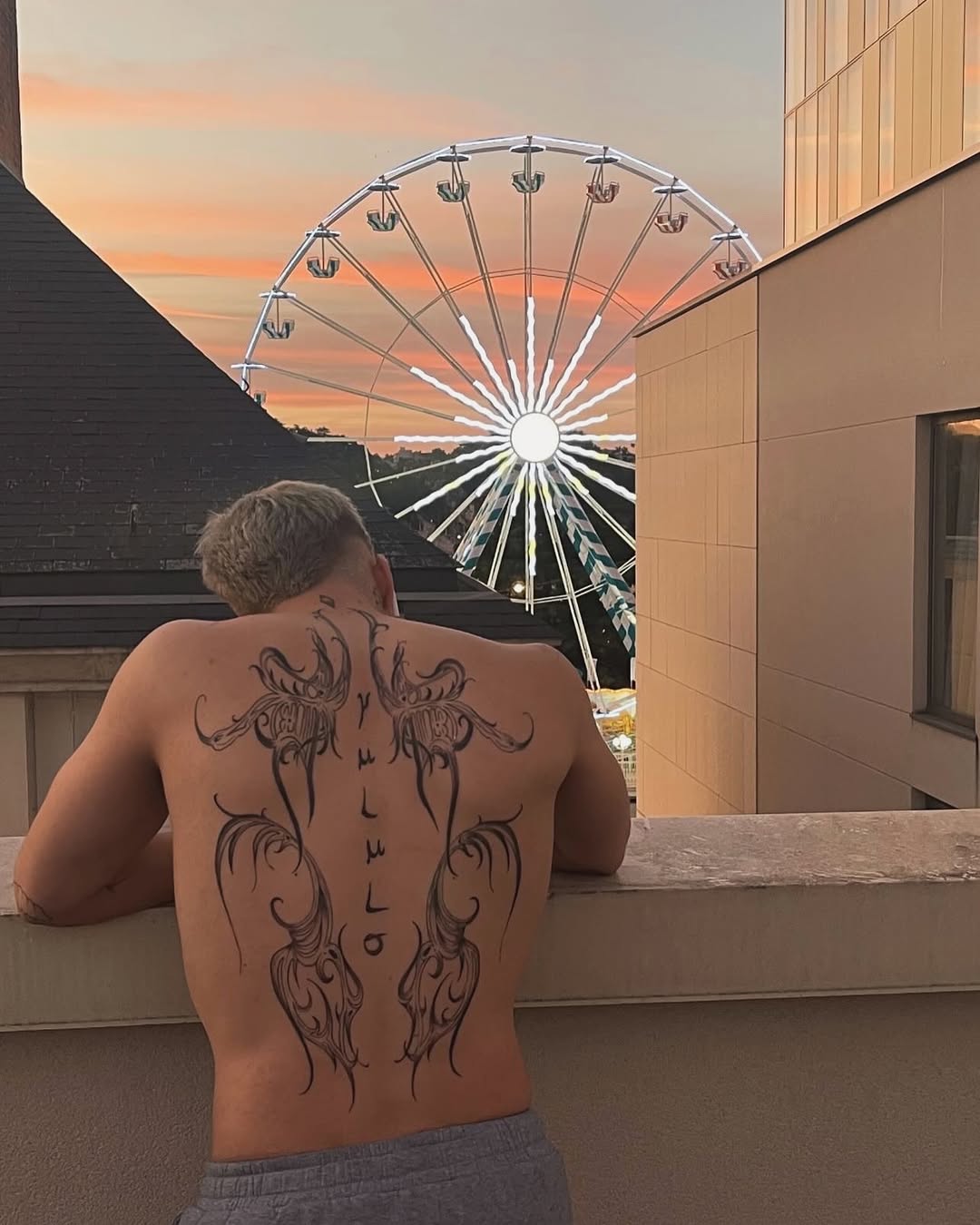
This back tattoo is built around vertical flow. Ornamental elements frame the spine, while subtle lettering runs down the center, guiding the eye naturally from neck to lower back.
The design feels ceremonial, almost calligraphic, blending elegance with intention. Rather than overwhelming the back, it works with the body’s natural symmetry, allowing negative space to play an active role.
This tattoo suits men drawn to refined aesthetics — relaxed tailoring, monochrome palettes, and quiet confidence. It’s expressive without shouting.
Abstract Wings with Geometric Cross
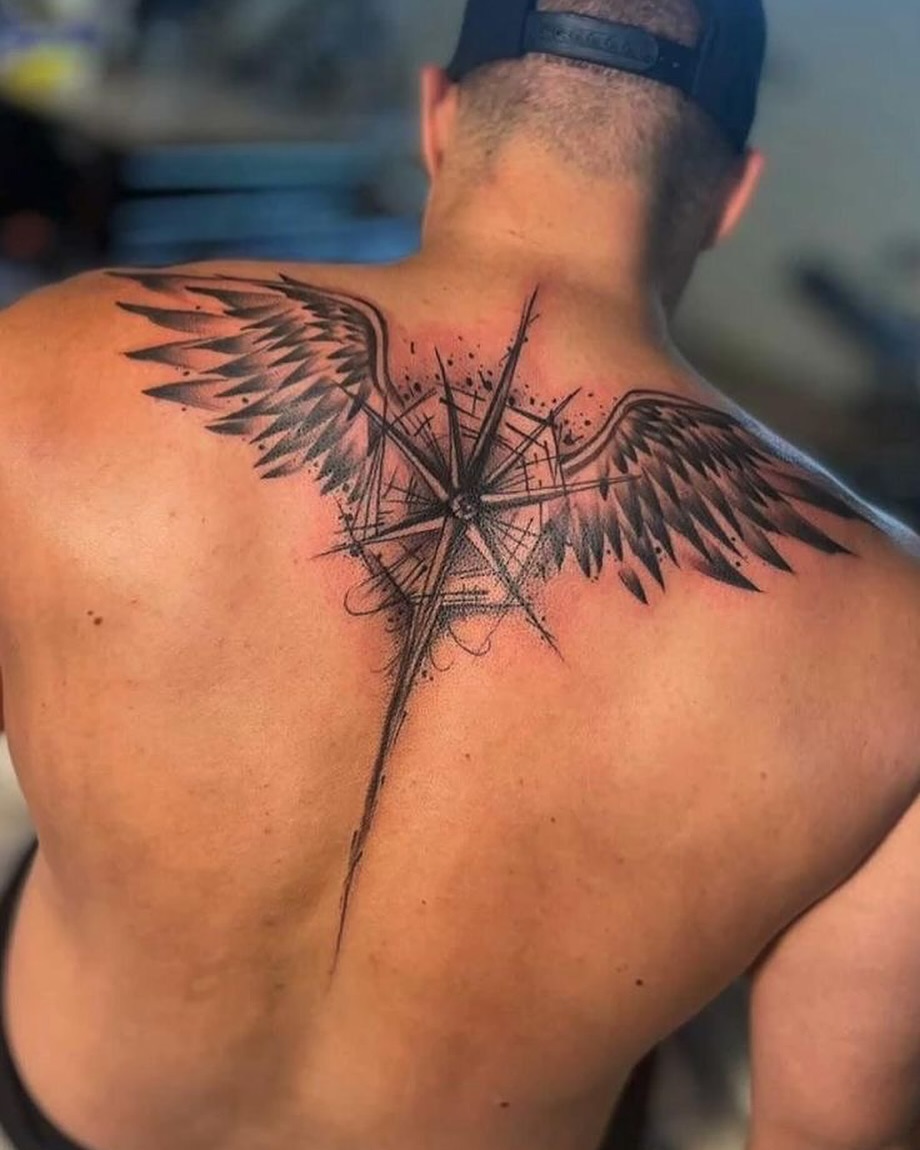
Here, wings are paired with a sharply defined cross, creating a tension between faith and abstraction. The cross cuts vertically through the center, grounding the design, while the wings stretch outward in angular strokes.
The execution leans toward modern illustration rather than classical realism. Splatter details and sharp intersections add energy without sacrificing clarity.
This tattoo feels at home in contemporary street or athletic styling — sleeveless tops, technical fabrics, and structured silhouettes that expose the upper back.
Angel Wings with Central Figure
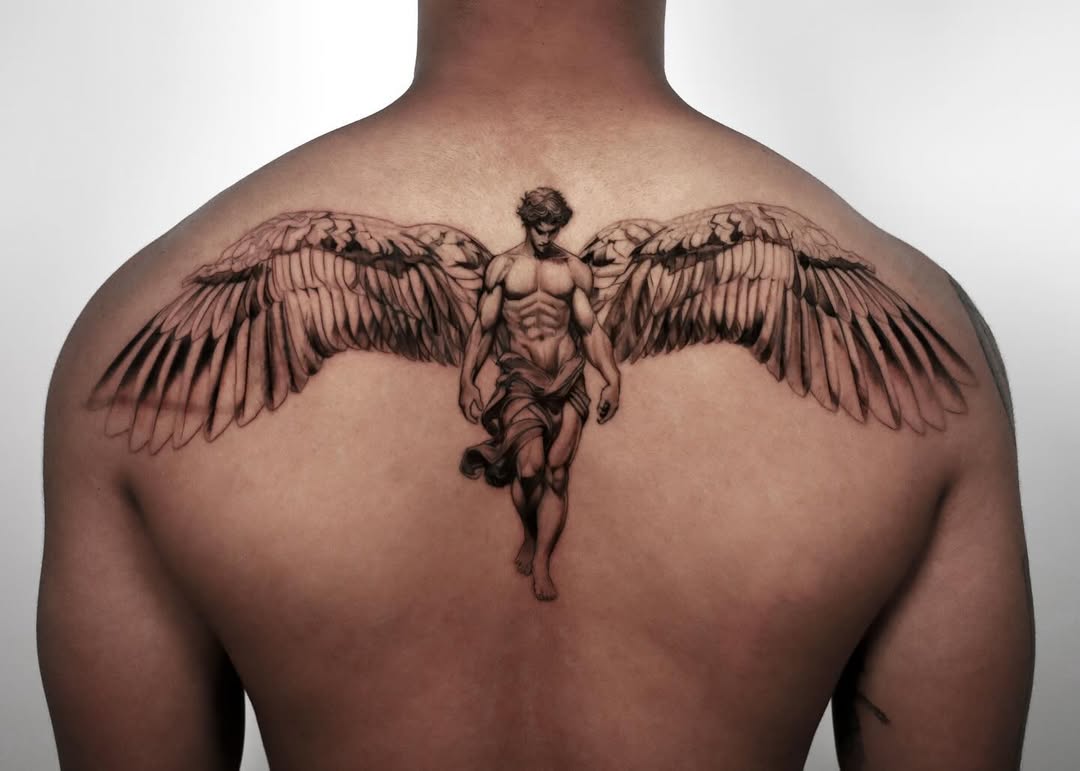
This piece draws from classical art traditions, featuring a central figure suspended between expansive angel wings. The anatomy is carefully balanced, with the wings framing the shoulders and the figure anchoring the composition.
Unlike darker religious back tattoos, this design feels contemplative rather than dramatic. The shading is controlled, allowing muscle structure and feather texture to coexist without visual overload.
This tattoo complements timeless menswear — neutral tones, tailored fits, and minimal accessories. It’s a nod to heritage without feeling dated.
Full Back Mythological Figure Tattoo
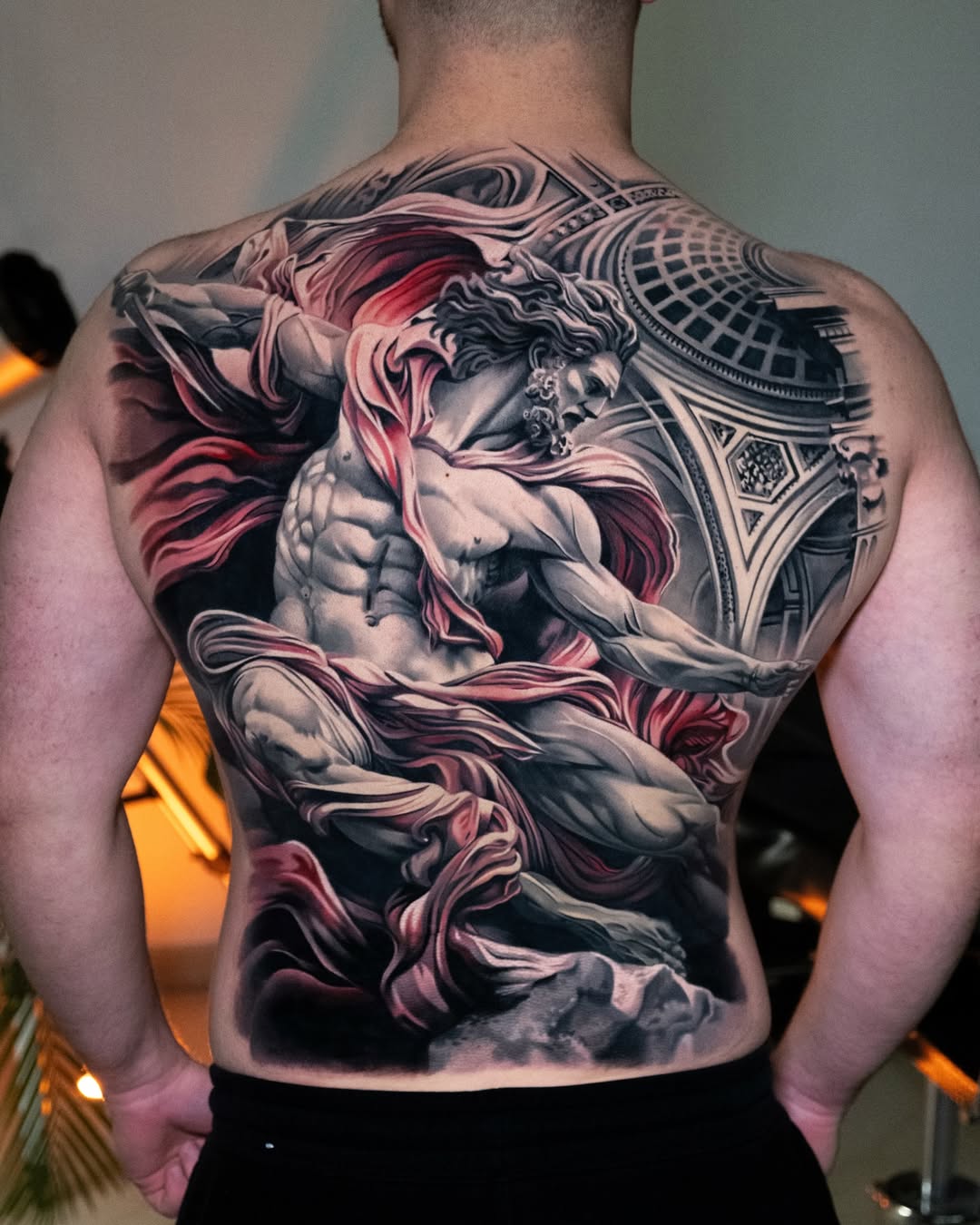
A true full back tattoo, this piece leans into mythological storytelling. The central figure dominates the canvas, surrounded by architectural and sculptural elements that echo classical European art.
The color palette is restrained, allowing subtle reds and deep shadows to guide the eye across the back. This level of detail demands commitment — both from the artist and the wearer.
This tattoo suits bold personal style: structured coats, statement footwear, and confidence to match the scale of the artwork.
Warrior Back Tattoo with Shield and Sword
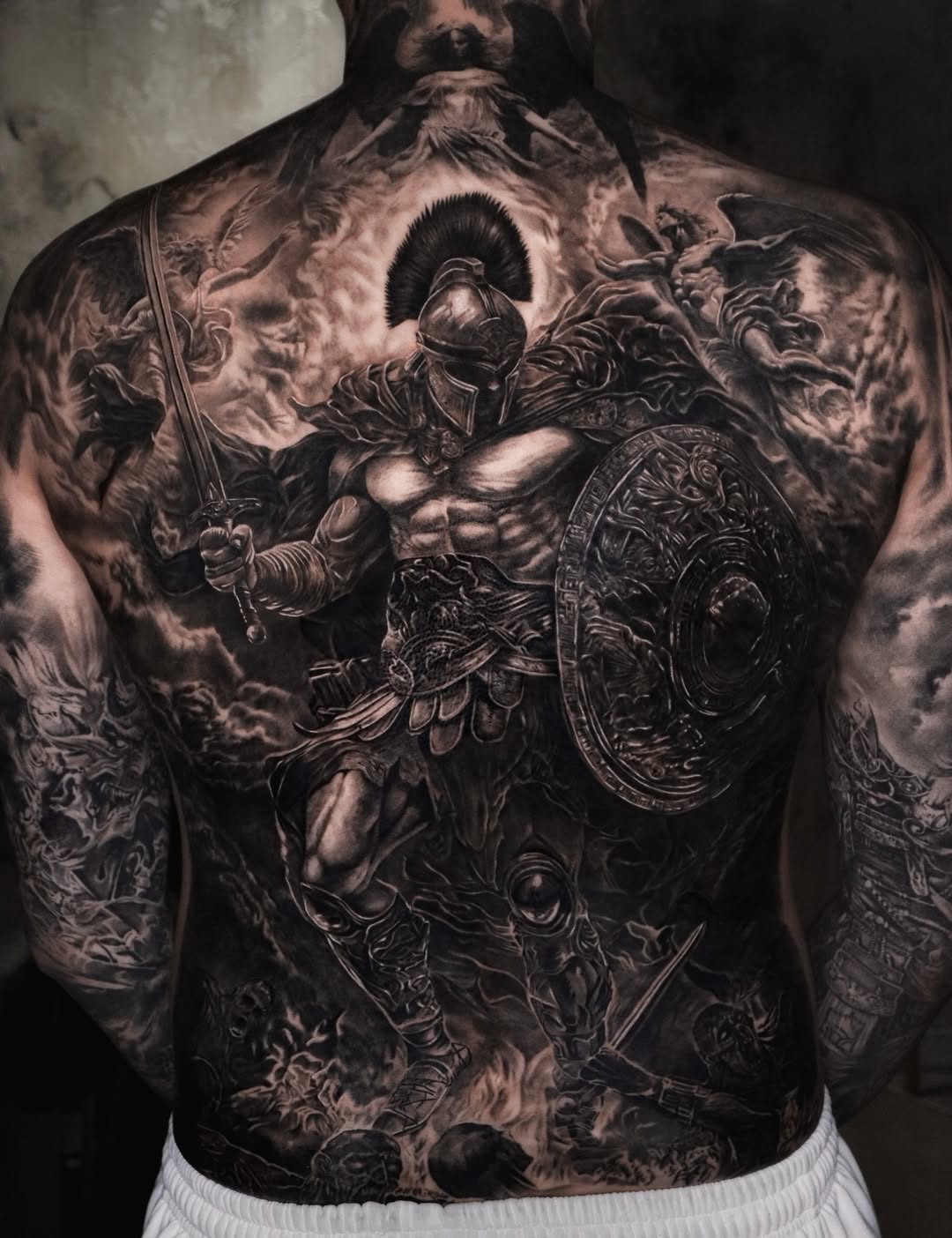
Power and movement define this back tattoo. A fully armored warrior stands at the center, shield raised, sword drawn. The surrounding smoke and motion lines create depth, giving the piece a cinematic quality.
Executed in high-contrast black and grey, the tattoo commands attention without relying on color. It’s unapologetically masculine, rooted in strength and resilience.
This design pairs naturally with rugged styling — boots, heavy fabrics, and a no-frills approach to fashion.
Japanese-Inspired Snake and Tiger Back Tattoo
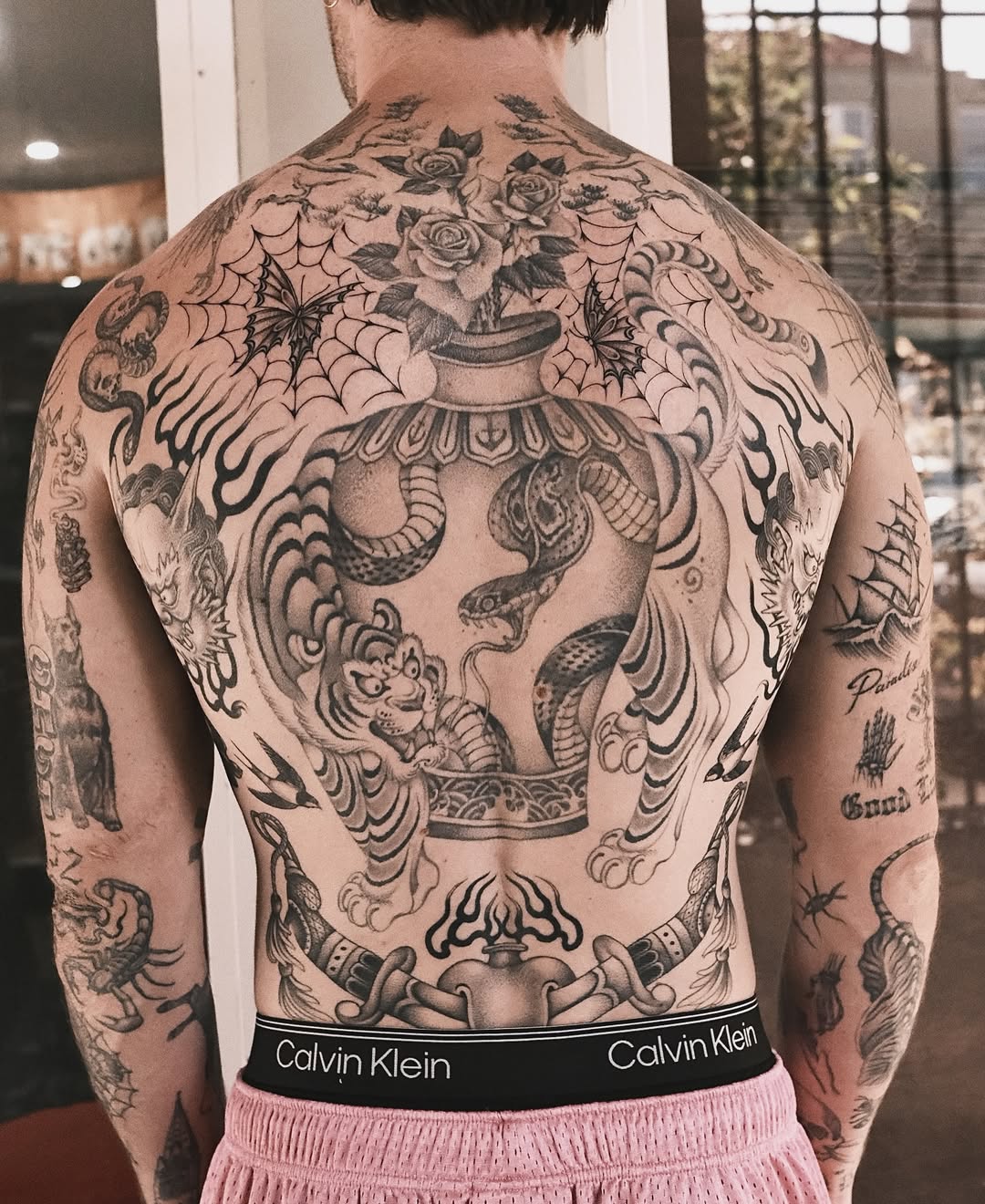
A masterclass in Japanese tattoo composition, this back piece brings together a coiled snake, a tiger, and floral elements in a balanced, traditional layout.
Every element has symbolic weight: the tiger for power, the snake for transformation, the flowers for impermanence. The density of the design fills the back without feeling cluttered — a hallmark of skilled Japanese tattooing.
This tattoo works best alongside understated fashion. Let the ink carry the narrative.
Classical Mythology Back Tattoo with Architectural Motifs
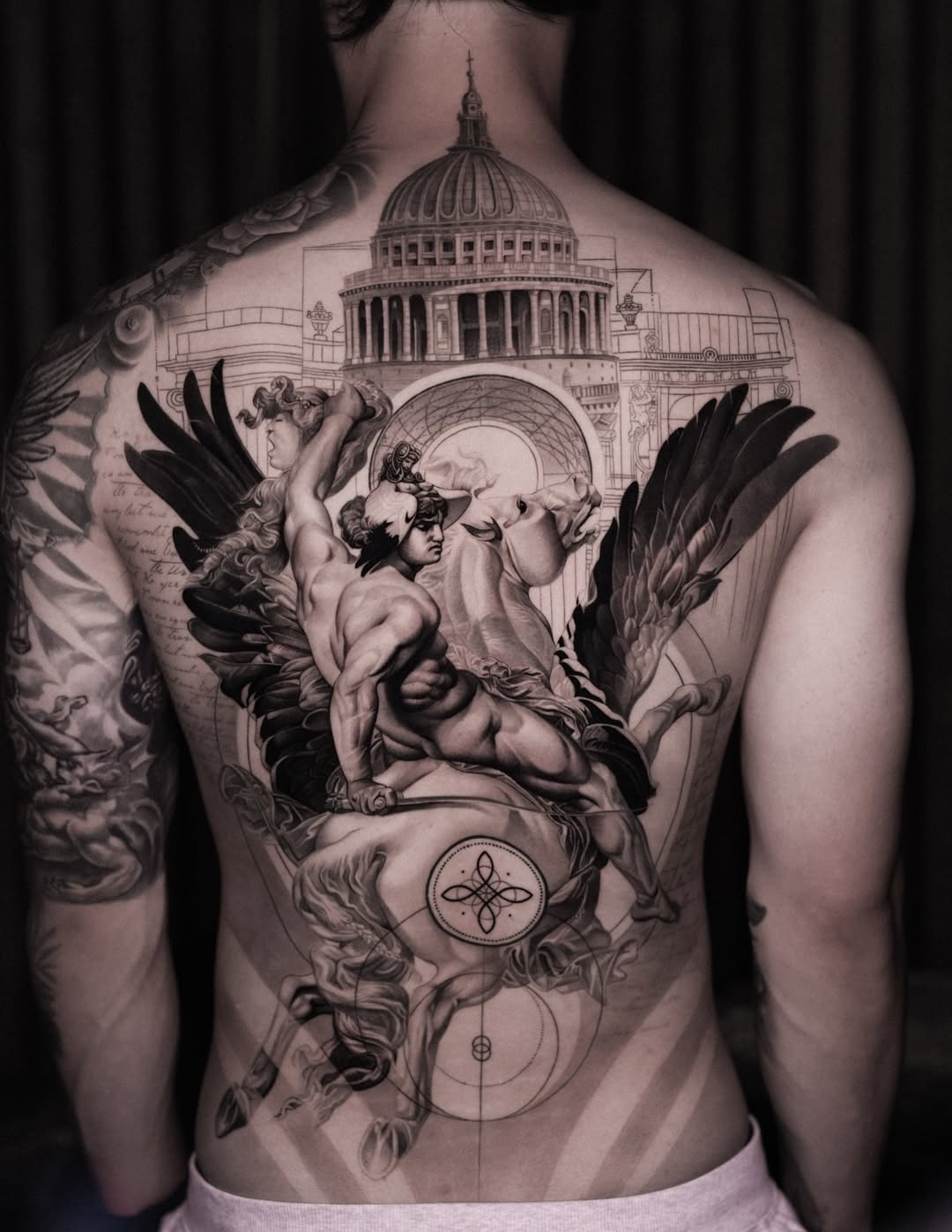
This back tattoo reads like a page torn from an art history book. A powerful mythological figure takes center stage, framed by architectural elements reminiscent of European neoclassicism. Columns, arches, and domes form a structural backdrop that gives the composition depth and historical weight.
The wings are dramatic yet controlled, extending across the upper back without overwhelming the anatomy. Fine geometric accents anchor the lower portion, introducing a modern counterpoint to the classical subject matter.
This design suits men who gravitate toward tailored clothing, clean lines, and cultural references. It’s a tattoo that feels intellectual, not ornamental.
Religious Full Back Tattoo in Black and Grey
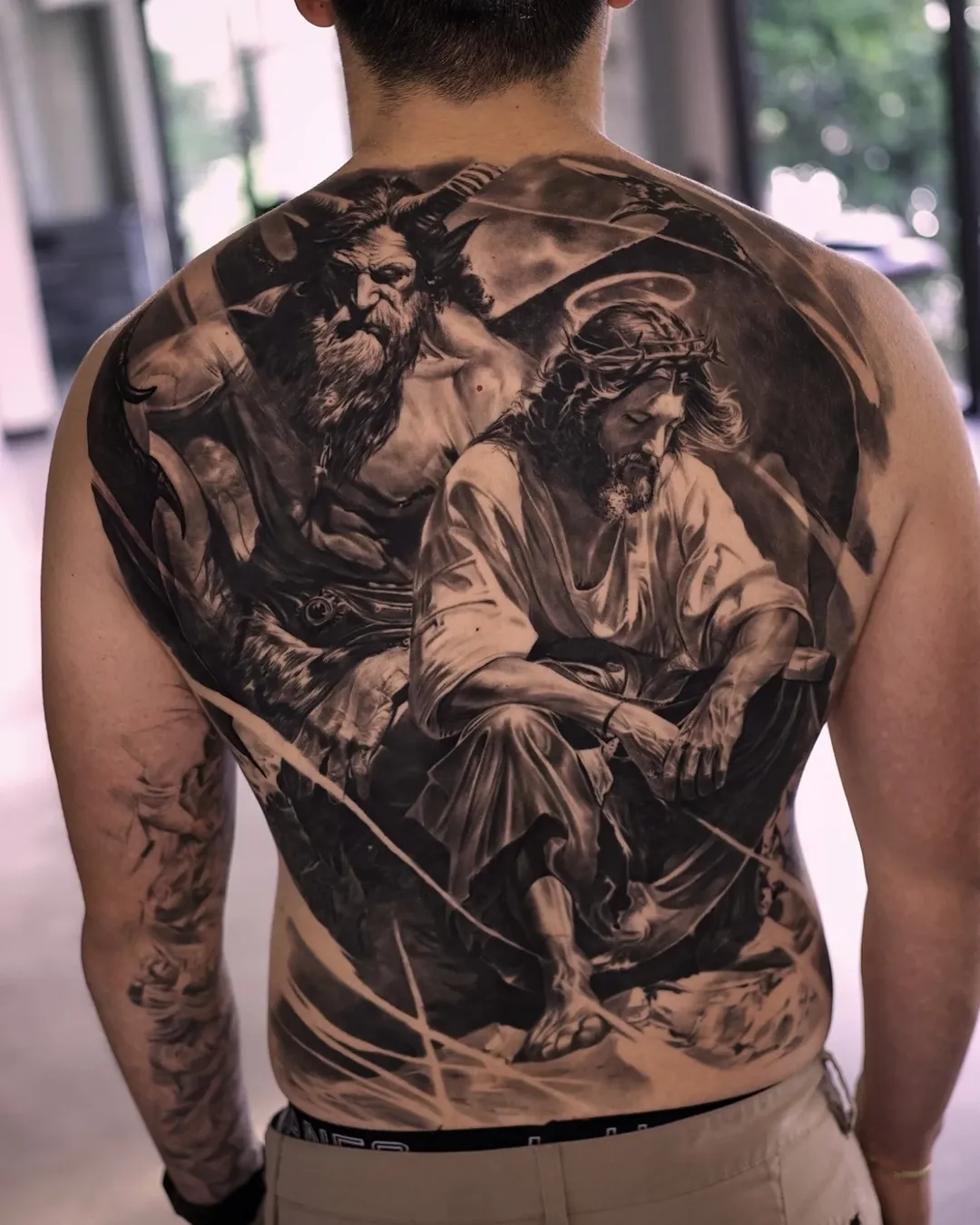
Few themes demand as much respect as religious imagery, and this full back tattoo delivers with gravity. The central figure, rendered in deep black and grey realism, conveys humility, suffering, and devotion without theatrical excess.
The composition flows diagonally, guiding the eye naturally across the back. Soft transitions between light and shadow prevent the tattoo from becoming visually heavy, despite its scale.
This kind of tattoo pairs best with understated personal style — neutral tones, minimal accessories, and confidence that doesn’t need embellishment.
Japanese-Inspired Half Back Mythological Tattoo
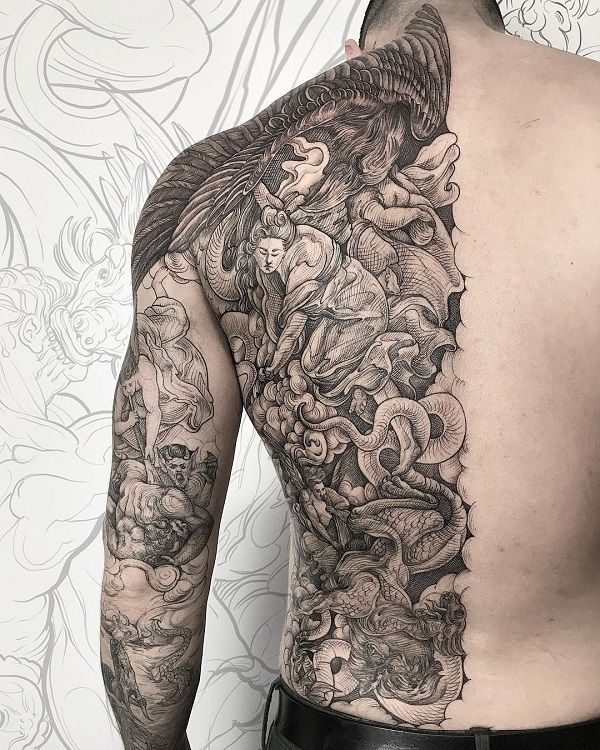
This piece embraces asymmetry, covering one side of the back in dense Japanese-inspired imagery. Mythical creatures, flowing forms, and layered textures create a sense of movement that feels alive rather than static.
The negative space on the opposite side enhances the impact, allowing the artwork to breathe. This approach reflects traditional Japanese tattoo philosophy, where balance doesn’t always mean symmetry.
Stylistically, it complements men who appreciate deliberate contrast — mixing tailored pieces with raw textures, or classic silhouettes with modern details.
Minimal Symbolic Spine Tattoo
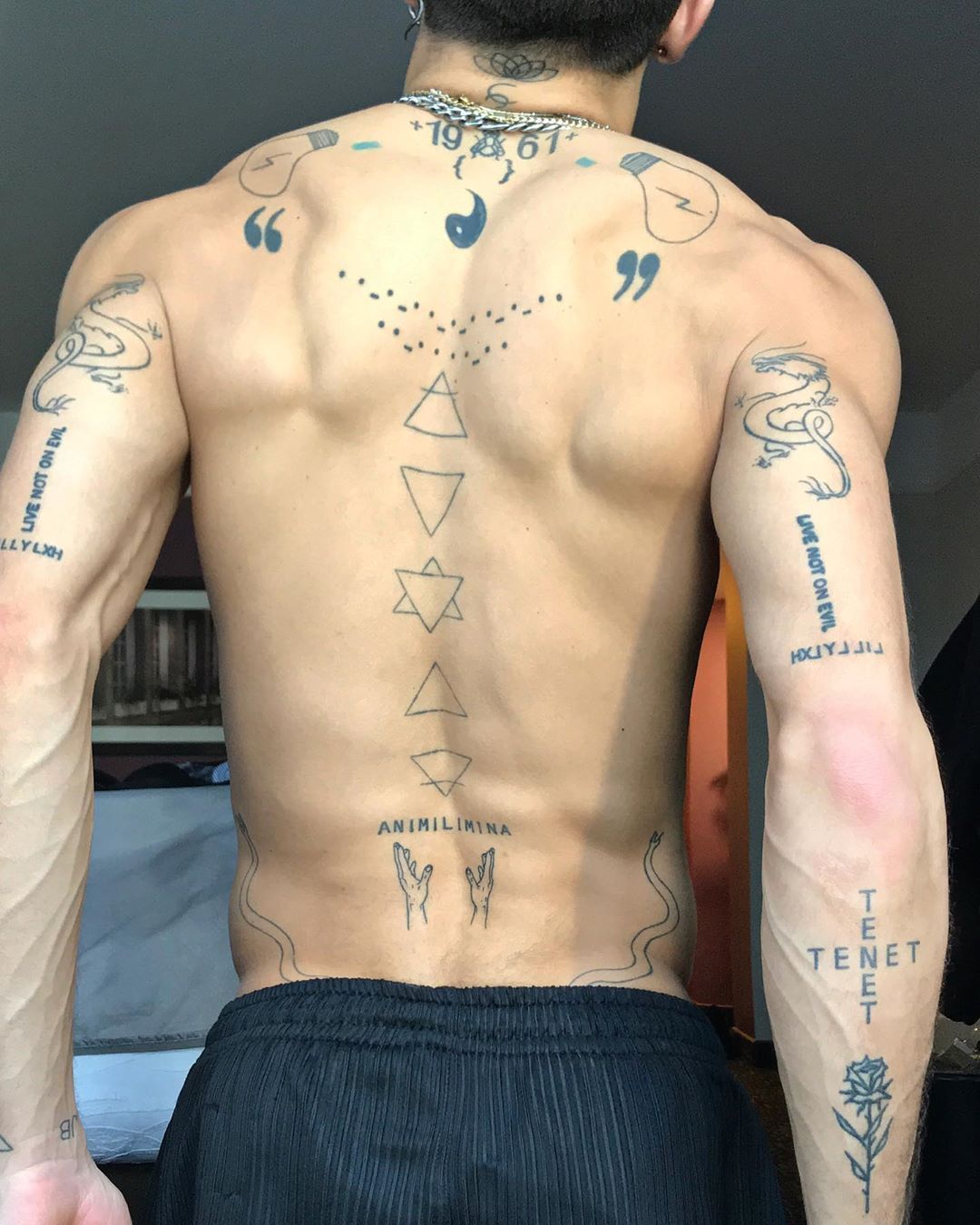
This design strips tattooing back to its conceptual core. A series of minimalist symbols align perfectly along the spine, creating a vertical narrative that feels both personal and abstract.
The linework is intentionally light, allowing the body’s natural contours to shape the design. Small typographic elements and geometric forms add rhythm without clutter.
This tattoo pairs effortlessly with contemporary, fashion-forward styling — cropped jackets, relaxed trousers, and subtle jewelry.
Sacred Geometry and Skeletal Wings Back Tattoo
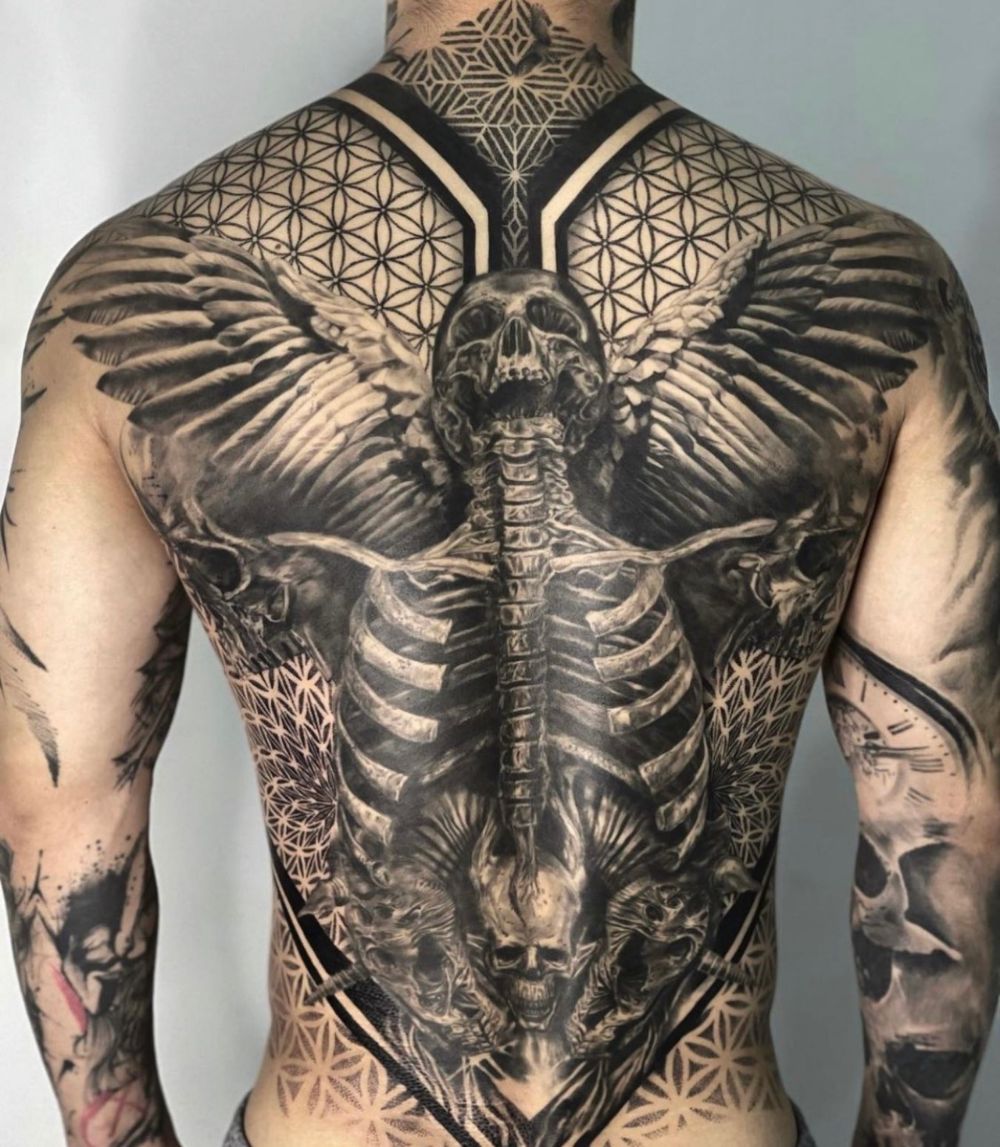
This back tattoo blends mandala-style sacred geometry with anatomical realism. A skeletal figure with wings dominates the center, while repeating geometric patterns fill the surrounding space.
The contrast between organic bone structure and precise geometry creates tension — life versus order, chaos versus control. Despite its density, the composition remains readable due to disciplined spacing.
This is a statement tattoo, best suited for men with bold personal style and a taste for visual complexity.
Upper Back Lettering Tattoo with Floral Elements
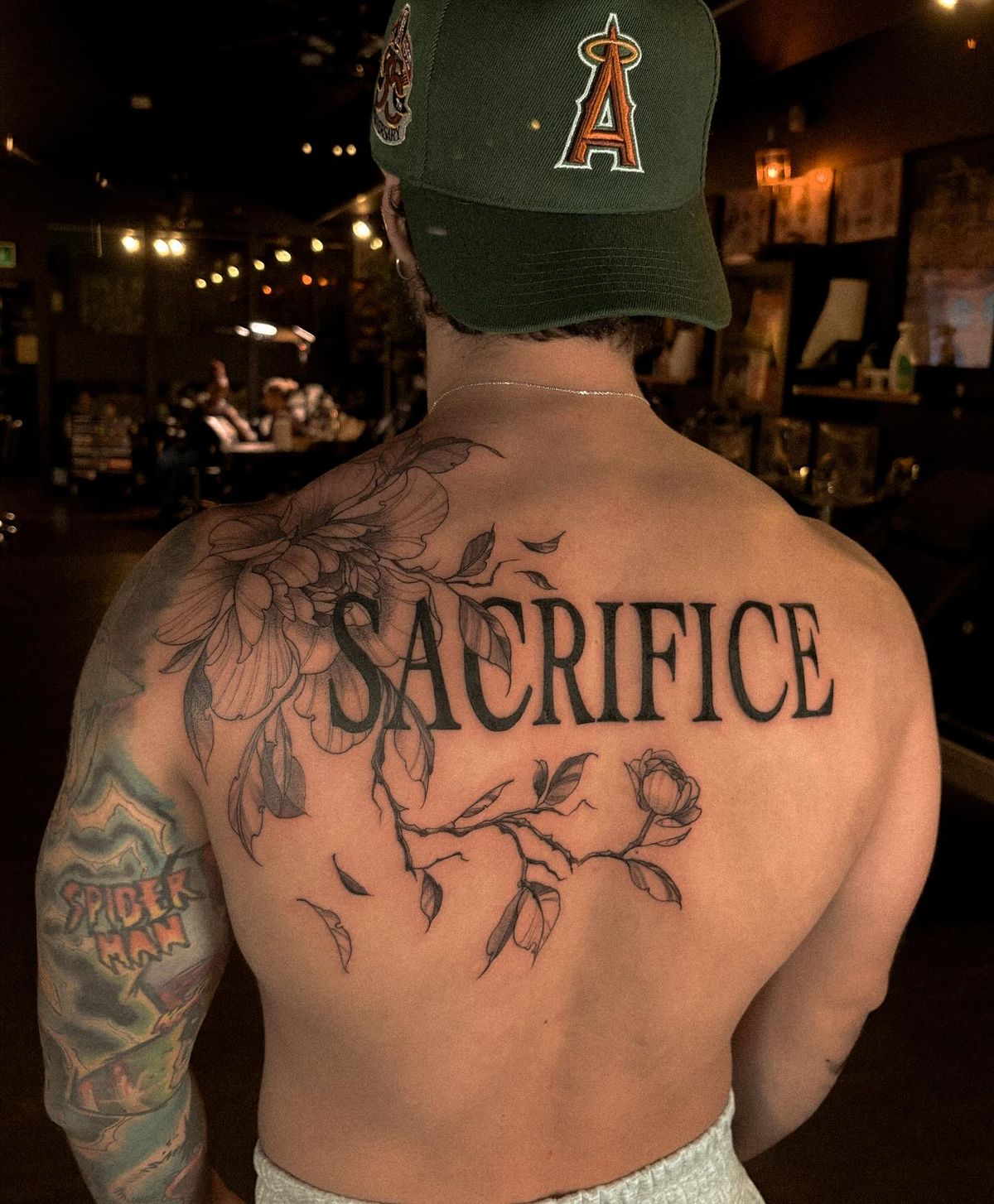
Bold lettering takes center stage here, stretched across the upper back in a strong, serif font. The word choice feels deliberate, carrying emotional weight rather than decorative intent.
Floral linework softens the composition, adding contrast and movement. The balance between typography and illustration prevents the tattoo from feeling rigid.
This style pairs naturally with casual, confident fashion — relaxed tees, caps, and lived-in denim. It’s expressive without being theatrical.
Cybersigilism-Inspired Wing Spine Tattoo
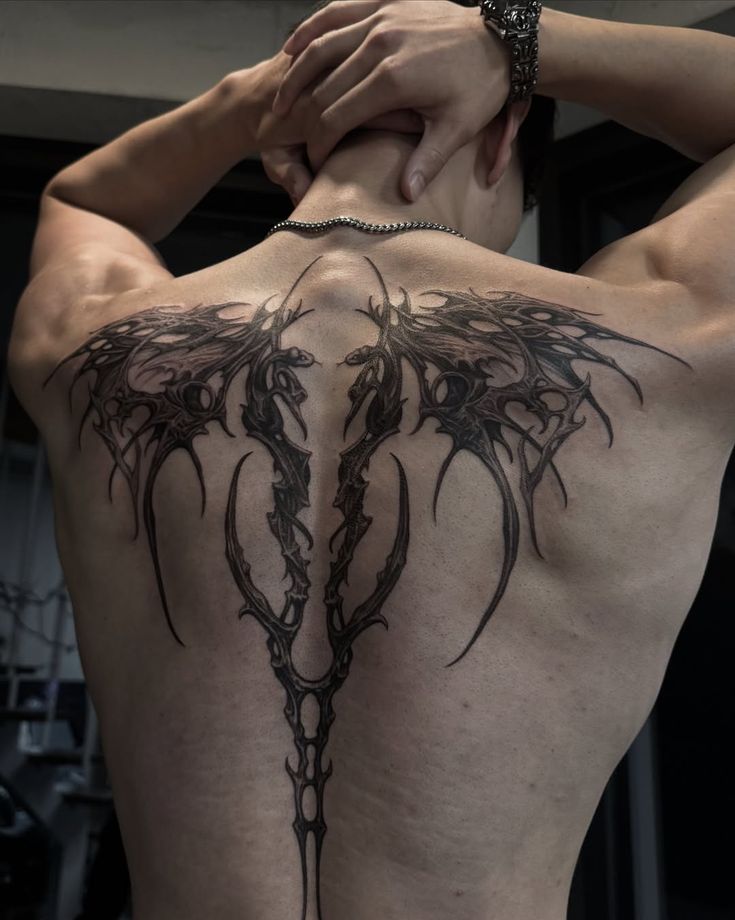
This design leans fully into cybersigilism, combining skeletal forms, abstract wings, and a sharp vertical spine element. The wings feel engineered rather than organic, giving the tattoo a futuristic, coded aesthetic.
The symmetry is tight, the lines aggressive, and the overall effect unmistakably modern. It’s a tattoo that feels born from digital culture rather than tradition.
This piece thrives alongside contemporary streetwear or minimalist athletic styling — monochrome palettes, technical fabrics, and sharp silhouettes.
Snake and Skull Spine Back Tattoo
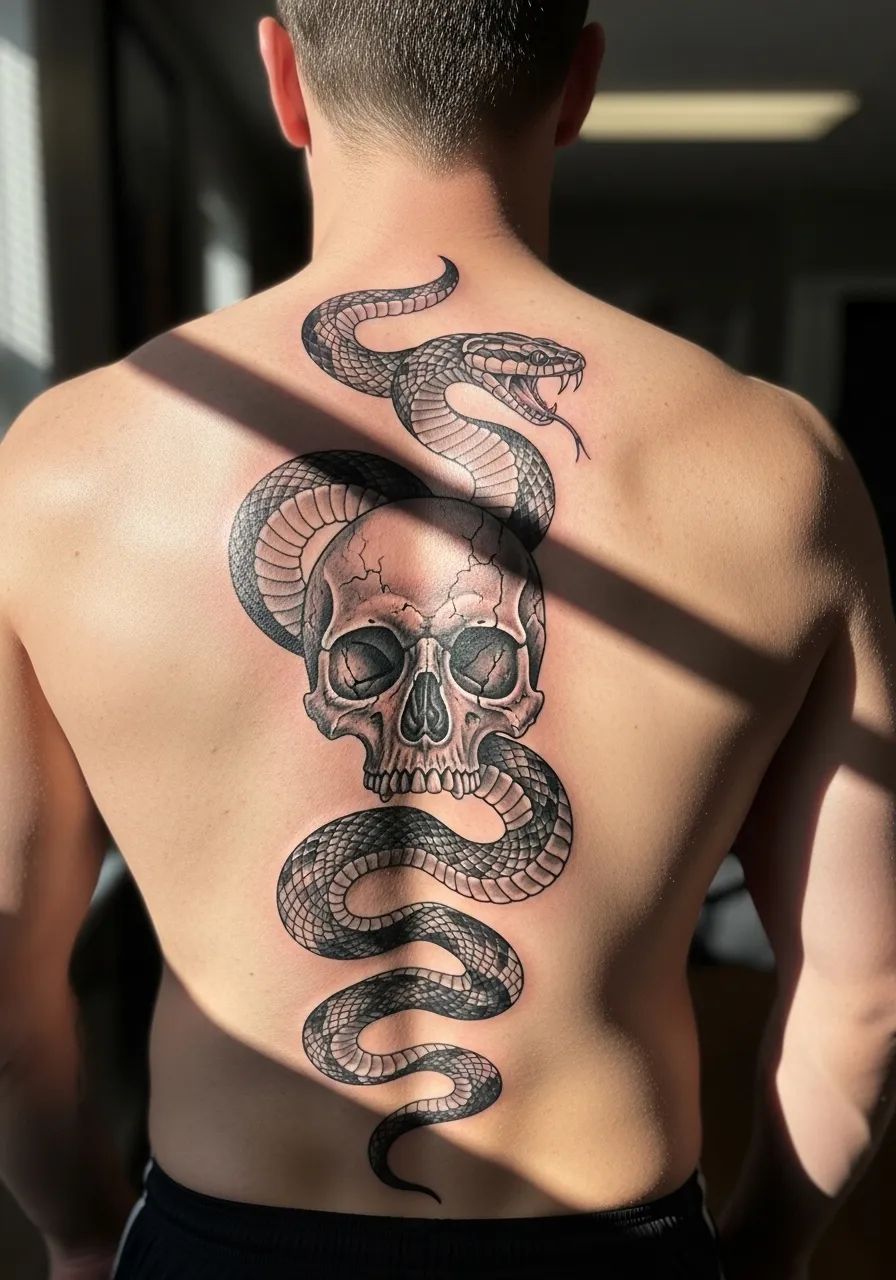
This back tattoo leans into timeless symbolism. A snake coils vertically along the spine, weaving through a cracked skull positioned at the center of the back. The composition feels deliberate and balanced, using the natural flow of the body rather than forcing scale for shock value.
The snake’s movement creates rhythm, while the skull acts as an anchor — mortality and transformation locked into a single narrative. The realism is controlled, avoiding excess shading so the tattoo remains readable from a distance.
This design pairs naturally with understated styling: neutral tones, simple cuts, and minimal distractions. It’s a tattoo that speaks through symbolism rather than volume.
Full Back Renaissance-Style Mythological Tattoo
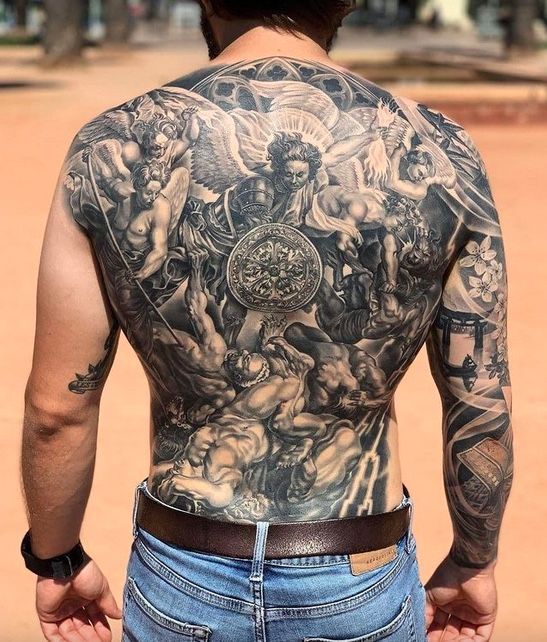
This is a statement full back tattoo in every sense. Drawing heavily from Renaissance and Baroque art traditions, the composition layers multiple mythological figures into a single, cohesive scene. Muscular forms, dynamic poses, and celestial elements give the tattoo a museum-quality presence.
The artist uses depth and contrast to guide the eye across the back, ensuring no single figure overwhelms the rest. Despite the density, the composition remains disciplined — a hallmark of high-level realism work.
This tattoo demands confidence and commitment. It pairs best with simple, classic clothing that lets the artwork stand alone without competition.
Back tattoos for men are no longer about filling space — they’re about meaning, movement, and personal language. Whether drawn to angel wings, Japanese mythology, mandala symmetry, or abstract fine line work, the modern back tattoo reflects identity more than trend.
If any of these designs sparked ideas or reminded you of your own ink journey, drop a comment and join the conversation. Tattoo culture evolves through shared stories — and every back tells one.