
Centipedes have quietly become one of the most compelling creatures in contemporary tattooing. They have the elongated movement of a snake, the unsettling detail of an insect, and a segmented body that can be adapted to almost any difficult placement. An artist can send one down a forearm, wrap it around an arm, stretch it along the spine, or exaggerate the legs until the whole design starts to feel almost abstract.
For Centipede tattoo ideas 2026, the most interesting direction is not one specific style but the range of interpretations. Heavy Blackwork can make the creature genuinely ominous, while a cleaner Traditional or Trad approach turns it into a graphic statement. There is also room for experimental Cybersigilism, delicate linework, red accents, and unusual combinations such as a centipede with a Spider lily, Heart, or Eye.
One thing worth remembering when collecting inspiration from tattoo publications and artist portfolios is that centipedes need to be designed for the body rather than simply copied from a flat Stencil. Publications have long demonstrated how much placement affects a tattoo’s personality. With a centipede, that relationship becomes particularly obvious: every curve of the creature can follow the anatomy.
Here are 30 very different approaches that show why this motif has so much potential in 2026.
Double Blackwork Centipede Arm Design
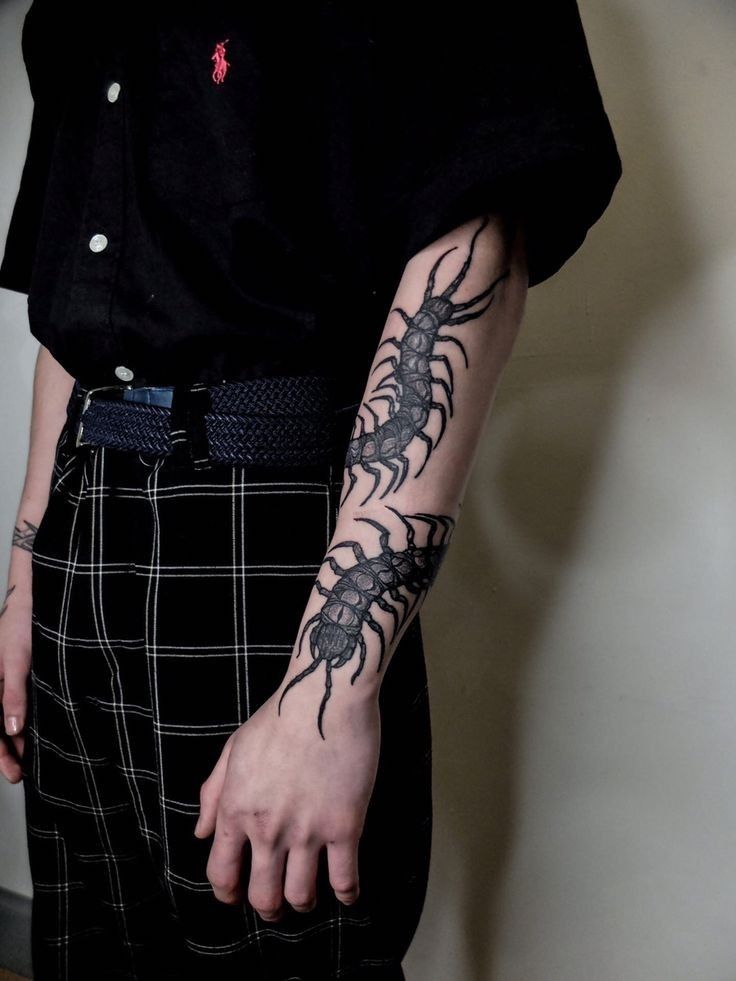
This is the kind of Design arm concept that immediately explains why centipedes work so well on long, narrow areas of the body. Instead of using one enormous creature, the composition divides the idea between two centipedes. One occupies the upper portion of the forearm, while the second begins closer to the wrist and hand.
The Blackwork treatment is dense without becoming a completely flat silhouette. Each segmented plate contains gray-black shading, creating the impression of a hard shell. The legs are comparatively thin and sharply curved, so they break away from the heavier central body and keep the tattoo from becoming visually muddy.
There is also something particularly effective about the irregular orientation. The centipedes do not sit on the Arm like straight decorative strips. Their bodies bend and change direction, which makes them feel as though they are actually moving over the skin.
For anyone considering a larger Arm wrap, this could also serve as the beginning of a more extensive composition. Additional segments, botanical elements, or dark ornamental shapes could eventually connect the two creatures without destroying the negative space that currently makes the design readable.
Coiled Realistic Centipede Blackwork Tattoo
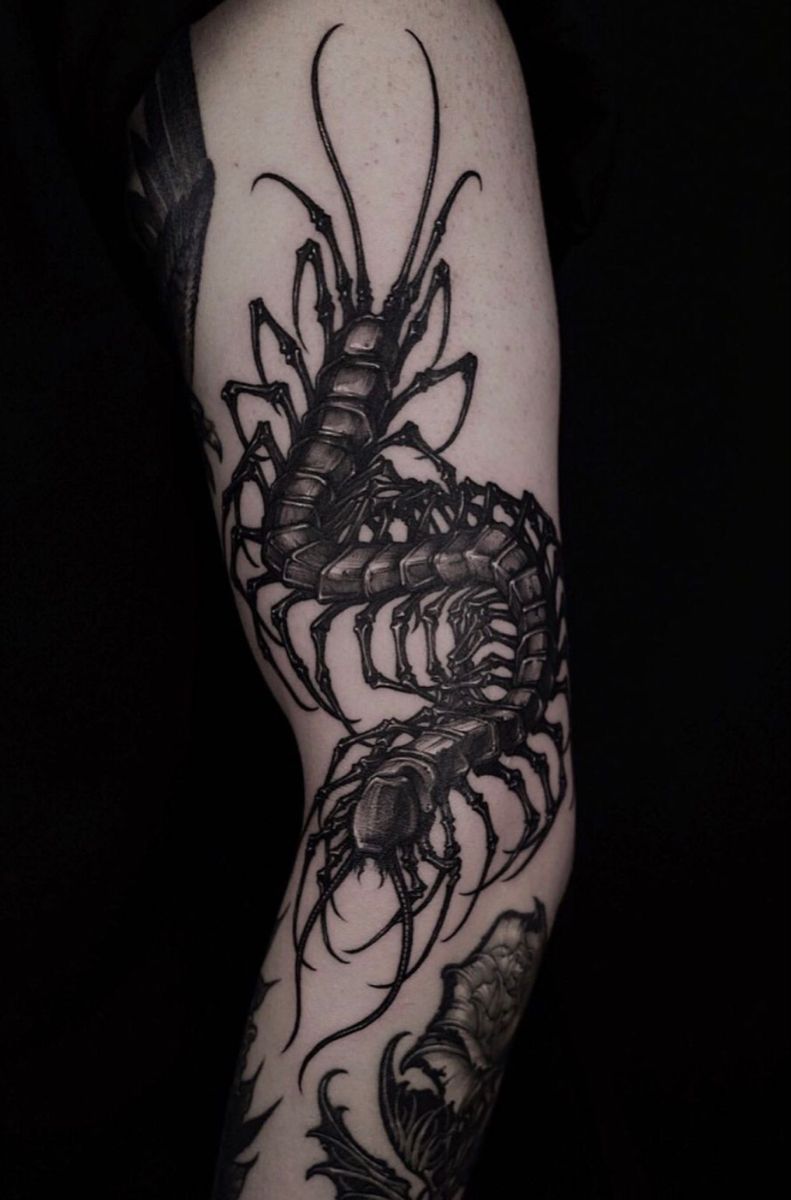
Some centipede tattoos are unsettling because they are simple. This one takes the opposite route: detail is the main attraction.
The creature bends dramatically across the arm, creating an almost S-shaped composition. That curve is an intelligent solution for a large Design because a perfectly straight centipede can occasionally feel stiff. Here, the body looks compressed and active, as though the insect has changed direction in the middle of its movement.
The shell is built from dark individual plates with lighter highlights running through them. Those subtle differences give the body depth, while the numerous legs overlap and intersect around the central form. Long antennae extend beyond the heavier portion of the tattoo and provide an elegant contrast to all that dense black.
This approach would suit someone who wants a substantial tattoo rather than a Simple insect outline. It could also translate effectively to the Leg, particularly the calf or outer thigh, where an artist would have enough room to preserve those tiny anatomical details.
The biggest lesson here is scale. When a tattoo contains this many legs, joints and shell divisions, giving the artist adequate space usually produces a cleaner result than trying to compress the same Design stencil into a tiny area.
Geometric Centipede Forearm Wrap
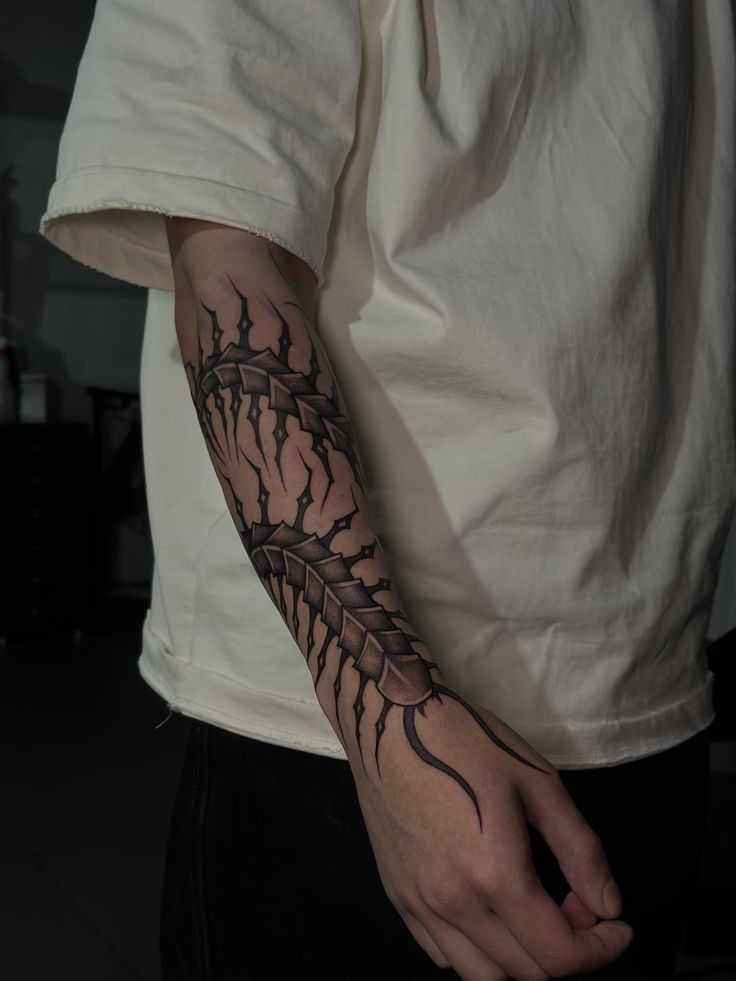
This Forearm tattoo takes the recognizable anatomy of a centipede and pushes it toward something more graphic. The body is constructed from angular, armor-like sections, while the legs become pointed black shapes rather than delicate anatomical lines.
That stylistic decision gives the tattoo a slightly futuristic personality. It sits somewhere between insect imagery, dark ornamentation, and the sharper vocabulary associated with Cybersigilism.
Placement does much of the work. Instead of simply running vertically from elbow to wrist, the centipede curves around the forearm. This creates the beginning of an Arm wrap effect and allows different portions of the creature to appear as the wearer turns the wrist.
I particularly like designs that reveal themselves this way. A tattoo does not always need to show its complete composition from one viewing angle. Sometimes the movement required to see the whole piece is part of what makes it memorable.
The restrained black-and-gray palette is also appropriate here. Red might have created a completely different mood, but monochrome ink keeps attention on the unusual geometry of the shell and legs.
Giant Centipede Back and Shoulder Tattoo
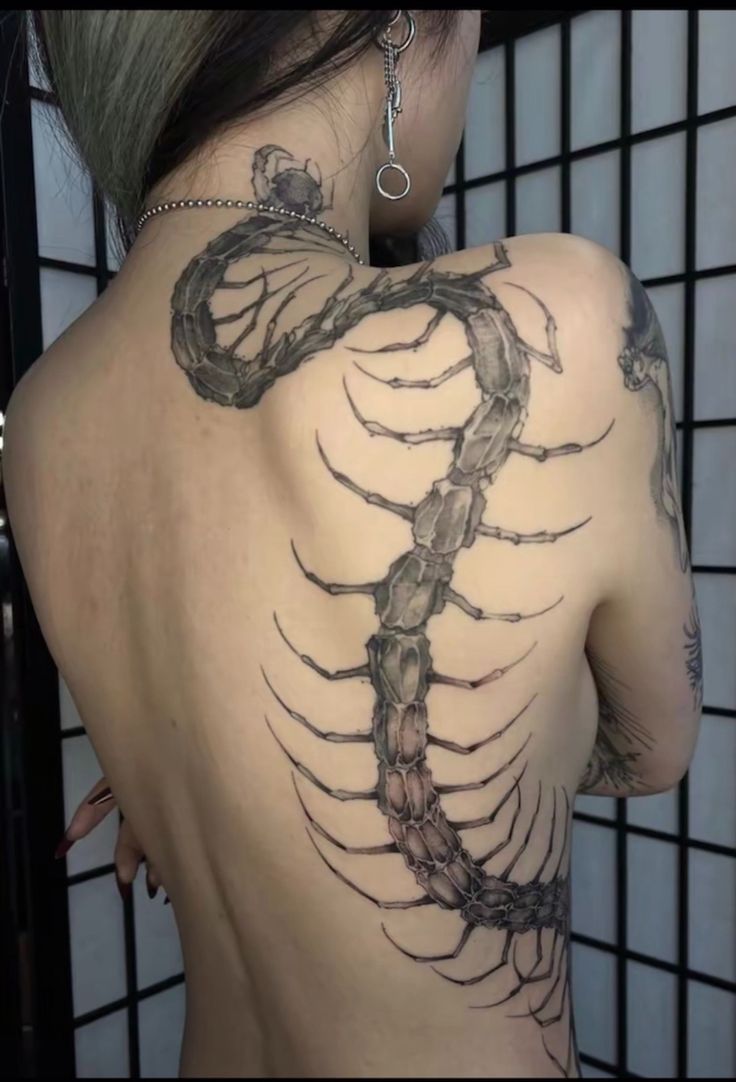
The Back offers an entirely different canvas, and this oversized centipede makes full use of it. Beginning near the upper back and Shoulder, the creature travels downward in a sweeping curve before reaching the lower side of the torso.
What makes the placement especially striking is the relationship between the long legs and the body’s natural contours. The central shell is substantial, but the thin legs extend outward into large areas of bare skin. As a result, the tattoo occupies an impressive amount of space without requiring every centimeter to be filled with ink.
The upper portion curls toward the Neck, creating an almost scorpion-like silhouette from certain angles. Lower down, the segmented body becomes straighter before curving again. This variation prevents a very large tattoo from feeling repetitive.
A centipede could also be arranged directly along the Spine, but the asymmetry here feels more organic. The creature appears to crawl across the body rather than function as a rigid piece of symmetrical decoration.
For a large-scale centipede project, this is a good reminder that negative space matters just as much as black ink. Leaving open skin between the legs makes each individual segment easier to distinguish and gives the composition room to breathe.
Fine Black Centipede Forearm Tattoo
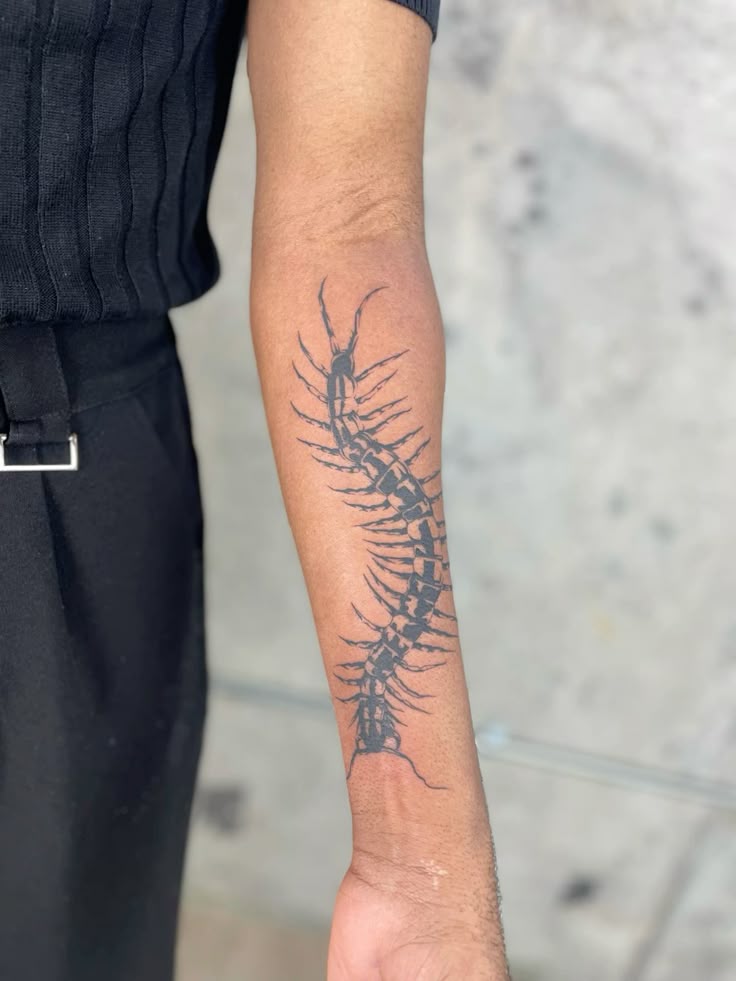
Not every centipede tattoo needs massive black areas. This narrower Forearm interpretation uses a much lighter visual language, making it an interesting option for someone who likes dark subject matter but does not necessarily want a heavy sleeve.
The creature follows the vertical direction of the arm with a subtle curve through its segmented body. Fine legs extend repeatedly from either side, producing a feathery silhouette from a distance. Up close, however, the recognizable centipede anatomy becomes much clearer.
There is an appealing tension between delicacy and discomfort here. Centipedes are hardly conventional “pretty” tattoo subjects, yet the thin lines and restrained scale give the creature an unexpected elegance.
This format is particularly adaptable. The same concept could move to the lower Leg, upper arm, or even become a much smaller Hand design if the number of anatomical details were reduced appropriately.
For Men and women looking for a versatile black centipede rather than an aggressively shaded piece, this kind of composition is worth considering. It proves that the motif does not depend on heavy black saturation to have presence.
Abstract Cybersigilism Centipede Forearm Design
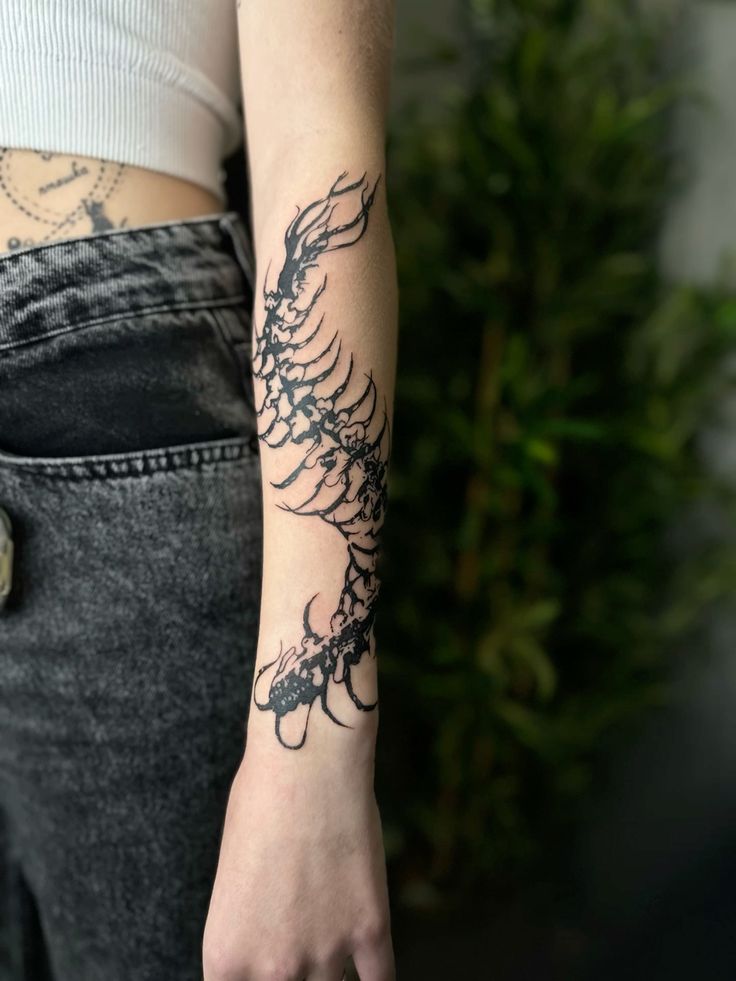
Here the centipede begins to move away from naturalism altogether. Its anatomy is still recognizable, but sections of the body dissolve into sharp, irregular forms. The legs resemble thorns, flames, or fragments of a dark sigil.
That ambiguity gives the tattoo a strong Cybersigilism influence. Rather than attempting to reproduce an insect precisely, the artist uses centipede anatomy as a framework for something more expressive.
The placement from the lower Arm toward the wrist is particularly effective because the design becomes lighter and more fragmented around its edges. It avoids creating a rectangular block of ink on the forearm.
This approach also offers plenty of opportunities for customization. A subtle Eye could be hidden among the abstract shapes, or a Heart motif could be incorporated into one of the central segments. A Spider lily would create an especially dramatic contrast between organic petals and the aggressive insect structure.
For 2026, this hybrid territory feels particularly interesting: recognizable subjects transformed through highly personal visual languages rather than reproduced as conventional illustrations.
Red Traditional Centipede Tattoo
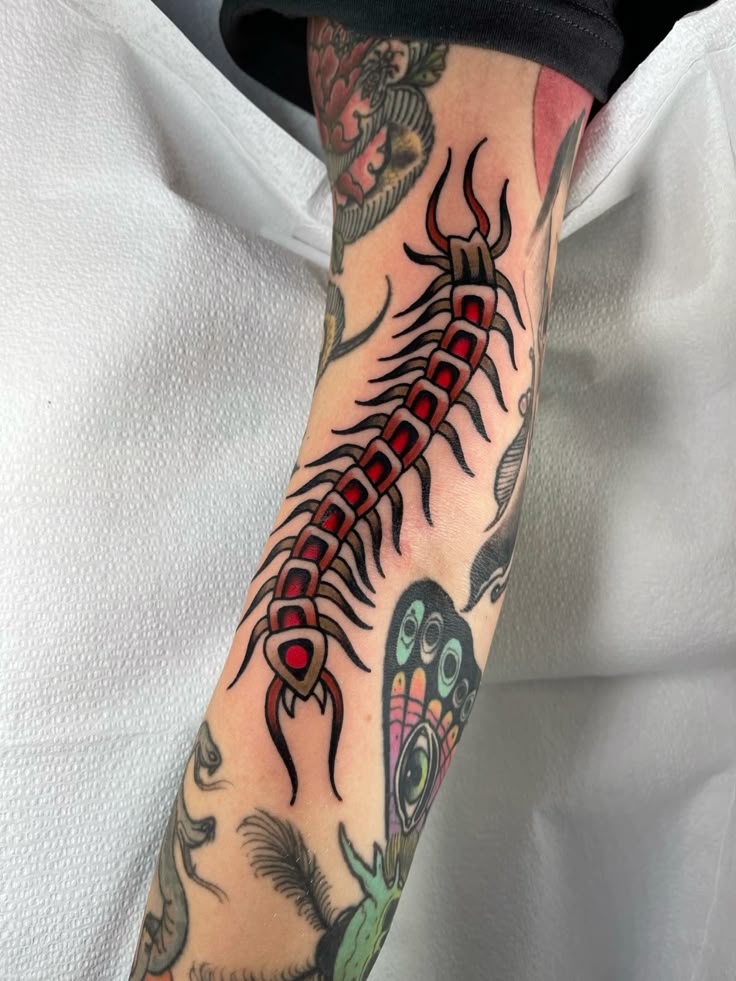
After several monochrome interpretations, this Red centipede shows how dramatically color can change the character of the motif.
The structure is much more graphic than realistic. Thick black outlines establish the legs, antennae, head, and individual body sections, while saturated red fills the repeating plates. Small areas of neutral shading prevent the red from overwhelming the entire composition.
There is a definite Traditional tattoo sensibility here. The design prioritizes recognizable shapes, strong outlines and limited color rather than tiny anatomical details. That makes it feel closer to a bold Trad piece than to the realistic black centipedes elsewhere in this collection.
I also like how naturally it coexists with surrounding tattoos. A centipede can be awkward to incorporate into an existing sleeve because of its length, but that same elongated anatomy can become an advantage: the creature can occupy narrow gaps that would be difficult to fill with rounder motifs.
For someone building a patchwork sleeve, this type of Design arm idea could connect otherwise unrelated pieces. It could even be customized with a traditional Eye, Heart, flower, or Spider lily while preserving the same black-and-red palette.
Fine Line Centipede Hand Tattoo
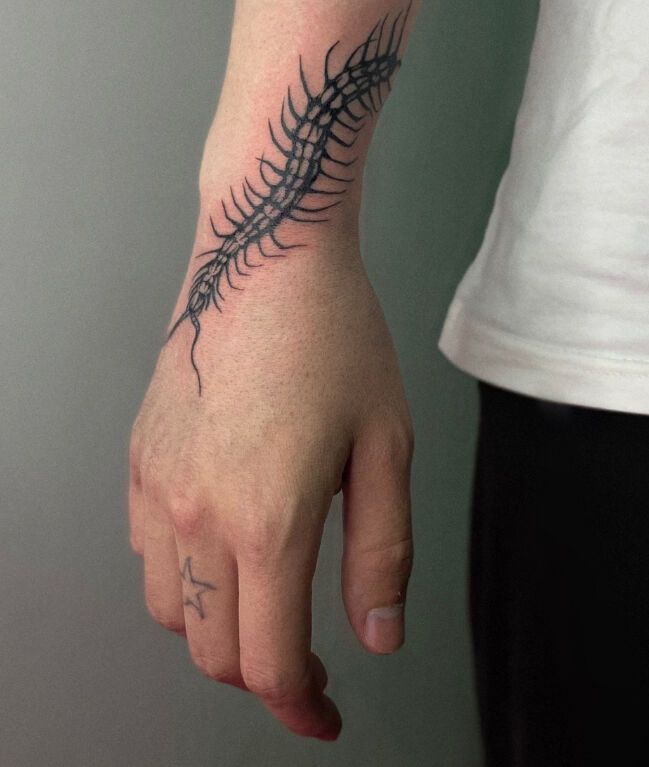
The Hand is a challenging placement for an elongated creature, but this design solves the problem by allowing the centipede to travel diagonally from the wrist toward the back of the hand. The body follows a gentle curve, while dozens of narrow legs spread outward like fine thorns.
What stands out is how little solid black is actually required. Rather than relying on dense Blackwork, the artist builds the creature primarily from crisp outlines. The repeated legs create most of the visual weight. Long antennae extend toward the hand, making the tattoo appear to crawl naturally across the transition between wrist and fingers.
This is a useful reference for anyone searching for a relatively Simple centipede without reducing the creature to a basic icon. A clean Stencil would be especially important here because small inconsistencies in the repeating legs become much more noticeable on an exposed placement.
There is also an understated punk quality to this piece. It works particularly well alongside small independent tattoos and could become the starting point for a patchwork Arm collection without demanding an entire sleeve.
Centipede and Red Spider Lily Forearm Tattoo
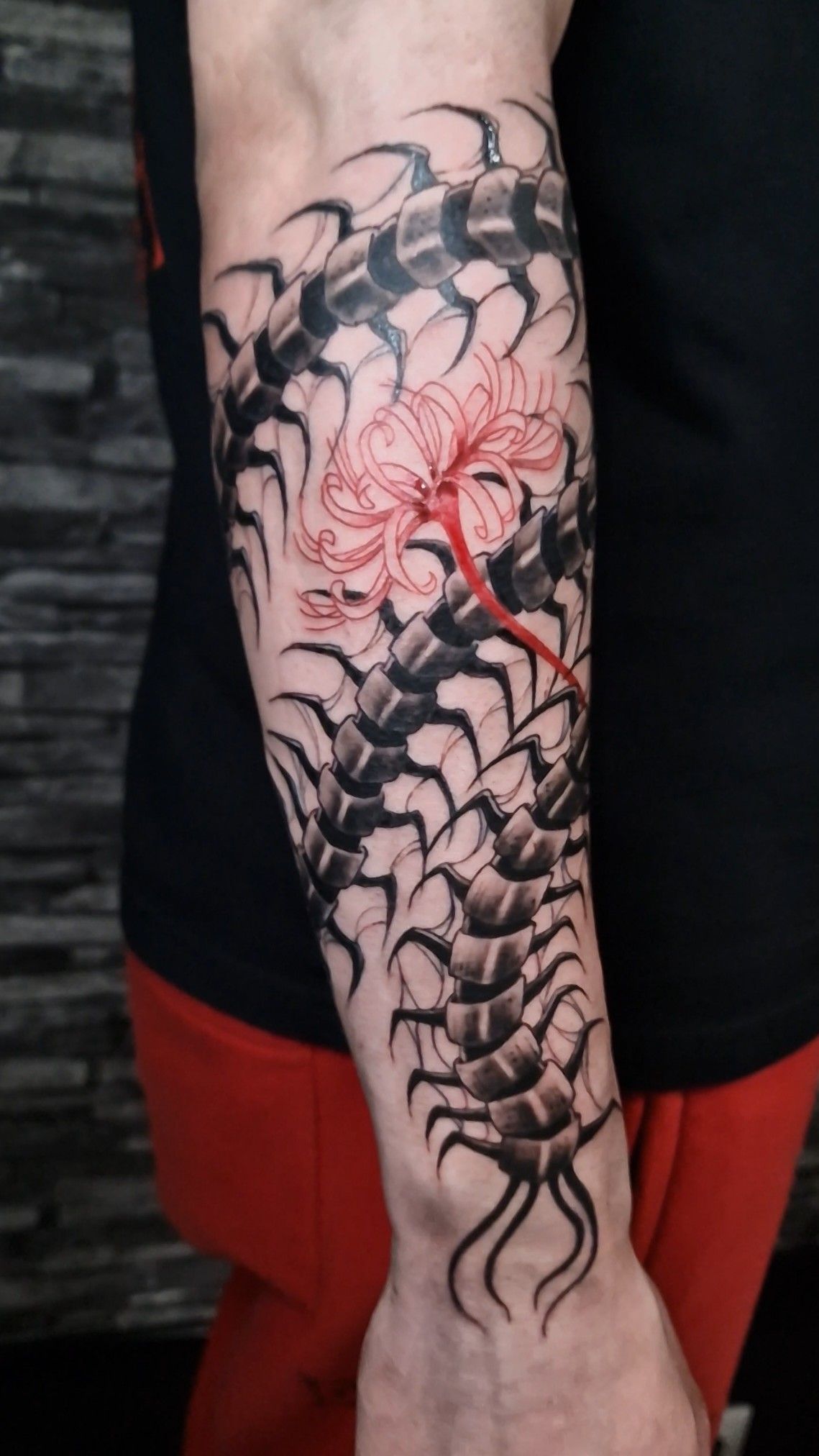
This is one of those combinations that feels unusually natural once you see it. Several dark centipede forms twist through the Forearm, while a delicate Red Spider lily provides the composition’s central focal point.
The contrast is beautifully controlled. Heavy black-and-gray segments establish the centipedes, with alternating dark bands giving their shells depth. Against them, the flower is drawn with much lighter red lines. Its narrow curling petals echo the rhythm of the insects’ legs without visually competing with them.
That relationship between softness and menace is what makes the Design memorable. The centipede supplies armor, movement and an almost claustrophobic density; the Spider lily introduces fragility and color.
For a larger Design arm, this formula offers considerable room for personalization. The flower could remain the only colored element while additional centipedes continue around the arm to produce an Arm wrap. Keeping the red selective would preserve its impact rather than turning the entire tattoo into a busy color piece.
Graphic Blackwork Centipede Forearm Tattoo
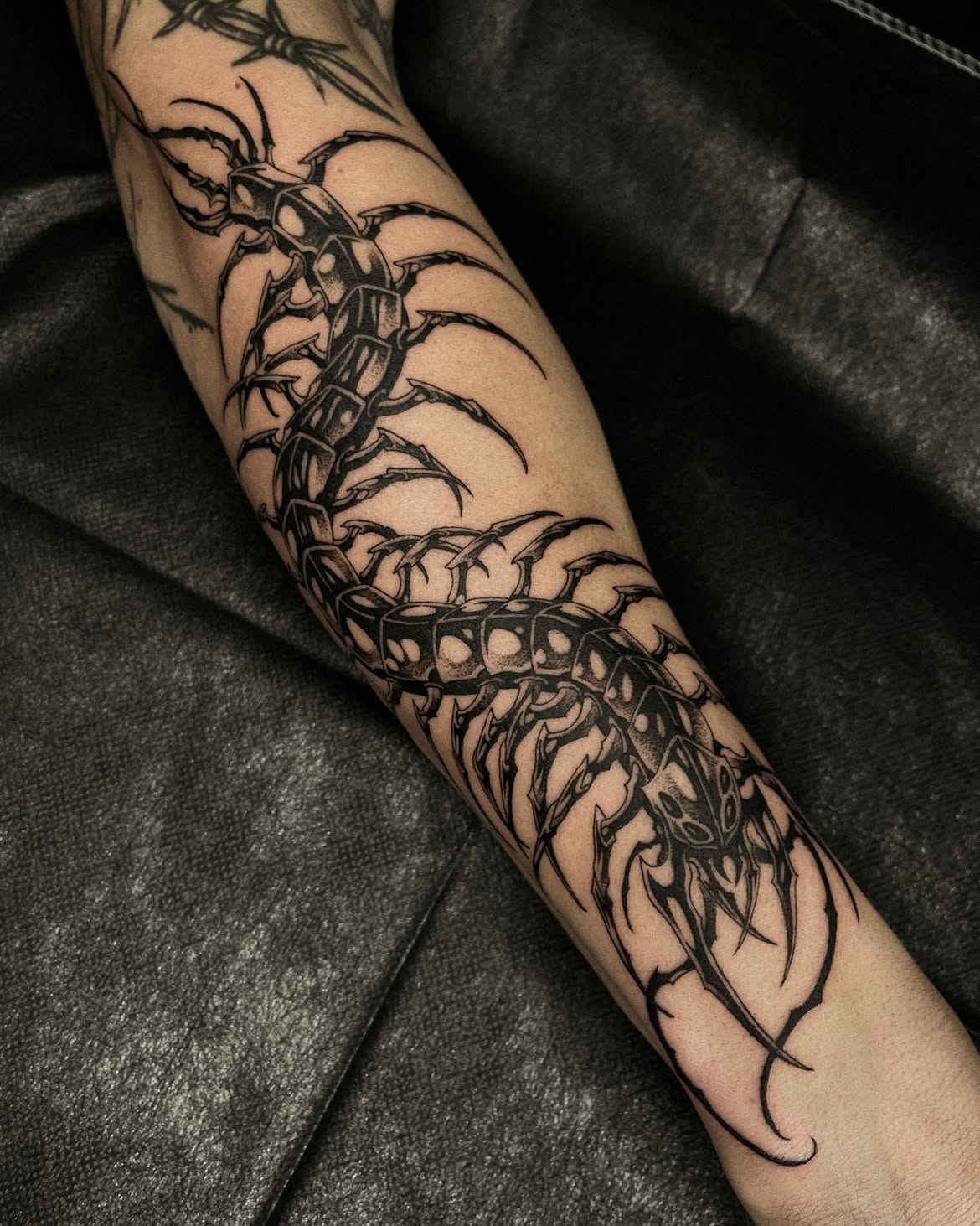
This interpretation leans decisively toward Blackwork, using thick contours and carefully preserved areas of bare skin to construct the armored body. Instead of soft realistic shading, many of the segments contain graphic highlights that make them look almost carved.
The centipede curves across the Forearm rather than following a rigid vertical line. That bend gives the insect a convincing crawling posture and creates room for the exceptionally long legs. The head is particularly elaborate, with large mandible-like forms and extended appendages giving it a more aggressive character.
There is a subtle Trad quality in the emphasis on strong silhouettes and readability, although the anatomy and decorative treatment feel more contemporary than classic Traditional tattooing.
A design like this benefits enormously from size. Shrinking the same Design stencil would force the artist to sacrifice many of those internal highlights and pointed leg details. At this scale, however, each segment remains distinct while the creature still reads as one continuous form.
Realistic Curved Centipede Arm Tattoo
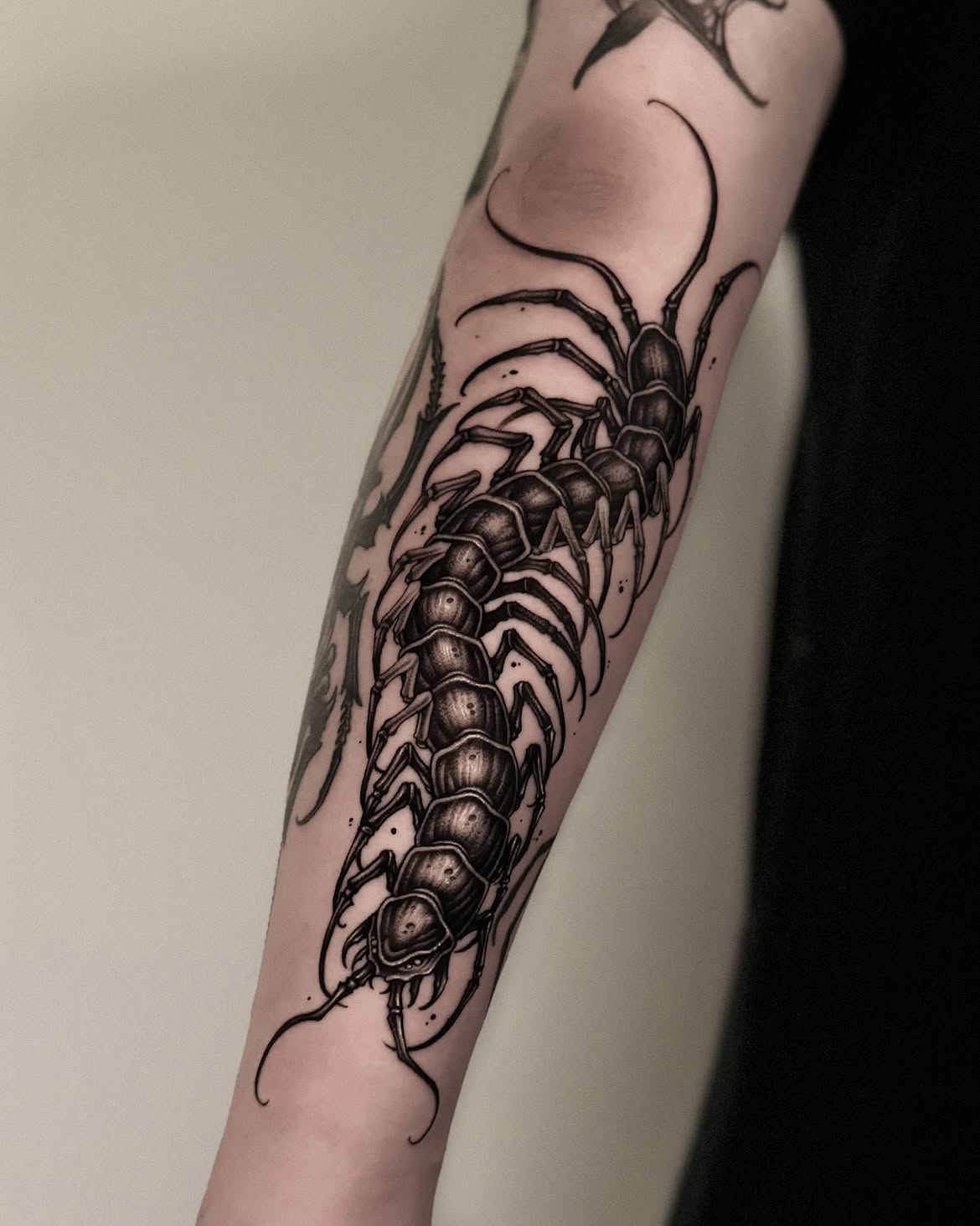
The most convincing feature here is the bend. The centipede makes a pronounced turn across the Arm, instantly giving a static tattoo the impression of movement.
Each body plate has a dark center surrounded by a narrow lighter edge. Fine stippling and smooth gray shading produce a slightly reflective shell effect, while the articulated legs remain comparatively dark. Small scattered dots around the insect loosen the composition and prevent the detailed creature from looking overly polished.
This is a strong example of designing around anatomy instead of forcing a straight Stencil onto a curved body part. The centipede changes direction naturally as it travels along the arm, and its antennae extend beyond the main silhouette to emphasize that movement.
For Men or women considering a realistic centipede, I would pay particular attention to this balance between detail and negative space. The shell can be heavily rendered, but keeping open skin between the legs prevents a complex insect tattoo from becoming an indistinct dark mass as it ages.
Heart-Shaped Centipede Leg Tattoo
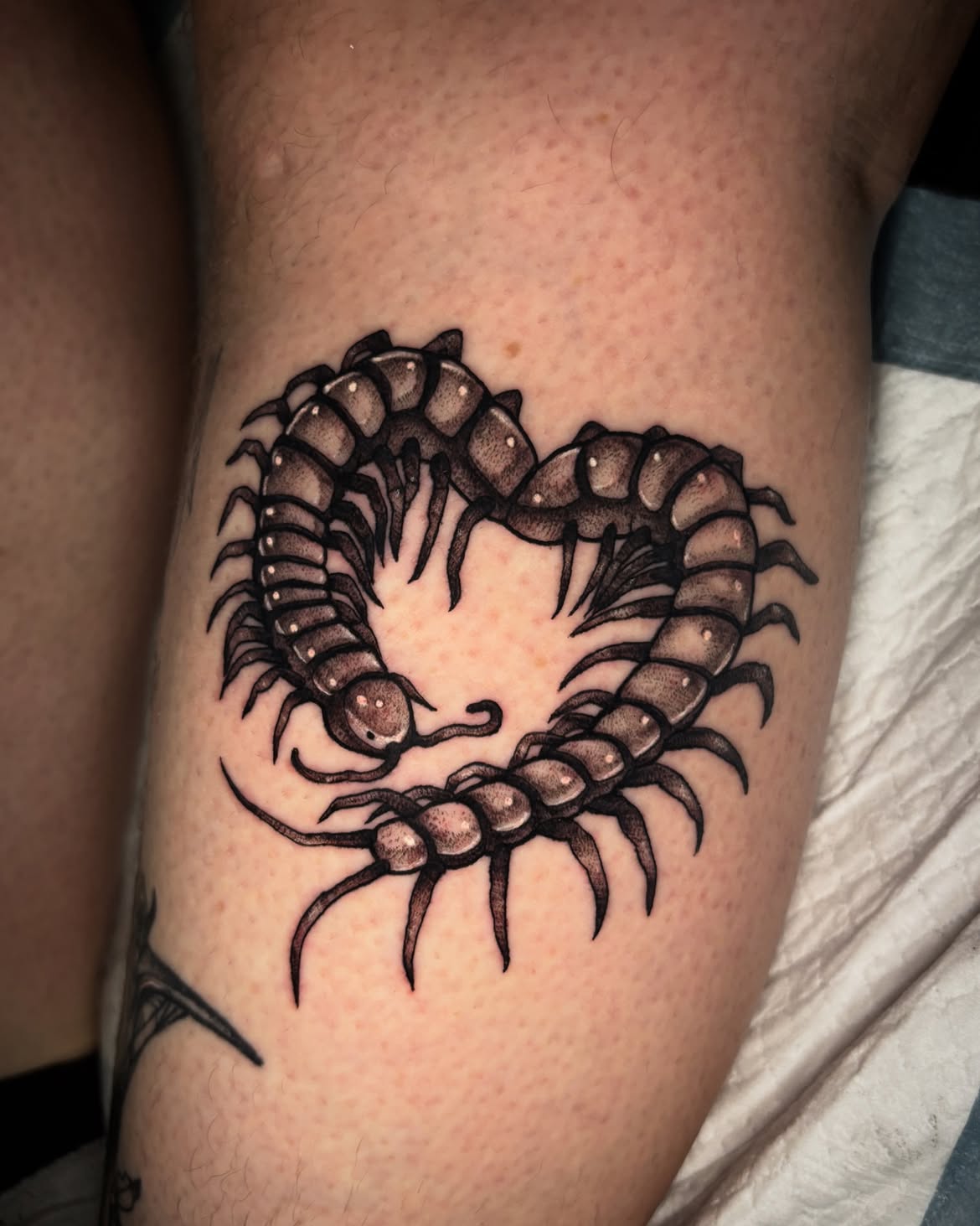
A centipede and a Heart sound like visual opposites, which is precisely why this concept works. Instead of adding a conventional heart symbol, the creature’s own elongated body curls around itself to create the recognizable shape.
Placed on the Leg, the tattoo has enough room for the centipede to remain detailed while maintaining a compact overall silhouette. Soft stippling creates texture inside the shell plates, and tiny pale highlights make individual segments look rounded. The numerous dark legs point inward and outward around the curve, adding an appropriately sinister edge to what would otherwise be a sweet symbol.
There is also a playful quality here that separates it from the darker horror-inspired examples. The Design could represent complicated love, attraction to unconventional beauty, or simply a taste for visual irony—but symbolism does not have to be imposed on it. Sometimes an unusual tattoo is worth choosing because the composition itself is memorable.
This would also translate nicely into a smaller Shoulder piece, provided the artist simplified some of the legs and shell texture.
Two Centipedes on the Forearm
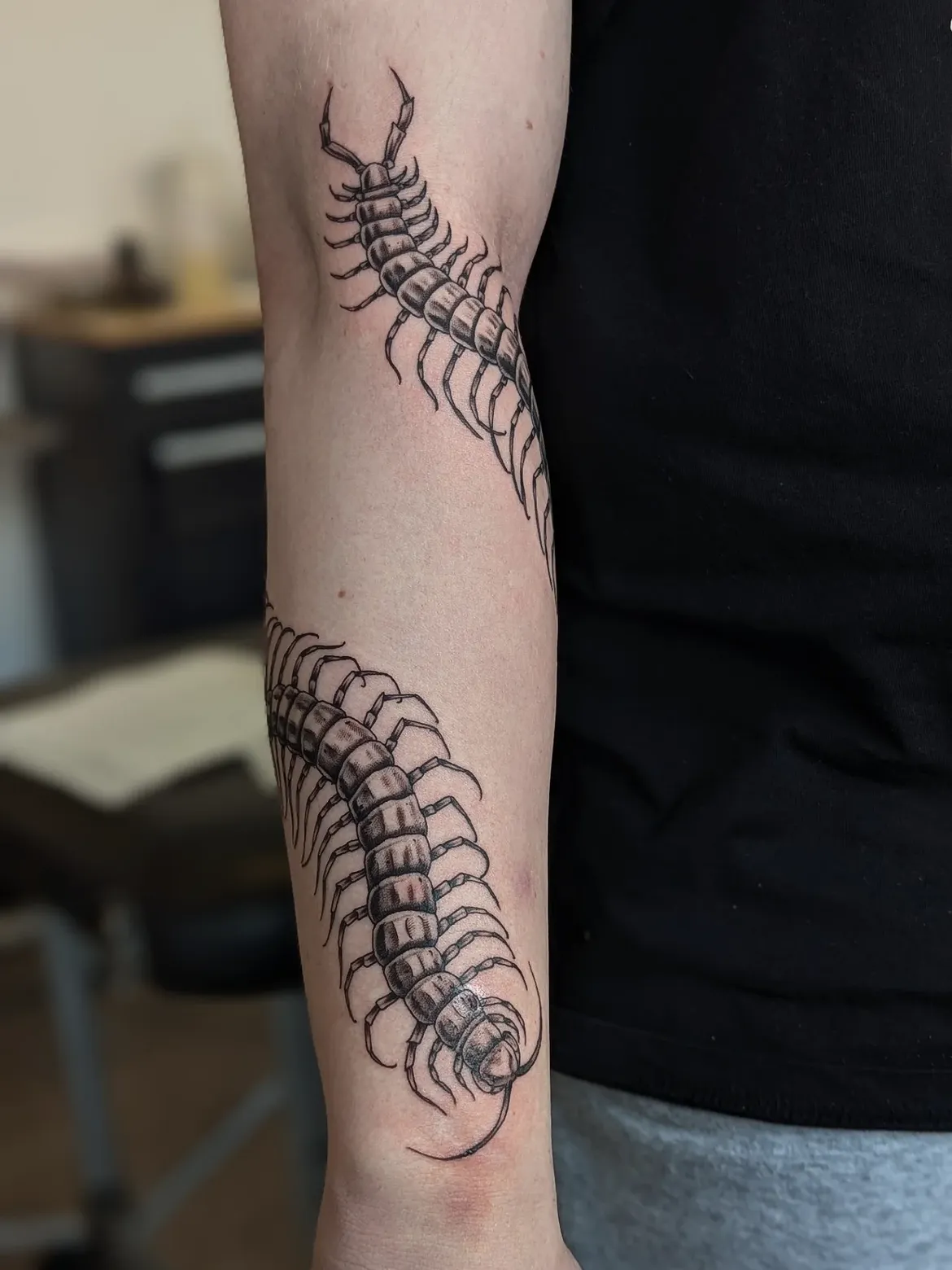
Rather than making one centipede dominate the entire Forearm, this arrangement uses two separate creatures positioned at different heights. The resulting negative space is an important part of the design.
Both centipedes are rendered with fine outlines and soft gray shading. Individual shell plates contain enough tonal variation to suggest dimension, but the overall treatment remains considerably lighter than dense Blackwork. Long, articulated legs provide most of the visual complexity.
I like this strategy for anyone gradually building a tattoo collection. There is no requirement to fill every gap immediately. The open section between the two creatures could remain untouched or eventually accommodate another motif—perhaps an Eye, a small flower, or an abstract symbol.
The upper centipede also demonstrates how effectively this subject can begin to wrap around an Arm. Because only part of its body remains visible from one angle, the tattoo encourages you to view the limb from another side. That three-dimensional relationship is something a flat Design stencil cannot fully communicate until it is adapted to the wearer.
Long S-Curve Centipede Arm Tattoo
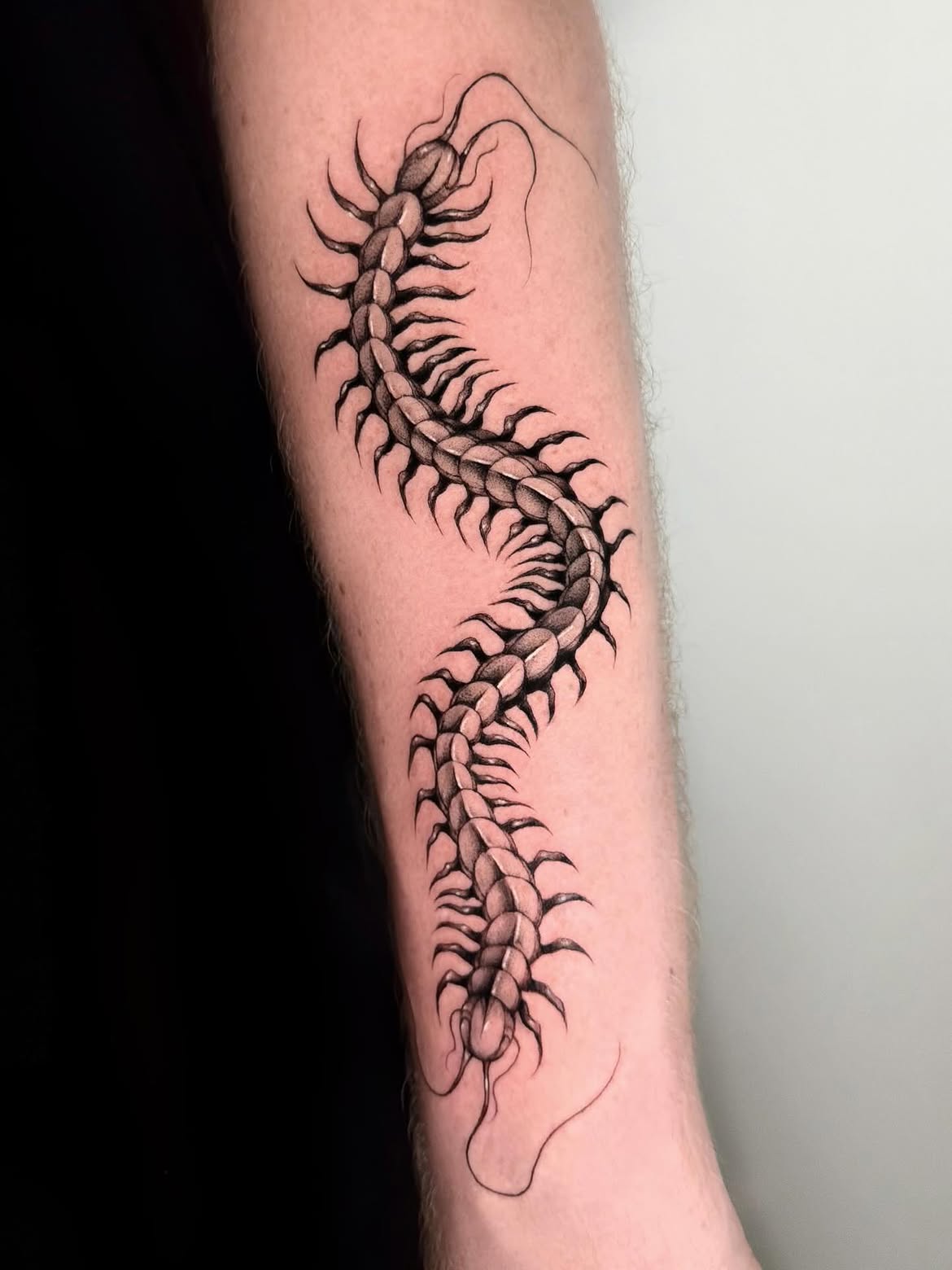
For an elongated centipede tattoo, an S-curve is one of the most effective ways to use a narrow placement. Here, the insect travels down the Arm through two broad changes of direction, producing a flowing silhouette rather than a rigid vertical stripe.
The body plates are relatively simple and consistent, while darker shading along their edges creates enough separation to keep every segment readable. The legs gradually change direction with the curve, which reinforces the impression that the centipede is actively moving across the skin. Fine antennae at both ends soften the boundaries of the tattoo.
What I find particularly successful is the restraint. There is no elaborate background, Heart, flower, Eye, or decorative frame. The centipede itself provides all the pattern the composition needs.
It is also a smart reference for someone considering an Arm wrap but not wanting a conventional band. Extending the curves farther around the limb could create a tattoo that changes considerably depending on viewing angle. The same principle could work beautifully down the Spine or along the Leg, where the creature’s naturally elongated anatomy has even more room to develop.
Bold Traditional Centipede Forearm Tattoo
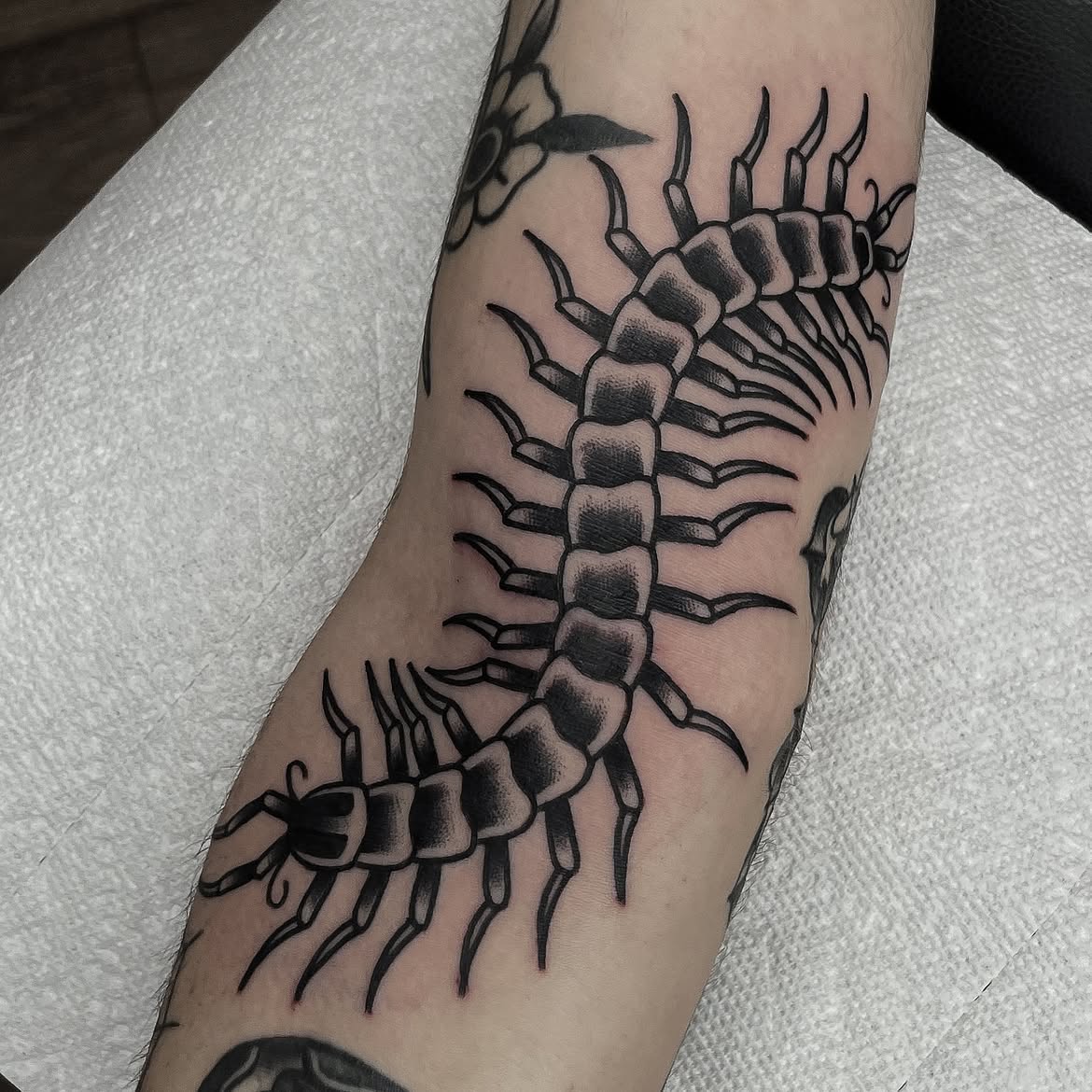
This Traditional centipede design is built around a strong curve that makes excellent use of the Forearm. Rather than following the arm in a perfectly straight direction, the creature bends sharply through the center, giving the composition movement and allowing the legs to spread into the available negative space.
The tattoo relies on thick black outlines and deliberately simplified anatomy. Each segment has a concentrated patch of dark shading in its center, while the surrounding skin is left considerably lighter. It is a classic tattooing trick: high contrast makes the creature readable from a distance without requiring microscopic detail.
The legs are equally important. Their angular construction feels more graphic than realistic, reinforcing the Trad character of the piece. This kind of Design arm can also work nicely as part of an existing patchwork sleeve because the centipede’s flexible shape can curve around older tattoos instead of competing with them.
For anyone drawn to old-school tattoo aesthetics but wanting a less predictable subject than a snake or panther, this is a particularly convincing direction.
Traditional Centipede with Flowers and Red Details
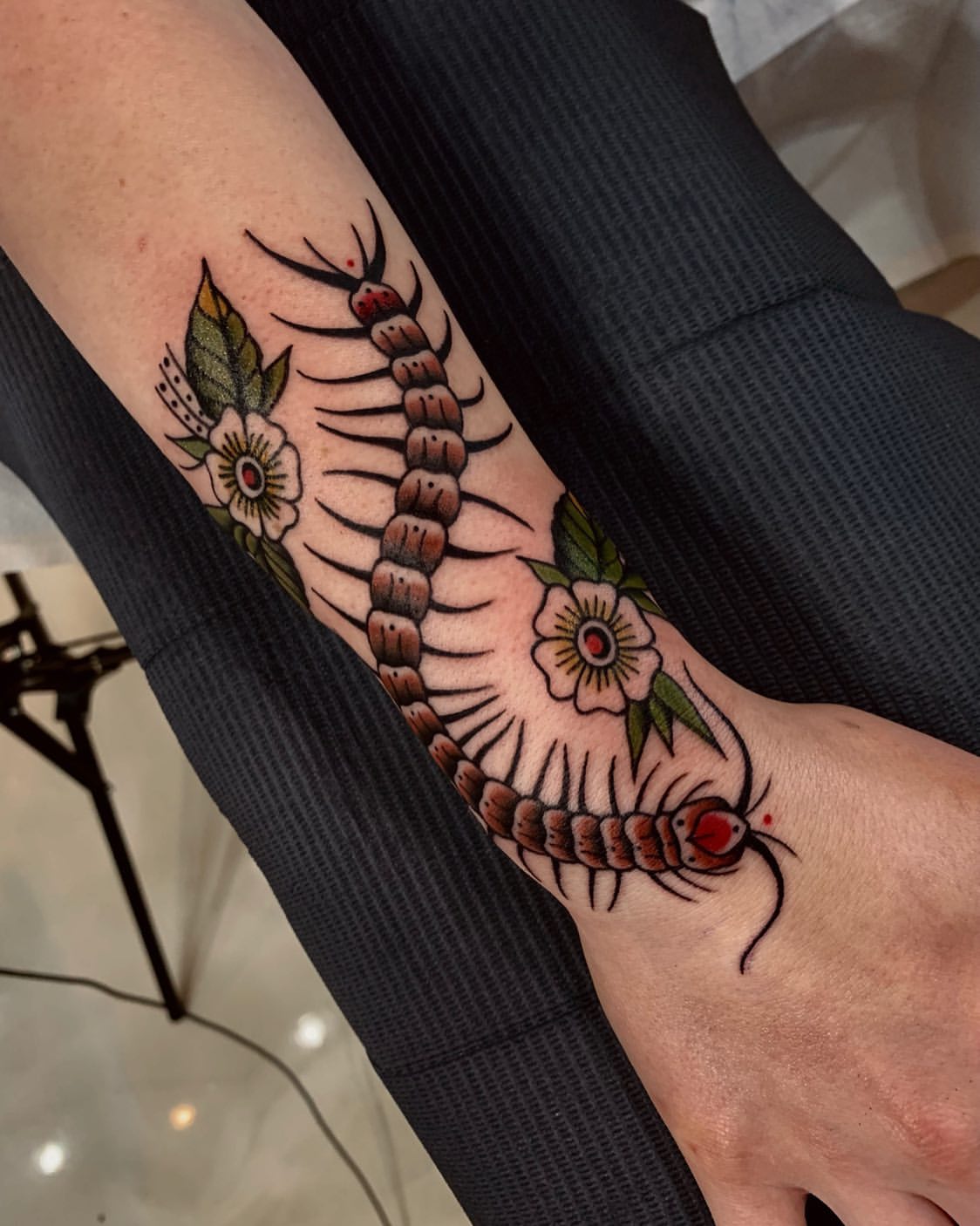
Here the centipede takes on a completely different personality. The creature remains unmistakable, but flowers, green leaves, warm brown shading and carefully placed Red accents soften its darker associations.
The composition travels along the Arm toward the wrist, with the body making a broad curve rather than forming a rigid vertical line. Two flowers occupy the open spaces beside it, creating a balanced Traditional arrangement. Their rounded petals are a clever counterpoint to the centipede’s narrow legs and repetitive segmented shell.
Red is used sparingly, which is exactly why it attracts attention. Small accents near the head and flower centers create focal points without overwhelming the earthy palette.
This is also a good example of how a centipede can belong comfortably within classic Trad tattoo language. Bold outlines, limited colors and simplified forms make the entire Design feel cohesive. A similar concept could incorporate a Heart or Eye while preserving the same vintage character.
Large Black and Gray Centipede Leg Tattoo
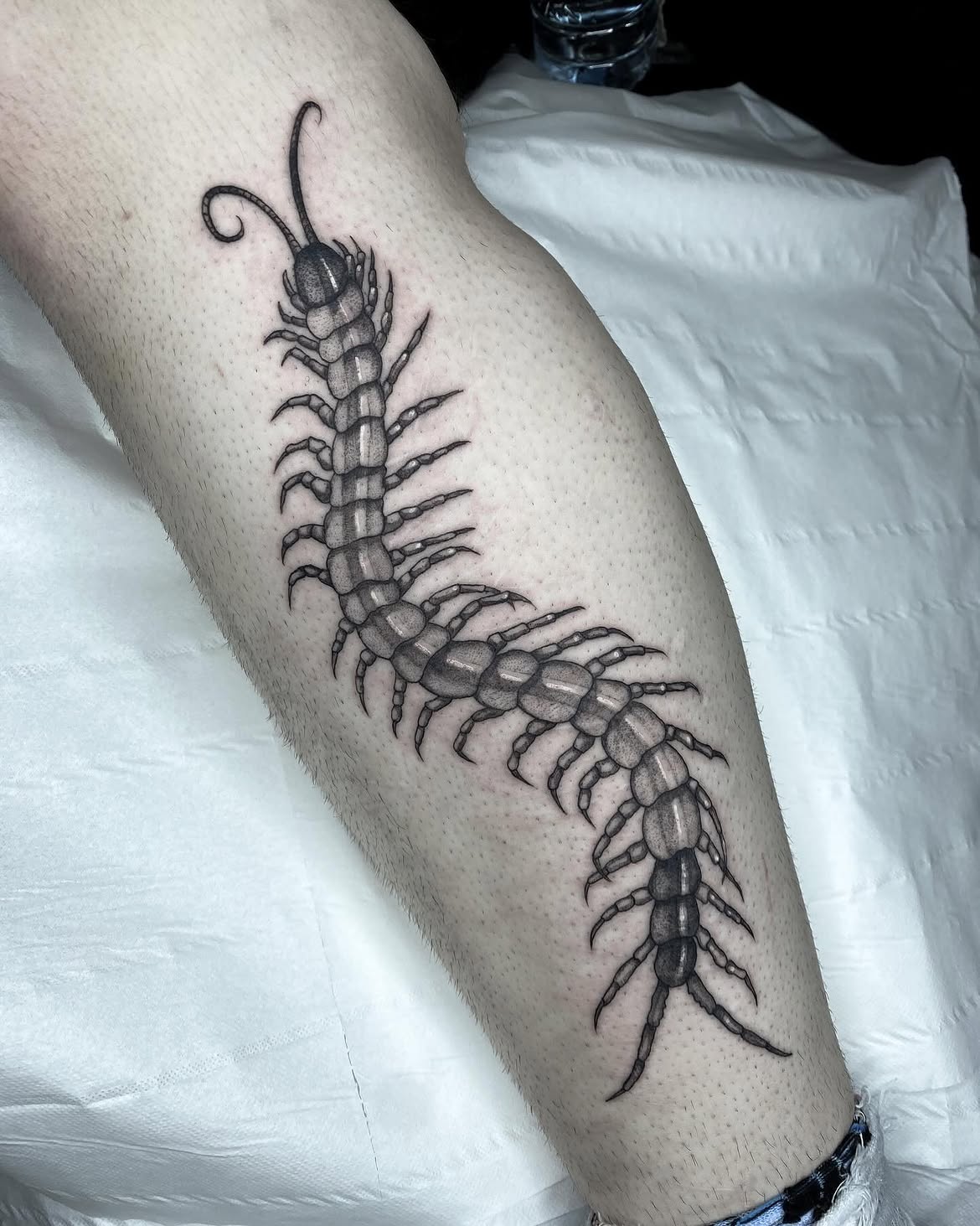
A long Leg provides exactly the kind of space this creature needs. The centipede extends across a substantial area while changing direction through the middle, allowing the tattoo to follow the natural shape of the limb instead of resembling a straight strip.
The black-and-gray execution is comparatively refined. Individual shell plates are softly shaded and separated by dark outlines, while small pale highlights create a slightly glossy surface. Each leg contains several articulated sections, adding anatomical detail without making the composition excessively dark.
What makes the piece especially successful is its scale. The artist has enough room to distinguish dozens of legs while maintaining open skin between them. With centipede tattoos, that breathing room matters: squeezing the same Design stencil into half the space would produce a much denser result.
For Men or women looking for a large insect tattoo without the visual weight of solid Blackwork, this is an effective middle ground. It feels realistic enough to be unsettling but stylized enough to remain clearly tattoo art.
S-Curve Centipede Forearm Design
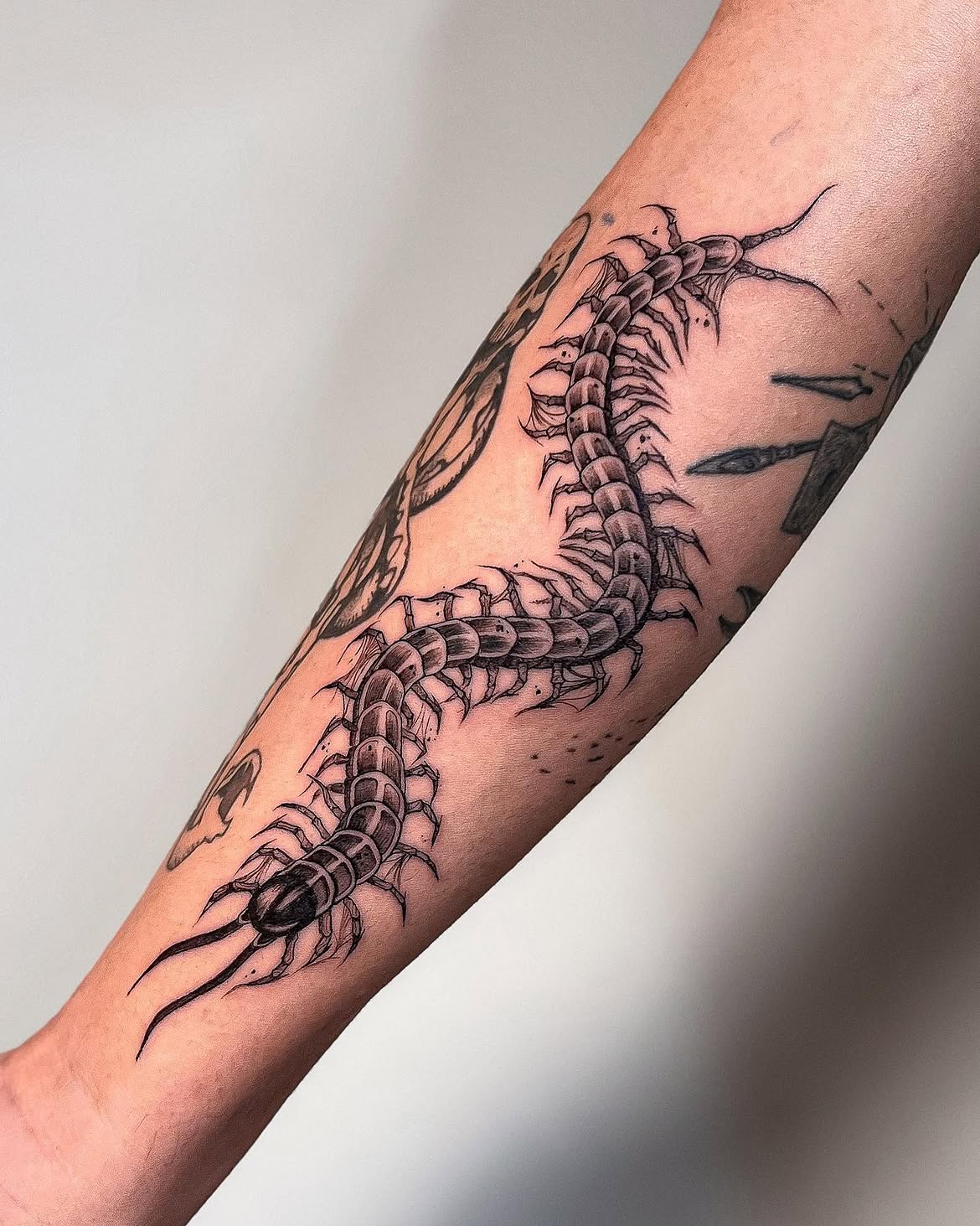
This centipede moves through the Forearm in an exaggerated S shape, demonstrating one of the best ways to adapt a long insect to a narrow body area.
The shell consists of small overlapping plates with delicate gray shading. Fine black legs radiate from either side, becoming denser around the curves. Long antennae at the lower end give the creature a clear direction and extend the visual movement beyond the main body.
Unlike heavier Blackwork, this Design retains a sketch-like quality. There are tiny dots and irregular marks around the legs, which keep the tattoo from appearing too mechanically perfect. That slight roughness gives it character.
It also integrates intelligently with neighboring tattoos. Rather than demanding an empty forearm, the centipede snakes through the available space. Anyone building a patchwork Arm can borrow that idea: the Stencil can be redrawn around existing work, making the insect function almost like a connecting element between separate pieces.
Dark Curled Centipede Leg Tattoo
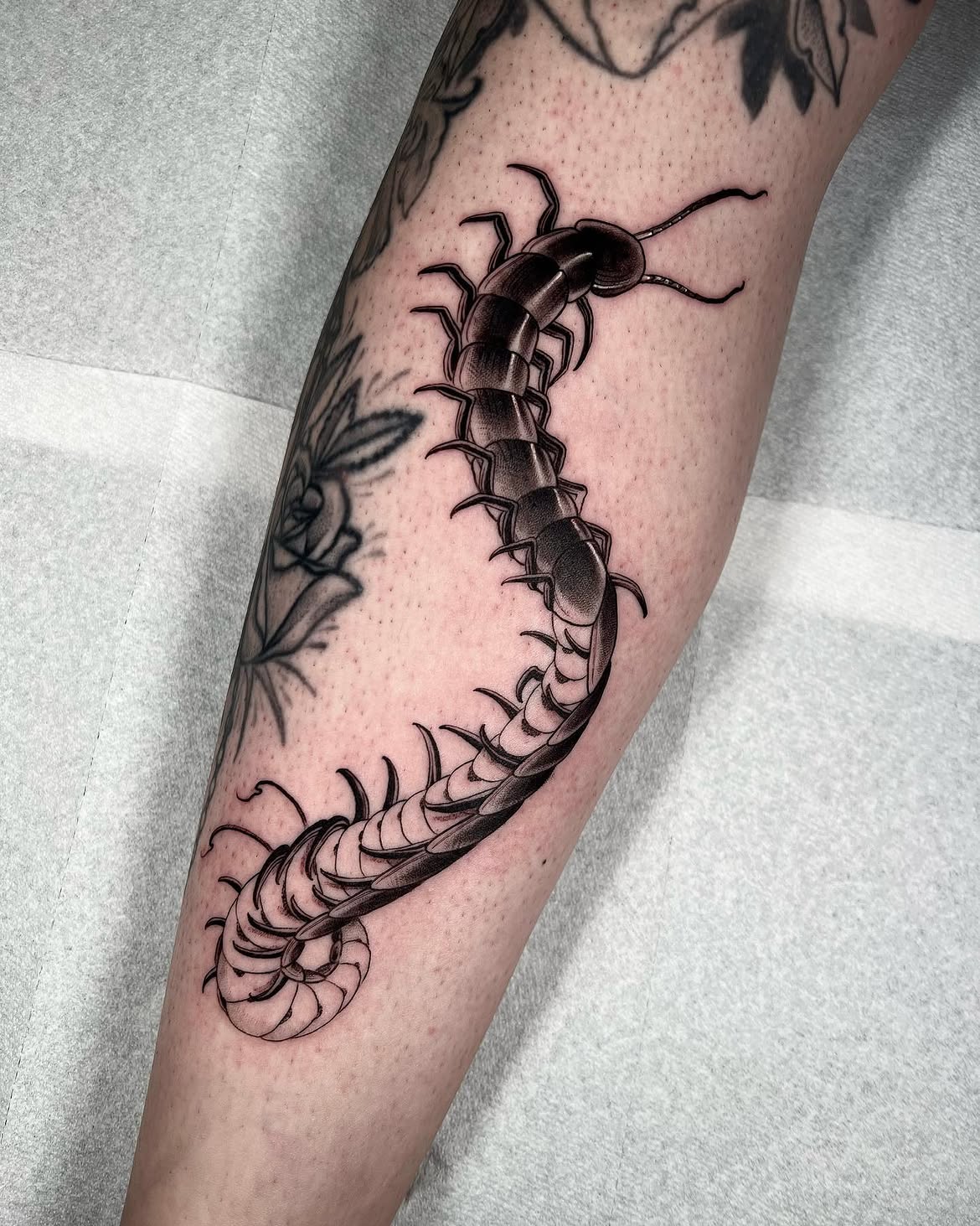
This unusual Leg design catches the centipede in a curled posture, revealing both the dark upper shell and a lighter underside. That shift in perspective gives the tattoo considerably more dimension than a straightforward top-down illustration.
The upper portion is saturated with smooth black shading. As the creature twists, the underside becomes pale and segmented, with repeating curved plates producing an almost skeletal rhythm. The contrast makes the body look genuinely three-dimensional.
It is a particularly interesting idea for people who enjoy Blackwork but do not want an entirely black silhouette. The artist uses heavy areas strategically, allowing the lighter underside to provide relief.
The curve is another smart choice. Centipedes are naturally flexible subjects, so there is little reason to force them into a straight composition. A similar twisting approach could work around the Shoulder, Arm, or even across the upper Back, where the creature could become much larger.
Long Blackwork Centipede Calf Tattoo
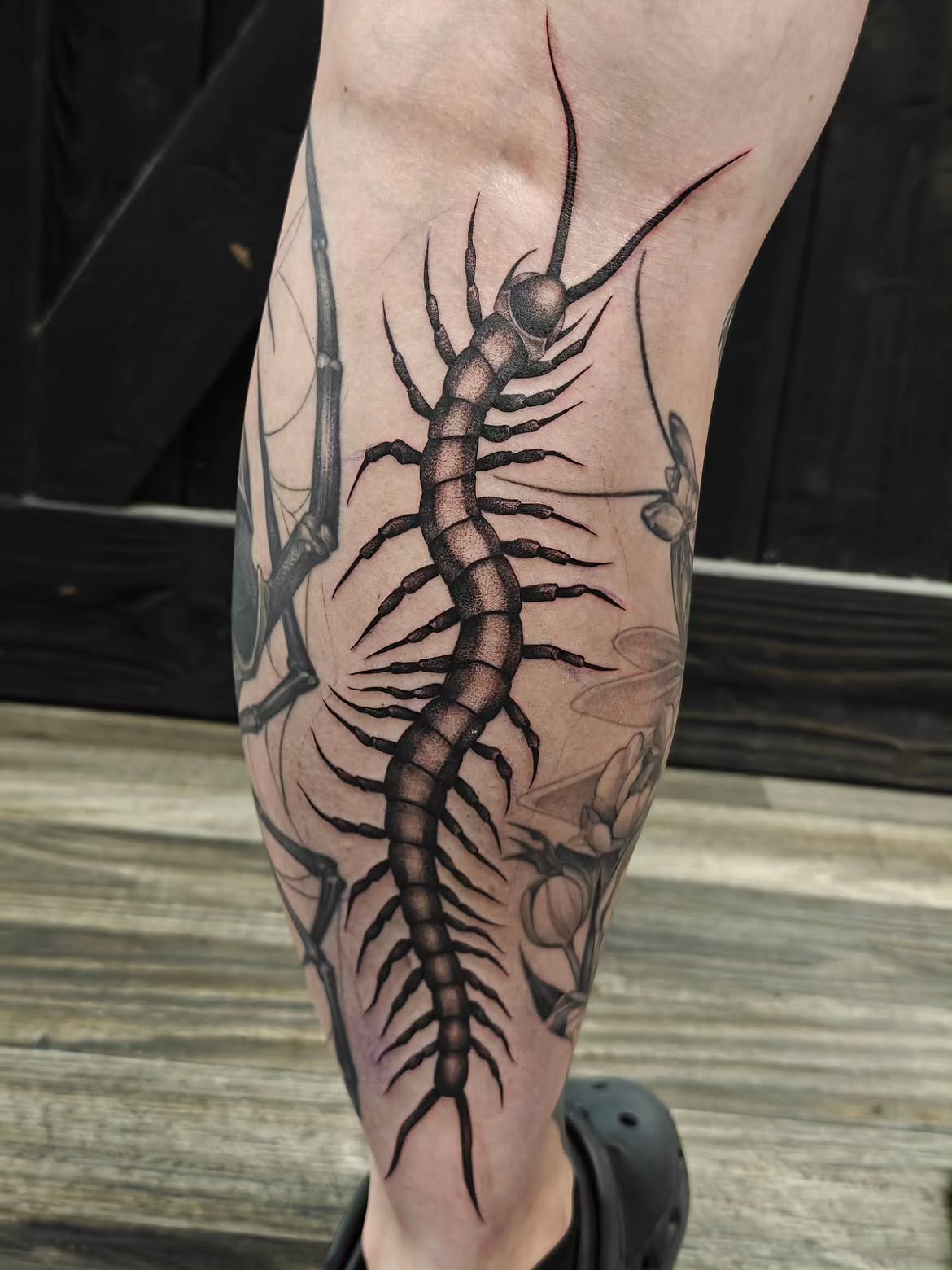
The calf is almost tailor-made for elongated insect tattoos, and this large centipede uses that vertical canvas confidently. Its body travels nearly the full visible length of the lower Leg, bending just enough to avoid looking static.
This version sits firmly in darker territory. The central shell contains concentrated black and gray shading, while the legs gradually taper into sharp points. Particularly long antennae and rear appendages extend the composition at both ends, making the creature appear even larger.
The placement works because the Design respects the proportions of the leg. Rather than filling the entire width, the artist keeps the central body relatively narrow and allows the legs to occupy the surrounding space. From farther away, that creates a strong dark spine running through the tattoo.
For a future Blackwork leg project, the centipede could also act as a connecting motif. Flowers, an Eye, geometric symbols or darker organic forms could be positioned around the legs without needing to interrupt the insect itself.
Centipede and Red Spider Lily Tattoo
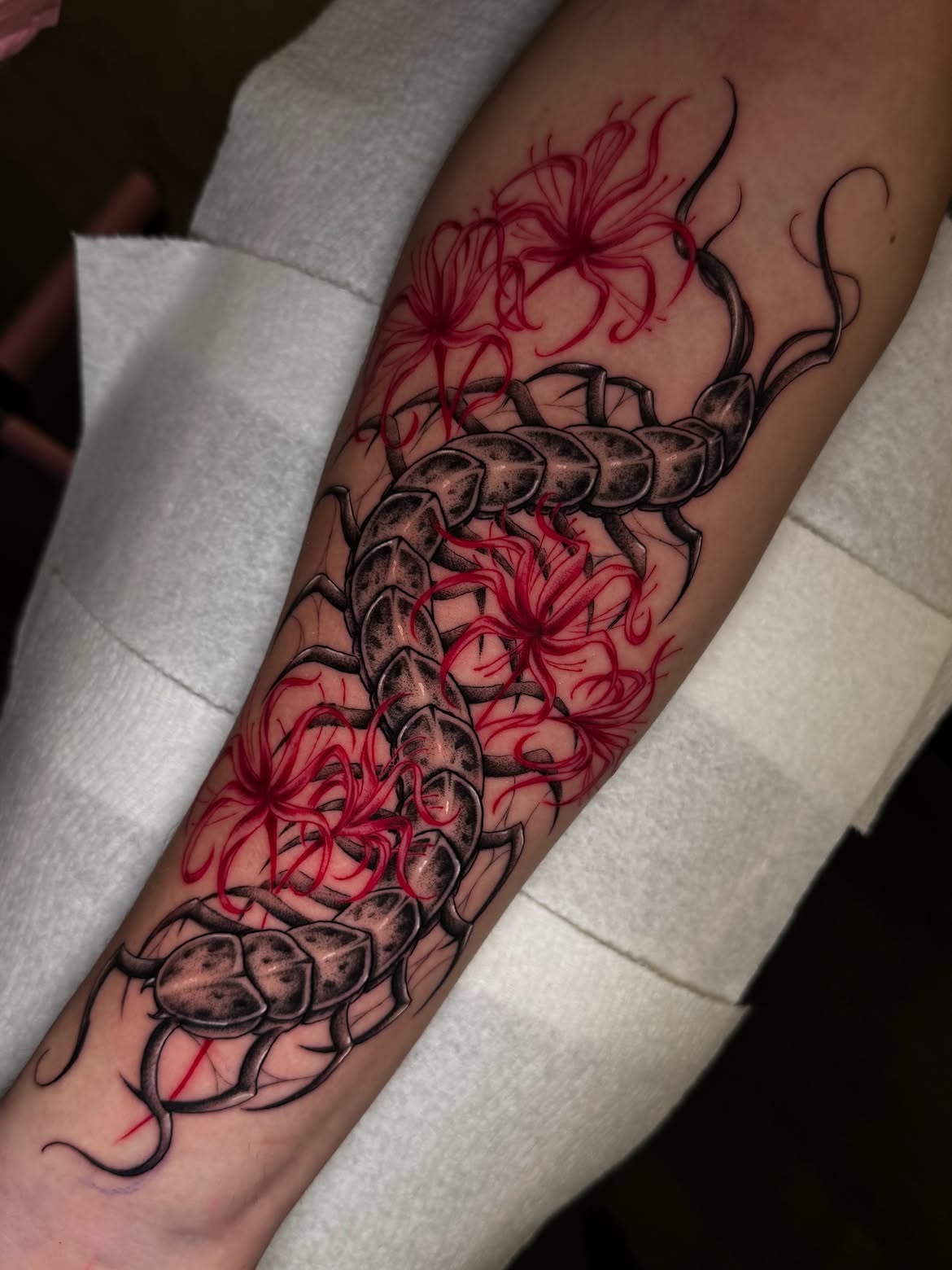
Among the more elaborate Centipede tattoo ideas 2026, the pairing of a dark insect with a Spider lily remains one of the most visually convincing. This version takes that combination further by surrounding the twisting centipede with several vivid Red blossoms.
The centipede itself is rendered in black and gray. Broad armored plates overlap along the body, with stippled texture and darker edges creating depth. Instead of running straight through the placement, it curves repeatedly, giving the entire composition a sense of restless movement.
Then there are the flowers. Their thin red petals weave between and around the centipede’s legs, sometimes visually overlapping the insect. Because the botanical linework is considerably finer than the dark shell, the two subjects remain distinct even where the composition becomes dense.
The limited palette is particularly strong. Keeping the creature monochrome while reserving saturated color for the Spider lily produces an immediate hierarchy: black provides weight and red provides energy.
This is the sort of tattoo where I would resist adding another color. The tension between red and black is already doing everything the design needs. For someone planning a larger Arm or Leg piece, the same principle could be extended into an Arm wrap, with additional lilies appearing around different sides of the limb while the centipede connects the composition.
Dark Abstract Centipede Blackwork Tattoo
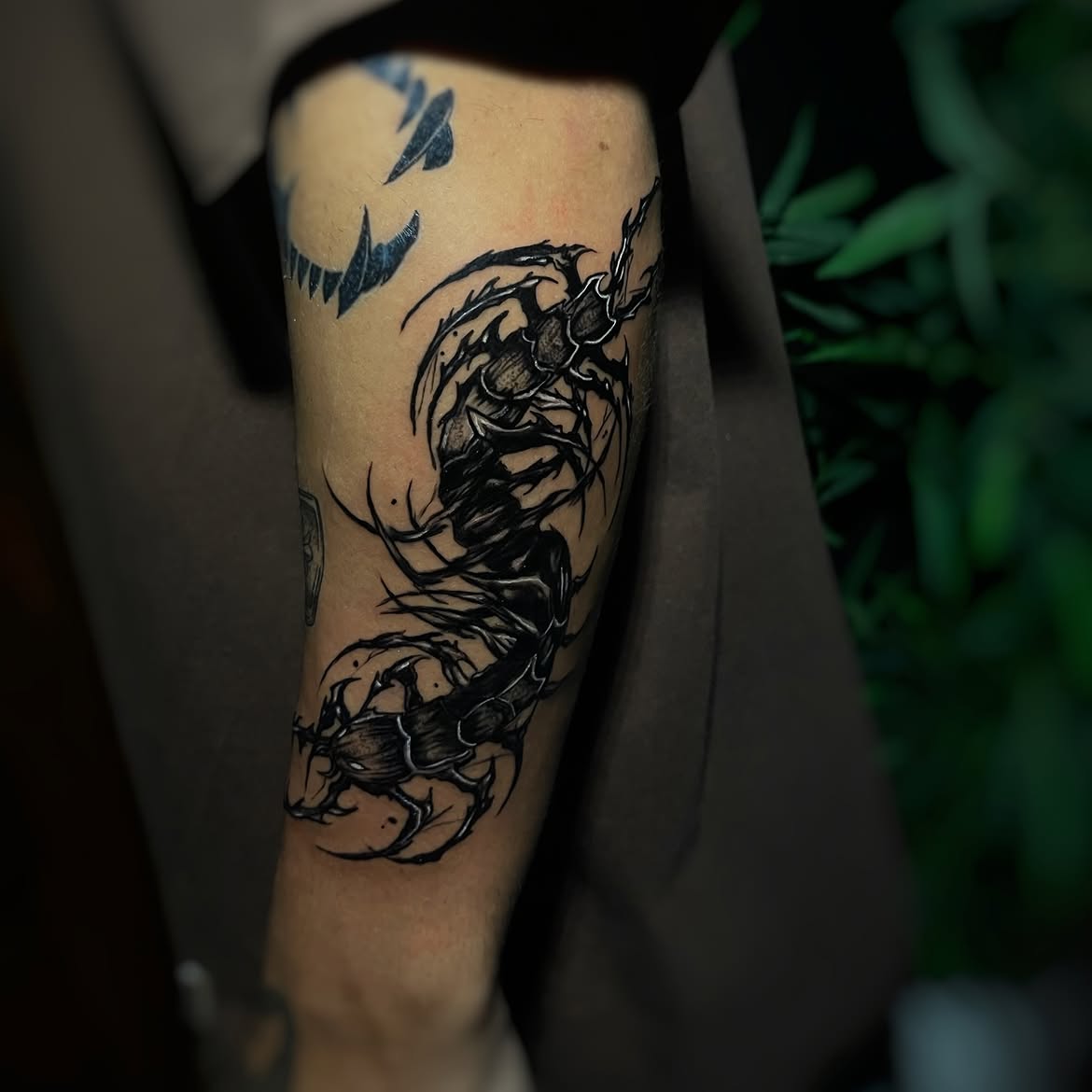
This piece takes the centipede into a darker, almost otherworldly direction. The creature is recognizable through its segmented body and repeated legs, but the anatomy has been exaggerated with jagged edges, heavy black sections, and sharp organic shapes.
The style sits comfortably between Blackwork and Cybersigilism. Some sections of the insect are tightly rendered, while others dissolve into aggressive strokes that make the body feel less biological and more like a creature from a dark illustration.
Its curved placement on the Arm is crucial. The centipede bends back toward itself instead of simply running vertically, giving the tattoo a compact but restless silhouette. The darkest ink sits through the middle of the composition, while thinner legs and pointed details break outward into negative space.
For someone who finds a realistic centipede too literal, this is an interesting alternative. A Design stencil based on this approach could be customized considerably because anatomical accuracy is less important than movement, contrast, and silhouette.
Skeletal Centipede Forearm Tattoo
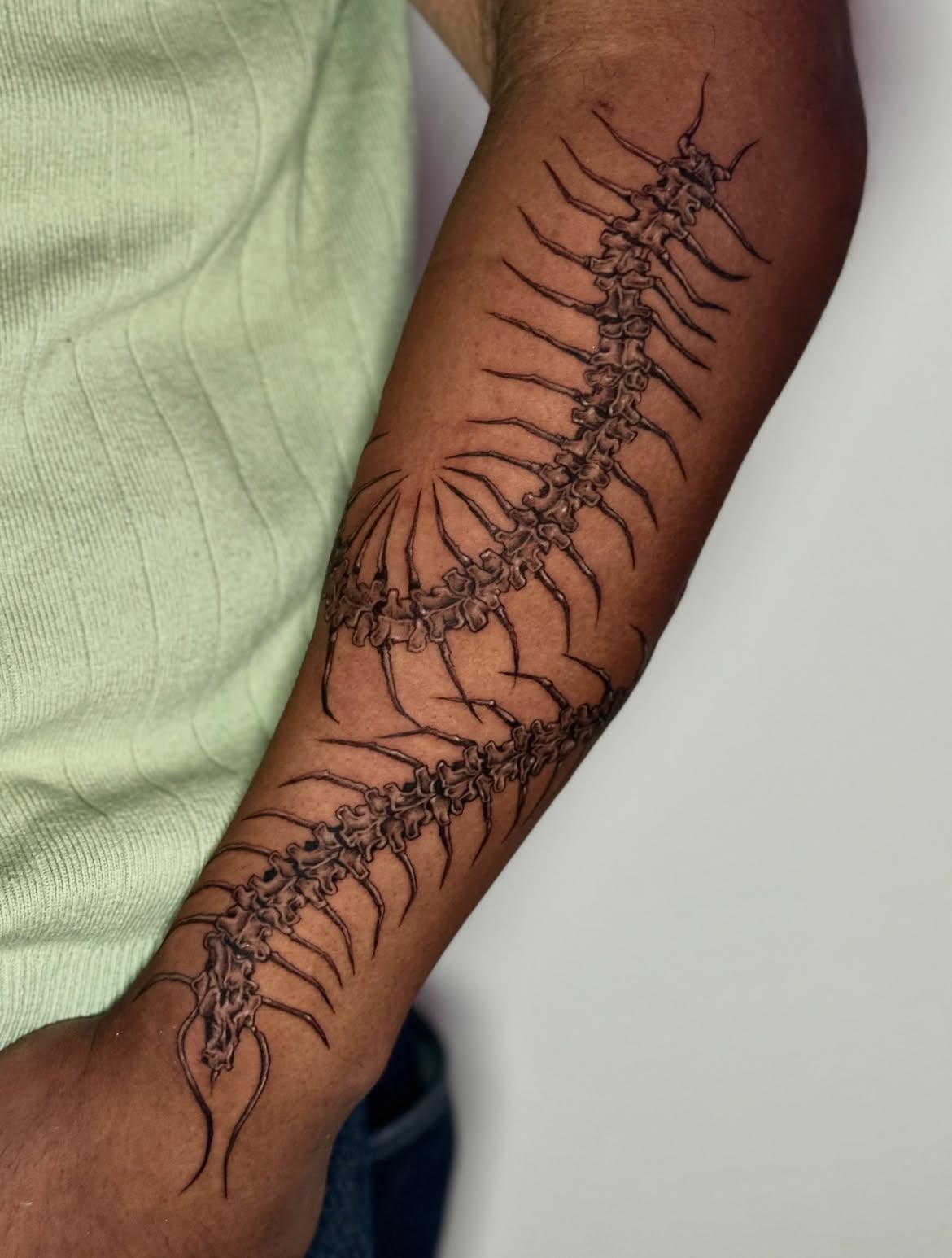
This unusual Forearm design reimagines a centipede almost as an exposed skeleton. Instead of broad armored plates, the center consists of small bone-like structures repeated along the length of the creature. Extremely long, narrow legs extend from either side.
The effect is eerie without depending on large areas of solid black. Most of the visual complexity comes from fine outlines, subtle gray shading, and the repeated skeletal details.
I particularly like the way the creature changes direction twice as it travels down the arm. Those bends make the composition feel organic, and the legs respond naturally to each curve rather than forming a perfectly symmetrical pattern.
It is also a clever option for darker skin because the artist has prioritized strong outlines and open negative space rather than relying exclusively on extremely faint gray tones.
Among the more experimental Centipede tattoo ideas 2026, this one demonstrates how far the basic anatomy can be pushed. It almost resembles a prehistoric fossil or fantastical spinal structure while remaining identifiable as a centipede.
Simple Curved Centipede Arm Tattoo
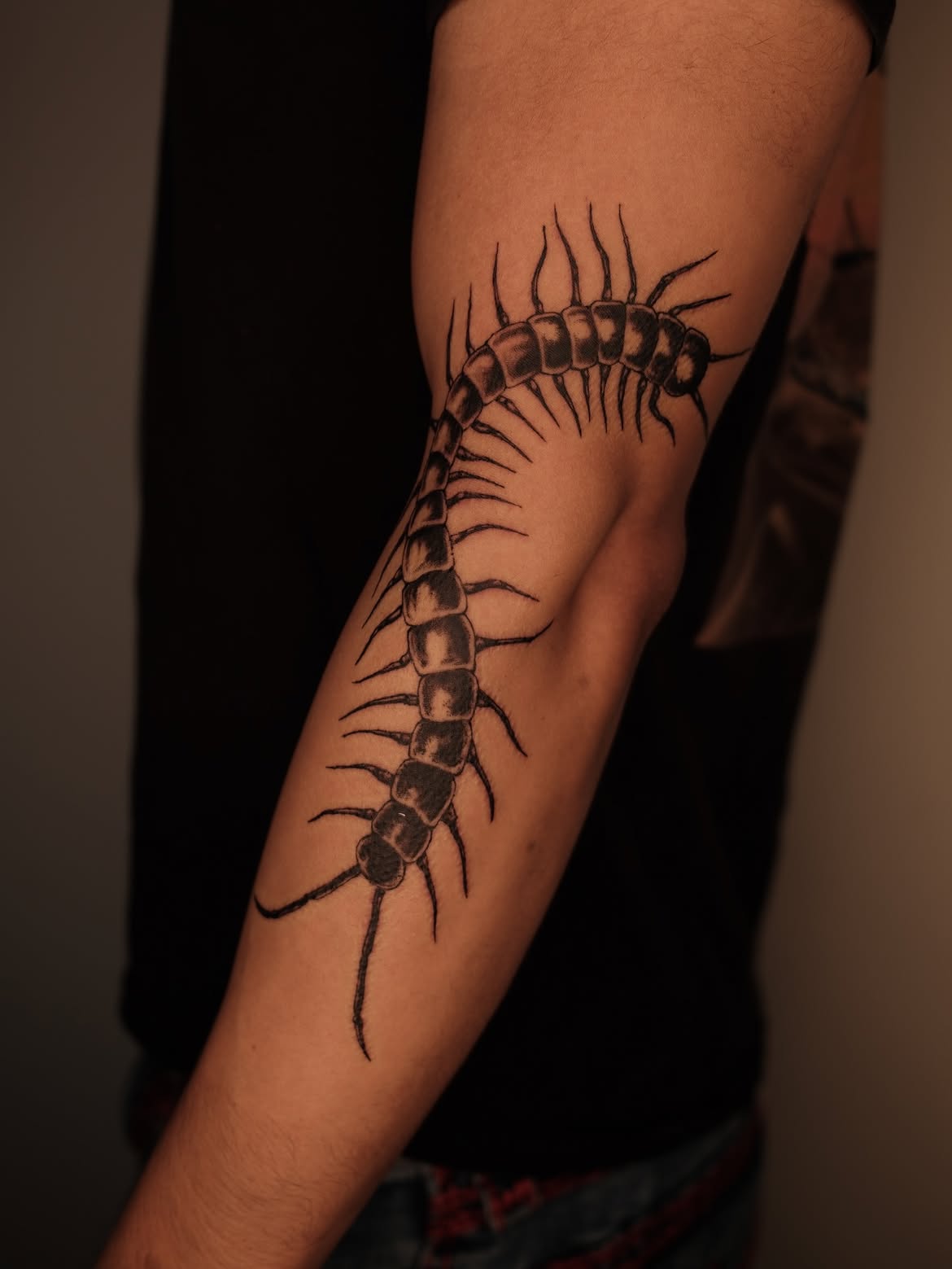
There is something refreshing about a Simple centipede after so many highly elaborate interpretations. This design concentrates on the creature’s most recognizable characteristics: repeating shell plates, a long curved body, thin legs, and extended antennae.
The broad curve follows the Arm beautifully. Instead of adding flowers, ornamental backgrounds, or additional symbols, the artist lets the centipede create its own composition. Soft black-and-gray shading gives the individual plates dimension without pushing the tattoo into photorealism.
This simplicity also makes the idea adaptable. The same basic Stencil could be resized for the Forearm, Leg, or Shoulder, although the curvature should always be adjusted to suit the exact placement.
For a first large insect tattoo, this is one of the more approachable options. It has enough detail to remain visually interesting but does not depend on an elaborate surrounding concept.
Black Centipede Forearm Tattoo on Dark Skin
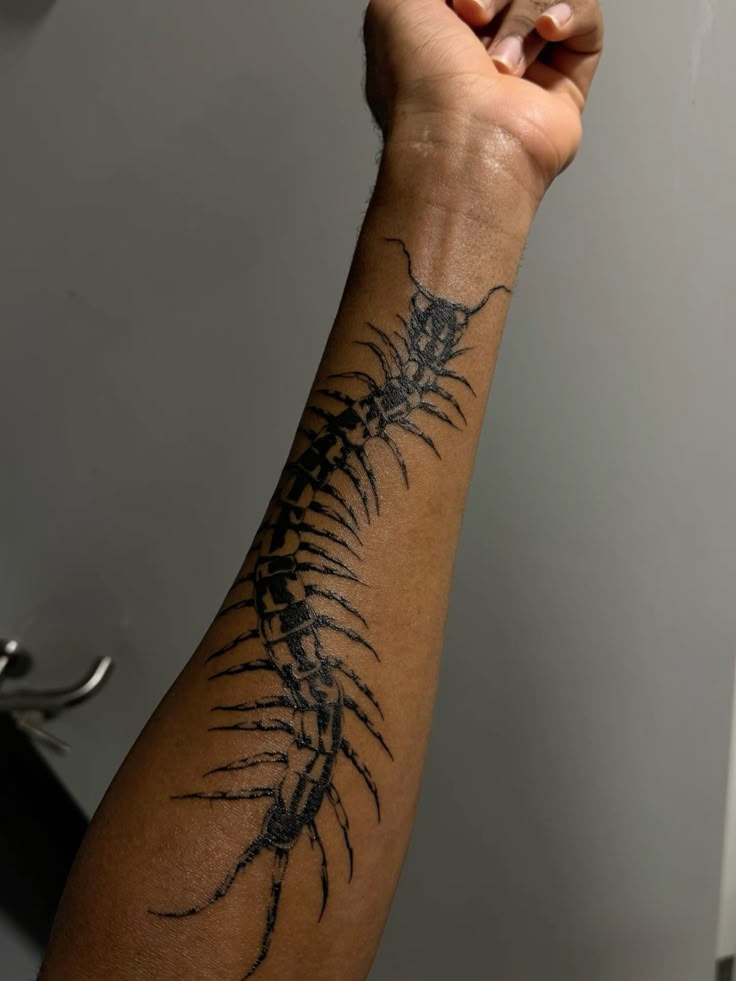
This long Forearm centipede makes excellent use of contrast. Dark black ink defines the segmented body and dozens of narrow legs, while the creature follows the natural vertical direction between elbow and wrist.
Instead of a perfectly symmetrical body, the centipede curves slightly as it travels down the arm. That subtle change makes a considerable difference: the tattoo looks like a moving creature rather than an anatomical diagram.
The execution also demonstrates why a strong silhouette matters. Individual internal details may be relatively restrained, yet the repeating dark segments and pointed legs make the subject immediately recognizable.
For anyone developing a Blackwork Design arm, this could eventually become part of a larger composition. The elongated form can connect tattoos above and below it, while the irregular spaces between the legs offer opportunities for smaller motifs.
It is a good reminder that successful tattoo design is not simply about adding detail. Sometimes placement, scale, and contrast do more work than elaborate decoration.
Giant Centipede Shoulder and Arm Wrap
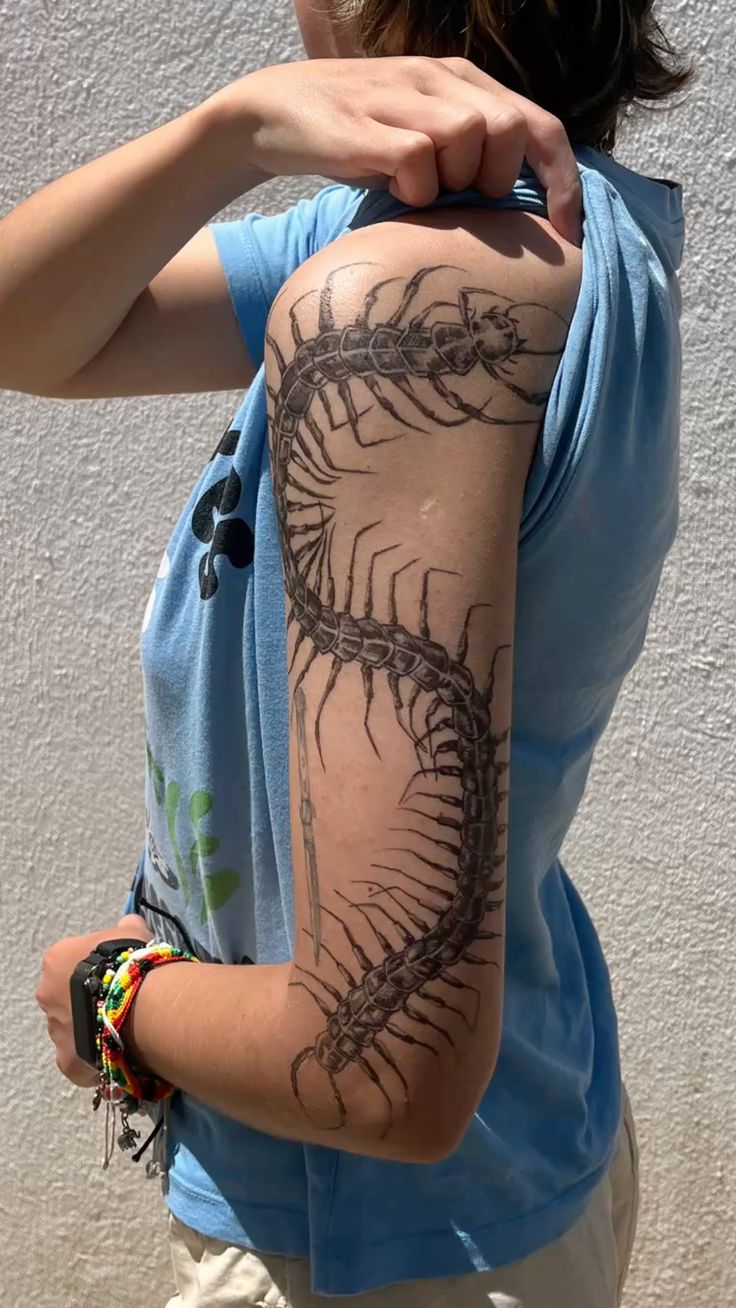
Few subjects are better suited to a dramatic Arm wrap than a centipede. This enormous version begins around the Shoulder, descends across the upper arm, changes direction around the elbow, and continues toward the lower arm.
The scale is what makes it memorable. Rather than treating the centipede as a small standalone emblem, the artist uses the entire limb as a canvas. The body repeatedly curves around the anatomy, meaning the complete tattoo cannot really be appreciated from only one angle.
Long legs spread far beyond the central shell, giving the creature an enormous visual footprint without requiring a solid sleeve of ink. The shell itself remains relatively open and illustrative, preventing such a large Design arm from becoming excessively heavy.
This is exactly the kind of project where a generic Stencil should only be the starting point. The final curves need to be mapped directly onto the wearer’s anatomy. When the arm bends, the centipede should still feel intentional rather than distorted.
For someone committed to making the creature the centerpiece of an entire sleeve, this is one of the boldest approaches in the collection.
Centipede and Red Spider Lily Arm Tattoo
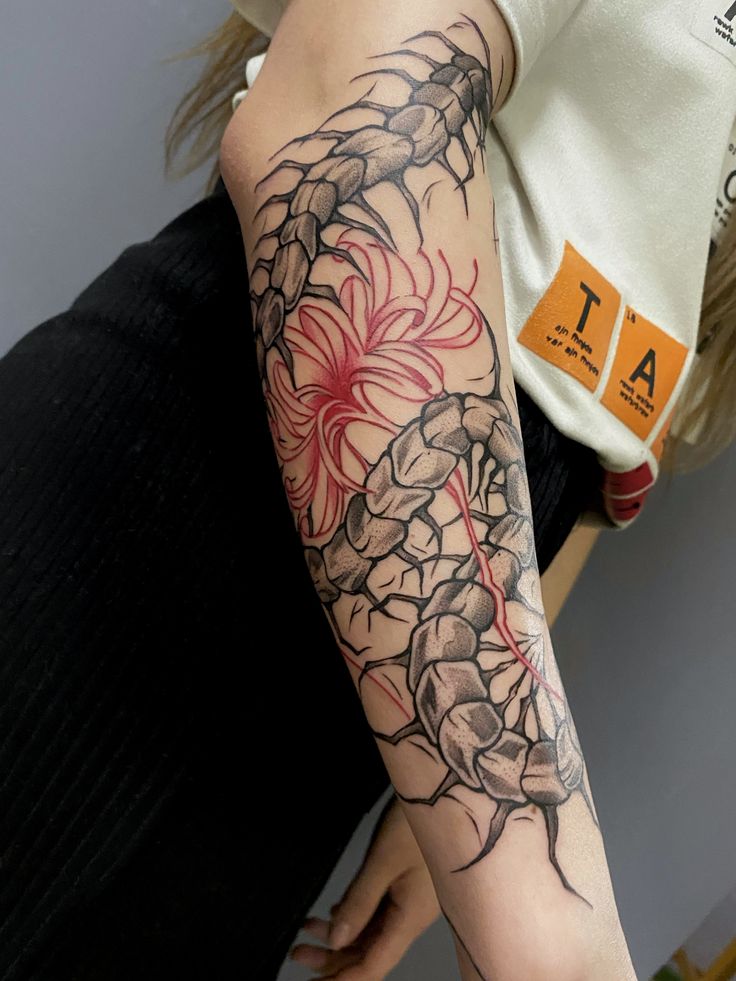
The combination of centipede and Spider lily returns here in a lighter, more spacious interpretation. Two gray-black sections of the creature curve around a large central flower, creating an almost circular flow through the Arm.
The difference in line weight is particularly effective. The centipede uses textured gray shading and stronger outlines, while the Red flower is created primarily from elegant, narrow strokes. The petals spread through the negative space between the insect’s body and legs.
Rather than feeling like two unrelated tattoo ideas placed beside one another, the elements interact. The flower interrupts the centipede’s darker rhythm and gives the eye somewhere to rest.
This could also inspire a larger Arm wrap concept. Additional red flowers might appear on the opposite side while the centipede continues around the limb. I would keep the palette limited, though—the contrast between black, gray, skin, and red is the reason the composition feels so cohesive.
Brushwork Centipede Upper Arm Tattoo
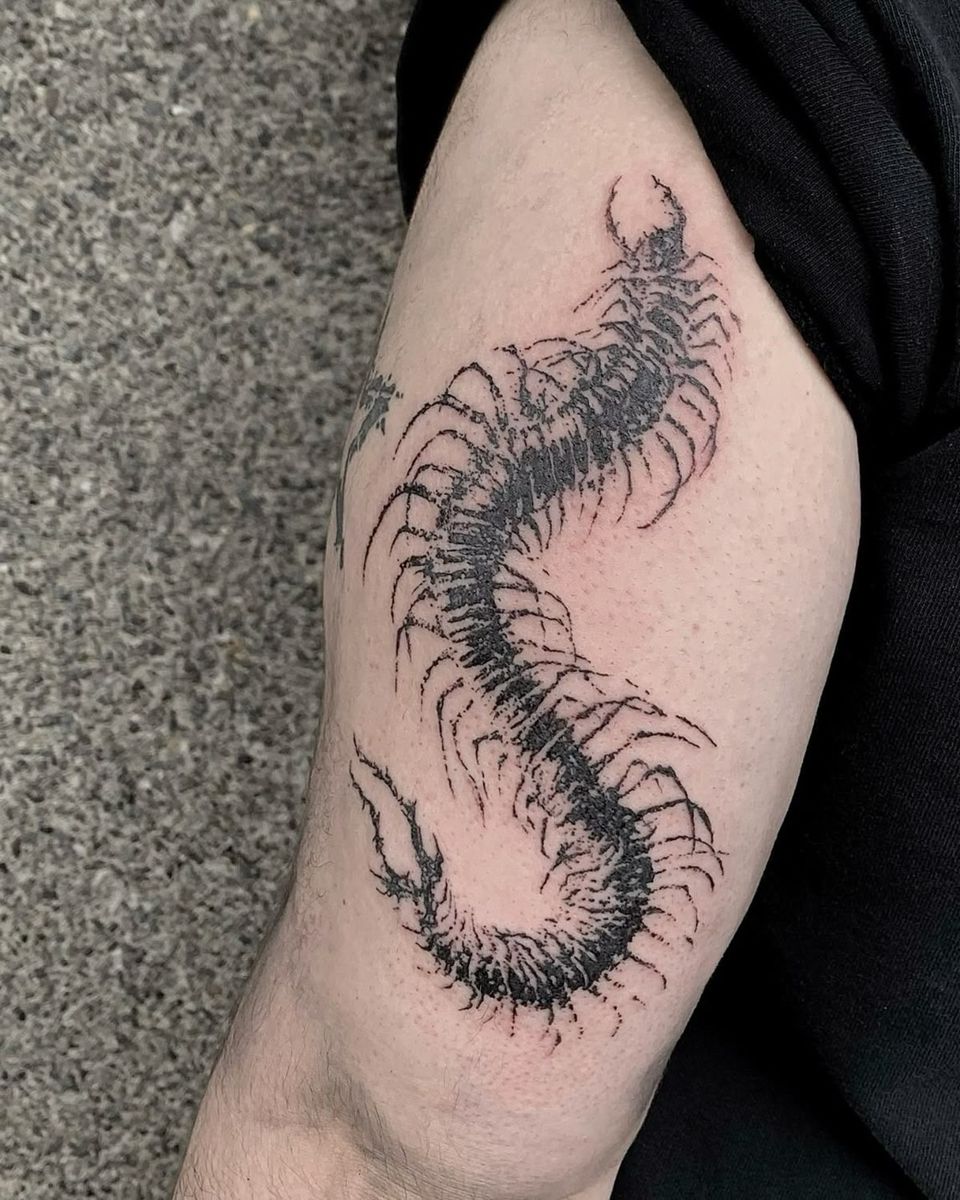
The final design abandons polished realism for something intentionally raw. This centipede is formed through broken black marks, irregular outlines, rough shading, and sections that almost seem to disappear before reappearing farther along the body.
That distressed texture gives the tattoo the feeling of an ink drawing or old printed illustration. From a distance, the curved silhouette remains obvious; closer inspection reveals how loosely some of the individual legs and segments have been constructed.
The Arm placement complements the style because the centipede curls naturally through the available area instead of being confined inside a geometric border. It feels spontaneous, even though arranging so many repeated elements into a readable creature requires careful planning.
There are hints of contemporary Blackwork here, but the intentionally imperfect edges separate it from clean graphic work. It could also appeal to someone interested in Cybersigilism who wants organic distortion without the more familiar symmetrical sigil shapes.
This is a good example of why centipede tattoos do not have to be biologically accurate. Once the segmented rhythm, numerous legs, and curved movement are established, an artist has considerable freedom to interpret the creature through a personal visual language.
Large Centipede Side and Rib Tattoo
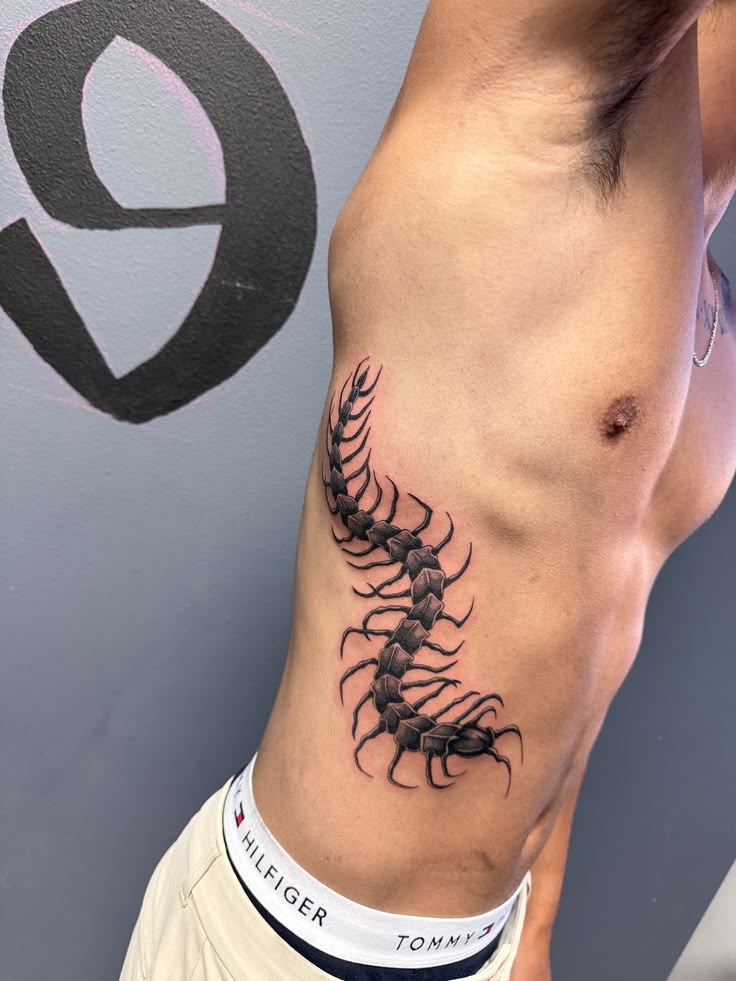
The side of the torso gives a centipede exactly what it needs: a long canvas and enough width for the legs to spread without crowding one another. This design runs vertically along the ribs and side, following a pronounced S-shaped curve that makes the creature look as though it is climbing across the body.
The central shell is constructed from substantial overlapping plates. Dark shading sits toward the edges and centers of individual segments, while softer gray areas create an armored, slightly three-dimensional surface. The numerous legs are thinner and more fluid, extending outward at different angles rather than forming a rigid symmetrical pattern.
What really sells this placement is the relationship between the Design and anatomy. The centipede narrows and changes direction as the torso curves, producing an effect that would be difficult to achieve with a generic straight Stencil. An artist planning a piece like this should map the composition directly on the body so that it remains balanced both standing still and in motion.
For Men who want a large centipede without committing to an entire Back or Leg piece, the ribs offer an impressive alternative. The tattoo can remain relatively concealed under clothing while becoming a major statement when visible.
There is also plenty of potential for expansion. The upper end could eventually travel toward the Shoulder or Back, while the lower section could develop into a darker Blackwork composition. Even without additional imagery, however, the centipede is substantial enough to stand entirely on its own.
Multiple Centipede Arm Wrap Tattoo
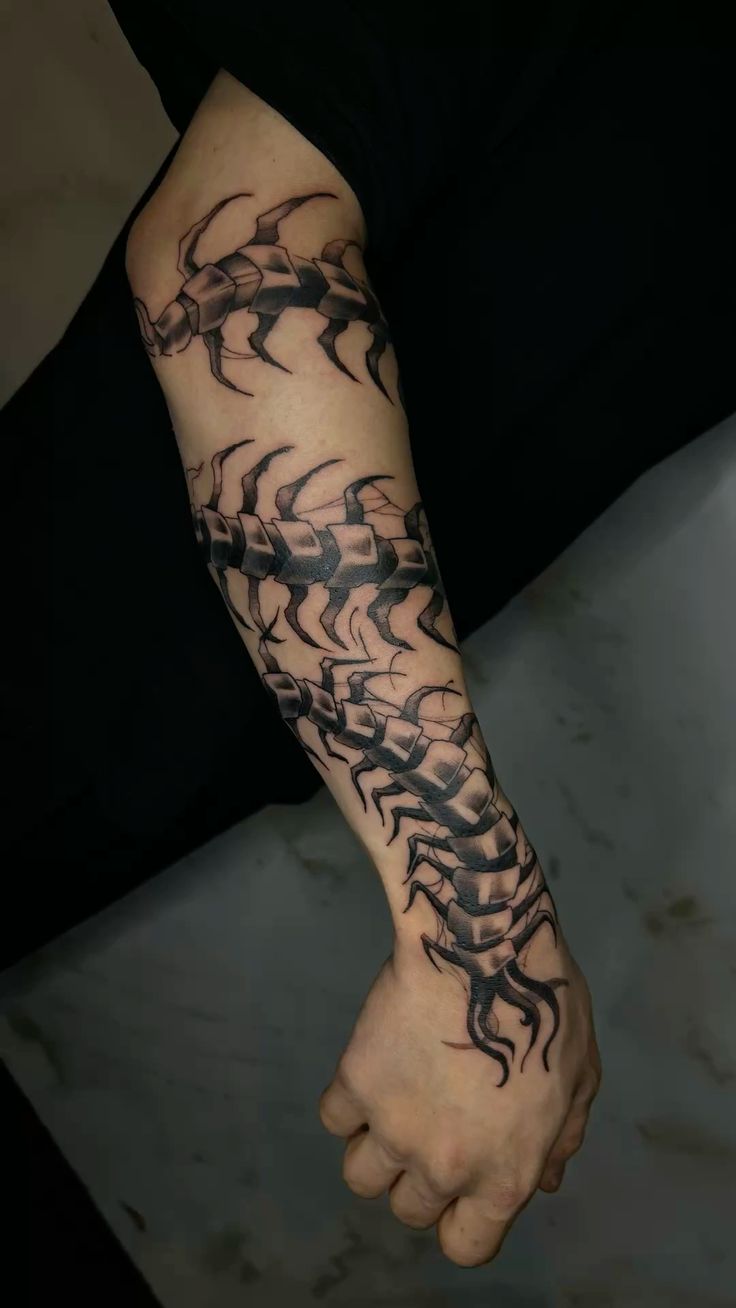
This Arm wrap takes a completely different approach by using several centipede sections to occupy the arm from above the elbow all the way toward the Hand. The result feels less like a single isolated insect and more like an infestation moving across the limb.
The segmented bodies are broad and heavily shaded, with alternating black and gray sections emphasizing the armored construction. Angular legs extend from both sides, but the artist keeps them comparatively restrained so the repeated bodies remain the dominant visual feature.
Placement is particularly effective around the elbow and lower Forearm. Rather than treating the joint as an interruption, the composition uses separate centipede forms to maintain movement across it. One creature travels toward the hand, with long terminal appendages extending onto the upper portion of the wrist and creating a natural transition between Arm and Hand.
This is a useful reference for anyone planning a full Design arm because it demonstrates that a centipede sleeve does not necessarily require one impossibly long creature. Multiple insects—or separate visible sections—can produce an even more immersive effect.
The black-and-gray execution also leaves the concept open to future development. Additional Blackwork, an Eye, abstract Cybersigilism details, or even carefully positioned Red accents could fill remaining spaces. Personally, though, I would preserve some bare skin between the creatures. That negative space is what keeps each segmented body readable and prevents such an aggressive composition from becoming one continuous dark mass.
Centipede tattoos are at their strongest when the artist treats the creature’s unusual anatomy as part of the placement rather than as a problem to solve. From a huge Back piece and coiled Blackwork to a fine-line Forearm design or bold red Traditional interpretation, these ideas show just how differently the same subject can behave on skin. Which version would you actually wear? Share your favorite—or your own centipede tattoo idea—in the comments.