Dinosaurs have a strange talent for never really going out of style. We discover them as children, meet them again in museums and movies, and eventually some of us decide that a velociraptor or long-neck dinosaur deserves a permanent place on our skin. That mix of nostalgia, natural history, and wonderfully odd anatomy is exactly what makes Dinosaur tattoo ideas so varied.
A dinosaur design can be serious without becoming intimidating. It can also be unapologetically cute. Some people gravitate toward a realistic predator rendered with painstaking shading, while others prefer a tiny cartoon creature drawn with half a dozen confident lines. There is plenty of room between those extremes, too: fine line botanical pieces, skeletal studies, minimalist collections, matching tattoos, and playful designs that feel almost like illustrations from a favorite childhood book.
Tattoo artists often stress that subject and placement need to work together rather than compete. That principle is especially useful with dinosaurs because their silhouettes can be unusually long, angular, or compact. Looking through these seven designs, I was struck by how differently artists solve that problem—from a substantial thigh piece to a miniature wrist tattoo.
Realistic Velociraptor Thigh Tattoo With Dramatic Black-and-Grey Shading
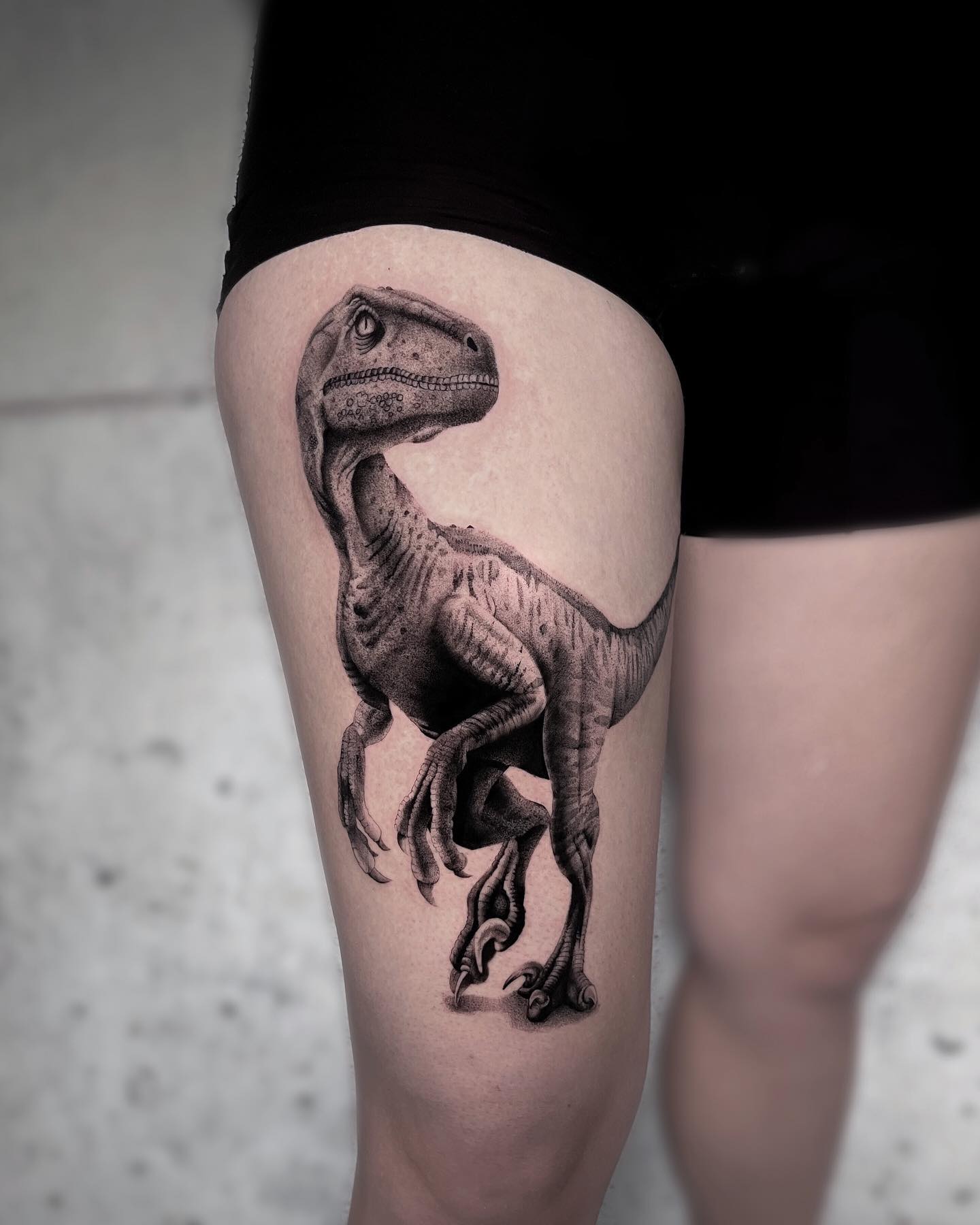
This is the kind of dinosaur tattoo that rewards a second look. The velociraptor occupies a generous section of the thigh, giving the artist enough space to develop its anatomy rather than reducing the animal to a recognizable outline. Its upright posture creates a strong vertical composition, while the curved tail helps keep the body connected to the natural shape of the leg.
The most compelling element is the textural work. Fine stippling and controlled black-and-grey shading establish folds along the neck, muscular definition through the torso, and subtle changes in the surface of the skin. The eye is particularly effective: small in relation to the head but sharply defined, it gives the dinosaur an alert, almost calculating expression.
This is an excellent reference for anyone collecting ideas realistic enough to preserve anatomical detail. Rather than relying on oversized areas of solid black, the design uses tonal transitions to create volume. The hands, claws, legs, jaw, and tiny teeth remain readable without making the overall tattoo excessively heavy.
It also demonstrates why the thigh works so well for a detailed dinosaur design. A realistic creature needs breathing room. Shrinking this composition to the wrist would sacrifice much of the facial texture and shading, whereas the larger placement allows those details to become the personality of the piece.
For men or for women who prefer natural-history-inspired tattoos over cartoon interpretations, this approach can age into a particularly striking standalone piece. It could even become the foundation for a larger prehistoric leg composition, although I rather like the confidence of leaving the raptor alone.
Minimalist Long-Neck Dinosaur Reaching for a Tree
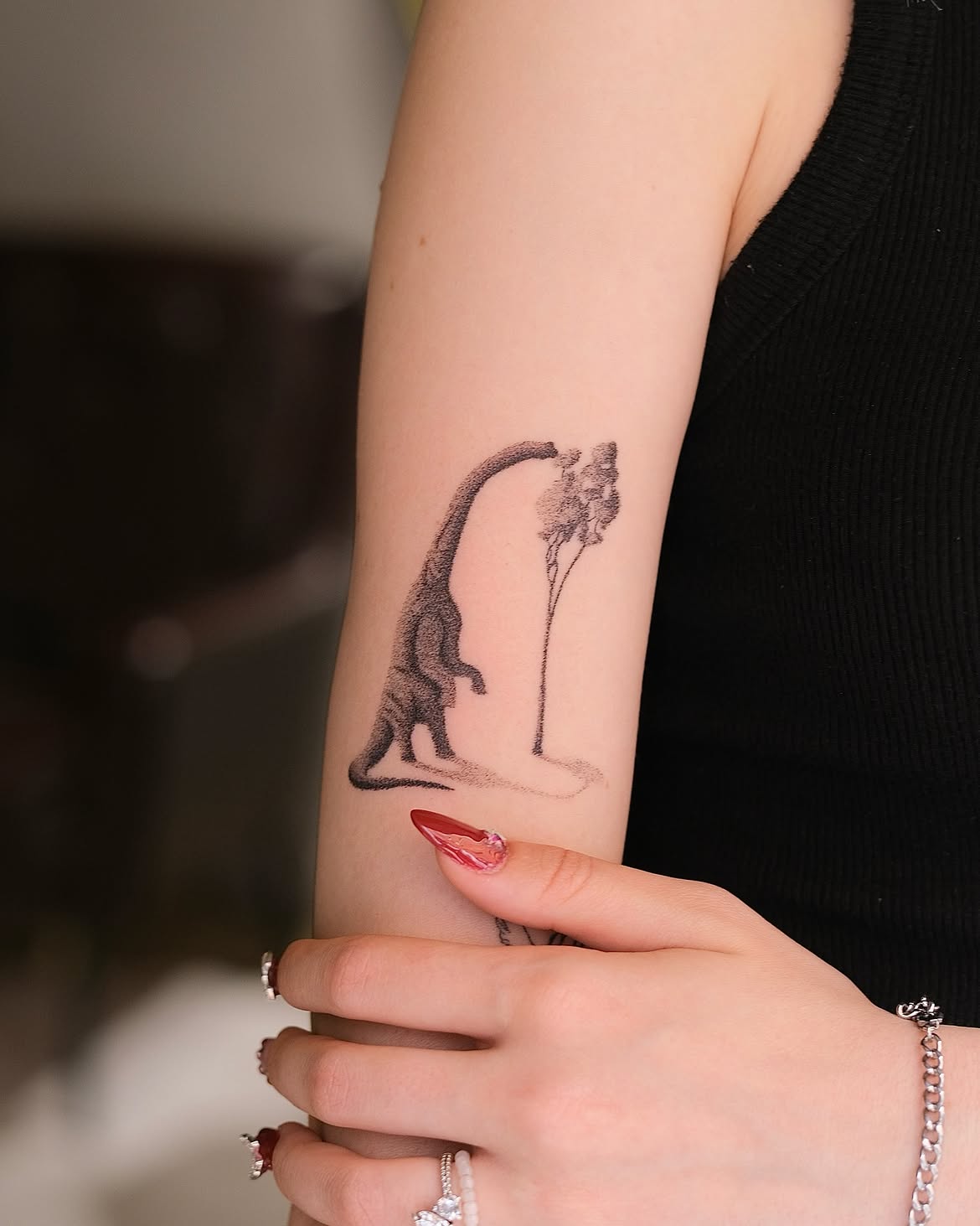
There is something unexpectedly poetic about this little dinosaur. Instead of depicting prehistoric life as violent or monumental, the artist has captured a quiet interaction: a long neck dinosaur stretches upward toward the foliage of a slender tree.
The tattoo sits vertically along the inner arm, and that placement is crucial to its charm. The exaggerated neck follows the length of the arm naturally, while the narrow tree balances it on the opposite side. A faint ground line underneath keeps both elements from appearing disconnected.
Technically, the piece falls somewhere between minimalist illustration and delicate stippled drawing. The dinosaur contains enough dark texture to establish its body, but several areas deliberately soften and disappear. The tree is even lighter, particularly around its foliage, producing an almost sketchbook-like finish.
This is a clever example of how a simple concept does not have to feel generic. There is a miniature story here. The dinosaur is not merely standing beside a decorative object; its posture creates interaction and movement.
Someone searching for tiny dinosaur tattoos could scale the concept down slightly, although preserving the soft texture would require careful discussion with an experienced artist. With small tattoos, simplification is often wiser than trying to squeeze every detail from a large reference into a few centimeters of skin.
Cute Parent and Baby Dinosaur Wrist Tattoo
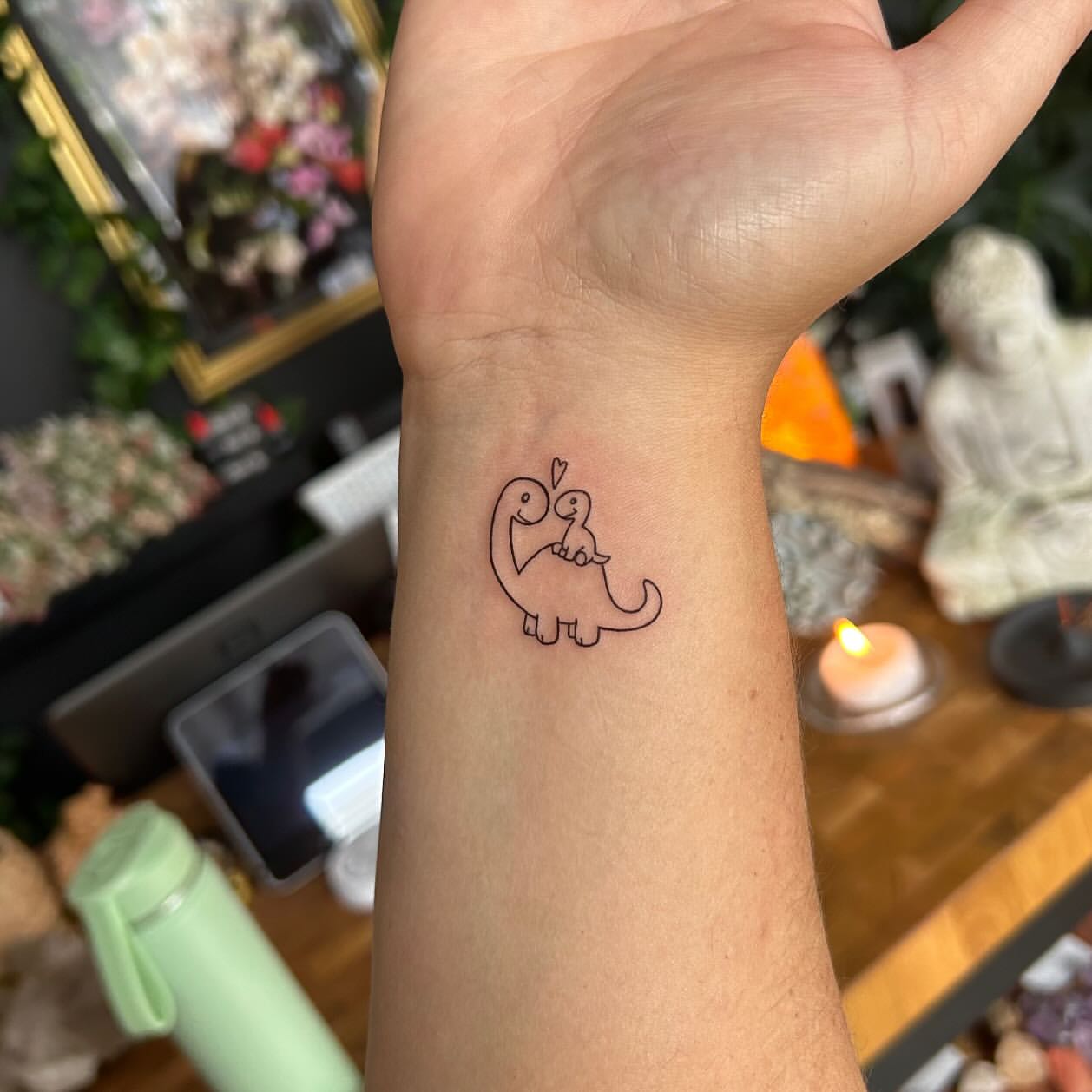
Not every dinosaur needs claws, dramatic shading, or museum-level anatomical accuracy. This little wrist tattoo takes exactly the opposite route, and its personality comes from that restraint.
Two rounded dinosaurs face each other, with the smaller one perched on the back of the larger figure. A tiny heart floats above their heads. Everything is created with a clean black outline and almost no interior shading, giving the piece the uncomplicated warmth of a hand-drawn cartoon.
The larger dinosaur’s curved neck and tail form a loose visual frame around the baby. That makes the composition feel complete despite its very small scale. The tiny feet, smiling faces, and deliberately simplified proportions push it firmly into the cute side of dinosaur tattooing.
There is also plenty of room for personal meaning. A parent could adapt the idea as a son tattoo, change the number of small dinosaurs to represent children, or use the same drawing as the starting point for matching family tattoos. The heart could be retained, removed, or replaced by a tiny initial.
From a practical perspective, this is also a strong stencil concept because its identity depends on a few essential contours rather than intricate texture. For anyone who likes tattoos that are personal but not visually loud, the inner wrist offers an intimate placement that is easy to see yet easy to cover when necessary.
Three Tiny Dinosaur Tattoos for a Playful Mini Collection
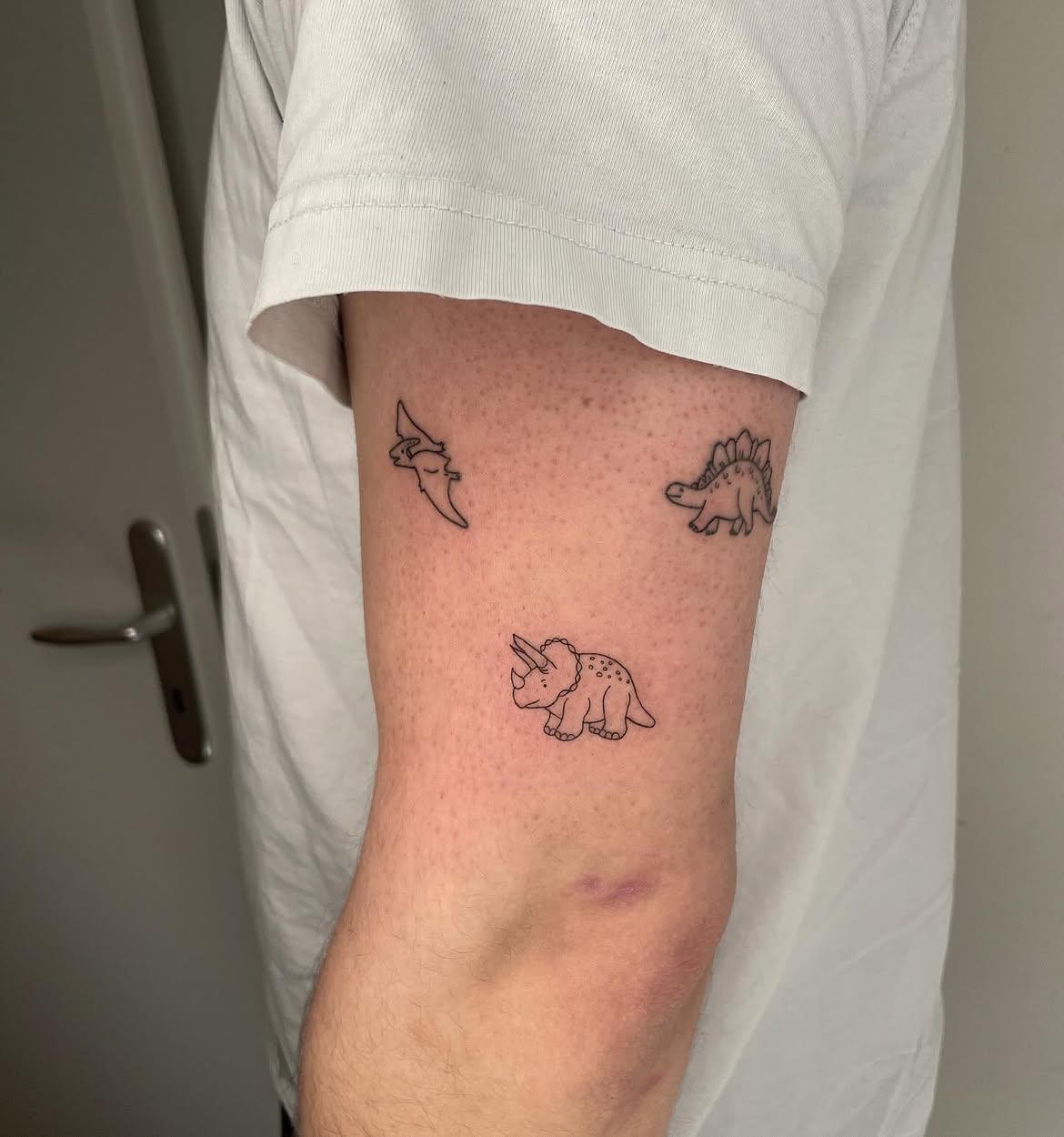
Why choose one dinosaur when three can occupy the same patch of skin without making the composition feel crowded? This miniature collection places three different prehistoric creatures around the upper arm: a flying pterosaur-like figure, a stegosaurus, and a triceratops.
Each animal has been reduced to its most recognizable features. The flying creature is defined by angular wings and a pointed head. The stegosaurus gets its row of unmistakable back plates, while the triceratops is built around its horns and broad frill. There is no unnecessary background and very little shading.
That restraint gives the group a charming flash-sheet quality. They look like individual motifs that could have been selected separately and gradually assembled into a personal collection.
This approach is particularly useful for anyone interested in a future patchwork sleeve. Starting with several small designs leaves open skin between the tattoos, so additional creatures, fossils, plants, footprints, or other personal symbols can be introduced later without forcing everything into a predetermined composition.
I also like that the tattoos do not take themselves too seriously. The proportions are intentionally soft and approachable. They offer an alternative to the hyper-detailed prehistoric predator and show how tiny, simple dinosaur tattoos can still have distinct identities.
T-Rex Skull Forearm Tattoo With Sketch-Style Energy
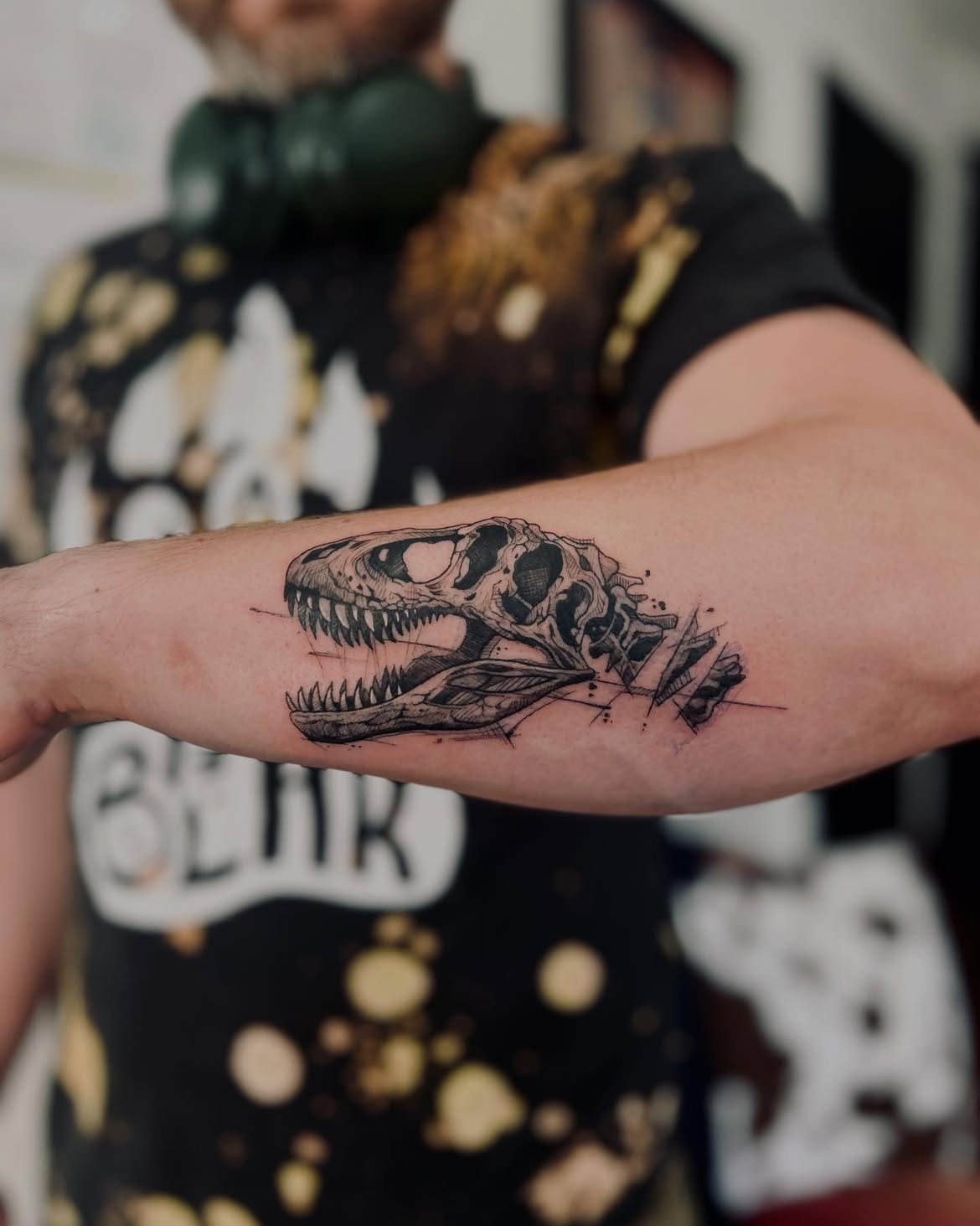
The Trex skull is one of those subjects that barely needs an introduction. Even stripped of skin and muscle, the enormous jaw and rows of teeth immediately communicate what kind of animal we are looking at.
Here, the skull stretches horizontally along the forearm, a smart decision because the elongated jaw naturally suits this part of the body. Instead of placing a compact motif in the center, the artist uses much of the available width, making the fossil feel substantial without requiring a full sleeve.
The technique combines anatomical illustration with loose graphic marks. Dark cavities in the skull create immediate depth, while finer lines define the bone structure, teeth, jaw, and remaining skeletal details. Around the rear of the skull, fragmented strokes and geometric-looking marks interrupt the realism.
That unfinished energy keeps the piece from resembling a textbook diagram. It feels more contemporary—almost as though a scientific drawing has been pulled apart and reconstructed as tattoo art.
This could appeal to people who like realistic dinosaur imagery but want something less conventional than a fully rendered living animal. It also offers useful inspiration for an American traditional or Traditional reinterpretation: a tattooer could take the same skull silhouette, simplify the anatomy, strengthen the outlines, and introduce a limited classic palette.
As it stands, though, the blackwork suits the fossil subject beautifully. The contrast between dense black cavities and exposed skin makes the skull readable from a distance while preserving enough fine detail to reward close viewing.
Baby Raptor Hatching From an Egg
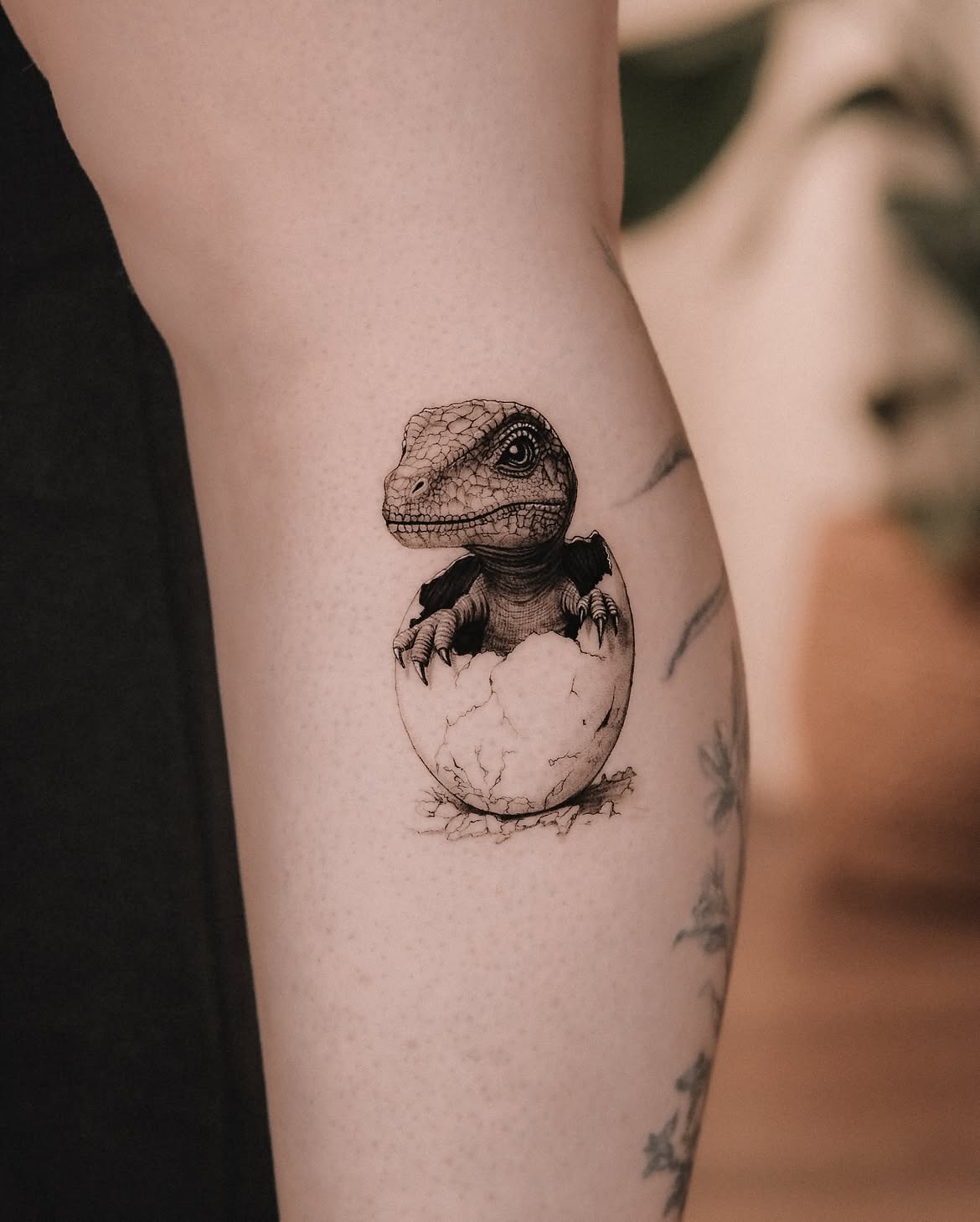
This design lands in the delightful middle ground between realistic and adorable. A baby raptor pushes its head and tiny clawed hands through a cracked egg, turning a potentially fierce prehistoric animal into a character with an almost curious expression.
The face receives most of the technical attention. Individual scales, wrinkles around the eye, small teeth, and layered shading around the neck create convincing reptilian texture. The large glossy eye becomes the focal point and softens the animal’s expression considerably.
Then there are the claws. They are anatomically sharp enough to remind us that this is still a predator, yet their tiny scale makes them strangely endearing as they grip the broken shell.
The egg provides a natural frame for the lower half of the composition. Hairline cracks travel across its surface, while fragments and subtle marks beneath it suggest that the hatching has just happened. This framing device is useful because it allows the tattoo to end cleanly instead of requiring the dinosaur’s entire body.
It is a great example of how cute and technically detailed tattooing can coexist. A simplified version could become a small cartoon piece, while a larger interpretation could push the scales, shell texture, and shadows much further.
There is an emotional angle here as well. Hatching imagery naturally lends itself to ideas of beginnings, curiosity, growth, or a new chapter. You do not need that symbolism to enjoy the tattoo, of course—sometimes a baby dinosaur breaking out of an egg is simply irresistible.
Floral Long-Neck Dinosaur Calf Tattoo
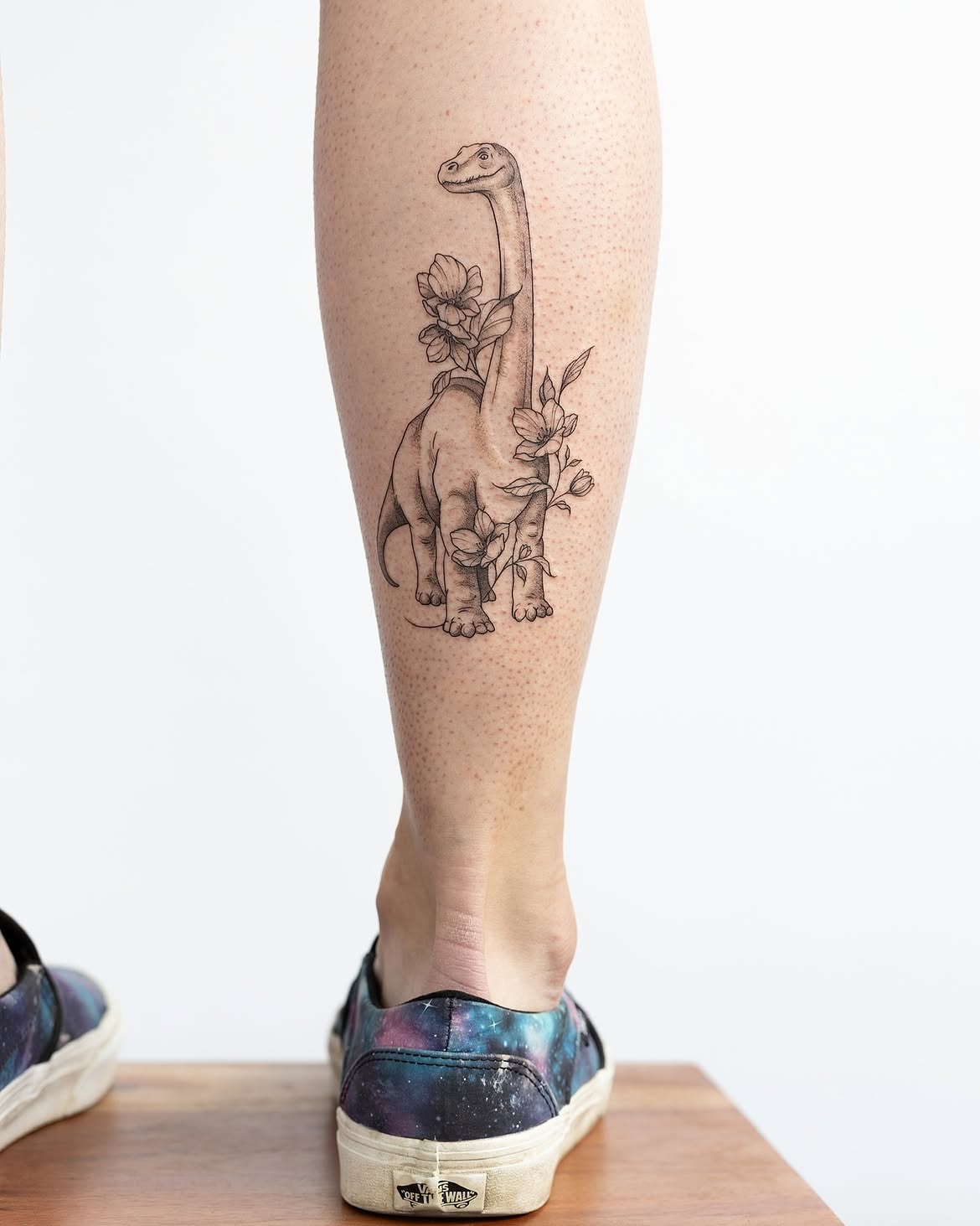
Of all the designs here, this one probably makes the strongest case for combining prehistoric imagery with botanical elements. A gentle long neck dinosaur stands vertically on the calf while flowering branches weave around its body and rise alongside the neck.
The proportions make excellent use of the placement. Sauropods are naturally vertical subjects because of their extraordinary necks, and the calf provides the length necessary to preserve that silhouette. Rather than filling the surrounding space with heavy scenery, the artist uses flowers to break up the dinosaur’s large body and connect the upper and lower portions of the tattoo.
The technique is predominantly fine line, with restrained shading inside the dinosaur and slightly more intricate outlines around the petals and leaves. The result feels delicate without losing the animal’s form.
What makes this floral dinosaur particularly successful is that the flowers do not look pasted onto the composition afterward. Stems overlap the dinosaur and travel through the negative space, visually integrating the two subjects.
This is a beautiful direction for women who enjoy botanical tattooing but want something more individual than a conventional floral arrangement. It certainly does not need to be gendered, though; changing the flower species, increasing the contrast, or using heavier blackwork could completely alter its character.
There is also an opportunity to personalize the botanical component. Birth flowers can represent family members, a specific bloom can reference a meaningful place or memory, and foliage can be extended gradually if the tattoo eventually grows into a larger leg piece.
The contrast itself is what I find most memorable: an enormous prehistoric animal interpreted with unexpectedly gentle lines and surrounded by flowers. It proves that dinosaur tattoos can feel graceful rather than aggressive.
Hyper-Realistic T-Rex Skull Tattoo
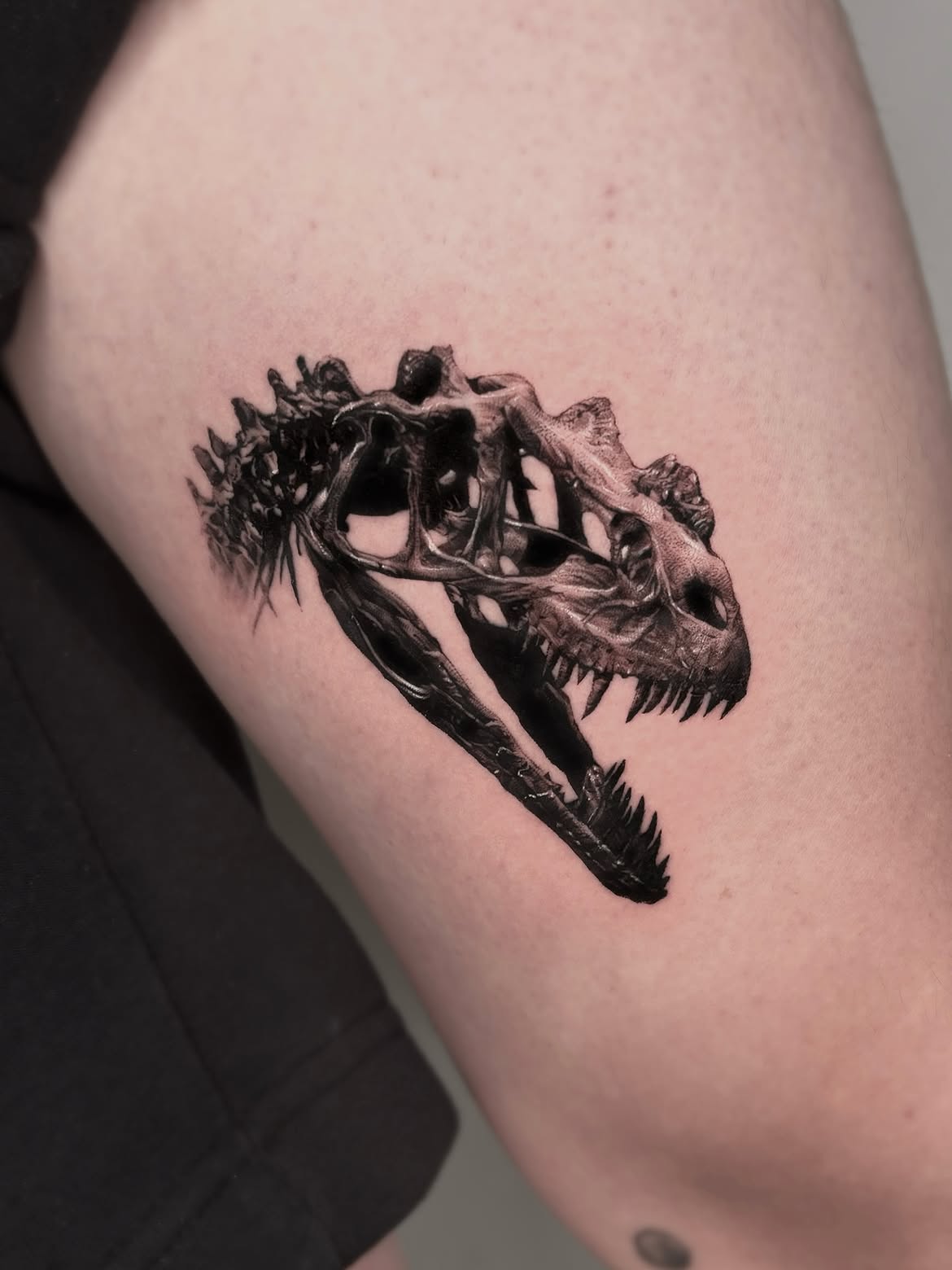
Few dinosaur motifs have the instant visual authority of a Tyrannosaurus skull. This design concentrates entirely on the head, allowing the open jaws, serrated teeth, eye socket, and complicated architecture of the bone to dominate the composition. Rather than turning the fossil into a clean scientific diagram, the artist gives it remarkable depth through dense black-and-grey work.
The darkest ink sits inside the skull cavities and along the lower jaw. Against those areas, softer grey transitions make the ridges of the bone appear raised from the skin. Tiny changes in tone are especially effective around the snout and upper openings, creating a genuinely three-dimensional impression. The teeth remain sharply separated despite the amount of black surrounding them—an important detail in any realistic dinosaur tattoo.
Its placement provides enough room for the skull to remain anatomically convincing. This is one of those ideas realistic tattoo collectors should consider at a reasonably substantial size; reducing such a complicated skull too aggressively would sacrifice the negative spaces that make the anatomy understandable.
The result has a darker, almost museum-after-hours quality. It is powerful without needing flames, lettering, or a decorative frame. For collectors who prefer serious prehistoric imagery, the fossil itself supplies all the drama.
T-Rex Being Taken for a Walk
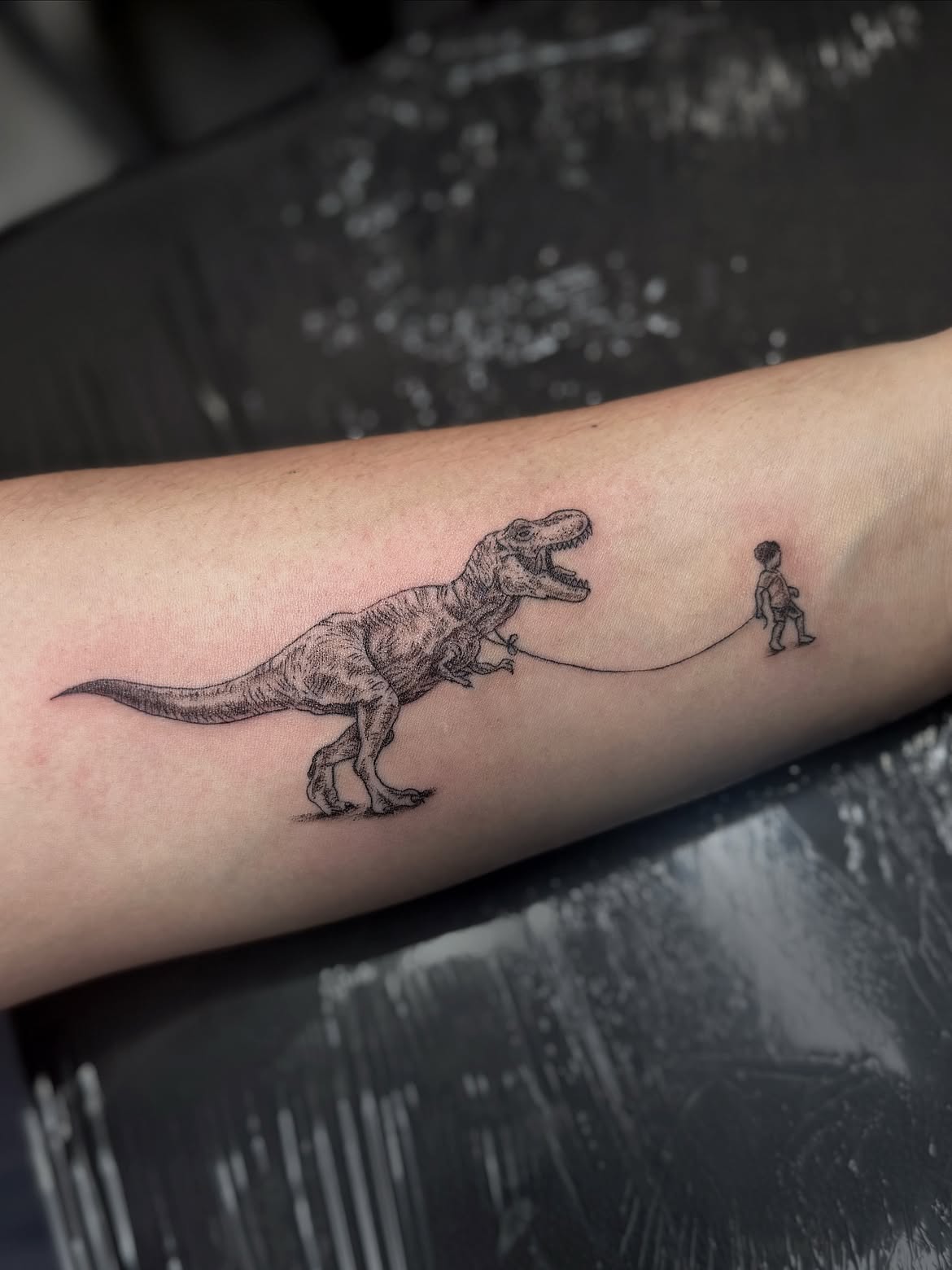
Some of the best tattoo ideas begin with a joke that is visually strong enough to survive without explanation. Here, an impressively rendered T-Rex is being walked on a leash by a tiny human figure. The absurd difference in scale makes the concept immediately funny.
The dinosaur itself is surprisingly detailed. Fine black-and-grey marks define the folds around its neck, muscular legs, open mouth, and long tail. Rather than making the entire composition cartoonish, the artist treats the animal almost seriously. That decision makes the punchline better: the enormous prehistoric predator looks convincing, while the person casually leads it along as though taking a dog around the block.
The forearm is particularly well suited to the horizontal design. The tail extends in one direction and the leash continues in the other, using the natural length of the arm instead of stacking the elements awkwardly.
This could also inspire a wonderfully unconventional matching tattoo. One person could wear the dinosaur and another the tiny walker, or a parent and son could adapt the concept around a shared dinosaur obsession.
It is playful tattooing without becoming visually childish—a good reminder that humor and careful technique can comfortably exist in the same piece.
Dark Realistic Spinosaurus Leg Sleeve
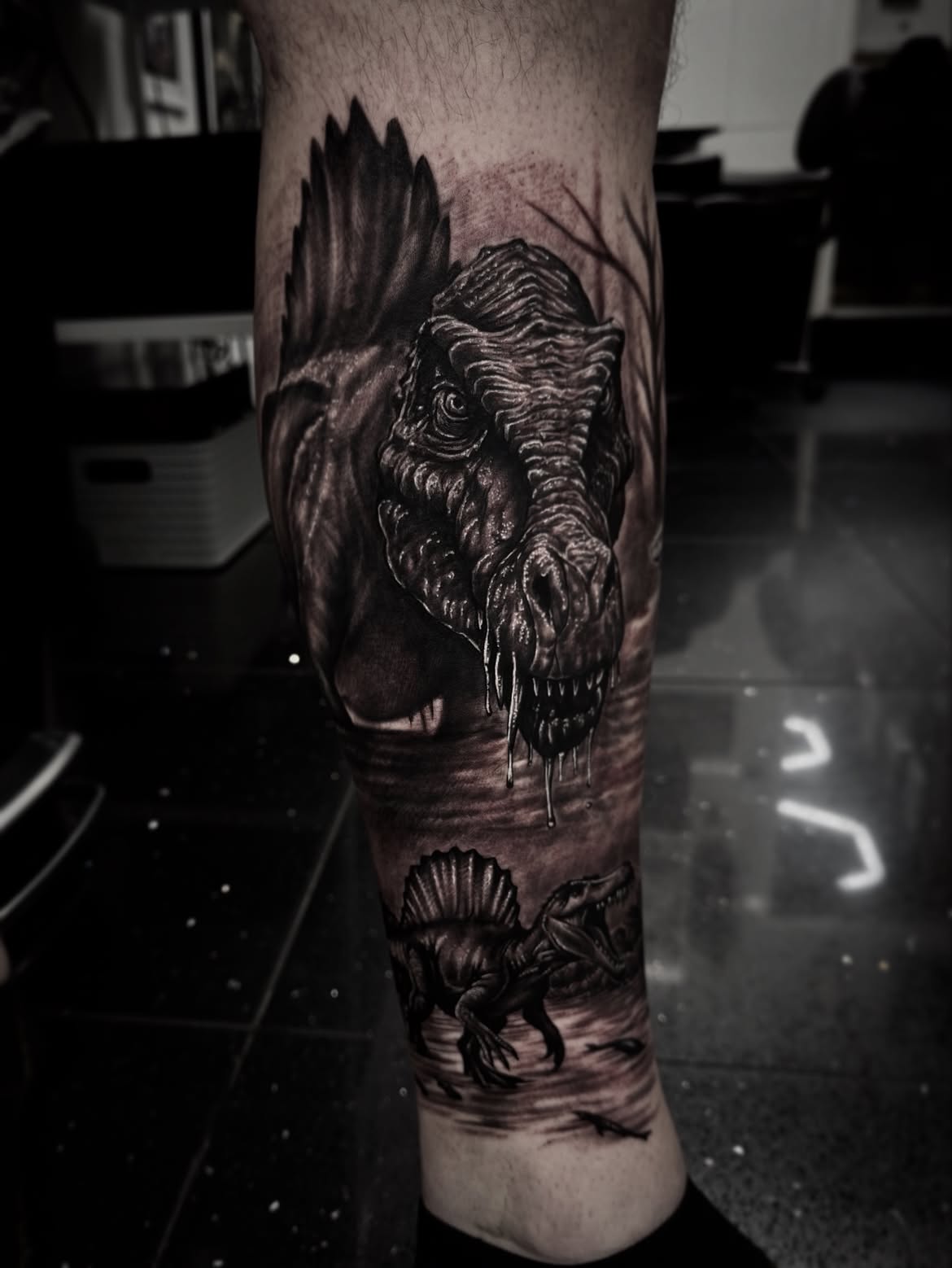
This piece leaves the cute end of the dinosaur spectrum far behind. It is a dark, cinematic prehistoric scene dominated by a huge Spinosaurus emerging from a shadow-heavy environment. Below it, a second dinosaur appears at a smaller scale, creating depth and turning the tattoo into a complete narrative rather than a single isolated portrait.
The upper dinosaur’s face is the undeniable focal point. Heavy blacks surround the eye and deepen the folds of its textured skin, while narrow highlights pick out ridges along the snout. The tall sail rises behind the head as a jagged silhouette, making the species recognizable even before the viewer reaches the lower part of the composition.
The smaller Spinosaurus adds an interesting change in perspective. Its body is shown more completely, including the sail, long jaws, arms, and legs. Ground texture beneath it and atmospheric shading behind the larger head suggest an environment without filling every centimeter with literal scenery.
This is essentially a dinosaur sleeve concept adapted to the lower leg. The vertical anatomy of the placement lets the artist establish multiple visual levels, with the monumental portrait above and the smaller full-body animal below.
For men or anyone drawn to dramatic black-and-grey work, this is a strong reference for planning a larger prehistoric tattoo. Unlike a minimalist piece, a composition like this depends on scale, contrast, and room for gradual tonal transitions. It needs space to breathe—and it uses that space unapologetically.
Floral Dinosaur Portraits With Butterfly and Rose
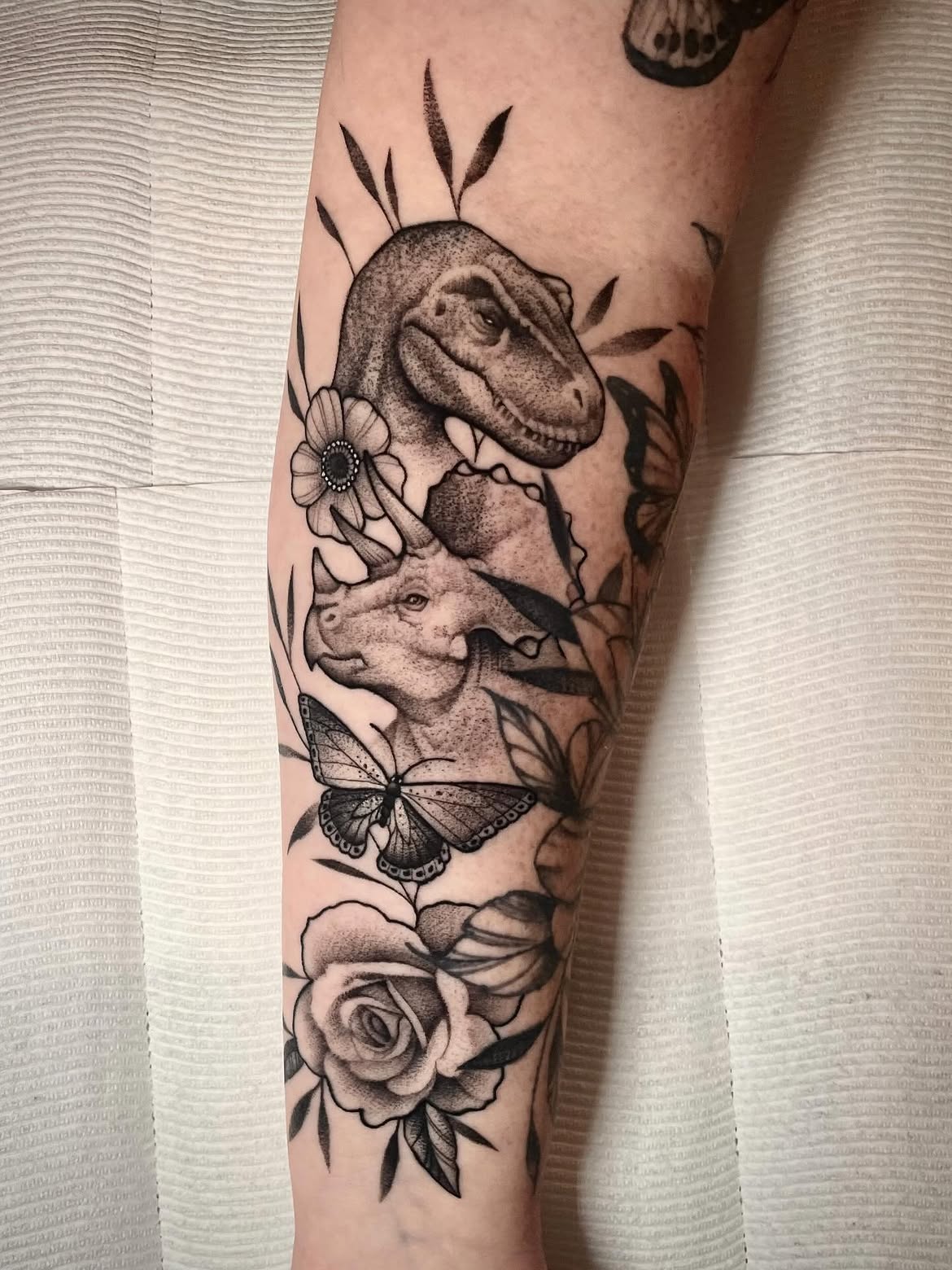
Dinosaurs and flowers might sound like visual opposites, yet this tattoo shows exactly why the pairing works. A large predatory dinosaur portrait and a triceratops are layered among flowers, leaves, and a butterfly, creating a sophisticated floral composition that softens the prehistoric subject without making it less recognizable.
The upper dinosaur has a strong, slightly downward-facing profile. Stippled shading gives its head texture while keeping the overall value relatively light. Below it, the triceratops introduces a completely different silhouette through its horns and broad frill. The two species therefore remain easy to distinguish even though their portraits overlap within a narrow vertical space.
Botanical elements are doing more than decorating empty areas. Leaves rise behind the upper head, a flower bridges the space between the dinosaurs, and a large rose anchors the lower section. The butterfly acts as a delicate transition between the prehistoric forms and the botanical imagery.
There is a lovely contrast here between strength and fragility: horns beside petals, reptilian skin beside butterfly wings. That balance makes the concept particularly interesting among dinosaur tattoos for women, although the composition can obviously work for anyone who enjoys nature-inspired blackwork.
It is also a smart model for a botanical sleeve. Additional flowers, insects, fossils, or dinosaurs could be introduced later without disturbing the original visual language.
Cute T-Rex Photographer Tattoo
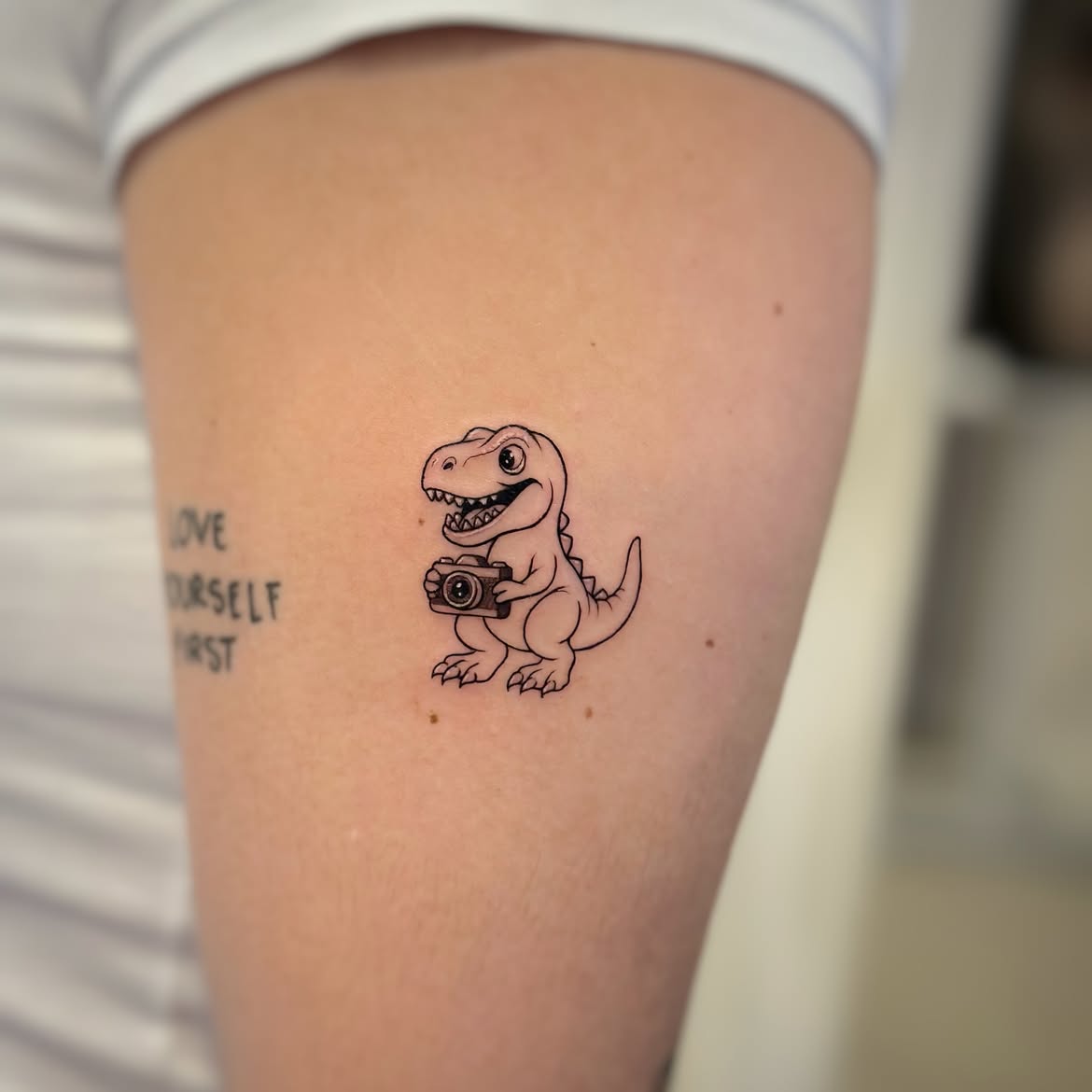
The famously short arms of a T-Rex have inspired endless jokes, and this little cartoon dinosaur makes excellent use of them. Instead of looking threatening, the T-Rex is carefully holding a miniature camera, complete with a clearly drawn lens.
Everything about the character has been designed for charm. The oversized head, large glossy eye, rounded belly, tiny arms, and curved tail give the dinosaur a friendly personality. Even the exposed teeth read more like a grin than a threat.
The tattoo is primarily built from crisp outlines, with selective black filling around the mouth, eye, camera, and small details along the back. That simplicity keeps the design readable at a relatively tiny scale. There is no complicated background competing with the character.
For someone searching for a cute, simple dinosaur tattoo, this is exactly the sort of concept that can be personalized around a hobby. The camera could become a book, coffee cup, paintbrush, game controller, flower, or virtually any small object associated with its wearer.
That personal twist is what prevents a small novelty tattoo from feeling disposable. A funny dinosaur is charming; a funny dinosaur doing something you genuinely love becomes a little self-portrait in prehistoric disguise.
Tiny Long-Neck Dinosaur and Triceratops Pair
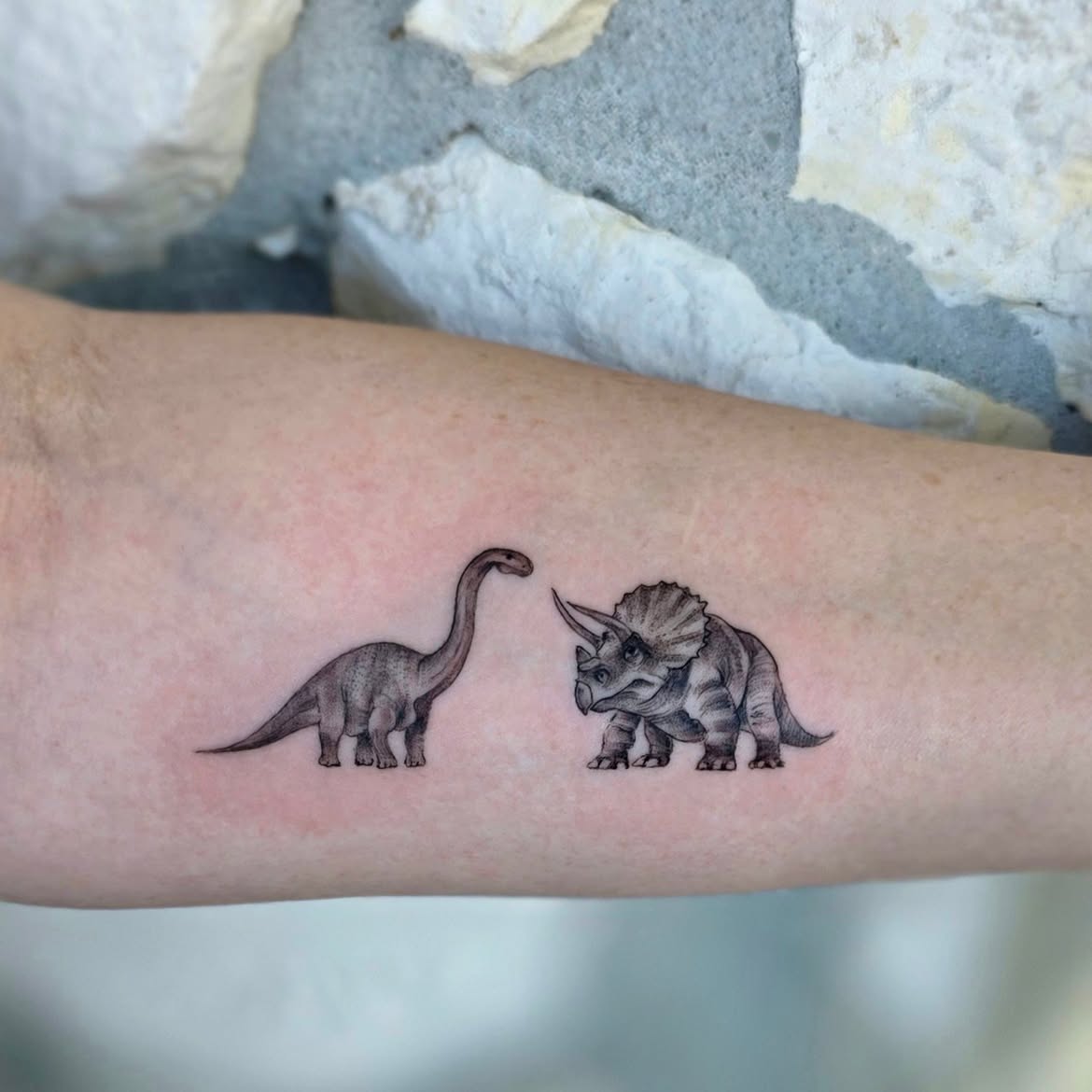
Two small dinosaurs face one another here: a long neck sauropod on one side and a triceratops on the other. The arrangement is wonderfully straightforward, but subtle differences in posture give each creature a distinct personality.
The sauropod has a tall curved neck, compact body, and long tapering tail. Opposite it, the triceratops feels heavier and more grounded, with its broad frill and forward-pointing horns creating a much stronger front silhouette.
Soft grey shading adds just enough volume to separate legs, bodies, and facial features. The approach sits between fine line realism and miniature illustrative work. It does not attempt to reproduce every scale or wrinkle; instead, the artist concentrates on the characteristics necessary to identify each species.
The open space between the animals is important. It keeps the pair from becoming a single dark shape and creates the impression that the two dinosaurs are encountering one another. That small compositional choice gives an otherwise simple tattoo a sense of story.
This is another concept that could work beautifully for matching tattoos. The dinosaurs could be separated between two people while retaining their shared style, making the idea especially appealing for partners, siblings, friends, or a parent and son.
Dinosaur Skull With Tropical Botanical Leaves
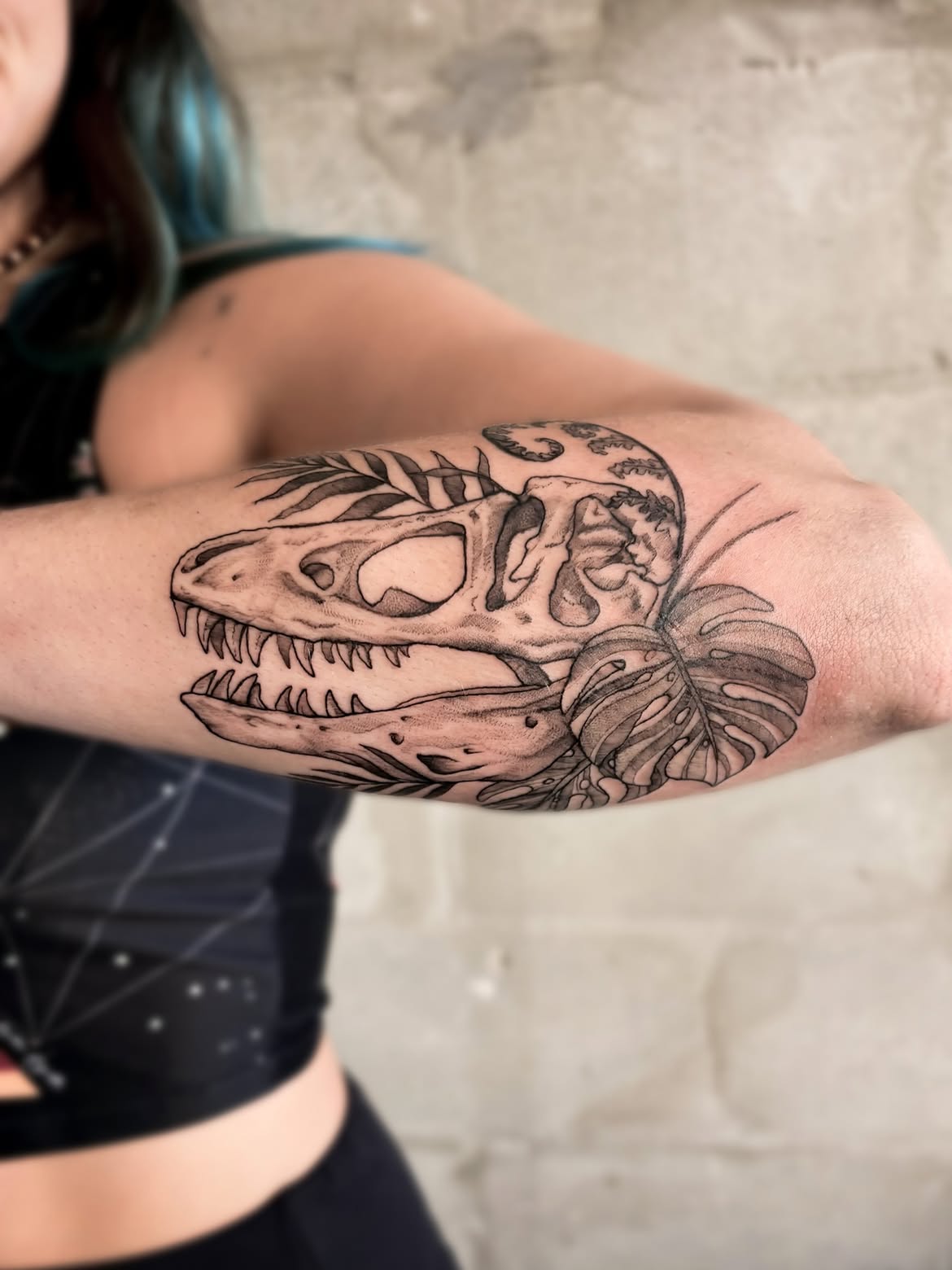
A large dinosaur skull occupies the arm here, but the surrounding tropical plants completely change its mood. Instead of presenting the fossil as something dark and macabre, the artist places it among broad monstera-like leaves and slender botanical forms, suggesting the lush vegetation associated with our imagination of prehistoric landscapes.
The skull follows the curve of the arm beautifully. Its long jaw extends horizontally, while the open mouth creates a dramatic strip of negative space between the upper and lower rows of teeth. Fine shading across the bone establishes depth without burying the drawing beneath solid black.
The botanical elements are especially well positioned. A large split leaf overlaps the lower portion of the skull, while additional foliage rises behind the upper section. These overlaps make the plants and fossil feel like one intentional design, rather than two unrelated tattoo subjects placed beside each other.
This is a more graphic interpretation of a floral or botanical dinosaur tattoo. There are no delicate bouquets; instead, broad tropical leaves provide strong shapes that can remain readable as the tattoo ages.
The combination would also translate effectively into a larger sleeve. Ferns, cycads, additional fossil fragments, insects, or smaller prehistoric animals could continue around the arm while preserving the natural-history theme.
What makes the piece memorable is the tension between life and extinction. The skull represents an animal known only through what remains, while the surrounding vegetation feels abundant and alive. It is an elegant way to give a dinosaur tattoo atmosphere without resorting to a conventional prehistoric landscape.
Velociraptor Surrounded by Tropical Leaves
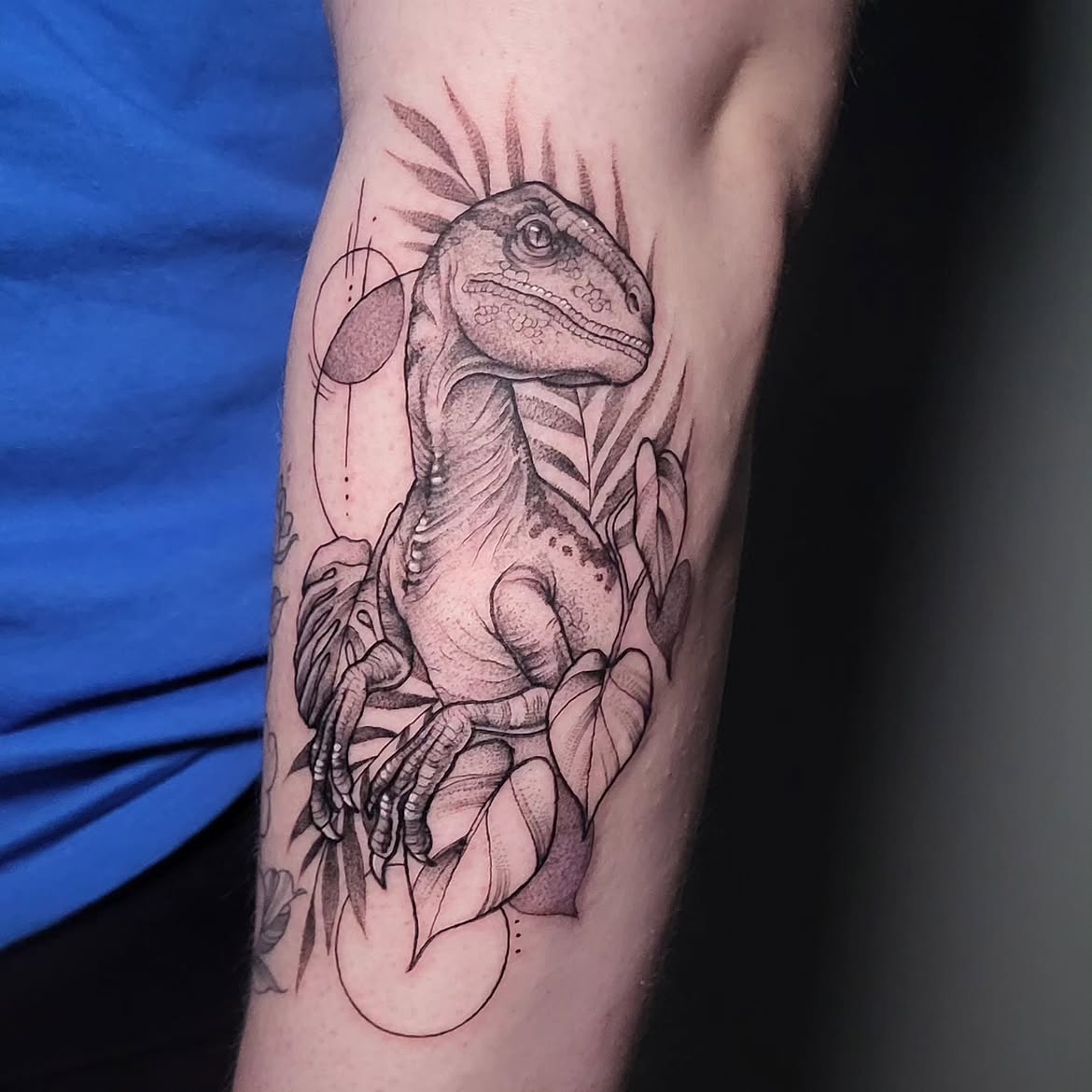
This velociraptor portrait takes a softer approach to a creature usually portrayed as an aggressive hunter. The dinosaur rises vertically through a cluster of tropical leaves, with its head, long neck, torso, and remarkably detailed hands forming the central structure of the composition.
The dinosaur itself sits somewhere between scientific illustration and contemporary fine line tattooing. Stippling creates subtle variations across the skin, particularly around the face and neck, while slightly stronger shadows define the chest and arms. The long fingers are one of my favorite details: each joint and claw remains distinct instead of disappearing into a dark mass.
The surrounding foliage changes the entire character of the piece. Broad leaves overlap parts of the body, while thinner botanical shapes extend behind the dinosaur and fill awkward negative spaces. There are also restrained abstract lines and circular forms in the background. Those geometric accents stop the tattoo from looking like a straightforward prehistoric scene and give it a modern editorial quality.
This is a clever direction for anyone interested in floral or botanical dinosaur tattoo ideas but who does not necessarily want conventional flowers. The leaves provide the organic softness, while the raptor keeps the composition unusual and slightly wild.
Tiny Dinosaur Skeleton Upper-Arm Tattoo
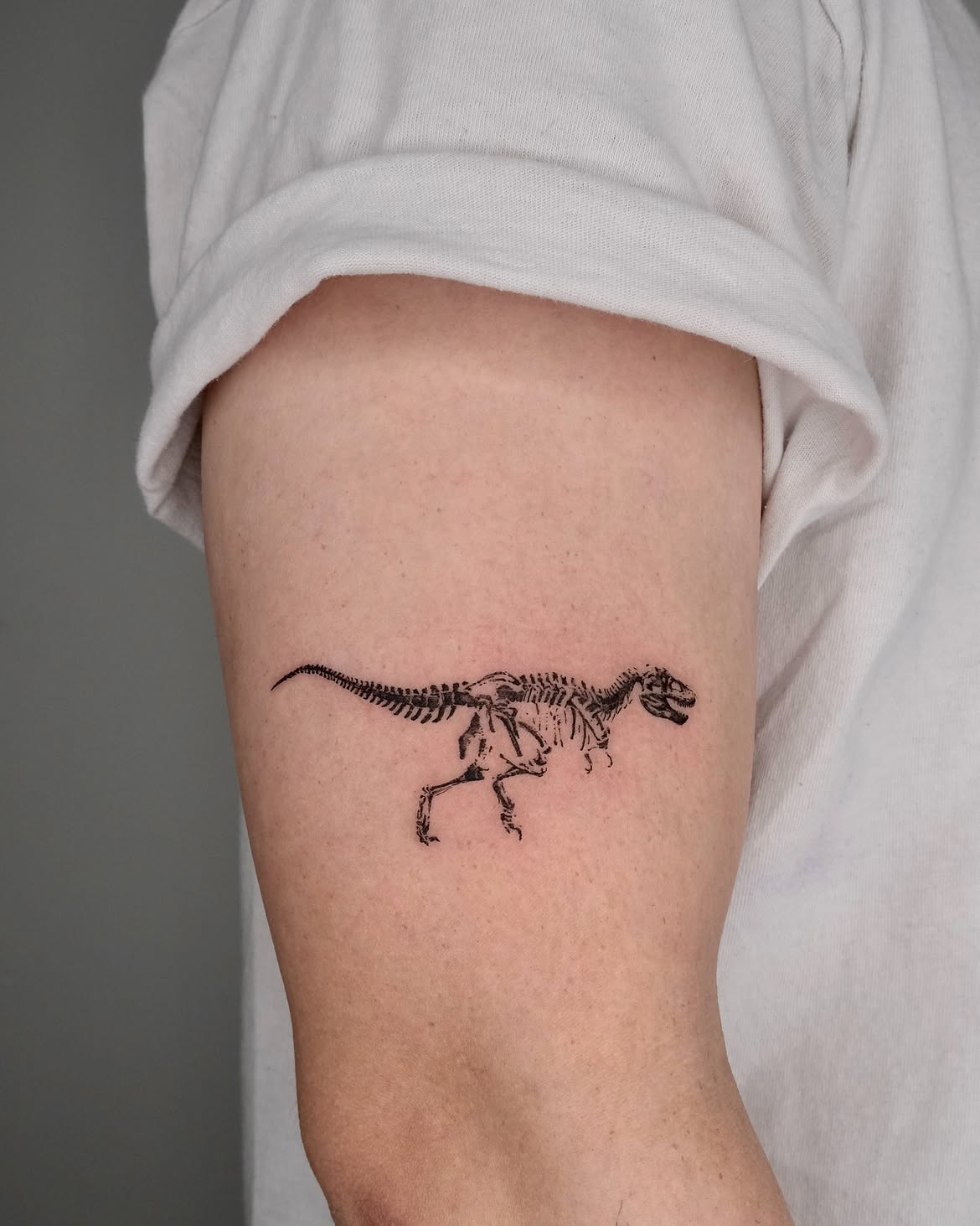
A dinosaur does not need to be large to make its species recognizable. This tiny skeletal tattoo stretches horizontally across the upper arm, relying almost entirely on the familiar structure of the skull, spine, ribs, legs, and exceptionally long tail.
The execution is deliberately light. Instead of filling the bones with heavy shading, the artist uses narrow black marks and small areas of stronger contrast around the torso and head. The skeleton consequently feels almost like a miniature museum specimen transferred directly from a paleontology sketchbook.
Its long horizontal silhouette is particularly effective. The tail tapers gradually toward one side while the skull provides a slightly heavier visual endpoint on the other. That balance prevents such a narrow tattoo from looking accidental on the arm.
This would make an interesting minimalist option for someone who likes fossil imagery but does not want a large realistic skull. It also shows why a good stencil matters with skeletal subjects: when the design is this small, the spacing between vertebrae, ribs, and limbs is what keeps the animal readable.
Simple from a distance and surprisingly intricate up close, it is a good example of understated dinosaur tattooing.
Geometric Origami-Style T-Rex Tattoo
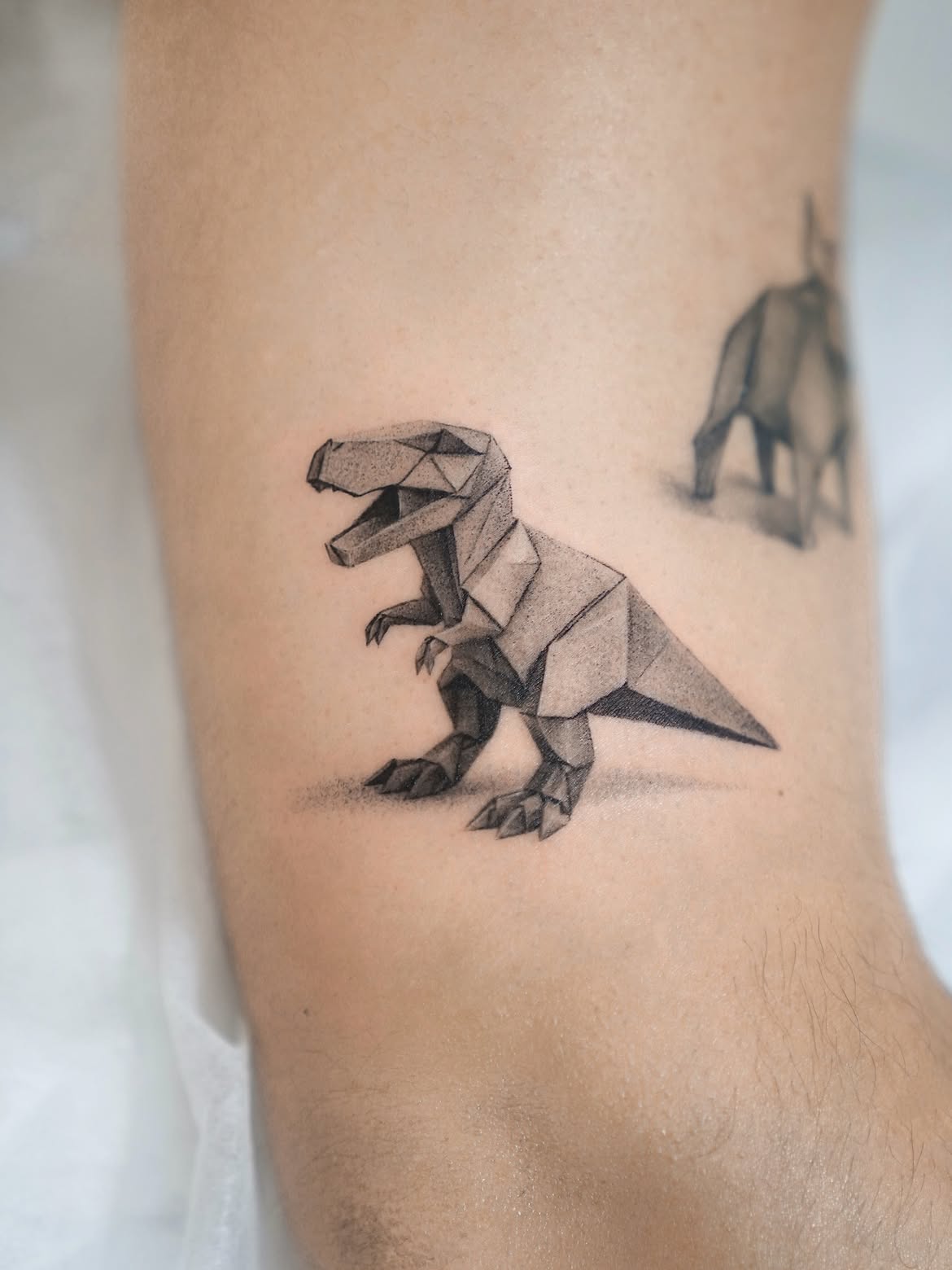
This little T-Rex looks as though it has been folded from paper. Instead of scales and organic anatomy, the body is constructed from angular planes that meet like the facets of an origami sculpture.
The head, torso, legs, and tail are divided into geometric sections, with stippled grey shading helping individual planes turn toward or away from the viewer. Darker triangular areas underneath the jaw and body provide depth, while the small forearms and oversized feet preserve the unmistakable T-Rex silhouette.
It is a particularly smart minimalist design because simplification is not being used merely to remove detail; it becomes the central visual idea. The dinosaur is still immediately recognizable, but its anatomy has been translated into an entirely different graphic language.
This style could also work well as matching tattoos. Two people could choose different dinosaur species rendered with the same polygonal treatment, creating a connection without wearing identical designs.
For collectors who find conventional realism too literal and a cartoon dinosaur too playful, geometric work occupies an appealing middle ground—clean, contemporary, and distinctive.
Fine Line T-Rex Skeleton With Flowers
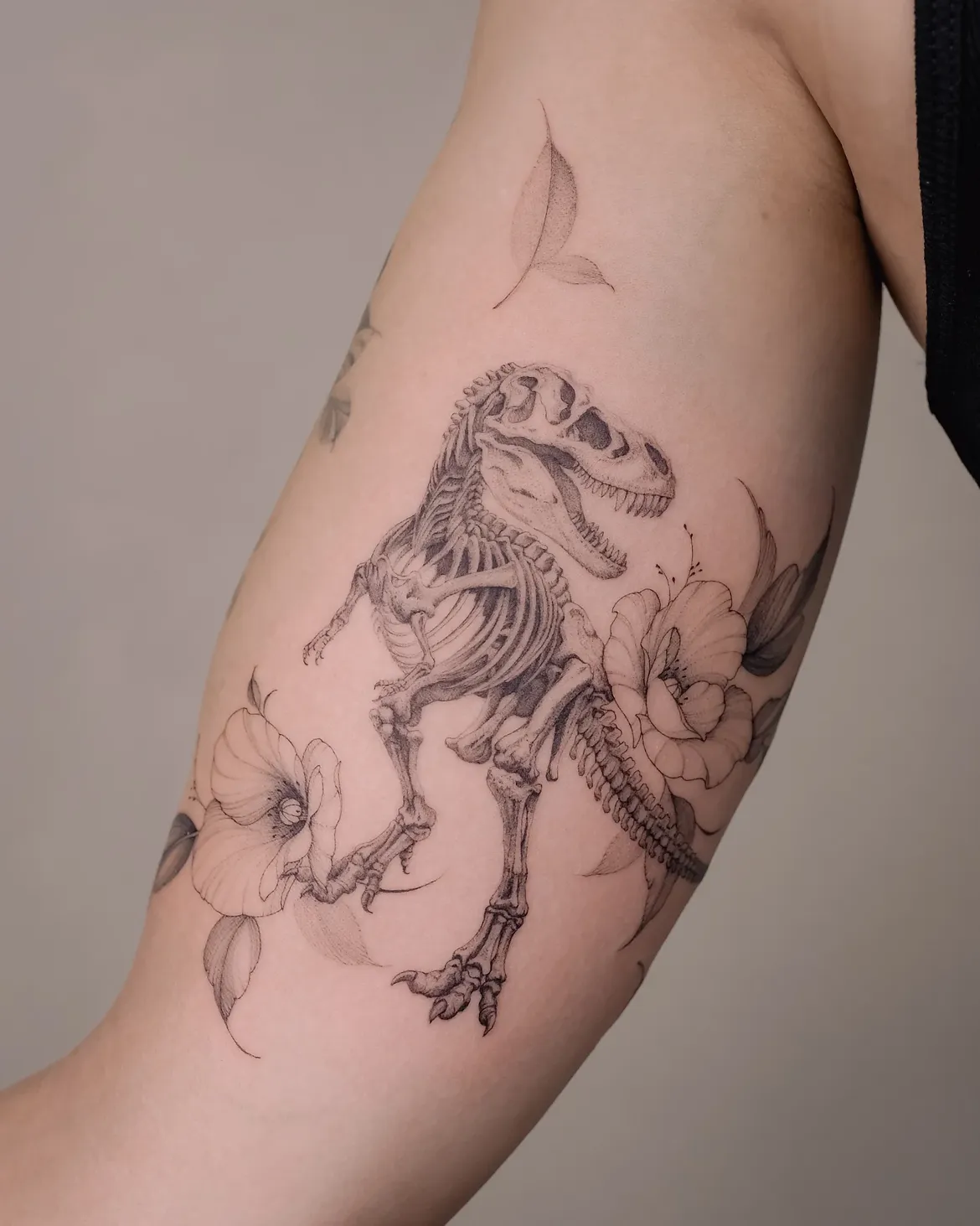
A T-Rex skeleton surrounded by delicate flowers creates one of the most striking contrasts in this collection. The prehistoric predator is represented entirely through bone, yet soft blossoms and leaves curve around the skeleton, giving the composition an unexpectedly graceful rhythm.
There is impressive restraint in the skeletal drawing. The skull contains recognizable openings and rows of tiny teeth, while the ribs, vertebrae, pelvis, legs, and tail remain individually readable. Rather than pushing every bone into dark blackwork, the artist relies on soft grey shading and exceptionally thin outlines.
The flowers work as more than decoration. One blossom fills negative space near the legs while another sits beside the tail, and scattered leaves extend beyond the skeleton to soften its angular silhouette. This interaction makes the floral theme feel integrated rather than added as an afterthought.
For anyone drawn to fine line dinosaur tattoos for women, this is an elegant reference, though the style is by no means limited to any gender. Changing the flowers alone could dramatically personalize the concept—birth flowers, favorite plants, or botanicals associated with a particular place would all work naturally.
It combines paleontology and botanical illustration in a way that feels almost like a page from an antique natural-history volume.
Realistic Raptor Head With Detailed Scales
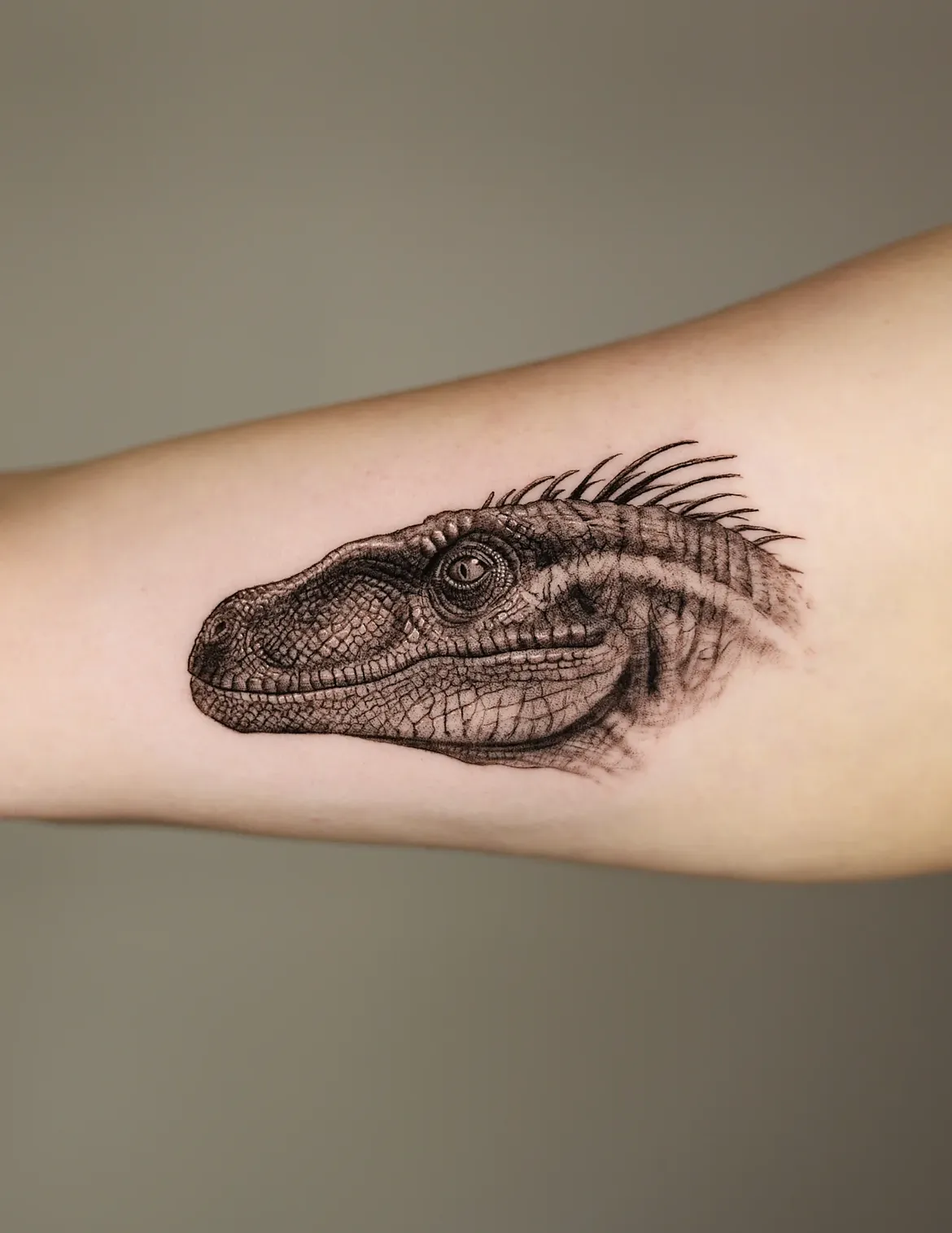
This raptor portrait demonstrates just how effective a dinosaur tattoo can be when the artist deliberately stops before showing the entire animal. Only the head and upper neck are developed, concentrating every bit of attention on the eye, scales, jaw, and skin texture.
The scale work is meticulous. Larger irregular shapes define the cheek and lower jaw, while finer scales cover the snout and area around the eye. Lines radiating through the eyelids make the eye feel embedded naturally in the skin rather than placed on top of it.
A row of thin spines follows the back of the head and neck, breaking up the smooth silhouette. Toward the rear, the rendering gradually becomes softer and less complete. That fading edge is an excellent decision: instead of ending the neck with an artificial hard line, the artist allows it to dissolve into the skin.
This belongs firmly among ideas realistic dinosaur fans may want to save. It has enough anatomical detail to feel convincing but avoids the visual weight of a complete animal.
The horizontal format also makes it particularly suitable for the forearm, where the elongated reptilian head can follow the natural direction of the limb.
Cute Fine Line Dinosaur Character Collection
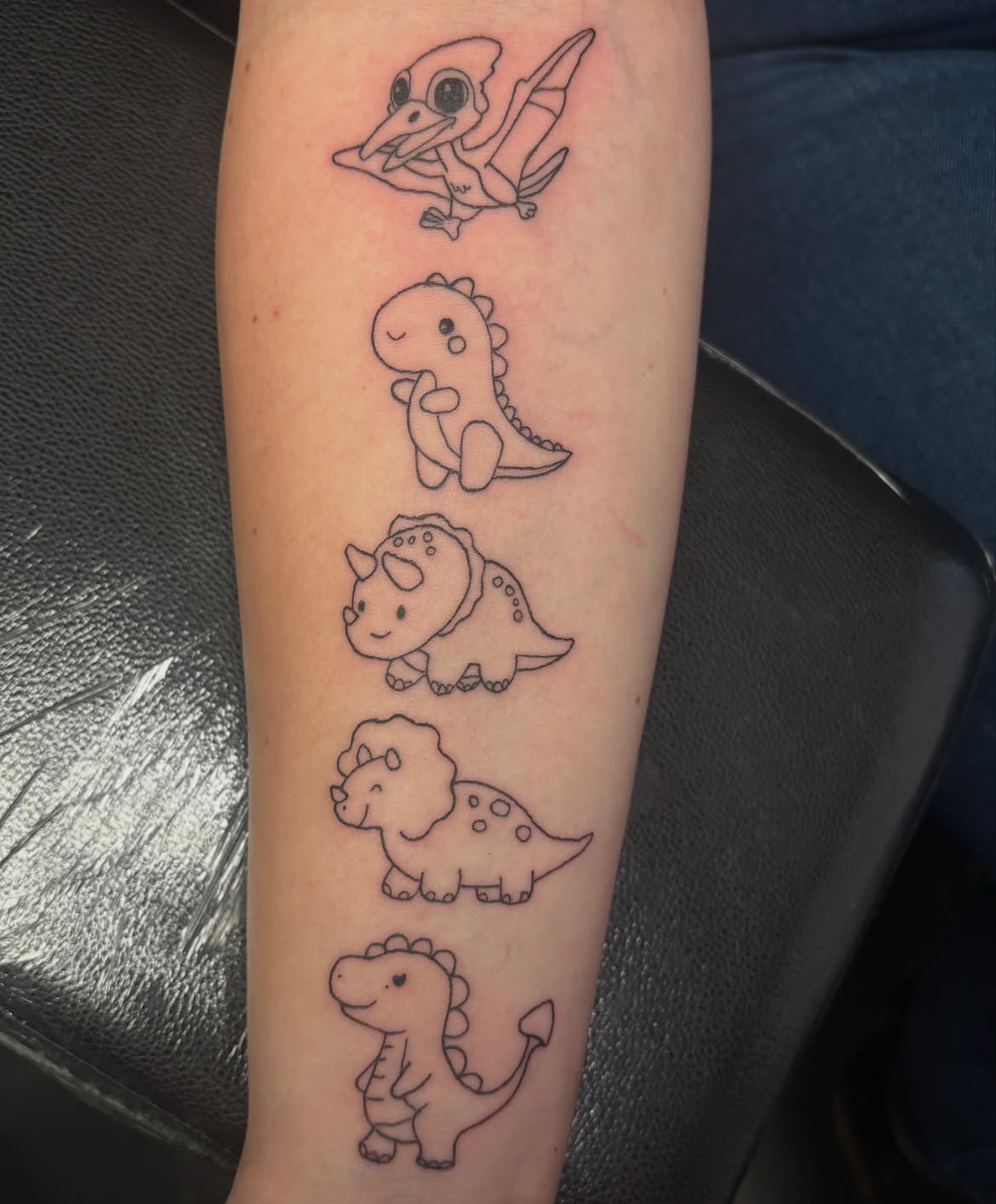
This vertical collection is pure prehistoric charm. Five small characters are stacked along the arm, including a flying pterosaur and several rounded dinosaur species rendered in a deliberately cute cartoon style.
Each character has been simplified into soft outlines, tiny facial features, rounded feet, and easily recognizable dinosaur traits. One has a row of small plates running down its back, another wears the broad frill and horns associated with a triceratops, while the flying creature at the top introduces a completely different silhouette.
There is almost no shading, and that is precisely why the concept works. The designs resemble clean pieces of tattoo flash, with each creature capable of functioning independently. Together, however, they form a playful vertical mini collection.
This arrangement could be especially fun for a parent who wants several symbols connected with children. Individual dinosaurs might represent family members, or a parent and son could each choose a favorite creature as a matching pair.
It is also a useful lesson in building a future sleeve gradually. Small tattoos do not have to be randomly scattered. Repeating the same line weight, scale, and visual language can make separate pieces feel intentionally connected.
Dramatic Stegosaurus Blackwork Tattoo
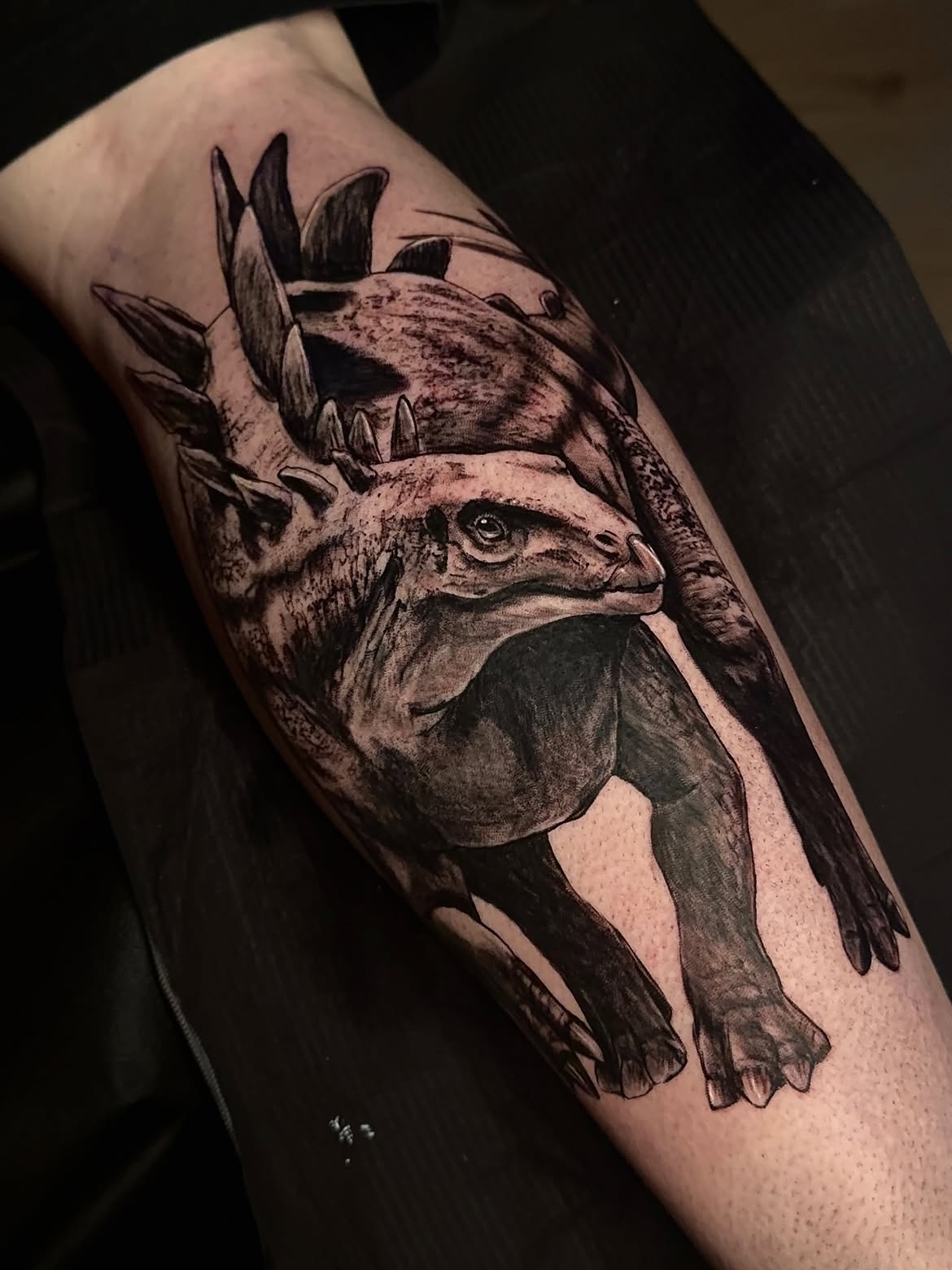
The stegosaurus is usually recognized first by its plates, and this tattoo turns those plates into the strongest graphic feature of the entire composition. They rise dramatically across the back, creating a jagged silhouette that immediately identifies the dinosaur even before the rest of its anatomy comes into focus.
The animal is rendered with heavy black-and-grey shading. Dark areas beneath the body and around the overlapping forms create substantial visual weight, while textured grey passages across the head and torso prevent the dinosaur from becoming flat. The eye is small but carefully highlighted, giving the animal an alert expression.
This piece feels considerably heavier than the fine line examples in the collection. It borrows some of the bold readability associated with Traditional tattooing while using more realistic texture and anatomy. A full American traditional reinterpretation could push that direction further with stronger outlines and a limited color palette, but the monochrome treatment here gives the dinosaur a raw, almost prehistoric atmosphere.
The composition is also designed intelligently for a larger limb placement. The broad body occupies the center, while the plates extend upward and the legs lead the eye downward. Instead of trying to squeeze the entire dinosaur into a neat rectangular frame, the artist lets its anatomy determine the outer shape.
For anyone considering a substantial dinosaur sleeve, this type of piece can act as an anchor. Smaller fossils, plants, footprints, or additional species could eventually be built around it without weakening the main subject.
What I like most is that it does not try to make the stegosaurus cute simply because the species is often treated that way in popular illustration. Here it feels massive, strange, and genuinely prehistoric—the qualities that make dinosaur tattoos so compelling in the first place.
Tiny Bernardo T-Rex Fine Line Tattoo
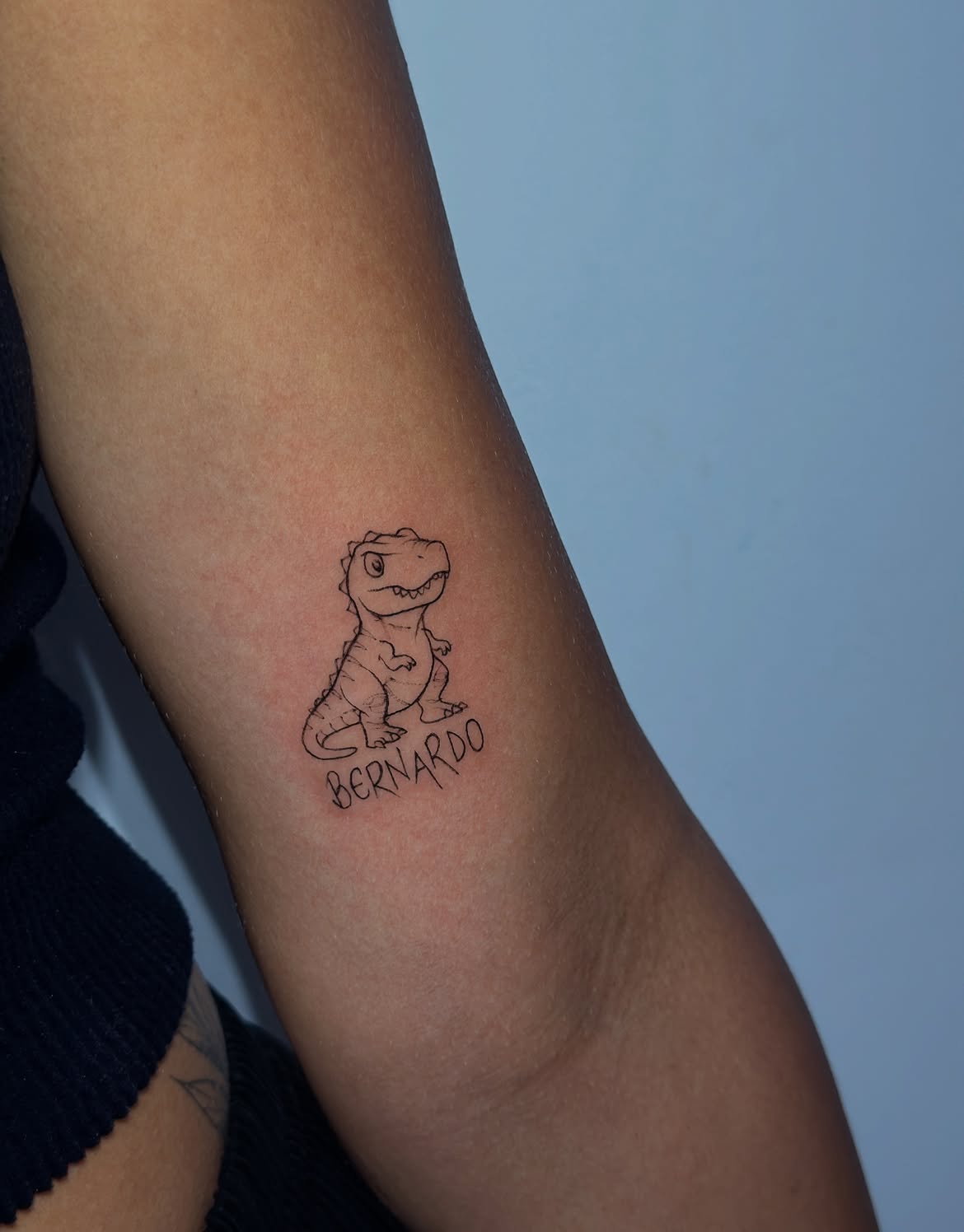
This tiny T-Rex tattoo proves that dinosaur designs can be personal without becoming complicated. The little dinosaur is drawn with extremely thin black outlines and almost no shading, giving it the appearance of a miniature hand-drawn illustration. Its oversized head, short arms, curved tail, and visible teeth make the species immediately recognizable, while the expression keeps the design friendly rather than intimidating.
The handwritten name Bernardo underneath transforms a simple dinosaur into a personalized piece. This could be adapted with a child’s name, nickname, important date, or short word, making it a particularly sweet idea for parents or anyone connecting dinosaurs with a specific memory.
Because the tattoo is so small, the generous negative space is important. Nothing feels crowded, and the design remains readable even from a distance. It is an excellent example of a tiny, simple, and fine line dinosaur tattoo that can fit naturally on the inner arm.
Spinosaurus With Tropical Flowers and Water
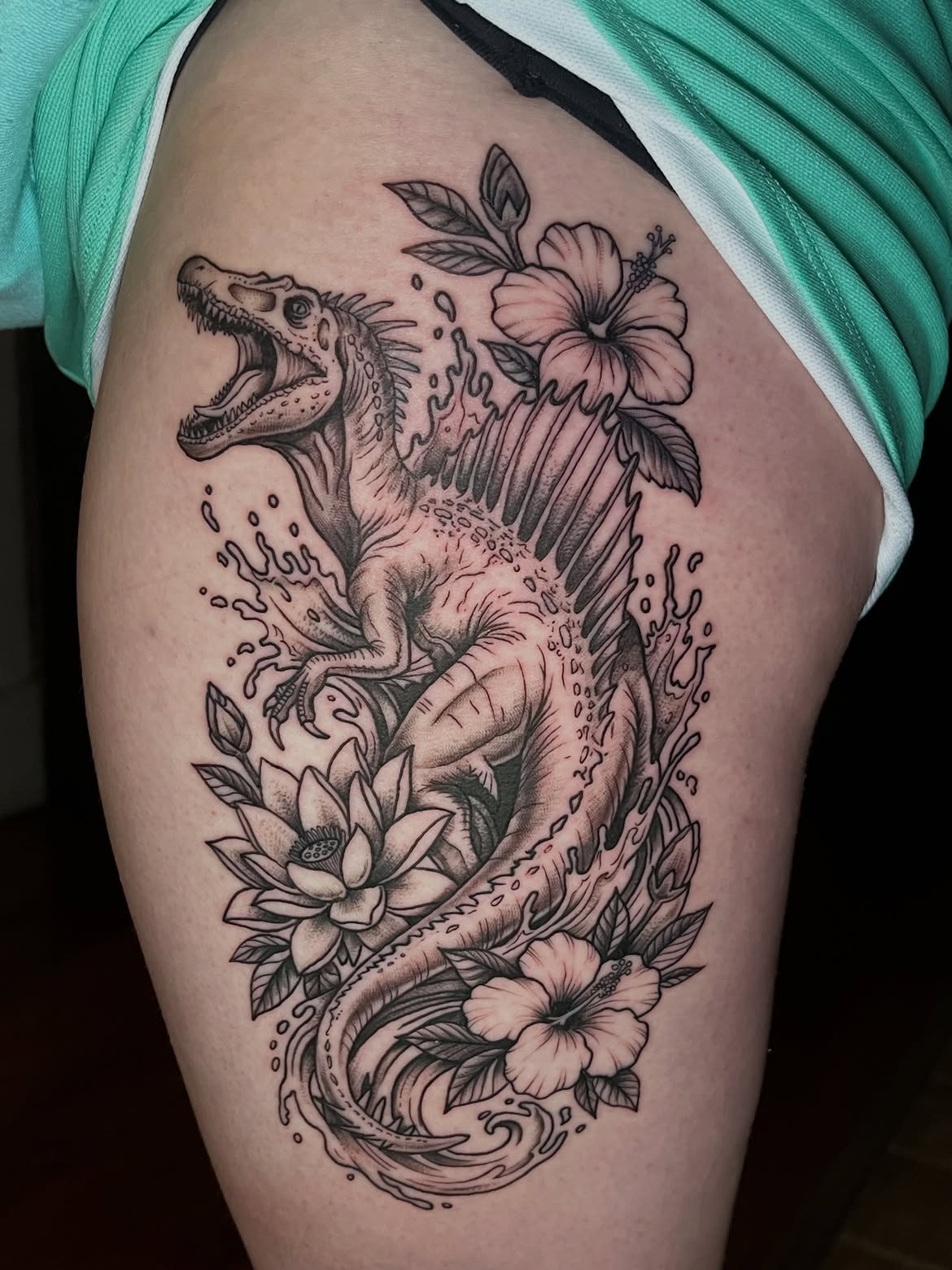
This dramatic Spinosaurus design combines prehistoric imagery with a lush botanical setting. The dinosaur twists vertically along the thigh, its open jaws creating an energetic focal point at the top while its long tail curls through stylized water at the bottom.
The distinctive sail along the back is emphasized with long dark sections and fine internal shading. Detailed teeth, claws, skin texture, and facial features give the dinosaur a semi-realistic character without making the composition excessively heavy.
Flowers dramatically soften the subject. Large hibiscus-like blossoms, a lotus, and clusters of leaves surround the body, while splashing water fills spaces between the dinosaur and vegetation. These elements create movement throughout the entire tattoo.
This is an excellent floral dinosaur concept for someone considering a larger thigh piece or sleeve. It demonstrates how flowers can frame a dinosaur without making it secondary. The contrast between an aggressive prehistoric predator and delicate tropical plants gives the design much of its personality.
Realistic Dinosaur Breaking Through the Skin
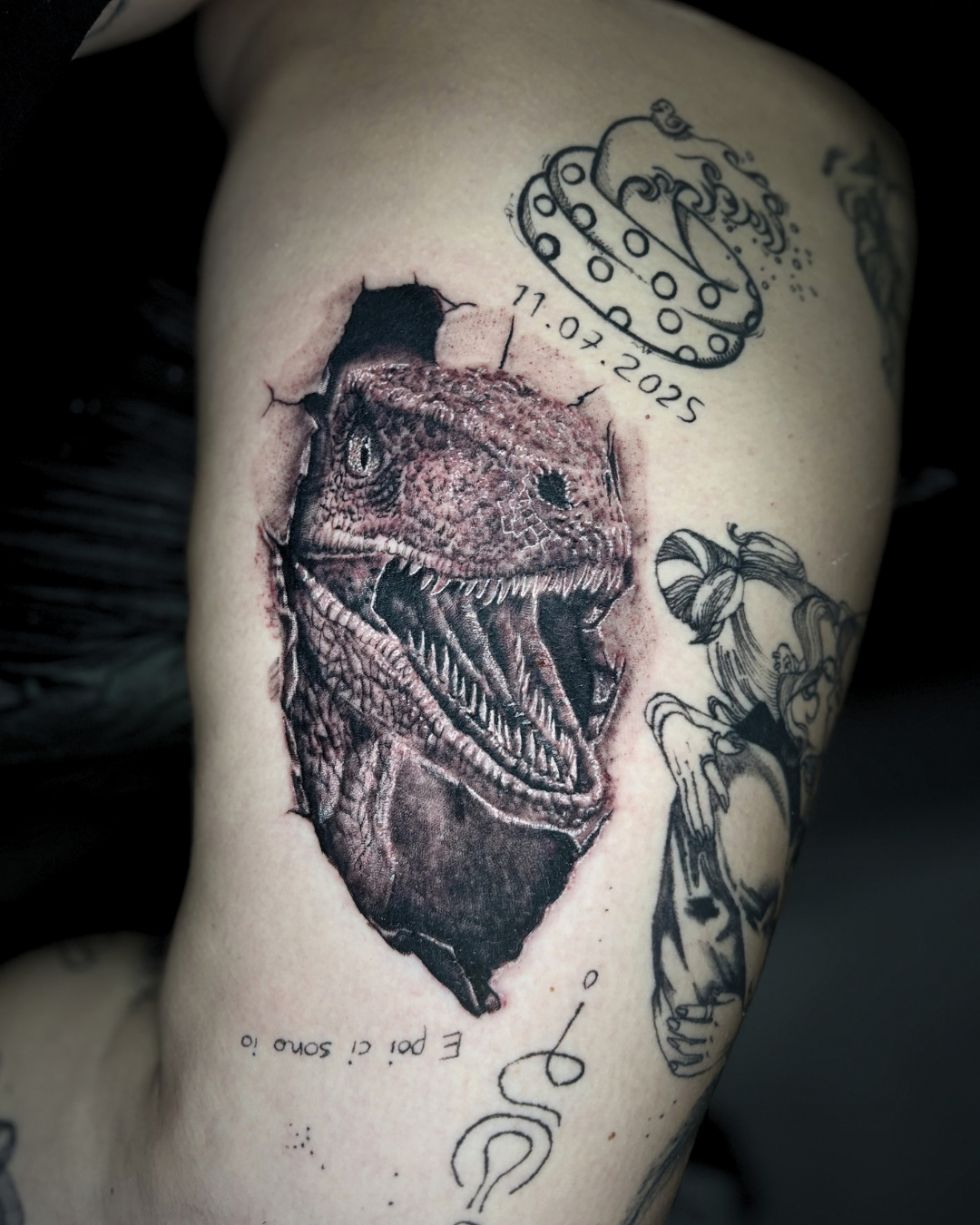
This design takes dinosaur realism in a much darker direction. A large predatory dinosaur appears to be breaking through the skin, with an irregular torn opening framing the head. The illusion gives the tattoo an immediate three-dimensional quality.
The open mouth dominates the composition. Rows of individually defined teeth surround a deep black interior, while dense texturing across the snout creates convincing reptilian skin. Dark shading around the torn edges further separates the dinosaur from the surrounding skin.
Rather than depicting a complete animal, the tattoo concentrates on the most intimidating features: the eye, jaws, scales, and teeth. That makes it particularly effective for collectors who want realistic dinosaur tattoo ideas with a horror-inspired edge.
The piece also works well among existing tattoos because its irregular outline does not require a perfectly empty rectangular area. It can feel like another strange artifact emerging between older pieces.
T-Rex Wearing Sunglasses Tattoo
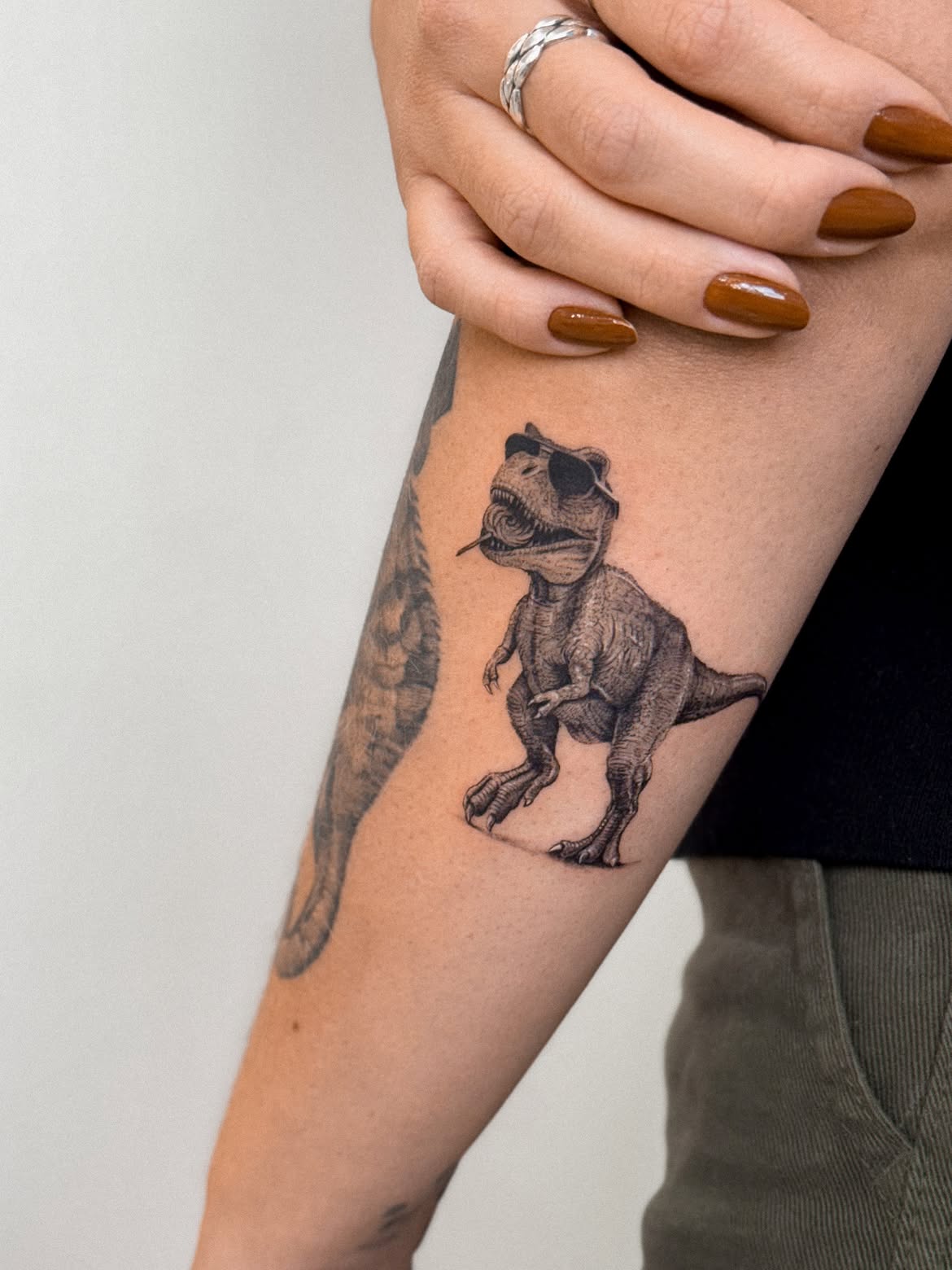
Sometimes the best dinosaur tattoos are the ones that refuse to take themselves seriously. This small T-Rex is rendered with surprisingly realistic anatomy but wears oversized dark sunglasses and holds what appears to be a thin stick or toothpick in its mouth.
That combination creates an instantly humorous personality. The dinosaur’s textured skin, muscular legs, heavy tail, and tiny arms could belong to a conventional black-and-grey illustration, but the accessories completely change the mood.
Fine stippling and short lines build texture across the body without turning the tattoo into a solid dark silhouette. The sunglasses provide the strongest black area, naturally pulling attention toward the face.
This is a fun alternative to a conventional cute cartoon dinosaur. It keeps enough realism for adult tattoo aesthetics while introducing a playful detail that makes the piece memorable. Similar concepts could easily incorporate hats, flowers, drinks, or other tiny accessories to create a more personalized character.
Cute Baby T-Rex Cartoon Tattoo
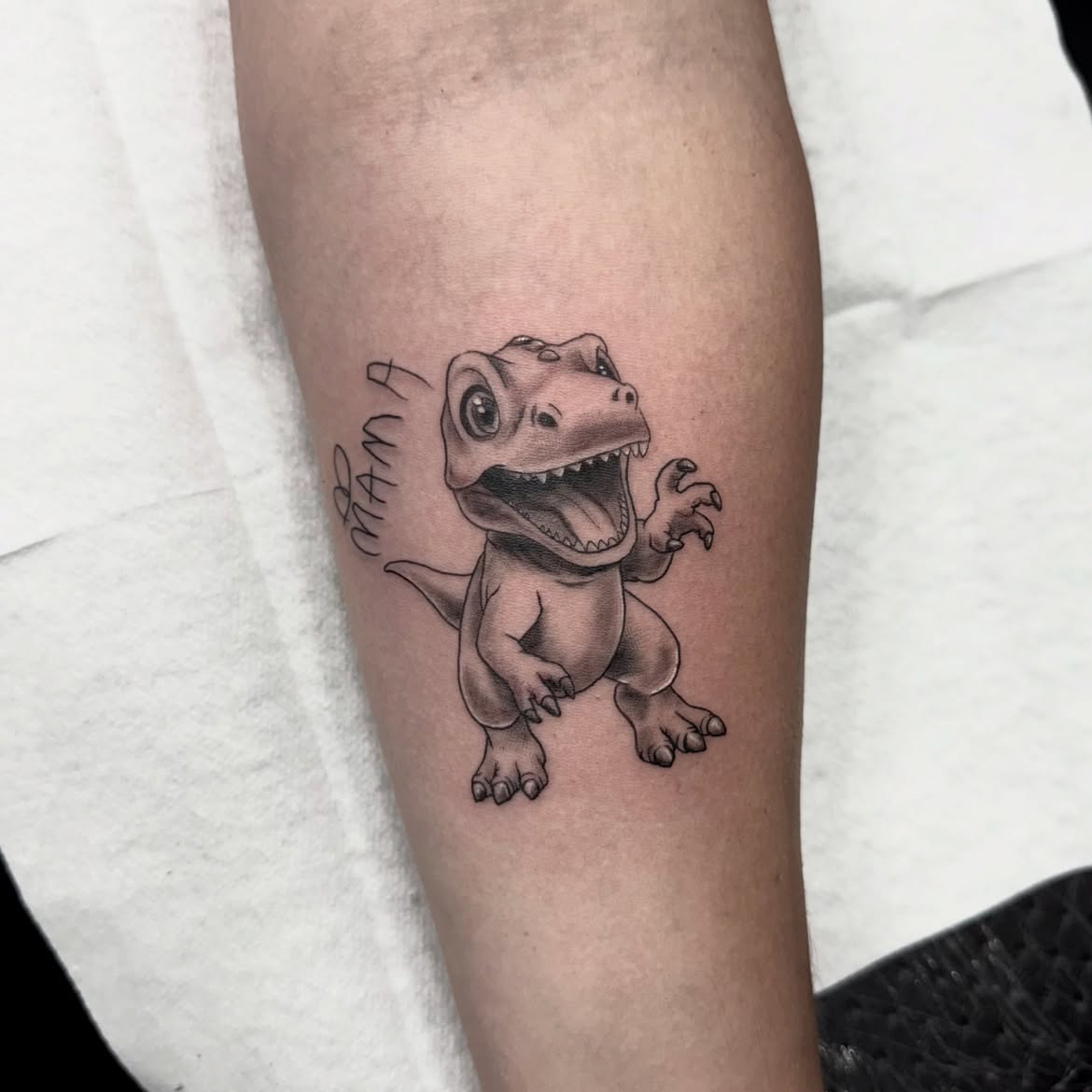
This cheerful baby T-Rex sits somewhere between animation and soft black-and-grey tattooing. The oversized head, huge expressive eye, rounded belly, short legs, and raised claw give the dinosaur an immediately friendly character.
Unlike extremely minimal cartoon designs, this one includes enough shading to create volume. Soft grey gradients appear around the cheeks, belly, limbs, and tail, while stronger blacks inside the mouth make the little teeth stand out. The large open smile becomes the emotional center of the design.
The result is unmistakably cute without feeling unfinished. It could work particularly well as a family-related tattoo, a nostalgic dinosaur piece, or even part of a collection of small prehistoric characters.
For anyone searching for simple dinosaur tattoo ideas, this illustrates an important option: simple does not necessarily mean outline-only. Carefully controlled shading can keep a compact design playful while giving it significantly more depth.
Baby Triceratops Hatching From an Egg
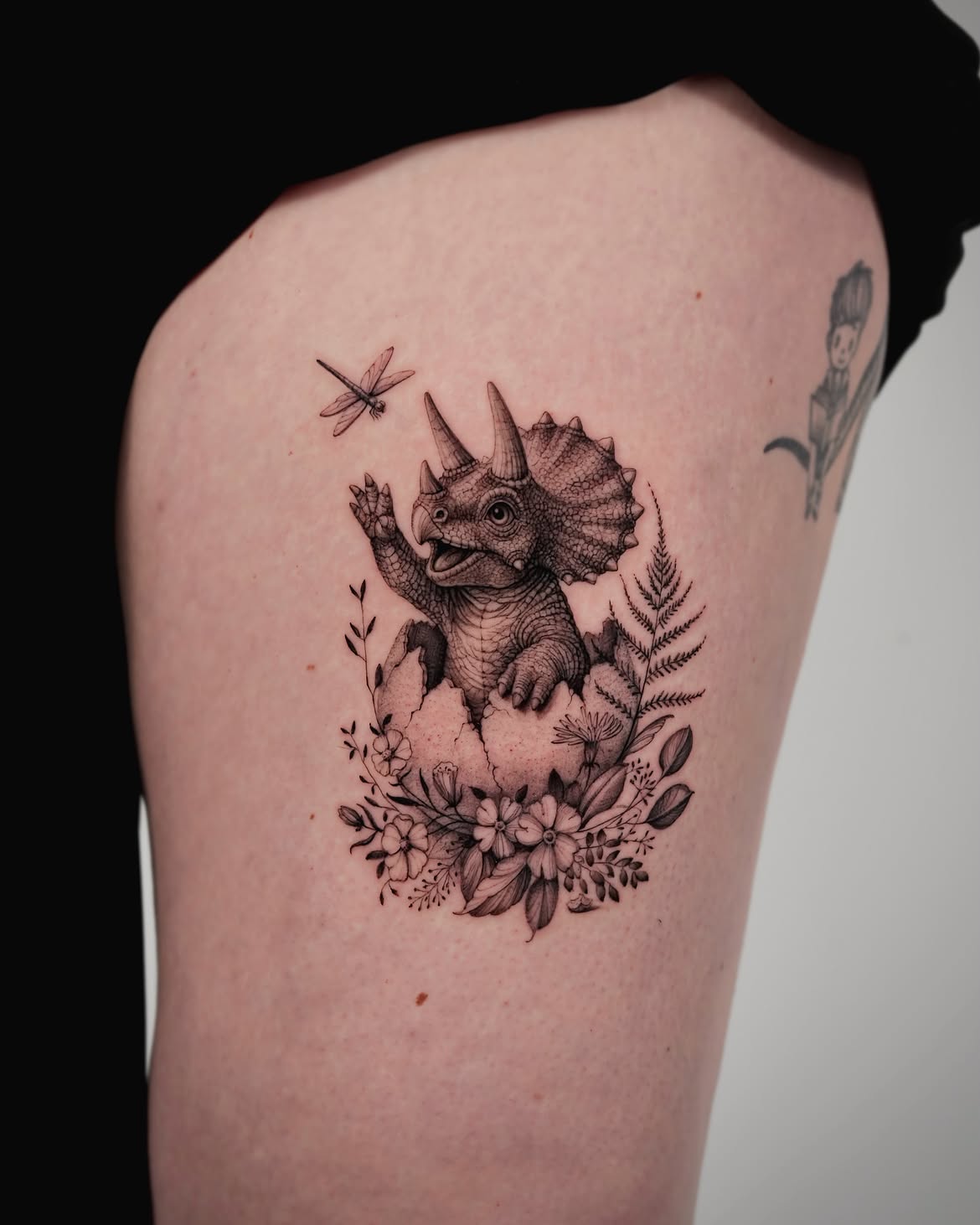
A baby triceratops emerging from a cracked egg creates one of the most charming concepts in this collection. The dinosaur lifts one tiny hand toward a hovering dragonfly while flowers and prehistoric-looking foliage form a delicate botanical frame underneath.
The technical detail is impressive. Tiny scales cover the face and frill, while the three horns remain clearly separated despite the relatively compact size. Fine stippling gives the egg a porous texture, and darker shadows inside the broken shell create convincing depth.
The surrounding floral elements make the design feel like a complete miniature scene rather than an isolated dinosaur. Ferns are especially appropriate because their ancient appearance reinforces the prehistoric theme.
Symbolically, the cracked egg can represent beginnings, childhood, growth, or a new chapter. That makes this an appealing option for a meaningful family tattoo as well as a purely decorative dinosaur design.
The dragonfly is an especially lovely touch. Its light silhouette balances the heavier dinosaur below and gives the triceratops something to interact with, adding a tiny narrative to the composition.
Large Realistic Velociraptor Black and Grey Tattoo
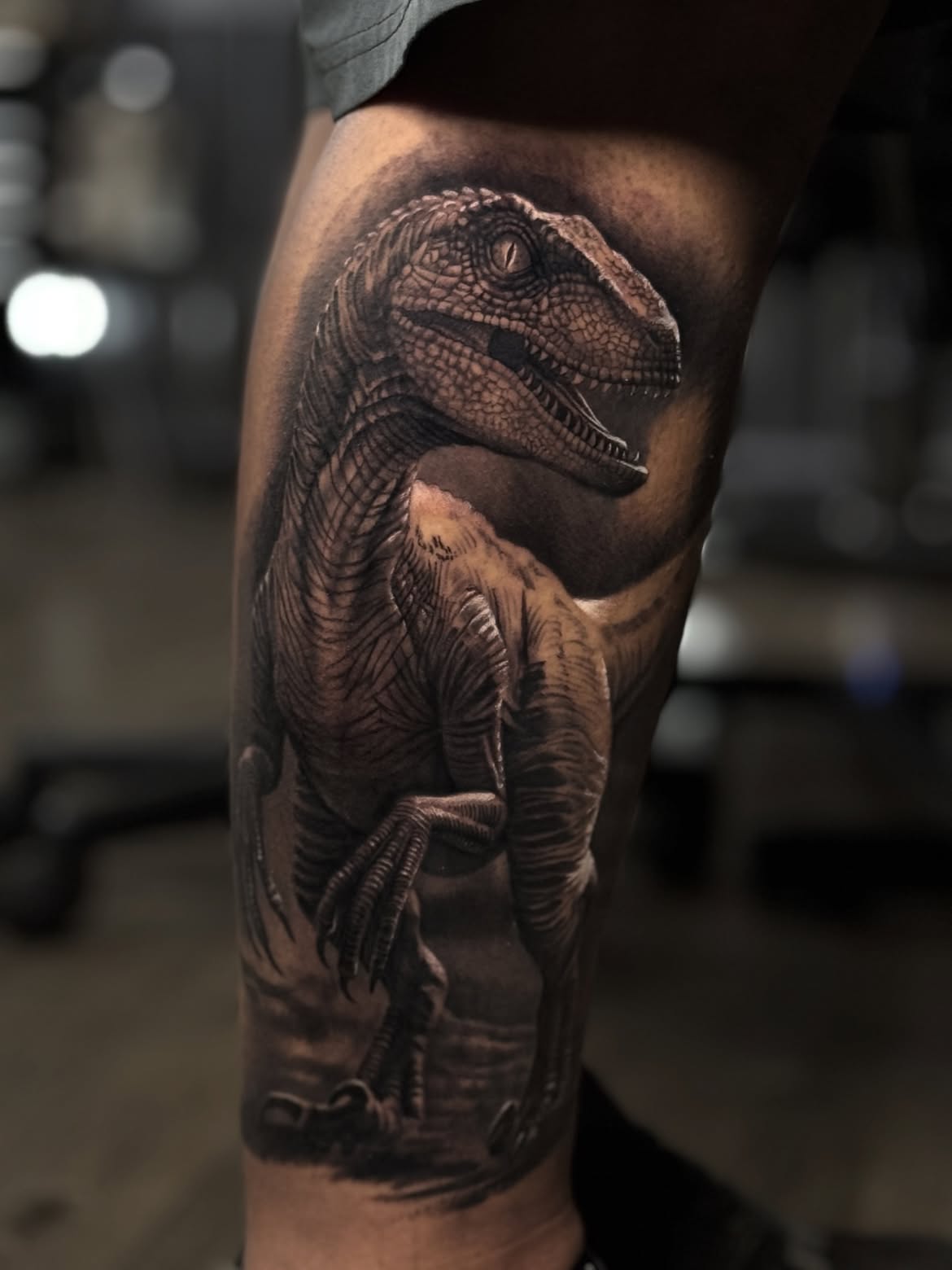
This large velociraptor tattoo is designed for maximum impact. The dinosaur fills most of the available limb space, allowing the artist to develop the head, neck, torso, arms, and reptilian skin with extensive black-and-grey detail.
The face is the natural focal point. Individual scales surround the eye and jaw, while subtle highlights along the snout separate the dinosaur from the dark background. Its partially open mouth exposes narrow teeth without turning the scene into an exaggerated attack pose.
The long neck and bent arms guide the eye downward through the composition. Dark atmospheric shading surrounds the dinosaur, creating depth and making lighter sections of the body appear illuminated. This contrast gives the tattoo an almost cinematic quality.
For men or women looking for substantial ideas realistic enough to become the centerpiece of a larger dinosaur sleeve, this is a strong reference. The scale allows textures that would simply disappear in a tiny tattoo, while the vertical composition follows the anatomy of the arm naturally.
Rather than presenting dinosaurs as nostalgic or cartoon subjects, this piece emphasizes the animal’s predatory character. It feels dark, immersive, and dramatic—a strong finale for a collection that shows just how many different directions dinosaur tattoo art can take.
T-Rex Skeleton Walking a Tiny Human
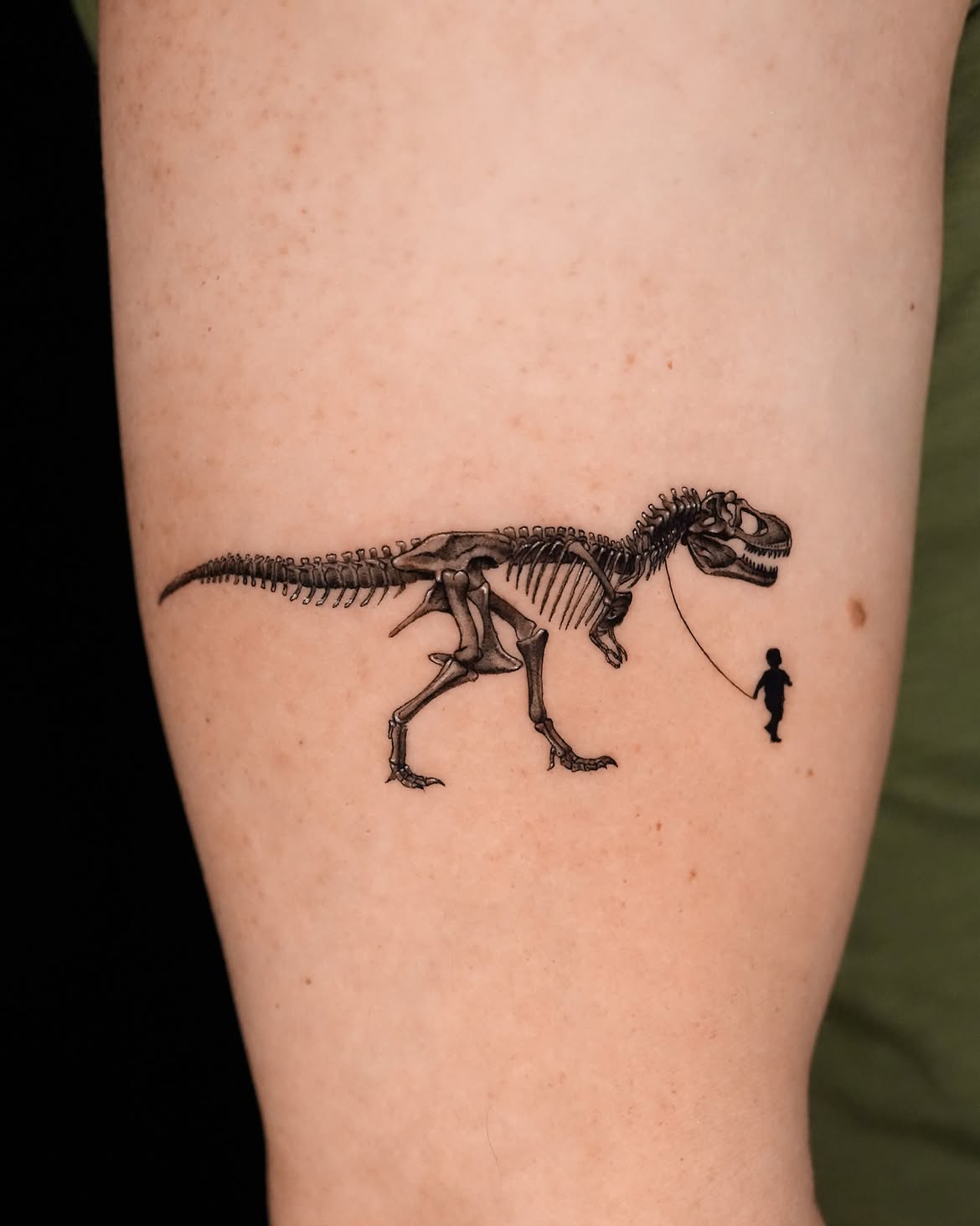
This imaginative dinosaur tattoo turns a museum-style T-Rex skeleton into a playful visual joke. The detailed prehistoric skeleton stretches horizontally across the skin, while a tiny human silhouette appears to be walking it on a thin leash. The enormous difference in scale between the two figures gives the design its humor and makes the concept instantly memorable.
The dinosaur itself is rendered with impressive anatomical precision. Individual vertebrae, ribs, leg bones, claws, pelvis, and skull structure remain clearly readable despite the relatively compact size. Fine black outlines are combined with restrained grey shading, creating depth without making the skeleton look overly heavy.
The tiny human is completely filled with black ink, providing a clever contrast to the intricate skeletal structure. The extremely thin leash connects both subjects and becomes an important storytelling element despite occupying almost no visual space.
This is a great option for anyone who likes dinosaur skeleton tattoo ideas but wants something more original than a straightforward fossil illustration. It combines paleontology, fine line detail, humor, and minimalist storytelling in one compact design.
Dachshund and T-Rex Hybrid Tattoo
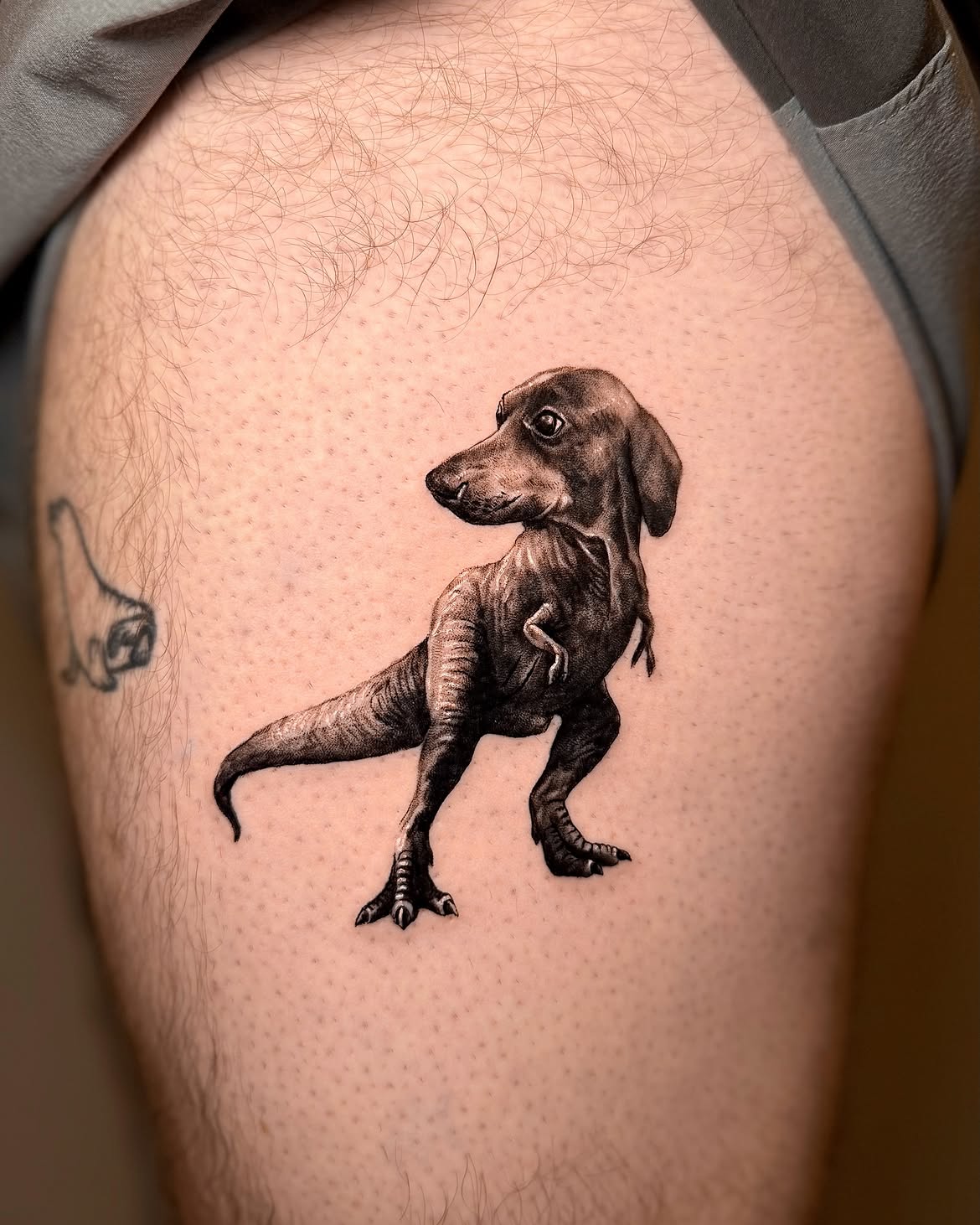
This unusual tattoo combines two completely different animals into one wonderfully strange character: the recognizable head of a dachshund sits on the powerful body of a T-Rex. The result feels simultaneously realistic, funny, and surprisingly believable.
The dog’s face receives particularly careful attention. Soft black-and-grey shading defines the long muzzle, floppy ears, expressive eye, and subtle folds around the neck. Instead of transitioning into a normal canine body, however, the portrait continues into muscular dinosaur legs, tiny prehistoric arms, and a long reptilian tail.
The contrast is what makes the tattoo work. A dachshund’s gentle expression clashes perfectly with the imposing stance of a prehistoric predator. Fine highlights across the face and body prevent the darker shading from becoming flat, while the absence of a background keeps all attention on the hybrid creature.
For people searching for cute, funny, or genuinely unique dinosaur tattoo ideas, this is a fantastic source of inspiration. The same concept could also be customized around a beloved pet, transforming a conventional dog portrait into a playful dinosaur design with much more personality.
Dinosaur tattoos have moved far beyond the predictable roaring T-Rex. A miniature parent-and-baby drawing can carry as much personality as a meticulously shaded velociraptor, while fossils, botanical sauropods, hatching raptors, and tiny collections open the theme to completely different aesthetics. Whether your favorite direction is Minimalist, Fine line, Floral, Traditional, Cartoon, or deeply Realistic, the strongest design is usually the one that fits both your personality and the anatomy of its placement. If one of these ideas has given you inspiration—or you already have a dinosaur tattoo of your own—leave a comment and tell us which prehistoric creature you would choose.