
Ladybugs have always carried an unusually cheerful reputation. They are tiny enough to feel delicate, instantly recognizable because of their red wings and black spots, and surrounded by associations with luck, protection, love, and positive change. That combination makes them surprisingly versatile tattoo subjects. Looking through Ladybug tattoo ideas 2026, it is clear that artists are moving far beyond the basic cartoon-like insect: miniature realism, fine line botanicals, playful heart shapes, and almost impossibly small designs are all finding their place.
One thing I particularly like about a ladybug tattoo is that it does not demand a large canvas. A wrist, ankle, shoulder, hip, or even a discreet spot behind ear can be enough. At the same time, adding flowers or experimenting with a more detailed realistic technique can turn the same motif into a much more substantial composition.
The 30 designs below show just how much personality can fit into such a small subject.
Tiny Realistic Ladybug on the Hand
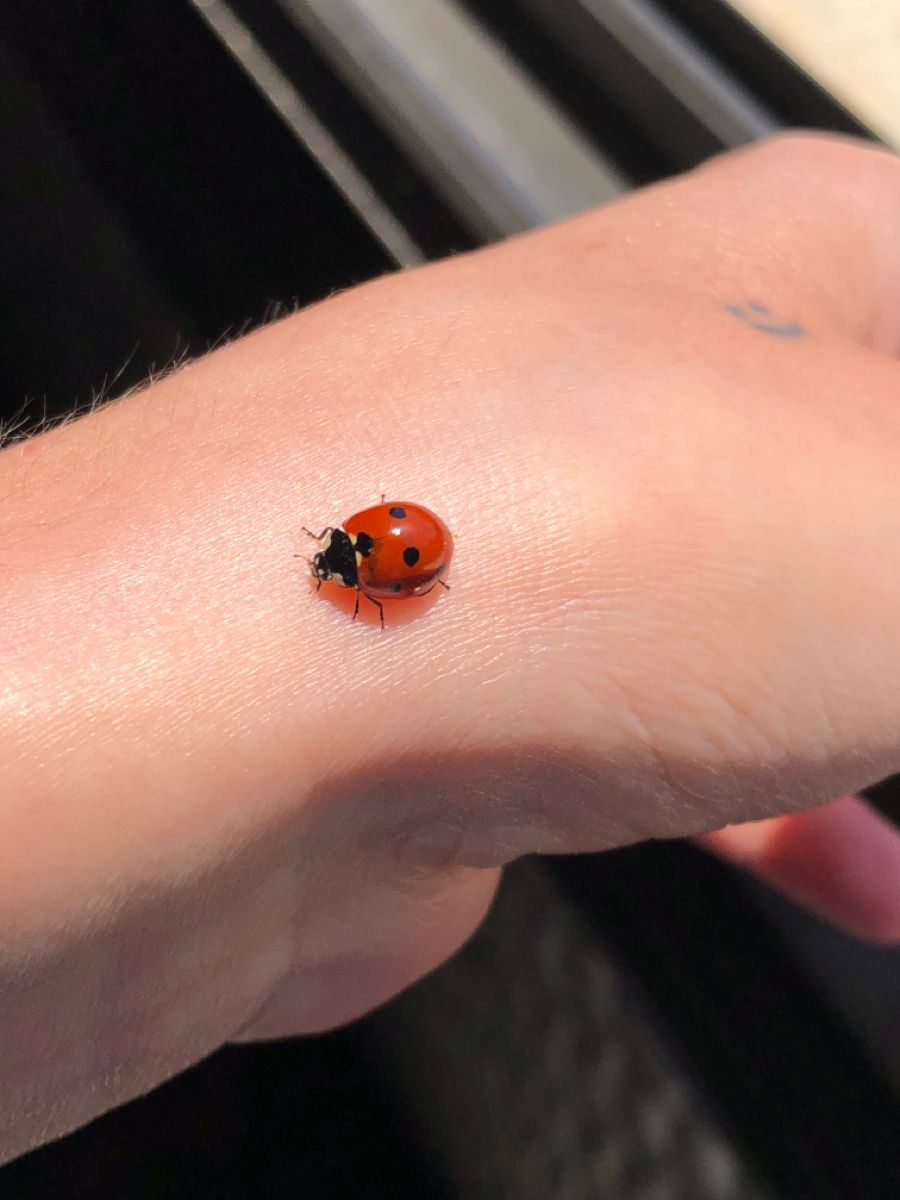
Few tattoo concepts play with perception as effectively as this tiny ladybug design. Positioned on the hand, it recreates the appearance of a real insect that has simply landed on the skin. The scale is crucial here: making the ladybug much larger would immediately remove some of the illusion, while this miniature format keeps the design wonderfully believable.
The bright red shell is divided by a fine central line and marked with irregular black spots. Dark detailing around the head, antennae, and extremely slender legs provides enough definition without surrounding the insect with a heavy outline. Subtle darker tones around the edges of the shell also create dimension, giving the body a gently rounded appearance.
This is a good example of how realistic tattooing can work even at a tiny scale. Anyone considering a similar design should pay particular attention to the artist’s portfolio of micro tattoos. Very small legs, antennae, and highlights require confident needle control, and these details need to remain readable after healing.
The hand is also an interesting placement because it reinforces the illusion that the insect has just landed there. For someone who wants a cute tattoo without flowers, lettering, or additional symbolism, this kind of miniature ladybug feels complete on its own.
Small Ladybug Hip Tattoo
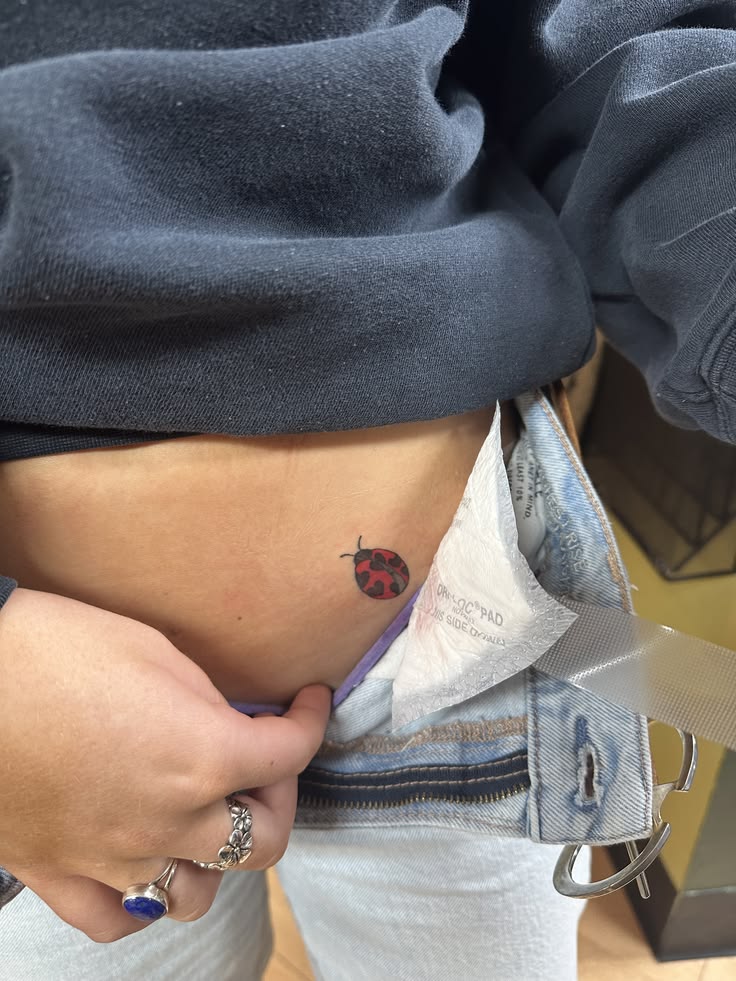
A tiny ladybug placed at the hip offers a completely different mood. Instead of being constantly visible, the tattoo can disappear beneath clothing and become a more personal detail. That sense of discovery suits the scale of the motif beautifully.
The insect itself has a compact oval silhouette with a rich red base and large dark markings. Rather than relying on extensive shading, the artist uses strong areas of color to make the ladybug immediately recognizable. Fine antennae extending beyond the body prevent the shape from becoming too graphic or flat.
For anyone collecting simple ladybug tattoo ideas, this is an especially useful reference. There is no decorative frame and no unnecessary background. The design succeeds because of proportion, color, and thoughtful placement.
A dainty hip tattoo like this can also work well as part of a future collection of tiny pieces. A little flower, bee and ladybug combination, miniature fruit, or another insect could eventually be added nearby without disturbing the original composition. On its own, however, it has the charming simplicity that makes small tattoos so appealing.
Fine Line Ladybug and Flowers Tattoo
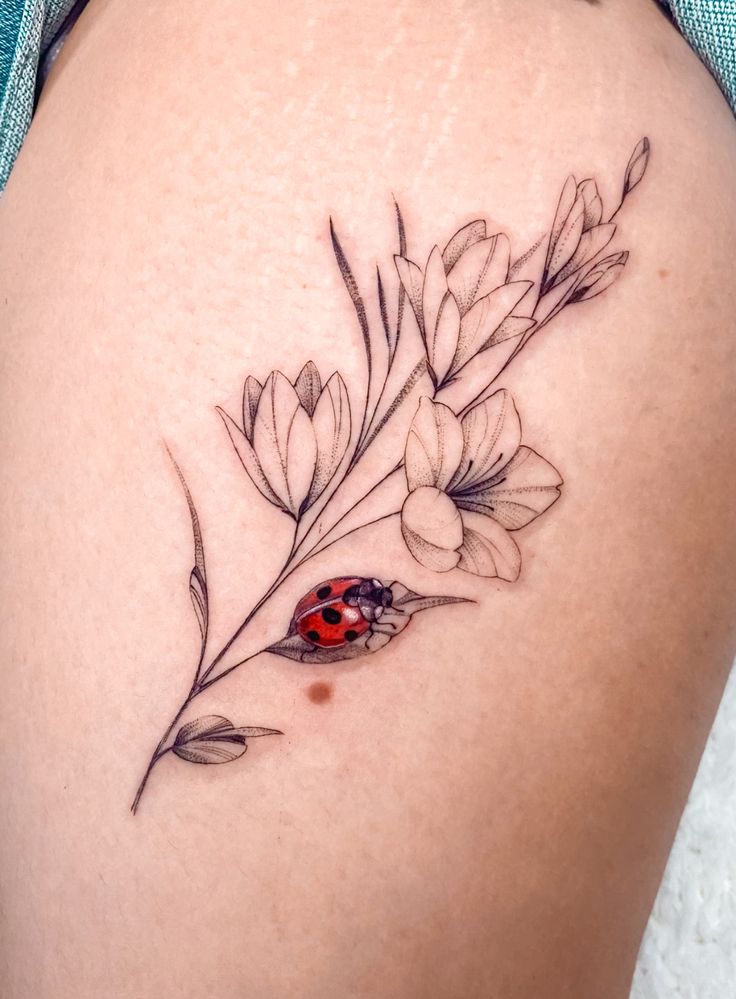
This botanical piece takes the ladybug motif in a more romantic direction. A slender flowering branch stretches diagonally across the skin, creating an elegant framework around a small red insect. Most of the composition remains restrained and nearly monochromatic, so the ladybug becomes the natural focal point.
The fine line work is particularly attractive. Narrow stems, elongated leaves, overlapping petals, and delicate interior textures give the flowers enough detail without making them visually heavy. Dotwork and whisper-light shading introduce depth while preserving the airy character of the composition.
Then comes the color contrast. The ladybug’s saturated red shell immediately catches the eye against the predominantly black and white botanical drawing. Its body contains considerably more concentrated shading than the flowers, making the insect feel almost three-dimensional against the softer linework.
I often find that selective color works better than filling an entire botanical tattoo with pigment. Here it gives the composition a clear visual hierarchy: first you notice the ladybug, then your eye travels along the stems and flowers.
There is plenty of room to personalize a similar design stencil. The flowers could be selected for their personal meaning, birth month, family connection, or simply their shape. It is also a strong idea for someone who likes minimalist botanical tattoos but wants one vivid detail to prevent the finished piece from feeling too conventional.
Micro Ladybug Shoulder Tattoo
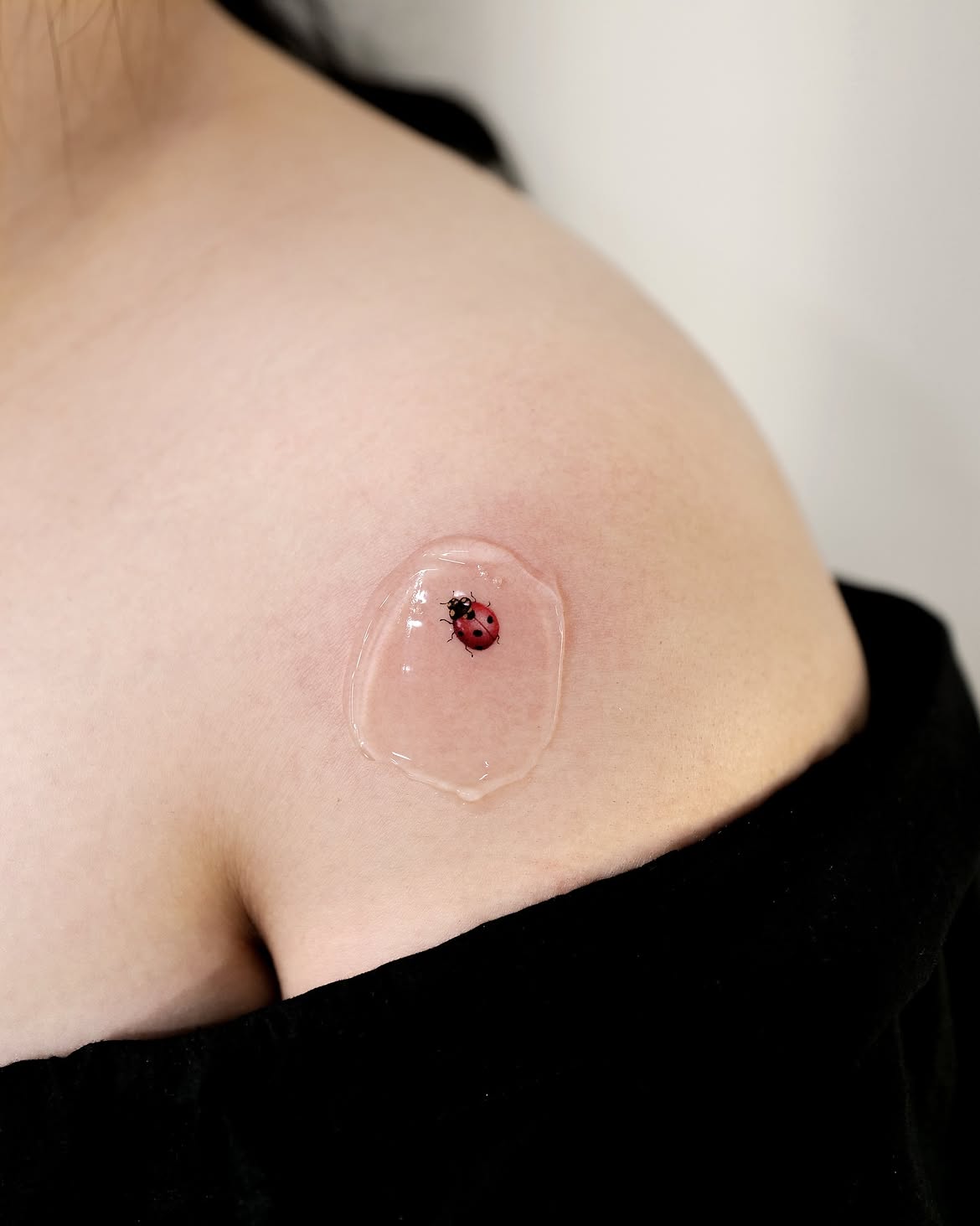
The shoulder provides a surprisingly effective canvas for an extremely small tattoo. Rather than filling the available space, this design deliberately leaves almost all of it untouched. The result is a miniature ladybug that feels like a tiny jewel against the skin.
Its scale pushes the concept toward micro realism. The shell contains bright red pigment, several crisp black dots, a darker central division, and tiny highlights that suggest a glossy surface. The black head and minuscule legs complete the illusion without requiring a conventional bold outline.
This approach is particularly relevant to minimalist tattoo trends in 2026. Minimalism does not necessarily mean drawing an object with only three lines. A tattoo can be technically detailed while still feeling minimalist because of its size, isolated placement, and generous negative space.
The shoulder also offers practical styling possibilities. A sleeveless top can reveal the tattoo completely, while other clothing can cover it easily. The same micro concept could translate nicely to the wrist, collarbone, ankle, or behind ear area depending on how visible you want the piece to be.
For a tattoo this small, however, it is worth discussing longevity with the artist rather than insisting on photographic detail at any cost. A skilled artist will know which microscopic features can be simplified so the ladybug continues to read clearly as the tattoo ages.
Tiny Realistic Ladybug on the Forearm
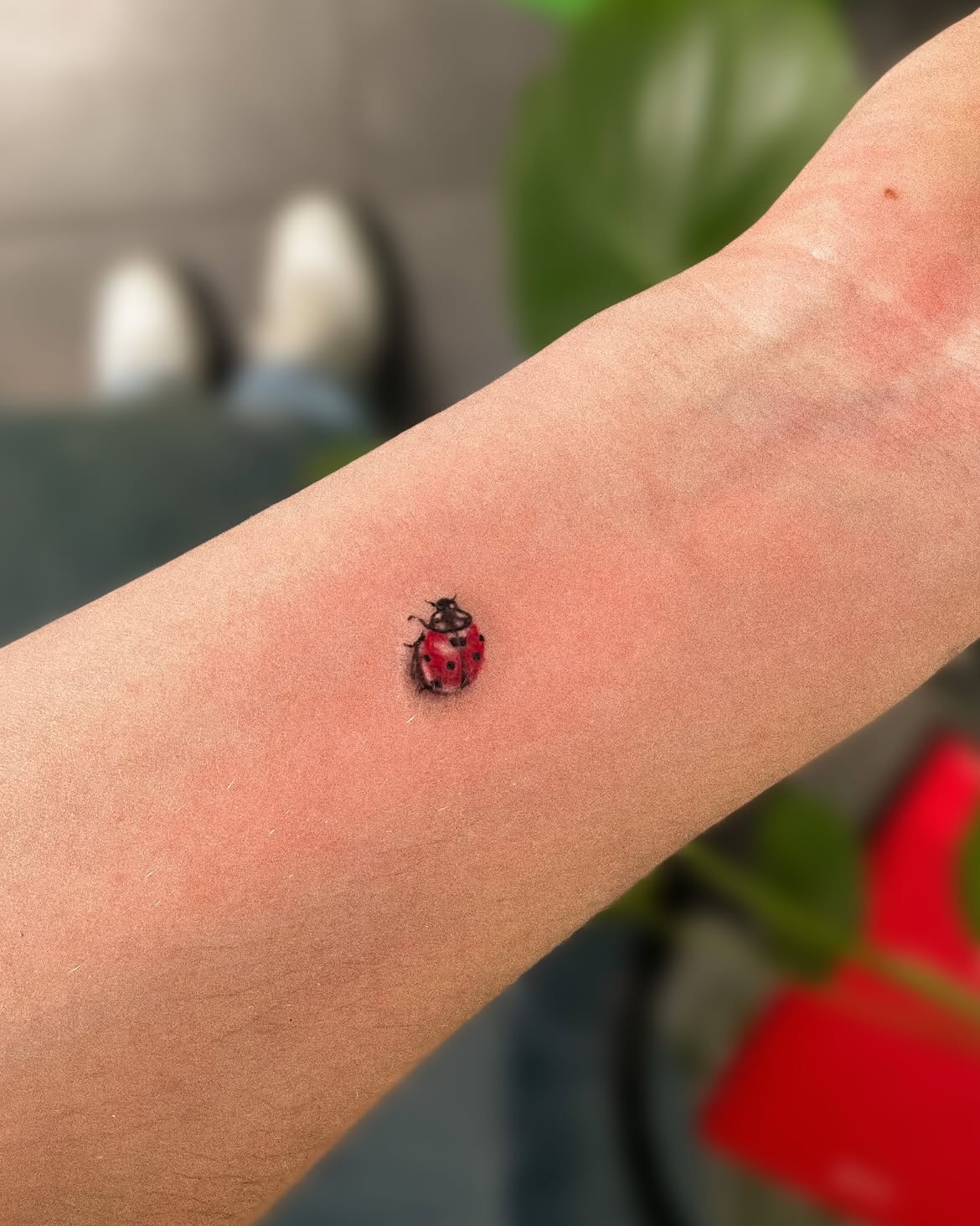
This forearm design captures the slightly imperfect appearance of an actual ladybug rather than turning the insect into a polished symbol. That makes it particularly charming.
The red wing cases contain tiny black spots, while the head and legs are rendered with dark, concentrated pigment. Soft tonal variation around the body creates volume, and the edges are not excessively graphic. From a short distance, the tattoo could genuinely be mistaken for an insect resting on the arm.
Forearm placement works beautifully for this type of realistic design because the relatively open skin allows the ladybug to remain visually isolated. There is no need for decorative filler. Negative space becomes part of the composition.
This is also an appealing direction for people who want something cute without making it overtly whimsical. The ladybug itself provides the charm, while the realistic execution keeps the tattoo sophisticated.
The meaning can remain equally uncomplicated. Ladybugs are commonly associated with good fortune and positive transformation, which makes the motif suitable for marking a new beginning without spelling out the story through text. Sometimes a tiny symbol understood primarily by its wearer feels more personal than a large explanatory piece.
Micro Ladybug Wrist Tattoo
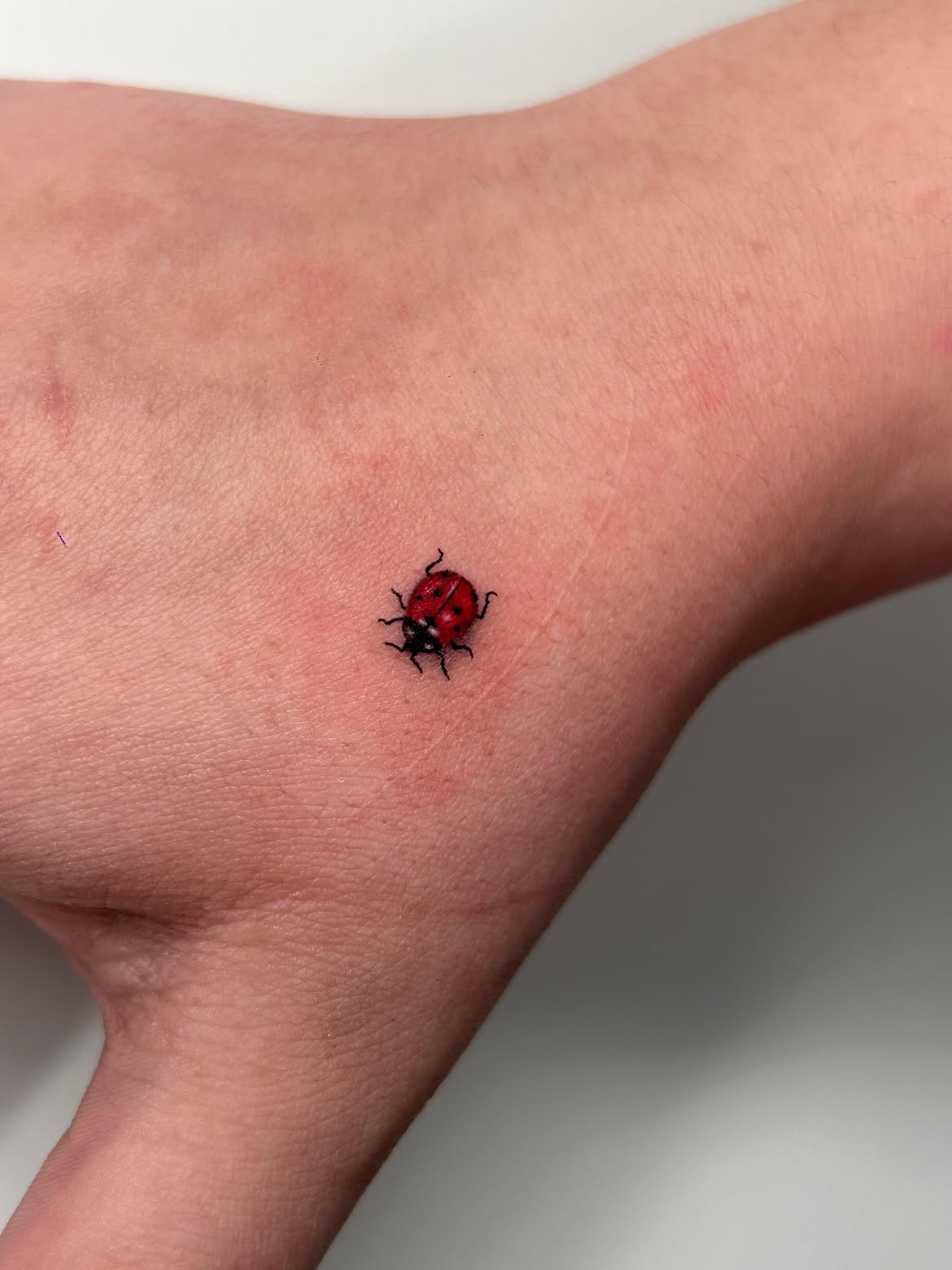
The wrist is practically made for tiny tattoos, and this miniature ladybug shows why. Its small proportions complement the narrow area rather than competing with it, while the bright red color gives the design enough presence to remain noticeable.
The tattoo uses a richer mix of red and black than a conventional fine line piece. Dark shading around the head and underside gives the insect visual weight, while thin irregular legs make the silhouette more natural. Tiny highlights across the wing cases create the impression of a glossy shell.
What makes this example interesting is its slightly organic quality. Perfect symmetry would have pushed it toward an icon or stencil aesthetic; instead, the uneven little legs and natural body proportions create character.
For anyone thinking about matching tattoos, this scale could work especially well. Two people could choose nearly identical ladybugs but alter the number of spots, orientation, placement, or a tiny accompanying element. A group of 3 friends could even use three subtly different insects rather than reproducing exactly the same design.
A ladybug in a flying position could be another variation for the wrist, particularly if the wings are opened slightly. The essential idea remains the same: keep the tattoo small enough to complement the anatomy while allowing enough detail to make the insect immediately recognizable.
Heart-Shaped Ladybug Ankle Tattoo
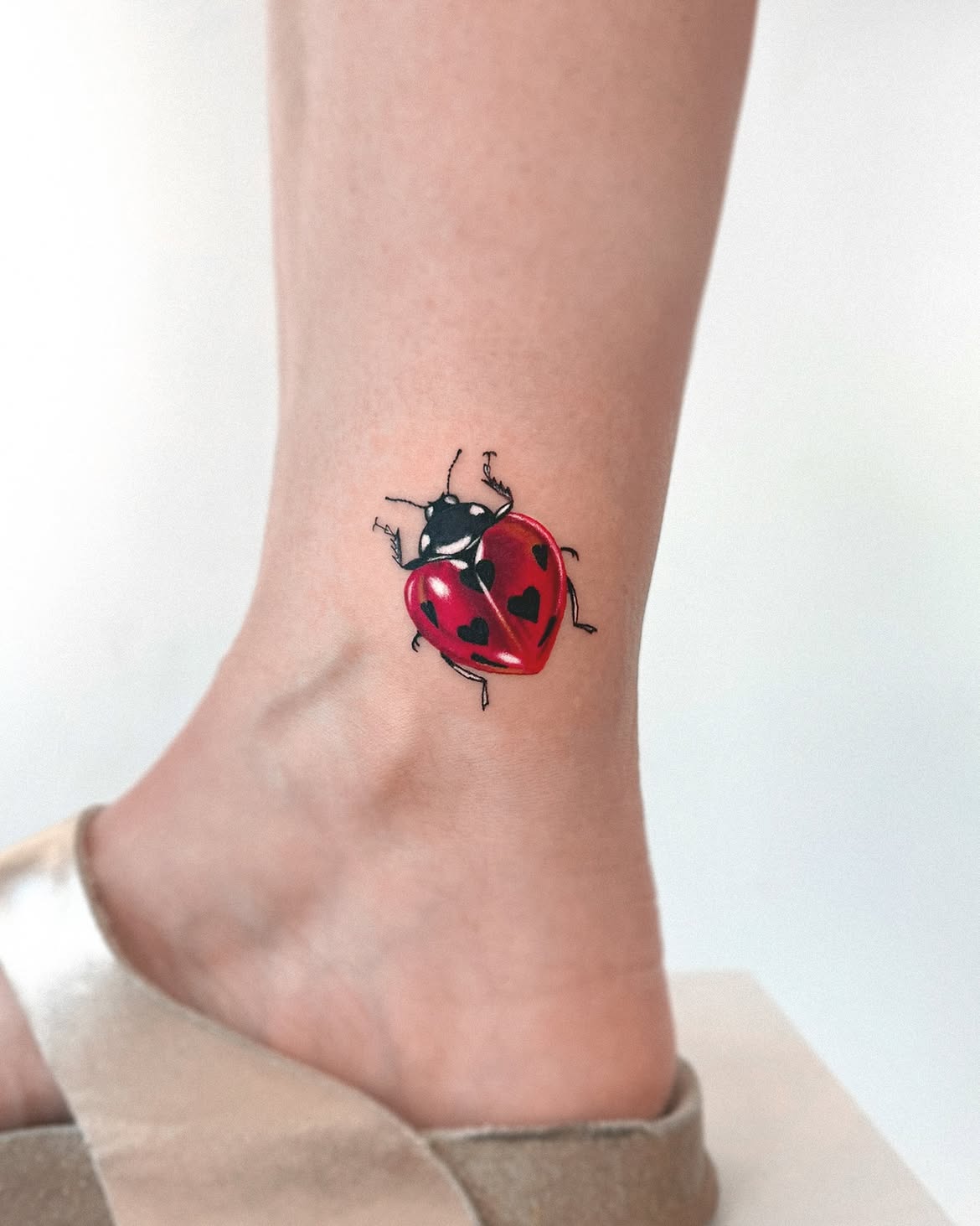
This is easily the most playful interpretation in the group. Instead of reproducing the natural oval shell of a ladybug, the artist transforms its wings into a glossy red heart. Even the black markings continue the theme, with several spots shaped like tiny hearts.
The result sits somewhere between realism and illustration. Fine black legs and antennae preserve the insect identity, while bright highlights across the red shell create a polished, almost enamel-like finish. The dark head provides a strong contrast against the luminous body.
The ankle is a particularly flattering placement for this design. The tattoo is visible with sandals, cropped trousers, or skirts but remains compact enough not to dominate the leg. Its vertical orientation also follows the natural transition between the ankle and lower leg.
For someone searching for cute or romantic Ladybug tattoo ideas 2026, this is a clever alternative to adding separate hearts around a conventional insect. The symbolism is built directly into the anatomy of the ladybug.
It could also inspire a more traditional interpretation. An American traditional artist might use a heavier black outline, flatter red fill, and simplified heart spots, while a contemporary realism artist could push the reflective highlights even further. A simple version could remove most of the shading and reduce the concept to a clean red heart shell with black legs.
That adaptability is part of the appeal. The same basic idea can become bold, delicate, romantic, or slightly quirky depending on the artist’s visual language.
Realistic Ladybug with Purple Flowers
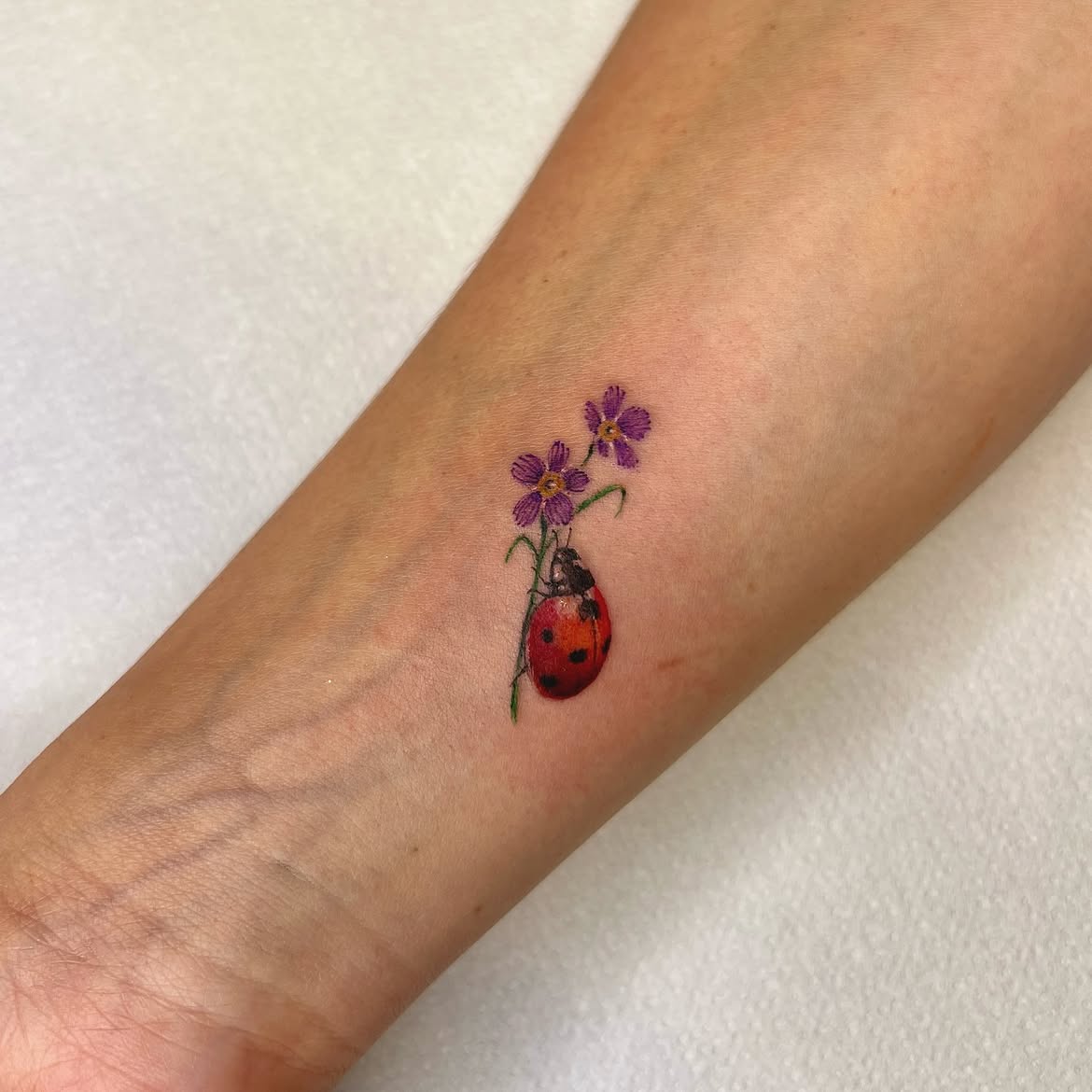
This design gives the familiar red ladybug a softer botanical personality by pairing it with two small purple flowers. The insect sits beneath the blossoms as though it has climbed naturally onto their thin green stems, making the tattoo feel more like a tiny fragment of a garden than a collection of separate decorative elements.
The ladybug itself leans toward realistic tattooing. Deep red pigment is softened with darker shading toward the lower edge, while irregular black spots and a detailed head keep the insect from looking overly polished. The delicate legs wrapping around the stems are an especially nice touch. They connect the two subjects and give the design a convincing sense of interaction.
Color is what gives this piece its personality. Purple petals, green stems, a warm yellow flower center, and the bright red shell create a surprisingly rich palette for such a small tattoo. Yet nothing feels crowded because the artist keeps the composition narrow and vertical.
For anyone who likes nature-inspired ladybug tattoo ideas, this is an easy concept to personalize. The flowers could be swapped for birth flowers or plants with personal meaning, while the ladybug could remain the vivid focal point. It is also a lovely compromise between a dainty floral tattoo and miniature realism.
Tiny Ladybug Collarbone Tattoo
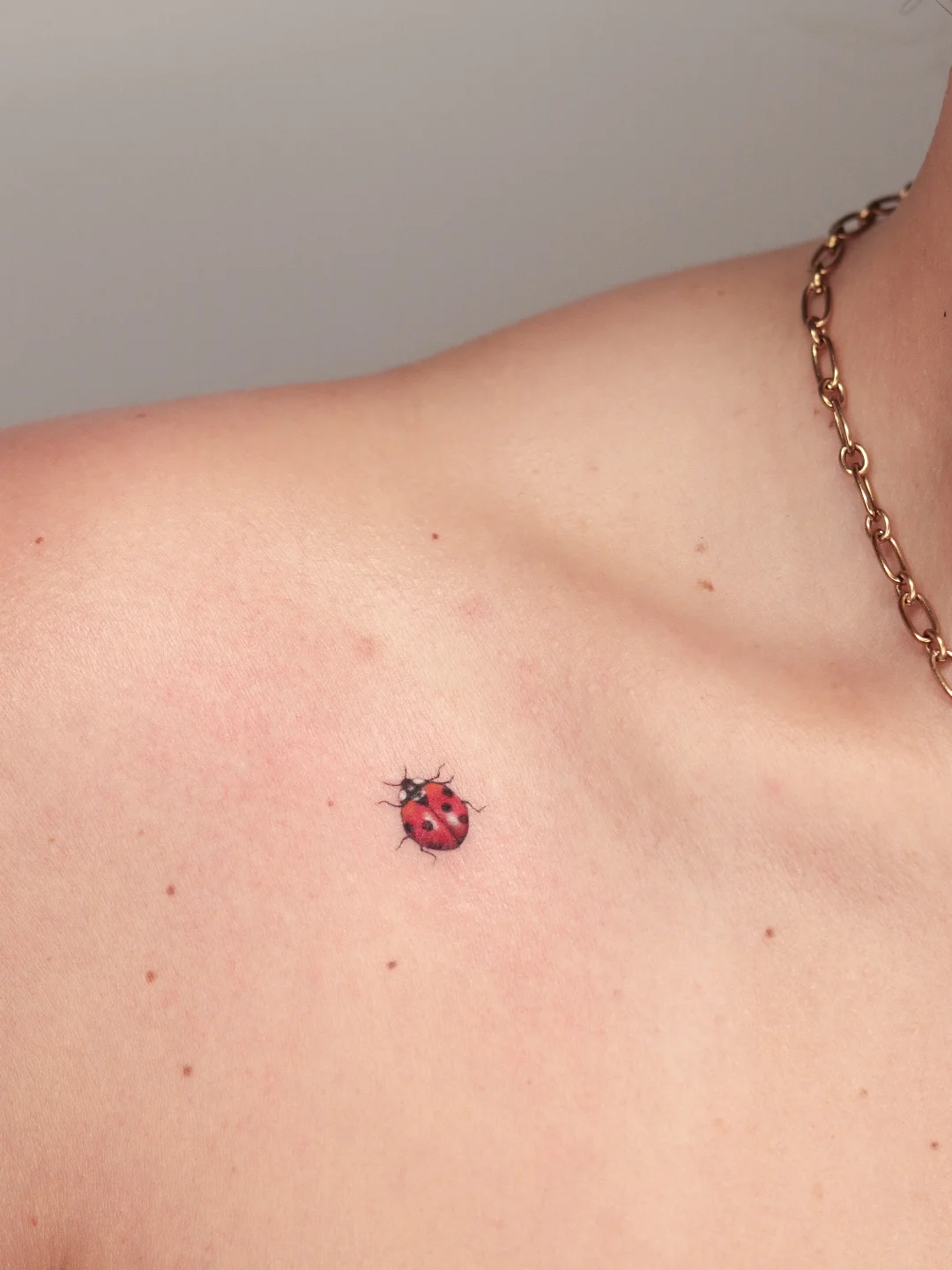
A solitary ladybug near the collarbone proves how effectively strategic placement can transform a very small tattoo. There is no decorative border, lettering, or botanical filler here. The design simply occupies a quiet area of open skin, and that negative space becomes part of its appeal.
The insect is rendered with a bright red shell, scattered black spots, a dark head, and exceptionally fine legs and antennae. Small white highlights on the wings create the rounded shine associated with a real ladybug. Despite its tiny proportions, the artist manages to retain enough tonal variation for the body to feel dimensional.
What I like most about this approach is that it never tries too hard. A tattoo does not need to fill every available centimeter to feel intentional. In fact, the isolated position makes this ladybug more noticeable precisely because there is nothing competing with it.
It is an excellent reference for someone considering a minimalist or simple design but still wanting more detail than a basic outline stencil. Similar micro tattoos could work near the shoulder, upper chest, behind ear, or along the wrist, although each location should be discussed with an artist to make sure the smallest details will age successfully.
Dainty Ladybug Wrist Tattoo
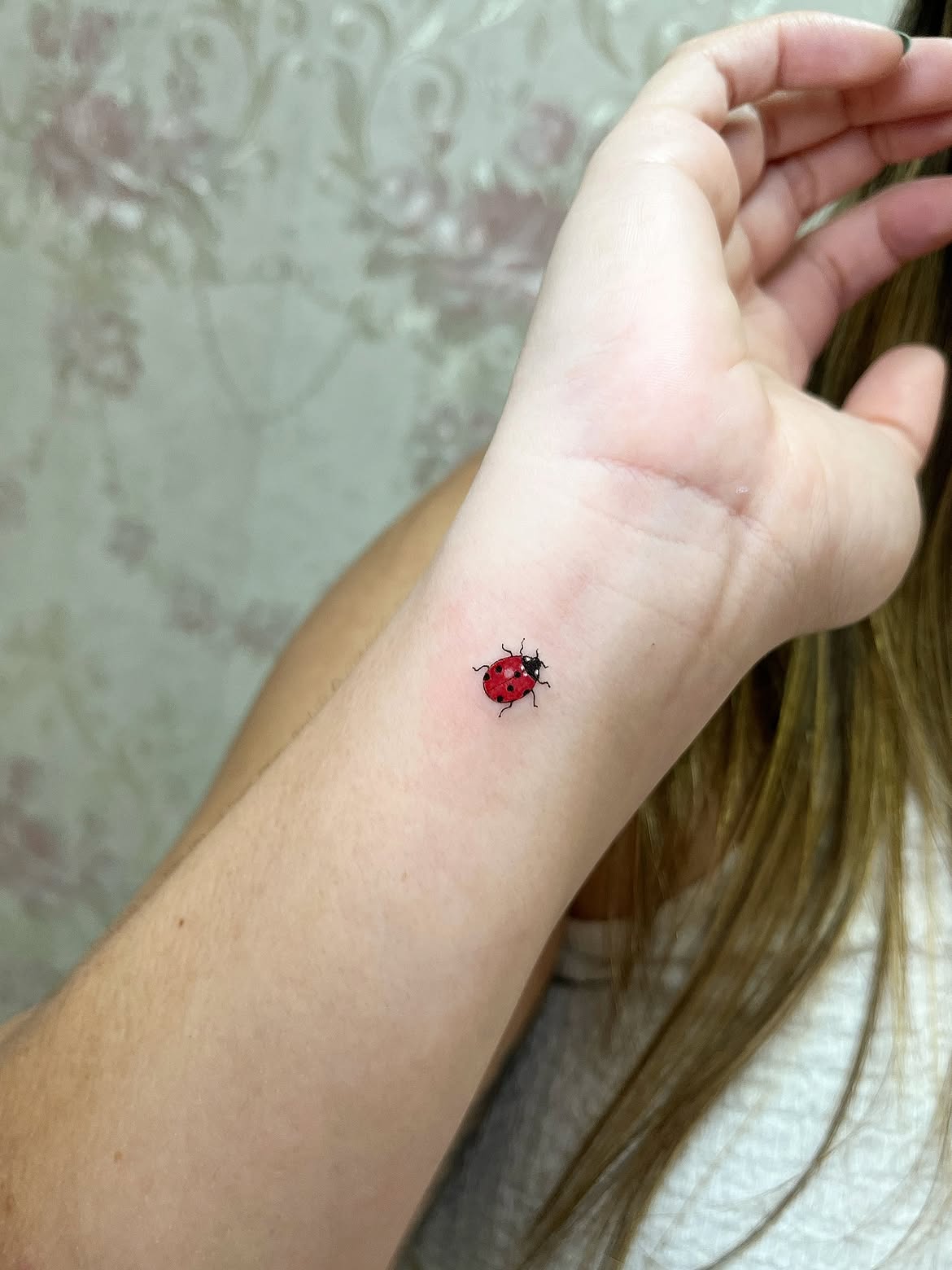
Here, the ladybug sits on the inner wrist, an intimate placement that works particularly well with miniature motifs. The design is small enough to remain delicate but colorful enough to avoid disappearing against the skin.
The red wings are divided by a crisp central line and decorated with recognizable black spots. The head is darker and slightly more concentrated, while extremely narrow antennae and legs introduce the fine line character that keeps the piece feeling light.
There is a pleasing balance between realism and simplicity. It is not a photorealistic insect, yet it has more dimension than a flat graphic icon. That middle ground makes the design highly wearable and gives it a distinctly cute quality without becoming childish.
This could also be an appealing concept for matching tattoos. Rather than copying every detail, two people might choose ladybugs facing opposite directions or place them on corresponding wrists. For 3 friends or family members, subtle differences in the number of spots could make each tattoo individual while preserving the shared idea.
Two Realistic Ladybugs Tattoo
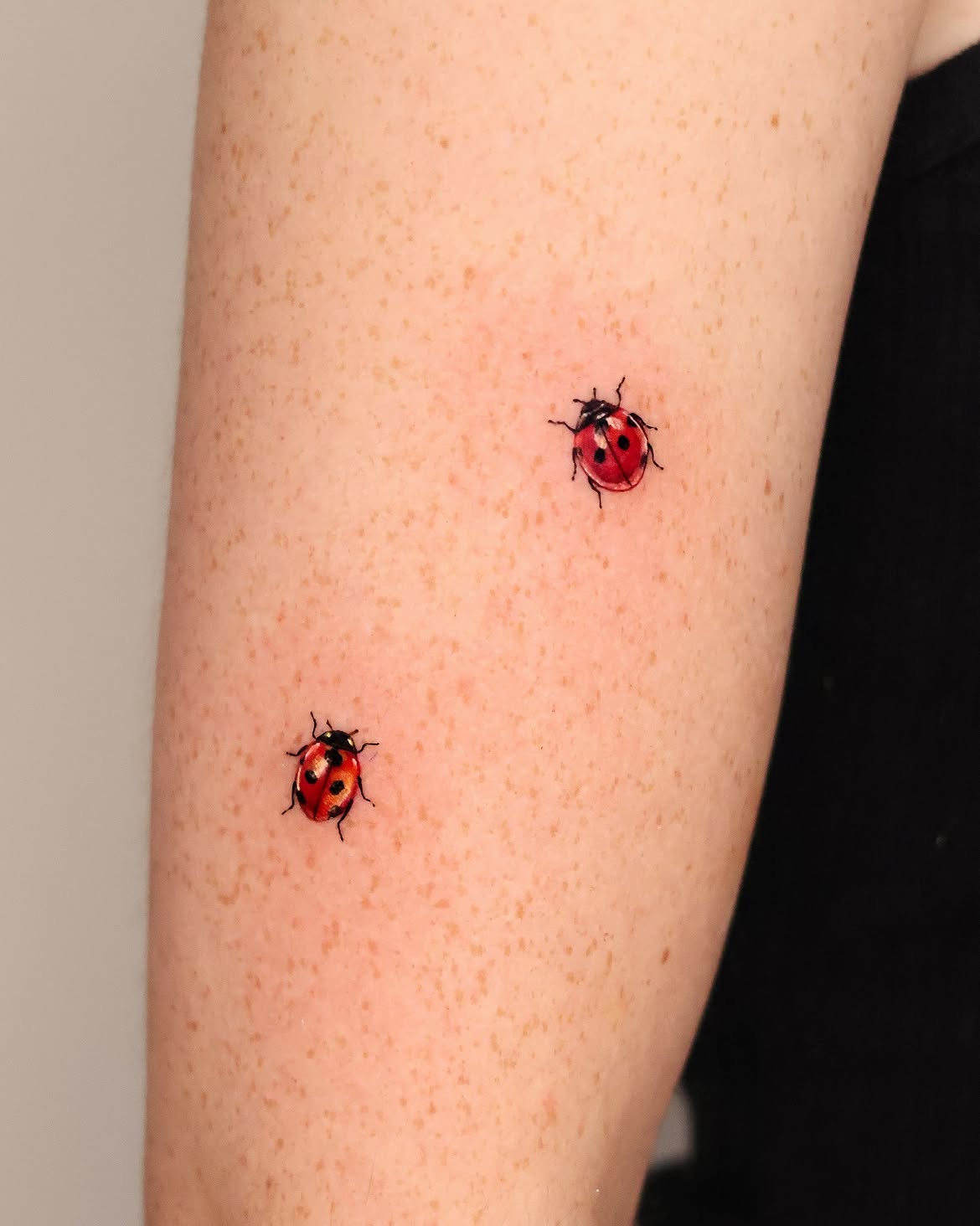
Two ladybugs moving across the skin turn a tiny insect motif into a miniature narrative. Their staggered positioning is important: instead of placing both insects side by side, the artist leaves a generous gap between them and angles each one slightly differently. The result suggests movement, almost as though they are following the same invisible path.
Both insects use vivid red and orange tones, glossy highlights, deep black markings, and slender legs. Small differences in their shell patterns make them feel individual rather than duplicated from the same design stencil.
This arrangement offers an interesting alternative to conventional matching tattoos. Two ladybugs can represent partners, siblings, parent and child, or simply two important parts of someone’s life. Their meaning does not need to be obvious to everyone else.
The concept could easily be expanded. A third insect would create a 3-ladybug composition, while one of the figures could be shown flying with its wings opening beneath the red shell. The key would be maintaining the generous negative space that makes this version feel natural rather than crowded.
Tiny Ladybug Upper Arm Tattoo
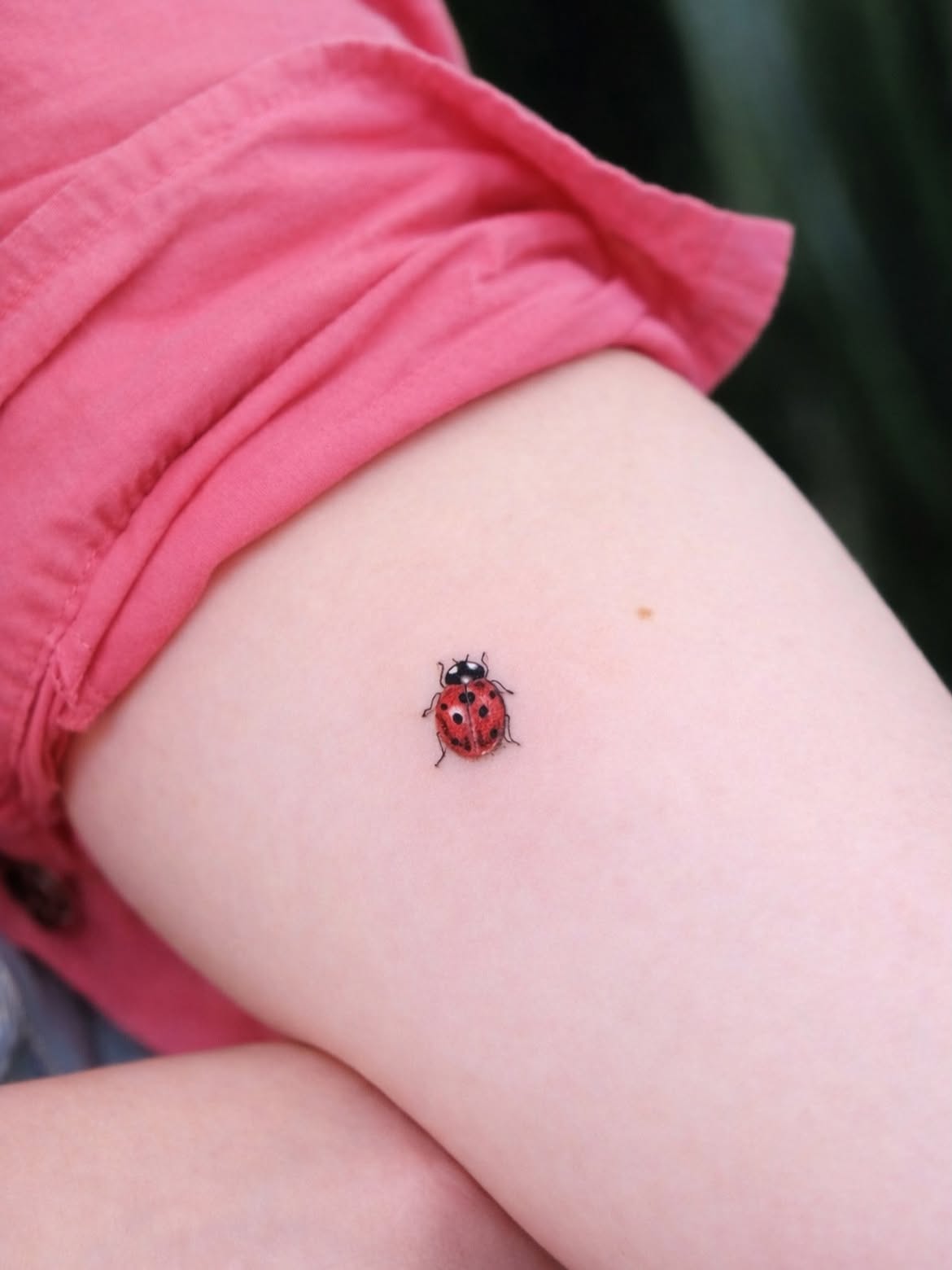
The upper arm gives this tiny ladybug plenty of breathing room, and the simplicity of the composition is exactly what makes it successful. Rather than adding leaves, flowers, or ornamental lines, the artist allows the insect to stand alone.
The shell is a warm, textured red rather than a perfectly uniform block of pigment. Several black spots, a narrow central division, and a glossy dark head establish the familiar ladybug anatomy. Fine legs extend outward just enough to soften the circular silhouette.
There is something particularly appealing about a micro tattoo placed on a relatively large area. The contrast in scale makes the design feel intentional and quietly playful. It is the opposite of a sleeve mentality: instead of asking how much skin can be filled, it asks how little imagery is needed to make an impression.
For someone drawn to tiny, dainty, and uncomplicated tattoo ideas, this placement is worth considering. It can remain a standalone piece or eventually become part of a larger collection of miniature nature motifs.
Detailed Realistic Red Ladybug Tattoo
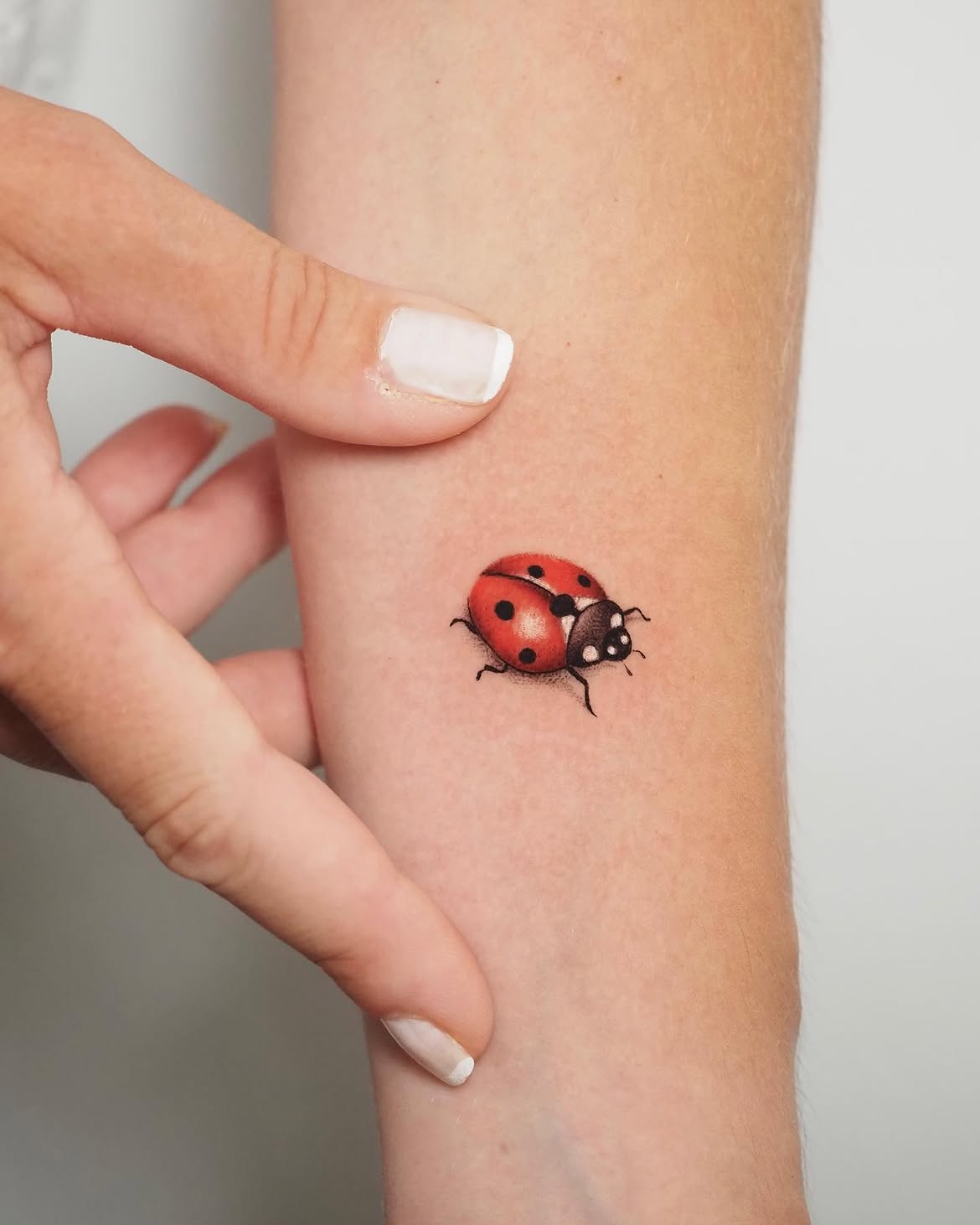
This design increases the scale just enough to reveal what micro realism can accomplish when the artist has a little more room. The ladybug’s shell has noticeable depth, with rich red transitioning into darker tones around the edges and bright highlights creating the illusion of a reflective surface.
The black spots are deliberately bold, while the head contains subtler brown, black, and pale highlights. Tiny legs project naturally from beneath the body rather than appearing as decorative lines attached to its outline. A faint shadow underneath completes the three-dimensional effect.
That shadow is a small detail, but it changes the entire tattoo. Instead of appearing printed onto the skin, the insect seems to sit slightly above it.
This is one of the strongest realistic options for someone who wants the classic ladybug appearance without reducing it to an ultra-small symbol. The slightly larger scale also gives important details more room to age than they would in an extremely tiny micro tattoo.
A simplified stencil based on this composition could work in many locations, including the forearm, calf, ankle, or upper arm. Those who prefer traditional or American traditional tattooing could take the same subject in the opposite direction with thick outlines, flat red pigment, and intentionally simplified anatomy.
Minimalist Ladybug Shoulder Tattoo
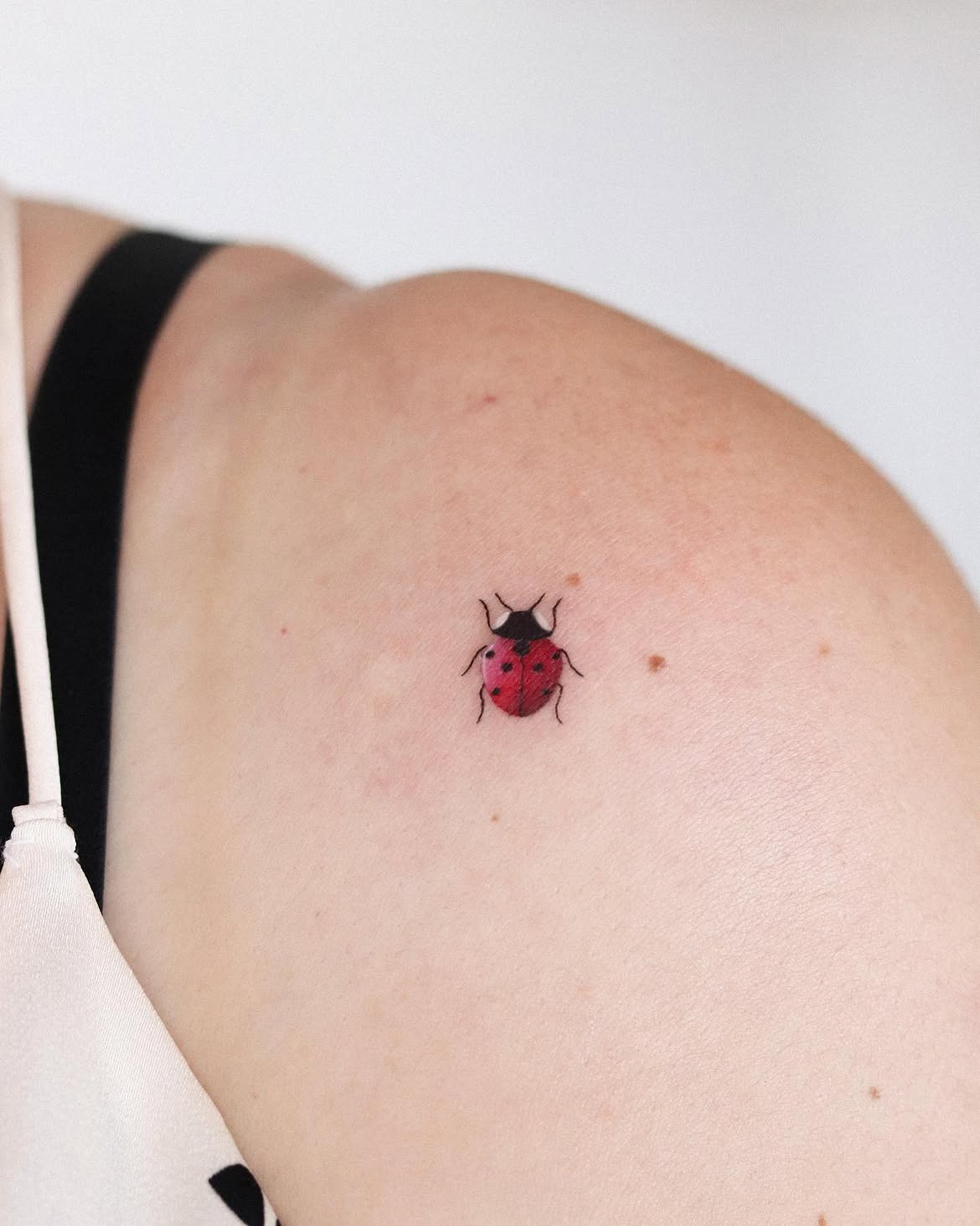
The final design uses the rounded surface of the shoulder as a clean backdrop for a compact red ladybug. Its positioning feels natural, almost like the insect has stopped there momentarily before taking flight.
The body is kept small, but the black head and antennae create a surprisingly strong silhouette. The red wings contain dark spots and a central division, while subtle tonal variation prevents the color from looking flat. Thin legs extending from either side preserve the delicate character of the piece.
This is a useful example of minimalist tattooing that still incorporates color and recognizable detail. Minimalism is sometimes reduced to black outlines alone, but scale, composition, and negative space matter just as much. Here, the untouched skin surrounding the ladybug is effectively part of the design.
The shoulder placement also makes the tattoo easy to style around. Depending on clothing, it can be completely visible, partly revealed, or hidden. Someone considering an even more discreet version could translate the concept to the ear area or behind ear, while a larger interpretation could incorporate small flowers or another insect such as a bee and ladybug pairing.
Tiny Red Ladybug on the Inner Wrist
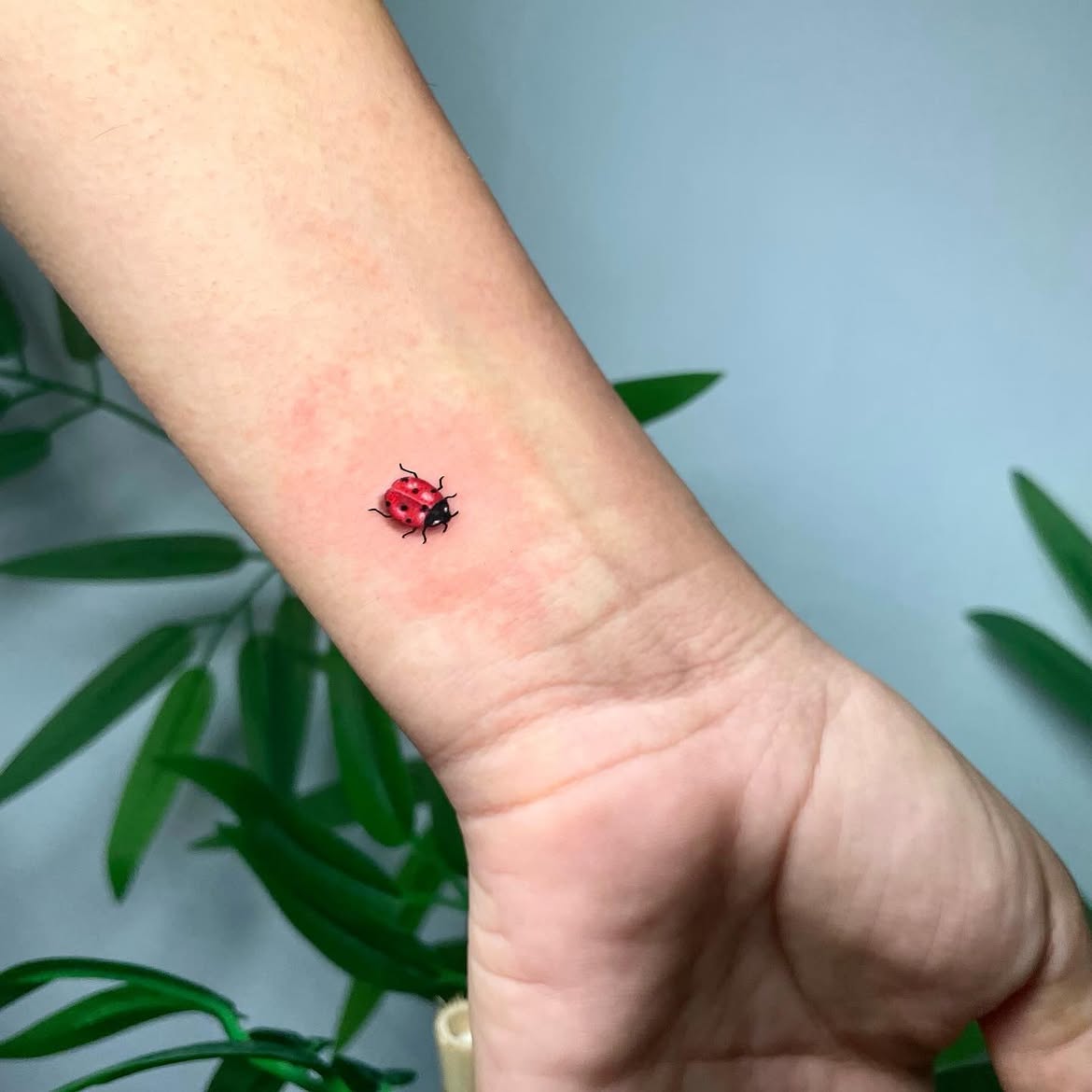
There is something especially convincing about a ladybug tattoo placed just above the wrist crease. The position is exactly where a real insect might land, and the small scale strengthens that illusion. Rather than decorating the area with extra symbols, the artist lets one intensely colored ladybug do all the work.
The red wings contain several crisp black spots and lighter highlights through the center, creating the impression of a rounded, glossy shell. Its black head is comparatively dense, while the antennae and legs are drawn with exceptionally narrow lines. Those little extensions matter: without them, a micro ladybug can quickly begin to resemble a red dot from a distance.
For a tiny tattoo, the design has plenty of personality. It falls somewhere between fine line and micro realism, retaining recognizable anatomy without becoming overloaded with details that may be difficult to preserve at this size.
The inner wrist is also a thoughtful placement for anyone who wants to see their tattoo frequently. It can feel almost like a tiny lucky charm rather than a major decorative statement. That idea suits the traditional meaning of the ladybug particularly well: good fortune, protection, and the arrival of something positive.
Soft Micro-Realistic Ladybug Wrist Design
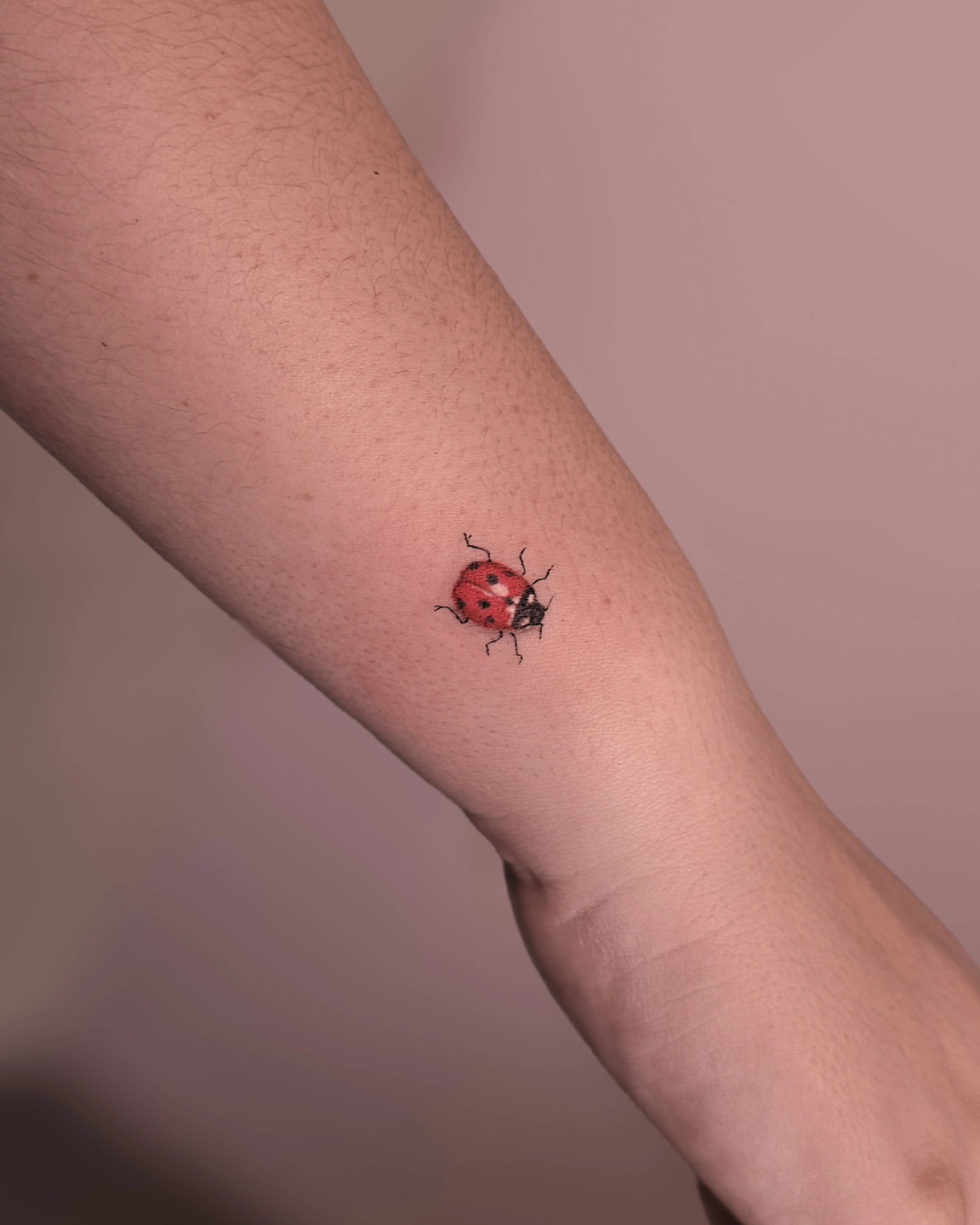
This version takes a softer approach to realism. The ladybug is not defined by a thick, perfect outline; instead, the edges, red pigment, and dark markings have slight tonal variation. That makes the insect feel organic and surprisingly natural against the skin.
Its rounded shell uses muted red rather than an aggressively saturated scarlet. Tiny black spots establish the familiar pattern, while the head and legs are rendered with delicate dark marks. One pale highlight crossing the shell creates just enough dimension to suggest reflected light.
I like this kind of realistic tattoo because it does not look digitally perfect. Real insects have texture and asymmetry, and allowing some of that irregularity into the design gives the finished tattoo more character.
It is also a strong reference for someone deciding between a simple ladybug and a highly detailed micro-realism piece. This design occupies the middle ground. The overall silhouette remains straightforward, but the shading adds depth that a basic stencil would not provide.
For placement, the area near the wrist works naturally, though the same concept could translate well to an ankle or upper arm.
Ladybug on a Fine Line Botanical Branch
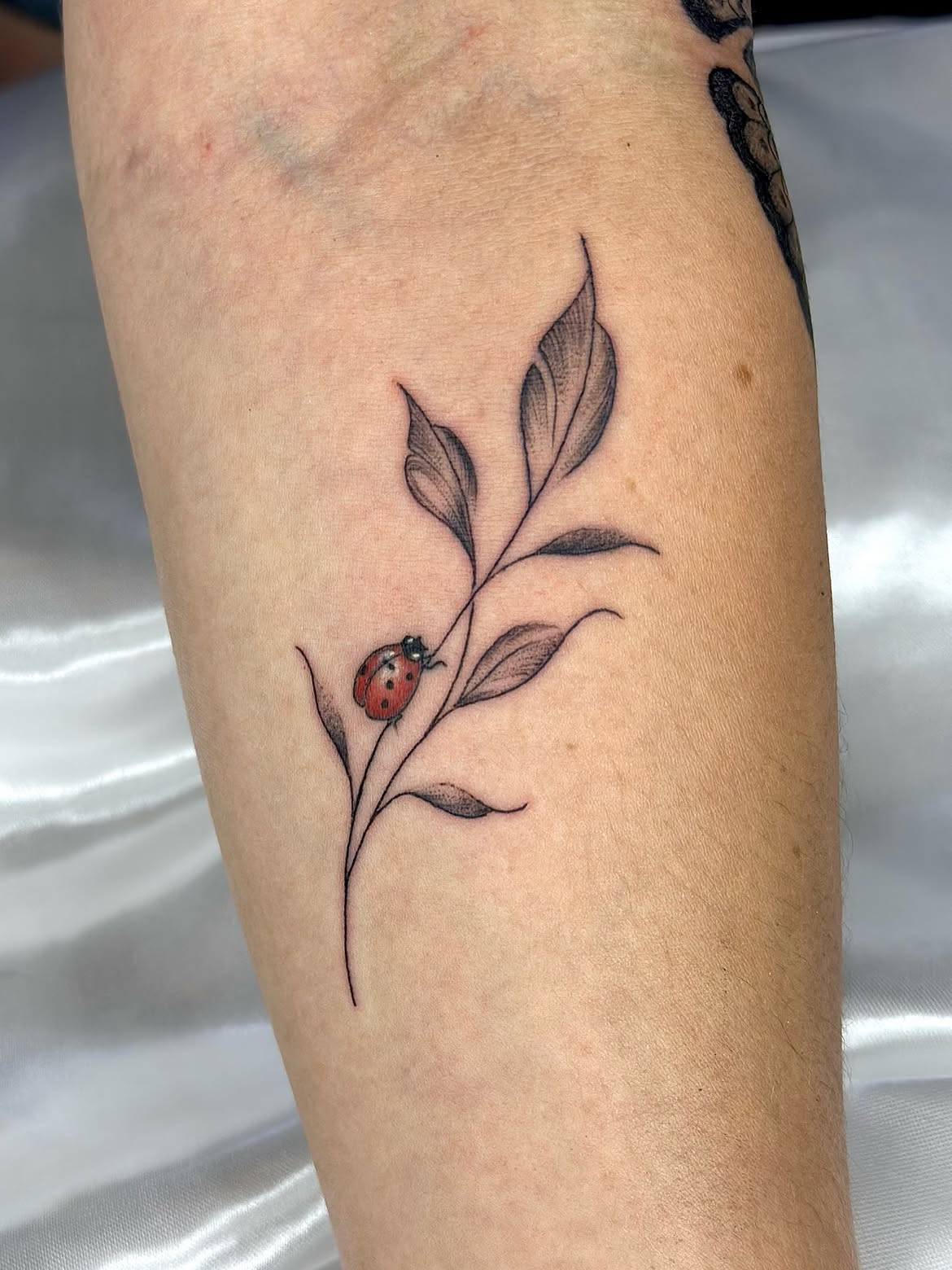
A slender botanical branch immediately changes the mood of a ladybug tattoo. Instead of presenting the insect as an isolated lucky symbol, this composition places it within a small piece of nature.
The branch rises vertically with several long leaves extending in alternating directions. Their outlines are exceptionally fine, while soft internal shading follows the veins and gives the foliage dimension. The composition stays predominantly black and white, which makes the small red ladybug climbing the stem stand out immediately.
That selective use of color is the strongest element of the design. The eye finds the ladybug first and then follows the dark stem upward through the leaves. Because the botanical portion is understated, the red never has to compete with other saturated colors.
This is a beautiful option for someone who loves fine line botanical tattoos but wants to introduce a little warmth. The plant itself could also be personalized. Instead of generic leaves, an artist could incorporate meaningful flowers, herbs, or a birth-month plant.
A clean design stencil would be particularly important here because the flow of the branch needs to complement the body before any shading is added. When botanical tattoos work well, their shape often matters just as much as their individual details.
Dainty Ladybug and Leafy Sprig Tattoo
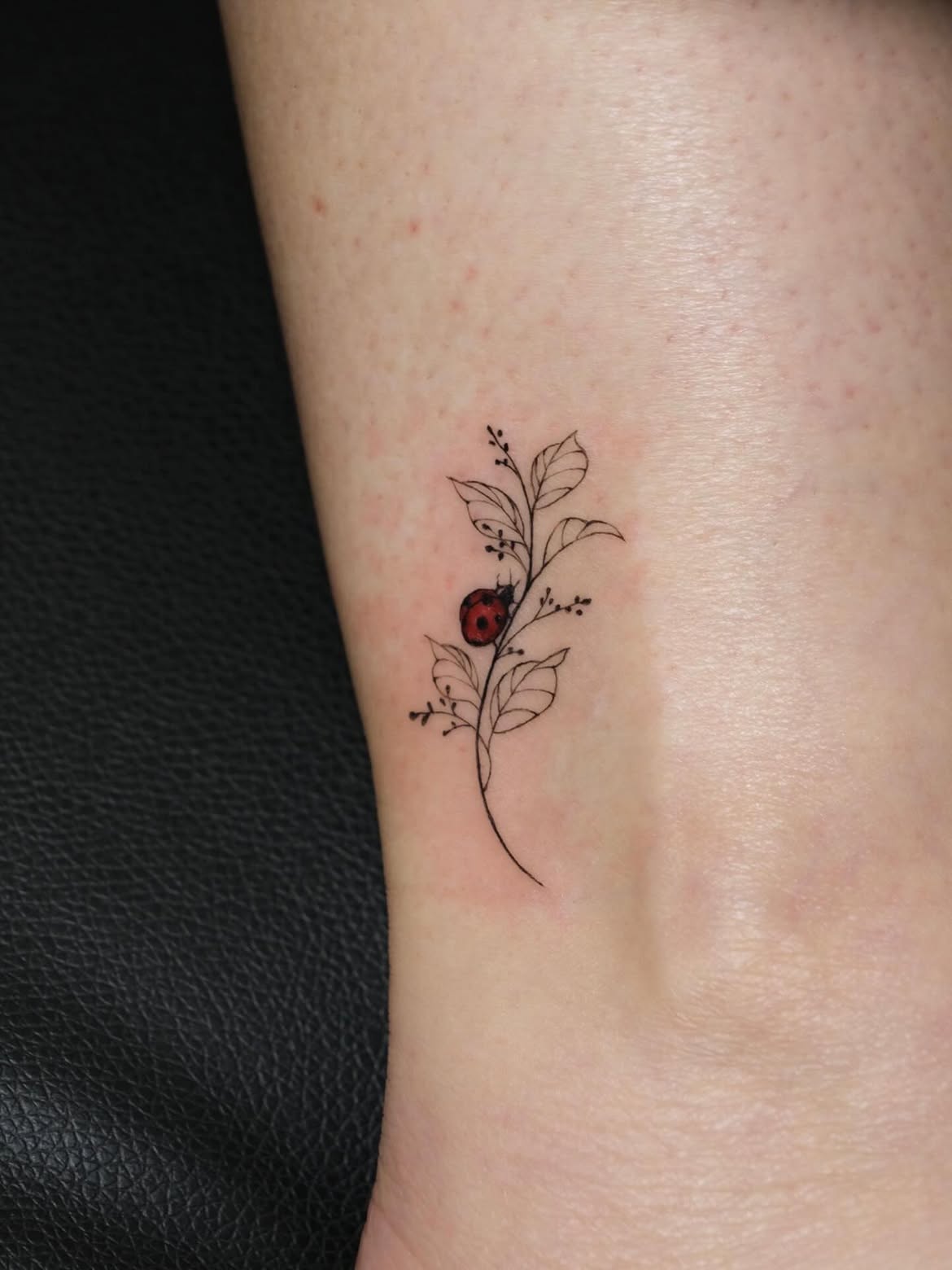
This botanical variation is even lighter and more dainty. A narrow curved stem supports several open leaves, tiny buds, and a miniature red ladybug nestled along one side. There is very little heavy shading, so the entire tattoo retains an airy, almost illustrated quality.
The leaves are constructed primarily from thin outlines and interior veins. Tiny clusters of dots break up the larger shapes and give the sprig a slightly wild, natural character. Against those black lines, the ladybug becomes the single concentrated area of color.
This is a clever way to combine minimalist tattooing with botanical detail. The piece is not minimalist because it lacks elements; rather, every element has been reduced to its essential lines. The result feels light even though there is plenty to look at.
The curved composition would suit several areas of the body. It could follow the lower leg, forearm, or ankle, while a much smaller adaptation might work behind ear. For someone interested in a ladybug tattoo with flowers but not wanting a conventional bouquet, using leaves and buds instead is an elegant alternative.
Delicate Black and White Ladybug Tattoo
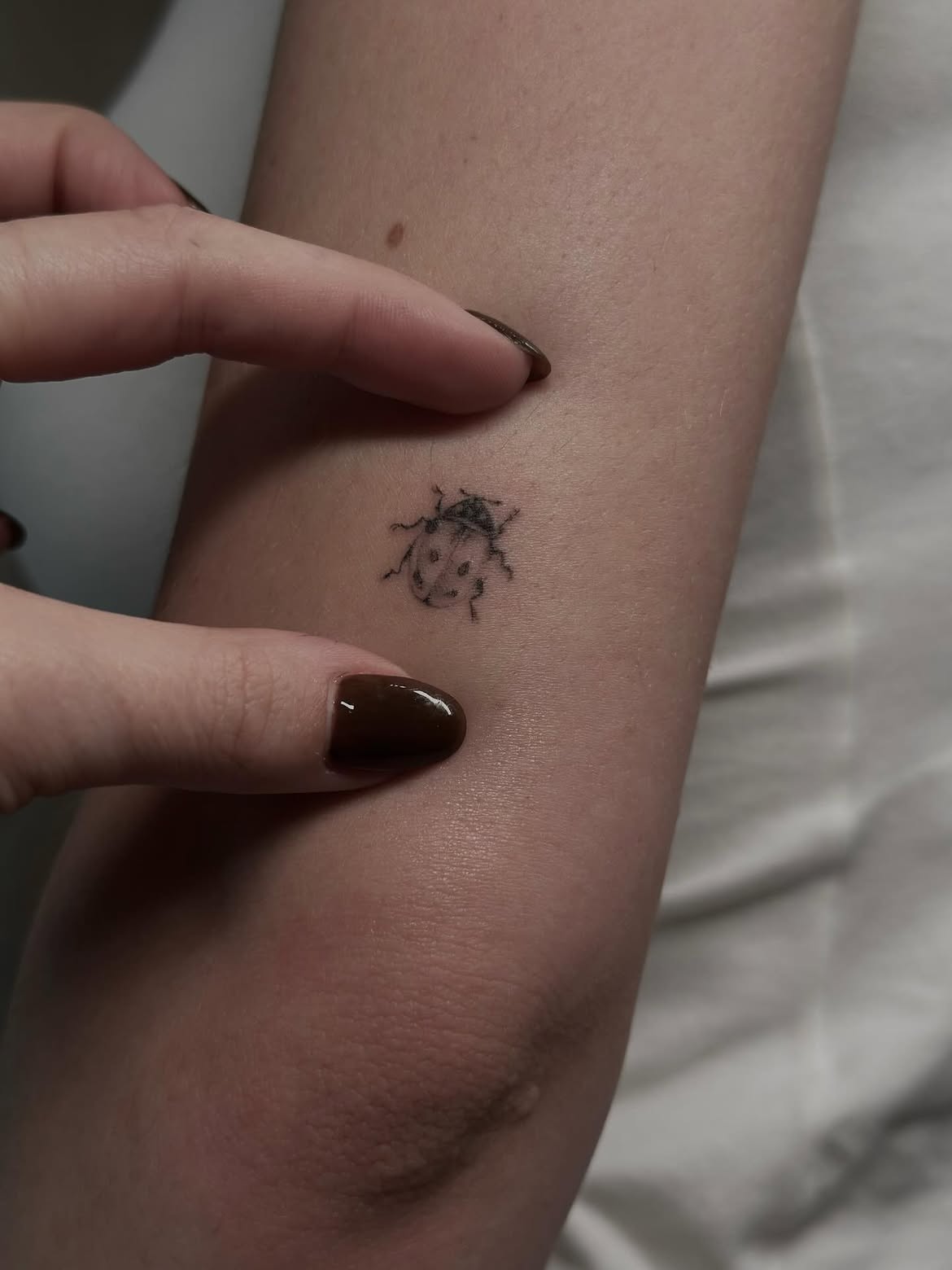
Not every ladybug tattoo needs red ink. This tiny monochrome interpretation removes the insect’s most recognizable color and relies entirely on linework, soft shading, and spots to establish its identity.
The shell has a translucent gray appearance, with darker spots scattered across its surface and fine shading around the head. The legs are almost sketch-like, and the overall edges remain soft rather than heavily outlined. The result is quiet and understated.
A black and white ladybug can be a smart choice for someone whose existing tattoos are exclusively black ink. It prevents one tiny piece from becoming an unexpected splash of color while preserving the recognizable shape of the insect.
The execution also has a subtle pencil-drawing quality that distinguishes it from a bold traditional tattoo. If translated into a cleaner fine line style, it could become even more minimalist; alternatively, stronger black areas could make it more graphic.
Sometimes removing the obvious feature of a motif makes it more interesting. Here, the absence of red encourages you to notice the insect’s shape and markings rather than color alone.
Minimal Black and Gray Ladybug Ankle Tattoo
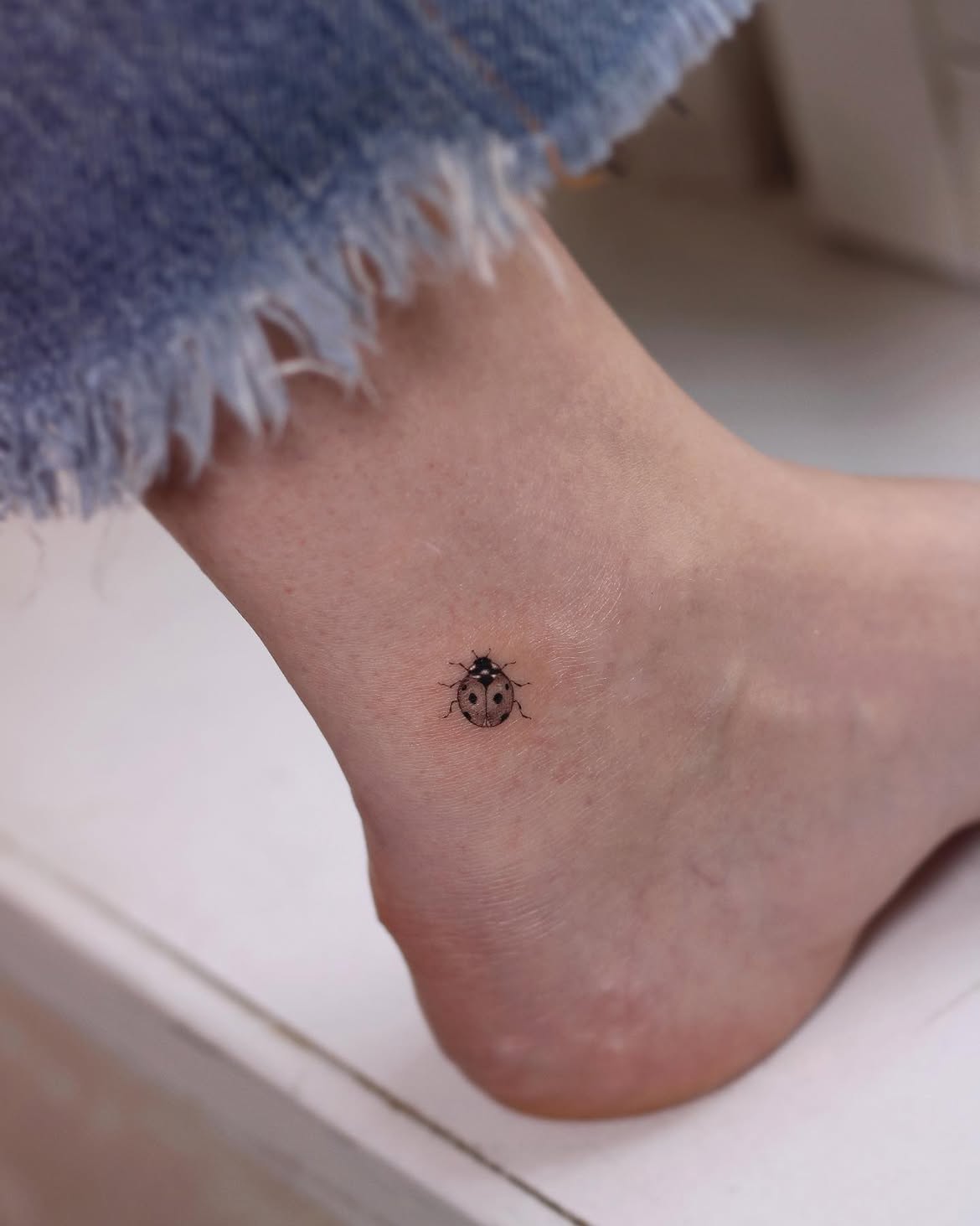
The side of the ankle is one of those placements that seems naturally suited to a miniature ladybug. It provides enough flat space for the insect to remain legible while keeping the tattoo discreet and easy to reveal or conceal depending on footwear.
This ladybug is rendered almost entirely in black and muted gray-brown tones. The round shell contains large dark spots and a clear central division, while the black head and tiny antennae give the design definition. Compared with the bright red examples, it has a quieter, more neutral personality.
The simplicity makes it especially wearable. There are no flowers, ornamental frames, or surrounding dots. The minimalist approach allows the tattoo to function as a small personal symbol rather than a centerpiece.
For people who like tiny tattoos, ankle placement also opens up interesting possibilities for future additions. A second insect, a miniature flower, or a small flying ladybug could create a loose nature-inspired collection without requiring everything to connect.
It would also make a subtle matching tattoo because the same basic shape could be adapted slightly for each wearer rather than reproduced identically.
Micro Realistic Ladybug Wrist Tattoo
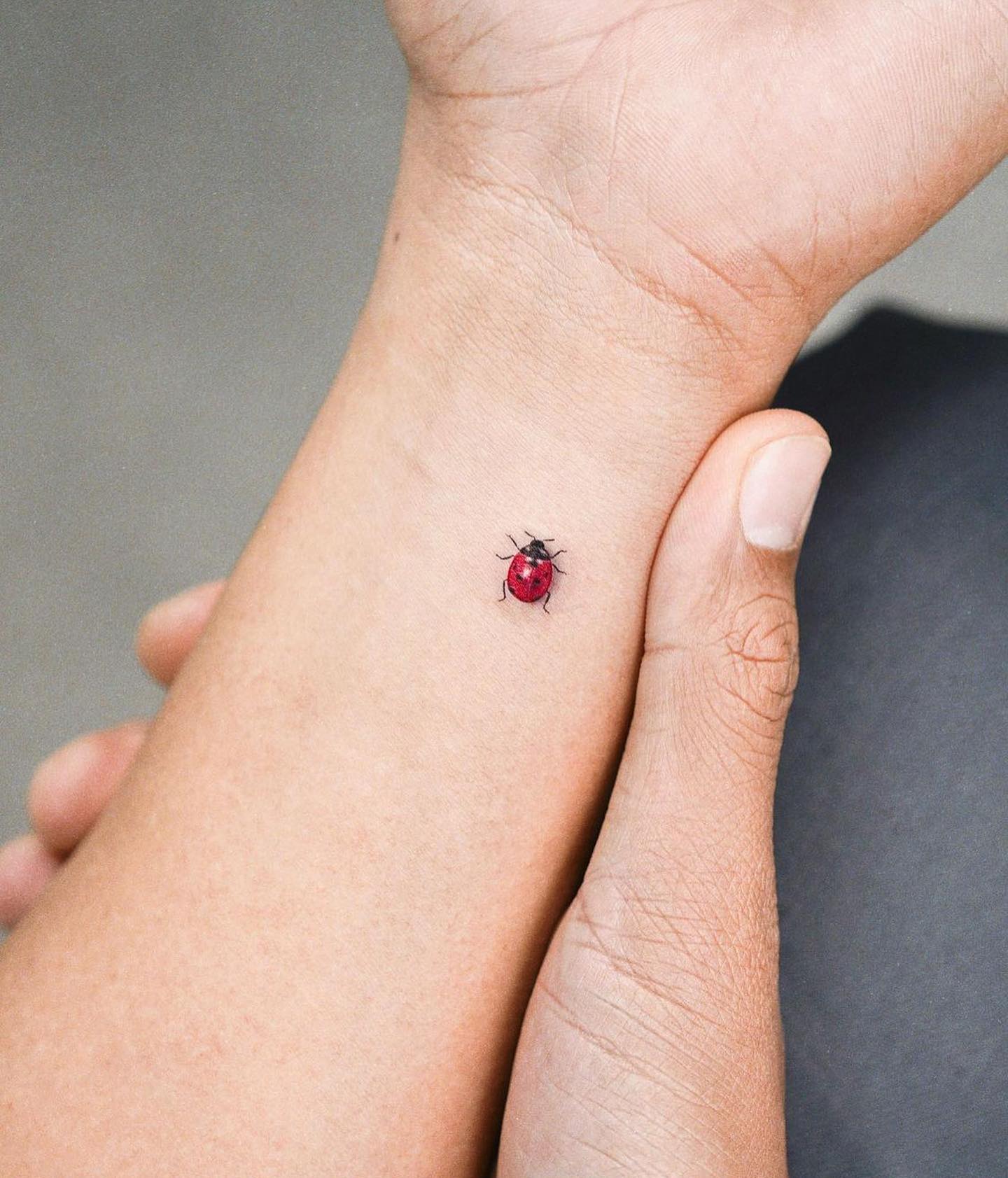
This final wrist design returns to the classic red-and-black palette but keeps everything remarkably small. Positioned on the inner wrist, the ladybug appears almost like a living insect resting on the skin.
Rich crimson pigment gives the shell immediate presence. Black spots remain distinct despite the tiny scale, while a dark head, narrow legs, and short antennae create a believable silhouette. Small variations in the red prevent the body from becoming a flat circle and push the piece toward realistic micro tattooing.
What works particularly well is the relationship between scale and placement. The wrist is visually delicate, so an oversized insect could feel heavy there. This tiny version follows the proportions of the area and leaves generous negative space around itself.
For anyone considering similar Ladybug tattoo ideas 2026, this is a reminder that simple does not have to mean generic. Scale, orientation, color, and placement can distinguish one miniature ladybug from another even when the underlying motif remains unchanged.
Micro Realistic Ladybug on the Upper Arm
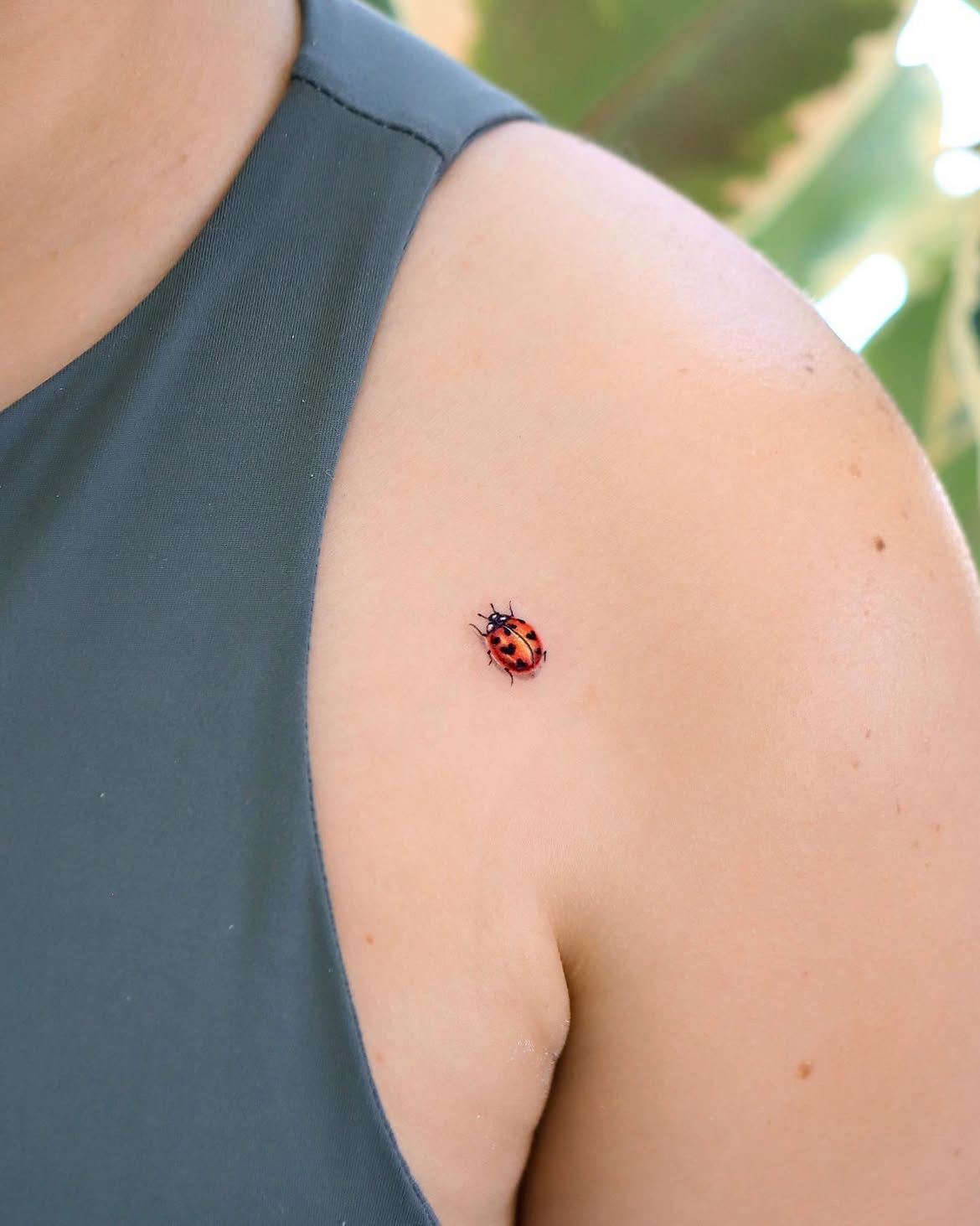
This tiny ladybug sits high on the upper arm near the shoulder, and the generous negative space around it makes the miniature design surprisingly noticeable. The tattoo uses a realistic red-and-black palette, with warm orange-red shading across the wings, distinct black spots, a dark head, and extremely fine legs and antennae.
The placement is especially effective for a tiny design because the rounded contour of the shoulder gives the insect a natural surface to rest on. From a distance it can genuinely resemble a ladybug that has just landed on the skin.
This is a strong example of micro realistic tattooing for anyone who prefers a simple motif without flowers, lettering, or decorative framing. Symbolically, the ladybug is commonly associated with luck, protection, happiness, and positive change, giving such a small tattoo an optimistic meaning.
Tiny Ladybug Near the Collarbone
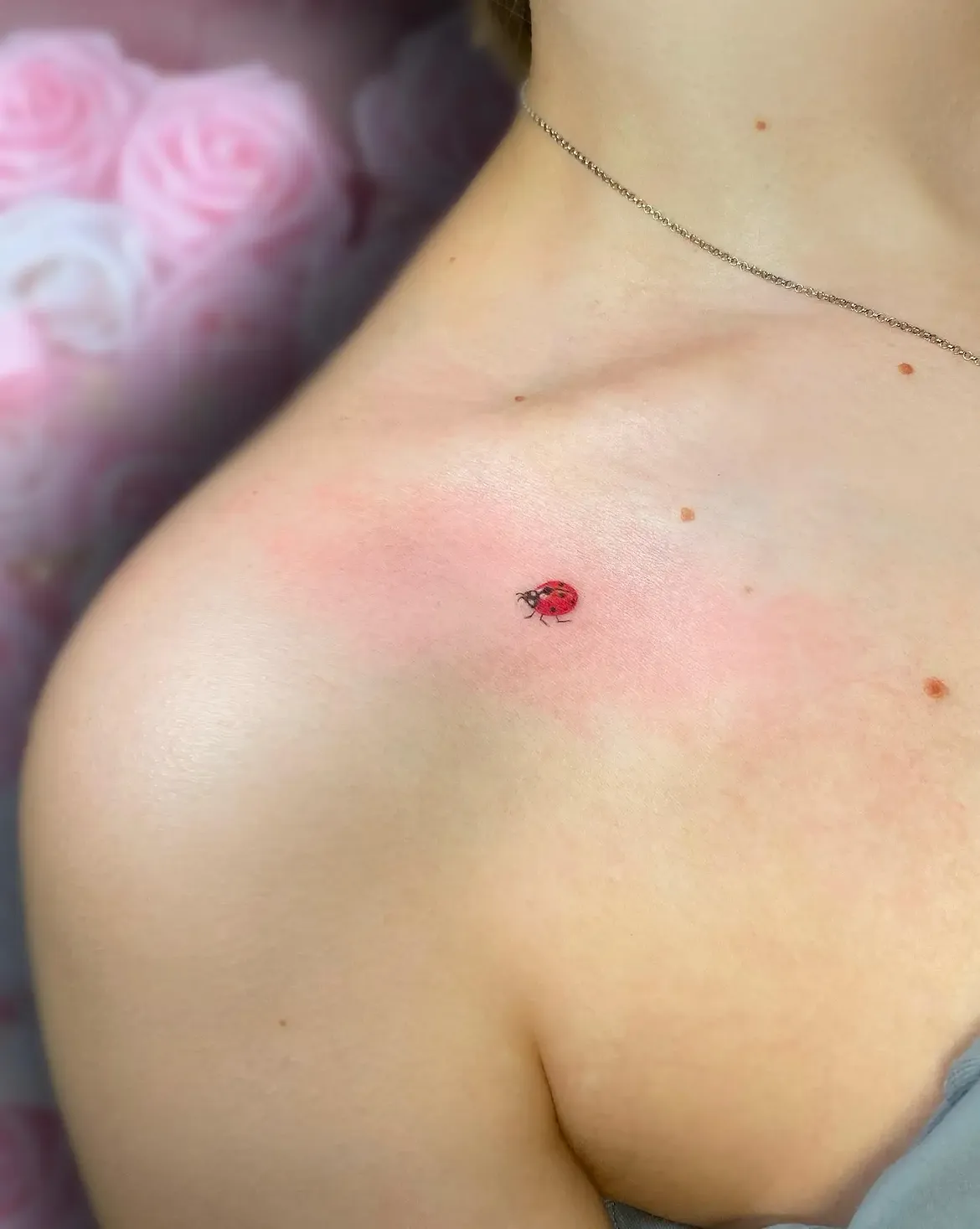
Placed close to the collarbone, this miniature red ladybug feels almost like a piece of delicate jewelry. The tattoo is extremely small, yet the artist preserves the essential details: a rounded red shell, black markings, a dark head, and tiny legs.
The open placement gives the insect plenty of breathing room. Rather than adding vines, flowers, or text around it, the design relies on scale and color for impact. This keeps the overall appearance feminine, subtle, and modern.
A collarbone ladybug can be particularly attractive for someone who wants a tattoo that appears with certain necklines but remains easy to cover. The bright red pigment creates just enough contrast against the skin without turning the piece into a large statement tattoo.
Its restrained appearance also makes this a useful reference for a minimalist ladybug tattoo stencil. The recognizable silhouette matters more than complicated detail, proving how effective a familiar symbol can be at micro scale.
Realistic Red Ladybug Shoulder Tattoo
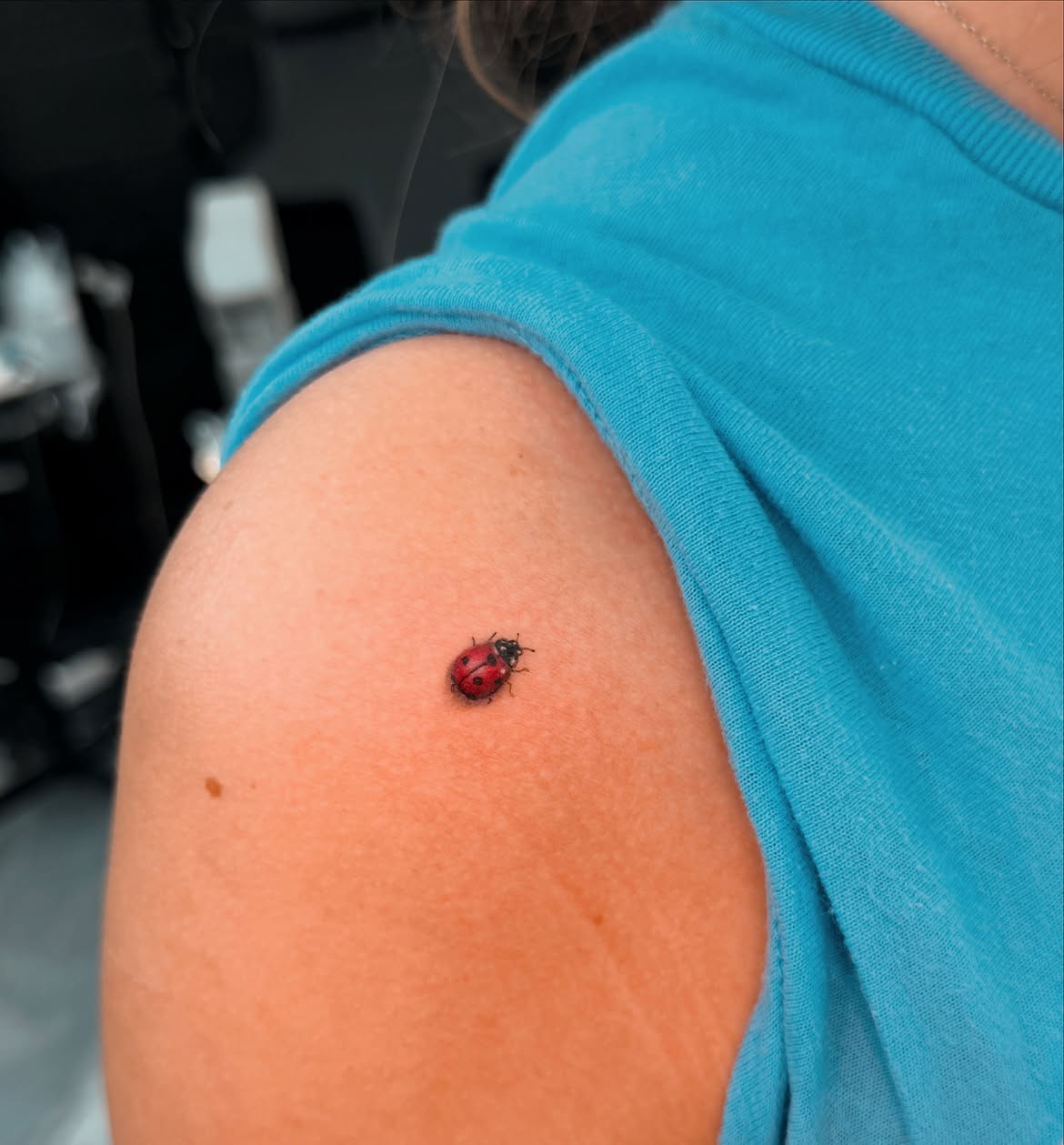
Another upper-arm design takes micro realism in a slightly darker direction. Here, the ladybug has a rich crimson shell surrounded by deeper shadowing, which gives its body convincing volume. The individual black spots are clearly visible, while the head, antennae, and legs are rendered with concentrated black ink.
The tattoo follows the curve of the shoulder rather than fighting against it. That makes the insect appear naturally positioned, almost as though it is crawling across the arm.
For anyone researching small ladybug tattoo ideas, this example demonstrates why color contrast is so important. Even though the tattoo occupies very little skin, the combination of saturated red and black prevents the details from disappearing.
It is a straightforward design, but that simplicity gives it versatility. The same micro-realistic approach could work on the wrist, ankle, forearm, or even behind ear for someone looking for a more hidden placement.
Ladybug Resting on a Green Leafy Stem
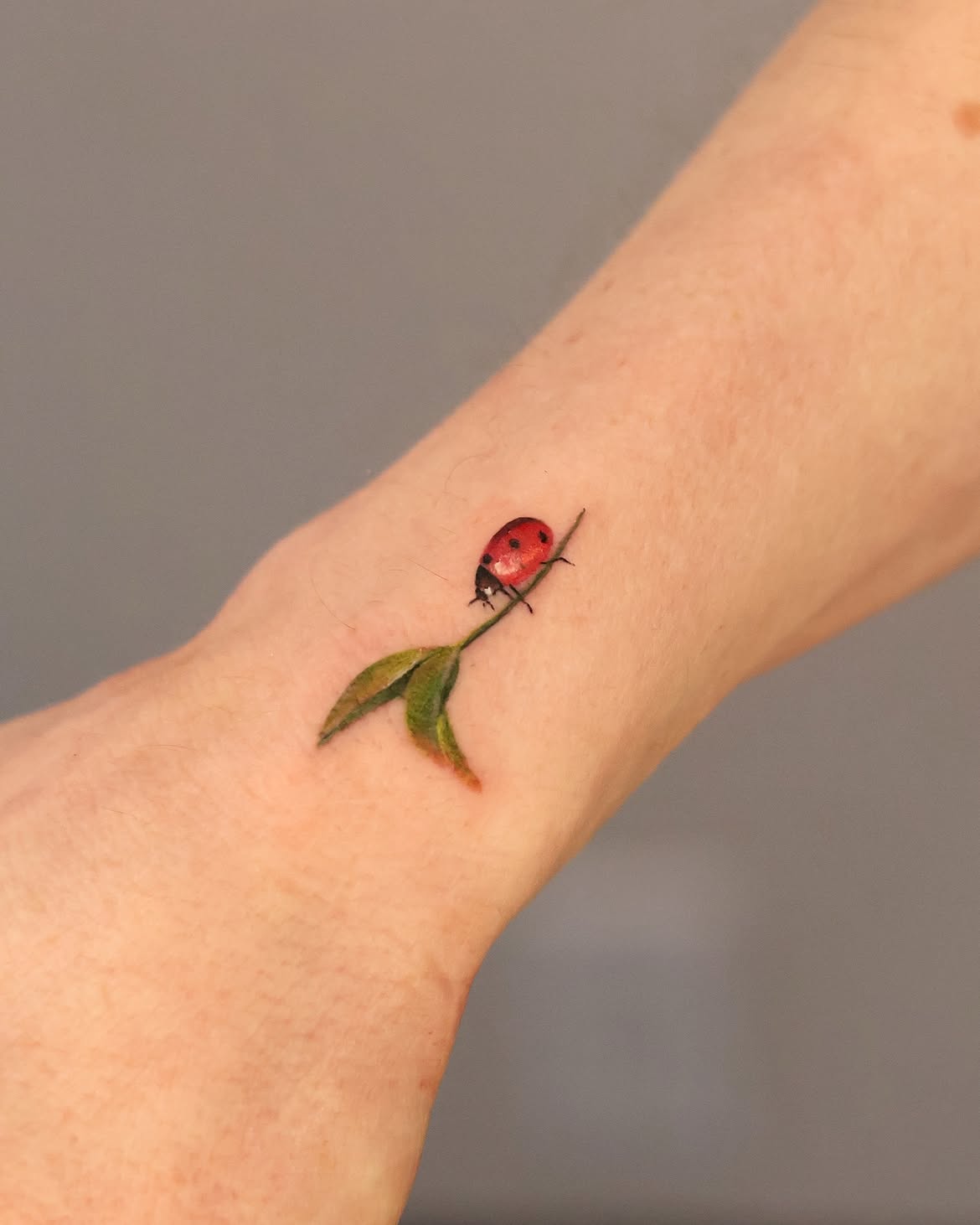
Color transforms this botanical ladybug tattoo into something completely different from the fine-line examples. A bright red insect rests on a narrow green stem that ends in two softly shaded leaves, creating a miniature nature scene.
The ladybug is noticeably larger than many of the micro designs in this collection. Its red wings have black spots and dimensional shading, while the dark head and legs provide definition. Below it, muted olive and green tones give the leaves a slightly painterly appearance.
The curved orientation of the branch complements the wrist and lower forearm beautifully. Instead of looking like a separate illustration placed randomly on the body, the design follows the natural direction of the limb.
This concept could easily be expanded with flowers, additional leaves, or even a second ladybug. However, its current simplicity is part of the charm. Red and green create a recognizable garden-inspired palette while keeping the composition compact enough for someone who still wants a relatively small tattoo.
Ladybug and Tiny Red Heart Ankle Tattoo
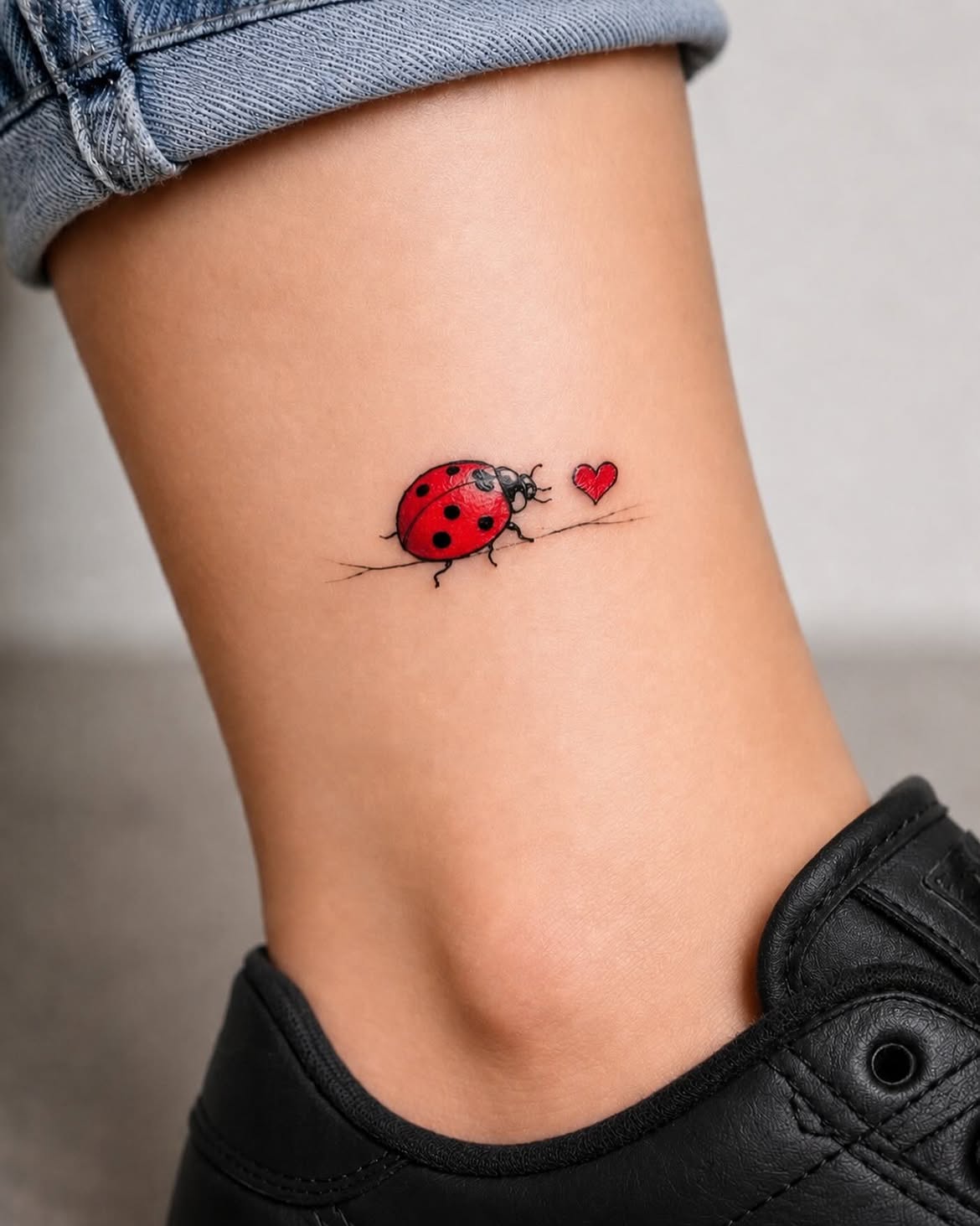
This playful design combines a bright ladybug with a miniature heart, introducing a clear romantic element without making the tattoo overly elaborate. The ladybug is rendered in vivid red with large black spots, a dark head, and thin legs, while the neighboring heart repeats the same saturated red.
A pair of extremely thin horizontal lines underneath the insect gives the composition an illustrated quality, almost as though the ladybug is walking toward the heart. This small narrative detail makes the piece feel more personal than a standalone insect.
The ankle is an excellent location for this type of design. There is enough room for the individual elements to remain readable, while shoes and socks can conceal much of the tattoo when desired.
The heart can also change the meaning. Instead of representing luck alone, the ladybug might symbolize love, affection, a relationship, or a fortunate connection. This could even become an appealing matching tattoo concept, with two people choosing related ladybug and heart variations.
Small Realistic Ladybug on the Inner Wrist
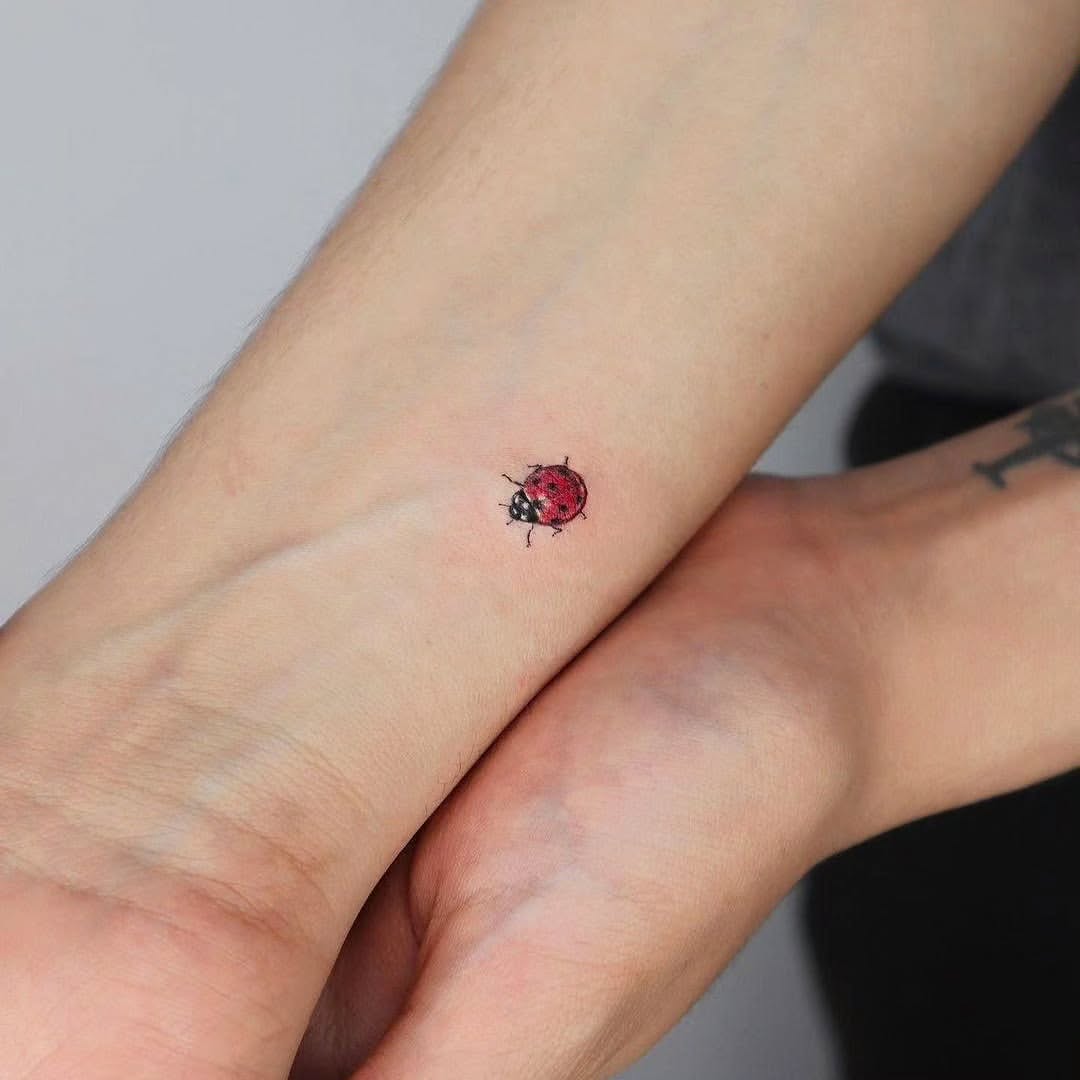
The inner wrist remains one of the most natural locations for a tiny ladybug, and this example shows why. A single red insect sits just above the wrist crease with no decorative additions, leaving the surrounding skin completely open.
The shell contains several dark spots and subtle variations of red, giving it more texture than a flat graphic design. Black ink defines the head and legs, while slightly irregular edges contribute to the realistic appearance.
Because this piece is so compact, it can function almost like a permanent lucky charm. It is visible to the wearer throughout the day but small enough not to dominate the hand or forearm.
For a first tattoo, this type of simple micro design can also feel approachable. Someone could keep it exactly as shown or later build around it with fine line flowers, leaves, stars, or another tiny insect. The uncomplicated composition gives plenty of flexibility for future additions.
Three Fine Line Ladybugs Across the Collarbone
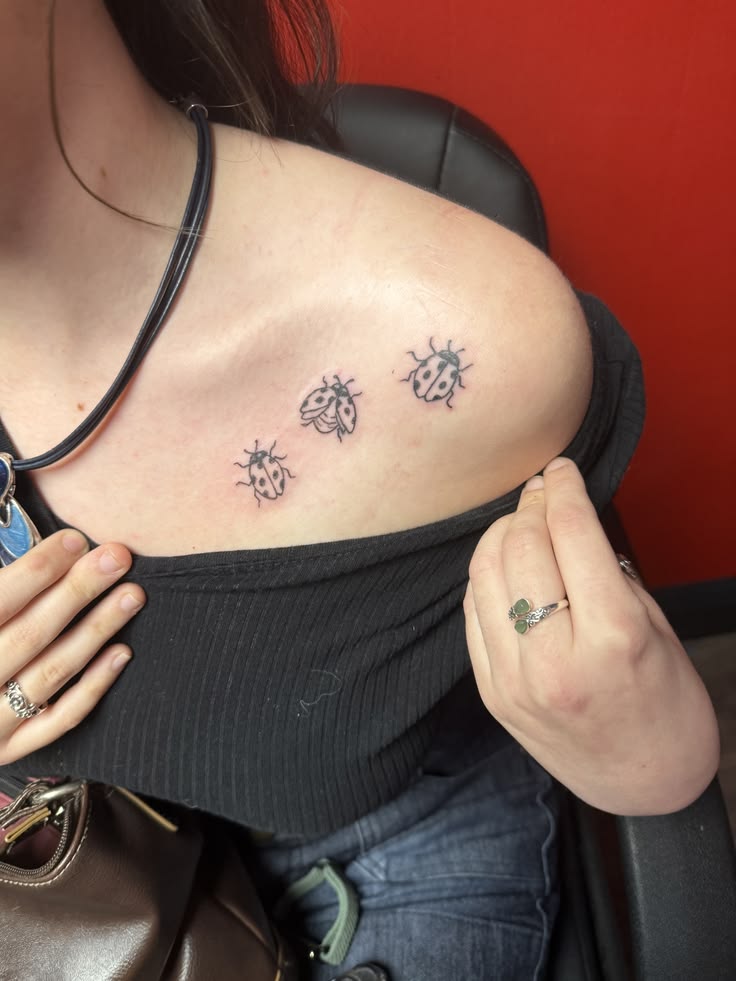
This design breaks away from the familiar red palette completely. Instead of one colorful insect, three ladybugs travel across the upper chest and collarbone area in black fine line work. Each insect is drawn from a slightly different position, creating a sense of movement rather than simple repetition.
The first ladybug appears compact and grounded, the middle insect is shown with its wings opening, and the third returns to the recognizable rounded shell. That variation makes the trio feel like successive moments in a tiny animation.
The lack of color gives the tattoo a more graphic, black and white aesthetic. Fine outlines describe the shells, spots, legs, and antennae, while the flying insect adds delicate wing details without heavy shading.
Using 3 ladybugs can also create personal symbolism. They might represent three family members, friends, children, important memories, or simply a preference for repeated nature motifs. This idea could therefore translate especially well into a meaningful matching concept.
The diagonal placement across the collarbone complements the body’s natural line and leaves room between each insect. Instead of forming one dense tattoo, the three elements remain visually independent while still reading as a coordinated composition.
Large Open-Wing Ladybug Tattoo on the Elbow
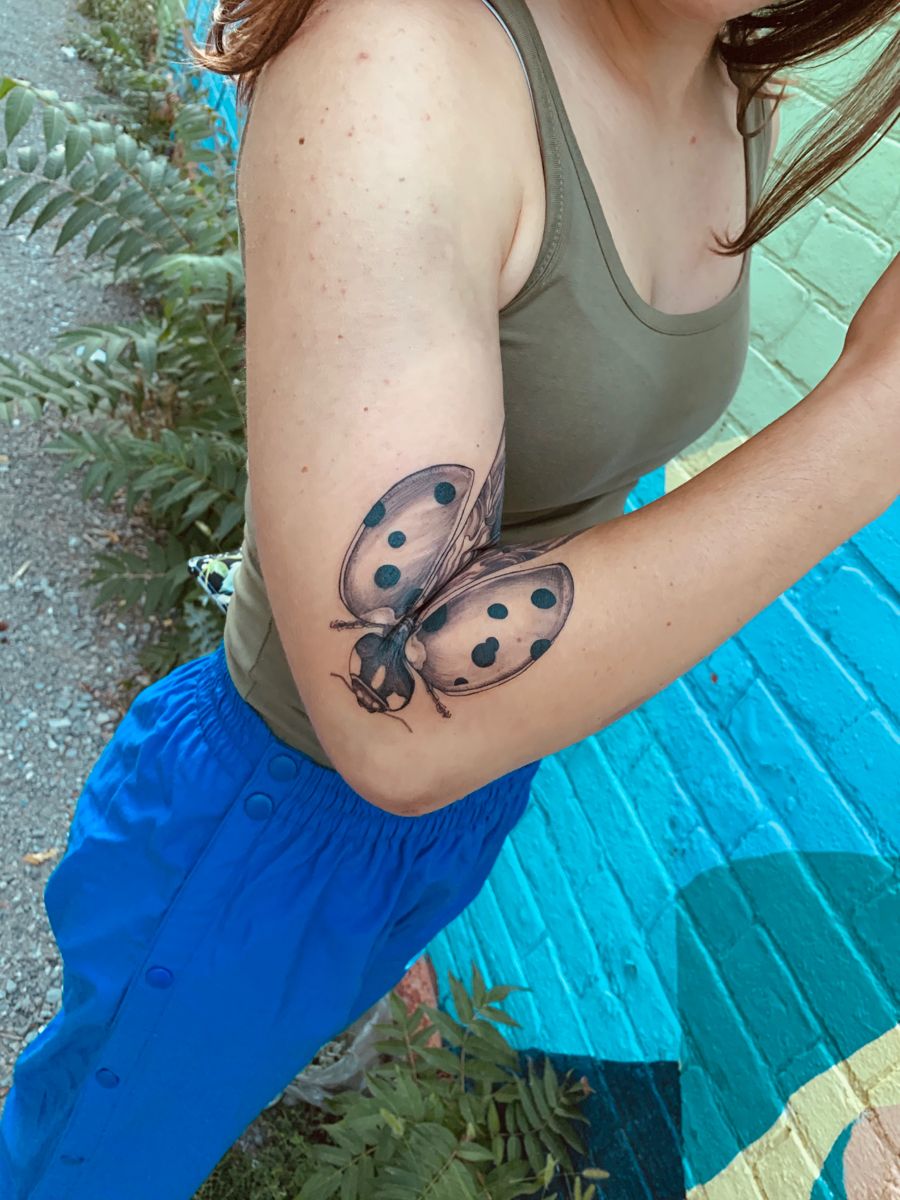
This striking ladybug tattoo takes a completely different approach from the tiny micro designs. Instead of showing the insect with its wings closed, the artist captures it with two large wings spread open across the inner elbow and lower arm. The positioning is particularly creative because the bend of the elbow becomes part of the composition, helping the wings appear naturally extended as the arm moves.
The piece is primarily black and grey, with soft translucent shading inside the wings and bold dark spots scattered across their surfaces. Fine parallel lines and delicate vein-like details add texture without making the design excessively heavy. The darker body anchors the composition between the two lighter wings and creates a convincing sense of depth.
This is an excellent choice for someone who loves realistic insect tattoos but wants something larger and more artistic than a traditional tiny ladybug. Open wings can also introduce an additional meaning, suggesting freedom, transformation, movement, and readiness for a new stage in life. The unusual placement makes the tattoo especially memorable while allowing the anatomy of the arm to enhance the design.
Minimalist Ladybug and Leaf Ankle Tattoo
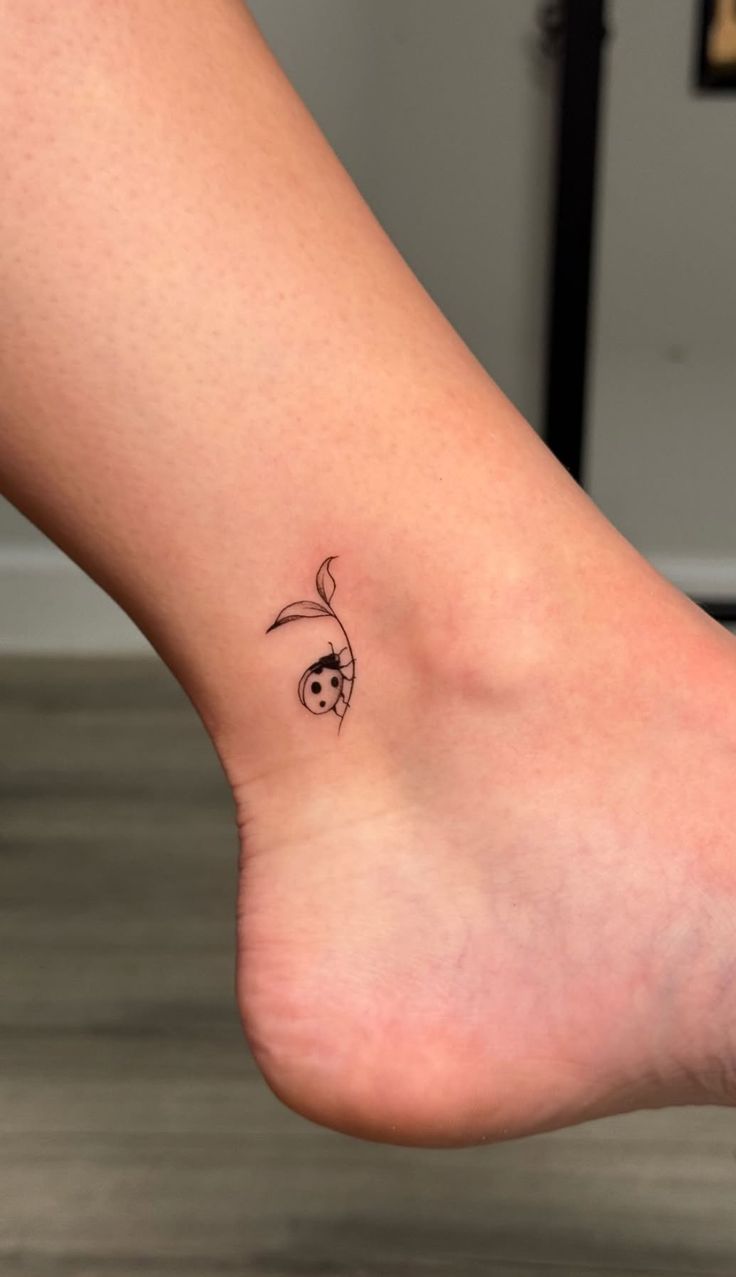
A completely different aesthetic appears in this delicate ankle tattoo. The composition features a tiny ladybug hanging beneath a curved botanical stem with two narrow leaves. Everything is created in thin black linework, giving the piece a clean, airy, almost hand-drawn appearance.
Rather than filling the ladybug with the familiar red color, the artist leaves most of its rounded shell open and uses several simple black spots to make the insect immediately recognizable. The small leaves above it introduce a subtle floral and botanical quality without overwhelming the central motif.
The side-of-the-ankle placement works beautifully with the vertical shape of the branch. Its curved line follows the natural transition between the leg and heel, while the tiny scale keeps the tattoo discreet and easy to style.
For anyone interested in minimalist, fine line, or simple ladybug tattoo ideas, this design offers a softer alternative to colorful realism. The combination of an insect and growing leaves can symbolize good luck, renewal, growth, nature, and positive beginnings, giving the understated tattoo a meaningful story despite its very small size.
Ladybug tattoos prove that memorable body art does not have to be large or complicated. From a nearly microscopic realistic insect to fine line flowers and a heart-shaped red shell, these designs offer plenty of inspiration for anyone considering a small tattoo in 2026. Which ladybug design would you actually wear—and where would you place it? Share your favorite idea in the comments.