
Carnations have a slightly different personality from the flowers that usually dominate tattoo inspiration boards. A rose can feel dramatic, a daisy carefree, but a carnation sits somewhere between softness and resilience. Its unmistakably ruffled petals give even a small tattoo enough texture to feel considered rather than generic.
That balance is especially relevant to Carnation tattoo ideas 2026. Current floral work is moving in several directions at once: barely-there fine line pieces, botanical blackwork, tiny wrist designs, painterly color, and surprisingly realistic red and pink flowers. Because the carnation is also widely associated with the January birth flower, it works beautifully as a personal design without requiring dates, initials, or obvious lettering.
28 ideas here show how dramatically the same flower can change depending on line weight, color, scale, and placement.
Fine Line Carnation Branch With Two Delicate Blooms
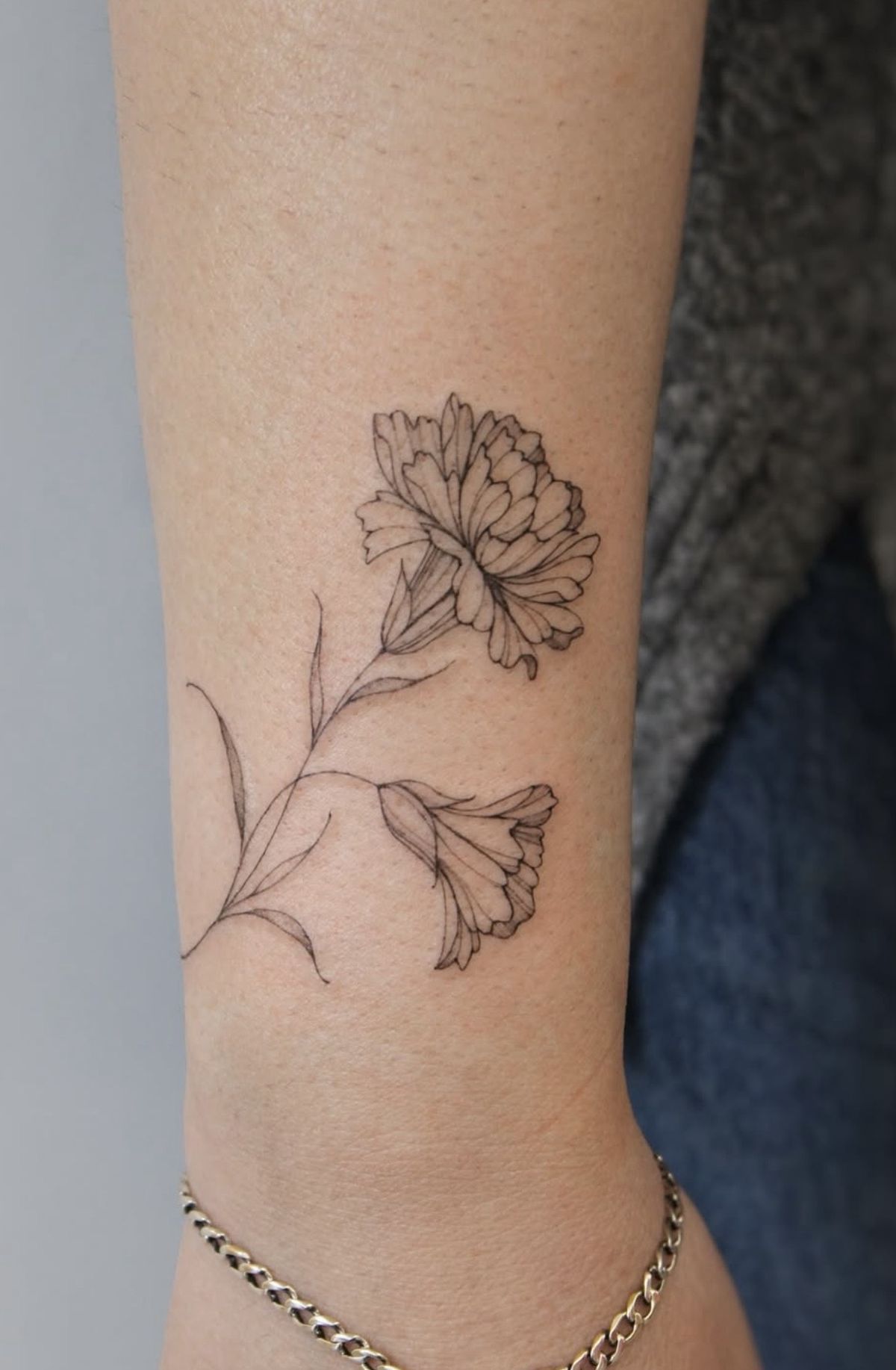
There is something wonderfully unforced about this fine line carnation. Instead of presenting the flower as a perfectly upright botanical specimen, the design lets two blooms grow in different directions from one slender, slightly curved stem. The upper carnation is open and full, while the lower blossom hangs downward, giving the composition the irregularity of a real cutting rather than a formal floral emblem.
The petals are the strongest part of the tattoo. Each one is defined with an extremely thin black outline, and overlapping lines create the carnation’s familiar ruffled structure without relying on heavy shading. Look closely at the larger flower and the center becomes quite intricate, yet the outer petals remain loose and airy. That contrast prevents the design from becoming visually dense.
Long, narrow leaves follow the stem and create a graceful vertical rhythm. Some are only partially defined, which is an effective choice for a simple botanical tattoo: not every surface needs to be filled or shaded.
This is an appealing direction for women who want floral ink that feels elegant without becoming overly decorative. It would also translate naturally into a larger arm arrangement later. A second birth flower, a small daisy and carnation pairing, or another botanical stem could be added without disturbing the original composition.
For anyone collecting references for a tattoo artist, this is also a useful example of why a stencil should preserve negative space between the petals. If those gaps become too narrow, the bloom may lose some of its crisp structure as the tattoo ages.
Tiny Minimalist Carnation on the Inner Wrist
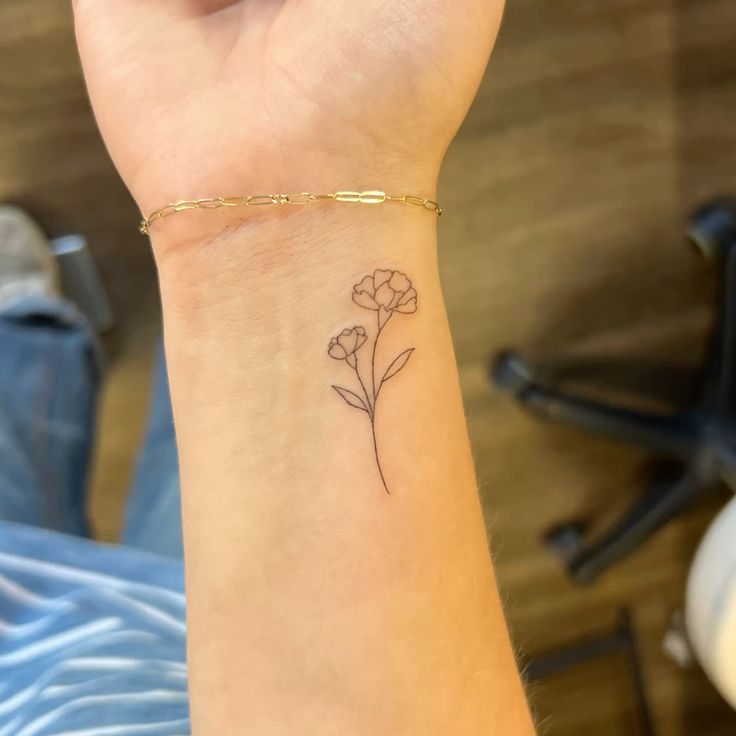
At the opposite end of the scale is this tiny wrist piece, a good reminder that a carnation doesn’t need dozens of petal lines to be recognizable. The design is stripped down to one small open flower, a second bud, a thin stem, and a handful of pointed leaves.
The restrained outline is what makes it work. Rather than attempting realistic texture inside such a compact space, the artist suggests the ruffled flower through a few carefully placed curves. The result feels closer to a miniature botanical sketch than a conventional floral tattoo.
Placement matters enormously here. Sitting on the inner wrist, the flower follows the natural length of the forearm and leaves plenty of bare skin around it. That breathing room makes the design appear even finer. I often find that tiny tattoos become more convincing when the artist resists the temptation to add one more leaf, one more shadow, or one more decorative detail. This piece understands when to stop.
It is an especially attractive interpretation of a January birth flower tattoo for someone who wants the symbolism but not an obviously commemorative design. The same idea could be adapted in black, muted pink, or even a very subtle red accent inside the petals.
For a first tattoo, this scale also has obvious appeal: it is discreet, easy to style around watches and bracelets, and visually gentle enough to coexist with future pieces.
Realistic Red Carnation With a Slender Green Stem
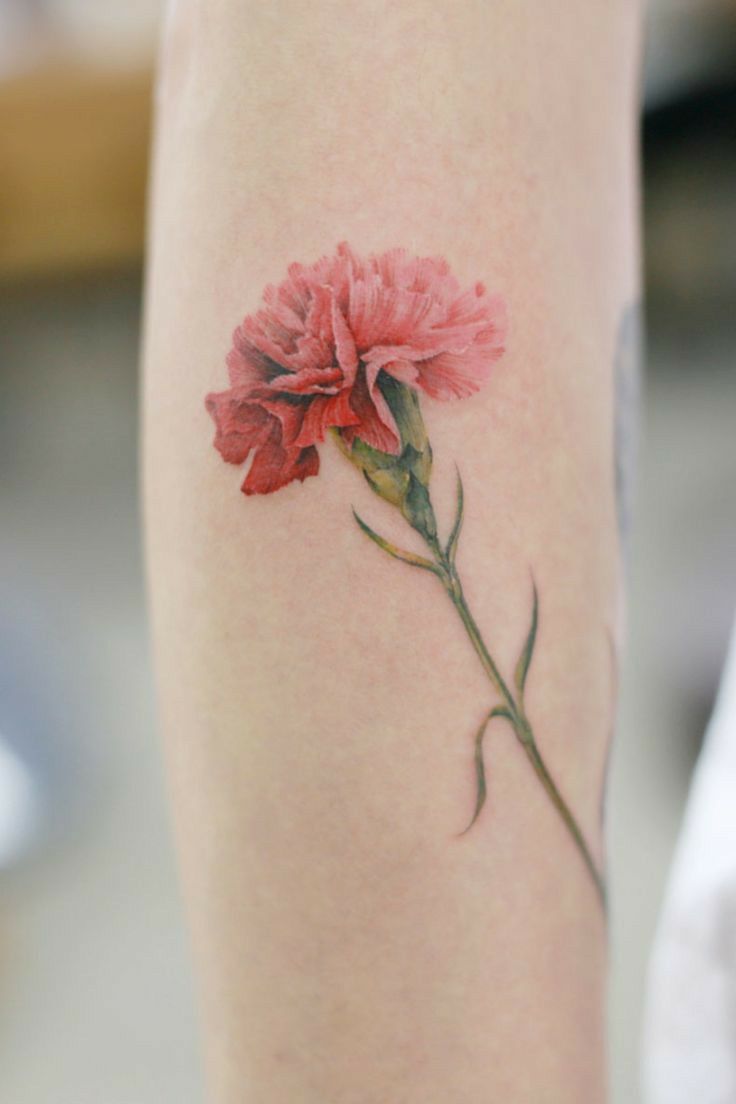
This red carnation takes a completely different route. Rather than simplifying the flower into line art, the tattoo leans toward botanical realism, using layered color to reproduce the velvety, folded character of actual carnation petals.
The flower head is richly textured. Darker crimson tones sit inside the deeper folds while softer coral-red and almost pink highlights catch the upper edges. Those tonal shifts give the petals dimension without surrounding them with a hard black contour. The result is soft at the edges, almost like a tiny botanical painting placed directly on the skin.
The green calyx beneath the bloom deserves attention too. Yellow-green highlights, deeper olive areas, and subtle shadowing make the transition from flower to stem believable. From there, the stem becomes progressively finer, accompanied by narrow leaves that keep the composition light.
A color design like this is a strong choice for someone who loves realism but does not want a large floral piece. It offers much of the visual richness associated with a sleeve while occupying only a narrow area of the arm.
There is also room to personalize the palette. A pale pink carnation would create a softer mood, while a white carnation could be interpreted through gentle gray shadows and touches of cream rather than literal white ink alone. Those choices are worth discussing with an experienced color tattoo artist, particularly because skin tone affects how delicate highlights read after healing.
Sketch-Style Carnations With Expressive Red Accents
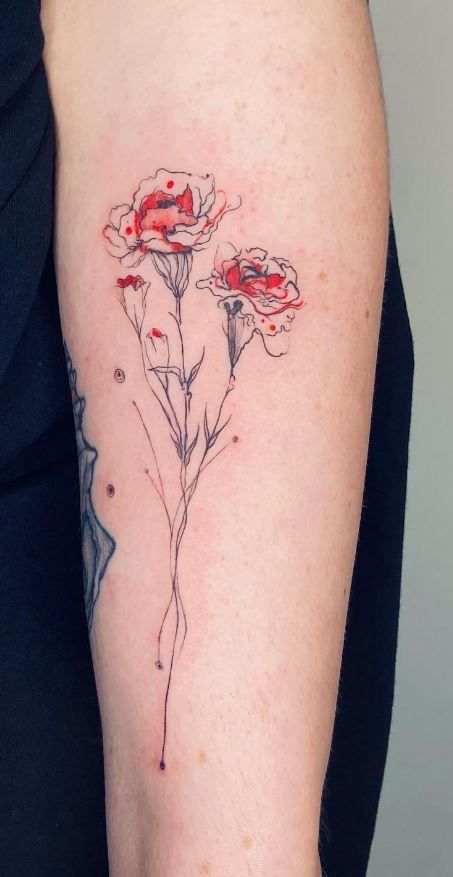
This is the rebellious one of the group. Three carnations rise from extremely thin, wandering stems, but instead of polished botanical realism, the flowers are rendered with loose black drawing and spontaneous red marks. It feels less like a finished botanical illustration and more like a page torn from an artist’s sketchbook.
The largest blossoms sit near the top, with a smaller bud balancing the composition lower down. Their petals are irregular and deliberately imperfect. Fine black lines overlap, disappear, and reappear, allowing the eye to complete some of the forms. Red pigment is then introduced selectively rather than used to fill every petal.
That decision gives the tattoo movement. Small red dots and fragmented patches extend beyond the expected boundaries of the flowers, creating an almost watercolor or ink-splatter effect. Against the long, spare stems, these concentrated flashes of color become particularly vivid.
For 2026, this type of floral design feels especially fresh because it avoids the two extremes we often see with flower tattoos: strict photorealism and ultra-clean minimalism. It occupies a more expressive middle ground.
It could also be expanded intelligently. More stems could transform it into an abstract floral sleeve, while a rose and carnation combination could emphasize the contrast between recognizable flowers and intentionally unfinished linework. I would keep any additions equally loose, though. A heavy traditional flower beside these airy stems would compete with their character rather than complement it.
Pink Carnation Pair With Personal Script
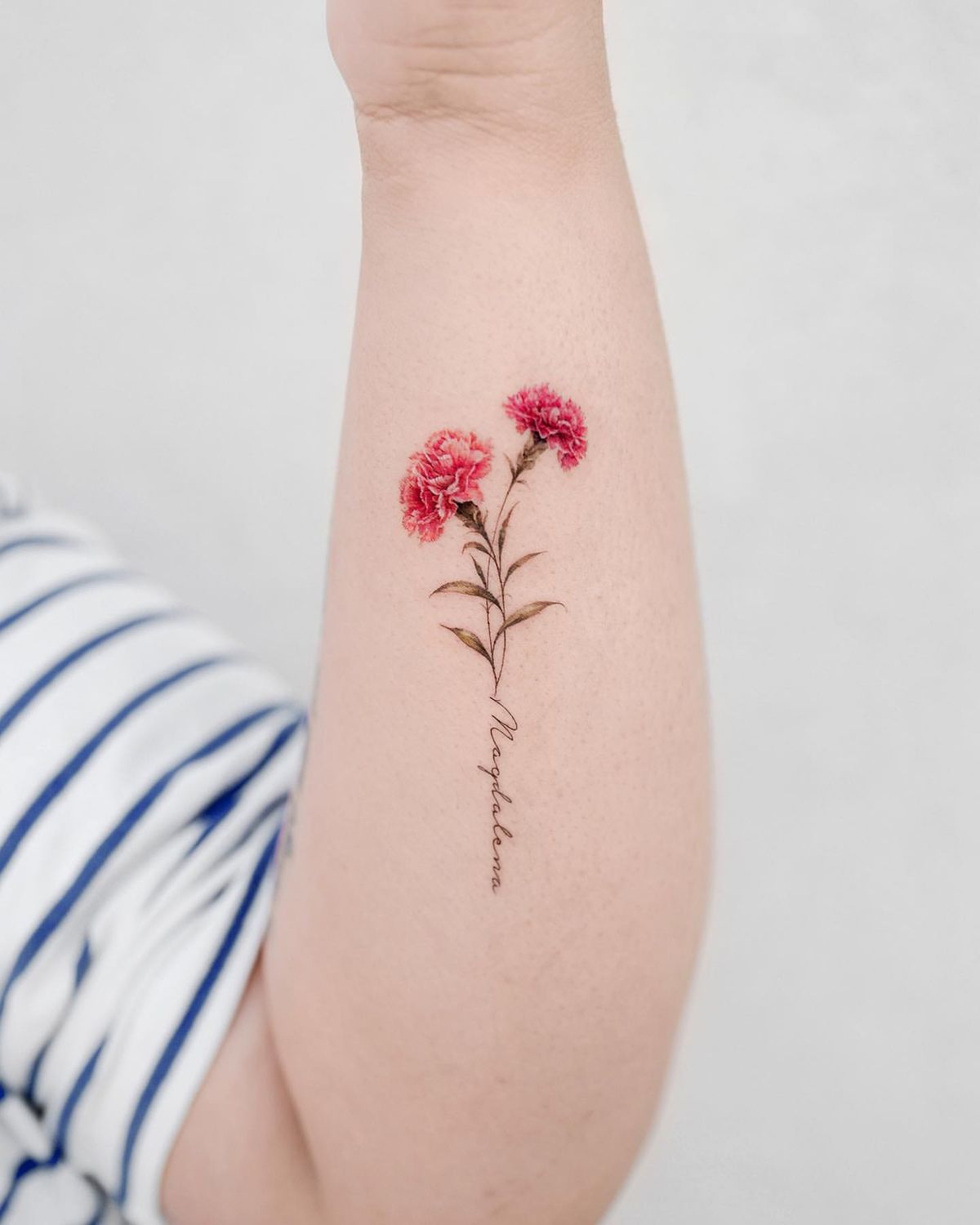
Two small pink carnations make this design feel intimate before you even reach the lettering. The flowers are arranged at slightly different heights, producing the kind of asymmetry that makes a miniature bouquet feel natural.
Color is used with impressive restraint. The petals move between raspberry, dusty pink, and pale highlights, while the stems and leaves stay muted in brownish olive tones. Nothing is aggressively saturated. That softened palette gives the tattoo a vintage botanical quality despite its contemporary scale.
The most personal detail is the fine handwritten word extending from the bottom of the stem. Instead of placing text beneath the flower as a separate element, the lettering visually continues the botanical line. This is a clever way to incorporate a name, meaningful word, or short dedication without making typography dominate the tattoo.
For a January birth flower concept, that opens up plenty of possibilities. A birth name, family word, or meaningful date could be worked into the stem in the same understated manner.
The vertical proportions are also excellent for the inner arm. It is narrow enough to leave considerable negative space around the design while still being large enough for the petal texture to remain visible. Someone considering a future cover up should remember that delicate work like this offers relatively little pigment for concealing older ink; its strength is elegance, not coverage.
Large Blackwork Carnation Along the Upper Back
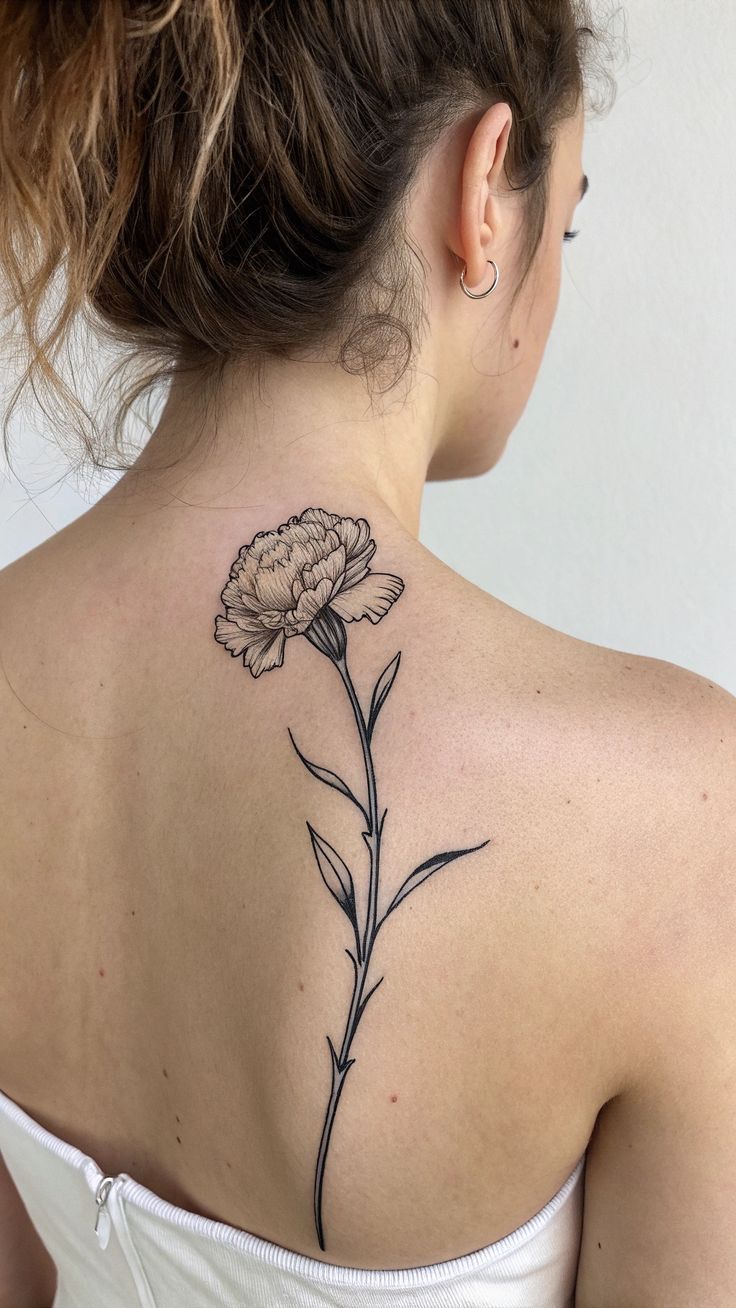
Scale changes the carnation completely. Here, a single flower begins high on the upper back and extends downward through a long stem, turning a traditionally delicate floral subject into a confident statement piece.
The blossom itself combines a clean outline with dense internal linework. Dozens of short strokes follow the folds of the petals, creating depth without solid black fill. From a distance, the flower reads clearly; up close, the engraved texture becomes the main attraction.
The stem is intentionally stronger than those in the smaller tattoos. Long pointed leaves branch away at alternating angles, giving the composition enough width to balance the substantial flower head. Its gentle curve also works with the anatomy instead of looking like a rigid vertical stripe.
This placement is particularly useful for anyone comparing a back tattoo with a collarbone design. A collarbone carnation usually benefits from following a horizontal or diagonal anatomical line, whereas this longer version takes advantage of the vertical space available across the shoulder blade and upper back.
The piece could remain beautifully isolated, but it also has potential as the beginning of larger botanical work. Additional stems could eventually develop into a shoulder or back arrangement without forcing the original flower into a conventional sleeve structure.
There is a subtle confidence to black floral work at this scale. It does not need bright color to announce itself; the shape of the carnation and the rhythm of the linework do all the work.
Deep Red Carnation on the Upper Arm
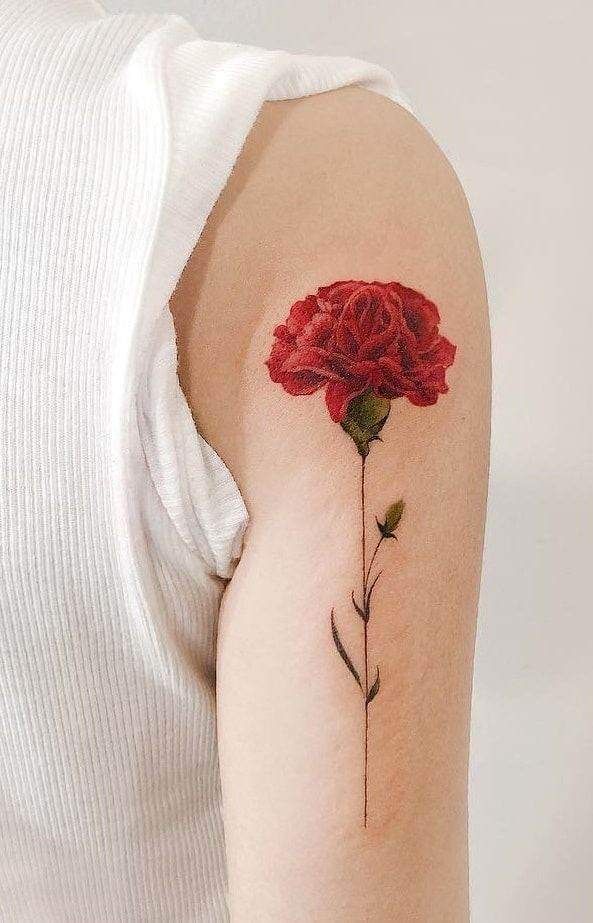
The final idea combines the romance of a classic red flower with a distinctly modern silhouette. A richly colored carnation sits on the upper arm, supported by an exceptionally thin stem and just a few understated leaves.
The flower head carries almost all of the visual weight. Deep burgundy shadows collect between the folds, while brighter scarlet and crimson tones define the upper petals. A compact green base provides just enough contrast to separate the bloom from the stem.
What makes this composition memorable is the dramatic difference in weight between top and bottom. The carnation is dense, rounded, and saturated; the stem below is almost threadlike. This keeps a realistic flower from becoming visually heavy.
The placement also offers an interesting alternative to American traditional carnation tattoos. Traditional work might use thick black contours, simplified red sections, and bolder green leaves. Here, the same classic color combination is interpreted through realism and minimal structure.
That makes it easy to imagine several variations. Men who prefer stronger floral work could increase the size, deepen the shadows, or introduce a bolder stem. Someone looking for a softer design could shift the petals toward dusty pink. And for collectors planning multiple tattoos, the narrow shape leaves enough surrounding space for other botanical pieces later.
Black Carnations With a Dramatic Crescent Brushstroke
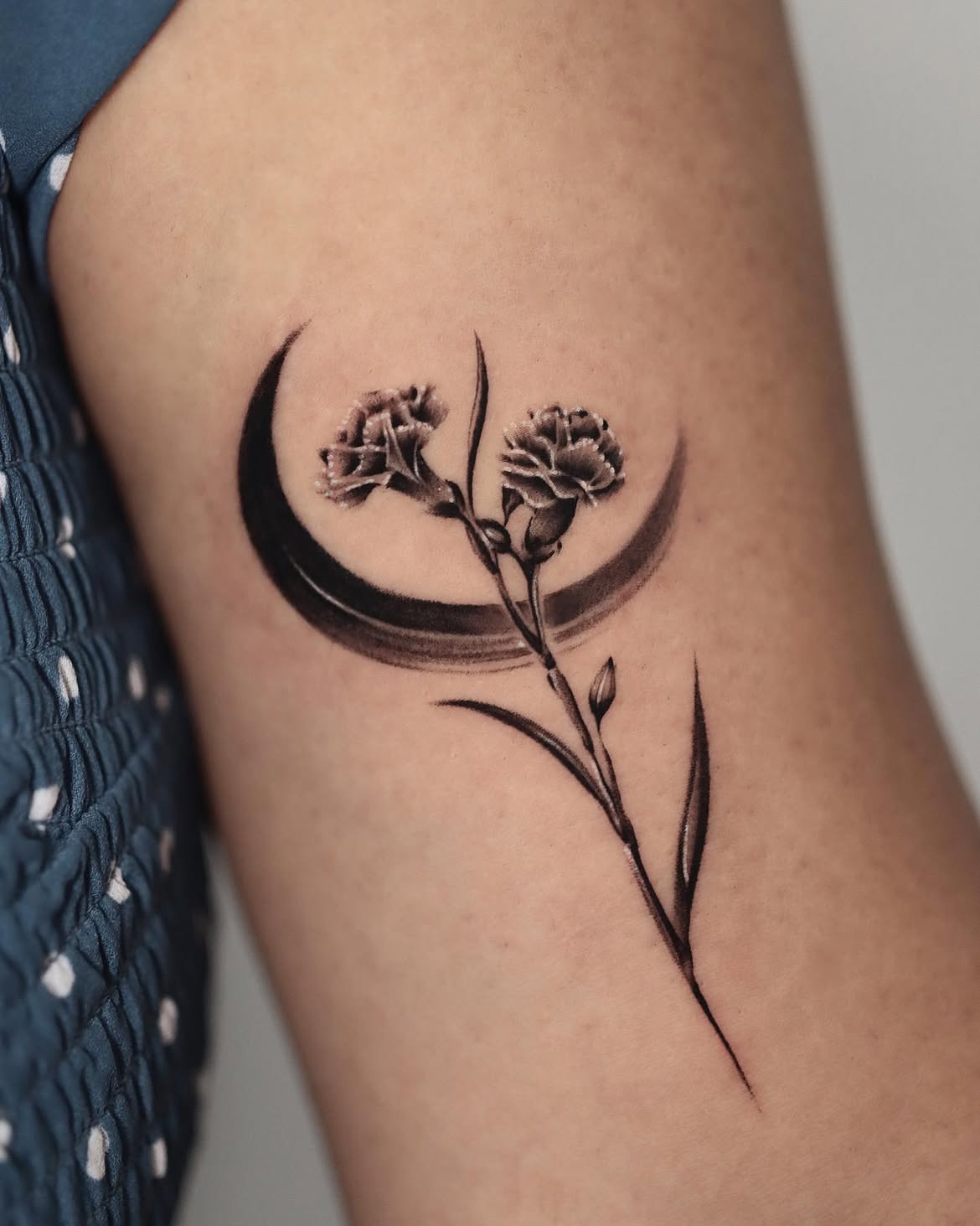
This carnation design immediately stands apart from conventional botanical tattoos. Two compact flowers rise from slender stems while a sweeping black crescent curves behind them, giving the composition a graphic, almost calligraphic quality. The contrast between detailed petals and the broad black gesture is what makes the piece memorable.
The carnations themselves are rendered primarily through black-and-gray shading. Tiny pale highlights along the curled petal edges help separate the layers, while deeper shadows near the centers create surprising dimension for flowers of this size. One bloom turns slightly outward and the other faces more forward, so the pair avoids looking mechanically symmetrical.
The crescent is deliberately imperfect. Its tapered ends and textured lower edge resemble a stroke made with an ink brush rather than a geometrically precise moon. That looseness works beautifully against the controlled floral details. Long leaves echo the sharp ends of the crescent, visually tying the botanical and abstract portions together.
For anyone who likes fine line floral tattoos but wants something darker, this offers an interesting middle ground. It could also inspire a larger blackwork arm composition or become part of a developing sleeve. The concept is versatile enough for women or men, especially when the size and density of the black elements are adjusted.
Tiny Single Carnation Fine Line Tattoo
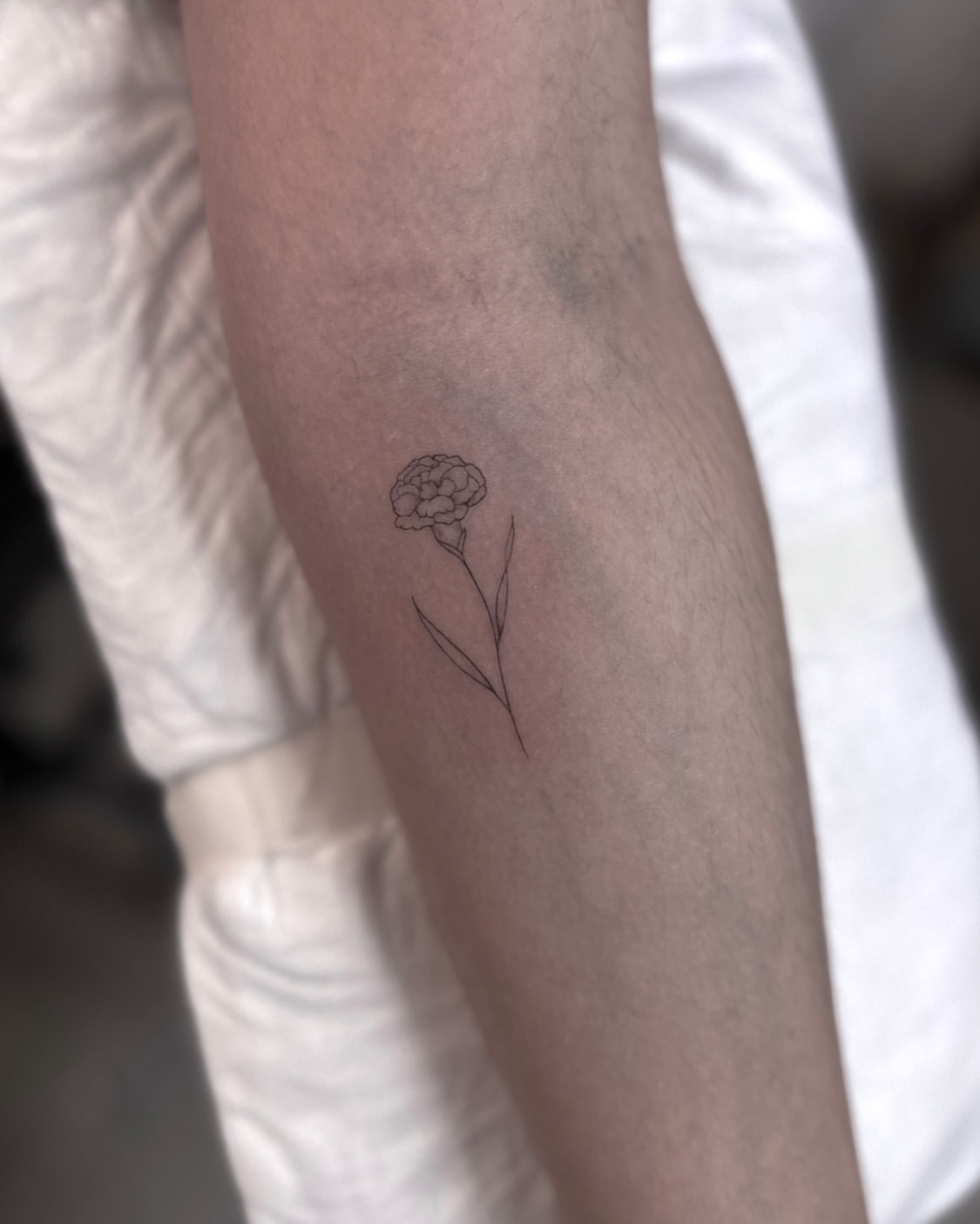
Sometimes the most convincing floral tattoo is the one that refuses to over-explain itself. This tiny carnation uses an exceptionally economical outline: one flower, one stem, and a few narrow leaves. There is no color, decorative frame, lettering, or heavy shading.
The flower head is built from small overlapping curves that suggest the carnation’s characteristic layered petals. Because the design is so small, the artist wisely avoids filling the center with excessive detail. The stem descends in a slightly irregular line, while the leaves extend at different angles to keep the silhouette natural.
This is a particularly good simple interpretation of the January birth flower. The symbolism can remain completely personal; to anyone else, it simply reads as a delicate botanical tattoo.
Scale is crucial with work like this. When preparing a stencil, an experienced artist may recommend opening up tiny spaces between petals rather than shrinking a larger drawing without modification. Those fractions of space can make an important difference once the lines settle into the skin.
Minimal floral tattoos are sometimes assumed to be exclusively for women, but the underlying design is neutral. For men who prefer discreet botanical symbolism, the same small carnation could work on the inner arm, ankle, wrist, or alongside other fine line pieces.
Flowing Two-Bloom Carnation Outline
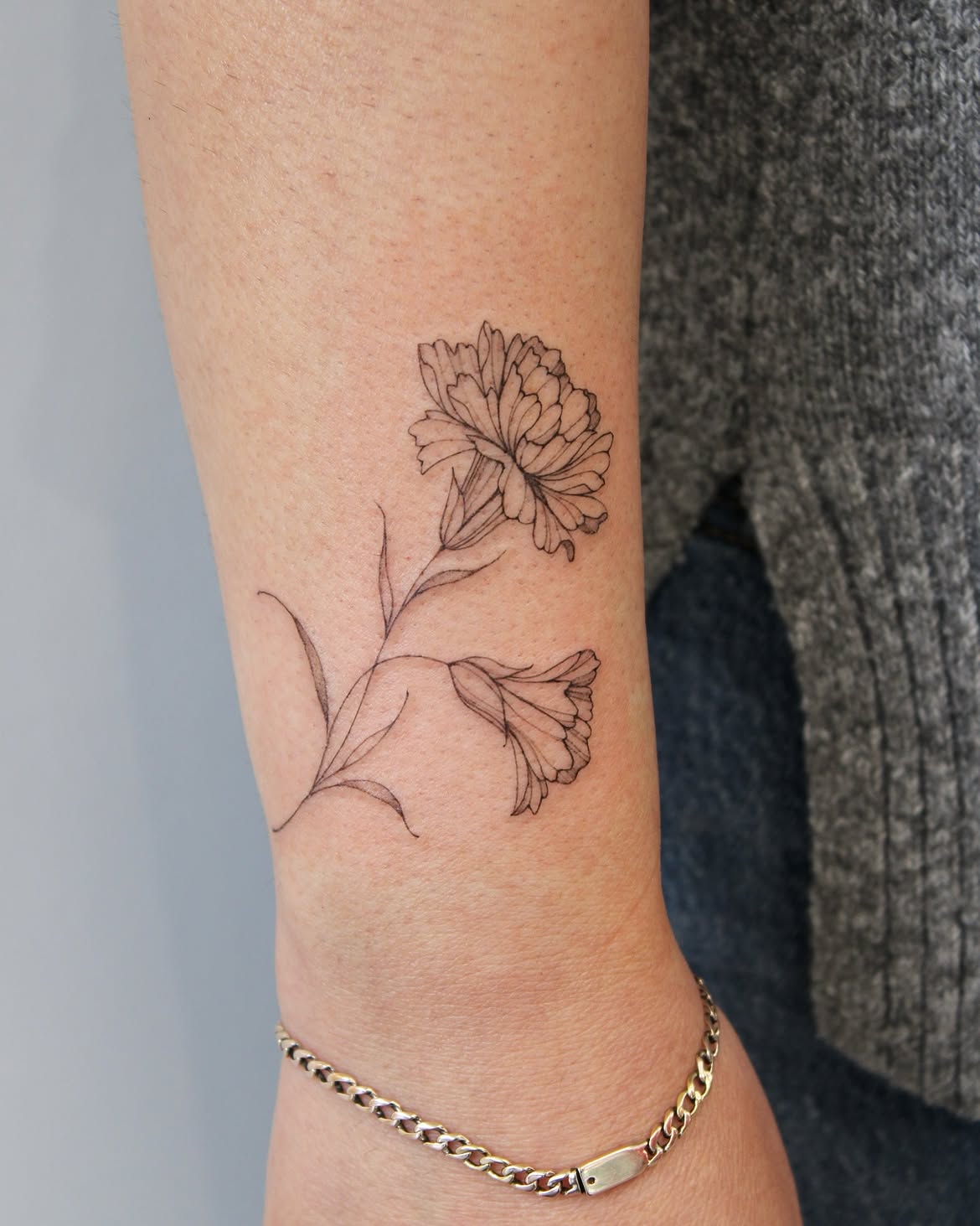
This two-flower composition has the relaxed elegance of a botanical drawing made in one sitting. A large open carnation anchors the upper portion, while a second blossom turns downward from a branching stem. Instead of forcing both flowers to face the same direction, the design uses their opposing angles to create movement.
The upper flower is especially detailed. Individual petals overlap from the center outward, with slightly jagged edges identifying it immediately as a carnation. The lower bloom is viewed more from the side, exposing the elongated base beneath the petals. This difference in perspective makes the pair much more interesting than two repeated copies of the same flower.
Everything is handled in restrained black fine line work. There is just enough soft shading around a few leaves and petal folds to give the drawing depth, but the tattoo remains predominantly an outline design.
This elongated shape works naturally on the inner arm, where the stems can follow the anatomy rather than fighting it. It also offers an excellent foundation for a future botanical collection. A rose and carnation pairing could extend upward, while a daisy and carnation combination would create a lighter mixed-flower theme.
What I like most is the lack of rigid symmetry. Real flowers rarely grow like clip art, and this design benefits from remembering that.
Three Carnations in a Delicate Botanical Bouquet
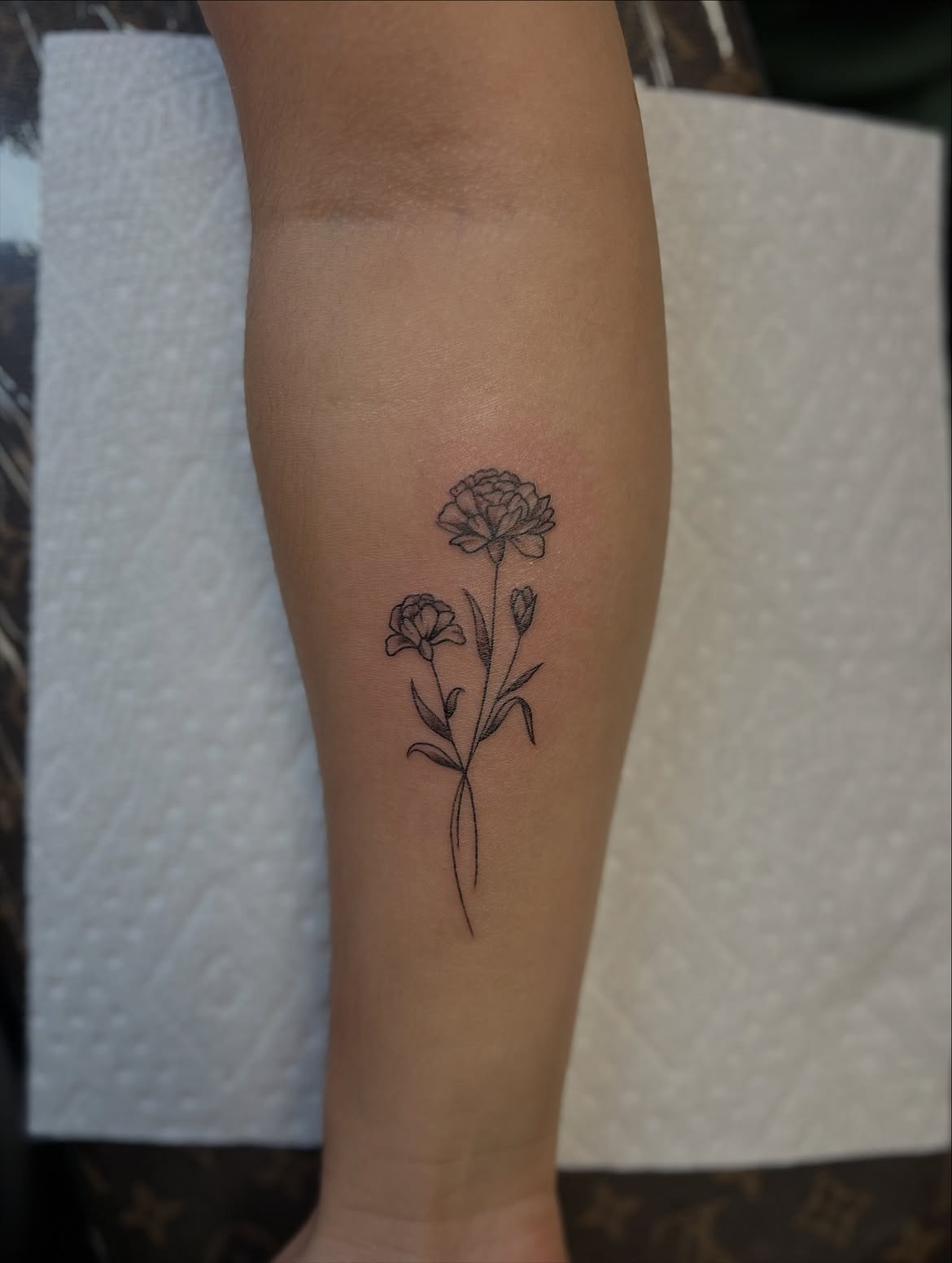
Three stages of the carnation give this tattoo the feeling of a tiny botanical study. There is a large open bloom at the top, a smaller flower positioned to the left, and a closed bud rising between them. Together they suggest growth without requiring any literal wording or dates.
The stems meet near the bottom before continuing into a loose tapered finish. Narrow leaves emerge along the branches, filling some of the negative space while preserving the design’s vertical character. Fine internal marks provide texture within the petals, particularly in the larger bloom, yet there is no heavy black area competing for attention.
This is one of those Carnation tattoo ideas 2026 that demonstrates how much storytelling can come from a relatively simple botanical arrangement. If the carnation represents a January birth flower, the open flower, smaller blossom, and bud could even be given personal meanings connected with different family members or stages of life.
The black-only treatment is also practical for someone who likes floral designs but doesn’t want to commit to red or pink pigment. It feels soft without relying on color.
As a starting point for a botanical sleeve, the bouquet offers several natural continuation lines. Additional flowers could branch from the stems rather than being placed around the tattoo as disconnected objects.
Realistic Orange-Red Carnation With Strong Botanical Detail
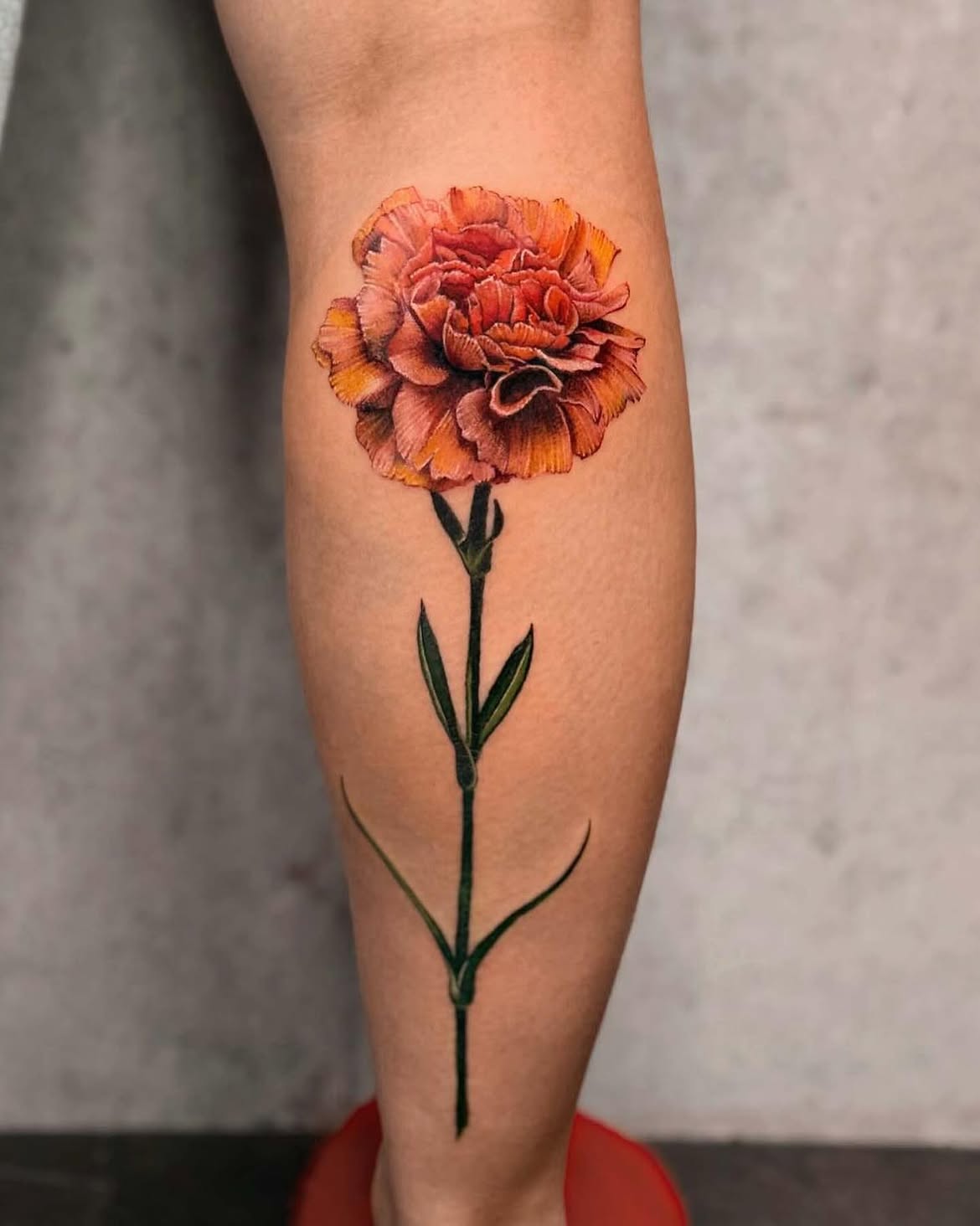
This carnation is all about color. The large blossom uses warm coral, burnt orange, rust, and deep red tones to create a flower that looks almost tangible. Rather than producing depth through a heavy black outline, the artist models individual petals with gradients, fine texture, and carefully placed shadows.
The center is densely folded and noticeably darker. Moving toward the outer edge, the petals become broader and brighter, with orange highlights catching their irregular tips. That progression is exactly what gives the bloom its dimensional appearance.
Below it, the green stem is remarkably restrained. Several long pointed leaves keep the silhouette unmistakably carnation-like, but they do not compete with the colorful flower head. The straight vertical placement is particularly effective on the forearm because it allows the full stem to be seen without wrapping around the body.
This kind of realistic design sits far from an American traditional interpretation. A traditional carnation would normally simplify the petal structure and emphasize bold outlines; here, subtle transitions and botanical observation are the point.
The palette could also inspire less obvious alternatives to the standard pink carnation. Warm orange-red ink feels energetic and slightly vintage, especially when paired with deep green. Anyone considering a color piece should bring healed-work references to the consultation, since a tattoo artist’s ability to maintain separation between closely related reds and oranges matters enormously in a flower this detailed.
Pink Carnation With Handwritten Mum Detail
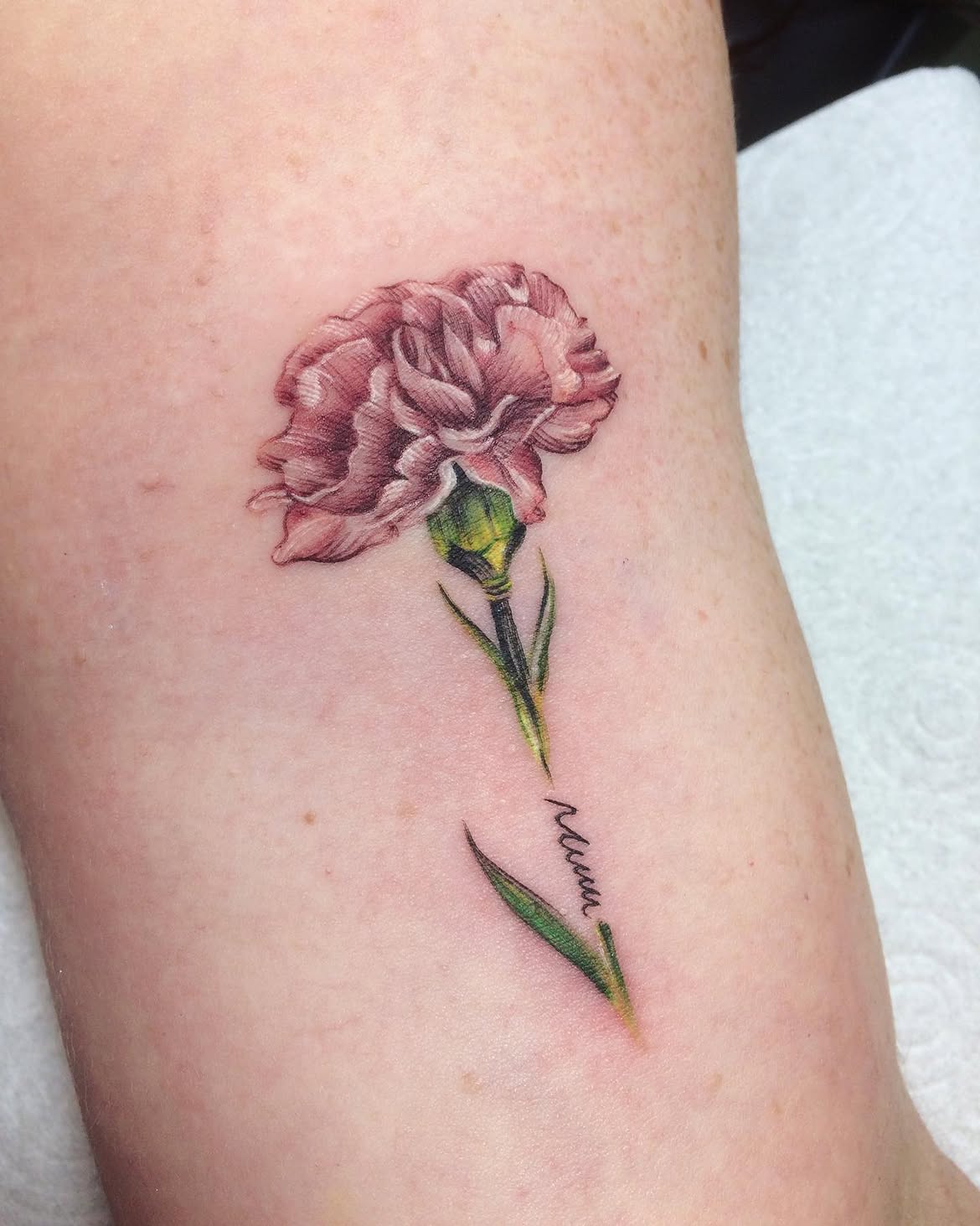
Floral tattoos become especially powerful when one small detail changes them from decoration into a personal keepsake. Here, a realistic dusty pink carnation is paired with the handwritten word “mum,” integrated directly into the lower portion of the stem.
The bloom uses muted mauve, blush, burgundy, and pale highlights rather than a bright candy pink. Fine strokes follow the direction of the petals, giving the flower a softly illustrated texture. Beneath it, a vivid green calyx provides a clean visual break between the warm petals and the stem.
The cleverest element is the lettering. Instead of placing “mum” beneath the flower like a caption, the script interrupts the stem itself. A green leaf appears below it, allowing the botanical line to continue visually after the word. It is a small compositional decision, but it makes the memorial element feel fully integrated.
Carnations have long been used in family-centered floral imagery, so this approach feels particularly natural. The same concept could use a parent’s handwriting, a name, initials, or a short word copied from an old card. When handwriting is involved, I would resist over-cleaning the original strokes; little irregularities are often exactly what make the finished tattoo feel personal.
This is also a good example of how pink can feel mature rather than sugary. Against the green and black detailing, the muted petals have a quiet, almost vintage quality.
Upside-Down Fine Line Carnation Near the Wrist
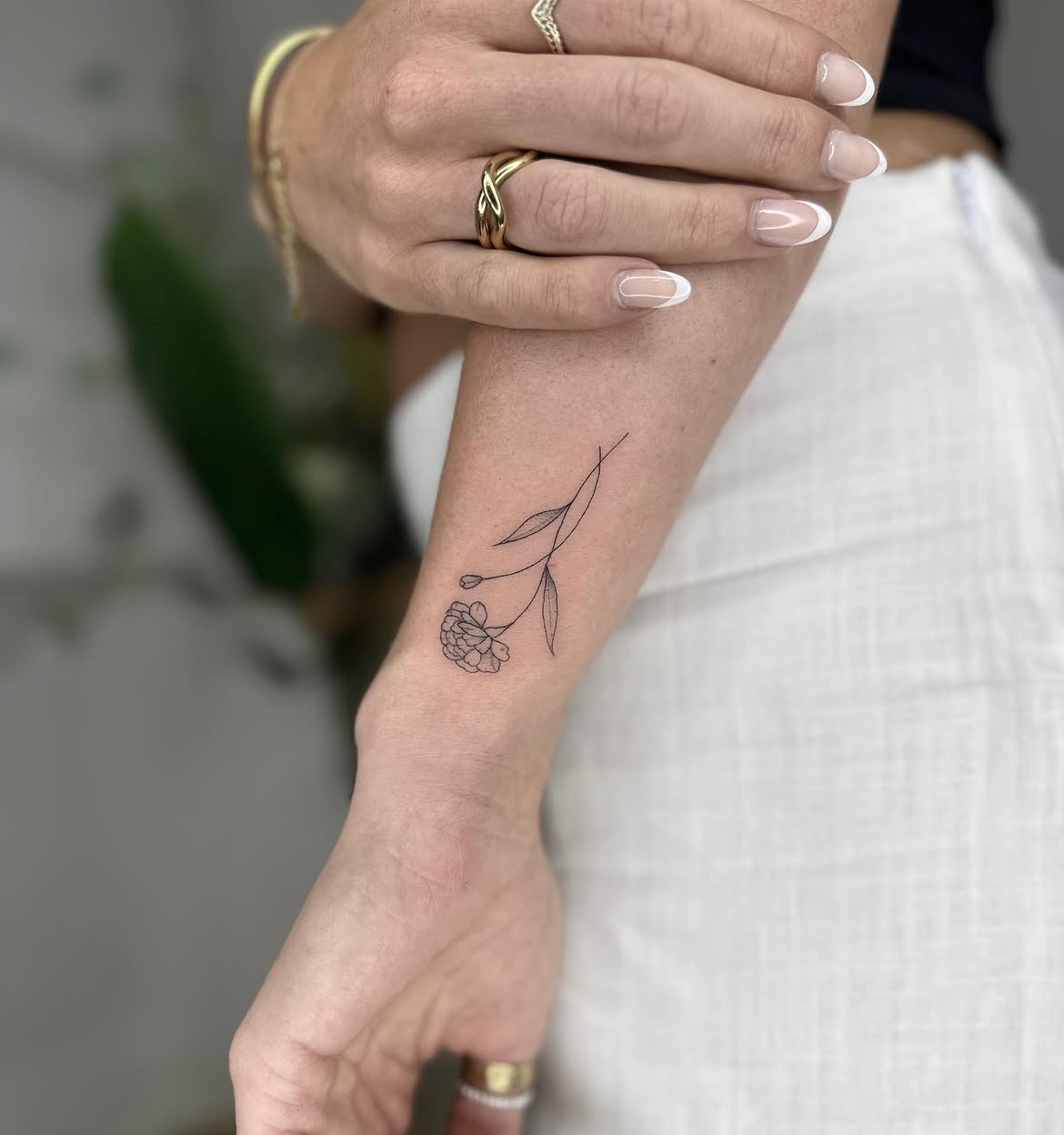
The orientation makes this minimalist carnation unexpectedly distinctive. Rather than growing vertically from wrist toward elbow, the stem travels downward and allows the flower to hang toward the hand. It feels casual and organic, almost as though a small flower has been laid across the skin.
A single open carnation sits at one end, accompanied by a tiny unopened bud and several elongated leaves. The entire piece relies on extremely delicate black lines, with almost no conventional shading. Petal divisions are suggested through small loops and curves, keeping the flower recognizable while preserving the airy quality of the design.
The placement near the wrist suits this fine line approach particularly well. When the arm is relaxed, the botanical line follows its length; when the hand moves, the changing angle gives the flower a different visual relationship with the wrist.
This would be an easy idea to personalize without losing its minimalist character. A tiny red mark could be introduced in the center, or the carnation could remain entirely black for a cleaner look. Another birth flower could also be added along the stem if the tattoo represents more than one person.
Among small carnation designs, this one is especially useful for anyone who dislikes rigid, perfectly upright flowers. Changing orientation sounds like a minor decision, but here it gives a familiar subject an entirely different personality.
Black and Gray Carnation Trio With Bold Botanical Shading
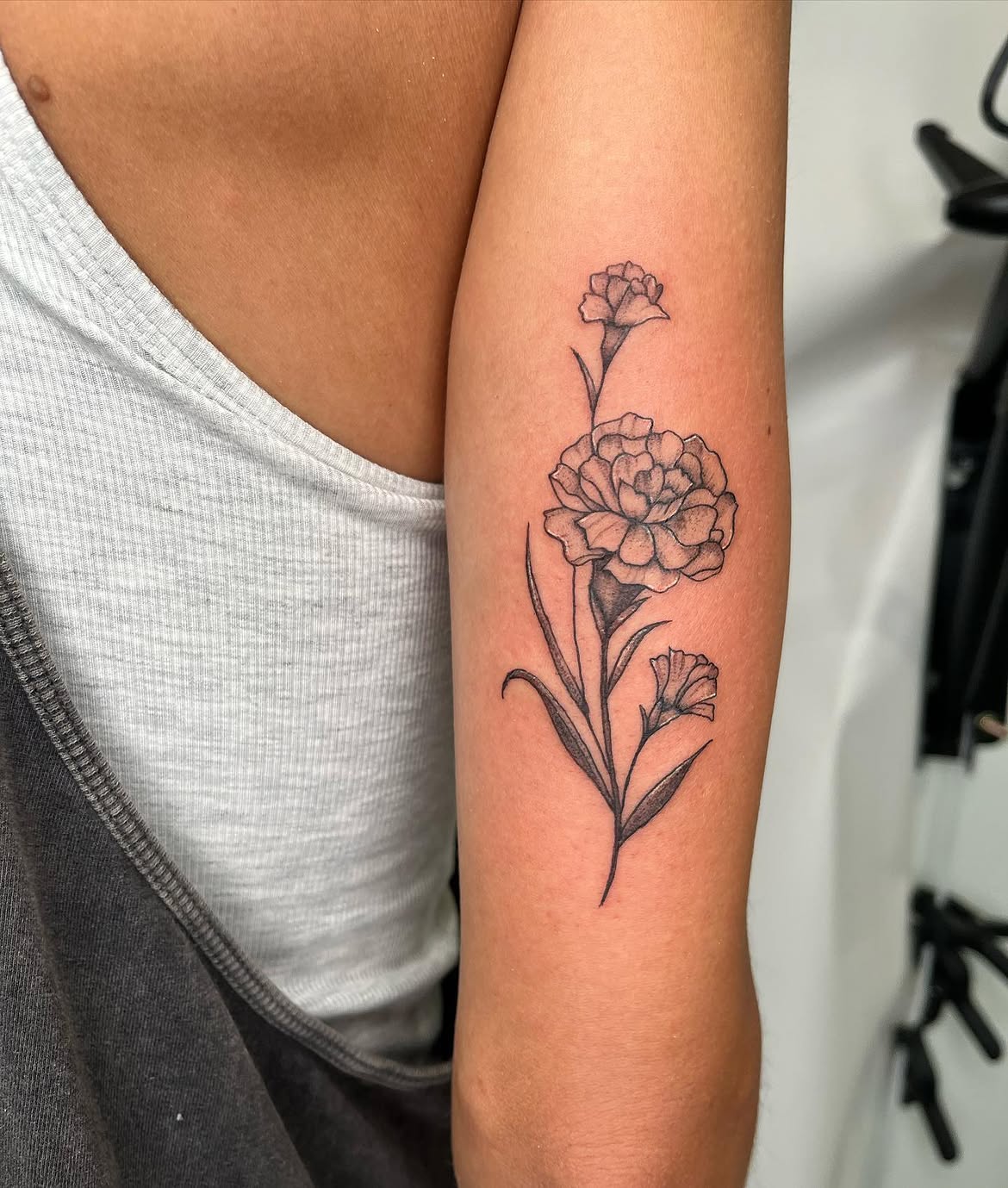
This larger carnation arrangement shows how well the flower works when a fine line foundation is combined with stronger black-and-gray shading. Instead of relying on one bloom, the composition brings together a large central carnation, a smaller flower above it, and a side-facing blossom below. The different stages and angles make the tattoo feel like an actual botanical stem rather than a repeated floral motif.
The central flower carries most of the detail. Its overlapping petals are separated by clean outlines and gentle gray shading, particularly toward the center where the layers become denser. The smaller upper carnation is simpler, which is a smart compositional choice: giving every flower equal detail would make the piece unnecessarily busy.
Long leaves rise between the blooms and create sharp directional lines. Some contain considerably darker shading than the petals, giving the tattoo a graphic backbone and keeping all that floral softness from becoming visually flat.
On the arm, the elongated arrangement follows the anatomy naturally and has enough scale to remain legible from a distance. This would also be a practical starting point for a botanical sleeve, since additional stems could extend upward or downward without changing the character of the original tattoo.
For anyone who likes blackwork but finds heavy American traditional outlines too bold, this style offers an appealing compromise: clear structure, recognizable flowers, and plenty of detail without solid color.
Tiny Two-Carnation Ankle Tattoo
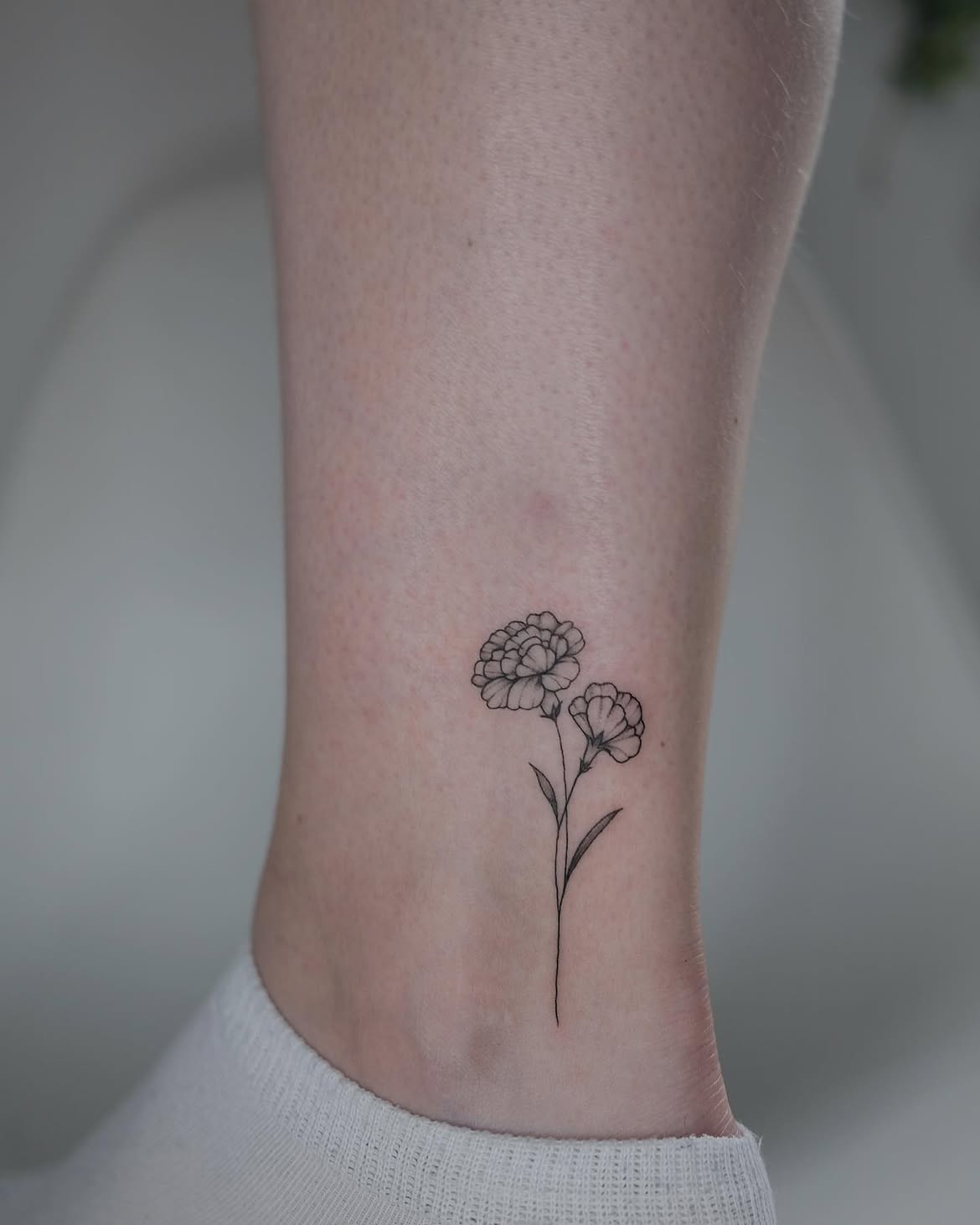
Two tiny carnations rise from a single narrow stem in one of the most understated designs in the collection. The placement just above the ankle makes the tattoo feel almost like a botanical charm—small enough to disappear beneath clothing but detailed enough to become noticeable when the leg is exposed.
The flowers are drawn almost entirely with a delicate black outline. One bloom faces more directly outward, allowing its concentric petal structure to be seen, while the second turns slightly sideways. That small change in angle prevents the pair from appearing copied and pasted.
There is virtually no shading. The artist relies on negative space and precise line placement instead, adding only a few narrow leaves to establish the plant’s silhouette. This restraint is exactly what a simple tattoo at this scale needs.
As a January birth flower idea, the design feels personal without announcing its meaning. Two flowers could symbolize two people, siblings, a parent and child, or simply create a better-balanced composition than a single stem.
Tiny botanical work is especially dependent on a carefully prepared stencil. The gaps inside those petals need enough breathing room to remain readable after healing. If I were adapting this design, I would preserve its scale rather than adding extra decorative details—the empty skin around the flowers is part of what makes it so charming.
Large Fine Line Carnation Bouquet on the Forearm
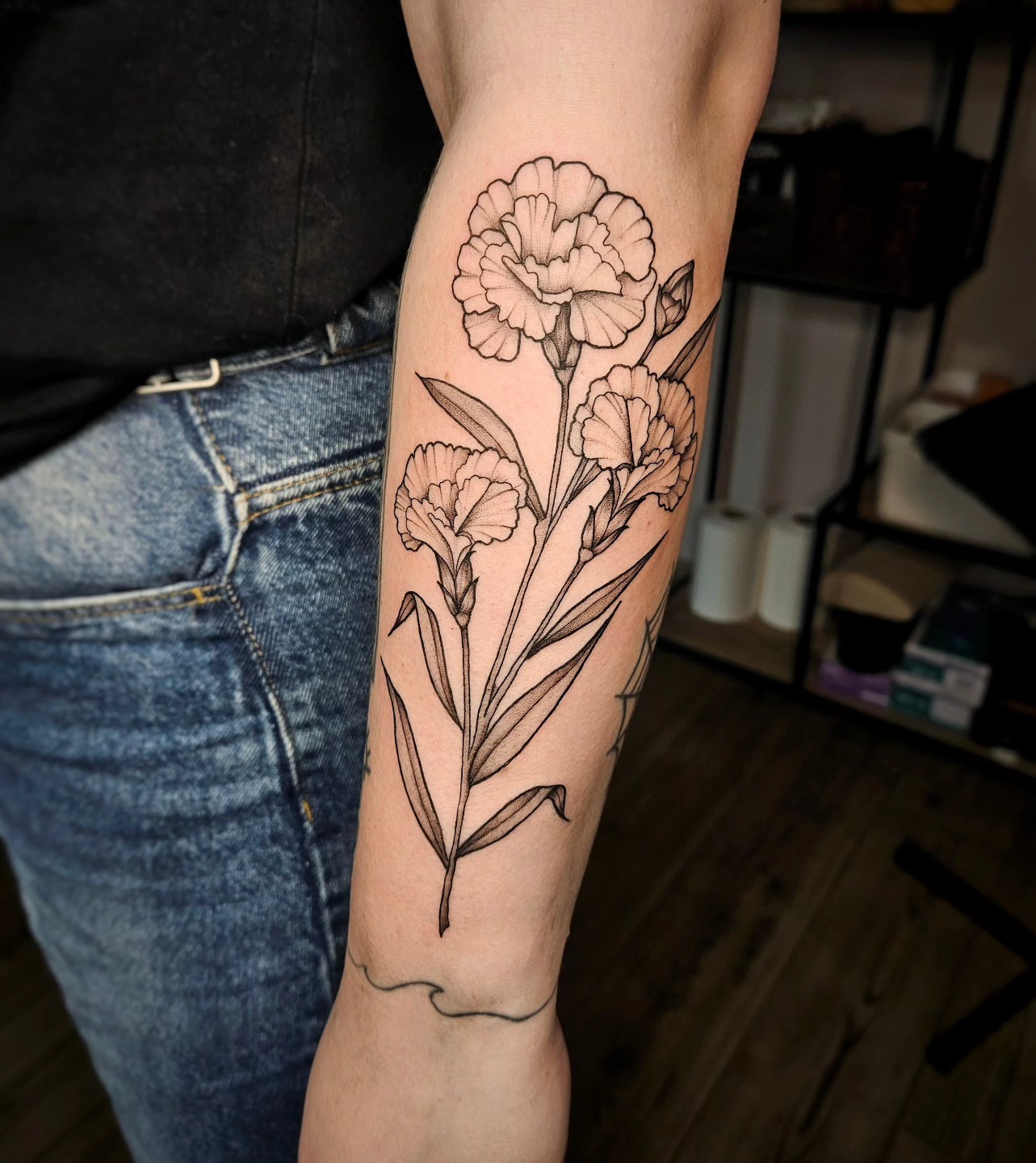
Here the carnation is treated almost like a full botanical illustration. Several blossoms occupy different levels of the forearm, supported by long leaves and intersecting stems that turn the design into a substantial floral statement.
The largest carnation sits near the top and opens toward the viewer. Its broad outer petals frame a more tightly layered center, while thin interior strokes create subtle texture. Smaller blooms face outward from either side, giving the arrangement width without turning it into a rigidly symmetrical bouquet.
The leaves are particularly important. Their long spear-like forms create diagonals between the rounded flower heads, and soft dotwork or gray shading inside some leaves adds dimension while keeping the overall palette black.
This is a good example of how fine line work can be large. Fine line does not have to mean tiny. In fact, giving delicate linework more space often allows the botanical details to breathe and can produce a much more impressive result.
For someone planning an eventual sleeve, this scale makes sense. Additional flowers could continue around the forearm, or another species could be introduced to create a mixed botanical story. A rose and carnation composition would feel richer and more romantic, while a daisy and carnation pairing could introduce a lighter contrast in petal shape.
Pink Carnation Pair With Olive Green Leaves
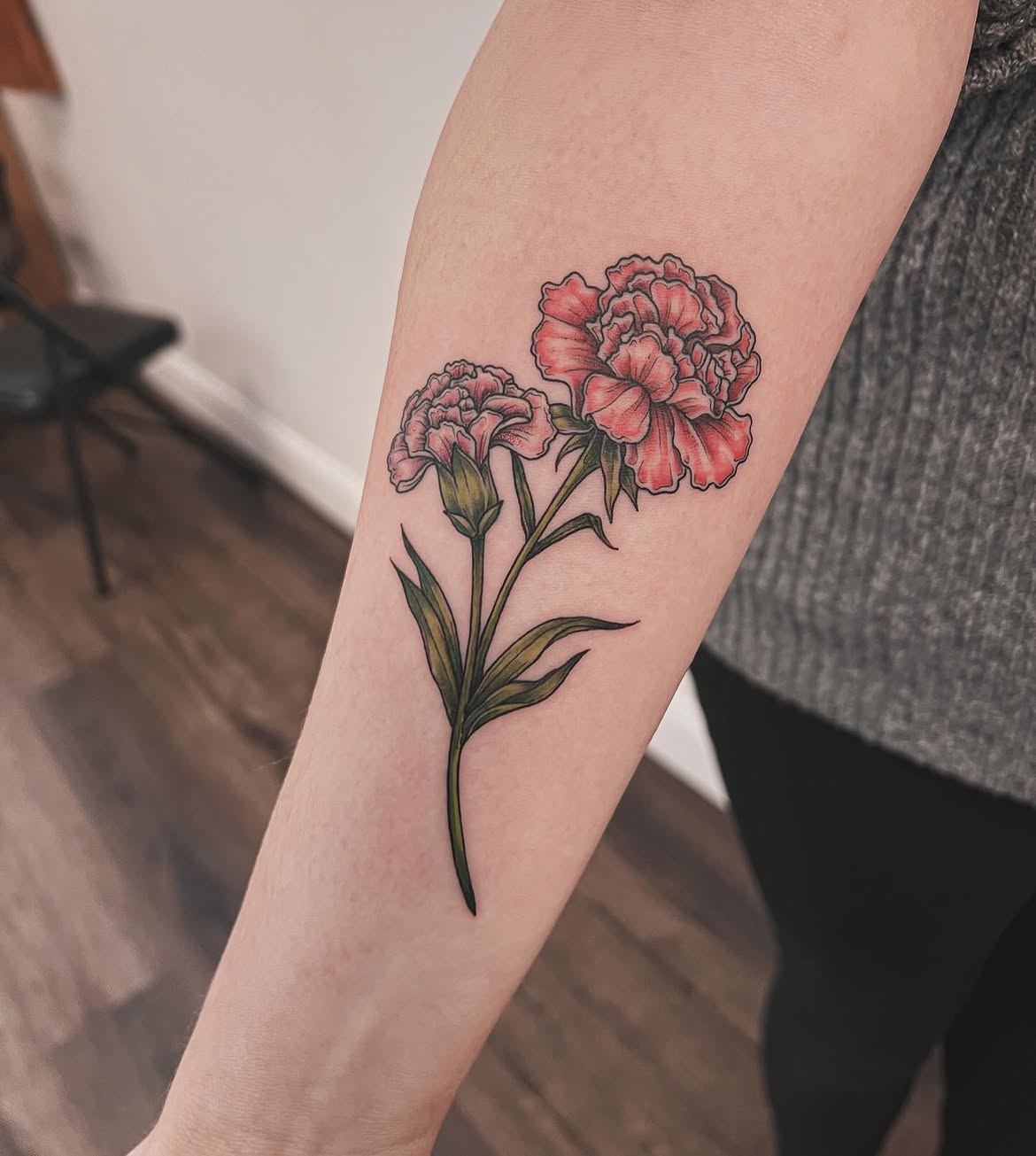
This colorful pair brings a slightly more illustrative character to the carnation. Two pink flowers sit at different heights, their stems meeting lower down and surrounded by muted olive-green leaves. Black contours give the design definition, but the softer color palette prevents it from feeling as heavy as classic traditional tattooing.
The larger bloom is the obvious focal point. Its ruffled petals alternate between pale pink highlights and deeper coral shadows, while thin dark edges separate the many overlapping layers. The smaller flower is viewed more from the side, revealing a green base and giving the pair a convincing botanical relationship.
The leaves use earthy green rather than bright emerald tones. That was a particularly good choice: intense green could have competed with the pink petals, whereas the muted shade keeps attention on the flowers.
This approach sits somewhere between realism and American traditional design. It retains strong outlines and readable shapes but introduces more nuanced petal shading than a strictly traditional tattoo normally would.
The vertical arrangement works beautifully on the inner forearm. It is noticeable without occupying the entire arm, and its narrow lower stem leaves generous negative space around the tattoo. If you love red carnations but want something less expected, this softened pink-and-coral palette is an easy direction to take to a color artist.
Delicate Four-Flower Carnation Botanical Design
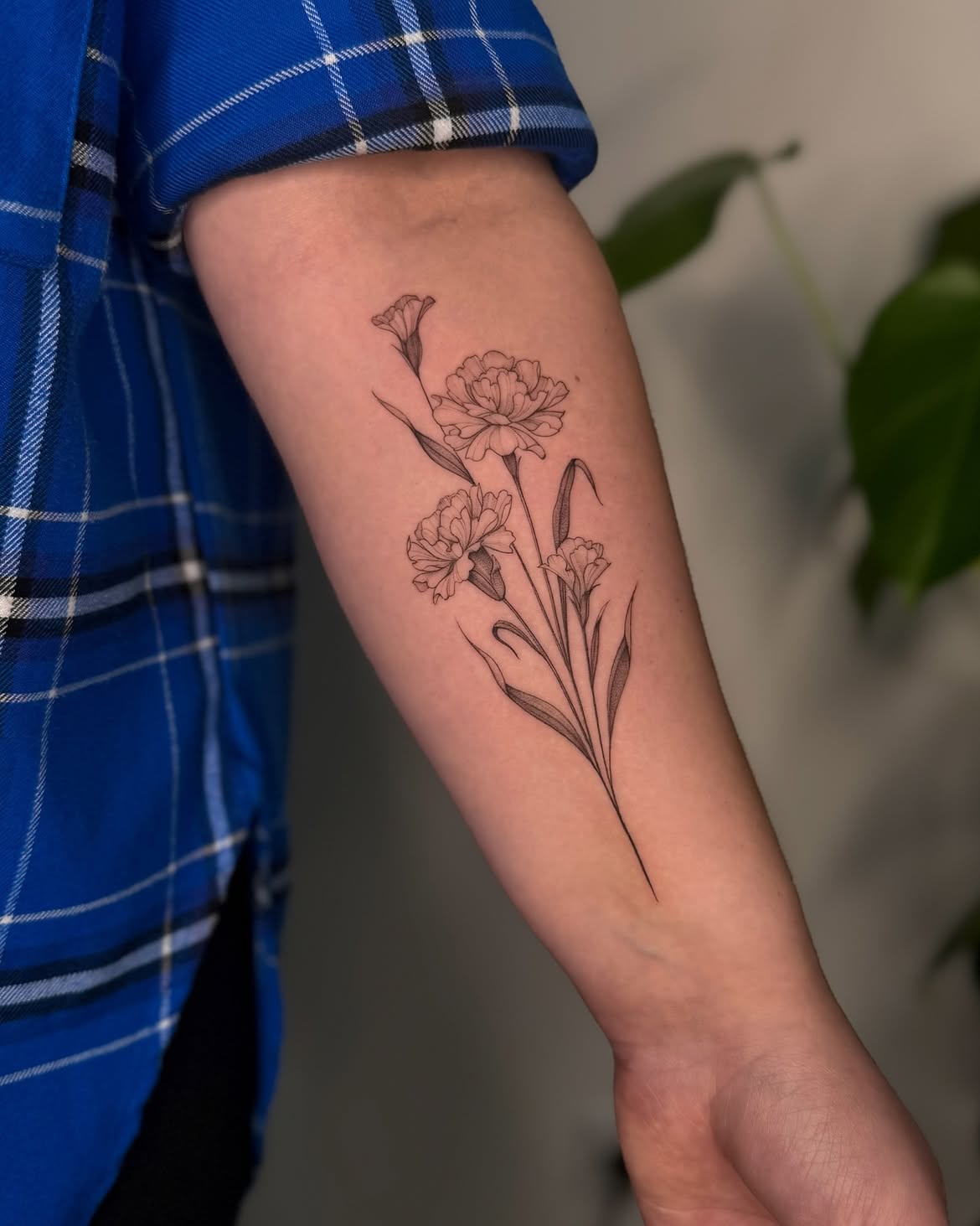
This design feels like a page from an old botanical notebook translated into tattoo form. Four carnations emerge from one long, tapering arrangement, with each flower presented from a slightly different perspective.
The upper bloom is the fullest, its petals spreading horizontally around a dense center. A second open flower sits lower and to the left, while two smaller blossoms and buds complete the composition. The variety gives the tattoo a sense of natural growth; nothing feels arranged into an artificial bouquet.
Extremely thin black lines define the petals, stems, and long leaves. Subtle shading inside the leaves gives them enough visual weight to support the flowers without changing the overall fine line character.
The lower stems converge into a single sharp point, which works particularly well with the shape of the forearm. It draws the eye downward and gives a fairly detailed design a clean finish.
I like this as an alternative to the familiar single-flower January birth flower tattoo. When the symbolism matters but you also want the piece to function as decorative botanical art, using several carnations creates a fuller result without introducing unrelated imagery.
The same drawing could even work in very soft color. Pale pink petals or restrained red accents would change its mood completely, though the monochrome version has an elegant timelessness that is difficult to improve upon.
Flowing Carnation Forearm Sleeve in Fine Line Blackwork
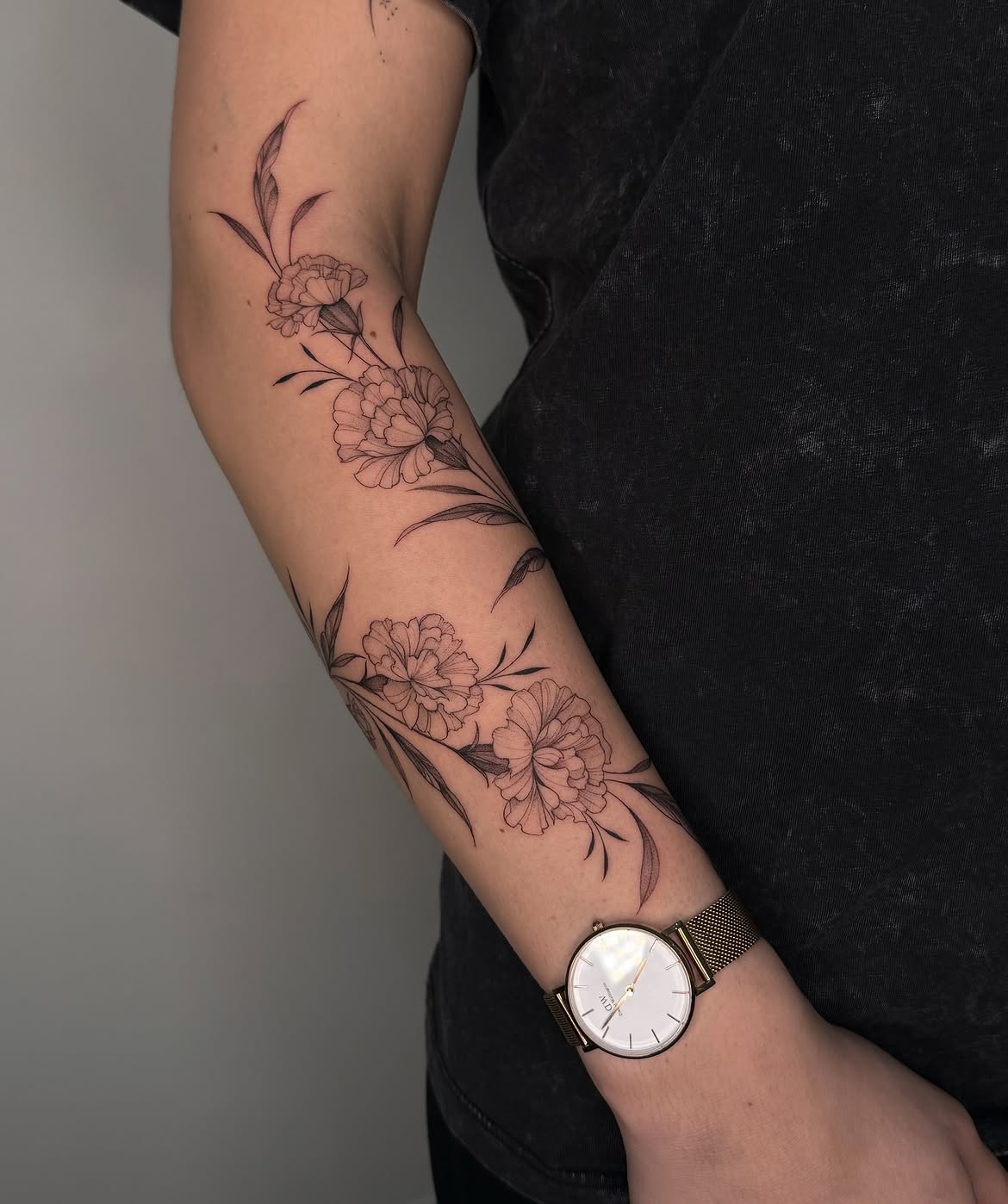
This is the most convincing sleeve concept in the collection. Instead of arranging the carnations along one straight stem, the design allows several floral clusters to travel around the forearm, using leaves and thin branches to connect the sections.
That flowing construction is what makes it work on the body. Large carnation heads appear at different points rather than forming a single row, and the stems shift direction as they move around the arm. The negative spaces between the clusters are just as important as the tattooed areas; they stop the piece from becoming one dense block of blackwork.
The flowers themselves remain remarkably delicate. Each bloom uses thin outlines and small internal marks to establish its ruffled petals. Darker shading appears mainly in the leaves and at the bases of the flowers, creating contrast without filling the petals.
Anyone planning a floral sleeve can take a useful lesson from this design: you do not necessarily need a background to connect individual elements. Repeating leaf shapes and maintaining a consistent line weight can create continuity on their own.
It also demonstrates how carnation tattoos can work for men as easily as for women. Increasing scale and extending the botanical movement around the arm changes the overall presence of the flower without requiring stereotypically masculine additions.
Realistic Bright Pink Carnations With Fresh Green Stems
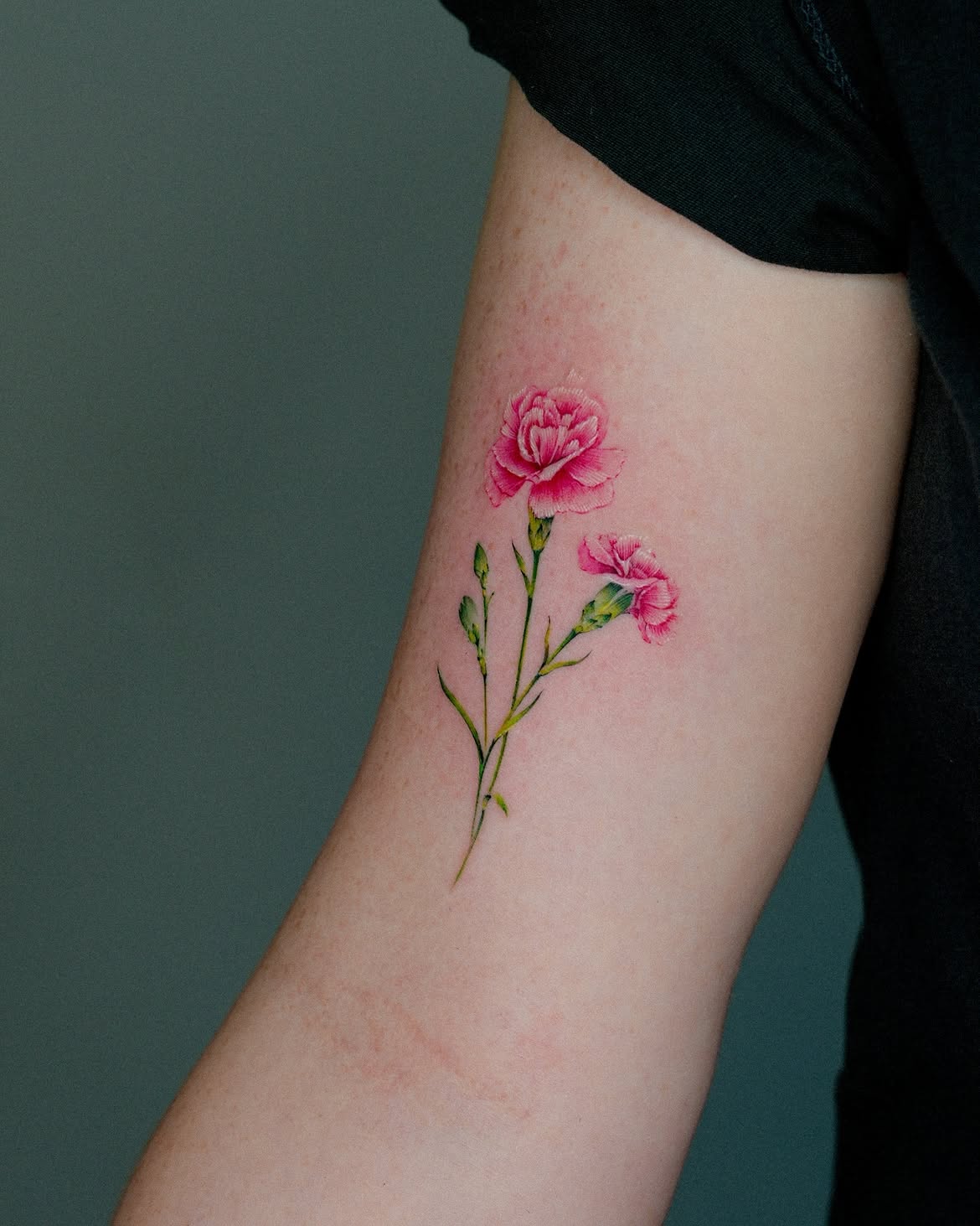
The final color piece is wonderfully fresh. Three pink carnations rise on extremely slender green stems, accompanied by small buds and narrow leaves. Instead of using dark black outlines around every surface, the artist allows color and tonal contrast to define most of the forms.
The largest flower combines vivid fuchsia-pink shadows with pale, almost white highlights along the edges of its petals. Those highlights are especially effective because carnations naturally have rippled surfaces; the lighter marks make each fold appear to catch the light.
A smaller side-facing carnation introduces a different silhouette, while unopened buds reinforce the impression of a living plant rather than a decorative floral symbol. The green is bright but used sparingly, concentrated mostly around the calyxes and narrow stems.
This type of realism is particularly attractive for someone who wants a flower tattoo that feels light despite having strong color. The absence of a heavy black border keeps the whole piece airy.
It is also an excellent alternative to the classic red carnation. Pink gives the same recognizable petal structure a gentler character, and the small bouquet format feels especially natural on the inner arm. If the tattoo represents a January birth flower, multiple blooms can subtly expand the symbolism to include family or relationships without adding names or text.
Taken together, these carnation tattoo ideas show just how much range one flower can offer. A tiny ankle outline feels almost private, while a flowing forearm sleeve turns the same botanical subject into a statement piece. Color changes the mood just as dramatically: black ink feels graphic and timeless, pink can be soft or vibrant, and deep red gives the carnation a more classic intensity.
Botanical Carnation Shoulder Tattoo With a Tiny Ladybug
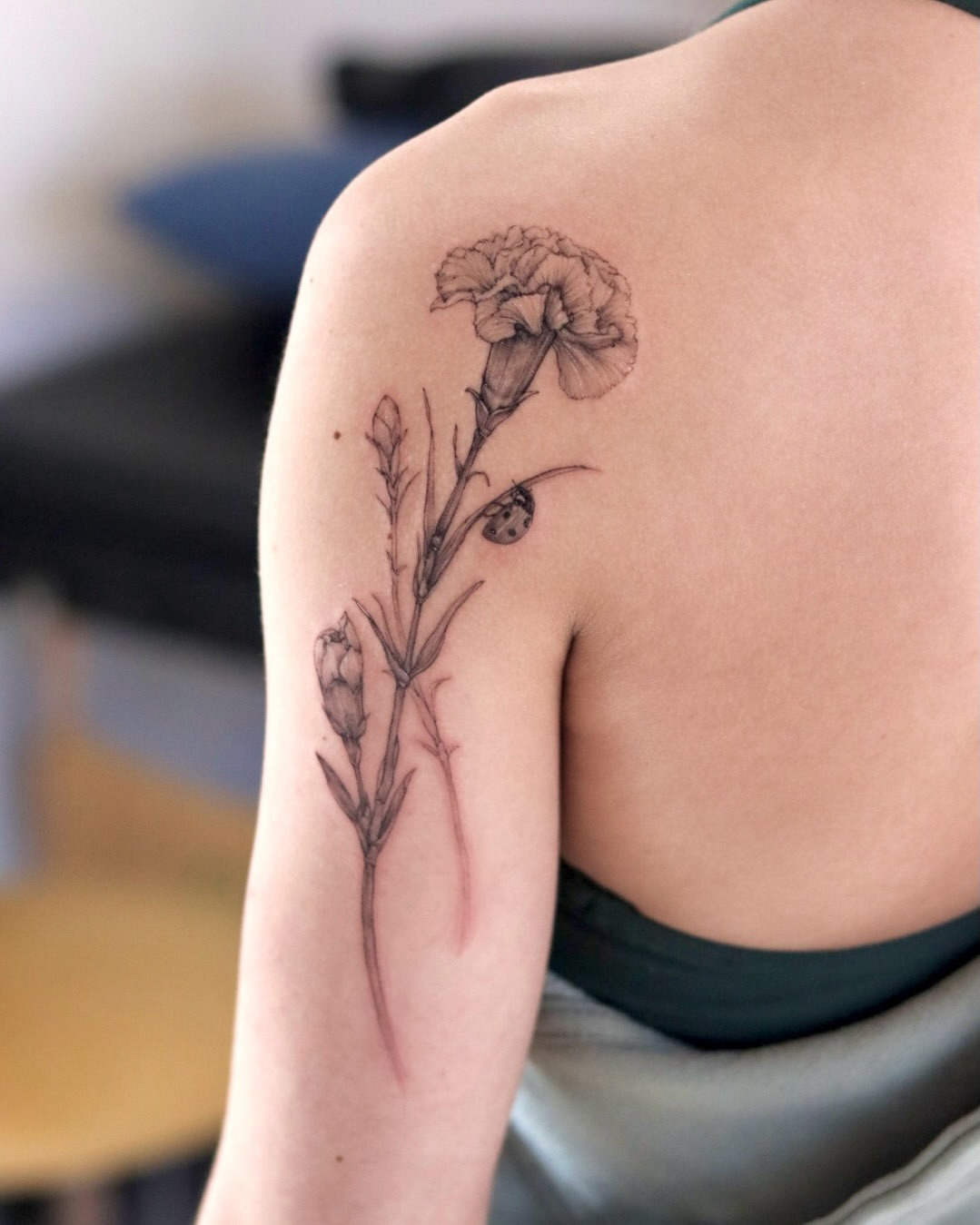
This botanical carnation tattoo uses the natural curve of the shoulder and upper arm beautifully. A single mature flower rises above several buds and long narrow leaves, creating a tall composition that follows the body instead of sitting like a separate illustration on the skin. The black-and-gray palette keeps the piece understated, while soft shading inside the petals adds enough depth to make the bloom recognizable.
One of the most charming details is the tiny ladybug resting beneath the main flower. It introduces a small natural element without distracting from the carnation itself. The combination feels like a miniature garden study rather than a conventional floral tattoo.
The placement also makes this design particularly interesting for anyone considering a future floral sleeve. Additional stems, insects, or complementary flowers could easily continue down the arm. Left alone, however, it remains an elegant fine line statement with a slightly vintage botanical mood.
Realistic Pink Carnation With a Delicate Bud
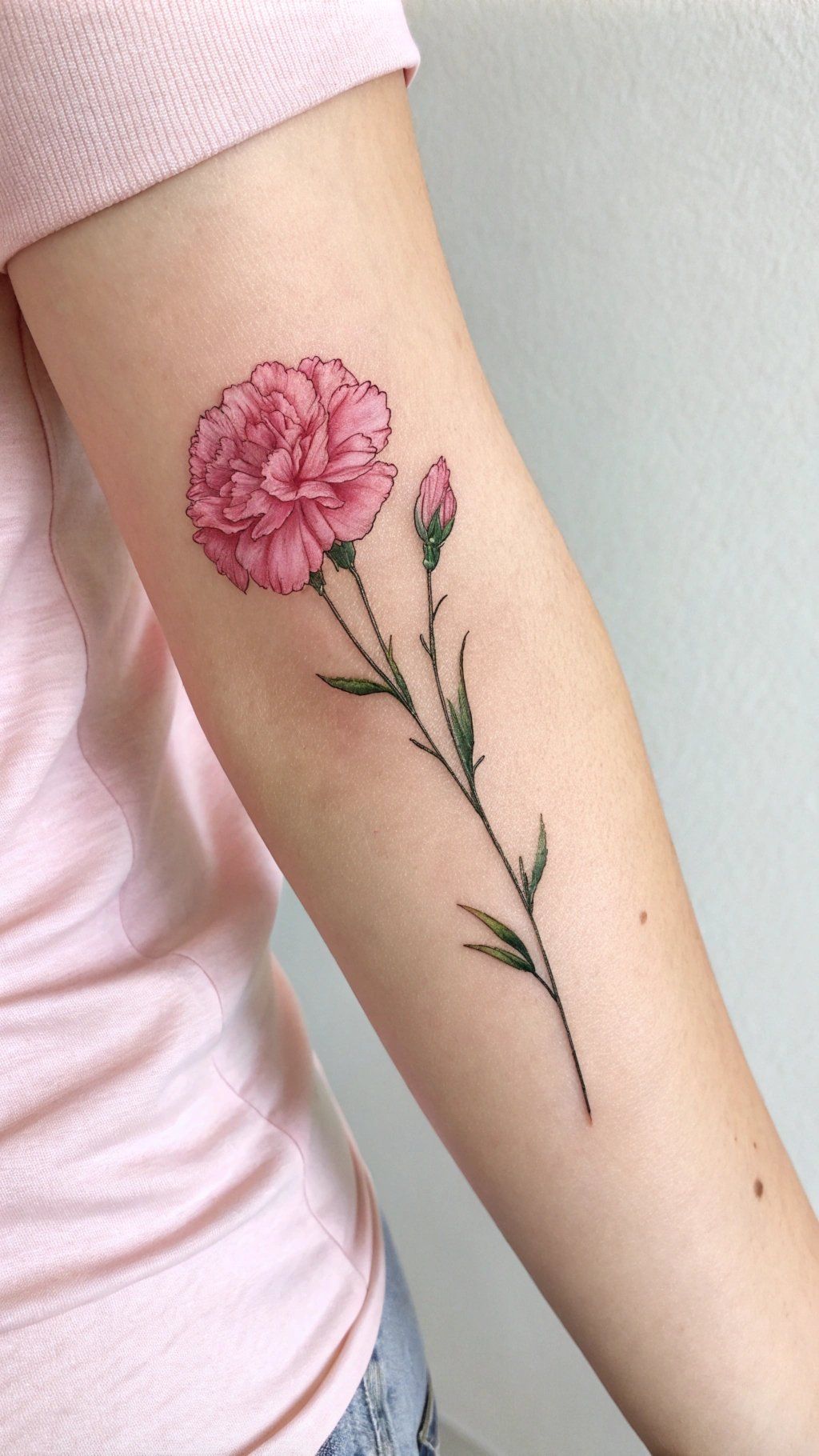
A lush pink carnation dominates this graceful upper-arm design. The flower has been rendered with impressive attention to its densely folded petals, moving from darker rose tones in the center toward softer pink edges. Rather than making the entire tattoo equally saturated, the artist keeps the long stem and foliage comparatively delicate.
A closed bud rises beside the main bloom, creating a subtle contrast between a flower at full maturity and one that has not yet opened. That detail can also give the tattoo personal meaning, suggesting growth, change, potential, or different stages of life.
The stem is exceptionally thin and extends well below the flower, giving the tattoo an elongated silhouette. Small green leaves appear intermittently rather than forming heavy foliage. This allows the pink blossom to remain the clear focal point.
It is a sophisticated example of a January birth flower tattoo that combines realistic color with a minimalist composition. Someone who wants a feminine floral piece without the visual density of a bouquet could use this design almost exactly as it is.
Tiny Red Carnation Pair Near the Elbow
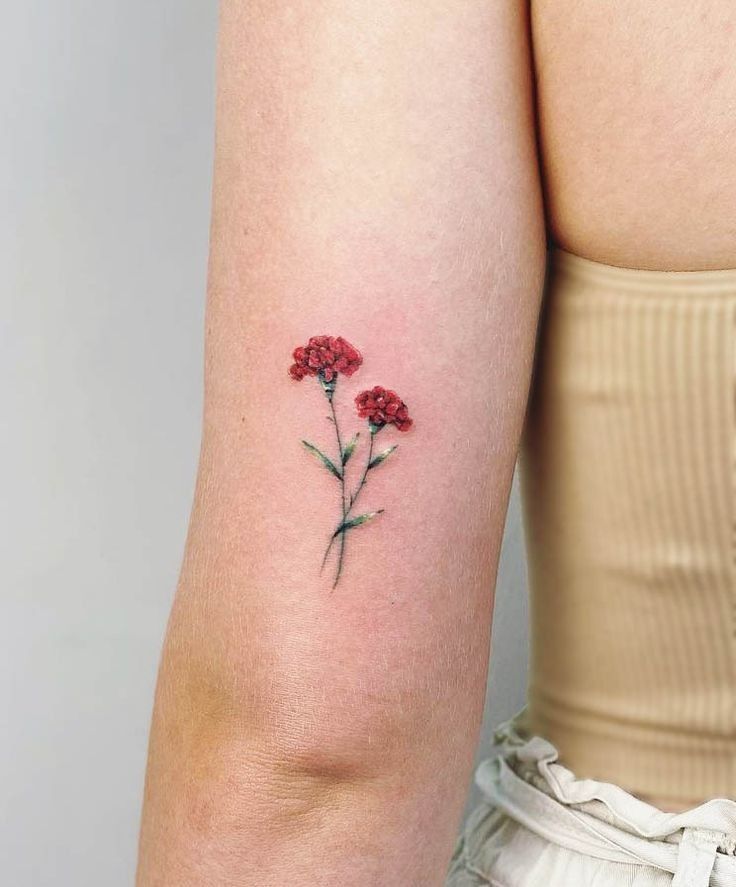
This miniature pair proves that a red carnation tattoo does not have to be large to make an impression. Two tiny flowers sit just above the elbow, connected by slender stems and a handful of green leaves. The entire composition occupies relatively little skin, making it an excellent reference for anyone interested in small or discreet floral tattoos.
The blossoms are surprisingly detailed considering their scale. Deep red pigment concentrates toward their centers and darker edges, while the stems remain extremely thin. The restrained use of green prevents the foliage from overwhelming the flowers.
Using two carnations rather than one also creates opportunities for personal symbolism. They might represent partners, siblings, children, parents, or two important dates. Alternatively, the pair can simply be appreciated as a more dynamic botanical arrangement.
Because this is such a tiny tattoo, simplification is essential. A good stencil should preserve clear gaps between the flowers’ major petal groups rather than attempting to reproduce every microscopic fold. That approach will help the design stay recognizable as it ages.
Pink Carnations With a Script Stem
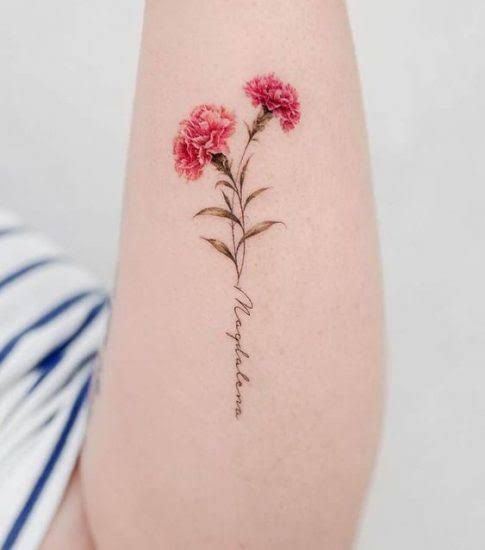
Floral imagery and lettering come together in this personalized carnation design. Two vivid pink blossoms grow from a narrow botanical stem, but instead of ending with an ordinary line, the lower portion transitions into flowing cursive writing.
This is a clever way to add a name, meaningful word, or short inscription without separating the text from the floral composition. The script visually becomes part of the plant, producing a more unified result than placing lettering underneath the flower.
The two pink carnations are relatively small but richly colored. Fine pale highlights along their ruffled edges emphasize the distinctive carnation texture, while subdued green and brown tones give the leaves a slightly naturalistic appearance.
For a January birth flower design, this format has especially strong personalization potential. A name or significant word can connect the flower directly with the person it represents. It could also be adapted as a memorial tattoo while remaining subtle and decorative rather than overtly commemorative.
Fine Line Carnation With Buds on the Inner Arm
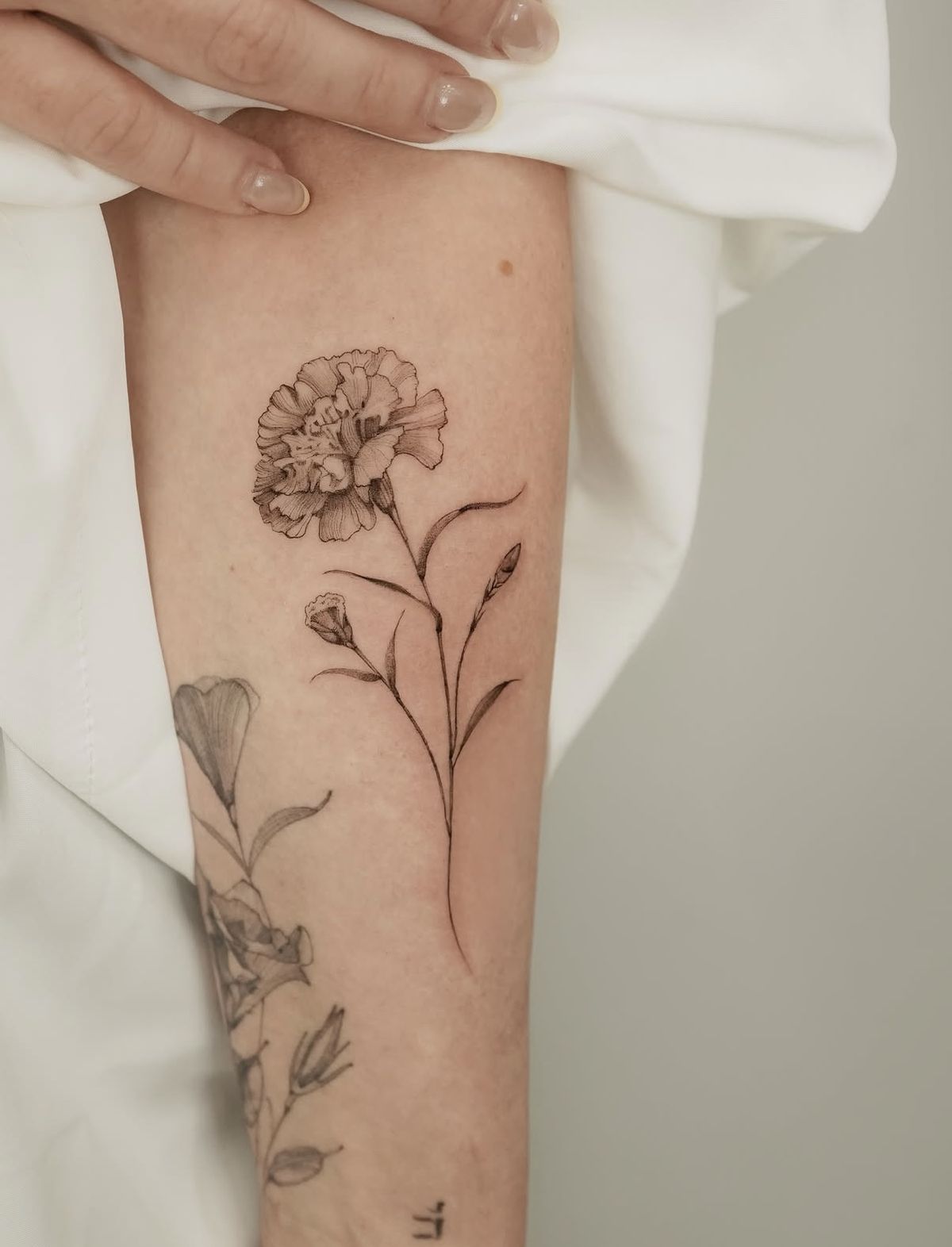
This black-and-gray piece offers a refined interpretation of the single-stem carnation. One large open bloom sits at the top, while a smaller partially opened flower and a narrow bud branch away from the central stem. The arrangement is asymmetrical, giving it the relaxed appearance of a freshly cut wildflower.
The petals contain extremely delicate interior shading. Rather than using large black areas, the artist builds texture through thin parallel marks that follow the direction of each petal. This technique gives the bloom volume while preserving the airy quality associated with fine line tattoos.
The leaves are equally restrained. Some are barely more than curved lines, while others contain enough shading to provide contrast. The long empty stem at the bottom visually stretches the tattoo and works particularly well with the vertical proportions of the inner arm.
This design would suit someone who wants botanical realism without color. It is detailed enough to reward close viewing but quiet enough to coexist with other floral tattoos if the arm eventually develops into a larger collection.
Minimalist Two-Carnation Fine Line Tattoo
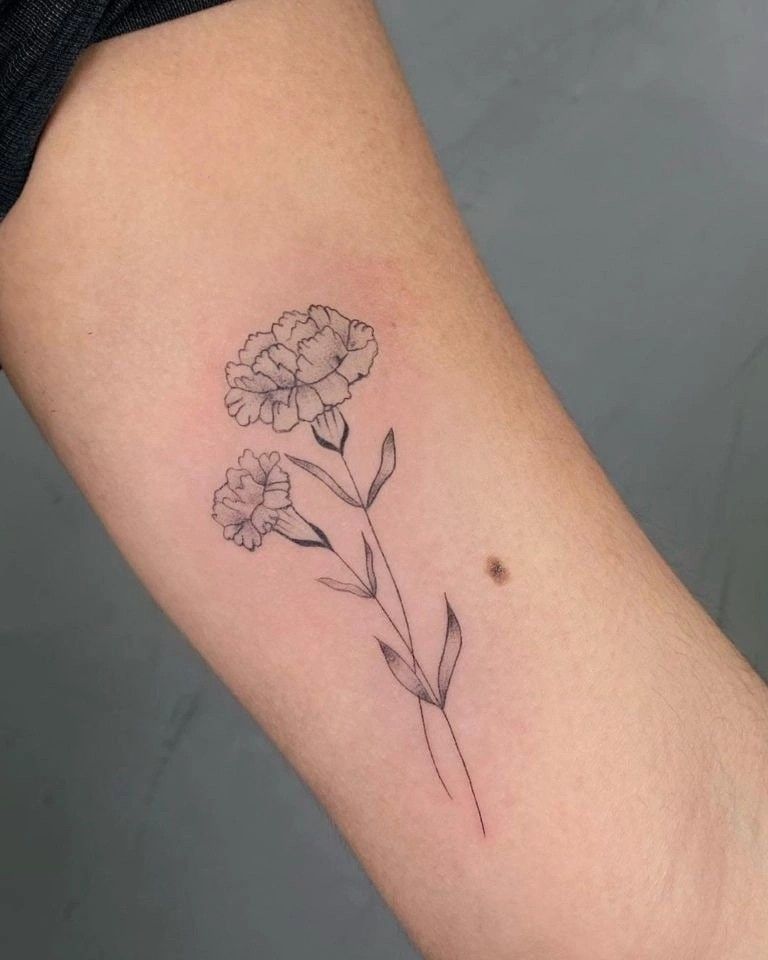
Two carnations are reduced to their essential shapes in this clean minimalist design. There is no color and almost no conventional shading; instead, extremely thin black lines describe the ruffled flower heads, calyxes, stems, and narrow leaves.
The larger flower occupies the upper part of the composition, while a smaller side-facing carnation branches away beneath it. This difference in scale creates hierarchy and makes the tattoo feel more organic than two identical blossoms would.
The stems cross near the bottom before extending into two exceptionally fine points. That simple construction gives the tattoo a hand-drawn quality reminiscent of a botanical sketch. Negative space is especially important here, both inside the petals and around the entire arrangement.
This is one of the easiest concepts in the collection to personalize. It could remain entirely black, receive tiny pink or white accents, or incorporate a date beneath the stems. Its understated character also makes it suitable for someone getting a first floral tattoo.
Small Pink Carnation Bouquet Tattoo
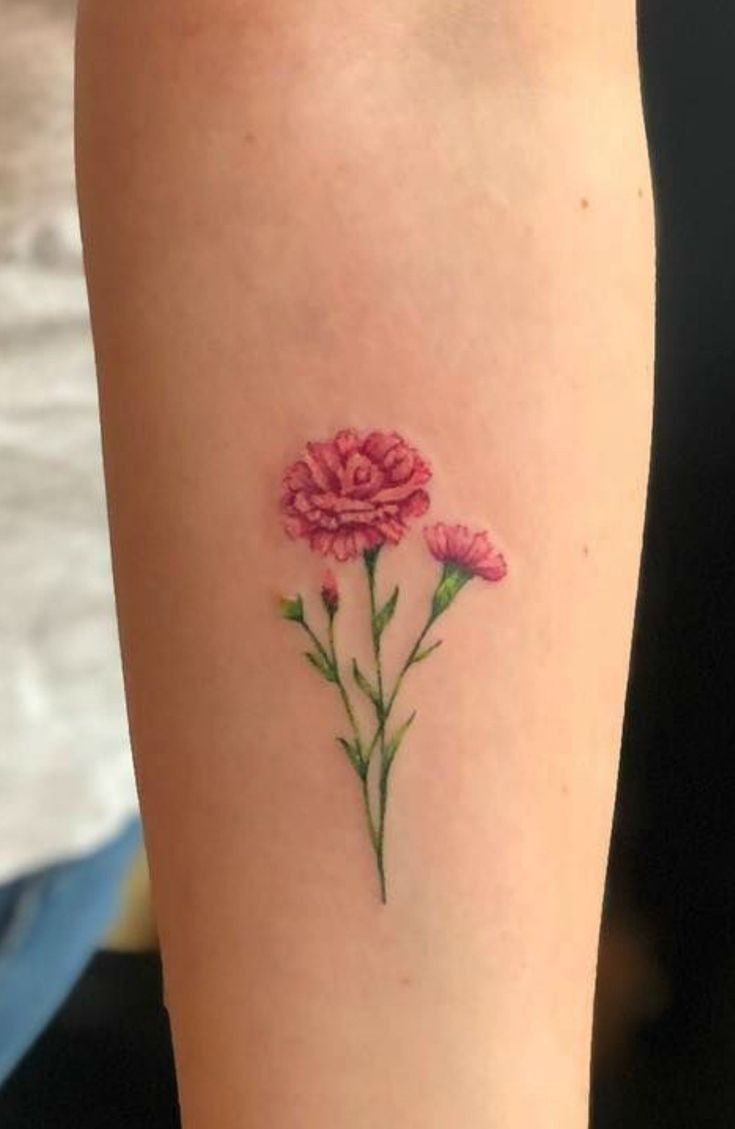
A compact bouquet of pink carnations creates a sweet, colorful alternative to the larger botanical pieces. The arrangement contains a dominant open bloom, a smaller side flower, and tiny developing buds, all connected by thin green stems.
The largest carnation uses several shades of pink to create depth within its densely ruffled petals. The second blossom is shown from a different angle and has a simpler silhouette, which makes the tiny bouquet feel more natural. Bright green around the bases of the flowers provides a fresh contrast against the warm pink.
Despite the realistic colors, the overall design remains simple. There are no surrounding ornaments, geometric shapes, lettering, or heavy outlines. The result is a flower tattoo that can be read immediately even at a relatively small scale.
This could work especially well as a feminine January birth flower tattoo or as a subtle family symbol. More blooms could also be added later, allowing the bouquet to represent additional people while preserving the original style. For anyone comparing carnation tattoo ideas 2026, this design captures one of the strongest current directions: recognizable botanical detail, compact placement, and soft natural color.
The carnation is particularly good at moving between tattoo styles because its identity comes from its petal structure rather than one specific visual treatment. It can be tiny and fine line, richly red and realistic, loosely sketched, or transformed into bold traditional work and still remain unmistakable.
That flexibility is what makes carnation tattoo ideas feel so relevant in 2026. The best version is not necessarily the most detailed one; it is the one whose scale, color, and placement fit the person wearing it. If one of these ideas sparked a variation of your own, leave a comment and share which carnation style you would choose.