Orchid tattoos have a particular kind of presence. They are floral without feeling predictable, romantic without automatically becoming sweet, and detailed enough to work beautifully in everything from a tiny minimalist piece to an elaborate botanical sleeve. That flexibility is one reason Orchid tattoo ideas 2026 feel especially relevant right now: the strongest designs are becoming more personal, more placement-conscious, and less interested in following a single recognizable tattoo trend.
Orchids also give an artist plenty to work with. A Cattleya can become a dramatic centerpiece, while a slender Phalaenopsis stem naturally lends itself to fine line work. There are Ghost, Spider, Leopard, and Tiger orchid varieties for anyone searching for something less conventional, while purple, pink, red, and blue palettes can completely alter the personality of essentially the same floral idea.
Looking through contemporary botanical work from artists featured by tattoo publications, one thing becomes clear: placement is increasingly treated as part of the drawing rather than somewhere to simply put it. The 28 designs below demonstrate that idea particularly well, moving from restrained linework to larger compositions that follow the shoulder, arm, and back.
Cascading Orchid Shoulder Tattoo With Soft Black-and-Grey Shading
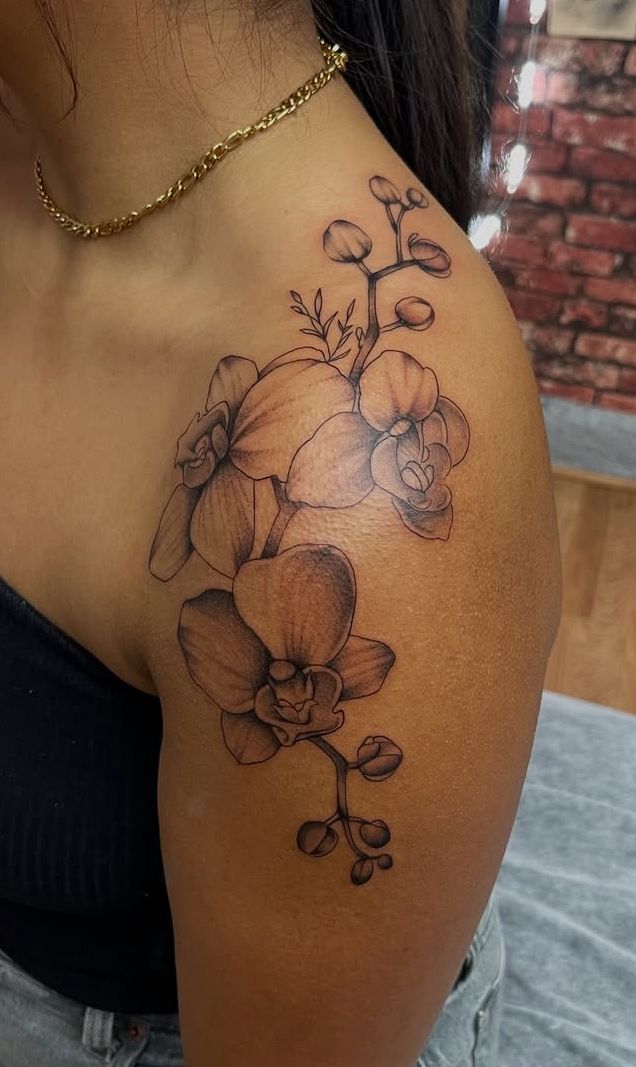
This orchid composition makes immediate sense on the shoulder because it has been drawn vertically rather than forced into a compact bouquet. The upper buds begin close to the shoulder cap, mature flowers create volume through the middle, and a second flowering stem extends toward the upper arm. That gradual change in scale makes the tattoo appear as though it is naturally growing across the body.
The approach sits somewhere between botanical illustration and contemporary fine line tattooing. Thin black outlines establish individual petals without making them look rigid, while extremely restrained grey shading provides just enough depth to separate overlapping forms. Instead of filling every petal with dark gradients, the artist leaves substantial areas of skin visible. The result feels lighter and more organic.
It is also a useful reference for anyone who likes large floral tattoos but worries that a bigger design will automatically look heavy. Size and visual weight are not the same thing. Here, the generous spacing between lines allows a substantial piece to remain airy.
This kind of arrangement could also translate beautifully into a custom stencil for the opposite shoulder, upper thigh, or side of the back. I would resist adding too many extra flowers, though. Part of its elegance comes from the irregular spacing of blossoms and buds rather than perfect botanical symmetry.
Dramatic Orchid Arm Design With Botanical Sketch Details
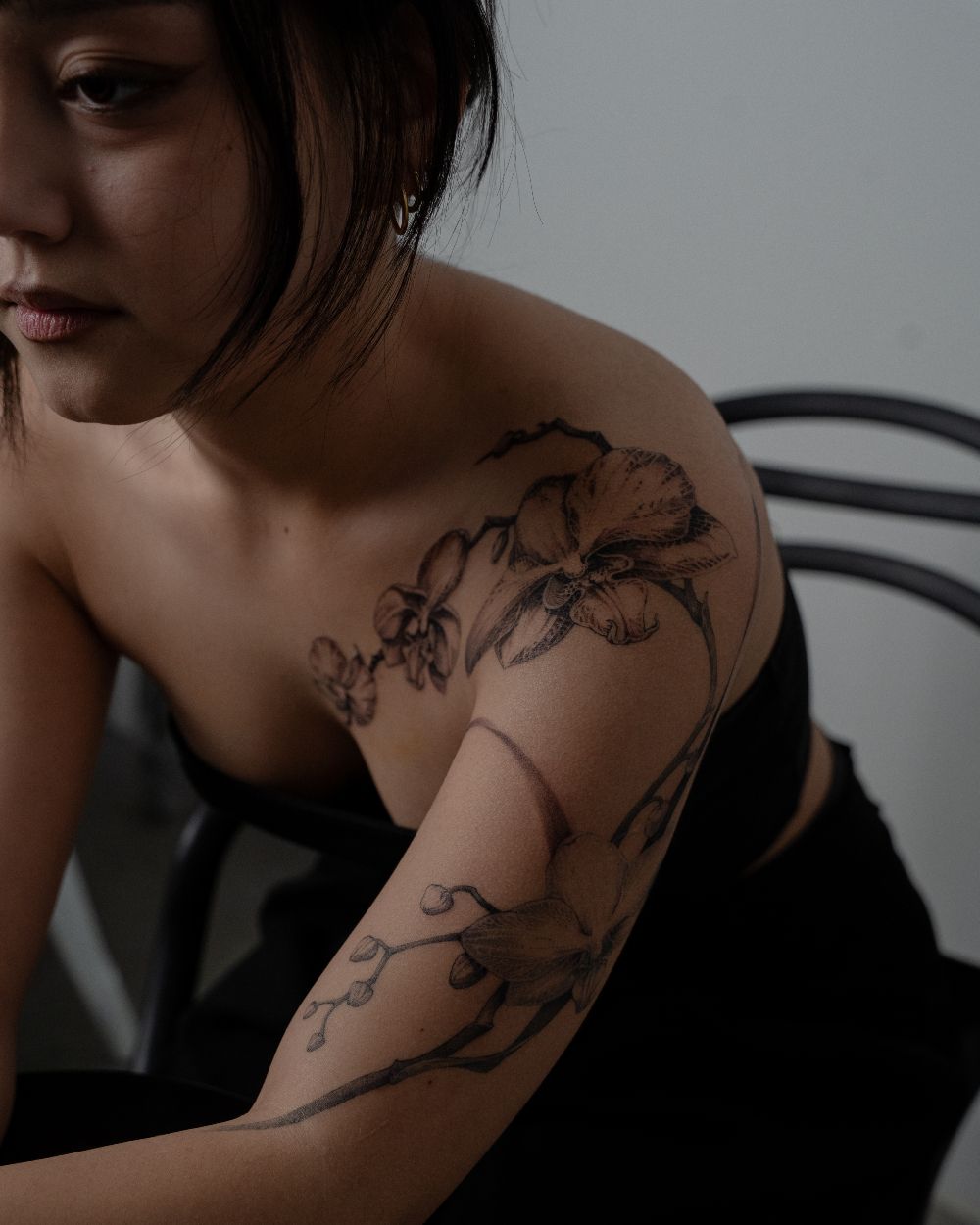
Here the orchid becomes much more atmospheric. Rather than presenting the flowers as isolated decorative objects, the tattoo uses long stems and changing blossom sizes to create movement across the shoulder and down the arm. The composition almost behaves like a botanical sketch enlarged directly onto the body.
The darker treatment is particularly effective. Fine lines remain visible inside the petals, but concentrated black shading around their centers gives the flowers depth and prevents such a large composition from disappearing at a distance. Some petals are soft and open; others are partly turned away, which makes the arrangement feel considerably more natural than a row of identical blossoms.
For people considering an orchid sleeve, this is an excellent direction because the structure already has room to evolve. Additional buds, leaves, stems, or another orchid variety could eventually continue toward the forearm without requiring the original tattoo to be redesigned.
There is something refreshingly unpolished about botanical tattoos like this. Not unpolished in execution—the linework is carefully controlled—but in composition. Real plants rarely grow with perfect symmetry, and preserving that slight unpredictability often makes floral tattoos more convincing.
A similar concept could work for men as well, particularly with heavier line weight, larger leaves, or a more graphic blackwork treatment. Orchid tattoos do not need to be coded exclusively as delicate or feminine; changing scale and contrast can radically shift their character.
Simple Orchid Stem With Fine Line Petals
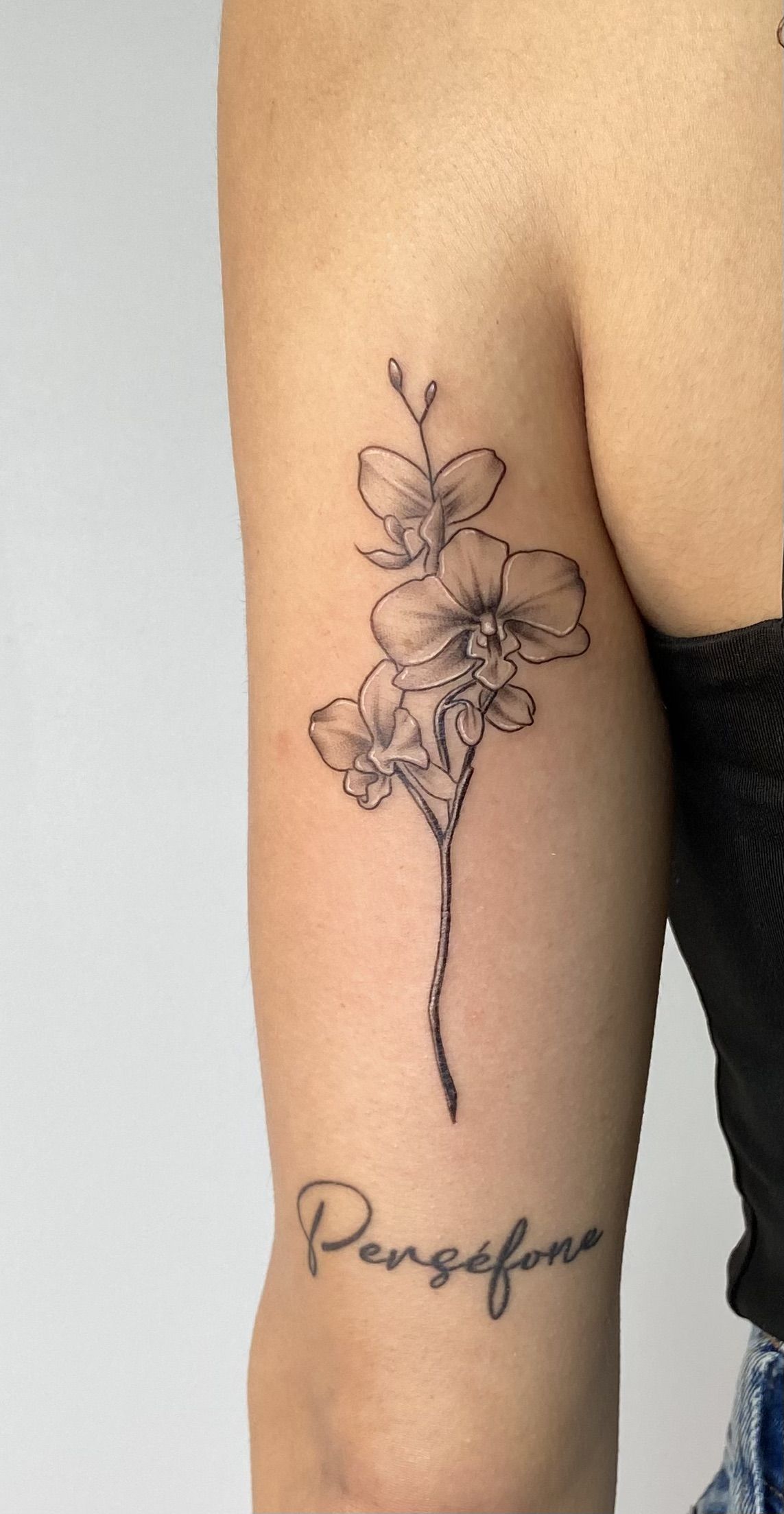
This single-stem orchid is a good example of how a simple concept can still contain enough detail to remain interesting. Three blossoms are positioned at different points along a narrow stem, with two small buds extending above the upper flower. The vertical structure makes the tattoo particularly flattering on the inner upper arm.
The linework deserves attention. The outer edges are defined clearly, but the interior shading remains soft and translucent. Darker values appear mainly around the centers of the orchids and along selected folds of the petals. That creates dimension without turning the flowers into a fully realistic study.
Anyone collecting design drawings for a first floral tattoo could use this type of composition as a useful starting point. It is compact enough to remain manageable, but large enough that the distinctive anatomy of an orchid does not disappear.
There is also an existing script tattoo below the flower, and the orchid has enough breathing room that the two pieces do not compete. That is a practical lesson worth remembering when adding a new tattoo near older work: not every empty patch of skin has to be filled. A small gap can make separate tattoos look deliberate rather than crowded.
For for women searches, this elongated style is understandably popular because it can be adapted to the inner arm, ribs, calf, or shoulder blade. The same drawing could become even more minimalist by removing most interior shading and retaining only the essential contours.
Large Orchid Shoulder Piece With Flowing Branches
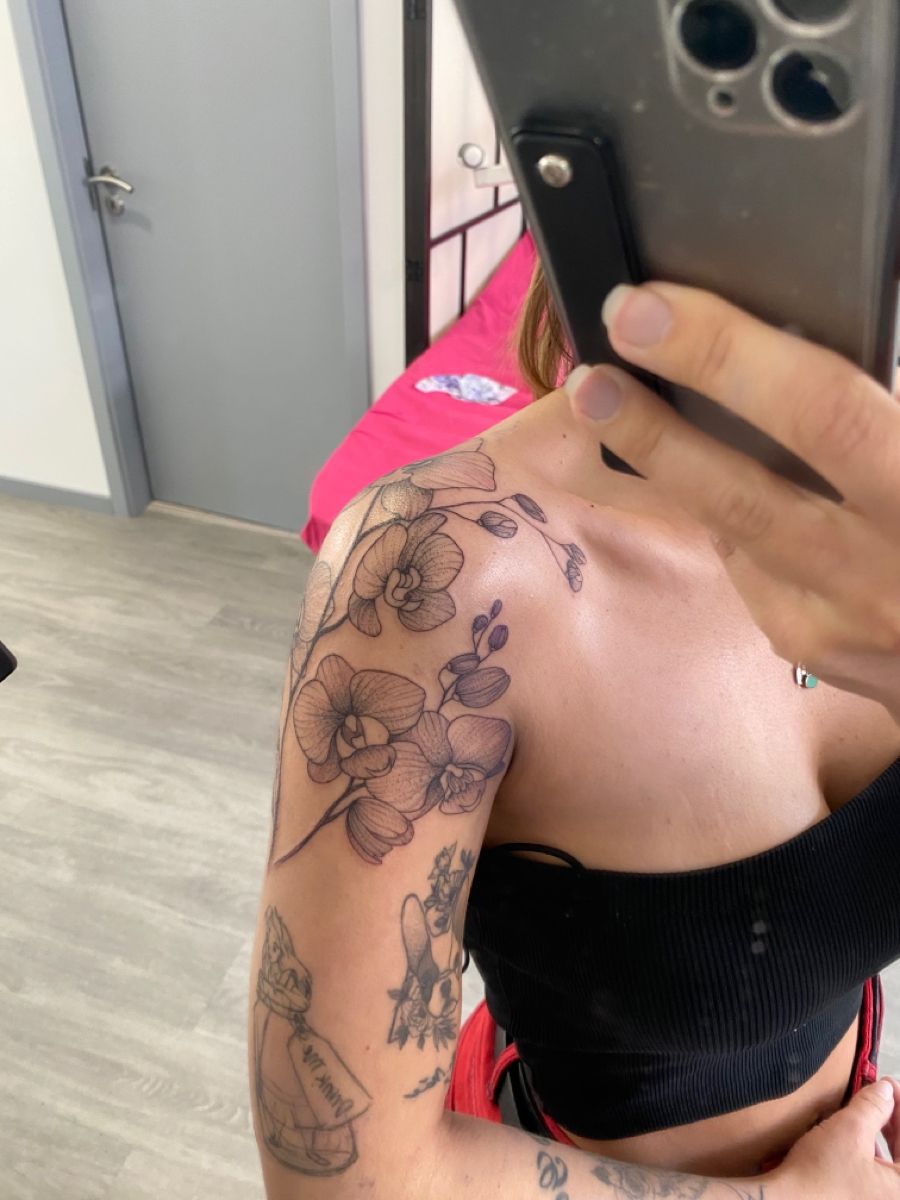
This larger shoulder tattoo takes the opposite approach. Instead of concentrating the entire arrangement into one vertical stem, the orchid branches spread around the shoulder cap and approach the collarbone. It creates an almost wearable quality—the flowers follow the architecture of the body rather than sitting inside a rectangular composition.
Several open blooms dominate the center, surrounded by smaller buds and branching stems. Fine parallel marks inside the petals mimic the subtle veining found in real orchids. There is enough shading to establish depth, yet the overall palette remains black and grey.
The shoulder is particularly well suited to this kind of design because an artist can use its rounded surface to create a composition that changes depending on viewing angle. From the front, part of the botanical line appears near the collarbone; from the side, the larger blossoms become the focus.
For someone building toward a botanical sleeve, this is also an intelligent foundation. The lower branch can naturally continue down the arm, while the upper elements could extend toward the chest or back if a larger project is planned later.
I especially like floral tattoos that do not reveal their entire composition from one viewpoint. They encourage movement. A tattoo becomes less like an illustration pasted onto skin and more like something designed specifically for a three-dimensional body.
Minimalist Fine Line Orchid Bouquet
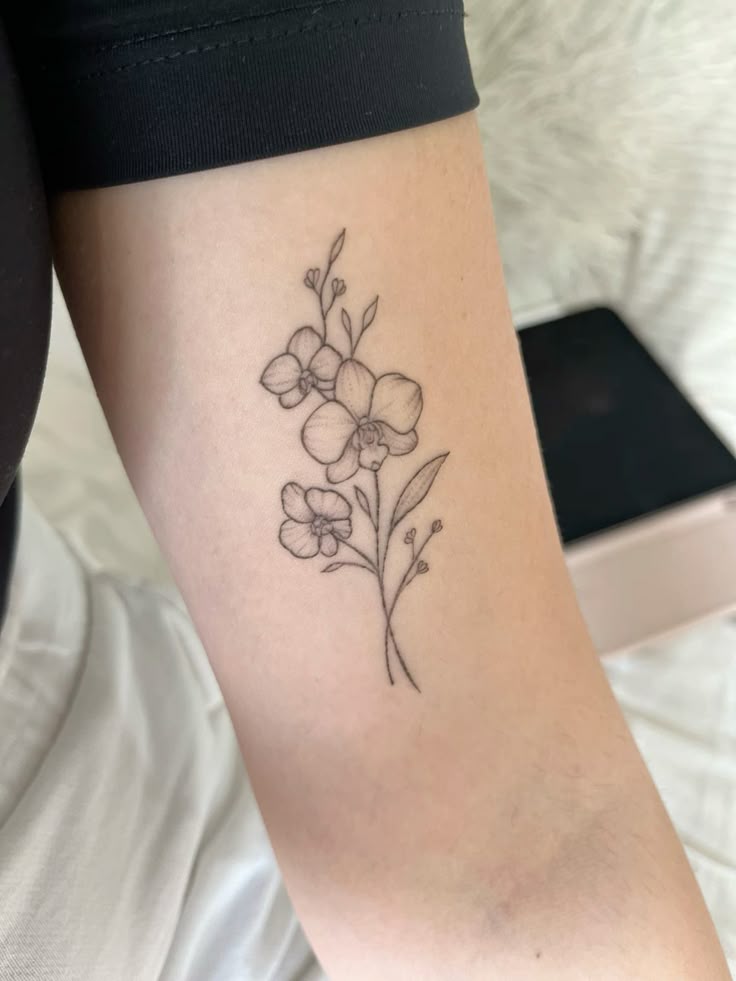
Among these Orchid tattoo ideas 2026, this is the clearest example of the current minimalist botanical direction. The tattoo is relatively small and uses an exceptionally restrained collection of lines to form three orchid blossoms, narrow leaves, buds, and crossing stems.
There is almost no dense fill. Instead, extremely light stippling and soft grey shading appear inside the petals, giving them just enough texture to remain recognizable. The open skin becomes part of the artwork.
That restraint is precisely what makes a successful fine line floral tattoo difficult. A complicated flower can easily become visually confusing when reduced in size. The artist has simplified the orchid anatomy without reducing it to a generic five-petal flower.
This is an appealing option for someone who wants a discreet first tattoo or a design that can coexist with other small pieces. It could work on the inner arm, ankle, ribs, shoulder blade, or calf. A competent artist could also create a clean stencil from the basic structure and personalize the arrangement by changing the number of blossoms.
One practical note with extremely delicate tattoos: it is worth discussing healed examples with your artist. Fine lines can age beautifully, but spacing and needle technique matter. A design that looks wonderfully intricate when fresh still needs enough separation to remain readable years later.
Purple Orchid Back Tattoo With Abstract Linework
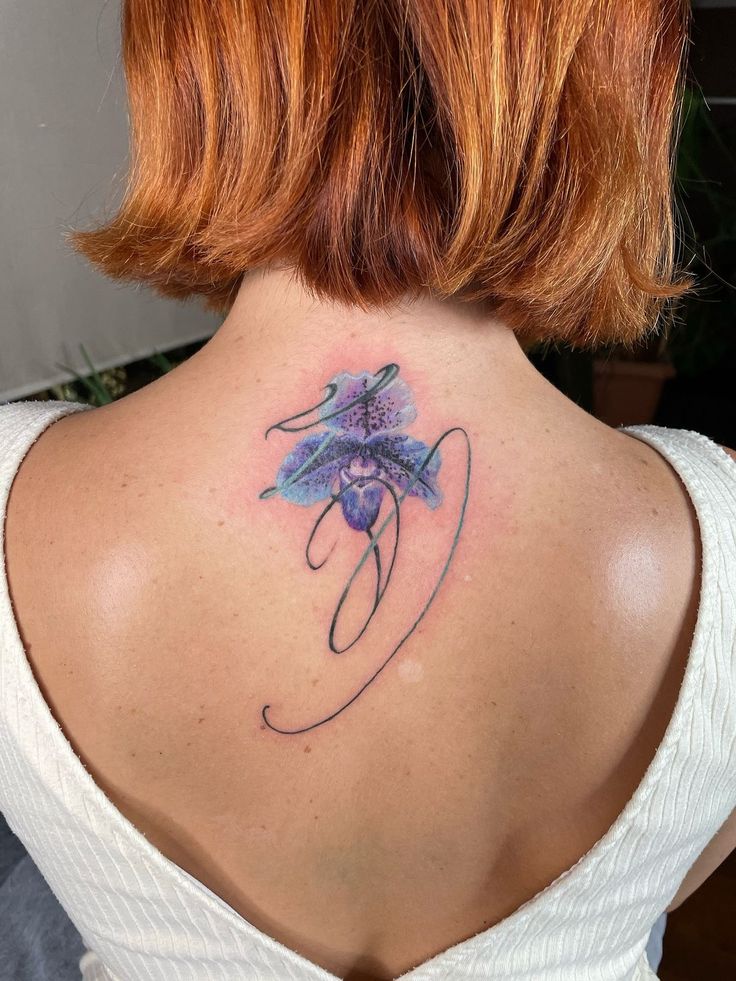
Color changes the mood completely. This purple orchid sits high on the back, close to the base of the neck, combining recognizable botanical detail with sweeping abstract linework.
The flower itself mixes violet, lavender, and cooler blue tones. Dark speckles across the upper petals introduce texture, while deeper purple around the center creates a strong focal point. Instead of enclosing the entire orchid in a conventional black outline, the tattoo allows portions of the color to feel loose and painterly.
Then comes the most distinctive element: long, fluid black lines travel through and below the flower in exaggerated curves. They resemble an artist’s spontaneous pen gesture and transform what could have been a straightforward botanical tattoo into something more contemporary.
This is an interesting direction for anyone who loves color but does not necessarily want a large realistic bouquet. One flower can carry plenty of personality when the palette and surrounding marks are expressive enough.
The placement is clever too. Centering the design high on the back gives the long linework enough empty skin to breathe. A smaller area such as the wrist would compress those curves and remove much of their visual impact.
A similar idea could be interpreted in pink, deep red, or electric blue. Personally, I would keep the palette limited rather than introducing every possible color. The strength of this piece comes from the conversation between one concentrated purple flower and those sparse black gestures.
Detailed Black Orchid Forearm Tattoo
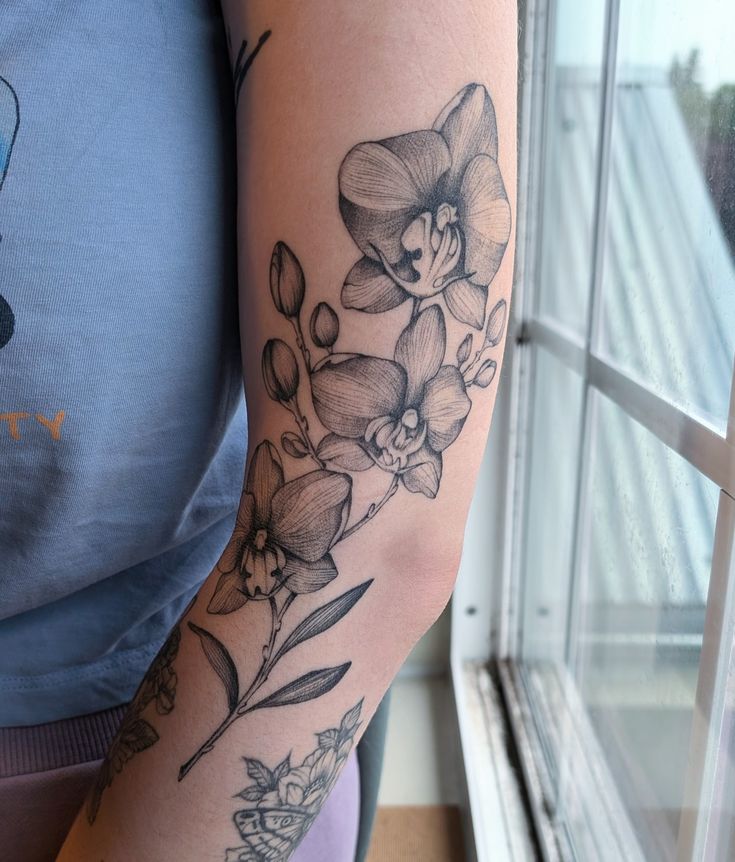
The final piece brings botanical detail to the foreground. Several orchid blossoms climb along the forearm, accompanied by unopened buds, a slender stem, and pointed leaves. The design is noticeably denser than the minimalist examples, yet it still avoids the solid darkness associated with heavier traditional tattooing.
Fine parallel lines run across the petals to establish their direction and curvature. Darker stippling gathers near the centers and underneath overlapping sections, while lighter petals remain largely open. This combination gives the flowers convincing volume without relying on full photorealism.
The arm is one of the strongest placements for a vertical orchid because the natural growth pattern of the plant already suits the shape of the limb. Here, the largest blossom anchors the upper section while smaller flowers and foliage taper downward. That hierarchy keeps the composition balanced.
It could also serve as the beginning of a larger floral sleeve. Rather than surrounding it immediately with unrelated flowers, I would continue the botanical narrative—perhaps smaller orchid buds, leaves, or a contrasting species such as a Spider orchid. A Leopard or Tiger orchid could inspire patterned details, while a Cattleya could provide a broader, more dramatic bloom.
For people deciding between realism and traditional tattoo styles, this approach offers a convincing middle ground. It has the observational detail of botanical art but retains the clarity and durability of defined black linework.
Rich Purple Orchid Tattoo With Realistic Color
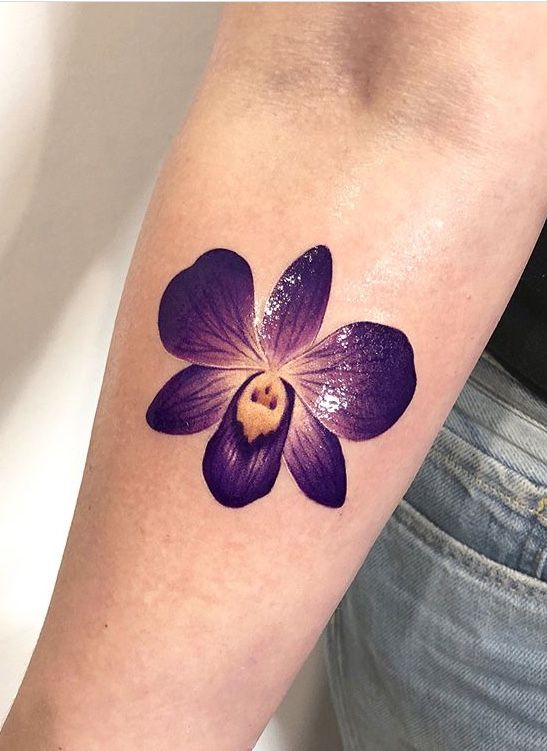
Sometimes one flower is enough. This compact purple orchid proves that a relatively simple design can have just as much impact as a sprawling botanical composition. Rather than using a stem, leaves, or decorative framing, the tattoo concentrates entirely on the open bloom, allowing its distinctive shape and saturated color to do the work.
The petals move from extremely deep violet at their outer edges toward softer lavender and warm cream near the center. That gradual transition creates convincing depth, while the small yellow detail in the lip of the flower gives the composition a natural focal point. Fine streaks running outward through the petals imitate real botanical veining without making the tattoo overly busy.
What makes this one of the more accessible Orchid tattoo ideas 2026 is its scale. It is noticeable without occupying a large part of the arm, and the isolated bloom could be adapted to several placements. It would also be easy to personalize through color: a deep red, soft pink, or even stylized blue orchid would produce a completely different mood while preserving the same compact structure.
For anyone who loves realism but does not want a large floral tattoo, this is a strong reminder that detail does not necessarily require size.
Black and Grey Orchid Shoulder Tattoo With Large Blossoms
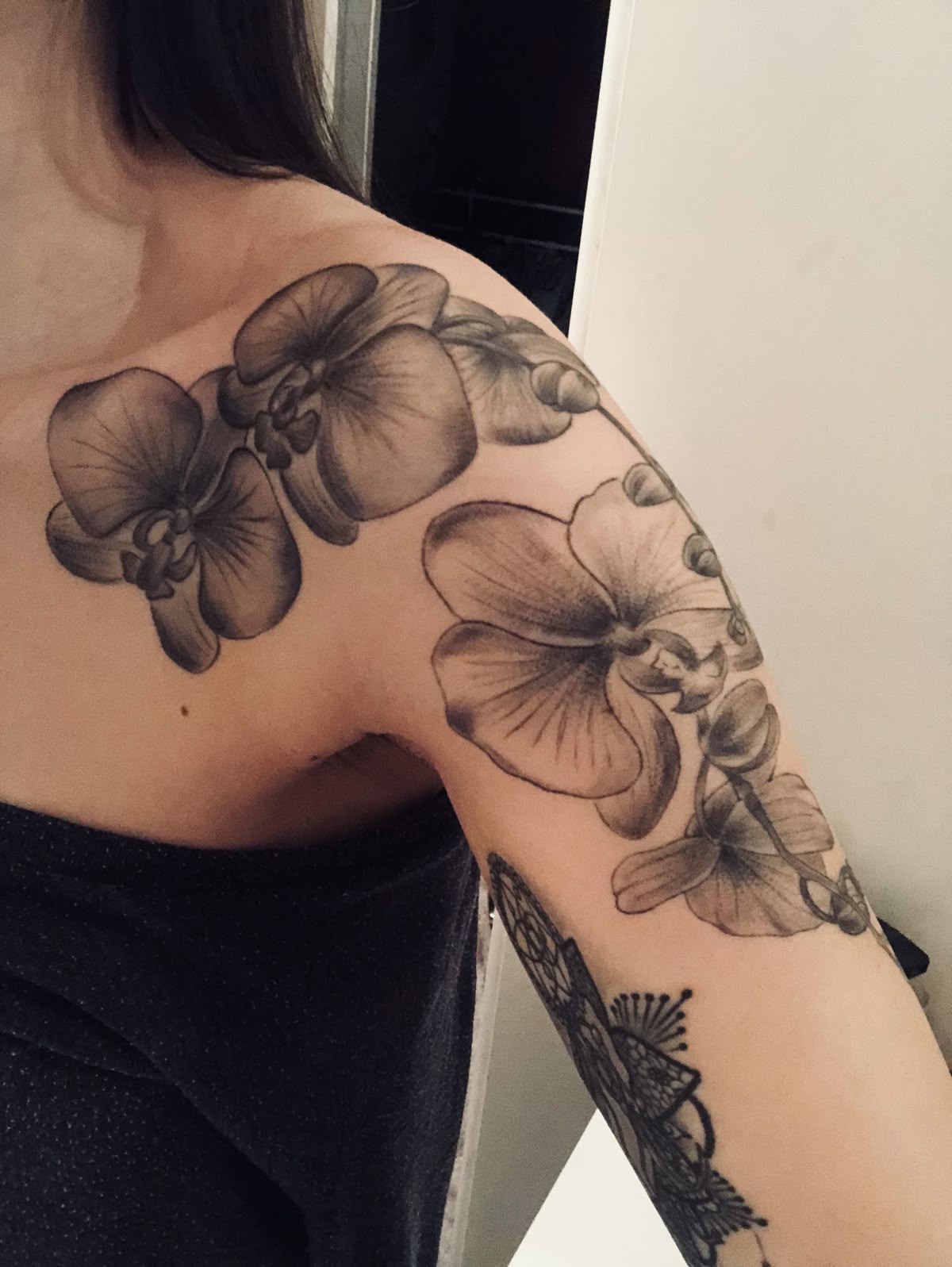
This is a much more ambitious interpretation of the orchid motif. Multiple oversized blossoms travel across the shoulder and continue down the upper arm, turning the natural curve of the body into part of the composition.
The individual flowers are substantial, but they avoid becoming visually flat because the artist varies their angle and tonal value. Some petals are seen almost directly from the front, while others overlap or turn toward the side. Fine radial lines inside the petals reinforce their structure, and soft black and grey gradients deepen the centers.
The shoulder is particularly effective for a design like this. A large flower can sit across the rounded shoulder cap without appearing oversized, while smaller blossoms and buds naturally taper toward the arm. The result has the scale of an early sleeve while retaining plenty of open skin.
There is also a slightly classical quality to the shading. It feels closer to a graphite botanical study than a hard-edged traditional tattoo. For someone collecting design drawings before an appointment, this is a useful reference for showing an artist how much detail can be achieved without solid black fills.
I could easily imagine the same concept extending farther down the arm in the future. More buds rather than more fully opened flowers would probably be the smartest addition—they would preserve the rhythm without making the composition excessively dense.
Pink and Red Orchid Branch in Realistic Color
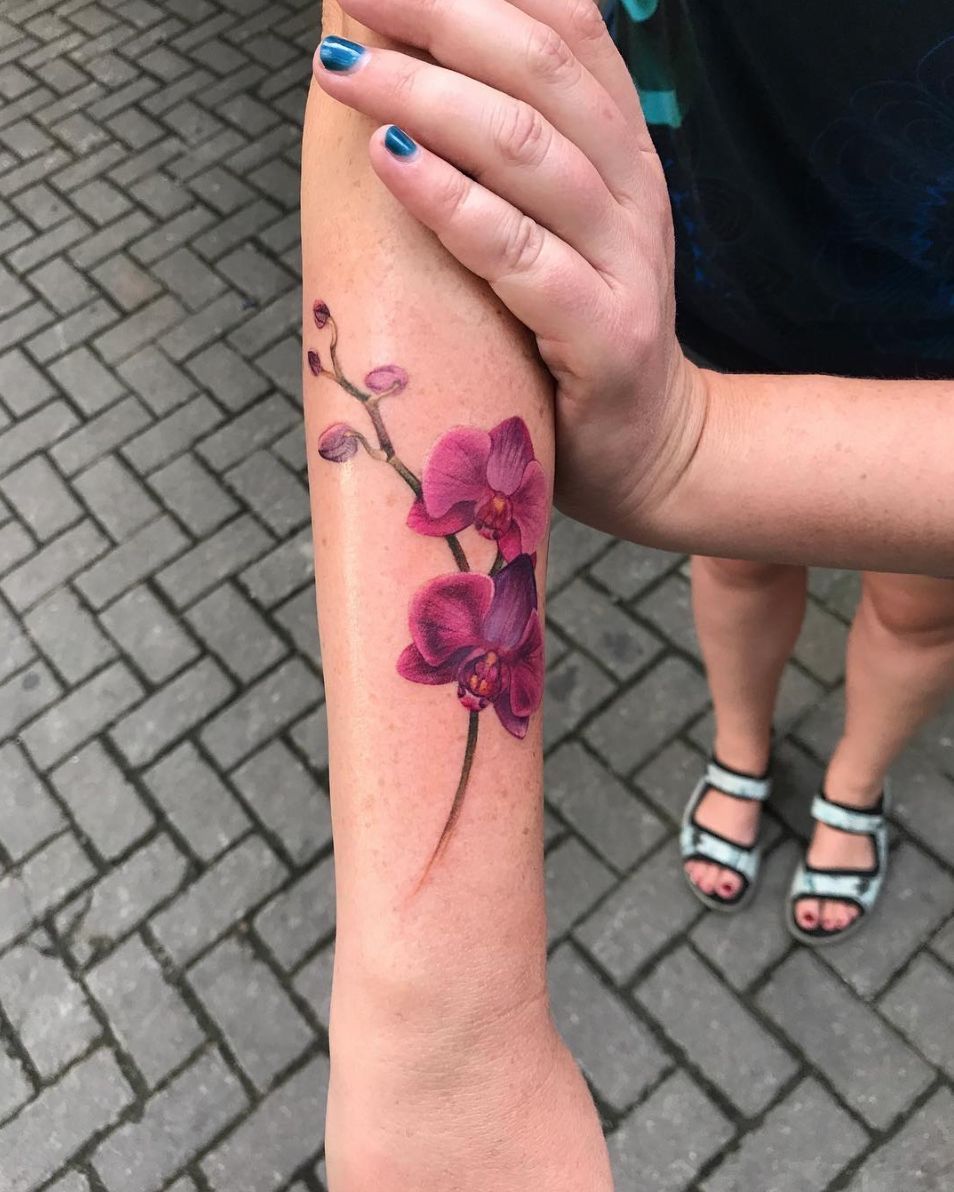
A vivid orchid does not need complicated surroundings to make an impression. Two large blossoms dominate this vertical forearm piece, accompanied by several small buds and a thin stem that gently curves between them.
The palette falls somewhere between saturated pink, magenta, and dark red. Deeper burgundy shadows collect around the folded petals and centers, while brighter pink areas catch the eye first. Tiny touches of warmer color in the flower centers add another layer of realism.
What I like most here is the restraint of the stem. A heavier branch could have competed with the flowers, but this narrow green-brown line essentially acts as a guide, moving the eye from the buds at the top through both blossoms and toward the lower end of the tattoo.
This kind of vertical design suits the arm exceptionally well. The tattoo has enough length to feel substantial, yet it remains narrow enough that it does not wrap around the entire forearm. It could therefore work as a standalone piece or eventually become part of a floral sleeve.
For anyone drawn to colorful orchid tattoos for women, this is a particularly adaptable reference. The magenta could be softened toward pastel pink or pushed into darker purple without changing the underlying composition.
Realistic Purple Orchid Plant Tattoo With a Personal Story
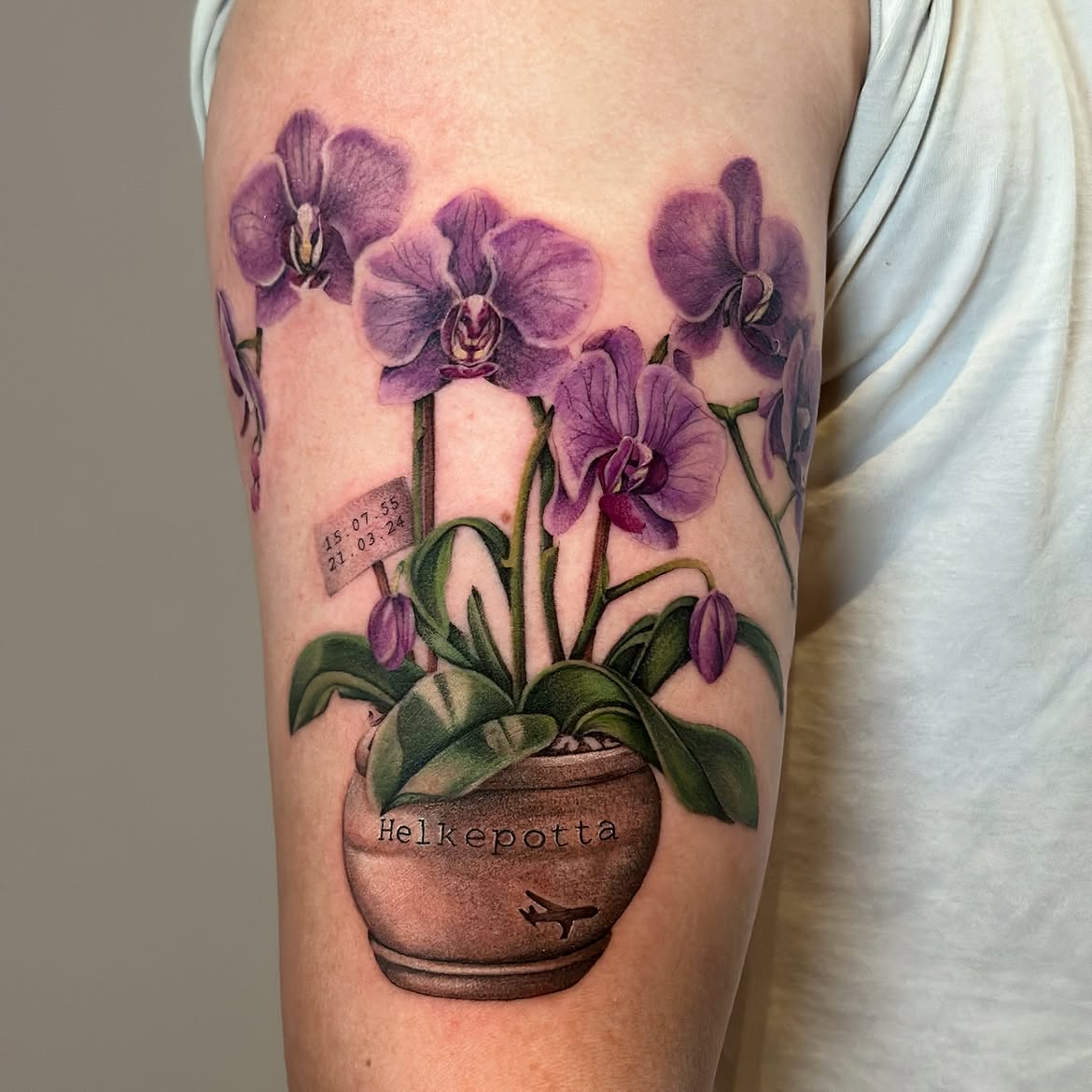
This piece feels less like a conventional flower tattoo and more like a botanical portrait. Instead of separating the orchid from its everyday context, the artist depicts an entire potted plant: broad green leaves, upright stems, unopened buds, multiple purple flowers, and the pot itself.
That decision immediately gives the tattoo personality. There is lettering on the pot and a small tag incorporated among the leaves, turning what might otherwise be decorative floral imagery into something that appears connected to a specific memory or plant.
The realism is impressive without becoming photographic to the point of stiffness. Purple petals contain visible tonal changes and fine veins; the leaves shift between olive and deep green; and the pot uses warm earthy shading to anchor the brighter color above it. Even the unopened buds have individual highlights and shadows.
This is the kind of tattoo that reminds me why personal references usually produce the strongest custom work. A person could bring an artist a photograph of an orchid inherited from a parent, grown at home for years, or associated with an important date and end up with something nobody else could meaningfully duplicate.
Its larger scale on the upper arm is important because all those botanical and personal details need room. Reduced to half the size, much of what makes this design special would be lost.
Tiny Purple Orchid Tattoo With Delicate Script
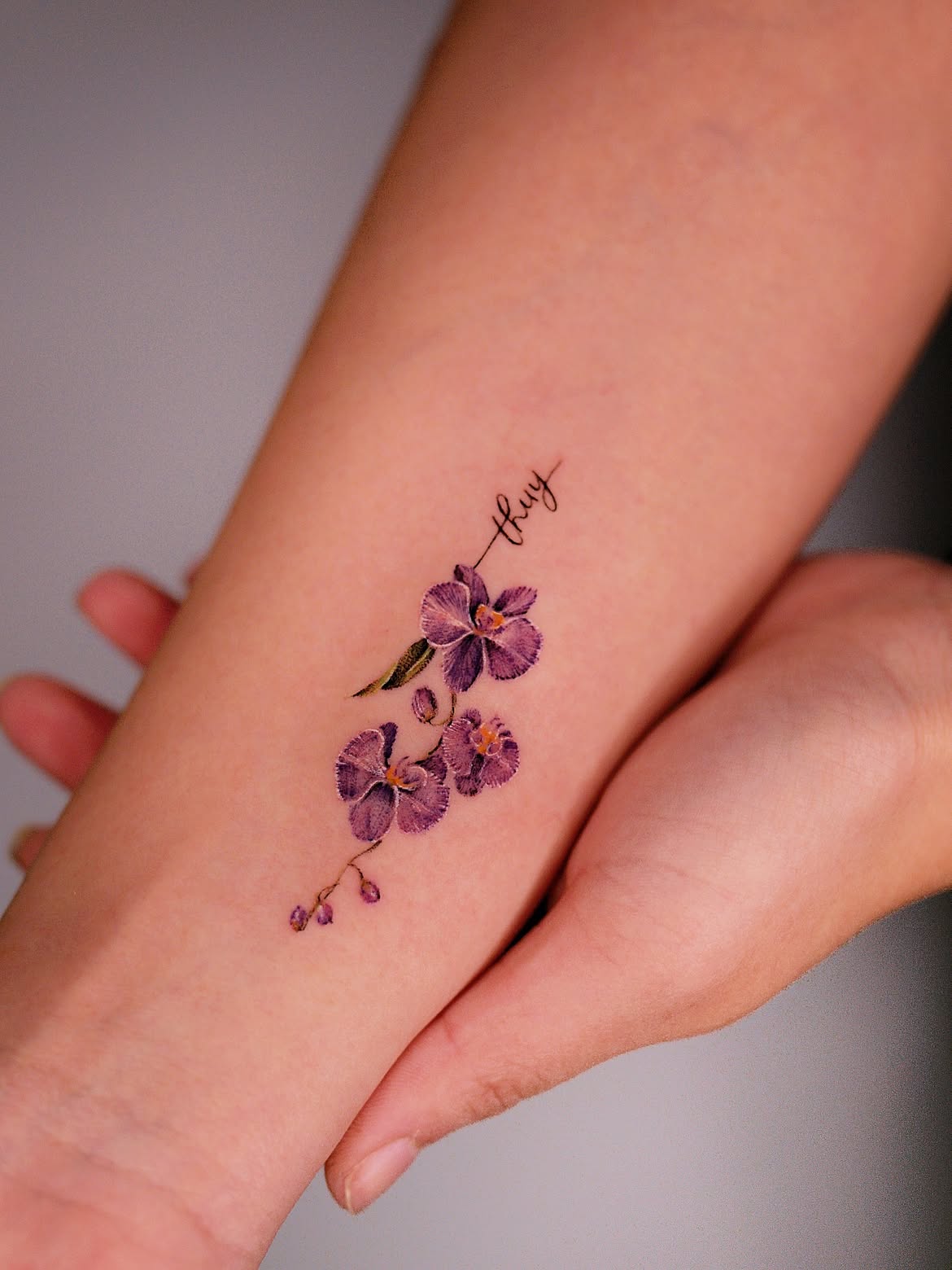
At the opposite end of the scale is this tiny flowering branch. Several miniature purple orchids sit along an exceptionally thin stem, accompanied by a small green leaf and delicate handwritten lettering above the upper flower.
This is not quite a conventional fine line tattoo because much of the flower itself is rendered in color, yet it shares the same minimalist philosophy: limited scale, generous negative space, and no unnecessary decorative elements.
The petals contain surprising detail for their size. Violet and lavender tones create the basic forms, tiny yellow-orange centers provide contrast, and subtle darker marks keep the flowers from turning into indistinct purple shapes.
The lettering is equally restrained. Instead of adding a large quotation, the tiny script behaves almost like another stem or flourish within the botanical composition. That balance matters. When words and flowers are combined at this scale, oversized typography can quickly dominate the design.
This is one of those minimalist ideas that could work well for someone who wants a personal tattoo without turning it into a large statement piece. The inner arm offers enough visibility to enjoy the detail while still making the tattoo relatively discreet.
Fine Line Orchid Branch With a Memorial Date
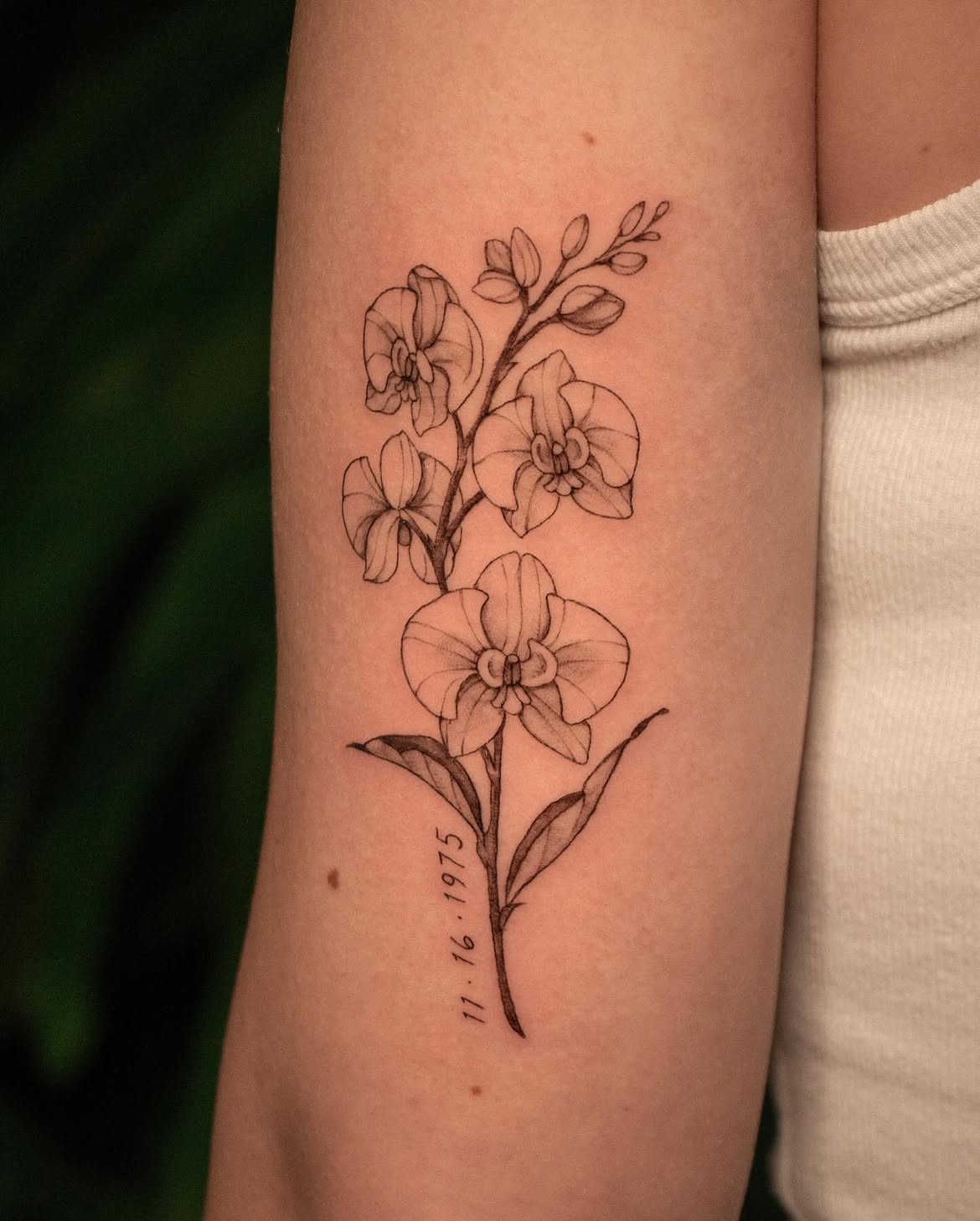
A floral tattoo becomes much more personal when a date is incorporated without overwhelming the flower itself. Here, several open orchids and small buds grow along a slender branch, while a vertically arranged date sits quietly beside the lower stem.
The black fine line approach keeps everything cohesive. Petal contours are precise, interior veins are suggested with delicate strokes, and darker shading is reserved primarily for the branch, leaves, and selected parts of the flower centers. There is no heavy background and no decorative frame.
The hierarchy is particularly good. The largest orchid sits in the lower half of the composition, two smaller blooms create movement above it, and the buds finish the branch rather than abruptly ending it. The date is secondary—you notice the flowers first and the personal inscription afterward.
For memorial tattoos, that subtlety can be powerful. The symbolism does not need to be immediately understandable to everyone who sees it. Sometimes a flower is simply beautiful to the outside observer while carrying a completely different meaning for the wearer.
As a stencil, the basic botanical structure could also be customized easily. Different dates, initials, or very short words could replace the existing numbers without disrupting the overall balance.
Orchid and Butterfly Fine Line Tattoo With Abstract Details
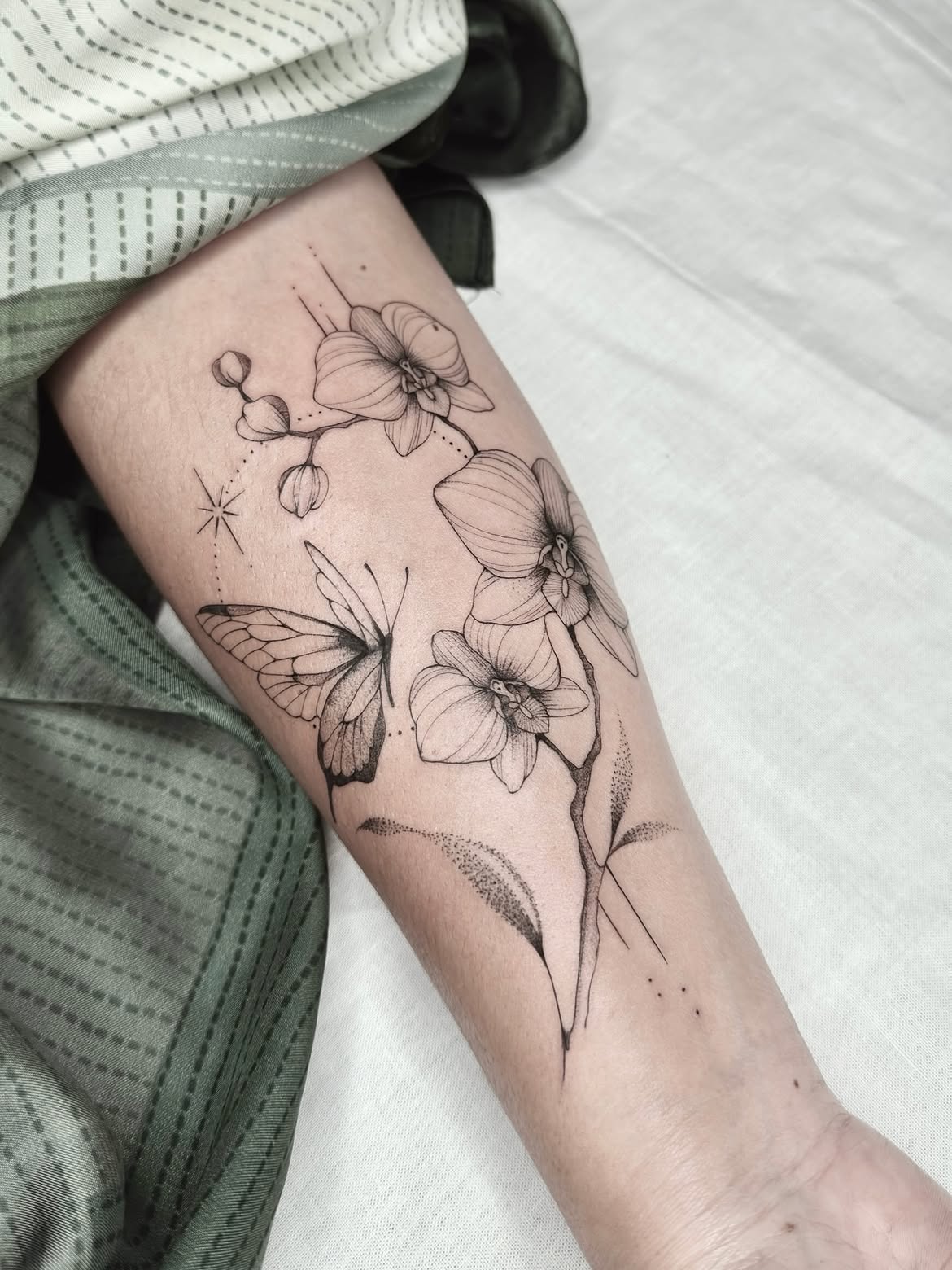
This final design moves beyond straightforward botanical illustration by pairing orchids with a butterfly and small abstract decorative details. It is still delicate, but considerably more layered than a simple flower stem.
Several orchids travel diagonally through the composition. Their petals are constructed from thin parallel lines, giving each flower texture without relying on dense shading. A butterfly occupies the opposite side, its translucent-looking wings carefully divided into small sections by fine black outlines.
What brings the separate elements together are the tiny dots, arcs, linear marks, and star-like symbol distributed through the empty areas. They create an almost celestial quality without turning the tattoo into an obvious space-themed design. Stippled leaves near the bottom introduce yet another texture.
The composition also demonstrates how useful negative space can be. The butterfly never touches the orchids, yet the dotted curve visually connects the two. That small decision makes the tattoo feel like one complete illustration rather than two unrelated motifs placed next to each other.
For someone who finds a plain floral stencil a little too conventional, adding insects and restrained geometric marks is an effective way to create a more contemporary identity. A similar concept could be developed with a moth, Spider orchid, or even more unusual Ghost orchid-inspired forms.
Delicate Pink Orchid Branch With Fine Line Details
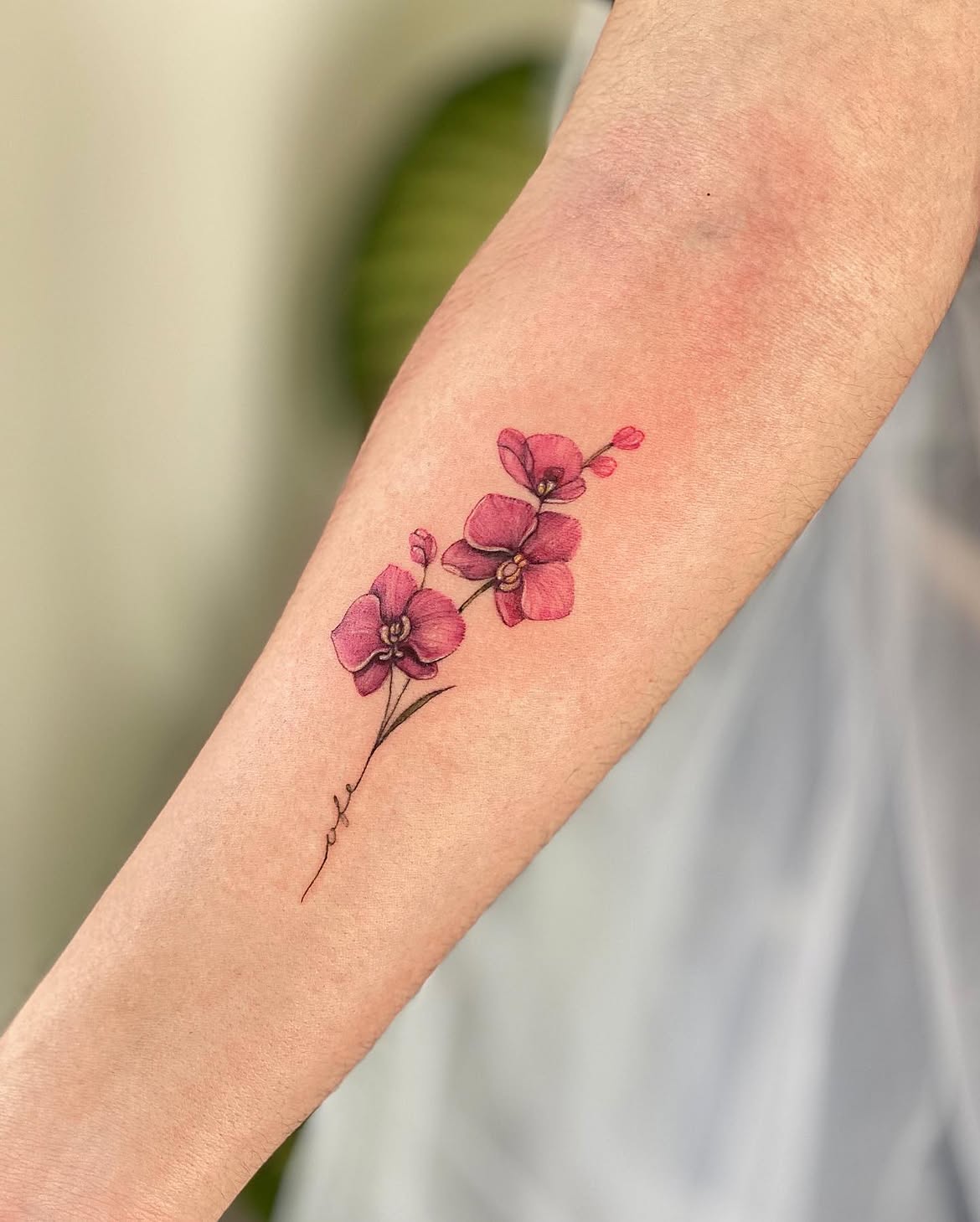
This compact orchid branch strikes a lovely balance between color and fine line work. Three open blossoms climb diagonally along the inner arm, accompanied by several tiny buds and a narrow stem. The arrangement is intentionally light, leaving enough negative space around each flower for the petals to remain distinct.
The palette moves through muted pink, dusty rose, and deeper berry tones. Instead of using flat blocks of color, the artist builds gentle tonal transitions across the petals. Darker edges and centers give each orchid dimension, while the tiny warm highlights around the reproductive structures keep the blossoms recognizable even at this relatively small scale.
One detail I particularly like is the lower stem, which becomes progressively thinner before finishing in an almost handwritten flourish. It prevents the tattoo from ending abruptly and adds a subtle personal quality without requiring a separate inscription.
For someone looking for minimalist ideas for women, this is a useful middle ground between an outline tattoo and full realism. It has enough pigment to be immediately noticeable, but the narrow proportions still make it understated. The same design could work beautifully in purple or red, although the muted pink is what gives this version its softness.
Purple Orchid Forearm Tattoo With Leaves and Script
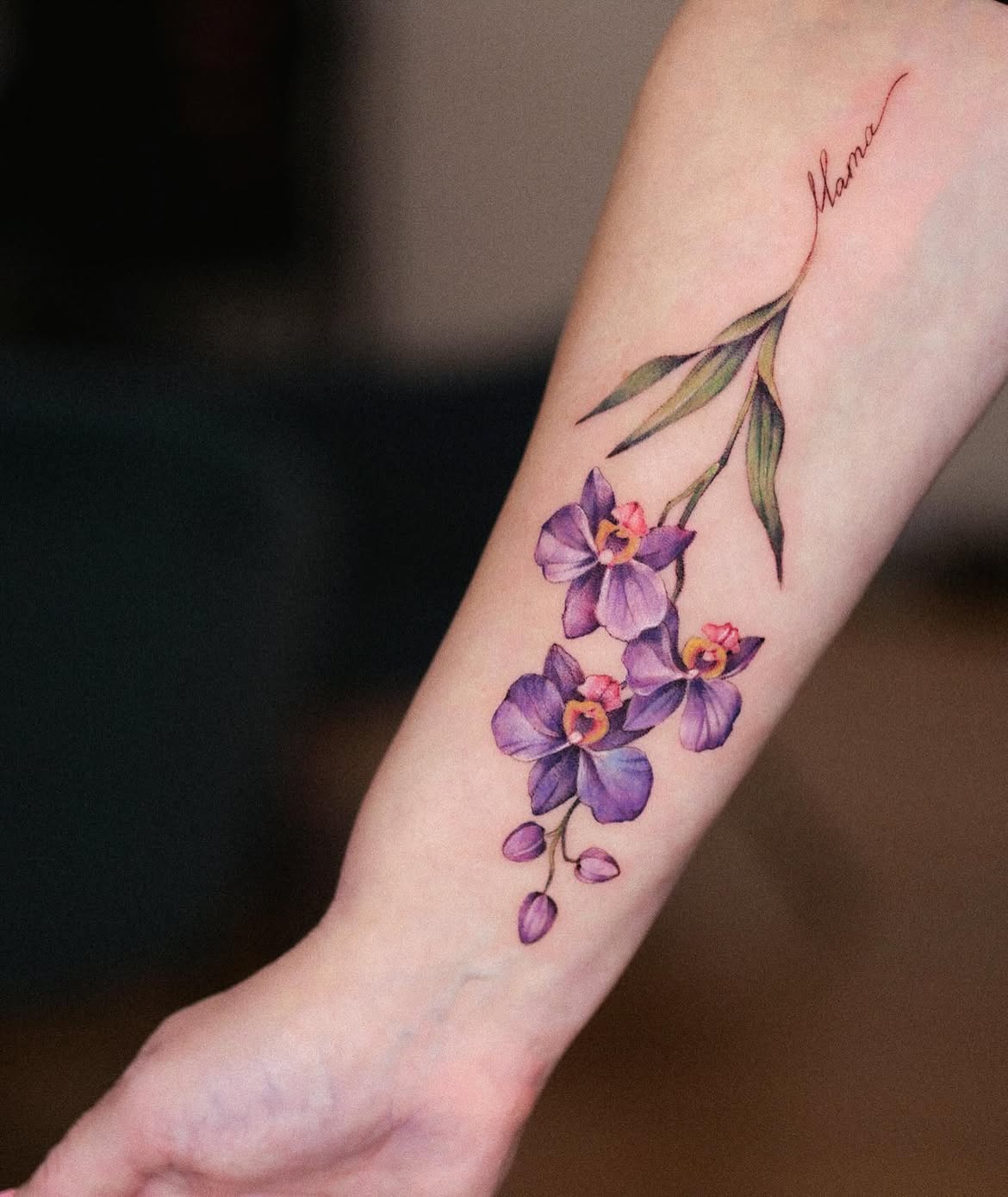
This vertical composition uses almost the full visual length of the inner forearm without becoming heavy. Three purple orchids form the center of the arrangement, with small hanging buds at one end and slender green leaves extending in the opposite direction.
The flowers are painted with a surprisingly broad range of tones. Lavender highlights sit beside dark violet edges, while warm pink and yellow details appear inside each center. That contrast keeps the orchids vivid and prevents the purple from becoming visually flat.
The foliage is equally important. Long, pointed leaves create a sharp counterbalance to the rounded flowers. Their olive, moss, and darker green shading gives the composition a botanical realism that would be lost if the design consisted of blossoms alone.
A handwritten word flows directly from the upper section, effectively becoming an extension of the plant. This is a clever approach when combining flowers with names or memorial lettering: instead of treating the inscription as a separate tattoo, the artist makes it part of the overall movement.
As an arm design, the proportions are especially successful. It could remain exactly as it is or serve as the beginning of a colorful botanical sleeve.
Simple Black Orchid Outline on the Lower Leg
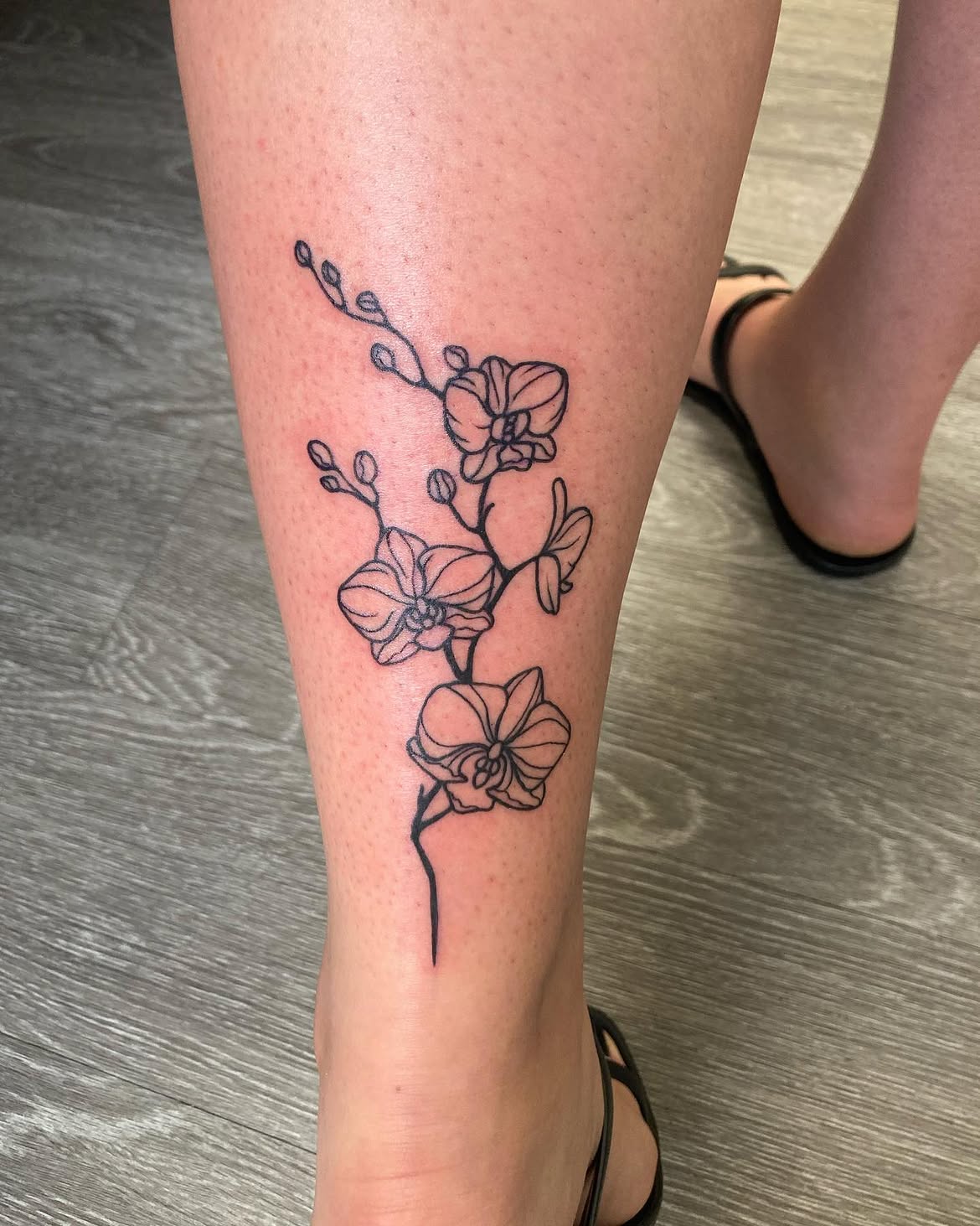
Not every orchid needs soft shading or realistic color. This lower-leg piece strips the plant back to strong black outlines, creating a clean botanical illustration built from blossoms, buds, and a single branching stem.
Three primary flowers appear at different heights, while several unopened buds extend outward at the top. The irregular orientation is important because it prevents the arrangement from looking like a decorative pattern. One blossom faces forward, another turns slightly, and the upper flower sits at a different angle again.
The line weight is stronger than in many of the fine line examples in this collection. That gives the tattoo a graphic presence and makes it readable from farther away. At the same time, the absence of dense black fill keeps it much lighter than a conventional traditional floral tattoo.
This is also an excellent reference for anyone searching for a straightforward orchid stencil. The structure is already clear enough to work as a tattoo drawing, yet there is plenty of room for customization. Soft grey shading could be added later, or selected petals could receive purple, pink, or red accents.
The vertical proportions suit the calf particularly well, but the same simple design could easily be adapted to the forearm.
Abstract Purple Orchid Tattoo With Watercolor Accents
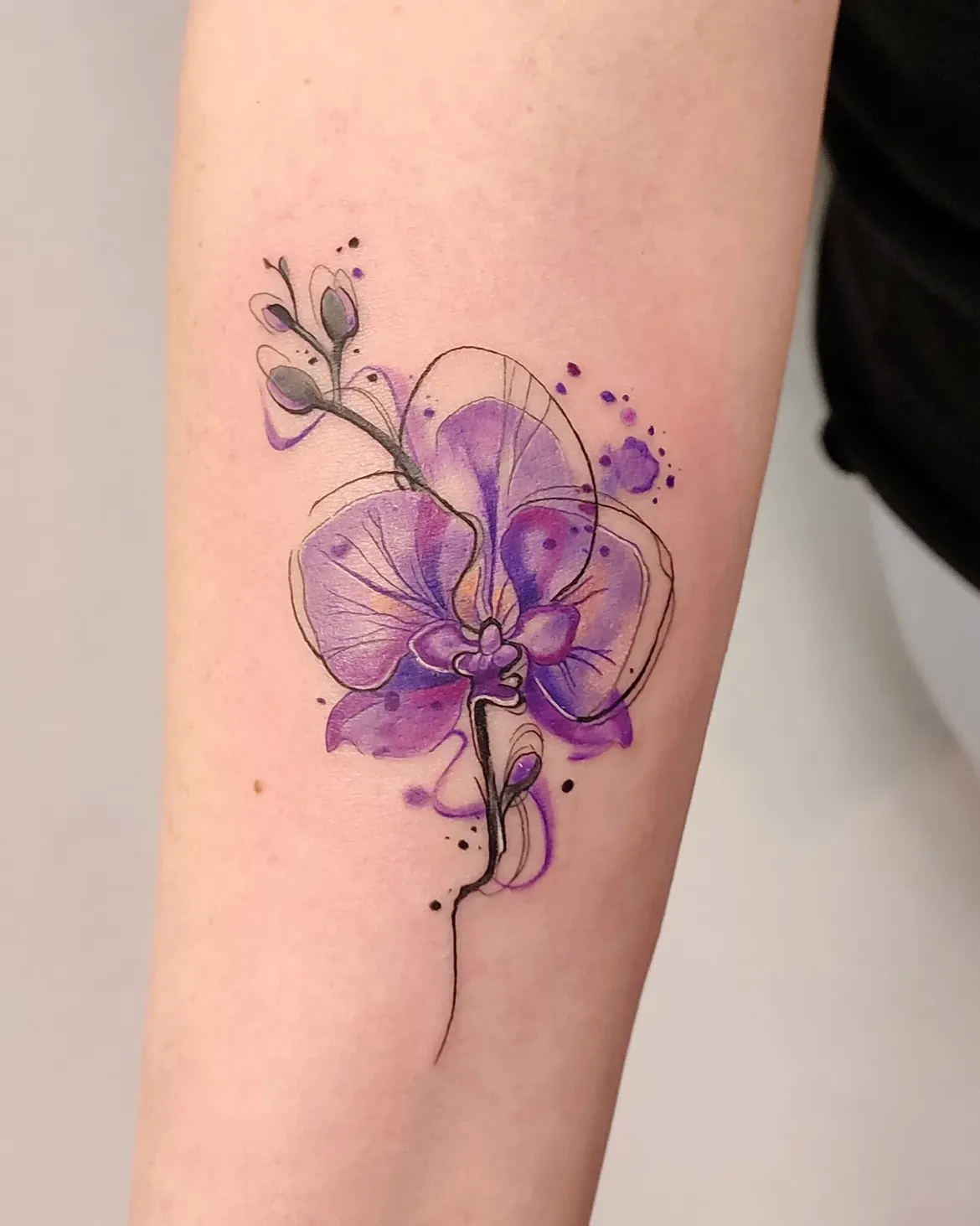
This orchid takes a much more artistic route. A large purple flower becomes the central subject, but loose pigment, floating dots, overlapping outlines, and gestural marks push the piece firmly into abstract territory.
The orchid itself is still recognizable. Broad petals are defined by exceptionally thin black contours, while washes of lavender, violet, and muted blue spread through their interiors. Some areas stay almost transparent; others receive concentrated purple pigment. That inconsistency is intentional—it gives the tattoo the appearance of a watercolor sketch rather than a carefully filled illustration.
Small purple splashes sit outside the flower, breaking through the traditional boundaries of the design. Additional looping lines overlap the petals and buds, while tiny black dots provide visual punctuation.
I have always found this approach particularly effective with orchids because their naturally unusual shapes already feel slightly surreal. Unlike a rose, which carries a very established tattoo vocabulary, an orchid can tolerate experimentation without immediately losing its identity.
For someone gathering contemporary design drawings, this piece shows how realism and abstraction can coexist. The artist does not abandon botanical structure; they simply allow the color to behave more freely than the outlines.
Minimalist Black and Grey Orchid Bouquet
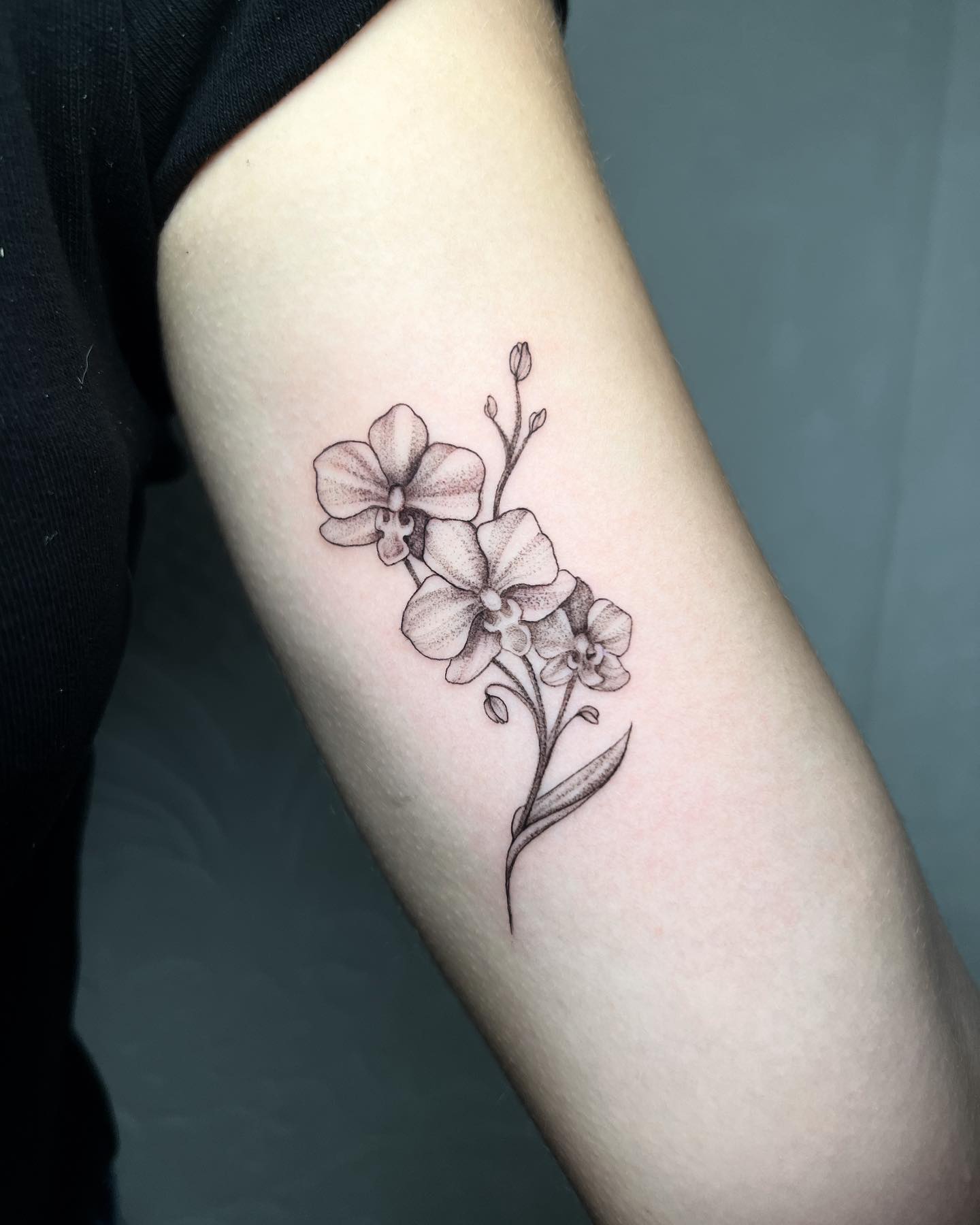
This small botanical arrangement demonstrates how much detail can fit into a restrained fine line tattoo when the spacing is handled correctly. Three orchid blossoms form a gentle diagonal, accompanied by tiny buds and a long pointed leaf.
Rather than filling the flowers with grey, the artist uses delicate dotwork. Tiny concentrations of pigment create shadows around petal folds and flower centers while leaving most of the skin untouched. From a distance the result appears softly shaded; closer inspection reveals how economical the technique actually is.
The flower sizes also decrease gradually through the composition. The largest blossom establishes the upper focal point, the middle flower bridges the arrangement, and the smallest orchid leads toward the lower section. A pair of buds rises above them, preventing the design from feeling abruptly cropped.
This would be a strong choice for someone who wants a minimalist black orchid without reducing the plant to a few generic outlines. There is still enough botanical information to recognize the flower immediately.
It could also translate well to the shoulder, ribs, or inner forearm. For men, increasing the overall scale and slightly strengthening the stem and shading would give the same composition a more graphic character without changing its essential structure.
Fine Line Orchid Cluster With Hanging Buds
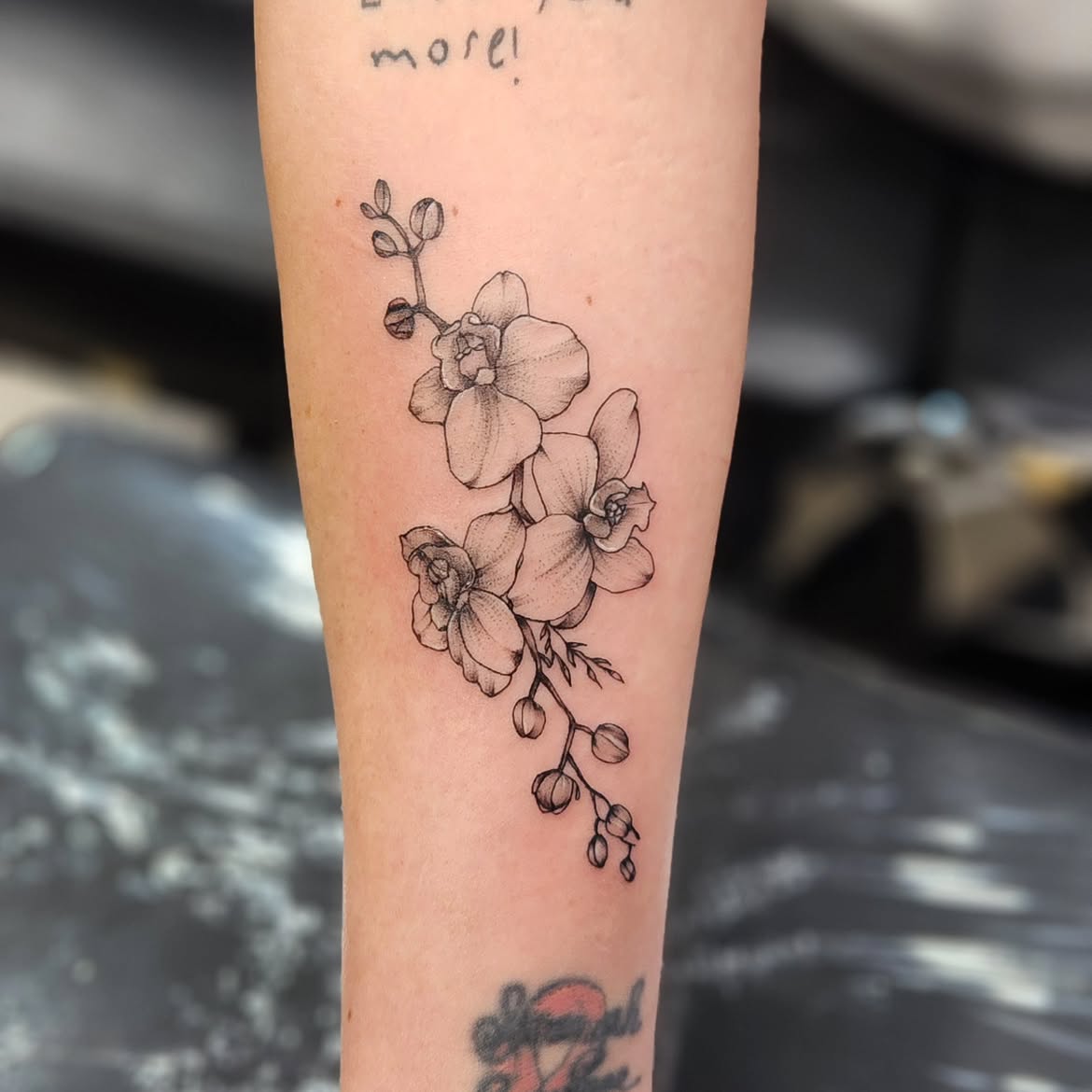
This design feels spontaneous in the best way. Instead of arranging every blossom at equal intervals, the artist clusters three open orchids around the middle of the composition and lets smaller buds extend above and below them.
The fine line technique is extremely controlled. Each petal has its own subtle contour, and tiny dotwork shadows provide depth without introducing large areas of black. The central blossoms overlap slightly, giving the arrangement more volume than a perfectly separated series of flowers would have.
The hanging buds are especially effective. They create a softer ending at the bottom of the tattoo and make the branch feel as though it continues growing rather than simply stopping at the edge of the composition.
This type of orchid is ideal for an existing patchwork arm because it occupies a relatively narrow vertical area. It can sit between older tattoos without demanding that everything around it be reorganized. At the same time, it has enough detail to work perfectly well as a standalone piece.
Anyone asking an artist for a custom stencil could also change the number of blossoms without losing the basic character of the design. Three flowers feel balanced here, but one larger Cattleya-inspired bloom could create a more dramatic variation.
Realistic Red and Pink Orchid Tattoo With Name Script
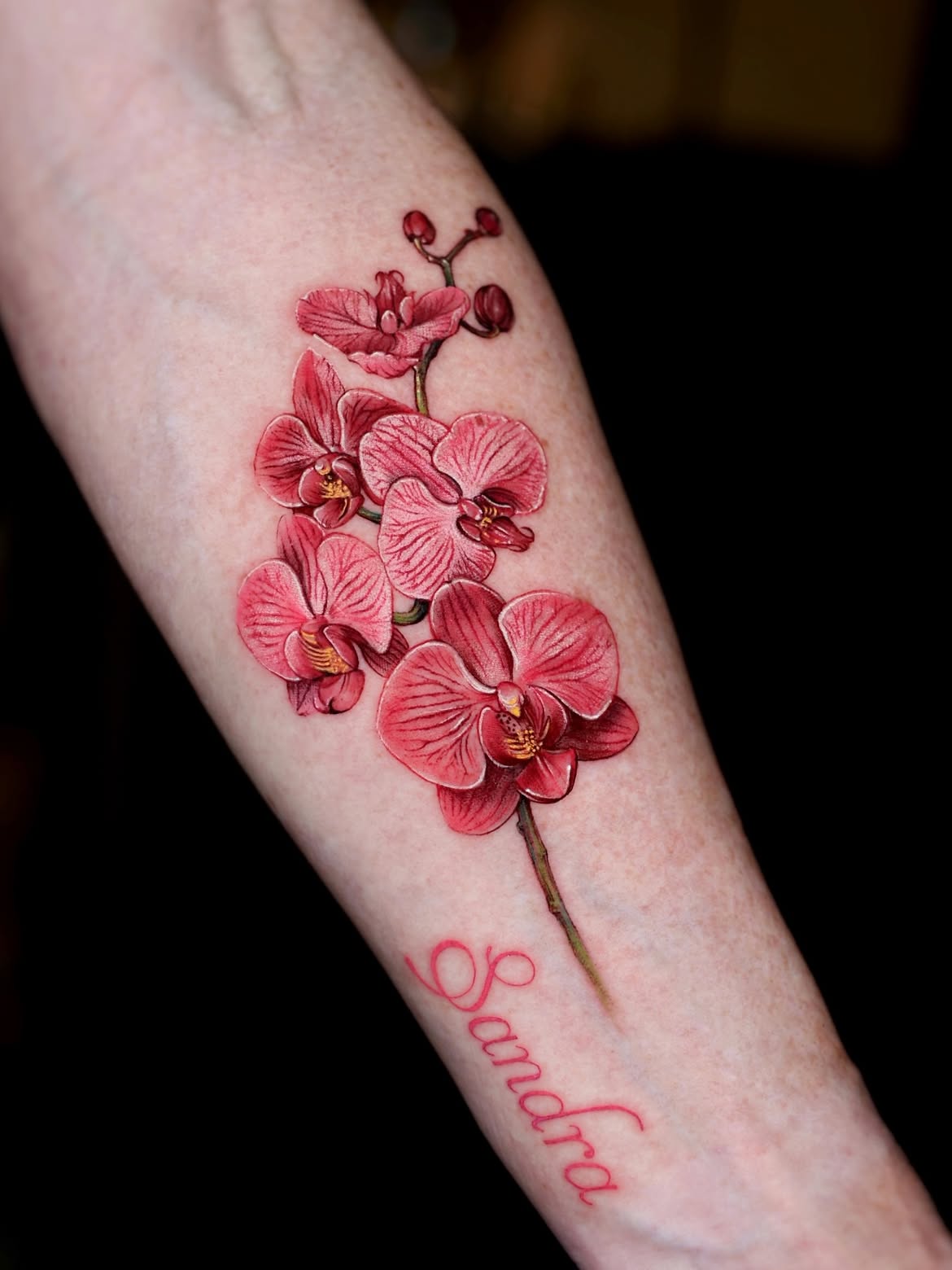
The final tattoo is one of the richest color pieces in the collection. A cascade of orchids travels vertically along the inner arm, combining coral, red, and deep pink with tiny yellow details and a restrained green stem.
Every blossom has been treated individually. Fine red veins spread across the petals, darker shadows define overlapping edges, and the centers contain remarkably small details. The buds at the top provide a natural transition from the dense floral cluster into open skin.
Despite the realism, the tattoo does not become excessively heavy. There is no background, and the narrow stem leaves plenty of negative space between individual flowers. That allows the saturated red palette to remain the focus.
The name written beneath the flowers introduces a deeply personal element. Its red line matches the botanical palette rather than switching to conventional black script, so the inscription feels integrated into the piece. This is a useful idea for memorial tattoos or designs dedicated to family members: typography can share the flower’s color and become part of the visual language rather than looking like an addition made afterward.
Among colorful Orchid tattoo ideas 2026, this is a strong option for anyone who wants realism with emotional significance. It also shows why orchids work so well for personalized tattoos—their color can be adapted almost endlessly, from natural pink and purple to more imaginative blue interpretations.
Pink Orchid Tattoo With a Love Mom Inscription
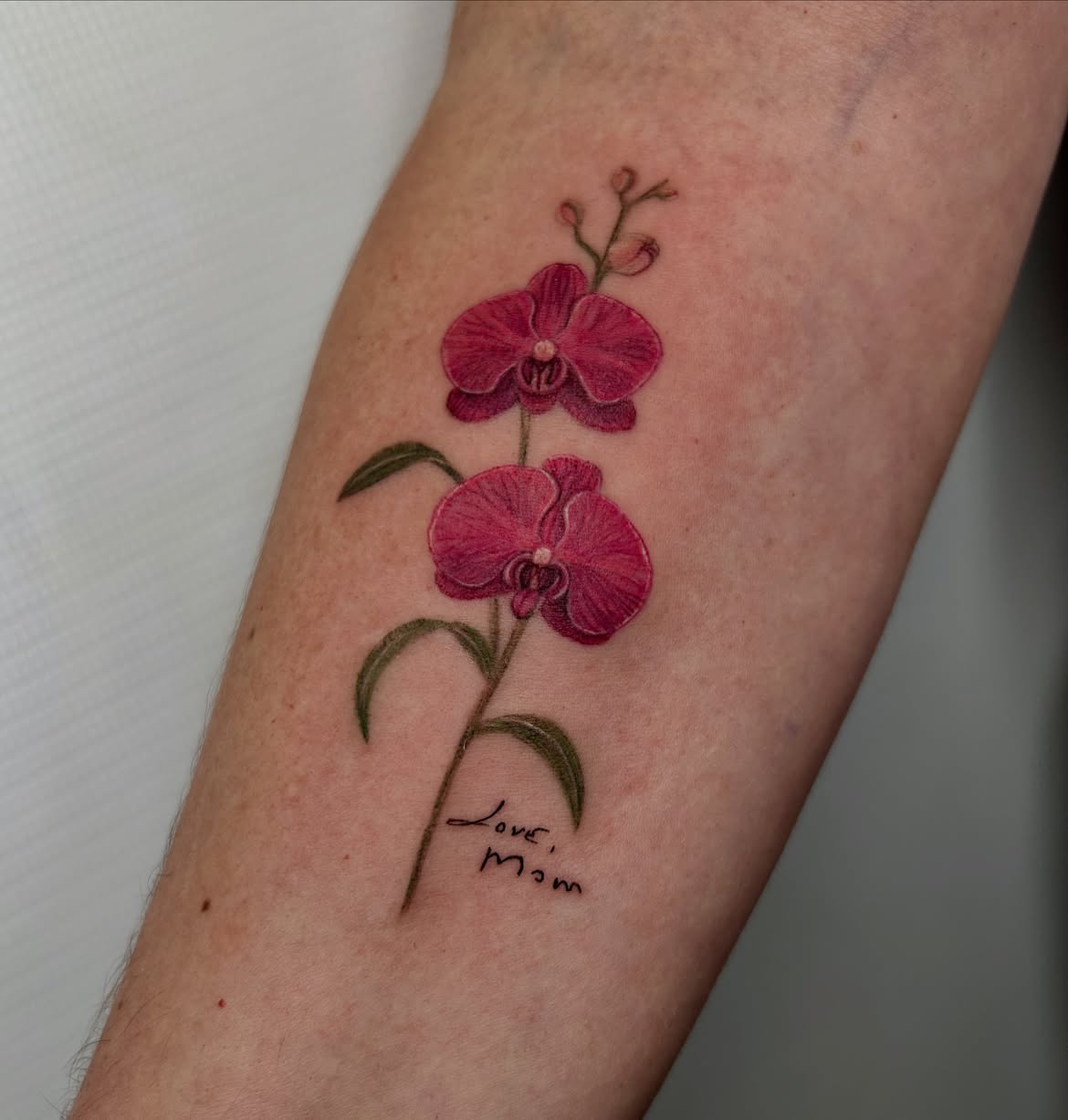
This orchid tattoo turns a botanical motif into something unmistakably personal. Two saturated pink blossoms grow from a slim green stem, with several small buds at the top and narrow leaves curving around the lower section. Beside the stem, the handwritten words “Love, Mom” transform an otherwise decorative flower into a sentimental keepsake.
The color work is particularly appealing because the petals are not treated as flat pink shapes. Fine darker veins radiate from the centers, burgundy shadows define the lower petals, and small pale highlights keep the flowers dimensional. The green is deliberately muted, allowing the pink and red tones to remain dominant.
It is also a smart example of how handwriting can be incorporated into floral design without becoming the focal point. The inscription is small and slightly irregular, which gives it the intimacy of an actual handwritten note rather than polished typography.
For memorial ideas, this approach can feel much more individual than simply adding a date beneath a flower. An artist could reproduce a short phrase from a card or letter and pair it with a meaningful orchid variety. The flower carries the visual beauty; the handwriting carries the private story.
Simple Fine Line Orchid Stem Near the Wrist
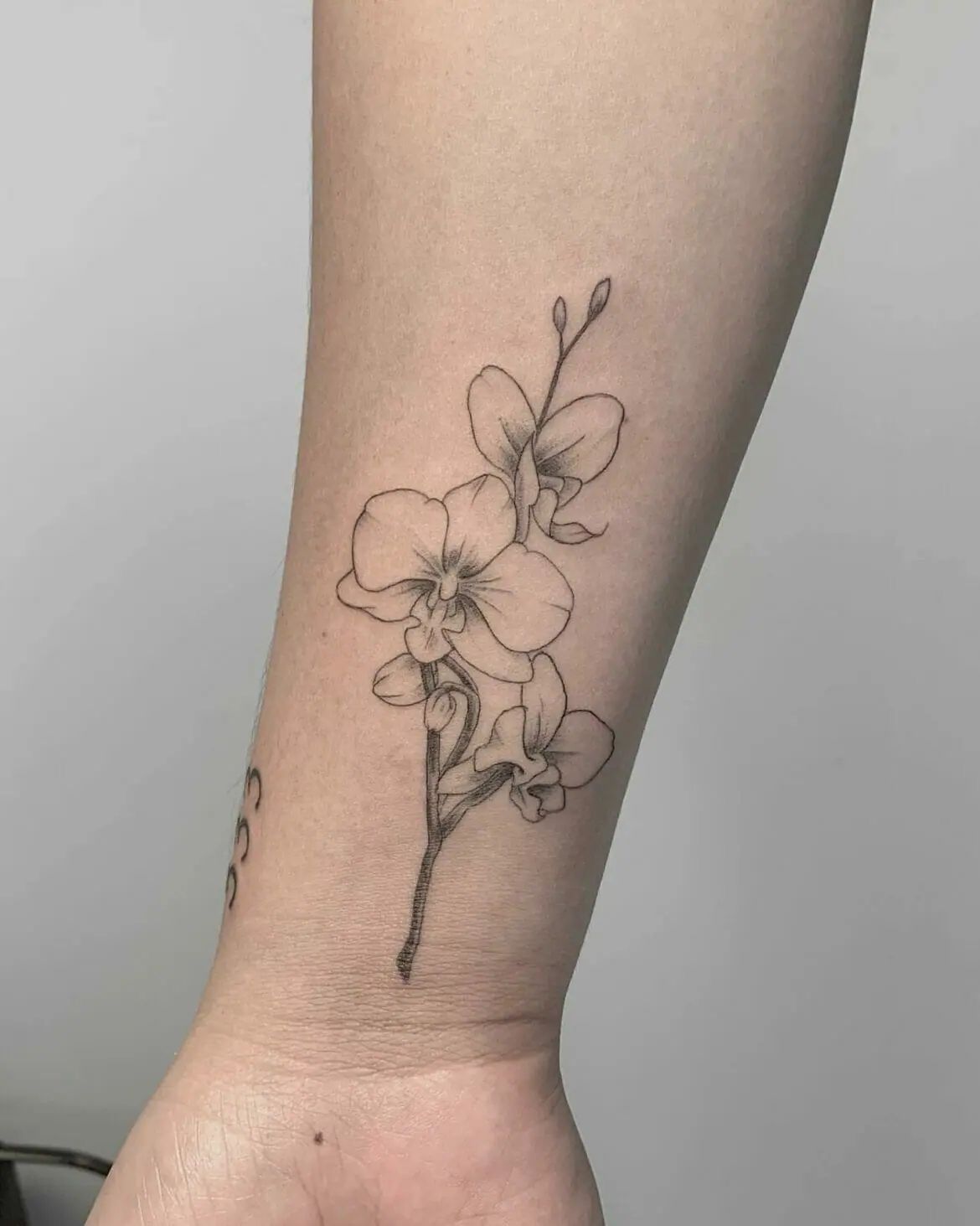
This vertical orchid branch is all about restraint. Three open blossoms and two tiny buds sit along a narrow stem positioned close to the wrist, creating a compact fine line composition with almost no unnecessary decoration.
The petals are outlined using extremely thin black lines. Instead of conventional grey filling, the artist concentrates subtle shading around the flower centers and selected overlapping sections. This is enough to suggest depth while maintaining the light, almost pencil-drawn character of the tattoo.
Placement plays an important role here. Because the design follows the length of the inner arm, the branch looks naturally elongated rather than cramped. The largest blossom occupies the middle, while smaller flowers above and below create a gentle taper.
For anyone looking through minimalist orchid tattoos, this is an especially practical reference. The structure could easily be converted into a clean stencil, and its modest scale makes it suitable for a first tattoo. It is also simple enough to coexist with other fine line pieces later.
I would keep this one monochrome. Adding strong color might be beautiful, but it would change the quiet character that makes the original work so well.
Tiny Black Orchid Tattoo With Botanical Dotwork
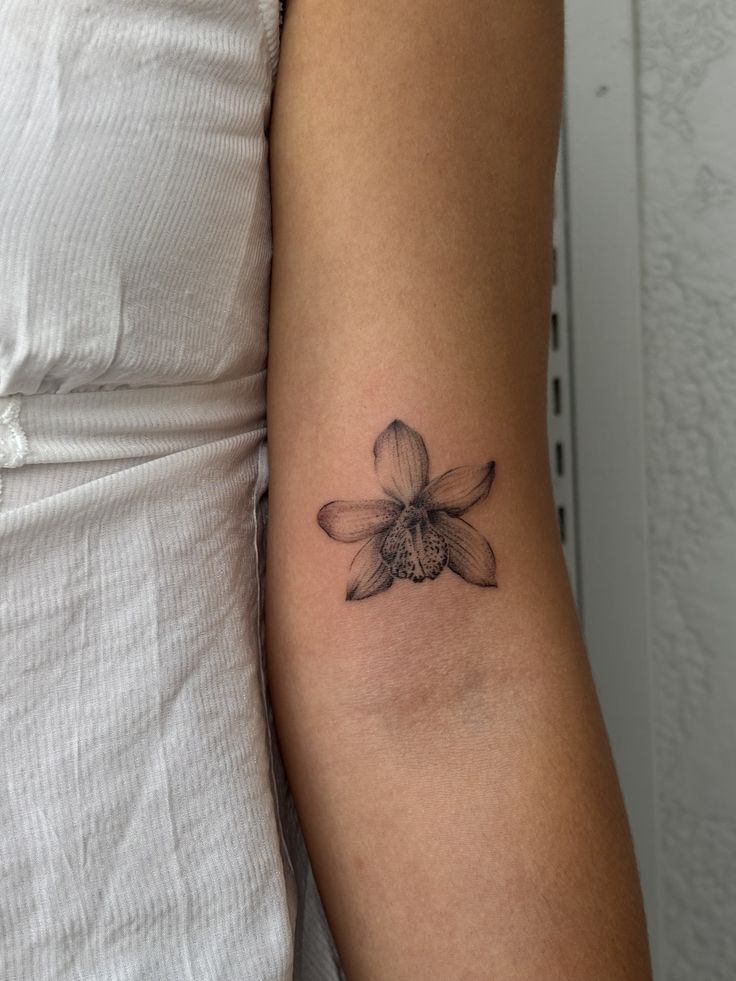
A single orchid can be surprisingly expressive when the flower itself receives all the attention. This tiny black botanical tattoo removes the stem entirely and focuses on one open blossom.
The petals are outlined delicately and filled with very light linear shading. The center receives considerably more texture, including small dots that create the speckled appearance associated with certain orchid varieties. That contrast between clean petals and a patterned center gives the flower personality despite its small size.
This is a genuinely minimalist approach rather than simply a large botanical illustration reduced in scale. There are no leaves, decorative lines, words, or additional buds. The negative space around the flower is just as important as the tattoo itself.
Anyone drawn to unusual orchid species could take this concept further. A Leopard or Tiger orchid could inspire more pronounced spotting, while a Ghost orchid would produce a very different silhouette. A miniature Cattleya, meanwhile, could emphasize wider and more ruffled petals.
As a simple design, this would translate easily to the upper arm, ankle, wrist, or shoulder blade.
Botanical Orchid Shoulder Tattoo That Follows the Collarbone
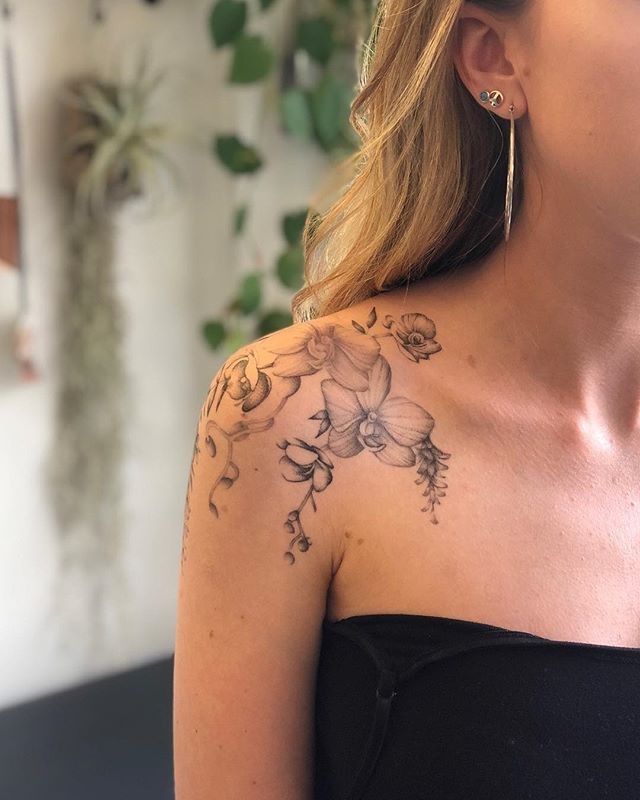
The shoulder offers a completely different canvas from the forearm, and this composition takes full advantage of it. Rather than placing the orchids in a straight vertical line, the flowers sweep over the shoulder cap and approach the collarbone.
Several botanical elements are mixed together, including open orchid blossoms, buds, leaves, and smaller floral forms. The result feels like a loosely gathered garden rather than a formal bouquet. Fine outlines establish each shape while soft black-and-grey shading adds dimension without overpowering the skin.
The most successful part is the way the design reacts to anatomy. Some flowers sit on the flatter upper shoulder, while others turn with its curve. That means the tattoo changes slightly depending on whether it is viewed from the front or side.
This is a useful direction for anyone considering a larger floral project but not wanting a conventional sleeve. A shoulder composition can occupy substantial space while remaining easy to conceal with clothing. It could also be extended toward the upper back or farther down the arm later.
The irregularity gives it charm. Botanical tattoos often become more believable when every blossom is not perfectly aligned or equally sized.
Purple Spotted Orchid Tattoo With Realistic Petal Texture
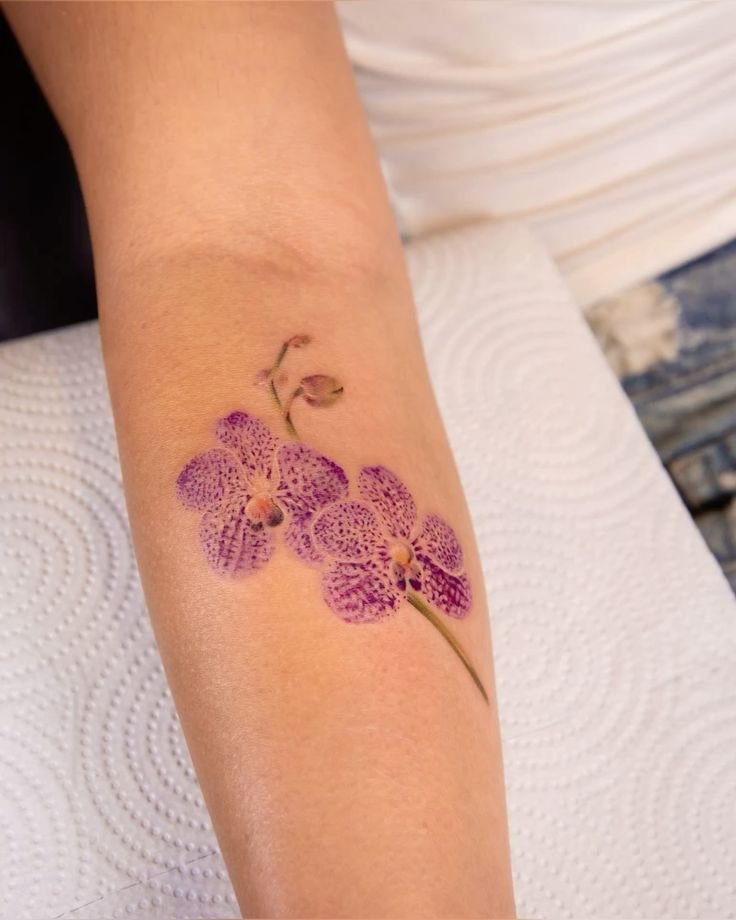
This small purple orchid branch stands apart because of its patterned petals. Two open flowers dominate the composition, each covered in numerous tiny violet spots that become denser toward selected areas of the bloom.
The artist uses those markings instead of heavy outlines to create much of the visual texture. Pale lavender forms the underlying petal color, while concentrated purple stippling provides contrast. Warm yellow and soft pink touches appear around the flower centers, and a narrow green stem keeps the palette botanical.
The result has something of a Leopard orchid quality, even if the design is better appreciated as a stylized spotted orchid rather than a strict botanical identification. That patterned appearance is a clever option for anyone who likes color tattoos but wants something more unusual than a solid pink or purple flower.
The scale is also nicely judged. Making the blossoms much smaller would risk losing those individual spots; making them significantly larger might make the pattern too dominant. Here, the detailing remains readable while the tattoo still feels delicate.
This is one of those orchid ideas where the flower’s natural markings provide almost all the decoration needed.
Pink Abstract Orchid Sleeve With Flowing Linework
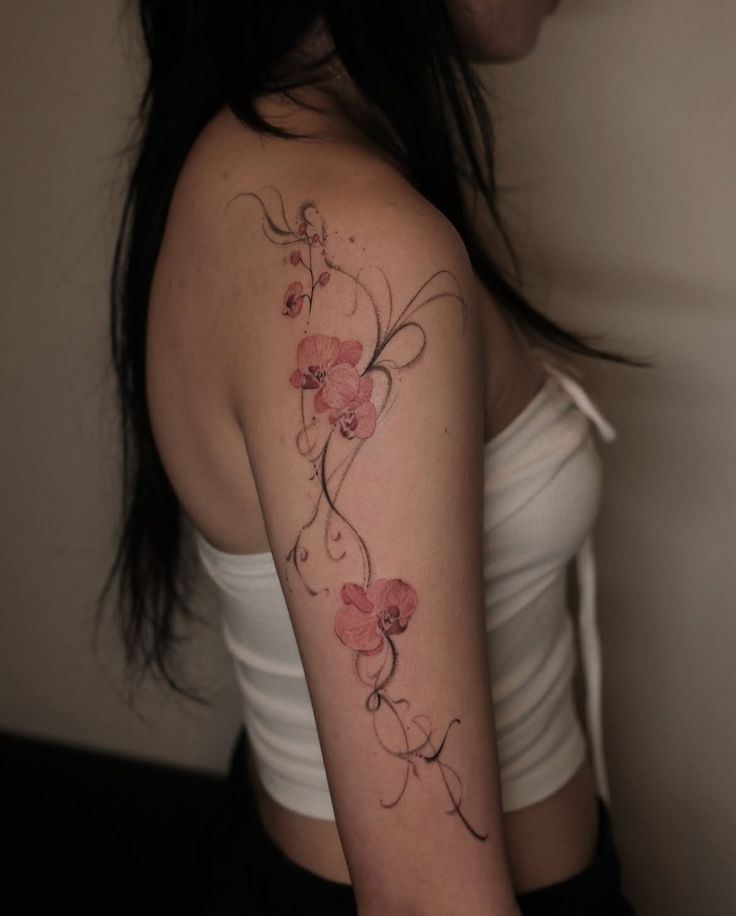
This elongated composition brings together pink orchids and expressive abstract linework, creating a design that feels almost like a drawing made directly on the body.
Several blossoms appear at different points along the upper arm. Instead of connecting them with a conventional botanical stem, the artist uses exceptionally thin sweeping curves, tiny dots, small buds, and loose ornamental gestures. Some lines loop around the flowers; others extend into open skin before disappearing.
The pink palette remains soft and slightly muted. Darker centers prevent the orchids from losing definition, but there is no attempt to create heavy photorealism. That allows the black lines and colored flowers to share attention.
This style is particularly interesting for someone considering a delicate floral sleeve. A traditional sleeve often relies on dense background material to connect separate motifs. Here, empty skin does that job instead. The result covers a substantial vertical area without ever looking crowded.
It could also evolve naturally. Another orchid could be introduced lower on the arm, while new lines could weave it into the existing composition. The trick would be knowing when to stop—too many flourishes would quickly remove the airy quality that makes this design distinctive.
Large Fine Line Orchid Back Tattoo
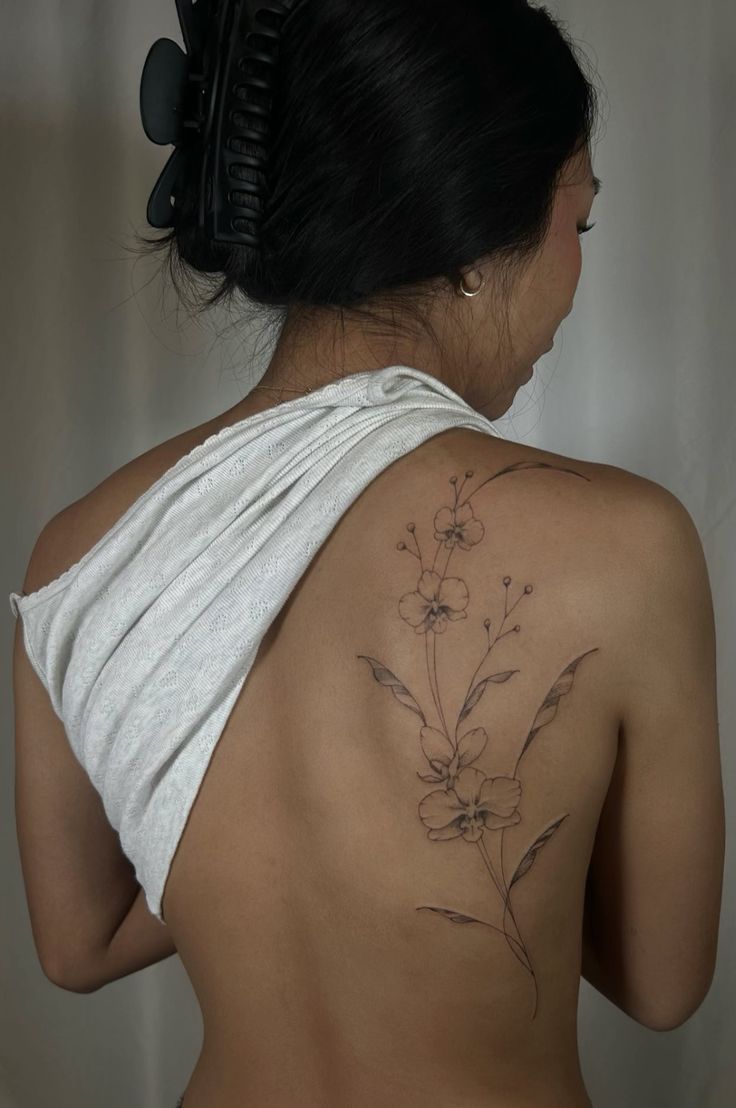
The final design demonstrates what happens when minimalist principles are applied on a much larger scale. A tall orchid arrangement grows across one side of the back, beginning lower near the waist and reaching toward the shoulder blade.
Multiple flowers appear at different stages of development. Larger open blossoms occupy the lower and central areas, while smaller flowers and round buds rise toward the top. Long narrow leaves extend outward at irregular angles, giving the composition enough width to balance its considerable height.
Despite its size, the tattoo remains exceptionally light. Fine black outlines define the flowers, while restrained grey shading appears inside selected petals and leaves. There is no dark background and virtually no solid fill. From a distance it has the elegance of a botanical pencil drawing.
This is why large fine line tattoos can be so effective on the back. There is enough space to preserve realistic proportions and generous negative space simultaneously. A smaller placement would require either simplifying the flower anatomy or compressing the arrangement.
The asymmetrical positioning is another smart decision. Instead of centering the plant along the spine, the design follows one side of the body. That gives it a more organic sense of growth and leaves open space should the wearer ever want to extend the composition.
Among larger Orchid tattoo ideas 2026, this is an excellent alternative to a dense traditional back piece. It has presence without visual heaviness and demonstrates that minimalist tattooing does not have to mean tiny.
Orchid tattoos are unusually adaptable, and that may be their greatest strength heading into 2026. A single flower can become a tiny fine line accent, an abstract splash of purple and blue, or the beginning of an elaborate shoulder and arm composition. Rather than choosing a design simply because it is trending, use these ideas to think about what kind of orchid, placement, scale, and technique actually feels personal. If one of these styles caught your attention—or you already have an orchid tattoo of your own—leave a comment and share which direction you would choose.