The Legend of Zelda has a distinct visual identity that lends itself perfectly to body art: symbols of power and purity, the Master Sword, dragons, masks, and one particular master swordsman named Link. Below are 31 Zelda tattoo ideas taken from actual designs created by human hands. We will see each design and discuss why it succeeds, where it should be located on your body, and finally, how it can be adapted for your needlework endeavors, regardless if you prefer something minimalist and discreet, a bold sleeve, or coordinating tattoos with friends. I will work these insider tips for seasoned body-artist dudes (line weights, clarity in your design template, positioning) until your design transitions seamlessly from tats-flash to completed work of art.
Triforce Circle with Master Sword and Sheikah Motifs
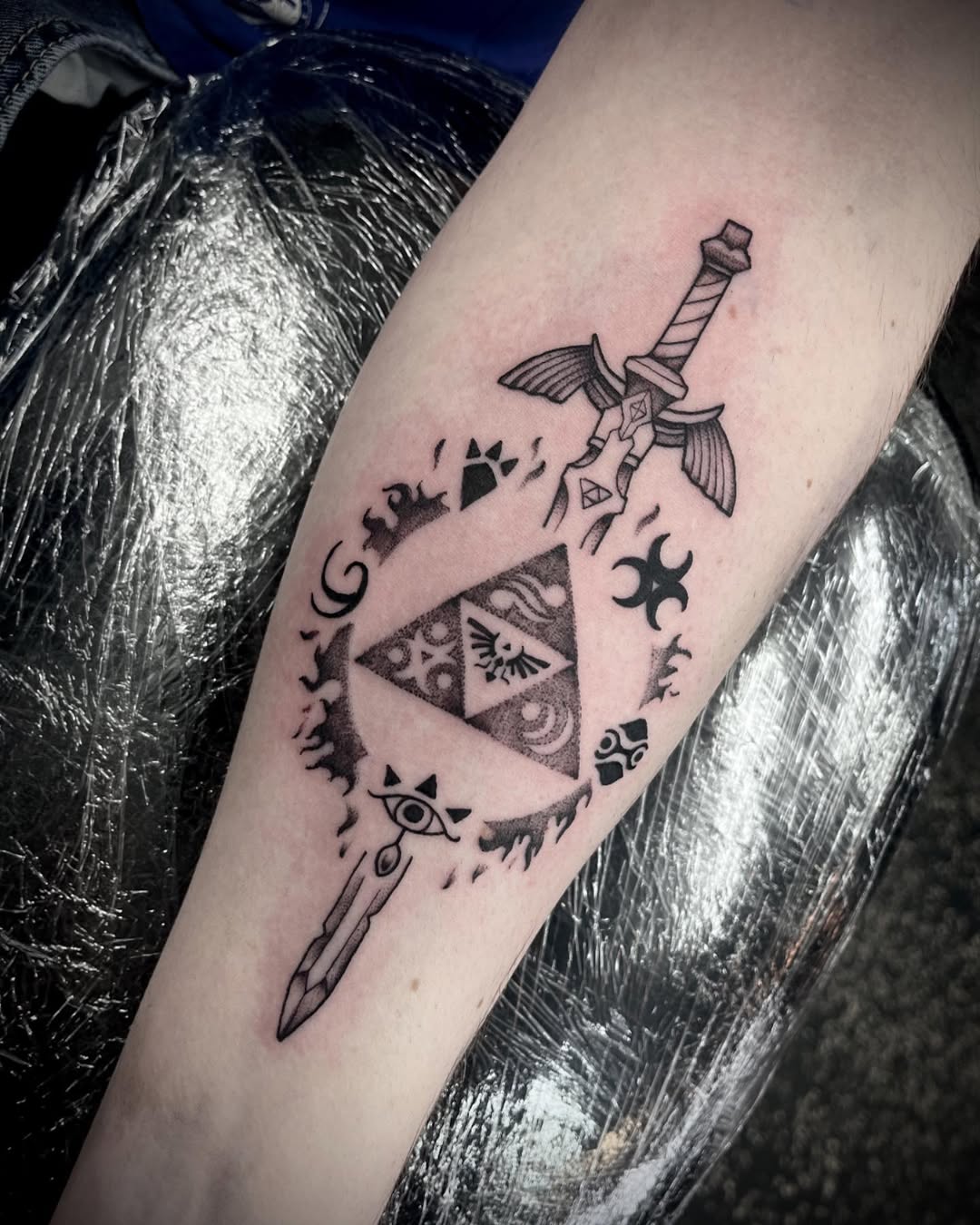
This design starts with a boundary for protection surrounding the Triforce, followed by mastering it with a Master Sword on top and a Sheikah Eye charm on the bottom—a quintessential Legend of Zelda design without resorting to character images. The flaming ring has a flowing effect with small triangle designs featuring dotwork patterns (an ingenious use of negative space without adding much actual negative space). The negative space is what makes this design come across as Legend of Zelda iconography without relying on character portraits. The circle of flame-like shapes reads as motion, while the inner triangles carry fine dotwork patterns (a clever way to create contrast without heavy black). The negative space keeps it simple and readable from a distance; up close, the design rewards you with texture.
Why it works:
- A balanced, emblem-style composition always fits cleanly on the arm or calf.
- Mixed line weights (bold border, delicate interior details) give the stencil strong staying power over time.
- It quietly nods to Navi and other symbols without overcrowding.
Pro tip: Ask your artist to scale-test the circle on your forearm. A diameter that lands between tendon lines preserves symmetry—vital for geometric pieces like this. If you’re doing matching tattoos, mirror the blade orientation for a subtle twin effect.
Serpentine Hyrule Dragon, Black & Grey Linework
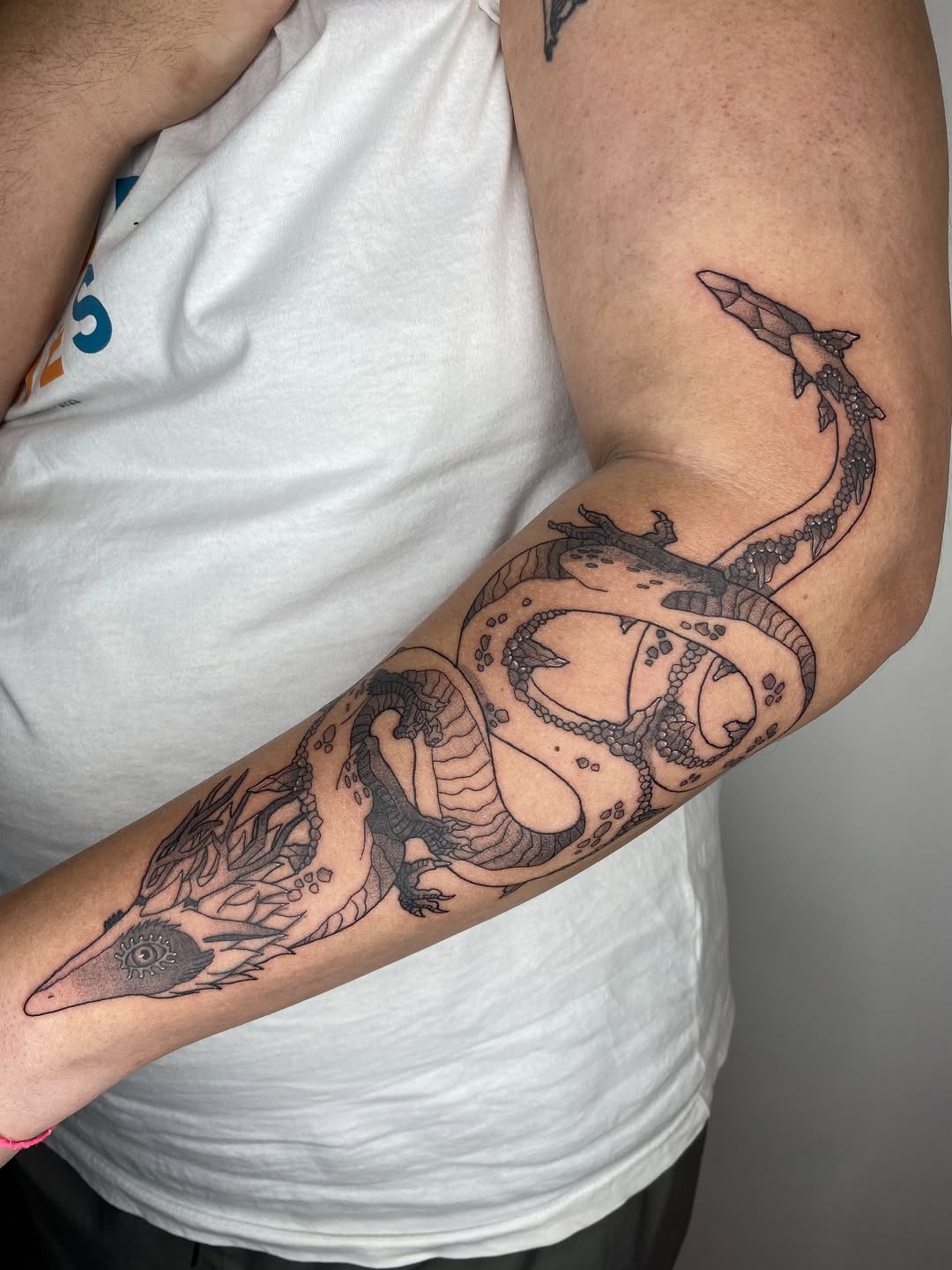
A long, lithe dragon snakes from wrist to elbow, showing how Zelda’s mythic creatures can become perfect forearm anchors. The placement follows the arm’s natural curve, and the artist uses scales and pebbled textures to build depth without saturating the skin. This is elegant, minimalist in palette, and decidedly unisex—ideal for men or women who want high presence without color.
Why it works:
- The flowing S-curve elongates the limb and makes the most of forearm real estate.
- Strategic dot shading keeps the creature dimensional but breathable.
- It pairs beautifully with future sleeve ideas (add nebula clouds, runes, or ruins as background later).
Pro tip: Ask for a slightly heavier outline on the head and talons to preserve definition long-term. If you’re building a Twilight Princess-inspired arm, this dragon can be your central vertical axis.
Link with Zonai Arm and Master Sword (Soft Color Focus)
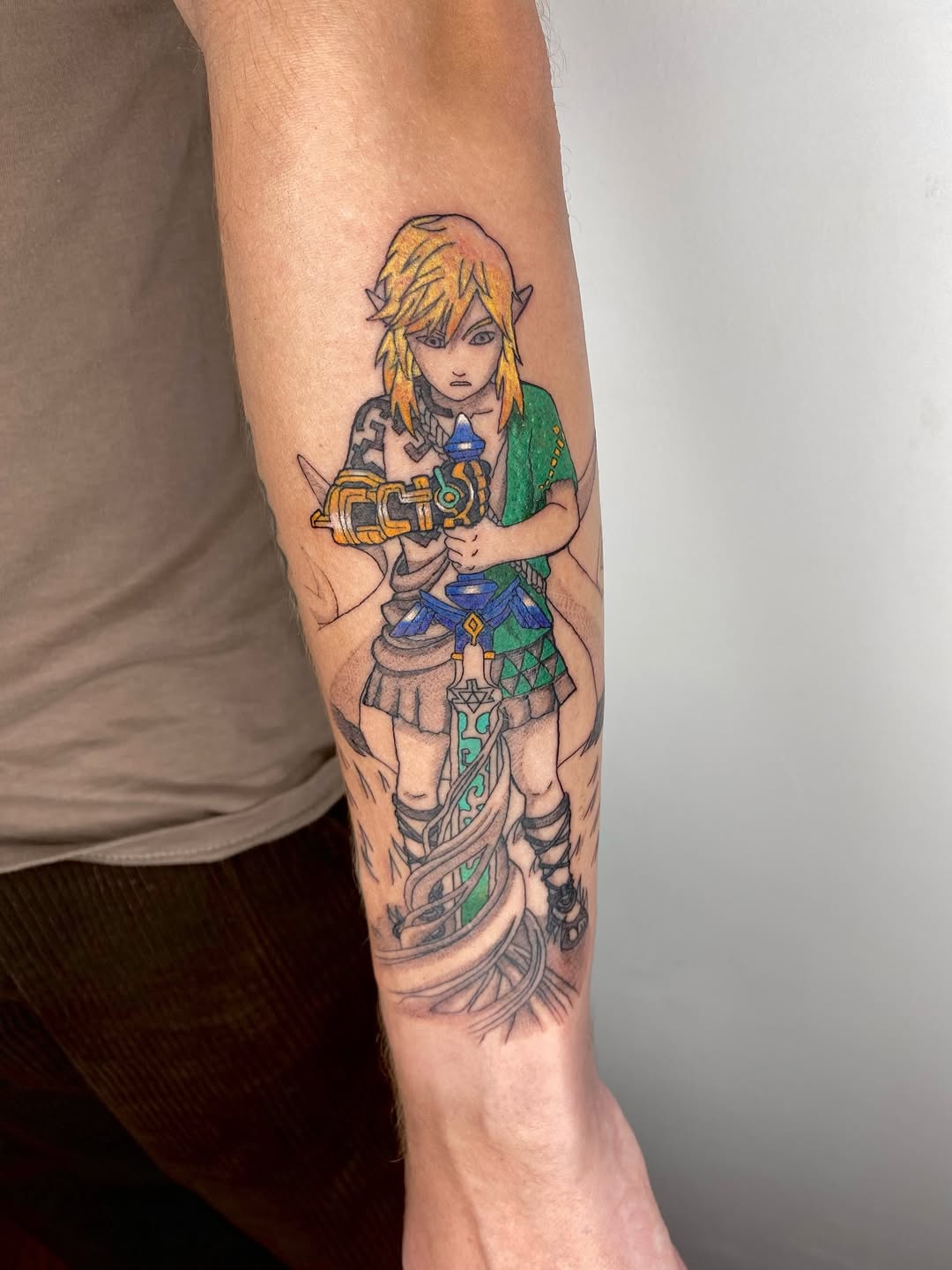
Here Link stands grounded, hand on the Master Sword, with that unmistakable green-tech Zonai arm. The palette is restrained—spot color on the hero while the plume and base remain in cool greys. That contrast draws the eye to Link’s expression, which sells the “master swordsman on a quest” narrative without clutter.
Why it works:
- Selective color pops (hair, tunic, sword hilt) keep maintenance manageable compared with a full-color fill.
- The vertical composition sits perfectly on the inner forearm, a natural storytelling panel.
- It’s fandom-forward yet subtle enough for daily wear.
Pro tip: For extra Zelda deep-cut flair, ask the artist to ghost in a faint Trifuerza (Triforce) pattern in the background smoke. It reads for fans and disappears for everyone else.
Light Dragon Coiled Around the Master Sword (Color)
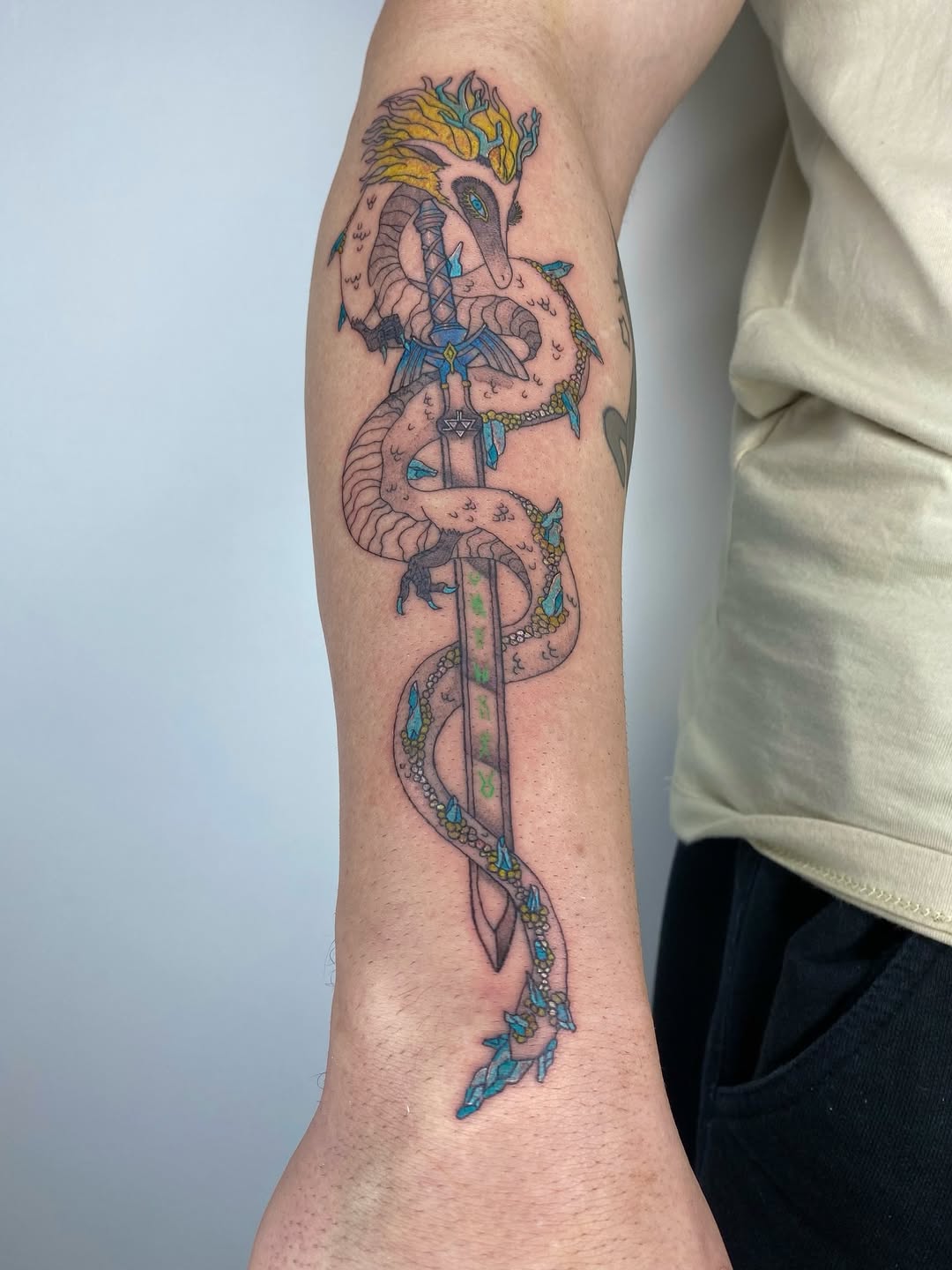
A luminous, amber-maned dragon wraps the blade, sprinkling blue crystal accents along the coils. This is Zelda romance—a living legend guarding the weapon of legends. The scale pattern is tight but not overworked, while the sword’s runes and guard echo game-accurate cues.
Why it works:
- Color contrast between the warm mane and blue crystals makes for a movie-worthy focal point.
- The coil design encapsulates your weapon for both creature and design in one efficient design.
- Additional functionality for use on the forearm’s front column or vertical placement for a partial sleeve.
Pro tip: Inform your artist to keep your brightest chroma value positioned mid-forearm (vs. wrist creases) to delay fading due to sun exposure or wear.
Dynamic Black & Grey Link in Motion
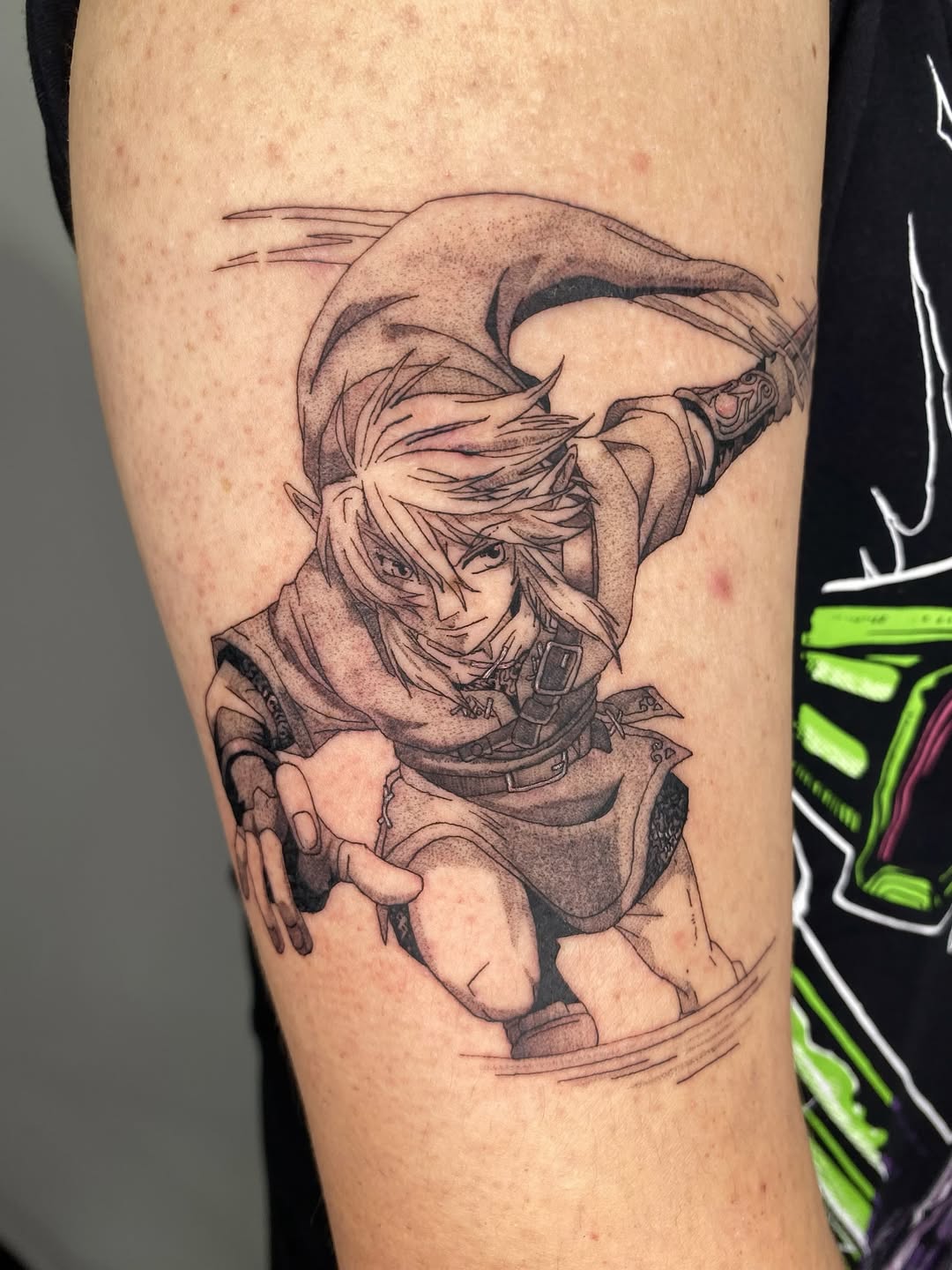
Kinetic lines explode out to frame your lunging Link—a pure manga aesthetic translated in stipple and darks. Color is unnecessary here—the motion speaks for itself. Additional details such as short tunic folds, glove design, and sword hilt signal this one out for Legends of Hyrule devotees without fanfare.
Why it works:
- Motion arcs and negative space bring your stencil design dynamically aged.
- Using dots instead helps avoid trauma and healing time on your upper arm or thigh areas.
- Aging is ensured here with high-contrast silhouettes and limited detailing.
Pro tip: If you plan on implementing a full-true sleeve, leave negative space ahead of Link’s movement to preserve the illusion of speed when you add background later.
Neo-Anime Portrait of Link (Saturated Color)
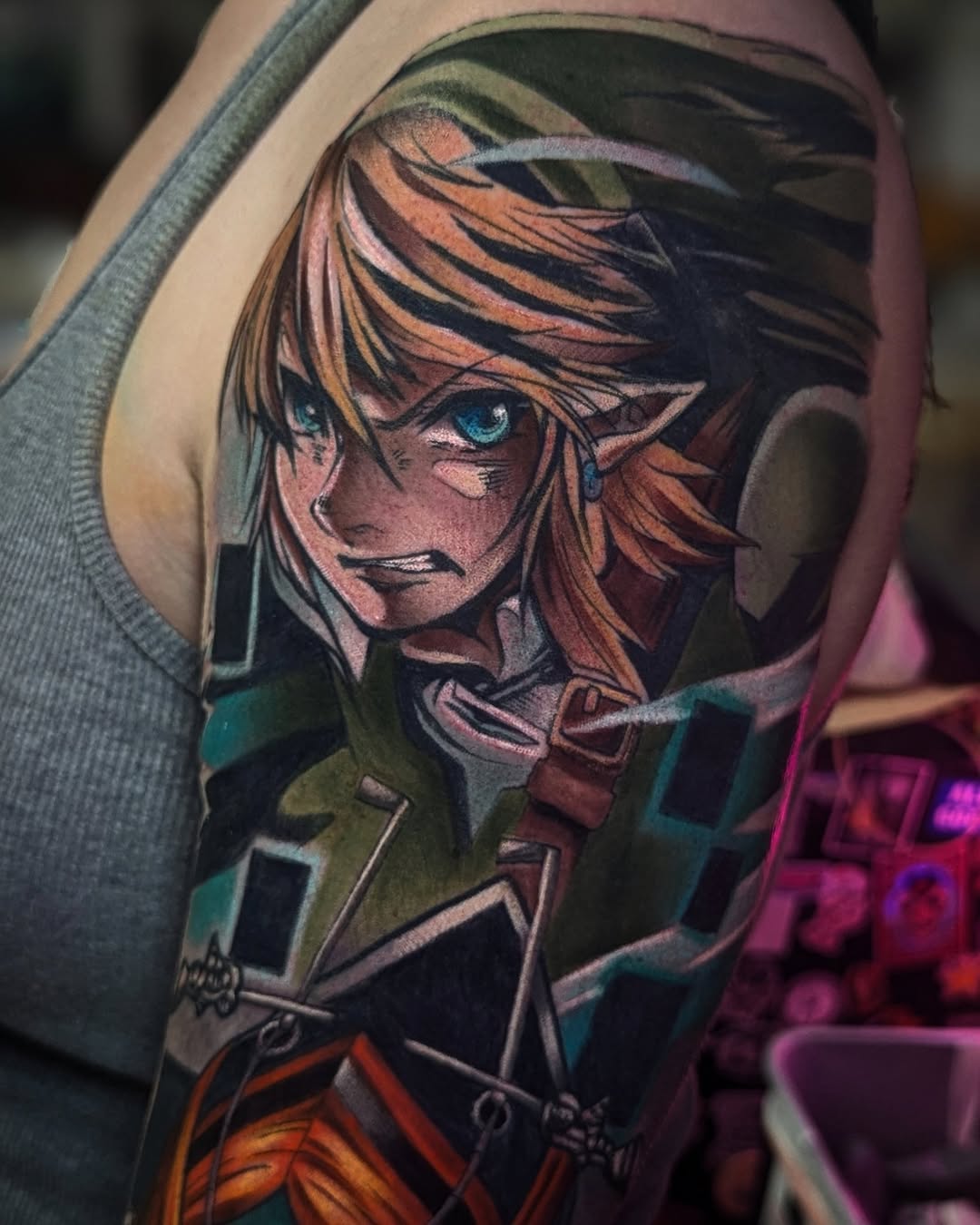
Here’s the bold choice: a saturated, painterly Link with cool teal blocks and warm orange accents. The eye highlight is razor-sharp, cheek shadows sculpt the face, and the hood frames everything like a living panel from an art book. For collectors who want the hero—not just the symbols—this is the statement piece.
Why it works:
- Contemporary color density and geometric shapes pack your design with interest without muddling.
- Upper-arm placement allows for enough design space for your micro-gradients.
- Signed on geometric backgrounds (fracture-triangle fascination nodding toward Triforces).
Pro tip: You can request a transparent teal wash around the outline after healing. It gives a nice ‘aura’ effect without committing to a heavy background—for us, it’s just one of those color artist favorite styles you see in magazines such as Inked and Tattoo Life.
Majora’s Mask Mash-Up Creature (Black & Grey Character Study)
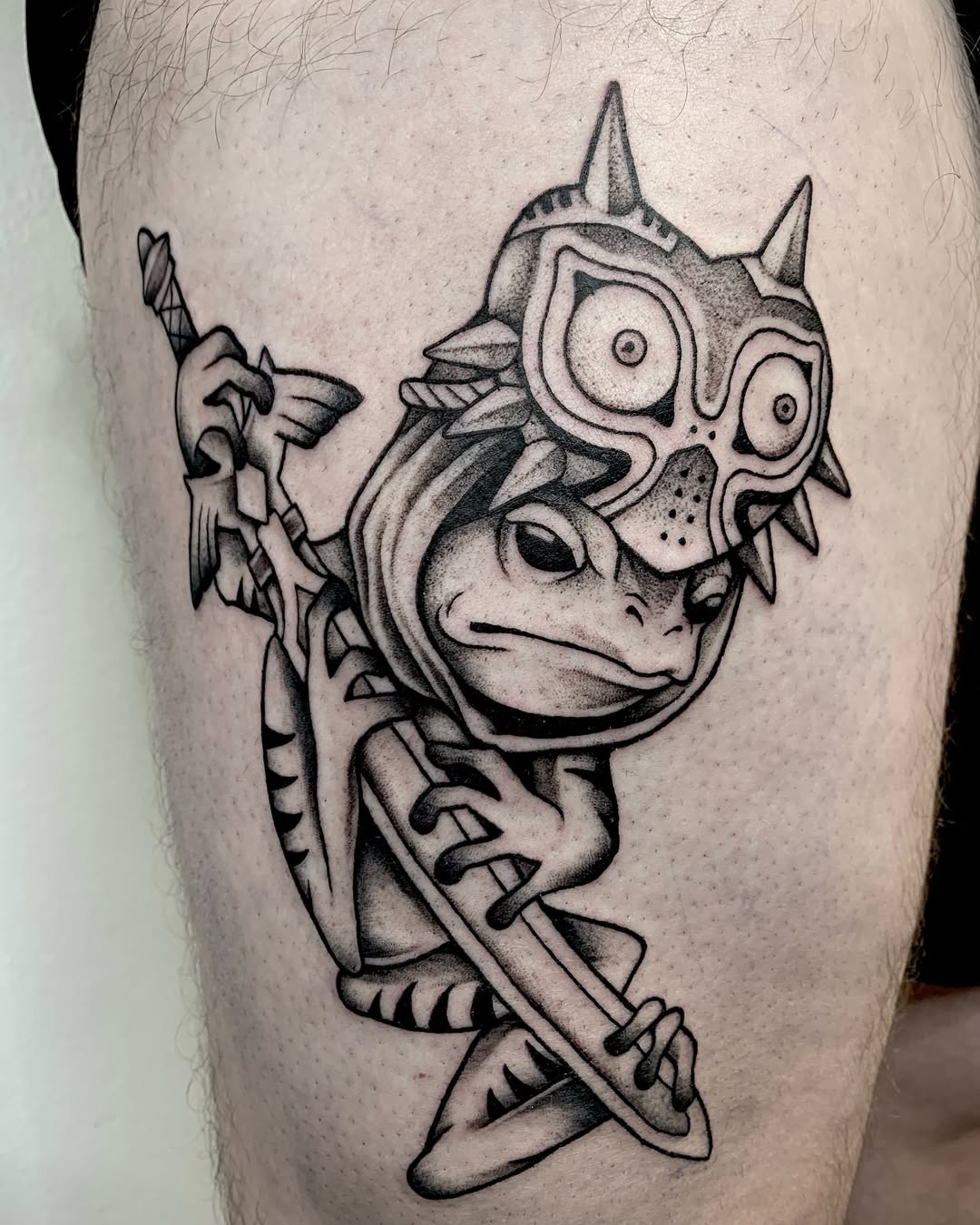
A sly, lizard-like character clutching a blade while wearing Majora’s Mask—whimsical, a little eerie, and instantly conversation-starting. The big-eyed mask steals focus while soft stipple shading shapes the belly and tail. It’s the kind of flash concept that feels custom, perfect for the thigh or outer calf.
Why it works:
- An oversized mask plus a small body keeps the silhouette readable at a distance.
- Just enough texture to feel dimensional while still minimalist in palette.
- Ideal for matching pieces—swap the character or blade style for your co-op partner, and you’ve got a duo.
Pro tip: If you’re sensitive to big blocks of black, ask for a pepper-shade gradient inside the mask’s horns. It keeps contrast high while making healing gentler.
Minimalist Master Sword with Navi Fireflies
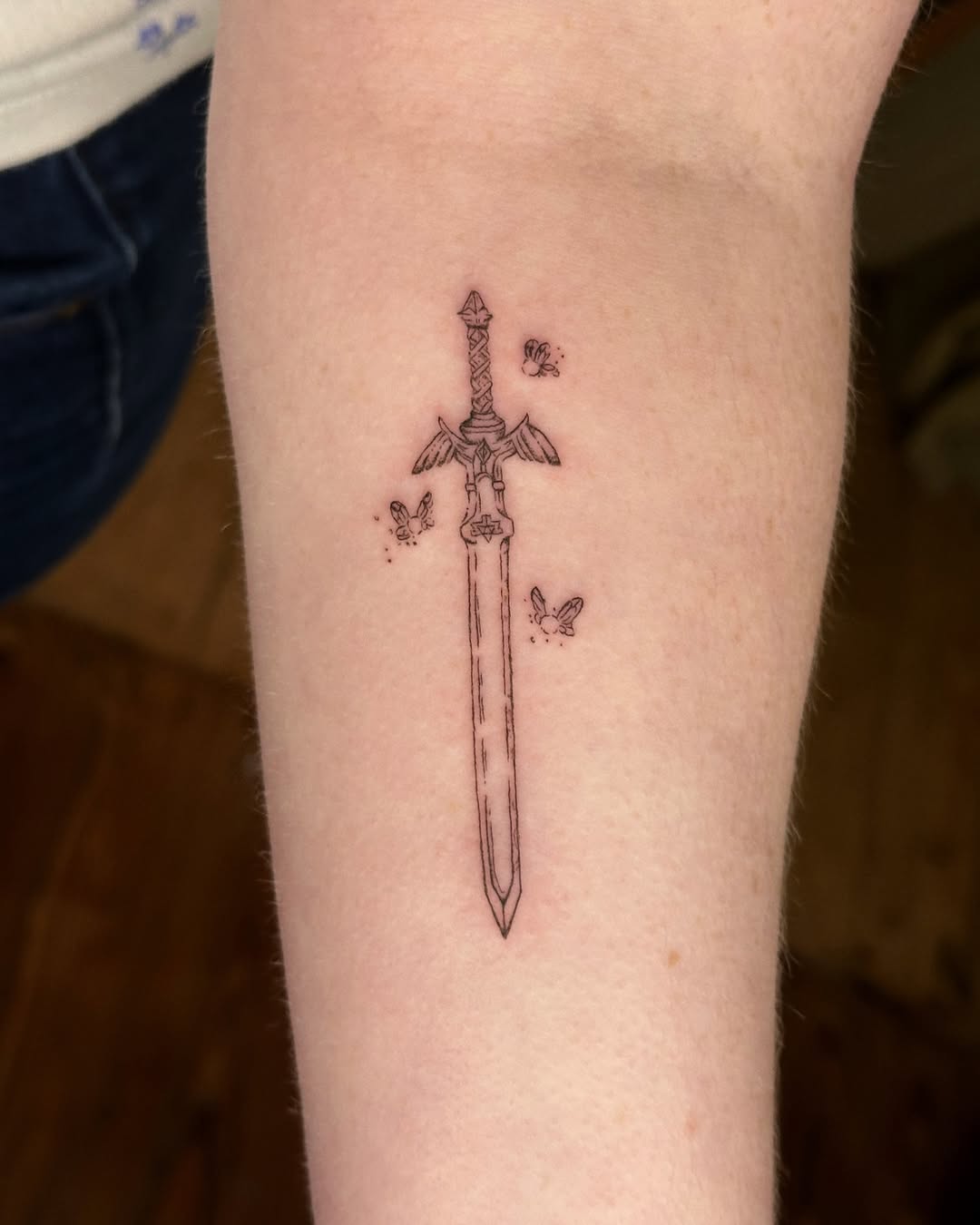
A whisper-thin Master Sword stands perfectly vertical, orbited by three tiny sprites that read instantly as Navi. The sparing line weight and total lack of fill make this a minimalist take that still signals Hyrule to anyone who knows the Legends of series. It’s the kind of design that looks quiet at a distance and delightful up close—great for the inner arm, where you can keep the blade undistorted by muscle flex.
Why it works & how to tailor it
- Keep the sword’s outer line one step heavier than the inner facets so the stencil stays readable for years.
- Ask your artist to dot-shade only the crossguard—just enough to separate metal from skin without turning the piece heavy.
- For matching ideas, let friends choose different sprite positions or counts; the set still feels unified.
Mastersword, Sun Halo, and Woodland Florals
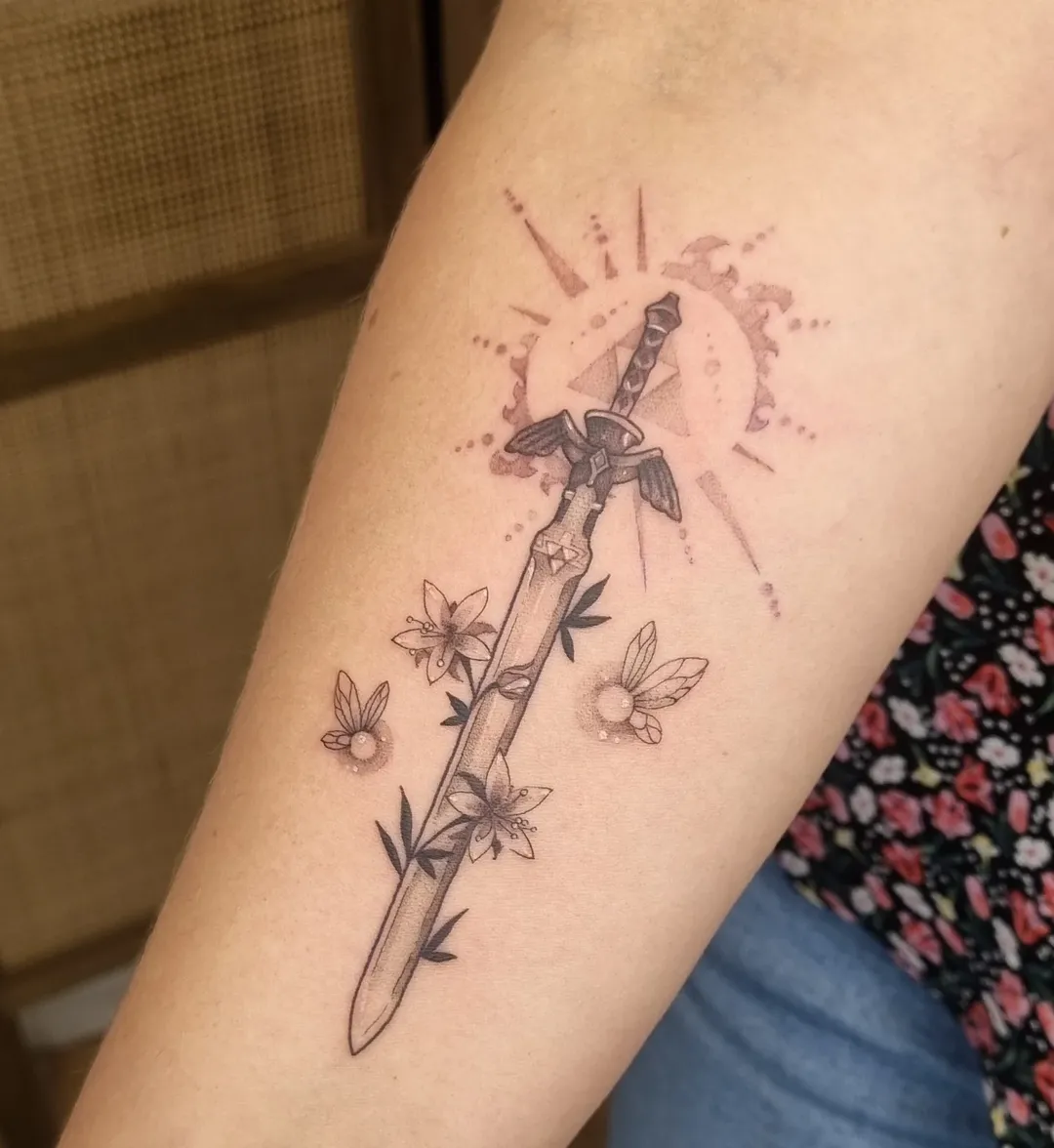
The sword rises through lilies and leaves while a soft dotted halo blooms behind the hilt—like catching the blade at first light. The gentle stipple and negative-space rays keep the piece subtle; the micro-orbs nod to Navi without crowding the composition. This reads beautifully on a forearm or outer calf, where the sun disc has room to breathe.
Styling notes
- Ask for a pale warm-grey wash in the halo and a cooler wash in the blade; that temperature contrast sells steel versus sky.
- If you’re building toward a partial sleeve, this disc becomes a perfect anchor for later background: ruins, vines, or a faint Triforce pattern.
Link Framed by Shield and Blossoms (Black & Grey)
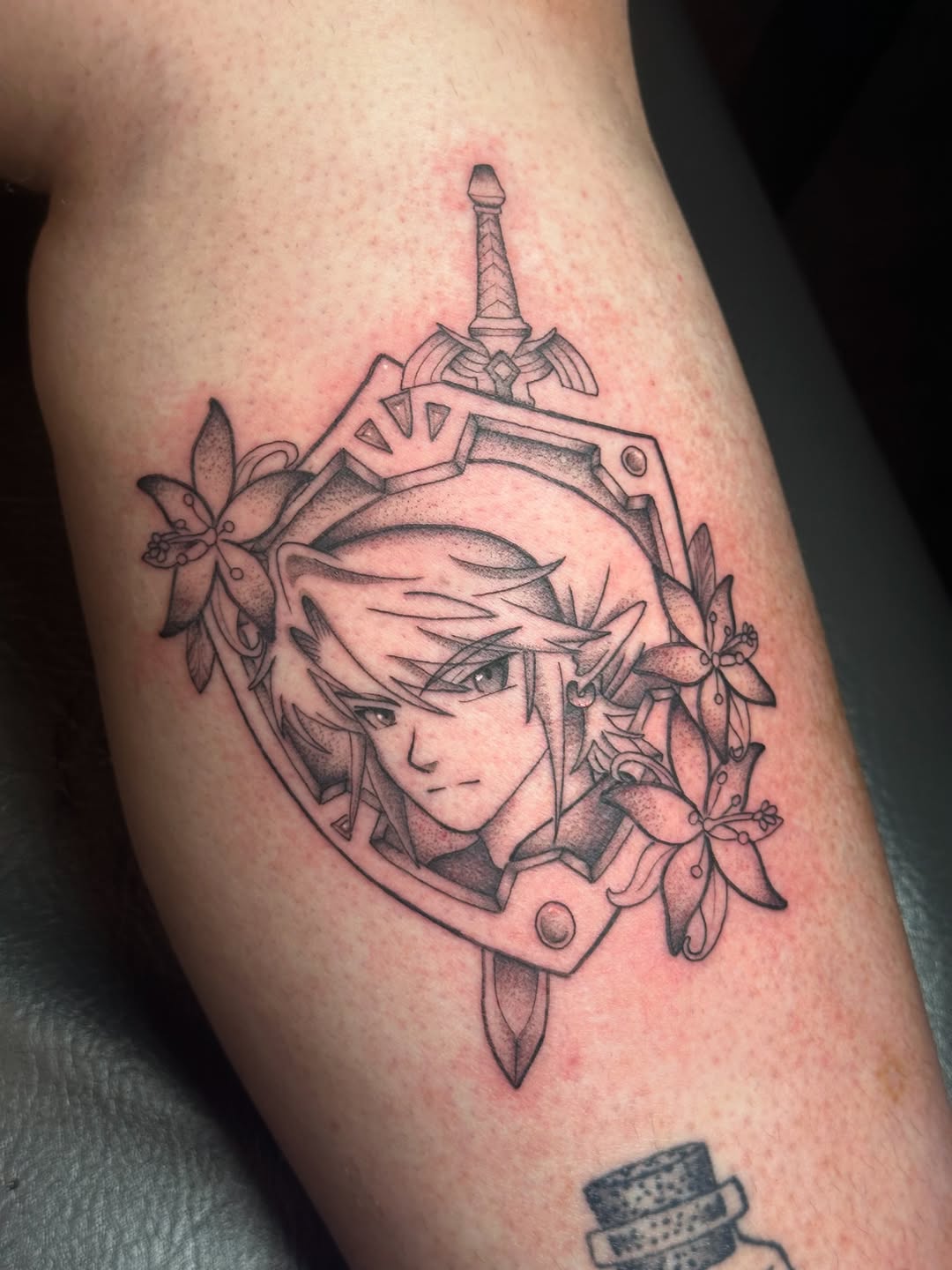
A determined Link looks out from a shield frame while the Master Sword peeks over the top, petals softening the geometry. Clean contouring around the jawline and eyes anchors the likeness without overworking the face—vital for portrait longevity. The floral ring adds movement and offers a graceful entry point if you expand into a hero-themed sleeve later.
Styling notes
- Keep facial features in tight, crisp lines; shade the hair and hood with textured dots so the portrait doesn’t flatten.
- If your era is Twilight Princess, slip in subtle armor cues on the pauldron; for other timelines, swap leaf shapes to match your favorite region.
- Works on the upper arm or thigh; both planes preserve the shield’s symmetry.
Korok Keepsake with Stone Pack
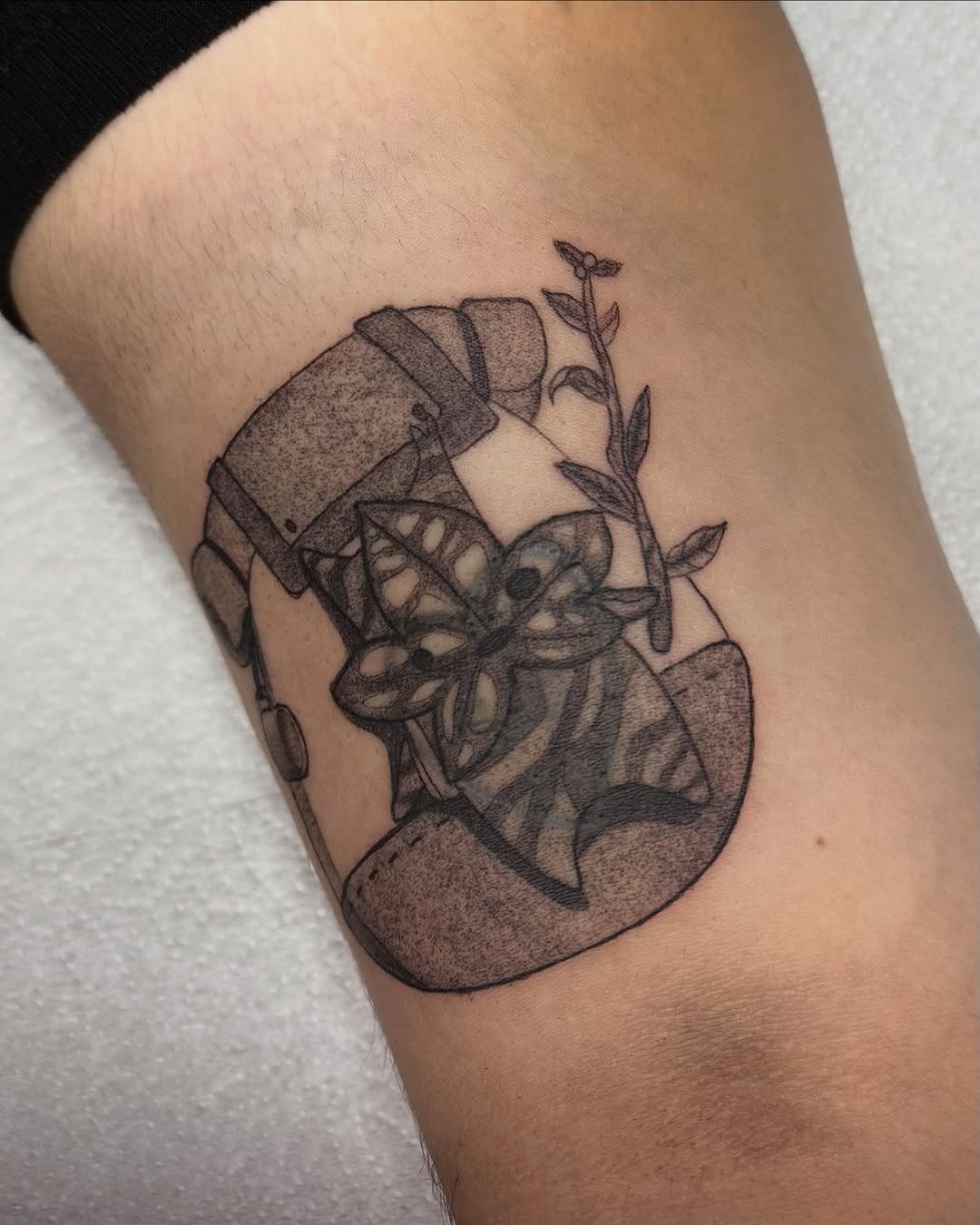
This charming forest sprite—dare I say, Kolog to match in-game slang—rests against a strapped stone satchel, face mask patterned in soft stipple. The charm is in the textures: pebbled granite, stitched strap, and leaf veining. It’s playful but not childish, squarely in that Zelda sweet spot where whimsy meets pilgrimage.
Styling notes
- Ask your artist to vary dot size on the stone so it reads as porous rock against the smoother mask.
- Lovely as a stand-alone ankle or calf piece; pair with a tiny sprout glyph for a matching micro-tattoo with a friend.
- Keep lines simple so the tiny eyes remain expressive after healing.
Color Totem: Arrow, Gems, Relics, and Triforce
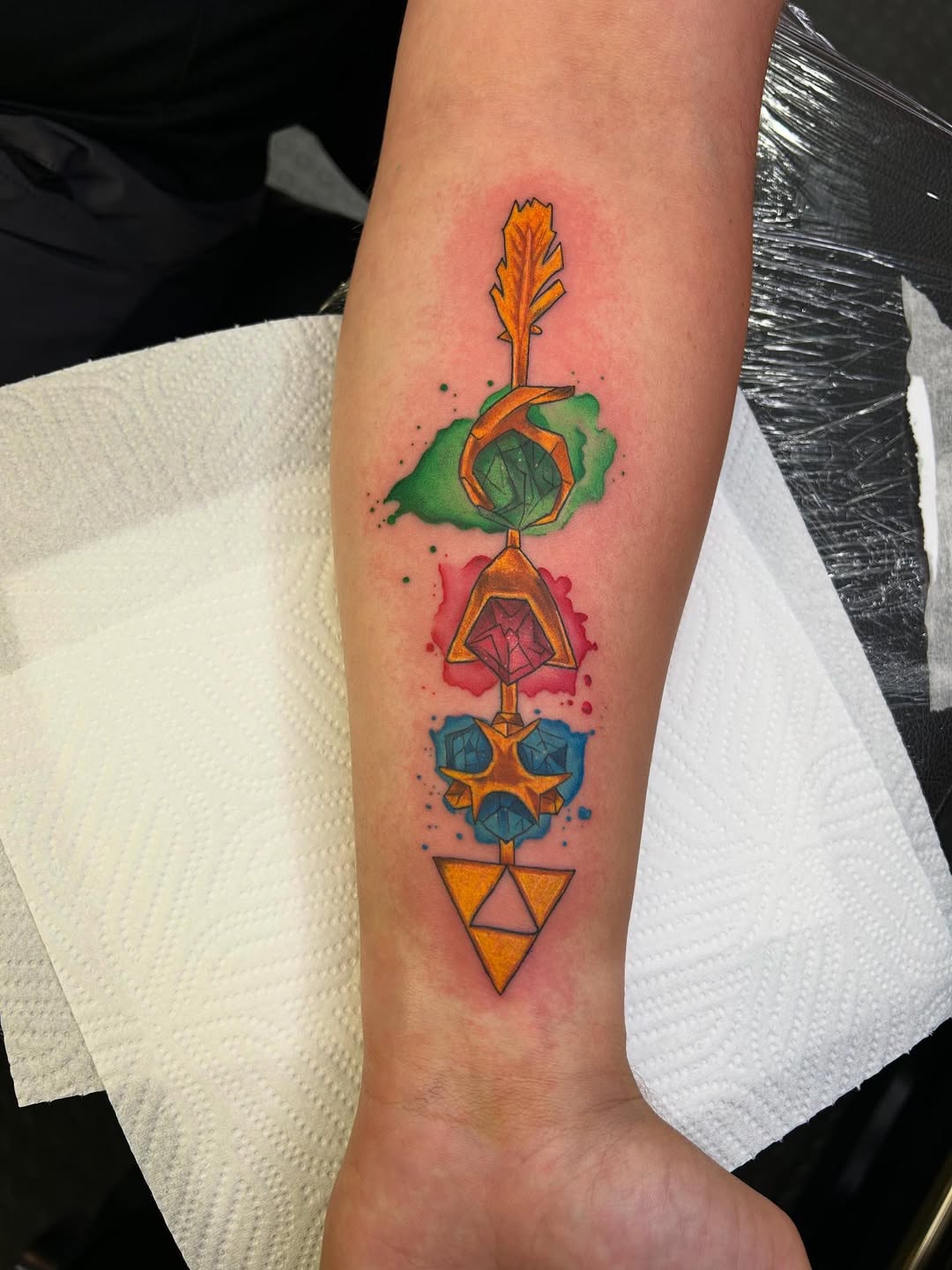
A vertical totem stacks game-coded shapes—emerald, ruby, and sapphire forms—pierced by a golden arrow and landing on the iconic Triforce. Saturated green, red, and blue washes feel joyous and unmistakably Legend of Hyrule. This is classic flash energy, modernized with watercolor bursts that keep the negative space alive.
Styling notes
- Ask for bolder black keylines only on the arrow fletching and Triforce; let the gems float in color for a jewel-like glow.
- Ideal for the inner forearm, where the totem can run true without wrapping.
- If you ever add a Princess or Link portrait above, the arrow naturally points the eye down the arm.
Weathered Master Sword with Moth Wings
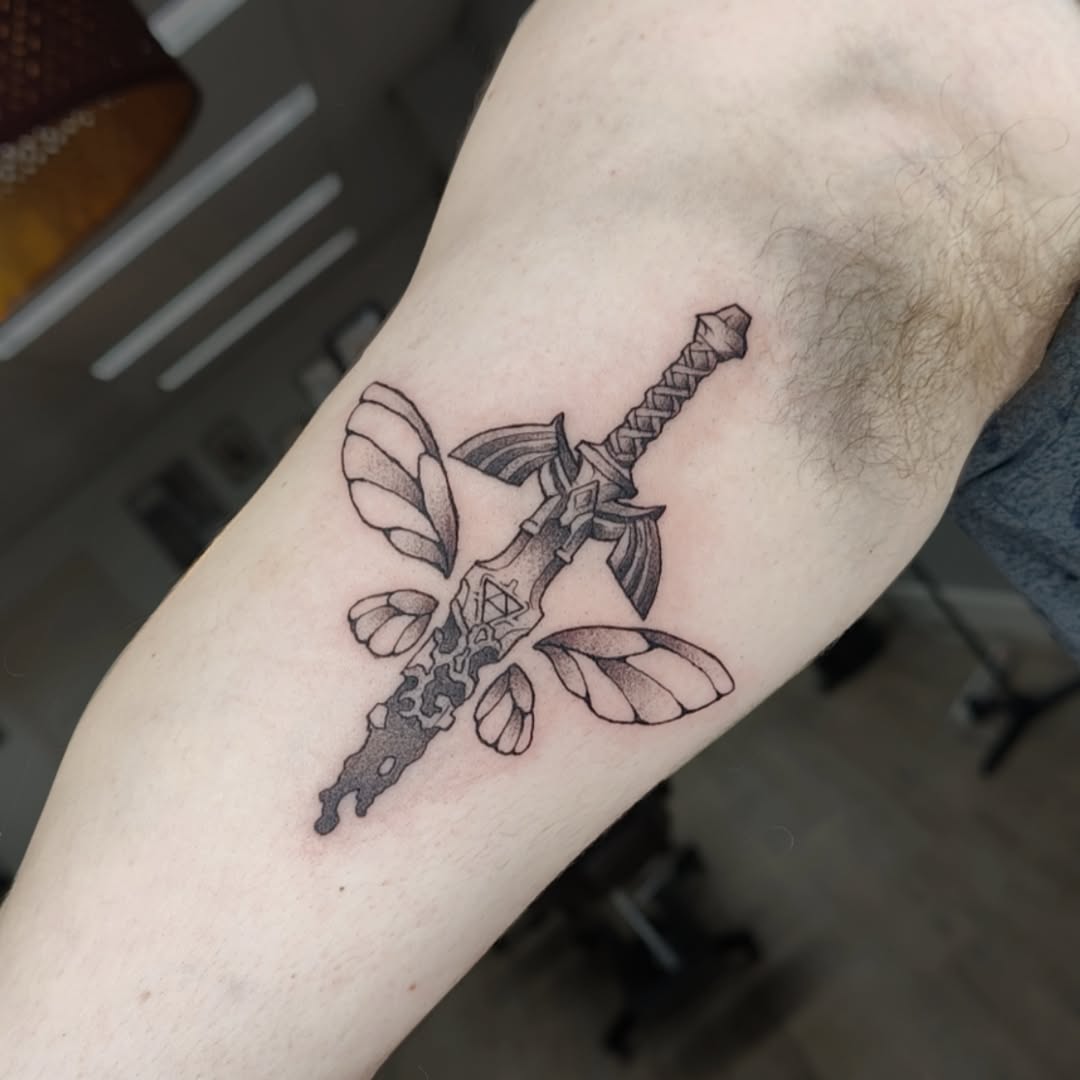
An aged blade—pitted, almost corroded—flanked by moth wings. It’s a poetic counterpoint: relic and renewal. The blade’s erosion is rendered with pepper shading so it feels tactile without becoming a black slab. The wings echo fairy lore without leaning literal; it’s a mature riff for men who prefer myth over mascot.
Styling notes
- Keep the corrosion areas darkest in the middle blade sections to keep edge bevels sharp.
- Works great in the inner biceps pocket; every lift of arms reveals your wings like a secret.
- For a stealth sleeve bridge, send small clouds of dust motes up towards future blade sections.
Navi with Wildflower Bouquet (Fine Line)
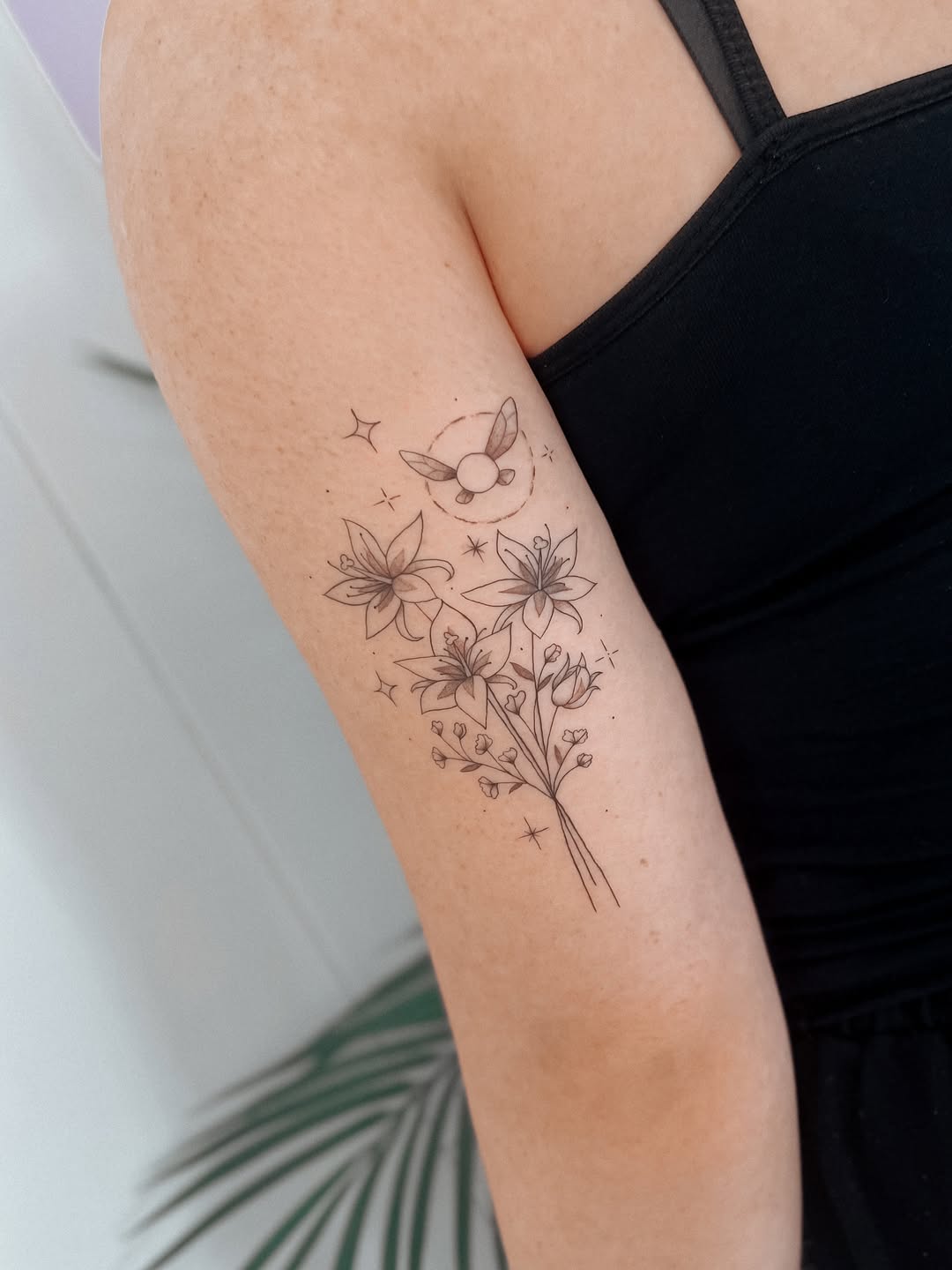
A lively Navi shines with bright star pinpoints while a delicate bunch of wildflowers reaches for the sky. This is Hyrule in a daydream: airy, romantic, and easily slipped on to the outer, everyday wearable design.
Styling notes
- Keep stems one line long and only have a small wash on petal bottoms; your bouquet will stay a unitasker and magazine-clean.
- A micro-Mastersword charm can hang on a ribbon looped between your bouquet tie if you’d like a deeper nod without impacting wear.
- Beautiful with your matching concept—with different flower types for each design.
Keaton-Mask Adventurer, Bold Blackwork Calf Piece
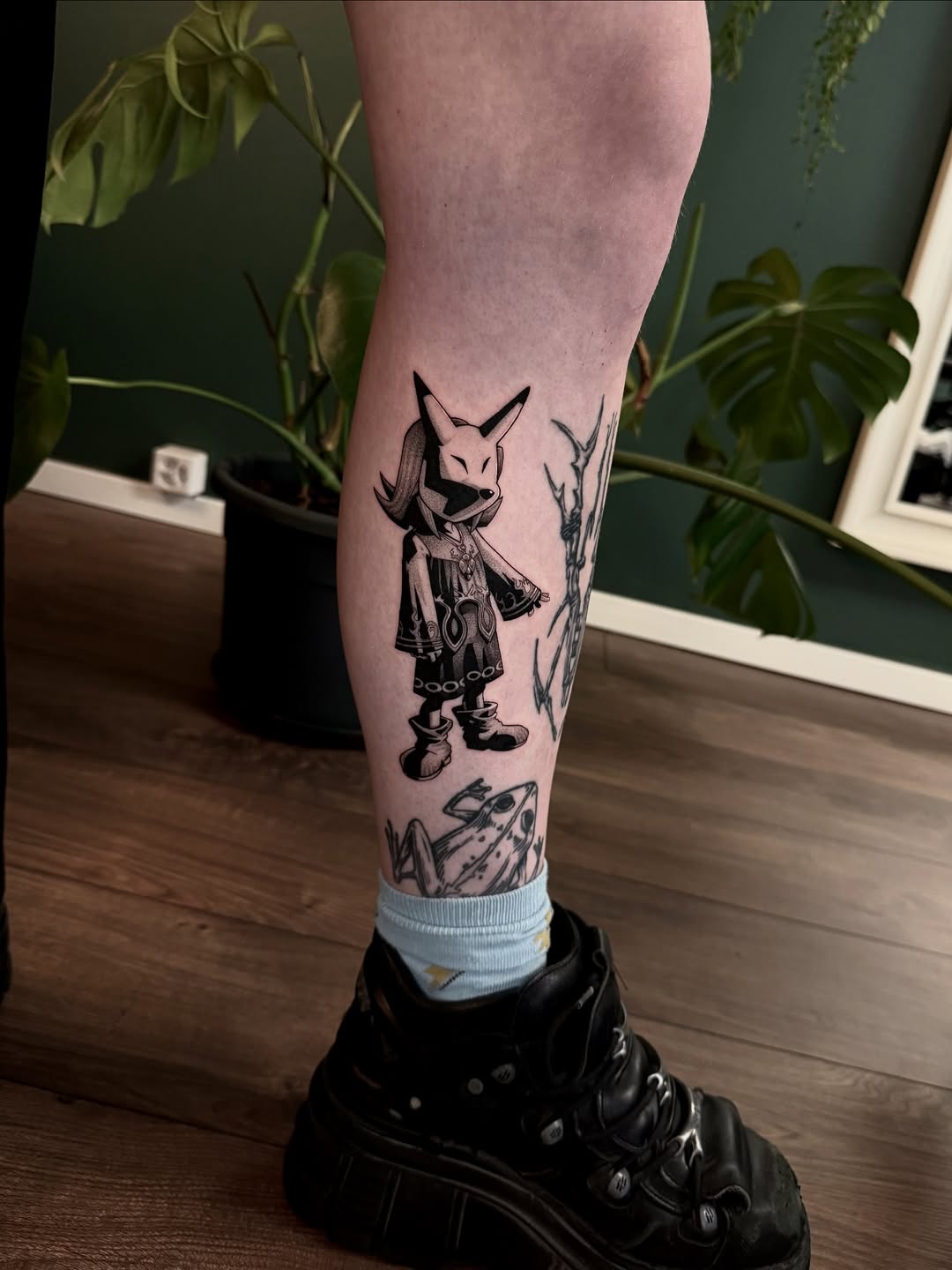
Adventurer Keaton dons his mask with his furled ears and strikes a mysterious wanderer stance via a bold all-black design with sharp negative space through his tunic, belts, and boots. Its compact design is ready on your calf and easily readable across a crowded convention floor—a pure flash impact—with ornamental trim that rewards a closer look. The heavy outer contour and simplified inner shapes make this a future-proof stencil for this high-motion body part. If building a Legends of set, pair it with a micro Triforce at the ankle for a quiet lore nod.
Light Dragon & Forest Reliquary, Story-Scale Thigh Composition
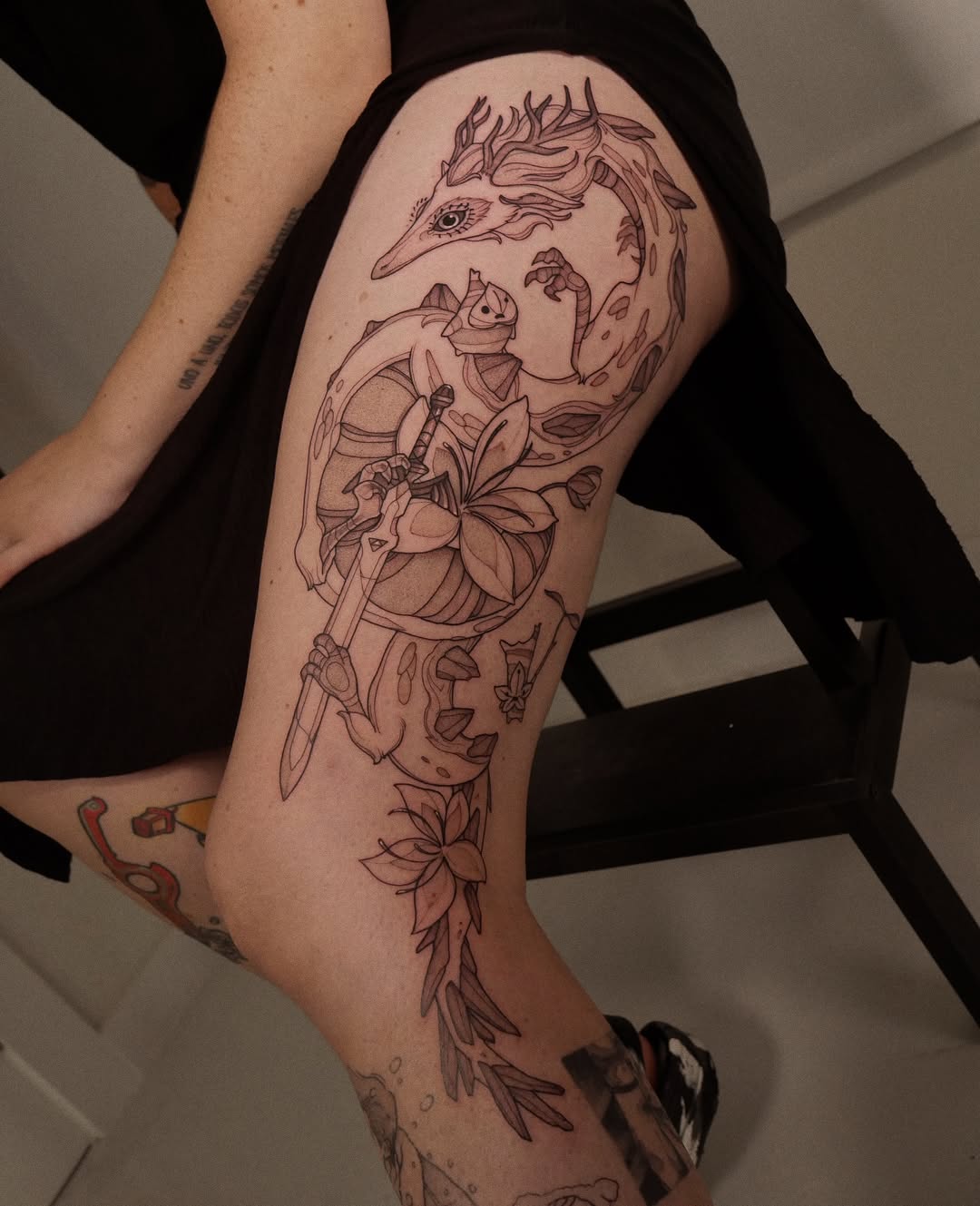
A luminous dragon arcs along the hip while a leaf-wrapped reliquary anchors the center, cradling the Master Sword. Long, breathing linework tracks the thigh’s curve so nothing warps when seated. The broken runes, falling leaves, and beadwork stitch the elements into one narrative flow—an elegant answer to those asking for large Zelda design ideas that aren’t just a collage. Ask the artist to keep dragon eyes and sword bevels in the sharpest line weight; everything else can live in softer hatching for depth that still feels subtle.
Princess Zelda & Sheik, Black-and-Grey Half-Sleeve
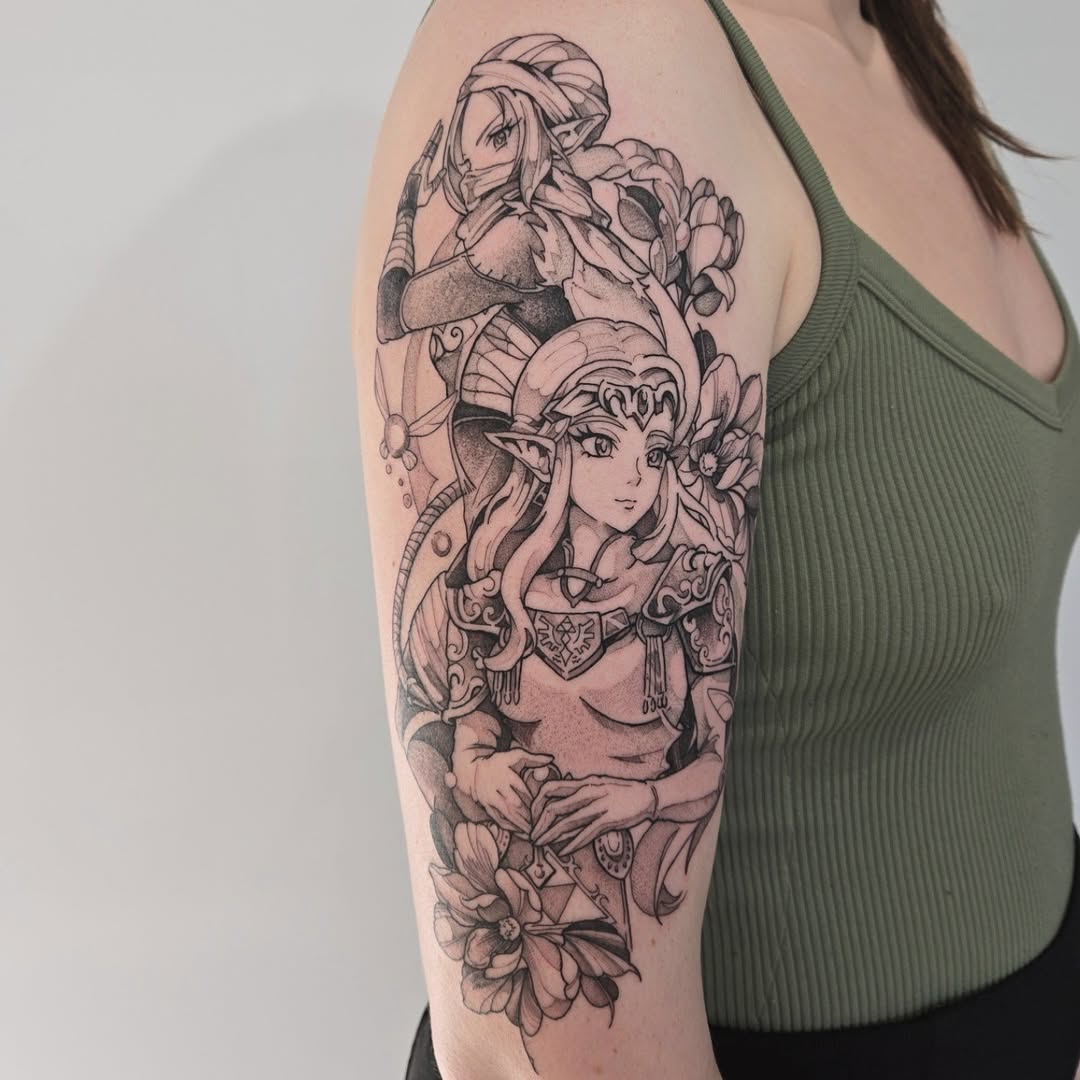
Two sides of courage and wisdom share one frame: Princess Zelda poised and serene, with Sheik coiled behind with a hand to the harp. Navi glints between floral clusters, tying motion to melody. Cohesive dot shading protects facial volumes, while ornate armor and braid lines deliver that unmistakable Hyrule elegance. This is a natural stepping stone to a full sleeve—leave airy negative space behind the figures so future background (temple stone or moonlit clouds) can slide in without crowding.
Cross-Fandom Geometry with the Master Sword
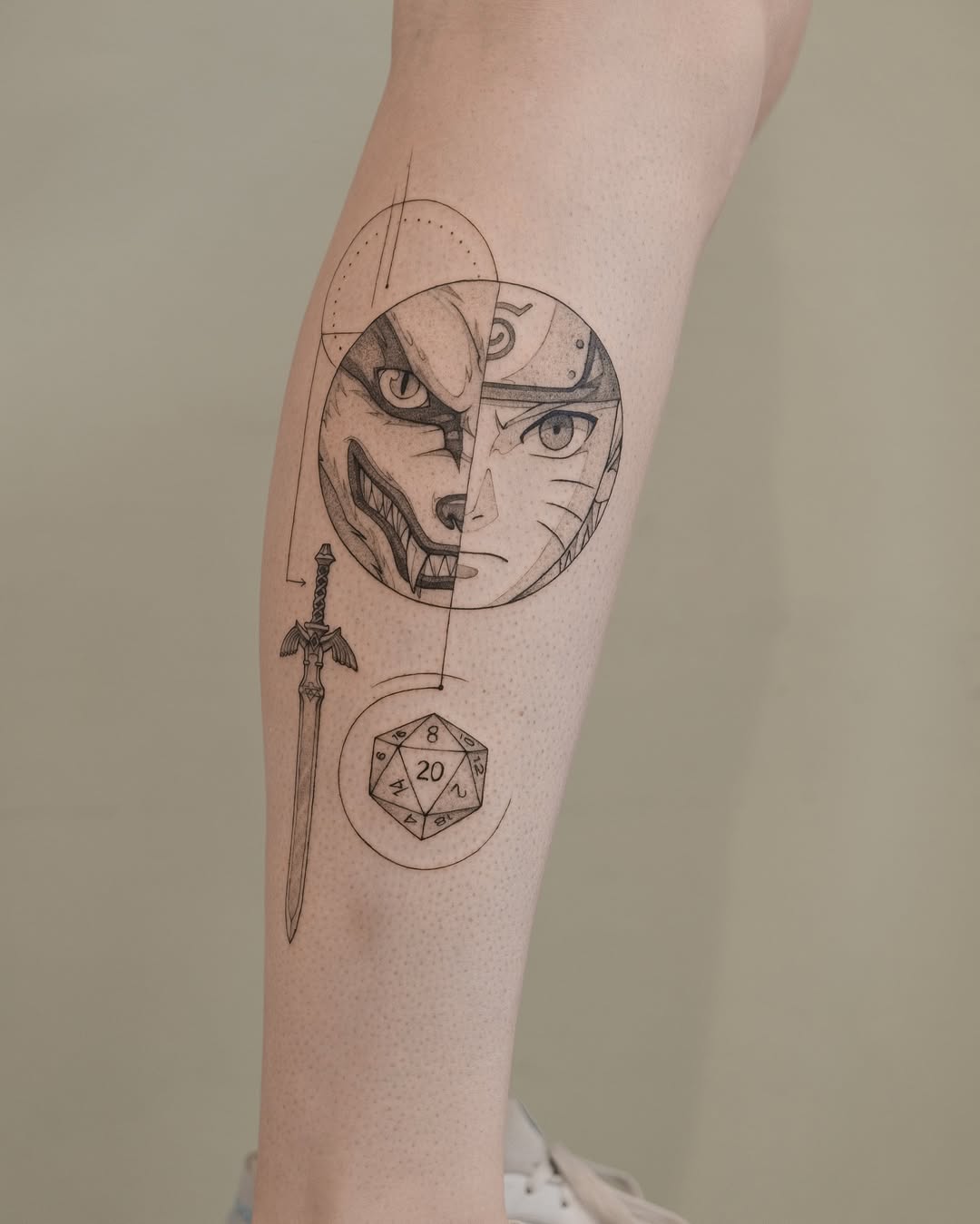
A precise set of circles and construction lines slices a dual portrait, then drops a fine-line Master Sword like a pendulum beside a D20. The technical drafting marks keep it intellectually cool—minimalist but loaded with meaning for players who live where anime, tabletop, and Legend of collide. Because geometry punishes distortion, forearm placement is smart; the sword’s spine mirrors the limb’s long axis, keeping the whole build tidy. Consider a whisper of warm grey on the blade to separate the metal from skin without breaking the simple aesthetic.
Watercolor Rupees, Triforce & Master Sword Burst (Upper Arm)
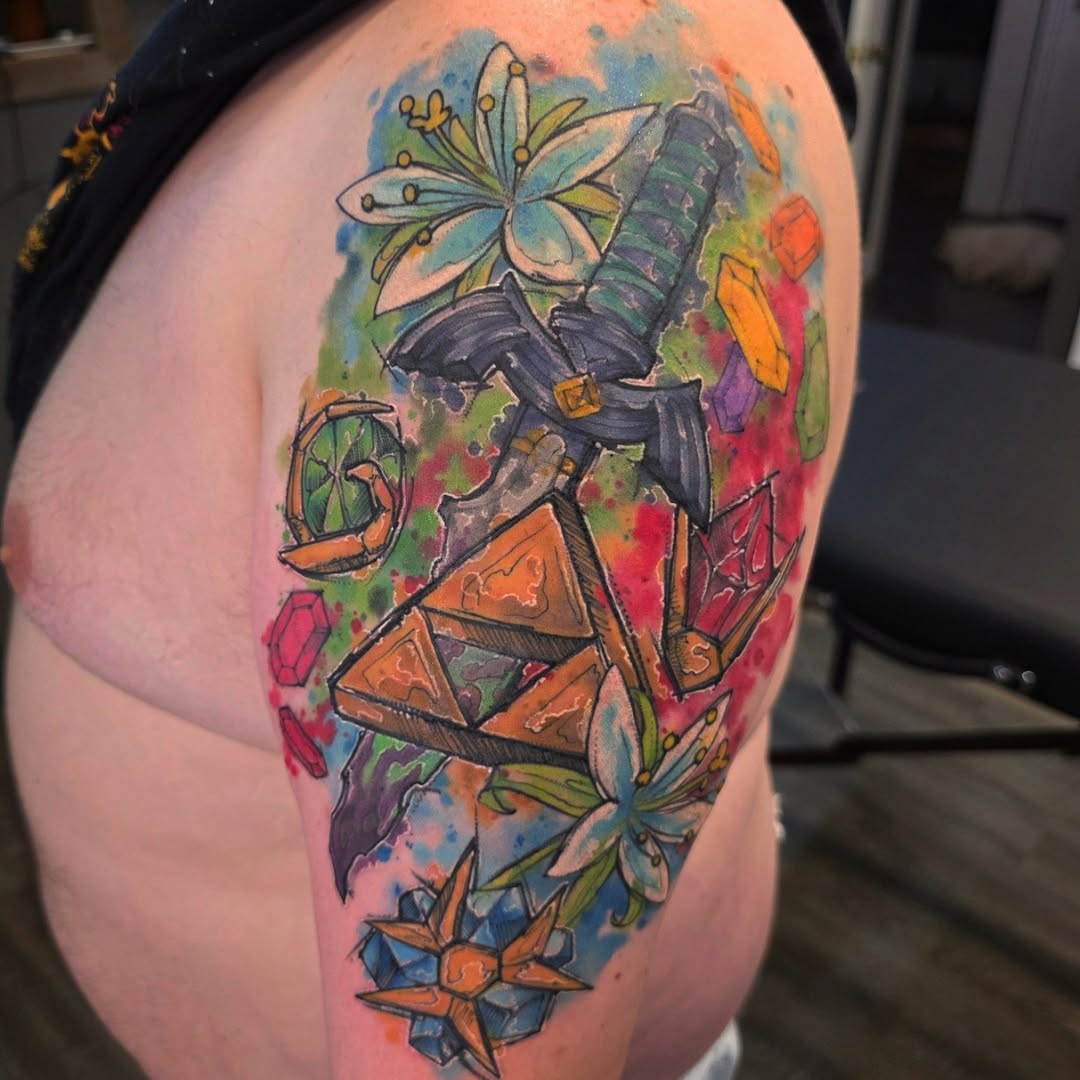
Saturated greens, reds, and violets explode behind rupees and artifacts, with the Master Sword and golden Triforce pushing forward. Painterly edge blooms give the piece a living glow, while bold black keylines keep the format and readability—exactly how high-chroma Zelda pieces should be built for longevity on the upper arm. It’s joyous, arcade-bright, and unapologetically mental in energy—great for fans who want color that will still punch after a decade.
Floral Master Sword with Filigree Guard (Fine Line)
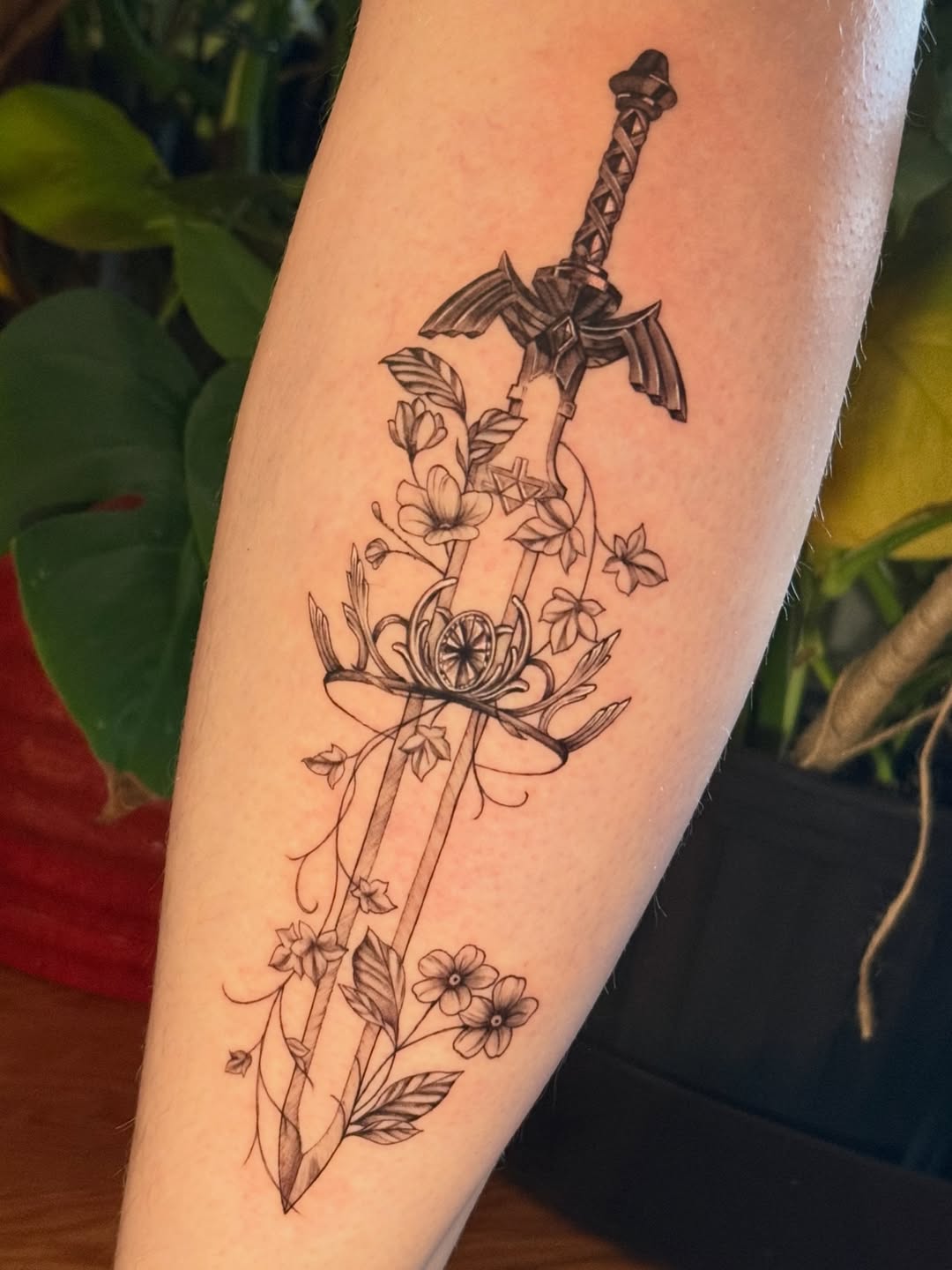
Vines climb a long, slender Master Sword, meeting a filigree rosette at the guard before trailing into wildflowers. It’s courtly and restrained—subtle enough for work, romantic enough for ceremony. The trick is contrast: keep petal interiors in soft wash, and reserve crisp blacks for the crossguard emblem so the sword reads first and the bouquet second. A perfect companion for matching micro pieces: give a partner the floral sprig alone, and you keep the blade.
Zelda with Tear, Sword-Hilt Devotion (Moody Linework)
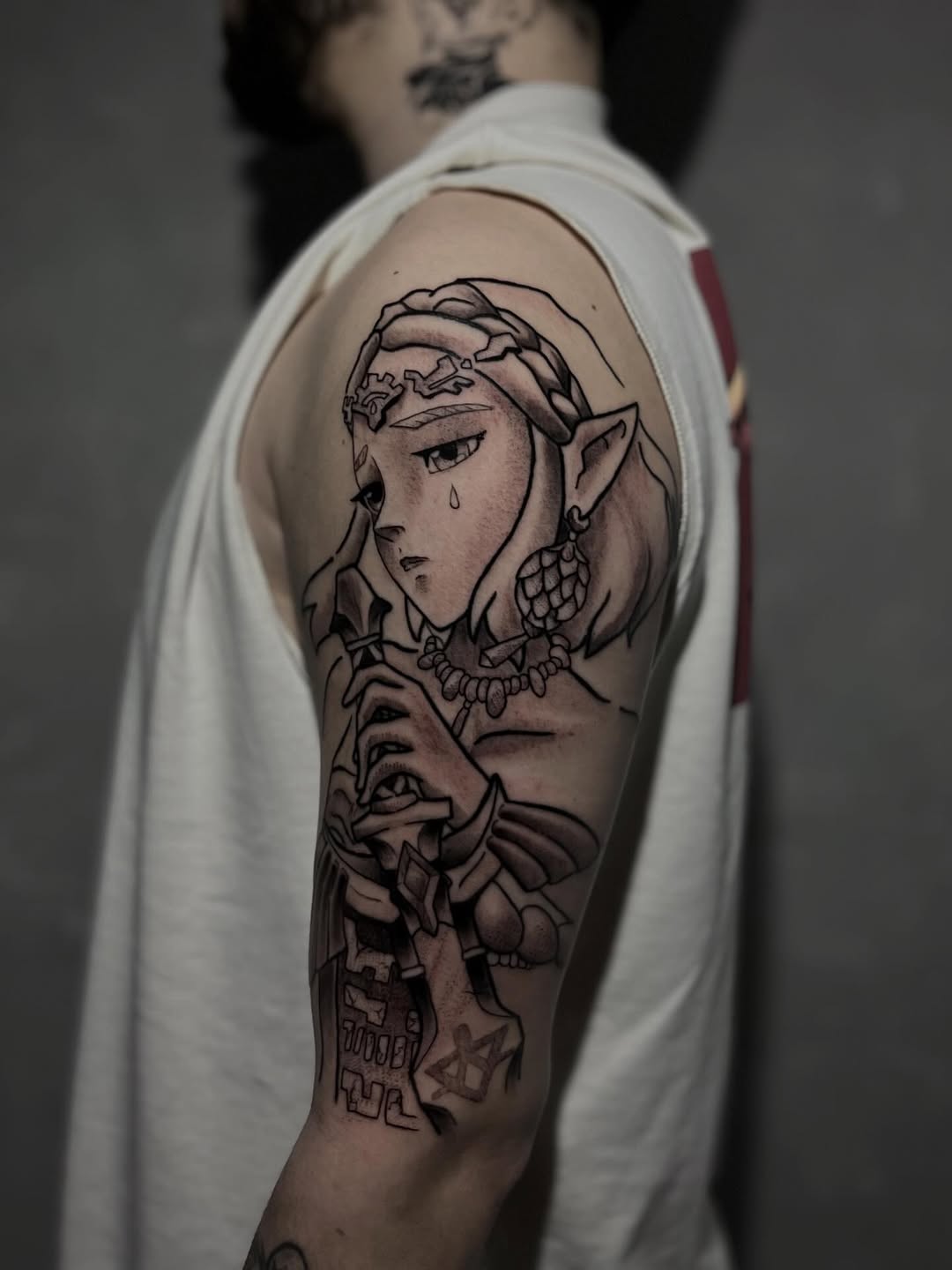
A contemplative princess presses on a sword hilt, a single tear sitting under the lower lash—melancholy, resilient, instantly evocative of the Twilight Princess era. Angular jewelry and gauntlet plates are simplified into confident planes so the face stays the emotional center. Place this as a three-quarter upper-arm panel and let fine stipple drift outward; it frames beautifully if you later add Link, a master swordsman vignette, or a quiet Navi glimmer to complete the arc.
Sheikah Eye Sigil with Wind-Waker Relics (Fine-Line Collage)
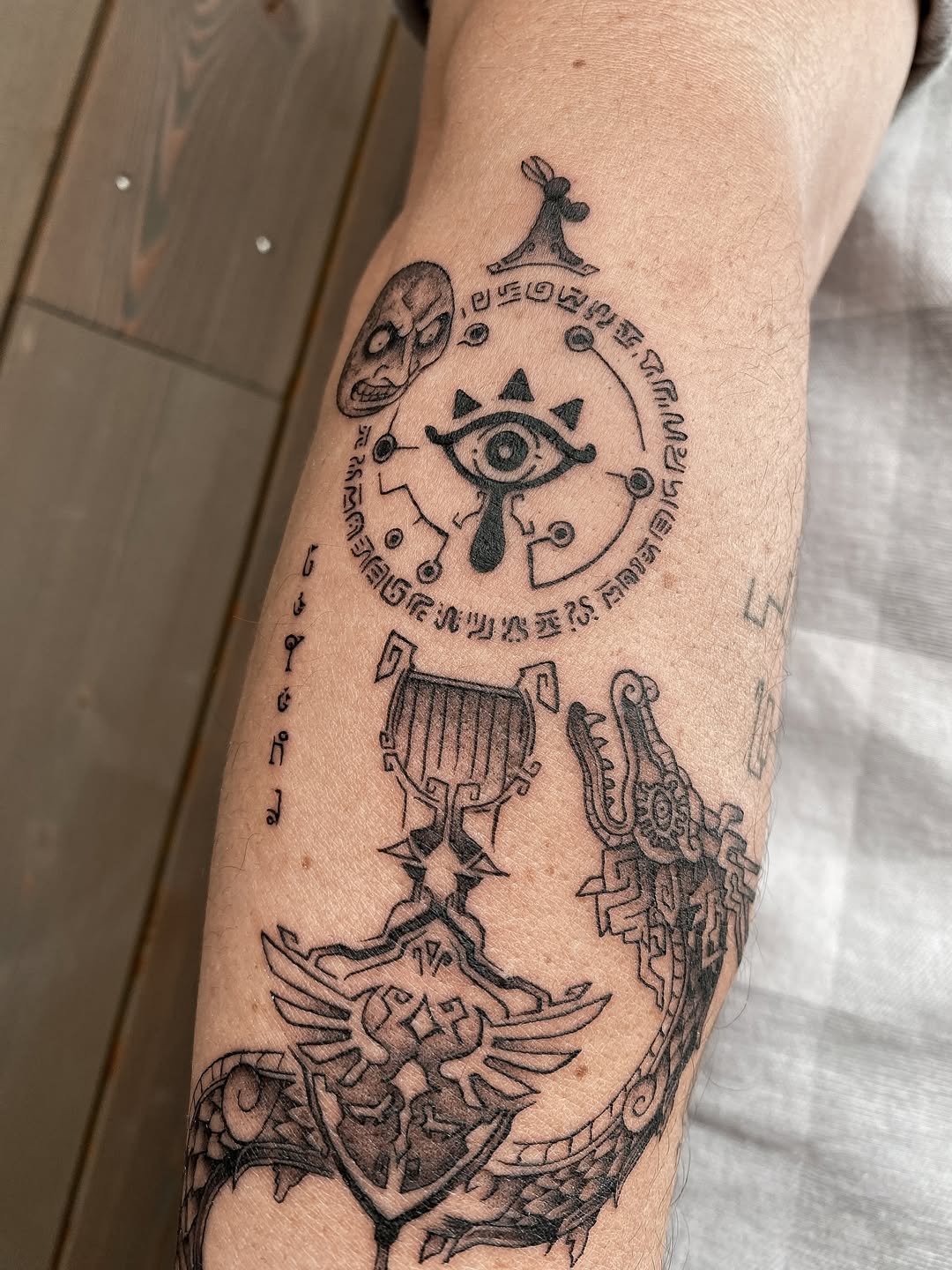
Arcane glyphs circle the Sheikah eye—a teardrop at the base and triangles at the brow—while a grim lunar face and a stylized cap tip the piece toward Majora’s Mask lore. Below, a harp, crestwork, and a serpent-headed prow echo the seafaring era of the Legends of Hyrule. It’s a scholarly, talismanic design: thin technical lines for the runes and denser black in the crest so the collage reads clearly from the arm’s curve.
Styling tip: ask the artist to thicken only the outer ring; that “keyline” keeps the stencil legible when healed while the interior stays subtle and textural.
Hylian Shield + Master Sword, Bold Color Emblem
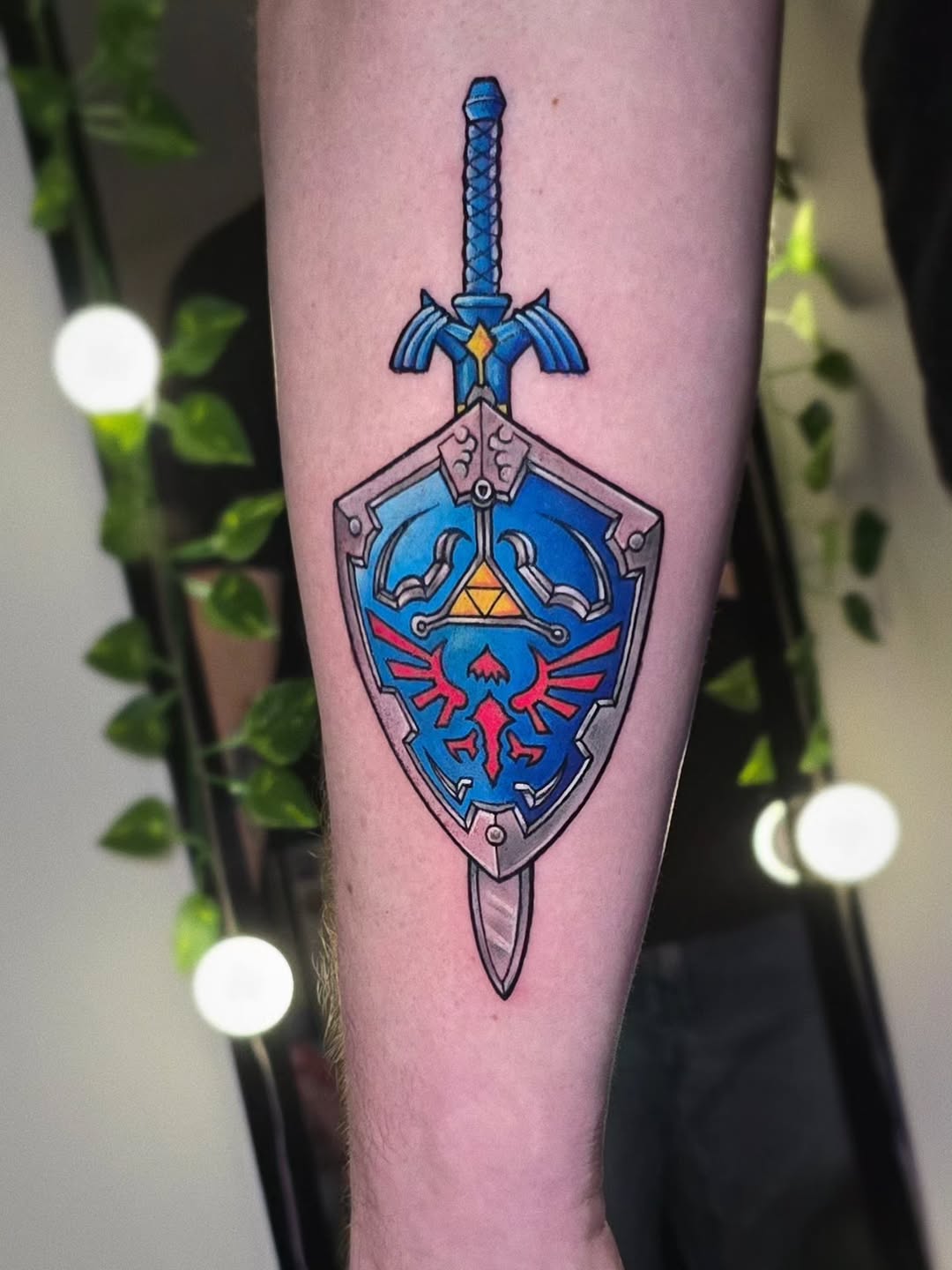
Primary blues and volcanic reds make the Hylian shield pop, while the Master Sword anchors the vertical—clean, heroic, and unmistakable. The negative space around the Triforce glows without extra white ink, which is smart for longevity. This emblem lands perfectly on the forearm for men and women who want classic flash impact with modern polish.
Styling tip: request a satin steel grey on the blade and a matte grey on the shield rim; that material contrast stays readable at selfie distance.
8-Bit Crest with Pixel Sword (Micro Color)
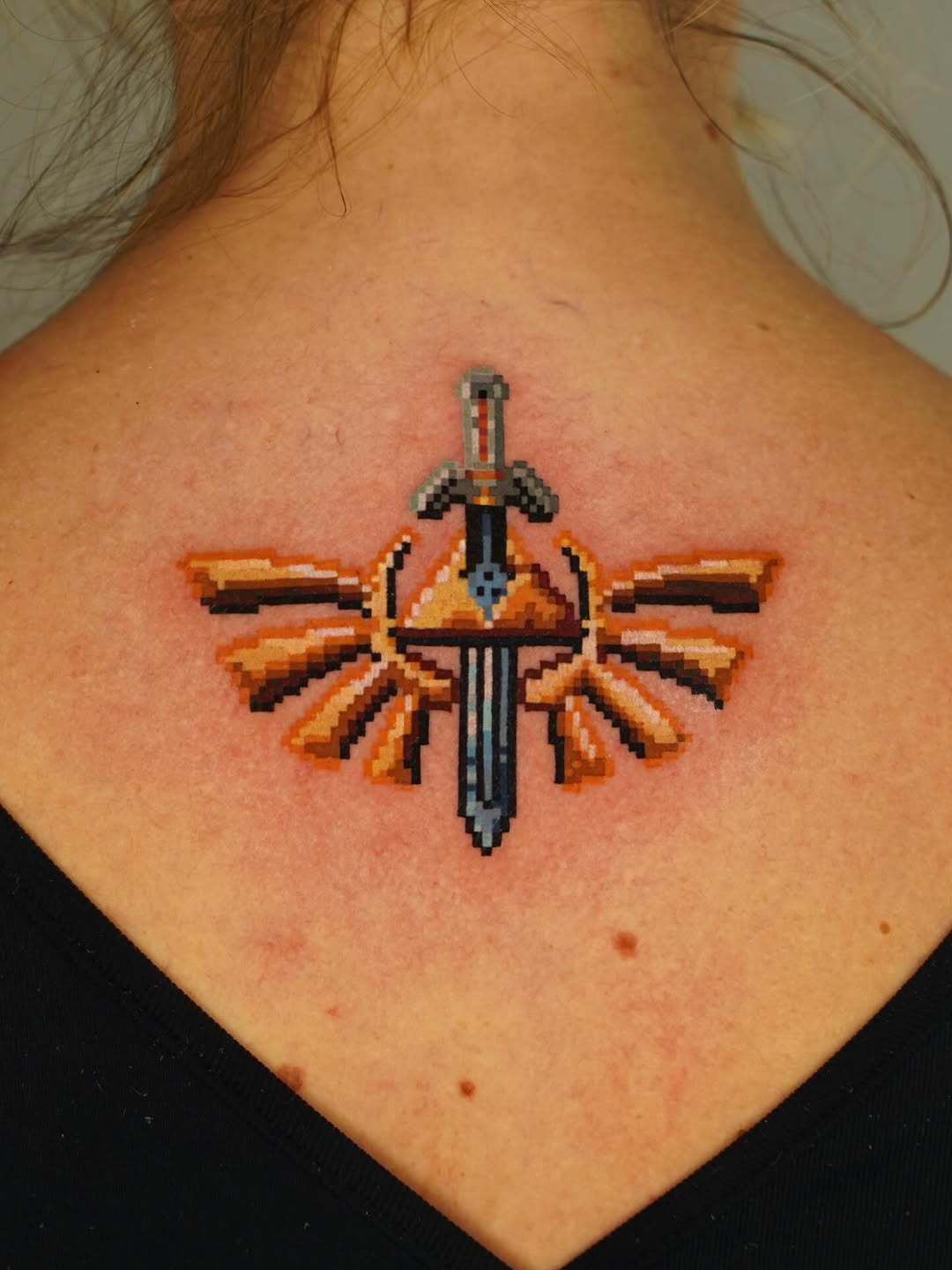
A love letter to the cartridge era: pixelated wings flare behind a tiny sword over golden Triforce tones. Each square has air around it so the edges won’t bleed together over time—vital for micro pieces. Placed high between the shoulders, it’s minimalist but instantly nostalgic.
Styling tip: keep the palette to five colors max; restrained pixels read crisp and simple while still shouting Legend of Roots.
Heart Container Cameo (Black & Grey Mini)
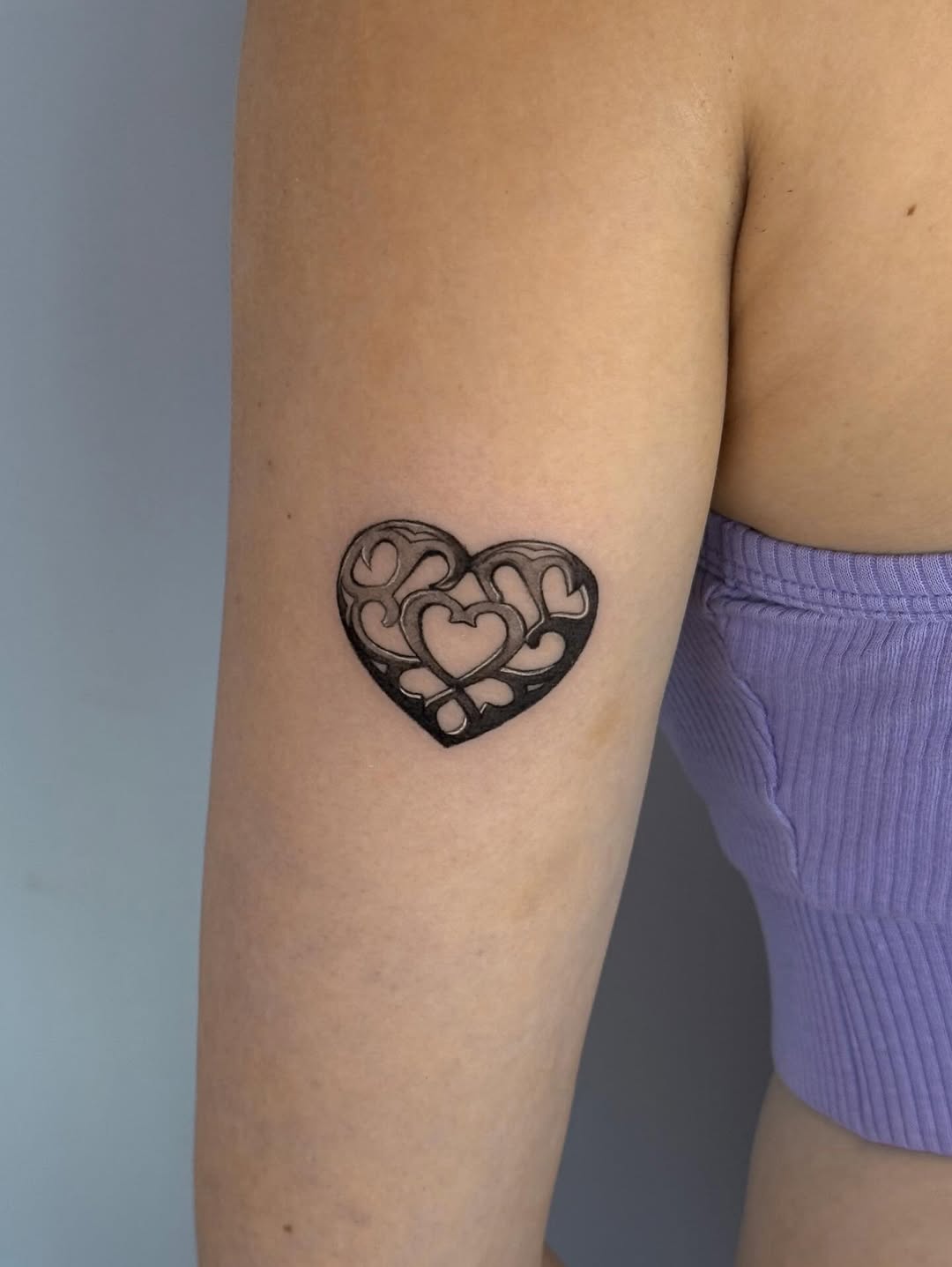
An ornate heart container in tight blackwork shading—small, sculptural, and jewelry-like. The bevels are pushed with powdery dotwork rather than heavy fill, giving a porcelain feel. Great on the triceps or inner wrist as a one-sitting keepsake or a matching pair.
Styling tip: a whisper of highlight at the lower right “facet” sells shine without white ink.
Princess & Link Cinematic Thigh Panel (Color Realism + Pixel UI)
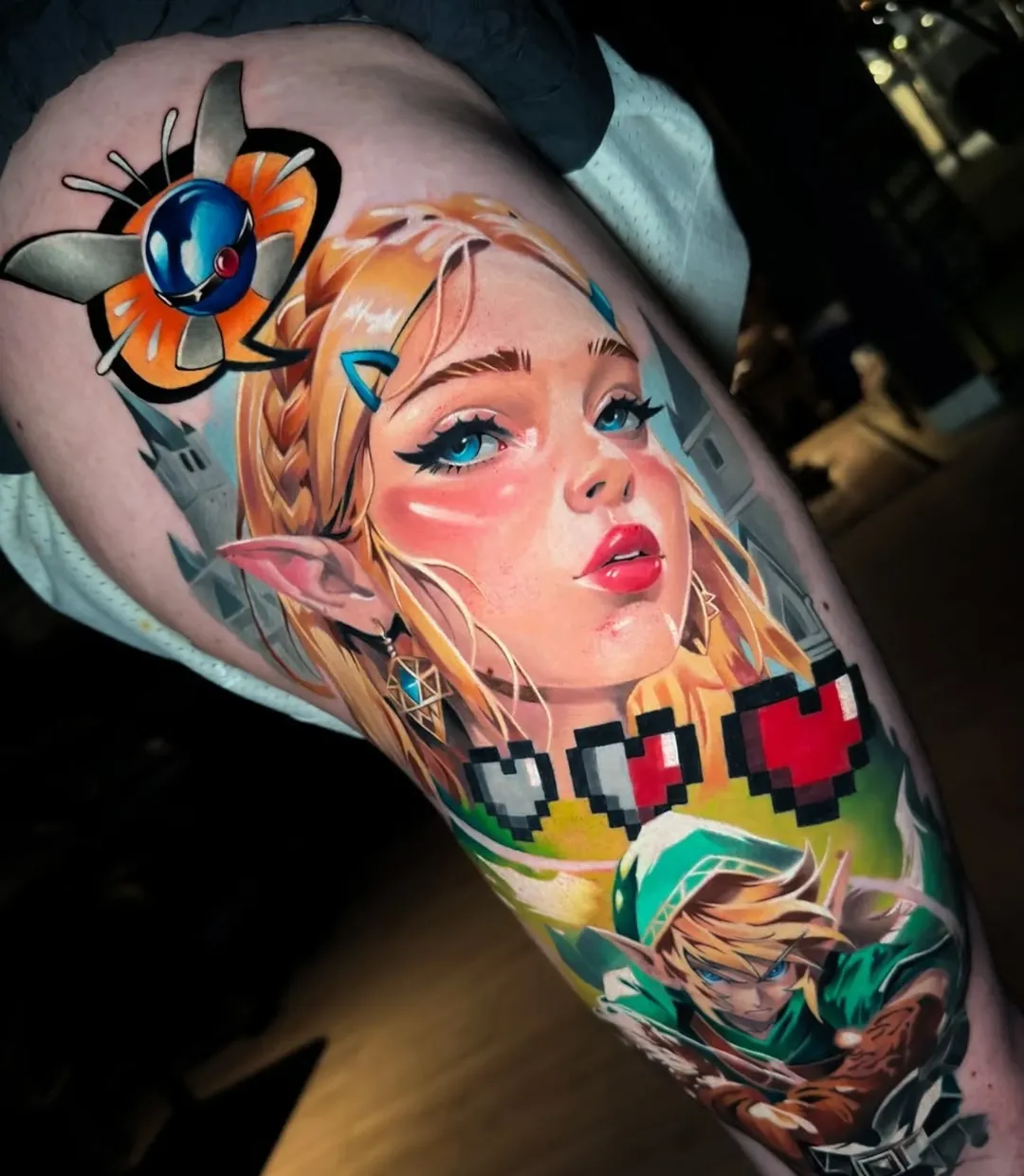
A luminous Princess portrait dominates while Link charges below—two energies, one story. Floating pixel hearts bridge eras, and a giant companion sprite riffs on Navi scale for playful drama. The composition is already half a sleeve: portrait for the focal, action for the base, and UI for rhythm.
Styling tip: protect the portrait with soft, cool shadows; let Link take the hotter greens so both figures stay separated in a crowded thigh canvas.
Link with Twin Masks (Blackwork Adventure Strip)
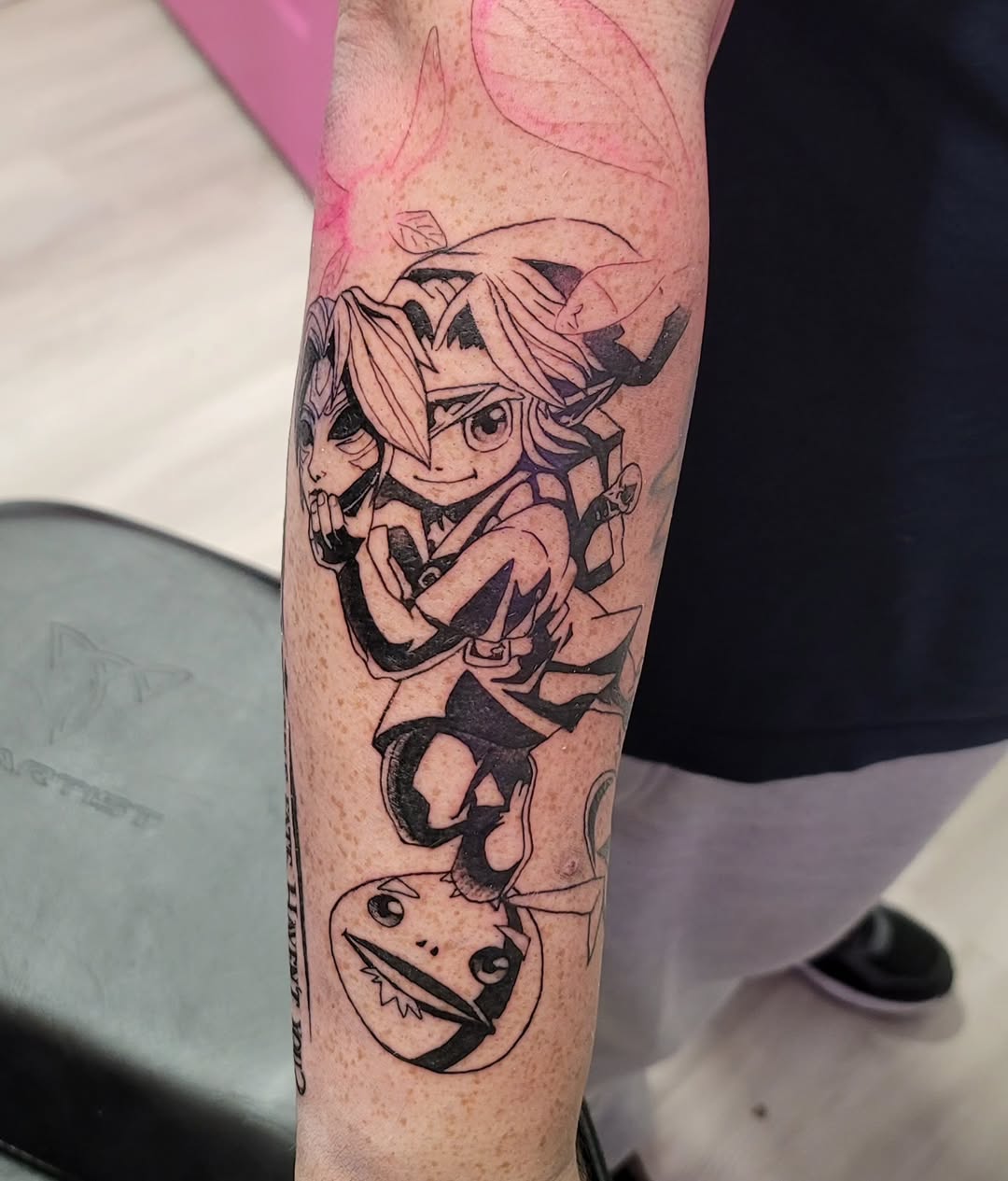
A mischievous Link cradles a mask while another grinning face caps the composition—pure quest energy with a wink to Majora’s Mask mythology. Crisp blacks outline the characters; interior crosshatching keeps motion without overpacking the skin. The vertical stack fits a forearm perfectly and leaves room to add a small Navi or rupee later.
Styling tip: keep hair strands and eye lines ultra-fine; a light hand there preserves expression as the piece ages.
Korok Patch (High-Contrast Dotwork Charm)
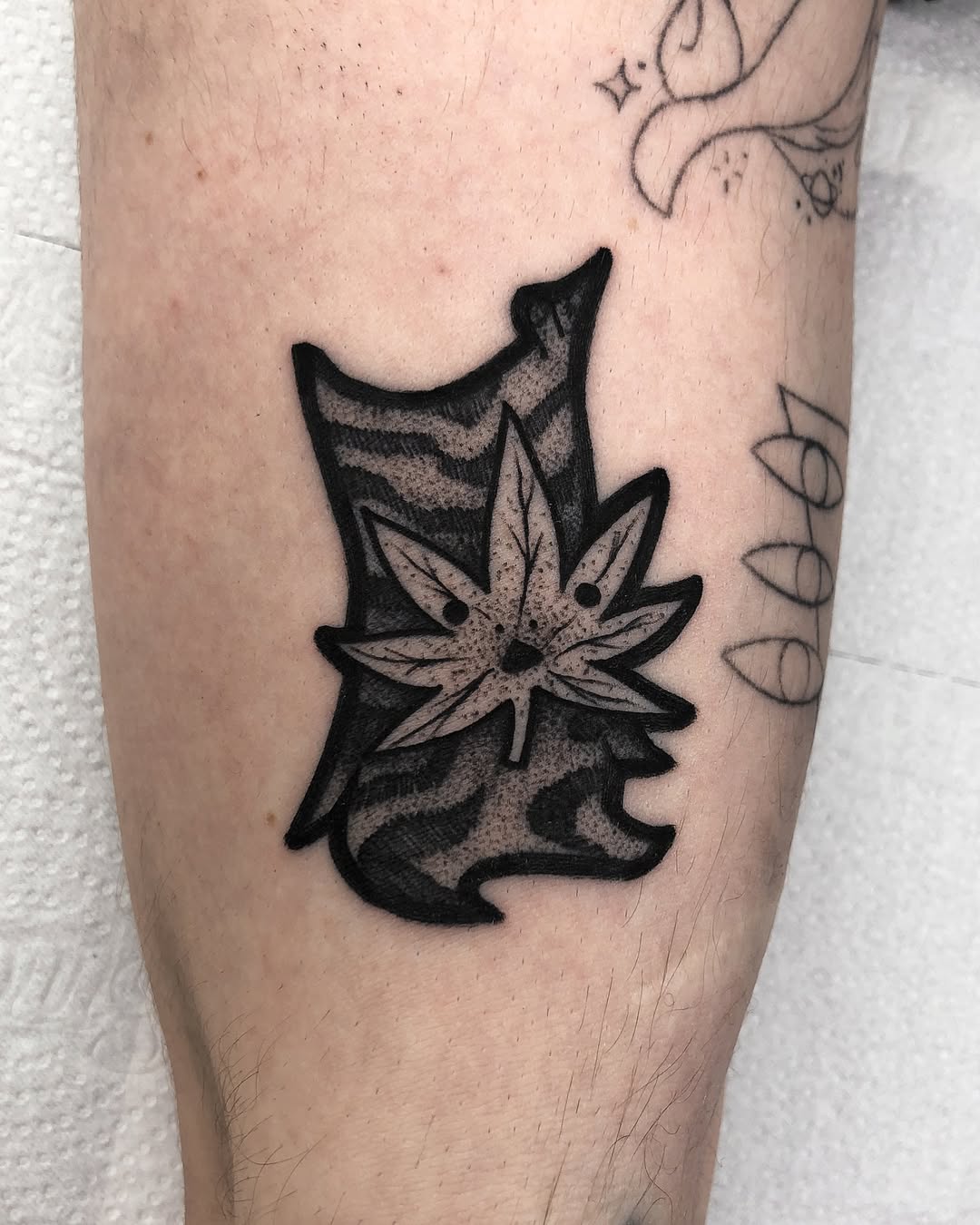
A bold little forest spirit—Kolog—rendered as a stitched patch: thick outline, dense interior stipple, and a leafy mask with curious eyes. It’s graphic, durable, and adorable—ideal for the ankle or calf, where you want max readability in a tiny footprint.
Styling tip: ask for a softer dot gradient along the leaf veins so the face stays lively rather than flat, and consider a companion micro sprout if you’re planning matching minis.
Zonai-Style Pixel Glyph, Teal on Black (Micro-Color)
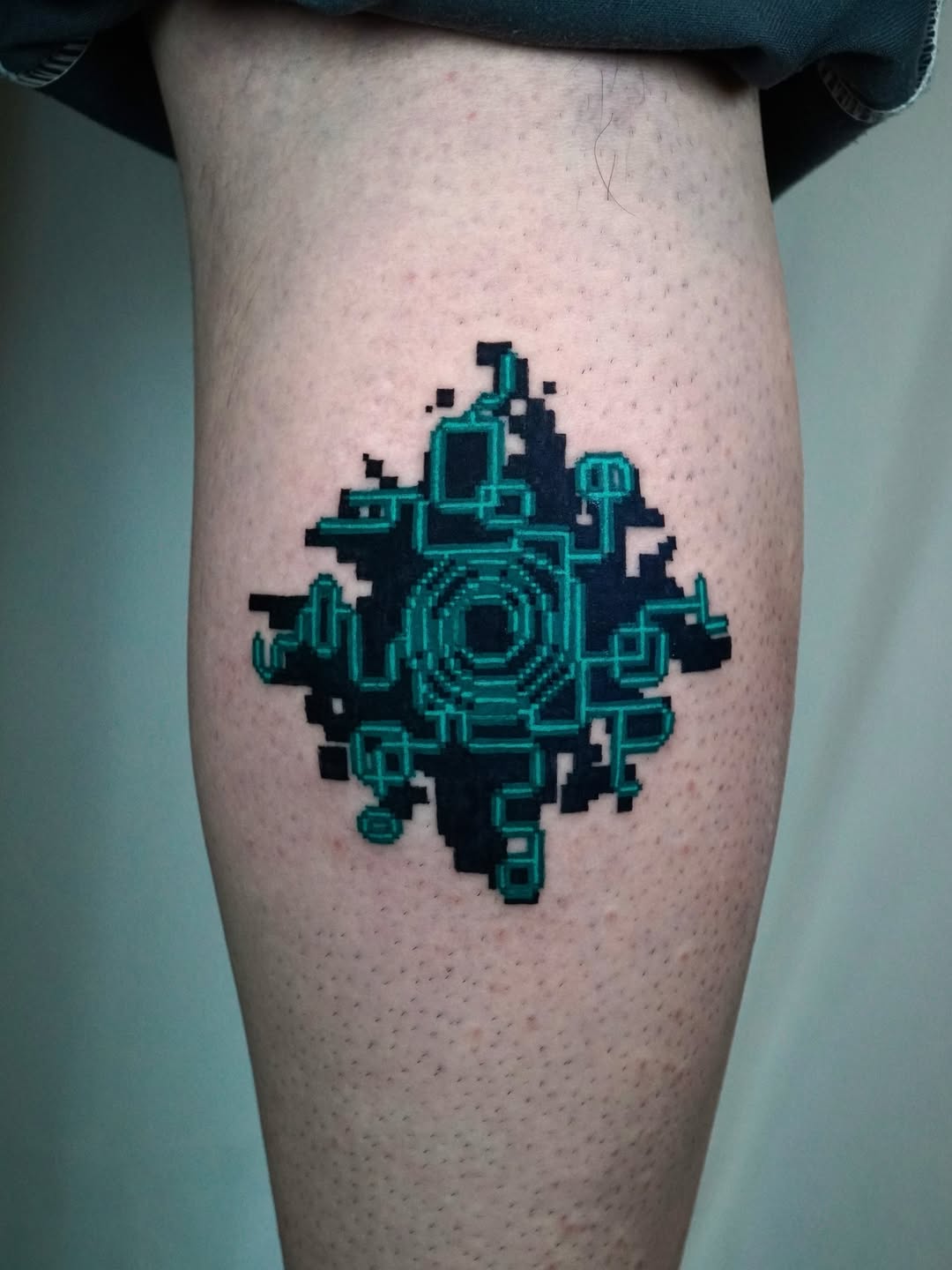
An 8-bit labyrinth blooms from the skin—teal circuitry stacked over matte black blocks. It reads like a shrine design from a distant era of the Legend of Hyrule: concentric squares at the center, stepped corridors radiating outward, and deliberate “missing pixels” to keep the edges alive. On a thigh, this square-ish composition lands flat and stays legible at any angle; on an outer arm, it would work as a floating badge between larger set pieces.
Why it works
- Pixel geometry ages well when each square has breathing room; the heavier black base protects the lighter teal from washout.
- The crisp 90° corners give you that minimalist/tech feel while still being instantly recognizable to fans.
- Works as a subtle anchor in a future sleeve of relics and runes.
Artist notes Ask for a limited palette (two teals + one black) and a stencil grid to preserve alignment. If your skin is warm-toned, nudge the teal one step cooler so the contrast pops without needing white ink.
Link Portrait with Fairies and Soft Dot Shading (Forearm Panel)
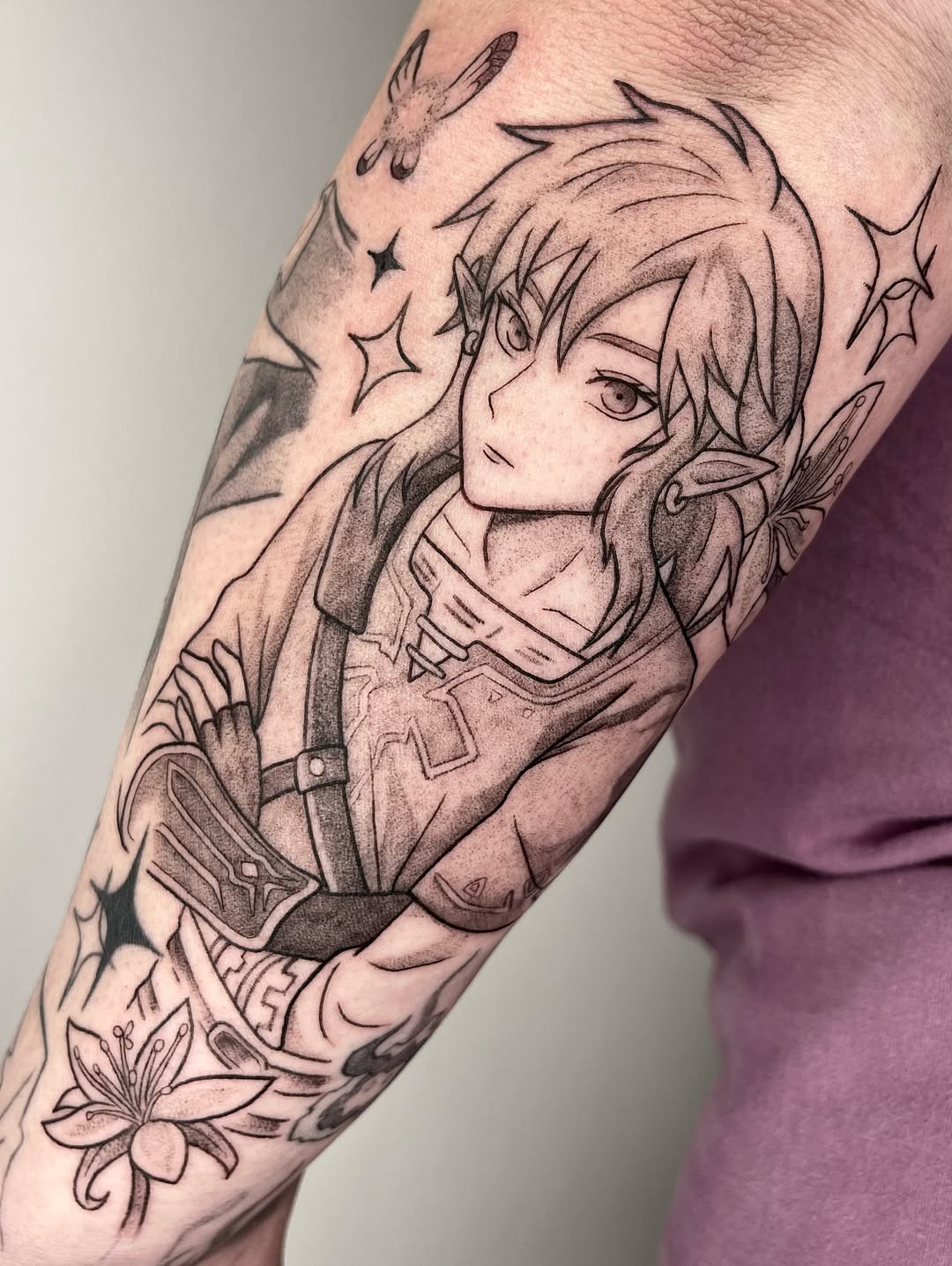
Calm, focused Link folds his arms while tiny sprites sparkle around him—an elegant wink to Navi without crowding the scene. The build is all about restraint: clean contour lines, powdery stipple over the tunic and gauntlet, and strategic negative space that frames his eyes. It’s a versatile forearm piece for anyone who prefers character tattoos that feel editorial rather than cartoonish.
Why it works
- Dot shading keeps volumes soft, so the face stays youthful and readable long-term.
- Neutral rendering means it layers beautifully with future elements—Master Sword hilt above, floral crest or Triforce below—if you expand to a story sleeve.
- The posture captures the quiet resolve of a master swordsman without needing action lines.
Styling tips Keep the hair and lashes in ultra-fine liners; reserve your boldest line weight for the jaw and ear tips to maintain silhouette. If you want a delicate accent, add a single starburst behind one fairy—simple, luminous, and on-theme with your Zelda ideas.
Whether you lean mythic (dragon and sword), iconic (Triforce, Sheikah), or character-focused (the stories involving Link and Princess-adjacent), Zelda’s lexicon offers you all the elements necessary to customize your tattoo design for your space, your needs, and your plans for Zelda’s future ideas for expansion. Have a favorite scene or artifact? Drop it in the comments—let’s map out a unique concept that feels true to your journey through Hyrule.